This approach addresses one of the big risks of just willy-nilly burying CO₂: that the gas will somehow escape and a) re-enter the carbon cycle via the atmosphere or b) create a Lake Nyos (Cameroon, 1986) scenario which released naturally trapped CO₂ and killed over 1700 people and thousands of head of livestock. Solidifying the CO₂ as part of the entombment has had its attractions since the Al Gore days:
I too have heard the siren song of carbon capture and storage.
There are two ways to use carbon once it is captured (still theoretical
because of price but the cost is dropping, see below), either sequester
it and remove it from the carbon cycle or reuse it in a closed loop
hydrocarbon fuel infrastructure.
From 2007: "Can baking soda curb global warming?":
I have a fascination with calcium carbonate. But, being flexible, I am willing to consider the bicarbonate of various metals.
Some scientists have proposed compressing carbon dioxide and
sticking it in underground caves as a way to cut down on greenhouse
gases. Joe David Jones wants to make baking soda out of it.
Jones, the founder and CEO of
Skyonic,
has come up with an industrial process called SkyMine that captures 90
percent of the carbon dioxide coming out of smoke stacks and mixes it
with sodium hydroxide to make sodium bicarbonate, or baking soda. The
energy required for the reaction to turn the chemicals into baking soda
comes from the waste heat from the factory.
"It is cleaner than food-grade (baking soda)," he said.
The system also removes 97 percent of the heavy metals, as well as most of the sulfur and nitrogen compounds, Jones said.
And
a few months earlier:
... Right now I'm looking at calcium carbonate. Literally. Got a hunk of
limestone. CaCO3. That's sequestered carbon, right?. Hmmm.
Make a green pitch, wrap it in recycled fiberboard; et voila! Return of
the Pet Rock, eco-version! And seashells, same stuff, calcite. There's
the hook! Mom, you're going to Miami Beach.
And many, many more. Use the 'search blog' box if interested.
The cost of the carbon capture stage is still exorbitant but who knows what advances are ahead?
From UnDark, February 19:
It’s a contentious idea, but advocates say storing CO2 under the seafloor could help address climate change—if it works.
In 2010, as the Deepwater Horizon rig sank
and millions of gallons of oil gushed into the Gulf of Mexico, Kate
Moran’s phone rang in Washington, D.C. At the time, she was assistant
director in President Barack Obama’s Office of Science and Technology
Policy, and government officials recognized that she brought years of
ocean drilling experience. Within a matter of days, and guided by her
understanding of deep ocean geochemistry, the government rapidly
deployed resources and experts to manage the crisis, overseeing
controlled burns, remote undersea vehicles, even air and sea traffic
control systems. “It was remarkable,” Moran said recently of the
mobilization. “Unbelievably remarkable.”
That memory looms large as Moran leads a project to mitigate the
environmental impacts of fossil fuels on a much larger scale. Now
president and CEO of the research institute Ocean Networks Canada, she
is also the principal investigator for Solid Carbon, a project overseen
by the institute that aims to permanently remove greenhouse gases from
the atmosphere by entombing carbon under the seafloor.
“You can do big things in the ocean — the oil industry does,” Moran
said, expressing dismay that governments have not marshaled resources
like they did for Deepwater Horizon. “So why not look at a system where
you could have essentially an independent system offshore that actually
removes CO2 from the atmosphere and puts it away forever?”
In addition to transitioning away from fossil fuels, climate science
experts are increasingly convinced that greenhouse gases will need to be
removed from the atmosphere to avoid cascading impacts of climate
change. A new global climate deal from the United Nations climate
conference, COP28, doesn’t require countries to completely phase out
fossil fuel use, but rather relies on investments in renewable energy
and carbon removal techniques to mitigate the impacts of greenhouse
gases. National climate plans, too, increasingly depend on carbon removal.
But it’s a gamble: Removing enough carbon dioxide on a large scale
hasn’t been fully tested. And the slower the transition away from fossil
fuels, the more carbon removal will be needed to reach goals and avoid
catastrophes.
“My students always say, ‘But don’t we have to try?’ And the answer
is absolutely,” said David Goldberg, a professor at Columbia
University’s Climate School who designed the Solid Carbon plan with
Moran.
Effective carbon removal is essentially a two-step process: first,
remove the carbon dioxide from the air, and then somehow keep it from
returning for at least several decades
and ideally much longer. Forests and other plant life remove and store
carbon dioxide naturally, but it risks returning through decomposition
or fires. Solid Carbon would use machinery that filters out carbon
dioxide both from sources of emissions, as well as directly from the
air. The next step is finding a way to permanently store the trapped
carbon dioxide.
Researchers at Solid Carbon are turning to basalt, a volcanic rock
that easily reacts with acids like carbon dioxide, to turn the
greenhouse gas into a carbonate rock under the seabed. Storing carbon in
geologic formations like this is expected to be the most long-lasting
method among options to keep carbon dioxide out of the atmosphere.
Under the Cascadia Basin off the coast of Vancouver Island lies the most
extensively studied ocean basalt. What’s more, it’s colossal: large
enough in theory to store carbon from all global annual emissions many
times over.
Solid Carbon offers a glimpse into the enormous scale that would be
required to impact emissions. In one version of its plan, dozens of
floating rigs on the Pacific Ocean would be coupled with many more wind
turbines to funnel compressed, carbon dioxide nearly 2 miles under the
sea. But that would only remove less than 1 percent of what climate
scientists predict will be needed by 2050. If carbon removal techniques
are to make any dent in emissions, they will need to scale up multiple
magnitudes....
....MUCH MORE
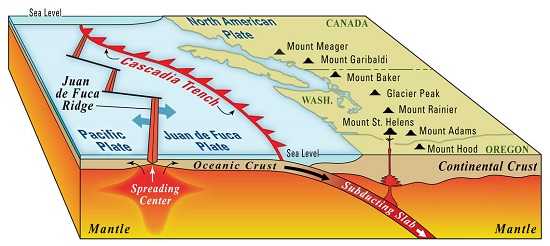
I know Professor Moran is all over the earthquake risk but for readers who are unfamiliar with the area here's a little map of the Cascadia Subduction Zone from Kids Fun Science:
And more fun via Climateer Investing:
When The Megaquake Hits, The Living Will Envy The Dead Okay, a bit of hyperbole in the headline but let's go with 10,000 dead, 30,000 injured and 2,000,000 people displaced and dependent on handouts.
We've had three posts on the Cascadia Subduction Zone, a couple links below.
There have been a few cat bonds issued over the years that cover Cascadia, they seem to be underpriced for the risk.*






![[b-APC-cht-0809]](https://lh3.googleusercontent.com/blogger_img_proxy/AEn0k_vG-al_8C2SJSdyZfL_i4_7vH_hg5zmTE9fS24TeLxPF_PJ9hfQCv99JkElkGzhlEI4NLPh5BN6XOvRFiLJlZ7-bErWsPofEBUhb6LkBI3YkYOcIG8_tFhrSDGP8oC1kw5VdMToqTabmWIVBX9MZ3wxnCo8P05xfQ=s0-d)