Showing posts sorted by relevance for query ever given suez. Sort by date Show all posts

Friday, March 26, 2021

Suez Canal Updates: The Effects On European Commerce

From Bloomberg via gCaptain:

Suez Canal Blockage Impacts; Stern Partially Refloated- Updated

Key Highlights:

  • Two more tugs will arrive at the Ever Given by Sunday, ship management company says in statement
  • Oil tanker diverts; several ships in Indian Ocean that were bound for Suez change course
  • Food supply chain faces risks
  • The containership could be carrying almost $1 billion of cargo, IHS says
  • Work to dislodge the ship will take until at least middle of next week
  • Almost 240 vessels have queued up, rising from 186 Wednesday, according to Bloomberg data

Biden Says U.S. Looking to Help (10:22 p.m. London)
The U.S. is looking into how it can help to unblock the canal, President Joe Biden said.
“We have equipment and capacity that most countries don’t have. And we’re seeing what help we can be,” Biden said.

Sea-Doo Maker Pivots to Planes (9 p.m. London)
Sea-Doo maker BRP Inc. has parts from Asian suppliers stuck on vessels jammed in the blockage.
The situation prompted the Canadian maker of recreational vehicles to shift to its backup plan: flying another batch of components from Asia to its North American plants.
“It’s more expensive, but it’s better than stopping assembly lines,” BRP Chief Executive Officer Jose Boisjoli said Friday in a phone interview.

Ever Given Was Refloated From Stern (8:42 p.m. London)
The elite salvage team working with the Suez Canal Authority was able to float the vessel from its “stern/aft” and released the rudder at approximately 9 p.m. local time, according to Inchcape Shipping Services, a maritime services provider.
Another effort will take place using the high tide, with the hope of refloating the vessel entirely.
Canal Authority Says Tug Operations Restart (7:54 p.m. London)
Pulling operations with tug boats to free the ship restarted after dredging operations were completed, the Suez Canal Authority said on its Facebook page.

‘Perfect Storm’ Brewing for Italy’s Ports (7:07 p.m. London)
Once the Suez blockage ends, the huge backlog of ships will create a traffic jam for ports on the Mediterranean.
“When traffic will flow again, ships will flood Italian ports,” said Daniele Rossi, chief of Italian ports association (Assoporti). Operational difficulties will make that difficult to “cope” with, he said.
“The perfect storm is coming.”
About 40% of Italian imports and exports pass through the Suez Canal, according to Assoporti/SRM research on Italian maritime economy.

Logjam Nears 300 Ships (6:16 p.m. London)
About 293 ships ranging from livestock carriers to liquefied natural gas tankers are waiting to transit the clogged waterway, compared with 238 on Thursday, shipping data compiled by Bloomberg show.

White House Sees Energy Impacts (5:17 p.m. London)
The White House is concerned about the impact on global energy, said Press Secretary Jen Psaki, who added that the Biden administration is monitoring market conditions.
“We do see some potential impacts on energy markets,” she told reporters at a briefing on Friday.
Earlier, a spokesman for the White House National Security Council said the U.S. government had offered Egypt assistance removing the grounded ship, the Ever Given. 
 
Wind Turbine Projects Seen Delayed (4 p.m. London)
Germany’s Enercon expects delays in wind turbine components from Europe to projects in Asia, according to a company spokesperson. The wind turbine maker also sees risks of congestion at ports, once the ships held up at the Suez Canal arrive at their destinations. Enercon is examining to what extent the problem will affect its supply chains.

North Sea Crude Loading Delays Likely (3:28 p.m. London)
At least seven supertankers are expected to load North Sea crude in April, with two or three of them likely to face delays due to the blockage in the Suez Canal, according to tanker fixture reports and ship tracking data compiled by Bloomberg.

Tanker Shares Surge (3:10 p.m. London)
With diversions starting to pop up, the shares of oil tanker companies surged. Frontline Ltd. rose as much as 11% in Oslo, the biggest intraday gain since September. Other owners were jumping too: Euronav NV climbed as much as 7%, while DHT Holdings Inc. was also up 7%, and International Seaways Inc. added as much as 6.4%. It comes as the prospect of ships taking the longer route around the southern tip of Africa raises the chances for higher earnings for ships.

British Retailers Say Impact Manageable (3:21 p.m. London)
Dixons Carphone Plc has a small number of containers on the grounded Ever Given vessel but “we don’t believe this will cause any meaningful disruption to our stock levels,” the company said in an emailed statement. While some U.K. grocers are reporting small quantities of stock stuck both on the Ever Given and some container ships behind it, the products are mostly general merchandise and clothing which is less time-sensitive as perishable food items.

Tug Boats Get Ready to Try and Tow Ever Given (2.22 p.m. London)
Tug boats are tying themselves up to the Ever Given in order to attempt to tow the container ship, according to Inchcape Shipping Services, a maritime services provider. Suez Canal Authority dredgers were earlier being used to clear away sand, the firm said.

Multiple Ships in Indian Ocean Take Detour (1:58 p.m. London)
Several ships in the Indian Ocean, initially bound for the Suez Canal, have changed course away from the waterway after it became blocked, according to vessel-tracking data compiled by Bloomberg. The vessels include container ships Ever Greet, HMM Stockholm and OOCL United Kingdom; vehicle carrier Morning Calm; and cargo ship Angelic.

U.S.-Asia Naphtha Arbitrage Opens on Suez Canal Blockage: BNEF (9:55 a.m. New York)
The U.S. Gulf Coast-to-East Asia naphtha arbitrage has opened as naphtha shipments from key exporters such as Russia and Algeria delayed by the blockage in the Suez Canal....

....MUCH MORE

Sunday, March 28, 2021

Ummm, About The Captain Of The Suez Blocker: ""EVER GIVEN" ship stranded in Suez Canal shows bad history

 From Egypt Today:

March 2020: It seems that the captain of Choi Kisen Kesha’s ship, EVER GIVEN, which was stranded in the Suez Canal, is used to mismanaging it.

In February 2019, EVER GIVEN collided with a small ferry in Germany's Blankenese and badly damaged it, causing international shipping to stop in the Port of Hamburg. Hamburg is Germany’s largest port, Europe’s third-largest, and ranks 18th in the list of the largest container ports in the world.

The repeated failure to control the ship’s course in light of the bad weather, which is the basis of the "force majeure" led by the same captain, calls for investigation into his error and the safety of the navigation devices of that giant ship. The ship disrupted the Suez Canal in the same way it disrupted the German port of Hamburg in 2019, resulting in a trade disaster....MUCH MORE

Why was he ever given command of this ship?

Friday, June 25, 2021

"Ever Given: Here Is Businessweek’s Detailed Account Of The Suez Canal Grounding"

 "Chaos Ensued. The Masseuse Panicked and Jumped Onto the Jet Ski with the Captain."

Ummm. that doesn't look right. Be right back.

Okay, via gCaptain:

“The second pilot tried to cancel the order, and more angry words were exchanged.”

“Captain Kanthavel reacted as anyone might in the same situation. “Shit!” he screamed.”

By Kit Chellel (Boomberg) Captain Krishnan Kanthavel watched the sun rise over the Red Sea through a dusty haze. Winds of more than 40 mph, whipping off the Egyptian desert, had turned the sky an anemic yellow. From his viewpoint on the bridge, it was just possible to see the dark outlines of the 19 other vessels anchored in Suez Bay, waiting for their turn to enter the narrow channel snaking inland toward the Mediterranean.

Kanthavel’s container vessel was scheduled to be the 13th ship traveling north through the Suez Canal on March 23, 2021. His was one of the largest in the queue. It was also one of the newest and most valuable, only a few years out of the shipyard. Ever Given, the name painted in block letters on its stern, stood out in crisp white against the forest-green hull. Soon after daybreak, a small craft approached, carrying the local pilots who’d guide the ship during its 12-hour journey between the seas.

Transiting the Suez Canal is sometimes nerve-racking. The channel saves a three-week detour around Africa, but it’s narrow, about 200 meters (656 feet) wide in parts, and just 24 meters deep. Modern ships, by contrast, are massive and getting bigger. The Ever Given is 400 meters from bow to stern and nearly 60 meters across—most of the width of a Manhattan city block, and almost as long as the Empire State Building is high. En route from Malaysia to the Netherlands, it was loaded with about 17,600 brightly colored containers. Its keel would be only a few meters from the canal bottom. That didn’t leave much room for error....

....MORE

....brightly colored containers?

See also the roundly applauded: So Good: "The bank effect and the big boat blocking the Suez"

Monday, March 29, 2021

Reinsurance: Ever Given Incident Likely To Cause Large Loss Event For Industry—Fitch

From Artemis

Ever Given blocking of Suez canal adds further pressure for reinsurers: Fitch

....Fitch Ratings has warned that, “The blocking of the Suez Canal and resulting disruption to global shipping is likely to cause a large loss event for the reinsurance industry.”

Adding, “This event will reduce global reinsurers’ earnings but should not materially affect their credit proles, while prices for marine reinsurance will rise further as a consequence of the container ship ‘Ever Given’ grounding in the canal.”

While the end of the blockage appears imminent, Fitch still believes that enough damage has been done to result in a meaningful marine market loss event.

“The ultimate losses will depend on how long it takes the salvage company to free the container ship completely and when normal ship traffic can resume, but Fitch estimates losses may easily run into hundreds of millions of euros,” the rating agency explained.

Incidents that damage or sink large container ships can easily result in US $1 billion or more of property losses, but there are largely related to salvage Fitch said.

As it’s now hoped the Ever Given will be able to continue forwards and clear the canal, claims related to the hull and cargo insurance, including salvage, should remain well below the billion dollar mark, Fitch explained....

....MUCH MORE

Monday, March 23, 2026

Five Years Ago Today The Ever Given Blocked The Suez Canal

From Dredging Today, March 23:

From Ever Given to Hormuz: Spotlight on strategic importance of maritime chokepoints

As the Middle East conflict throttles global trade via the Strait of Hormuz, five years ago a stranded cargo ship revealed a frail transport system. On this day, the 400m-long Ever Given ran aground in the Suez Canal, Egypt, completely blocking the waterway for six days. 

The 20,000 TEU vessel was buffeted by strong winds on the morning of 23 March, and ended up wedged across the waterway with its bow and stern stuck on opposite canal banks, blocking all traffic and creating one of the most dramatic disruptions in modern shipping history.

The incident halted roughly 12% of global trade, costing the Egyptian economy millions in daily revenue.

Salvage teams from multiple countries worked around the clock to refloat the vessel, employing dredgers, tugboats and careful maneuvering. Dredgers were brought in and dug 30,000 cubic meters of mud and sand from beneath the ends of the ship....

....MUCH MORE 

https://upload.wikimedia.org/wikipedia/commons/thumb/1/15/Container_Ship_%27Ever_Given%27_stuck_in_the_Suez_Canal%2C_Egypt_-_March_24th%2C_2021_cropped.jpg/960px-Container_Ship_%27Ever_Given%27_stuck_in_the_Suez_Canal%2C_Egypt_-_March_24th%2C_2021_cropped.jpg 

Via Wikipedia 

And via one of our contemporaneous posts: 

Wednesday, April 14, 2021

Ever Given's Insurer Disappointed By the Arrest and Detention of the Ship. Also The $916 Million Ransom

The protection and indemnity insurer is the UK P&I Club. I've not seen a statement of the extent of the coverage they offered but it damn sure wasn't anywhere near what the Egyptians are demanding.  

From UK P&I:

Disappointed by arrest of “Ever Given” 

Updated 1500 UTC 13 April 2021

On 7 April, the owners of the container vessel “Ever Given” received a claim from the Suez Canal Authority (SCA) for the sum of US $916 million. Despite the magnitude of the claim which was largely unsupported, the owners and their insurers have been negotiating in good faith with the SCA. On 12 April, a carefully considered and generous offer was made to the SCA to settle their claim. We are disappointed by the SCA’s subsequent decision to arrest the vessel today.  We are also disappointed at comments by the SCA that the ship will be held in Egypt until compensation is paid, and that her crew will be unable to leave the vessel during this time.

The SCA has not provided a detailed justification for this extraordinarily large claim. The grounding resulted in no pollution and no reported injuries. The vessel was re-floated after six days and the Suez Canal promptly resumed their commercial operations.  The claim presented by the SCA also does not include the professional salvor’s claim for their salvage services which owners and their hull underwriters expect to receive separately. The P&I aspects of the claim are relatively modest, with the exception of a claim for loss of reputation, which is disputed.

Owners have cooperated fully with the SCA throughout their investigation into the cause of the grounding, which we understand is now complete.  When the grounding occurred, the vessel was fully operational with no defects in her machinery and/or equipment and she was fully manned by a competent and professional Master and crew. Navigation was being conducted under the supervision of two SCA pilots, in accordance with the Suez Canal Rules of Navigation....

....MORE

Wednesday, March 24, 2021

So, What's The Mess In The Suez Canal Going To Cost?

 A lot.

Those oil tankers and container ships parked at the southern end of the canal don't come cheap.

From Reuters via gCaptain:

Owner and Insurers of Ever Given Face Millions in Claims

The owner and insurers of one of the world’s largest container ships stuck in the Suez Canal face claims totalling millions of dollars even if the ship is refloated quickly, industry sources said on Wednesday.

The 400-meter, 224,000-tonne Ever Given ran aground on Tuesday morning after losing the ability to steer amid high winds and a dust storm, the Suez Canal Authority (SCA) said in a statement, threatening to disrupt global shipments for days.

GAC, a Dubai-based marine services company, said authorities were still working to free the ship mid-afternoon on Wednesday.

The ship’s owner, Japanese firm Shoei Kisen KK, and its insurers could face claims from the SCA for loss of revenue and from other ships whose passage has been disrupted, insurers and brokers said.

“All roads lead back to the vessel,” said David Smith, head of marine at insurance broker McGill and Partners.

Shoei Kisen could not be reached for comment.

Container ships of this size are likely insured for hull and machinery damage of $100-140 million, insurance sources say. The ship was insured in the Japanese market, two of the sources said.

The cost of the salvage operation is also borne by the hull and machinery insurer.

“It is potentially the world’s biggest ever container ship disaster without a ship going bang,” one shipping lawyer, who declined to be named, said.

Martijn Schuttevaer, spokesman for Dutch marine services company Boskalis, told Reuters its subsidiary Smit Salvage had been hired to help with the operation. A team of around 10 people is heading to Egypt.

SUPPLY CHAIN ISSUES

In addition, owners of the cargo on board the ship and on other ships stuck in the Canal will likely claim from the ship’s liability insurer for losses to perishable goods or missed delivery deadlines, the sources said....

....MUCH MORE

And earlier, Bloomberg via gCaptain:

Grounded Mega Ship in Suez Canal Paralyzes Trade for Second Day

Friday, March 26, 2021

Russia Pokes Fun At Egypt's Suez Canal Problem

From The Barents Observer:

Making fun of Suez traffic jam, Rosatom promotes Russia's Arctic route as an alternative

In a twitter thread, Russia's State Nuclear Energy Corporation makes big fun of the trouble for global shipping caused by the wedged cargo ship in the Suez canal and uses the opportunity highlight benefits of sailing the Northern Sea Route route between Asia and Europe.  

10 percent of global trade is shipped through Egypt’s 193 kilometers long Suez canal, connecting the Red Sea with the Mediterranean. Since Tuesday, the 400 meters “Ever Given” container ship has blocked the canal, spiking fear on oil prices and European industry’s dependence of on-time delivery of spear parts produced in Asia.

Rescue boats are working day-and-night trying to release the 224,000-ton vessel.   

In Moscow, Rosatom Thursday morning posted several tweets listing the favorable reasons to consider world shipping to look north for an alternative to the Suez Canal Route....

....MUCH MORE

The Russians appear to be quite good at the Twitter trolling and they did the thread in English.

However, the last time the Russians made this pitch in 2018 the Egyptians fired right back:

September 2018
Shipping: Egypt (Suez Canal) Is A Bit Nervous About Russia's Northern Sea Route


Following on this morning's post, "Shipping: Venta Maersk Successfully Transits Russia's Northern Sea Route Becoming The First Container Ship To Do So", here's a story we've been waiting to link, from Egypt Today:
CAIRO – 29 August 2018: Although Maersk will be sending its Venta Maersk vessel to collect data from the Arctic sea route in the next few days, research has shown that the Suez Canal Route is more cost effective and will remain unaffected....

Friday, January 19, 2024

"Red Sea attacks already bigger issue for supply chain than pandemic, maritime advisory warns"

From CNBC, January 18:

  • The Red Sea crisis and continued Houthi rebel attacks on cargo ships and tankers is now a bigger impact event for shipping than the early pandemic, according to the latest data from maritime advisory firm Sea-Intelligence which measures changes in vessel capacity.
  • The only event in recent years to have a bigger impact on the supply chain was when the cargo ship “Ever Given” got stuck in the Suez Canal in 2021.
  • The longer transit around the Cape of Good Hope is having a significant impact on vessels available to pick up containers, but unlike during Covid, there is excess vessel capacity currently unused which could be put back into service and help solve the issues.

A leading ocean supply chain advisory firm is warning that the disruptions to shipping from the Houthi rebel attacks in the Red Sea are already more damaging to the supply chain impact than the early Covid-19 pandemic.

Sea-Intelligence analyzed current vessel delays compared to delays over the last several years in a report for clients. The data shows that the longer transit around the Cape of Good Hope as ships divert from the Red Sea is already having a more significant impact on vessels available to pick up containers at ports than during the pandemic. This supply chain measure is known in the industry as “vessel capacity.”

The vessel capacity drop is the second largest in recent years, according to Alan Murphy, CEO of Sea-Intelligence. The only single event with a bigger impact than the Red Sea crisis was the “Ever Given,” the giant cargo ship which got stuck in the Suez Canal for six days during March 2021. Billions in trade were at a standstill during that event. With that exception, “This [the Red Sea crisis] is the largest single event – even larger than the early pandemic impact,” Murphy said....

Also at CNBC, January 17: "Red Sea crisis could last a year with Houthi attacks ‘just increasing’: Experts"

Thursday, March 25, 2021

So Good: "The bank effect and the big boat blocking the Suez"

Ha! FTAV used the "Big Boat" nomenclature in the headline. 

We last consulted the writer, Brendan Greeley, on things nautical in September 2020's "Physics, Flotillas and Seamanship (plus pirates)" and prior to that, September 2018's "In Which FT Alphaville Takes On Sailing Yachts, Admiralty (Maritime) Law, and Dinghy Davits".

From FT Alphaville:

Brendan Greeley is FT Alphaville’s part-time boat correspondent. 

The hardest thing about teaching someone how to drive a boat is that it’s not at all like driving a car. To steer a car, you turn the wheel until your nose is pointing where you want to go, then you straighten out and go there. This works because the car is attached to the road. It’s when the car itself is no longer attached to the road that things get weird. When you turn too hard, for example, the rubber in your tires loses purchase on the on the street, and you are “in drift.” The normal rules no longer apply. 

When you drive a boat, you are always in drift. You are attached to nothing. Stuff happens in the water beneath you that does not make any intuitive sense. Sometimes your stern (your tail) moves faster than your bow (your nose), and in a different direction. Sometimes both stern and bow are moving in the same direction at the same speed, but it’s not the direction the bow is pointed. On a boat, you don’t always go where you’re pointed.  

On Wednesday, the Golden-Class container ship Ever Given made an unplanned berth in the sand on both sides of the Suez Canal, stopping trade between Europe and Asia. Evergreen Marine, which operates the Ever Given under a Panamanian flag, told the Financial Times in an email that the ship was “suspected to have met with a sudden gust of strong wind, which caused the ship’s body to veer from its course and accidentally run aground.” At press the ship was still where it came to rest, tended by several tugs. It may be there for a while; you can check for yourself on VesselFinder. 

 It’s hard to describe what happened as a “grounding,” though....

....MUCH MORE

Ummmm, About That Just-in-Time Inventory: "Blocked Suez Forces Ships to Look at Long Trip Around Africa"

We'll find out if the German automakers are okay with the Belt-and-Road railroad tracks that end in Poland. It's twelve days by rail to Gdansk with current throughput, though that can probably be sped up with the right financial lubrication. That should be faster than the route around the Cape.

From gCaptain:

A massive container ship blocking the Suez Canal showed no signs of budging for a third day, forcing container carriers and other vessels to weigh costly and time-consuming voyages around Africa that threaten to destabilize the already fragile underpinnings of global trade.

Two liquefied natural gas tankers loaded in the U.S. and bound for Asian markets appear to have changed course in the mid-Atlantic and are now heading around Africa to avoid gridlock in the Suez waterway. A.P. Moller-Maersk A/S and Hapag-Lloyd AG are considering sending ships along the same route, moves that would follow a Synergy Marine-managed ship that is being sent around the Cape of Good Hope. Torm A/S, a Danish owner of tankers, said its customers have asked about the cost of options to divert.

The possibility of alternate routes is the starkest example yet of how the canal blockage is starting to ripple across maritime transportation for everything from finished goods to energy and commodities. Even before the 400-meter long Ever Given got blocked on Tuesday, the pandemic sowed havoc in supply chains with shortages and delays.

“Regarding the possible alternatives, we are looking at all of them, including the Cape of Good Hope but also many others, for example air solutions for critical and time-sensitive cargo,” Maersk said in a statement. “No concrete decision has been taken yet. It will depend on how long the Suez Canal remains impassable.”

The logjam threatens to unleash more shipping turmoil that could mean higher costs for container carriers, the importers they cater to and maybe consumers eventually. A particular worry for the broader economic impact of the Suez incident are the supply lifelines for European companies ranging from car manufacturers to retailers that rely on a steady flow of Asian imports.

“Even if the situation is resolved within the next 48 hours, port congestion and further delays to an already constrained supply chain is inevitable,” said Daniel Harlid, a Moody’s analyst. That’s bad because European manufacturers including automakers don’t stockpile parts, he said, adding that freight rates “will also most likely increase or at least stop decreasing from their currently very high levels,” he said.

The German container line Hapag-Lloyd said it’s monitoring the situation “and closely follows the implications on its services. We are presently looking into possible vessel diversions around Cape of Good Hope.”

For the container lines that haul about 80% of global merchandise trade, a prolonged bottleneck between Europe and Asia risks throwing off ship schedules set months in advance so importers can plan their purchases, manage inventories and keep store shelves stocked or production lines running....

....MUCH MORE

I think the FT's southern Africa correspondent was kidding a couple days ago: 

South Africa's Plan To Re-Route Ship Traffic Around The Cape

If the container ships do take the long-way-round it is going to tie up an already tight market in containers as thousands will be at sea rather than in port loading and unloading.

Also via gCaptain:

Suez Canal Closure Deepens Global Container Crunch

Sunday, February 18, 2024

"Red Sea Rivalries"

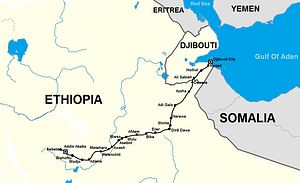
The most amazing thing that has been pointed out over the last couple months is that China's base on Djibouti's Gulf of Aden coast, at the approaches to the Bab al-Mandab chokepoint into the Red Sea, gives them the perfect location to monitor Houthi action and American reaction:

China Officially Sets Up Its First Overseas Base in Djibouti

—China Officially Sets Up Its First Overseas Base in Djibouti, The Diplomat

From Phenomenal World, February 15:

Egypt, Ethiopia, and histories of maritime war 

Every few years, a crisis in the Red Sea makes global headlines. In 2014, the Yemeni Civil War spilled into the Red Sea after the Houthis captured the capital Sana‘a and dissolved the parliament. As a warning, the Houthis allegedly conducted two missile strikes on US Navy ships, prompting a swift but limited retaliation from a US warship. In 2021, a malfunctioning commercial vessel was left stranded in the Suez Canal for six days, obstructing the trade of an estimated $9 billion in commercial goods passing through the Red Sea each day. The scale of the economic impact was so severe that the Egyptian government, which profits from tolls on Suez transport, initially demanded close to a billion-dollar settlement from the Japanese owner of the vessel.

Since October of 2023, the Houthi organization, the de facto governing authority in Yemen backed by Iran, has launched a barrage of attacks on several commercial ships in response to the war in Gaza and US support for Israel. The goal of these attacks has been to undermine US military presence in the area as well as to restrict the passage of Israeli commercial ships.

In light of the Houthis’ unprecedented military capability, the US has organized a coalition to secure Red Sea trade. The political implications of these naval operations are momentous. India, for example, has taken the opportunity to flex its own naval might, deploying warships east of the Red Sea in response to its rising concerns about its exports, 50 percent of which travel through the Bab-El-Mandeb Strait.

This most recent escalation invites a deeper reflection on the history of a small but profoundly important body of water—a history which traverses several centuries and crucially takes place on both sides of the sea, recounting persistent rivalries of great and middle empires. In particular, we can look to Egypt and Ethiopia’s battle for dominance in the Red Sea to contemplate current crises. Their rivalry embroils powers like the United States, Saudi Arabia, and China, extends to the wars in Palestine and Israel, and implicates past and present national claims in the Horn of Africa. While the actors may have fluctuated over centuries, the singular significance of this water passageway to the global political economy has endured.

Geographies of power

It is difficult to overplay the Red Sea’s economic importance. At the northern edge of the sea, the Egyptian-owned Suez Canal connects it with the Mediterranean. By extension, the Bab-El-Mandeb at its southern edge serves as the gateway between Europe and Asia. In normal times, up to 15 percent of all global trade passes through the Red Sea, though recent conflicts have cut this volume by nearly half. The current crises in the region have disrupted the supply chain of critical commercial goods, including grains, oil, and natural gas. Given these high economic stakes, it is no surprise that established and emerging powers alike have sought to project naval power in the region. 

Well before the latest series of crises, the Red Sea served as a battleground for states seeking a higher position within the global order. Much of the focus of these new power contentions has been on the Horn of Africa, lying at the crossroads of the Red Sea, the Gulf of Aden, and the Indian Ocean. Traditionally, the Horn was dominated by the influence of Egypt, the United Kingdom, and France. Beginning in 1896, the latter utilized Djibouti as a strategic hub for its colonial endeavors along the coast, known as French Somaliland. The Djibouti base enabled France to monitor maritime trade routes from the Red Sea to the Indian Ocean and facilitated the expansion of its military operations in the 1930s.

Power within the Red Sea has shifted throughout the period of US hegemony and then with the emerging multipolar order of the twenty-first century. In 2001, the United States took ownership of the Camp Lemonnier base under the guise of the War on Terror. With its own pretext of combating piracy, China established its first overseas naval base in Djibouti in 2017. The same year, Turkey established its largest overseas military base in Somalia. The Gulf Powers have also been eager to spread their influence west of the Suez; after failing to garner concessions from Djibouti, both Saudi Arabia and the United Arab Emirates (UAE) secured agreements for military installations in Eritrea, another coastal state in the Horn. 

This diplomatic interest has, since 2018, eroded the traditional geopolitical divide between the Horn of Africa and the Middle East. The Gulf monarchies were quick to assert their influence west of the Suez, investing billions of dollars and brokering groundbreaking peace agreements between Eritrea and Ethiopia....

....MUCH MORE

We watch chokepoints:
You Knew China Had A Base At The Approaches To The Red Sea, Right? "...Chinese, Iranian and Indian Warships Are Now in the Red Sea, Gulf of Aden"
July 25, 2021
"China & Egypt Strengthen Belt And Road Collaborations Including The Suez Canal International Logistics Zone"
I'm beginning to see a pattern here.*
*Starting with the Bosporus/Dardanelles between the Black and Mediterranean Seas:

And the Panama Canal:
China Will Help Panama Secure the Canal Against Terrorists

and:  

 And all of a sudden you have China on-site on three of the world's MAJOR shipping chokepoints and what could very well become the fourth at the Bering Straits.

Battery Metals and Rare Earths: The U.S. Will Use The Slightly Controversial Blanche DuBois Extraction Method

....It's just that, as we've seen over the last year, supply lines are fragile, a weak spot even without unfriendlies doing an interdiction.

Should someone actively attempt to halt transportation it would make the Ever Given snafu look like child's play. As just one example, China has been very active in extending their belt and road initiative in Panama, including a $1.4 billion bridge over the canal and rail and other infrastructure.

And that's just one potential flashpoint. The Chinese influence in Brazil, hitherto based on VALE and iron ore could potentially go exponential as Brazil expands/modernizes its shipping and rail infrastructure. And then there's Australia...and...

I suppose somebody should keep an eye on Morocco to note if the Chinese set up camp on the Strait of Gibraltar. 

Friday, June 3, 2022

How to rescue the world's biggest cargo ships

I think this article comes to us via Pocket but as I don't subscribe (not much of a joiner) and the little URL tag was not appended it's only a guess. Anyway, thanks to a friend for the link.

From the BBC, May 30:

Enormous container ships ferry goods all over the world, but when one of them gets into trouble – as happened with the Ever Given and Ever Forward recently – how can they be saved? Chris Baraniuk finds out.

https://ychef.files.bbci.co.uk/1280x720/p0c9zd9f.webp

Rain lashed the windows. A violent sea pounded the steel hull of the ship and the wind roared with primeval power. It was the middle of the night in the summer of 2010. The Kota Kado, a 230m-long container ship, had run aground outside the port of Hong Kong. Her crew had evacuated but standing on the bridge in his life jacket, prepared for the worst, was salvage master Captain Nick Sloane. He beheld the force of the typhoon that now, in the darkness, raged over the stricken vessel. 

Sloane was holed up with just five other members of the salvage team. Days earlier, they had arrived to the South China Sea with the aim of saving the Kota Kado. When typhoons were forecast to batter the grounded ship, Sloane made the decision to stay on board overnight with a skeleton crew. He wanted to feel how the vessel flexed in the storm, to understand where it hit her hardest, knowing that this would inform whatever measures they took next. But it was a very close call. 

"We nearly lost her that night," he says.

The world's cargo ships, which transport around 90% of global trade, do not always make it to their destination without incident. According to the Safety and Shipping Review by insurance company Allianz, 27 cargo vessels were lost in major incidents during 2021, and 357 during the past decade. They catch fire. They hit rocks, reefs and sand bars. They malfunction. But they don't always sink. Whenever there's a chance to rescue a large ship, their owners almost always take it because these vessels can be worth hundreds of millions of dollars.

The people that shipping firms call on in such situations are called salvors. And they have seen some extraordinary things at sea. Salvors came to the aid of the huge Ever Given container ship after she ran aground, blocked the Suez Canal, and triggered global supply chain issues last year, for example. But when a ship weighing tens or hundreds of thousands of tonnes gets stuck somewhere, how do you free it?....

....MUCH MORE

Monday, March 29, 2021

Suez Canal: Ever Given Now Floating, Oil Drops

 From Reuters:

World shares steady as Archegos concerns temper Suez relief

World shares started the week on cautious ground as uncertainty over the fallout of the default of a U.S. hedge fund tempered relief from the refloating of the ship blocking the Suez Canal.

Banks Nomura and Credit Suisse warned on Monday they were facing significant losses after the hedge fund, named by sources as Archegos Capital, defaulted on margin calls.

Investors were bracing for further block trades causing volatility in markets after a $20 billion worth of fire sales on Friday reportedly linked to Archegos hit shares in some big U.S. media and Chinese tech companies.

Developments in the Suez Canal however raised hopes that the vital waterway could reopen and ease global shipping backlogs, sending oil prices lower and offering support to stocks, while currency markets were largely unaffected by Archegos worries.

The MSCI world equity index, which tracks shares in 49 countries, was just above parity by 0809 GMT, while U.S. and euro zone volatility gauges picked up from last week’s lows....

....MUCH MORE


Tuesday, April 13, 2021

The Question On Everyones Mind, Answered

From gCaptain:

Suez Canal Authority: Meme’d Digger Operator Will Get His Overtime Pay

The Suez Canal Authority is responding to online reports that the real star of the Ever Given’s salvage, the guy with the digger, has not been paid for his efforts.

We’ve seen this story in a few places now. But from what we can tell it was first reported by Business Insider that the 28-year-old operator of the little excavator that could worked 21-hour days to free the stuck ship and, as of April 8, he had still not been paid his overtime!

Surprisingly, the Insider article actually says the man, identified as Abdullah Abdel-Gawad, didn’t actually like the memes (ok, now I feel bad), but the publicity actually made him work extra-hard because of the added the pressure they brought to dig the ship free.

“The thing is, I was terrified that the ship might list too far to one side or the other,” he told Insider. “Because if it fell onto its side on me, then it’s goodbye me, and goodbye excavator.”....

....MUCH MORE

Thursday, April 29, 2021

"On French Lake, Mariners Learn How Not to Get Stuck in the Suez Canal"

The first thing I thought of was this pic from April 11's French History Messy Nessy Style: "Little Tuscany in the Heart of Paris":


But non.

Even better!

Via gCaptain, April 21:

https://gcaptain.com/wp-content/uploads/2021/04/2021-04-21T130141Z_1368025633_RC2D0N9B39F2_RTRMADP_3_FRANCE-SHIPPING-SCHOOL-1536x1019.jpg

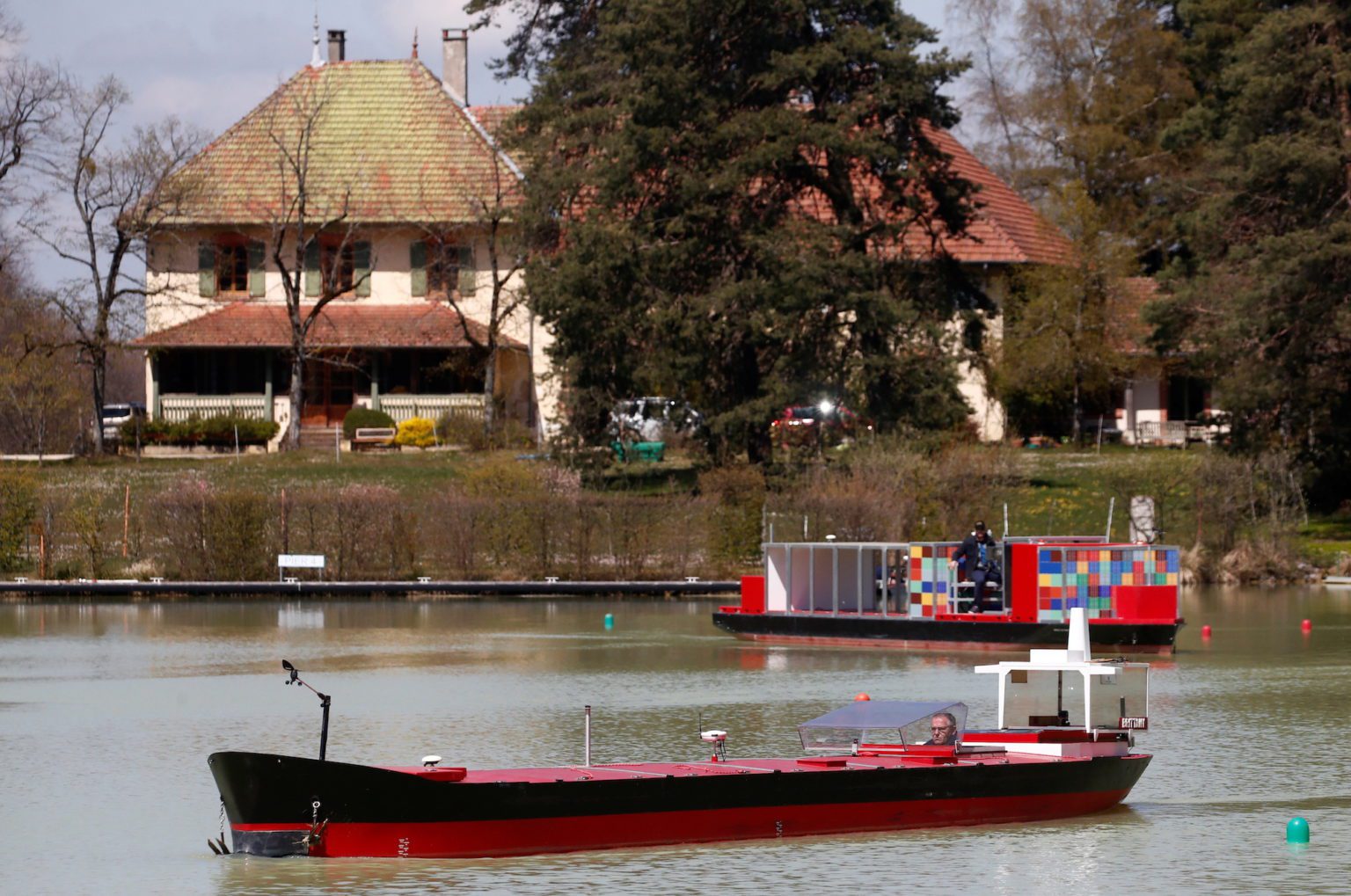
Francois Mayor, managing director of Port Revel, steers a scaled-down model of a tanker, named the Brittany, on a lake at the Port Revel Shiphandling Training Centre in Saint-Pierre-de-Bressieux, France, April 19, 2021. Picture taken April 19, 2021. 

Francois Mayor nudged back on the power and made a subtle adjustment on the wheel as he coaxed his cargo vessel through a narrow point in the Suez Canal — not the Egyptian one, but a replica in the middle of a French forest.

This stretch of water was built to train ship captains and maritime pilots how to navigate the Suez Canal — a skill now in the spotlight after the Ever Given cargo ship got wedged in the Egyptian waterway last month in high winds and a sandstorm.

The channel is built to one twenty-fifth the scale of a section of the real Suez Canal. Trainees have to steer through scale models of massive container ships without getting stuck.

“It’s a bit hard to recreate sandstorms,” said Mayor, the managing director of the Port Revel training facility, built around a lake in eastern France. “But we have gusts of wind which will push our ship to one side or another.”....

....MUCH MORE

Sunday, July 25, 2021

"China & Egypt Strengthen Belt And Road Collaborations Including The Suez Canal International Logistics Zone"

I'm beginning to see a pattern here.*

From Silk Road Briefing, July 23:

Egypt’s Free Trade Agreements with AfCFTA and the EU make it an attractive Chinese investment destination to access new export markets

China and Egypt have signed a deal to establish an intergovernmental cooperation committee aimed at further enhancing bilateral relations, in an agreement signed by Chinese Foreign Minister Wang Yi and his Egyptian counterpart Sameh Shoukry. Wang is on an official visit to Egypt and has also visited Syria.

“Egypt is one of China’s most important strategic partners among Arab countries, in the Islamic world, in Africa and among developing countries,” Wang said, reiterating that Beijing appreciates Cairo for its support on issues concerning Beijing’s core interests and said China also supports Egypt in safeguarding its own sovereignty, security, and development interests.

“China is ready to work with Egypt to deepen the alignment of their development strategies, expand cooperation in production capacity, infrastructure, new energy, space and aviation, as well as new and high-tech industries, and open up new prospects for mutually beneficial cooperation,” he said, adding that China will continue to support Egypt’s localized production of vaccines to help the country fight Covid-19.

For his part, Shoukry said that “Egypt is willing to work with China to strengthen their cooperation in economy, trade, industry, science and technology within the framework of the Belt and Road Initiative (BRI), expand people-to-people and cultural exchanges and maintain communication on the reform of the United Nations Security Council and other international and regional issues,” he added.

Egypt is currently regaining stability after the ”Arab Spring” disturbances and problems with fighting ISIL. It is a huge market of some 100 million people and an important regional player. Russia has also been making inroads into Egypt with a Special Economic Zone at Port Said near the mouth of the Suez Canal, building Egypt’s hi-speed Red-Mediterranean Sea railway and is shortly to conclude an Egyptian-Eurasian Economic Union free trade agreement....

....MUCH MORE 
*Starting with the Bosporus/Dardanelles between the Black and Mediterranean Seas:

And the Panama Canal:
China Will Help Panama Secure the Canal Against Terrorists

and:  

 And all of a sudden you have China on-site on three of the world's MAJOR shipping chokepoints and what could very well become the fourth at the Bering Straits.

Battery Metals and Rare Earths: The U.S. Will Use The Slightly Controversial Blanche DuBois Extraction Method

....It's just that, as we've seen over the last year, supply lines are fragile, a weak spot even without unfriendlies doing an interdiction.

Should someone actively attempt to halt transportation it would make the Ever Given snafu look like child's play. As just one example, China has been very active in extending their belt and road initiative in Panama, including a $1.4 billion bridge over the canal and rail and other infrastructure.

And that's just one potential flashpoint. The Chinese influence in Brazil, hitherto based on VALE and iron ore could potentially go exponential as Brazil expands/modernizes its shipping and rail infrastructure. And then there's Australia...and...

I suppose somebody should keep an eye on Morocco to note if the Chinese set up camp on the Strait of Gibraltar. 

Monday, March 29, 2021

Capital Markets: "Markets Look for Direction after Large Block Trade[s] and Before Key Data"

 As mentioned in the post immediately below, uncertainty in the equity market is overshadowing any jubilation over the Ever Given being refloated.

From Marc to Market:

Overview: The large block trade (~$20 bln) before the weekend, apparently from a family office, continued to have ripple effects today, but the MSCI Asia Pacific Index barely noticed. It extended its pre-weekend rally of 1.3%, and only South Korea and Australia fell among the major markets. Europe's Dow Jones Stoxx 600 edged to new highs since last March but struggled to sustain the upside momentum. Financial and real estate sapped the strength that had been coming from consumer staples and information technology. US futures indices are nursing 0.3%-05% losses. The US 10-year yield is a little softer at 1.65%, while European yield benchmarks have edged slightly higher. The dollar is stronger against most currencies today. Sterling and the Australian dollar, among the majors, are showing a little resilience, while the Swedish krona is off around 0.6%. Emerging market currencies, except for a few from East Asia, are lower, led by the 0.7% fall of the Mexican peso, followed by around a 0.65% loss of the Turkish lira. The JP Morgan Emerging Market Currency Index is lower for the fifth time in the past six sessions. Gold is trading heavy, around $1725 near midday in Europe. It continues to trade within the $1719.30 and $1755.5 range set on March 18. Progress on moving the ship blocking the Suez Canal was reported, and oil prices softened after last week's choppy action ended with a 4.1% gain to almost $61. The May WTI contract found support a little below $59.50 and recovered more than a dollar in the European morning to approach $61.00 a barrel.

Asia Pacific
After announcing retaliatory sanctions on the EU and UK at the end of last week, Beijing announced over the weekend that it would sanction two Americans. The Chair and Vice-Chair of the US Commission on International Religious Freedom are now barred from visiting or doing business in China.
The Chair, incidentally, is the wife of Senator Manchin. Beijing also sanctioned a member of the Canadian parliament too. A few months ago, Nike and H&M expressed concern about forced last in Xinjiang's cotton industry, and last week faced consumer boycotts and backlash in China. Some H&M stores were shut by landlords, according to press reports. These are mainly symbolic moves and will not change the behavior on either side. Former US Secretary of State Kissinger has characterized the broader confrontation as the "foothills of a Cold War." This implies the likelihood of escalation. The Biden administration's invitation to Xi (and Putin) to a global climate change summit is a polite gesture. Still, any agreement requires, as Reagan instructed, trust but verification, both of which are obstacles, especially given the poisoned atmosphere.

Separately, but not totally unrelated, China's trade punishment of Australia is set to continue.
Beijing's temporary sanctions on Australian wine, in place for months, has formally been extended to five years. The tariff ranges from 116% to 218%. China was the largest buyer of Australian wine. China claims the wine was subsidized and dumped (sold below either the price in Australia or below "market value"). However, China has taken action on many commodities, including barley, coal, beef, and lobster. Australia has threatened to take the case to the WTO, but the Biden administration has continued to block appellate judges' appointments, which undermines the conflict resolution mechanism. Australia ran A$5.7 bln trade surplus with China in January, as Canberra reported a record trade surplus. February trade figures are due out later this week. Japan is the only G7 country not to sanction China. Still, pressure appears to be mounting ahead of Japan's Prime Minister Suga's expected trip to Washington to be the first foreign leader to visit President Biden, possibly as soon as April 9. ...

....Europe
There are several moving parts of the vaccine rollout. The UK had secured favorable contracts but lacks the manufacturing capacity to produce sufficient vaccines. The EU has the manufacturing capacity but did not secure favorable contracts, and when they did, it appears they backed the wrong ones. The US has both the manufacturing capacity and favorable contracts. Indeed, the NY Times warned of a coming glut of vaccines in the US....

Saturday, March 26, 2022

WSJ: "Food Hoards Can Ease Inflation, but Only Some Governments Are Prepared"

 From the Wall Street Journal, March 24:

Countries with large grain reserves, such as China, can shield their citizens from higher food prices caused by war in Ukraine

Food stockpiles might look comfortable at the global level. In reality, only a handful of governments have provisions to cope with grain shortages caused by the war in Ukraine.

For important cereals such as wheat and corn, the world-wide stock-to-use ratio—a measure of inventories as a proportion of annual demand—will finish the year at 29%, according to forecasts by the Food and Agriculture Organization of the United Nations. This is lower than before the pandemic, although not worryingly so.

But the headline number is deceptive as a small number of countries control the biggest share. The U.S. Department of Agriculture estimates that China holds half of the world’s wheat reserves and 70% of its corn. After five consecutive record crops, India has almost one-tenth of global wheat stockpiles. The U.S. has 6% and 12% of global wheat and corn reserves, respectively. Combined, countries in North Africa that are especially reliant on grain imports from the Black Sea region have a roughly 5% share of global wheat reserves.

With the largest grain inventories in the world, China is best prepared for a global crunch. Beijing has given priority to food security for its 1.4 billion-strong population for several years and began steadily building the country’s strategic reserves after the 2008 food price crisis.

China significantly ramped up imports at the beginning of the Covid-19 outbreak. In 2020, the country brought in 26% more grains and oilseeds than the year before, according to agricultural market data provider AgFlow. Import volumes rose a further 11% in 2021 and continued to show year-over-year growth in January and February of this year.

As Ukraine and Russia are major international grain exporters, tensions between the two countries began to push up the cost of commodities well before Russian troops first crossed the Ukrainian border on Feb. 24. Since December last year, cash prices for Argentine wheat and corn—a likely substitute for Ukrainian crops for a number of importing nations, especially in Africa—are up 27% and 38% respectively, according to AgFlow....

....MUCH MORE

We'll have more on stockpiles next week. In the meantime keep an eye open for China to do a bit of grain diplomacy with Egypt. As noted in July 25's "China & Egypt Strengthen Belt And Road Collaborations Including The Suez Canal International Logistics Zone"

I'm beginning to see a pattern here.

Starting with the Bosporus/Dardanelles between the Black and Mediterranean Seas:
"China will buy Turkey on the cheap"
Why Turkey is Important

And the Panama Canal:
China Will Help Panama Secure the Canal Against Terrorists

and:
"Don't Fear China's Arctic Takeover"
And all of a sudden you have China on-site on three of the world's MAJOR shipping chokepoints and what could very well become the fourth at the Bering Straits.

Battery Metals and Rare Earths: The U.S. Will Use The Slightly Controversial Blanche DuBois Extraction Method

....It's just that, as we've seen over the last year, supply lines are fragile, a weak spot even without unfriendlies doing an interdiction.

Should someone actively attempt to halt transportation it would make the Ever Given snafu look like child's play. As just one example, China has been very active in extending their belt and road initiative in Panama, including a $1.4 billion bridge over the canal and rail and other infrastructure.

And that's just one potential flashpoint. The Chinese influence in Brazil, hitherto based on VALE and iron ore could potentially go exponential as Brazil expands/modernizes its shipping and rail infrastructure. And then there's Australia...and...

I suppose somebody should keep an eye on Morocco to note if the Chinese set up camp on the Strait of Gibraltar. 

Saturday, December 23, 2023

You Knew China Had A Base At The Approaches To The Red Sea, Right? "...Chinese, Iranian and Indian Warships Are Now in the Red Sea, Gulf of Aden"

I've been meaning to post something on that addition to the chokepoints the Peoples Liberation Army (Navy) overlooks* but every time I approach the keyboard, K.C. and the Sunshine Band fires up with Sheikh, Sheikh, Sheikh, Sheikh, Sheikh, Sheikh, Sheikh, Djibouti, Sheikh Djibouti.
(I am so sorry)
From naked capitalism, December 23: 
 
Breaking News: Chinese, Iranian and Indian Warships Are Now in the Red Sea, Gulf of Aden
Yves here. I have to admit to suffering from a lack of sufficient imagination. When I saw the tweet below from guurst, I thought the motive was to put US/NATO ships at risk so as to strengthen the US case for other countries to join the inaptly named Operation Prosperity Guardian, to protect commercial commercial ships transiting from Houthi fire (as we and many others have described, much easier said than done). Over my pay grade, but one wonders why the many countries that opposed Israeli action in Gaza would go along (assuming they are). But having Chinese, Iranian and Indian warships in theater to keep tabs on the potentially not friendly Operation Prosperity Guardian warships.

By John Helmer, the longest continuously serving foreign correspondent in Russia, and the only western journalist to direct his own bureau independent of single national or commercial ties. Helmer has also been a professor of political science, and an advisor to government heads in Greece, the United States, and Asia. He is the first and only member of a US presidential administration (Jimmy Carter) to establish himself in Russia. Originally published at Dances with Bears

A Russian military blog post posted on Thursday, December 21 at 11:33 Moscow time, has revealed the hitherto secret positions of all warships in the area which the Pentagon has announced for its OPERATION PROSPERITY GUARDIAN.

The fresh data and the open map (lead image) were not available when yesterday’s report was published at 09:32 Moscow time of Russia’s “two-track” strategy for opposing the US and NATO,  and for protecting Russian oil shipments while  the Houthi drone and missile operations are under way against Israel.

No Russian Navy vessel is in the area at present although Russian crude oil cargoes are moving through the Red Sea with Iranian and Houthi agreement. Because these ship movements are defying US and NATO sanctions, it has been decided in Moscow to negotiate safe passage with Iran and Yemen rather than deploy the Russian Navy to protect them. However, the new combined US and NATO operation, targeting the Houthis and their Iranian support and supply systems,  increases the possibility of a direct American, allied, or false-flagged attack on a tanker carrying Russian oil.

In yesterday’s morning report, I indicated that “the current whereabouts of the [Chinese] warship group has not been reported in the open press.”

The Russian source map is now reporting that the Chinese Navy’s 45th Escort Task Force, comprising the Type-052 destroyer Urumqi,  the Type-547 frigate Linyi,  and supply ship Dongpinghu were at  berth at the Chinese base at Djibouti as of Wednesday, December 20.

The Russian map also reveals that the Iranian vessel MV Behshad is in a standing position in the Red Sea (lead image, top left of map). According to the Russian source, it is operating as an electronic surveillance, command and control centre to monitor friendly state ship movements – Russian, Chinese, Indian – and also  hostile vessels of the US, British and French navies, tracking their positions; and relaying the data to Iran and probably to shore positions in Yemen. Although US media and Pentagon statements accuse the Ansar Allah government in Yemen and Houthi forces of acting as Iranian proxies in the war against Israel, there has been no disclosure before now of this vessel in the Red Sea....

....MUCH MORE

*July 25, 2021
"China & Egypt Strengthen Belt And Road Collaborations Including The Suez Canal International Logistics Zone"

I'm beginning to see a pattern here.*

From Silk Road Briefing, July 23:

Egypt’s Free Trade Agreements with AfCFTA and the EU make it an attractive Chinese investment destination to access new export markets

China and Egypt have signed a deal to establish an intergovernmental cooperation committee aimed at further enhancing bilateral relations, in an agreement signed by Chinese Foreign Minister Wang Yi and his Egyptian counterpart Sameh Shoukry. Wang is on an official visit to Egypt and has also visited Syria.

“Egypt is one of China’s most important strategic partners among Arab countries, in the Islamic world, in Africa and among developing countries,” Wang said, reiterating that Beijing appreciates Cairo for its support on issues concerning Beijing’s core interests and said China also supports Egypt in safeguarding its own sovereignty, security, and development interests.

“China is ready to work with Egypt to deepen the alignment of their development strategies, expand cooperation in production capacity, infrastructure, new energy, space and aviation, as well as new and high-tech industries, and open up new prospects for mutually beneficial cooperation,” he said, adding that China will continue to support Egypt’s localized production of vaccines to help the country fight Covid-19.

For his part, Shoukry said that “Egypt is willing to work with China to strengthen their cooperation in economy, trade, industry, science and technology within the framework of the Belt and Road Initiative (BRI), expand people-to-people and cultural exchanges and maintain communication on the reform of the United Nations Security Council and other international and regional issues,” he added.

Egypt is currently regaining stability after the ”Arab Spring” disturbances and problems with fighting ISIL. It is a huge market of some 100 million people and an important regional player. Russia has also been making inroads into Egypt with a Special Economic Zone at Port Said near the mouth of the Suez Canal, building Egypt’s hi-speed Red-Mediterranean Sea railway and is shortly to conclude an Egyptian-Eurasian Economic Union free trade agreement....

....MUCH MORE 
*Starting with the Bosporus/Dardanelles between the Black and Mediterranean Seas:

And the Panama Canal:
China Will Help Panama Secure the Canal Against Terrorists

and:  

 And all of a sudden you have China on-site on three of the world's MAJOR shipping chokepoints and what could very well become the fourth at the Bering Straits.

Battery Metals and Rare Earths: The U.S. Will Use The Slightly Controversial Blanche DuBois Extraction Method

....It's just that, as we've seen over the last year, supply lines are fragile, a weak spot even without unfriendlies doing an interdiction.

Should someone actively attempt to halt transportation it would make the Ever Given snafu look like child's play. As just one example, China has been very active in extending their belt and road initiative in Panama, including a $1.4 billion bridge over the canal and rail and other infrastructure.

And that's just one potential flashpoint. The Chinese influence in Brazil, hitherto based on VALE and iron ore could potentially go exponential as Brazil expands/modernizes its shipping and rail infrastructure. And then there's Australia...and...

I suppose somebody should keep an eye on Morocco to note if the Chinese set up camp on the Strait of Gibraltar.  

—from "China & Egypt Strengthen Belt And Road Collaborations Including The Suez Canal International Logistics Zone",  July 25, 2021