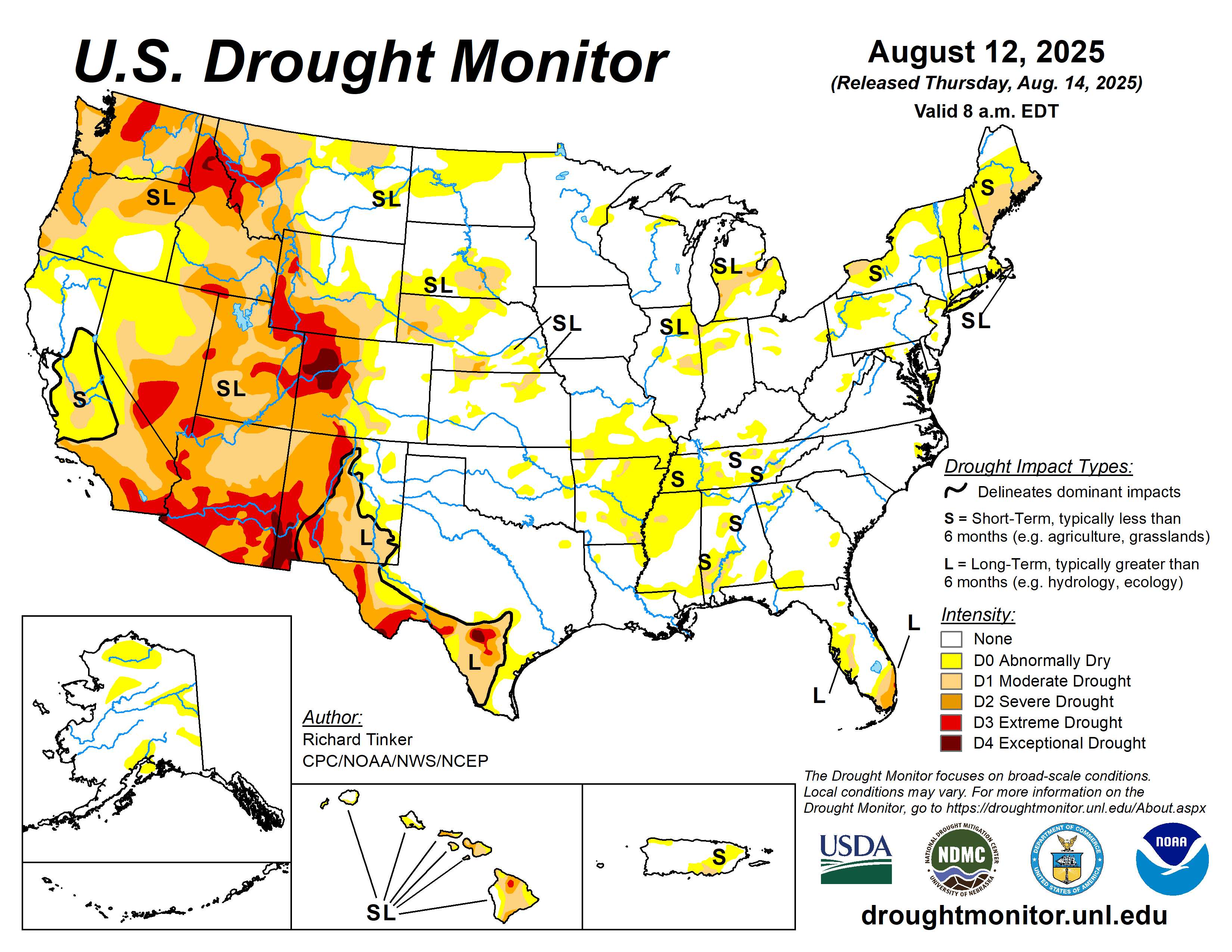
From the University of Nebraska - Lincoln, May 21:
This Week's Drought Summary
During the week, the contiguous United States exhibited significant regional temperature anomalies driven by a highly amplified synoptic pattern. Early in the period, a pronounced unseasonable cold air mass influenced the Northern Plains, Upper Midwest, and Northeast, depressing temperatures 5°F to 15°F below normal across the Dakotas, Minnesota, New York, and Pennsylvania. Conversely, the Southwest and South Texas experienced anomalous warmth, with maximum temperatures exceeding 90°F and averaging up to 15°F above normal. By the latter half of the week, this warm air mass expanded eastward into the Ohio Valley and Mid-Atlantic, initiating an early-season heatwave with observed maximum temperatures climbing into the mid-80s to low 90s.
Precipitation regimes during this period were characterized by severe convective outbreaks and pronounced moisture disparities. In the early portion of the week, persistent onshore moisture transport resulted in heavy rainfall totals of 4 to 6 inches across the central Gulf Coast, specifically affecting Louisiana, Mississippi, and Alabama. Between May 17 and 18, a powerful frontal system traversing the central United States triggered widespread severe weather across the Great Plains and Midwest. This system produced damaging winds up to 80 mph, large hail, and multiple tornadoes across South Dakota, Nebraska, Iowa, Kansas, and Missouri, alongside localized flash flooding. In contrast, extreme moisture deficits persisted west of the Rocky Mountains, where weekly precipitation totals generally remained under 0.10 inches, further elevating wildfire risk across the southern High Plains.
Northeast....
....MUCH MORE