Saturday, February 14, 2026

Technology's Long Shadow: How Areas In Germany That Early-Adopted The Steam Engine Are Outperforming Today

As always, being aware that the arrow of causality could go either directions.

Or neither. 

I'm thinking average intelligence of the native workforce as a proxy for inventiveness and adaptability.

From Berlin's Rockwool Foundation, January 2026: 

From Steam Power to Artificial Intelligence: What the Past Can Teach Us About the Future of Work
Short summary

Regional inequalities remain a central issue in public and policy debates. In Germany, average full-time wages in the richest 10% of counties are more than 40% higher than those in the poorest 10%. This raises core questions: Where do such disparities originate? How persistent are they? And what policies can reduce them?

A new study traces these inequalities back to the introduction of a transformative technology: the steam engine. Much like AI today, the steam engine was among the most disruptive technologies in the 19th century. While the long-term effects of AI remain uncertain, history provides guidance: German regions that had more steam engines per worker in 1875 have higher wages, a more skilled labor force, and greater firm productivity today. They also show greater occupational diversity and sustained innovation over time.

These findings are consistent with theories of technology–skill complementarity (where new technologies raise the demand for skills) and directed technical change (where firms orient innovation toward exploiting those higher skills), pointing to a persistent, self-reinforcing dynamic between technological progress and human-capital development.

Key Findings
  • Higher long-run wages in regions with higher steam engine density: Compared to regions with an average adoption rate of 6.64 steam engines per 1,000 workers in 1875, regions that were in the top 10% steam engine intensity (13.13 steam engines per 1,000 workers) have 4.59% higher average wages in modern day Germany (1975-2019). This wage premium holds after accounting for worker demographics, historical industry mix, and geography.
  • Greater educational attainment and higher firm productivity: These regions have also a larger share of tertiary-educated and technically skilled workers 150 years later, as well as more productive firms. The study finds that nearly 50% of the steam engine-related wage premium is explained by having more productive firms in these regions.
  • Innovation and technological diversity: Regions with more steam engines per worker in 1875 registered significantly more patents, historically (1877-1918) and in recent decades (1980–2014), and show greater technological diversity in their innovations.
  • Occupational diversity: Regions with more steam engines per worker in 1875 exhibit greater occupational diversity today, both in overall economy and within the manufacturing sector

“Steam power didn’t just fuel factories, it reshaped the technology and skill development of entire regions for generations. The lesson for today is clear: early adoption of transformative technologies like AI can have long-lasting consequences.”

— Christian Dustmann

 Based on RFBerlin Discussion Paper 13/26: Becker, Dustmann & Ku (2025) “The Virtuous Cycle Between Skills and Technology”

Research summary

A central question in economics is how new technologies shape labor markets and, in turn, how these changes influence innovation and long-run growth (Autor et al., 2003; Katz & Margo, 2014). With today’s rapid advances in automation, digitalization, and artificial intelligence, this issue has gained renewed urgency (Brynjolfsson & McAfee, 2014; Autor, 2015; Acemoglu & Restrepo, 2018).

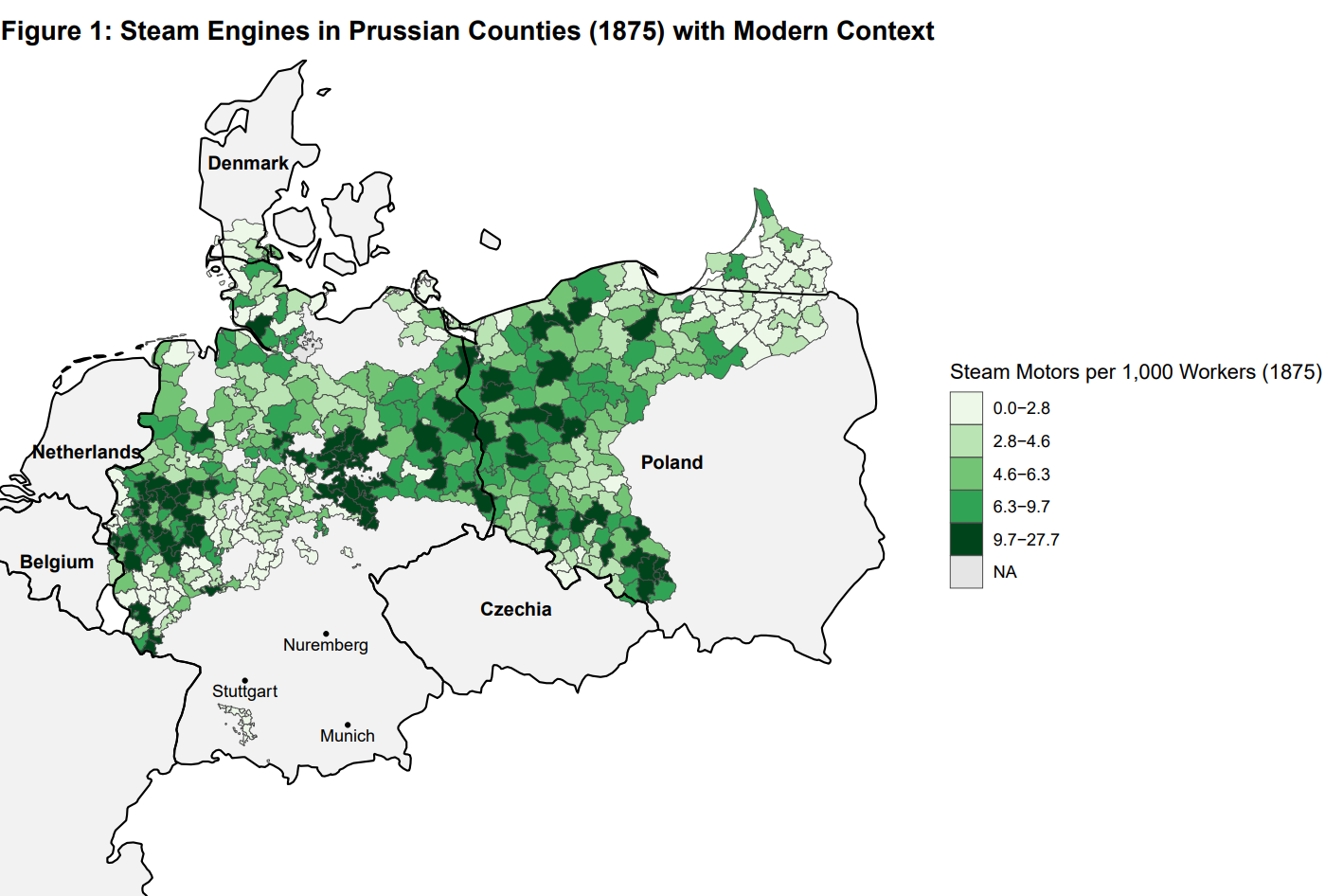
Our study (Becker, Dustmann & Ku, 2025) takes a historical perspective. We examine one of the most transformative technologies of the past: the steam engine. Unlike water or wind power, steam provided a reliable, scalable, and geographically flexible source of energy that reshaped industrial production across 19th-century Germany (Crafts, 2004). By linking digitized census records of steam adoption in 1875 to German social security data (1975–2019), firm productivity measures, and historical as well as modern patent data, we investigate how steam engine adoption influenced regional outcomes over more than a century. Figure 1 shows the number of steam engines per 1,000 workers in 1875 across Prussia.

 https://www.rfberlin.com/wp-content/uploads/2025/12/Steam-machine-1-1-1.png

 Notes: This figure shows the spatial distribution of steam engines per 1000 workers in 1875. 
Data on steam engines are available at the level of year 1871 Prussian counties. The figure 
also shows the boundary of modern Germany 2019. 

The results are striking. Regions with higher steam engine density in 1875 have persistently higher wages today: a one standard deviation (4.6 steam engines per 1,000 workers) increase in steam adoption is associated with 2.3–3.7% higher wages today. This relationship can also be seen in Figure 2 which shows the number of steam engines per 1,000 workers on the X-axis and mean wages in 2015 on the y-axis....

....MUCH MORE