From Rystad via OilPrice, February 10:
- Downside oil price risks from a renewed Iran nuclear deal are limited and gradual, while escalation scenarios carry large and rapid upside potential.
- Iran’s strategic location and influence over transit routes matter more to oil pricing than its production alone.
- Severe scenarios involving instability or infrastructure disruption could permanently embed a higher geopolitical risk premium in oil markets.
To help navigate the uncertainty, we have framed five possible scenarios, detailed below, that outline plausible pathways, from diplomatic normalization to severe destabilization, and assess their consequences for geopolitics and global oil markets. Only a week ago, the balance of risks appeared tilted towards military action. More recently, intensified diplomatic engagement and signalling from both Washington and Tehran have shifted expectations toward a less confrontational path. That said, developments can unfold quickly, and the probability distribution across scenarios remains highly fluid.
Scenario 1: US forces new nuclear deal
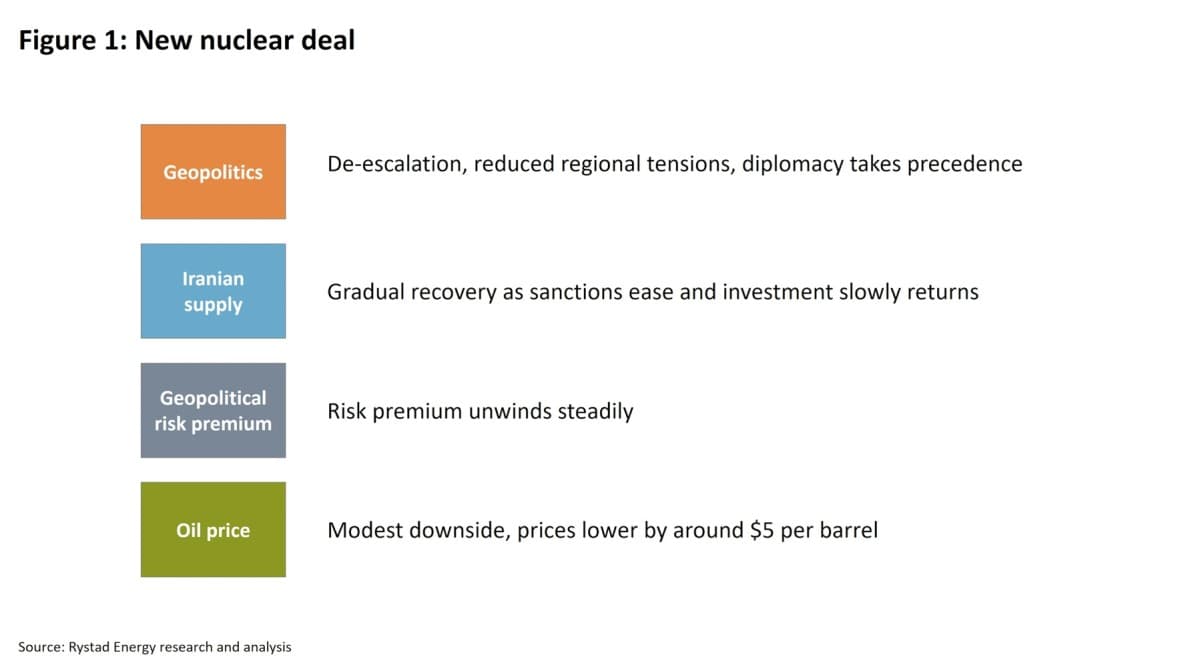
Under this scenario, diplomatic pressure, economic incentives and the credible threat of escalation succeed in bringing Iran back into a formal nuclear agreement without direct military confrontation. Washington prioritizes containment and de-escalation, while Iran’s leadership concludes that economic stabilization and regime survival are best served through compromise rather than resistance. Sanctions are lifted in stages, contingent on compliance, allowing Iran to re-engage with global trade and financial systems.
From a geopolitical perspective, this scenario leads to a gradual reduction in regional tensions. The immediate nuclear threat recedes, lowering the likelihood of unilateral Israeli military action and reducing the need for a sustained US military presence in the Persian Gulf. Relations between Iran and Gulf Cooperation Council (GCC) countries stabilize, with backchannel diplomacy intensifying, particularly with Saudi Arabia and the UAE. Iran shifts focus inward, prioritizing economic recovery and social stability over regional power projection.
For oil markets, the impact is gradual and muted rather than disruptive. Oil prices decrease by around $5 per barrel on the news. Years of sanctions on Iran have eroded upstream capabilities, damaged reservoirs and constrained access to technology and investment. Hence, production and exports recover slowly – likely over several months – limiting the immediate downside for prices. Iran’s crude production increases from 3.2 million barrels per day (bpd) in January this year to around 3.6 million bpd at the end of 2027.
Additionally, the rest of OPEC+ would partially absorb the incremental supply through quota management, while still allowing for the group to regain market share as part of the strengthened diplomatic relations between Iran and GCC countries, particularly Saudi Arabia and the UAE. The disappearance of the geopolitical risk premium, together with the additional supply from Iran, only partially offset by OPEC+, would exert modest downward pressure on prices.
For Israel, a renewed nuclear deal reduces the immediate case for unilateral military action, even if long-term concerns about Iran remain. US security guarantees and enhanced monitoring lower the near-term risk of escalation, allowing Israel to step back from direct confrontation.
At the same time, the Abraham Accords gain further traction. Improved ties between Israel and key Gulf states, particularly the UAE and Bahrain, deepen as shared security priorities shift from crisis management to containment. Stronger regional coordination helps stabilize the security environment and further erodes the geopolitical risk premium in oil markets.
Scenario 2: Limited US strikes on nuclear and IRGC targets....
....MUCH MORE

