Saturday, February 28, 2026

"How 3G Capital, the lean and secretive private equity firm, created some of the world's largest companies"

From Colossus, February 2026:

Built to Own 

At two in the morning on September 2, 2010, the 37th floor of 600 Third Avenue was dark except for the boardroom. At one end, 3G Capital’s chief financial officer was arranging papers across the conference table. At the other, two junior lawyers checked signatures under the hospital lights.

Burger King’s board had agreed to sell the company for $4.1 billion to 3G Capital, but the firm was obscure enough that the previous day The Wall Street Journal had mistaken it for a different company entirely. The deal would be one of the largest buyouts since the financial crisis.

Outside, Manhattan’s towers blinked in the late summer heat. Three hours earlier, across the river in Queens, Andy Roddick had been knocked out of the US Open by an unseeded player in the second round. Somewhere in the city, he was probably still awake.

So was Daniel Schwartz, sitting in an airport hotel room in Miami with a phone to his ear. He was 29 years old, a partner at 3G, and he had until the New York Stock Exchange opened in seven hours to secure $2.4 billion in debt financing. At six in the morning, as planes began flying into the sunrise over Biscayne Bay, the lawyers in New York confirmed the documents were set.

The debt remained a problem, as it had been since 3G began talks with Burger King in March. It was 2010, the scars of the financial crisis were still raw, and in Europe, fresh wounds were opening by the week. Schwartz got married in May, though there was little time to celebrate. Greece needed rescuing by the IMF and EU, which unsettled markets and cast doubt on the eurozone itself. The kind of loan 3G needed to make a deal like this work all but disappeared.

By late summer, JPMorgan agreed to split the financing with Barclays. They would each lend $1.2 billion. The deal was progressing quietly until Wednesday, September 1, when The Wall Street Journal reported that 3i Group, a private equity firm based in London, was buying Burger King. The stock jumped 15%. 3i’s spokeswoman jumped higher. “We’re not talking to Burger King, we have no interest in the company, and we’re not sure where this has come from.”

The New York Stock Exchange halted trading and called John Chidsey, Burger King’s chairman and CEO. He had until Thursday’s opening bell at 9:30am to announce a deal or dismiss the rumors. Which was why, at two in the morning, the lawyers were still at it on the 37th floor. And why Schwartz, who still hadn’t slept and still hadn’t been on his honeymoon, was trying to get signatures from both banks before the market opened.

Alex Behring, 3G’s co-founder and managing partner, had flown to Miami with Schwartz on Wednesday. At 9am on Thursday, he stood with Chidsey in a conference hall at Burger King’s headquarters on Blue Lagoon Drive, a burger flip from Miami airport and Schwartz’s hotel room. Several hundred employees had gathered to hear an announcement. The market opened in 30 minutes.

Behring called Schwartz.

“Can we go?”

“No,” Schwartz replied. “The banks still haven’t signed the commitment papers.”

Behring and Chidsey stood at the front of the room. A sea of eyes fixed upon them. After 15 eternal minutes, Schwartz called back.

“We can go.”

Burger King shares rose 25% to $23.59. The deal, a take-private acquisition priced at $24 per share, was a 46% premium to the stock price before rumors began circulating on Tuesday. It did not take long for analysts to weigh in. “The valuation is based on good fundamentals,” Reuters noted, “which Burger King does not have.”

The deal included a “go shop” provision that allowed Burger King to solicit a better offer from other buyers over the course of the next month. Nobody expected another bid, and none came.

Since Burger King’s founders had sold the business in 1967, the company had cycled through four owners and 19 CEOs. Franchisees were suing the business over a dollar double cheeseburger that cost them money with every sale. Growth and profitability trailed the industry, and Burger King’s shares had underperformed those of McDonald’s by 49% since the end of 2008.

Even people on their own side had questions. Paul Fribourg had spent his entire career in food and agriculture. He was CEO of Continental Grain, and served on the boards of Estée Lauder and Loews. He had known 3G’s founders for 40 years, and Behring since he arrived in New York to set up the firm in 2004. When Behring called about Burger King, Fribourg cut to it.

“Come on Alex,” he said. “You’re Brazilian. You’ve never worked in the US. You don’t know anything about the fast food industry. What are you going to do that these really smart American investors haven’t already done?”

The smart Americans were Goldman Sachs, Bain Capital, and TPG. They had acquired Burger King in 2002 from Diageo, taken it public in 2006, and made multiples of their money along the way. In 2007, they began selling down their stake, having—surely—taken all the meat off its bone.

In the carcass everyone assumed Burger King to be, Behring and Schwartz saw a business that would not die. It kept surviving its owners! And not just surviving. It had become the world’s second-largest hamburger chain. Schwartz sought outside counsel from his mother and fiancée. He asked them how big Burger King was relative to McDonald’s. They each said half the size. The actual number was one-sixtieth. The brand was bigger than the business. If they could fix some obvious problems—like not selling cheeseburgers at a loss—they’d make money. Their model projected they would triple their money in five years.

“I honestly didn’t believe they could do what they were saying,” Fribourg told me. “But I liked Alex, Daniel, and their partners, so we wanted to give them a shot.” He wrote a check.

Fifteen years later, the investment is up nearly 30 times. Burger King is now one piece of a $45 billion public business Behring and Schwartz have built: Restaurant Brands International (RBI). 3G owns a quarter of it. The annual dividend alone is four-fifths of what they paid for Burger King in 2010. It may be the greatest private equity deal in history, and they have no plans to exit.....

....MUCH MORE 

Don't mention the ketchup:

Kraft Heinz cut expenses too deeply under private equity management, its new CEO says 

—Business Insider, February 24 

Also at Colossus, September 2025:

How Thomas Peterffy built the machines that killed the trading floor and made Interactive Brokers into a $100 billion business

"Evolution made us cheats, now free-riders run the world and we need to change, new book warns "

After looking at some of the Epstein emails I'm considering replacing the term "elites" with "the parasite class."

From the University of Cambridge: Research, June 17, 2025:

To save democracy and solve the world's biggest challenges, we need to get better at spotting and exposing people who exploit human cooperation for personal gain, argues Cambridge social scientist Dr Jonathan Goodman.

In Invisible Rivals, published by Yale University Press on 17 June, Dr Goodman argues that throughout human history we have tried to rid our social groups of free-riders, people who take from others without giving anything back. But instead of eliminating free-riders, human evolution has just made them better at hiding their deception.

Goodman explains that humans have evolved to use language to disguise selfish acts and exploit our cooperative systems. He links this ‘invisible rivalry’ to the collapse of trust and consequent success of political strongmen today.

Goodman says: “We see this happening today, as evidenced by the rise of the Julius Caesar of our time—Donald Trump— but it is a situation that evolution has predicted since the origins of life and later, language, and which will only change form again even if the current crises are overcome.”

Goodman argues that over the course of human evolution “When we rid ourselves of ancient, dominant alphas, we traded overt selfishness for something perhaps even darker: the ability to move through society while planning and coordinating.”

“As much as we evolved to use language effectively to work together, to overthrow those brutish and nasty dominants that pervaded ancient society, we also (and do) use language to create opportunities that benefit us … We use language to keep our plans invisible. Humans, more than other known organisms, can cooperate until we imagine a way to compete, exploit, or coerce, and almost always rely on language to do so.”

Goodman, an expert on human social evolution at the University of Cambridge, identifies free-riding behaviour in everything from benefits cheating and tax evasion, to countries dodging action on climate change, and the actions of business leaders and politicians.

Goodman warns that “We can’t stop people free-riding, it’s part of our nature, the incurable syndrome… Free riders are among us at every level of society and pretending otherwise can make our own goals unrealistic, and worse, appear hopeless. But if we accept that we all have this ancient flaw, this ability to deceive ourselves and others, we can design policies around that and change our societies for the better.”

Lessons from our ancestors 
Goodman points out that humans evolved in small groups meaning that over many generations we managed to design social norms to govern the distribution of food, water and other vital resources.

“People vied for power but these social norms helped to maintain a trend toward equality, balancing out our more selfish dispositions. Nevertheless, the free-rider problem persisted and using language we got better at hiding our cheating.”

One academic camp has argued that ancient humans used language to work together to overthrow and eject “brutish dominants”. The opposing view claims that this never happened and that humans are inherently selfish and tribal. Goodman rejects both extremes.

“If we accept the view that humans are fundamentally cooperative, we risk trusting blindly. If we believe everyone is selfish, we won’t trust anyone. We need to be realistic about human nature. We’re a bit of both so we need to learn how to place our trust discerningly.”

Goodman points out that our distant ancestors benefitted from risk-pooling systems, whereby all group members contributed labour and shared resources, but this only worked because it is difficult to hide tangible assets such as tools and food. While some hunter-gatherer societies continue to rely on these systems, they are ineffective in most modern societies in our globalized economy.

“Today most of us rely largely on intangible assets for monetary exchange so people can easily hide resources, misrepresent their means and invalidate the effectiveness of social norms around risk pooling,” Goodman says.

“We are flawed animals capable of deception, cruelty, and selfishness. The truth is hard to live with but confronting it through honest reflection about our evolutionary past gives us the tools to teach ourselves and others about how we can improve the future.”

Taking action: self-knowledge, education and policy 
Goodman, who teaches students at Cambridge about the evolution of cooperation, argues that we reward liars from a young age and that this reinforces bad behaviour into adulthood.

“People tell children that cheaters don’t prosper, but in fact cheats who don’t get caught can do very well for themselves.”....

....MUCH MORE 

Bolded paragraph: mine; because that bit is not a new observation:

"Ils ne se servent de la pensée que pour autoriser leurs injustices, et emploient les paroles que pour déguiser leurs pensées"
François-Marie Arouet--'Voltaire', Dialogue xiv. Le Chapon et la Poularde (1766).
"Men use thought only to justify their wrong doings, and employ speech only to conceal their thoughts"

At least three other commentators expressed similar conclusions before Voltaire. Here are a couple that were close to hand:

"Speech was given to the ordinary sort of men whereby to communicate their mind; but to wise men, whereby to conceal it."—Robert South: Sermon, April 30, 1676.

"The true use of speech is not so much to express our wants as to conceal them."—Oliver Goldsmith: The Bee, No. 3. (Oct. 20, 1759.) 

And secondly:

January 2022 - "The role of verbal intelligence in becoming a successful criminal..."

Chicago's Debt Gets Another Downgrade

 This time by Fitch,:

Rating Action Commentary
Fitch Rates Chicago, IL's $503M GOs Ser 2026A (Taxable) and Ser 2026B 'BBB+'; Downgrades Outstanding

Wed 25 Feb, 2026 - 5:14 PM ET
Fitch Ratings - New York - 25 Feb 2026: Fitch Ratings has assigned a 'BBB+' rating to the following general obligation (GO) bonds to be issued by the city of Chicago, Illinois:

--$487,515,000 GO bonds, taxable series 2026A;

--$15,480,000 GO bonds, series 2026B.

About $166 million of the bond proceeds will be used to fund firefighter collectively bargained retroactive wage increases. Another $283.3 million will fund settlement and judgment costs against the city as a condition to the resolution of litigation or threatened litigation. Proceeds will also be used to fund capitalized interest and costs of issuance. The bonds are expected to price in mid-March via negotiation.

Fitch has downgraded Chicago's Issuer Default Rating (IDR) and outstanding GO bonds to 'BBB+' from 'A-'. Fitch has also downgraded the Sales Tax Securitization Corporation's (STSC) outstanding sales tax securitization bonds (senior lien) to 'AA+' from 'AAA'. Fitch has affirmed STSC's outstanding second lien sales tax securitization bonds at 'AA-'.

The Rating Outlook remains Negative on Chicago's IDR, GO bonds and STSC sales tax securitization bonds (senior lien). The Outlook on the STSC second lien sales tax securitization bonds is Stable.
...MORE

Hat Tip:

And at the Chicago Tribune, February 27:

Editorial: Mayor Brandon Johnson is leaving his successors with a financial ash heap. It’s worse than we thought.

Previously:

"How Debt Ate Chicago: Mounting liabilities are the greatest threat to the city’s survival."

Warren Buffett: Avoid States With Large Unfunded Pension Liabilities 

....The rest of the country has to begin planning now, immediately, how they will fight being forced to pay for Chicago's political and criminal corruption. Because you know, as sure as this old world keeps spinning around, that the Chicago politicians and their corrupt buddies in Congress, from many states but in particular New York and California, that they are already planning how to shake down the people who didn't cause this mess. 

Chicago has had 90 years to get things just the way they wanted them. This is what they created.

And the Chicago mob and their ilk will run the shakedown through any or all of the institutions they can corrupt or control, the House of Representatives that holds the power of the purse, the Presidency and its powers of executive orders and the bureaucrats in its administrative state, including but not limited to the U.S. Treasury, and finally the Federal Reserve which seems to have some funny ideas about buying muni. paper....

TL;dr:  

...Mr. Buffett's thinking on dealing with these swine can be boiled down to two words: Do  NOT. 

Do not do business with them unless you have good collateral, in hand. Do not acquiesce to their pleading, cajoling, threats of force or retribution. Do not "be nice" and entertain, or in any way agree with, their mental illness and social depravity.

Do not be a cuckold to those corrupt bastards in Cook County.


"The most dysfunctional state in America? Soaring unemployment, sky-rocketing debt and punishing taxes send residents fleeing"

And within the next ten years this most dysfunctional state will want the rest of the country to pay for what the state, county and municipal politicians created over the last ninety years....

***** 

Good timing. If interested see also yesterday's "Chicago’s pension funding crisis is a century in the making. 5 grad students could change that" posted within an hour of the above. Great minds and all that. Or maybe just observant.

There is no hope but it is probably good that they are trying.

I say "no hope" because private sector employers and employees are now indentured servants of the public employee pension plans. And as more and more people realize this and flee (how much money did Citadel take out of the tax base when they went to Florida?) those that remain behind will literally be left to foot the bill.

All so the party in power the last 90 years could buy votes with other peoples money....

Over the years, Warren Buffet has obliquely commented on Illinois without mentioning it by name. From "Citi Shuts Muni Business That Once Was Envy of Rivals" (plus Warren Buffet gives a class on muni realities)

Can you imagine personally buying a 20-year City of Chicago general obligation bond?

Airports are a bit different because the airport authority is taxing transients who don't vote.

But they are dependent on people wanting to travel to or through that airport so the city's general economy is a factor. The city on the other hand....

Here's Mr, Buffett in the 2008 Berkshire Hathaway annual report, wrapped by a February 2019 post:

San Francisco: "Warren Buffett discusses ‘disaster’ contributing to Bay Area exodus in CNBC interview"

Mr. Buffett, through his insurance companies, guarantees a few of the country's municipal bonds. Muni holders are often in conflict with public employee unions and/or public employee pension overseers, especially in the event of a municipal bankruptcy.

These guarantees usually take the form of credit default swaps.

In addition Berkshire Hathaway carries a small amount of munis as an asset on the consolidated balance sheet.

Warren pays attention to this stuff. His 2008 Letter to Shareholders is a mini-masters course in moral hazard in the muni biz. Some copied out after the jump
*****

The class begins on page 13 of the 2008 letter....

Iran’s Foreign Minister On Khamenei: He’s still alive ‘as far as I know’

That's now at the top of the Times of Israel liveblog of the attack on Iran.

Earlier:

"Israel “assesses” that Iran’s Supreme Leader Ali Khamenei was likely killed in an Israeli strike earlier today"


"Inside the secretive data centers powering the AI boom"

A bit of poignancy/reality: As the E.W. Scripps Company was publishing this piece the company is trying to figure-out how to deal with A.I. before A.I. puts the old-line media company out of business. 

From Tampa Bay 28, part of Scripps News Group, February 26:

Scripps News got rare access inside a Dallas data center as thousands of new facilities are built to meet surging AI-driven demand. 

Thousands of data centers are being built across the country this year to power the AI boom, but few people ever get a look inside.

Scripps News got rare access inside Digital Realty's data center in Dallas, Texas — one of the largest data center platforms in the world — to see what's really going on behind the walls of these massive, yet somehow nondescript facilities.

Getting inside requires passing through a single-file turnstile, multiple card swipes and a biometric scan. Once inside, visitors must be careful around the surrounding cages that house servers — just touching one of them sets off a building-wide alarm....

....MUCH MORE 

"Israel “assesses” that Iran’s Supreme Leader Ali Khamenei was likely killed in an Israeli strike earlier today"

From the Times of Israel, February 28: 

Israeli TV report, citing unnamed Israeli sources: Growing indications that Khamenei killed

Israel “assesses” that Iran’s Supreme Leader Ali Khamenei was likely killed in an Israeli strike earlier today, Channel 12 says, citing unnamed Israeli sources. It says there are “growing indications” to this effect.

There is no official confirmation of the report.

The TV station had minutes earlier said the Israeli assessment was that Khamenei was “hurt at the very least, ” and that this was not an assessment based on satellite imagery showing Khamenei’s presidential compound being flattened, but rather on information from unnamed sources....

....MORE 

The Times of Israel front-page live-blog

And at the Jerusalem Post:

Khamenei fate unclear, IDF strikes said to kill IRGC generals as Iran pummels Israel with missiles 

"Saudi Arabia Denounces Iranian Attacks on Arab Neighbors"

Lifted in toto from the Wall Street Journal, February 28:

Saudi Arabia condemned Iran, accusing it of "treacherous" aggression against the United Arab Emirates, Bahrain, Qatar, Kuwait and Jordan.

"The Kingdom of Saudi Arabia condemns and denounces in the strongest terms the treacherous Iranian aggression and the blatant violation of the sovereignty of each of the United Arab Emirates, the Kingdom of Bahrain, the State of Qatar, the State of Kuwait, and the Hashemite Kingdom of Jordan, affirming its full solidarity and standing by the side of the sister states.”

The statement warned "of the grave consequences of the continued violation of the sovereignty of states and the principles of international law." It didn't mention Israel or the U.S.

Also at the Journal, February 28: 

Trump Rolls the Dice on Regime Change With a Massive Attack on Iran 

And from India's WION, February 28: 

'UAE, Saudi Arabia, Qatar and more': 6 countries under attack as US-Israel launch strike against Iran 

Multiple loud explosions rocked Abu Dhabi as Iranian forces targeted the Al Dhafra Air Base, a critical military installation shared by the UAE Air Force and the US Air Force. 

1. The Scope of the Regional Counter-Attack
Iran has launched a massive, multi-front retaliatory campaign targeting at least six nations across the Middle East. Beyond its direct missile barrage against Israel, the Islamic Revolutionary Guard Corps (IRGC) has directed ballistic missiles and drone swarms at US military installations scattered across the Arabian Peninsula. Iranian officials have publicly stated that all US bases and interests in the region are now within their operational reach, effectively engulfing the entire Gulf in the conflict. 
2. Bahrain: The US Fifth Fleet Targeted
In a direct strike against American naval dominance, Iran targeted the headquarters of the US Navy's Fifth Fleet located in Manama, Bahrain. Bahrain's National Communication Centre confirmed that the fleet's service center was subjected to a missile attack. Thick smoke was reported rising from the Juffair area, highlighting a severe escalation that directly threatens international maritime security and logistical support ships in the Gulf....

....MUCH MORE 

Globaloney: "The Life of Zbigniew Brzezinski, America’s Cold War Prophet"

From the London Review of Books, Vol. 48 No. 4 · 5 March 2026:

Zbigniew Brzezinski​  was a difficult man. As a child, he stood out from his three brothers in being ‘emotionally detached and hard to please’, according to his sympathetic biographer, Edward Luce. He slept on hard floors to feel the discomfort experienced by the less fortunate. In his high school yearbook photo, ‘the eye is drawn to his hawklike nose and piercing gaze,’ Luce writes, and despite his desire to feel what the poor feel, ‘there is a hauteur about him.’ The young Zbig was long on language skills, short on introspection. As a PhD candidate at Harvard, ‘he would bludgeon, set traps, ambush and trip up. His manner, which did little to disguise that he thought he was cleverer than most people, left many of his interlocutors feeling bruised.’ Relentless combativeness became his signature style of argument throughout his career. And when he was at his most powerful, as national security adviser to Jimmy Carter, he won most of the arguments.

Brzezinski became a powerful force in the reshaping of US foreign policy at a critical historical moment – the immediate aftermath of the failure in Vietnam. For a few years it seemed that the US leadership class might be willing to re-examine the dangers of Cold War dogma and overextended imperial reach. The New York Times had published the Pentagon Papers, revealing the systematic mendacity behind the Vietnam War, as well as Seymour Hersh’s investigations into the illegal covert operations of the CIA. The Senate had convened an inquiry into CIA misconduct, and even the fanatical cold warrior Richard Nixon had promoted détente with the Soviet Union and opened a diplomatic door to China. One could be pardoned for hoping that a reorientation of policy was underway.

But almost as soon as the last helicopter left the roof of the American Embassy in Saigon, pundits and politicians began to warn against learning the wrong lessons from Vietnam. They fretted that the body politic was infected by ‘Vietnam syndrome’ – a reluctance to use force in a foreign land which was viewed as a pathology the US needed to cure. Brzezinski shared this worry. And as a Polish émigré and fervent Polish nationalist, he focused most of his fear on the Soviet Union. A visceral hostility to the USSR became the driving force behind his career as a policy intellectual, followed by a strong suspicion of post-Soviet Russia. He steered US foreign policy into a militant anti-Russian turn from which it has never recovered.

Luce’s Zbig aims to present Brzezinski as a ‘Cold War prophet’ who was prescient in his time and is relevant to ours. When Brzezinski came to Washington in the mid-1970s, Russophobia had been dormant since the near cataclysm of the Cuban Missile Crisis, but it returned in the shadow of the Vietnam debacle and started to spread in the late 1970s. It receded briefly during the Reagan-Gorbachev rapprochement and the crumbling of communism but resurged in the late 1990s, in tandem with the eastward march of Nato. When the idea of Nato expansion first surfaced in policy circles in the mid-1990s, Brzezinski – no longer in office but still influential – was among its most strenuous advocates. To him the plan simply acknowledged the new order of things: the triumphant spread of democracy after the collapse of Soviet communism.

In 1998, Congress approved Nato expansion into Hungary, Poland and the Czech Republic with substantial bipartisan majorities. In 2004, the Baltic states, three more Warsaw Pact nations and Slovenia were added. Diplomats from George Kennan to Jack Matlock (Reagan’s ambassador to the Soviet Union) and William Burns (later head of the CIA under Biden) all warned against extending Nato eastwards. They predicted that the siting of potential adversaries – perhaps eventually nuclear-armed ones – along its border would exacerbate Russia’s fears of encirclement and invasion. Brzezinski dismissed those anxieties as paranoia. In his world, dogmatic sentiment – disguised as rationality – trumped realities on the ground.

We have already paid a steep price for Brzezinski’s decisions, and we are likely to pay more. Despite Luce’s hagiographic inclinations, he faithfully records the problems created by his subject’s obsession. His exhaustive research provides more than enough evidence to create an alternative story, revealing a man whose attachment to his ancestral home transformed him into a monochromatic ideologue. Brzezinski brought covert operations back into vogue after they had briefly been discredited by revelations of CIA misconduct. He revived the Cold War after a promising period of détente by secretly backing the insurgency in Afghanistan. This policy inaugurated the dubious practice of making common cause with jihadist groups and provoked the Soviet invasion of Afghanistan in 1979. He opposed the nuclear freeze movement in the 1980s on the nonsensical grounds that it would condemn the US to permanent inferiority, although both sides had more than enough weapons to incinerate the planet. Like other policymakers in his time and ours, Brzezinski seemed unable to grasp that nuclear weapons were not weapons like any other. Finally, Brzezinski rejected any possibility of a ‘peace dividend’ when the Cold War ended by insisting on Nato’s expansion. This led to the confrontation with Russia that Kennan and his colleagues had warned against, and which now threatens us with world war....

....MUCH MORE 

If interested see also:

The Broken Chessboard: Brzezinski Gives Up on Empire

"How China Aims to Block Mossad Operations in Iran"

From Modern Diplomacy, January 28:

China is closely monitoring the extent of Mossad penetration into Iran, especially after the events of 2025 and the Israeli strikes deep inside Iran, which revealed extensive security gaps.  

China is closely monitoring the extent of Israeli intelligence (Mossad) penetration into Iran, especially after the events of 2025 and the Israeli strikes deep inside Iran, which revealed extensive security gaps.  The most prominent features of the Chinese position and actions in this regard are embodied in the Chinese assessment of the “Pandora’s Box of global security risks.” Chinese observers and military analysts warned that Mossad’s success in penetrating Iranian intelligence agencies and sensitive facilities has opened a Pandora’s box of global security risks. Beijing believes that Israel’s ability to plant agents and disable Iranian air defense and radar systems from within represents a new pattern of intelligence warfare that necessitates vigilance and the strengthening of Chinese national security measures as well.

  To counter Israeli intelligence penetration within Iranian territory, Chinese technical cooperation with Iran has increased to uncover Israeli infiltrations within Iran. Reports in July 2025 indicated Iranian cooperation with China and Russia to investigate how Israel managed to penetrate the official Iranian database and government software, including civil registry and passport data. This cooperation aims to close the technical gaps that Mossad exploited to reach sensitive Iranian military and nuclear targets. Furthermore, Chinese support for Iran’s defense and intelligence capabilities: China is working to enhance Iran’s ability to counter this infiltration through the supply of surveillance satellites to Iran. Iran has sought advanced technology from leading Chinese companies, such as Chang Guang, to develop its remote monitoring and intelligence-gathering capabilities, enabling it to more accurately track Israeli movements.

  Iran has also announced plans for a complete transition to the Chinese navigation system known as BeiDou as an alternative to the American and Western GPS systems. This move aims to reduce reliance on Western technology, which may be vulnerable to hacking or disruption. In addition to Chinese military efforts to bolster Iran’s deterrent capabilities, leaked reports have revealed a Chinese agreement to assist Iran in rebuilding its ballistic missile arsenal and supplying it with solid-fuel components and guidance systems following the attacks it suffered from Israel in 2025.

  Regarding China’s political and diplomatic stance on American and Israeli interference in Iran, China affirms its continued opposition to any foreign intervention in Iran’s internal affairs. It considers Tehran’s stability a strategic interest, particularly given the 25-year comprehensive strategic cooperation agreement between the two countries. Beijing expresses concern about the escalating intelligence and military confrontation between Israel and Iran and consistently calls for restraint to avoid disrupting energy and trade routes in the region.

   Here, Chinese intelligence, military, defense, and security reports, along with field operations for 2025 and 2026, point to several Chinese strategies to counter Israeli (Mossad) infiltration and support the stability of the Iranian regime. These strategies include cybersecurity and severing “software arms,” ​​through China replacing Western technologies in Iran with Chinese-made alternatives. In January 2026, China began implementing a strategy aimed at thwarting Mossad and the American Central Agency “CIA” by urging Iran to cease using software from American and Israeli companies and replace it with secure, closed Chinese systems that are difficult to penetrate.

  China is also working to support digital sovereignty within Iran. The “15th Chinese Five-Year Plan” (2026-2030) focuses on strengthening cybersecurity and artificial intelligence in Iran as essential tools to protect Iranian cyberspace from Israeli and American sabotage attacks. Furthermore, China is involved in rebuilding Iran’s missile deterrent after the 2025 war, compensating for the losses suffered by Iran and its armed forces after the 12-day war in June 2025, during which Israel targeted Iranian missile sites. China is assisting Iran in rebuilding its arsenal and supplying the Iranian army with sensitive components for its ballistic missiles. Specifically, China has provided its ally Tehran with solid rocket fuel chemicals, such as sodium perchlorate, as well as precision guidance systems and microprocessors, making it more difficult for Israeli intelligence to technically disable Iranian missiles.....

....MUCH MORE 

Also at Modern Diplomacy, February 10:

How Iran Gained the Ability to Track Stealth Aircraft: China Deal and the YLC-8B system 

Friday, February 27, 2026

"U.S. official confirms strikes against Iran underway: Reuters"

From CNBC, February 28:

  • In Tehran, witnesses heard the blast. Iranian state television later reported on the explosion, without offering a cause.
  • Sirens sounded across Israel at the same time.
  • The Israeli military said that it had issued a “proactive alert to prepare the public for the possibility of missiles being launched toward the state of Israel.” 

A U.S. official has confirmed that American forces attacked Iran, the Reuters news agency reported on Saturday.

Earlier, Israel launched a daylight attack Saturday on Iran’s capital, with a cloud of smoke rising from the city’s downtown, the Associated Press reported.

It wasn’t immediately clear what the target was. But the attack comes as the United States has assembled a vast fleet of fighter jets and warships in the region to try to pressure Iran into a deal over its nuclear program.

Israeli Defense Minister Israel Katz described the attack as being done “to remove threats.” He did not immediately elaborate.

In Tehran, witnesses heard the blast. Iranian state television later reported on the explosion, without offering a cause.

Sirens sounded across Israel at the same time. The Israeli military said that it had issued a “proactive alert to prepare the public for the possibility of missiles being launched toward the state of Israel.”....

....MUCH MORE 

"Nvidia plans new chip to speed AI processing, WSJ reports" (NVDA)

From Reuters, 

(NVDA.O) plans to launch a new processor designed to help OpenAI and other customers build faster, more efficient AI systems, the Wall Street Journal reported on Friday, citing people familiar with the matter.

Nvidia is developing a new system for "inference" computing, a form of processing that allows AI models to respond to queries, the report said.
 
The new platform is set to be unveiled at Nvidia’s GTC developer conference in San Jose next month and will incorporate a chip designed by startup Groq, the report added citing people familiar.
 
Reuters could not immediately verify the report. Nvidia and OpenAI did not immediately respond to Reuters request for comment.
 
Reuters earlier this month reported OpenAI is unsatisfied with the speed at which Nvidia’s hardware can spit out answers to ChatGPT users for specific types of problems such as software development and AI communicating with other software....
....MORE 

Commodities: "Chocolate Market Enters New Phase As 'Double-Digit Raw Material Deflation' Eases Costs"

Readers who have been with us for a while have seen us quote one of the more evocative sentences you are likely to find on markets:

 “…For, after all, I had been into cocoa a bit myself. That was back when The Great Winfield had discovered cocoa trading. Occasionally in those more leisured days I would sit with him lazily watching stocks move, like two sheriffs in a rowboat watching catfish in the Tennessee River….”
—'Adam Smith', Supermoney 

—  On the Trail of Cocoa: The Dark Goddess, April 3, 2021, more after the jump* 

From ZeroHedge, February 27:

Cocoa prices have collapsed 75% from their 2024 peaks, and Goldman’s latest note points out that the worst of the cocoa shock for chocolate makers may finally be passing after being squeezed by soaring bean costs through 2023, 2024, and into the first half of 2025. This only suggests that lower chocolate bar prices at the supermarket could materialize later this year. Against that backdrop, Goldman reiterated Buy ratings on two confectionery stocks.

Analysts led by Sam Darbyshire said the global chocolate production costs should drop by as much as 10% in 2026 and 2027. She pointed out that weather patterns in West Africa - the mecca of global cocoa farming - have supported increased production for the upcoming harvest, leading to stabilization in global supplies.

Darbyshire pointed out that the cocoa futures curve is no longer backward-dated, with December 2027 delivery now 17% more expensive than March 2026 delivery. She said this would help top confectionery firms to commit to increased volumes.

"Double-digit raw material deflation in chocolate over the next two years is likely to drive an increasingly competitive operating environment as manufacturers strive to return to volume growth," she wrote in the report.

Darbyshire noted that, with elevated chocolate prices, current Nielsen data show that consumer demand for chocolate remained soft in January, with elasticities worsening in Europe (consistent with Mondelez commentary). She said that private players are being more competitive on pricing, with Mars and Ferrero pricing below market.

"With weak underlying volumes and easing raw material inflation, we expect promotional activity to intensify throughout the year," the analyst said.

Darbyshire said this new cocoa pricing regime has generated a "Buy" in Barry Callebaut and Nestle, but "Sell" in Lindt....

....MORE
*
The 'Adam Smith' intro was last seen in October 2025's "Cocoa Price Selloff Accelerates as Global Supply Prospects Improve" which concluded with this outro:

....part of the chapter it comes from.

Via the Twitter feed of Anne-Elisabeth Moutet:

So: the funniest pages ever written on commodities investing, by the great "Adam Smith", in 1968: "The Cocoa Game", from "The Money Game". 1/2

*****


***** 

*****

There's more, all great, but that should help to sate the cravings until the chocolate Easter bunnies arrive.

If interested here are the two tweets that Anne-Elisabeth posted:

1/2   https://twitter.com/moutet/status/962695914833022977

2/2   https://twitter.com/moutet/status/962696246023553025

"Hacker Used Anthropic’s Claude to Steal Mexican Data Trove"

From Bloomberg, February 25:

Lea la nota en español

A hacker exploited Anthropic PBC’s artificial intelligence chatbot to carry out a series of attacks against Mexican government agencies, resulting in the theft of a huge trove of sensitive tax and voter information, according to cybersecurity researchers.

The unknown Claude user wrote Spanish-language prompts for the chatbot to act as an elite hacker, finding vulnerabilities in government networks, writing computer scripts to exploit them and determining ways to automate data theft, Israeli cybersecurity startup Gambit Security said in research published Wednesday.

The activity started in December and continued for roughly a month. In all, 150 gigabytes of Mexican government data was stolen, including documents related to 195 million taxpayer records as well as voter records, government employee credentials and civil registry files, according to the researchers.

AI has become a key enabler of digital crimes, with hackers using the tools to augment their efforts. Last week, researchers at Amazon.com Inc. said a small group of hackers broke into more than 600 firewall devices across dozens of countries with the help of widely available AI tools.

Read More: Hackers Used AI to Breach 600 Firewalls in Weeks, Amazon Says

Gambit hasn’t attributed the attack to a specific group, though researchers said they don’t believe they are tied to a foreign government.

The hacker breached Mexico’s federal tax authority and the national electoral institute, Gambit said. State governments in Mexico, Jalisco, Michoacán and Tamaulipas as well as Mexico City’s civil registry and Monterrey’s water utility were also compromised.

Claude initially warned the unknown user of malicious intent during their conversation about the Mexican government, but eventually complied with the attacker’s requests and executed thousands of commands on government computer networks, the researchers said.

Anthropic investigated Gambit’s claims, disrupted the activity and banned the accounts involved, a representative said. The company feeds examples of malicious activity back into Claude to learn from it, and one of its latest AI models, Claude Opus 4.6, includes probes that can disrupt misuse, the representative said.

In this instance, the hacker continuously probed Claude until they were able to “jailbreak” it — meaning it finally bypassed guardrails, the representative said. But even as the hacking campaign got underway, Claude occasionally refused the hacker’s demands, they added.

Mexico’s tax authority said it had reviewed its access logs and couldn’t find evidence of a breach. The country’s national electoral institute said it hadn’t identified any breaches or unauthorized access in recent months and that it had bolstered its cybersecurity strategy. The state government of Jalisco also denied that it was breached, saying only federal networks were impacted.

Mexico’s national digital agency didn’t comment on the breaches but said cybersecurity was a priority. A representative for Monterrey Water and Drainage Services said the agency didn’t detect any intrusions or major vulnerabilities in the second half of 2025.

The local governments of Mexico, Michoacán and Tamaulipas didn’t respond to requests for comment, nor did representatives of Mexico City’s civil registry.

Mexican officials released a brief statement in December saying they were investigating breaches from various public institutions, though it’s not clear if that was related to the Claude attack.

The attacker was seeking to obtain a large number of government employee identities, Gambit said, though it’s not yet clear what — if anything — they did with them. Researchers said they found evidence of at least 20 specific vulnerabilities being exploited as part of the attack.

When Claude encountered problems or required additional information, the hacker turned to OpenAI’s ChatGPT to provide additional insights. That included how to move laterally through computer networks, determine which credentials were needed to access certain systems and calculate how likely the hacking operation would be detected, according to Gambit.

“In total, it produced thousands of detailed reports that included ready-to-execute plans, telling the human operator exactly which internal targets to attack next and what credentials to use,” said Curtis Simpson, Gambit Security’s chief strategy officer....

....MUCH MORE 

ICYMI: "Quanta Services Commits $700 Million to Bolster Transformer and Supply Chain Infrastructure" (PWR)

Not just hanging wires.

From Transformer Technology magazine, February 24:

During its fourth-quarter 2025 earnings call last week, Quanta Services detailed a strategic plan to invest between $500 million and $700 million over the next several years into its power transformer manufacturing and vertical supply chain infrastructure. 

According to President and CEO Earl C. “Duke” Austin, the capital deployment is intended to de-risk the company’s project execution by securing the availability of high-voltage components, specifically 345 kV through 765 kV power transformers and circuit breakers. Austin noted that these specific assets are currently facing significant industry lead times that could otherwise impact the company’s ability to meet project schedules.

The investment marks a significant expansion of the manufacturing capabilities Quanta acquired through its 2023 purchase of Pennsylvania Transformer Technology (PTT). Management stated that this capital will be used to scale PTT’s existing footprint to meet increasing demand from the utility and technology sectors.

During the call, Quanta leadership described the move as part of a broader transition toward a "total solutions" model and a shift from spot-market bidding to long-term "programmatic" contracts....

....MUCH MORE 

 If interested see February 19's "Quanta Services Q4 2025 Earnings Call Transcript - February 19, 2026 (PWR)"

Today the stock is down $11.99 (-2.12%) at $553.06. 

"PPI for final demand advances 0.5% in January; services rise 0.8%, goods decrease 0.3%"

From the Bureau of Labor Statistics, February 27:

PRODUCER PRICE INDEXES - JANUARY 2026

The Producer Price Index for final demand increased 0.5 percent in January, seasonally adjusted, the U.S. Bureau of Labor Statistics reported today. Final demand prices advanced 0.4 percent in December 2025 and 0.2 percent in November. (See table A.) On an unadjusted basis, the index for final demand rose 2.9 percent for the 12 months ended January 2026.

The January increase in prices for final demand can be traced to a 0.8-percent advance in the index for final demand services. In contrast, prices for final demand goods declined 0.3 percent.

The index for final demand less foods, energy, and trade services moved up 0.3 percent in January, the ninth consecutive increase. For the 12 months ended in January, prices for final demand less foods, energy, and trade services rose 3.4 percent.

Final Demand

Final demand services: The index for final demand services advanced 0.8 percent in January, the largest increase since moving up 0.9 percent in July 2025. Most of the January rise in prices for final demand services can be traced to margins for final demand trade services, which jumped 2.5 percent. (Trade indexes measure changes in margins received by wholesalers and retailers.) Prices for final 
demand transportation and warehousing services advanced 1.0 percent, while the index for final demand services less trade, transportation, and warehousing was unchanged.

Product detail: Over 20 percent of the January increase in prices for final demand services is attributable to a 14.4-percent jump in margins for professional and commercial equipment 
wholesaling. The indexes for apparel, footwear, and accessories retailing; chemicals and allied products wholesaling; bundled wired telecommunications access services; health, beauty, and optical goods retailing; and food and alcohol retailing also moved higher. Conversely, prices for system software publishing fell 12.2 percent. The indexes for guestroom rental and for apparel wholesaling 
also decreased. 
(See table 2. Please note, some indexes listed in tables 1 through 3 of this release have changed due to the previously announced elimination of selected PPI commodity indexes and the PPI weight allocation update. For more information, see www.bls.gov/ppi/notices/2026/ppi-modifies-news-release-tables.htm.)

Final demand goods: Prices for final demand goods moved down 0.3 percent in January, the largest decrease since falling 0.7 percent in March 2025. Leading the January decline, the index for final demand energy dropped 2.7 percent. Prices for final demand foods decreased 1.5 percent. In contrast, the index for final demand goods less foods and energy advanced 0.7 percent.

Product detail: Nearly 80 percent of the January decline in prices for final demand goods can be traced to the index for gasoline, which fell 5.5 percent. Prices for chicken eggs, electric power, gas fuels, fresh fruits and melons, and ethanol also moved lower. Conversely, the index for search, detection, navigation, and guidance systems jumped 15.5 percent. Prices for nonferrous metals and for pork also rose....

....MUCH MORE, including tables and narrative. 

"U.S. Needs To Plan For AI Jobs Wipeout: JPMorgan CEO Dimon"

From Investor's Business Daily, February 24:

JPMorgan Chase (JPM) CEO Jamie Dimon said on Monday evening that AI jobs displacement "may happen "faster than we can adjust to" and advised the government to begin working with business to devise policies that can address the fallout. His comments came after JPMorgan stock, American Express (AXP) and other financial stocks sank as Citrini Research's fictional account of mass AI layoffs triggering a 2027 recession went viral.

"I'm not predicting it's going to be a problem," Dimon said, but nor did he suggest that AI jobs fears were overstated, as a questioner invited him to do. Dimon's comments on AI's job impact largely echoed those he made at the World Economic Forum in Davos, Switzerland, on Jan. 21, when he said it was important for public policymakers to "have plans in place to make it work better if in fact it does something terrible."

AI Jobs Impact 'Thought Exercise' 
As he did in Davos, Dimon envisioned the abrupt layoff of 2 million truck drivers replaced by autonomous trucks. "Should we as a society agree to that? I don't think so." That scenario is unlikely because of the capacity constraints in building large trucks, especially autonomous trucks, but the point of Dimon's "thought exercise" may be to make a government solution seem more clearly necessary than for AI jobs displacement of office workers.

White-collar workers, considered more likely to be on the firing line due to generative AI advances, were the focus of Citrini's own thought exercise. The firm, which offers thematic and global macro trading ideas, penned an essay, which is set in 2028 and looks back on the doomsday scenario that transpired.

"It should have been clear all along that a single GPU cluster in North Dakota generating the output previously attributed to 10,000 white-collar workers in midtown Manhattan is more economic pandemic than economic panacea."

Dimon suggested that the U.S. should have an AI-era version of trade adjustment assistance, a program that, prior to its phaseout in 2022, provided funding and income support for retraining workers who lost jobs due to foreign competition.

Back to his truck-driver analogy, "Maybe you phase it (adoption) in over five years, and during that five years you have time to retire people, income assistance, relocate, retrain. But you have to have systems that actually work." Trade adjustment assistance, he said, "didn't work."

JPMorgan AI Job Cuts Coming? 
On Monday, Dimon clarified his remark from Davos that JPMorgan would agree to defer layoffs at the government's behest "if we have to do that to save society." He said he wasn't talking about banning layoffs. In Davos, Dimon discussed the government providing an incentive for companies to defer layoffs and retrain workers.

As far as JPMorgan's adoption of AI, Dimon has said he expects the bank will have fewer employees in five years. He said management couldn't bury their heads in the sand when competitors were lining up to take away its business.

Marianne Lake, CEO of JPMorgan Chase's consumer and community banking division, said last May that she expected headcount to trend down by about 10% over the next five years, even as the business grows by more than 25%.

Dimon noted on Monday that the company already has "huge redeployment plans" for workers displaced by AI. "We have to up that a little bit."....

....MUCH MORE  

Largest Power Grid Operator, PJM, Board Approves $11.8B Transmission Expansion Plan

From the Prometheus Institute, February 16:

PJM board approves $11.8B transmission expansion plan 

The PJM Interconnection’s board last week approved $11.8 billion in baseline transmission projects, with Dominion Energy’s Virginia utility landing roughly $4.8 billion in those projects.

The projects are part of PJM’s 2025 Regional Transmission Expansion Plan Window 1, which is designed to bolster grid reliability that is strained by accelerated load growth in multiple areas across its Mid-Atlantic and Midwest footprint.

The projects are also needed to handle new generation in southern Virginia, future generation in western PJM, delays to New Jersey offshore wind projects and increased regional flows toward the eastern parts of PJM’s footprint, the grid operator said Friday.

PJM will monitor load and generation in its footprint to make sure needed transmission development is progressing in a timely manner, the grid operator said in its board-approved plan.

“PJM also clarified that siting, routing and regulatory processes, as well as construction, take a long time, and PJM needs the plan to be ready and advanced for the forecasted conditions proactively rather than bringing needed development late, which introduces impediments to development and reliability risks to stakeholders,” the grid operator said.

Meanwhile, transmission costs are making up a growing share of the price of wholesale electricity in PJM.

In 2024, transmission contributed $17.71/MWh to the cost of wholesale power in PJM, up 23%, or 5.8% a year, from $14.40/MWh in 2022, according to reports from Monitoring Analytics, PJM’s market monitor.

Transmission costs totaled $13.9 billion, or 32% of total wholesale costs of $43.6 billion, in 2024, the last full year of Monitoring Analytics’ reporting. Energy costs made up nearly 59% of the cost of wholesale power that year and capacity accounted for 6.6% of the total.

As part of PJM’s transmission expansion plan, Dominion Energy Virginia intends to build a $2.3-billion, 525-kV underground “backbone” transmission line in Virginia. The project, set to be online by June 2032, also calls for building two high-voltage direct current converter stations at each end of the 185-mile line for about $1.5 billion.

The project is designed to deliver 3,000 MW into Loudoun County in northern Virginia, the area with the most data center capacity in the world.....

....MUCH MORE 

PJM serves 65 million people in parts of 13 states:

https://upload.wikimedia.org/wikipedia/commons/9/9d/Rto_map_2024.png 

"Trump lays out a new ground rule for Big Tech's AI build-out: Bring your own power" (plus EIA on states that saw the biggest price increases)

From Yahoo Finance, February 25: 

In his State of the Union address on Tuesday night, President Trump laid out new guidelines for Big Tech's AI developers: Bring your own power, and pay your own way.

Under a new "ratepayer protection pledge," companies building out AI data centers — which consume enormous amounts of energy — will be required to fund their own electricity usage going forward, Trump said.

“We have an old grid, it could never handle the kind of numbers — the amount of electricity — that’s needed,” Trump said. “So I’m telling [companies] they can build their own plant; they’re going to produce their own electricity.”

Details of the new agreement remain sparse, but Energy Secretary Chris Wright said after the State of the Union address that "all of the brand-name hyperscalers" have signed onto the deal, according to Politico. That category would presumably include companies like Alphabet (GOOG), Meta (META), and Amazon (AMZN).

The announcement comes as domestic energy demand and prices have soared.

According to estimates from the Lawrence Berkeley National Laboratory, power demand from US data centers doubled between 2018 and 2024 and could triple by 2028. The average retail price for electricity reached $0.1724 per kilowatt-hour in December, roughly 6% higher than the same time the year prior, according to government data.

The issue has been a persistent thorn in Trump's side. On the campaign trail, the president promised to cut electricity bills by half, but prices have instead surged throughout his second term on the back of the growing AI industry.

Americans are concerned that “energy demand from AI data centers could drive up their electricity utility bills," Trump said on Tuesday.

In the service region for PJM Interconnection, the country's largest grid operator, capacity prices — the price utilities must pay to generators for electricity — have exploded, rising to $329.17 per megawatt-day for the 2026-2027 period from $28.92 in the 2024-2025 period.

For their part, AI hyperscalers and developers have already made independent pledges to pay for their energy use.

In January, Microsoft said it would pay utility rates high enough to fully cover its data center energy costs and replenish more water than its US data centers consume, and OpenAI said the ChatGPT maker would "commit to paying our own way on energy, so that our operations don’t increase your electricity prices."....

....MUCH MORE 

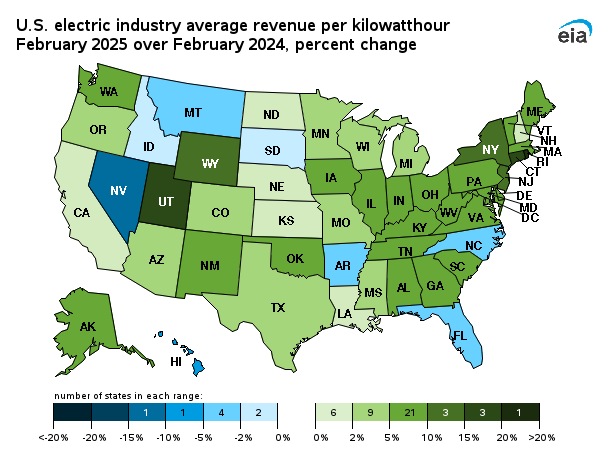
The last Energy Information Agency update, February 24,  saw average rates up 7.1% with a wide range across the states:

....Retail rates/prices and consumption

In this section, we look at what electricity costs and how much is purchased. Charges for retail electric service are based primarily on rates approved by state regulators. However, a number of states have allowed retail marketers to compete to serve customers and these competitive retail suppliers offer electricity at a market-based price.

EIA does not directly collect retail electricity rates or prices. However, using data collected on retail sales revenues and volumes, we calculate average retail revenues per kWh as a proxy for retail rates and prices. Retail sales volumes are presented as a proxy for end-use electricity consumption.

[emphasis added] 

https://www.eia.gov/electricity/monthly/update/maps/change_in_average_retail_revenues.png 

....Forty-four states and the District of Columbia saw increased revenue per kilowatt-hour (kWh) compared to last December, while average revenue per kWh increased by 7.1% on a national basis. The largest percent increase was in the District of Columbia, up 26.3%, followed by Pennsylvania, up 18.9%, and Rhode Island, up 16.3%. Average revenue per kWh figures decreased in five states compared to last year. The largest percent decrease was in Nevada, down 7.7%, followed by Connecticut, down 7.6%, and New Mexico, down 2.9%. In the contiguous US, California, Rhode Island, and Massachusetts had the highest average revenues at 28.18, 28.01, and 26.72 cents per kWh, respectively. North Dakota, New Mexico, and Iowa had the lowest average revenues at 8.12, 8.69, and 8.94 cents per kWh, respectively....

....MUCH MORE 

Capital Markets: "PBOC Steadies the Yuan, Denmark Calls Snap Election, Greens' Win the UK Special Election"

 From Marc Chandler at Bannockburn Global Forex:

The US dollar is mostly softer today as North American participants enter the fray. Trading remains quiet and the general consolidative tone continues amid a relatively quiet news stream. Although US and Iranian talks are set to continue next week, the market remains on edge. 

There are three developments to note. First, the PBOC abolished the reserve requirement on foreign exchange forwards and adjusted rules to make it easier for Chinese banks to provide yuan liquidity to offshore markets. This has the effect of weakening the yuan. Second, the Danish Prime Minister has called for snap election for next month (March 24) to secure a stronger mandate as it seeks a stronger hand to resist US pressure over Greenland. Third, the Greens won the byelection in the Gorton and Denton constituency in Great Manchester. This would seem to complicate the Labour government’s challenge, which is from both the right and left....

*** 

....Data

• US PPI inflation looks to have slowed in January. A 0.3% rise in the headline and core rate will, given the base effect, allow the year-over year headline rate to slow to 2.6% (from 3.0%) and the core rate to 3.0% (from 3.3%). The Chicago PMI may receive some passing interest ahead of November construction spending.....

.....MUCH MORE

Inflation: "Smartphone market set for biggest-ever decline in 2026 on memory price surge, IDC says"

International Data Corporation, a Blackstone company.

From Reuters, February 26:

The global smartphone market is poised to suffer its biggest decline ever in 2026, sinking to a more than decade low in shipments, as surging memory chip prices drive up device costs, the International Data Corporation said on Thursday.
 
Smartphone shipments are expected to drop 12.9% to 1.12 billion units, the research firm said in a report.
 
The decline will hit low-end Android manufacturers the hardest, while Apple (AAPL.O),  and Samsung (005930.KS), are positioned to gain market share as smaller rivals struggle or exit the market entirely, the report said. 
 
"What we are witnessing is not a temporary squeeze, but a tsunami-like shock originating in the memory supply chain," said Francisco Jeronimo, vice president for Worldwide Client Devices at IDC.
 
A rapid build-out of AI infrastructure by tech firms such as Meta, Google and Microsoft has captured much of the memory chips supply, lifting prices as manufacturers prioritize components for higher-margin data centers over consumer devices.
 
Memory chips, or DRAM, are crucial to smartphones as they allow power-hungry applications to run smoothly.
 
Analysts have said rising component costs will force budget-device focused companies to pass the expenses on to consumers, just as demand at higher price points is weakening.
Apple and Samsung, with stronger balance sheets and premium positioning, are better positioned, IDC said.
 
It expects the average selling price of smartphones to surge 14% to a record $523 this year, as manufacturers shift toward higher-margin models to offset ballooning costs....
....MUCH MORE 

We'll add it to the memory shortage series. These two are from January:

Memory: "Do It Now: Industry Insiders Urge Consumers To Front-Run PC, TV, Smartphone Purchases As 'Memory Crunch' Will Intensify"

The reason we exited January 3's "AI data centers are swallowing the world's memory and storage supply, setting the stage for a pricing apocalypse that could last a decade" saying:
With the Consumer Electronics Show kicking off in Las Vegas this might be of interest. 

Thursday, February 26, 2026

"Block plans to lay off nearly half its staff in ‘deliberate and bold’ embrace of AI" (XYZ)

From MarketWatch, February 26:

Block’s stock surges 20% as Wall Street rewards massive job cuts at the parent company of Square and the Cash App

Block, the parent company of Square and the Cash App, is conducting a major reorganization in the age of artificial intelligence, and investors are rewarding the move.

The payment-technology company plans to cut almost half of its workforce, it announced Thursday. The restructuring will bring Block’s employee count below 6,000 versus more than 10,000 today.

Shares of Block are up 22% in after-hours action on Thursday.

The layoffs at Block come just days after Citrini Research rattled markets with the publication of a blog post detailing a fictional scenario in which AI productivity tools were so powerful that they forced widespread shifts in the U.S. labor market. These particularly impacted knowledge workers.

‘Intelligence tools have changed what it means to build and run a company,” CEO Jack Dorsey said in a shareholder letter. “We’re already seeing it internally. A significantly smaller team, using the tools we’re building, can do more and do it better.”

By “intelligence tools,” the company is referring to AI and automation. CFO Amrita Ahuja said that Block has seen sizable productivity gains recently, not just among programmers but also within the broader company.

Within a year, Dorsey expects other companies to follow suit with “similar structural changes.”....

....MUCH MORE 

 After hours the stock is up $12.78 (+23.44%).

Cofounding Twitter and Square as well as founding Bluesky, Mr. Dorsey does have some street cred. 

Be all that as it may be though, I'm still puzzled by this from 2020: 

The Criminal as Entrepreneur (or how did Jack Dorsey end up in a painting from 1883?)

The guy second from right, Dorsey right?

https://nypost.com/wp-content/uploads/sites/2/2020/10/jack-dorsey-0.jpg?quality=90&strip=all&w=1200

From American Affairs, Fall 2018, Volume II number 3:

About the Author
Cedric Muhammad is an entrepreneur and author of The Entrepreneurial Secret. He is the former general manager of Wu-Tang Management and is a member of the African Union’s Congress of Economists. Follow him on Twitter.

***

Painting can do for the illiterate what writing does for those who can read.
—Pope Gregory the Great

Drug dealers anonymous / Y’all think Uber’s the future, our cars been autonomous.
—Jay-Z, “Drug Dealers Anonymous

https://americanaffairsjournal.org/wp-content/uploads/2018/08/bulandtripot.jpg
Jean-Eugène Buland (1852–1926), Le Tripot (The Dive) (1883), oil on canvas, 63.5 × 109.2 cm, location not known. Wikimedia Commons