Friday, March 29, 2019

"China Cracks Down on ‘Himalayan Viagra’ Used to Bribe Officials "

From the OCCRP:
Chinese anti-corruption authorities in the northwest Qinghai province have launched a three-month campaign to crack down on “Himalayan Viagra,” a fungus that is more valuable than gold and is used to bribe officials, the country’s anti-corruption watchdog, the Central Commission for Discipline Inspection (CCDI), said in an online statement.

The fungus, a genus called Ophiocordyceps sinensis, or simply cordyceps, lives on certain caterpillars in the mountainous regions of China and Tibet and has been used by traditional healers since ancient times, according to a 2011 article published in the Journal of Ayurveda and Integrative Medicine.

 It is thought to cure dozens of ailments, but it is mostly used to treat kidney disorders and male sexual problems.

There remains, however, significant scientific debate as to its medical powers. According to an article in the Journal of Traditional and Complementary Medicine, scientists are still unable to cultivate cordyceps in a lab, rendering its biology “a secret” and “its commercial cultivation still a dream.” 
Growing only in wild, remote regions, the fungus fetches a heavy price. A cordyceps dealer told the Hong-Kong based South China Morning Post that he sells the fungus for US$47 (HK$370) per gram, about $5 more per gram than gold. 

“In the good old days, the price of top grade cordyceps was over HK$40,000 [US$5,097] a tael, or more than HK$1,000 [US$127] per gram,” he told the SCMP.....MORE

Thursday, March 28, 2019

"Saudi Arabia Looks to Enter Arctic LNG With Large Investment"

From High North News:
The world’s largest oil company Saudi Aramco aims to acquire large stake in Novatek’s Arctic LNG 2 project. Large Russian energy developments supported by China and now likely Saudi Arabia will continue to impact Norway.

Ongoing discussions between Novatek, Russia’s largest privately-owned natural gas company, and Saudi Aramco, the world’s largest oil company, for cooperation on the new Arctic LNG 2 project are expected to conclude in the coming months. Novatek is considering the sale of up to a 30 percent stake in its latest Arctic venture, “if the terms are favorable,” explains the company’s CEO Leonid Mikhelson.

Previous reports indicated that Saudi Aramco was interested in investing up to USD 5 billion in the Arctic LNG 2 venture, Novatek’s second and largest project to produce LNG in the Arctic and export it via the Northern Sea Route. The project is scheduled for commissioning in 2022-2023 and will deliver 19.8 million tons of LNG annually.

The company’s first project, Yamal LNG, came online in December 2017 and has since delivered more than 10 million tons of LNG to markets in Europe and Asia.

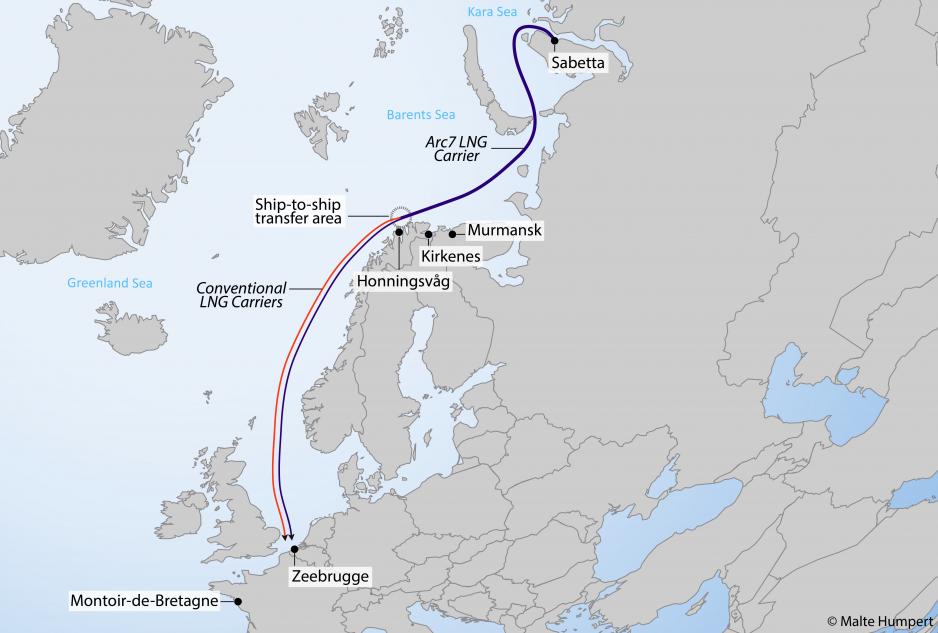
While Russian Arctic developments may appear remote, their economic and potentially environmental impact can be felt beyond the region. A significant share of Russian LNG passes through Norwegian waters during the winter months when up to 300 large LNG carriers operate in the waters of Honningsvåg to transfer gas from ice-capable ships to regular LNG tankers. Russia Arctic crude oil also passes along Norway’s coastal waters.
Map showing Novatek’s winter operation delivering LNG from Sabetta to Europe onboard Arc7 carriers or conventional carriers after ship-to-ship transfer off northern Norway. (Source: Author's own work)
Map showing Novatek’s winter operation delivering LNG from Sabetta to Europe onboard Arc7 carriers or
 conventional carriers after ship-to-ship transfer off northern Norway. (Illustration: Malte Humpert) 

Growing cooperation between Russia and Saudi Arabia...

...MUCH MORE

As noted in the introduction to October 2018's "Saudi Aramco wants to buy 30% of Novatek’s Arctic LNG-2":
Back in December 2017, at the opening of Russia's Yamal LNG operation the Saudis sent Energy Minister Khalid al-Falih to represent the Kingdom. President Putin told him "Buy our gas and you’ll save oil".
We caught up to the story in early February with the passage of Teekay's Eduard Toll across the Northern Sea Route.
Although sometimes slow to grasp what's up, we did have the sense to note the commencement of the Novatek operation was "a pretty big deal."
No kidding.

Here's The Barents Observer, October 26 with the rest of the story:...

"Commodity Traders Turn to LNG as Big Oil Profits Prove Elusive"

Have I mentioned LNG? It appears the game is afoot.

From Bloomberg via RigZone:

With margins narrowing in the crude oil business, some of the world’s biggest commodity trading houses are helping to reshape the energy industry with a drive into liquefied natural gas.
Gunvor Group Ltd., Trafigura Group Pte. Ltd. and Vitol SA have moved a step beyond trading LNG, investing in ships and terminals handling the fuel. That’s accelerating the growth of the industry, moving more gas that traditionally has flowed through pipelines onto ocean-going tankers chilled to minus 162 degrees Celsius (minus 260 degrees Fahrenheit).

Those houses in the 1970s broke away from Big Oil’s long-term contracts and created a market where cargoes change hands in the blink of an eye. Now they’re turning their attention to LNG, where spot trading is rapidly expanding. The result is handing utilities from Centrica Plc to RWE AG more flexibility to buy gas, encouraging them to make the leap away from more polluting coal.
“It looks like a much younger crude oil market,’’ Russell Hardy, chief executive officer of Vitol, said in an interview in Lausanne, Switzerland. “It is an area that can grow and that is a positive for us.’’
The top three commodity trading houses active in LNG have more than doubled their delivered volumes over the past two years and took almost 9 percent of the global trade in 2018, according to data compiled by Bloomberg. Royal Dutch Shell Plc remains the industry leader with 22 percent and stakes in LNG plants and import terminals.

Other traders such as Glencore Plc and Koch Supply & Trading LP also are building expertise or looking to expand in LNG. Most trading houses set up their desks earlier this decade, while Vitol started back in 2005.
There’s now at least 800 people working in LNG trading and sales, no more than 150 or so a decade ago, according to Connexus Search, which has hired for leading trading houses, producers, developers and utilities. Many companies have three to six traders each in Europe and one or two in Singapore.

“Five to 10 years ago, it was really immature,” said Alex Lee, managing director of Connexus. “Now we see LNG become a much more of a traded commodity, like oil, like metals, as the market becomes more liquid.”

Slower growth in the oil trading business is pushing the trading houses into gas. The biggest energy commodity traders now trade twice or even triple the amount of oil they did a decade ago, but their earnings have remained largely flat as the margin per barrel narrowed.

The oil business remains gigantic, with annual physical crude deliveries of at least $2.3 trillion. LNG is enjoying more rapid growth with about $150 billion in revenue last year, according to McKinsey Energy Insights. By next year, LNG volumes will be more than triple what they were at the start of the century, making it the quickest-growing segment of the fossil-fuel industry, according to Shell.
The biggest reason for the expansion: tighter curbs on pollution have pushed power generators toward cleaner fuels.

“We are spending a lot of resources on developing our gas and LNG business,’’ said Gunvor CEO Torbjorn Tornqvist. “In any realistic scenario for cleaner fuel oil, you can’t bypass gas to replace the more polluting sources.’’...MUCH MORE
A Google search of the blog shows 2100 hits for LNG, although many of those are duplicates or other sites linking in.
Excluding those, the hits are still a bigger number than I care to count, or have someone else count.
Let's just call it "A bunch"

"Commodity traders superior to chimpanzees, research shows"

Lest we forget.
A repost from 2008:

I made a serious career track mistake.
Years ago a counselor pointed out that I seemed to have an affinity for animals (It's true. Kids and dogs like me. So do drunks and and folks suffering from various psychopathologies).
Had I followed up on her thinking I would now be tenured, trading outside my species and living the grant-proposal dream.
This was first posted last January:
From RISK Over the Counter:
In a radical overturning of conventional wisdom, scientists in Georgia and California have found significant differences between commodity traders and chimpanzees. Chimps are, in fact, not very good at commodity trading:
the researchers found that chimpanzees often did not spontaneously barter food items, but needed to be trained to engage in commodity barter. Moreover, even after the chimpanzees had been trained to do barters with reliable human trading partners, they were reluctant to engage in extreme deals in which a very good commodity (apple slices) had to be sacrificed in order to get an even more preferred commodity (grapes)...
The report becomes particularly readable when it speculates on the reasons why:
because of their lack of property ownership norms...
...or, for that matter, pockets....
...chimpanzees in nature do not store property and thus would have little opportunity to trade commodities....MORE
That Risk.net link has rotted so here's EurekAlert:
...The observed chimpanzee behavior could be reasonable because chimpanzees lack social systems to enforce deals and, as a society, punish an individual that cheats its trading partner by running off with both commodities. Also because of their lack of property ownership norms, chimpanzees in nature do not store property and thus would have little opportunity to trade commodities. Nevertheless, as prior research has demonstrated, they do possess highly active service economies. In their natural environment, only current possessions are "owned," and the threat of losing what one has is very high, so chimpanzees frequently possess nothing to trade....MUCH MORE
If interested see also:
Trading Behavior Between Conspecifics in Chimpanzees, Pan Troglodytes

Duuude, This Paul Murphy Fellow Is Taking No Prisoners

From FT Alphaville:
Yeah, we're just capturing this snapshot so it sits on the internet. Forever.

Wirecard stock was quoted at €123.30 at pixel. Here are the sell-side names + target prices, where applicable. H/T Bloomberg...MORE
Memorialized and immortalized.

Fun fact: Mr. Murphy chose as the spot for his vacation home the only country with an AK-47 on the national flag:

File:Flag of Mozambique.svg

Yesterday:
Wirecard's obfuscation

Like Mr. Murphy, we too eschew obsfucation.

"How Turkey Committed Financial Suicide" (plus an Avenatti drive-by)

From ZeroHedge:
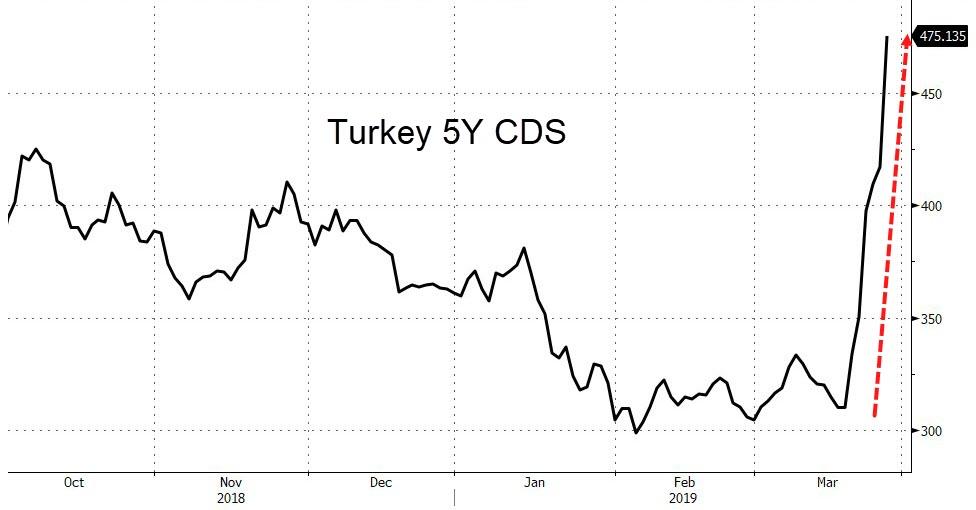
We have extensively documented the ongoing collapse of Turkey's financial system in the last few days as Reserves plunge, credit risk soars, and the currency plummets...
...but Bloomberg macro strategist Mark Cudmore warns this is far more than just a 'Turkey' issue:
"The extraordinary stress currently seen in Turkey’s lira funding market may appear to be a niche issue, but the repercussions will be far-reaching."
Via Bloomberg,
Many commentators expressed surprise or even disbelief that ructions in the lira swap market caused knock-on effects from Sao Paulo to Jakarta. Yet the transmission is real. And it will persist, thanks to value-at-risk (VAR) limits and volatility targeting

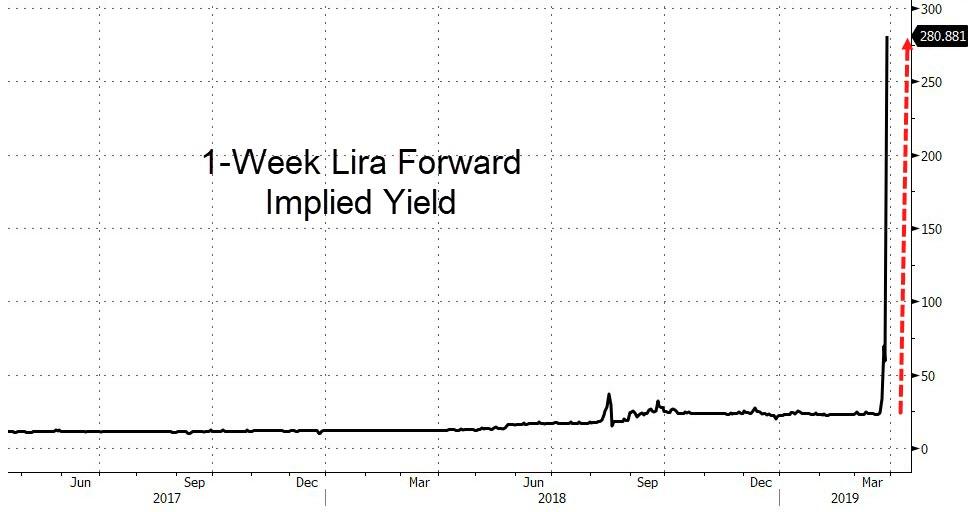
Due to recent policy measures making Turkish lira funding prohibitively expensive -- one-week lira implied yields closed at 280% Wednesday -- it’s become almost impossible for many foreign investors to sell the lira.
This isn’t just about making it too expensive for short-sellers to borrow the currency. The problem also applies to those who are long lira and wish to exit their positions; they are trapped as it’s too costly to unwind their FX swaps....MUCH MORE
Which is why we titled yesterday's post "Turkey: Just Try To Get Your Money Out (TUR)".

Also at ZH: 
Michael Avenatti, Pedophilia , & A Fainting Heiress: NXIVM Sex-Cult Trial Gets Kinked Up In Court
Seagram heiress Clare Bronfman had a dramatic day in court Wednesday where the accused NXIVM sex-cult financier fainted in response to being asked if she'd secretly retained lawyer Michael Avenatti....
We were again able to stay a half-step ahead of ZeroHedge with Monday's:
"Seagram heiress gave prosecutors the death stare during Nxivm trial"
but it is not easy, wherever fainting heiresses are to be found there also is ZH.. 

(Retail) Questions Americans Want Answered: "Will Subscription Coffee Carry The Breakfast Wars?"

From PYMNTS.com:
Breakfast, we have been told since time immemorial, is the most important meal of the day. But it’s not because medical science has told us so. There have been dueling studies over the last several decades about whether breakfast is good, bad or indifferent for consumer health – and the jury is mostly still out.

A piece of fruit at the start of the day definitely won’t hurt anyone, and a three-course meal of bacon, Lucky Charms and donuts is definitely not a good way to start the day – but between those two extremes is a lot of grey area.

The reason breakfast is widely considered the most important meal of the day, however, is instructive to modern commerce. The phrase first appeared in a radio advertising campaign run in the 1940s by Grape Nuts cereal maker General Foods.

“Nutrition experts say breakfast is the most important meal of the day,” said the ad, and the mnemonic power of the phrase stuck in the American consciousness.

Stuck so hard, in fact, that these days the war for breakfast is among the bigger races in the food business. Americans are wired to eat at least something in the morning – every weekday, 135 million people in the U.S. get behind the wheel and drive 51 minutes, round trip, to and from work. Those commuters, according to the PYMNTS Digital Drive Report, spend about $230 billion a year in commuter-inspired purchases.

It’s a big market capture, and the rapid proliferation of ordering food online and picking it up at the drive thru/counter is a testament to how committed merchants – particularly QSR merchants – are to capturing that consumer spend as it drives by each morning.

But last week, Burger King upped the ante on the war of breakfast dominance, and added an additional sweetener. Instead of paying a dollar or two a day for coffee on the ride to work – netting out $20 a month – Burger King wants customers to get their morning Java on subscription for $5 a month. The consumer then has a reason to see everything else on the BK breakfast menu....MUCH MORE

More On WeWork's Burn Rate

From Crunchbase:
Morning Markets: In today’s boom, rare is the tech giant that makes money. And some even lose a lot. And then there’s WeWork.
WeWork, now styled as The We Company, grew quickly in 2018. The famous unicorn doubled its revenue from $886 million in 2017 to around $1.8 billion in 2018. That growth came stapled with stiff losses, however.

Reporting this week from Axios and CNBC and Bloomberg detail the cost of WeWork’s growth, including the fact that the company’s net losses grew by nearly $1 billion in 2018 alone.
Let’s quickly explore WeWork’s results and try to come up with a bull case. The bear case, as we’ll see, writes itself.
Burn
Up front, here are the top-line figures that show how quickly WeWork is growing, and how much that has cost the company in recent years:
  • WeWork’s 2017 revenue: $886 million
  • WeWork’s 2017 net loss: $933 million
  • WeWorks 2018 revenue: $1.82 billion (+105.4 percent)
  • WeWork’s 2018 net loss: $1.9 billion (+103.6 percent)
That works out to a net margin of -105.3 percent in 2017, and -104.4 percent in 2018. That’s flat. So, in 2018, WeWork did not manage to materially increase its profitability despite scaling revenue by more than 100 percent.

That trend does not appear set to change. According to Axios, “WeWork President and CFO Artie Minson says to expect both revenue and net loss figures to continue growing, as the latter relates largely to upfront construction and long-term rental contract costs.”

So what we can see is not a company that sells $1 bills for $.50. Instead, over the past two years, WeWork has sold them for a little less than $0.50. That’s a great way to grow, but a difficult way to reach profitability....
....MUCH MORE
Previously:
March 26
"WeWork Made $1.8 Billion In Revenue Last Year; It Lost $1.9 Billion"

And the post that proves I am addicted:
January 14, 2019
Programming Note: Climateer Investing Is Dropping Coverage of the Company Formerly Known as WeWork
It was fun back in 2014 when headlines like WeWork Worth $5Bil., Weally were fresh and new.

And in 2015 it offered an intellectual exercise: How To Convince Investors Your Startup Is Worth $10 Billion: "There has got to be a way to short this". And  $16 Billion Valuation WeWork Cut Forecasts as CEO Asked Employees to Change ‘Spending Culture’:
"It has been a long cherished dream to figure out a way to bet against this one, links below....

Climateer Investing even took "WeWork: 'Our valuation and size today are much more based on our energy and spirituality than it is on a multiple of revenue.'" at face value:
Roger that, energy and spirituality. Over....
C.I. did not disclose our response to WeWork's mandatory veganism: strategically located bar-b-que food trucks equipped with giant fans to waft the aroma at WeWork properties.

Even when our go-to WeWork jounalist left FT Alphaville we soldiered on: 
"WeWork is getting a lot bigger, but so are its losses"
With Alexandra Scaggs leaving FT Alphaville for Barron's* it appears there is an ecological niche that needs to be filled—WeWork....
But this latest is too much.

From StreetInsider, January 8:

WeWork to rebrand to The We Company and announce a major corporate and strategic shift - Fast Company.
WeWork to rebrand to The We Company and announce a major corporate and strategic shift - Fast Company. (LINK)
"The new structure is part of Neumann’s heady ambition to push the company’s market and opportunity beyond commercial real estate. Rather than just renting desks, the company aims to encompass all aspects of people’s lives, in both physical and digital worlds, he says."
The CEO also talked about the disappointing SoftBank round.
And TechCrunch::
WeWork rebranding won’t work
The company formerly known as WeWork has rebranded as the We Company — although a better name for its network of on-demand office spaces for the newly incorporated and nominally employed, co-living spaces for the same easyJet-set and educational and coding services could be “House of Cards.”...
They should have gone with "WeWork wēbwanding won't work" for the Elmer Fudd alliteration.

When it comes public get your shortin' shoes on.
And when the stock cracks we might relent and resume coverage of The Wee Co.

Here's our parting gift, 2017's "The story of WeWork’s mysterious first investor".

Re/Insurance: Early "2019 hurricane forecast points to slower season if El Niño holds"

Both IRI/Columbia and Australia's BOM are forecasting El Niño or at least El Niño conditions*, see after the jump.
From Artemis:
An early 2019 hurricane season forecast from suggests this year could see a little less Atlantic tropical storm related activity than normal overall, but the recently begun El Niño events strength and persistence is expected to be a major factor here.

NOAA announced the arrival of an El Nino event back in February and as ever it is expected to be a major factor in how many Atlantic tropical storms or hurricanes form during the coming season.
El Nino is expected to be a little on the weak side through spring, hence it is the influence that El Nino could have later in summer that is likely to have the most bearing on hurricane activity in the Atlantic it seems.

Forecasters recently gave a roughly 80% chance that weak El Nino conditions will persist through the Northern Hemisphere spring, with a 60% chance of El Nino conditions persisting into summer, and a 50% chance of El Nino conditions running beyond the summer months.
El Nino’s are often thought to be a driver of less active Atlantic hurricane years and there’s plenty of research to suggest that hurricane numbers and the intensity of tropical storms is perhaps influenced by the occurrence of El Nino conditions and how strong an El Nino is.

But for insurance, reinsurance, ILS and catastrophe bond interests the number of storms is less important than the direction any tropical storms that do form during the season take and their eventual intensity should they interact with land.

Weatherbell Analytics LLC forecaster Joe Bastardi suggests we are in for a hurricane season with below average levels of activity in 2019, in his early season forecast, this includes on an accumulated cyclone energy (ACE) basis, as well as strictly on numbers of storms that form.

Bastardi forecasts between 10 and 15 named tropical storms will form in the Atlantic basis in 2019, with between 4 and 7 becoming hurricanes, and from 0 to 2 attaining major hurricane status....MUCH MORE
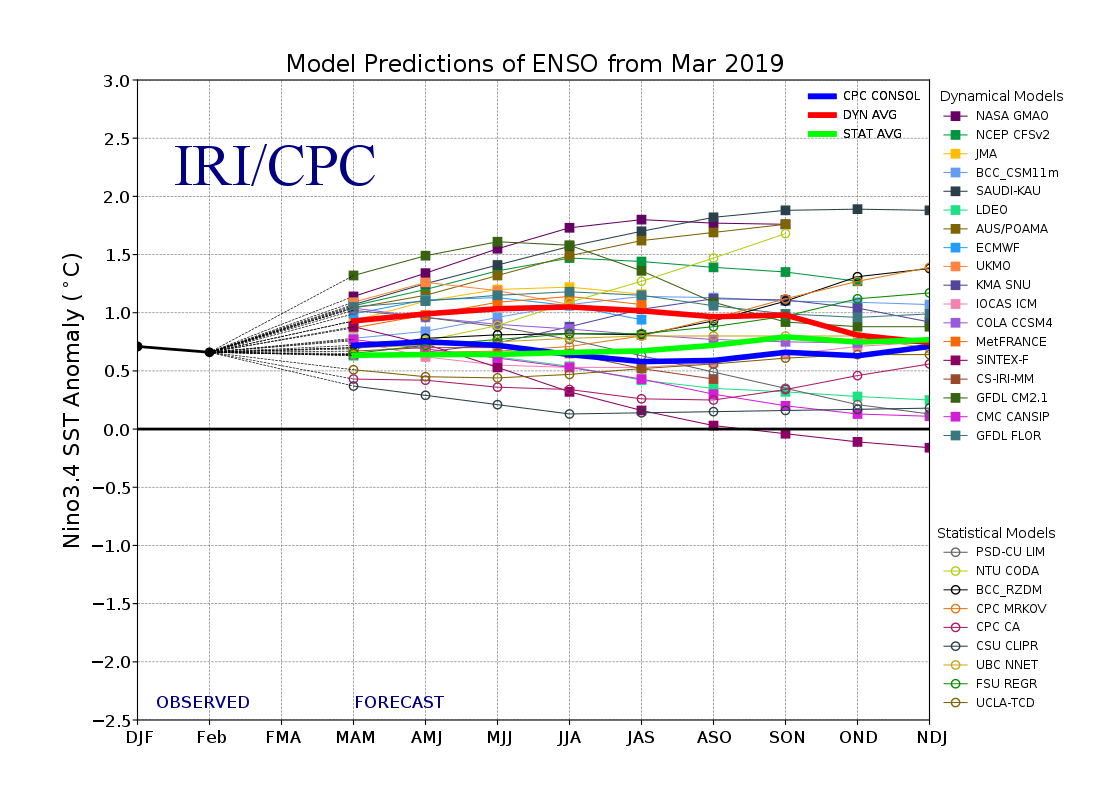
From the International Research Institute for Climate and Society the plume of model predictions:
IRI ENSO Forecast
IRI/CPC ENSO Predictions Plume
Published: March 19, 2019
Note on interpreting model forecasts The following graph and table show forecasts made by dynamical and statistical models for SST in the Nino 3.4 region for nine overlapping 3-month periods. Note that the expected skills of the models, based on historical performance, are not equal to one another. The skills also generally decrease as the lead time increases. Thirdly, forecasts made at some times of the year generally have higher skill than forecasts made at other times of the year--namely, they are better when made between June and December than when they are made between February and May. Differences among the forecasts of the models reflect both differences in model design, and actual uncertainty in the forecast of the possible future SST scenario.
* El Niño "conditions" begin at a half-degree above the zero line while a full blown  El Niño is declared after three rolling three month periods (five consecutive months) above +0.5°C.

And from Australia's Bureau of Meteorology:

El Niño ALERT; likelihood of El Niño in 2019 increases
The El Niño–Southern Oscillation (ENSO) is currently neutral. The Bureau's ENSO Outlook has moved to El Niño ALERT.
This means the chance of El Niño developing in 2019 has increased to approximately 70%, around triple the normal likelihood.

Tropical Pacific sea surface temperatures have touched on El Niño thresholds for the past three weeks, while waters below the surface are also slightly warmer than average. Signs of El Niño in the atmosphere are less clear. While values of the Southern Oscillation Index (SOI) are currently within El Niño bounds, the index is likely to weaken in the coming days. Large swings in the SOI are not uncommon during the southern hemisphere monsoon season. Additionally, trade winds have been closer to normal over the past fortnight after a period of weakened trades in the western tropical Pacific.

Most international climate models suggest sea surface temperatures in the central tropical Pacific Ocean are likely to remain at El Niño levels into winter. Sustained warmer than average ocean waters would increase the likelihood of coupling between the atmosphere and ocean, which would typically cause changes in Australian and global weather patterns. However, current outlooks have less skill for the period beyond May, and therefore predictions for the latter months should be viewed with some caution....MUCH MORE

"When Can Yield Curves Fail As Indicators? "

Now.
As noted in the intro to Feb. 28's Rhyme Time at the San Francisco Federal Reserve Bank: "Did the Yield Curve Flip? Will the Economy Dip?":
The curve is not yet important. We (possibly delusionally) think we'll be able to tell you when it is. 
If you think of all the wasted pixels-n-print spent on the curves over the last six months, the attention of millions of readers, time that could just as well been spent watching cat videos, it has to add up to billions of people-hours.

From Bond Economics (also on blogroll at right):
Although yield curve slopes are very effective indicators for forecasting recessions, they are not infallible. This article discusses some of the reasons why a yield curve inversion can be a misleading recession signal.

NOTE: This article is an unedited section from my manuscript on recessions. As an immediate disclaimer, this section follows one in which I lay out an explanation of why the yield curve is an effective indicator (which is a re-write of an article published earlier). This section counter-balances the enthusiasm from the previous analysis. This is not a statement of my personal views about the recent curve inversion; I remain agnostic with respect to recession odds. Much of the discussion is generic, and may not be applicable to the current U.S. situation.

Although yield curves (slopes) should be expected to be a useful recession indicator, this will not always be the case. (Once again, I will use “yield curve” as a stand-in for what are more properly termed slopes.) The explanation is that they result from fixed income pricing, and investors trade bonds in order to make money, not provide signals to economic analysts.  Anything that puts a wedge between that goal and economic outcomes clouds the signal.


One first obvious point is that bond market pricing could be completely unhinged with respect to future outcomes. We cannot expect bond market participants – and by extension, bond market pricing – to be clairvoyants. We are instead assuming that bond market participants have at least a plausible chance of making a correct prediction based on available information.
One important potential source of distortion – that cannot be corrected for by a technical discussion of bond market characteristics – is that the risk-free curve is pricing the path of the policy rate. Yield curve inversion is associated with expected rate cuts. The historical experience is that the central bank generally only cuts rates when a recession hits, but this is not always the case.
Chart: U.S. Rates and Slope
The figure above shows the experience in the United States around the 1998 crisis in the post-1990 period. (I recycled the chart I used last week, with no updates.) We will focus on the experience around the 1998 crisis. The slope from the Fed Funds rate to the 10-year yield inverted (bottom panel), and this coincided with rate cuts (top panel). Although the move was quickly reversed, bond market participants did correctly anticipate the central bank policy shift. However, the United States avoided recession (the Asian economies were plunged into a deep contraction because of currency pegs breaking, and policies pushed on them by the IMF). In other words, the market was correct about Fed policy (and hence pricing was vindicated), but there was no recession to show for it....MUCH MORE

Capital Markets: "Brexit Uncertainty Deepens as Parliament is Divided, while Turkey's Short Squeeze Falters"

From Marc to Market:
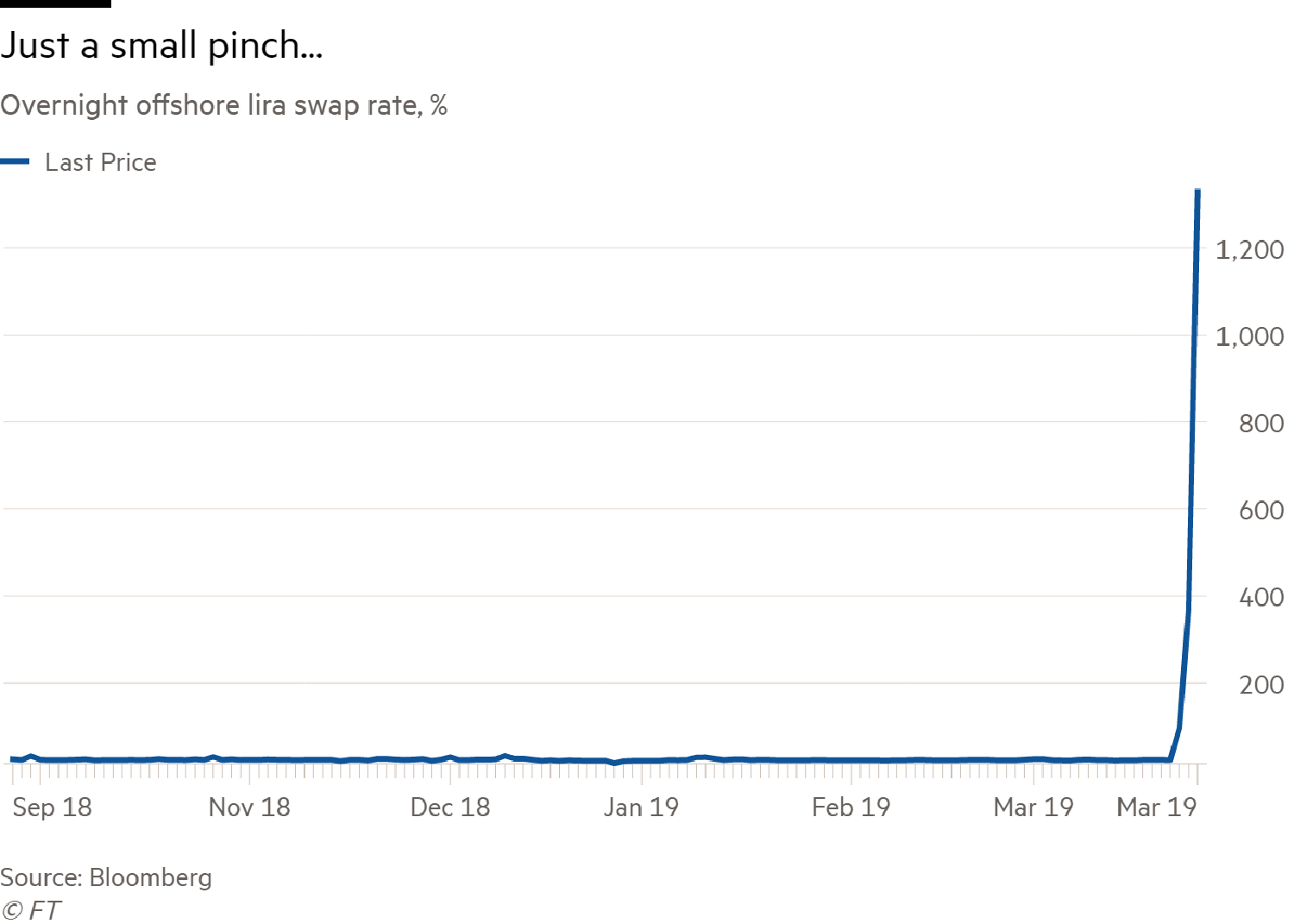
Overview: The lurch lower in global interest rates continue. The US 10-year yield is at new 15-month lows, five basis points through the average effective Fed funds rate. Late yesterday, it appeared that 10-year German Bund yields slipped below similar Japanese government bond yields for the first time since Q4 16, but when the JGB market opened, it the 10-year JGB yield fell a couple more basis points to minus 10, the most negative since August 2016, The 10-year Bund yield is steady near minus eight basis points. Peripheral European yields are firmer as they are tarred with the risk-off brush that is keeping equities on the defensive. The large bourses in Asia-Japan, China, Korea, Taiwan, and Australia weakened, but some smaller markets and India were more resilient. Barring a sharp sell-off tomorrow, Indian shares are poised to extend their advance for a sixth consecutive week. European shares are mixed to higher, with the Dow Jones Stoxx 600 trying to extend its gains for third sessions. US shares are trading with a slightly heavier bias. Most of the major currencies are a little lower, with the yen and Antipodean currencies the exceptions. Emerging market currencies are nearly all weaker, with short-squeeze in Turkey have faltered, pushing the lira down nearly 5% at pixel time despite the overnight swap rate soaring above 1000%. The risk is that the short squeeze will deter international investors who will be asked to refinance some $177 bln of foreign currency debt coming due over the next year.

Asia Pacific
Japan's Ministry of Finance reported portfolio flows on a weekly basis.
The large moves in stocks and bonds and the approaching fiscal year end has seen sharp moves by Japanese and foreign investors. Last week, Japanese investors bought JPY1.1 trillion of foreign bonds. It is the second largest buying spree this year. They were small sellers of foreign shares. Offshore investors were larger sellers of Japanese bonds and stocks. They sold JPY1.5 trillion of Japanese bonds, the most this week, while they sold JPY1.1 trillion of Japanese stocks. Over the past three-weeks, foreign investors sold JPY3.7 trillion of Japanese stocks, which appears to be a record. They have only bought Japanese shares one week here in Q1.

The economic calendar will pick up now. Tomorrow Japan reports employment, industrial output, and retail sales. While jobs reports should be little changed, the February factory output and retail sales are expected to have bounced back from a poor January. Early Monday in Tokyo, the March Tankan Survey will be released, and sentiment is expected to have weakened in most categories, though large non-manufacturers may have fared best. Capital expenditure plans were likely slashed. China reports its official PMI over the weekend. South Korea will report industrial output figures tomorrow and trade figures early Monday in Seoul. Trade seemed to improve as the month, so the year-over-year contraction appears to have eased compared with January and February.

The dollar has traded between JPY110.00 and JPY110.50 today. It found a good bid in early Europe just above JPY110, where a $965 mln option will be cut today. There is an option that expires tomorrow there for $1.2 bln. There is another $840 mln option at JPY110.50 that will also expire today. The Australian dollar is trading near the lower end of the two-week range, which extends to almost $0.7050. There is an A$1 bln option struck at $0.7100 that is expiring. The week's high was set near $0.7150, where a six-week downtrend is found.

Europe
The UK House of Commons failed to find a majority for any of eight different options
to Prime Minister May's Withdrawal Bill. It intends to narrow the range of options to see if a consensus can be forged. Two proposals did a little better than the Withdrawal Bill's second attempt: staying in the customs union and a second referendum. May capitulated to demands and offered to resign once Brexit is approved, but understood to be resigning in the coming months in any case. This seemed to have been enough to entice some like Boris Johnson and Duncan Smith, but DUP continued to oppose the Withdrawal Bill on principle, and this seems to have doomed it.... 
...MUCH MORE

Wednesday, March 27, 2019

Questions the Irish Are Asking: "Are the English ready for self-government?"

Reminiscent of the emancipated slave quoted in Ken Burns' The Civil War who, upon seeing his former master marched past as a prisoner-of-war said:
"Bottom rail on top now, boss."
 From The Irish Times, March 19 i.e. five/six votes ago:
Westminster chaos affords preview of Britain standing alone with its demons 
The alleged aptitude of the English for self-government,” wrote Bernard Shaw in his preface to Androcles and the Lion, “is contradicted by every chapter of their history.” Shaw was, of course, parodying British imperialist rhetoric and its insistence that lesser peoples – including his own nation, the Irish – were not ready to govern themselves. He was being naughtily provocative, which only the most irresponsible of commentators would dare to be in these grave times.

But there is nonetheless some tinge of truth in his words. Aptitude for self-government is not what comes to mind when one looks in from the outside at the goings-on in Westminster last week, when, as Tom Peck so brilliantly put it in the London Independent, “the House of Commons was a Benny Hill chase on acid, running through a Salvador Dali painting in a spaceship on its way to infinity”.
Let’s just say that if Theresa May were the head of a newly liberated African colony in the 1950s, British conservatives would have been pointing, half-ruefully, half-gleefully, in her direction and saying “See? Told you so – they just weren’t ready to rule themselves. Needed at least another generation of tutelage by the Mother Country.”...
...MUCH MORE

See also the FT's Joseph Cotterill who should win an award for his foreign correspondent in Britain thread, that is if there were an award for staying in character in the longest running pastiche on the twitter box, now over two years:
And so many, many more.
Thread
Scroll upward, upward, past the Zambezi, continuing north, scrolling upward, past the headwaters of the Nile, scrolling, scrolling...
I frankly have no idea how many tweets it's been.

We don't catch everything but we try to catch what's important and noted the beginning of the journey.
Here's the initial thread, as linked in "This Cotterill Fellow Is First Rate":

But we knew that didn't we. 
From Medium, March 19 [2017]:

The news is a foreign country
This month I started tweeting about my home country as if its news was happening somewhere else — somewhere a bit closer to the region that I cover, as the Southern Africa bureau chief of the Financial Times.
Well, it’s a hobby.
But there is also a half-serious point behind it, about language and institutions in ‘Brexit Britain’. We’ll get to that point in a second.
But first, since an editor in Friday morning conference took some mild interest in the week’s rather intense political developments in this curious and far-off country, there was a commission to write a catch-up news analysis for the weekend world section…

In a Fractured British State, Separatists See Their Moment

Separatists in Britain’s oil-rich north said this week that they would hold a fresh independence vote only a few years after previously being narrowly defeated, in a major escalation of the political crisis consuming the divided Atlantic seaboard country.
Announcing the vote on Monday, the Scottish Popular Liberation Movement said that it could take place as soon as next year — openly defying the United Kingdom federal government in the far-off southern capital, London.
Preparations for a vote would underline the fragile authority at home of a revisionist power as it prepares for a simultaneous confrontation with 27 of its near neighbours over what it sees as the injustice of the regional order.
“Our efforts at compromise have instead been met with a brick wall of intransigence,” the separatist leader, Nicola Sturgeon, said from the provincial capital, Edinburgh.
She added that the vote would be held once the terms of the UK’s separation from regional bodies — where negotiations will soon begin — were known.
The move signals that a hard line recently taken on north-south power-sharing by Premier Theresa May, leader of the ruling English People’s Congress, has dramatically backfired — despite the separatists losing a similar vote only in 2014. While the EPC could block a new vote, such a move may only play into the separatists’ hands....MORE 
And the ghosts of foreign correspondents, in dive bars and FC clubs around the world, raise a glass and exclaim "Hear, Hear."

We linked to Mr. C dozens of times during his stint at FT Alphaville, this is one of my personal favorites:

Holy Cow, Is This a Paragraph or What? (Poor Nassim Taleb Never Stood A Chance)
By Joseph Cotterill (his ranting gets raves):....

It's Like Uber But For Bras

From Crunchbase:
App-Powered Bra Seller ThirdLove Raises $55M
ThirdLove, the direct-to-consumer women’s bra and underwear company, announced today the completion of a $55 million fundraising round. TechCrunch reports that the company’s valuation reached “over $750 million” thanks to the new fundraising.

Subscribe to the Crunchbase Daily

That puts the company on track to reach unicorn status when it raises again. The latest round brings total financing for the six-year-old company to $69 million, a somewhat low figure for a company worth three-quarters of a billion dollars....MORE
Meanwhile, at Discover Magazine:
Scientists Still Stumped By The Evolution of Human Breasts
Further research is called for by most of the researchers.

Earlier from Crunchbase:
"Ride-hailing, Fracking, Capital Hunger, And Future Profits"

Turkey: Just Try To Get Your Money Out (TUR)

Buy emerging markets they said, diversify your geographical risk they said.
From MarketWatch:

A popular Turkey-focused ETF tumbles nearly 8% as cost of borrowing lira soars 
A popular way to bet on Turkey's stock market was tumbling sharply on Wednesday, as the Turkish government prevented foreign banks from accessing lira in so-called swaps transactions, a tactic intended to prevent bets against lira ahead of a weekend election, according to reports. That move has sent the overnight cost of borrowing lira, or swap rate, to 1,200% from 23%, according to Reuters. The exchange-traded iShares MSCI Turkey ETF TUR, -7.83% was down 7.8% midday Wednesday as the Turkish lira USDTRY, +1.9126% was weakening sharply against bucks....MORE
And from Colby Smith at FT Alphaville, a look at the currency:

Turkey: trading constraints “unprecedented”
With local elections just days away, Turkish authorities are taking “extreme” measures, as one investor puts it, to protect the value of its currency.
The cost to borrow liras offshore overnight soared past 1,000 per cent today, hitting as high as 1,337 per cent at pixel. That is triple the rate from yesterday, and leagues higher than the 23 per cent level seen last week:
Not a Bitcoin chart from 2017.
“It sends the signal that something is dysfunctional here, especially because the lira is still selling off despite this huge squeeze in the offshore market”, says Paul McNamara, an Investment Director focused on emerging markets at GAM. “This is unprecedented. I can't think of a parallel in emerging markets.”...MORE

Worst-Case Wednesday: How To Cross a Piranha-Infested River

Would also apply to "How to get to the Boardroom". See e.g. blood in the water.
From Quirkbooks:
If you are going to certain parts of South America this year for your summer break, and are likely to be around freshwater rivers, this advice may come in handy if you find yourself in a situation where the only way to survive is to cross a river full of flesh eating fish.

Hopefully, you will spend your break having a good time, seeing some beautiful sights and relaxing by the pool, but just in case, The Worst Case Scenario Survival Handbook: Travel, can help you out. And read on to win a copy!

1. Do not cross if you have an open wound. Piranhas are attracted to blood.

2. Avoid areas with netted fish, docks where fish are cleaned, and areas around bird rookeries. Piranhas may become habituated to feeding in these areas and may become more aggressive there.

3. Stay out of waters when piranhas are feeding. When large numbers of piranhas are attacking prey – a true feeding frenzy – they may snap and bite at anything around them. If you see them feeding, stay away, or well upriver....
...MORE

"Ride-hailing, Fracking, Capital Hunger, And Future Profits"

Alex, I'll take "three realities and a dream" for $1000 please.

From Crunchbase:
Morning Markets: I’m a bit jet lagged, but walk with me. We’re talking endless fundraising and growing losses.
The world’s ride-hailing companies need more money.

The revolution that Uber kicked off and a host of startups around the world are racing to complete is a cash-hungry business. Happily for the founders in the space, the business of ride-hailing generates one thing that investors do covet, namely growth.

And that spells big investment dollars. Uber and Lyft have raised billions apiece. Didi and Ola have raised billions apiece. Go-Jek and Grab have raised billions apiece. And none of them, so far as I can tell, generate profit. Indeed, the collection of companies are neck-deep in losses, deficits that show few signs of drying up.

And that means that the group of companies needs more money. And they are out to get it. Lyft’s IPO is set to raise $2 billion, we recently learned. That’s a fraction of the company’s raise-to-date, but is still a staggering sum of money for a company whose competitive edge seems to be its brand.
And even more, recent news has Ola, the India-based ride-hailing leader, raising another $300 million. You’ll forget about the Ola round by lunch. After all, it’s just another few hundred million into a regional ride-hailing shop. It’s not like it’s a big deal.

More notable than simply the titanic sums of capital that the ride-sharing world has raised is how far it remains from making money. The ever-excellent Shira Ovide tweeted something this morning from the Lyft IPO roadshow:
Note that at some point in the future Lyft expects its “Adjusted EBITDA Margin” to reach 20 percent. That’s pretty slack, and the news gets even worse. Here’s more from Ovide:
I had to *really* squint to read the footnotes. “Adjusted” Ebitda excludes: depreciation and amortization, stock pay, charges to insurance reserves, acquisition related costs, income taxes and interest. Ok!
In short, Lyft will, at some point in the future yet to be determined, generate 20 percent profit margins on its revenue, provided that we exclude an incredible slurry of material, GAAP costs from the calculations. The only way I can read the chart’s figures and its explainer text is that Lyft expects to never make money, and it wants you to know it....MORE
Also at Crunchbase:
As Lyft’s Public Offering Looms, A Reminder Of Where The Year’s Unicorn IPO Crop Stands

Today I Learned Amazon Makes 14 Cents On Every Lyft Ride

From poet and piano player (also Lightspeed [India], ex-A16Z)  Hemant Mohapatra‏:

...THREAD

"Edvard Munch's Scream isn't screaming, says British Museum"

Oh dear.
Don't tell the Norwegians.

From The Telegraph:
Look at Edvard Munch’s Scream and what do you see? According to the British Museum, you may have it all wrong.

Many people believe it shows a man screaming. Not so, says the museum, which is about to display a black and white print of the image.

“This rare version of the Scream that we’re displaying at the British Museum makes clear that Munch’s most famous artwork depicts a person hearing a ‘scream’ and not, as many people continue to assume and debate, a person screaming,” said Giulia Bartrum, curator of a forthcoming exhibition devoted to the Norwegian artist.

The lithograph, unlike the coloured works, features an inscription by Munch that reads: “I felt the great scream throughout nature.”

It is a reference to his inspiration for the painting. Munch was walking by a fjord overlooking Oslo in 1892 when the sky turned blood red, a sight that had a profound effect upon him.....MORE

"New Report: Germany Caved To France On Copyright In A Deal For Russian Gas"

From Techdirt:
from the horse-trading:-the-public-internet-for-russian-gas dept
In the hours leading up to the vote in the EU Parliament on the EU Copyright Directive, the German publication FAZ (which has been generally supportive of the Directive) has released quite a bombshell (in German), suggesting that the reason Germany caved to France on its terrible demands concerning copyright was in order to get France's approval of the controversial Nord Stream 2 gas pipeline from Russia.

If you don't recall, the German delegation had actually pushed back on the more extreme versions of Article 13 -- and, in particular, had demanded that a final version have a clear carve-out for smaller companies, so as not to have them forced out of business by the onerous demands of the law. However, after some back and forth, Germany caved in to France's demands, with many left scratching their heads as to why. However, some noted the "coincidence" in timing, that right after this, France also withdrew its objections to the pipeline which is very controversial in the EU (and the US, which is threatening sanctions).

FAZ notes that there were whispered rumors about Germany and France basically trading these two proposals, with Germany effectively selling out the open public internet in exchange for easier access to Russian gas. However, it has now seen documents that support this claim. Germany's economic minister,.....MORE
Earlier:
Why the EU Copyright Directive Can't Be Amended

Why the EU Copyright Directive Can't Be Amended

Trickery.
From Techdirt:

Enough MEPs Say They Mistakenly Voted For Articles 11 & 13 That The Vote Should Have Flipped; EU Parliament Says Too Bad

from the well-that's-messed-up dept

Earlier today we wrote about the terrible vote by the EU Parliament to approve the Copyright Directive including the dangerous Articles 11 and 13. As we noted in the original post, the key vote was whether to allow amendments that could have deleted those two articles. That vote failed by just five votes, 317 to 312. Unfortunately, soon after the vote was finalized, a few of the MEPs who voted against the plan for amendments -- Peter Lundgren and Kristina Winberg -- said they voted incorrectly and meant to vote for the amendments in order to get rid of Articles 11 and 13. Apparently, someone changed the vote order which threw them off:
What happened was that in the middle of a sitting meeting, it was decided to make an adjustment in the order of voting in itself. This did not appear in a clear way where the President was also somewhat confused.
Indeed, soon after that some others admitted to voting incorrectly, believing they were voting for something else.
A few hours later, the EU put out the official voting record which includes an astounding 13 MEPs who said they voted incorrectly. Ten of them said they meant to vote for amendments. Two of them said they wanted to vote against it. And one did not want to vote. As you can see in the screenshot below, everyone next to the "+" would have voted for the amendments if they had actually realized what they were voting on...MORE