Saturday, August 6, 2022

Europe Forsakes Russian Coal...

....for Colombian, Australian, South African, Kentuckian, Canadian, Indonesian....

From The Wall Street Journal, Aug 2:

Europe’s Coal-Buying Frenzy Means Windfall for Producers
Miners from Colombia to Australia see a resurgence; ‘There’s a lot of business going around for everyone.’

TÓPAGA, Colombia—The people of this coal-mining hamlet say they grasp little about Russia’s invasion of Ukraine. But they do know it has translated into boom times for them.

In the wake of the war, Europe is weaning off Russian coal and turning to Colombia and a host of other countries from South Africa to Australia with an urgent appeal: Sell us more coal. A commodity that was fetching $134 a metric ton at the start of the year is now selling for up to $400 a ton, leading coal producers to try to crank up production and creating a windfall in towns like Tópaga, located in the mountains in the heart of this country.

“It’s a very good moment,” said César Pardo, a miner who has seen his salary grow threefold in a matter of weeks. “With prices today, there’s a lot of business going around for everyone, from the smallest (mines) to the very biggest.”

With a European Union embargo on Russian coal imports set to start in less than two weeks, importers are racing to wean themselves off what for the continent has been the main provider of coal for power generation.

They are buying it from open pit mines cut into South Africa’s Mpumalanga Highveld and the vast Illinois basin, in Illinois, Kentucky and Indiana. Germany has been buying from Australia—the world’s second-largest exporter of the thermal coal used to generate electricity—the coal dug up from rolling hills in the wine-growing Hunter Valley region.

The purchasing surge comes despite the pledges of many countries to reduce their coal consumption to combat climate change. Climate activists have expressed concern but say they see the renewed demand being short-term.

“The world has changed,” said Nicolás Arboleda, mining and metals analyst at Baker McKenzie in Bogotá, the Colombian capital. “Thermal plants using coal in Europe are again active.”

Russia accounted for about 46% of the coal consumed by the EU in 2021 and about 40% of its natural gas. As a response to a flurry of sanctions after Russian President Vladimir Putin ordered troops into Ukraine on Feb. 24, Moscow throttled deliveries of natural gas, creating shortages and leading to soaring prices.

Europe has responded in part by turning to non-Russian coal. The Paris-based International Energy Agency said in a report issued Thursday that coal consumption in the EU is expected to rise 7% this year. With China forecast to reduce imports by 45 million tons this year, coal shipments that would have gone there can be redirected to Europe, said Carlos Fernández, senior coal analyst for the IEA.

“The decline in Chinese imports in 2022 will be bigger than the increase in European imports this year,” said Mr. Fernández.

Germany’s coal imports from Australia were up 21% from March through May compared with the same period in 2021, according to customs data collected by Trade Data Monitor. Though a major supplier to Japan and other Asian countries, Australia accounted for nearly 17% of Germany’s coal imports during that three-month period ending this past May.

Imports in Germany of South African coal in that March-to-May period were seven times what they were in those three months in 2021. South Africa accounted for 8.1% of Germany’s imports in that period, up from less than 1% in the same months last year....

....MUCH MORE

Friday, August 5, 2022

"Polio virus found in another New York county, officials say"

From United Press International (also on blogroll at right), August 4:

New York health officials say they have detected the polio virus in wastewater samples in another county, just days after the virus was found in Rockland County.

The virus in Rockland County was discovered last month. It was the first time the polio virus was found anywhere in the United States in more than a decade.

Earlier this week, officials in Orange County said they have also found it in wastewater samples from June and July.

"The New York State Department of Health informed the Orange County Department of Health that analysis from the CDC detected the polio virus" in two different regions, Health Department spokesperson Samantha Fuld said in a statement.

"These environmental findings -- which further indicate potential community spread -- in addition to the paralytic polio case identified among a Rockland County resident, underscore the urgency of every New York adult and child getting immunized against polio, especially those in the greater New York metropolitan area."....

....MUCH MORE

Turning to our analyst:

"Once is happenstance. Twice is coincidence. Three times is enemy action"
—Auric Goldfinger to James Bond in Ian Fleming's Goldfinger.

Paul Murphy Was Right! Scientist Admits "James Webb Photo" Of Distant Star Was Actually A Slice of Chorizo

The detail, the exquisite delineation of the various regions:

From The Miami Herald, August 5:

Scientist shares new ‘star’ photo — but admits it’s actually much closer to home

A prominent French scientist is apologizing after he posted a photo of what he called “the closest star to the Sun.” That’s because it turned out to be something much tastier instead. In the photo, posted July 31 to Twitter, a deep red orb with patches of orange swirling inside seemed to glow against an all-black background.

Claiming the photo came from the James Webb Telescope, the scientist, Etienne Klein, accompanied the image with this message: “This level of detail… A new world is revealed day after day.” 

Except the photo was not of the star Proxima Centauri.

It was a slice of chorizo, a spicy Spanish sausage, Klein admitted in a later tweet. Many people did not get the joke, The Local reported, and some who did criticized the scientist for misleading people at a time when scientific communities are “battling fake news.” Klein, who is a research director at France’s Alternative Energies and Atomic Energy Commission, said the photo was a “form of amusement....

....MUCH MORE

Mr. Murphy was famous for saying "E pur si muove".
Or was that Galileo?

Anyhoo, I'm sure this was Mr. Murphy:

Watch as a Master Trolls the Trolls: Pluto Edition

Some say "Don't feed the trolls".

Hah!

Here Paul Murphy doesn't just chum them in.
He gets 'em close and then shoves the gavage tube down their troll throats to force-feed the little buggers and  create a 42-comment foie gras....

....MUCH MORE

This On The Other Hand May Signal The End Of The Stock Market Rally Is Close

Earlier we mentioned we didn't much care how this jobs report came out and after seeing the Nasdaq 100 futures down 1.6% in late pre-market trade it is now down .99%, big whoop.

However, for the first time since QT was supposed to start on June 1, we saw some serious declines in both Treasury holdings and, I suspect more importantly, Agency MBS.

First up, the largest (by far) line items in the H.4.1 report:

H.4.1

Factors Affecting Reserve Balances of Depository Institutions and Condition Statement of Federal Reserve Banks

August 4, 2022


1. Factors Affecting Reserve Balances of Depository Institutions

Millions of dollars

Reserve Bank credit, related items, and
reserve balances of depository institutions at
Federal Reserve Banks

Averages of daily figures

Wednesday
Aug 3, 2022

Week ended
Aug 3, 2022

Change from week ended

Jul 27, 2022

Aug 4, 2021

Reserve Bank credit

 8,847,741

-   18,258

+  659,077

 8,838,997

Securities held outright1

 8,447,773

-   16,560

+  790,576

 8,439,018

U.S. Treasury securities

 5,727,943

-    5,814

+  457,879

 5,719,119

Bills2

   326,044

         0

         0

   326,044

Notes and bonds, nominal2

 4,933,455

-    7,004

+  396,108

 4,924,116

Notes and bonds, inflation-indexed2

   374,719

         0

+   25,434

   374,719

Inflation compensation3

    93,725

+    1,190

+   36,337

    94,240

Federal agency debt securities2

     2,347

         0

         0

     2,347

Mortgage-backed securities4

 2,717,483

-   10,746

+  332,698

 2,717,552

....MUCH MORE

And from the Federal Reserve Bank of St. Louis' FRED database:


Down $15.384 billion on the week and down $40.430 since June 1. Still far behind the idealized shrinkage of $101.31 billion (1.583 billion per day x 64 days) but going in the desired direction.

Here's the Fed's May 4 announcement of the $47.5 billion per month target for June, July, August.

Another week of $10 billion+ reduction and we will call the end to the equity rally. 

Nasdaq 100 futures currently 13194.75 down 0.99%; S&P futures 4136.75

""Widespread Civil Unrest" Looming In UK Over Cost-Of-Living Crisis"

Uh oh. I have a bad feeling that we are going to see Izabella Kaminska transform from reporting on the unrest, losing her trademark objectivity, and going all "Aux barricades!". 
Izzy, remember to bring some water for when the tear gas flies, it's not the most effective eyewash but helps a bit.  Also, if interested, take a look at "Protest In Hong Kong: The Technology" for some other tips e.g.

Well, in the early days, last spring it was confirmed that short wave radio was an effective form of communication. More on comms further down.

It was shown that lasers have some efficacy when used against facial recognition cameras, either pointed directly at the camera or under the chin to make spooky campfire faces...

And via ZeroHedge: 

The chance of “widespread civil unrest” occurring in the UK as a result of people being unable to afford to pay their bills due to the cost of living crisis is “inevitable,” according to one campaigner.

With energy prices set to soar even higher in October as a result of the sanctions on Russia, many Brits have resolved to refuse to pay their bills as part of a growing backlash some are comparing to the poll tax riots.

London was hit with violent riots back in 1990 in response to the government’s efforts to introduce the poll tax, and the new levy was eventually scrapped after a coalition of interest groups amongst both the working class and the middle class combined to defeat it.

A similar movement under the umbrella of the Don’t Pay organization is now urging people to cancel their direct debits in October if energy prices continue to rise.

Average energy bills in the UK for dual fuel are expected to rise to £3,615 by January 2023, an increase of 283 per cent on March levels....

....MUCH MORE

And In Non-Labor Market News: "Copper Worth Nearly Half a Billion Dollars Goes Missing in China"

From Bloomberg, August 4:

  • Onshore depot in Hebei has 200,000 tons less than it should
  • Risky financing in China exposed by volatility, economy woes

A group of Chinese companies are investigating why a commodities storage site in northern China is holding only one third of the copper concentrate they were financing, according to people familiar with the situation.

Traders from more than a dozen mostly state-owned firms gathered in Qinhuangdao city this week after becoming aware of the missing material following concerns into the borrower’s finances, said the people, who asked not to be identified as they aren’t authorized to speak publicly.

The group has a total claim on 300,000 tons of concentrate worth about 5 billion yuan ($740 million), but there’s only 100,000 tons at the depot, the people said. That puts the dollar value of the missing material at about $490 million.

The copper discrepancy in Hebei province comes just months after a separate dispute, spanning several locations in southern China, over missing aluminum tied to $1 billion of lending. Scrutiny of commodities financing and warehouse operations in China is growing, especially as volatile global markets expose some of the more opaque funding arrangements to greater risk.

At the center of this latest case is Huludao Risun Trading Co., a medium-sized merchant that purchases between 800,000 and 1 million tons of imported copper concentrate a year for distribution to domestic Chinese smelters, said the people. The company typically relies on larger counterparties to finance the materials, and then repays the loans with interest and fees after finalizing the trade....

....MUCH MORE

Giving the lie to one of the scenarios in 2020's "Dungeons & Dragons & Bitcoin":

....One more:

ADVENTURERS:     We're here for your treasure!

DRAGON:              No problem. It's over there.

ADVENTURERS:     But it's...

DRAGON:             ...all in copper pieces, yes.

ADVENTURERS:     But there's no way we can carry all that!

DRAGON:              Logistics is a bitch, isn't it?

Revealed: "Bank of America’s view on the labour market isn’t actually evil"

Following on July 30's ""Bank of America Memo, Revealed: “We Hope” Conditions for American Workers Will Get Worse"" where our additions focused on wage-price spirals rather than evil, we hear that other folks who saw the Intercept piece did the reverse.

Here is FT Alphaville's Alexandra Scaggs setting the record straight:

The Intercept’s Ken Klippenstein has done some sharp reporting on national security, along with many other documents that weren’t meant to reach the public

So we regret that we need to publish this take. 

But it seems like it would be useful to clarify that there is no real scandal in the so-called private memo from Bank of America published last Friday by the Pierre Omidyar-backed outlet. First, the memo was actually a research note, and those notes are distributed to thousands of clients.

To be fair, we can see the appeal of the story idea. Sell-side research has long reminded us of the conflicts between investors’ priorities and the wellbeing of workers, even if those reminders are unintended. Investors may find political gridlock to be helpful, for example, and cures for chronic diseases to be unprofitable....

....MUCH MORE  

I think it all started with:
...That headline, "Revealed" reminded me of my two post fling with scandal headlines last year:
Darkest secrets, EXPOSED!

“Do you have a moment for the environment, sir?”
No,” I barked as I evaded her, “I don’t!”...

Capital Markets: "Downside Risks to the US Employment Report?"

We are not yet putting a lot of weight on the employment numbers but the September and October reports will be importnt.

On the JOLTS report, help-wanted/position available ads are just too ephemeral for betting real money. Years ago, when companies had to spend money in classified advertising there was a tendency to pull ads when positions were filled, making the numbers more timely.

Now we see the notices floating around until HR gets tired of telling people there is no longer a position available and tracks down where the applicants are seeing the openings.

From Marc to Market:

Overview: The US dollar enjoys a firmer bias against the major currencies ahead of the July employment data. Emerging market currencies are mixed. Asian currencies are generally firm while central Europe is a bit softer. Some detect a relaxation in tensions around Taiwan, though China’s aerial harassment continues. Taiwanese shares jumped 2.25% to lead the region that saw China’s CSI 300 rally over 1%. Europe’s Stoxx 600 is giving back yesterday’s 0.2% gain, even though Germany, France, and Spain reported stronger than expected June industrial output figures. US futures are narrowly mixed. The 10-year US Treasury yield is around 2.69%, flattish, while European yields are slightly firmer. 

Gold approached $1800 but has been turned back. It is near $1785 near midday in Europe as it solidifies its third weekly gain. September WTI traded below its 200-day moving average (~$88.80) for the first time since mid-March, while Brent saw its lowest level since the Russian invasion of Ukraine. Prices have steadied so far today. US natgas is edging lower after falling 1.75% yesterday. It is about 1.3% lower on the week. Europe’s natgas benchmark is off 1%, roughly the same as the past two sessions, which leaves it a little higher on the week. Iron ore snapped a five-day slide of around 11% with a 3.2% gain today. September copper is edging higher for the second day. It fell for the first three sessions this week to snap a six-day rally. September wheat gained 2.45% yesterday, its first advance in five sessions. However, it is off 1% today....

*****

...America
There is no doubt that the US labor market momentum is slowing.
The four-week moving average of weekly jobless claims has risen to 254k, up from the 170k low nearly four months ago. They averaged 238k at the end of 2019. Continuing claims have risen to 1.416 mln, which is still an historically low number. At the end of 2019, for example, continuing claims were slightly below 1.9 mln. Alternatively, consider that the four-week moving average is 1.375 mln and it bottomed in mid-June at 1.314 mln. Non-farm payroll growth is also slowing and the median in Bloomberg's survey is for a 250k increase. That would be the lowest since December 2022 when the US reported a 115k decline in nonfarm payrolls. The risk seems to be on the downside. The JOLTS showed a large fall in job openings. The weekly jobs claims rose during the survey week. The ISM manufacturing and services survey showed continued contraction in employment. Economists have been over-estimating many important economic data points. Given the normal volatility of the report, a rule of thumb is that 100k deviation from expectations is the threshold of importance.....

....MUCH MORE

Thursday, August 4, 2022

"China Banks May Face $350 Billion In Losses From Property Crisis"

First up, from Bloomberg via Yahoo Finance, July 31:

China’s banks face mortgage losses of $350 billion in a worst-case scenario as confidence plunges in the nation’s property market and authorities struggle to contain deepening turmoil.

A spiraling crisis of stalled projects has dented the confidence of hundreds of thousands of homebuyers, triggering a mortgage boycott across more than 90 cities and warnings of broader systemic risks. The big question now is not if, but how much it will batter the nation’s $56 trillion banking system.

In a worst-case scenario, S&P Global Ratings estimated that 2.4 trillion yuan ($356 billion), or 6.4% of mortgages, are at risk while Deutsche Bank AG is warning that at least 7% of home loans are in danger. So far, listed banks have reported just 2.1 billion yuan in delinquent mortgages as directly affected by the boycotts.

“Banks are caught in the middle,” said Zhiwu Chen, a professor of finance at the University of Hong Kong Business School. “If they don’t help the developers finish the projects, they would end up losing much more. If they do, that of course would make the government happy, but they add more to their exposure to delayed real estate projects.”....

....MUCH MORE, including some information-dense graphics.

And from the Paulson Institute’s Macro Polo think tank, August 1:

China’s Mortgage Fiasco: To Bail Out or Not To Bail Out?

China’s ongoing housing mortgage crisis will end up being much more significant than just the Evergrande default a year ago. This is largely because of the scale of the problem and the fact that the solution requires Beijing to spend considerable political capital rather than just financial capital.

Although Beijing’s “whack a mole” approach in saving the most distressed property developers will allow it to muddle through and avoid contagion in the banking system, it comes at the expense of eroding government credibility and undermining confidence in the “pre-sale” business model that constitutes more than 80% of all property developer revenue.

At risk are hundreds of billions of Chinese homebuyers’ money tied up in pre-sale accounts that they may not get back. That figure will likely grow as more property developers enter into default in coming months. Nearly half of all listed property developers now trade at a P/E ratio of less than 0.5, which is where Evergrande was at four months before its default. Moreover, nearly 100 cities, including major municipalities like Chongqing, are reportedly experiencing incomplete project problems.

The growing scale of stranded property projects means that the more than 300 mortgage boycotts, based on a rough social media tally, is likely just the tip of the iceberg. As more defaults ensue, these boycotts will grow in size accordingly.

On the face of it, the solution is obvious: bail out distressed developers because this is mainly a cash flow problem of not being able to pay construction firms to finish projects. Once construction restarts, the units get completed, buyers get their homes, and mortgage payments will start to flow again.

But what is obvious is not simple politically. In fact, Beijing has been quite timid in stepping in because it is concerned about a massive moral hazard problem that would shift all the cost onto the central government.....

....MUCH MORE

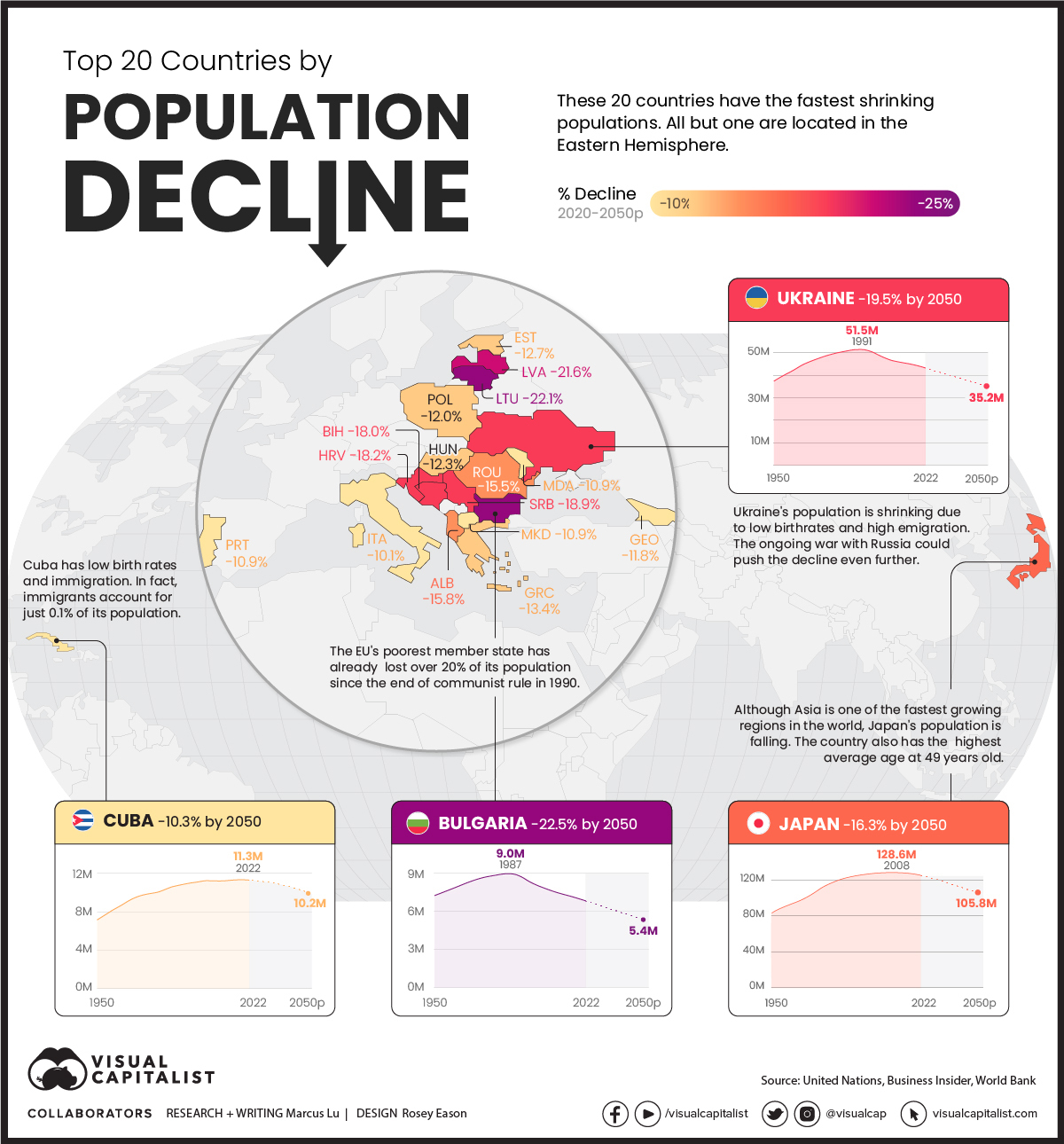
The 20 Countries Whose Populations Will Disappear First

Expanding on and contextualizing some of the comments in July 28's "Are Ukrainian Farmers an Endangered Species?".

First up, Visual Capitalist:

https://www.visualcapitalist.com/wp-content/uploads/2022/07/OC_Population-Decline_July21.jpg

....MUCH MORE, click through for larger image and top 20 ranking details.

And from journo/history nerd Ed West's Wrong Side of History substack, March 10:

'Children of Men' is really happening

Russia is dying. In just the first week of Putin’s war, the country lost somewhere between 2,000 and 6,000 men, according to western sources, an immense and needless tragedy for the poor families left behind to grieve.

Whether those in the Kremlin will weep for them, they must shudder at the thought that in the average week the country loses another 2,000 through population decline, a rate that rose to 20,000 during Covid. But even in normal periods, Russia is now shrinking by more than 100,000 people a year and with no prospect of raising fertility above the 2.1 total fertility rate (children-per-woman) replacement threshold.

The incomprehensible thing about this war is that Russia is not a belligerent young nation in need of expansion; it is not filled with frustrated young men hoping to assert themselves in conflict, as with Syria, Afghanistan or the world’s other conflict zones; it is already elderly, ageing quickly and in some parts heading for oblivion. Some 20,000 Russian villages have been completely abandoned in recent years, and 36,000 others have fewer than ten inhabitants left and will follow them soon. A third of land once farmed in the former USSR has now been abandoned.

If the Russians turn out to have no stomach for this fight, it will probably be for the simple fact that the country does not have enough men to spare. The majority of those poor young men killed for Russia’s honour will be their mother’s only son, in many cases their only child; this will make the impact of Putin’s crimes even more devastating for its victims.

For the same is true of Ukraine; indeed its rate of population decline is even worse. Across huge swathes of the planet, in an ‘infertile crescent’ from Spain to Singapore, the population is ageing quite rapidly, and about to begin a steep decline — a real life Children of Men that is the subject of a new book, Tomorrow’s People by Paul Morland.

Morland’s previous work The Human Tide was a fascinating look at the political and cultural impact of demography throughout history. His follow-up charts the world of the 21st century, and is a similarly enjoyable and informative read; although ‘enjoyable’ might not be quite the appropriate word, for the future in many ways looks bleak, and in some countries, that future is already the present.

The upside is that — and this is admittedly a strange time to suggest it — the world is going to be a lot less violent. Describing a holiday in Catalonia around the time of that province’s comical attempts at independence in 2017, Morland wrote: ‘As I sat in one of Portbou’s squares, I reflected on why the referendum had become a footnote in history rather than the trigger for violent conflict. I looked around at the grey-haired locals enjoying the October sunshine and sipping cups of black coffee. They were far too old to take up arms and march in the streets, enraged by political injustice.’ He contrasts this with the youthful tension he felt in Israel on the eve of the First Intifada, a Palestinian population dominated by teenagers about to explode in violence.

In recent years we have benefited from what has been termed the Pax Americana Geriatrica. Most wealthy countries have median ages of over 40, and middle-aged people don’t like starting fights. We have responsibilities and worries, our frontal-lobes have made us cautious, and our testosterone levels are in terminal decline.....

....MUCH MORE

"The Paradox of Salmon Hatcheries"

From Hakai Magazine:

The golden dream of hatcheries was to make more fish. The reality is much more complicated.

After around 150 years of managing Pacific salmon with all the wrong goals in mind—more fish, more profit—and relying heavily on fish hatcheries to meet those flawed objectives, the path to sustainable and healthy wild salmon runs is murkier than ever.

No one can turn back the clock and convince the builders of that first salmon hatchery in the Pacific Northwest that they would reap more benefits from restoring and protecting habitats. But if Pacific salmon are to have a future, we can learn from the past and the present.

To quote a famous philosopher, life can only be understood backwards—but we have to live it forwards....

....MUCH MORE

Very related:  

Canada Plans To Spend $647.1 Million (Cdn) To Rehabilitate The Pacific Commercial Salmon Industry.

"Russia’s Stranglehold on Vacuum Tubes"

Seems like a very Russian thing to have a stranglehold on.

From The Milken Institute Review:

Old Technology and New Sanctions

There are a thousand stories behind the effort to blunt Russian aggression with economic sanctions, and this is one of them.

First there was oil, gas and wheat. And now... vacuum tubes? To the list of goods that are suddenly scarce following Putin’s invasion of Ukraine, add these hoary electronic devices originally conceived in the 19th century. Hard numbers are elusive, but the vast majority of vacuum tubes in use today were manufactured in Russia, which banned their export (along with hundreds of other products) in March in retaliation for Western sanctions.

Now, few people care about vacuum tubes — or, for that matter, know what they are — but those who do care, care a lot. Guitarists have long treasured audio amplifiers using tubes in place of solid-state components for their responsiveness and, ironically, the way they distort tones when they are pushed hard (think Jimi Hendrix). Some audiophiles, the sort inclined to drop an extra $20,000 for the state of the art, treasure tube-based amps for their warm romantic sound and some ineffable sense of harmonic rightness. It’s not just nostalgic boomers, by the way. Generations X, Y and Z have embraced tube amps along with vinyl LPs and film cameras.

This is not to say that the loss of access to freshly made vacuum tubes should make us think twice about punishing the Russian economy for the invasion. Tube audio is a niche within a niche. And since the companies making the highest-end amps are all privately held, no one even knows how much revenue is at stake. But the rarified market does amount to many millions, if not small-digit billions, of dollars. And Russia’s tit-for-tat announcement that it was freezing tube exports spawned a wave of panic buying, along with price hikes and hoarding.

Pass the Quaaludes
The wild rumpus got going with an announcement of the freeze from Electro-Harmonix, a U.S. company that sells tubes under several brand names — all of which are manufactured at its factory in Saratov, a city of 800,000 about 500 miles southeast of Moscow. Some tube vendors raised prices immediately, while others took their websites offline for the duration. Even those with plentiful inventory have been daunted by the volume of orders. 

“Where are the Quaaludes?” moaned Kevin Deal, proprietor of Upscale Audio, a major online retailer of tubes and audio equipment. “People are acting really foolish right now, buying tubes when they don’t need them. I will sell tubes at a reasonable price to my customers who have bought from us for years, not to some rich guy who’s looking to be the King Midas of tubes.”

Upscale has plenty of tubes, Deal said, but has suspended sales because it has run out of tested ones, and tube quality varies. “Every vacuum tube is different, and because they are made in Russia, China and Slovakia, these people are not inclined to say, ‘this tube’s a little funky, I think I’ll throw it in the trash,’” he said. “In a time like this, when all the top shelf stuff gets sold, you’re going to be left with more crap.”....

....MUCH MORE

"The town with the cleanest air in the world"

 From The BBC, July 28:

In Svalbard, there's a village where the atmosphere is ultra-clean, Wi-Fi is banned, and all buildings go unlocked in case you need to hide from polar bears – but as Anna Filipova discovered, big changes are in the air.

The air around me crackles with diamond-like dust with every breath. It is cold, but clear on this mountainside, in the midst of what is essentially an Arctic desert. The extremely dry, freezing air almost instantly turns the fog of moisture from my mouth and nose into tiny, sparkling crystals of ice.

I am standing just below the peak of Zeppelinfjellet, a 556m (1,824ft) mountain on the Brøggerhalvøya peninsula of Spitsbergen in Svalbard, the Norwegian archipelago in the Arctic Ocean. Beneath me is the town of Ny-Ålesund, a tiny settlement with a population of 45 in the depths of winter and up to 150 at the height of the summer. It is the northernmost permanent settlement in the world, situated around 765 miles (1,231km) from the North Pole.

With the mountain rising on one side, and a fjord on the other, it is a breathtakingly beautiful place. It is perhaps also one of the best places on the planet to take a breath – situated far from major sources of pollution in the almost untouched Arctic environment, the air here is some of the cleanest in the world.

The town's residents are largely scientists who come here precisely for this reason. In 1989,  a research station was built on Zeppelinfjellet's flanks at an altitude of 472m (1,548ft) to help researchers monitor atmospheric pollution. More recently the Zeppelin Observatory, as the research station is called, has become a crucial site for measuring greenhouse gas levels that are driving climate change.

But there are also signs that the air quality here may be changing. Occasionally atmospheric currents carry air from Europe and North America to this part of Svalbard, bringing pollution from these regions with it. Not only are researchers seeing levels of certain pollutants increasing, there are signs of new types of pollution being carried on the wind that are worrying scientists.

"The Zeppelin Observatory is located in a remote and pristine environment, far away from major sources of pollution," says Ove Hermansen, senior scientist at the Zeppelin Observatory and the Norwegian Institute for Air Research. "If you can measure it here, you know that it already has a global prevalence. This is a good location to study the changing atmosphere."....

....MUCH MORE

Potentially very important News You Can Use: What To Do If You Meet A Polar Bear

Three Provincial Premiers Reject Canadian Central Government Nitrogen Decrees

These aren't just any provinces. I mean New Brunswick is nice, and huge shout-out to Gander, Newfoundland but the three provinces in the headline are the breadbasket of Canada and a world-class agricultural resource.

The Premiers of Saskatchewan:

And Alberta:

And Manitoba:

As noted in the outro from yesterday's Nitrogen: "Was the Colosseum Paid for with Pee?":

That's it for Messy Nessy for this week. I had been feeling as though I was depriving our readers of that cyber cabinet of curiosities but it's August in Paris and posting will be light.

We on the other hand, despite a few hundred posts on the topic, have barely scratched the surface in our review of nitrogen: Money, Power, Glory, Guano! 

There is a concerted effort to decrease meat consumption, with or without the concurrence of the citoyens, and the focus recently has been on what makes protein, protein, nitrogen. From the decrees in Canada and The Netherlands to article's such as this in Scientific American, July 27: "Nitrogen Emissions: "Eating Too Much Protein Makes Pee a Problem Pollutant in the U.S.""

The biggest problem with moving too fast on this stuff:
Three Billion People Eat Food Grown With Natural Gas Derived Nitrogen Fertilizer

It would be best if we had an alternative in place before going all command-and-control and recreating in food what is being done in energy.

Ummm, Why Does USA Today Think I Need To Be Able To Idendify The Symptoms Of Marburg Virus Disease?

I think I know the symptoms, you start to bleed from everywhere and then you die.

But what's up with USAT? July 28:

What is the Marburg virus? What you need to know Ghana outbreak, symptoms and prevention.

Ghana has confirmed the first two fatal cases of Marburg virus disease, a deadly infliction in the same family as the Ebola virus. The two patients died in the same hospital in late June and their tests, which came up positive on July 1, were confirmed later by a lab in Senegal. 

The life-threatening virus is highly contagious, and has no known cure or approved vaccine. Here's what you need to know about the symptoms, spread and treatment for the Marburg virus disease....

... How deadly in the Marburg virus?
The average fatality rate, according to the WHO is about 50%. Depending on the strain of the virus and the nature of the outbreak and public health measures, the death rate can range between about 25% and 90%....

And as to symptoms, half the people I deal with exhibit symptoms:

  • Lethargy
  • Non-itchy rash
  • Bleeding from nose, gums, vagina
  • Blood in feces, vomit
  • Confusion, irritability, aggression in severe cases

In the words of esteemed epidemiologist Sting:

Don't stand so
Close to me
Don't stand so
Close to me

If interested see also this March 2022 post:

So, About This Crimean Hemorrhagic Fever
More accurately, Crimean-Congo Hemorrhagic Fever
The introduction to a February 1, 2020 post:

....I've mentioned that one of my doctors has a tropical medicine sub-specialty. His verdict:
Coronavirus is virulent, but not that virulent. It's deadly but not that deadly.[*]
His advice? Stay away from areas with active Ebola and Marburg, in fact all the hemorrhagic fevers; don't smoke, lose five or ten pounds.
He tells everyone to lose 5 or 10 pounds.
He doesn't seem all that impressed with Wuhan coronavirus.

And yes, yes Covid-19 has killed 400,000 people in the U.S. under President Trump, and 600,000 under President Biden and 5,145,239 people in the rest of the world but the last time I saw him he said the jury was still out on just how deadly the coronavirus is and he's part of a group working on why white folk seemed so much more susceptible than people on his native continent, Africa, and I should see if I could drop another 5 - 10 pounds..... 

[*]for chronological reference, six weeks after the good Doctor told me that, Dr. Fauci was saying: "COVID-19 Travel Update: Fauci Says Cruising Is OK If You Are Healthy" - Forbes, March 9, 2020

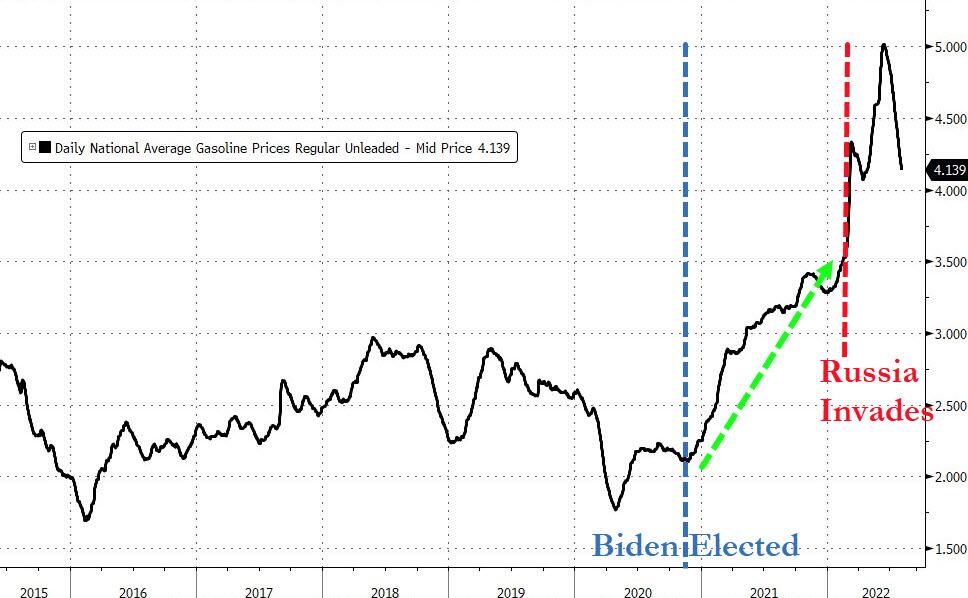
Senior Administration Energy Advisor Goes Full Soviet On Gasoline Prices

From ZeroHedge:

Biden administration energy adviser Amos Hochstein claimed Wednesday that it is “just factually not true” to claim that gas prices were increasing before the invasion of Ukraine earlier this year, despite the fact that the prices had increased by over a dollar per gallon from the day Biden took office to the day of Russia’s military intervention....

.... The guy is just flat out lying.

....MUCH MORE

Bringing to mind an astute comment on what governments do when they think they have impunity:

Which raises the question: "Why do they think they have impunity?"

"2022 hurricane forecast numbers reduced by NOAA and CSU" (plus a caution on interpretation)

From the catastrophe bonds/ILS nerds at Artemis:

After a relatively slow start to what was anticipated to be another particularly active 2022 Atlantic hurricane season, two of the forecast teams most followed in insurance and reinsurance circles have reduced their seasonal storm and hurricane numbers.

But before anyone gets too excited that we might be in for a less impactful Atlantic hurricane season, first it’s always vital to remember it only takes one storm barrelling into a highly populated center to cause a significant industry loss, and second there is still a long-way for the 2022 hurricane season to run.

First NOAA and the US National Hurricane Center, which in May called for a 65% chance of an above-normal hurricane season in 2022, forecasting between 14 and 21 named tropical storms, with between 6 and 10 becoming hurricanes, while 3 to 6 could intensify to become major hurricanes with Category 3 or greater wind speeds.

Updating its forecast numbers today, NOAA now gives a 60% chance of an above-average hurricane season.

At the same time, NOAA’s likelihood of near-normal hurricane activity has risen to 30% and the chances remain at 10% for a below-normal season....

....MUCH MORE (they take this stuff very seriously)

Economy: Both Maersk and BMW Warn

Two from Reuters, August 3. Via Autoblog:

BMW sees volatile 2022 with chips and energy squeeze in focus
Expects fewer deliveries despite strong EV demand

BMW lowered its output forecast and warned of a highly volatile second half on Wednesday, pinpointing supplies of energy in Europe and chips worldwide as the two crucial factors to the carmaker hitting full-year earnings targets.

New incoming orders were beginning to fall but order books remained filled for the next few months, chief executive Oliver Zipse said.

Demand for electric models was particularly high, finance chief Nicolas Peter added. The premium carmaker was on track to meet its goal of doubling all-electric car sales by year end and expected total sales growth of 5% to 10% in the second half boosted by strong Asian markets, he said.
Still, BMW expects year-end deliveries to fall short of last year's record highs of 2.52 million.

Tightening sanctions on Russia, interruption of gas supply or the possibility of the war in Ukraine spreading were not factored into its forecast.
"The crucial factor will be how the supply situation develops – not just for semiconductors, but also energy supplies in Europe," Zipse said.

Daniel Schwarz, analyst at Stifel, called its outlook "rather disappointing" while Berstein Research noted how BMW became the first carmaker to signal caution about demand.

ENERGY EMERGENCY PLANS
Germany and other European Union members have adopted emergency plans to curb gas use amid fears that Russia could further cut or stop supplying gas to Europe in response to Western sanctions over its invasion of Ukraine....

....MUCH MORE

And via Yahoo Lifestyle (what, gotta problem with that?):

Shipping group Maersk expects global container demand to fall this year as sales of durable goods come to a "standstill", leaving flat-screen TVs and furniture piling up in warehouses, the company said on Wednesday.

A surge in consumer demand and pandemic-related logjams holding up containers in key ports had boosted freight rates and profits in the shipping industry in recent quarters, yet the cost of living crisis has reversed that trend.

Maersk, one of the world's biggest container shippers with a market share of around 17%, said inflation and a worsening economic situation had dented consumer demand, which could lead to a normalization of the global shipping market towards the end of the year.

"Sales of durable consumer goods have come to a standstill," Chief Executive Soren Skou told journalists at the company's headquarter in Copenhagen. "Consumers have bought what they need for now of new sofas, kitchens, flat screens and garden furniture."

However there were also more positive signs.

"On the other hand, within fast fashion and lifestyle products, like Nike and other brands, there is still a lot of demand," Skou said....

....MUCH MORE

Creighton University's "Mid-America Index Climbs, Remains in Growth Range: Manufacturers Expect Prices to Rise 7.4% Over Next 12 Months"

 From Creighton's Heider College of Business, August 1L

July Survey Highlights:   

  • Creighton’s regional Business Conditions Index climbed into a range indicating solid manufacturing growth.
  • Despite supply chain bottlenecks and the strong dollar, regional exports were healthy for July.
  • The regional inflation gauge continues to indicate excessive inflationary pressures at the wholesale level. 
  • Confidence indices for all of 2022, all below growth neutral, are the worst recorded since the 2008-09 recession.
  • On average, supply managers expect their prices to climb by 7.4% over the next 12 months, which is down from their 7.7% projection last year at this time. 
  • On average, manufacturing supply managers expect a raise of only 3.5% for the next 12 months.  

OMAHA, Neb. (August 1, 2022) – The Creighton University Mid-America Business Conditions Index, a leading economic indicator for the nine-state region stretching from Minnesota to Arkansas, rose above growth neutral for the 25th straight month. 

Overall Index: The Business Conditions Index, which uses the identical methodology as the national Institute for Supply Management (ISM) and ranges between 0 and 100 with 50.0 representing growth neutral, rose to a solid 59.8 from June’s 58.6. The Mid-America report is produced independently from the national ISM.

“Creighton’s monthly survey results indicate the region continues to add manufacturing activity at a solid pace, but with significant inflationary pressures ahead. Supply chain disruptions eased further in July, according to supply managers,” said Ernie Goss, PhD, director of Creighton University’s Economic Forecasting Group and the Jack A. MacAllister Chair in Regional Economics in the Heider College of Business.  

Even with solid economic activity, supply managers were very pessimistic about the economy. As reported by one supply manager, there are “relatively new concerns with eminent recession and the impacts.”....

....MUCH MORE

"Judge Orders Jury Trial for JPMorgan Whistleblower Who Claims Bank Fired Her for Reporting Suspicious Payments to Former U.K. Prime Minister Tony Blair"

 From Wall Street on Parade, August 3:

Playing out in a federal courtroom in Chicago have been JPMorgan traders telling a jury that it was standard operating procedure at the bank to rig precious metals markets in order to make huge profits for their trading desk. That case is U.S. v. Smith in the Northern District Court in Chicago. (Case number 1:19-cr-00669.)

Now there may be more explosive revelations spilling out against JPMorgan Chase in the Southern District Court in Manhattan beginning this fall. That case is Shaquala Williams v JPMorgan Chase. (Case number 1:21-cv-0932.) Last week, Judge Jed Rakoff, who is overseeing the Williams case, ruled that JPMorgan’s motion for dismissal would not prevail on Williams’ claim for retaliatory dismissal and ruled that a jury trial would begin on November 7. (Judge Rakoff did dismiss the Williams’ claim that the bank’s actions had adversely affected a job offer.)

Williams is an attorney who previously worked as a compliance official at JPMorgan Chase. She is suing the bank for retaliating against her protected whistleblowing activities by terminating her employment after she raised concerns about improper activities at the bank.

One of those improper activities involves Tony Blair, who served as Prime Minister of the U.K. from 1997 to 2007. Blair started taking down big bucks from JPMorgan not long after leaving his post as Prime Minister. JPMorgan Chase issued a press release on January 10, 2008, announcing that Blair was being hired as a “senior advisor” and would be joining JPMorgan’s International Council.

Williams is a financial crimes compliance professional with more than a decade of experience at multiple global banks. Part of Williams’ role at JPMorgan Chase was to make sure that the bank was in compliance with a non-prosecution agreement the bank had signed with the Justice Department in 2016. (The bank has admitted to an unprecedented five criminal felony counts since 2014 and received deferred-prosecution agreements for those.) All of these frauds occurred while Jamie Dimon was Chairman and CEO of the bank.

Not only are this many felony charges unprecedented at a U.S. megabank, but the failure of federal regulators and the Board of Directors of JPMorgan Chase to demand that Dimon step down is equally unprecedented.

The 2016 non-prosecution agreement that Williams was supervising compliance with for the bank stemmed from charges brought by the Justice Department that JPMorgan’s Asia subsidiary had engaged in quid pro quo agreements with Chinese officials to obtain investment-banking business and had falsified internal documents to cover up the activities. The quid pro quo agreements resulted in the bank putting the children of high Chinese government officials on its payroll in order to further its business interests in China....

....MUCH MORE

In January 2009 we happened to catch the Blair/JPM tie-up:
Kids, Some of These Green-Collar Jobs Pay Pretty Well

Wednesday, August 3, 2022

Nitrogen: "Was the Colosseum Paid for with Pee?"

From Messy Nessy Chic:

What we know as the famous Roman “Colosseum” might have been paid for with pee, more specifically poor people’s pee. Built under the rule of Emperor Vespasian of the Flavian dynasty, he is one of the only known rulers in history to have imposed a urine tax on the sale and distribution of urine from the city’s public toilets, which in the time of Ancient Rome, apparently had very good resale value. Let us explain…  

Roman Emperors had controversial lifestyles, but the Emperor that preceded Vespasian – Nero – trumped them all and bankrupted the empire with reckless spending. The senate declared him a public enemy, he committed suicide and a civil-war broke out. Rising from this chaos was Vespasian, a commoner and civil servant known for his fiscal responsibility and military campaigns. Basically, the opposite of Nero. His peers nicknamed Vespasian “Mulio,” or mule-breeder, because he sold mules to get to finance the North African Province he governed rather than exploiting the local resources. 

Now Emperor, Vespasian found the imperial treasury depleted and needed to generate funds. He did this by raising taxes. Most of his taxes targeted the rich. He even extorted nobles by promoting them, only to then imprison them and make them pay fines for their freedom. People said he used these men as “sponges” – soaking them when they were dry and squeezing them when wet. 

However, his most infamous tax targeted the commoners. Most Romans were generally “too poor to have a pot to piss in” as the saying goes, and had to go to local public latrines to relieve themselves. Landlords would collect and sell the peasants’ pee. Buyers paid the tax. Why would anyone buy urine, you ask? Tanners, wool producers and launderers coveted piddle for its high ammonia content and some Romans even believed it could be used it for whitening their teeth.....

....MUCH MORE 

That's it for Messy Nessy for this week. I had been feeling as though I was depriving our readers of that cyber cabinet of curiosities but it's August in Paris and posting will be light.

We on the other hand, despite a few hundred posts on the topic, have barely scratched the surface in our review of nitrogen: Money, Power, Glory, Guano! 

There is a concerted effort to decrease meat consumption, with or without the concurrence of the citoyens, and the focus recently has been on what makes protein, protein, nitrogen. From the decrees in Canada and The Netherlands to article's such as this in Scientific American, July 27: "Nitrogen Emissions: "Eating Too Much Protein Makes Pee a Problem Pollutant in the U.S.""

The biggest problem with moving too fast on this stuff:
Three Billion People Eat Food Grown With Natural Gas Derived Nitrogen Fertilizer

It would be best if we had an alternative in place before going all command-and-control and recreating in food what is being done in energy.

Edward Luttwak Asks: "Why Am I Banned in Ukraine?"

From Tablet Magazine, August 1:

Geostrategist Edward Luttwak explains his support for plebiscites in Donetsk and Luhansk

Last year a “Center for Countering Disinformation,” headed by former lawyer Polina Lysenko, was established within Ukraine’s National Security and Defense Council under the authority of President Volodymyr Zelensky. Its stated aims were to detect and counter “propaganda” and “destructive disinformation” and prevent the “manipulation of public opinion.”

On July 14, 2022, it published on its website a list of politicians, academics, and activists accused of “promoting Russian propaganda,” including me.

Two specific reasons were given for my inclusion on this list. The first one was that I said or wrote that “Putin has been provoked to start a war against Ukraine.”

This is an easy one to dispense with: I never said or wrote or thought that. Either Polina Lysenko or one of her staff confused me with somebody else, or else they cut short a longer phrase of mine, such as “Putin’s agents claim that he was provoked …”

The other reason given is that I’ve supposedly proposed holding referendums in the Donetsk and Luhansk regions of eastern Ukraine as a way out of the war....

"China Has Started What Looks Like A Sea and Air Blockade of Taiwan"

From 19FortyFive, August 3:

Speaker of the House Nancy Pelosi has left Taiwan after a day of meetings with Taiwanese officials. Despite several warnings, including assessments that Pelosi’s trip might even be harassed, China didn’t respond directly. But now, with Pelosi gone, Beijing is upping the ante.

Sea and Air Blockade
Hours after Pelosi’s plane departed Taipei, the Chinese military announced large-scale military exercises all around Taiwan, essentially declaring a sea and air blockade around the small island nation.

Indeed, some of the Chinese military drills will take place both within Taiwan’s 12 nautical mile maritime and air territory and 6-mile internal waters, which is considered sovereign territory in international law and has the same rights as ground territory. If Beijing carries out military exercises there, it would be the same as if it landed a battalion of marines in Taiwan for military drills without permission....

....MUCH MORE

The Speaker was entirely within her rights to make the trip but I sure hope the U.S. military and State Department have gamed out the scenarios 16 moves ahead. Otherwise this is pretty much all we managed to accomplish:


p.s.contra the title, that's not a monkey doing the poking. As one of the commenters pointed out, monkeys have tails. However, the same commenter thought it was a chimp but if I had to guess, I'd say it is a very young gorilla,

Now back to China blockading Taiwan. WTF?