Friday, December 7, 2018

"Fed’s QE Unwind Reaches $374 Billion"

It was in April 2017 that David Keohane, then Alphaville, now barricade beat—Paris, highlighted this bit from a Barclay's report:

Your fast changing Fed and the spur to runoff, charted
...We now expect the committee to raise the target range for the federal funds rate two more times this year, in June and September, and to announce balance sheet runoff at the December FOMC meeting....
Basically telling us when the good times would end and the madness begin.
Fast forward to Wolf Street, December 6, 2018:

Fed’s QE Unwind Reaches $374 Billion 
But how low might the Fed’s balance sheet go?
The Federal Reserve shed $54 billion in assets over the five weekly balance sheet periods that encompass the calendar month of November. This reduced the assets on its balance sheet to $4,086 billion, the lowest since January 15, 2014, according to the Fed’s balance sheet for the week ended December 5, released this afternoon. Since the beginning of the QE unwind — or “balance sheet normalization,” as the Fed calls it — in October 2017, the Fed has now shed $374 billion:
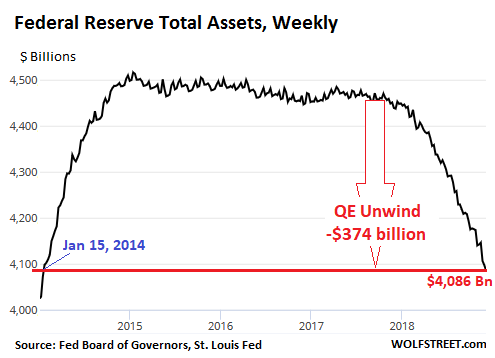
The Fed holds a variety of assets, including the Treasury securities and mortgage-backed securities (MBS) that it had acquired as part of QE. Between the end of QE in late 2014 and the beginning of the QE unwind in October 2017, the Fed replaced maturing securities with new securities to keep their levels roughly the same. Starting in October 2017, the Fed has been shedding Treasury securities and MBS. 

How much lower will the balance sheet go?
The Fed held about $910 billion in assets in the summer of 2008, before the whole mess started. Over the prior decades, the amount of assets on its balance sheet had roughly grown in line with nominal GDP (not inflation adjusted); and this trend would have continued. In other words, there is zero chance the assets on the balance sheet will ever revert to $910 billion.

Since Q4 2008, nominal GDP has grown by 42%. Assuming that QE continues for five more years: At the average growth rate of the past few years, nominal GDP in 2023 will have grown by 72% since Q4 2008. If the Financial Crisis had never happened and if therefore the Fed had continued expanding its balance sheet in line with nominal GDP, the balance sheet would have reached about $1,570 billion by 2023.

This marks the absolute lowest point for the assets on the Fed’s balance sheet by the time the QE unwind is finished – but more likely, the balance sheet won’t drop quite that far.

Treasury Securities
Until October, the QE unwind had been in ramp-up mode. In October, it reached cruising speed, according to the Fed’s plan. In the cruising-speed phase, the Fed is scheduled to shed “up to” $30 billion in Treasuries and “up to” $20 billion in MBS a month, for a total of “up to” $50 billion a month. So how did it go in November?

From November 1 through December 5, the Fed’s holdings of Treasury Securities fell by $30 billion to $2,241 billion, the lowest since January 22, 2014. Since the beginning of the QE-Unwind, the Fed has shed $225 billion in Treasuries:
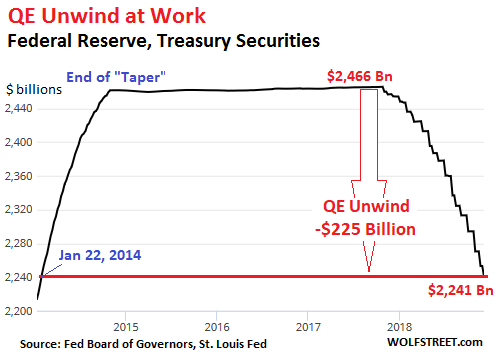
The Fed sheds Treasury securities by allowing them to “roll off” when they mature. When Treasury securities mature, the Treasury Department sends money to all holders of those maturing bonds to redeem them at face value. Treasuries mature mid-month or at the end of the month. Hence the step-pattern of the QE unwind in the chart above.

On November 15, three issues matured totaling $34 billion. On November 30, three more issues matured totaling $25 billion. So for the month in total, $59 billion in Treasury securities matured. This was an unusually large amount, the most since the QE unwind began.
Sticking to the plan, the Fed did two things:...MORE
As it turned out the Board directed the New York Fed's Open Market Desk to begin the roll-off operations in October 2017 rather than December but because we had marked our calendars and we dramatically scaled back our equity rah-rah which allowed a semi-sanguine view of, first the February, and then October-December volatility.
We're still looking for equities to set their ultimate highs for this go-round somewhere above 3000 on the S&P but fully aware this transition by the Fed is a definite headwind and uncharted territory for pundits and participants and pundit-participants.

Here's the Fed go-ahead:
Implementation Note issued September 20, 2017
 
Keep your head down Mr. Keohane.

And readers, we meant every word of last Sunday's pair of posts after the G20 news but before Monday's big gap open:
Sunday, Dec. 2 
Yuan Surges In Early Trading, Signals 2800 Open For The S&P 
We cautiously caution, be cautious.
The real action in equities, and probable all time highs for the indices will come in the first quarter of 2019....
Sunday, Dec. 2
Trade Talks: Grains and Beans 
More chance of an extended move here, over the next few weeks, here than in equities, see after the jump.... 

Questions DARPA is Asking

From DARPA's Twitter feed:


The UN Food and Agricultural Organization's Food Price Index for November, 2018

From the FAO, December 6:

FAO Food Price Index registered another decline in November
Release date: 06/12/2018
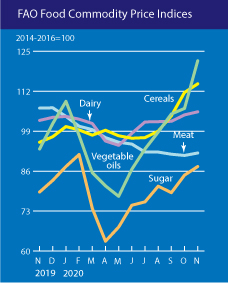
» The FAO Food Price Index* (FFPI) averaged 160.8 points in November 2018, down 2.1 points (1.3 percent) from October, the lowest since May 2016, and nearly 15 points (8.5 percent) below its level in the corresponding period last year. The decline in November was led by much weaker vegetable oil, dairy and cereal prices. Meat values also fell, though slightly, while sugar prices firmed.

http://www.fao.org/fileadmin/templates/worldfood/images/home_graph_1_dec.jpg?23344565» The FAO Cereal Price Index averaged almost 164 points in November, some 1.7 points (1.1 percent) below October and 11 points (7.1 percent) down from November 2016 average. Large nearby export supplies weighed on wheat prices while intensified export competition put downward pressure on maize quotations. New crop arrivals continued to weigh on rice export quotations despite some support provided by demand from the Philippines and expectations of lower fragrant rice production in some key exporting countries.

» The FAO Vegetable Oil Price Index averaged 125.3 points in November, down 7.6 points (5.7 percent) month-on-month, marking the tenth consecutive monthly fall and a twelve-year low. The decline reflects weakening prices across the vegetable oil sector. International palm oil quotations posted a marked drop, fuelled by both persisting large inventories in leading exporting countries and the recent contraction in global mineral oil prices. At the same time, soy oil and sunflower oil values weakened amid, respectively, abundant supplies across the US, the EU and several emerging markets and positive production prospects in the Black Sea region.

http://www.fao.org/fileadmin/templates/worldfood/images/home_graph_2_dec.jpg?23944588926» The FAO Dairy Price Index averaged 175.8 points in November, down 6 points (3.3 percent) from October, representing the sixth consecutive month-on-month drop. At this level, the index is 13.9 percent below its value in the corresponding month last year and 18.3 percent below its highest level reached this year (in May). In November, international price quotations of butter, cheese and Whole Milk Powder declined, driven by large stocks coupled with increased availability of export supplies, especially from New Zealand. By contrast, Skim Milk Powder prices partially recovered in November, mainly on stronger import pace by buyers seeking immediate deliveries.

» The FAO Meat Price Index* averaged 160 points in November, marginally lower than its slightly revised value for October, and 7.4 percent below its level in the corresponding month last year. In November, international price quotations for poultry, pig and ovine meat continued to ease, with ovine meat falling the most, while those of bovine meat marginally recovered. Notwithstanding increased demand from Asia, ovine prices declined, underpinned by high export supplies from Oceania.  Pigmeat price quotations fell for the third consecutive month, reflecting availability of large export supplies from main producing regions and continued trade restrictions imposed on account of African swine fever outbreaks. Poultry meat prices remained under pressure due to slack demand. By contrast, after five months of declines, bovine meat prices rebounded slightly, supported by somewhat limited spot supplies and firm demand from Asian markets....
...MUCH MORE

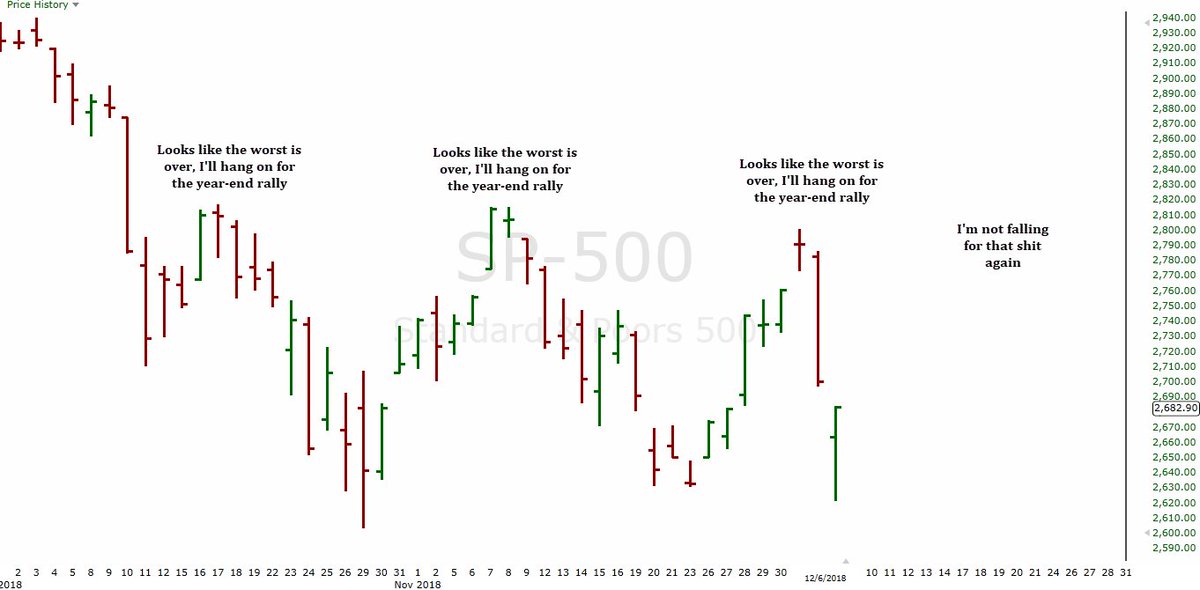
Chartology: Well It Does Have A Sort Of Symmetry

and red/green Christmas-y!

https://pbs.twimg.com/media/DtwzZuWX4AAfGPJ.jpg


From StockCats

Oil & Gas: U.S. Geological Survey Latest Permian Basin Report—That's a Big Field

From Investing.com (also on blogroll at right):
December 6, 2018
Texas and New Mexico shale basins hold 49 years worth of oil: USGS
The largest oil field in the United States holds as much as 49 years worth of oil at current production rates, according to data from a report released on Thursday by the U.S. Geological Survey (USGS).

In its first assessment of the Delaware portion of the Permian shale field that spans west Texas and New Mexico, the USGS, which is part of the U.S. Department of the Interior, said it contains about 46.3 billion barrels of oil and 281 trillion cubic feet of natural gas.

The government estimates include all underground shale oil and gas that is technically recoverable but may not be economic to extract at current prices.

The estimate is twice the size of the country's next largest shale reserve - the Midland Basin - another portion of the Permian. In 2016, that was found by the USGS to have about 20 billion barrels of oil and 16 trillion cubic feet of natural gas....MORE
Here's the USGS
USGS Identifies Largest Continuous Oil and Gas Resource Potential Ever
And the report:
Assessment of Undiscovered Continuous Oil and Gas Resources in the Wolfcamp Shale and Bone Spring Formation of the Delaware Basin, Permian Basin Province, New Mexico and Texas, 2018

Meanwhile at Slope of Hope:

Trillions of dollars in equity lost.
Silicon Valley stocks down 40%, 50%, 70%, or more.
Dejected and disillusioned millennials.
The smoldering ruins of the failed cryptocurrency industry.
I’m honestly not sure how much more happiness I can take.
Pleasure Me, Nov. 19, which included this chart:
https://v5v3t3f8.stackpathcdn.com/wp-content/uploads/2018/11/Omega-640x529.png

We'll be back with how it turned out and maybe some thoughts on the mind of a short-seller

NASA Admonishes Elon Musk For Marijuana Use, Joe Rogan Comments (SpaceX)

From Mr. Rogan's Twitter feed:


"Is China Buying Soybeans Yet?"

The question the whole nation is asking.
Two from AgProfessional, Dec. 6:

So how soon will we see U.S. ag start flowing again to China?
Bloomberg News reporting Chinese officials are preparing to restart those imports and specifically U.S. soybeans and liquefied natural gas.

If true, it backs up a statement released over the weekend from the White House that China had agreed to start buying some U.S. products immediately. U.S. traders, however, say they're yet to see evidence any buying has taken place....MORE, including video

And: 
China Isn't Buying U.S. Soybeans, Yet 

Here is the two week chart from FinViz:
https://finviz.com/fut_chart.ashx?t=ZS&cot=005602&p=h1&rev=636797649002615879
The commodity algos, unlike their equity brethren, remain stoic in the face of uncertainty.

Thursday, December 6, 2018

If Michael Bloomberg Sells: Who has the money — and similar strategy — to buy Bloomberg

From CNBC, Dec. 5:

Mike Bloomberg says he'd try to sell Bloomberg LP if he becomes president, but finding a buyer wouldn't be easy
  • Mike Bloomberg, owner of Bloomberg LP, said in a Radio Iowa interview that he will likely try to sell his company if he becomes president.
  • "I think at my age, if selling it is possible, I would do that,” Bloomberg said. “At some point, you’re going to die anyway, so you want to do it before then.”
  • Bloomberg would only sell the company if he becomes president, rather than simply run, according to a person familiar with the matter.
Mike Bloomberg said Tuesday in a Radio Iowa interview that he will probably try to sell Bloomberg LP if becomes president in 2020.

"I think at my age, if selling it is possible, I would do that," Bloomberg said. "At some point, you're going to die anyway, so you want to do it before then."

Bloomberg said he would have to start the process of either selling or putting the business into a blind trust if he ran because any process would take a long time. But he won't sell the business unless he actually becomes president, according to a person familiar with the matter.
Finding a buyer may not be easy.

Bloomberg takes in about $10 billion in annual revenue, according to a source familiar with the matter. The company would probably fetch more than $40 billion in a sale, according to two investment bankers familiar with the company's finances.

A spokesperson for Bloomberg LP declined to comment.

There aren't many companies large enough to absorb Bloomberg that make sense as buyers. The most likely option for a sale, said the bankers, is a consortium leveraged buyout deal. Private-equity firm Blackstone acquired a majority stake in Thomson Reuters's financial information business, which competes with Bloomberg, in a deal that valued the unit at $20 billion earlier this year.
Still, club private-equity deals aren't nearly as common as they were a decade ago. Many of those transactions led to huge losses after the financial crisis. A leveraged buyout of Bloomberg would likely be the largest in history, topping the $32 billion acquisition of TXU led by KKR & Co. and TPG in 2007....
Google and Amazon both have the balance sheets to acquire Bloomberg. But Google's primary revenue stream and area of expertise is advertising sales related to its search business. That's not Bloomberg's business at all, which derives its revenue from selling pricey subscriptions (about $22,000 a year) for its financial news and information service....
...MORE

Headline from and HT to: TalkingBizNews

Yesterday: "Bloomberg would consider selling his company if he runs".

If considering a bid see also:
"Can Anyone Bury Bloomberg?"

"Twilight Of The Terminal: The Disruption Of Bloomberg L.P."

Here's Nomura's McElligott: "Trader Who Correctly Called Tuesday's Crash Lays Out What Happens Next"

Unbeknownst to moi as I was typing "Quant blame game over stock sell-off pits Nomura against Nomura":
This is a placeholder until ZeroHedge gets around to posting Charlie McElligott's latest on the CTA crowd....

ZH had already posted but no one told me.

Here it is from ZeroHedge:
Having correctly predicted the "breaking point" trigger for the S&P's Tuesday plunge - which incidentally coincided with the 200DMA - at which CTAs would collectively puke, Nomura's head cross-asset quant Charlie McEllgiott, is back with a note slamming his critics (apparently those who failed to be right decided to deflect their lack of added value by criticizing the Nomura strategist), while also mapping out what's next for the market should the current risk waterfall continue.

First, we go right to McElligott's well-deserved victory lap, in which he steamrolls his "quant" critics, and writes that he received a number of pass-along notes yesterday from around the Street "which questioned the validity accuracy of our CTA model ‘deleveraging’ call from Tuesday, which again “nailed” the S&P futures level where the market would come under significant notional selling pressure (as well as Russell and Nasdaq “trigger” levels as well)."

What he is saying is simple: Wall Street is perplexed by how he could get it so right, and all the other "experts" did not, and is accusing the Nomura quant of a lucky one-time fluke. Needess to say, McElligott will have none of it, and highlights that as part of the sellside criticism of his take, there were "mis-categorizations/inaccuracies" on a number of fronts which need to be highlighted:
  • Misinformation as to the notional size of the selling which we estimated vs what was reported
  • Inaccuracies of the AUM scale of the CTA universe and position sizing / leverage allocation therein
  • Whether this “trigger” was a “deleveraging” of a long (size reduction of the long which it was) vs outright “shorting”(which was misreported / misinterpreted by some)
  • Omissions / lack-of-context surrounding macro- and positioning- / performance- catalysts which I’ve been documenting in recent notes that actually “kicked off” the move to said trigger levels
  • A general lack-of-awareness as to the make-up of the model--i.e. that we incorporate 2w, 1m, 3m, 6m and 12m windows to capture the broad-spectrum of CTA lookback periods across the trend universe
  • No context as to the incredible accuracy of the model—not just via the success that the tool has had in identifying “market inflections,” but with regards to our CTA replication model’s incredible track-record vs benchmark
Not satisfied with the evisceration of his most vocal critics, the man who is rapidly emerging as the true quant "Gandalf" writes that in light of "the incredible task of prognosticating 58 unique cross-asset futures contracts as our QIS team’s model does—and inherent requirements of trade direction / sizing / leverage of course—the index replication model is brilliantly accurate on performance-matching vs the index", to wit:
  • Since 2016, the model has exhibited an average deviation from benchmark of just 54bps, with a median deviation from benchmark of 48bps
  • Over the incredibly volatile last 6m both from a cross-asset realized volatility- and CTA performance- perspective, the average deviation of the replication model from benchmark is just 56bps, with the median deviation from benchmark being 58bps
And his crushing parting words at his desperate-for-publicity-and-page-views critics:...
...MORE

I have to go have a word with some young people, back in a bit.

In Some Positive News, The Desert Locust Situation Remains Calm

No breeding frenzies, no orgies, no Steve Bannon with the sex robots.
From Locust Watch:

Desert Locust situation update 3 December 2018 
Locusts move to winter breeding areas
The Desert Locust situation remains calm in all countries.
In the Central Region, adults and a few small groups moved from the summer breeding area in eastern Sudan to the Red Sea coastal plains and northeastern subcoastal areas of Sudan. Low numbers of adults were present on the coast of Eritrea and Saudi Arabia. As good rains fell along both sides of the Red Sea, small-scale breeding was already underway in Eritrea and commenced during the last week of November in Sudan. Local breeding also occurred along the edge of the Empty Quarter in southern Oman where good rains fell in October from Cyclone Luban. During the forecast period, small-scale breeding will cause locust numbers to increase on the coastal plains along both sides of the Red Sea from southeast Egypt to central Eritrea and from northern Saudi Arabia to southwest Yemen. Small-scale breeding may also occur along the Gulf of Aden coastal plains in southern Yemen and northwest Somalia if more rains fall. Limited breeding may continue in southern Oman.

In the Western Region, small-scale breeding caused locust numbers to increase in western Mauritania, northern Mali and Niger, and southern Algeria near the Niger border. Groups formed in northeast Mali and southern Algeria, and ground teams treated 130 ha in southern Algeria. A few residual summer-bred populations of solitarious adults remained in northeast Chad. During the forecast period, small-scale breeding is likely to continue in Mauritania and may extend to the north of the country and to adjacent areas of Western Sahara, causing locust numbers to increase.

In South-West Asia, no locusts were reported and no significant developments are likely.

The reason this is notable?  October 14's "Saudi Arabia—Oh Just ^#@&*%^ Great: Now There's A Cyclone Bearing Down That's Going To Jumpstart The Locusts"

I must have been excitable that day.

Locusts: we watch 'em so you don't have to.

"Quant blame game over stock sell-off pits Nomura against Nomura"

This is a placeholder until ZeroHedge gets around to posting Charlie McElligott's latest on the CTA crowd.
From the Australian Financial Review, yesterday:
London | After Nomura apportioned blame for Tuesday's dramatic stock plunge on trend-following quants, an unlikely defender has emerged for the systematic hedge funds: Nomura.
In the quest to uncover the culprit behind the S&P 500's 3.2 per cent rout, the investment bank has emerged conflicted over the role of computer-driven traders that surf the market's momentum.
The schism hinges on differences in how strategists there calculate the way programmatic traders reacted to shifts in sentiment this week - and the buy and sell orders seen along the way. Figuring out their next moves could be crucial in prepping for the next downleg - depending on whose quant story you buy into.
Their esoteric investing style and billions in equity holdings that can be liquidated en masse once again finds trend-chasers at the centre of market intrigue. In the past, it's pit AQR Capital Management against the likes of JPMorgan Chase & Co.
At Nomura right now, it's in-house. The first shot came from Charlie McElligott on the equity-derivatives sales team in New York. His quant model, which reverse-engineers returns, has obtained something of a cult-following on Wall Street - flashing out sell signals during especially tumultuous days.

On Tuesday, he argued commodity trading advisers, or CTAs, hammered markets to the downside as a three-month measure of S&P 500 momentum turned negative.
Less than 24 hours later, his Tokyo-based colleague with the research team, Masanari Takada, told clients CTAs couldn't possibly serve as the whipping boy - having pared their bullish positions in the earlier autumn swoon.

"On our research side, the CTA model did not show any selling signal beforehand, and CTAs were forced to follow the market decline somewhat," Takada said by email.

His model suggests coming into this week, CTAs had a modest overweight position that fell in sympathy with the broader market on Tuesday - the worst day since the Brexit referendum for the S&P following a 1 per cent gain.

Differences in published opinion within investment banks are common given the complexity of high-octane markets.

McElligott reckons these leveraged funds were bullish to the max - adding $US42 billion of fresh exposure thanks to Monday's rally, which was spurred by expectations the G-20 had secured a thawing in Sino-US trade tensions.

Those longs were then abruptly whittled down to a fifth the following day - helping to whipsaw US stock markets in the process, according to the strategist.

"Due to the choppiness and volatility profile year-to-date, you've had a really tight band - basically 100 points - that in two days of trading can go from max long to max short," McElligott said by telephone. "CTAs' impact, and potentially their part in the overall market, is larger than usual because fundamental managers have been so crushed by performance and grossed down."...MORE
Previously:
Tues. Dec. 4
Markets: What Triggered the Latest Whack

Markets: The Fly Appears To Be Building....An Ark?

With the DJIA down 500 points I am confused.
The S&P and Nasdaq aren't down nearly as large a percentage.
It almost looks.....

As I puzzle that out, here's The Fly at iBankCoin: 

GET ON THE FUCKING ARK LADS — THIS MARKET IS TOAST
Listen to me now.
Avoid buying dips like a fucking moron. Don’t you have eyes? Can’t you read the fucking news? You’re so accustomed to the news and facts not mattering, you’ve blocked it from your idiot brains. 
Do yourselves a favor and explore the possibility of being long bonds now. Why bonds? Because when the shit hits the fan, mind you, US treasuries are safe harbor.
Why?
Because when FUCKERS like me sell stocks — they don’t go into checking accounts — because the FDIC doesn’t insure for large amounts. The proceeds head into treasuries. Plus, now we have a market rout and people view bonds, especially the long end, as a great alternative to getting fucked on a minute by minute basis.
I stepped in and bought TLT here — 10% position.

Also, I bought some SOXS — because the semis are woefully exposed to China.
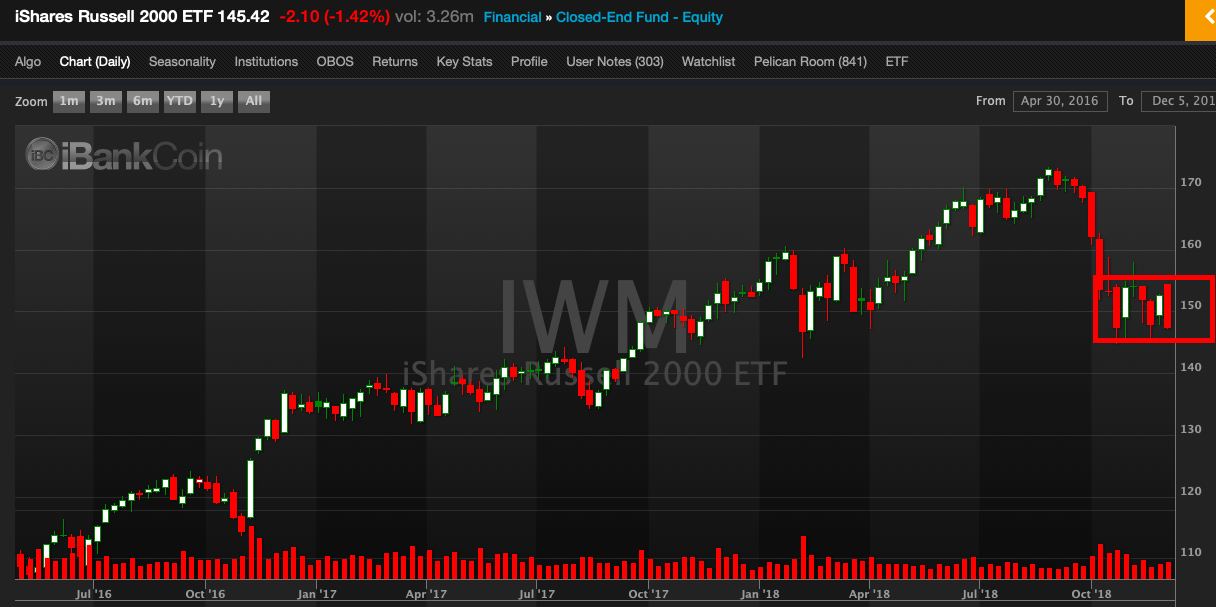
Bear this in mind, this recent chop has created a FAGbox. Do you think we’ll hold this range, or break lower? Do you really believe we’re gonna break higher? REALLY?!


Also at iBankCoin  
Cramer: US-China Row Not About Trade, But Global Hegemony

Steve Bannon Disinvited as Keynote Speaker at Sex Robot Conference

So, uhhh, what's up at the University of Montana?

The comments are, as usual, informative.

"Arrested Huawei CFO Sabrina Meng Wanzhou told staff ‘one may accept the risk of temporary non-compliance’ in some cases"

A bit of background from the South China Morning Post:
PUBLISHED : Thursday, 06 December, 2018, 1:47pm
UPDATED : Thursday, 06 December, 2018, 4:13pm

Huawei CFO Sabrina Meng Wanzhou was held on December 1 in Vancouver and is facing a US extradition request
Huawei chief financial officer Sabrina Meng Wanzhou, who was arrested in Canada and is facing a US extradition request, had told employees in an internal talk on compliance that there are scenarios where the company can weigh the costs and accept the risks of not meeting the requirements of the law.
Meng took part in an internal question-and-answer session on October 29 with her father, Huawei founder Ren Zhengfei, where father and daughter shared their views on compliance.

Both executives made references to the need to control the costs of compliance and not to exceed what is legally required in individual jurisdictions, according to a transcript of their remarks distributed to employees and obtained by the Post.

Huawei declined to comment or verify the contents of the memo.

Meng spoke of the different types of external regulatory compliance, dividing them into “red” and “yellow” lines. The former referred to rules where there is “no bargaining and must be strictly complied with,” she said. The latter is where strict compliance is not operationally feasible and the company can build in the costs of flouting the rules as “sunk costs,” she said, citing examples such as labour risks....MUCH MORE

"China demands immediate release of Huawei CFO: FM"

From the party mouthpiece, People's Daily:
17:06, December 06, 2018
Both the Chinese government and people on Thursday called for the immediate release of Meng Wanzhou, CFO of China’s Huawei Technologies, after it was reported that she was arrested in Canada at the request of the United States.

On Thursday, the Chinese Foreign Ministry responded to the incident at a regular press conference. Spokesperson Geng Shuang said that China has made its position clear to Canada and the United States and has demanded that Meng Wanzhou be released immediately. The spokesperson also said that the two countries are required to immediately clarify the reasons for her detention and must protect her legitimate rights and interests.

Under the official Weibo account of the US Embassy in China, a Chinese citizen wrote that the United States, which has already imposed a number of sanctions on Chinese companies, has hit a new low by arresting a Chinese citizen in Canada, limiting her personal freedom. “Are you that afraid of China’s rise?” the netizen asked. “Is this really how the world’s most powerful country should act?”
Some Chinese people online said that Meng Wanzhou was detained for no reason. “I have a new view of the United States. Even if America was once great, but has since gone rogue,” a comment read.
Under the official account of the Embassy of Canada to China, a large number of internet users questioned whether Canada has gone from being a sovereign state to “America’s hired thug.” They claim that Canada has violated the human rights of a Chinese citizen and demand that the Canadian side release Meng right away....MORE

Creighton University Mid-America Business Conditions Index For November

The Mid-Am index has been diverging from Creighton's Rural Mainstreet index, we'll follow-up when that is released.
From Creighton University, December 3:

Mid-America November Index Declines for Third Straight Month: Two-thirds Supply Managers Report Negative Tariff Impacts
November survey highlights:

* The Business Conditions Index fell for the third straight month, but remained above growth neutral for the 24th straight month.

* Strong manufacturing job gains for the month with durable goods producers leading the way.

* Approximately 65.2 percent of the supply managers indicated that rising tariffs had made it more difficult, or expensive, to purchase from abroad. Up from 40.8 percent in September.

* Lower oil prices pushed the regional inflation gauge lower.

OMAHA, Neb. (Dec. 3, 2018) – The November Creighton University Mid-America Business Conditions Index, a leading economic indicator for the nine-state region stretching from Minnesota to Arkansas, sank for a third straight month, but remained above growth neutral, and continues to point to positive economic growth for the next three to six months. 

Overall index: The Business Conditions Index, which ranges between 0 and 100, fell to 54.1 from October’s 54.9. This is the 24th straight month the index has remained above growth neutral 50.0, but it dropped to the lowest reading since December 2016. 

“The regional economy continues to expand at a healthy pace. However, as in recent months, shortages of skilled workers remain an impediment to even stronger growth. Furthermore, supply managers are reporting mounting negative impacts from tariffs and trade skirmishes,” said Ernie Goss, PhD, director of Creighton University’s Economic Forecasting Group and the Jack A. MacAllister Chair in Regional Economics in the Heider College of Business. 

Employment: The November employment index climbed to 57.5 from 52.2 in October.
“Overall manufacturing employment growth in the region over the past 12 months has been very healthy at 2.5 percent, compared to a lower 2.3 percent for the U.S. I expect this gap to close in the months ahead as regional job growth slows faster than national manufacturing job growth Regional job growth for durable goods producers has been approximately four times that of nondurable goods manufacturers over recent months,” Goss reported. 

Wholesale Prices: The wholesale inflation gauge continues to indicate elevated inflationary pressures. However, lower oil prices softened the November index to 70.0 from October’s much stronger 79.9....MUCH MORE

Trade Talks: This Was Not The Christmas I Was Looking For

Less than 24 hours ago all was right with the world.
Or at least our small corner of it: "China Is Preparing to Buy U.S. LNG and Soybeans Again, Sources Say".
Now it's just mayhem. Viz,

Soybeans down 5 cents at 908.50.

Wednesday, December 5, 2018

Russia Has Decided To Build Two More Of The World's Most Powerful Icebreakers

In September we noted a delay in the delivery schedule of the first of the LK-60Ya class icebreakers, the Arktika, from May 2019 to April 2020. Despite this Atomflot appears to be adding to the initial three-ship order.
From the Barents Observer:

More nuclear power for Russia’s icebreaker fleet
A fleet of five LK-60 icebreakers will be built to keep waters open for the quickly growing Russian Arctic shipping.
A fourth and fifth vessel of the powerful LK60 class (project 22220) are needed for support of vessels shuttling to the major coal project in Taymyr and the Payakha oil field in the Yenisey river delta, Atomflot leader Vyacheslav Rukhsha said in a conference this week.

The vessels come in addition to the three similar ships that already are under construction at the Baltic Shipyard in St.Petersburg

The two additional vessels will help secure round-the-year shipments on the Northern Sea Route for the next 25-30 years, Ruksha made clear.

The statement comes after Rosatomflot’s deputy director Mustafa Kashka in the recent Murmansk Business Week confirmed that a final decision on the vessels would be taken «in the course of 2018.» According to Kashka, the investments needed for their construction will provided thanks to long-term contracts with the mineral extracting companies, Rosatom informs.

According to the company, the two powerful ships will cost 100 billion rubles, of which 45 billion will be provided by the federal budget, 10 billion by Rosatom itself and the remaining 45 billion by credits, PortNews informs.

The Baltic Yard started construction of the first LK-60 icebreaker, the «Arktika», in 2013. The building of the second vessel of the kind, the «Sibir», was launched in 2015, while the «Ural» was launched in 2016. The vessels are now reported to be ready for sailing in 2019, 2020 and 2022 respectively....MORE
Previously:
"One of Russia’s new nuclear icebreakers facing delays"

Here's the current king of the north, the 25,168 tons displacement 50 Let Pobedy (50 years of victory)
 
http://network.bellona.org/content/uploads/sites/3/2017/08/icebreaker2.jpg
The 50 Let Pobedy icebreaker bringing politicians to the North Pole. (Photo: Murmansky Vestnik) 
 
The Arktika will have a displacement of  ~37,000 tons.
 
There are also plans for an even more ridiculously powerful class that we saw in "Russia Official Announces Plans to Build Space Age Nuclear Icebreakers".

"Carnage Continues: US Futures Crash At Re-Open After Huawei CFO Arrest"

Dudes, you'd best not be thinking of messing with my soybeans.

From ZeroHedge:
Having taken a day off to watch Bush's funeral - drifting modestly higher before the early close - reports of the arrest of Huawei's CFO at the request of US authorities has sparked carnage at the re-open.

As we detailed earlier, mere hours after Chinese officials finally affirmed President Trump's description of Saturday's trade 'truce' - this after fears that the true nature of the agreement might have been "lost in translation" helped trigger the worst one-day market selloff since October - the DOJ has gone ahead and kicked the hornet's nest, seriously jeopardizing the prospects for a prolonged trade detente between the world's two biggest economies.

Dow futures were down over 500 points as they opened...

...MORE

"New York City votes to establish minimum wage for Uber, Lyft drivers"

From United Press International, Dec. 4:
New York City's Taxi and Limousine Commission voted Tuesday in favor of establishing a minimum wage for app-dispatched drivers.

The city became the first in the United States to set a minimum wage for drivers working for companies such as Uber, Lyft, Juno and Via at $17.22 per hour.

"This first-time regulation to form a floor for app driver earnings and give a modest first raise is a long time in the making. It's the first real attempt anywhere to stop app driver pay cuts, which is an Uber and Lyft business practice at the heart of poverty wages," New York Taxi Workers Alliance Executive Director Bhairavi Desai said in a statement. "Just as it did with the vehicle cap, New York City is once again passing landmark regulation to protect workers in the unruly gig economy."

The $17.22 per hour is $2.22 above the city's $15 per hour minimum wage, accounting for contract drivers' payroll taxes and paid time off....
...MORE

Ahead of the IPO: "Uber Is Headed for a Crash"

Picking up the torch Izzy K. set down when picking up the nappies, Naked Capitalism's Yves Smith writing at New York Magazine's Intelligencer column, December 4:
By steamrolling local taxi operations in cities all over the world and cultivating cheerleaders in the business press and among Silicon Valley libertarians, Uber has managed to create an image of inevitability and invincibility. But the company just posted another quarter of jaw-dropping losses — this time over $1 billion, after $4.5 billion of losses in 2017. How much is hype and how much is real?

The notion that Uber, the most highly valued private company in the world, is a textbook “bezzle” — John Kenneth Galbraith’s coinage for an investment swindle where the losses have yet to be recognized — is likely to come as a surprise to its many satisfied customers. But as we’ll explain, relying on the extensive work of transportation expert Hubert Horan, Uber’s investors have been buying your satisfaction in the form of massive subsidies of services. What has made Uber a good deal for users makes it a lousy investment proposition. Uber has kept that recognition at bay via minimal and inconsistent financial disclosures combined with a relentless and so far effective public-relations campaign depicting Uber as following the pattern of digitally based start-ups whose large initial losses transformed into strong profits in a few years.

Comparisons of Uber to other storied tech wunderkinder show Uber is not on the same trajectory. No ultimately successful major technology company has been as deeply unprofitable for anywhere remotely as long as Uber has been. After nine years, Uber isn’t within hailing distance of making money and continues to bleed more red ink than any start-up in history. By contrast, Facebook and Amazon were solidly cash-flow positive by their fifth year.

The fact that this glorified local transportation company continues to be a financial failure should come as no surprise. What should be surprising is that the business press still parrots the fond hope of Uber’s management that the company will go public in 2019 at a target valuation of $120 billion. That’s well above its highest private share sale, at a valuation of $68 billion. And Uber’s management and underwriters will no doubt hope that the great unwashed public looks past the fact that more recently, SoftBank bought out insiders at a valuation of $48 billion, and its offer was oversubscribed. Why should new money come in at a price more than double where executives and employees were eager to get out?

Uber has never presented a case as to why it will ever be profitable, let alone earn an adequate return on capital. Investors are pinning their hopes on a successful IPO, which means finding greater fools in sufficient numbers.

Uber is a taxi company with an app attached. It bears almost no resemblance to internet superstars it claims to emulate. The app is not technically daunting and and does not create a competitive barrier, as witnessed by the fact that many other players have copied it. Apps have been introduced for airlines, pizza delivery, and hundreds of other consumer services but have never generated market-share gains, much less tens of billions in corporate value. They do not create network effects. Unlike Facebook or eBay, having more Uber users does not improve the service.

Nor, after a certain point, does adding more drivers. Uber does regularly claim that its app creates economies of scale for drivers — but for that to be the case, adding more drivers would have to benefit drivers. It doesn’t. More drivers means more competition for available jobs, which means less utilization per driver. There is a trade-off between capacity and utilization in a transportation system, which you do not see in digital networks. The classic use of “network effects” referred to the design of an integrated transport network — an airline hub and spoke network which create utility for passengers (or packages) by having more opportunities to connect to more destinations versus linear point-to-point routes. Uber is obviously not a fixed network with integrated routes — taxi passengers do not connect between different vehicles.

Nor does being bigger make Uber a better business. As Hubert Horan explained in his series on Naked Capitalism, Uber has no competitive advantage compared to traditional taxi operators. Unlike digital businesses, the cab industry does not have significant scale economies; that’s why there have never been city-level cab monopolies, consolidation plays, or even significant regional operators. Size does not improve the economics of delivery of the taxi service, 85 percent of which are driver, vehicle, and fuel costs; the remaining 15 percent is typically overheads and profit. And Uber’s own results are proof. Uber has kept bulking up, yet it has failed to show the rapid margin improvements you’d see if costs fell as operations grew....
...MUCH MORE, some of it quite brutal.

HT: naked capitalism

"Bloomberg would consider selling his company if he runs"

Via TalkingBizNews;
Michael Bloomberg, the founder of the eponymous financial data and news operation, said he is likely to sell his company if he runs for president, reports Dakin Campbell of Business Insider.
Campbell writes, “Bloomberg said he would either sell the company or put it in a blind trust, but that at his age, 76, it makes more sense to sell it, according to an interview he gave to Radio Iowa.

“‘I think at my age, if selling it is possible, I would do that,’ Bloomberg said....MORE

"China Is Preparing to Buy U.S. LNG and Soybeans Again, Sources Say"

Well, I think my work here is done.
Time for a very important video.

But first, as noted in a 2016 post:
I've been at the market pretty much my entire adult life and like anyone doing something repetitively have developed mental filters to cut through the noise so one can focus on the important things: cat videos, dirty limericks about Turkey's ErdoÄŸan (A wannabe Pasha from 'bul, showed Europe that they had no pull...) and Sartre parodies.

After a while you internalize the patterns and trust that if the world is about to end someone will text you....

...As to cats, I don't really care for them and they appear to know this. Dogs on the other hand seem to look on me as that big dog who knows how to drive and has impeccable taste in snacks.
I suppose though, some of the cat vids are okay:
And before I forget, from Bloomberg, December 4, 9:20 PM PST:

China Is Preparing to Buy U.S. LNG and Soybeans Again, Sources
    • Officials told to take necessary steps to restart purchases
    • U.S. said China promised to buy more energy, agriculture goods
      Chinese officials have begun preparing to restart imports of U.S. soybeans and liquefied natural gas, the first sign confirming the claims of President Donald Trump and the White House that China had agreed to start buying some U.S. products "immediately."

      Chinese officials have been told to take necessary steps for the purchases, according to two officials with knowledge of the discussions. It wasn’t clear whether the preparations meant China would cut the retaliatory tariffs it imposed on those products, or when the purchases would happen. It is possible that Beijing could reimburse buyers for the tariffs they pay, as they have done for purchases for the state soybean reserve.

      Chinese purchases of the goods collapsed after Beijing imposed tariffs on them in retaliation for U.S. import taxes. The two nations agreed to temporarily halt the spiraling exchange of tariffs over the weekend, promising to try and iron out their differences by the start of March next year....MORE
      Finally, combining the two strands... the Sartre and Monsieur Chat (not the beans and the gas):


      China’s eight centuries of experiment with paper money is coming to a close

      And speaking of the Ming Dynasty (Monday's "Thinking About President Xi and Prince Kanenaga"), a repost from June 4, 2018.

      From 15MB, February 9:
      The Chinese were first with the great transition from commodity money to paper money. They had the necessary technologies (you can’t have paper money without paper and you can’t do it at scale without printing) and, more importantly, they had the bureaucracy. In 1260, the new Emporer Kublai Khan  determined that it was a burden on commerce and drag on taxation to have all sorts of currencies in use, ranging from copper coins to iron bars, to pearls to salt to gold and silver, so he decided to implement a new currency. The Khan decided to replace metal, commodities, precious jewels and specie with a paper currency. A paper currency! Imagine how crazy that must have sounded! Replacing actual stuff with apparently worthless paper! It’ll never work!

      Crazy or not, it worked and just as Marco Polo and other medieval travellers returned along the Silk Road breathless with astonishing tales of paper money, so modern commentators (e.g., me) are tumbling off of flights from Shanghai with equally astonishing tales of a land of mobile payments, where paper money is vanishing and consumers pay for everything with smartphones. China is well on the way to becoming a cashless society, with the end of paper money in sight. Something like one-seventh of China’s population relies on mobile payments to get around, carrying no cash, according to a survey conducted by Renmin University of China. The natural step from there is to create digital currency so that settlement is in central bank money and there are no credit risks.

      This thinking has been evolving for some time. Back in 2016, the Governor of the People’s Bank of China (PBOC), Zhou Xiaochuan, set out the Bank’s thinking about digital currency, saying that it is an irresistible trend that paper money will be replaced by new products and new technologies. He went on to say that as a legal tender, digital currency should be controlled by the central bank and after noting that he thought it would take a decade or so for digital currency to completely replace cash in China, he went to state clearly that the bank was working out “how to gradually phase out paper money”. Rather than simply let the cashless society happen, which may not led to the optimum implementation for society, they were developing a plan for a cashless society.

      As I have written before, I don’t think a “cashless society” means a society in which notes and coins are outlawed, but a society in which they are irrelevant. Under this definition the PBOC could easily achieve this goal for China. But should they do this? Yao Qian, from the PBOC technology department wrote on the subject in 2017, saying that to “offset the shock” to commercial banks that would come from introducing an independent digital currency system (and to protect the investment made by commercial banks on infrastructure), it would be possible to “incorporate digital currency wallet attributes into the existing commercial bank account system” so that electronic currency and digital currency are managed under the same account.

      This rationale is clear and, well, rational. The Chinese central bank wants the efficiencies that come from having a digital currency but also understands the implications of removing the exorbitant privilege of money creation from the commercial banks. If the commercial banks cannot create money by creating credit, then they can only provide loans from their deposits. Imagine if Bitcoin were the only currency in the world: I’d still need to borrow a few of them to buy a new car, but since Barclays can’t create Bitcoins they can only lend me Bitcoins that they have taken in deposit from other people. Fair enough. But here, as in so many other things, China is a window into the future, because Alipay, WeChat Wallet and other Chinese third party payment platforms use financial incentives to encourage users to take money out of their bank accounts and store it on their platforms. If commercial banks cannot fund loans from deposits, we are in a new place, economically speaking....MORE
      Previously:
      January 2016
      More On China's Cryptocurrency Push and Financial Repression

      September 2007
      Chinese inflation hits 6.5 percent, highest rate in nearly 11 years
      ...If I recall correctly, the Ming Dynasty had to repudiate paper money in the 1450's to end a hyperinflation.
      Update: I am pleased with myself.
      Found this quote from "A History of Money":

      1448 Hyperinflation in China
      The Ming note nominally worth 1,000 cash has a market value of only three.
      p 183
      Here's the Hyperinflator:


      Ying Zong, Zhu Qizhen, 1436 - 1450 and 1457 - 1464,
      Emperor Ming Dynasty

      Tuesday, December 4, 2018

      Shipping: Mediterranean Shipping Co. Expects A $2 Billion Annual Rise In Fuel Costs From 2020 Low Sulpher Rules (MSC)

      "MSC" is the abbreviation, not a stock symbol. The company Is privately owned with the controlling shareholders, the Aponte clan, being worth at least $8 billion and probably over $10 B.

      From gCaptain:
      MSC Facing Over $2 Billion Bump in Annual Fuel Bill from IMO 2020
      Swiss-headquartered MSC expects to pay over $2 billion a year in fuel costs due to tougher global marine fuel rules and will introduce a bunker charge next year to recoup expenses, the world’s number two container line said.

      UN agency the International Maritime Organization (IMO) will prohibit ships from using fuels with sulphur content above 0.5 percent from Jan. 1, 2020, compared with 3.5 percent today, unless they are equipped with exhaust gas cleaning systems, known as scrubbers, to clean up sulphur emissions.
      For shipping companies struggling from years of weaker earnings, the new regulations are expected to mean more cost pressure.

      “MSC has estimated that the cost of the various changes we are making to our fleet and its fuel supply is in excess of two billion dollars (USD) per year. We have already had to start incurring these costs to be ready for 2020,” the group said in a Dec. 1 note.

      MSC said it would levy a bunker recovery charge from Jan. 1, 2019 “as a result of the regulatory changes we all support”...
      ...MORE

      Related: 
      Big Oil Traders Set to Cash In On Low Sulphur Shipping Fuel Change

      Oil: The Impact On Refiners Of Shipping's Low-Sulpher Fuel Ruels After 2010

      "Maersk Braces For A $5+ Billion Fuel Bill In 2020"

      Top Norwegian Oil Analyst Quitting DNB to Pursue 2020 Low Sulphur Fuel Rule Riches

      Shipping: The New Low Sulpher Rules Will Have A Huge Impact On the Oil Business (shipping and world economy too)

      Rich Rewards Await Top Oil Refiners as Ships Make Low Sulpher Switch Fuel

      Shipping: "Hapag-Lloyd Expects USD 1 Bn in Extra Fuel Costs from 2020 Sulphur Cap"

      Shipping: CEO of Third Largest Fleet Says "We're All Going to Go Bust"

      Shipping: "CMA CGM Says Global Sulphur Cap to Cost Customers $160 Per Container on Average"
      That's serious money, say on a 10,000 TEU average voyage, $1.6 million per trip?
      Jeez, no wonder the industry is freaking out....

      Equities: After The Rout

      Futures were up around 2/10 percent for the major U.S. indices.
      (also on blogroll at right)

      From Investor's Business Daily:
      7:24 PM ET
      Dow Jones futures rose late Tuesday, along with S&P 500 futures and Nasdaq futures. The Dow Jones, S&P 500 index and Nasdaq composite tumbled in Tuesday's stock market. Investors can find parallels to the choppy stock market rally from this past spring and summer. But there are key differences that aren't encouraging. Long-term support lines are acting as resistance. Stock market rallies are short-lived, while the stock market struggles to make higher highs. Apple (AAPL) and FANG stocks Facebook (FB), Amazon.com (AMZN), Netflix (NFLX) and Google parent Alphabet (GOOGL) are all in worse shape than earlier this year. Finally, economic and earnings growth look weaker going forward.

      Dow Jones Futures Today
      Dow Jones futures rose 0.3% vs. fair value. S&P 500 futures advanced 0.45%. Nasdaq 100 futures climbed 0.5%. Remember that Dow Jones futures, Apple stock and other overnight action don't always translate into actual trading in the next regular stock market session.
      The NYSE and Nasdaq stock markets will be closed Wednesday for President George H.W. Bush's funeral. So will other U.S. financial markets.

      Stock Market Sell-Off
      The Dow Jones industrial average fell 3.1% in Tuesday's stock market trading. The S&P 500 index tumbled 3.2% and the Nasdaq composite 3.8%. Confusion and concerns about the China trade war truce, along with a partially inverted Treasury yield curve were the key catalysts for the sell-off.
      Those are similar headwinds to earlier this year, when Trump tariff threats and a flattening Treasury yield curve — though with rates generally rising — were the main culprits.
      Eventually, the stock market recovered over several months, but in choppy action that made investing challenging.

      So, are we headed for a similar stock market slog to new highs? Keep in mind, to borrow every investment vehicle's legalese, that past performance is not a guarantee of future results. But in addition to similar headwinds and volatile market action, there are four notable differences between then and now.

      Key Support Levels Act As Resistance
      In the early 2018 stock market correction and aftermath, the 200-day moving average acted as support. The major averages hit stock market correction lows on Feb. 9, when the S&P 500 index just undercut that long-term support intraday. The S&P 500 index did test its 200-day over sessions in April, closing just below that line on one occasion. The Dow Jones tested that level several times but didn't close below that rising line until July 30. The Nasdaq composite never touched its 200-day. So the line generally acted as a support area.

      Since the stock market correction kicked into gear in October, the 200-day line has acted as resistance, especially for the Nasdaq and S&P 500 index. On Tuesday, the Dow Jones and S&P 500 plunged through their 50-day and 200-day lines. The Nasdaq lost further ground....
      ...MUCH MORE 

      Goldman Sachs: Talking Trash and Making Cash

      Down in the dumps, bunky?
      (that's all I've got, weak, I know)

      From The Fly at iBankCoin: 

      RARE DOUBLE UPGRADE ALERT FROM GOLDMAN: BUY TRASH
      Via CNBC:
      Because they believe the economy is about to roll over and into the shitter, they double upgraded WM today.
      Garbage stocks may be the key to success in a sluggish economy, and Waste Management “should be a core holding in every portfolio,” according to Goldman Sachs.
      The firm on Monday raised its rating on the trash giant two notches to outperform from underperform, a rare “double upgrade.”

      “Given the age of the current business cycle and expectations for slowing economic growth, we believe now is the right time to own waste stocks,” analyst Brian Maguire wrote to clients. “The waste sector not only compounds earnings growth at a higher rate than the overall market, but it does so with much less volatility and draw-downs in its earnings.”...
      ...MORE, including video and table of names

      Markets: What Triggered the Latest Whack

      At least I have my soybeans.

      DJIA down  602.39 (-2.33%) at 25,224.04
      S&P 500 down 66.00 (2.37%) at 2,724.37

      From ZeroHedge: 
      "Collapse Of Civilisation Is On The Horizon" World Leaders Warned

      Oops, wrong ZH headline. Let's try again: 

      Here Is What Triggered Today's Sudden Stock Liquidation
      Earlier this morning, Nomura's Charlie McElligott noted something which in retrospect was quite prophetic: the cross-asset strategist highlighted that his Risk Parity model showed that the market's most important strategy is in "de-risking" mode as the economic cycle turns sharply:
      In a positioning confirmation / “nod” then to this growth- and inflation- slowdown scenario, it is finally worth noting that we see our Risk Parity model having added enormous notional size in global Government Bonds (USTs and JGBs) over the past month, against very large selling of global Equities and Credit.
      The implication, and confirmation judging by today's market, is that the trade was a long way from finished, looking at the recent risk parity deleveraging in equities...
      ... offset by buying of gov't bonds.
      But while ongoing (relatively slow) risk parity deleveraging may explain the pressure on the market over the past month, the reason for the sharp waterfall in US stocks just after 12pm ET...
      ... has to do with another systematic "trader" type in the market: namely the much faster CTAs.
      As McElligott writes in a follow-up note, he notes that Nomura's CTA Trend model "is again deleveraging massive notional in long US Equities expressions across SPX, RTY and NDX live."...
      ...MORE

      The soybeans reference is to a couple Sunday posts after the G20 news but before yesterday's big gap open:
      Sunday, Dec. 2 
      Yuan Surges In Early Trading, Signals 2800 Open For The S&P 
      We cautiously caution, be cautious.
      The real action in equities, and probable all time highs for the indices will come in the first quarter of 2019....
      Sunday, Dec. 2
      Trade Talks: Grains and Beans 
      More chance of an extended move here, over the next few weeks, here than in equities, see after the jump.... 

      Beans up another 5.25 cents at 911.00:

      Izabella Kaminska Is Back At FT Alphaville

      We haven't seen her byline, with the exception of an encore podcast on complexity, since January.
      In lieu of our usual line or two introduction here is the runner-up headline (discarded for lack of utility except as clickbait) and some context:

      Ms Kaminska Confronts Entropic Techno-Barbarism
      ...Capitalism is now bent on finally eliminating all autonomy and opposition to itself. Rather than governing through freedom as such, late liberalism harnesses freedom to the uncertainties of its own survival. Shocks and disruption are needed, even celebrated as essential, in order to better mediate, exploit, and direct their impacts. To this extent, as a model for our collective future, the dystopia of permanent emergency has to be resisted.

      This challenge has appeared at a time when the possibility of revolution has long passed. We know from the Frankfurt School, there is no natural law of progress. While early capitalism may have battered down Chinese walls, late capitalism is more likely to degenerate into an entropic techno-barbarism. Now faced with such a reality, rather than revolution, the more urgent and practical task is that of resistance, of helping something new emerge by holding back the gathering shitstorm.

      The disruption that late capitalism has unleashed presses disproportionately on a contained global precariat. There is no renewal or betterment through disaster — just cumulative loss and abjection. This negative outcome, however, is occluded and suppressed by a positive techno-design culture.....
      Emeritus Professor at the Global Insecurities Centre, University of Bristol November 26, 2018
      And from FT Alphaville:
      Don't let GDPR spoil Christmas

      The EU's General Data Protection Act (GDPR) was supposed to free us from data servitude.
      Everyone, we were told, would be entitled to their data privacy because the act was designed to “Protect and empower all EU citizens' data privacy”.

      We've been living with the supposed benefits of GDPR since May 2018. But are we any better off?
      Turns out, probably no.

      After a rush of spammy emails from anyone and everyone you ever gave your email to asking you to opt in to their mailing lists, things have gone quiet. But they have not necessarily got any better. In reality, retailers and service providers still hold all the power in the data relationship.

      Problematically, the legislation did little to force institutions into providing alternative versions of their services that aren't based on data harvesting. As it stands, we're politely warned that x business model depends on your data, so please accept the T & Cs to carry on. With full awareness of this disclosure most of us have little choice but to “Accept” if we're to go on with consuming that provider's services. Most of the time there are no other options, since so many online service providers are monopolies — and there's almost nobody out there who doesn't take advantage of data in some way to enhance their business models.

      And so, here we are. Something covert has been made overt. And that's about it.

      We're still being data-mined — we're now just voluntarily signing up for the Faustian data pact instead.
      But it gets worse.

      In some cases GDPR is now forcing consumers to give up even more of their personal data than they would have before just to get the same services.

      Take the online shopping market as an example.

      Most retailers have always offered two types of checkout service for online purchases. Registered or guest, with the data-discrete inclined to use the latter.

      Historically, there has never been any discrimination between these two options. Whether you sign out as a guest or signed-in as a registered client, the assumption is you are entitled to all the same consumer protection rights and service qualities offered by the retailer in general.

      But with GDPR something has changed. And consumers are only now beginning to cotton on....MUCH MORE
      Don't be surprised if I purloin 'data servitude'.

      Media: "BuzzFeed CEO Jonah Peretti’s increasing pessimism and why it matters"

      As promised in our earlier "Fed Working Paper: "Are Millennials Different?" (and why 'news for millenials' plays never panned out)" a continuation of our look at the "Millennial" media.

      From What'sNewInPublishing:
      I can’t be the only person who was genuinely perplexed by the interview BuzzFeed CEO Jonah Peretti gave to The New York Times last week. In it, he floated the idea of a sort of mega-merger between several of the biggest digitally native news organizations, including Vice, Vox Media, Group Nine, and Refinery.

      The motivation behind such a hypothetical merger? A combined entity, with all the scale that comes with it, would be able to negotiate better rates for the content it supplies to major platforms like Google and Facebook. “If BuzzFeed and five of the other biggest companies were combined into a bigger digital media company, you would probably be able to get paid more money,” Peretti said.
      Peretti’s statements were pretty bizarre. First of all, why make a proposal like this in such a public forum? While I’m sure he’s not the first CEO to ever muse in an interview about a merger, this was a hypothetical scenario that contained such specificity and intent that it seemed like he was using The New York Times as some kind of go-between for these publishing entities to start negotiations. 
      Second, I’m not really sure that such a scheme would actually result in the desired outcome. As a venture backed company, BuzzFeed has had just about all the access to capital and talent it needs to reach massive levels of scale. Its media advertising kit brags that it reaches 650+ million people. It’s difficult to see how simply adding more pageviews would improve its negotiating position with Facebook to such an extent that it would make a merger worth it.

      But while Peretti’s proposal is bewildering and came seemingly from left field, this isn’t the first time he’s expressed frustration at the amount of money his company has been able to extract from the tech platforms. In October 2017, he appeared at a Wall Street Journal tech conference and made the argument that Facebook and Google should be sharing more revenue. “The business model of news is changing, and if Google and Facebook take all the revenue but don’t want to pay for the fact checking, the reporting, the more-intensive investigations, who does that work for?” he said. “I think Google and Facebook are going to have to fix that.”

      Five months later, he elaborated on these thoughts in an interview with Digiday, arguing that, while BuzzFeed did receive revenue for content produced for Facebook Watch and Facebook Instant Articles, those places aren’t where Facebook extracts most of its value from BuzzFeed:
      My big criticism of the strategy so far is all their revenue is generated in the news feed, and they only share revenue for new surfaces — Instant Articles or Watch — but don’t share any of the revenue from their main source of revenue, the news feed…

      …it’s in Facebook’s interest to share news feed revenue, not because it’s good for the world, but it allows Facebook to have some control of what’s showing up in the news feed. If they say they want local or trusted news, they say that will get more distribution and more revenue, so companies can produce more of it. It doesn’t need to be some carriage fee or a thing where the amount of traffic is directly related to the revenue. It could be that they have a metric for time well-spent, and you’re paid 2 cents per minute of time well-spent.
      Speaking as someone who’s read a lot of interviews with Jonah Peretti over the years, I was struck by how cynical and pessimistic he’s become about the role the tech platforms are playing in our media ecosystem. In fact, you don’t have to travel that far back in time to find quotes from Peretti where he’s expressed unbounded optimism about the rise of social media and how it has allowed companies like his to thrive....MUCH MORE
      All these companies raised so much money and that is part of the problem.
      Two of the most cogent expositions of  the challenges facing new media came from Talking Points Memo, in November 2017 and April 2018:

      Is Venture Capital Destroying Online Journalism?
      I don't know but having spent some time trying to front run Sand Hill Road and understand things like Uber I have to say this is an interesting insight.

      From Talking Points Memo, November 17:
      There’s a Digital Media Crash. But No One Will Say It
      Yesterday I appeared on a panel about digital publishers who are ‘pivoting to video’. I’ve written about this before. But in case you’re new to it, there have been numerous cases over the last six months to a year in which digital publishers have announced either major job cuts or in some cases literally fired their entire editorial teams in order to ‘pivot to video.’ The phrase has almost become a punchline since, as I’ve argued, there is basically no publisher in existence involved in any sort of news or political news coverage who says to themselves, my readers are demanding more of their news on video as opposed to text. Not a single one. The move to video is driven entirely by advertiser demand.

      What crystallized for me from this and other discussions I had yesterday is that we’re actually in the midst of a digital news media crash, only no one is willing to say it. I’ve noted before that digital news media in the midst of a monetization crisis. But it’s more than that. It’s a full blown crash.
      Here’s why.

      You have three different factors coming together at once: two primary ones and one secondary but critical one....MORE

      Followed by:

      Media—"Data Lords: The Real Story of Big Data, Facebook and the Future of News"
      This afternoon I saw a friend on Twitter say that he doesn’t buy the idea that if people just paid Facebook some sort of fee the data and privacy issue would go away. Because he subscribes to the Times, the Post and the WSJ and they each track his readership habits and sell that data to advertisers or make it available to them for targeting. This is at least partly true – I’ll discuss the ins and outs of that point in a moment. But this is a good opportunity to discuss the real relationship between publishers and big data. It’s actually very different than it looks.

      First, what my friend says is true. These publications are all in the data collection and sale business. Indeed, TPM is too – not directly at all but because of the ad networks (like Google and others) we have no choice but to work with. The key on the main claim is that the issue is one of diversity of revenue streams. Each of those big publications mentioned has at least three big revenue sources that are relevant to this conversation. They have premium advertisers for which the kind of data we’re talking about has limited importance. They also have subscriptions. The final bucket is made up of advertising that is heavily reliant on data and targeting.

      The difference is that Facebook is almost 100% reliant on advertising which is not only reliant on data and targeting but reliant on the most aggressive kinds of data collection, tracking and targeting. That is Facebook’s entire business. Anything that cuts deeply into that model and advantage represents an existential threat.

      But here’s the really salient point. Almost every publication participates in the data economy. But the data economy is almost universally a bad thing for publications, especially ones that have real audiences.
      Allow me to explain....MORE