Tuesday, December 4, 2018

"Yuan could become next battleground in Trump-Xi ruckus"

From the Asia Times:

Both leaders accept that a truce was called in the China-US tariff war during their meeting at the G20 in Buenos Aires. Could a weakening yuan reignite it?
The spin-meisters around Donald Trump and Xi Jinping are still speaking different languages about trade. This lost-in-translation dynamic belies claims something big happened in Buenos Aires.
US President Trump’s people claim Chinese President Xi pledged to “reduce and remove” tariffs on goods, including American-made vehicles, at the Group of 20 meeting in Argentina last weekend. Xi’s team insists that America did the bowing, by agreeing to increase market access for China.

Most intriguing, perhaps, is how Team Trump members seem to be on different wavelengths. Listening to Larry Kudlow, Trump’s top economic advisor, you get the impression détente with Beijing is a done deal, whereas US Treasury Secretary Steve Mnuchin gives out the message that the process is just beginning.

Given the uncertainty, it’s best to focus on what may decide whether the ceasefire is real or a mere lull in a broader trade war: the yuan.
By this measure, Trump must be feeling quite good about his dinner with Xi. Monday, the first trading day since Buenos Aires, saw the biggest one-day jump in the yuan since early 2016. That must be music to the ears of a protectionist US leader who has long claimed Beijing’s exchange-rate policies are “killing us.”

Can Trump’s post-Argentina high be sustained? It’s doubtful, given events on the ground in China. Thanks largely to Trump’s tariffs on $250 billion of Chinese goods and threats of more to come, exports, industrial production, purchasing manager’s orders and fixed-asset investment are experiencing downshifts.

Present dangers
Those headwinds pose clear and present dangers to Xi’s stated goal of recalibrating growth engines and curbing bubbles in debt, credit and property.

“China faces a Faustian choice between growth or deleveraging,” Standard & Poor’s argues. “Planned stimulus to boost output and business sentiment in China could undermine the country’s deleveraging push.” That, S&P concluded, “leaves policymakers with a tough choice between missing targets on growth or on reducing financial risks.”

The toughest choice of all, though, may be taking a sliding exchange rate off the table. Here, too, Xi faces a test of his 2013 pledge to let market forces play a “decisive role” in China.
If not for his boss, free-market folks like Kudlow would surely counsel at laissez-faire approach. Traders, after all, have every reason to look at China’s debt-heavy, highly imbalanced and slowing economy and sell yuan. Yet two problems complicate letting markets drive the yuan lower....
...MUCH MORE

So, Beyond Brexit, Brazil, Xi and France, What's Cookin'?

Bond Vigilantes does a quick overview, December 3:

Panoramic Weekly: Fed extends Goldilocks contract
If investors enjoyed a dream Goldilocks scenario in 2017 in which growth was hot enough to lift earnings but not too much to warrant sharp rate hikes, many expected 2018 to be more like the year of the bear, marked by a significant rate hiking cycle – until last week. US Fed chair Jerome Powell said the current policy rate is just below the non-accelerating rate of inflation –  a sign that the central bank might slow down the rate-hiking path it outlined in October. Stocks soared and bond yields dropped, with the 10-year Treasury yield slightly dipping under 3% for the first time since September. Risk asset spreads, such as those of High Yield, tightened.
Powell’s dovish comments came as oil has shed $20 per barrel over the past two months to trade at just above $50, the lowest level in more than one year. US economic data has also disappointed (Housing, Industrial Production, Durable Goods Sales and Consumer Confidence) Recent mid-term election reverse for US president Trump makes further tax cuts more unlikely, which could weigh on growth. Last week, European PMIs also came in below expectations. The IMF warned about weakening global data and darker clouds looming, only one month after cutting its global growth forecast. At least, geopolitical tensions seemed to abate after the weekend’s G20 summit in Buenos Aires, in which Trump and China’s president Xi signed a trade war truce, which helped soften the US dollar, boosting Emerging Markets assets.
Heading up:
EM currencies – winter sun: Emerging Market (EM) currencies had a good November. Despite the recent global credit sell-off, locally-denominated EM sovereign bonds delivered a 1.6% return to investors in November, which increases to 2.2% when translated in to US dollars, given the currency appreciation. As seen in the chart, the Turkish lira (blue line) has performed strongly up 6.7% against the greenback so far this month, helping it recover about half of what it lost over the summer. Investors now seem less concerned about Turkey’s fundamentals especially given the plunging oil prices which are a relief for the country’s Current Account. India, another major oil importer, saw its currency soar 5% over the past month, especially as the US waived some sanctions on Iran so that the oil-producing nation could continue exporting. The South African rand, recently unfavoured by investors due to the country’s high Budget and Current Account deficits, also rallied after the central bank recently hiked rates to 6.75%, from 6.50%, and cut its inflation projections. After the summer storm in which Turkish and Argentinian uncertainty spread to other EMs investors seem to be looking back at fundamentals. As seen in the chart the growth outlook is far rosier for EMs than for Developed Markets.
Italy – last will be first: Still deep in the red so far this year, Italian government bonds occupy a surprising No. 1 position in the weekly return table of 100 Fixed Income asset classes. The gains, which reduce the year-to-date loss to 4.7%, come as the country’s government and the EU seem to be nearing an accord over Italy’s budget deficit. Since it was elected in May, the government has challenged Brussels’ fiscal discipline creating tensions that not only widened Italian government and corporate spreads but also had a negative impact on European assets overall. More optimism about an agreement has lifted this week’s returns of Europe’s High Yield indices where Italy has a 15% weight, more than any other nation.

Heading down:
Cars – canary in the coal mine? Car sales have stopped being an economic driver – they feel more like a puncture to the wheels of global growth: maybe this is because of global trade wars; maybe because developed market average populations are getting old and youngsters use on-demand services, or perhaps because the EU has introduced a new pollution-testing regime....MORE

Fed Working Paper: "Are Millennials Different?" (and why 'news for millenials' plays never panned out)

Yes they are different.
They apparently don't have can openers.
More after the jump.

From the Divisions of Research & Statistics and Monetary Affairs, Federal Reserve Board, Washington, D.C.:
November 2018
Abstract
The economic wellbeing of the millennial generation, which entered its working-age years around the time of the 2007-09 recession, has received considerable attention from economists and the popular press. This chapter compares the socioeconomic and demographic characteristics of millennials with those of earlier generations and compares their income, saving, and consumption expenditures. Relative to members of earlier generations, millennials are more racially diverse, more educated, and more likely to have deferred marriage; these comparisons are continuations of longer-run trends in the population. Millennials are less well off than members of earlier generations when they were young, with lower earnings, fewer assets, and less wealth. For debt, millennials hold levels similar to those of Generation X and more than those of the baby boomers. Conditional on their age and other factors, millennials do not appear to have preferences for consumption that differ significantly from those of earlier generations. 
HT: today's FT Alphaville Further Reading post.

Well that should put the brakes on some of those "Things Millenials Are Wrecking" stories:
Bustle
11 Things Millennials "Ruined"
BuzzFeed
29 Things Millennials Killed This Year
Mashable
11 things millennials ruined
Now, about those can openers, from the Wall Street Journal, Dec. 2:
The Trouble With Tuna: ‘A Lot of Millennials Don’t Even Own Can Openers’
StarKist, Bumble Bee and Chicken of the Sea deal with slumping market amid competition from fresher options
And speaking of Bustle, BuzzFeed and Mashable here's Digiday:
Why ‘news for millennials’ media plays never panned out
We'll have more on that later today.

Monday, December 3, 2018

"Bogle Sounds a Warning on Index Funds "

From the Wall Street Journal, Nov. 29:
The father of the index fund says it’s probably only a matter of time before they own half of all U.S. stocks; ‘I do not believe that such concentration would serve the national interest’
By  John C. Bogle
There no longer can be any doubt that the creation of the first index mutual fund was the most successful innovation—especially for investors—in modern financial history. The question we need to ask ourselves now is: What happens if it becomes too successful for its own good?

The First Index Investment Trust, which tracks the returns of the S&P 500 and is now known as the Vanguard 500 Index Fund, was founded on December 31, 1975. It was the first “product,” as it were, of a new mutual fund manager, The Vanguard Group, the company I had founded only one year earlier.

The fund’s August 1976 initial public offering may have been the worst underwriting in Wall Street history. Despite the leadership of the Street’s four largest retail brokers, the IPO fell far short of its original $250 million target. The initial assets of 500 Index Fund totaled but $11.3 million—falling a mere 95% short of its goal.

The fund’s struggle for the attention (and dollars) of investors was epic. Known as “Bogle’s folly,” the fund’s novel strategy of simply tracking a broad market index was almost totally rejected by Wall Street. The head of Fidelity, then by far the fund industry’s largest firm, put the kiss of death on his tiny rival: “I can’t believe that the great mass of investors are [sic] going to be satisfied with just receiving average returns. The name of the game is to be the best.”

Almost a decade passed before a second S&P 500 index fund was formed, by Wells Fargo in 1984. During that period, Vanguard’s index fund attracted cash inflow averaging only $16 million per year.
Now let’s advance the clock to 2018. What a difference 42 years makes! Equity index fund assets now total some $4.6 trillion, while total index fund assets have surpassed $6 trillion. Of this total, about 70% is invested in broad market index funds modeled on the original Vanguard fund.

Yes, U.S. index mutual funds have grown to huge size, with their holdings doubling from 4.5% of total U.S. stock-market value in 2002 to 9% in 2009, and then almost doubling again to more than 17% in 2018. Even that penetration understates the role of mutual fund managers, as they also offer actively managed funds, and their combined assets amount to more than 35% of the shares of U.S. corporations.
If historical trends continue, a handful of giant institutional investors will one day hold voting control of virtually every large U.S. corporation. Public policy cannot ignore this growing dominance, and consider its impact on the financial markets, corporate governance, and regulation. These will be major issues in the coming era.

Three index fund managers dominate the field with a collective 81% share of index fund assets: Vanguard has a 51% share; BlackRock, 21%; and State Street Global, 9%. Such domination exists primarily because the indexing field attracts few new major entrants....
... My concerns are shared by many academic observers. In a draft paper released in September, Prof. John C. Coates of Harvard Law School wrote that indexing is reshaping corporate governance, and warned that we are tipping toward a point where the voting power will be “controlled by a small number of individuals” who can exercise “practical power over the majority of U.S. public companies.” Professor Coates does not like what he sees, and offers tentative policy options—some necessary, often painful to contemplate. His conclusion—“The issue is not likely to go away”—is unarguable....
...MUCH MORE, including proposed solutions.

How To Go Viral

It began with a simple query from Kristen (@Kica333):
Among thousands of others, GameInformer editor David Milner accepted the challenge:

Milner was retweeted by Rage Against the Machine's guitarist:

Which sadly led to this retweet, subsequent emotional breakdown and disturbing personal details (see comments if interested):

Meet IARPA:, It's Like DARPA But For Spies


Published on Oct 16, 2018
Oct.16 -- Stacey Dixon, director of Intelligence Advanced Research Projects Activity within the Office of the U.S. Director of National Intelligence, talks with Bloomberg's Mark Miller about the future of intelligence gathering at the Bloomberg Sooner Than You Think technology summit in Brooklyn.
Previously on IARPA:
Forecasting: The Intelligence Advanced Research Projects Activity (IARPA) Has An "Office for Anticipating Surprise"
"U.S. Intelligence Community Explores More Rigorous Ways to Forecast Events"
Forecasting: "So You Think You're Smarter Than A CIA Agent"
Rumbles of the Quantum Computing Revolution in Security
...The initial discovery of these and other bizarre quantum interactions were “a great surprise…but it wasn’t until more recently that we focused on actually controlling these phenomena,” said Dr. Brad Blakestad, quantum computing expert and Program Manager at the Intelligence Advanced Research Projects Activity (IARPA), under the Directorate of National Intelligence....
And a whole bunch of links in Credit Suisse's Mauboussin: "Sharpening Your Forecasting Skills"

Thinking About President Xi and Prince Kanenaga

Sometimes when thinking about what President Xi is up to Chairman Mao comes to mind. I mean with posts like:
Mao obviously comes to a lot of minds.
And then when President Trump tweets: "Relations with China have taken a BIG leap forward!" it's inescapable. or as they say in Hollywood, "A little too on the nose?"

There is however another Chinese emperor leader that should also come to mind, Ming Dynasty founder Emperor Hongwu.
Upon gaining control in 1368, Hongwu ('Vastly Martial') began demanding tribute from all the surrounding lands, including Japan.

We mentioned this obliquely in 2014's Oil and China's Territorial Ambitions: "The World Is the World's World". Here is a better, more scholarly reference via Oxford Journals' Chinese Journal of International Politics, Summer 2012:
...The threat of military force was evident in Ming China’s effort to bring Japan into the tribute system. Japan’s Prince Kanenaga imprisoned and executed a number of the Chinese envoys that Emperor Hongwu had sent in 1369 to demand tribute, apparently angered at the condescending tone of the diplomatic letter denoting Chinese superiority. When the Ming court threatened invasion, the Japanese reminded it of the Mongols’ failed attempts in 1281 to conquer Japan. A letter Kanenaga sent in 1382 explicitly denied the legitimacy of Chinese dominance: ‘Now the world is the world’s world; it does not belong to a single ruler … . I hear that China has troops able to fight a war, but my small country also has plans of defence … . How could we kneel to and acknowledge Chinese overlordship!’88  ...
Jus' sayin' Mr. President Xi, jus' sayin'.

Equities: The Modesty of Le Fly

With the DJIA currently off the day's highs by 200 points we have to get this in before all the joy and gloating dissipates.
Lifted in toto from The Fly at iBankCoin: 

Obligatory Fly Wins Again Post
Mon Dec 3, 2018 9:12am EST
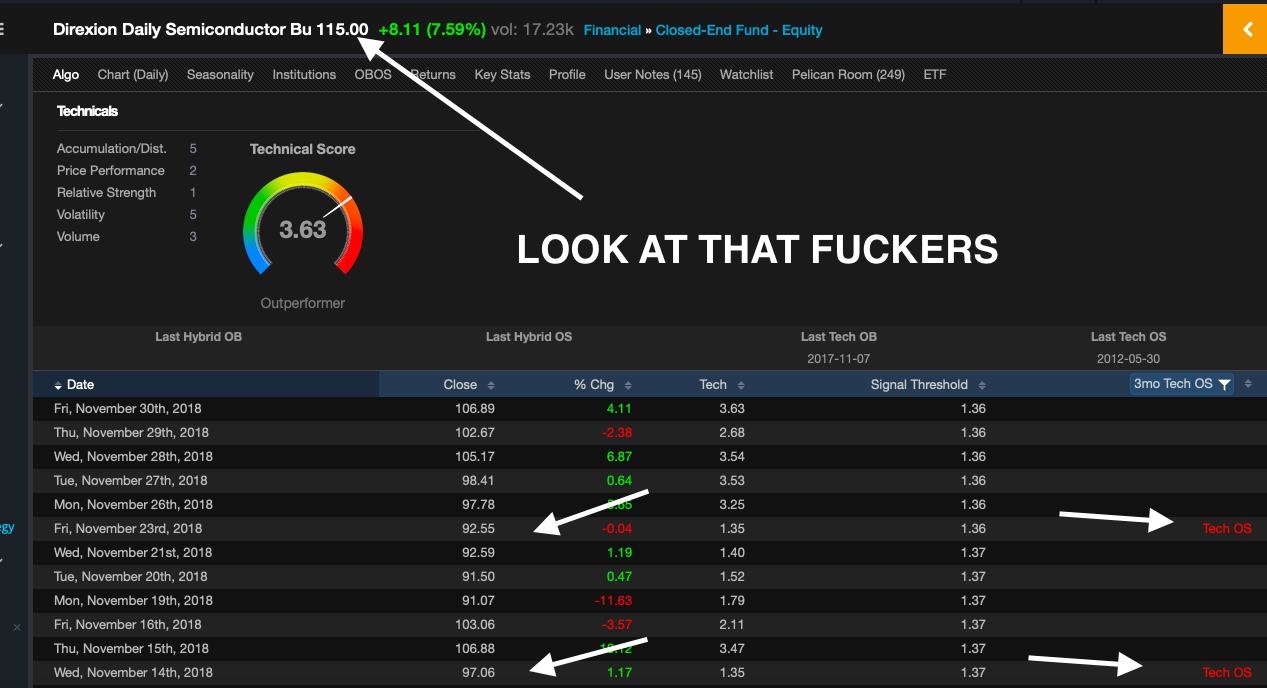
Eat a bag of dicks, fuckers. Look at that.
We’re going to gloss over the fact that I’m 80% cash in my trading account and instead marvel at my pivot away from TVIX and into SOXL on Friday. We’re also going to keenly focus on my Quant account, which represents 75% of my money and will have made more than 3% the past month.
A new stratagem will be implemented today, one that is mindful of downside hazards and positions my person for extreme success.

Now is the time to congratulate me. Do not bother doing so later on, for I will not accept it.

Capital Markets: "G20 Fan Animal Spirits"

From Marc to Market:
Overview: The US and China kept their trade guns cocked at each other but offered the last opportunity for a negotiated settlement before escalation. What is billed as a 90-day freeze on tariff increases is really only 60 days beyond January 1 when Trump had threatened to increase the 10% tariff on $200 bln of Chinese goods to 25%. The US and China could not agree on a joint statement, and there appear to be differences between the two on what was agreed. Moreover, early today Trump tweeted that China would reduce and remove tariffs on US autos, which had not been announced previously. At the same time, Russia and Saudi Arabia agreed to extend their pact, boosting the likelihood that OPEC+ will announce output cuts later this week. Efforts to support the oil market also came from an unexpected source. The Canadian province of Alberta announced a 325k barrel a day cut (8.7%) starting in January. Equities have rallied strongly. The MSCI Asia Pacific Index nearly matched last week's 2% gain. China, Hong Kong, Taiwan, and Singapore markets led the advance, gaining more than 2% each. India was the sole exception. The rupee is also underperforming in the face of the US dollar's pullback. Higher oil prices appear to be the drag. Oil has rallied 4-5% after last month's 22% plunge. European shares are higher, and the Dow Jones Stoxx is up more than 2% in late morning turnover in what could be the biggest advance in eight months. The high beta dollar-bloc and Scandi currencies are leading the move against the US dollar. Among emerging markets currencies, the South African rand, the Mexican peso, and Chinese yuan are up over 1%.

Asia Pacific
China reportedly agreed to step up its purchases of US agriculture and industrial goods (including energy) immediately. This is one of the measurable outcomes even though the amounts were not agreed. China also agreed to classify fentanyl as a controlled substance, which would allow greater over it, which has been a scourge in America (and Canada). Neither the US nor China claimed any change in the Made in China 2025 initiative or US arms deals with Taiwan.

Separately, Caixin reported its manufacturing PMI edged higher
in November to 50.2 from 50.1. Recall that the official measure eased to 50.0 from 50.2. The Caixin measure picks up more small businesses than the official PMI. Chinese officials cut the required margin to trade futures on equity indices.

The Japanese economy contracted in Q3, and after the capex details, the weakness may be deeper than initially reported. Next week, the -0.3% initial estimate could be revised to -0.5%. Capital spending was considerably weaker than expected. The 4.5% increase compares with median forecasts (Bloomberg survey) of 8.5% after rising 12.8% in Q2. Corporate profits were also weak. The 2.2% rise pales in comparison with expectations of a 14% increase (almost 18% in Q2). However, this is history, and the economic weakness was largely a function of the disruption caused by natural disasters. An economic recovery has already begun as 2.9% surge in October industrial output (preliminary figures reported last week) illustrate. The November manufacturing PMI slipped to 52.2 from 52.9 in October. New orders fell back to July levels warning that the best of the recovery may be behind it.

The dollar initially traded higher against the yen, reaching JPY113.85 in early Asia. It trended lower and returned to the pre-weekend lows near JPY113.35. A break below there would undermine the technical tone. Last week's range was roughly JPY113.20 to JPY114.05. There are $1.3 bln in expiring options at JPY113.15-30 today and nearly the same amount between JPY113.70 and JPY114.00.

The Australian dollar gapped higher, and that gap appears on the weekly bar charts, making it potentially even more significant. Last week's high was $0.7344, and Bloomberg has today's low at $0.7348. the last session's high was near $0.7325. The upside momentum seemed to falter in the European morning, and the gap may attract prices. There is are A$1.1 bln in $0.7350 strikes that expire today. The RBA meets tomorrow, and it is widely seen on hold for some time.

Europe
The EMU November PMI was a little better than the flash estimate suggesting that the worst of the soft patch may be abating, though Italy is still problematic. The final manufacturing PMI came in at 51.8 compared with the 51.5 flash reading and 52.0 in October. German and French preliminary readings were revised higher, while Spain exceeded expectations (52.6 from 51.8 in October and is highest since August. Italy, however, went the other way. The contraction deepened to 48.6 from 49.2. A reading below 50 is associated with falling output....
...MUCH MORE 

Sunday, December 2, 2018

Shipping: "China trials LNG delivery via containership"

Who needs those fancy tankers?
Actually, China may have swiped the progenitor idea from CMA CGM, see after the jump.

From LNG World:
China’s efforts to secure a stable supply of natural gas during the coming winter have pushed the market players to explore new avenues of supply.
In a new attempt to alleviate gas shortages in the North, China’s National Development and Reform Commission (NDRC), National Energy Administration (NEA) and Ministry of Transport (MOT), approved a trial project to deliver surplus capacity of Hainan terminal to its northern part via LNG tank containers on a feeder container ship.

The vessel was loaded with 130 LNG tank containers developed by CIMC Enric and departed the Port of Yangpu in the Hainan province towards Port of Jinzhou.
Regasified volumes of natural gas from a single LNG tank reaches 25,000 cubic meters, China International Marine Containers (CIMC) said in its statement.

China has seen an explosive growth of natural gas consumption over the years, and it is challenging to meet the country’s demand for natural gas, especially in the heating season.

According to Wood Mackenzie, China’s LNG imports are forecast at nearly 50 million metric tons in 2018, an increase of 12 million tons over 2017.
https://www.lngworldnews.com/wp-content/uploads/2018/11/12-768x516.jpg
130 LNG tank containers arriving at the destination (Image courtesy of CIMC)
In its latest market report, International Energy Agency said that China will become the world’s largest importer of natural gas, and by 2023, it will import 171 billion cubic meters of natural gas, with LNG accounting for more than 50 percent of the total imports.

However, the country’s LNG infrastructure is mostly located in the southern region and in order to cater for the natural gas demand in the north, LNG had to be trucked from LNG import terminals...
...MORE.

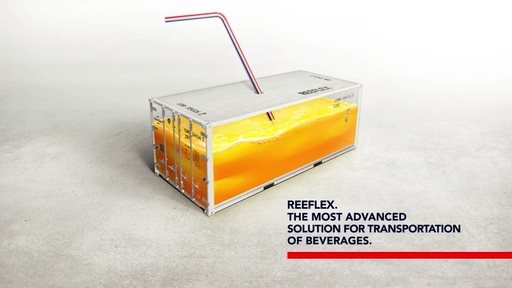
From last February's "Shipping: France's CMA CGM Does Wine-in-a-Box Gone Large":
Or other liquids:
https://www.ajot.com/images/uploads/article/cma-cgm-reeflex.jpg
Innovation mondiale: le Groupe CMA CGM lance REEFLEX: son nouveau système unique de transport de liquides par conteneurs

From CMA CGM (En)

The finest degree in reefer expertise
CMA CGM - introduces: REEFLEX, our most advanced solution for transportation of liquids
...MORE

Visiting France But Would Rather Not Stay at The Meurice? Try a bit of Solitude

At least until the street is cleaned up from the recent unpleasantness,
consider this option from Brilliant Maps:

Parts of France Where Nobody Lives Within 1km

Nobody Lives Here: Parts of France Where Nobody Lives Within 1km
Map crated by @matamix
The map above shows where nobody in France lives, based on 1km2 squares. In total, 31.7% of metropolitan France is uninhabited.

Which is actually pretty remarkable considering the number for the United States is 47%, despite the fact that France is almost 4X more densely populated than the United States (123 people per km2 vs 34 people km2)...
... MORE

That's really kind of amazing.

Meanwhile in Nigeria: President Buhari Denies Dying and Being Replaced By a Lookalike

Mandy Rice-Davies moment ahead.

From Reuters:
Nigeria’s President Buhari on Sunday denied claims that he had died and been replaced by a Sudanese impostor, breaking his silence on a rumor that has circulated on social media for months.
Buhari, who is running for re-election in February, spent five months in Britain last year being treated for an undisclosed illness. One theory widely aired on social media - and by some political opponents - was that he had been replaced by a lookalike from Sudan called Jubril.

No evidence has been presented, but videos making the claim have still been viewed thousands of times on YouTube and Facebook.

“It’s real me, I assure you....MORE
All together now: "Well (giggle) he would, wouldn’t he?"

One of my favorites is found in Lords/Hansard for 6 Feb 2002, Column 671, 5:13 pm.
We're keepers of the MRD flame.

Trade Talks: Grains and Beans

More chance of an extended move here, over the next few weeks, here than in equities, see after the jump.

From AgWeb:

Weekend Wrap Up
...Last Week’s Close: January soybean futures finished Friday’s session up 6 cents, extending gains for t he week to 12 ½ cents. Futures traded in a 39 ½ cent range through the week. Friday’s Commitment of Traders report showed funds sold 6,124 futures through November 27th, expanding their net short position to 59,303 contracts.

Quick Take: News from the G-20 summit over the weekend indicate that the “trade war” between the US and China has come to a 90-day truce. This will almost certainly send the market higher on this evenings open, early calls are for beans to open anywhere from 20-40 cents higher. Significant resistance this week comes in at 932 ¾, this represents resistance on July 31st. Much of the move higher will likely be spurred by short covering over renewed optimism....MORE
Here's Friday's "China? Soybeans and Transport Stocks Are Up On a Meh Day":

... a year of beans via FinViz:
up 6.00 at 893.25


Although wheat is actually up double the 1% that soybeans are showing I wanted an excuse to highlight something from two weeks ago today:

Big Money: Consider The Humble Soybean
I'm tellin' ya, this Colby Smith is one to keep an eye on....

...So if someone who is doing the grunt work says en passant "beans may have bottomed" it may behoove the consumer of data/information/knowledge/wisdom to take note and be aware something might have changed and the game may be afoot:...
We have that series of higher lows starting with the September bottom but not (yet) higher highs.
If one can ascribe animal spirits to lines-on-chart I'd say soybeans are looking for a reason to trade higher.

Great. I am now anthropomorphizing inanimate objects....MORE
And today our link to Colby's confrère, Brendan Greeley:
Trade Deal: China Will Continue To Import Only What It Wants/Needs

Yuan Surges In Early Trading, Signals 2800 Open For The S&P

We cautiously caution, be cautious.
The real action in equities, and probable all time highs for the indices will come in the first quarter of 2019.

From ZeroHedge:
For now, FX markets remain the only 'liquid' course of reflection on the Trump-Xi trade-truce 'deal' and China's offshore yuan has spiked over 6 handles (back below 6.90/USD) implying a solid jump at the open for US equity futures...
A big jump for sure in offshore yuan but remains well below the early Nov spike highs...
...And extrapolating from last week's moves, offshore yuan implies an open for S&P futures around 2800...
...Which, as we noted earlier, is exactly in line with one "base case" which correctly predicted that a Truce - in which existing tariffs stay in place - is the most likely outcome (with a 70% chance), while also accurately predicting a 3 month ceasefire, the agreement will be enough to get the S&P to 2,800...

...MORE

Trade Deal: China Will Continue To Import Only What It Wants/Needs

As was noted in an October 2009 post "U.S. stock-market investors may want to follow stimulus":

...A corollary of last year's "Be long what China is short of and short what China is long of".

It seems to still be the guiding principle nine years later.
From FT Alphaville:

China has agreed only to import more of what it doesn't want to make at home
China and the US aren’t fighting over what China exports now — assembled electronics, toys, socks, furniture. They’re fighting over what China wants to make at home in the future. China has a plan to become self sufficient in electric cars, aerospace, bio-medicine and farming equipment. These things are hard to make. They require decades to figure out, and a well-educated, productive, high-wage workforce. Xi Jinping didn’t compromise on this goal in Argentina. It’s hard to see that he ever will.
Mr Xi met with Donald Trump over Malbec and grilled sirloin at the G20 summit in Buenos Aires this weekend. He agreed to talk for three months about intellectual property transfers and state support of industry. As an immediate good-faith gesture, he will also punish Fentanyl exporters more severely. Also, according to the White House:
China will agree to purchase a not yet agreed upon, but very substantial, amount of agricultural, energy, industrial, and other product from the United States to reduce the trade imbalance between our two countries. China has agreed to start purchasing agricultural product from our farmers immediately.
First, China is explicitly conceding that it's a command economy. In an open market, China's companies and hog farmers should buy oil and soyabeans from wherever they're cheapest on the global market. Mr Xi shouldn't have the power to compel them to buy from Texas and Iowa. That he can is in fact the definition of the problem the world's free-market economies have with China. The US and China didn't remove any structural or tariff-based market distortions in Buenos Aires. Rather, Mr Trump jawboned Mr Xi to command some changes at home. That's diplomacy, but it's not really commerce....MORE

Ogilvy's Rory Sutherland Has Some Thoughts

Mr. Sutherland is Vice-Chairman of Ogilvy U.K. He is also a behavioural science/behavioral economics wonk.
From Edge.org:

Things to Hang on Your Mental Mug Tree
Rory Sutherland [7.10.17]
I don't think there's any huge amount of intelligence required to look at the world through different lenses. The difficulty lies in that you have to abandon four or five assumptions about the world simultaneously. That's what probably makes it difficult.

On a list of ten things that matter in terms of how you look at the world, satisficing would be number one, along with the whole business of decision making under uncertainty. This opens up the idea that something which may seem at first glance to be completely irrational may in fact be a useful and highly effective non-catastrophic heuristic.

At around the same time as Herbert Simon was doing his work, David Ogilvy was talking to someone who ran the Chicago office of Ogilvy called Joel Raphaelson [Joel, who is still alive and as quick-minded as a 25-year-old, is the son of Sampson Raphaelson, scriptwriter for The Jazz Singer and Heaven Can Wait]. David agreed with Joel’s idea that people bought brands to avoid badness rather than to maximize perfection. They bought brand A over brand B not because they thought it was better, but because they were more certain it was good.

The idea is that when you make decisions in an uncertain setting, you have to care about not only the expected outcome, but also the possible variance. We'll pay a premium not only for "better," but for "less likely to be terrible." That seems to be an important thing to understand when analyzing decision making. 
 
Human decision making is also pretty path-dependent. In one case in my life I've been able to profit from this. I live in a house, which in the UK is something called Grade 1 listed. It's by the great eighteenth century Robert Adam, and the grounds are by Capability Brown. I'm in a four bedroom flat on the roof of a house built for the doctor of George III in about 1785. For a time it was the home of Napoleon III.

I didn't pay anything extra for the architecture or the genius of the landscaping because nobody places that very high on their list of priorities when they buy a house. I asked our next-door neighbor, an economist, how much he thought we paid for this property relative to a property in an identical location of the same size by an indifferent architect. In other words, what's the premium we pay for the Robert Adam-ness of it? He said somewhere between zero and about 5 percent.
That's quite interesting if you think about it. When we buy a property, the order in which we look at things places location as the highest priority. Next. In the UK, it might be the number of bedrooms it has (in the US, it might be the floor area, by square footage). We might then look at the size of the garden, a few other features, and whether it has a pool. But architecture generally comes pretty low down the list. We only look at architectural aesthetics when we've got down to a final selection of four or five
.
Whereas a painting by a great artist might cost literally 10,000 times more than an equivalent-sized painting by an indifferent artist, a building by a fantastic architect costs about 1-3 percent more than a building by an average or even indifferent architect.

If we bought paintings the way we bought property, we'd say, "I want a painting that's exactly this size; I want these three colors to predominate; I want it to be in exactly these proportions." In the fifth iteration or so, we'd get down to who the artist was. Most of the time, we wouldn't end up with a Picasso. It seems to me that architecture is an incredibly cheap way of buying art, compared to art.
If you're interested and want to take advantage of this, go to a website in the US
called savewright.org, which shows Frank Lloyd Wright properties for sale. In most cases, they seem to be no more expensive than the neighboring property. Similarly, there was a Gropius flat that came for sale in the UK. It was expensive because it was in Notting Hill, but no more expensive than a totally average building next door. What intrigues me about human decision making is that there seems to be a path-dependence involved—to which we are completely blind.

Number two? Costly signaling theory is also pretty useful. I suppose the peacock's tail is the standard view. What seems undoubtedly true is that humans, like peahens, attach significance to a piece of communication in some way proportionally to the cost of generating or transmitting it. Instinctively, you will open the FedEx package on your desk before you open the letter. One of the problems of email is there's no cost attached to sending it, so we don't have a useful heuristic for deciding what to read first. That strikes me as interesting.

Cost might mean anything from financial expense to use of a scarce resource—anything that requires something in scarce supply, whether it's money, talent, effort, or time. The more that is invested in the communication, essentially, the more weight that communication carries. That makes perfect sense because, in some ways, that means that your sincerity is hard or costly to fake. That could also apply to creativity—the effort required to communicate humorously, which you have invested up front, connotes something about the sender’s intent.

Let me give you an example. You receive two wedding invitations on the same day, one of which comes in an expensive envelope with gilt edges and embossing, and the other, which contains exactly the same information, is in the shape of an email. You're probably going to go to the first wedding. (The second one, well, there's a dangerous implication there might be a cash bar.) Now, what happens if you haven't got much money, but you want to do an impactful wedding invitation? Then you make it really creative.

If you can't put actual money into the paper or the printing. What you can put in is something different, which is imagination. You can make it a fantastically imaginative or beautiful [or humorous] wedding invitation.

But there has to be some investment of a scarce, costly thing. It's the difference between saying your horse is going to win and visibly betting on your horse. In the latter case, you have skin in the game; in the former case, you don't. That's important to understand. To some extent, effective communication will always require some degree of inefficiency because if it's perfectly inefficient, it then becomes meaningless.

There's a rather lovely company in the UK that pays people who are housebound—whether for medical reasons, or are caregivers—to handwrite envelopes and letters. You could regard this as a very silly thing to do, but in costly signaling theory terms, it makes perfect sense. The open rate of these letters, and the response they generate, is an order of magnitude higher than for laser-printed letters.

Another thing worth bearing in mind is countersignaling, which, unlike signaling, seems to be uniquely human. There aren't cases of peacocks who demonstrate their extraordinary genetic quality by having really shitty tails. What seems to happen with humans is you have multiple parallel status currencies, and quite often you will signal your position on status by adopting none of the status currencies of the class immediately below your own, or by essentially demonstrating zero effort in standard status currencies. An unwashed bass guitarist in a cool rock band, for example, can get away with poor levels of hygiene, which signals: "I'm so sexy by dint of my bass guitar playing skills that I can get away with not making an effort in any of these conventional areas." Sometimes it's done as a positional thing, and sometimes it's done as a pure demonstration of handicap.

Relevance theory [from Dan Sperber and Deirdre Wilson] might be another thing that's interesting. In other words, replacing the “conduit” idea of communication with this idea that we communicate the minimum necessary for the recipient to recreate the message within their own head using context as a very large part of the information. Those interesting new theories of communication, which don't always sit with the Claude Shannon theories, are worth exploring. A very simple manifestation would be jokes which, like IKEA furniture, demand some self-assembly on the part of the recipient....
...MUCH MORE

We've visited Mr. Sutherland a few times, among the more interesting:

Ogilvy & Mather UK Vice-Chairman, Rory Sutherland, Talks Behavioral Economics
Ogilvy & Mather UK Vice-Chair Rory Sutherland on Driverless Showers

"China Is So Desperate for Pork That It's Buying American Again"

From Bloomberg, November 29:
A disease sweeping through Chinese hog herds is helping negate the effects of the trade war for American farmers, with U.S. pork sales to the Asian nation back to levels before tariffs were introduced.
China was the third-largest buyer of pork in U.S. Department of Agriculture weekly data released Thursday. The 3,300 metric ton-purchase was the most since February, a month before China imposed tariffs on U.S. pork. Hog futures rose 4.4 percent in Chicago, the most in two weeks.

“This is a game changer,” said Dennis Smith, a senior account executive at Archer Financial Services Inc. “It gives confirmation that the disease is far worse than what we’ve been told.”

“This is a game changer,” said Dennis Smith, a senior account executive at Archer Financial Services Inc. “It gives confirmation that the disease is far worse than what we’ve been told.”

Outbreaks of African swine fever have been reported at farms in 20 Chinese provinces since August, with about 600,000 hogs culled. But until now, the country has abstained from upping its imports from the U.S....MORE 
Also at Bloomberg:
Updated Dec. 2
Trump, Xi Agree to Temporary Truce in Bid to Contain Trade War

And recently at Climateer Investing:
November 15 
Want To Get China To The Trade Negotiating Table? Here's How You Get China To The Trade Negotiating Table
Bacon....

Possibly related:
Nov. 30
China? Soybeans and Transport Stocks Are Up On a Meh Day
Nov. 18
Big Money: Consider The Humble Soybean

There is Being a Lowlife and Then There's Stealing Books From An Ancient French Monastery

Back in the day, stealing from a church or monastery might result in your getting skinned alive.
From Cabinet magazine:

Inside Jobs
Geoff Manaugh
The books and manuscripts were disappearing from a room no one seemed to be entering. Its doors were almost never opened, the room itself closed to public view. There was no believable explanation for where the materials might be going, so the least believable reasoning soon took hold. It was the work of the devil, the residents said. A poltergeist. A symbolic act of God meant to communicate something, if only they could interpret the signs.

This was, after all, a monastery—indeed, one of the world’s most picturesque, Mont Sainte-Odile, perched high in the mountains of France, nearly on the border with Germany—and its library was vanishing into thin air. A manuscript here, a bound volume there; five, six, a dozen, all quickly adding up to nearly a thousand key pieces of church scholarship missing from the shelves and tables.
When the police were finally notified, they chose not to perform an exorcism. Being a secular institution, they instead installed a hidden surveillance camera, and, in May 2002, the truth came to light. It was not a ghost at all, but an engineering teacher from Strasbourg. He had been entering the room through a long-forgotten secret passage, access to which was hidden inside one of the bookcases. Unseen—indeed entirely unsuspected—he was able to remove the library’s priceless collection piece by piece, emerging from the walls to take entire shelves of books at a time.

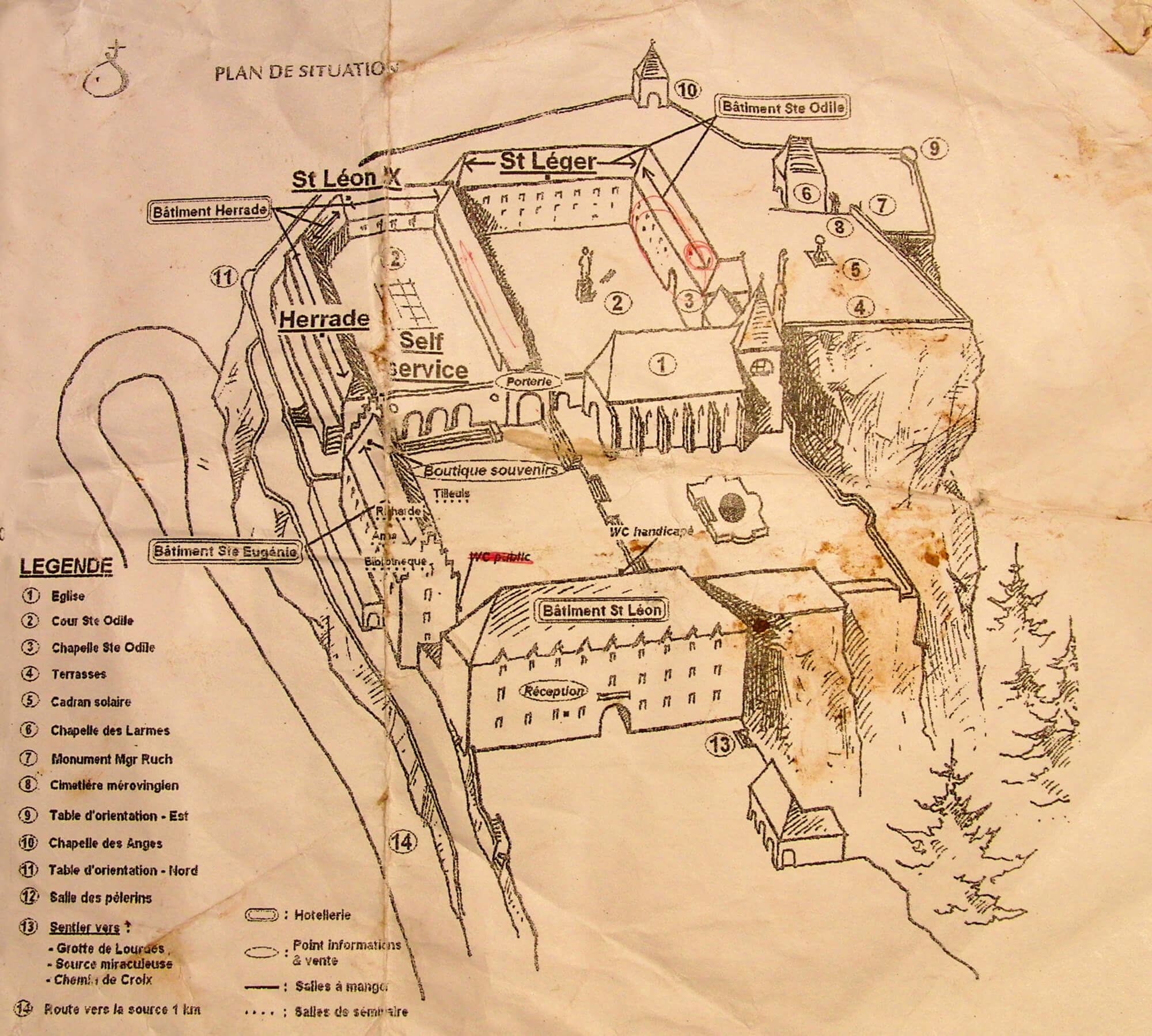
Perhaps more spectacular than the teacher’s indirect method of approach was how he came to know the passage was there in the first place. According to the Guardian, this otherwise law-abiding engineer first learned about the route “after discovering a forgotten map in public archives” revealing how the monastery’s attic was covertly joined to the library on a lower floor. This chance discovery of a discarded floor plan made him one of the very few people in the world who knew the architectural connection existed at all; it had long ago ceased being used by the monks themselves, having fallen into a state of neglect resembling spatial hibernation.

Bringing the passage back into service as a reliable form of internal circulation was not, in fact, easy. According to some newspaper accounts, doing so required scaling the outside walls of the monastery, then navigating a precipitous attic stairway. According to others, the man posed as an overnight guest staying in another part of the monastery that had been converted into a hotel; carrying a suitcase, he would slip into a room with access to a hidden passageway, climb down a rope ladder, then enter the library through the trick bookcase. Some reports also claim that he had to locate “a hidden mechanism” tucked inside the wall that would cause the back of the bookcase to flip open, allowing entrance into the library. Regardless of how he ultimately gained access to the books, his actions transformed the confines of the monastery into a kind of three-dimensional puzzle. Indeed, the very fact that these accounts diverge suggests something of an epistemological uncertainty at the heart of such crimes: that a burglar can misuse a piece of architecture so radically it becomes almost impossible to narrate what actually took place there.
Map of monastery and adjoining hotel. This map was obtained and used by an amateur sleuth who visited the monastery in May 2011 looking for its secret passages. 
Courtesy adventurecycletour.wordpress.com.
Half a world away, another prolific book thief found equally furtive ingress through similar spatial means. An avid lock picker, expert counterfeiter, and methodical planner committed to researching the targets of his heists, Stephen Blumberg stole an estimated twenty million dollars’ worth of rare books and manuscripts from institutional archives and academic libraries around the United States.

His plan for hitting the rare books collection of the University of Southern California in Los Angeles was characteristic: researching the history of the building, Blumberg had learned that a series of disused dumbwaiters had once functioned to deliver books between floors. The dumbwaiters were no longer active, but the shafts inside the walls of the library still offered a direct connection to book stacks that were otherwise inaccessible to the public....MORE
The writer is author of A Burgler's Guide to the City which we visited in 2016's "A Burgler's Guide To The City--How a Criminal Sees the World".

Saturday, December 1, 2018

Neil deGrasse Tyson Responds to Sexual Misconduct Allegations, Explains Special handshake

Neil deGrasse Tyson explains the special handshake

From Dr. Tyson's Facebook page:

On Being Accused
...Summer 2018 Incident
...Further, I never touched her until I shook her hand upon departure. On that occasion, I had offered a special handshake, one I learned from a Native elder on reservation land at the edge of the Grand Canyon. You extend your thumb forward during the handshake to feel the other person’s vital spirit energy — the pulse. I’ve never forgotten that handshake, and I save it in appreciation of people with whom I’ve developed new friendships....
Doing some research we find depictions of the special handshake that immeasurably  pre-date the Native elder on reservation land at the edge of the Grand Canyon and may bolster the veracity of Dr. T's story:
Now. it is entirely understandable that the young lady was creeped out if she was unaware of the spiritual significance of the special handshake,
Or it might be that NdGT is full of it.
Your call.

note: the image depicted is not the actual special handshake.
I just happened to see Dr. Tyson's 'On Being Accused' within a couple hours of seeing the Michelangelo and the juxtaposition sort of created itself.

"What big data can tell us about how a book becomes a best-seller"

Looking at last week's sales figures I'd have to say that rule #1 is: be Michelle Obama.
Her book, Becoming, has sold 2 million copies in 15 days.

From The Conversation:
The average American reads 12 or 13 books a year, but with over 3 million books in print, the choices they face are staggering.

Despite the introduction of 100,000 new titles each year, only a tiny fraction of these attract a large enough readership to make The New York Times best-seller list.
Which raises the questions: How does a book become a best-seller, and which types of books are more likely to make the list?

I’m a data scientist. Recently, with help of Burcu Yucesoy, a postdoc in my lab, I put the reading habits of Americans under our data microscope.

We did so by analyzing the sales patterns of the 2,468 fiction and 2,025 nonfiction titles that made The New York Times best-seller list for hardcovers during the last decade.

Real lives, imaginary action
The first thing the data reminded me is just how few books in my favorite category, science, become best-sellers – a paltry 1.1 percent. Science books compete for a spot on the nonfiction list with everything from business to history, sports to religion.

Yet, on the whole, hardcovers in these categories don’t fly off the shelves, either.
Which nonfiction titles do? Memoir and biographies, with almost half of the 2,025 nonfiction best-sellers falling into this category.

Then we examined the fiction list. Much of the press focuses on literary fiction – books we see debated by critics, lauded as important and culturally relevant, and eventually taught in schools.
But in the past decade, only 800 books categorized as literary fiction made the best-seller list. Most best-sellers – 67 percent of all fiction titles – represent plot-driven genres like mystery or romance or the kind of thrillers that Danielle Steel and Clive Cussler write.
Action sells – there’s no surprise there.

But it was unexpected the degree to which only a handful of authors repeatedly appear: Eight-five percent of best-selling novelists have landed multiple books on the list. Mystery and thriller novelist James Patterson, for example, had 51 books on the best-seller list in the period we explored.

By contrast, only 14 percent of nonfiction authors had more than one best-selling book. Perhaps this is because the genre often requires expertise on a specific subject matter. If an author primarily writes about football, or neuroscience, or even her own life, it’s difficult to generate 10 books on the topic.

A universal sales curve
Publishers eagerly slap “New York Times Bestseller” stickers on each book that appears on the list’s 15 slots.

A quarter of those, however, have only a cameo appearance, briefly grabbing a spot at the bottom of the list and dropping out after a single week. Only 37 percent have some staying power and spend more than four weeks on the best-seller list. Even fewer – 8 percent – attain the number one spot.
Some rare exceptions can lease out a spot for years: “The Help” by Kathryn Stockett lingered on the fiction list for an astonishing 131 weeks, while Laura Hillenbrand’s “Unbroken” stayed on the nonfiction list for a record 203 weeks.

One big misconception is that you have to write a mega-seller to make the list. The majority of titles on The New York Times best-seller list only sell between 10,000 and 100,000 copies in their first year. “The Slippery Year,” a 2009 memoir by Melanie Gideon, made the list with a yearly sale of fewer than 5,000 copies.

How is this possible? 
????? ?
MORE

"Blockchain study finds 0.00% success rate and vendors don't call back when asked for evidence"

I found myself reading the sub-head in Edward G. Robinson voice.
It's a sickness*

From The Register:

Where is your distributed ledger technology now?
Though Blockchain has been touted as the answer to everything, a study of 43 solutions advanced in the international development sector has found exactly no evidence of success.
Three practitioners including erstwhile blockchain enthusiast John Burg, a Fellow at the US Agency for International Development (USAID), looked at instances of the distributed crypto ledger being used in a wide range of situations by NGOs, contractors and agencies. But they drew a complete blank.

"We found a proliferation of press releases, white papers, and persuasively written articles," Burg et al wrote on Thursday. "However, we found no documentation or evidence of the results blockchain was purported to have achieved in these claims. We also did not find lessons learned or practical insights, as are available for other technologies in development."

Blockchain vendors were keen to puff the merits of the technology, but when the three asked for proof of success in the field, it all went very quiet.

"We fared no better when we reached out directly to several blockchain firms, via email, phone, and in person. Not one was willing to share data on program results, MERL [monitoring, evaluation, research and learning] processes, or adaptive management for potential scale-up. Despite all the hype about how blockchain will bring unheralded transparency to processes and operations in low-trust environments, the industry is itself opaque."...MORE
*As noted in last March's "Is It Ethical To Deal With Facebook? "Facebook Advertisers Start Pulling Out" (FB)":
This is the second time in a week we've had Rico "Little Caesar" Bandello in the intro. to a post.

I know Edward G. Robinson didn't add the "see" to his great line in The Ten Commandments: "Where's your Messiah now?"
But with Easter approaching the cross-wiring of the Robinson movies has begun. And it's not just me:


Economist Gary Shilling Says The U.S. Will Win The Trade War

At the moment both countries have reason to pull back from the brink.
Ten years from now, if China's domestic market grows fast enough or if exporters can develop foreign markets, say Russia and Africa for example, the pressure on the Chinese to negotiate will be much less.

From Business Insider, Friday Nov. 30, 09:30:
  • President Trump will meet with Chinese President Xi Jinping on Friday and Saturday at the G20 summit in Argentina — and the trade war will be a major topic.
  • Economist Dr. Gary Shilling says that when it comes to trade, the buyer has the upper hand when there's plenty of supply. And in the scenario of the global trade war, the US is the buyer.
  • Shilling says it's possible that China will "go to the mat" and things could get nasty. But ultimately, he believes the US will end up winning the trade war.
Dr. Gary Shilling, the president of A. Gary Shilling & Co., spoke to Business Insider editor-at-large Sara Silverstein about the escalating trade tensions between the US and China.

Sara Silverstein: And what do you think about Trump's trade war? What's the outcome going to be?

Gary Shilling: Here's the point that I continue to make. When you've got plenty of supply in the world, and I think you do — plenty of industrial capability, plenty of raw materials and so on — it's the buyer that has the upper hand not the seller. The buyer has the ultimate power and who's the buyer? US is the buyer, China is the seller. And besides that, if you say, if we weren't buying all those consumer goods from China, and you and I enjoy them, they're cheap, they're great. But if we weren't buying them, where would China sell them? They have no other place to sell them, and in the meanwhile, China's growth is slowing. 

They've got a problem of huge debt expansion they're trying to curb, they're trying to deal with a shadow lending a shadow banking system and so on and so forth. China isn't going to collapse obviously, but I think in this trade war, that the US has the upper hand.

If you look at how this whole thing developed, after World War II, the rest of the world was pretty much in ashes and we were promptly into the Cold War, so I think that implicitly or explicitly, we basically said, "We will let Japan and Europe export freely into the US," because that gave them the growth to revive in a postwar era and that was cheaper for us than garrisoning even more US troops around the world and having more border wars. Well, that was fine, but that era's over, and globalization has replaced it, so it's an entirely different scene, and I think as a result, you have this situation where ChinaChina, you know, grew basically through exports and they went to Europe and North America.

But you know, they did it with some rather underhanded — we'd let them into the World Trade Center in 2001 and they basically have not fulfilled their promises, they have not opened up their technology, they're not opening up to our investments, they steal our technology, they demand tech transfers for companies that want to operate in China and so on. And so you've got a situation now where China is basically playing by the old game, when everybody could export to the US, but now when you see the unemployment problem, no growth and purchasing power for the average guythe non-supervisory and production employeesno growth in real incomes for a decade and that has changed the whole scene and I think that's really what has gotten Trump elected and he's basically saying, "Hey wait a minute. We've got the upper hand here and we're going to go ahead."
I mean, people say nobody wins trade wars. Yeah, in the short-run you don't, but in the long-run ... the US will be better off.
Now, they could go to the mat. Xi, who is basically the president for life in China, and Trump, he won't be around forever of course, but they could go to the mat and you could get a really nasty, all-out trade war and a serious global recession. I'm not predicting that. I think they probably will settle and China will begrudgingly give ground. They'll import more US goods, they'll ease up on required tech transfers, steal less of it...MORE, including video

How to Make A Billion: "The Gambler Who Cracked the Horse-Racing Code"

From Bloomberg, May 3:

Bill Benter did the impossible: He wrote an algorithm that couldn’t lose at the track. Close to a billion dollars later, he tells his story for the first time.
Horse racing is something like a religion in Hong Kong, whose citizens bet more than anyone else on Earth. Their cathedral is Happy Valley Racecourse, whose grassy oval track and floodlit stands are ringed at night by one of the sport’s grandest views: neon skyscrapers and neat stacks of high-rises, a constellation of illuminated windows, and beyond them, lush hills silhouetted in darkness.

On the evening of Nov. 6, 2001, all of Hong Kong was talking about the biggest jackpot the city had ever seen: at least HK$100 million (then about $13 million) for the winner of a single bet called the Triple Trio. The wager is a little like a trifecta of trifectas; it requires players to predict the top three horses, in any order, in three different heats. More than 10 million combinations are possible. When no one picks correctly, the prize money rolls over to the next set of races. That balmy November night, the pot had gone unclaimed six times over. About a million people placed a bet—equivalent to 1 in 7 city residents.

At Happy Valley’s ground level, young women in beer tents passed foamy pitchers to laughing expats, while the local Chinese, for whom gambling is a more serious affair, clutched racing newspapers and leaned over the handrails. At the crack of the starter’s pistol, the announcer’s voice rang out over loudspeakers: “Last leg of the Triple Trio,” he shouted in Australian-accented English, “and away they go!”

As the pack thundered around the final bend, two horses muscled ahead. “It’s Mascot Treasure a length in front, but Bobo Duck is gunning him down,” said the announcer, voice rising. “Bobo Duck in front. Mascot fighting back!” The crowd roared as the riders raced across the finish line. Bobo Duck edged Mascot Treasure, and Frat Rat came in third.

Across the road from Happy Valley, 27 floors up, two Americans sat in a plush office, ignoring a live feed of the action that played mutely on a TV screen. The only sound was the hum of a dozen computers. Bill Benter and an associate named Paul Coladonato had their eyes fixed on a bank of three monitors, which displayed a matrix of bets their algorithm had made on the race—51,381 in all.
Benter and Coladonato watched as a software script filtered out the losing bets, one at a time, until there were 36 lines left on the screens. Thirty-five of their bets had correctly called the finishers in two of the races, qualifying for a consolation prize. And one wager had correctly predicted all nine horses.

“F---,” Benter said. “We hit it.”

It wasn’t immediately clear how much they’d made, so the two Americans attempted some back-of-the-envelope math until the official dividend flashed on TV eight minutes later. Benter and Coladonato had won a jackpot of $16 million. Benter counted the zeros to make sure, then turned to his colleague.

“We can’t collect this—can we?” he asked. “It would be unsporting. We’d feel bad about ourselves.” Coladonato agreed they couldn’t. On a nearby table, pink betting slips were arranged in a tidy pile. The two men picked through them, isolating three slips that contained all 36 winning lines. They stared at the pieces of paper for a long time.

Then they posed, laughing, for a photo—two professional gamblers with the biggest prize of their careers, one they would never claim—and locked the tickets in a safe. No big deal, Benter figured. They could make it back, and more, over the rest of the racing season.

Veteran gamblers know you can’t beat the horses. There are too many variables and too many possible outcomes. Front-runners break a leg. Jockeys fall. Champion thoroughbreds decide, for no apparent reason, that they’re simply not in the mood. The American sportswriter Roger Kahn once called the sport “animated roulette.” Play for long enough, and failure isn’t just likely but inevitable—so the wisdom goes. “If you bet on horses, you will lose,” says Warwick Bartlett, who runs Global Betting & Gaming Consultants and has spent years studying the industry.

What if that wasn’t true? What if there was one person who masterminded a system that guaranteed a profit? One person who’d made almost a billion dollars, and who’d never told his story—until now?
In September, after a long campaign to reach him through friends and colleagues, I received an email from Benter. “I have been avoiding you, as you might have surmised,” he wrote. “The reason is mainly that I am uncomfortable in the spotlight by nature.” He added, “None of us want to encourage more people to get into the game!” But in October he agreed to a series of interviews in his office in downtown Pittsburgh. The tasteful space—the top two floors of a Carnegie Steel-era building—is furnished with 4-foot-tall Chinese vases and a marble fireplace, with sweeping views of the Monongahela River and freight trains rumbling past....MUCH MORE

"How the Mafia got to our food"

Via the Irish Times:


The Italian Mafia has turned its attention to the food industry – to the tune of around €22bn a year – affecting the path of food to dinner tables around the world

Giuseppe Antoci had been warned more than once. “You will end with your throat cut,” read one note, composed entirely of individual letters clipped from newspapers in ransom-note style.

In May 2016, they came. Antoci, then president of the Nebrodi National Park, a protected area in Sicily’s north-east, was returning home from a meeting accompanied by his police escort. As his armour-plated Lancia Thesis rounded a bend in the Miraglia forest, he saw the mountain road was strewn with rocks, forcing the driver to stop.

First, two hitmen fired at the vehicle’s wheels to immobilise it. Then a shootout ensued. The would-be assassins eventually fled but Antoci recalls his terror that night: “The police tried to move me to another car but, in my fear, I didn’t recognise them. I thought I was being kidnapped. I thought of my family and prayed they were safe.”

Antoci believes the attempted hit was ordered by the Sicilian Mafia in retaliation for new regulations blocking millions of euros in EU subsidies on farmland from reaching it. It was the most serious Mafia attack on a state representative since the high-profile assassinations of several Italian prosecutors in the 1990s.

Siphoning off farm subsidies does not carry the same dubious “glamour” as the racketeering or drug running usually associated with the Mafia. But it has become a highly lucrative income stream for Italy’s organised-crime syndicates. Their forays into farming do not end there: in recent years, they have infiltrated the entire food chain, according to a Rome-based think-tank, the Observatory of Crime in Agriculture and the Food Chain.

Taking advantage of the decade-long economic crisis in Italy, the Mafia has bought up cheap farmland, livestock, markets and restaurants, laundering its money through what is one of the country’s leading industries. The value of the so-called agromafia business has almost doubled from €12.5bn in 2011 to more than €22bn in 2018 (growing at an average of 10 per cent a year), according to the Observatory.

It now accounts for 15 per cent of total estimated Mafia turnover. “The reliability of the business in the crisis brought about the interest of the Mafia,” says Stefano Masini, a law professor at the Observatory. “It’s profitable and not dangerous like the drug market. They are now inserted in the industry from field to fork.”

From the terroirs of Chianti to the ancient olive groves of Puglia, Italy’s Mafia organisations have put down roots throughout the food and agriculture sector, from production to packaging, transport and distribution. Police data indicate that all of Italy’s major crime syndicates - the Neapolitan Camorra, the Sicilian Cosa Nostra and the ‘Ndrangheta from the region of Calabria - invest in farming.

According to Prof Umberto Santino, a Mafia historian from Palermo, the Mob’s interests in the agricultural industry now extend to “human trafficking, money laundering, extortion, loan sharking, illegal breeding, backstreet butchering and baking and the burial of toxic waste on farmland. It’s an integrated cycle, a full package of systematic interactions.”

In a globalised industry, the Mafia’s reach extends beyond Italy’s borders, affecting the path of food to dinner tables around the world. Often the methods remain old-school: bribery, intimidation, counterfeiting and extortion. But the cartels have also developed white-collar expertise in infiltrating the local councils and committees that award tenders and subsidies.

Under the scheme uncovered by Antoci, Mafiosi and their affiliates leased hundreds of thousands of hectares of public land in the Nebrodi Park from the state, using intimidation to scare away rival bids. When Antoci took over in 2013 he found 80 per cent of the park’s leases were under Mafia control, including a lease to Gaetano Riina, brother of Salvatore “Toto” Riina, also known as “The Beast”, the Sicilian Mafia chief who died last year while serving life imprisonment.

According to Antoci, it was rare that this land was actually farmed. A Mafia family could claim about €1m a year in EU subsidies on 1,000 hectares, while leasing it for as little as €37,000. “With profit margins as high as 2,000 per cent, with no risk, why sell drugs or carry out robberies when you can just wait for the cheque to arrive in the post?” he says by telephone from his home in the coastal village of Santo Stefano di Camastra, where he lives under armed guard....MUCH MORE