UNITED NATIONS (AP) - Iraq said the Islamic State extremist group has
taken control of a vast former chemical weapons facility northwest of
Baghdad, where 2,500 chemical rockets filled with the deadly nerve agent
sarin or their remnants were stored along with other chemical warfare
agents.
Iraq's U.N. Ambassador Mohamed Ali Alhakim said in a
letter to U.N. Secretary-General Ban Ki-moon in a letter circulated
Tuesday that "armed terrorist groups" entered the Muthanna site on June
11, detained officers and soldiers from the protection force guarding
the facilities and seized their weapons. The following morning the
project manager spotted the looting of some equipment through the camera
surveillance system before the "terrorists" disabled it, he said.
The
Islamic State group, which controls parts of Syria, sent its fighters
into neighboring Iraq last month and quickly captured a vast stretch of
territory straddling the border between the two countries. Last week,
its leader, Abu Bakr al-Baghdadi, declared the establishment of an
Islamic state, or caliphate, in the land the extremists control.
Alhakim
said as a result of the takeover of Muthanna, Iraq is unable "to fulfil
its obligations to destroy chemical weapons" because of the
deteriorating security situation. He said it would resume its
obligations "as soon as the security situation has improved and control
of the facility has been regained."
Alhakim singled out the
capture of bunkers 13 and 41 in the sprawling complex 35 miles (56
kilometers) northwest of Baghdad in the notorious "Sunni Triangle."
The
last major report by U.N. inspectors on the status of Iraq's weapons of
mass destruction program was released about a year after the experts
left in March 2003. It states that Bunker 13 contained 2,500
sarin-filled 122-mm chemical rockets produced and filled before 1991,
and about 180 tons of sodium cyanide, "a very toxic chemical and a
precursor for the warfare agent tabun."...MORE
A little Americentric, I know.
Natural gas was down another 2.1 cents to $4.204 after trading as low as $4.129, while our preferred trade, the equities as proxied by the Revere index ETF managed a gain of .31% to $21.70. Considering the futures have been pretty much down since mid-June when they touched $4.90 a couple days, the FCG is 'only' down 5.9% from its 3-year high established on June 23.
That action in the futures sure looks like a reversal, tomorrow should tell the tale.
From Accuweather:
Days after Typhoon Neoguri takes a curved path over Japan and into
the northern Pacific, much cooler air will drive southeastward across
the Midwest and into the Northeast.
The cause and effect of a typhoon curving away from Asia is well known among the weather community.
"A southward dip in the jet stream over Asia is what is turning the
typhoon out to the east," according to AccuWeather Senior Meteorologist
Joe Lundberg.
The jet stream is a fast river of air, high in the atmosphere, that
guides storms along and allows fair weather systems to build over a
particular region.
"If you think of the jet stream as a really long jump rope and start
to shake one end up and down, eventually those waves will show up at the
other end of the rope," Lundberg said....MORE
RIO DE JANEIRO — Outrageous crimes happen with a certain frequency in Brazil. Bank robbery by way of a tunnel
painstakingly dug from a nearby building is one favorite. ATMs are
regularly ripped out of supermarkets and blown up, with mixed results.
Dangerous criminals constantly fail to return to prison from holiday
visits home (these are allowed, as are conjugal visits). Crime, in Brazil, can —and often does — pay.
But
the daring robbery at a Samsung factory in Campinas in the early hours
of Monday took the biscuit. An armed gang spent hours loading an
enormous haul of cellphones, laptops and tablets onto a fleet of trucks,
which then split off in different directions.
“They carried it
off in approximately seven trucks and left the place with 40,000
products,” a spokesman for Campinas police told The Washington Post by
telephone. Local media said $36 million worth of merchandise was stolen,
based on preliminary reports. Samsung said Monday night that $6.3
million in goods were stolen and that just 50 employees were held....MORE
From Barron's: The strategist writes that the last of four phases for the S&P 500, the "melt-up," probably began in May.
Editor's Note: Yardeni is president and
chief investment strategist of Yardeni Research, a provider of
independent strategy and economics research.
In
1725, Antonio Vivaldi composed "The Four Seasons," a set of four violin
concertos. The sounds of each concerto resembles its respective season.
So for example, "Winter" is punctuated with pizzicato notes from the
high strings, suggesting icy rain. "Summer" sounds like a thunderstorm
in its final movement, which is often called "Storm."
One
of the great virtuosos of the investment business was Sir John
Templeton. He observed that bull markets experience four phases:
pessimism, skepticism, optimism, and euphoria. Similarly, my friend
Laszlo Birinyi has also identified four phases: reluctance, digestion,
acceptance, and exuberance.
Where are
we now in the current bull market? In my opinion, we are moving from the
third to the fourth phase for the S&P 500. The first phase started
on March 9, 2009 and ended after the second and worst correction of the
bull market, on October 3, 2011. The second phase included three minor
corrections, with the last one ending on June 1, 2012.
The
third phase has had no corrections and is probably coming to an end
now. It may be setting the stage for what can also be called the
"melt-up" phase. The start of the fourth phase probably coincided with
the bottom in the "internal correction" of the momentum stocks on May 8.
Adding to last week's lovefest for
stocks was June's employment report. It was a strong one, which should
have raised concerns that the Fed might have to start raising interest
rates sooner rather than later. Indeed, the 10-year US Treasury bond
yield has risen from the year's low of 2.44% on May 28 to 2.65% on
Thursday. That's a relatively tame reaction given that the unemployment
rate is down to 6.1%, the lowest since September 2008....MORE
As the star was named something rather inappropriate, there was
speculation that name might be changed or censored. The founder of the
Pale Blue Dot Project, Travis Metcalfe, put this speculation to rest. Metcalfe told The Moscow Times, "Free speech is now written in the stars. We have no plans to censor any of these star adoptions. We appreciate the support for science."...MORE
How John
Arrillaga Sr. transformed California fruit orchards into high-priced
office space for the likes of Google, Apple, Hewlett-Packard, and Cisco.
For months it has been a popular parlor game among the tech
cognoscenti: speculating on the identity of Company X, the mysterious
tenant slated to move into the 2-million-square-foot office park planned
near Mineta San Jose International Airport. Some insist that it’s
Apple, spreading its cash-laden wings beyond Cupertino and Sunnyvale. Did
we mention the scale: 10 seven-story buildings, 7,000-plus parking
spaces, a complex twice the size of Facebook’s current quarters in Menlo
Park? Others say Samsung–or Google. Note the Googley underground pool, the skyways, the soccer field sketched out in the blueprint. Still others claim Company X is Qualcomm, decamping at last from the outback of San Diego–or EMC, or SAP. Hey, San Jose’s mayor slipped that it’s a Fortune 100 company … Then Microsoft? Or Cisco, maybe?
Of all the names connected to the development, though, there is one
that says more about the project–about the mystery surrounding it, about
the history of Silicon Valley and perhaps even its future–than any
other. And that, remarkably, is one that most people outside the Valley
have never heard of: John Arrillaga Sr., the 77-year-old co-founding
partner of the site’s developer, Peery Arrillaga. Sure, the modern tech
industry was created by visionaries like Gordon Moore and Robert Noyce,
the semiconductor entrepreneurs who put the “silicon” in the Santa Clara
Valley; by the likes of Bill Hewlett and Dave Packard, the computer
whizzes who burnished the romance of starting a company in a one-car
garage; by Steve Jobs, who, well, was Steve Jobs. But Arrillaga–who also
happens to be the father-in-law of one of the Valley’s famed venture
capitalists, Marc Andreessen–is the guy who built the tech corridor
where it all happened.
He and business partner Richard Peery are the real estate developers
who had the foresight in the 1960s to buy up the Valley’s fruit orchards
and turn the farmland into thousands of acres of low-slung office parks
and campuses that have come to house Intel, HP, Apple, Google, and more. All told, the duo have erected more than 12
million square feet of office space and sold or leased tens of billions
of dollars in property–an effort that has made Arrillaga, worth more
than $2.5 billion, perhaps the richest man in Silicon Valley who didn’t make his money by starting a tech company. (Peery is also a billionaire.)
The developer with daughter Laura Arrillaga-Andreessen and Marc Andreessen.Courtesy of Laura Arrillaga-Andreessen
Seemingly in lockstep with these development projects, Arrillaga has
remade, brick by brick, his alma mater, Stanford University–contributing
hundreds of millions of dollars to the school and donating an
additional 160 buildings, including Stanford Stadium, which he
demolished and rebuilt in 2005 and 2006. There are even those who credit
Stanford’s unprecedented run of championship NCAA teams–in June the
school collected its 20th consecutive Learfield Sports Directors’ Cup,
awarded to the nation’s best college athletic program overall–in large
part to Arrillaga’s dutiful, hands-on patronage. (The claim is hardly
outlandish.)
But if all this weren’t unusual enough, there is one aspect to the
man that runs counter to the tech industry’s star-centered ethos, the
look-what-I-did mantra of founder-folk like Jobs, Jeff Bezos, and Larry
Ellison: John Arrillaga doesn’t want to be known. Famously private, the
developer detests awards, won’t do ribbon-cuttings, and never talks to
the press. (Keeping to that practice, he refused to be interviewed for
this story.) Though his family name graces several buildings at
Stanford, Arrillaga reportedly does the vast majority of his giving
anonymously. Interviews with dozens of associates, relatives, and
business partners–many of whom requested anonymity as well–paint a
portrait of a man who is so modest that he looks downright pained when
receiving a compliment. He will listen with a kind of gentle
frustration, say two longtime friends who were classmates of Arrillaga’s
at Morningside High School in Inglewood, Calif. “He just has no place
in his life to put admiration,” says one....MORE
41.22 on the DJIA.
And Dow Theorist Robert Rhea called the end of the Big Bear a couple weeks later. As I relayed back in June, 2008: Worst June Since 1930
After that July 8,1932 closing low of 41.22, the Dow put on a
nifty little seven week sprint to an intraday high of 77.01 on August
29. That 87% move might be the largest ever for a major index.
Of course very few people called the bottom with the notable exception of Robert Rhea:
...The
next great Dow theorist, Robert Rhea,
initially stumbled upon the Dow Theory
during his endeavor to find "a system"
for helping him make money in the stock
market. In his attempts to
disprove the theory, he became
a convert. Rhea was a very
serious student, and he was able
to utilize the Dow Theory as interpreted
by Hamilton to his advantage, buying and
holding stocks in 1921, and basically
holding them until late 1928 (he
reversed his short position
when he realized Hamilton's
advice was incorrect in early 1926), missing
only the final blowoff phase. He also
"played" the short side successfully
during the subsequent deflation. In 1932,
he began publishing his
newsletter based on the Dow
Theory, called the "Dow Theory
Comment."
Rhea
called the bottom of the stock
market in July 1932 almost to
the exact day and the
subsequent top in 1937. On July 21,
1932, with the Industrials at 46.50 and
the Rails at 16.76, Rhea instructed his
broker to tell his friends "the Dow
Theory implied heavy buying for the
first time in over three
years." Further, on
July 25, 1932, Rhea sent a memo to
50 correspondents, part of which is reproduced
below:... Source
The
declines of both Rail and Industrial averages between early March and
midsummer were without precedent. The thirty-five year record of the
averages shows a fairly uniform recovery after every major primary
action, and such recoveries average around 50% of the ground lost on the
decline; are seldom less than a third and more than two thirds. Such
recovery periods tend to run to about 40 days, but are sometimes only
three weeks - and occasionally three months.
The
time element is in favor of a normal reaction at this time - because
the slideoff was normal (the normal time interval of major declines
being about 100 days).
The
market gave the unusual picture of hovering near the lows for more
than seven weeks, and might be said to have made a "line" during the
latter weeks of that period.
Because
of all these things, and because the volume tended to diminish on
recessions and increase on rallies during the ten days preceding July
21, almost any one trading on the Dow Theory would have bought stocks on
July 19th. Those who did not, had a clean cut signal again on the
21st. Since that date the implications of the averages have been
uniformly bullish, and it is reasonable to expect that a normal
secondary will be completed, even though the primary trend may not have
changed to "bull". So much for the speculative viewpoint.
...My favorite tidbit is the listing, among the pre-1871 industrials, of New York Guano.
Some things never change.
Here’s Yale’s (and my) gift: http://cowles.econ.yale.edu/P/cm/m03/index.htm
It links to a big ‘ol hog of a PDF.
...Can Stock Market Forecasters Forecast? is the title of a paper by one of my heroes, Alfred Cowles III.
It appeared in Vol.1, No. 3 of Econometrica, after having been read to a
joint meeting of the Econometric Society and the American Statistical
Society.
...Cowles (1944) acknowledged that one series of forecasts
made by three forecasters in succession from 1903 onward had a record of
prediction so consistently successful that it could not be attributed
to chance. Cowles (1944) did not identify who made that series of
forecasts, and it is not certain who Cowles meant. The 1903 start date
and the number of successive forecasters match the Dow Theory forecasts
of William Peter Hamilton (believed by Cowles to have succeeded as
editor of the Wall Street Journal immediately after Charles Dow died in
December 1902), then Robert Rhea after Hamilton died in December 1929,
and then Perry Greiner of Rhea, Greiner & Company after Rhea’s
death. However, Cowles referred to “the forecasting agency with the best
results for the 15 ½ years since 1927,” which would put the splicing
point for the Hamilton, Rhea, and Greiner series of predictions in the
period when Hamilton was writing editorials, not at the point when
Hamilton died and Rhea began forecasting.
He's early but we don't know if he's early by a week or ten.
S&P 500 1964.88 down 12.77, DJIA 16,907.20 down 117.01.
From Raymond James:
“Making a Market Call” July 7, 2014
By the time the 2nd quarter was complete 2014 was in the process of
being transformed from a flat year for risk assets and a strong year for
fixed income into a much more encouraging year for the former and
perhaps less so for bonds. Indeed if the SPX index were to simply
replicate its first +6.05% half performance the full year return would
be very close to that of 2010 (12.78%) and 2012 (13.41%), both of which
went into the history books as ‘good years.’ Of course first halves are
not always predictive of second halves. 2011’s gain of 5.01% in its
first two quarters was entirely wiped out by what followed, with most
participants grateful that after collapsing in the summer and early fall
the SPX index clawed its way back to close the year exactly where it
started at 1257.6. With regards to the rest of 2014 our sense remains
that the bull market is very much intact, but that round number
resistance at 2000 in the SPX (just over 1% above the current price) and
4000 in the NDX (2.6% above Wednesday’s close) may prove to be tough
levels to surpass in the immediate future.
... Marketfield Asset Management (7/3/14)
In last Monday’s strategy report I noted that the week before July
4th has an upward bias for the equity markets. On Tuesday I backed that
up by writing, “From 1950 to 2013 the market has delivered positive
returns 72% of the time during the last two days of June and the first
five days of July.” Thackray’s Seasonal Investment Guide goes on to
write, “By mid-July, seasonal investors should probably be looking for
the exits and moving to a more defensive position as the market enters
into a period of seasonal weakness.” Obviously that statement “foots”
with what the folks at Marketfield Asset Management believe given their
statement, “But that round number resistance at 2000 in the SPX and 4000
in the NDX may prove to be tough levels to surpass in the immediate
future.” To be sure, that agrees with what I think, even though the
S&P 500 (SPX/1985.44) has surpassed my envisioned resistance zone of
1950 – 1975. The move above that level I would describe as “forereach.”
For those non-nautical types, the hull of a sailboat, unlike a
powerboat, is so “slick” in the water that even after you drop the
sails, or cut the engine, the boat continues to move forward ... aka,
“forereach.”....MORE
...The call for this week: Just like our fundamental analysts are
making a negative “call” on the PC computer business that fell off a
cliff in May/June, I am making a “call” that the current set-up in the
equity market is remarkably similar to the summer of 2011 that ushered
in an 18% decline. While I do not think any pullback from here will be
that severe, I do think we are vulnerable to a 10% - 12% decline in the
weeks ahead, albeit within the construct of a secular bull market that
has years left to run....
Brain research at Caltech and Virginia Tech suggests an early warning signal tips off smart traders
Investment
magnate Warren Buffett has famously suggested that investors should try
to "be fearful when others are greedy and be greedy only when others
are fearful."
That turns out to be excellent advice, according to the results of a new study by researchers at Caltech and Virginia Tech
that looked at the brain activity and behavior of people trading in
experimental markets where price bubbles formed. In such markets, where
price far outpaces actual value, it appears that wise traders receive an
early warning signal from their brains—a warning that makes them feel uncomfortable and urges them to sell, sell, sell.
"Seeing
what's going on in people's brains when they are trading suggests that
Buffet was right on target," says Colin Camerer, the Robert Kirby
Professor of Behavioral Economics at Caltech.
That
is because in their experimental markets, Camerer and his colleagues
found two distinct types of activity in the brains of participants—one
that made a small fraction of participants nervous and prompted them to
sell their experimental shares even as prices were on the rise, and
another that was much more common and made traders behave in a greedy
way, buying aggressively during the bubble and even after the peak. The
lucky few who received the early warning signal got out of the market
early, ultimately causing the bubble to burst, and earned the most
money. The others displayed what former Federal Reserve chairman Alan
Greenspan called "irrational exuberance" and lost their proverbial
shirts.
A paper about the experiment and the team's findings appears this week
in the journal Proceedings of the National Academy of Sciences. Alec
Smith, the lead author on the paper, is a visiting associate at Caltech.
Additional coauthors are from the Virginia Tech Carilion Research Institute.
The
researchers set up a simple experimental market in which they were able
to control the fundamental, or actual, value of a traded risky asset.
In each of 16 sessions, about 20 participants were told how an on-screen trading market worked and were given 100 units of
experimental currency and six shares of the risky asset. Then, over the
course of 50 trading periods, the traders indicated by pressing
keyboard buttons whether they wanted to buy, sell, or hold shares at
various prices.
Given the way the experiment was set up, the fundamental price of the risky asset was 14 currency units. Yet in many sessions, the traded price rose well above that—sometimes three to five times as high—creating bubble markets that eventually crashed.
During
the experiment, two or three additional subjects per session also
participated in the market while having their brains scanned by a
functional magnetic resonance imaging (fMRI) machine. In fMRI, blood
flow is monitored and used as a proxy for brain activation.
If a brain region shows a relatively high level of blood oxygenation
during a task, that region is thought to be particularly active.
At
the end of the experiment, the researchers first sought to understand
the behavioral data—the choices the participants made and the resulting
market activity—before analyzing the fMRI scans.
"The first thing
we saw was that even in an environment where you don't have squawking
heads and all kinds of other information being fed to people, you can
get bubbles just through pricing dynamics that occur naturally," says
Camerer. This finding is at odds with what some economists have
held—that bubbles are rare or are caused by misinformation or hype....MORE
As the single family office industry consolidates, surviving single
family offices are hanging on by slashing pricey overhead. One way is to
hire outside investment teams and many single family offices are
availing themselves of this outsourcing option. One of the winners of
this trend is wealth manager Pittsburgh-based Greycourt & Co in Pittsburgh.
Prior to 2010, Greycourt was primarily a consultant to family
offices, merely advising on portfolio decisions. Greycourt advises on
$9.2 billion in client assets. The firm, with 41 employees, has 70
client relationships, both wealthy individuals and institutions, with an
average account of about $130 million. Greycourt charges a minimum
annual fee of $200,000 on discretionary assets and $125,000 on
non-discretionary. That fee can be negotiated.
But the financial crisis upended that business model. Now, says
Greycourt’s founder, Gregory Curtis , 70% of new clients coming through
the doors are looking for an outsourced CIO. “During the financial
crisis, wealthy families were either panicking or frozen,” he says.
Investment teams were understaffed and barely able to keep up with the
fast collapsing financial markets. Portfolios were indiscriminately
battered and wealthy families grew increasingly leery of complicated and
costly investment strategies like hedge funds, which were pitched as
stable ballasts but inevitably stumbled along with the market.
So the emerging practice of outsourcing a family’s investment picks
gathered in earnest after the financial crisis, when costly Dodd-Frank
regulatory requirements also added on significant overhead costs. As Penta has noted before,
the annual cost of running a $100 million family office is 1% of assets
annually, about four or five times more expensive than running, say, $1
billion.
That is a high hurdle to clear for smaller family offices, says Bob Casey senior managing director of research for The Family Wealth Alliance,
especially when real Treasury yields are essentially zero. “It’s
treacherous to try to preserve the family’s real purchasing power in
this environment, where traditional, conservative investments alone
don’t keep your head above water,” he says.
According to a Family Wealth Alliance survey, half of single family
offices with $100 million to $500 million in assets now think they lack
sufficient expertise to analyze investments themselves....MORE
Maybe it’s the foolish amounts of venture capital swirling around
Silicon Valley, but it often seems as though we are all playing a game
in which the contestants have to determine what is a parody
and what isn’t, and it’s getting harder instead of easier. Is the app
that sends a single word — “Yo” — to another user a parody or a real
company? Turns out it’s real. How about one that makes fake reservations
at restaurants and then sells them to the highest bidder? Yup, that’s
real too. But ReservationHop seems to have triggered a collective feeling of disgust that others haven’t, which may be a sign that there is still some hope left.
Creator Brian Mayer started the service as an experiment after he
waited too long for a burrito, and apparently wasn’t intending to make
it a big splash with it, but word quickly got out and Twitter had a
field day with the idea, turning it into what the founder called “a
maelstrom of hate.” The vast majority of the responses — as Mayer noted in a subsequent blog post about the blowback — called him a lowlife scumbag, or variations on that theme, and said his idea was morally bankrupt....MUCH MORE
Or, as one of Wired's SanFrancisco writers put it:
My new startup stands in front of you at movies until you pay me to sit down
— mat honan (@mat) July 4, 2014
This post is an updated and somewhat expanded version of one I made last December.
I think it was insightful then, and the major themes still hold today.
Importantly, however, things look a little better now than they did just
seven months ago, mainly because there are growing signs that risk
aversion is beginning to decline.
The recovery from the Great Recession of 2008-09 has been the weakest ever,
and that has a lot to do with the fact that this has also been the most
risk-averse recovery ever. Households have deleveraged like never
before; the world has stocked up on cash and cash equivalents like never
before; banks have accumulated trillions of dollars of excess reserves;
and business investment has been exceptionally weak despite
record-setting profits. Contrary to popular perception, these facts
suggest that the real function and purpose of the Fed's Quantitative
Easing program was to satisfy the world's voracious appetite for
risk-free, safe assets, which in turn was a by-product of the scariest
recession ever. The reason QE has not boosted the economy is
because QE has only served to treat the symptoms of risk aversion that
have held the economy back. With QE now winding down, and risk
aversion beginning to decline, the economy is facing reduced headwinds
and growth could therefore begin to pick up.
Why so much risk aversion? There are undoubtedly lots of reasons, but
the obvious ones are 1) the profound shock that accompanied the Great
Recession, as the global economy and financial markets teetered on the
brink of disaster; 2) the great uncertainty that has accompanied the
Fed's unprecedented foray into Quantitative Easing (you can see that
uncertainty reflected in the surge in the price of gold to $1900/oz.);
3) the increased regulatory burdens imposed by Dodd-Frank and Obamacare;
and 4) the trillion-dollar deficits that arose from a massive increase
in government spending in 2008 and 2009.
Many of these problems are still with us, but they are fading. The
federal deficit has plunged by fully two-thirds, to only $490 billion in
the 12 months ending last May. The Fed is tapering QE and should finish
within a matter of months. Obamacare is slowly but surely imploding,
and market-based reforms are the only viable and sensible solution.
Global equity market capitalization has reached new highs, and this
surely reflects at least a decline in pessimism if not the return of
some optimism. Swap spreads in
most major markets are at very low levels, suggesting an almost
complete absence of systemic risk. PE ratios are now at above-average
levels. As risk aversion declines, risk taking increases, and that is an
essential ingredient for healthier economic growth....MUCH MORE
What happens as machines and artificial intelligence push humans out
of the workforce? It’s one of the more important problems of our time —
theoretical as it may seem in some sectors today — as technology makes
industry after industry more efficient.
One of the most important tech overlords, Google CEO Larry Page,
thinks most people want to work, but they’d be happy working less.
In fact, today humanity does dumb things like destroy the
environment, in part because people work when they don’t have to, Page
contended.
The answer isn’t to just cut jobs en masse, Page said. People want to
feel “needed, wanted and have something productive to do.” But most
everyone would like a little more time off. So perhaps one solution
would be to split up part-time work between people, as Page said Richard
Branson is experimenting with in the U.K.
Page’s co-founder Sergey Brin had a slightly different take. “I do
think that a lot of the things that people do have been, over the past
century, replaced by machines and will continue to be,” Brin said. But
after Page opined about his idea of “slightly less employment,” Brin
interjected to say, “I don’t think that in the near term, the need for
labor is going away. It gets shifted from one place to another, but
people always want more stuff or more entertainment or more creativity
or more something.”
Here’s the relevant segment:
Sergey Brin: I do think that a lot of the things
that people do have been, over the past century, replaced by machines
and will continue to be.
Larry Page: 90 percent of people used to be farmers. So it’s happened before. It’s not surprising.
Vinod Khosla, interviewer and long-time technology investor who tried to buy Google when it first started:
The vast majority of employment shifted from farming to only needing
about two percent of the U.S. workforce. That happened between 1900 and
the year 2000. I see the beginnings of that happening again with the
rapid acceleration the next 10, 15, 20 years.
Page: I totally believe we should be living in a
time of abundance, like the Peter Diamandis book. If you really think
about the things that you need to make yourself happy: housing,
security, opportunity for your kids. I mean, anthropologists have
identified these things. It’s not that hard for us to provide those
things. The amount of resources we need to do that, the amount of work
that actually needs to go into that is pretty small. I’m guessing less
than 1 percent at the moment. So the idea that everyone needs to work
frantically to meet people’s needs is just not true. I do think there’s a
problem that we don’t recognize that. I think there’s also a social
problem that a lot of people aren’t happy if they don’t have anything to
do. So we need to give people things to do. You need to feel like
you’re needed, wanted and have something productive to do. But I think
the mix with that and the industries we actually need and so on are —
there’s not a good correspondence. That’s why we’re busy destroying the
environment and doing other things maybe we don’t need to be doing. So
I’m pretty worried until we figure that out, we’re not going to have a
good outcome.
One thing, I was just talking to Richard Branson about
this. They have a huge problem that they don’t have enough jobs in the
U.K. So he’s been trying to get people to hire two part-time people
instead of one full-time. So at least, the young people can have a
half-time job rather than no job. And it’s a slightly greater cost for
employers. I was thinking, the extension of that is you have global
unemployment or widespread unemployment. You just reduce work time.
Everyone I’ve asked — I’ve asked a lot of people about this. Maybe not
you guys, but most people, if I ask them, “Would you like an extra week
of vacation?” They raise their hands, 100 percent of the people. “Two
weeks [of vacation], or a four-day work week?” Everyone will raise their
hand. Most people like working, but they’d also like to have more time
with their family or to do their own interests. So that would be one way
to deal with the problem, is if you had a coordinated way to just
reduce the work week. And then, if you had slightly less employment, you
can adjust and people will still have jobs....
The CIA swears that it does not know whether rapper Tupac is alive and where he might be.
It
also hasn't kept track of passwords that people may have forgotten, but
it would be willing to take a picture with Ellen DeGeneres, if she
visited its headquarters in Langley, Va.
We are fans of Godley.
From Boston Review, December, 2002: Return of the Repressed
In February 2001 the psychoanalytic world was shaken by a London Review of Books article
by Wynne Godley, visiting scholar at Bard College’s Levi Economics
Institute, professor emeritus of applied economics at Cambridge
University, and onetime member of H.M. Treasury Panel of Independent
Forecasters (the so-called Six Wise Men). “Saving Masud Khan” tells the
story of Godley’s lengthy psychoanalysis with Mohammed Masud Raza
Khan, the charismatic Anglo-Pakistani who—it was recently revealed—slept
with and abused many of his patients. In Godley’s telling, he was
essentially tortured by Khan from beginning to end. It was a “long and
fruitless battle culminating in a spiral of degradation.”
“Within minutes of our first meeting, the therapeutic relationship
had been totally subverted,” he writes. In later sessions Khan violated
every conceivable boundary between analyst and patient. He assaulted
Godley with verbal tirades (“And to think you people ruled the world!”).
He gossiped freely about his A-list social life (Rudolph Nureyev, Julie
Christie, Peter O’Toole, Mike Nichols) and his other patients, going so
far as to arrange a liaison between Godley (who was happily married)
and a female patient (Khan said they were “handmade for one another”).
The three of them—two patients and their analyst—even played poker
together (Khan cheated). In less jovial circumstances, Godley witnessed a
drunken row between Khan and his wife, the Royal Ballet’s beautiful
prima ballerina Svetlana Beriosova, which ended with her kicking Khan in
the groin and then passing out in the front hall....MORE
This is the story of a disastrous encounter with psychoanalysis which severely blemished my middle years.
I
was about thirty years old when I found myself to be in a state of
terrible distress. It was the paralysis of my will, rather than the pain
itself, which enabled me to infer, using my head, that I needed help
different in kind from the support of friends. A knowledgeable
acquaintance suggested that I consult D.W. Winnicott, without telling me
that he was pre-eminent among British psychoanalysts.
I don’t
think that living through an artificial self, which is what had got me
into such an awful mess, is all that uncommon. The condition is
difficult to recognise because it is concealed from the world, and from
the subject, with ruthless ingenuity. It does not feature in the
standard catalogue of neurotic symptoms such as hysteria, obsession,
phobia, depression or impotence; and it is not inconsistent with worldly
success or the formation of deep and lasting friendships. The
disjointed components of the artificial self are not individually
artificial.
What is it like to live in a state of dissociation? In a real sense,
the subject is never corporeally present at all but goes about the world
in a waking dream. Behaviour is managed by an auto-pilot. Responses are
neither direct nor spontaneous. Every event is re-enacted after it has
taken place and processed in an internal theatre. On the one hand, the
subject may be bafflingly insensitive but this goes with extreme
vulnerability, for the whole apparatus can only function within a
framework of familiar and trusted responses. He or she is defenceless
against random, unexpected or malicious events. Evil cannot be countered
because it cannot be identified.
The short personal story which
follows is so familiar in its outline that it may seem stale, but I
cannot explain how I allowed such strange things to happen to me unless I
tell it.
My parents separated from one another, with great and
protracted bitterness, at about the time I was born, in 1926, and I
hardly ever saw them together. In infancy I was looked after, in various
country houses in Sussex and Kent, by nannies and governesses as well
as by a fierce maiden aunt who shook me violently when I cried. My
mother, though frequently in bed with what she called ‘my pain’, was a
poet, playwright, pianist, composer and actress, and these activities
took her away from home for long and irregular periods of time. When she
rematerialised, we had long goodnights during which, as she sang to me,
I undid her hair so that it fell over her shoulders. She used to parade
naked in front of me, and would tell me (for instance) of the intense
pleasure she got from sexual intercourse, of the protracted agony and
humiliation she had suffered when giving birth to my much older
half-sister, Ann, who grew up retarded and violent (screamed, spat, bit,
kicked, threw), and of her disappointment when my father was impotent,
particularly on their honeymoon.....MORE
This is a few months out of date having been published in November 2013.
From The Best Schools:
Many
college professors change lives, challenge the world around us, and
teach us the skills needed to improve our lives. However, their salaries
range widely—anywhere from adjunct professors earnings around $30,000
to a full-time professor earning $500,000 and more.
College professors may teach at either private or public
universities; their level of expertise and interest will determine where
they spend the bulk of their years teaching. If a professor can obtain a
position at a prestigious private university, he or she will most
likely be paid a lot more than at a second-tier or lesser-known public
school.
As you might expect, the highest-paid professors teach mostly at
prestigious private universities: Columbia, Cornell, Yale, Harvard, and
Duke. Two teach at public universities: UC Berkeley and UT Austin. And
three teach at the Thunderbird School of Global Management, an
international business school located in Arizona.
You
may wonder how these professors can command such amazing salaries. The
answer is: These are not your run-of-the-mill, everyday instructors.
They are world-renowned, have made major contributions to society, and
stand at the pinnacle of their profession. They are the rock stars of
academia.
The professors are listed by salary, in descending order. The salary
figures have been obtained from a faculty salary survey conducted by the
American Association of University Professors, as reported in the Chronicle of Higher Education, as well as from other sources. The figures are not necessarily current, but in no case are they more than five years old.
Salaries above $1 million are rounded to the nearest $100,000 or
$10,000, depending on the information available; those below $1 million
are rounded to the nearest $1,000.
* * *
1. David N. Silvers: $4.33 million David N. Silvers is Clinical Professor of Dermatology and Pathology
and Director of the Dermatopathology Laboratory at Columbia University.
His stellar salary rivals that of many college coaches.
Dr. Silvers received his MD from Duke University in 1968. He is board
certified in dermatology and pathology, with a certification of special
competence in dermatopathology.
According to Bloomberg, when questioned about Silvers’s high
salary, the school remarked, “David Silvers is renowned in the field
and has significant responsibilities in directing a highly specialized
lab at Columbia University Medical Center.”
2. Zev Rosenwaks: $3.3 million Zev Rosenwaks is Professor of Obstetrics and Gynecology at Cornell
University and Director and Physician-in-Chief of the Ronald O. Perelman
and Claudia Cohen Center for Reproductive Medicine at the Weill Cornell
Medical College.
Dr. Rosenwaks received his MD from the SUNY Health Science Center at
Brooklyn in 1972. He is board certified in Obstetrics and Gynecology and
Reproductive Endocrinology and Infertility, and a Fellow of the
American College of Obstetricians and Gynecologists.
Dr. Rosenwaks is internationally renowned for his pioneering work in
assisted reproduction. He was the director of the Jones Institute for
Reproductive Medicine in Norfolk, Virginia, the unit that achieved the
first IVF pregnancy in the United States. He also developed the first
egg donation program in the United States.
3. Dean Takahashi: $2.6 million Dean Takahashi is Adjunct Professor in the Practice of Finance at the
Yale School of Management, and Senior Director of Investments at Yale
University.
Dr. Takahashi received his Ph.D. in economics from Yale.
In addition to being a professor, Dr. Takahashi is Senior Director of
Investments for Yale, where he helps oversee more than $17 billion of
the university’s endowment, pension, and charitable trust assets. Prior
to joining the Yale Investments Office in 1986, he worked at Affirmative
Investments in Boston and as a VISTA volunteer in Vermont.
In 2009, Dr. Takahashi took a two-month leave from Yale to serve as a
consultant to the Office of Domestic Finance in the U.S. Department of
the Treasury, where he focused on the impact of the financial crisis on
municipal finance and policy issues regarding the Emergency Economic
Stabilization Act of 2008.
Dr. Takahashi is married to Wendy Sharp, who teaches violin and
oversees chamber music at Yale. They have two children, Kerry and Kai,
who are members of the Yale College classes of 2014 and 2016.
4. William E. Fruhan, Jr.: $1.19 million
William E. Fruhan, Jr., is the Baker Foundation Professor, as well as
the George E. Bates Professor Emeritus, at the Harvard Business School,
where he has served as Senior Associate Dean, Director of Faculty
Development, Chairman of the Executive Education Advanced Management
Program, Chairman of the Finance Area, and Course Head for Finance in
the first year of the MBA Program.
Dr. Fruhan, who received his Doctor of Business Administration degree
from Harvard University, has also directed 15 different private
corporations. He is the author of a number of books, including The Fight for Competitive Advantage (1972), Financial Strategy (1979), and Revitalizing Businesses (1984), as well as co-editor of Case Problems in Finance (11th ed., 1997).
Dr. Fruhan’s many scholarly articles include “Corporate Raiders: Head
‘em Off at Value Gap,” “Management, Labor and the Golden Goose,” “How
Fast Should Your Company Grow?,” “Is Your Stock Worth Its Market Price?”
(with T. R. Piper)—all in the Harvard Business Review—and “Levitz Furniture: A Case History in the Creation and Destruction of Shareholder Value,” in Financial Analysts Journal....
I'd have guessed multiples of that.
From The Guardian:
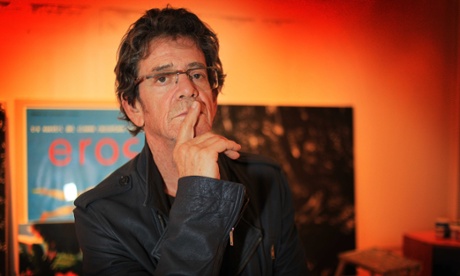
Lou Reed leaves $30m fortune Singer's estate boosted by $20m gathered by his manager since his death last year at 71
Lou Reed … man with a fortune. Photograph: Sipa Press/Rex
Lou Reed has proved to be more profitable in death than in life,
with his estate swelled by $20.4m (£11.9m) since his death, in addition
to the money distributed in his will.
According to documents
lodged with Manhattan Surrogate Court by Reed's manager Robert Gotterer,
the singer's estate totals $30m (£17.5m), with two-thirds of that
having been gathered by Gotterer since Reed's death at the age of 71
last year.
The New York Post reports
that the additional money "is likely from Reed’s copyright and
publishing interests, which, in his will, he instructed Gotterer to
treat as his own".
The main beneficiary of Reed's will is his
wife, Laurie Anderson, to whom he left his $7m (£4m) Manhattan
apartment, as well as a $1.5m (£880,000) property in the exclusive
Hamptons area of Long Island. She will also receive $15m of the money
Gotterer collected....MORE
Here's a bit of genius off his arena-rock Rock 'n' Roll Animal livealbum:
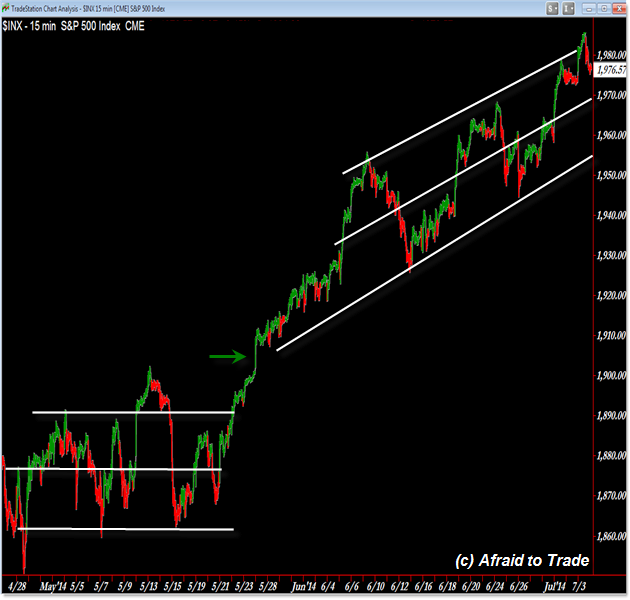
Let’s start our week with a simple “Color Structure” Chart of the S&P 500 and use it to plan a price pathway for the week.
We’ll start with the current intraday structure chart to set the stage:
The color structure chart shows a sideways rectangle (early May)
which is a consolidation pattern and then the recent breakout above the
1,900 level that fueled the breakout and uptrending channel that took
place through June (and now into July).
The main idea is that price tends to trade within trendline
boundaries and we see a rising parallel trendline channel building the
’structure’ for the current market.
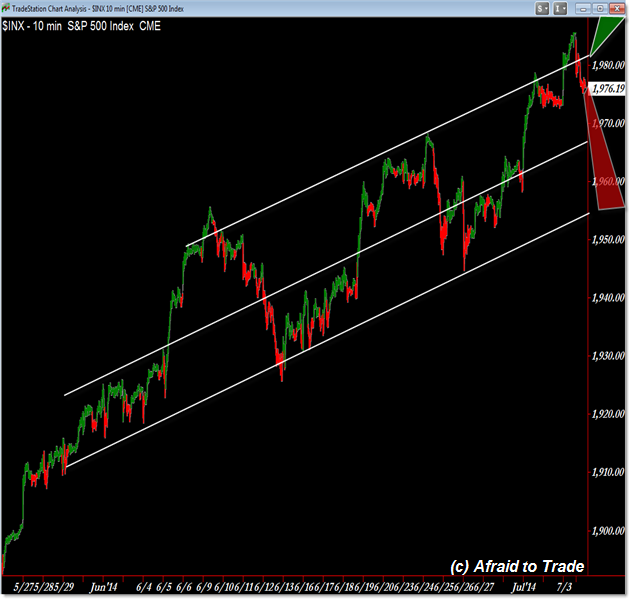
Let’s zoom down to a closer perspective to plan our two price pathways to trade the next price swing:
If the structure continues, then we’ll simply expect price to swing
down away from the 1,980 level at least toward the 1,970 Midpoint and
then likely down to the lower rising trendline target which will soon
intersect 1,960...
The papers contain names of spies, descriptions of secret weapons and detailed plots against the West
A stash of 2,000 documents smuggled out
of the former USSR is now available for viewing at Cambridge
University. As intelligence historian Christian Andrew told Time,
the documents represent "the most important single intelligence source
ever," listing the names of around 1,000 spies who operated in the
U.S., designs for various booby traps and weapons and plots that were
later given names such as "the Mousetrap."
The documents have been held in secret since Vasili Mitrokhin, a
former KGB official-turned-dissident, snuck them out of the collapsed
Soviet Union in 1992. Mitrokhin first tried bringing them to a U.S.
embassy in Latvia. (Time writes that the Americans turned him away; the Guardian states
that it was actually the long lines at the embassy that deterred
him.) He next tried the British embassy, which was more receptive.
Mitrokhin was taken to Britain to continue life under a new name and
identity, and since then the classified documents have been stashed in
19 boxes at an archive in Cambridge, Time writes.
Over the years, the papers have proven especially useful for
identifying former spies and for offering insight into some of the
USSR's troubles with its embedded intelligence officers. One British spy
who was recruited to work for the Soviets was “constantly under the
influence of alcohol,” while another was “not very good at keeping
secrets,” Time reports....MORE
Over at the Journal today, you will find an amazing story chronicling an FBI sting operation called “Operation Pennypincher,”
wherein an agent with the Federal Bureau of Investigation posed as a
crooked hedge fund manager named John Kelly, of the fictional SeaFin
Capital. Starting in 2010, Kelly (real name: John Keelan) invited people
to his office, which was “tucked behind an auto-parts supplier in a
Boston suburb” and asked them to “help him reel in executives of
penny-stock companies willing to pay a huge kickback in return for an
investment of up to $5 million by SeaFin.” (Naturally, these meetings
were surreptitiously videotaped.)
One of the people with whom Kelly/Keelan took a meeting was Edward
Henderson. A 71 year-old retiree from Rhode Island who previously worked
as a stockbroker, Henderson was just your average guy looking for a
straightforward scam with a nice little payoff....MORE
As I'm flipping between terminals and feed-readers it strikes me that
I'm not interested in any of the news stories I'm looking at.
Valero reports nice crack-spreads but the stock appears to have double-topped.
China is doing a freight rail build-out that should be very positive for
Inner Mongolia Baotou Steel Rare-Earth Hi-Tech Co., Ltd. but the stock
may have started a head-and-shoulders top.
With the lazy days of summer coming on I think of a line by "Adam Smith":
“…For, after all, I had been into cocoa a bit myself.
That was back when The Great Winfield had discovered cocoa trading.
Occasionally in those more leisured days I would sit with him lazily
watching stocks move, like two sheriffs in a rowboat watching catfish
in the Tennessee River….”
And then the voice of one of my mentors says "This is an opportunity".
I've mentioned him a few times...
...*One of my mentors, and one of the sharpest traders I
ever met, had the most common flaw of students of markets, hubris. In
his case it was non-fatal, more of a cost of doing business:...
...2) He got into a rigged blackjack game in Yugoslavia. Lost
half-a-mil. Said he started to think it was was fixed when he was down a
couple hundred.
Wife: "Then why the hell did you keep playing?"
Him: "I thought I could beat it".
Analysis: Forecaster who correctly predicted a big drop says gold may fall even more
The gold bugs are stirring.
A 10% gain by the yellow metal this year is rekindling hope among
long-suffering bulls that the major bear market that began nearly three
years ago finally might be over.
They argue that gold will continue to rise because investors will be
seeking a hedge against rising inflation, currency fluctuations and
geopolitical uncertainty.
Yet according to Duke University
finance professor Campbell Harvey, one of academia’s leading experts on
gold prices, the odds are poor that the metal will return any time soon
to its all-time high in August 2011. That month, the spot Comex gold
contract reached an intraday high of $1,929.20, more than $600 above
Thursday’s settle price of $1,320.40.
He puts gold’s fair value today at a little higher than $800.
A valuation model Harvey proposed in a National Bureau of Economic
Research study 18 months ago, when gold was nearly $1,700 an ounce,
correctly foresaw that the metal was overvalued.
That model is based on the tendency for gold to decline whenever the
ratio of its price to the consumer-price index rises well above its
average level of about 3.4, and to rise when it is significantly below
that average. With the CPI now at 237.1, this ratio stands at 5.6.
To be sure, Harvey acknowledges, gold is perfectly capable of taking a
long time to return to its fair value — and by no means will the path it
takes be a straight line. So a near-term rally isn’t out of the
question.
There is a shorter-term factor that nevertheless leads him to doubt gold
can mount even a short-term rally that is very significant: rising
Treasury yields, which go up as bond prices fall....MORE
HT:Ritholtz@Bloomberg We've been calling for a downturn since Alphaville's Izabella Kaminska made a profound observation in Dec. 2012 and specifically targeting $875 since July 2013. Izzy's story was posted a couple days before an interim high of $1715 so I guess you could say it's been nothing but downhill with Kaminska ever since. The price this summer has run from the June 3 low at $1,240.20 to the July 1 peak at $1,334.90.
$1316.70 last, off 3.70.
As usual, apologies to Mr. Van Otterloo although I am beginning to fear his fate may match that of Fenner & Beane.
From Advisor Perspectives:
GMO’s Ben Inker says he wouldn’t touch U.S. small-capitalization
stocks “with a 10-foot pole” – and says he sees no asset class that is
attractively priced. That isn’t the way Blackrock, the world’s largest
asset manager, sees things. Blackrock’s Dennis Stattman likes Japanese
equities and gold and isn’t afraid of rising rates.
Inker is the head of asset allocation at the Boston-based GMO and
Stattman is head of the global allocation team within the multi-asset
strategies group at New York-based Blackrock. Inker manages the GMO
Benchmark-Free Allocation III Fund and the Wells Fargo Absolute Return
Fund. Stattman manages the Blackrock Global Allocation Fund.
At the recent Morningstar investment conference in Chicago, the two
discussed their global market views in a panel session hosted by
Morningstar’s Kevin McDevitt.
Let’s look at what each had to say about key asset classes in the global markets.
On European value stocks
Although Inker sees opportunity in European value stocks, he says
that “you've really got to hold your nose to find stuff to buy.” He is
finding pockets of opportunity in the more cyclical, leveraged and
European-focused companies – but those companies are cheap for a reason
and “they all have hair on them.” He is betting that the market is under
pricing unfavorable European utility, telecommunications, automobile,
and energy companies. Inker said GMO has very few investments in
European banks because of little visibility as to what is on their
balance sheets. He is not confident that they are a bad investment but
is unwilling to invest in companies he does not know much about.
Stattman sees occasional opportunity in international oil companies
domiciled in Europe and in European cyclicals that offer a combination
of depressed margins and cheap valuations. His optimism is tempered by
underlying problems of European governments that “promise too much, tax
too little and don’t have a match between their fiscal policies and
monetary policy controlled by the European Central Bank (ECB).” The
ECB’s guarantee of liquidity has removed the market’s fear of a European
banking system failure, according to Stattman, and removal of this tail
risk has led to upward valuations in European stock markets and more
favorable value.
Stattman says trading equity volatility has become too crowded with
the VIX, a measure of volatility, at historic lows. But Inker says that
in 4% of their portfolio, GMO is selling puts in Europe and Japan where
implied volatilities are higher. He sees this as a way to get paid for
taking equity risk.
On U.S. small caps
With regard to U.S. small caps, Inker says he cannot envision a
scenario where they can increase their profitability on a sustainable
basis to justify their valuations. Profit margins have been better in
the U.S. markets than in the global markets, and small caps have
benefitted from their more domestic orientation and better profit
margins.
Stattman also says profit margins on U.S. small caps will not
continue to increase and sees those margins reverting to the mean. He is
not sure when this would happen. He feels that “the labor share is an
important component, and you have to be a bull on labor to be a bear on
profits.”
On emerging markets and Japan
Inker says he is most scared of emerging-market countries that are in
a dangerous area of the credit cycle and potentially on the edge of a
financial crisis (which, he added, they deserve). In China, Turkey and
Brazil, there has been rapid credit growth and investment in bad ideas.
He believes those debts will go bad and negatively affect these
economies....MUCH MORE
Be careful what you wish for. As the Fed imbibes a
sense of confidence in its ability to manage any bumps in the road on
its perpetual bubble-blowing mission through the use of macro-prudential
policies (big words that truly mean nothing) as stock valuations surge
and the repo market is experiencing severe problems; it can always point
to VIX as an indicator that all is well in the world and no real risk
exists. The problem is - the world is beginning to wake up to the 'odd'
micro-structure of the US equity markets and how 'dark pools' are
beginning to dominate trading volume. As Barclays faces major legal
problems over its alleged dark pool lies, lies, and more lies, the Fed
must be growing concerned... as the following chart shows JPMorgan
indicates there is evidence of an inverse relationship between equity volatility and the share of off-exchange trading.
Off-Exchange trading has soared since the financial crisis...
Off exchange trading rose sharply in 2009 with volumes almost
doubling vs. 2008. But off-exchange volumes declined since then for
three consecutive years i.e. during 2010, 2011 and 2012. The
average daily volume of off-exchange share transactions rose in both
2013 (+6.4%) and in 2014 (+6.1%). This compares to -8.9% YoY change in
exchange trading volumes in 2013 and +3.3% in 2014 YTD. That is
off-exchange trading has grown much faster than exchange trading over
the past two years. As a result the share of off-exchange volumes as percentage of total equity trading volumes jumped in 2014 to 37%, the highest ever (Figure 2).
YTD 2.4bn shares per day were traded off-exchange vs. 4.1bn shares
per day in traditional exchanges. For comparison, in 2008 2.1bn shares
per day were traded off exchange vs. 7.7bn on exchanges. But, we note
that the improvement in off exchange volumes over the past two years
does little to alter a picture of still subdued overall equity trading
volumes.
With dark pools dominating...
As mentioned above dark pools or ATS represent only a part of
off-exchange trading and reporting has started only recently in May
2014. For the two weeks commencing May 19th and May26th FINRA reported
an ATS trading volume of 0.78bn shares per day which accounted for 39%
of off-exchange (TRF) volumes for these two weeks and 15% of all trading
volumes (on and off exchange) for that week also. That is, dark pools or ATS account for around 39% of off-exchange trading activity and 15% of all equity trading volumes.
But there is a relationship between stock volatility and off-exchange trading...
We find evidence of an inverse relationship between equity volatility and the share of off-exchange trading.
This is shown in Figure 3 which suggests that big drops in equity
volatility in the past were associated with shifts towards off exchange
trading. One potential explanation is that price competition intensifies
when volatility goes down, as overall volumes also decline, causing a
shift in equity trading towards lower cost off-exchange venues.
* * *
Simply put - the end of dark pools would be the end of the complacent benign risk markets that the Fed enjoys control over...
Just a personal, machine searchable, www-accessible bookmark.
From Pew Research, May 14, 2014:
Many experts say the rise of embedded and wearable computing will bring the next revolution in digital technology.
About This Report
This report is the latest research report in a sustained effort
throughout 2014 by the Pew Research Center Internet Project to mark the
25th anniversary of the creation of the World Wide Web by Sir Tim Berners-Lee (The Web at 25).
A February 2014 report
from Pew Internet Project tied to the Web’s anniversary looked at the
strikingly fast adoption of the Internet. It also looked at the
generally positive attitudes users have about its role in their social
environment.
A March 2014 Digital Life in 2025 report issued by Pew Internet Project in association with Elon University’s Imagining the Internet Center
looked at the Internet’s future. Some 1,867 experts and stakeholders
responded to an open-ended question about the future of the Internet by
2025. They said it would become so deeply part of the environment that
it would become “like electricity”—less visible even as it becomes more
important in people’s daily lives.
To a notable extent, the experts agree on the technology change that
lies ahead, even as they disagree about its ramifications. Most believe
there will be:
A global, immersive, invisible, ambient networked computing
environment built through the continued proliferation of smart sensors,
cameras, software, databases, and massive data centers in a
world-spanning information fabric known as the Internet of Things.
“Augmented reality” enhancements to the real-world input that people
perceive through the use of portable/wearable/implantable technologies.
Disruption of business models established in the 20th century (most notably impacting finance, entertainment, publishers of all sorts, and education).
Tagging, databasing, and intelligent analytical mapping of the physical and social realms.
This current report is an analysis of opinions about the likely
expansion of the Internet of Things (sometimes called the Cloud of
Things), a catchall phrase for the array of devices, appliances,
vehicles, wearable material, and sensor-laden parts of the environment
that connect to each other and feed data back and forth. It covers the
over 1,600 responses that were offered specifically about our question
about where the Internet of Things would stand by the year 2025. The
report is the next in a series of eight Pew Research and Elon University
analyses to be issued this year in which experts will share their
expectations about the future of such things as privacy, cybersecurity,
and net neutrality. It includes some of the best and most provocative of
the predictions survey respondents made when specifically asked to
share their views about the evolution of embedded and wearable computing
and the Internet of Things.
Survey respondents expect the Internet of Things to be evident in many places, including:
Bodies: Many people will wear devices that let them
connect to the Internet and will give them feedback on their
activities, health and fitness. They will also monitor others (their
children or employees, for instance) who are also wearing sensors, or
moving in and out of places that have sensors.
Homes: People will be able to control nearly
everything remotely, from how their residences are heated and cooled to
how often their gardens are watered. Homes will also have sensors that
warn about everything from prowlers to broken water pipes.
Communities: Embedded devices and smartphone apps
will enable more efficient transportation and give readouts on pollution
levels. “Smart systems” might deliver electricity and water more
efficiently and warn about infrastructure problems.
Goods and services: Factories and supply chains
will have sensors and readers that more precisely track materials to
speed up and smooth out the manufacture and distribution of goods.
Environment: There will be real-time readings from
fields, forests, oceans, and cities about pollution levels, soil
moisture, and resource extraction that allow for closer monitoring of
problems.
Expert respondent Patrick Tucker, author of The Naked Future: What Happens In a World That Anticipates Your Every Move?
provided a nice working description of the Internet of Things, writing:
“Here are the easy facts: In 2008, the number of Internet-connected
devices first outnumbered the human population, and they have been
growing far faster than have we. There were 13 billion
Internet-connected devices in 2013, according to Cisco, and there will
be 50 billion in 2020. These will include phones, chips, sensors,
implants, and devices of which we have not yet conceived.”...
The morning I met Elaine Rich, she was sitting at the kitchen table
of her small town home in suburban Maryland trying to estimate refugee
flows in Syria.
It wasn't the only question she was considering; there were others:
Will North Korea launch a new multistage missile before May 10, 2014?
Will
Russian armed forces enter Kharkiv, Ukraine, by May 10? Rich's answers
to these questions would eventually be evaluated by the intelligence
community, but she didn't feel much pressure because this wasn't her
full-time gig.
"I'm just a pharmacist," she said. "Nobody cares
about me, nobody knows my name, I don't have a professional reputation
at stake. And it's this anonymity which actually gives me freedom to
make true forecasts."
Rich does make true forecasts; she is curiously good at predicting future world events.
Better Than The Pros
For
the past three years, Rich and 3,000 other average people have been
quietly making probability estimates about everything from Venezuelan
gas subsidies to North Korean politics as part of , an experiment put together by three well-known psychologists and some people inside the intelligence community.
According
to one report, the predictions made by the Good Judgment Project are
often better even than intelligence analysts with access to classified
information, and many of the people involved in the project have been
astonished by its success at making accurate predictions.
When Rich, who is in her 60s, first heard about the experiment, she
didn't think she would be especially good at predicting world events.
She didn't know a lot about international affairs, and she hadn't taken
much math in school.
But she signed up, got a little training
in how to estimate probabilities from the people running the program,
and then was given access to a website that listed dozens of carefully
worded questions on events of interest to the intelligence community,
along with a place for her to enter her numerical estimate of their
likelihood.
"The first two years I did this, all you do is
choose numbers," she told me. "You don't have to say anything about what
you're thinking, you don't have to justify your numbers. You just
choose numbers and then see how your numbers work out."
Rich's numbers worked out incredibly well.
She's
in the top 1 percent of the 3,000 forecasters now involved in the
experiment, which means she has been classified as a superforecaster,
someone who is extremely accurate when predicting stuff like:
Will there be a significant attack on Israeli territory before May 10, 2014?
The Superforecasters
In
fact, she's so good she's been put on a special team with other
superforecasters whose predictions are reportedly 30 percent better than
intelligence officers with access to actual classified information.
Rich
and her teammates are that good even though all the information they
use to make their predictions is available to anyone with access to the
Internet.
When I asked if she goes to obscure Internet sources, she shook her head no.
"Usually I just do a Google search," she said....MUCH MORE


 ...MUCH MORE
College professors may teach at either private or public universities; their level of expertise and interest will determine where they spend the bulk of their years teaching. If a professor can obtain a position at a prestigious private university, he or she will most likely be paid a lot more than at a second-tier or lesser-known public school.
You may wonder how these professors can command such amazing salaries. The answer is: These are not your run-of-the-mill, everyday instructors. They are world-renowned, have made major contributions to society, and stand at the pinnacle of their profession. They are the rock stars of academia.
David N. Silvers is Clinical Professor of Dermatology and Pathology and Director of the Dermatopathology Laboratory at Columbia University. His stellar salary rivals that of many college coaches.
Zev Rosenwaks is Professor of Obstetrics and Gynecology at Cornell University and Director and Physician-in-Chief of the Ronald O. Perelman and Claudia Cohen Center for Reproductive Medicine at the Weill Cornell Medical College.
Dean Takahashi is Adjunct Professor in the Practice of Finance at the Yale School of Management, and Senior Director of Investments at Yale University.
William E. Fruhan, Jr., is the Baker Foundation Professor, as well as the George E. Bates Professor Emeritus, at the Harvard Business School, where he has served as Senior Associate Dean, Director of Faculty Development, Chairman of the Executive Education Advanced Management Program, Chairman of the Finance Area, and Course Head for Finance in the first year of the MBA Program.