Monday, June 6, 2011

Zeitgeist: "EPA considers delay to power plant emissions rules"

I thought I first saw this story at The Hill but can't put my hands on the link. From businessGreen:

Environmental agency reportedly considering two-month postponement to unveiling of emissions performance standards
The US Environmental Protection Agency (EPA) is reportedly poised to delay an imminent announcement on controversial new rules intended to curb emissions from power plants.

According to a number of reports over the weekend, the agency, which is under intense pressure from Republicans and energy lobbyists, is likely to put back the release of proposed performance standards for power plants that had been expected next month. The delay is likely to stretch to one or two months, according to sources.

News of the possible delay was first reported in the National Journal and was followed by reports from news agencies Reuters and Bloomberg, both of which cited anonymous sources familiar with the EPA.
The EPA declined to comment on the speculation, insisting that the agency had nothing to announce at this time....MORE

Bloomberg Analyst Survey: "Wheat Rallying 20% as Parched Fields Wilt From China to Kansas"

Chicago wheat is trading at $7.62, down 11 3/4 cents.
Be careful on this one, see stories below the jump.
From Bloomberg:
The worst droughts in decades are wilting wheat fields from China to the U.S. to the U.K., overwhelming Russia’s return to grain markets and driving prices to the highest levels since 2008.

Parts of China, the biggest grower, had the least rain in a century, some European regions are the driest in 50 years and almost half the winter-wheat crop in the U.S., the largest exporter, is rated poor or worse. Inventory is dropping 8.8 percent, the most in five years, Rabobank International says. Prices will advance 20 percent to as high as $9.25 a bushel by Dec. 31, a Bloomberg survey of 14 analysts and traders shows.
Wheat as much as doubled in the past year as crops failed, spurring Ukraine and Russia to curb shipments and increasing the U.S. share of global sales by the most since 2004. Russia ending its export ban on July 1 and Ukraine lifting quotas may not be enough as crops wither elsewhere, fuelling gains in food prices which the United Nations says are already near a record.
“In 32 years, I’ve never seen so many problems in so many places,” said Dan Basse, the president of AgResource Co., a farm researcher in Chicago. “We’re concerned about the world story now,” said Basse, who has been studying agricultural markets since 1979 and expects prices as high as $10 this year....MORE
The drought in China is serious but may not have the effects on wheat that the pros are looking for. First some orientation:

Agricultural map of China
China Ag Regions and Crops

From CNtv (May 25):
Bumper harvest for Shandong wheat farmers
Much of China's Yangtze River region is currently battling the worst drought conditions in 50 years. But it's not all bad news in the agricultural sector. Farmers in Shandong Province, one of the country's major wheat-producing areas, are expecting higher wheat output this summer.

Lingxian County, in the eastern part of Shandong Province, suffered from heavy drought this spring.
But due to the high soil moisture level and effective measures adopted by the local government, the drought did not cause much of a negative impact to wheat production in the region....MORE 
From Xinhua (June 5):
Persistent rain expected to ease drought in central, south China
Rain in central and south China over the next three days is expected to drench drought-hit regions, according to the country's weather forecast department.

At least light to moderate rains would saturate most of the regions to the south of the Yangtze River by early Sunday morning, said the China Meteorological Administration (CMA).

The CMA also said that heavy rains would hit the provinces of Guizhou, Hunan, Hubei, Anhui, Jiangxi, Jiangsu, Zhejiang, as well as Shanghai....MORE
Which was followed by:
Rain continues to drench drought-hit south China


Former First Solar President Bruce Sohn named CEO of next-gen energy storage company Fluidic Energy (FSLR)

That's got to be a relief for the folks in Tempe. From our April 14 post "Jim Chanos (!) Spanks First Solar (!) FSLR)":
...Regarding the insider selling, we've chronicled billions of dollars worth highlighting the bails by Chairmen Ahern, former BFF Goldman Sachs and the Wal*ton interests.
More problematic might be an idea mooted by Auriga analyst Mark Bachman yesterday:

First Solar President Sohn May Leave to Join Rival Company, Analyst Says...
Bruce ran operations at FSLR, probably the last person you want going head to head with you.
Here's the release from Fluidic Energy: 
Fluidic Energy Announces Bruce Sohn as CEO
Mr. Sohn brings a wealth of experience in growing technology companies, including 24 years at Intel and most recently as the President of First Solar. Intel and First Solar both realized substantial growth during his tenure at each company.

In welcoming Mr. Sohn to Fluidic, Lee Scott, Fluidic's Chairman, commented, “We are excited that Bruce has decided to join Fluidic. His management style fits well with our company culture and his proven leadership skills and experience in high-growth tech companies are a perfect fit as we transition to the next stage of our growth.”...MORE
Mr. Sohn ran INTC's first volume 300mm fab.
Those plants cost at least $1 bil. to build. An operations guy all the way. As I said, not the guy you want competing with you.

Sunday, June 5, 2011

Decision Time For Corn (DBA; DBC; CORN)

The Missouri River flooding, especially the stretch from South Dakota to along the Nebraska/Iowa border could be enough to spook the speculators to the upside.
Otherwise the 'huge double top' rules. (click the charts to enlarge)
Lifted in toto from Alpha Global Investors:

Huge move in the corn market ?


A reader asked me to look at the corn market ; By looking at both charts (daily & weekly) I now understand why he asked me ....
Corn is ready for a major move !
The big picture (weekly) suggests that a break out (above that long double top) could send corn prices zooming up fast !
Short term picture (daily) reflects an overbought condition

Stocks and Sex: A Socionomic View of Demographic Trends

An oldie (1999) but goodie from Robert Prechter via Socionomics Institute:

Most people think that the economy is a key determinant of stock market behavior. Pages 260 through 264 of The Wave Principle of Human Social Behavior and the New Science of Socionomics demonstrate that actually, social mood trends, as reflected by the trends of the stock market, determine the direction of economic activity. Most people think that politics affect the stock market. Pages 272 through 282 in the book show that the social moods, as reflected by the stock market, controls the selection of leaders and therefore the direction and outcome of politics. Most people think that peace and war mightily affect the valuation of stocks. Pages 265 through 270 show that aggregate mood trends, as reflected by stock prices, determine social climates that are conducive to peace or war. The fundamental observation of the new science of socionomics is that social mood, which is patterned according to the Wave Principle, is the generator of social action, be it economic, political or cultural. The key insight of socionomics is that the direction of causality between social mood and social action is precisely the opposite of that which is almost universally presumed; the former dictates the character of the latter, not vice versa.

Most people who attempt to relate demographics to the stock market operate under the standard presumption that, if there is any relationship at all, demographic changes (like changes in politics, economics, cultural events, and so on) would be causal to the trends of the stock market. In reviewing related studies, one finds full agreement on that starting point and utter disagreement thereafter. Of course, in any instance when there is a paucity of data and a researcher has the option of sliding two series around until he finds a fit, it is quite easy to find confluence somewhere.2 With respect to demographics and the stock market, one study, based on a cycle theory, postulates a 20-year lag in the stock market’s reaction to the number of births.3 Another, based on the hypothesis that people in their forties spend and invest more than those in other age groups, shows a 44-to-49-year lag between birth rates and stock price trends from 1956 to the present.4,5 Another researcher disputes this claim, pointing out that the number of 44-to-49-year olds “kept rising right through the 1929[-1932] crash, [which] calls the reliability of the ‘spending wave’ as a stock market indicator into question.” To improve the correlation, he constructs a five-year moving average of the rate of change of a “saver/spender ratio” (in this case, the number of 40-to-49-year-olds divided by the number of 25-to-34-year-olds) that correlates with broad stock trends in the U.S. and Japan since 1948 and 1965 respectively, but not well beforehand.6 At least three studies, including one from academia, argue that there is too little data, too little cross-cultural correspondence and far too much divergence in pre-1956 data to suggest any relationship at all between the stock market and lagged birth trends.7,8,9 It is clear from the disagreement among the proponent studies and the statistical analysis in the opponent studies that there is in fact, as the latter conclude, little or no basis for proposing that there is a causal relationship between demographic trends and later stock market trends. However, that is as far as these studies go, because social researchers cannot imagine a basis for investigating any other correlation.

What all of these studies have in common, despite their wide differences, is the presumption that if there is any causality at all, it is demographics that would be causal to the stock markets trends. This stance reflects the standard misconception of causality, i.e., the idea that social mood, and therefore the stock market, is a slave to “outside” influences. The socionomist understands that this view with respect to demographics, as with every other major social phenomenon, is precisely backwards; the premise is false. Naturally, this false presumption has led, as it has with studies relating stocks to economic or political causation, to utter chaos in the aggregated conclusions, as the wide disagreements catalogued above reveal.

How may we state the correct premise for the purposes of testing its validity? We must start from the socionomic perspective on social causality. We know that social mood, as reflected by the stock market, determines the expansions and contractions in the economy. We know that extremes in social mood, as reflected by extremes the stock market, determine whether a landslide election will favor the incumbent or the challenger. We know that the direction and extent of social mood change, as reflected by the stock market, determine the extent of peace or whether there is a social mindset conducive to the outbreak of war. Is it possible to imagine that social mood also determines demographics? Most people would never pose such a question; I hope to suggest an answer.


Figure 1 shows stock market prices plotted against birth rates from 1909 to the present. The data is shown with no lag. The first thing to notice is that there is a fairly noticeable correlation between the two sets of data.
Why would births and the stock market trend together, if they do at all? Sometimes answers can be found in subtleties. Notice that the deepest low in births this century came in 1933, the year after the deepest low in the stock market this century. Notice that the second most important low in births occurred again in 1975, one year after the second most important stock market low of this century. Why would there be a one-year lag? Well, can you think of any activity that always precedes a birth by about a year? If so, could this activity be correlated directly with people’s moods and therefore the trend and level of the stock market? Chapter 14 of The Wave Principle of Human Social Behavior characterizes a rising social mood trend as correlating, among other things, with “friskiness, daring and confidence,” a falling trend with “somberness, defensiveness and fear.” We now have a tenuous basis for a socionomic hypothesis regarding demographic trends. When aggregate feelings of friskiness, daring and confidence wax, people engage in more sexual activity with the aim of having children. When these feelings wane, so does the desire for generating offspring. It takes about nine months between the procreative impulse and a child’s birth, which is why, at least at market bottoms, annual data on births lag annual data on the stock market by one year. Figure 2 shows the same data, lagged by one year to reflect conceptions. The result is not an extrapolation or theory, nor is it the result of elaborate exercises in data fitting, as we find so often with hypotheses that demographics drive the economy. We know that a procreative decision or impulse is required nine months prior to a birth, so there is no theoretical presumption in repositioning and renaming this data.10 Now the two major lows line up exactly.


Let’s investigate the relationship at market tops. As you can see from the slash marks imposed upon Figure 2, the rate of procreation has declined prior to major tops in the Dow Jones Industrial Average. This is precisely the same behavior exhibited by indicators of market breath and rates of change for stock averages, which always peak and begin declining before the major blue-chip averages top out. To visualize the similarity, let’s graph the relationship between procreative activity and the success of the broad stock market, not just the blue chips....MORE
From Calculated Risk (April, 2010):

...That calls for a graph...

Saturday, June 4, 2011

Big Banks Cash In on Commodities (DBA; MOO; CORN; BARN; JPM)

Yes, BARN is an ETF.
My overarching view on commodities trading is that the financial intermediaries should go play in the gold and silver markets and leave the consumables (food, energy) to the hedgers and speculators.
I'd been meaning to post this Wall Street Journal article since last week:
Wall Street is tapping a real gusher in 2011, as heightened volatility and higher prices of oil and other raw materials boost banks' profits.

A group of 10 large banks—including Goldman Sachs Group Inc., Morgan Stanley, J.P. Morgan Chase & Co., Citigroup Inc., Bank of America Corp. and Barclays PLC—saw their commodities revenues increase by 55% in the first quarter, according to Coalition, a firm that analyzes the performance of investment banks. After a disappointing 2010, commodities was the fastest-growing segment in banks' fixed-income businesses in the first three months of this year, even though it still accounts for just 7% of banks' total fixed-income revenues, Coalition said.

Commodities trading is a bright spot for institutions that face new regulatory clampdowns on practices that previously fattened bank profit margins, such as trading with their own capital and slapping customers with hefty "overdraft" fees. Oil is up about 10% so far this year, settling at $100.29 a barrel Wednesday, and commodities such as gold and copper are close to all-time highs.

J.P. Morgan has emerged as one of the biggest beneficiaries of the commodities boom sweeping Wall Street. The bank's commodities unit—which employs about 1,800 people, more than any of its rivals—made more money during the first quarter than through all of last year, according to people familiar with the matter. So far this year, the unit has earned roughly $750 million and is on course to beat its 2011 internal target of $1.2 billion, these people added. The J.P. Morgan unit earned just $514 million for all of 2010, falling far short of its goals.

The performance at J.P. Morgan is largely the result of a recent acquisition and the run-up in prices and volatility levels. But the early results are being celebrated inside the halls of J.P. Morgan after the bank struggled through defections, miscues, bad press and a coal trade that cost the firm $130 million in 2010. The New York bank is making a bold and costly bet that a recent string of commodities-trading acquisitions will transform the operation into an industry leader and unseat rivals Goldman Sachs and Morgan Stanley. A bank spokeswoman declined to comment on any commodity-trading dollar figures, which it doesn't make public.

Commercial banks such as J.P. Morgan and Bank of America may have an edge over rivals like Goldman Sachs and Morgan Stanley, as new financial rules force Wall Street to cut back on "proprietary trading" with the bank's own capital and turn the focus of their business toward helping clients. Commodities desks at commercial banks can tap a larger corporate client base, offering hedging services to producers and consumers of raw materials, facilitating transactions for hedge funds and selling commodity-linked investment products to pensions and sovereign-wealth funds.

The revenue jump takes some heat off J.P. Morgan's embattled head of commodities, Blythe Masters, who went before the board last fall to explain why her group had fallen short of its goals and assured employees she still had the support of her superiors; her boss, Jes Staley, who runs the investment bank, had indicated he would re-evaluate the business this year if revenue dipped below $1 billion, according to a person familiar with the matter.

J.P. Morgan isn't the only financial-services firm getting a commodities lift this year....MORE
Here are some of our posts on JPM's Ms. Masters:

"CFTC Probes JP Morgan's Silver Trading" (JPM; SLV; HBC)

Brilliant: Maxwell's SILVER Hammer Came Down on Blythe Masters' Head (SLV; JPM)

"Woman Who Invented Credit Default Swaps is One of the Key Architects of Carbon Derivatives, Which Would Be at the Very CENTER of Cap and Trade"
.

...Flooding on the Missouri River 2011...

The entire river is flooding, from Montana to the confluence* with the Mississippi
From the National Weather Service Weather Forecast Office, Kansas City:

In the past few weeks, the upper Missouri basin has received nearly a year`s worth of rainfall. In addition, snow pack runoff entering the upper portion of the river system is 140 percent of normal. These conditions have resulted in Missouri basin reservoirs across eastern Montana and the Dakotas nearing their maximum levels. Record releases have begun at Gavin’s Point dam located to the west of Yankton, South Dakota. Current releases are around 80,000 cubic feet per second (cfs), with plans to increase the release to 150,000 cfs by mid-June. The previous high release at Gavin’s Point was 70,000 cfs in 1997.
 
These extremely high flows, combined with normal rainfall, may result in near-record flooding along portions of the Missouri River. At this time, flooding in the immediate Kansas City area is expected to be within the minor to moderate category, with the potential of flood walls being closed in the central industrial district if the crest nears 39 feet.

For the most up to date information on likely long term stages based on Gavin's Point releases, please see the  
Corps of Engineers Long Range Forecast

Please Note: The following table is a long-range Missouri River forecast from the US Army Corps of Engineers, assuming normal summer precipitation along with the expected peak releases of 150,000 cfs from Gavin’s Point dam. Record and 2010 flood crests have been included for reference....MORE
*The Big Muddy is the, well, muddier one:

"The Best of the Bozeman Police Reports"

From time to time Tim Iacono (Iacono Research) shares the goings-on in Bozeman.
Via The Mess That Greenspan Made:
From the Police Reports page of the Bozeman Daily Chronicle come the best of the Bozeman police reports from the last week along with some items from the Sheriff’s Office.


The weather is getting wetter and warmer and both humans and wildlife are getting into more trouble around here, the former mostly a result of too much drinking, offering further confirmation that the state stereotype noted here yesterday has some degree of truth to it. As noted in the last highlighted item at the end of this list, one of the things that can be seen around here with some regularity is people driving their cars with their dog running outside, on a leash, in order to let the dog get some good exercise without the owner exerting themself. This is the first time I’ve heard of this when drinking was involved.
  • A caller wanted two men moved along. They were sitting in lounge chairs, drinking and watching the flooding at East Mendenhall Street and Rouse Avenue around 3:30 a.m.
  • A caller just arriving to work on West Mendenhall Street around 7:45 a.m. found the front window broken and an intoxicated man in the building. The man took off but police tracked the 27-year-old Bozeman burglar down and arrested him.
  • A deputy put a black cow and calf back in their pasture on Baxter Lane around 7 a.m.
  • Three bison were grazing outside a pasture fence on Cottonwood Road around 10:15 a.m.

  • A woman who had reported her social security card as stolen later found it “in the safe place where she hid it.”
  • A caller had questions as to how to handle a neighbor who “makes obscene gestures” every time he drives by the caller’s house.
  • A bear was going through trash it had gotten from a dumpster on Arrowleaf Hills Drive around 11:30 p.m.
  • A driver was stopped on North Fifth Avenue and West Main Street for going the wrong way on a one way with no headlights. The driver was arrested for driving under the influence....MORE
See also:
At Least We’re Not Fargo

In place of the Best of the Bozeman Police Reports that normally appears here on Saturday, here’s an item from the local paper that offers at least a partial explanation for all those drunk and disorderly incidents that you’ve been reading about here:

Website names Bozeman among ‘Drunkest Cities’

Bozeman makes a lot of nationwide lists, but a new ranking as one of the top 10 Drunkest Cities in America caught a few people off guard....MORE

"Robert Arnott's Magic Indexing Formula"

We have been fans of Mr. Arnott since his days as editor of the Financial Analysts Journal.
The into to this piece cracked me up, we'll link to the Bloomberg article below.
From Forbes:
Robert Arnott, resplendent in a purple-check jacket, purple-striped shirt, and purple-print tie, is regaling his staff with tales of his favorite hobby: chasing solar eclipses from the ice floes of Antarctica to the singing sand mountains of the Gobi Desert. The scene is the ritual daily luncheon inside the cavernous conference room at Research Affiliates, Arnott's fast-growing eight-year-old investment research firm in Newport Beach, Calif. On this sunny Thursday in April, Ph.D.s from as far away as China and Russia sample Turkish cuisine, share ideas for applying game theory to portfolio design, and swap ferocious forehands at the Ping-Pong table. It all has the loose, zany vibe of the cafeteria at a university research lab.

Arnott is well-suited to the role of mad professor. The burly, goateed 55-year-old plows through life with a nonstop enthusiasm that he channels into an assortment of extreme hobbies. He is an avid collector of both the world's fastest vintage motorcycles -- he recently paid $100,000 for a Morbidelli from Italy with a miniature Ferrari engine -- and the graffiti art of Banksy, the phantom underground British painter famed for masking his identity. But Arnott loves nothing more than retelling his eclipse-seeking adventures.

In his rich bass voice, Arnott recounts an epic expedition to Paraguay in the mid-1990s. "We drove nine hours on dusty, bumpy roads to a tiny cow town called Filadelfia," he says. "We hopped the fence of a ranch to see the eclipse, and the owners rushed over to kick us off. When we explained that this happens once every 360 years and only lasts five minutes, they stayed and were mesmerized. A woman cried tears of joy when she saw the moon blot out the sun. I've seen that reaction many times at eclipses."

When he's not circling the globe in search of celestial rapture, Arnott is easily one of the most important figures working in the investment world today. At Research Affiliates he has created a menu of exchange-traded funds, mutual funds, and other offerings that now manage a total of $52 billion (most through indexes licensed to big institutions). But his influence extends well beyond the size of those portfolios.

Arnott's innovative approach to designing and marketing index products has rocked the investment world. "No one is having a bigger impact in reevaluating the full and hidden costs of conventional indexing," says Brent R. Harris, a managing director at nearby Pimco, the $1 trillion money management colossus for whom Arnott directs a family of funds. "He's also creating a better alternative with a proven track record."...MORE
And Bloomberg's take, sans the fashion info:

Arnott Index Derided by Bogle as Witchcraft Beats Vanguard Fund
As Robert Arnott was deciding whether to start his own investment firm, he met with his hero John Bogle for dinner. At a steakhouse in downtown Philadelphia in 2001, the founder of indexing powerhouse Vanguard Group Inc. spoke with enthusiasm about running his own firm. Bogle, who’s now 82, told Arnott that starting a company could be rewarding once your investing ideas catch fire.

Arnott, 56, says Bogle inspired him to set up Research Affiliates LLC less than a year after that dinner. Arnott then went on to shake the foundation on which the older man built Vanguard: indexing that allocates equities based on market capitalization, Bloomberg Markets magazine reports in its July issue.
Arnott debuted in 2005 a new type of indexing that uses fundamental measures such as cash flow to pick stocks -- a methodology that the father of indexing would later denounce as “witchcraft” in an interview with Morningstar Inc. (MORN) because of its similarity to active management and higher costs. By 2011, the innovator’s brand of stock indexing had produced better returns than Bogle’s.

The PowerShares FTSE RAFI US 1000 Portfolio (PRF) ETF, which is based on Arnott’s methodology, advanced at an average annual rate of 5.3 percent from its inception on Dec. 19, 2005, through May 9. That beats the flagship Vanguard 500 Index Fund’s 3.2 percent return, according to data compiled by Bloomberg. Armed with those results, Arnott is now planning to stir up the world of bond funds.

Bond Indexes
As the U.S. and Europe struggle with record deficits, the money manager is building a new set of bond indexes that shun the world’s most indebted nations and favor developing economies with smaller obligations.
“Fundamental indexing in bonds may very well be bigger than in stocks,” Arnott says. “We’re looking now at how a debt burden affects gross domestic product and capital markets, and it paints a pretty scary picture.”
Economists and money managers, including Clifford Asness, founder of AQR Capital Management LLC, the $38.8 billion hedge fund, have derided Arnott’s indexes. “Rob’s a good guy; he’s very smart,” says Bogle, who retired as Vanguard’s chairman and chief executive officer in 1996. “He has beaten the market over the past five years, but one might want to think about what goes into that: risk.”

Eugene Fama, a professor of finance at the University of Chicago’s Booth School of Business who helped develop the efficient market hypothesis, said Arnott’s indexes represent a triumph of marketing rather than an innovation in investing. ...MORE
Lastly, from Future of Capitali$m:
Robert Arnott's Deriders
...What the article doesn't mention is that Professor Fama is a "board member of Dimensional Fund Advisors" and a consultant for Dimensional's Fixed Income and Value Strategies. In other words, he's a money manager that competes with Mr. Arnott.
Likewise, the Bloomberg article reports:
As investors started buying fundamental index funds, traditionalists publicly attacked them. Bogle, now president of Vanguard's Bogle Financial Markets Research Center, and Burton Malkiel, a Princeton University economics professor, penned a column in the Wall Street Journal in June 2006 criticizing fundamental index funds for charging higher management fees and expenses that were five to 10 times as much as those levied by traditional index funds.
Like Professor Fama, Professor Malkiel is identified by Bloomberg only with his academic affiliation. There's no mention that Professor Malkiel is the chief investment officer of Alphashares, another firm that competes with Mr. Arnott.
While Malkiel doesn't interest me, we've had a few posts on Mr. Asness:
How Asness's firm lost $17 billion in two years—and made it up in one.
And in "General Electric Dividend: Good Sign or Management out of Ideas? (GE)":
It is usually a good thing when companies dividend out cash to the owners rather than investing it in some self-aggrandizing managerial wish list. Robert Arnott and Clifford Asness did a nifty little 18-page paper that looks at the issue:
Surprise! Higher Dividends= Higher Earnings Growth
We have so many posts on Arnott that it is probably easiest to do a Google search of the blog:
site:climateerinvest.blogspot.com robert arnott

Friday, June 3, 2011

CodeBreaker Cracks Winnie Jiau's Insider Trading Crypto

From CodeBreaker:
Expert Network Empress Winifred Jiau Didn’t Give Up Any Of Her ‘Recipes’ Without The  "Sugar"

One major focus of the Feds’ insider trading cases du jour is the use of expert networks by hedge fund managers, and whether or not the information is “too” good (the government is of the opinion that it is). While a whole bunch of employees with various expert networks have been charged, one stands out as the leader in the field- Primary Global’s Winifred Jiau, who is the woman you wanted to get in good with if you were looking to (allegedly) trade on material non-public information. Jiau seems to have worked with everyone who’s been accused of insider trading (Donald Longueuil, Noah Freeman, the Goffer brothers and so on and so forth) and presumably had a waiting list for her tips. According to Assistant US Attorney David Leibowitz’s opening statement yesterday, Jiau’s information was “precise to the decimal point,” and even created her own code to discuss such info so that no one would ever catch on to what she and her clients were discussing, should their conversations be tapped.
Leibowitz said Jiau spoke in code, demanding payments for the information, which she called “sugar,” and describing her sources as “cooks” and referring to tips as “recipes.”
For example, if you’d been reading over Jiau’s shoulder on June 3, 2008, you would’ve seen the following IM and while perhaps felt a pang of hunger, been none the wiser:
Jiau wrote, “Cooks are on strike now,” adding later in the same conversation, “so drop some of your extra sugar to me.”
Barai replied, “yep.”
Jiau answered, “cooks don’t talk to me without sugar. they are not my boyfriends.”
Barai wrote that he’d gone on a “few dates,” adding that he hadn’t found them “boring.”
“Anyhow, I will know something when I got the sugar,” Jiau said. “before that, I don’t know anything.”
Subsequent conversations included the following, which we’ve attempted to crack:

* “Boil the water” (drum up short interest)
* “Pound with a mallet to a quarter inch thick” (sell a quarter of your shares)
* “Chop up fresh herbs and tuck them under the chicken’s skin along with a few pats of butter” (create an email trail)...MORE

Boring: Adecoagro Up in a Down Market (AGRO; CRESY)

Sometimes boring is good. The farmland biggie* is up 31 cents (2 1/2%) with the DJIA and S&P down .9% and 1.0% respectively. Here's the six-month comparison chart:


The stock came public at the end of January.
*See:
Soros Fund Management's Largest Position Was up 7.68% Yesterday (AGRO; CRESY; MOO; DBA)

Jobs Report: Economists React

From Real Time Economics:

‘Consider Me Worried’
Economists and others weigh in on the acceleration in GDP growth tepid rise in payrolls amid a increase in the unemployment rate.

–There has clearly been a “soft patch” in economic performance this spring and as such, the employment growth rate is slowing rather than accelerating. We believe that given what we know now, job growth is still set to accelerate as we believe the recent weakness is, relatively speaking, a bump in the road… The more important problem, in our opinion, is the lack of wage growth among those with a job and those gaining new employment. Between labor market slack, which reduced bargaining power among the employed, and the mix of job creation (leisure, food service and retail) being on the lower end of the scale, there has been no meaningful increase in aggregate earnings. –Dan Greenhaus, Miller Tabak

–What appeared to be a sustainable level of job growth seems to have faded hard in May. Yes nonfarm payrolls increased for the month, but that increase is actually a net-negative considering population growth that adds 75,000 – 85,000 workers to the labor force in an average month. Job growth is (was?) the only thing going for consumer incomes and spending, and this most recent result will throw said spending, responsible for 70% of economic activity, into a questionable state. –Guy LeBas, Janney Montgomery Scott

–Some of the drag causing the soft-patch is temporary. Among those factors are higher oil prices earlier in the year, bad winter weather, spring floods and tornados, and the Japan disaster. Oil has already fallen to near $100 a barrel, weather can only be assumed to normalize, and Japan appears to be making good progress in getting production back up to plan by late summer/early fall. Other factors are longer term including cutbacks in state and local government spending, limits to federal spending, and the ongoing drag from depressed commercial and residential real estate markets. Still other factors contributing to weak economic growth can be termed structural, including lower population/labor force growth and a cyclical decline in productivity growth. –Robert A. Dye, PNC>

–I worry about the fragility of “animal spirits,” and the damage that even ostensibly temporary forces can have in interrupting the building optimism that had led to a nice pickup in hiring and investment by businesses and spending by consumers late last year. My read of the anecdotal information is that the economy has substantial underlying resilience and can quickly recover, but consider me worried. –Stephen Stanley, Pierpoint Securities ...Many MORE

Sometimes Stocks Just Want to Go UP (DIA; SPY; QQQQ; VXX; MCP)

Take a look at this chart from WallStreetTrader:

http://i202.photobucket.com/albums/aa241/BatmaxPT/8bcbbc31.png

If the VIX currently at $17.80, DOWN 29 cents with the DJIA down 80 and the S&P down .59% turns south, then (via BigTrends):
for the overall market and one of the best relative strength plays, Molycorp, currently up 77 cents (1.2%) at $64.79.

Job Creation Disappears and Lord Rothschild Suggests You Panic, Sells Gold (and the Jeremy Grantham Commodity Call that Didn't Make the Headlines)

You saw the non-farm payrolls number, we'll be back with a roundup of opinion.
In the meantime here's the head of a fam that has been watching (and creating) the world economy for a while.
From Citywire:

Rothschild starts selling gold; warns on commodities
RIT Capital Partners, the global growth trust which provides the investment vehicle for Lord Jacob Rothschild, has started taking a profit on its gold holdings.

The trust has released final results showing a total return of 9.3% on its portfolio compared to the 5.2% for the MSCI World index over the period to the end of March 2011.

Rothschild told investors the trust has ridden the rally in gold prices but will now incrementally sell down. 'Real assets...were a major contributor to performance with a return of around 28% on our average exposure of 13% to these strategies. Funds invested in oil and gas shares, as well as exposure to gold and via futures, were the primary drivers of return. More recently, we have made some reductions to our exposure to these areas.'

Rothschild said that investors should recognise the possibility that the leadership in global markets, that has been occupied by commodity prices over the past decade, could be coming to an end. He cited Jeremy Grantham's recent research to argue that the trust must prepare for a new era where quality growth companies experience returns eclipsing commodities.

'There is I believe a growing awareness of the dangerous position which confronts many countries, particulary those in the developed world. In spite of these concerns, we continue to take advantage of areas that we believe are attractive, but we will remain cautious in terms of the quantum of capital that we allocate,' said Rothschild....MORE
This didn't get a lot of play in late April and in fact I missed it on first reading GMO's letter. Most folks focused on the longer-term "paradigm shift" portion of what Grantham was saying and missed this because the shorter-tem negative bits were scattered throughout. Citywire wrapped it up in a neat package (note, this is not the Grantham piece linked in the article above) .

Grantham predicts commodity crash on scale of financial collapse
GMO’s self confessed perma-bear Jeremy Grantham has rung the alarm bell on rising commodity prices predicting a crash ‘not unlike the financial collapse’.
In his latest quarterly letter titled ‘Time to wake up: days of abundant resources and falling prices are over forever’, he argues that a combination of better than expected weather and a blip in China's 'warp speed' growth due to anything from wage increases, misappropriated capital in large, unnecessary projects, rising debt or a house price bubble, could drag commodity prices down dramatically.
He warned: ‘If the weather and China syndromes strike together, it will surely produce the second “once in a lifetime” event in three years.’

Elaborating, he said: 'Several of my smart colleagues agree with Jim Chanos that China’s structural imbalances will cause at least one wheel to come off of their economy within the next 12 months. This is painful when travelling at warp speed – 10% a year in GDP growth.'

'The significance here is that given China’s overwhelming influence on so many commodities, especially in terms of the percentage China represents of new growth in global demand, any general economic stutter in China can mean very big declines in some of their prices.'

'You can assess on your own the probabilities of a stumble in the next year or so. At the least, I would put it at 1 in 4, while some of my colleagues think the odds are much higher.'

'If China stumbles or if the weather is better than expected, a probability I would put at, say, 80%, then commodity prices will decline a lot. But if both events occur together, it will very probably break the commodity markets en masse. Not unlike the financial collapse.'...MORE

Finally, back to Lord R. with ZeroHedge:
When The Lord tells you to panic... You panic.
And beg for QE 3, 4, 5, etc. Just think of the poor bankers....MORE

Thursday, June 2, 2011

Chartology: Ladies, Are You Dating a Cat?

From The Frisky via I Love Charts:
 

pleatedjeans:

Are you dating a cat? via The Frisky

Attention Prognosticators: "Italian scientists charged with manslaughter for failing to predict earthquake"

Interesting concept.
From ScienceInsider via Foreign Policy's Passport blog:
 Enzo Boschi, the president of Italy's National Institute of Geophysics and Volcanology (INGV), will face trial on charges of manslaughter with six other scientists and technicians for failing to alert the residents of L'Aquila ahead of the devastating earthquake that struck the central Italian town on 6 April 2009, killing 308 people.

The seven experts sit on the nation's major risks committee, and were probed by L'Aquila prosecutors after members of the public complained that it was the committee's reassurances that persuaded them not to leave their homes ahead of the quake.[...]

The seven were placed under investigation almost a year ago, and today L'Aquila Judge Giuseppe Romano Gargarella announced that they will be tried. According to the Italian daily Corriere della Sera, Gargarella said that the seven defendants had supplied "imprecise, incomplete and contradictory information," in a press conference following a meeting held by the committee 6 days before the quake. In doing so, they "thwarted the activities designed to protect the public," the judge said....MORE 

Abnormal Returns on the Farmland Beat (DBA; MOO; AGRO; CRESY)

Every time I type the symbol for Cresud, the big farmland operator, I think of the Battle of Crécy:

Battle of Crécy
A bad day if you were French.

Here's Abnormal Returns stealing our Farmland Investment  thunder by way of Big Picture Agriculture, Curious Capitalist and Index Universe.

First Solar Chartology: Mind the Gaps (FSLR)

The stock is up 83 cents at $120.54.
It still amazes me how many times a stock or commodity will fill the gap on a chart.
I've been at the market for my entire adult life, going back to the days of CycleCharts and other chart books [tell them about the quill pens -ed] and it is one of the basic tenets of technical analysis that still has a statistically meaningful result.

That said, when I was a pup there was an older analyst who would not buy into the 18-year bull market that started on August 12, 1982 at DJIA 776 because of a gap on the Dow's chart dating back to 1973 or '74 in the 590 area.

He died poor and crabby.

Here's the 15-minute five day chart for FSLR, We are of the opinion that the stock bottomed at $114 and change last week and is setting up to squeeze the shorts, the gap up on Tuesday being an indication of the large short interest (third largest among the S&P 500 components):

Here's the six month chart showing the gaps at the round numbers, 130 and 140:

Climatology: "Do farmers face repeat of 1983-style devastation?" (DBA; MOO; DE; POT)

From Agrimoney:

La Nina may be dead, but that doesn't mean an end to the unusual weather patterns which have dogged the world's growers.
The US may continue to witness extremes – rain to the north and drier and hotter weather to the south – this summer, with Europe potentially facing a "historic drought", David Tolleris at WxRisk.com says.
Some observers have made comparisons, for US weather, with 1983 when, as Kim Rugel at Benson Quinn Commodities says, "Mother Nature shut off the spigot in late June after a wet spring delayed planting".
"That is possible. It certainly looks like we have had a shift to a warmer and drier pattern for a lot of states," Mr Tolleris said, while saying he expected Midwest temperatures to prove -fortunately - relatively cool in July and August, after hotting up this month.
Bad year 
Farmers might hope for that mercy, given what a repeat of 1983 would mean.
That year was dire for US agriculture. Soybean output tumbled by one quarter, on yields which fell to a seven-year low of 26.2 bushels per acre.
Corn production near-halved, as wet weather prevented farmers sowing – plantings fell by 26% to 60,200 acres, is still the lowest on record – with yield on what was seeded tumbling 28% to 81.1 bushels per acre.
"The trouble was that root systems used to rain every other day did not develop fit for the dry spell that followed. They were too shallow," Mr Tolleris said, adding that this year's switch from wet conditions for much of the Corn Belt to dry was hardly ideal either.
"What you need is occasional moisture, and we are not getting that at the moment."
Cool pool 
The climatalogical culprit this time is an area of cold water off in the eastern Pacific, which is driving rain fronts into North America, from where they are being directed across the continent by a jet stream, a narrow belt of fast moving air some 10km up in the atmosphere....MORE
Long time readers may remember that, based on a search of the New York Times' archive to 1851, the preponderance of  incidences of the term "crop failure" occured during the cool phase of the Pacific Decadal Oscillation.
Here's the current Sea Surface Temperature Anomaly Map from Unisys: 

Current Sea Surface Temperature Anomaly Plot

Altucher, Dow 20,000 and Enlightenment

When I posted "James Altucher: "Next stop: Dow 20,000" (DIA)" I had two thoughts:
1) If he's talking any kind inflation adjusted return I would like to take the other side of that action.
2) Perhaps #1 is a rash judgement and guru Swami James has achieved a deep Prajñā by one means or another:

Benefits of Yoga and Drinking.
Research confirms that drinking gives you the same benefits yoga does!!!

Savasana
Position of total relaxation.


Balasana
Position that brings the sensation of peace and calm.


Setu Bandha Sarvangasana
This position calms the brain and heals tired legs.


Marjayasana
Position stimulates the midirift area and the spinal comumn.


...MORE

James Altucher: "Next stop: Dow 20,000" (DIA)

We'll have a comment in the next post.
From MarketWatch:

Commentary: 10 reasons why the market will soar
The market fell like a brick on Wednesday. People can’t handle any piece of bad news without saying “this is the big one.” We have visceral memories of May through July 2010, just a year ago. We have visceral memories of 2008, when it seemed like no end was in sight. Nobody wants to be caught trying to catch that knife with their mouths like in a circus act. You get cut up that way, and the blood isn’t pretty.
But it’s not going to happen. Even God took one day to rest. The market every now and then needs a day or two to rest. Maybe even more than a day or two. But over the next 12 to 18 months I expect to see Dow 20,000 DJIA -2.22%  .
Here are some reasons: 

1) QE2 has not started. WHAT? You might say? I thought not only has it started last November, it’s about to end? Not true at all. Federal stimulus takes 6 to 18 months before even one dollar hits the U.S. economy in a meaningful way. So expect that $600 billion or more to start hitting toward the end of 2011. 

2) Then why is the market going up? One major reason is because we are in the third administration of George W. Bush. The tax cuts got extended. This signaled that Barack Obama was going to pay lip service to his constituents while still keeping an eye on the stock market. The guy wants to get re-elected, after all.
3) Multiplier effect. Once the stimulus hits the economy, it’s not just $600 billion. It’s probably more like $3 trillion. How come? Because when you buy that coffee with $1 at the local deli, what does that deli guy do with it? He buys a newspaper? And then that guy buys a donut. The multiplier effect is up to 10X. To be honest, I’m more worried about a bubble in 2013 then I am worried about a economic slowdown....MORE

Wednesday, June 1, 2011

I love the Short Side but This Could Get Concerning

It appears that the herd has gotten spooked.
DJIA down 274, S&P 500 down 29.

From our February 2, 2011 post "Nomura's Bob Janjuah: QE2 Has Run It's Course, "Time to Fade Jackson Hole"':
Wile E. Coyote & the Roadrunner
I think he's early on the call.
The Fed's open market purchases of treasuries are scheduled to run through June and equity market participants are fully aware that they are playing a game of Chicken with each other. The problem the punters face is the miserable returns offered elsewhere, a half-point picked up in a Netflix scalp can equal the interest earned on T-bills in 100 days. So they stay at the market.

It is going to take one of those collective Wile E Coyote moments:

Wile E realizes there is nothing supporting him a nanosecond before gravity reasserts itself. We aren't at the mass realization stage yet. As I said yesterday, "When the music stops try to grab a chair, this is a dangerous little game we're all playing.". 
We all know it, we've been babbling about it since August.
Last month in "How Dysfunctional Is This Market? (SPY; XLF)":
Everyone knows this market is rigged. The general feeling is that when it tanks "I" will be sharp enough to recognize it....
Well, with the ADP jobs numbers this morning and the Moody's downgrade of Greece, described by the Wall Street Journal's Mark Gongloff:
...Eh, there’s no point in even being sarcastic about it any more. Moody’s has downgraded Greece today to Caa1 from B1, which is essentially downgrading a corpse from dead to really, truly dead....
The markets have been in pretty much straight-line decline since the open.
Wile E. may have just realized that General Motors has stuck their dealers with 574,000 cars that they've counted as "sales" and that Joe Biden isn't as smart as we thought. QE2 is ending and Jesus didn't return last month.
Alles ist kaput.

In September-November 2008 I was sleeping in the office at least a couple nights per week and the markets were moving 7 to 11% on the wildest days. The volatility index was setting new all time highs and it was exhilarating. Look at these point moves, the largest in the history of the DJIA:

Rank↓         Date↓     Close↓ Net Change↓  % Change↓
1 2008-10-13 9,387.61 +936.42 +11.08
2 2008-10-28 9,065.12 +889.35 +10.88
3 2008-11-13 8,835.25 +552.59 +6.

And on the downside:

1 2008-09-29 10,365.45 −777.68 −6.98
2 2008-10-15 8,577.91 −733.08 −7.87
4 2008-12-01 8,149.09 −679.95 −7.70
5 2008-10-09 8,579.19 −678.91 −7.33

Today I'm just tired

North Korean analyst: We'll be the next Asian tiger by 2012

From Foreign Policy's Passport blog:
North Korean scholar and unofficial Kim Jong Il spokesman Kim Myong Chol writes in the Asia Times on the glorious success of Dear Leader's visit to China and throws in a mighty bold prediction:  
A closer bond of friendship and solidarity that bands together two nuclear weapons states goes a long way to keeping the peace in East Asia. The enhanced ties coincide with two major developments in the global balance of power.

One is an International Monetary Fund forecast that China will become the world's number one economy in 2016, downgrading the war-weary and reluctant US into a humiliating second place. Leaderless Japan finds itself reeling from the poorly managed nuclear power disaster, while South Korea's President Lee Myung-bak and his administration are shivering in their shoes at disquieting signs of their lame-duck syndrome given their successive election defeats at the hands of disgruntled South Korean voters.

The other is a growing strong likelihood that a 2006 Citigroup prediction of North Korea becoming the next Asian tiger will come true in 2012....MORE
See also:
Kim Jong-Il and the Carbon Markets
"North Korea offers to pay its debts in ginseng"
Totally off-topic: Kentucky Fried North Korea
North Korea endorses IPCC, goes Solar
North Korean Soccer Coach Sentenced to Manual Labor for Loss (FSLR)
And from kim jong-il looking at things:

looking at plywood looking at plywood
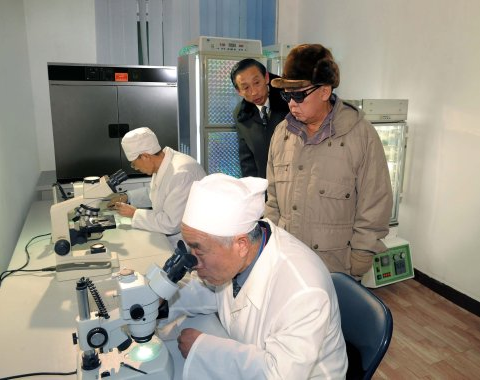
looking at microscopes looking at microscopes

General Electric’s Big bet on Natural Gas (GE)

In a 2009 post, "GE, Cleantech and Your Tax Dollars" I said:
Marc Gunther is pretty green and has been for as long as I can remember. He's also a good analytical thinker.
Although he doesn't mention it, I find it astounding that GE's CEO Jeff Immelt is an advisor to President Obama at the same time his company has $51 Billion of a subsidiary's debt guaranteed by the FDIC.
Meet the new boss, same as the old boss....
At the time, and for a couple years prior, many writers in the alt/green/clean space became cheerleaders for the companies, regardless of the underlying economics. Mr Gunther avoided that trap and remains someone I'll link to. Add to that the fact that Marc was dubious of GE's pronouncements and strategy under Jeff Immelt and I thought "Hey, this guy is seeing the stuff without the rose colored glasses". Cool
Plus, I just can't picture him with pom-poms.

On the Immelt/GE B.S. I felt personally vindicated a few weeks ago: "GE's Immelt wishes he had soft-pedaled green talk" (GE).

Gunther has been much kinder toward Immelt than I've been. I don't recall him using the words corporatist, fascist or crony, or calling for the J-man's dismissal as I have done but on the other hand I couldn't get an interview with Immelt if I wanted one.

Here's Marc's latest, via AltEnergyStocks:
General Electric Co. (GE) is betting big on natural gas.

The $150-billion a year company, whose power plants generate about one-fourth of the world’s electricity, today announced a new natural-gas power plant that it says is more efficient and flexible than any other in the market.

By phone from Paris, where the announcement was made, Steve Bolze, president of GE Power & Water, told me:  “This is about transforming the industry over the next five or 10 years.”

GEEnergyLogoGE says it invested more than $500 million in the new plant development. It will be manufactured in France and sold first in Europe and Asia, and then later in the U.S.
One key selling point of the new plant is its unprecedented flexibility: It can ramp up and down rapidly, and thus be easily combined with wind and solar power plants that generate electricity intermittently.

It’s also efficient enough to work as a generator of baseload power, Bolze said. Here’s a GE webpage describing the plant and its operation.

The new GE plant—dubbed the FlexEfficiency 50–is rated at 510 megawatts and offers fuel efficiency greater than 61 percent.  Competing plants burn natural gas at efficiency rates of 57 or 58 percent, Bolze said. Each percentage point of improved efficiency saves a utility about $2 million a year, he said. Capital costs are projected to be CapitaCosts should be somewhere “north of $450 million.” he said....MORE
See also:
Siemens energy plan: Diversify (SI; GE)
What Does Big Solar Want? What Doesn't It Want?
GE’s Immelt: I thought wind was a “hula hoop”

Here's my intro for another of his posts with the appropriately skeptical view:
Beware of [President] Obama's 'Battery Gold Rush'
Please note that Marc Gunther is one of the 'greenest' writers out there. It is simply prudent to remind ourselves that investing in areas that are not self-sustaining is as much about politics as it is about balance sheet analysis. When you are backing rentseekers you have to stay attuned to the political winds or risk being blindsided by a policy change. This is why, since our second month, we have periodically quoted the first inductee into the prestigious Climateer Hall of Fame:
...Finally for investors in rent-seeking organizations there is the real risk that the politicians will change the rules. Heed the words of Sen. Simon Cameron (R&D!-Pa.):
"The honest politician is one who when he is bought, will stay bought."
Our Hero
Simon Cameron

And from 2007:
Clean energy will make Gore rich
A good follow-up piece from the co-author of the 3400 word(!) Fortune exclusive on Mr. Gore and Kleiner Perkins:
Al Gore's next act: Planet-saving VC

Wind farms: Britain is 'running out of wind'

The hell you say.
From the Telegraph:

Despite the freak gales that battered parts of the country last week, climate experts are warning that many of Britain’s wind farms may soon run out of puff. 
Wind farms: Britain is 'running out of wind'
Statistics suggest that the winds that sweep across the British Isles may be 
weakening Photo: ALAMY

According to government figures, 13 of the past 16 months have been calmer than normal - while 2010 was the “stillest” year of the past decade.
Meteorologists believe that changes to the Atlantic jet stream could alter the pattern of winds over the next 40 years and leave much of the nation’s growing army of power-generating turbines becalmed.
The Coalition has drawn up plans to open more wind farms in an effort to meet Britain’s European Union target of providing 15 per cent of its energy from renewable sources by 2020.More than 3,600 turbines are expected to be installed in offshore wind farms over the next nine years.
But statistics suggest that the winds that sweep across the British Isles may be weakening. Last year, wind speeds over the UK averaged 7.8 knots (8.9mph), a fall of 20 per cent on 2008, and well below the mean for this century, which stands at 9.1 knots (10.5mph).
Usually Britain has warm, wet and windy winters, thanks to Caribbean air carried here by the Atlantic jet stream, a fast-flowing current of air.

But the last two winters have featured exceptionally low temperatures and were remarkably still when they should have been the windiest seasons of all, as high pressure diverted the jet stream from its normal position.
Meteorologists have found that the position of the jet stream has been influenced by the lower levels of activity on the Sun. This decline in sun-spot activity is expected to continue for the next 40 years, with potentially serious consequences for the viability of wind farms....MORE
If the lower levels of sunspots should lead to the "Little Ice Age"temperatures experienced during the Maunder minimum, 1645-1715, what with the Thames freezing over and all, it would be a rotten time to have the power go out.

The calm before the (volatility) storm (VIX; VXX; XIV)

Nice catch at FT Alphaville:
We ♥ this note from Bank of America Merrill Lynch’s Ruslan Bikbov and Priya Misra.
It’s on a subject dear to our own hearts here on FT Alphaville — the curious case of persistently low volatility and the idea that it might be masking systemic risk. It also weaves together a plethora of other themes — massive short volatility positions, search for yield, correlation, LTCM – we’ve touched on.
So sit back, think of stubbornly low volatility measures like the Vix, and read on:
The Chart of the Day shows that our measure of average cross-asset correlation has notably increased. This measure is a weighted-average correlation of the 10y US swap rate with the S&P 500, oil and DXY dollar index. The rise in correlations is evident in almost all individual cross-asset pairs. For example, the three-month correlation between 10y and S&P increased to 64% (1.7 standard deviation above its historical mean). In the Chart of the Day, a positive value corresponds to a risk-on/ risk-off trading environment. Days when rates increase tend to coincide with the rallies in risky assets and weaker US dollar, while days when rates decline tend to go along with sell-offs in risky assets and dollar strengthening.
It is very unusual, however, to see high levels of cross-asset correlation together with declining volatility.
...MORE

Soros Fund Management's Largest Position Was up 7.68% Yesterday (AGRO; CRESY; MOO; DBA)

Each quarter there is a great wastage of electrons when hedge funds file their 13F position statements.
It's a waste because half the sites linking to the reports don't understand what the SEC requires and the various ways the funds can reduce transparancy.

I'll leave that discussion to another post. Another problem is that most of the commenters are clueless when it comes to connecting investments listed in the reports to major economic and financial trends. When Soros Fund Management LLC released their positions a couple weeks ago most of the commentariat glommed onto the funds drastic reduction in the SPDR gold trust. There were maybe two dozen comments that pointed out the new names in the portfolio. There were a handful who made the connection between SFM's new largest position and the current commodity megatrend.

Back on April Fools Day we posted: "Farmland: "Investors pump $400m into Ukraine farming groups"; Soros-Backed Adecoagro Trades solidly Above IPO Price Despite Loss (AGRO)" as part of our almost obsessive attraction to farmland as an investment (links below).

Here's SFM's March 31, 2011 13F. At the bottom of the page we find Adecoagro, 27,158,693 shares worth $366,099,000. That is the fund's largest position, the second biggest being $302 mil. worth of InterOil (use the blog search box, symbol IOC, we have quite a few posts) and the SPDR S&P 500 ETF worth $278 mil.

It was also a new position.
Mr. Soros' has had an interest in Adecoagro through other entities for some time but for SFM it was brand new.
You'd think that Soros buying farmland as his largest position would have made headlines around the world.
It didn't.

One writer who did understand, Frank Byrt at TheStreet, put this story together:
5 Stocks to Bet on Farming, Like Soros Does
Billionaire investor George Soros has gone from gold bug to gaucho, as his hedge fund took a 23% stake in a South American farming conglomerate after dumping most gold holdings in the first quarter.

Soros' move underscores a growing trend among investors who are cutting back on gold and shifting into assets that can produce saleable products, such as farmland, and hence serve as an inflation hedge as well as a bet on the value of the land.
South America is the geographic hotspot for many of these companies due to its favorable growing climate, dearth of natural disasters, the availability of farmland and a minimal number of government restrictions on its ownership by foreigners.

And many companies there grow can grow sugar and corn which then have multiple uses for them depending on market conditions, either as human food, animal feed or to be converted into bio-fuels.

Other hedge funds recently joining Soros down on the farm are the $18.7 billion Van Eck Associates fund, which is the largest investor in Brasil Foods(BRFS), with a 1% stake, and D.E. Shaw & Co., which is the largest shareholder of Argentine farm conglomerate Cresud(CRESY) at just under 9% of its shares, according to Securities and Exchange Commission 13-F filings.

Renatto Barbieri, chief investment officer at Galtere Ltd., a New York-based private-equity firm that, among its many investments, runs a $1 billion agribusiness fund, said in an interview that "there is a global trend to be invested in, what we would call 'real assets,' and tangible assets in agriculture is very much a part of that basket."

He said that's being driven by concerns over "climate change, food (supply) security and the health of the financial system....MORE
I'll come back to AGRO later this week. In the meantime here are some of the stories we thought were signposts along the way:

2007
Ethanol Is Feeding Hot Market for Farmland

2008
Farmland value boom continues
The hedge fund manager who bought a farm
Hedge Funds Buying Farmland
England's green and pricey land
Did Hedge Funds Signal the Top in Farm Income?
Californians to pay $600 mln for green think tank. And Farm visits can ease mental illness

As I said, more to come on  AGRO.
And more of our earlier posts on farmland investments.
Or you can copy and paste " site:climateerinvest.blogspot.com climateer farmland" as a search term.