Friday, March 6, 2009

Who’s Really Being Propped Up in the A.I.G. Bailout?

That's the New York Times' Joe Nocera on March 2. I thought I answered the question on Feb 26,
"We Must Save GS; MS; JPM: U.S. May Backstop AIG CDS":
Those banks are counterparties to a slug of the paper that AIG wrote. They did not do their due diligence on AIG. They were only in it for the money, to the tune of billions in profits.
Now the American taxpayer is going to go on the hook for another $300 Billion (notional).
This is getting old.
Here's Mr. Nocera's Executive Suite blog:
It is a simple enough question: who bought the credit-default swaps that American International Group sold during the housing bubble? And at this point — after Bailout No. 4, with the government handing A.I.G. another $30 billion to go with the previous $150 billion — you would think that the taxpayers would have the right to know that information. Is it Goldman? Royal Bank of Scotland? The Irish banks that are on the verge of collapse? What happened to all that transparency the new administration keeps talking about?>>>MORE
And here is the answer from the Federal Reserve via the WSJ's Real Time Economics blog:
In a Senate hearing, Federal Reserve Vice Chairman Donald Kohn delivered the news to lawmakers that Chairman Ben Bernanke has largely failed to give so far — that the Fed probably isn’t going to give up the names of American International Group Inc. counterparties.
“My judgment would be that giving the names would undermine the stability of the company,” Kohn said in a contentious Senate hearing....MORE
And here is one Senator's reaction, again via RTE:

...At a Senate Banking Committee hearing Thursday, Mr. Bunning lashed out at Fed Vice Chairman Donald Kohn for a slew of issues. Like many lawmakers, he was particularly troubled by the central bank’s reluctance to disclose the names of American International Group’s counterparties that were rescued from potential losses in the government’s bailout of the insurance giant.

“We have put in approximately $170 billion to $180 billion into one corporation. And you are telling us that the counterparties that got par for their bonds, or for whatever — the American taxpayer shouldn’t know who they are” Mr. Bunning said, growing more agitated. “And then you may come back to us and and ask for more money for more banks and more corporations. You will get the biggest ‘no’ you ever got. I will hold the bill. I will do anything possible to stop you from wasting the taxpayers’ money on a lost cause. And that’s what AIG is, it’s a lost cause.”

Yes, kids, that’s what one might call a filibuster threat.

Where’s the bottom line for taxpayers on AIG? Mr. Bunning asked. “Is it a trillion dollars? Is it two trillion dollars?”

“I can’t give you a number, Sen. Bunning,” said Mr. Kohn, who clearly wasn’t enjoying himself much at the hearing. “We have done with the Treasury what we can to stabilize the company,” he said, explaining the exit strategy of selling off AIG in pieces and repay the taxpayer.

Then this: “As our press release said, I cannot guarantee you” Mr. Kohn said, before getting cut off.

Who ever thought that would be the line to set someone off?

“I’m not interested in the press release, I’m interested in facts,” an incredulous Sen. Bunning shot back....MORE

Stimulus Spending by State

The Wall Street Journal has an interactive map of the money flows. We added Recovery.gov to the link list a couple days ago.

Government departments have started to announce how some of the major spending in the stimulus legislation will be shared among the states. About one-sixth of the money in the bill has been allocated so far....MAP

Al Gore. No Score: Camco shares fall on delay of '08 results release (CAO.l; CAMIN.L)

Camco appears to be Al Gore's favorite carbon trader, his Generation Investment Management owns a bit under 14% of the company.
From Reuters:
Clean-energy project developer Camco International's decision to postpone publishing its full-year preliminary results due to accounting discrepancies drove down shares on Thursday as analysts digested the news.

Camco (CAMIN.L) said minutes before the market closed on Wednesday it would delay publishing its 2008 results, scheduled for release on Thursday, due to discussions with its auditors over the company's revenue recognition policy.

Camco shares were down 5.41 percent at 8.625 pence at 1031 GMT.

The company, scheduled to release the results on Thursday, did not say when it would announce its results....MORE

"Carbon Trading: Camco cuts 2008 outlook (CAMIN.L)" has links to some of our prior posts on Camco.

Thursday, March 5, 2009

GE Wrapup: "Treated Like a ‘Leper’ as Investors Punish Shares"; Closing Price; Valuation

From Google Finance:
GE - General Electric Company (NYSE)
6.66 -0.03 (-0.45%) Mar 5 4:00pm ET
Open: 6.75
High: 7.17
Low: 6.53
Volume: 444,582,156
Avg Vol: 179,604,000
Mkt Cap: 70.33B
Disclaimer


Here's the headline story from Bloomberg.

From StreetInsider:

Deutsche Bank Said GE Industrial (GE) Worth $12, But GE Capital Concerns Keep Them On The Sidelines

Deutsche Bank is commenting on GE (NYSE: GE) today following the free-fall in the stock. The firm said they are inclined to be much more positive since GE's industrial businesses are clearly worth more than the current share price, but they remain on the sidelines due to lingering concerns.

The firm said, "...we value GE Industrial at $12/share and so we believe the market is factoring GE Capital at a negative valuation of as much as $60bn. This seems very bearish, but the equity market has become convinced that GE Capital is under-capitalized. Our concern is that this fear is becoming transmitted into the credit markets where GECC spreads have ballooned for both cash and CDS contracts.">>>MORE

I Wanna Be Sedated: Feels a bit Like September '08

I've posted this song a few times, including September 19, 2008. That was the Friday of the week that saw Lehman Brothers fail, Merrill Lynch merge with Bank of America and AIG become a subsidiary of the U.S. Treasury.
Twenty-four hour days.
The market's swings this week aren't as large, more like a damped harmonic of six months ago but it feels similar.
Good Night and Good Luck (into the arms of morpheus)

Back in July we were experiencing volatility that got me humming this song. I hadn't thought about it in seven weeks. Time to call it a week.
Volatility: I Wanna be Sedated

Ladies and Gentlemen: THE RAMONES!


I Wanna Be Sedated: Top Strategists Still Expecting a 46% Gain From Here

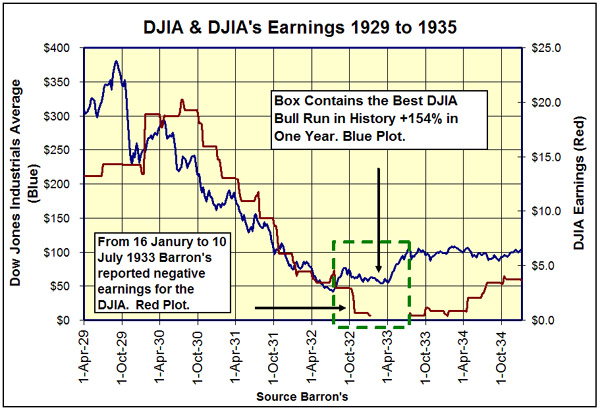
There is historical precedent. After the 89% decline to the 1932 bottom the DJIA better than doubled in a year (via Gold-Eagle):
...Looking at the recovery from July 1932 to July 1933 the above chart shows a very weak recovery. The reality is that from July 1932 to July 1933 the DJIA increased by 154% even while the Great Depression caused bank closings, DJIA stock earnings were negative and US unemployment was over 25%!

July 1932 to July 1933 is the best year the DJIA ever had in its 123 year history. I suspect this historic bull move made money for only a very few. The 1929-1932,

-89% decrease killed off most of the 1920’s investment-banking industry’s customers. By 1932, the very thought of investing in the stock market, or borrowing money from a bank produced a sense of revulsion and dread in most people.,,,MANY CHARTS

And there have been a fair number of 50% rallies over the years. When it comes, just remember our January 20 post "This is What a Bear Market Looks Like Folks":

This is the sixth time I've posted this cartoon since September 5.
(That's pre-Lehman, pre-Merrill, pre-AIG, pre-Wamu, pre-Wachovia etc.)
I'll keep posting it until the bottom-callers get sick of me.

So we can look for a bounce but think of these names as a trade; bear markets can suck you in. When I first came to the market, one of the older traders told me he was saved in the '73-'74 bear by a cartoon:
(click to enlarge)

That's Alfred Frueh's January 16, 1932 New Yorker classic, "Just around the Corner", commenting on President Hoover's statement that "Prosperity is just around the corner".


Here's the headline story from Bespoke Investment Group:

Click to enlarge
Yearend09

Go to Bespoke for their commentary.

Oil: Beware the Rolls of March. And: Spreaders Heed Schork (USO)

Oil was trading down $1.80, last I saw.
First up, FT Alphaville:

Oil-invested index funds like the Dow Jones AIG commodity index, the S&P GSCI and the United States Oil Fund begin to rollover their positions from the April front-month WTI contract to the May one this Friday.

Accordingly, energy markets are prepared for some significant distortions in the days ahead.

The United States Oil Fund ETF will be most closely watched after changing its roll period from one day to four. A reminder, the USO’s February roll saw the March front-month contract at the time lose more than 2 per cent in trading on the Nymex as it moved its holdings into the April oil contract. The CFTC has since said it is investigating the fund, whose positions have by far surpassed Nymex accountability limits in the last few months.

Furthermore, despite moving to a four-day roll, some analysts feel the ETF won’t actually fare that much better as, adding to its troubles, it will have to compete with both the DJ AIG and the S&P GSCI for contracts.

That said, while the fund still holds a substantial 81,707 or so April-WTI contracts collectively between the ICE and Nymex exchanges, analyst Olivier Jakob of Petromatrix notes the fund’s size has been decreasing of late. Although at its current size it is still comparable to when it rolled in February....MORE

And from Hard Assets Investor:

Looks like somebody took Stephen Schork's advice Wednesday. Somebody bought oil options.

Maybe a little background's in order.

Schork,editor of The Schork Report energy newsletter, in an Hard Assets Investor interview ("Schork: Seeds Being Sown For Oil Rally") made a case for $60-$65 oil. That level, says Schork, is OPEC's "marginal breakeven."

Schork's not looking for oil to rally today, next week or even next month. Rather, his sights are set some 12-18 months out. Mindful of the withering effect of a year's worth of negative roll yields, Schork pooh-poohed the use of oil ETFs. No, said Schork, investors looking for a ride on the price train to the sixties should instead, consider long-term call options on oil futures.

A call entitles its holder to purchase the underlying futures contract at a pre-determined strike price anytime before the option's expiration. It's a right, not an obligation to buy futures, mind you. A holder can also sell the call to close out the contract. On Wednesday, for example, with March 2010 oil at $53.15, a $55 call could be purchased at $8.52 a barrel. Since oil futures, and their associated options, represent 1,000 barrels, that makes for an $8,520 tab. Pricy, though still cheaper than futures margin.

A gain in the underlying futures should cause, all else held constant, an increase in the call's value. It won't be a dollar-for-dollar gain, though. The option's delta expresses its sensitivity to futures. The $55 call's delta is 0.56, meaning a $1 increase in March 2010 futures translates, today at least, into a 56-cent gain in the option's premium....MORE

For many USO links, see: "U.S. Oil Trust Investigated by CFTC (USO)"

Zimbabwe del Sur: Chavez tightens state control of food amid rocketing inflation and food shortages

Guess what happens when you drive out the private sector and set prices?
From the Telegraph:

President Hugo Chavez is tightening state control over Venezuela's food supply, setting quotas for food staples which are to be sold at government-imposed prices.
...Production quotas and prices have now been set for cooking oil, white rice, sugar, coffee, flour, margarine, pasta, cheeses and tomato sauce.

White rice, the staple for many Venezuelans, can now only be sold at a price of 2.15 bolivares (71p) per kilo. Private companies insist that production of that kilo costs 4.41 bolivares (£1.46) and that government regulations are impossible to fulfil and companies will quickly go broke. Companies that are dedicated to rice production must ensure that 80 per cent of their efforts are dedicated to white rice. The new regulations set production percentages, as companies were rebranding their products to avoid the government controls, like flavouring the rice, as the price restrictions apply only to white rice.

"Forcing companies to produce rice at a loss will not resolve the situation, simply make it worse," said Luis Carmona of Polar, a rice company that has been singled out by the government for trying to sidestep restrictions....MORE

Jim Chanos: Short Construction, Long Power Grid Buildout (PWR)

From Market Folly:

Jim Chanos, noted short seller and manager of hedge fund Kynikos Associates recently appeared on CNBC and shared some of his views. His bearish stance on infrastructure in general is not necessarily new. He likes being short construction plays, but also likes being long infrastructure that plays the power grid buildout. Chanos says,

"We're short construction companies that are still doing physical build-out of buildings, say, for example, in Las Vegas."
In terms of the power grid, Chanos likes being long names such as Quanta Services (PWR)....MORE
He has the vid.

See also "Grid: Is Quanta Services the Ultimate Infrastructure Play? (PWR)"

Citigroup now Deer Nuts (C)

Under a buck.

GE: "Hey guys – you can make a much better investment than Warren Buffett"

Hokey Smoke Bullwinkle!*
Bronte Capital has been on a "I got blisters on my fingers" posting rampage focusing on GE. Right now they are THE blog for all things GE. I'll link to some of their posts after the headline story:
Warren purchased some GE converts a while ago. Got what looked like a sweet deal at the time – a big yield and a nice conversion.

With where GE and GE debt is trading now you can – by buying debt and equity – produce a hybrid instrument that is (a) senior to Warren, (b) has a higher yield than Warren and (c) has better effective conversion terms than Warren.

Warren has stuffed up before. He purchased Irish banks last year. He purchased oil companies when the oil price was high.

But GE – wow. Maybe his ability to analyse it is no better than any of ours.
For those of you too young to remember, Rocky actually said
"Hokey Smoke" as a lead-in to some commercials.
Advertisers weren't too thrilled.
To make nice Rocky started saying

"And now, here's something we hope you'll really like."
or
"This is what I really call a message."

Before we get to the treasure-trove from Nature, a few more R & B quotes:

Rocky: Do you know what an A-bomb is?
Bullwinkle: Certainly. A bomb is what some people call our show.
Rocky: I don't think that's very funny.
Bullwinkle: Neither do they apparently.
_______________________________________________________

Bullwinkle: Humble, that's me... Mr. Modesty.
When it comes to humility, I'm the greatest.
_______________________________________________________

Bullwinkle: You just leave that to my pal. He's the brains of the outfit.
General: What does that make you ?
Bullwinkle: What else? An executive..
_______________________________________________________


Europe’s insurance meltdown and its implications for the US

From the Asia Times' Inner Workings blog:

The worst performer in today’s European equity route is Aviva (the old Commercial Union), down by nearly 30%, followed by Prudential PLC, Friends Po, Legal and General, and ING, all down around 20%. The insurance sector, down 8% overall, is the worst in the broad DJ Stoxx index....

...As I keep emphasizing, the pyramid scheme that links insurers and banks (insurers own the capital securities of banks and provide first- or second-loss protection for bank positions in a variety of ways) makes it impossible to keep the two sectors separate.

Insurers used to be yield hogs. AIG was the worst, writing protection with abandon on asset-backed Collateralized Debt Obligations, effectively shorting a mass of put options - which is how it racked up the worst corporate loss in American history last quarter. But the rest of the insurers did the same thing, albeit with a bit less greed, scarfing up barely-investment-grade tranches of asset-backed deals that amount to second-loss pieces, and similar parts of the capital structure in commercial mortgage backed securities.

If the capital securities of the banks are at risk, starting with preferred stock, and then going to trust preferreds, subordinated debt, and so forth, then the insurers are in deep trouble....MORE

GE Finance Chief Says Market Fears ‘Overdone’ (GE)

Seventeen months into the bear market, I may have lost it.
I saw that headline and the first thought that pops into my head is the title of Lynda Obst's book,
"Hello, he lied".

When GE joined the US Climate Action Partnership, with their bald-faced rent-seeking, I chalked it up to the machinations of folks not creative enough to compete without perverting the political system.

When GE lobbied for the incandescent light bulb ban (which bulbs were manufactured in the U.S.), their replacement being compact fluorescent bulbs manufactured in China, I thought "these people are scum".

When they applied for (and received) a grant from the state of Connecticut to install GE solar panels on GE headquarters, I thought "Okay, lower than scum".

When I saw this, from Mr. Immelt (via Environmental Capital):
I believe we are going through more than a cycle. The global economy, and capitalism, will be “reset” in several important ways. The interaction between government and business will change forever. In a reset economy, the government will be a regulator; and also an industry policy champion, a financier, and a key partner […] I think this environment presents an opportunity of a lifetime....
I realized these people are nothing but fascists and it was time to stop being charitable.
Here's the headline story from the New York Times' DealBook blog.
Here's another quote that came to mind, we last saw it in our post "10 Ways the World Could End and How to Play Them":
"He lied like a finance minister on the eve of a devaluation"
-Warren Buffett
I'm thinking it might be a good idea to read up on Mussolini for tips on making money off the corporativismo.

It looks like the U.S. taxpayer is going to be asked to bail out GE Capital.
Why do I think that?
GECC credit default swaps steady at 15.5 pct upfront

That's $1,550,000 upfront plus $500K/yr to insure $10 mil. for five years.
$4 to insure $10. You tell me.

Alcoa: Target lowered to $3 at Merrill/BAM (AA)

In early pre-market trading the stock is changing hands at $5.94, down 4.8%.
From Notable Calls:
Merrill Lynch/Banc of America is out neg on Alcoa (NYSE:AA) lowering their tgt to $3 from $6 after reduced EPS outlook. Their rating continues to be Underperform.

Based on a $0.59/lb aluminum price (was $0.88), they are revising down our 2009e EPS to a $1.50 loss (was $0.20 loss). 2010e EPS is revised down to $0.00 (was $0.90) based on a $0.79/lb metal price....
...Notablecalls: The $3 tgt (50% downside to tgt) reads ugly for Alcoa. I think we are going to see some more downside in the name today....MORE

Wednesday, March 4, 2009

Job Losses Show Breadth of Recession

Go for the column, stay for the map. From the New York Times:

What does the worst recession in a generation look like?


It is both deep and broad. Every state in the country, with the exception of a band stretching from the Dakotas down to Texas, is now shedding jobs at a rapid pace. And even that band has recently begun to suffer, because of the sharp fall in both oil and crop prices.

Unlike the last two recessions — earlier this decade and in the early 1990s — this one is causing much more job loss among the less educated than among college graduates. Those earlier recessions introduced the country to the concept of mass white-collar layoffs. The brunt of the layoffs in this recession is falling on construction workers, hotel workers, retail workers and others without a four-year degree....MORE
HT: The Columbia Journalism Review's The Audit blog.

Nalco: Buffett's bet on water (NLC)

From BloggingStocks:

"Warren Buffett's Berkshire Hathaway revealed a new position in Nalco Holding (NYSE: NLC); it's my favorite pure play on water filtration," says Chris Mayer in Daily Wealth.

"With a $1.6 billion market cap, Nalco is a small-cap stock, but it's actually one of the world's largest water-treatment companies. Customers use Nalco's products and services to prevent corrosion, contamination, and the buildup of harmful deposits.

"Buffett picked up 8.7 million shares. That makes Berkshire the second-largest shareholder in the company, with a little more than 6% of the shares.It's easy to see what Buffett likes.

"Nalco generates a steady stream of free cash flow – $142 million in its fiscal year ended September 30. Today, the market cap is about $1.6 billion....MORE

A Mixed Up Economy

From the Washington Post's Achenblog:

My job is to keep everyone calm. We have nothing to fear but fear itself, plus asteroid impacts, mutant airborne Ebola, runaway robotic sentience, and the Earth being transformed by collider-generated strangelets into an undifferentiated gray goo (to paraphrase FDR).

So I don't worry about the stock market. Buy and hold those stocks is my advice. I will not let my stocks go until they're pried from my cold, dead, frozen-by-poverty fingers. FACT: I still haven't sold the Lucent stock I bought nearly a decade ago. (It dwindled to near-nothingness and transmogrified into something different, a bit like soup abandoned in a remote corner of the fridge.)...MORE

Schork: Seeds Being Sown For Oil Rally

From Hard Assets Investor:
...Stephen Schork, editor of The Schork Report (Schork): This is an absolute change in behavior. Now, Mike, as a trader, I never like to say, this time it’s different, that we’re not going to get ourselves hooked back on oil the way we did in the post-1970s crash, post-1980s crash, post-1990s crash.

There are two schools of thought here and you just articulated them, and I call them the 911 school and the Al Gore school. The 911 school are people … we all remember that tragic day; oil money to a great extent financed what happened on that day.

So there’s certainly a push now, especially with the amount of communication … I can go onto the Internet and I can get a translation of what some of these more radical imams are saying in their Friday afternoon services. I know what my petrodollars are in part funding.

There’s also the Al Gore school. Now regardless of whether or not you think global climate change is actually manmade, it doesn’t really matter what you think. There’s enough people, and as you just said, the administration is here. So we are certainly going down that route.

Now OPEC – producer of 40% of the world’s oil – they are aware of this and they are certainly concerned about their loss of market share, because what does OPEC do? They produce oil and that’s all they do. If you take away that market share from them, they are going to do what any business would do: They are going to defend that market. How are they going to defend that market? They have to keep oil at a certain level; they have to keep it below what these alternative fuels are going to demand in the market.

Norman: What’s the threshold? OK, so we understand that they have to keep it below. There’s also a problem in that because it’s not purely a market-driven process. You have government subsidy here, so where do they have to keep it to even make government subsidy, that the government’s going to say, hey, we don’t want to do this because we don’t want to subsidize it. That’s a tough thing; they might to have to keep it really low for a long time.

Schork: Well, they’re going to have it low for at least the next four years with this administration certainly, and right now all the analysis is the marginal economic break even for Syncrude … this is the tar sand crude that we get out of Alberta, of the heavy oil down in the Orinoco belt in Venezuela … is $60 to $65 a barrel. So they need oil at at least that price threshold.

If they can get oil at $60 to $70 a barrel, that’s certainly going to help retard the push toward alternative fuels, because regardless of the 911 school or the Al Gore school, if oil goes back, or gasoline goes back to $4 a gallon, if home heating oil goes back to $4, you know what? You can put the environment to the side – Americans are going to want the cheaper energy source. That is the one balancing act that both the governments and OPEC now have to try to play off one another....MORE

Keynes The Money Manager

UPDATE: I know I promised a post on Berkshire Hathaway's derivative book. It's coming, sorry about the delay.

Original Post:
Some years ago I got into an argument with a hotshot money manager about John Maynard Keynes' investment performance. The MM insisted that during Keynes' time as bursar of Kings College, Oxford he had increased the college's endowment ten fold.

I didn't know the actual numbers but this struck me as high, at a time when most endowments were invested in property and fixed income securities. I decided I didn't much care for the MM when he said he couldn't give me a citation for his assertion and decided to find the numbers.
Then promptly forgot about the question.

Last year, when it seemed that everyone had become a Keynes expert I thought I should read his "The General Theory of Employment, Interest and Money".
(here's an online version at Marxists.org [!])

It's a heavy slog but now it takes strangers longer to recognize my mental resemblance to Homer Simpson ("Stupidity got us into this mess and stupidity will get us out."; "I'm not a man who's easily impressed. Hey, a blue car." etc.).

More interesting to me was a return to the money manager's assertion, which meant biographies and typing. Luckily, MaynardKeynes.org has put some of the material online so I can copy and paste rather than get all qwerty on you.
First up, a couple snippets from the one page piece "Keynes The Speculator":

John Maynard Keynes began his career as a speculator in August 1919, at the relatively advanced age of 36 years.

Keynes traded on high leverage - his broker granted him a margin account to trade positions of £40,000 with just £4,000 equity....

You know where this is going don't you:

...Keynes soon learned that short-term currency trading on high margin, using only his long-term economic predictions as a guide, was foolhardy. By late May, despite his belief that the U.S. dollar should rise, it didn’t. And the Deutschmark, which Keynes had bet against, refused to fall. To Keynes’s dismay, the Deutschmark began a three-month rally.

Keynes was wiped out. Whereas in April he had been sitting on net profits of £14,000, by the end of May these had reversed into losses of £13,125. His brokers asked Keynes for £7,000 to keep his account open....MORE
Here are some snips from the slightly longer "Keynes the Money Manager":
...His policy of selling properties and using the proceeds to “speculate in the stock market” was opposed by many of King’s College’s fellows. Keynes’s view was that he would rather be a “speculator” in an asset that had a daily price quotation and was liquid enough to be bought and sold than an “investor” in something whose price was largely unknown....
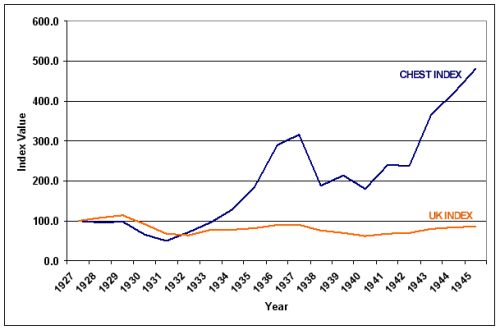
...The Chest’s initial capital was £30,000. By the time Keynes died in 1946 the fund had grown to £380,000 - an annual compounding rate of just over 12 percent. This might not seem very remarkable but for the facts that:

  • This performance was achieved during a period that encompassed both the crash of 1929 and the build up to World War Two, both of which proved disastrous for British stocks.
  • In the same period of time, the British stock market fell 15 percent.
  • The growth in the value of the Chest Fund was entirely due to capital appreciation. There was no dividend reinvestment because Keynes spent all of the dividends on the college. He believed the fund was there to provide money for the college and was scornful of the way other Cambridge colleges managed their finances, referring to them as “savings banks”.

The performance of Keynes’s fund from 1927 to 1946 is shown below. During these years the Chest grew at an annual compounding rate of 9.1 percent while the general British stock market fell at an annual compounding rate of slightly under 1 percent.

Chest Fund Performance 1927 to 1946

Maynard Keynes Chest Fund

The whole thing is worth a read.

So I give half an apology to the money manger, and a thank-you.
Keynes did have a ten bagger.
It wasn't the entire endowment, it was a sidecar of the endowment, but the question was worth checking into.

If you want to poke around at Keynes.org, here are some of their pages:

China stocks surge 6.1 pct on data, policy pledge (There's Infrastructure and Infrastructure)

From Reuters India:
China's main stock index surged over 6 percent on Wednesday, posting its biggest gain since November, after the government said it would expand its fiscal spending plan and data supported hopes for an early economic recovery.

The Shanghai Composite Index .SSEC rocketed 6.12 percent in heavy trade to close at 2,198.107 points, just off the day's high of 2,201.727. Sectors rose sharply across the board.

Gaining Shanghai A shares overwhelmed losers by 917 to one, with over 50 shares rising their 10 percent daily limits. Turnover in Shanghai A shares climbed to a one-week high of 127.5 billion yuan ($18.6 billion) from Tuesday's 79.8 billion. Continued...

And from the Asia Times' Inner Workings blog:

My longtime colleague Uwe Parpart, now chief Asia strategist at Cantor Fitzgerald in Hong Kong, has argued all year that the Chinese economy will avoid recession thanks to aggressive intervention by the Chinese government. Today’s 6.2% surge in the Shanghai Composite in response to the likely increase in the existing stimulus package bears out the China bulls. This optimism has spilled over into commodity prices and raw materials stocks worldwide.

What’s the difference between infrastructure spending in China (stocks up 20% year to date) and infrastructure spending in the US (stocks down 20% year to date)? China needs infrastructure; the interior of the country remains horrifically backward and spending on infrastructure feeds rapidly into productivity, just as the huge infrastructure spend in the coast had a massive effect on productivity. The US could use some repairs, but putting a few hundred billion dollars into the hands of construction unions won’t change life in the United States....MORE

China Investment Corp may diversify portfolio into commodities, energy. And: Commodities Soar versus Equities...

First up, from Mineweb:

China Investment Corp sees investment opportunities in energy and commodities sectors as prices have fallen steeply, Jesse Wang, a senior official with the country's $200 billion sovereign wealth fund, said on Wednesday.

Officials have said that CIC wants to diversify its portfolio in the natural resources sector after booking heavy losses on high-profile financial investments in private equity fund Blackstone and U.S. bank Morgan Stanley.

Wang, CIC chief risk officer, said the global recession had just begun, and as a result, bigger price declines in commodities and energy were possible.

"No matter where the company invests, it is always possible there will be book losses in a particular period," he told reporters on the sidelines of a meeting of a parliamentary advisory body.

The wealth fund will diversify its investments in the financial and energy sectors, Wang added.

A move into commodities and energy by CIC would add to a wave of investments backed by Chinese state funds in those sectors that topped $50 billion in February alone, including Russian and Brazilian oil deals and investments in Australian mining firms Rio Tinto and OZ Minerals....MORE

And from Dead Cats Bouncing:

Commodities as represented by the CRB index have outperformed the S&P by a stunning 33% since mid December, and stand at a new relative high, surpassing even the levels seen at the peak of the commodity bubble last July. Why, when equities are panicked by depression and deflation, should economically sensitive commodities (and also credit markets) be diverging so markedly? Even more remarkable is to see this performance while the dollar is hitting 3 year highs on a trade weighted basis, against the bearish consensus. Having called the bubble last Summer, I've been advocating the accumulation of long-term resource positions this year, and in December took a contrarian stance on oil, where I saw a bottoming process supported by the steep contango structure encouraging OPEC quota discipline (although that same price curve makes ETF investing perilous).

On Jan 30th, I noted that strategic stockpiling by China (and indeed Korea), partly to protect domestic industry margins, would be supportive of base metal prices and had fuelled a radical turnaround in the scrap market. Copper is at a one month high, oil is holding a floor at about $40 rising to $55-60 by year-end (and recent evidence that US gasoline demand has bottomed is very supportive), but even agricultural commodities like corn are catching a bid despite ample short-term supplies as ethanol production slumps....MORE

Tuesday, March 3, 2009

Upper-Income Taxpayers Look for Ways to Sidestep Obama Tax-Hike Plan. And: Where the $200,000+ Crowd Lives

From ABC:
President Barack Obama's tax proposal – which promises to increase taxes for those families with incomes of $250,000 or more -- has some Americans brainstorming ways to decrease their pay, even if it's just by a dollar.

A 63-year-old attorney based in Lafayette, La., who asked not to be named, told ABCNews.com that she plans to cut back on her business to get her annual incomeunder the quarter million mark should the Obama tax plan be passed by Congress and become law.

So far, Obama's tax plan is being looked at skeptically by both Democrats and Republicans and therefore may not pass at all.

"We are going to try to figure out how to make our income $249,999.00," she said.

"We have to find a way out where we can make just what we need to just under the line so we can benefit from Obama's tax plan," she added. "Why kill yourself working if you're going to give it all away to people who aren't working as hard?">>>MORE

And from CNBC via Yahoo:

The White House's budget for fiscal year 2010 calls for tax hikes on wealthy Americans. In this case, that means couples making over $250,000 a year and individuals $200,000 a year. Under the budget plan, these households (about 3 percent of the total) would experience tax increases of $318 billion over the next 10 years. Here's a look at the states that will be most affected by the tax hike and how they voted in the last presidential election.

1. District of Columbia

% of Households Earning $200K+: 8.4%
Total Households: 251,039
Median Income: $50,318
Households Earning $200K+: 21,194

Election Results:
Obama: 93%
McCain: 7%

2. Connecticut

% of Households Earning $200K+: 8.0%
Total Households: 1,320,714
Median Income: $64,158
Households Earning $200K+: 105,433

Election Results:

Obama: 61%
McCain: 38%

3. New Jersey

% of Households Earning $200K+: 7.5%
Total Households: 3,149,910
Median Income: $65,249
Households Earning $200K+: 235,278

Election Results:
Obama: 57%
McCain: 42%

4. Maryland

% of Households Earning $200K+: 6.9%
Total Households: 2,082,458
Median Income: $65,552
Households Earning $200K+: 142,694

Election Results:
Obama: 62%
McCain: 37%

5. (Tie) Massachusetts

% of Households Earning $200K+: 6.2%
Total Households: 2,449,133
Households Earning $200K+: 152,348
Median Income: $57,681

Election Results:
Obama: 62%
McCain: 36%

5. (Tie) California

% of Households Earning $200K+: 6.2%
Total Households: 12,200,672
Households Earning $200K+: 757,411
Median Income: $56,311

...MORE

Why Pundits Get Things Wrong

From NewsWeek:

The best predictor was fame: the more feted by the media, the worse a pundit's accuracy.

Pointing out how often pundits' predictions are not only wrong but egregiously wrong—a 36,000 Dow! euphoric Iraqis welcoming American soldiers with flowers!—is like shooting fish in a barrel, except in this case the fish refuse to die. No matter how often they miss the mark, pundits just won't shut up, and I'll lay even odds that the pundits (and pollsters) who predicted a big defeat for Tzipi Livni in the Israeli elections last week didn't slink away in shame after her party outpolled all others. The fact that being chronically, 180-degrees wrong does not disqualify pundits is in large part the media's fault: cable news, talk radio and the blogosphere need all the punditry they can rustle up, track records be damned. But while we can't shut pundits up, we can identify those more likely to have an accurate crystal ball when it comes to forecasts from the effect of the stimulus bill to the likelihood of civil unrest in China. Knowing who's likely to be right comes down to something psychologists call cognitive style, and with that in mind Philip Tetlock, a research psychologist at Stanford University, would like to introduce you to foxes and hedgehogs.

At first, Tetlock's ongoing study of 82,361 predictions by 284 pundits (most but not all of them American) came up empty. He initially looked at whether accuracy was related to having a Ph.D., being an economist or political scientist rather than a blowhard journalist, having policy experience or access to classified information, or being a realist or neocon, liberal or conservative. The answers were no on all counts. The best predictor, in a backward sort of way, was fame: the more feted by the media, the worse a pundit's accuracy. And therein lay Tetlock's first clue. The media's preferred pundits are forceful, confident and decisive, not tentative and balanced. They are, in short, hedgehogs, not foxes.

That bestiary comes from the political philosopher Isaiah Berlin, who in 1953 argued that hedgehogs "know one big thing." They apply that one thing (for instance, that ethnicity and language are primal; ergo, any country that contains many ethnic groups will break up) everywhere, express supreme confidence in their forecasts, dismiss opposing views and are drawn to top-down arguments deduced from that Big Idea. Foxes, in contrast, "know many things," as Berlin put it. They consider competing views, make bottom-up inductive arguments from an array of facts and doubt the power of Big Ideas. "The hedgehog-fox dimension did what none of the other traits did," says Tetlock, who described the study in his 2005 book "Expert Political Judgment": "distinguish more accurate forecasters from less accurate ones" in both politics (will Iraq break up?) and economics (whither unemployment?)....MORE

HT: Futurismic

Hidden Pension Fiasco May Foment Another $1 Trillion Bailout

This is a follow-up to yesterday's post "Could 20 % of the S&P 500 Go Bankrupt?" which looked at the possible implications of the underfunding of S&P 500 component companies defined benefit plans. This article widens the scope to look at the government (public) pension plans.
From Bloomberg:

...Public pension funds across the U.S. are hiding the size of a crisis that’s been looming for years. Retirement plans play accounting games with numbers, giving the illusion that the funds are healthy.

The paper alchemy gives governors and legislators the easy choice to contribute too little or nothing to the funds, year after year.

30 Percent Shortfall

The misleading numbers posted by retirement fund administrators help mask this reality: Public pensions in the U.S. had total liabilities of $2.9 trillion as of Dec. 16, according to the Center for Retirement Research at Boston College. Their total assets are about 30 percent less than that, at $2 trillion.

With stock market losses this year, public pensions in the U.S. are now underfunded by more than $1 trillion.

That lack of funds explains why dozens of retirement plans in the U.S. have issued more than $50 billion in pension obligation bonds during the past 25 years -- more than half of them since 1997 -- public records show.

The quick fix for pension funds becomes a future albatross for taxpayer....MUCH MORE

In Downturn, Americans Flock to the Movies (But Don't Bet on It)

This is off topic but I had the Cowles Comission's Common-Stock Indexes: 1871-1937 open for a quick post on Warren Buffett's derivatives exposure and thought "what the heck".
From the New York Times:

Hollywood could get used to this recession thing.

While much of the economy is teetering between bust and bailout, the movie industry has been startled by a box-office surge that has little precedent in the modern era. Suddenly it seems as if everyone is going to the movies, with ticket sales this year up 17.5 percent, to $1.7 billion, according to Media by Numbers, a box-office tracking company.

And it is not just because ticket prices are higher. Attendance has also jumped, by nearly 16 percent. If that pace continues through the year, it would amount to the biggest box-office surge in at least two decades....

...Historically speaking, the old saw that movies do well in hard times is not precisely true. The last time Hollywood enjoyed a double-digit jump in attendance was 1989, when the unemployment rate was at a comfortable 5.4 percent and the Gothic tone of that year’s big hit, “Batman,” seemed mostly the stuff of fantasy. That year, the number of moviegoers shot up 16.4 percent, according to Box Office Mojo, a box-office reporting service.

In 1982, theater attendance jumped 10.1 percent to about 1.18 billion (the top seller was “E.T.: The Extra-Terrestrial”) as unemployment rose sharply past 10 percent. Then admissions fell nearly 12 percent, an unusually sharp drop, in 1985 (the “Back to the Future” year), as the economy picked up — suggesting that theater owners have sometimes found fortunes in times of distress, and distress in good times.

Academic research on the matter is scant. One often-quoted scholarly study by Michelle Pautz, of Elon University, was published by the journal Issues in Political Economy in 2002. Over all, it said, the portion of the American population that attended movies on a weekly basis dropped from around 65 percent in 1930 to about 10 percent in the 1960s, and pretty much stayed there....MORE
A quick look at the Cowles Theaters and Motion Pictures sub-index* (price series P-55, page 152) shows the index bottoming at 46.0 in October of the 1921 bear market, a Roaring 20's high of 150.6 in January 1929 and a depression low of 5.1 in March, 1933.

Although the business held up fairly well in the first year of the depression, they ended up a bit worse than the general market. Between th '29 high and the '33 low they lost 96% vs. the DJIA's 89% fall.
The stocks declined despite the common (and erroneous) perception that motion pictures were a resiliant business. From Film Encyclopedia:
...The industry had enjoyed a period of prosperity in the 1920s, building luxurious movie palaces and, from 1927 on, cashing in on the novelty of the newly developed technology of talking films. Between 1930 and 1933, however, movie attendance dropped from around ninety million admissions per week to sixty million admissions, and average ticket prices dropped from 30 cents to around 20 cents over the same span. Industry revenues dropped from $720 million in 1929 to $480 million in 1933, while total company profits of $54.5 million in 1929 gave way to total company losses of $55.7 million in 1932....
There are two problems with the business as an investment.
First, similar to the investment banks, when times are good the profits belong to the employees. When times are bad the losses belong to the shareholders.
Second, there are no pure plays among the six majors:

Columbia/Tristar and MGM/UA are owned by Sony.
Disney is a conglomerate.
Paramount is owned by Viacom
Warner Brothers is owned by Time-Warner
Universal is owned by General Electric
20th Century Fox is owned by News Corp

*Sub-index components are listed on page 474:
Paramount Publix
Loew's
RKO
Fox Film
Fox Theatres
Shubert
Stanley Co.
Warner Brothers
Columbia
Twentieth Century Fox

Marc Faber: Stocks Poised to Rally

Mr. Faber's comments were originally reported on February 23, the S&P 500 opened that day at 773.25. In the intervening week, the market was down over 9%.
From Bloomberg via MoneyNews:

Investment guru Marc Faber, publisher of The Gloom, Boom & Doom Report newsletter, sees better times ahead for the stock market.

That may surprise many, given that stocks dropped to fresh lows this week as the government wrestled with bank bailouts and rumors of nationalization in the financial sector.

But Faber tells Bloomberg that the economy and markets have slumped so badly that they should soon rebound — at least a little bit...MORE

Monday, March 2, 2009

First Solar Buys OptiSolar Projects to Expand in U.S. (FSLR)

It's early days but this could signal a firming in the industry.
From Bloomberg:
First Solar Inc., the world’s largest maker of thin-film solar power modules, agreed to take over a portfolio of utility-sized projects from closely held OptiSolar for $400 million in stock to expand sales in the U.S.

The projects include a 550-megawatt plant being developed for San Francisco-based PG&E Corp., a group of 1,300 megawatts of utility orders under negotiation and land rights on about 136,000 acres that could handle up to 19,000 megawatts, Phoenix-based First Solar said in a statement today.

First Solar last week reduced its sales forecast for the year because of the recession and that it plans to invest in some projects for which customers have been unable to secure financing on their own....

...Purchasing OptiSolar’s projects will reduce per-share profit this year by 35 cents to 40 cents because of stock dilution and transaction costs, Ahearn said. The projects will add 600 megawatts to 700 megawatts of solar module sales from 2010 to 2013, he said....MORE

Hey! There's an Upside to Warren Buffett's/Berkshire Hathaway's Derivative Exposure! (BRK.A)

I had meant to have a couple BRK posts this morning but reality got in the way.
Markets down 4%, oil down 10%, BRK.b down 6%.
I apologize and promise I'll get to it before the open tomorrow.

There are actually a few positives to the derivatives, the one that just struck me is the losses being marked to market are a non-cash charge and are thus shielding the holding company's income from the tax man.

For the time being Warren gets to hold on to a bit more of the cash flow, which ain't all bad.
Of course, should the markets turn he'll have to flow the income off the balance sheet and onto the income statement but at that time the operating companies should be kicking off more cash anyway.
I'll have more tomorrow.

Could 20 % of the S&P 500 Go Bankrupt?

I was just talking with a confrere about the unfunded pension liability of those S&P 500 members that have Defined Benefit pension plans.
(I seem to recall it's about 35% of 'em)
The problem is, for the equity portion of the plans, the fact is they tend to invest in the S&P 500.
This could create a feedback loop (it's a positive feedback even though the results are negative) where falling values push companies over the edge.
In late December S&P gave us this heads-up, via Reuters:
S&P 500 Pensions Expected to Report Broad Losses for 2008; Stage is Set for 
Record Underfunding
..."Massive losses in the equity markets will require companies to either sell
assets at their depressed levels, or shore up assets with significant cash
infusions," says Howard Silverblatt, Senior Index Analyst at Standard & Poor's...
and the author of the research.

...While assets will decline, Standard & Poor's Index Services also expects
discounted pension liabilities to fall slightly due to the higher discount
rate used in their computation. The result is that pension funds will be
underfunded on an aggregate basis by $257 billion (17.9%), easily surpassing
the record $219 billion under funding set in 2002....MORE


From BusinessWeek, Jan 13:
Company Pensions Need $109 billion in Cash

The bad news just keeps getting worse for companies that offer workers a traditional pension plan.

According to pension experts at consulting firm Watson Wyatt, companies with defined benefit pensions are going to have to come up with $109 billion in cash to shore up their pension plans this year. And another $103 billion next year. That’s up from $38 billion in 2007.

Plans with assets worth less than 80% of their liabilities (and there will be plenty of them) will be hit with an additional $3.2 billion in penalties....MORE

Since that article, the S&P 500 has dropped another 19%, a tough couple months.
From Pensions&Investments, last Friday:
GE dividend cut said to be tied to benefit underfunding

General Electric Co., Fairfield, Conn., today announced it will cut its dividend to 10 cents per share, from 31 cents, in the second half of 2009 to “preserve approximately $9 billion” on an annual basis — a move analysts linked to the company’s underfunded post-retirement obligations....MORE
From today's Chicago Business:
Pension bombs going off

Exploding pension fund shortfalls are blowing billion-dollar holes in the balance sheets of some of the Chicago area's biggest companies, forcing them to make huge contributions to retirement plans at a time when cash flow and credit are already under stress.

Boeing Co.'s shareholder equity is now $1.2 billion in the hole thanks to an $8.4-billion gap between its pension assets and the projected cost of its obligations for 2008. At the end of 2007, Boeing had a $4.7-billion pension surplus. If its investments don't turn around, the Chicago-based aerospace giant will have to quadruple annual contributions to its plan to about $2 billion by 2011.

Stock market losses also pounded pension funds at Abbott Laboratories Inc., Caterpillar Inc. and Exelon Corp., with others sure to emerge as companies file their annual financial reports with the Securities and Exchange Commission in coming weeks.

The pension gaps underscore a growing conundrum. Unfunded pension liabilities have to be subtracted from shareholder equity, weakening balance sheets at a time when it's already tough to borrow money. Barring a reprieve from Congress, companies may be forced to make more layoffs or curb capital investments to divert cash to shore up pensions.

"There are companies out there faced with paying their pension plan or staying in business," says Mark Ugoretz, president and CEO of the ERISA Industry Committee, a Washington, D.C., lobbying group. ERISA refers to the Employee Retirement Income Security Act of 1974, which sets standards to ensure pension plans are sufficiently funded....MORE


Oh well, for the employees there's always the Pension Benefit Guarantee Corp., right?

From our Feb. '08 post "Yikes! In Policy Shift, PBGC Turns to Stock Market":
From CFO.com:

The nation's pension insurer will shrink the portion of bonds in its portfolio to 45 percent from as much as 85 percent.

After five years of strictly matching its assets to its liabilities, the nation's defined-benefit pension insurer will stock its investment portfolio with a larger percentage of equities and a new host of "alternative investments," including real-estate and private-equity partnerships.

Under its new policy announced Tuesday, the Pension Benefit Guaranty Corporation "will allocate 45 percent of its assets to a diversified set of fixed-income investments, 45 percent to diversified equity investments and 10 percent to alternative investment classes," according to a press release. The PBGC has about $55 billion to invest under the new investment policy....

In Other News, The Dow Jones Industrial Average is Down 195 Points...

...approaching the 6800 mark, a level it first achieved January 17, 1997.
Now back to our show.
"Caller, are you still there?"

Help Wanted: Pembroke College, Cambridge- Adam Smith Fellowship And College Lectureship

From Jobs.ac.UK:
Applications are invited for the post of College Lecturer in Political Economy. The appointment will be for five years from 1 October 2009, with the possibility of reappointment thereafter, and will carry with it an Official Fellowship; the successful candidate will be known as the Adam Smith Fellow....
Not "that Adam Smith feller".
HT: Division of Labor

"Once Upon a Denver Bleary, How I Pondered Green and Weary"

The Wall Street Journal has a new blog!
That brings the number of ponies in the the stable to a bazillion!
I may never have time to do anything but read WSJ blogs!
Where else but Heard on the Runway are you going to see stuff like this:

The collection was outstanding....

prada_CV_20090301193147.jpg
Associated Press
A model wears a creation as part of the
Prada Fall/Winter 2009/2010 fashion collection

Okay, sarc/off. (wait, one more-Is it just me or do you think of Eva Braun when you look at that picture?)
[it's just you -ed]

The new blog is Andy Jordan's American Journey (from whom I stole the title of this post) which is described by the Journal's Washington Wire thusly:
WSJ’s American Journey Blog: Searching for Economic Stimulus

Washington Wire recommends checking out The Wall Street Journal’s latest blog, American Journey, a one-man multi-media operation headed up by WSJ’s Andy Jordan who is traveling coast to coast in search of “people, communities and companies at the forefront of economic stimulus and the conversion to a greener economy.”

Featuring original videos, interviews, and analysis, the American Journey blog puts a human face on how the economy is affecting everyday American lives.

A Thursday post takes a look at President Barack Obama’s proposal to move towards electronic medical records as a way to save on health care costs with a visit to Dr. Patrick Goggin’s office in Cambridge, Ohio, which uses an electronic system.

As a bonus, Andy also shares his adventures on finding vegetarian options in the heartland.

Some of the early posts (the trek apparently began Feb. 23):

Yes, Mom. It’s a Hybrid!

Electric Car, Where Art Thou?

February 23, 2009, 06:20 PM EST
Well, I Was Runnin’ Down the Road…
  • Mapping Andy's Journey
    Welcome to Andy Jordan’s American Journey, or “AJ squared,” as we’ve taken to calling it around the newsroom. It’s a project that began with President Obama and Senator McCain providing a pushpin cushion for my map and will end when I arrive at the ECO:Nomics conference (sponsored by The Wall Street Journal — also sponsoring me and this cross-country trip!) in Santa Barbara, CA to cover the likes of Al Gore, the European Union’s Vaclav Klaus and Google’s Eric Schmidt.

    See all comments on this post here

    Full Article...
  • February 23, 2009, 03:13 PM EST

    Getting the Lead Out

    Cars aren’t the only hybrids out there. Hybrid batteries, or more exactly Advanced Batteries, are getting a lot of attention, and money: $2 billion in the stimulus bill, to be exact. What are they? Axion Power, A company in New Castle, Pennsylvania is replacing some of the lead in the traditional car battery workhouse, the lead-acid battery, with activated carbon. The end result: a battery that lasts up to four times longer, a key battle in building batteries for electric and hybrid cars–something even Steve Jobs hasn’t been able to figure out: building a battery that lasts longer than it takes to watch two movies.

    Full Article...
You get the idea. It's pretty good.

I'm going to have nightmares about that Prada model.

The Last Holdout: "U.S. farmland fetches top dollar despite recession"

During the 1920's as the stock market went on it's Roaring 20's run, from it's bear market low of 65.34 on August 29, 1921 to it's bull market high of 381.17 on September 3, 1929, commodity prices collapsed. (following the end of World War I)
File:Djia 1921 1929.png
Land prices followed commodity prices, falling 50% between the 1920 peak and 1940.
Here's a snip from the headline story at Reuters:

..."Farmland is completely different than other real estate, residential or commercial. That market is really tough, where the ag market is very strong," Aumann said.

The average price of an acre of U.S. farmland more than doubled from $1,030 in 1999 to $2,350 in 2008, according to the U.S. Agriculture Department. Over that period the Dow Jones Industrial Average fell over 20 percent and is down further in 2009.

High prices for top Midwest farmland like the Kilton Farm are still holding up these days, shrugging off factors like weaker crop prices or the housing price crash in metro suburban areas due to foreclosures are taken into account.

"Farmland in part is driven by commodity prices. How much retracement we see in commodities is going to end up having some impact on farm values. That's a concern," said Jerry Warner, president of American Society of Farm Managers and Rural Appraisers and chief management officer with Farmers National, a farm management firm in Omaha, Nebraska....

However, from the FDIC:

Do Record Farmland Prices Portend Another Steep Downturn for Agriculture and Farm Banks?

...Farmland Booms Preceded Hardships for Farmers and Their Lenders

Two significant boom-bust cycles in farmland prices occurred in the 20th century: one in the first two decades of the century and the other in the 1970s. In the first instance, strong population growth, improvement in railroads and shipping that allowed the opening of export markets, and increased productivity through the rapid adoption of tractor power all contributed to rising farm incomes.1 By 1920, crop prices had more than doubled in only five years, and high farmland prices followed.2

Farmland values were similarly inflated by skyrocketing farm income in the 1970s. Strong export demand—due in part to rising incomes and growing populations in importing countries, and a weak U.S. dollar—fueled rapid increases in farm incomes during this period.3 In addition, negative real interest rates caused by high inflation spurred massive borrowing for farmland purchases.

In both instances, strong export demand and growing income levels convinced farmers they were experiencing a new era in agriculture that would continue indefinitely. However, the unprecedented demand for U.S. farm commodities proved only temporary. In the 1920s, the end of World War I precipitated the decline in export demand, while in the 1970s, falling demand was due to greater global competition and a stronger dollar.4 In addition, more restrictive monetary policy reduced the annual inflation rate from more than 13 percent in 1980 to less than 2 percent in 1986, further dampening farmland prices.5 The distress led to thousands of farm bankruptcies, hundreds of farm bank failures, and a sustained decline in farmland prices.6

Farmland Values Have Escalated Sharply, Reaching New Peaks

Farmland values have risen dramatically across the United States during the past several years. Between 1993 and 2003, inflation-adjusted farmland prices were quite stable, increasing by 3.0 percent per year (see Chart 1). Since 2004, however, prices have jumped by an average of 11 percent annually.7 At $2,350 per acre, average farmland values are more than 20 percent higher than their historic peak of $1,940 recorded in 1981....

Chart 1

In 2008 dollars, present farmland prices exceed the two price booms of the 20th century.
d

Oracle's: Ya See What Ya Want to See...* (BRK.A)

I'll have comments on Mr. Buffett's letter throughout the day. In the meantime here are some examples of human nature.

The Delphic Oracle spoke in riddles which had to be interpreted by the priests of the temple. The act of interpretation injected as much of the priest as of the Oracle. This reflection aspect has been used by fortune tellers since time immemorial. As the headline says, Ya see what ya wanna see*.

Here are some headlines regarding Berkshire:
Times of India
Warren Buffett hints at Indian successor
Gulf News
Crude's bearish run won't last, Buffett says
Do you think these headline writers might be feeling some angst?
From CNBC:

Warren Buffett's Letter Generates "Worst" Headlines
Associated Press Berkshire has worst year, Buffett still optimistic
Financial Times (UK) Worst year for Buffett’s Berkshire
Fortune Buffett's worst year
Fox Business Buffett's Berkshire Posts Worst Annual Results Ever
*From a post last November:
"The Rock Man said, "Say, babe, there ain't nothing pointless about this gig. The thing is you see what you want to see and you hear what you want to hear. You dig? Did you ever see Paris?"

"No."

"Did you ever see New Delhi?"

"No."

"Well, that's it. You see what you want to see and you hear what you want to hear." And with that the Rock Man fell soundly asleep...
-from Harry Nilsson's The Point!

Sunday, March 1, 2009

The Green Rich List

Here's the top 10 of 100 from the Times of London:
A special survey of how the world's wealthiest people are turning into eco-pioneers

The global rich are going green as never before. This first Sunday Times Green Rich List shows that the enthusiasm among the world’s wealthiest for investments in areas as diverse as electric cars, solar power and geothermal energy is unaffected by the recession. Read the full article


Click on the names to read detailed files on each entry


Rank


Name


Country


Wealth


Green investment

1


Warren Buffett


USA


£27bn


Wind power

2


Bill Gates


USA


£26bn


Renewable fuel

3


Ingvar Kamprad


Sweden


£22bn


Renewable energy

4


Marcel Brenninkmeijer


Holland


£19bn


Natural power

5


Mukesh Ambani


India


£15bn


Life sciences

6


Michael Bloomberg


USA


£14.4bn


Natural energy

7


Michael Otto


Germany


£13.2bn


Green products

8


Paul Allen


USA


£11.5bn


Natural fuels

9


Donald Bren


USA


£8.2bn


Environmental research

10=


Sergey Brin


USA


£7.5bn


Green energy

10=


Larry Page


USA


£7.5bn


Green energy


Words From the Investment Wise ...

A snippet from an extended post at Investment Postcards from Cape Town:

Battle-weary investors remained skeptical of a banking quick fix and endured more grim economic fodder during the past week, causing US stocks to hit their lowest level since 1997. After the worst January (-8.8%) on record, the Dow Jones Industrial Average closed February (-11.7%) in the third worst position, after 1933 (-15.6%) and 1920 (-12.5%).

As if the recent declines are not bad enough, Chart of the Day points out that in inflation-adjusted terms the Dow has gained only 55% since its 1929 peak and a mere 10% since the 1966 high....

1-mrt-v1.jpg


HT: The Big Picture. See also our posts "That's a Wrap: The Market has Given Back One-half of ALL the Gains in the DJIA Since the 1932 Market Bottom" and "Factoid of the Day: We are Now 80 Points Away from Erasing One-half of ALL the Gains in the DJIA Since the 1932 Market Bottom"