Showing posts sorted by date for query nvda. Sort by relevance Show all posts

Tuesday, October 6, 2026

"Nvidia Heads for $6 Trillion Value With Chipmaker Back at Record" (NVDA)

Last week when Nvidia finally got around to exceeding the May 14, 2026 all-time-high I was reluctant to post on the new ATH. Mainly because of First Solar. 

The last time I called out an all-time-high was introducing June 4's "China's solar majors charge into batteries as panel sales falter": 

This reminded me that I should note First Solar surpassed its $317.00 May 2008 all-time-high* yesterday, June 3, by trading up to $320.95 and closing at $318.25. The stock also had a $320 handle this morning ($320.64) before reversing to close down $3.30 at $314.95. Fingers, toes and other body parts crossed that we didn't just see a double top.

Astute reader is ahead me. 
It was a double top: 


TradingView 

$177.78 last, up $1.62 (+0.92%) in late pre-market trade.

But, Nvidia set the ATH on Friday and another on Monday the 5th and looks to open higher today so the double top concern is not in play and the action looks like a legitimate breakout so Here's Bloomberg, October 6:

Nvidia Corp. is on the verge of becoming the first company with a $6 trillion market capitalization as investors rotate back into the artificial-intelligence chipmaker. 

The stock is once more at a record high after the company gave a robust revenue outlook and announced the biggest buyback in history, which takes advantage of a valuation that's near multi-year lows. Those twin pillars — strong growth and a cheap multiple — stand out, especially as investors grapple with high interest rates and tepid economic data.

"Nvidia is attractive on both a growth basis and a value basis, and it looks like a haven from any damage higher rates could do to the economy," said Jim Awad, senior managing director at Clearstead Advisors, which owns Nvidia shares. "All of which makes it such an attractive proposition here and a place people should continue to gravitate to if they have concerns."

The shares are up 28% this year in a rally that has added $1.2 trillion to Nvidia's market capitalization, bringing it to just shy of $5.8 trillion. The company also is by far the biggest contributor to the S&P 500 Index's 14% gain in 2026. 

The move is particularly striking considering the stock was down 11% for the year on March 30 as investors questioned the hundreds of billions of dollars being spent on AI infrastructure. Since then, sentiment around the AI landscape has flipped, with more existential questions about the potential threats it poses to humanity now leading the conversation. Meanwhile, inflation risks and the likelihood of interest-rate hikes by the Federal Reserve have made megacap technology companies like Nvidia look relatively safe to investors.

"As rate hike fears have materialized money starts to move into these megacap tech stocks because they're a little bit more resistant to rate hikes," said Larry Tentarelli of Blue Chip Daily, adding that the semiconductor sector has also seen a rebound spurred by Meta Platforms Inc.'s Muse AI agent. There's "big rotation back into semis, a big rotation back into the megacaps and both of those play out well for Nvidia."

 The lure for investors was underlined by Nvidia's authorization of an additional $150 billion under its existing share-repurchase program, which Chief Executive Officer Jensen Huang said "reflects our confidence in the long-term opportunity ahead." Prior to that, he called Nvidia "the world's first and only growth value stock."....

....MUCH MORE 

If you want to own the future own this company. 
(last bleated in August 2024's "Nvidia And The Keynesian Beauty Contest (NVDA)") 

Saturday, October 3, 2026

"Kai-Fu Lee: China Will Win the AI Race for Reach"

One of the big dogs.

From Bloomberg, September 3: 

The former Google China chief and longtime AI investor on Beijing’s open-model advantage, the future of work and why CEOs still underestimate AI. 

Chinese AI companies are rapidly closing the gap with US rivals, even after years of restrictions on their access to advanced chips. But the race between the world’s two AI superpowers is only one part of a much bigger transformation — of companies, jobs and even how people think about work. Few have watched it unfold from as many vantage points as AI pioneer and investor Kai-Fu Lee, who has worked at Apple and led Microsoft and Google teams in China. His backing of dozens of tech startups has helped create billion-dollar Chinese companies, while his own AI company is 01.ai.

This conversation has been edited for length and clarity. You can listen to an extended version on The Mishal Husain Show podcast.

We’ve turned to you because there are so many headlines on AI in the US and China. You know both these countries. You have seen the development of this technology over 40 years. What do you think is still underappreciated?

The speed of improvement and reduction of costs. Most people do not realize that AI is solving tasks 10 times longer than it was a year ago. If AI solved a four-minute task [then], now it can solve a 40-minute task. The acceleration is going to drive adoption like no technology ever has before. More than the steam engine, the internet [and] Moore’s Law.

AI improving that fast means our companies, enterprises, society [and] governments will need to consider the drastic changes it will bring about. In my view, the CEO is currently one of the least aware of how important this technology is. 1

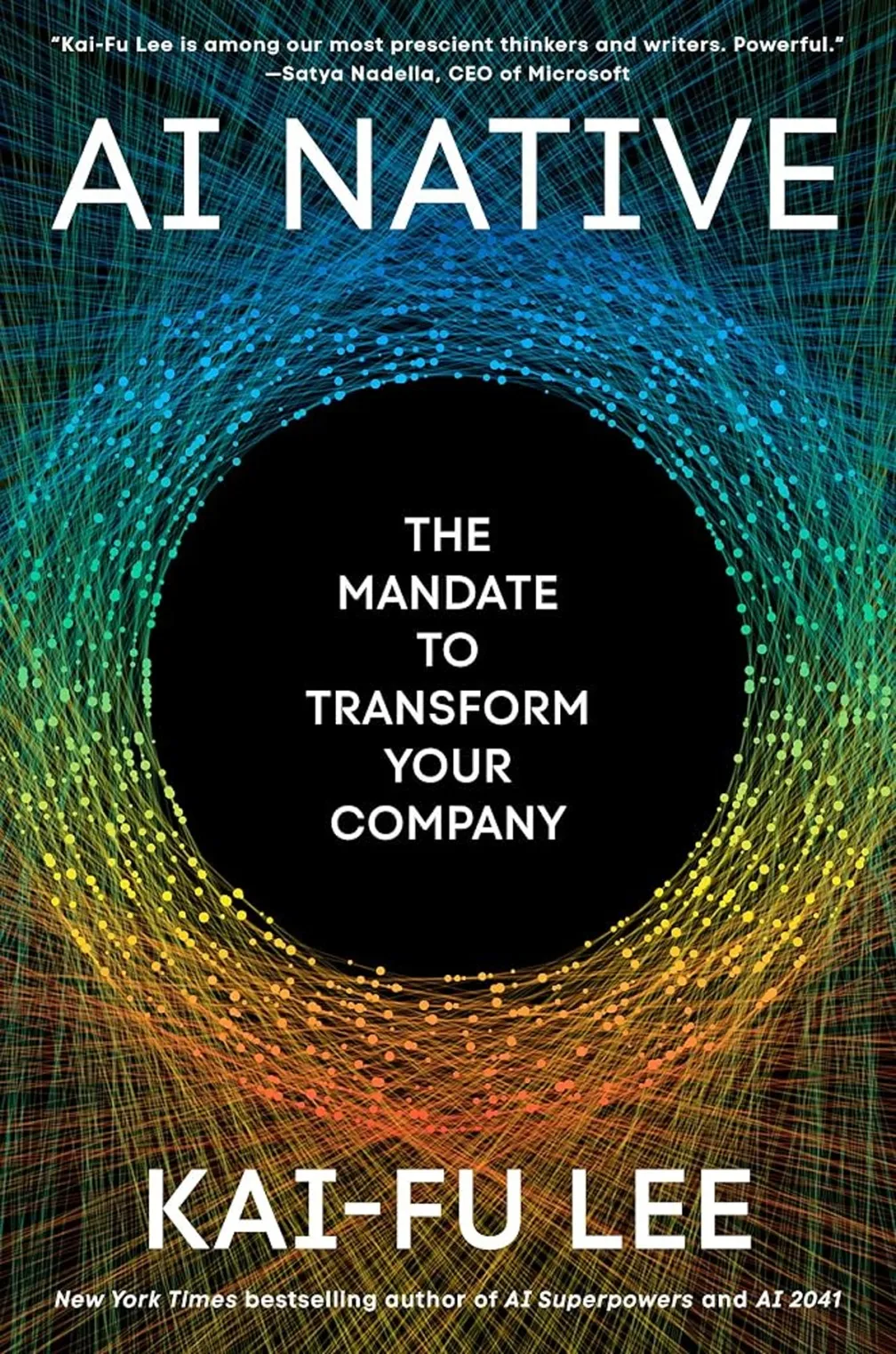
1This is quite a statement on CEOs, given how many make a point of publicizing their use of AI, and their penchant for hiring $25,000-a-day “AI gurus.” In a preview of Lee’s new book, AI Native: The Mandate to Transform Your Company, he dismisses most AI programs in use as “theater.” Note-takers and departmental chatbots are useful, he writes, but “irrelevant to the real value at stake … if your AI program hasn’t moved a single number on your earnings call, you didn’t transform anything.”

book cover of AI Native: The Mandate to Transform Your Company 

Jobs are going to change. In five years, the typical company’s organizational chart will be different; people who occupy the most important places will look different. AI workers are becoming better, cheaper [and] faster. In order to make that work effectively in an organization, it cannot be retrofitted into a hierarchy intended to manage people. AI workers don’t need hierarchies. What they need is people who know how to design the right problem to solve, organize AI to solve it, and — importantly — be accountable if anything goes wrong. AI can’t be accountable.

What are the qualifications that would put people in these positions? What should people study?

I suggest they study how to solve problems, come up with new problems, and command armies of AI to parallel-solve complex problems — show your mastery of AI. This is not coding. This does not require any engineering background; a humanities student can easily do this. Hard requirements can be learned, even [by] an older, non-tech-background person; that’s the good thing.

Good to know. [Laughs] Can I put a real-world example to you? We are a small team — myself and a handful of producers. I would hate to think of a future where it’s me and essentially an AI team.

I am not saying the [team] is one person and all AI. It’s as many as needed to ensure that the people connection part is worked out.

I don’t know enough about your business so using my business as an example: maybe a unit of 20 people and 100 AI to begin with. Over time, if the business is flat, then probably fewer people and more AI. If the business is growing, there may be more people and more AI.

Look at the protests that have just happened in India, the frustrations of so many young people that entry-level jobs aren’t there anymore. There are very serious social implications. Unless you’re saying there will be enough jobs in other fields for those people. 2

2India’s Gen Z movement, which forced the resignation of a cabinet minister, has tapped into widespread unhappiness at the limited availability of jobs for recent graduates. India’s economy remains fast-growing, but hiring in the customer support and tech-services industry has dropped in recent years.

Graduates Rise, Jobs Lag in India

The number of young graduates has increased 13 times since 1983 to 63 million, while those unable to find work have grown 16-fold to 11 million as of 2023.

There will be jobs in certain new industries.

Our whole society needs to rethink how much we depend on jobs. AI will generate a lot of wealth, and I think we can find ways of redistribution so people can work fewer hours and be paid for activities that were not economically important. But I think this is very hard to communicate to someone who couldn’t find a job, or lost [their] job.

You were at the forefront of Microsoft and Google’s foundations in China. How much of a challenge do Chinese AI companies like DeepSeek and Moonshot represent to US companies like OpenAI and Anthropic?

They represent a significant challenge, especially if they continue to keep up at recent levels. OpenAI and Anthropic always stayed at number one or two by most metrics on AI quality, but their models are closed. The Chinese models have been largely open source.

If you are OpenAI or Anthropic, you have a product you sell for a very high price, with an open-source version equivalent to your best model six months ago. Would you pay $50,000 for a [new] Tesla, or $15,000 [for a] Tesla that’s six months old? Obviously, the second is a strong value proposition. 3

3What Lee refers to as “open source” is described by most analysts as “open weight,” meaning that the AI model can be downloaded and potentially modified or redistributed; unlike in open-source software, the code used to train the model is typically not released. While US labs have mostly maintained closed-weight models, Nvidia, Microsoft and Meta were among firms recently warning US policymakers against “premature” restrictions on open-weight models, saying that they “expand access to the AI economy.” Anthropic and OpenAI were not among the signatories.

In the long run, are the Chinese companies more likely to make a profit?

No, the American companies will make more money.

Anthropic and OpenAI have built the iPhone. The Chinese companies are more like the way Google felt. Okay, you got the best product; we’ll build something that’s almost as good, sell it cheaply and win the larger share.

Like Android, the open-source models will have more share, more footprint, more usage. But people will pay very little. In some cases, they just copy the model, pay for the servers on which it’s run [and] don’t pay the Chinese companies anything.

Anthropic and OpenAI have the American system — selling enterprise products that are very highly priced....

....MUCH MORE 

Previously: 

September 2018 - "If You Read Only One Column On Artificial Intelligence This Month..."

Back in May we thumbnailed Lee Kai-fu as "Sometimes the competition is just plain intimidating/scary/resistance-is-futile, smart."
Followed by his mini-bio from Edge.org:

"KAI-FU LEE, the founder of the Beijing-based Sinovation Ventures, is ranked #1 in technology in China by Forbes. Educated as a computer scientist at Columbia and Carnegie Mellon, his distinguished career includes working as a research scientist at Apple; Vice President of the Web Products Division at Silicon Graphics; Corporate Vice President at Microsoft and founder of Microsoft Research Asia in Beijing, one of the world’s top research labs; and then Google Corporate President and President of Google Greater China. As an Internet celebrity, he has fifty million+ followers on the Chinese micro-blogging website Weibo. As an author, among his seven bestsellers in the Chinese language, two have sold more than one million copies each. His first book in English is AI Superpowers: China, Silicon Valley, and the New World Order (forthcoming, September)

  • "Kai-Fu Lee launches AI start-up to seize on ‘historical opportunity’ to build Chinese LLMs"
  • Artificial Intelligence Guru Kai-Fu Lee: "China Can Quickly Catch Up to US AI..."
  • Kai-Fu Lee Builds His AI Startup From $0 To $1 Billion Valuation In Eight Months
  • The computer brainiacs at IEEE Spectrum are fans, linked in "AI: 'Kai-Fu Lee'". 

    Also:

    September 2021 - Sensei Kai-Fu Lee on AI in 2041

    Yes, yes, in the headline I am mixing-and-matching two ancient Asian cultures but, despite his having been born on Taiwan Dr. Lee really is a sensei in the Japanese meaning of being both master and teacher....

    November 2023 - Kai-Fu Lee's AI Firm Stockpiled 18 Months of Nvidia GPUs Before Export Ban

    May 2024 - "AI Pioneer Kai-Fu Lee Aims to Bring China Its ChatGPT Moment"

    And on China:

    December 2023 - "Chinese generative AI to account for a third of industry’s economic value by 2035, Beijing think tank says"

    That seems a lofty target but it also seems the whole country is mobilized to extract value out of the entire AI ecosystem, from chips to software to use cases so maybe 1/3 of the pie isn't so lofty.

    The Chinese have been working toward AI dominance for years, from 2019's "China's AI Dream: The Plan and the Players" through to June 2023's "Microsoft helped build AI in China. Chinese AI helped build Microsoft." (MSFT)":
    Microsoft R&D in China is a huge effort. So big that MSFT has become a bit nervous about the exposure to the diktats of The Party and Government. So they are moving big chunks of the operation to Canada.

    From January 2018's "Can Chinese AI Chip Makers Compete with Nvidia?" (NVDA) and "Military AI: China, Russia and the U.S. are Running Neck-and-Neck in an Arms Race" and ""China wants to make the chips that will add AI to any gadget" to November 2023's "Kai-Fu Lee's AI Firm Stockpiled 18 Months of Nvidia GPUs Before Export Ban" and September 2023's "Chips: "Teardown of Huawei's new phone shows China's chip breakthrough".

    If the reader is interested we have dozens hundreds of posts on China and chips and computers and AI. Use the 'search blog' box, upper left.

    Here's more on the entire country seemingly moving in lockstep, July 2023:
    "Billionaires and bureaucrats mobilize China for AI race with US"

    Tuesday, September 29, 2026

    Physical AI: "AMD acquiring Fei-Fei Li’s World Labs AI firm in deal worth $8.2 billion"

    There just might be something to this physical AI stuff.

    From CNBC, September 28: 

    • AMD said it agreed to acquire World Labs, a San Francisco-based AI lab developing a so-called world model.
    • The chipmaker said it’s paying $8.2 billion in an all-stock transaction for World Labs.
    • AI researchers hope that world models can help develop robots and other physically grounded artificial intelligence applications.  

    Advanced Micro Devices said Monday that it’s agreed to acquire World Labs, the San Francisco-based AI lab founded by industry pioneer Fei-Fei Li, for $8.2 billion.

    The chipmaker, which previously invested in World Labs, said it’s paying for the startup in stock.

    Li was a Stanford professor who previously worked for Google and led AI research. She will become AMD’s chief scientist and an executive vice president at AMD, which is chasing Nvidia in the market for AI processors.

    World Labs is developing a so-called world model, which can be used to simulate 3D environments. In a demo presented by Li and AMD CEO Lisa Su earlier this year, the two executives showed a World Labs model called Marble creating a 3D scene out of a few images.

    “Intelligent agents, whether it’s robots or vehicles or even tools, can learn inside very rich physics-aware digital worlds before they even need to be deployed into the real one, making them much safer,” Li said at the presentation....

    ....MUCH MORE 

     If interested, some of our prior links on Madame Li are in Saturday, September 26's AI: "World model companies are keeping a lot of secrets".

    Our single-sentence opinion introducing January 2026's ""As artificial intelligence moves into real world, will physical AI pay off?":

    Good question. Physical AI will probably pay off in ways that are measurable faster than chatbots will...

    August 14 - "World Models Are AI’s Next Frontier"  

    August 15 - More On Physical AI: "How world models became AI's next frontier"

    Nvidia's Jensen Huang has been very serious about physical AI for the last three years. Here's a February 2025 post: 

    Nvidia Plummets 8.5% On Ennui, Boredom (NVDA)

    ... On the other hand Observer jumps ahead to what will most likely be a theme for the next twelve - fifteen months and/or until Blackwell's replacement is rolling off TSMC's assembly lines. February 27:

    Nvidia CEO Jensen Huang Predicts the Next Big Thing After ‘Agentic A.I’ 
    "Now is the beginning of the agentic A.I. era...then there's physical A.I. after that."

    Wednesday, September 23, 2026

    "SoftBank’s $50B data centre group slows IPO plans as investors balk at valuation"

    SB Energy was tapped to build the huge (9.2 megawatt, 2nd largest in the world) gas-fired power plant in Ohio.*

    From CryptoBriefing, September 22:

    SB Energy's massive backlog and zero operational data centers are giving prospective investors pause 

    SoftBank’s data center subsidiary SB Energy has hit the brakes on what was supposed to be one of the largest IPOs of 2026, pushing back its listing from September to at least mid-to-late October. The culprit: investors aren’t buying the $50 billion price tag for a company that hasn’t actually turned on a single data center yet.

    The company filed its S-1 registration statement with the SEC on September 1, seeking to list on Nasdaq under the ticker SBE and raise between $5 billion and $7 billion while keeping SoftBank as majority owner....

    ....MUCH MORE 

    Previously on the big one:

    February 24 - Ahead of Tonight's State Of The Union: Hoping For Clarity On The Gigantic Gas-Fired Electrical Generation Plant

    Everything other than the fact it is Japanese money funding the beast and a Japanese company (SB Energy  sub. of SoftBank) overseeing the project and Japanese companies expressing interest in developing same, a mention of American corporate participation could be rocket fuel for a couple of our favorite names.

    First up, Barron's last week, with the overview: 

    February 20
    A Gargantuan Natural Gas Plant Is Planned for Ohio. These Stocks Could Benefit. 

    July 20 - Not Good - "Nvidia in Talks With OpenAI to Guarantee $250 Billion Financing for Data Center"

    The quarter-trillion guarantee would be risky no matter who NVDA was co-signing for but the fact it will be for Mayoshi Son and Sam Altman is nuts.

    Our last mention of the Ohio property was February 25's Transmission: "Central Ohio Set for Major Grid Expansion as PJM Approves 765-kV Lines"

    We didn't get any further information on the immense Ohio natural gas power plant in last night's State of the Union message but as a possible consolation prize for the hyper-concentrated mini-portfolio we see this from Construction Review, February 17...

     And a few more.

    Tuesday, September 22, 2026

    "U.S. Markets to begin trading 23 hours a day, Monday-Friday, beginning on December 6" (plus how to know if you are having a stroke)

    From CryptoBriefing, September 17:

    Starting December 6, 2026, US equity markets will operate 23 hours a day, five days a week. The one-hour break each evening, from 8 p.m. to 9 p.m. ET, is reserved for maintenance. Every other hour belongs to the traders.

    The Securities and Exchange Commission approved the infrastructure changes needed to make this happen, and the agency has gone a step further: it’s openly exploring whether full 24/7 trading should come next.

    How the new schedule works....

    ....MUCH MORE 

    Our first post on stroke symptoms was in October 2008 during the Great Unpleasantness:

    How to Recognize the Symptoms of a Stroke (and what to do)

    It came with a three minute video. 

    Then in October 2016, a couple weeks ahead of an Nvidia earnings report:
    "Earnings Jolt Stocks Like Never Before as ETFs, Algos Get Blame" (NVDA; FSLR)
    Yes, I am thinking about NVIDIA'a upcoming numbers* and I still get butterflies riding an extended stock that is priced with zero-tolerance for disappointment.

    We went through the same thing with First Solar, out in public here on the blog, every three months, pretty much from the $20 IPO in November 2006 to the $317 top-tick in less than 18 months and then down to $11.43 over the next four years.
    On some report days the options would move through five or six strike prices.

    It got so rollery-coastery we'd do stroke symptom identification drills using the American Stroke Association's F.A.S.T. protocol:
    Face drooping:  -no, that's just a hang-dog expression
    Arm weakness:  -no, she just threw a monitor across the room
    Slurred speech: -no, that's the director of customer relations/client retention just returned  from a three grand lunch.
    Time to call an ambulance: no, time for some rapid-pulse chair aerobics as the algos move faster than even seems possible.
    Hmmm....this intro seems to be going to a dark place.
    On a lighter note, here's the headline story from Bloomberg....
    No video. 

    And our newest go-to diagnostic test: 

    Tuesday, September 8, 2026

    Google's TPU Chips Will Deliver Up To 50% Better Perfomance Per Dollar On Some Inference Chores Vs. Nvidia (GOOG; NVDA)

    Took ya long enough.*

    From SemiAnalysis, September 7:

    • TPU Inference Externalization Full Steam Ahead - InferenceX
    • InferenceX, Up to 50% Better Performance per Dollar, Rapid Externalization of TPU stack, Growing Customer Base, Ironwood, TPUv8i, Reducing CUDA Moat 

    For more than a decade, the industry has watched Google build an empire on its own silicon. Search, Ads, YouTube, and every generation of Gemini run on TPUs. Few accelerators have attracted as much architectural scrutiny or as much debate about what their performance and economics would look like outside the company that designed them. Anthropic being the biggest user of TPUs, surpassing Deepmind’s own use by 2029.

    Google’s internal success was never the question. The question was how much of that advantage the rest of the industry could actually get. Could you take an open-weight model, serve it through a familiar inference engine, and beat NVIDIA on the economics that matter to your business?

    Today, we are publishing the first third-party inference results for TPUv7 Ironwood on InferenceX Official Preview. In our apples-to-apples comparisons against B200/B300, Ironwood delivers up to 50% better performance per dollar. Its advantage extends across much of the Pareto curve, and we examine the economics from both sides: Google’s internal total cost of ownership and the external TCO an actual customer pays.

    Ironwood (TPUv7) is the first generation in which Google is competing for others’ inference workloads with chips that can be purchased outright or rented through its own cloud. In November 2025, we already said that Anthropic loves TPUs and committed to over one million of them (around 400k+ in direct purchases and 600k+ rented through GCP), used mainly for training but also for inference. Our Accelerator Model has the latest figures for Anthropic’s TPU shipments and Google’s overall TPU shipments by quarter, plus estimates for TPUv8i, v8t, and various v9 / v10, and more

    We are excited by how quickly the new TorchTPU stack is developing, the external stack for TPUs. Later in the article, we will discuss the upcoming work needed for TPU software externalization, including optimizing speculative decoding, disaggregated prefill, KV-cache offloading, multi-turn agentic workloads, and more. Even so, we at SemiAnalysis strongly believe that TPU externalization is heading in the right direction and moving full steam ahead. Furthermore, unlike AMD, which is still learning how to build a test-first software culture, Google has decades of software engineering experience and an extremely well established quality-driven culture, so we expect external TPU software to mature rapidly.

    In this article, we will cover all the optimizations that went into TPU kernels and the serving stack for open-weight models, including DP attention optimization, MoE routing and kernel optimization, and reducing padding in GDN kernels. We will also take a deep dive into the TPU system and discuss the next steps the amazing TPU performance engineers are pursuing to make the stack widely available.

    Google has spent more than a decade demonstrating what it can build with TPUs. Now we get to measure what the rest of the industry can do with them.

    Shoutout to the Google (Chris Chan, Jahangir Hasan, Wangyuan Zhang, Anne Stern, Puneith Kaul, Ruizi Dong, Sangam Jindal, Qi Zhou, Madhan Jaganathan, Gang Ji, Jun Wan, Devanshu Jain, Jiaxin Cao, Srinath Mandalapu, Haowen Ning) and Inferact teams and RedHat Teams (Michael Goin) for this amazing TPU foundation and performance! Furthermore, shoutout to the RadixArk team that is also working on TorchTPU SGLang.

    InferenceX Official Preview: TPUv7 Ironwood vs. Blackwell and Blackwell Ultra 

    We are already seeing strong results from the upcoming native TorchTPU vLLM stack in apples-to-apples comparisons against Nvidia GPUs. Google is using Qwen3.5 397B in FP8 as the initial bring-up model. Later sections take a deep dive into why the new TorchTPU approach is a marked improvement over the previous TorchAX path for external TPU vLLM/SGLang serving.

    Once that foundation is in place, Google plans to extend support to other open-weight models, including Kimi K3 and GLM5.3. Once a handful of models are well optimized, we believe adding optimized support for a wide range of popular open models near day 0 becomes far easier. Today, vLLM and SGLang concentrate their day-0 support on Nvidia, with passable day-0 coverage for AMD. We expect TorchTPU to be stable enough in the near future that vLLM and SGLang maintainers may add TPUs to that day-0 list. The stack is expected to leave private beta & be open sourced around October. 

    In apples-to-apples comparisons of aggregated serving with FP8 and single-token prediction, we are seeing up to 50% better performance per dollar from TPU than from B200 and B300 running FP8 in aggregated serving. When serving models using FP4 on NVIDIA GPUs, there is quality loss verus FP8. TPUv7 does not have native FP4 computation thus on FP4, NVIDIA GPUs still maintains the lead. This will change with TPUv8i which has native FP4 support thus we strongly believe TPUv8i Boardfly will be competitive to Rubin NVL72.... 

    ....MUCH MORE
    *
    April 2017 - Watch Out NVIDIA: "Google Details Tensor Chip Powers" (GOOG; NVDA)
    We've said NVIDIA probably has a couple year head start but this bears watching, so to speak....

    And many, many more, including November 2025 "CHIPS: Google's Tensor Processing Unit (Finally) A Viable Competitor For Nvidia (GOOG; NVDA)" 

    Thursday, September 3, 2026

    "Nvidia is driving the AI boom. Good" (NVDA)

    The Economist's cover story, September 3 (lifted in toto with links to the rest of the package):

    The chipmaker’s enormous bets are how capitalism is supposed to work 

    NVIDIA was named in 1993 after the Latin word for envy. Sure enough, the American colossus inspires plenty of it. Insatiable global demand for its graphics-processing units (GPUs), the chips that power artificial intelligence, has made Nvidia the world’s most valuable company, worth $5.4trn. Next year it may also become the most profitable, generating $370bn in net income. By 2029 its sales could hit $1trn.

    Jensen Huang, Nvidia’s boss, is truly the magician at the heart of the AI boom. His firm’s share price is 14 times what it was on ChatGPT’s release in late 2022. The ten biggest public companies championing AI make up 40% of the value of the S&P 500 index. Nvidia alone accounts for 8% and unlike, say, Apple or Tesla, which make smartphones and cars, it is almost solely a bet on AI. The company has produced about 15 cents of every dollar the American stock market has returned since 2023—returns that have kept consumers spending despite rising interest rates, tariffs and a war with Iran.

    Yet many also see Mr Huang as a magician in a more worrying sense, fearing that he is an illusionist inflating a dangerous bubble. Through $1trn-worth of deals, Nvidia provides data-centre landlords and AI labs with cash or guarantees so that they can buy its GPUs. Some call it the “bank of AI”. At the very least, Nvidia’s critics say, its financial engineering smacks of the “vendor financing” which pumped up the revenues of networking-gear makers like Cisco in the dotcom mania of 2000-01, whose collapse brought about a recession.

    Look more closely, however, and the worries are mostly unjustified. If Nvidia’s bets on ai come good, they could accelerate the technology’s adoption, boosting productivity and living standards. If they misfire, the cost will fall chiefly on Nvidia’s shareholders. That is how capitalism is supposed to work.

    True, the dotcom and AI booms share unnerving similarities: an exciting new technology, an epic bull run, hubristic tech bosses. Nvidia’s rise from seller of chips to video-gamers and cryptocurrency miners to linchpin of the economy has been so rapid that many people have yet to learn how to say its name (“en-vidia”, not “nuh-vidia”). This mirrors the ascent of Cisco, which in 2000 briefly also became the world’s most valuable firm. Just as Cisco’s sales of routers and switches presupposed exponential growth in web traffic, Nvidia’s GPU revenues assume endless demand for AI tokens.

    Cisco was right about eventual demand but wrong about the timing—hence the dotcom crash. Today it is the pace of AI adoption that is hard to forecast. Set aside Claude-addled software engineers and usage remains fledgling. If it does not soon soar, Nvidia’s customers may call in the guarantees just as the chipmaker’s own sales nosedive. Since no one is sure how quickly GPUs lose their value, any used chips Nvidia repossesses may be worthless.

    Nvidia’s financial wizardry is partly defensive. Its latest GPUs no longer have the market to themselves. Roughly half Nvidia’s revenue comes courtesy of America’s cloud-computing “hyperscalers”, chiefly Amazon, Google, Meta and Microsoft, which are designing their own silicon. Non-Nvidia AI chips account for 38% of the market, up from 26% in 2023. To stay ahead, Nvidia used to spend over a fifth of sales on research and development. Now it spends less than a tenth.

    Last, the scale of Nvidia’s financial commitments can look terrifying. Morgan Stanley puts its overall credit exposure—ie, its modest borrowing plus support for customers—at $200bn by the start of 2029. In time Nvidia’s shadow debt could reach $300bn or more. It is a gargantuan sum: today only America’s six largest banks carry more debt.

    Yet the differences from the dotcom boom are more important than the similarities. Nvidia’s balance-sheet is extraordinarily robust. The company has $99bn of cash and is churning out more. In each of the past three years annual sales have roughly doubled. Gross margins have fattened from less than 60% to 75%. Mr Huang’s cult-CEO status now rivals that of Elon Musk. But whereas Mr Musk's firms generate little cash (at Tesla) or burn lots of it (at SpaceX), Nvidia will yield about $200bn this year.

    This means that, whereas Cisco used debt, Nvidia can use cash to backstop its deals with buyers of its GPUs. Even if its commitments came due and its cashflows levelled off starting next year, by 2028 it would still be less leveraged than all but 39 non-financial firms in the S&P 500 are today. Profits would need to drop by 60% from that plateau for Nvidia to forsake its investment-grade credit rating.

    And demand for AI is not illusory, as it was for Pets.com and other revenueless dotcom darlings. The sales of Anthropic, the leading AI lab, shot up from $5bn in the first quarter to $11.5bn in the second. OpenAI, its main rival, is probably not far behind. The hyperscalers are also booking AI income. All told, AI may be earning American tech around $150bn a year, from nothing a few years ago. That is still far from the $2.5trn needed to cover AI capital spending, but growth is fast.

    Mr Huang thinks that the biggest obstacle to the AI revolution is not lack of demand for AI but inadequate infrastructure. The markets will not provide capital on the scale that is necessary, so Nvidia is offering financing itself. Nvidia has an advantage in understanding the balance of risks and rewards. Although this bet is big enough to affect the economy, it is an entrepreneurial one. Every company that reinvests cash rather than returning it to shareholders also gambles that it can beat the market. Companies exist to make such concentrated bets. If investors want to diversify, they can do so themselves.

    And Mr Huang is hardly alone. The hyperscalers, the world’s most successful companies before Nvidia came along, are making the same bet. So are some big names on Wall Street. Last month Goldman Sachs, BlackRock, Blackstone and others joined Nvidia in a $500bn data-centre initiative. And so are Mr Huang’s shareholders, who haven’t yet rushed for the exit. If they are all wrong, it is their money on the line. And if they are right, the AI era may arrive a bit sooner.

    Tuesday, September 1, 2026

    "Nvidia is building an IP licensing empire on the back of NVLink" (NVDA)

    From The Register, August 31:

    Even when you think you're not buying Nvidia, you might still be buying Nvidia 

    The proliferation of custom AI ASICs, or XPUs, from OpenAI, Meta, Microsoft, and others has led many to question Nvidia's grip on the market. After all, if everybody's building their own, who needs the GPUs the AI arms dealer has made its fortune on?

    But Nvidia isn't concerned in the least and has instead invited its competition to raid – or, rather, license – the GPU giant's IP holdings, particularly those related to networking.

    On Monday, MediaTek became the latest to embrace Nvidia's NVLink Fusion high-speed interconnect technology for its fledgling datacenter XPU offering. In exchange, Nvidia has invested $3.5 billion in convertible bonds issued by MediaTek. The GPU giant will also continue to license the Taiwanese SoC provider's own designs for use in future DGX and RTX Spark systems.

    If you're curious, we explored MediaTek's datacenter ambitions last month. But the designer, best known for its Arm-based smartphone and tablet processors, is only one of several high-profile chip designers that plan to integrate the tech. Amazon, Fujitsu, Qualcomm, Arm, and Marvell are all on the same list.

    NVLink Fusion started as a commercialized version of Nvidia's high-speed inter-GPU interconnect, introduced early last year. Initially, it was offered in two varieties: a chip-to-chip (C2C) variant for connecting CPUs to GPUs (or XPUs) in a memory coherent fabric, and a switched fabric used to stitch together multiple accelerators into one big logical rack-scale chip. It's since expanded to become the blanket offering by which Nvidia licenses its semiconductor IP.

    Given how long it's taken Broadcom and others to develop competitive alternatives to NVLink, it's not surprising companies like MediaTek would license the tech, rather than reinventing the wheel, or piping alternative interconnects, like UALink, over regular old Ethernet.

    By licensing Nvidia's NVLink Fusion tech, companies can focus on building competitive accelerators without worrying about how they're going to scale in production.

    And because Nvidia's MGX rack designs are part of the Open Compute Project, MediaTek and its partners not only benefit from Nvidia's scale-up networking tech, but also can essentially take existing NVL72 racks and slot in their compute blades. This should dramatically reduce the system design and mechanical engineering experience required to go from silicon to AI racks.

    And this isn't theoretical. Amazon is doing just that with its Trainium series of AI accelerators. As we wrote at the time, Amazon used Nvidia's MGX NVL72 reference design for its Trainium3-based rack systems launched last year. Meanwhile Trainium4, expected late this year, will ditch Amazon's in-house NeuronLink interconnect tech for NVLink Fusion.

    Nvidia's cut
    So, what does Nvidia get from letting rival chip designers piggyback off its hard-won networking tech?

    A lot more than licensing fees: It's also a way to keep companies hooked on its other products....

    ....MUCH MORE 

    Connecting it all together, very important. 

    Previously:

    May 2015 - "Nvidia Wants to Be the Brains Of Your Autonomous Car (NVID)":

    Among the fastest processors in the business are the one's originally developed for video games and known as Graphics Processing Units or GPU's. Since Nvidia released their Tesla hardware in 2008 hobbyists (and others) have used GPU's to build personal supercomputers.
    Here's Nvidias Build your Own page.
    Or have your tech guy build one for you.

    In addition Nvidia has very fast connectors they call NVLink.
    Using a hybrid combination of IBM Central Processing Units (CPU's) and Nvidia's GPU's, all hooked together with NVIDIA's NVLink, Oak Ridge National Laboratory is building what will be the world's fastest supercomputer when it debuts in 2018.

    As your kid plays Grand Theft Auto.... 

    March 2018 - "Connecting The Dots On Why Nvidia Is Buying Mellanox" (NVDA)

    March 2026 - Connecting it all together: "Nvidia to invest $4 billion in two photonics companies" (NVDA; LITE; COHR)

    Mr. Huang has said he wants to connect entire data centers together into one gigantic chip.

    To do that you have to get latency between chips and then between servers as close to zero as possible.

    June 2026 - "Nvidia Takes the Lead in Another AI Market Beyond Chips...." (NVDA)

    From TipRanks, June 18:

    Story Highlights

    • Nvidia became the top vendor in data center Ethernet switching for the first time.
    • IDC said Nvidia’s switching revenue jumped 193% year-over-year in the first quarter.
    • The gain shows Nvidia is expanding beyond GPUs into a larger share of AI infrastructure spending....

    If there is any money to be made from artificial intelligence Mr. Huang seems bound-and-determined that it go to Nvidia. 
    In other news, the move to optical and photonics from wires is real and accelerating.
    From Nvidia's blog, June 16...

    ....MUCH MORE  

    Friday, August 28, 2026

    Deutsche Bank Research: "AI at 70: 14 lessons from a lifetime of boom and bust"

    Following on the post immediately below, "Would There Be an AI Revolution If There Were No Nvidia?" (NVDA).

    From the Deutsche Bank Research Institute via Beijing's 36Kr-European Central Station, August 18: 

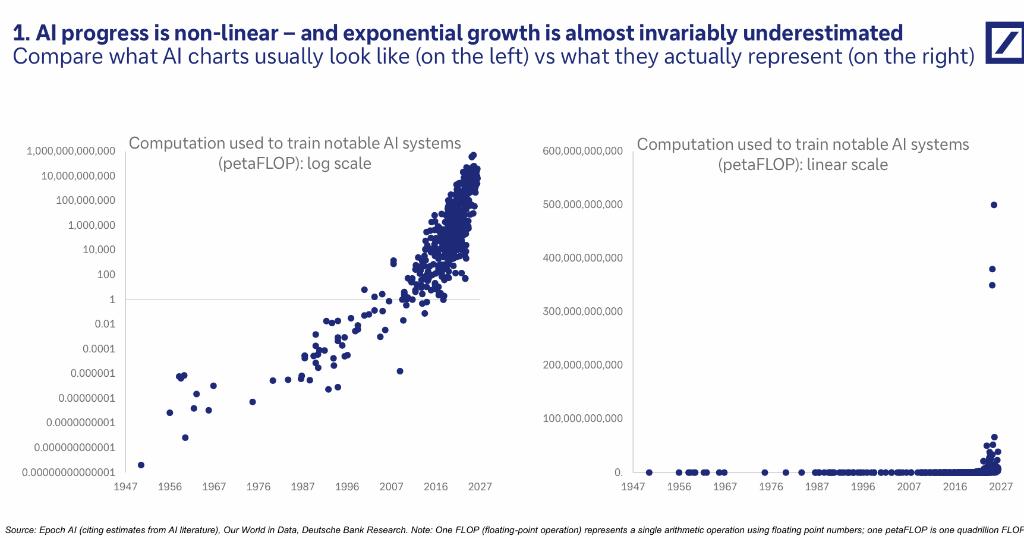
    Deutsche Bank sorts out the 70-year development trajectory of AI and sums up 14 historical takeaways. AI is witnessing exponential non-linear growth, and falling costs will spur even greater demand. However, technical routes see frequent iterations, with bottlenecks emerging in hardware and supply chains. While AI has gained rapid popularity among consumers, its commercial application in the enterprise segment is still in the early stage. Current market valuations are nearing historically high levels, and investors need to stay alert to risks brought by technological iteration and supply chain disruptions.

    Deutsche Bank's latest research report sorts out the development context of artificial intelligence since its birth in 1956, extracts 14 key insights from historical patterns, and provides a reference for investors to judge the trend of the current AI boom.

    This August marks exactly 70 years since the 1956 Dartmouth Summer Research Project on Artificial Intelligence, the birthplace of AI. Adrian Cox, Thematic Strategist at Deutsche Bank Research, points out in the latest report that the 70-year history of AI has been filled with alternating booms and busts, and the current round of investment and valuation frenzy is repeating the paradigm of technological revolutions that have appeared many times in history.

    The report argues that "context" is critical to understanding the future direction of AI. From non-linear growth and infrastructure bottlenecks to the expansion and bursting of valuation bubbles, historical signals are clearly identifiable. The report states directly that some people may claim that "this time is different", but the data from the past 70 years provides another frame of reference — for investors betting on the AI track, these insights are directly related to asset allocation logic and risk judgment.

    01 Growth is not linear, and is often severely underestimated

    The report highlights the core feature of AI progress at the beginning: non-linearity. Presenting the historical data of training computing power on a logarithmic scale, it can be clearly seen that since 1956, the growth of computing power used to train major AI systems has spanned dozens of orders of magnitude, while the visual presentation of linear charts almost completely obscures this trend. Exponential growth is intuitively very easy to underestimate, which is the first cognitive threshold for understanding the AI wave.

    Closely related to this, the progress speed of AI has surpassed Moore's Law. Traditional computing power doubles every 18 to 24 months, but after entering the era of deep learning, the average annual growth rate of computing power has reached about 4 times, far higher than the annual growth rate of about 1.4 times before the deep learning era. The reason lies in the simultaneous improvement of multiple factors such as system scale expansion, memory enhancement, and algorithm optimization, forming a superposition effect.

    02 Technical routes continue to iterate, today's leader is not necessarily tomorrow's winner

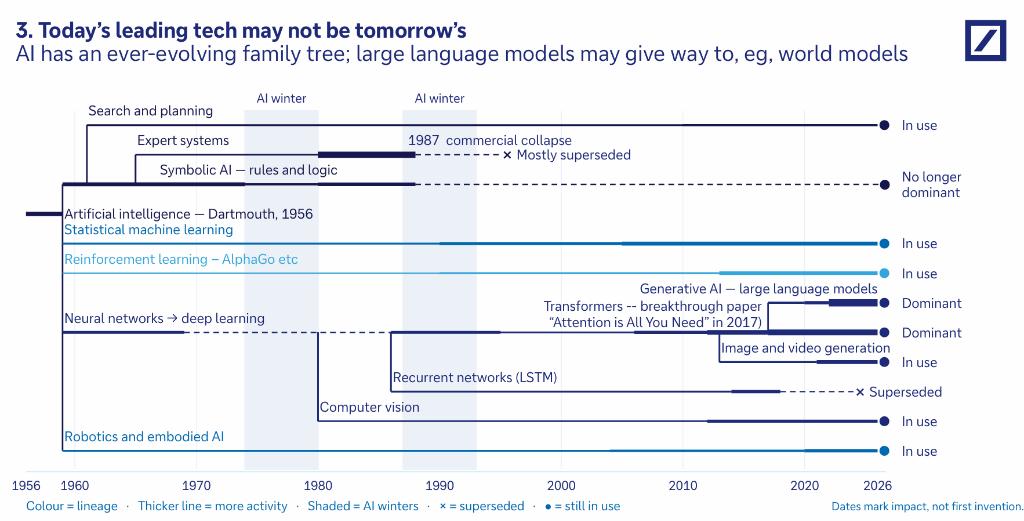
    The report presents the 70-year evolution of routes through the AI technology spectrum: from symbolic logic and expert systems to statistical machine learning, deep learning, and then to the currently dominant large language models. Each generation of mainstream technology has gone through a cycle from rise to replacement. Some routes (such as recurrent neural networks) have been surpassed, while others are still evolving in parallel. The report points out that large language models may give way to new paradigms such as "world models" in the future, and the intergenerational replacement of technologies does not depend on the will of current leaders.

    Historical changes in market share also confirm this point. Internet Explorer once outperformed Netscape, but was later replaced by Chrome. In the current competitive landscape of generative AI platforms, ChatGPT leads in monthly visits, but Google Gemini, DeepSeek and Claude are all catching up rapidly. Early advantages do not equal long-term moats.

    03 R&D accumulation determines the competitive landscape, and the rise of DeepSeek is no accident

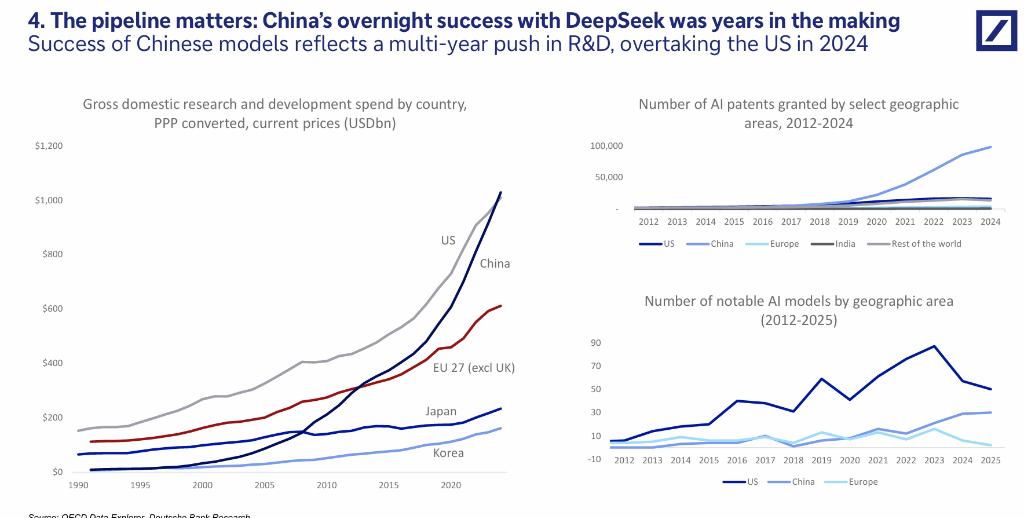
    The sudden rise of Chinese AI models, represented by DeepSeek, seems to be "overnight success" on the surface, but it is actually the result of years of R&D investment accumulation. Data shows that China has surpassed the United States in total R&D expenditure in 2024, and its catching-up speed in the number of major AI models is also remarkable. In terms of the number of AI patent grants, China's growth curve is also far ahead of other economies. For investors, this means that changes in the competitive landscape often accumulate at the underlying level for many years before they are visible on the surface.

    04 Cost reduction will not compress demand, but will instead expand demand

    The report cites the "Jevons Paradox" to illustrate that the sharp drop in the cost of AI use will not lead to a reduction in total expenditure, but will instead stimulate a surge in demand. Since 2006, the cost of GPU computing power has dropped by more than 99%, but according to the forecast of the International Energy Agency (IEA), global data center power consumption will double from 2024 to 2030. Lower marginal cost means more application scenarios and higher total demand....

    ....MUCH MORE 

    Here's the original at DB, 17 page PDF, downloadable.

    If interested see also the RAND Corporation's relationship with AI: 

    RAND: "Artificial Intelligence and Biotechnology: Risks and Opportunities"

    RAND has a very deep history in artificial intelligence. From Jeremy Norman's History of Information:
    Newell, Simon & Shaw Develop the First Artificial Intelligence Program

    During 1955 and 1956 computer scientist and cognitive psychologist Allen Newell, political scientist, economist and sociologist Herbert A. Simon, and systems programmer John Clifford Shaw, all working at the Rand Corporation in Santa Monica, California, developed the Logic Theorist, the first program deliberately engineered to mimic the problem solving skills of a human being. They decided to write a program that could prove theorems in the propositional calculus like those in Principia Mathematica by Alfred North Whitehead and Bertrand Russell. As Simon later wrote,

    "LT was based on the system of Principia mathematica, largely because a copy of that work happened to sit in my bookshelf. There was no intention of making a contribution to symbolic logic, and the system of Principia was sufficiently outmoded by that time as to be inappropriate for that purpose. For us, the important consideration was not the precise task, but its suitability for demonstrating that a computer could discover problem solutions in a complex nonnumerical domain by heuristic search that used humanoid heuristics" (Simon,"Allen Newell: 1927-1992," Annals of the History of Computing 20 [1998] 68).

    The collaborators wrote the first version of the program by hand on 3 x 5 inch cards. As Simon recalled....

    For a bit more on Mr. Simon here's the introduction to 2016's "Interview: Manuela Veloso Head of Machine Learning, Carnegie Mellon University":

    Our readers probably know Carnegie Mellon more for the  top-ranked financial engineering program (Master of Science in Computational Finance) but artificial intelligence was pretty much invented at CMU by Herbert Simon and Allen Newell. Simon received the Nobel in Economics but it actually could have been for any of four or five subjects, he was quite the polymath.

    Newell had to settle for the Turing award (along with Simon) from the Association for Computing Machinery, probably the root'in-tootin high-falootinest tchotchke in the computer biz.
    The Association for the Advancement of Artificial Intelligence along with the ACM subsequently named an award in Newell's honor. Ditto for CMU.

    The University's machine learning department was the first in the world to offer a doctorate and as far as I know is still the largest.
    A department, for one branch of AI.

    Carnegie-Mellon used to have a world class robotics Institute but Uber gutted it with a combination of cash and stock options leaving a Dean and a couple robots to rebuild.
    One of the robots is said to be in advanced negotiations with the Ube-sters.

    "Would There Be an AI Revolution If There Were No Nvidia?" (NVDA)

    From the Wall Street Journal via MSN, August 27:

    Would there be an AI revolution if there were no Nvidia?

    That’s what I found myself thinking as I listened to CEO Jensen Huang during the company’s earnings call yesterday after it reported a blowout quarter. Delivered in a just-the-facts tone even if it was peppered with words such as “extraordinary,” Huang made it clear that if you turn left or right, look up, down or under, you’re likely to find Nvidia in whatever part of the transformation you’re exploring. 

    There’s no doubt that we still don’t know how this all will play out. It is, of course, in Huang’s interest to emphasize his company’s role in the AI build-out. Nvidia also has a lot on the line through its role as the de facto banker/backer of many pieces of the revolution. 

    But even here, Huang expressed the kind of confidence that the market has appeared to be searching for, as some investors fretted over the gargantuan amounts of capital being bet to build the necessary compute. (Its stock was up nearly 5% in after-hours trading.)

    Investing in companies including Anthropic and OpenAI is a “once in a generation opportunity,” he said. “I think the only regret that I have is that I didn’t invest more and sooner. And two of the companies will likely go public soon, and others will follow, and these will be some of the most consequential technology companies in history.”

    Not only that, but they’re also Nvidia customers. “I have 100% confidence that you know through quite a long period of time they’re going to be utilizing Nvidia compute for a lot of their computing,” he added. 

    Huang noted more than once that capacity, not demand, is constraining Nvidia’s growth—it projected 70% revenue growth for fiscal 2028. What if there are no capacity constraints, he was asked. 

    “The unconstrained, you know, is significant, and so we’re just going to have to go work hard to get more capacity.” Thus its involvement in the AI supply chain that includes data centers. 

    The open versus closed AI models debate? Nvidia wins with both, he said....

    ....MORE

    Regarding capacity constraints, here's the transcript: 

    ....Tiffany, Conference Operator: Your next question comes from the line of James Schneider with Goldman Sachs. Your line is open.

    James Schneider, Analyst, Goldman Sachs: Good afternoon. Thank you for taking my question. If you think about the 100% growth you talked about in terms of the plus unconstrained demand growth you are expecting, the 70% you expect to fulfill in terms of supply, can you maybe talk about some of the, or rank order some of the most acute constraints, whether that be things like data center, power and shell availability, DRAM, wafer foundry availability, et cetera? If you could maybe help us understand which are the biggest among those, that would be very helpful. Thank you.

    Jensen Huang, President and Chief Executive Officer, NVIDIA: There’s something funny I could say, but I’m going to just not. Last year, one of the funnest things to do is just to go figure out where I go for dinner and who I have dinner with, and their stock price doubles the next day. I think the answer is, our entire supply chain is challenged. Everybody is really running flat out. More capacity is coming online all the time, which is one of the advantages of what’s going to happen this year. It’s not going to come online in an instance in time, but it’s going to come online every day. Yields are going to get improved. We’re going to be doing yield improvement. We’re going to work hard on working with every one of our suppliers.

    We have a It’s not even next year yet, so we’ve got lots and lots of time to work hard every day. So at this moment, we have supply for 70%. We have more supply than 70%, but about 70%. Our demand is much higher than that, and we’ve got to go work hard, or we’re going to be disappointing customers. We like not to disappoint our customers, and we like to work hard for them. So I’m going to need the help of the entire supply chain to help me out here. They all know that. What I’m telling you about our needs for next year is exactly consistent with what I’ve told them. Everybody’s on the exact same song sheet, and I’m trying to be as transparent as we can because we’re talking about big numbers....

    Thursday, August 27, 2026

    "Earnings call transcript: NVIDIA beats Q2 2026 estimates as AI demand stays hot" (NVDA)

    First up, from Barron's Adam Levine who is obviously not a member of the NVDA obsessive-compulsive club, August 26:

    These Two Sentences May Have Just Fixed Nvidia’s Stock 

    As usual, the Nvidia earnings call was a discursive affair, touching on many different subjects. But the only thing that mattered in the end came right near the beginning of the call.

    The stock was down after the earnings release showed that Nvidia's vaunted 75% gross margin would slip a bit in the second half of the year due to spiraling memory chip costs That outlook overshadowed another stellar second quarter. The stock was roughly flat as the call began at 5 p.m. ET.

    But moments later Chief Financial Officer Colette Kress said the magic words: "We expect to grow revenue by approximately 70% in fiscal 2028. This is a supply-constrained outlook." Nvidia shares instantly surged 4%.

    Fiscal 2028 begins in late January, so it encompasses 11 months of calendar 2027. Wall Street was expecting 45% growth next year, a big slowdown from what looks to be a doubling of sales this year.

    Later in the call, CEO Jensen Huang said that were the company not supply-constrained, sales would double again next year, and that the company was working on opening up some of the bottlenecks holding them back.

    There was another hour of talking on the call, but none of it mattered as much as those two sentences spoken by Kress. 

    And for those of us who are obsessive about the company and its stock, Investing.com has the fix, August 26: 

    NVIDIA said fiscal second-quarter revenue more than doubled from a year earlier to $96.2 billion and adjusted earnings topped Wall Street expectations, underscoring how the company remains at the center of the global AI spending boom. The chip maker reported adjusted earnings of $2.22 a share, above the $2.08 forecast, and said revenue exceeded the $91.9 billion consensus. Shares rose 3.98% after hours to $218, after closing the regular session at $209.66, down 1.59%.

    Key Takeaways

    • Revenue rose to a record $96.2 billion, more than doubling from a year earlier.
    • Adjusted EPS of $2.22 beat expectations by 6.73%.
    • Data center revenue reached $89 billion, or 92.7% of total sales.
    • NVIDIA said demand is broadening beyond hyperscalers to sovereign AI, NeoClouds and enterprises.
    • The company guided for $108 billion in revenue in the current quarter, above the latest consensus.

    Company Performance

    NVIDIA’s latest quarter showed that the AI infrastructure build-out remains in full force. Revenue growth accelerated for a fourth straight quarter, driven mainly by data center demand. The company said data center sales rose 18% from the previous quarter to $89 billion, with hyperscale revenue at $49 billion and its ACIE business — which includes sovereign AI, regional cloud providers and enterprises — at $40 billion.

    The results reinforce NVIDIA’s position as the dominant supplier of AI computing systems. Management said the company’s architecture now supports the full AI life cycle, from data preparation and training to post-training and agentic inference. That broadening use case has helped NVIDIA expand beyond the original wave of large cloud customers into a wider customer base.

    Gross margin remained 75%, but management warned that margins are likely to come under pressure in the near term because of memory pricing. Even so, the company said demand remains stronger than supply and that its products are fully utilized across every cloud it serves.

    Financial Highlights

    • Revenue: $96.2 billion, more than double year over year.
    • Adjusted EPS: $2.22, up from a forecast of $2.08.
    • Data center revenue: $89 billion, up 18% sequentially.
    • Hyperscale revenue: $49 billion, up 13% sequentially.
    • ACIE revenue: $40 billion, up 25% sequentially and 138% year over year.
    • Gross margin: 75%, unchanged from the prior quarter.
    • Return on equity: 114%, reflecting exceptional profitability.
    • Market capitalization: $5.08 trillion, maintaining its position as one of the world’s most valuable companies.
    • Operating expenses: up 10% on a GAAP basis and 11% on a non-GAAP basis sequentially.
    • Inventory: $32 billion, higher as the company prepares for the Vera Rubin launch.
    • Days sales outstanding: 60 days, reflecting longer payment terms for large investment-grade customers.
    • Shareholder returns: $26 billion, including $20 billion in buybacks and $6 billion in dividends.

    Earnings vs. Forecast

    NVIDIA beat expectations on both earnings and revenue. Adjusted EPS of $2.22 came in $0.14 above the $2.08 forecast, a surprise of 6.73%. Revenue of $96.2 billion beat the $91.9 billion estimate by $4.3 billion, or 4.68%.

    The size of the beat was solid, though not unusual for NVIDIA in the current AI cycle. Investors have come to expect strong outperformance from the company, so the market reaction likely reflected not only the beat itself but also the strength of the outlook and the continued scale of demand. The revenue beat was larger in dollar terms than the EPS surprise, which suggests that sales momentum remains the main story.

    Market Reaction

    The stock moved higher in after-hours trading, rising 3.98% to $218, or $8.34 above the regular-session close. The shares had finished the day at $209.66, down 1.59% from the previous close of $213.05, so the post-earnings move reversed part of that decline.

    At $218, the stock traded near the upper end of its 52-week range of $164.07 to $236.54. The reaction was positive, but not extreme, which may reflect the market’s view that NVIDIA’s results were strong but broadly in line with the company’s powerful recent run. No unusual trading volume data was provided.

    Outlook & Guidance

    NVIDIA said it expects fiscal third-quarter revenue of $108 billion, plus or minus 2%, which implies a range of about $106 billion to $110 billion. The company also guided for gross margins of 74%, plus or minus 50 basis points, and operating expenses of $9.2 billion on a GAAP basis and $9.0 billion on a non-GAAP basis.

    Management said Vera Rubin shipments began in August and that the new platform is already seeing purchase orders from major hyperscalers, AI cloud providers and system makers. The company said Vera Rubin should account for about 20% of data center revenue in the current quarter.

    Looking further ahead, NVIDIA said revenue growth in fiscal 2028 should be about 70%, though management stressed that demand would be higher if supply were not constrained. The company also said CPU revenue is expected to more than double in fiscal 2028. InvestingPro Tips highlight that 10 analysts have revised their earnings upwards for the upcoming period, reinforcing the bullish outlook. For investors seeking deeper insights, NVIDIA is one of 1,400+ US equities covered by comprehensive Pro Research Reports, which transform complex Wall Street data into clear, actionable intelligence through intuitive visuals and expert analysis.

    Executive Commentary

    Chief Executive Jensen Huang said the company is seeing a shift toward agentic AI, which he said requires far more computing power than human-driven use. “The amount of compute necessary for an agent versus a human using it is probably 15 to 100 times,” he said.

    Huang also argued that NVIDIA’s advantage comes from offering a full-stack platform rather than just chips. “We are the only company in the world that creates and builds, offers an entire AI factory platform, a full stack system,” he said.

    Chief Financial Officer Colette Kress said the company’s business is broadening across customer groups. “Non-hyperscaler growth, our ACIE segment spanning sovereign regional NeoClouds, enterprise edge, and air gap data centers will represent roughly half of our data center business,” she said.

    Risks and Challenges

    • Margin pressure: NVIDIA said memory scarcity is pushing costs higher and could weigh on gross margins in coming quarters.
    • Supply limits: Management said demand exceeds supply, which means the company may not be able to capture all available demand immediately.
    • China exposure: The company said it did not include China data center compute revenue in forward guidance because of geopolitical uncertainty.
    • Heavy customer concentration: Hyperscalers remain a large share of the business, even as the customer mix broadens.
    • Execution risk on new products: Vera Rubin is only beginning to ramp, and any delay could affect growth expectations.

    Q&A

    Analysts focused on three main issues: the sustainability of 70% growth, the scale of future demand from agentic AI, and the impact of open-source models and custom chips.

    Questions also centered on supply-chain bottlenecks, especially memory, power and data-center capacity. Huang said the company has supply for 70% growth but that demand is much higher. He added that the entire supply chain is under strain and that NVIDIA is working closely with suppliers to add capacity.

    Another theme was competition from custom chips developed by major AI labs. Huang said NVIDIA is not just selling chips, but a full platform that can run across clouds and workloads worldwide. He said the company expects to remain a long-term partner to those customers.

    Analysts also asked about open-source models. Huang said both open and closed models are growing quickly and that nearly all open models run on NVIDIA’s platform. He said the rise of open models is not a threat, but another source of demand.

    Full transcript - NVIDIA Corporation (NVDA) Q2 2027....

    ***boilerplate*** 

    ....Colette Kress, Executive Vice President and Chief Financial Officer, NVIDIA: Thanks, Toshiya. We delivered another outstanding quarter with record revenue, operating income, and EPS. Total revenue of $96 billion more than doubled year-over-year as growth accelerated for the fourth consecutive quarter. The surge in AI demand is driving a global infrastructure build-out, supported by an expanding and diverse set of growth opportunities, spanning hyperscalers, AI labs, AI natives, enterprises, and sovereign customers. We expect to grow revenue by approximately 70% in fiscal 2028. This is a supply-constrained outlook. Q2 data center revenue increased 18% quarter-over-quarter to $89 billion, with strong contributions from both sub-segments, hyperscale and ACIE, which includes our NeoCloud, industrial, and enterprise customers. Hyperscale revenue of $49 billion grew 13% sequentially, driven by sustained strength in Blackwell.

    Reinforcing that more compute drives more revenue as new GPU capacity comes online, our hyperscale customers delivered strong financial results in the quarter, with accelerating revenue growth and expanding margins. With cloud industry backlog now greater than $2 trillion, CapEx by the top five hyperscalers is expected to reach nearly $800 billion in 2026 and $1.3 trillion in 2027. Today, we are delighted to announce an expansion of our partnership with AWS. Building on its already vast installed base of NVIDIA Compute, AWS is deploying an additional 2 million GPUs starting this quarter through the second quarter of fiscal 2029, along with Vera CPUs, some integrated with Rubin, others standalone. AWS will serve NVIDIA Nemotron family of open models on Amazon Bedrock and SageMaker. Amazon will also adopt our full physical AI stack, Omniverse, Cosmos, Isaac, and Jetson to power its fleet of warehouse robots.

    ACIE revenue of $40 billion increased 25% sequentially and 138% year-over-year. Growth was driven by NeoCloud capacity additions to meet the rising demand from enterprises, AI startups, and sovereigns, as well as hyperscalers purchasing capacity to supplement their own build-outs. Using NVIDIA DSX reference designs, our NeoCloud partners are bringing capacity online faster and at lower token cost. They are expected to exit the year with 8 gigawatts in total installed capacity, up from approximately 3 gigawatts at the end of 2025. Incredibly, we are seeing demand acceleration even at our scale. Customers’ forecasts point to our growth doubling next year. However, as I mentioned earlier, we expect to grow approximately 70% as we are supply-constrained. NVIDIA Compute is fully utilized across every cloud we serve. The economic value it generates for our hyperscale, NeoCloud, and AI lab partners keeps rising.

    Besides building the best AI computing technologies and the most capable supply chain, NVIDIA has three unique capabilities that are engines powering our growth. First, NVIDIA’s architecture runs every model, and we’re growing share as closed and open model adoption grow. Closed and open models alike, adoption is skyrocketing. NVIDIA runs the leading closed models, OpenAI, Anthropic, Groq, Meta, Gemini, and the leading open models, Thinking Machines Lab, Mistral AI, Qwen, Kimi, GLM, DeepSeek, MiniMax, and Nemotron. We’re great at small models and giant ones, large or video, auto, regressive or diffusion, in the cloud or in the edge. NVIDIA is great at training, great at inference, great at agentic workloads. One platform, fungible for every model and workload. Durable for the entire life cycle of AI. That combination of performance, fungibility, and durability is what makes NVIDIA the productive and financiable compute infrastructure.

    Our second unique capability is our full stack AI factory platform that is expanding our share of the data center TAM. Since Hopper, our revenue opportunity has grown from roughly $18 billion per gigawatt to $25 billion with Blackwell, to $40 billion with Vera Rubin, which now spans Vera CPU, Rubin GPU, NVLink, InfiniBand or Ethernet, and Groq LPU, announced earlier this week. Our ability to extreme co-design across GPU, CPU, NVLink scale-up networking, scale-out networking, systems, algorithms, and software enables us to deliver X factor performance gain every generation. Vera Rubin exemplifies this, delivering 30x higher throughput per megawatt and 35x lower token cost relative to Grace Blackwell Ultra. We commenced production shipments of Vera Rubin earlier this month. Having already received purchase orders from every major hyperscaler, AI cloud, and system OEM, we expect Vera Rubin to mark the fastest product ramp in NVIDIA’s history.

    Our networking business had another record quarter, with revenue growing 18% on a sequential basis. Spectrum-X Ethernet, which grew 2.6x on a year-over-year basis, is already helping us become the largest and fastest-growing network company in the world. Rising adoption of agentic AI is driving an acceleration in demand for data center CPUs. Our Grace CPU, introduced in 2021, has been a great success, with revenue on a trailing 12-month basis exceeding $5 billion. Today, we are in full production of our next generation Vera CPU. As a standalone product, Vera expands our TAM even further. Vera completes agentic tasks 1.8x faster on the spec benchmark and provides five times the bandwidth per watt than any other data center CPU.

    We expect Vera to be deployed by every major hyperscaler, NeoCloud, AI lab, and system OEM, with shipments already underway to our lead partners, including Oracle Cloud Infrastructure, SpaceX AI, and starting this quarter, AWS. We continue to see demand for approximately $20 billion in total server CPUs. Based on our customer demand and improving supply outlook, our preliminary expectation is for CPU revenue to more than double in fiscal 2028, positioning us as one of the world’s leading server CPU suppliers. Since the announcement of our Groq partnership last year, we’ve been working to unite NVIDIA’s high throughput and Groq’s high interactivity architectures. At Hot Chips earlier this week, we announced that Groq 3 LPX, our first rack-scale LPU system, is in full production and already setting records, demonstrating nearly 4x the number of tokens per second against the next best alternative on our Artificial Analysis benchmark....

    ....MUCH MORE 

    In pre-market trade the stock is changing hands at $221.89 up $12.23 (+5.83%)

    If interested Yahoo Finance has a truncated version of the call transcript.