Showing posts sorted by date for query it's too early. Sort by relevance Show all posts

Thursday, June 11, 2026

"Bezos’ AI startup Prometheus raises $12B at $41B valuation, and the CEOs explain what they’re doing"

From Seattle's own, GeekWire, June 11:

Jeff Bezos has bankrolled his Blue Origin space venture on his own, selling shares of Amazon stock to get the company to orbit and beyond, but others are chipping in for his next big endeavor.

Prometheus, the AI startup where Bezos is co-CEO, is announcing Thursday morning that it has raised $12 billion in Series B funding at a valuation of roughly $41 billion. Investors in the round include JPMorgan, BlackRock, Goldman Sachs, DST Global and Arch Venture Partners, according to Axios.

Bezos was the largest backer of the company’s $6.2 billion Series A, and he said in a CNBC interview at the company’s San Francisco headquarters that he participated in the new round as well. The interview, with CNBC’s David Faber, was the first time Bezos and co-CEO Vik Bajaj have spoken together publicly about the secretive venture.

“This is a capital-intensive startup, there’s no question about that,” Bezos said, citing the cost of compute and of building the specialized training data the company needs.

Asked about an eventual IPO, he said it’s “too early to think about that.”

Prometheus, which has dropped the “Project” from its name, is building what Bezos calls an “artificial general engineer,” AI tools meant to speed up the process from design to manufacturing for physical objects, from bridges to chips. Bezos first outlined the idea in a CNBC interview last month.

Speaking this morning, Bajaj cited the example of a jet engine, which takes teams of engineers a decade or more to design, prototype and manufacture — one of the most technically sophisticated and creative acts that humans accomplish, as he described it....

....MUCH MORE 

Previously: 

November 17, 2025 - "Jeff Bezos Creates A.I. Start-Up Where He Will Be Co-Chief Executive" 

March 19, 2026 - "Jeff Bezos aims to raise $100 billion to buy, revamp manufacturing firms with AI, WSJ reports"
The Journal says the big money is in the Middle East and Singapore. It reads as though the new venture is separate from Project Prometheus.

April 8 - "Jeff Bezos Is Quietly Building an A.I. Dream Team at Project Prometheus"

Saturday, May 16, 2026

"Cut Off: Soon, access to frontier AI will be scarce and selective"

That would lead to rebellion among the dispossessed. I think. Maybe not. Am I giving too much credit to the populace?

From Anton Leicht's Threading the Needle substack, May 13:

There’s a common mantra in the outskirts of AI policy thought: driven by market pressures and overheated capital markets, AI tokens will soon be abundant—and the future belongs to those who can use them best. The further you get away from San Francisco, the louder this mantra grows. It reaches a fever pitch in the peripheries, the many middle powers of the world still caught up in a plan to navigate the AI revolution on the basis of merely good-enough models. That view requires important AI capabilities to be widely accessible: defenders have access to models before attackers do, firms in all domains compete based on access to the same AI capabilities. 

Recent events have thrown that view for a loop, and it now seems clear that access to frontier AI will soon be limited by economic and security constraints. In early April, Anthropic announced it had developed Mythos, a leading cybersecurity model, and that it would only make its considerable ability to patch extant vulnerabilities available to a select few companies. Cybersecurity start-ups in the Mission District, systems integrators on the Eastern Seaboard and allied capitals on the Atlantic and Pacific all had a similar experience: scrolling down the page to see the list of privileged partners only to find a limited selection of U.S.-based corporations. 

Perhaps you were hopeful that OpenAI was going to stick to its preferred method of rollout—that it would release gpt-5.5-cyber, a model reportedly similar to Mythos in capabilities, more broadly. And yet it did not: in their Daybreak initiative, OpenAI too committed to a limited release, dispelling hopes that this was a fluke or ‘doomer’ marketing. Even worse: while it’s not quite clear to anyone—including the U.S. government—what exactly the U.S. government will do about all this, by all reports, it’s at least planning to do something at some point. And while it’s easy to dismiss this as a confluence of current events, the Mythos moment actually reveals structural trends that have been ramping up for a while.  

Mythos and Reality

Three trends—compute, security, and U.S. government involvement—will further constrain the availability of frontier AI1 in the future. They compound and reinforce each other, and have dramatically accelerated in recent weeks and months. Everyone outside the inner circle of U.S.-based developers needs to grapple with that fact.


Security & Distillation

The first and most obvious constraint on widespread availability is the one we’ve seen in the Mythos context: security considerations prevent developers from providing top-tier capabilities to every paying customer.

The canonical story starts with misuse risks: a highly capable new model seems realistically useful for conducting some sort of dangerous activity, such as cyberattacks or biological weapons design. Instead of rolling it out to the general public right away, you might first distribute it to defenders who can use their early access to shore up vulnerabilities—like we’ve seen in the case of Mythos. You continue by rolling out some models only to customers of which you’re reasonably sure they won’t outright abuse the model for criminal purposes; and perhaps only after the model is no longer state-of-the-art, you roll out to everyone.

Already now, we’re seeing the second stage: the U.S. government realises that this sort of restricted access is better both for the national interest and national security, and starts flirting with the idea of making the virtuous early example into a general rule. There are many reasons for the national security apparatus to do this—perhaps they don’t trust AI developers to keep dangerous capabilities away from just-as-dangerous criminals, non-state actors and adversaries. Or perhaps they’d rather like to know which exploits the new models are about to reveal so they can use them themselves first—as they’ve done before. Put differently: if I were the NSA and sitting on a bunch of zero-days, I’d also love to know which of them Mythos can find so I could use them to my advantage before everyone gets their patch online.

Next to misuse risks, there’s another dimension that might motivate even more straightforward crackdowns on availability: risks of model theft, espionage and distillation. The former would make developers wary of where to host models—weights in an unsecured datacenter would pose a substantial vulnerability, and many countries outside the U.S. haven’t even started thinking about securing datacenters. But the latter, distillation, is the more pressing concern. Multiple reports indicate that part of the success story of so-called fast followers—model developers 6-9 months behind the frontier like China’s DeepSeek—is based on distillation practices that require more or less unfettered access to API tokens.

Distillation is not tenable for model developers in the long run: it will be very hard to capture sufficient revenue if you have to recoup all R&D investment in the six months until someone distilled your model. That point is extremely salient to politicians, and plays right into latent concerns on U.S.-China competition and industry espionage. So I’d expect distillation crackdowns, if not from the government, then from developers—more burdensome KYC, more restrictive default access, more geopolitically motivated access conditions. None of those bode well for broad-based frontier access.

Compute Crunches

But the trouble does not stop with security concerns. More fundamentally, providing access to a frontier model is a zero-sum game. Veterans of the tech industry and European sovereignty hawks both like to invoke the parallel to software licenses—that yes, software innovation came with some marginal dependencies, but that the logic of consumer market size prevailed in the end: Microsoft and others face low marginal costs compensated at full market prices for rolling out their software for everyone. But not so with frontier AI....

....MUCH MORE 

"Why Swedish Schools Are Bringing Back Books"

From UnDark, April 1:

Amid declining test scores, the country has pivoted away from screens and invested in back-to-basics school materials. 

In 2023, the Swedish government announced that the country’s schools would be going back to basics, emphasizing skills such as reading and writing, particularly in early grades. After mostly being sidelined, physical books are now being reintroduced into classrooms, and students are learning to write the old-fashioned way: by hand, with a pencil or pen, on sheets of paper. The Swedish government also plans to make schools cellphone-free throughout the country.

Educational authorities have been investing heavily. Last year alone, the education ministry allocated $83 million to purchase textbooks and teachers’ guides. In a country with about 11 million people, the aim is for every student to have a physical textbook for each subject. The government also put $54 million towards the purchase of fiction and non-fiction books for students.

These moves represent a dramatic pivot from previous decades, during which Sweden — and many other nations — moving away from physical books in favor of tablets and digital resources in an effort to prepare students for life in an online world. Perhaps unsurprisingly, the Nordic country’s efforts have sparked a debate on the role of digital technology in education, one that extends well beyond the country’s borders. U.S. parents in districts that have adopted digital technology to a great extent may be wondering if educators will reverse course, too.

So why did Sweden pivot? In an email to Undark, Linda Fälth, a researcher in teacher education at Linnaeus University, wrote that the “decision to reinvest in physical textbooks and reduce the emphasis on digital devices” was prompted by several factors, including questions around whether the digitalization of classrooms had been evidence-based. “There was also a broader cultural reassessment,” Fälth wrote. “Sweden had positioned itself as a frontrunner in digital education, but over time concerns emerged about screen time, distraction, reduced deep reading, and the erosion of foundational skills such as sustained attention and handwriting.”

Fälth noted that proponents of reform believe that “basic skills — especially reading, writing, and numeracy — must be firmly established first, and that physical textbooks are often better suited for that purpose.”

In a country with about 11 million people, the aim is for every student to have a physical textbook for each subject.

Between 2000 and 2012, Swedish students’ scores on standardized tests steadily declined in reading, math, and science. Though they recovered ground between 2012 and 2018, those scores had dropped again by 2022.

Though it’s unclear precisely how much of the decline is due to digitization, there is some evidence that analog teaching materials for reading may be superior to screen learning. However, this applies to expository as opposed to narrative texts. Narrative texts tell a story, whether fiction or non-fiction, while expository texts are designed to inform, describe, or explain a topic in a logical, factual manner.

Swedish officials emphasize that digital technology isn’t being removed from schools altogether. Rather, digital aids “should only be introduced in teaching at an age when they encourage, rather than hinder, pupils’ learning.” Achieving digital competence remains an important objective, particularly in higher grades.

Historically, the technology industry has pushed for more use of digital learning, seeing itself as a transformer of education.....

....MUCH MORE 

Friday, May 15, 2026

Agriculture: "Monsoon rains to hit southern Indian coast early, spurring crop planting"

It is hard/impossible to overstate just how important* the monsoon is.

From Reuters, May 15: 

Monsoon rains are expected to hit India's ‌southern coast on May 26, six days earlier than usual, the state-run weather office said on Friday, spurring hopes ​among farmers of early planting of crops ​such as rice, corn, soybean and sugarcane.
 
The ⁠monsoon is likely to set in over ​the southern state of Kerala on May 26, ​with a margin of error of four days, the India Meteorological Department said in a statement.
 
Typically, the monsoon ends ​across the country by mid-September and always ​begins in Kerala.
 
The monsoon is essential to India's nearly $4 trillion ‌economy, ⁠delivering almost 70% of the rainfall needed to water farms and replenish aquifers and reservoirs....
....MORE 
 *How important? June 2018:
India to Build Supercomputer To Better Forecast Monsoon
Complex chaotic systems are some of the toughest things for the human mind to understand and one of the biggest challenges for model makers. (another of the big challenges is model makers recognizing their own biases)

On a related subject, the current trend in supercomputer construction is to use a combination of CPUs and GPUs connected by superfast links which puts the Graphics Processing Unit manufacturers such as NVIDIA in an enviable position. Both the planned-to-be-fastest-in-the-world 'puter at Oak Ridge and the current 2nd fastest at ORNL use this approach as does the just upgraded Swiss machine (7th fastest)....
Also July 2009's "Naked girls and gold demand". 
A failure of the rainy phase of the monsoon cycle combined with crop failures in any one of the world's breadbaskets, Australia, Brazil, Canada, USA, Ukraine would lead to higher prices if it lasted one year, malnutrition if the combination lasted two years and outright starvation if it got to three growing seasons. 

On the other hand a rainy season that is too intense can kill thousands/tens of thousands across south Asia.

Ditto for the breadbaskets. From May 2019:

One of the Scariest Sentences In the English Language: Crop Progress Report Edition

The weekly crop progress report was released yesterday but first a quick diversion:
In the spring of 1315, unusually heavy rain began in much of Europe. 
The story continues:
Throughout the spring and summer, it continued to rain and the temperature remained cool. These conditions caused widespread crop failures. The straw and hay for the animals could not be cured and there was no fodder for the livestock. The price of food began to rise. Food prices in England doubled between spring and midsummer. Salt, the only way to cure and preserve meat, was difficult to obtain because it could not be evaporated in the wet weather; it went from 30 shillings to 40 shillings. 
Some of the headlines introducing yesterday's USDA report:
Spring field work continues to be hampered by cold, wet conditions
Corn planting is behind schedule in Minnesota, again
More rain to target flood-weary US Heartland this week, further delaying planting 
Ohio Crop Progress: Rain continued to stall planting
Trump tweet may play to quick-growing corn switch as rain persists

I am so torn on this stuff.
The world can handle one year of crop failures in two of the major growing regions, think Ukraine, western Russia, U.S. Midwest, northeast China, Brazil, Australia.
If it stretches to two years in two regions simultaneously it's time to start thinking famine.
And famine is profitable for everyone but the people who need to eat.

Back to the Wikipedia entry:
...The famine caused millions of deaths over an extended number of years and marked a clear end to the period of growth and prosperity from the 11th to the 13th centuries.

The Great Famine started with bad weather in spring 1315. Crop failures lasted through 1316 until the summer harvest in 1317, and Europe did not fully recover until 1322. The period was marked by extreme levels of crime, disease, mass death, and even cannibalism and infanticide. The crisis had consequences for the Church, state, European society, and for future calamities to follow in the 14th century....

Dear Norway, Thanks Again: That Time A Couple Of Old Norwegian Guys Put Down Their Coffee, Sank A Nazi Warship and Saved Western Civilization

Over the years we've posted on military moments that were turning points in history, D-Day, the second day of the battle of Gettysburg, the Black Monday hailstorm in 1360.

Here's one we haven't reposted in a while that definitely qualifies. 

April 9, 2017

Okay, the 'saved Western civilization' part may be a bit much but April 9, 1940 was an important day.

Going back 77 years to the story of how a couple old coots, Birger Eriksen and Andreas Anderssen, hanging out on their little island, decide it's their job to defend the country against a Nazi freakin' armada headed for Oslo, go out and sink a brand new battle cruiser and send the rest of the invaders running, allowing the King and Government enough time to evacuate the capital to Hamar, 125 km north and eventually to set up the Government-in-exile plus kept the national treasury, 50 tons of gold, out of the hands of the Nazis.

As I put it a couple years ago to mark the 75th anniversary:

...sank the most modern ship in the German Navy, saved the Norwegian King and government from being taken captive and pulled Churchill's fat out of the fire-keeping the path open for him to assume the premiership of Britain and thus save Western Civilization.
We like Norway.

The two old guys at Oscarsborg that evening were Colonel Birger Eriksen, commander of the fortress, age 64 and Andreas Anderssen, a 60 year old Kommandørkaptein but retired and living in the town who Eriksen probably enticed to come out to the fort with offers of coffee and brown cheese.

As the German armada approached, Eriksen aware his rookie cadets had started their national service just days earlier and wouldn't be able to reload the old cannons, Moses and Aron, knew he'd only get one chance so he waited and waited for the Nazis to get closer.

At around a mile he disobeys general orders to first fire a warning shot, says "Either I will be decorated or I will be court-martialed, Fire!" and shoots at the heavy cruiser Blücher which had only been completed in September 1939.

No neutrality there.

They missed.

With the artillery now pretty much useless, Eriksen tells Anderssen to fire a couple obsolete land-based torpedoes. Anderssen does, missing the mark with the first, adjusting his aim and:

https://upload.wikimedia.org/wikipedia/commons/d/df/German_cruiser_Bl%C3%BCcher_sinking.jpg
The rest of the flotilla including the pocket-battleship Lützow turned tail and ran back down the fjord, not quite sure what had hit them.
A pretty good English language version of the story is at:
Making do with what you have... [link rotted, here's the Internet Archive cache]

One of these days I'll get around to explaining why Churchill almost wasn't going to become Prime Minister the following month. 

When not saving the world the blue-eyed Arabs (oil business nomenclature) settled for saving Europe:

February 27, 2018
That Time A Dozen Norwegians Stopped the Nazis From Developing the Atom Bomb and Possibly Saved Europe 
 
This isn't the story of Birger and Andreas having to take a break from the brown cheese and herring and, well, we marked that anniversary with "That Time A Couple Of Old Norwegian Guys Put Down Their Coffee, Sank A Nazi Warship and Saved Western Civilization".

Rather, our headline event happened a few years later but first, I know everyone reading can't wait for a History-of-Norwegian-Industry-ca-1900 - 1915-diversion, so here goes. We've posted on Kristian Birkeland more than once, this is part of last year's "Shipping: He May Not Have Received His Nobel Prizes But The World's First Fully Electric Autonomous Container Ship Will Be Called the Birkeland"

...the introduction to the Plasma Universe entry on Birkeland:
Kristian Olaf Bernhard Birkeland (13 December 1867 - 15 June 1917) was a Norwegian scientist who has been called "the first space scientist"[1] and "the father of plasma experiments in the laboratory and space"[2] [3] [4]. He is perhaps most well-known for his scientific work on the aurora using a terrella (a magnetized globe), and as inventor of an electromagnetic cannon, and, a method of electrically producing artificial fertilizer. He also became a full professor of physics at the University of Oslo at the age of 31.

Birkeland also had astrophysical research published on cathode rays,[5] the Zodiacal lights,[6] comets,[7] the Sun and sunspots,[8] the origin of planets and their satellites,[9] the Earth's magnetism.[10]
 
Some of Birkeland's other contributions to science included:[2] • Derived the general expression for the Poynting vector • Gave the first general solution to Maxwell's equations [11] • Pioneered the field of charged-particle beams • Utilized the concept of "longitudinal mass" • Constructed the first foil diodes • Pioneered the field of visible-light photography of electrical discharges • Advocated charged-particle propulsion engines for space travel • Created Norsk Hydro's nitrogen-fertilizer industry (the Birkeland-Eyde method for production of potassium nitrate) • Invented an electromagnetic rail gun capable of firing a 10-kg projectile • Established Birkeland's Firearms company • Anticipated cosmic rays (discovered in 1911) with his calculations involving energies of several billion electron volts • Held patents on the electromagnetic cannon,[12] electric blankets, solid margarine, and hearing aids.

In 1969 when field-align currents had been identified in the Earth's atmosphere, they were named in his honor: Birkeland currents.[13]....
...MUCH MORE

He also co-founded Norsk Hydro and got his picture on the cover of the Rolling Stone Norway's 200 kr banknote:
https://upload.wikimedia.org/wikipedia/en/e/e4/VII-200-forside-200.jpg

The note will become invalid at the end of this year and the old boy will be replaced by a cod and a herring....

It was that Norsk Hydro bit that is important to this tale.
Norsk Hydro made nitrogen fertilizer using giant arcs to fix nitrogen in the air to nitric oxide which could be further manipulated to become nitric acid which can then be used to make explosives or fertilizer or other stuff. The process was very energy inefficient but hey, it was the early 20th century and we're talking Norway. They have a few waterfalls.  Fast forward thirty years and despite the efforts of Birger and Andreas the Nazis have invaded and are intent on grabbing them some heavy water, of which Norsk Hydro has become the go-to source, as a byproduct of the now-modernized (no more Birkeland-Eyde process) fertilizer operation.

And it is here the story of February 28, 1943 really begins. From The Conversation via Scientific American:

Operation Gunnerside: The Norwegian Attack on Heavy Water That Deprived the Nazis of the Atomic Bomb
February 28 marks the 75th anniversary of one of the most dramatic and important military missions of World War II
The following essay is reprinted with permission from The Conversation, an online publication covering the latest research.
The Conversation
After handing them their suicide capsules, Norwegian Royal Army Colonel Leif Tronstad informed his soldiers, “I cannot tell you why this mission is so important, but if you succeed, it will live in Norway’s memory for a hundred years.”

These commandos did know, however, that an earlier attempt at the same mission by British soldiers had been a complete failure. Two gliders transporting the men had both crashed while en route to their target. The survivors were quickly captured by German soldiers, tortured and executed. If similarly captured, these Norwegians could expect the same fate as their British counterparts, hence the suicide pills.

Feb. 28 marks the 75th anniversary of Operation Gunnerside, and though it hasn’t yet been 100 years, the memory of this successful Norwegian mission remains strong both within Norway and beyond. Memorialized in moviesbooks and TV mini-series, the winter sabotage of the Vemork chemical plant in Telemark County of Nazi-occupied Norway was one of the most dramatic and important military missions of World War II. It put the German nuclear scientists months behind and allowed the United States to overtake the Germans in the quest to produce the first atomic bomb.

While people tend to associate the United States’ atomic bomb efforts with Japan and the war in the Pacific, the Manhattan Project—the American program to produce an atomic bomb—was actually undertaken in reaction to Allied suspicions that the Germans were actively pursuing such a weapon. Yet the fighting in Europe ended before either side had a working atomic bomb. In fact, a rehearsal for Trinity—America’s first atomic bomb test detonation—was conducted on May 7, 1945, the very day that Germany surrendered.

So the U.S. atomic bomb arrived weeks too late for use against Germany. Nevertheless, had the Germans developed their own bomb just a few months earlier, the outcome of the war in Europe might have been completely different. The months of setback caused by the Norwegians’ sabotage of the Vemork chemical plant may very well have prevented a German victory.

Nazi bomb effort relied on heavy water
What Colonel Tronstad, himself a prewar chemistry professor, was able to tell his men was that the Vemork chemical plant made “heavy water,” an important ingredient for the Germans’ weapons research. Beyond that, the Norwegian troops knew nothing of atomic bombs or how the heavy water was used. Even today, when many people have at least a rudimentary understanding of atomic bombs and know that the source of their vast energy is the splitting of atoms, few have any idea what heavy water is or its role in splitting those atoms. Still fewer know why the German nuclear scientists needed it, while the Americans didn’t.

“Heavy water” is just that: water with a molecular weight of 20 rather than the normal 18 atomic mass units, or amu. It’s heavier than normal because each of the two hydrogen atoms in heavy H2O weighs two rather than one amu. (The one oxygen atom in H2O weighs 16 amu.) While the nucleus of a normal hydrogen atom has a single subatomic particle called a proton, the nuclei of the hydrogen atoms in heavy water have both a proton and a neutron—another type of subatomic particle that weighs the same as a proton. Water molecules with heavy hydrogen atoms are extremely rare in nature (less than one in a billion natural water molecules are heavy), so the Germans had to artificially produce all the heavy water that they needed.

In terms of their chemistries, heavy water and normal water behave very similarly, and you wouldn’t detect any differences in your own cooking, drinking or bathing if heavy water were to suddenly start coming out of your tap. But you would notice that ice cubes made from heavy water sink rather than float when you put them in a glass of normal drinking water, because of their increased density.

Those differences are subtle, but there is something heavy water does that normal water can’t. When fast neutrons released by the splitting of atoms (that is, nuclear fission) pass through heavy water, interactions with the heavy water molecules cause those neutrons to slow down, or moderate. This is important because slowly moving neutrons are more efficient at splitting uranium atoms than fast moving neutrons. Since neutrons traveling through heavy water split atoms more efficiently, less uranium should be needed to achieve a critical mass; that’s the minimum amount of uranium required to start a spontaneous chain reaction of atoms splitting in rapid succession. It is this chain reaction, within the critical mass, that releases the explosive energy of the bomb. That’s why the Germans needed the heavy water; their strategy for producing an atomic explosion depended upon it.

The American scientists, in contrast, had chosen a different approach to achieve a critical mass. As I explain in my book, “Strange Glow: The Story of Radiation,” the U.S. atomic bomb effort used enriched uranium—uranium that has an increased concentration of the easily split uranium-235—while the Germans used unenriched uranium. And the Americans chose to slow the neutrons emitted from their enriched uranium with more readily available graphite, rather than heavy water. Each approach had its technological trade-offs, but the U.S. approach did not rely on having to synthesize the extremely scarce heavy water. Its rarity made heavy water the Achilles’ heel of the German nuclear bomb program.

Stealthy approach by the Norwegians 
Rather than repeating the British strategy of sending dozens of men in gliders, flying with heavy weapons and equipment (including bicycles!) to traverse the snow-covered roads, and making a direct assault at the plant’s front gates, the Norwegians would rely on an alternate strategy. They’d parachute a small group of expert skiers into the wilderness that surrounded the plant. The lightly armed skiers would then quickly ski their way to the plant, and use stealth rather than force to gain entry to the heavy water production room in order to destroy it with explosives...MUCH MORE

So again, thanks. 

Wednesday, May 13, 2026

High Speed Rail: "Florida’s Ailing $6 Billion Rail Line Has Debt Vultures Circling"

From Bloomberg, May 11:

It’s becoming clearer by the day that Brightline, the struggling Florida private railroad, is shaping up to rank among the biggest municipal-bond restructurings ever, alongside the likes of Puerto Rico and Detroit.

But that’s where any clarity around the future of billionaire Wes Edens’ $6 billion passion project ends.

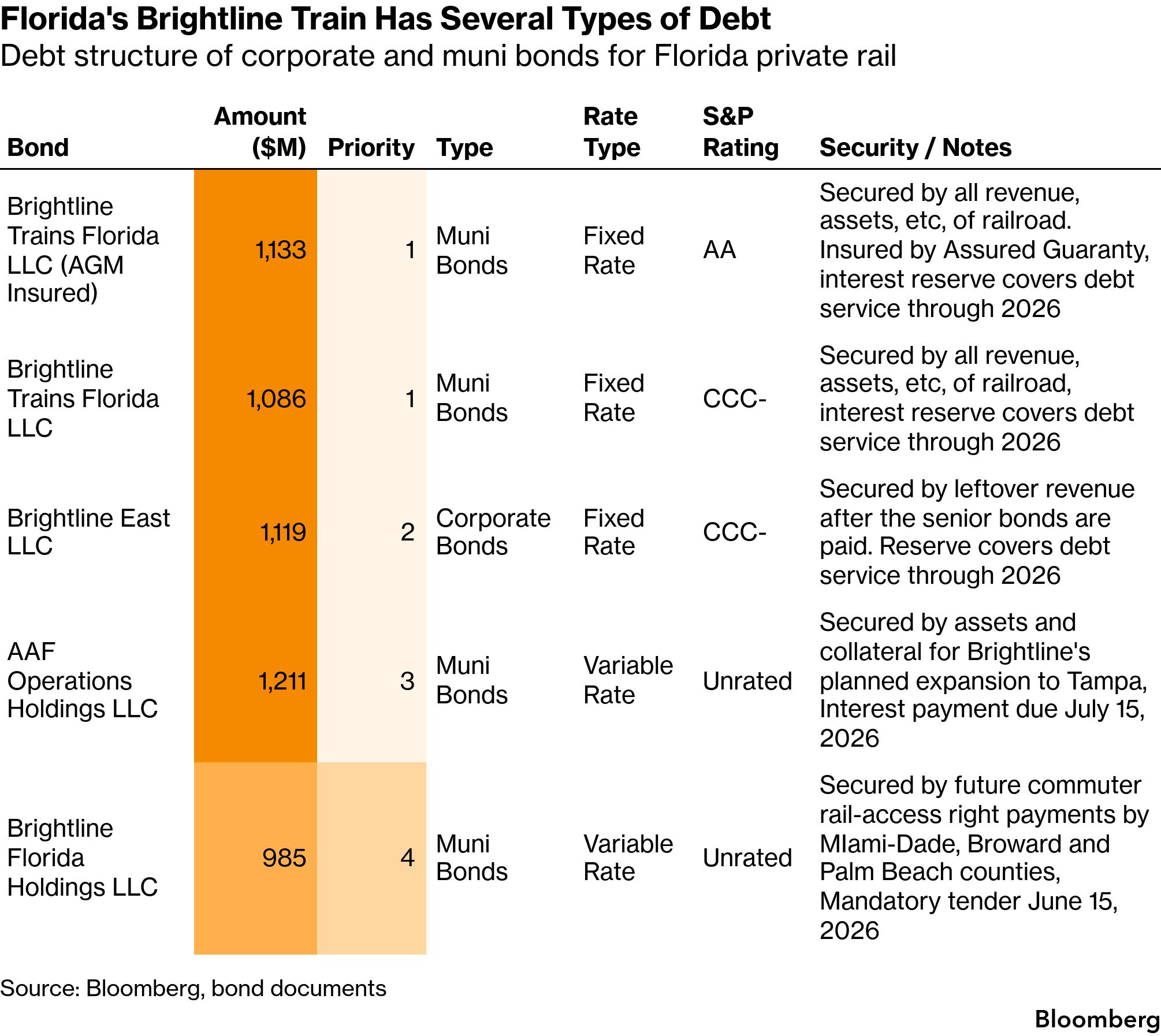
The Fortress Investment Group-backed railroad’s complex debt structure — a mix of municipal and corporate notes issued by four subsidiaries — is among the biggest challenges, as are the pack of firms jockeying for position in any workout scenario.

Invesco Ltd. and Nuveen LLC, giants in the world of tax-exempt securities, lead a group holding Brightline’s $2.2 billion of highest-priority debt that also includes First Eagle Investments. Bond insurer Assured Guaranty Ltd. looms large, too — it guarantees about $1.1 billion of senior securities, a majority, and must consent to any changes.

Meanwhile, distressed specialists Redwood Capital, Aristeia Capital and Nut Tree Capital Management lurk one rung below in the hierarchy. So does an entity of Israel-based Phoenix Financial Ltd., Bloomberg reported last week.

Both factions are angling for a way to wrest control of the railroad in exchange for a large investment, potentially in the form of senior loans to finance a bankruptcy, according to people familiar with the matter.

And then there are the wild cards: deep-pocketed infrastructure funds or strategic buyers that could also be in the mix to take over. One firm that had considered investing in Brightline, but has since moved on, was Italian infrastructure firm Mundys SpA, which owns airports and toll roads, some of the people said.

https://assets.bwbx.io/images/users/iqjWHBFdfxIU/ixA4mOiCDNq8/v3/pidjEfPlU1QWZop3vfGKsrX.ke8XuWirGYh1PKgEw44kE/-1x-1.png 

Source: Bloomberg, bond documents

These competing interests are all coming to a head. Brightline’s auditors Brightline Florida Warns of Likely Insolvency in Financial Audit recently that it doesn’t have the cash to service its debt and meet financial obligations over the next 12 months, raising “substantial doubt” about the 235-mile line’s ability to function without some sort of relief.

For now, the trains between Miami and Orlando are running — still with far fewer riders than projected — and the rail operator has tapped consultants in a renewed bid to find third-party investors and avoid a possible bankruptcy. But its creditors broadly agree that the situation is untenable, and that a debt restructuring, whether in or out of court, is coming within months.

“The debt that the company took out to pay for the project was too high for a realistic assessment of how much ridership they were going to attract,” said Yonah Freemark, a researcher at the Urban Institute. “This is why, generally, infrastructure projects come with public subsidies.”

Interviews with restructuring experts and people with direct knowledge of the Brightline situation describe the railroad plowing slowly into a cash crunch as high costs continuously outstripped revenue.

But its various creditors are now in a race to the finish, huddling with the company in confidential talks as Fortress prepares to relinquish an albatross that lost it $2.2 billion in equity over the course of more than a decade. In the same time span, Fortress itself underwent three ownership changes and a management turnover, and pivoted from its early private equity model to private credit and real estate investments.

A potential bankruptcy, in particular, could cast a shadow over Brightline’s more ambitious project located some 2,500 miles away — a $21.5 billion high-speed rail line between Southern California and Las Vegas called Brightline West....

....MUCH MORE 

If interested see also, May 3:

Florida High Speed Rail: "The Great Train Bankruptcy"

Following on April 30's "In Case You Missed It: The Cost Of California's High-Speed Rail Project Is Now Approaching A QUARTER-TRILLION Dollars"

I apparently have a fascination for train disasters, just not of the Gare Montparnasse variety:
https://upload.wikimedia.org/wikipedia/commons/1/19/Train_wreck_at_Montparnasse_1895.jpg

Monday, May 4, 2026

"Junior Bankers Sick of Grunt Work Build $2 Billion AI Tool to Do the Job"

Opportunity is everywhere. 

From Bloomberg, April 29:

Rogo, started by young bankers around a kitchen table in 2021, just won a multibillion-dollar valuation 

In a cramped Manhattan apartment in late 2021, three young investment bankers often toiled into the wee morning hours, crunching away on spreadsheets and rearranging logos on slide decks, while one of their roommates was taking a risk.

Gabriel Stengel had just quit his job at Lazard Inc. to team up with fellow Princeton University computer science graduate John Willett, a former JPMorgan Chase & Co. banker, so the pair could work fulltime around Stengel’s kitchen table on something else: coding an artificial intelligence tool that would take over that dealmaking drudgery.

“A lot of the analytical work is done by a 21-year-old in tools from 40 years ago at 2 a.m.,” Stengel, 27, said in an interview at the Park Avenue headquarters of their venture, Rogo Technologies. Such thoughts nagged at him in his early career: “Why do I have to use Excel? Why do I have to present it in PowerPoint?”

Rogo, which they founded with computer scientist Tumas Rackaitis, 26, just notched a $2 billion valuation in a fundraising round. That’s up from $750 million three months ago. The new $160 million series D round was led by Kleiner Perkins, with additional money coming from existing backers including Sequoia Capital, Thrive Capital, Khosla Ventures and JPMorgan Chase & Co.’s Growth Equity Partners, Rogo said Wednesday.

The company has more than 35,000 users and counts some of the world’s largest banks and private markets investors among its more than 250 clients, including Lazard, JPMorgan, Moelis & Co., Bank of America Corp., Wells Fargo & Co. and Singapore sovereign wealth fund GIC Pte, according to people familiar with the matter. It offers them a platform designed to lighten workloads — though some in the industry worry that it may reduce the number of junior bankers, too.

Rogo’s founders left their budding banking careers at a moment of acute dissatisfaction among young Wall Streeters. When the pandemic erupted in 2020, it unleashed a torrent of dealmaking, and professionals on the lower rungs ended up working around the clock from apartments, trying to keep up with demands. In early 2021, a slide deck by junior Goldman Sachs Group Inc. bankers went viral on social media, complaining of conflicting workstreams and almost 100-hour work weeks.

Rogo’s platform can create slide decks, design complex corporate restructurings and produce research that can take an analyst dozens of hours to do manually. Its workforce is roughly evenly split between engineers and former finance professionals — called “forward deployed bankers” — who in many cases once worked for the same firms they’re now advising, helping them maximize what the tool can do. Felix, its AI agent, is inspired by Felix Rohatyn, a legendary investment banker at Lazard who helped rescue New York City from financial collapse in the 1970s.

One of Rogo’s features is the ability to toggle between underlying AI models, including Anthropic PBC’s Claude, OpenAI’s ChatGPT and Alphabet Inc.’s Gemini, so that clients don’t have to put all of their money into one of them while it’s unclear which may ultimately dominate the industry.

“For a lot of these executives, it’s such a turbulent moment — you want to pick the right horse,” Stengel said. One of his former roommates, who worked late hours in investment banking while Stengel and Willett, also 27, built Rogo, now works in private equity and uses the software in his day job.

Rogo, along with other specialized AI entrants such as Hebbia, are fueling a lot of anxiety in Wall Street’s lower rungs over the prospect that machines will displace trainees, then work up the ranks. While Rogo’s founders acknowledge those concerns, they predict that junior bankers will benefit by being freed from grunt work so they can try more meaningful roles earlier in their careers. Ultimately, Stengel predicts, the technology will spawn “AI-first” investment banks, where staff will focus on “more human” parts of the job, offering insights and handling relationships....

....MUCH MORE 

Saturday, May 2, 2026

"Goldman, JPMorgan Show Wall Street’s Split in Quantum Computing Race"

From Bloomberg, April 26:

As a breakthrough proves elusive in the quest to deploy the nascent technology and boost earnings, global finance is divided on how to proceed. 

Roughly three years ago, Goldman Sachs Group Inc. looked like it had an edge in Wall Street’s race to master quantum computing.

The banking giant had assembled a handful of highly specialized scientists and partnered with Amazon.com to figure out how the nascent technology could be used to juice better returns for its raft of wealthy clients. They were shocked by what they found.

Goldman’s researchers discovered they would have to run an algorithm for millions of years in order to solve the problem. What’s more, the processor would need to have at least 8 million so-called logical qubits — a set of quantum bits that form the building blocks of quantum computers. Current machines consist of fewer than 100.

Shortly after, Goldman’s quantum team evaporated amid the bank’s widespread cost cutting program. While it now employs next to none, its rival JPMorgan Chase & Co., on the other hand, has persisted with a team of well over 50 physicists, computer scientists and mathematicians, exploring applications in optimization problems, machine learning and cryptography.

The contrast between the two of the world’s largest lenders is emblematic of the split among global financial firms debating ways to harness what’s touted to be the next big thing after artificial intelligence. Experts say quantum computing can reshape areas ranging from new drug discovery to machine learning and risk modeling in finance, with the potential to add billions of dollars in revenue. But it’s also thought to be still years away from offering many practical solutions, raising questions about its near-term value.

Unlike pharmaceutical, defense or material sciences firms — which appear to have a clearer understanding of where they would like to use quantum computing — banks, insurers and asset managers are chasing fixes to a myriad of complex problems: transaction fraud, risk management, how to maximize returns from a portfolio and asset price prediction, to name just a few. The wide array of issues they want to tackle and the limitations imposed by currently available hardware have made it more difficult for them to pinpoint potential benefits.

Wary of these challenges, many financial firms have largely stayed on the sidelines, happy to let others take the lead in exploring these machines that are exponentially more powerful than existing supercomputers. But some like JPMorgan are pouring resources in the hope that one day the technology would give them an edge over competitors.

“We’re positioning ourselves so we can take advantage by understanding what the problem space is across our portfolio,” said Rob Otter, JPMorgan’s head of global technology applied research who earlier ran State Street Corp.’s digital technology department, including quantum research.

While JPMorgan declined to reveal the exact size of the team, Otter said his crew is seeking ways to resolve performance issues and bottlenecks using a quantum computer across the business — including the investment bank — working with colleagues covering portfolio analytics, asset and mortgage pricing.

In November, the bank said it had developed a method to process and analyze large, fast-arriving datasets more efficiently using Quantinuum Ltd.’s Helios processor, which would enable the bank to perform complex tasks like anomaly detection, fraud monitoring, or network analysis quicker. In March last year, it demonstrated an algorithm on a quantum processor with Amazon.com that could make portfolio selection easier by identifying large sets of uncorrelated assets, enhancing diversification and risk management.

Otter said his team may be able to start running useful algorithms on a quantum processing unit in the next couple of years. Now, “we’re waiting for the hardware to be more commercially viable in order to use them,” he said.

Still largely in the domain of academic research, the technology is based on the complex principles underpinning quantum mechanics. Just like traditional computers, quantum computers also use tiny circuits to perform calculations, but they do that simultaneously, rather than in sequence. That allows for complex problems to be solved at vastly faster speeds than those of classical processors.

Business consultants even have some early estimates for its potential. Research by McKinsey & Co. last year said revenue from quantum computing is likely to surge to as much as $72 billion by 2035, from about $4 billion in 2024, fueled by developments in industries such as chemicals, life sciences and finance.

Read More: Quantum Computing Is Finally Here. But What Is It?

Given the stakes, others in the world of finance — besides JPMorgan and Goldman — have been poking around as well, but with varying intensity.

UBS Group AG is upskilling around 50 of their quant analysts in the basics of quantum computing. Spanish lender BBVA SA has worked with Multiverse Computing SL on speeding up ways to optimize portfolio management, and also with other firms. Credit Agricole SA has looked at how quantum algorithms can anticipate credit downgrades better. Many lenders are also racing to upgrade their cryptography, wary that the immense power of the emerging technology may enable it to break encryption standards.

But most of the action is currently led by tech titans including Alphabet Inc.’s Google and International Business Machines Corp., plus a raft of startups, as they build and test software and hardware, like Google’s Willow and IBM’s Heron processors. Though current models are too small and unreliable to be useful, they have been collaborating with companies across industries to explore potential applications by offering their services on the cloud.

Read More: Google’s Quantum Computer Solves Septillion-Year Task in Minutes

For instance, BMW is working with Nvidia Corp. and quantum software firm Classiq to find ways to improve drivetrains and cooling systems; Novo Nordisk A/S and Roche Holding AG are looking at modeling molecular interactions for new discoveries; and, Exxon Mobil Corp. is working with IBM to map the most efficient routes for its tanker fleets.

But for financial firms, developing solutions for risk tolerance and portfolio diversification gets trickier.

Plus, when it comes to applications for finance, “there’s a lot of confusion” about the direction, further complicated by differences in system architectures and technologies used to build them, said Subodh Kulkarni, chief executive of quantum computer builders Rigetti Computing Inc. — one of a growing number of listed companies in this area. That could mean one bank may have to work with multiple quantum computing companies to meet its needs instead of just one.

“We certainly see increased interest from various different higher-end financial companies,” Kulkarni said. “We certainly see them hiring quantum physicists, exploring algorithms and doing research with companies like us, IBM and a few others.”....

....MUCH MORE 

Sunday, April 26, 2026

CURRECTED—What Happens When Sovereigns Crank Up The Issuance Of Short Term Debt?—CORRECTED

First up, to set the scene, a Xitter denizen: 

Continues:

....global macro this year, and finance X has not discussed it once.

Gross borrowing by central governments in emerging market and developing economies crossed $4 trillion in 2025, up from roughly $3 trillion in 2024. That is a 33% year-over-year increase in sovereign issuance from EMDEs in a single year. The OECD area as a whole hit record highs on both bond issuance and outstanding volume, with refinancing requirements accounting for most of the gross borrowing.

Here is what that means structurally. We are watching the largest sovereign bond supply glut in modern history collide with the end of accommodative monetary policy. Under quantitative tightening, central banks have stepped back from debt markets. Retail and foreign investors have stepped in as marginal buyers. Those buyers are more price sensitive and more focused on relative yields. The OECD’s exact language was that this combination has “contributed to higher term premia and steeper yield curves.”

Translation. The bid for long-dated sovereign debt is getting thinner at exactly the moment issuance is hitting records. That is why UK 30-year gilts sit at 5.12%, US 10-year at 4.42%, Colombian TES bonds above 11%, South African RSA at 10.45%. Those are not isolated moves. They are the expression of a structural supply-demand imbalance at the long end that has no precedent in the post-GFC era.

The positioning response from sovereigns themselves is the tell. Per OECD data, many countries are rebalancing issuance toward shorter maturities to limit exposure to higher long-term borrowing costs. This increases refinancing risk downstream but is the only way to get bonds out the door today. The US Treasury has been doing this for two years. The UK, France, and Italy are following. Japan is the outlier that has not yet started. When Japan capitulates, the move gets violent....

....MORE

I cut it at that point because he goes on to extrapolate effects on other assets that I am not sure are correct. But his observation on what the OECD report says about the duration of sovereign issuance leads us to a repost from October 2011, during the Autumn of Occupy Wall Street**:

Correction: The below is the wrong repost, interesting but not the one intended. See after the jump for the "Tale for our time."

Profuse apologies for the brain spasm. I'm hearing good things about ketamine from Elon and AOC, it may be time to give it a whirl. 

New York Fed: Rollover Risk 
An arcane topic that we've visited a few times.*
From the Federal Reserve Bank of New York's Liberty Street blog:

Short-Term Debt, Rollover Risk, and Financial Crises 
One of the many striking features of the recent financial crisis was the sudden “freeze” in the market for the rollover of short-term debt. In this post, based on my paper “Rollover Risk and Market Freezes,” I explain how firms may be unable to borrow overnight against high-quality assets even in the absence of the usual frictions (asymmetric information, adverse selection, or moral hazard) that can cause credit rationing.
Two Freezes
The first such market freeze occurred in the summer of 2007. On July 31, two Bear Stearns hedge funds based in the Cayman Islands and invested in subprime assets failed. The following week, more news of problems with subprime assets hit the markets. On August 9, BNP Paribas halted withdrawals from three investment funds and suspended calculation of their net asset values because it could not “fairly” value the funds’ holdings. This announcement appeared to cause investors in asset-backed commercial paper (ABCP), primarily money market funds, to shy away from further financing of ABCP structures. Since many ABCP vehicles had recourse to sponsoring banks that provided them with liquidity and credit enhancements, if ABCP debt could not be rolled over, the sponsoring banks would have to take assets back onto their balance sheets. In that case, given the assets’ illiquidity, the ability of the banks to raise additional financing would be limited too. Money market funds thus faced the risk that the assets underlying ABCP would be liquidated at a loss. This liquidation and rollover risk produced a freeze in the ABCP market, raised concerns about counterparty risk among banks, and caused the Libor to rise. Providing evidence of such a freeze, Gorton and Metrick (2010) show that during 2007-08, the repo haircuts on a variety of assets rose on average from zero in early 2007 to nearly 50 percent in late 2008. Interestingly, while some of the collateralized debt obligations had a 100 percent haircut and thus no secured borrowing capacity at all during the crisis, equities—which are in principle much riskier assets—had only around a 20 percent haircut.

    The failure of Bear Stearns in mid-March 2008 offers a second example of a market freeze. (A March 20 Securities and Exchange Commission press release provides an interesting discussion of the account.) As an intrinsic part of its business, Bear Stearns relied on day-to-day, short-term financing through secured borrowing. Beginning late on Monday, March 10, rumors about liquidity problems at Bear Stearns eroded investor confidence in the firm. Even though Bear Stearns continued to have high-quality collateral, counterparties became less willing to enter into collateralized funding arrangements with the firm. This resulted in a crisis of confidence and led to a sharp and continuous fall in Bear Stearns’ liquidity, which caused the near-failure of the firm. Furthermore, even at the time of the firm’s sale, the capital ratio of Bear Stearns was well in excess of the 10 percent level used by the Federal Reserve as its standard for well-capitalized banks. As Chairman Bernanke observed, “Until recently, short-term repos had always been regarded as virtually risk-free instruments and thus largely immune to the type of rollover or withdrawal risks associated with short-term unsecured obligations. In March, rapidly unfolding events demonstrated that even repo markets could be severely disrupted when investors believe they might need to sell the underlying collateral in illiquid markets.” 
Why the Freezes?...MORE
HT: FT Alphaville

Correct repost:

In July 2011 it was "The Black Swan Isn't the Debt Ceiling, It is Holders of U.S. Treasuries Asking for Cash Rather Than Rolling the Paper
 
And don't think it can't happen.
Here's TIME Magazine, February 16, 1959:
Business: Bond Failure
The U.S. Treasury offered $9.1 billion in new securities last week to private holders of maturing debt and got a shock. It had hoped to persuade most of the holders of maturing issues, bearing 1⅞% and 2½% interest rates, to trade them in for new Government securities paying 3¾% and 4%. Instead, owners of more than 20% of the old issues demanded to be paid off in cash, the biggest such demand in six months.

To help make up the difference, the Treasury must go to the public this week with a $1.5 billion emergency issue.

The failure of the latest debt "rollover" attempt was a fresh sign of softness in the Government bond market—and of the size of Secretary of the Treasury Robert Anderson's task of refinancing $42 billion of Government securities falling due this year. At a time when most investors want to buy stocks, real estate or other things as a hedge against inflation, Anderson is finding the public increasingly uninterested in bonds.

Furthermore, Wall Streeters thought he had made a mistake in trying to sell securities with one year as the shortest maturity. At a time when investors were trying to figure how high interest rates might go, too many of them did not want to tie up their cash for a year.

Anderson's troubles began last spring when it became clear that the Treasury would have to raise up to $12 billion to cover the Government's deficit for this fiscal year....MORE 
We're racking up $12 Billion every three days.  [2026: $1 Trillion every three months]
***** 
The risk is a buyers strike at the long end.
 
***** 
 
*Back in August 2007, a week after the "Quant-quake", we posted "Liquidity in Business and Markets":
Liquidity is expensive but illiquidity is much more so, 
because it destroys the very existence of a firm"

I don't remember if it was Johannes or Ernst, it was a long time ago that I read Manchester, quoting one of the Schroeder boys on the insolvency of Krupp. That line has stuck with me. Here's the book....

In July 2011 it was "The Black Swan Isn't the Debt Ceiling, It is Holders of U.S. Treasuries Asking for Cash Rather Than Rolling the Paper"

Last Friday: "Too Funny: "GE Capital CEO "sympathetic" to Wall Street protests'":
...Three years ago this month, in the Fall of 2008 no one on earth would touch GE Credit's commercial paper and the entire company was within days of becoming insolvent.

The company had been padding reported earnings by borrowing short and lending long, at one point having over $100 Billion in CP outstanding.
The borrow short/lend long scam is a great way to increase your bonus but in finance it's nothing short of playing Russian roulette....

Even though OWS was three months after the correct repost I will leave this outro up as a parting gift for those readers who have made it this far.

Again, regret the error. 

**Some of our Occupy Wall Street posts: 

The Retired Trader Who Bankrolled #OccupyWallStreet 
"DJ Spooky, Occupy Wall Street, and the Frictions of Radical Chic"  
Some Thoughts on the OccupySesameStreet Protests
#OccupySesameStreet Turns Violent
Breaking--From the OccupySesameStreet Protests: "Three Die After The Electric Company Privatized"--Breaking  
 
Ayatollah Khamenei says Occupy Wall Street could mark the fall of the west
China and GE's Immelt Sympathise with #OccupyWallStreet 
North Korea Comments on #OccupyWall Street   
#OccupyRedSquare Doesn't Go at All Well
 
We Will NOT Be Co-opted: "Luxury Ice Cream Unit of Multinational Unilever Endorses #OccupyWallStreet 
#OccupyWallStreet: The Revolution Will be Televised (and trademarked)
Adbuster Calls on #OccupyWallStreet to Declare Victory and Go Home; "Zuccotti Lung"; and Jay-Z Pulls Occupy T-Shirts from Website 
Today in #OccupyWallStreet News: "I'm a F***ing Journalist, You Motherf***er!
 
"The Occupy Wall Street bank" 
Octopi Wall Street
Banks Much More Successful at Panhandling than #OccupyWallStreet
"Ossify Wall Street: Russell Simmons/Kanye West; Richard Trumka, Tim Robbins Swing By; Jesse Ventura only Gets as Far as Minneapolis". 
Michael "I'm Part of the 99%" Moore Heckled at #Occupy Rally
"Occupy Wall Street in New York running out of cash" 
"Occupy Wall Street leader now works for Google, wants to crowdfund a private militia"

#OccupyWallStreet Proclaims Victory, Announces Plan to Re-launch #OccupyMom'sBasement 
Don't get me wrong, I'm as much into anarcho-capitalism as the next guy, I think I'd do pretty well whatever the ground rules.
It's just that #OWS isn't showing the kind of higher-level cognitive abilities you'll find at, say, MI-6...
 
Good times.