Showing posts sorted by date for query Warren Buffett. Sort by relevance Show all posts

Saturday, October 17, 2026

"Fewer than 5 innovations could return 1920s era growth"

From Cody Finke's substack, October 12:

US growth and stagnation:

In the US, the period from 1870 to 1970 saw massive economic growth. Known as the “special century,” real GDP per capita grew about 2.0% per year. After 1970, growth stagnated and real GDP per capita has only grown about 1.8% per year since.[1]

Researchers noticed that total factor productivity (TFP, a measure of how efficiently we use resources) correlates well with this difference.1 The usual story is that the special century’s growth came from a handful of great inventions: electricity, the internal combustion engine, running water and indoor plumbing, the telephone, and chemicals which all improved productivity.1

However, since 1970 jet air travel, personal computers, cell phones, and the internet have all either been invented or deeply penetrated the US economy leaving researchers to wonder why they did not impact growth or TFP.[2] No explanation is given for why certain productivity inventions cause growth, but others do not.

A simple theory for US growth and stagnation:

My proposed explanation is that in order to impact growth, the innovation must impact a market large enough to matter or a set of markets large enough to matter. While it is statistically possible for hundreds or even millions of innovations to add up to high growth (and for indoor plumbing to lead to millions of innovations), it is much more likely that a smaller number of innovations impacting very large markets occurred. I argue that 7 times in the special century, innovations dramatically cut cost for products that, by themselves, were more than 1% of economic growth. This has never happened since 1970.

One way to drive economic growth is to reduce the cost of things the economy needs. When something gets cheaper, the economy can produce the same amount of it and still have resources left over to make other things. Spending the excess money from cost reductions pulls freed resources into new uses, and, via Jevons paradox, we also, often, end up buying more of the thing that got cheaper.[3] Standard economic growth is really the sum of all the innovations that save us money and make us richer, causing us to spend more which is directly proportional to growth at nearly 1:1[4]. Some of the money from cost reductions could be saved and therefore invested with a different economics return, but for commodities I assume that little of these cost reductions went to savings because they usually represent a small fraction of the final product’s value.

There are many ways to create large cost reductions in the economies, either many innovations can create cost reductions across dozens or even thousands of products adding up to massive economic growth, or a single innovation on a huge product can drive economic growth. A single innovation is much more likely than multiple innovations.

So, if we look at which single products made up more than 1% of the US economy between 1870 and 1970 there were eight: general-purpose concrete, mild steel, gasoline, diesel, electricity, coal, field corn, and upland cotton.[5],[6],[7],[8],[9] Wheat, coal, and hay also topped 1% at times briefly, but not in a sustained way.[10],[11],[12]

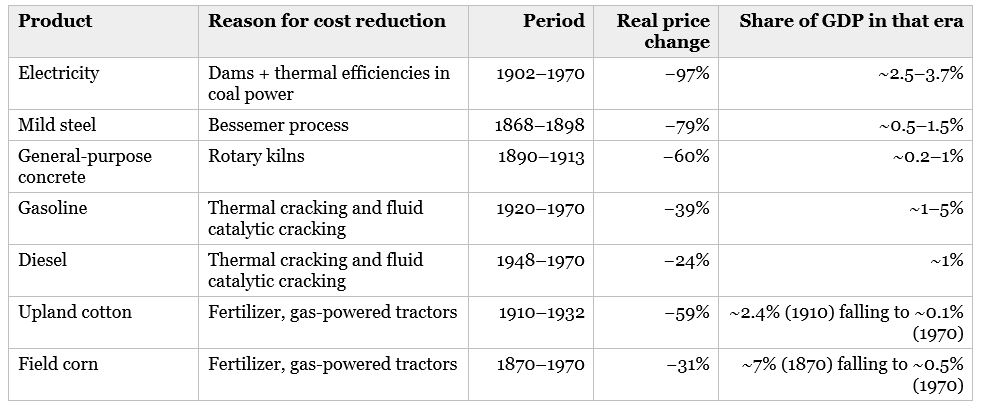
Adjusted for inflation, seven out of these eight products got A LOT cheaper during the special century:[13],[14],[15],[16],[17],[18],[19],[20],[21],[22],[23],[24]

https://substackcdn.com/image/fetch/$s_!Mv2Z!,w_1456,c_limit,f_webp,q_auto:good,fl_progressive:steep/https%3A%2F%2Fsubstack-post-media.s3.amazonaws.com%2Fpublic%2Fimages%2F235fa652-ace0-4cb8-80c7-9960d2e190c5_984x409.png 

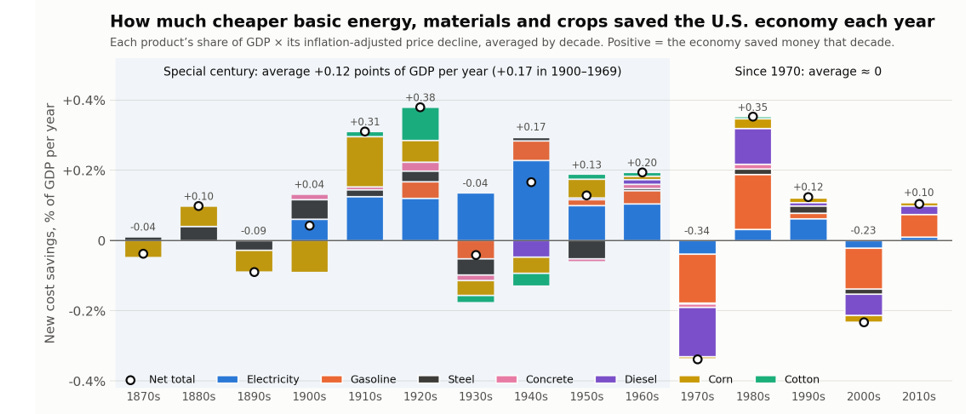
Multiplying each product’s share of GDP by its price decline on a decade basis estimates the GDP growth each year:[25]


The average growth of the special century was about +0.2% per capita, which is nearly entirely explained by the cost reduction in these 7 products which account for +0.17%.[26]

However, by 1970, each of these materials had reached a steady state price, and in the 1970s some started to rise in price due to shocks like the oil crisis.[27] Thus, after 1970, no product that is worth more than 1% of the US economy has reduced in price.

How do we repeat high growth? 

....MUCH MORE

We're going to need some big ideas. All of which brings mind one of my favorite Warren Buffett stories (they are legion). 

....a couple snips from Warren Buffett's Letters to the Shareholders of Berkshire Hathaway
The '85 Berkshire letter continues one of my favorite BRK stories.
First the background, from the 1984 Chairman's Letter:

"...Using my academic voice, I have told you in the past of the drag that a mushrooming capital base exerts upon rates of return. Unfortunately, my academic voice is now giving way to a reportorial voice. Our historical 22% rate is just that - history. To earn even 15% annually over the next decade (assuming we continue to follow our present dividend policy, about which more will be said later in this letter) we would need profits aggregating about $3.9 billion. Accomplishing this will require a few big ideas - small ones just won’t do. Charlie Munger, my partner in general management, and I do not have any such ideas at present, but our experience has been that they pop up occasionally. (How’s that for a strategic plan?)..."
And then, the dénouement in the paragraph which immediately preceded the Halley's bit in the 1985 letter:
...You may remember the wildly upbeat message of last year’s report: nothing much was in the works but our experience had been that something big popped up occasionally. This carefully- crafted corporate strategy paid off in 1985. Later sections of this report discuss (a) our purchase of a major position in Capital Cities/ABC, (b) our acquisition of Scott & Fetzer, (c) our entry into a large, extended term participation in the insurance business of Fireman’s Fund, and (d) our sale of our stock in General Foods....

As seen in January 2018's "In 2016 We Had the #1 Stock In the S&P 500, In 2017 We Had the Top-Performing Commodity, In 2018 We've Got...."

Nuthin'.
So here's a little victory dance 'til we figure something out.
And after that, a pretty good Warren Buffett story....
And in a half-dozen other posts.

Tuesday, October 6, 2026

"Five reasons India's stock market is sinking even when its economy is growing"

From the BBC, October 5:

India's economy is growing at an enviable rate of over 7% despite global energy shocks, rising interest rates, tariff uncertainties and weather-related disruptions.

But the world's fastest growing major economy also has one of the worst performing major equity markets in 2026. The correction in Indian stocks has, in fact, only intensified in recent weeks.

The benchmark Sensex and Nifty indices, which represent the country's largest companies, have inched up slightly since Monday after posting losses for eight straight weeks - the longest losing streak in 25 years, according to Reuters.

Indian mom-and-pop investors who put their money into the Nifty have seen their wealth erode by about 15% this year. In comparison, they would have made 62% returns on Korea's Kospi index since January or 170% in the last two years.

On aggregate, the money foreign investors have put into Indian markets in the past decade - after subtracting what they sold or withdrew - is nearing zero. In the past two years alone, foreign institutional investors have withdrawn a staggering $40bn, according to data from Bernstein Research.

It is the large pool of domestic institutional and retail money, flowing into instruments like mutual funds, that have helped the markets avoid a sharper fall.

Domestic assets under management of mutual funds have grown from about $125bn in 2016 to some $900bn this year, with the number of Indians parking money in stocks and mutual funds more than tripling to 150 million individuals.

This makes the recent fall in the markets more worrying - since households, already struggling from a weak job market, high inflation and faltering consumption, are now seeing their equity savings take a beating too.

So, what's gone wrong?

Here are five reasons India's booming economy isn't lifting its stock market....

....MUCH MORE 

Here is the BSE (formerly Bombay Stock Exchange) SENSEX Index over the last five years via TradingView:


Total gain in the last half-decade: 21.62%. To quote Warren Buffett on a different index “Now I’m known as a long-term investor and a patient guy, but that is not my idea of a big move.”

Over the last year the SENSEX is down 10.31%. 

On the other hand the sub-head at the Times of India, October 6 is:

Indian equities enter the session after a sharp turnaround from a prolonged period of weakness, with the previous day's gains offering some relief following the market's longest weekly losing streak in 25 years. The recovery came as concerns around oil supplies ease 

Sunday, June 7, 2026

"Lindt says weight-loss drugs users are eating more chocolate, not less"

From Reuters, March 10:

Chocolate sales are rising ​faster among U.S. users of GLP-1 weight-loss drugs than in ‌the rest of the population, Swiss chocolatier Lindt & Spruengli said on Tuesday, citing data that defied forecasts the drugs would reduce confectionery demand.

The company said an internal study, ​based on February data from market researcher Circana, found 15% of ​U.S. households use GLP-1s, representing 17.5% of chocolate sales.
 
GLP-1s include ⁠weight-loss drugs such as Novo Nordisk's Ozempic and Eli Lilly's 
Mounjaro.
 
Consumers cutting ​back on high-calorie intake categories, such as pasta, pizza and potato chips, ​are still looking for some kind of indulgence, chief executive Adalbert Lechner told a news conference on Tuesday.
 
"They are upgrading to premium products. Less is more – small rewards with moment of bliss rather ​than mindless munching," said Lechner.
 
Lindt, which makes chocolate Easter bunnies, said U.S. sales of ​premium chocolate increased among GLP-1 users by nearly 17% in 2025, compared to a ‌6.5% ⁠rise among non-GLP-1 users....
....MORE 
 
And at Bakery and Snacks, March 16:
Ozempic’s chocolate contradiction: Indulgence isn’t disappearing, it’s trading up
As appetite-suppressing drugs take hold, the real shift in snacking may not be how much people eat but how deliberately they choose to indulge

There's opportunity in here, somewhere. 

In the meantime, living La Vida Cocoa! 

Possibly also of interest:

Only The Dead Have Seen The End Of Candyflation 

Living La Vida Cocoa: Warren Buffett, Berkshire Hathaway and the Chocolate Wars (BRK.A; BRK.B; CBY; KFT; HSY)  

Thursday, June 4, 2026

"end the deficit in five minutes"

Via MoneyWise, June 2: 

 “I could end the deficit in five minutes,” he said. “You just pass a law that says that any time there’s a deficit of more than three percent of GDP, all sitting members of Congress are ineligible for re-election. Yeah, yeah, now you’ve got the incentives in the right place, right?”

—Warren E. Buffett, retired insurance salesman, Omaha Nebraska 


Friday, April 24, 2026

"Down on your luck? How behavioural neuroscience could help"

From The Guardian, March 29:

The latest research suggests there’s far more to good fortune than mere accident 

When the founder of Panasonic, Kōnosuke Matsushita, was asked what quality he valued most in job candidates, his answer baffled everyone: whether they were lucky. Not their credentials, not their intelligence, not their experience. Luck. For years, this anecdote struck me as charmingly eccentric – the kind of thing a titan of industry gets away with saying because nobody around them dares to laugh. Then I began studying the neuroscience of fortunate people, and I stopped laughing, too.

What my research has revealed is that luck, far from being a roll of the cosmic dice, operates through identifiable patterns of brain chemistry and behaviour. The consistently lucky are not blessed by fate. They are running different neurological software – and the remarkable thing is that this software can be installed.

Consider what happens when someone simply declares: “I am a lucky person.” It sounds like wishful thinking. But brain imaging tells a different story. That declaration activates the prefrontal cortex in a way that shifts perception from threat-detection mode toward opportunity-recognition mode. The person begins to notice possibilities that a self-described unlucky individual, scanning the same environment, simply filters out. Over weeks and months, these perceptual micro-advantages compound. The lucky person encounters more openings, seizes more of them, and accumulates a track record that reinforces the original belief. Psychologists call this a self-fulfilling prophecy. I prefer to think of it as the brain taking your word for it, and reorganising reality accordingly.

This was the finding that first drew me deeper into the subject. If a mere shift in self-narrative could produce measurable differences in outcome, what other levers might the brain offer? The answer turned out to be surprisingly biological. Our emotional baseline depends heavily on serotonin, a neuro­transmitter that regulates mood, social confidence and resilience. And serotonin production follows a strict daily rhythm. It requires morning sunlight hitting the retina, the amino acid tryptophan from foods such as fish and eggs, and – critically – a regular sleep-wake cycle. People who rise early and spend their first waking minutes in natural light are, quite literally, manufacturing the chemical foundation of good fortune. Those who keep erratic hours, by contrast, suppress serotonin and elevate cortisol, the stress hormone. Chronic stress narrows attention to threats and closes down the peripheral awareness where serendipity lives. The perpetually unlucky are not cursed. They are, in many cases, chronically sleep-deprived.

Yet body chemistry is only half the picture....

....MUCH MORE 

Some previous looks at luck:

How To Be Lucky
It pays to imagine your life is on a winning streak.

“Luck is believing you’re lucky.”
—Tennessee Williams, A Streetcar Named Desire

And many, many more including:

"Warren Buffett on the Ovarian Lottery"

You work with what you got. 

Sunday, April 12, 2026

"Hedge Fund Money Is Reshaping a 180-Year-Old Insurance Model"

Though this has been going on for years the offloading of risk is starting to draw some serious attention. And with the simultaneous specter of lower and lower premiums caused by the flood of capacity the bag-holders will be, if not retail, then unsophisticated players.

This is the point in the cycle where Warren Buffett and Ajit Jain would decline to cover perils they can't get paid for.

As noted exiting January 12, 2026's ""How GE Vernova’s ‘Good Times’ Could Mean Bad Times for Its Stock" (GEV)": 

Warren Buffett ran into similar situations in Berkshire's reinsurance business. When re profits were good, everyone and his brother would flood into the market, writing policies at prices that Warren didn't think covered the risk. Rather than withdrawing completely he continued to offer policies at prices he thought were fair while telling the insurance companies that needed reinsurance cover that Berkshire would be there when the others had skedaddled.

The same is true for GE Vernova. They've been manufacturing and maintaining generators/turbines since Thomas Edison and J.P. Morgan formed the General Electric Company in 1889.

They'll be around to come make a service call when you think your turbine is making a funny sound....

From Bloomberg April 12:

Alternative investment managers are pouring unprecedented sums of money into the market for property cover, and reshaping a 180-year-old reinsurance model in the process.

Allocations to catastrophe bonds and other insurance-linked securities popular among hedge funds and institutional investors rose 18% to reach a record $136 billion last year, according to data provided by broker Aon Plc. That rise in alternative capital and “its influence in the broader reinsurance market is growing because of the record growth in catastrophe bonds,” Aon told Bloomberg.

The shift promises to alter the face of a market whose basic role is to provide stable property cover during periods of sustained losses. It also raises questions as to whether reinsurers will gradually play a smaller role as the ultimate backstop for covering catastrophe risk.

Reinsurers may end up becoming more like risk managers, “shifting the risk to the capital markets which have trillions of dollars to invest,” Brian Schneider, senior director of insurance at Fitch Ratings, said in an interview. And if “more and more of this business gets shifted to the capital markets, then maybe the traditional companies become less and less relevant.”

Reinsurers covered just over 10% of total insured catastrophe losses in 2024, well below the historical average of 20%, according to S&P Global Ratings. The industry’s biggest firms have more than halved their exposure to insured disaster losses in recent years, S&P also said.

Reinsurers are themselves the driving force behind the shift. That’s as urbanization, higher inflation and climate change combine in ways that mean natural catastrophes are both more frequent and more devastating when they hit. The industry’s response has been to look for ways to offload risk to capital markets.

They mainly do this by issuing cat bonds, an asset class that saw “breathtaking” growth in issuance last year, according to John Seo, managing director and co-founder of Fermat Capital Management, the biggest hedge fund investor specialized in such securities. Speaking in a February interview, Seo said he thinks “the issuance surge we’re seeing is far from over.”

Reinsurers are also attracting record levels of private capital into so-called sidecars. Such vehicles give third-party investors access to premiums, in exchange for which they must accept a slice of the risk associated with natural disasters. It’s a market that’s nearly tripled in size since 2023, reaching as much as $18 billion today, with much of the growth coming from property catastrophe coverage, according to AM Best, a rating agency that tracks the insurance industry. 

Germany’s Hannover Re recently set up a Bermuda-based insurance agent to create bespoke catastrophe-related portfolios for hedge funds, pensions and other professional money managers.

“As part of the overall ILS activities that we have, we felt this was the missing piece,” said Michael Eberhardt, chief executive of the new venture, Hannover Re Capital Partners. “It allows us to leverage our own underwriting expertise and partner with third-party capital investors.”

Fitch notes that investors in sidecars can face potentially bigger losses than holders of cat bonds, should a natural disaster result in a trigger event. That’s because sidecars tend to be exposed to losses from more common secondary perils such as hailstorms, wildfires and floods.

“There’s concern that maybe some naive capital is coming in,” and that “investors don’t really think they’re going to get hit by a lot of these secondary perils,” Schneider said....

....MUCH MORE

I may end up purloining "naive capital" rather than having to explain who the "dentist from Peoria" is.:

October 2023
"Weather derivative market activity soars on belief extremes to increase: Report"
Action, baby, action!

Friday, March 27, 2026

Betting On The Weather, On Catastrophes, On Natural and Unnatural Phenomena

This is pretty much dead-center on our wheelhouse.

From Aeon Magazine, March 27:

Catastrophe markets
Americans love to gamble. But placing bets on wildfires, floods and storms comes with serious moral and social costs 

Will a Category 5 hurricane make landfall in the US before 2027? Will there be a megaquake by 30 June? Will 2026 be the hottest year ever? You can bet on these and dozens of other disasters in the online prediction markets Kalshi and Polymarket, where users trade ‘yes’ and ‘no’ shares in the outcome of future events in politics, sports, popular culture, business, and weather. Interspersed with trending categories like ‘Ukraine’, ‘Trump’ and ‘Crypto’ are event markets in ‘Hurricanes’, ‘Natural disasters’ and ‘Climate change’.

In January 2025, emergency management officials and insurance companies began estimating losses in the Los Angeles wildfires that ultimately included 440 deaths, of which 31 were direct deaths, and between $76 billion and $131 billion in property and capital losses. Online bettors had been wagering on this event and tallied their winnings or losses in catastrophe markets. By mid-January, Polymarket bets on the wildfires’ spread, duration and political fallout totalled more than $1.2 million. A Polymarket user posted a comment: ‘Volume so high in this market it cause another fire.’

After the 1906 San Francisco earthquake and fire, The New York Times published an article entitled ‘Catastrophe Markets’ that discussed the short-lived impact of the disaster on stock prices. Today’s online catastrophe markets are markets literally in disaster. People bet on whether disasters will happen and how bad they will be. These catastrophe markets raise some questions, including what, besides money, is at stake? What kind of thinking about risk in society do they promote and preclude?

One aspect of the history of catastrophe markets is very old. Weather gambling was described by one newspaper in 1931 as ‘one of the oldest, most fascinating and uncertain gambles in the world’. In 1886, betting on how long it would rain was ‘in vogue’, and, by the 1930s, office weather pools were commonplace. Weather gambling has taken on different and increasingly organised forms from the 19th to the 21st centuries, from informal wagers to gambling rings and lotteries to gamified forecasting apps like Weather Champs.

Rain betting, the oldest and most common form of weather gambling, was often tied to local community traditions. It flourished in Calcutta and Bombay in the 1880s and ’90s. Crowds gathered to gamble on whether a rain gauge would overflow, confident that cheating was impossible because there was no ambiguity in a downpour. As one newspaper remarked: ‘When it rains in India it rains; there is no half-way business about it.’ This assumption that the natural world defied market manipulation was echoed by accounts imagining rain betting as a model for speculation in the US because of its distance from volatility in railroad stocks and market swings in general.

Capitalism turned the uncertainty of the weather into a calculable risk and source of profit

So-called ‘pools on the weather’ in the early to mid-20th century signalled the growth and bureaucratisation of weather gambling, made possible in the US by government weather data. With the rise of government forecasting in Europe and the US, meteorological data became a steady stream in what the philosopher of science Ian Hacking called the 19th-century ‘avalanche of printed numbers’ produced by European state bureaucracies, and it led to the systemisation and scaling up of weather gambling in the 20th century. As a Texas newspaper observed in 1915: ‘Gambling on the weather has become an institution throughout a great part of the United States.’ Large syndicates in cities in the US and Canada were well organised, lucrative, and illegal. In 1950, St Louis police raided what newspapers called a ‘weather-betting racket’ that pulled in a reported $2.6 million annually. Some lotteries were pure chance, while others involved forecasting skill and judgment. Some cities had pools on the temperature at a specific hour the next day or on other combinations of weather data.  
Gamblers attempted to bribe US weather officials to falsify temperature figures and tampered with government weather reports en route to newspaper offices. In St Louis, extra security measures were implemented to prevent this manipulation, and the national weather service stressed its commitment to keeping weather data, a public good in the US, accessible to the public.

Weather data also enabled the financialisation of catastrophe, another precursor of catastrophe markets. In his speech on ‘New England Weather’ (1919), Mark Twain catalogued weather varieties, including ‘weather to sell; to deposit; weather to invest.’ Twain’s satirical assetisation of the weather was prescient. Speculative financial instruments designed to manage weather-related risk – rain insurance, flood insurance, weather derivatives, and catastrophe bonds – emerged during the 20th century. Through insurance and reinsurance, capitalism turned the uncertainty of the weather into a calculable risk and source of profit. This process of taming weather-related risk hinged on the assumption that the stochastic nature of rain, hurricanes and other natural hazards could be rationally managed, like an asset, with market logic. But insurance agents, energy traders and hedge fund managers were only ever partially successful. The uncertainties of bad weather and natural hazards always persisted....

....MUCH MORE 

I will note that, at least as far as fires go, the concept of insurable interest, i.e. who can bet on the event, should be structured to prevent the arsonist from participating in the payoff, perhaps by public execution. 

If interested see:

"Early abuses in life insurance markets"

On moral hazard:

Pro forma, I'm Miss America 
Warren Buffett: Avoid States With Large Unfunded Pension Liabilities

And the conceptually related:

Perversity and Credit Default Swaps

And many, many more. 

Tuesday, March 10, 2026

"Ackman’s Pershing Square Seeks Up to $10 Billion in NYSE IPO" (plus an anniversary)

Mile markers on the road to perdition. 

From Bloomberg, March 10:

Bill Ackman is returning to the IPO market with a combined offering for his hedge fund manager and a new closed-end fund, the latest move in the billionaire’s long campaign to expand his asset management empire to public market investors.

The initial public offering for Pershing Square USA Ltd., the closed-end fund, would also give investors stakes in Pershing Square Inc., his alternative asset management firm, according to filings with the US Securities and Exchange Commission. For every 100 shares of the closed-end fund IPO purchased by a buyer, that investor will receive 20 shares in the management company, the filing shows.

Ackman is looking to raise between $5 billion and $10 billion for Pershing Square USA in the combined deal, with investors who buy shares in the closed-end fund at $50 apiece receiving the management firm’s shares for no additional cost.

The offering marks a fresh attempt by Ackman to bring his long-term investment strategy to a broader base of investors, with a vision inspired by Warren Buffett’s Berkshire Hathaway Inc. After a plan to raise as much as $25 billion for a New York Stock Exchange-listed closed-end fund floundered in 2024, Pershing Square pivoted to boosting its Howard Hughes Holdings Inc. stake a few months later to use as a vehicle for taking majority stakes in other firms.

In a letter to Pershing Square Inc. investors, Ackman noted recent market volatility including the war in Iran, and said that unlike operating companies considering IPOs, stock market disruption actually helps Pershing Square USA’s acquisition program.

“Pershing Square has been a long-term beneficiary of the opportunity to buy superb companies at bargain prices driven by macro events that did not have a material impact on their long-term intrinsic values,” Ackman wrote. “We believe now is one of these opportune times.”....

....MUCH MORE 

See also:

May 4, 1999 - Goldman Sachs Initial Public Offering

Friday March 10, 2000 - Nasdaq all-time closing high at 5048.62

On the following Monday the Naz was down 141 points. On Tuesday, 200.
The index had begun a 30-month decline to its September 24, 2002 intra-day low of 1,169.04,
down 77%.

This became one of my favorite songs: 

The Day the NASDAQ Died
Humble Pie (sung to the tune of American Pie)

A long, long week ago
I can still remember how the market used to make me smile
What I'd do when I had the chance
Is get myself a cash advance
And add another tech stock to the pile.
.
But Alan Greenspan made me shiver
With every speech that he delivered
Bad news on the rate front
Still I'd take one more punt
.
I can't remember if I cried
When I heard about the CPI
I lost my fortune and my pride
The day the NASDAQ died
.
So bye-bye to my piece of the pie
I poured my paycheck into Datek
Now my cash account's dry
It's just two weeks from a new all-time high
And now we're right back where we were in July
We're right back where we were in July.....

 SONG CONTINUES

Saturday, February 28, 2026

Chicago's Debt Gets Another Downgrade

 This time by Fitch,:

Rating Action Commentary
Fitch Rates Chicago, IL's $503M GOs Ser 2026A (Taxable) and Ser 2026B 'BBB+'; Downgrades Outstanding

Wed 25 Feb, 2026 - 5:14 PM ET
Fitch Ratings - New York - 25 Feb 2026: Fitch Ratings has assigned a 'BBB+' rating to the following general obligation (GO) bonds to be issued by the city of Chicago, Illinois:

--$487,515,000 GO bonds, taxable series 2026A;

--$15,480,000 GO bonds, series 2026B.

About $166 million of the bond proceeds will be used to fund firefighter collectively bargained retroactive wage increases. Another $283.3 million will fund settlement and judgment costs against the city as a condition to the resolution of litigation or threatened litigation. Proceeds will also be used to fund capitalized interest and costs of issuance. The bonds are expected to price in mid-March via negotiation.

Fitch has downgraded Chicago's Issuer Default Rating (IDR) and outstanding GO bonds to 'BBB+' from 'A-'. Fitch has also downgraded the Sales Tax Securitization Corporation's (STSC) outstanding sales tax securitization bonds (senior lien) to 'AA+' from 'AAA'. Fitch has affirmed STSC's outstanding second lien sales tax securitization bonds at 'AA-'.

The Rating Outlook remains Negative on Chicago's IDR, GO bonds and STSC sales tax securitization bonds (senior lien). The Outlook on the STSC second lien sales tax securitization bonds is Stable.
...MORE

Hat Tip:

And at the Chicago Tribune, February 27:

Editorial: Mayor Brandon Johnson is leaving his successors with a financial ash heap. It’s worse than we thought.

Previously:

"How Debt Ate Chicago: Mounting liabilities are the greatest threat to the city’s survival."

Warren Buffett: Avoid States With Large Unfunded Pension Liabilities 

....The rest of the country has to begin planning now, immediately, how they will fight being forced to pay for Chicago's political and criminal corruption. Because you know, as sure as this old world keeps spinning around, that the Chicago politicians and their corrupt buddies in Congress, from many states but in particular New York and California, that they are already planning how to shake down the people who didn't cause this mess. 

Chicago has had 90 years to get things just the way they wanted them. This is what they created.

And the Chicago mob and their ilk will run the shakedown through any or all of the institutions they can corrupt or control, the House of Representatives that holds the power of the purse, the Presidency and its powers of executive orders and the bureaucrats in its administrative state, including but not limited to the U.S. Treasury, and finally the Federal Reserve which seems to have some funny ideas about buying muni. paper....

TL;dr:  

...Mr. Buffett's thinking on dealing with these swine can be boiled down to two words: Do  NOT. 

Do not do business with them unless you have good collateral, in hand. Do not acquiesce to their pleading, cajoling, threats of force or retribution. Do not "be nice" and entertain, or in any way agree with, their mental illness and social depravity.

Do not be a cuckold to those corrupt bastards in Cook County.


"The most dysfunctional state in America? Soaring unemployment, sky-rocketing debt and punishing taxes send residents fleeing"

And within the next ten years this most dysfunctional state will want the rest of the country to pay for what the state, county and municipal politicians created over the last ninety years....

***** 

Good timing. If interested see also yesterday's "Chicago’s pension funding crisis is a century in the making. 5 grad students could change that" posted within an hour of the above. Great minds and all that. Or maybe just observant.

There is no hope but it is probably good that they are trying.

I say "no hope" because private sector employers and employees are now indentured servants of the public employee pension plans. And as more and more people realize this and flee (how much money did Citadel take out of the tax base when they went to Florida?) those that remain behind will literally be left to foot the bill.

All so the party in power the last 90 years could buy votes with other peoples money....

Over the years, Warren Buffet has obliquely commented on Illinois without mentioning it by name. From "Citi Shuts Muni Business That Once Was Envy of Rivals" (plus Warren Buffet gives a class on muni realities): 

Can you imagine personally buying a 20-year City of Chicago general obligation bond?

Airports are a bit different because the airport authority is taxing transients who don't vote.

But they are dependent on people wanting to travel to or through that airport so the city's general economy is a factor. The city on the other hand....

Here's Mr, Buffett in the 2008 Berkshire Hathaway annual report, wrapped by a February 2019 post:

San Francisco: "Warren Buffett discusses ‘disaster’ contributing to Bay Area exodus in CNBC interview"

Mr. Buffett, through his insurance companies, guarantees a few of the country's municipal bonds. Muni holders are often in conflict with public employee unions and/or public employee pension overseers, especially in the event of a municipal bankruptcy.

These guarantees usually take the form of credit default swaps.

In addition Berkshire Hathaway carries a small amount of munis as an asset on the consolidated balance sheet.

Warren pays attention to this stuff. His 2008 Letter to Shareholders is a mini-masters course in moral hazard in the muni biz. Some copied out after the jump
*****

The class begins on page 13 of the 2008 letter....

Thursday, February 12, 2026

"“We Screwed Up”: How Warren Buffett And Charlie Munger Regretted Not Investing In Google" (GOOG; BRK)

From Office Chai, January 4:

Even some of the world’s best investors can get pretty down when they realize they missed an investment opportunity that had been staring them in the face.

At a Berkshire Hathaway annual meeting several years ago, Warren Buffett and his longtime business partner Charlie Munger did something rare for investors of their stature: they publicly admitted to a major investment mistake. In a candid exchange, the two legendary investors discussed their failure to invest in Google despite having direct evidence of the company’s extraordinary business model through their own insurance subsidiary, GEICO. Their admission offers a striking window into how even the most sophisticated investors can overlook opportunities hiding in plain sight.

Munger opened the discussion by drawing a distinction between the tech giants they’d missed. “I don’t mind not having caught Amazon early,” he said. “The guy is kind of a miracle worker. It’s very peculiar. I give myself a pass on that, but I feel like a horse’s ass for not identifying Google better. I think Warren feels the same way.”

Buffett confirmed with a simple “Yeah,” before Munger delivered the blunt assessment: “We screwed up.”

“He’s saying we blew it,” Buffett acknowledged. “And we did have some insights into that because we were using them at GEICO and we were seeing the results produced, and we saw that we were paying $10 a click or whatever it might have been for something that at a marginal cost to them was exactly zero. And we saw it was working for us.”

Munger reinforced the point about their access to firsthand data: “So you could see in our own operations how well that Google advertising was working. And we just sat there sucking our thumbs. So we’re ashamed. We atone. We’re trying to atone. Maybe Apple was atonement.”....

....MORE 

Office Chai front page

Monday, January 12, 2026

"How GE Vernova’s ‘Good Times’ Could Mean Bad Times for Its Stock" (GEV)

In late pre-market trade the stock is down $1.57 (-0.25%) at $621.00. This follows Friday's slaughter of the innocents, down $58.36 (-8.57%) to $622.50.

Here's Al Root at Barron's January 9/11:

An age-old problem for the stock market is that when things are really good in a certain business, it invites competition. That makes conditions less positive down the road. That scenario could play out for the power-generation technology company GE Vernova, according to one analyst who follows the stock.

Vernova’s performance has been nothing short of amazing. The stock has more than quadrupled since the company was spun out of General Electric, now GE Aerospace, in April 2024. Estimates for 2028 earnings before interest, taxes, depreciation, and amortization have gone from below $5 billion to almost $11 billion over that span.

Higher growth in electricity demand, partly because of data centers for artificial intelligence, has pushed up pricing for Vernova’s turbines and filled its order book for years to come. The problem is that good times draw a crowd.

Baird analyst Ben Kallo downgraded GE Vernova stock on Friday to Hold from Buy, cutting his price target to $649 a share from $816. That is a big cut: The $167 difference amounts to about $45 billion of market value.

Kallo says he is worried about “potential oversupply” as competitors announce additions to production capacity. Almost anyone with turbine technology is now considering entering power generation, including Doosan, supersonic jet start-up Boom Technology, and FTAI Aviation. Caterpillar, which has long had a generator business, is another player.

“While we believe the market remains tight (particularly in the near term), we see these announcements and oversupply fears shifting sentiment for a consensus long,” wrote Kallo. That means the market, now convinced that Vernova is a winner, could change its mind.

Shifting sentiment can shift valuation multiples—a risk Kallo is concerned about. Today, GE Vernova trades for about 20 times estimated 2027 Ebitda, while comparable industrial stocks in the S&P 500 trade for closer to 16 times.

“Our long-term outlook for GE Vernova as a leader in both Power and Electrification, and viewing GE Vernova as a core holding, are unchanged, but we are moving to the sidelines,” he wrote....

....MORE 

He's right. 

Barron's front page. 

Warren Buffett ran into similar situations in Berkshire's reinsurance business. When re profits were good, everyone and his brother would flood into the market, writing policies at prices that Warren didn't think covered the risk. Rather than withdrawing completely he continued to offer policies at prices he thought were fair while telling the insurance companies that needed reinsurance cover that Berkshire would be there when the others had skedaddled.

The same is true for GE Vernova. They've been manufacturing and maintaining generators/turbines since Thomas Edison and J.P. Morgan formed the General Electric Company in 1889.

They'll be around to come make a service call when you think your turbine is making a funny sound.


In the meantime, should you prefer a small modular nuclear reactor they have those too, 

And wind, if that comes back into favor.

Wednesday, January 7, 2026

"Nvidia Is Missing Out on the Latest AI Stock Surge. But This Catalyst Will Fix That."

If you've been following the news out of the Consumer Electronics Show it seems that any company or industry that Jensen Huang mentions or even thinks about gets a 10 or 15% bump in their stock price even as NVDA flatlines:


TradingView

Up 1.8% over the last month, not quite as dreary as the action that prompted one of Warren Buffett's greatest lines* but still...

And the headline story from Barron's, January 7:

Nvidia is missing out on the latest surge in the artificial-intelligence trade. Investors look to be waiting for confirmation it will be able to sell its chips in China or of major new orders from American companies.

Nvidia shares were up 0.5% at $188.16 in after-hours trading on Tuesday. The stock fell 0.5% during Tuesday’s trading session and is down around 1% over the past three months.

It’s not that investors are losing interest in the AI trade—just look at the huge gains in memory component companies like Sandisk SNDK +27.56%.

But shareholders look to have largely priced in the success of Nvidia’s latest Vera Rubin hardware for the U.S. and are still skeptical over whether it will be allowed to sell its H200 chip for the Chinese market.

“We’ve fired up our supply chain, and H200s are flowing through the line,” Nvidia CEO Jensen Huang said Tuesday during a question-and-answer session at the CES trade show, according to The Wall Street Journal. “We’re getting the last details of the licensing finished with the U.S. government.”

Nvidia already has orders for more than two million H200 chips at a face value of $27,000 each, implying around $54 billion worth of revenue, Reuters previously reported. However, it’s not clear if authorities in Beijing will allow widespread purchases by Chinese customers....

...MORE, as that guy from Avon who said it in 1592 (also Scorpions 2010), the sting is in the tail.

And Mr. Buffett?
September 2012 - Meet Warren Buffett, High Frequency Trader (BRK.B; INTC; WFC):
Well, high frequency for Mr. B.
 
From "Bull Markets; Bear Markets; Secular and Observant", long time readers will recognize it as part of our ongoing discussions of bear markets:
...Secular bear markets are characterized first by the initial decline and then by P/E multiple contraction.
During the last secular bear, 1966-1982, the cyclical bear of '73-'74 had a S&P 500 trailing four quarters P/E of 6.97 for the quarter ending 9/30/74 while the '80-'82 cyclical had a P/E low of 6.68 for the quarter ended 3/31/80. 
One of my favorite Warren Buffett quotes:
December 31, 1964: DJIA 874.12
December 31, 1981: DJIA 875.00
“Now I’m known as a long-term investor and a patient guy, but that is not my idea of a big move.”
—Warren Buffett
That’s a secular bear market.

Saturday, January 3, 2026

Nvidia's Jensen Huang: "King of Cannibal Island"

 From the London Review of Books, Vol. 47 No. 23 · 25 December 2025:

The Thinking Machine: Jensen Huang, Nvidia and the World’s Most Coveted Microchip 
by Stephen Witt.
Bodley Head, 248 pp., £25, April, 978 1 84792 827 6
The Nvidia Way: Jensen Huang and the Making of a Tech Giant 
by Tae Kim.
Norton, 261 pp., £25, December 2024, 978 1 324 08671 0
Empire of AI: Inside the Reckless Race for Total Domination 
by Karen Hao.
Allen Lane, 482 pp., £25, May, 978 0 241 67892 3

The tulip bubble is the most famous financial bubble in history, but as historical examples go it is also, in one crucial respect, misleading. That’s because anyone can see the flagrant irrationality which was at work. At peak tulip madness in 1637, rare bulbs were so expensive that a single one was worth as much as a fancy canalside house in Amsterdam. You don’t have to be Warren Buffett to see that the disconnect between price and value was based on delusional thinking.

Most bubbles aren’t like that. Even the South Sea Bubble, the event which gave its name to financial bubbles, had an underlying rationale: who can deny that the expansion of global networks of trade and capital turned out to be a vitally important and vastly lucrative event? Even if all the investors in the original bubble – including Isaac Newton, who realised it was a bubble, but got caught up in the excitement anyway – lost their shirts. The historical pattern is typically that a big, genuine innovation is spotted on the horizon. Money floods in to take advantage. Too much money. The flow of capital is so great that it is impossible to allocate it correctly, and distinctions disappear between what is likely and what is impossible, what is prudent and what is reckless, what might happen and what never could. After the flood of money, the doubts; after the doubts, the crash; and after the crash, the gradual emergence of the phenomenon that got all the speculators so excited in the first place. It happened with the South Sea Bubble, with the many railway manias of the mid-19th century, with the electrification mania of fifty years later and with the dot-com bubble at the turn of this century.

That is where we are now with AI. In the deep historical past of 2018, Apple became the first public company in the world to have a market capitalisation of more than a trillion dollars. Today, each of the ten biggest companies in the world is worth more than $1 trillion. Only one of them, the Saudi oil monopoly, Aramco, has nothing to do with the future value of AI. The top company, Nvidia, is worth $4.45 trillion. Not by coincidence, Nvidia shares are the purest bet you can make on the impact of AI. The leading firms are lending money to one another in circular patterns, propping up turnover and valuations. Colossal amounts of money are pouring in. Is it a bubble? Of course it’s a bubble. The salient questions are how we got here, and what happens next.

How did we get here? That story is among other things a narrative about two men, who gratifyingly correspond to the two main character types of the tech age: academically overachieving immigrant (Elon Musk, Sergey Brin, Sundar Pichai, Satya Nadella) and US-born college dropout (Steve Jobs, Bill Gates, Mark Zuckerberg). Companies founded or run by such men are the first, second, third, fourth, fifth and seventh most valuable in the world. Their combined value is $20.94 trillion – one sixth of the entire world economy.

Let’s begin in medias res. In the spring of 1993, three nerds visited a lawyer in Silicon Valley with the intention of setting up a company to make computer chips. The men were Curtis Priem, Chris Malachowsky and the person they had chosen to be their CEO, Jensen Huang, a Taiwanese-born electrical engineer with a talent for management and business. Malachowsky and Priem, according to Stephen Witt’s Thinking Machine, had complementary skills – they were, respectively, an architect and a chip mechanic. They wanted to make a new kind of chip, optimised for a rapidly growing sector: video games. Their employer, the large chip company LSI Logic, didn’t like the idea, so the three men cooked up a business plan, working mainly in a branch of the 24-hour chain restaurant Denny’s that was accessorised with bullet holes from drive-by shootings. Huang didn’t think the new company was worth launching until they had a credible chance of making $50 million a year in revenue. Fiddling with spreadsheets over long sessions at Denny’s, he eventually made the numbers add up. The three amigos went to see Jim Gaither, a lawyer well known in the Valley. Gaither filled out the paperwork, with the company’s name left as NV, for New Venture. Malachowsky and Priem were entertained by that: they had been playing around with company names that suggested their chip would leave competitors sick with envy. The coincidence was too good to resist. They decided to call their company Nvision. When the lawyer checked, it turned out that Nvision was already taken. They chose a backup: Nvidia.

Good choice of CEO, good choice of name. A third of a century later, Huang is the longest-serving CEO in the industry and Nvidia is the most valuable company in the world. Nvidia’s share of global stock market value is historically unprecedented: its shares make up a greater part of global indices than the entire UK stock market.

Huang had a hard start in life. He arrived in the US in 1973 aged nine, small for his age and not speaking much English. His parents, Hokkien-speakers from Tainan who had emigrated to Bangkok, had attempted to teach him and his brothers English by making them learn ten words a day, chosen at random from the dictionary. They sent Huang to the Oneida Baptist Institute in Kentucky under the mistaken impression it was a posh boarding school. In fact, it was a reform school for unruly boys whom the regular US education system couldn’t handle. Huang’s academic abilities meant that he was put in a class with boys a year older. If you were designing a formula to make a child a target for bullying, you couldn’t do much better. On his first night, Huang’s roommate pulled up his shirt to show him the scars he had accumulated from knife wounds. The newcomer, who stayed at school during the holidays because he had nowhere else to go, was given the job of cleaning the toilets.

This might sound like a deprivation narrative. Huang doesn’t tell it that way. He taught his roommate to read, and his roommate taught him to do push-ups – a hundred a day. The bullies stopped trying to tip him off the rope bridge he had to cross on the way to school. Huang says it toughened him up and, according to Witt, in a commencement speech in 2020 he ‘said that his time at the school was one of the best things ever to happen to him’. After two years in Kentucky, Huang moved to Oregon, where his parents had immigrated. He went to school and university and married there, before starting his career at the Silicon Valley microchip design company AMD. Many promotions and one job move later he met Malachowsky and Priem through LSI.

The trio’s new venture was far from an overnight success. There were at least 35 companies competing to build a specialised chip for video games, and it was evident that most of them were going to fail. When Nvidia’s first chip, the NV1, bombed, it looked as if their company was going to be one of them. ‘We missed everything,’ Huang later said. ‘Every single decision we made was wrong.’ He laid off most of the company’s employees and bet the shop on the successful design of their next chip, the NV3. (The NV2 was cancelled before launch.) Rather than build the chip the traditional way – they couldn’t do that, because they would have run out of money before it was finished – they used an emulator, a machine designed to mimic chip designs in software rather than silicon, to test it virtually. When the first real NV3 chip arrived, there was a crucial test. If even one of the 3.5 million transistors on the chip was flawed, it would be dead on arrival and Nvidia would disappear. It wasn’t and it didn’t. ‘To this day we are the largest user of emulators in the world,’ Huang says.

By this point, in 1997, Huang had made two big bets: one on video games’ insatiable demand for better graphics, and one on the emulator. Those successful bets kept Nvidia alive, and growing. He would make three more. The first was on a type of computing known as parallel processing. A traditional computer chip, such as the one inside the laptop I’m using, runs with a Central Processing Unit, a CPU, which works through computations in sequence. As chips have grown in power, the length and complexity of the computations have too. But chips had become so small that they were starting to run up against the laws of physics.

Parallel processing instead performs calculations not in sequence, but simultaneously. Rather than working through one huge calculation, it works through lots of small calculations at the same time. On YouTube, you can find the MythBusters, an excitable duo of American science-explainers, demonstrating the difference at an Nvidia conference in 2008 (Huang commissioned the demo). The MythBusters set up a robot gun to fire paintballs at a canvas. The first run works like a CPU: the robot fires a rapid sequence of blue paintballs, adjusting its aim after every shot to paint a smiley face. It takes about thirty seconds. Then they set up another robot gun, this time shooting 1100 paintballs simultaneously. The guns cough and in a fraction of a second – eighty milliseconds, to be precise – on the canvas appears a paintball copy of the Mona Lisa. The instant Mona Lisa is a visual metaphor for the way the new chips worked: instead of huge calculations done in sequence, a vast number of short calculations done at the same time. Parallel processing.

The video games industry loved the new chips, and demanded an update every six months, to render the ever more complex visual environments inside their games. Keeping up with that appetite was demanding and expensive, but it took Nvidia to a leading position in the chip industry. In The Nvidia Way, Tae Kim describes Huang’s relentlessness in keeping ahead of the competition. ‘The number one feature of any product is the schedule,’ Huang said, marking a difference between engineering elegance and Nvidia’s emphasis on getting-it-done, getting-it-shipped. The company’s chips were by this point so powerful that it began to seem bizarre that their only use was in allowing people to go online and shoot one another in increasingly complex and well-rendered sci-fi settings. At this point, Huang made another of his bets. He set Nvidia to develop a new kind of chip architecture, which he gave the deliberately obscure name CUDA, an acronym of Compute Unified Device Architecture.

The term doesn’t really mean anything, which was part of the point – Huang didn’t want the competition to realise what Nvidia was doing. Its engineers were developing a new kind of architecture for a new kind of customer: ‘doctors, astronomers, geologists and other scientists – highly educated academic specialists who were skilled in specific domains, but who maybe didn’t know how to code at all’. In Witt’s metaphor, the CPU is like a kitchen knife, ‘a beautiful multipurpose tool that can make any kind of cut. It can julienne, batonnet, chop, slice, dice, or hack ... but the knife can only ever chop one vegetable at a time.’ Nvidia’s processor, which the company was now calling a GPU, or Graphics Processing Unit, was more like a food processor: ‘loud, indelicate and power-intensive. It cannot chiffonade tarragon or score a crosshatch on a tube of calamari. But to mince a bunch of vegetables quickly, the GPU is the tool.’ The CUDA architecture took this tool and repurposed it for a new audience. In effect, gamers were paying for the chip development costs of the scientific users who Huang believed would show up. It was a version of ‘if you build it, they will come.’

They didn’t, or not in sufficient numbers to make CUDA a success. Demand failed to surge, and so did the company’s share price. There are many examples in the history of technology of an invention waiting for a ‘killer app’ – an application or function that suddenly gives the invention an irresistibly compelling purpose. The killer app for the PC, for instance, was the spreadsheet: overnight, a new technology that allowed a user to experiment with numbers and parameters and see what would happen if you tweaked a and b with the intention of arriving at z. It’s no exaggeration to say that spreadsheets remade capitalism in the 1980s by making it easy to run multiple alternative business scenarios and continue until you’d come up with something that made sense. Nvidia’s amazing new chips and their CUDA architecture were waiting for a killer app.

Salvation arrived in the form of an unfashionable branch of computing called neural networks. This was a field dedicated to the idea that computers could copy the structure of the brain by creating artificial neurons and connecting them in networks. Early neural networks were trained on labelled datasets, where the answer for each image was known in advance. The network made a prediction, compared it with the correct label, and adjusted itself using an algorithm called backpropagation. The major breakthrough came when researchers learned how to train networks with many layers of artificial neurons – ‘deep learning’. These deep networks could detect increasingly complex patterns in data, which led to dramatic progress in image recognition and many other areas. A computer scientist at Google, for instance,

fed their deep learning net a random sampling of ten million still images taken from YouTube and let it decide which patterns occurred frequently enough for the net to ‘remember’ them. The model was exposed to so many videos of cats that it independently developed a composite image of a cat’s face without human intervention. From then on, it could reliably identify cats in images that were not part of its training set.

Three things came together: algorithms, datasets and hardware. Computer scientists had developed the first two. It was Nvidia’s chips that brought the third – because, as it happened, the parallel processing of these chips was perfectly adapted for the new El Dorado of deep learning. Multiple calculations happening at the same time was exactly what constituted neural nets. These neural nets are the foundational technology for what was once called machine learning and is now generally referred to as AI. (Machine learning is a more accurate and helpful term, in my view, but that’s a topic for another day.)

The head scientist at Nvidia was a man called David Kirk. As he told Witt,

‘with parallel computing, it really took us a fair amount of convincing to talk Jensen into it ... Same with CUDA. We really had to make the business case.’ But with AI, Huang experienced a Damascene epiphany. ‘He got it immediately, before anybody ... He was the first to see what it could be. He really was the first.’

Huang reasoned that if neural nets could solve visual learning, they had the potential to solve everything else too. He sent out a company-wide email one Friday saying that Nvidia were no longer a graphics company. One colleague recalled: ‘By Monday morning, we were an AI company. Literally, it was that fast.’ That was in 2014. It was the fifth and most successful of Huang’s five bets, and the one that has made Nvidia the planet-bestriding colossus it is today.

Soon after this, if you were a nerd or nerd-adjacent, you started to hear about AI. Talking to people who knew more than I did about technology and economics, I would often ask questions along the lines of ‘What’s next?’ or ‘What’s the next big thing?’ and increasingly the answer that came back would involve AI. I have a particular memory of talking to an astute tech investor a few days after the Brexit vote, and asking him what he thought was going to happen. I’ve forgotten the details of his answer – we were drinking martinis – but the gist was AI advances in China. What struck me most was that I was asking about Brexit, but he regarded AI as so much more important that it didn’t even occur to him that was what I meant....
....MUCH MORE 

Wednesday, November 12, 2025

"Warren Buffett on the Ovarian Lottery"

This and his good fortune to have been born in the U.S.A. and at the time in the country's history that baby Warren arrived have been constant themes for Mr. Buffett over the years.

Mr. Buffet has said having the father he had was the greatest gift of all. Not because dad owned a brokerage firm and not because dad was a four-term Congressman but because he got Warren hooked on reading, among other things.

Charlie Munger shares the enthusiasm, From 25iq:

  1. “In my whole life, I have known no wise people (over a broad subject matter area) who didn’t read all the time – none, zero.”
  1. “You’d be amazed at how much Warren reads – at how much I read. My children laugh at me. They think I’m a book with a couple of legs sticking out.” 
  1. “As long as I have a book in my hand, I don’t feel like I’m wasting time.”
  1. “I’ve gotten paid a lot over the years for reading through the newspapers.”....

....MUCH MORE

And the headline story from The Conversable Economist, November 25:

Warren Buffett used to talk from time to time about the implications of what he called “the ovarian lottery”–the random accident of why you were born with one time, place, and identity rather than another.

It’s not a new idea. Some of you will know it as a version of what the philosopher John Rawls was talking about in his 1971 book A Theory of Justice when he discussed how justice required making decisions behind a “veil of ignorance.” Going back further, it’s version of what Adam Smith was talking about in 1759 in his first classic book The Moral Sentiments, when he discusses morality as evaluated by an “impartial spectator”–a hypothetical someone who not personally involved with the specific situation under discussion. There are of course differences in how this idea is used in each case, but overall notion is that to make a fair or moral evaluation, you need to remove yourself personally from the situation, so that you instead can imagine what it would be fair or ethical if you did not know what role you might end up playing.

Buffett’s telling is vivid in its own way, and focuses on his feelings of gratitude and thankfulness. Here, I’m quoting from the transcript of a question-and-answer session Warren Buffett had with a group of business school students at the University of Florida in 1998:

I have been extraordinarily lucky. I mean, I use this example and I will take a minute or two because I think it is worth thinking about a little bit. Let’s just assume it was 24 hours before you were born and a genie came to you and he said, “Herb, you look very promising and I have a big problem. I got to design the world in which you are going to live in. I have decided it is too tough; you design it. … You say, “I can design anything? There must be a catch?” The genie says there is a catch. You don’t know if you are going to be born black or white, rich or poor, male or female, infirm or able-bodied, bright or retarded. All you know is you are going to take one ball out of a barrel with 5.8 billion (balls). You are going to participate in the ovarian lottery. And that is going to be the most important thing in your life, because that is going to control whether you are born here or in Afghanistan or whether you are born with an IQ of 130 or an IQ of 70. It is going to determine a whole lot. What type of world are you going to design?....

....MUCH MORE

Originally posted December 12, 2022.

This stroll down Memory Lane triggered by November 10's "Warren Buffett's (Likely) Last Letter To The Shareholders Of Berkshire Hathaway, November 10, 2025 (BRK)".