This piece looks at the visual part of the electromagnetic spectrum but the thing that always got me thinking was thermal/infrared. As long as you are alive it is hard to avoid giving off a thermal image so most of the approaches involve cloaking of some sort which at the moment is far from elegant.
From The Economist, July 8:
In the Ukraine war, anti-AI tactics are producing bizarre forms of camouflage
IN RECENT MONTHS Russian military lorries in Ukraine have begun sporting a striking new colour scheme of vivid black-and-white stripes. As camouflage goes, it is not much use against human observers. But then, it is not intended to fool biological eyes. Its aim is to frustrate the machine-vision systems that are fitted to the Ukrainian drones that zip around battlefields looking for prey.
The stripes are reminiscent of the “dazzle camouflage” used by the Royal Navy in the first world war. But whereas dazzle camouflage was intended to break up a ship’s silhouette, making it difficult to judge its speed and heading, the new variant aims to fool machines into thinking that a lorry is not, in fact, a lorry at all.
Machine vision is based on pattern-matching. A model is trained by exposing it to images, some of which contain lorries (or tanks, or aircraft) and some of which do not. Over zillions of exposures, the computer deduces rules that allow it to identify the things its trainers want to teach it about. Because zebra-striped trucks are unlikely to appear in the training data, says Todd Humphreys, an engineer at the University of Texas at Austin, an AI that encounters one in the real world may not realise what it is looking at.
Computers often rely on very specific features to recognise an object. That leads to a problem known as “brittleness”, in which small variations can cause bizarre misclassifications. “Adversarial examples” designed to exploit the quirks of computer vision, have been around for years. One, developed at the Massachusetts Institute of Technology in 2017, featured a plastic turtle. Misled by the pattern on its shell, a computer confidently classified it as a rifle. In another project, researchers produced stickers which, when attached to roads, caused a Tesla’s self-driving software to steer into oncoming traffic.
Dr Humphreys says that efforts to counter machine vision in the Ukraine conflict work on the same principle, obscuring expected features with unexpected ones. Parked Russian aircraft have been seen with rows of old tyres on their wings to confuse image-matching software on drones. Some Russian drones also now have dazzle camouflage of their own, presumably to make it harder for Ukrainian interceptor drones to identify them.
These tactics are likely to become more common. Presently most battlefield drones are still flown by a remote human operator, who is unlikely to be fooled by the markings....
....MORE
Previously:
July 2020 - "How to hide from a drone – the subtle art of 'ghosting' in the age of surveillance"
Hong Kong and Seattle protesters sometimes use umbrellas but that leads us into another story for another day....
And the outro:
Long time readers know most of this stuff, from the drone-hunting birds
of prey to anti-drone-drones with nets to.....well, we've examined a lot of techniques.
If interested see also:
Protest In Hong Kong: The Technology
We've looked at a few of the improvisations of the Hong Kong protesters over the last year. See for example "Hong
Kong: After The Cash Machines Were Emptied There Was a Run On The
Grocery Stores As The Homemade Catapult Was Rolled Out and.." and more....
Another Way To Fool The Facial Recognition Algos
A quick refresher:
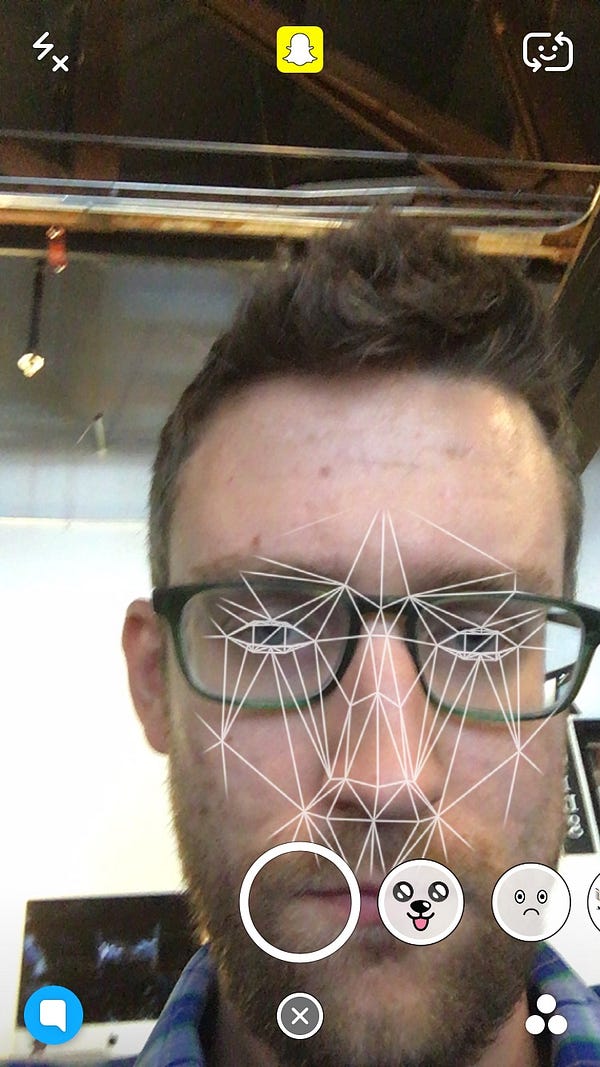
The algorithms measure various points on the face captured by a camera and compare to known/identified images. Much of the focus is on the eyes: distance between, relationship to other features (apparent cheekbones, philtrum etc), depth of sockets and to other landmarks of facial topology.
Here's an early approach to confusing the cameras:

It is based on the distorting effects found in WWII "Dazzle" camouflage:

The next step isn't so much distorting the apparent nodal points as it is overwhelming the algos with what they think are thousands of facial "hits":

Print that on a shirt and matching billed cap and you end up with some very confused computer programs.
Finally, there's this, from Oddity Central:
Talented Makeup Artist Takes Facial Optical Illusions to a Whole New Level
31-year-old Mimi Choi, a makeup artist from Vancouver, spends hours turning her face into mind-boggling optical illusions that look photoshopped at first glance.

A former schoolteacher, Choi got into makeup only three years ago, attending classes at Blanche Macdonald, a local beauty school, to learn the basics of the craft. She’s come a long way since then, though, and today she uses her makeup skills to turn her own face into incredible optical illusions.....
And the outro from a 2024 post:
Things are moving pretty quick. From 2013's "Imagining a Drone-Proof City in the Age of Surveillance" To 2016's "There's A Drone Spying On Your Daughter and Using A Shotgun Is Frowned On In Many Locales......What to Do?":
My interest in anti-drone technology was probably intensified when I saw this guy at Economic Policy Journal back in 2012:
"If you're concerned about it, maybe there's a reason we should be flying over you, right?" said Douglas McDonald, the company's director of special operations and president of a local chapter of the unmanned vehicle trade group....We've probably all known the creepazoid military/law enforcement wannabe. They came out of the woodwork after 9/11 and dealing with them was just yucky. It's been a while for me but just seeing that in print reminded me of how loathsome the type is.
And "Dutch Police Training Eagles to Take Down Drones":
...back to Digg: A Compilation Of Animals Attacking Drones. Although the verticality achieved by the crocodile is impressive, it's probably not practical for police work or home use.
Unless you have a moat.
To 2018's "Disney Rumored To Be Securing The Set Of The Next Star Wars Episode With Anti-Drone Drones"
To 2020's "al-Qaeda's 22 Tips for Avoiding a Drone Attack"
In an October 18 post on breaking up Google I said we'd have an upcoming post on how to hide from drones. And then I promptly forgot....
A couple recent posts that highlight the problem of drones:
- "On Ukraine’s ‘Transparent Battlefield,’ There Are Few Places Left to Hide"
- "Ukraine Is the First 'Hackers’ War'”
And the truly terrifying prospect of "Omniviolence Is Coming and the World Isn’t Ready"
A wider-angle view from April 2026:
"A Shakeup Is Coming for the Nation-State"
Yes, we've thought about this stuff for quite a while.

