Showing posts sorted by relevance for query gunvor putin. Sort by date Show all posts

Tuesday, May 8, 2012

Is Gunvor, the Kremlin’s Favourite Oil Trader, Manipulating Markets?

In 2007 the word was that Putin owned 75% of Gunvor.*

Putin's energy resources

From the Economist:
FEW people outside Russia have ever heard of Gunvor—and Gunvor would probably prefer it that way. It is the world’s fourth-biggest oil trader, and at its peak handled roughly a third of Russia’s seaborne exports of crude oil. We suspect that Gunvor has been driving down the price of Russian oil. An investigation by The Economist into Gunvor’s trading in Urals crude, a benchmark blend in north-west Europe, suggests that such a strategy could have helped the firm buy oil in Russia cheaply and, in theory, earn inflated profits when it sold the same oil on the international market at full price.

Spot markets for oil are virtually unregulated so the law allows Gunvor considerable freedom of manoeuvre. Yet any fall in Russia’s revenues could have harmed the country’s citizens, who benefit from oil taxes. Moreover, the spot markets have become the subject of official concern. In March, after a request from the leaders of the G20 (including Russia), the International Organisation of Securities Commissions (IOSCO), a forum for regulating financial markets, issued an appeal for ideas on reforming oil-price reporting. One of its aims is to “ensure the integrity of [the oil markets’] price assessment”. If our suspicions are well-founded, Gunvor’s Urals trade would show how vulnerable oil markets are to distortion.

Nobody but Gunvor itself knows for sure whether it set out to move the Urals price, as we suspect. The firm is adamant that it has done nothing wrong.
So we have no proven case. But we do have a set of suspicious circumstances. Under Vladimir Putin, who was elected Russia’s president in March and will be sworn in next week, Gunvor has grown from a small, virtually unknown company into the most important trader of Russian oil (see article). Before Russia’s presidential election, Gunvor attracted criticism from opposition protesters for making money out of the country’s oil and for being based in Switzerland. Given Gunvor’s political sensitivity and that Russia needs to get the best price for its oil, Mr Putin should look into the Urals market.
Our investigation has three parts. The first is based on public data, which show that over a period of years Gunvor’s trading was repeatedly associated with falls in the market price for Urals crude over a few days or weeks. The second is our analysis, which founds our suspicion that Gunvor intended to drive the price down temporarily in this way. And the third is the related question of what such a strategy might have accomplished.
The “Urals blend” includes much of the 5m barrels a day or so of crude oil that Russia exports. The sellers are oil producers, including Rosneft, Surgutneftegaz and Gazprom Neft. The buyers are European refiners such as Hellenic and INA and the refining arms of oil companies such as Royal Dutch Shell and Total. In among the buyers and sellers are the trading companies, such as Glencore, Vitol—and Gunvor.

The way of the window
Most of the Urals spot trading takes place in private and is not reported. The published price for Urals oil is set by Platts, part of McGraw-Hill, a media company. Platts writes about the market in its daily Crude Oil Marketwire, a representative summary containing the day’s most noteworthy public bids, offers and trades.
Platts sets its daily price using the bids, offers and transactions that are published on its systems. Its reporters can consider trades at any time in the day, but what counts is the last half-hour of trading, which ends at 4.30pm sharp London time, when the price is established. Platts invites parties to disclose open bids and cargoes for sale in the lead up to a 3.45pm cut-off, after which it accepts no new bids or offers. Starting at 4pm, it watches the dealing in the half-hour “window”. It uses its knowledge of the market plus the prices of these trades, bids and offers to establish the published price for the day.

This system, known as the “Market-on-Close” (MOC) methodology, has many advantages. Instead of relying only on the subjective impressions of reporters telephoning around for news from their contacts, it also uses a formal mechanism to help establish a price at the same time each day. It brings together buyers and sellers who want a part in forming the published price. It avoids the drawbacks of average prices, set over the whole trading day, which tend to be too high in a falling market and too low in a rising one....MUCH MORE
HT: FT Alphaville

*From our Dec. 2010 post "Putin Takes a Stand Against Wind Power":
I have always thought of the Prime Minister as Hydrocarbon Man.
Back in 2007 the Guardian published "Putin, the Kremlin power struggle and the $40bn fortune" which stated:

...In an interview with the Guardian, Belkovsky repeated his claims that Putin owns vast holdings in three Russian oil and gas companies, concealed behind a "non-transparent network of offshore trusts".

Putin "effectively" controls 37% of the shares of Surgutneftegaz, an oil exploration company and Russia's third biggest oil producer, worth $20bn, he says. He also owns 4.5% of Gazprom, and "at least 75%" of Gunvor, a mysterious Swiss-based oil trader, founded by Gennady Timchenko, a friend of the president's, Belkovsky alleges....
This led to a letter to the editor the next day, from Gunvor's CEO. "Putin owns no part of Gunvor". which categorically denied that Vlad had any interest in the trader.

Last Thursday the Financial Times published "Oil trading group Gunvor denies Putin links":
Gunvor, a Switzerland-based oil trading company, has been dragged into the growing WikiLeaks scandal after diplomatic cables released by the website discussed “rumours” that Vladimir Putin, Russia’s prime minister, had had a relationship with it.

Russia’s press on Thursday treated the cables with caution, and Mr Putin’s press spokesman Dmitry Peskov dismissed them as “rubbish”. In an interview with CNN’s Larry King this week, Mr Putin said the WikiLeaks cables represented “no catastrophe” to Russia and, with a characteristic conspiratorial air, added that the WikiLeaks scandal could have been orchestrated for “political purposes”.
A cable from September 2008 describes the trading group handling “massive volumes” of Russian oil, adding: “This trade was resulting in reportedly very large profits for Gunvor and its secretive ownership, which is rumoured to include prime minister Putin.”...MORE
Setting Gunvor aside, both of the oil and gas companies are down considerably from their YE '07 market caps: 4 1/2% of Gazprom is worth around $6 billion while 37% of Surgutneftegaz clocks in at $12 1/2 bil.
Still a nice pile....

Thursday, March 20, 2014

As The U.S. Treasury Sanctions Its Founders, Oil Trader Gunvor Denies Knowing 'This Putin Fellow'

Okay, truth be told they didn't do the "Putin who?" schtick.
But they come close.

http://www.robcubbon.com/images/russia-putin.jpg

From our 2010 post "Putin Takes a Stand Against Wind Power":
I have always thought of the Prime Minister as Hydrocarbon Man.
Back in 2007 the Guardian published "Putin, the Kremlin power struggle and the $40bn fortune" which stated:
...In an interview with the Guardian, Belkovsky repeated his claims that Putin owns vast holdings in three Russian oil and gas companies, concealed behind a "non-transparent network of offshore trusts".

Putin "effectively" controls 37% of the shares of Surgutneftegaz, an oil exploration company and Russia's third biggest oil producer, worth $20bn, he says. He also owns 4.5% of Gazprom, and "at least 75%" of Gunvor, a mysterious Swiss-based oil trader, founded by Gennady Timchenko, a friend of the president's, Belkovsky alleges....
This led to a letter to the editor the next day, from Gunvor's CEO. "Putin owns no part of Gunvor". which categorically denied that Vlad had any interest in the trader.

Last Thursday the Financial Times published "Oil trading group Gunvor denies Putin links"....
Here's the latest, from the Financial Times:

US targets Vladimir Putin’s inner circle
By Richard McGregor in Washington, Peter Spiegel in Brussels, Roman Olearchyk in Kiev, and Stefan Wagstyl in Berlin

President Barack Obama struck at the heart of President Vladimir Putin’s inner circle on Thursday, slapping sanctions on 20 individuals and a Russian bank linked to his closest associates.

The US response to Russia’s annexation of Crimea triggered an immediate change of ownership in Gunvor, the world’s fourth-largest oil trader. Its co-founder Gennady Timchenko, who was included on the US blacklist, sold his 43 per cent stake to ensure its “continued and uninterrupted operations”, the company said.

Escalating sanctions on Russia prompted Standard & Poor’s, the rating agency, to revise its outlook for Russian debt down to negative from stable, citing “rising geopolitical and economic risks”....MORE
Meanwhile, at the Wall Street Journal:

Gunvor Denies Putin's Involvement in Its Business
Privately-held commodity trader Gunvor Group said U.S. Treasury allegations that Russian President Vladimir Putin has investments in its business are "outrageous."

The U.S. Treasury Thursday announced a second round of sanctions against Russian officials and members of the Kremlin's inner circle, including one of Gunvor's founding members, Gennady Timchenko. 

In a statement published on its website, the Treasury said Mr. Timchenko's activities in the energy sector have been directly linked to Putin. According to the Treasury's statement, the Russian president owns investments in the company and may have access to its funds.

"President Putin has not and never has had any ownership, beneficial or otherwise in Gunvor," the company said in an emailed statement. "Any understanding otherwise is fundamentally misinformed and outrageous," it said....MORE
For an idea of the scale these guys see themselves living on, our 2011 post Nice Shack: "RuLeaks posts photos of alleged 'Putin Palace'" :
RuLeaks, a WikiLeaks type site owned and operated by the Russian Pirate Party, was shut down by a denial of service attack yesterday after posting photos of a lavish mansion alleged to be Prime Minister Vladimir Putin's estate on the Black Sea. The site, and the photos, are now back up. 
The existence of the "Putin palace" on the Black Sea was discussed by the Washington Post's David Ignatius in an article last year. According to Russian whistleblower Sergey Kolesnikov, the still under-construction digs cost more than $1 billion, include an amphitheater and three helipads and is being "predominantly paid for with money donated by Russian businessmen." Putin's spokesman denied the report, saying that the building has nothing to do with Putin.

From the photos, the place certainly looks fit for a Romanov, with frescoed ceilings, outdoor maze bushes, marble floors, and four-post beds. Bizarrely, a man who appears to be a construction worker with his face blacked out poses in a number of the shots. (He may want to read up on the fates of previous WikiLeakers.) RuLeaks' description of the photos coyly describes them as "photographs of a palace, which has recently been discussed in the press"....MORE

Friday, October 4, 2019

Re-post: "The Key to Understanding Vladimir Putin"

Apologies,  glitch in the matrix and the post disappeared.
Original post:

One note up front. The writer, John Evans, U.S. Consul General in St. Petersburg from 1994 to 1997." says "He is not motivated primarily by money, although St. Petersburg friends of ours acknowledge that he has not failed to take advantage of opportunities that have come his way. "

This is incorrect. Mr. Putin's net worth has been estimated at between $40 billion and $200 billion and you simply don't acquire that kind of loot without having a money motivation.
Though the latter number is probably too high, Putin is doin' all right (he's got a daytime job).
A couple of our links after the jump.

From The National Interest:
It is common to ascribe America’s growing difficulties with Russia to President Vladimir Putin personally, but the sources of Russian discontent predate Putin’s presidency.
Let me put it right out there: I believe we Americans have misunderstood  -- or, as George Bush might have said, “misunderestimated” -- Vladimir Putin from the moment he entered our consciousness, at the very start of the present millennium.  Here is how I remember him and what I think of where we are today.

Putin was my guest at a July 4th reception in St. Petersburg in 1995, when I was serving as the U.S. Consul General there. I recall taking him into my library. We spoke Russian in those days, before he began to learn English.  His wife, still recovering from a bad automobile accident, did not accompany him. On that occasion, he was representing his boss, Mayor Anatoly Sobchak, who was off on a trip.  Of course, I hadn’t the faintest idea that this man was destined to become the President of the Russian Federation--and neither did he.

It seems hundreds of books have been written about Putin, and thousands of articles. More are coming, and each of them will attempt to shed some additional light on this remarkable man, who has risen from humble beginnings to lead one of the world’s great nations, and has now, at the relatively young age of 66, broken the (post-Stalin) record set by Leonid Brezhnev for doing so. If I had had any idea in the mid-nineties that my guest would one day become Russia’s leader, I would have had him over to lunch, to say the least.  But I didn’t, and I am just as glad, because it would have altered the dynamic. We were simply colleagues then.

On one occasion I called Putin for help when some young American investors from California who had set up a Subway fast-food restaurant with Russian partners arrived at the Consulate General pursued by the mob. The Russian side of the 50-50 venture had learned how to make sandwiches and had called in “muscle” from the criminal world in order to evict the Americans and take over the business. I called Putin for assistance. His first reaction was to say that he needed a copy of the contract.  He also assured me that he would order the mob to back off so that our citizens could safely make it to Helsinki, as they feared for their physical safety. The matter would then need to go to court (which it eventually did). That was what Petersburg was like in the 1990s. Some called it the Wild East. I was struck at the time by Putin’s immediate reaction in wanting to see the contract.  It was the reaction of one trained in law, as Putin had been, and intent on seeing that the matter was resolved in accordance with the law.

Putin is what Russians call a “gosudarstvennik,” a man of the state. He is not motivated primarily by money, although St. Petersburg friends of ours acknowledge that he has not failed to take advantage of opportunities that have come his way. When I and other Americans in St. Petersburg knew Putin, he had the reputation as the only bureaucrat in the city who did not take bribes (this is an exaggeration; there were others).   He was well regarded on the whole, and devoted to his mentor and then-boss, Sobchak, one of the great democrats of the new Russia. A former law professor, Sobchak was a fine writer and orator, but not the most effective manager. Putin largely ran the day-to-day operations of the city, and was credited with bringing some order into the chaotic crime-ridden business world. As Russians said in those days, “if you have crime, isn’t it better that it be organized?” I cannot recall Putin personally saying that, but he might have.

Unlike Yeltsin, Putin was never a heavy drinker. Nor was he a teetotaler. He would deliver a toast when required, which was often, and do it well. Toasts in Russia are a way of communicating, of showing respect, and of honoring people, especially on birthdays and career anniversaries or other milestones. Toasts are offered also (without clinking glasses) to the dead, and there were unfortunately many such occasions in St. Petersburg in the 1990s, not to mention the tragic memories of World War II, in which the city was besieged for 900 days, claiming members of Putin’s own family. The entire city and Consular Corps turns out without fail for the memorial to those who died in the Siege of Leningrad and lie in mass graves at the Pushkaryevskoe Cemetery.

Those of us who knew Putin in the 1990s recall that his formula for the recovery of Russia consisted of three elements: rebuilding the economy, dealing with the crime problem, and reforming the courts. That was a pretty good prescription for what ailed Russia at the time and is still a good basic recipe. Note that he was concerned exclusively with domestic problems: nothing about geopolitics here.

I am not going to attempt to prove it, but I assure you that Putin 1) was not anti-American (although he felt more comfortable with Germans); 2) was not a communist (at least by that time) or hostile to private business; 3) was not anti-Semitic; 4) and was not intolerant of gay people.  I have already noted that he had a legal bent. You may take my word for these assertions or not.  I have concrete examples to back each of them.

I should mention Putin’s favorite sport, judo. Photos of Mr. Putin engaging in this form of martial arts abound, as do theories purporting to explain him by reference to the sport, which is also called “sambo” in Russia.  I have been told that this is an acronym for “samo-oborona bez oruzhiya” (self-defense without weapons) but can not confirm this. Most Western analysts have focused on the fact the sport requires the player to use the strength and weight of his opponent to his own advantage.  That theory conveniently supports the contention that Putin has played Russia’s relatively weak hand well in dealing with stronger adversaries, but there is another aspect that is usually overlooked: the sport comes from the East, Japan, I believe.  Contestants prepare for combat in a friendly, collegial way. They bow to each other as a sign of respect before engaging, and again afterwards. It is a bloodless affair, almost courtly, with strict rules and formalities, although it does require real strength, agility, and skill. Putin has won numerous black belts.  But he is a good sport: memorably, he allowed himself to be thrown by a much younger opponent while visiting Japan. It also requires sobriety, flexibility, and self-control, qualities that Putin exhibits in abundance.

Much has been made of the fact that Putin started his professional life in the KGB, the Soviet Union’s dreaded intelligence service. Senator McCain once said that when he looked into Putin’s eyes he “saw K-G-B.” Well, maybe McCain did, although George Bush had a different reaction on his first meeting with Putin in Ljubljana in 2001. Prior to that meeting, as briefing memoranda were being prepared for the President about what to expect, I took advantage of my position at the time as Director of the section of the State Department’s Office of Intelligence and Research that covered the former Soviet Union and penned a two-page memorandum entitled “Vladimir Putin: A Heterodox View.” In it I tried to convey something of what I knew about Putin the man, as a counterweight to the other memos that derided him as a “provincial politician” and a “lightweight” who “wouldn’t last long.”  I sent the memo to the White House, to Secretary Powell’s office and to the CIA, but it was met by a deafening silence. Then one analyst called me from deep in the bowels of CIA at Langley and said, “John, thank you for writing that; we could never have gotten it cleared out of here.” My guess is that my memo landed in multiple shredders. Surely it never got anywhere near the President.  And yet, after that first meeting in Ljubljana, there were at least two people in the U.S. government who seemed to take Putin seriously: President Bush and me....
....MUCH MORE

From 2010's "Putin Takes a Stand Against Wind Power":

...Back in 2007 the Guardian published "Putin, the Kremlin power struggle and the $40bn fortune" which stated:
...In an interview with the Guardian, Belkovsky repeated his claims that Putin owns vast holdings in three Russian oil and gas companies, concealed behind a "non-transparent network of offshore trusts".

Putin "effectively" controls 37% of the shares of Surgutneftegaz, an oil exploration company and Russia's third biggest oil producer, worth $20bn, he says. He also owns 4.5% of Gazprom, and "at least 75%" of Gunvor, a mysterious Swiss-based oil trader, founded by Gennady Timchenko, a friend of the president's, Belkovsky alleges....
 This led to a letter to the editor the next day, from Gunvor's CEO. "Putin owns no part of Gunvor". which categorically denied that Vlad had any interest in the trader.

Last Thursday the Financial Times published "Oil trading group Gunvor denies Putin links":
Gunvor, a Switzerland-based oil trading company, has been dragged into the growing WikiLeaks scandal after diplomatic cables released by the website discussed “rumours” that Vladimir Putin, Russia’s prime minister, had had a relationship with it.

Russia’s press on Thursday treated the cables with caution, and Mr Putin’s press spokesman Dmitry Peskov dismissed them as “rubbish”. In an interview with CNN’s Larry King this week, Mr Putin said the WikiLeaks cables represented “no catastrophe” to Russia and, with a characteristic conspiratorial air, added that the WikiLeaks scandal could have been orchestrated for “political purposes”.
A cable from September 2008 describes the trading group handling “massive volumes” of Russian oil, adding: “This trade was resulting in reportedly very large profits for Gunvor and its secretive ownership, which is rumoured to include prime minister Putin.”...MORE
Setting Gunvor aside, both of the oil and gas companies are down considerably from their YE '07 market caps: 4 1/2% of Gazprom is worth around $6 billion while 37% of Surgutneftegaz clocks in at $12 1/2 bil.
Still a nice pile. ...

And in 2017:
Daily Mail On Putin: "After 17 years in power, Russian leader has a '$200 billion fortune, 58 planes and helicopters and 20 palaces and country retreats'"

Wednesday, December 8, 2010

Putin Takes a Stand Against Wind Power

I have always thought of the Prime Minister as Hydrocarbon Man.
Back in 2007 the Guardian published "Putin, the Kremlin power struggle and the $40bn fortune" which stated:
...In an interview with the Guardian, Belkovsky repeated his claims that Putin owns vast holdings in three Russian oil and gas companies, concealed behind a "non-transparent network of offshore trusts".

Putin "effectively" controls 37% of the shares of Surgutneftegaz, an oil exploration company and Russia's third biggest oil producer, worth $20bn, he says. He also owns 4.5% of Gazprom, and "at least 75%" of Gunvor, a mysterious Swiss-based oil trader, founded by Gennady Timchenko, a friend of the president's, Belkovsky alleges....
This led to a letter to the editor the next day, from Gunvor's CEO. "Putin owns no part of Gunvor". which categorically denied that Vlad had any interest in the trader.

Last Thursday the Financial Times published "Oil trading group Gunvor denies Putin links":
Gunvor, a Switzerland-based oil trading company, has been dragged into the growing WikiLeaks scandal after diplomatic cables released by the website discussed “rumours” that Vladimir Putin, Russia’s prime minister, had had a relationship with it.

Russia’s press on Thursday treated the cables with caution, and Mr Putin’s press spokesman Dmitry Peskov dismissed them as “rubbish”. In an interview with CNN’s Larry King this week, Mr Putin said the WikiLeaks cables represented “no catastrophe” to Russia and, with a characteristic conspiratorial air, added that the WikiLeaks scandal could have been orchestrated for “political purposes”.
A cable from September 2008 describes the trading group handling “massive volumes” of Russian oil, adding: “This trade was resulting in reportedly very large profits for Gunvor and its secretive ownership, which is rumoured to include prime minister Putin.”...MORE
Setting Gunvor aside, both of the oil and gas companies are down considerably from their YE '07 market caps: 4 1/2% of Gazprom is worth around $6 billion while 37% of Surgutneftegaz clocks in at $12 1/2 bil.
Still a nice pile.
Here's the headline story from Reuters:
Russian Prime Minister Vladimir Putin said on Monday that wind power can pose environmental risks, casting doubts over plans to develop this alternative energy source in the oil-rich country.
Putin, who has overseen all major energy deals Russia made in recent years, is keen for the country to maintain its role as a major oil and gas producer. He has repeatedly expressed his skepticism about alternative energy.

"Windmills, which are so widespread in many European countries seem to be an environmentally friendly kind (of energy), but in fact they kill birds," Putin told a conference of his United Russia party in the Far East.
"Vibration there is such that worms come out of the ground, not to mention moles. This is a real environmental problem," he said, adding that solar energy was the only alternative source that was entirely harmless.
Renewable energy accounts for only 1 percent of all power generated in Russia, but under a plan backed by President Dmitry Medvedev, Putin's partner in Russia's ruling tandem, this share should grow to 4.5 percent by 2020.

Germany's Siemens plans to create a joint venture with Russian power firm RusHydro and state holding firm Russian Technologies to develop windmill parks able to produce 5 gigawatts by 2020.
Atomenergomash, a unit of state nuclear power holding Rosatom, announced similar plans and said the company was looking for an international partner, estimating the potential share of wind in Russian power generation at 5 to 10 percent.

Atomenergomash said wind power generation would become profitable in Russia after the government introduced incentives for producers....MORE
Although I found nothing on the moles and worms here's a previously secret indication of Mr. P's ornithological bent:


putin bird

Monday, February 20, 2017

Daily Mail On Putin: "After 17 years in power, Russian leader has a '$200 billion fortune, 58 planes and helicopters and 20 palaces and country retreats'"

For those keeping track at home, RuLeaks, who revealed interior photos of the Putin Palace on the Black Sea (Zillow Zestimate® $1 billion) earlier this decade has disappeared from the face of the earth.

From the Daily Mail:
Russian President Vladimir Putin might be the richest man in the world, according to experts who believe he could have a net worth of $200billion.

The official richest man in the world, according to Forbes, is Microsoft's Bill Gates with a net worth of $75billion.

During his nearly two decades in power, Putin's net worth has been widely speculated, with the former KGB agent likely having private assets in real estate and company holdings.

One of the most quoted guesses of the 64-year-old's net worth is political analyst Stanslav Belkovsky's 2007 estimation of $40billion, but Bill Browder, author and a former fund manager in Russia, has said the president has a higher worth - upwards of $200billion.
http://i.dailymail.co.uk/i/pix/2017/02/20/16/3D744A5500000578-0-image-a-144_1487607384925.jpg
IBTimes raised the question of Putin's wealth last week, pointing out that Browder spoke to Fareed Zakaria GPS in 2015, claiming that Putin's years in power have led him to gain quite a fortune.

'I believe that it's $200 billion,' he said at the time. 'After 14 years in power of Russia, and the amount of money that the country has made, and the amount of money that hasn't been spent on schools and roads and hospitals and so on, all that money is in property, bank - Swiss bank accounts - shares, hedge funds, managed for Putin and his cronies.'

And yet, Putin has been snubbed from the official Forbes list of the world's richest men and women over the years....MUCH MORE
Previously:
2010
I have always thought of the Prime Minister as Hydrocarbon Man.
Back in 2007 the Guardian published "Putin, the Kremlin power struggle and the $40bn fortune" which stated:
...In an interview with the Guardian, Belkovsky repeated his claims that Putin owns vast holdings in three Russian oil and gas companies, concealed behind a "non-transparent network of offshore trusts".

Putin "effectively" controls 37% of the shares of Surgutneftegaz, an oil exploration company and Russia's third biggest oil producer, worth $20bn, he says. He also owns 4.5% of Gazprom, and "at least 75%" of Gunvor, a mysterious Swiss-based oil trader, founded by Gennady Timchenko, a friend of the president's, Belkovsky alleges....
This led to a letter to the editor the next day, from Gunvor's CEO. "Putin owns no part of Gunvor". which categorically denied that Vlad had any interest in the trader....MORE
2011

We hot-linked to the pictures rather than downloading to our 'puters so when the site disappeared the pics on our site died as well, they're still out there on the web if you want to poke around, we don't. 
Here's an exterior shot:

http://xoxol.org/putin/putins-palace-on-black-sea-1200x780.jpg

Friday, March 18, 2011

Natural Gas: Putin Scores Again! (OGZPY)

Not directly but he sure did move a pile of loot to where he can visit it if he wishes.

Any idea what the Japanese earthquake did for the value of Russian far-east natural gas?
With the fall of Mubarak and the likely departure of Gaddafi, Mr. Putin should be able to claim the undisputed title of World's Richest Despot, links below.

Here's a little back-scratching, Russian style, from the Streetwise Professor:

Several interesting stories on the way things work in Russia.
The most fascinating is the tale of the remarkable rise to prominence of gas producer Novatek, and the windfall reaped by Putin friend Ginnady Timochenko:
The Novatek agreement was signed on March 3 in Novo-Ogaryovo with Putin personally blessing the deal. According to official reports, Total will acquire 12 percent of Novatek, the second-largest gas producer in Russia, from its CEO and largest shareholder, Leonid Mikhelson, and co-owner Gennady Timchenko.
The huge figures involved in this deal are especially noteworthy. In fact, on Dec. 20, Gazprom sold Gazprombank a 9.4 percent stake in Novatek for 57.5 billion rubles ($2 billion). Only one day earlier, that stake was valued on the MICEX at 87 billion rubles, and it is now worth 101.3 billion rubles. The very next day, Dec. 21, Gazprombank resold those shares to Novatek. Now, with Putin looking on, Timchenko and Mikhelson resold several major share packets to Total for 30 percent more money than Gazprom received for the same shares.
Gazprom is run by Putin’s friend Alexei Miller, Gazprombank is owned by Putin’s friend Yury Kovalchuk, and yet another friend of Putin’s, Timchenko, is co-owner of Novatek. What we have is a complex, multistaged financial transaction in which individuals and companies with close ties to Putin flip billions of dollars worth of stocks and securities in murky, under-the-table schemes.
And lo and behold, Putin anoints Novatek as the leader in future Russian LNG endeavors:
Prime Minister Vladimir Putin, who wants Russia to export 10 percent of its gas as LNG by 2020, blessed Novatek’s plans at a ceremony near Moscow last week, calling it a “good and large- scale work.” Gazprom has delayed decisions on expanding Russia’s only LNG facility, the Sakhalin-2 project with Royal Dutch Shell Plc, and developing the Shtokman field on the Barents Sea.
“Novatek’s project is now Russia’s primary LNG project outside of Sakhalin,” said Chris Weafer, chief strategist at UralSib Financial Corp. “Total’s strategic partnership with Novatek is an acknowledgement that Shtokman is on a much slower development path with an unpredictable future.”...MORE
Putin's energy resources

Previously:
"It’s Amazing: You Poke Gazprom, and Putin Screams" (OGZPY)
Russia: What a Scam We Have in Carbon
UPDATED:"Gazprom and Igor Sechin: The Dale Carnegies of Gas"
Putin Takes a Stand Against Wind Power
(computation of Putin's net worth)
...Setting Gunvor aside, both of the oil and gas companies are down considerably from their YE '07 market caps: 4 1/2% of Gazprom is worth around $6 billion while 37% of Surgutneftegaz clocks in at $12 1/2 bil....  
Nice Shack: "RuLeaks posts photos of alleged 'Putin Palace'"
Quick, what's Vlad's net worth?
From Foreign Policy's Passport blog:
RuLeaks, a WikiLeaks type site owned and operated by the Russian Pirate Party, was shut down by a denial of service attack yesterday after posting photos of a lavish mansion alleged to be Prime Minister Vladimir Putin's estate on the Black Sea. The site, and the photos, are now back up. 
The existence of the "Putin palace" on the Black Sea was discussed by the Washington Post's David Ignatius in an article last year. According to Russian whistleblower Sergey Kolesnikov, the still under-construction digs cost more than $1 billion, include an amphitheater and three helipads and is being "predominantly paid for with money donated by Russian businessmen."....

Friday, October 8, 2021

Natural Gas: "Is Gunvor Getting Flushed? How NatGas 'Netbacks' Are Crushing The Secretive Commodity Trader"

It would be good for Gunvor if the Putin ownership rumors are true. Though they deny he's ever had a stake having a liquidity backstop might prove very important.

From ZeroHedge:

Earlier this week, we noted that some of the world's largest commodity traders were facing massive margin calls from wrong-way spread trades in the natural gas markets.

According to reports, it appears the trading shops have all been hammered by a spread (or arbitrage trade) gone wrong.

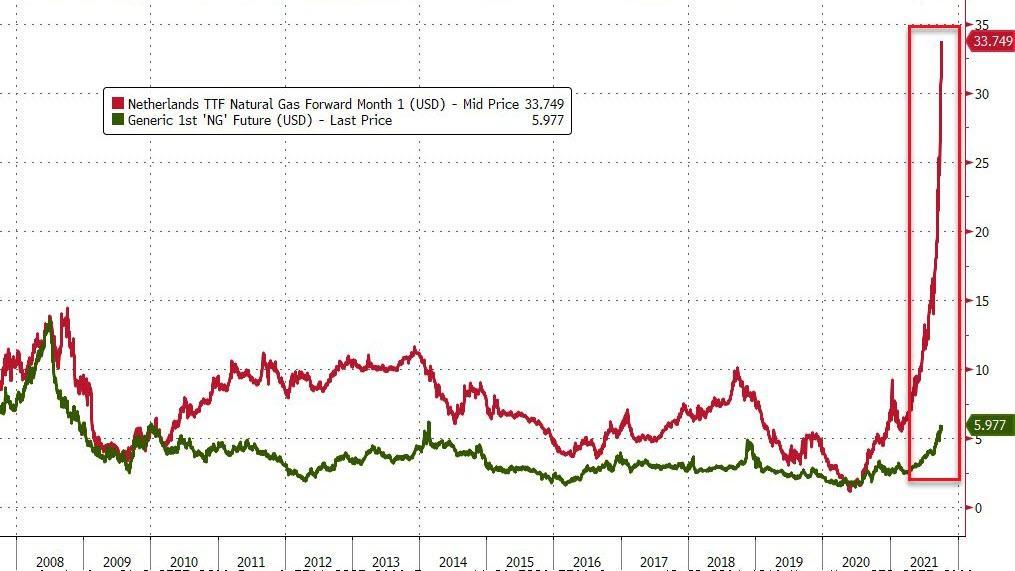
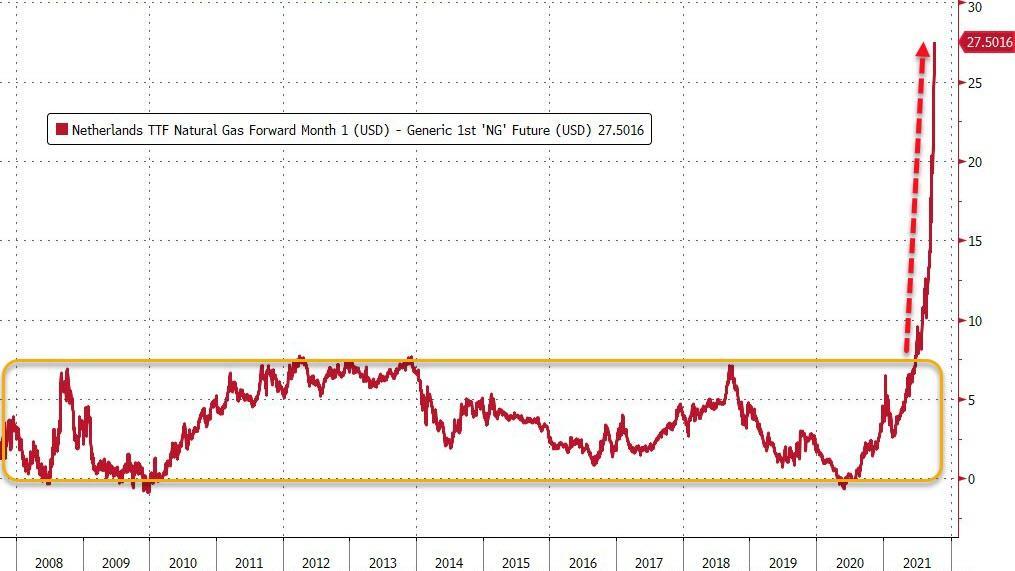
For years, the prices of European (red) and US natural gas (green) have traded within a well-defined range. When the spread between the two reaches one extreme or the other, you buy one and sell the other – easy, right ?

Source: Bloomberg

So as European NatGas prices surged in Q2, it reached a notable extreme relative to US NatGas, prompting traders to instigate the strategy of selling European Gas and Buying US Gas in the hopes the spread compresses.

The strategy backfired last month when European gas prices soared due to a variety of factors including low inventories, high demand for gas in Asia, low Russian and LNG supply to Europe, and outages.

Since then, the situation appears to have grown more grim, as Bloomberg reports that major energy traders including Gunvor Group. and Mercuria Energy Group. have reduced the size of their trading positions and increased borrowing from lenders to cover large margin calls stemming from the unprecedented surge in European gas prices, according to people familiar with the matter.

Specifically, Bloomberg reports that both Gunvor, the biggest independent trader of liquefied natural gas, and Mercuria, a major power and gas trader, asked banks for additional credit to fund margin calls arising from their hedging positions, said the people, who asked not to be named because the information is private. 

But, as 'Structurer', Jacques Simon, details in the following report, the situation could be far more grave for Gunvor...

TL;DR...

  • Two weeks ago Gunvor was in the debt market for the 1st time since 2013 according to BBG. We note that Gunvor is the world largest LNG independent trader and also the biggest by % share among the houses with this exposure.

  • The trader is a net buyer of netbacks (a type of contract under which it receives the Henry hub index and pays the TTF or Platts JKM index to the producers).

  • Recently it has changed its LNG head in Singapore and we are also aware that Gunvor Singapore uses a strategy called “the box” whereas the trader locks the arbitrage spread at predetermined levels by swap hedges.

  • U.S website Zerohedge reports that Gunvor is facing massive margin calls as the global natural gas arb explodes.

  • Among the injured will be ABN amro, Credit Agricole, Rabobank, SG, Natixis, ING and Unicredit.

  • The margin calls are between $3.6B and $6.1B in the coming months for a company with a $2.5B net equity.

  • We will explain what is “the box” and then show our calculations for the margin calls and summarize our assumptions below.

  • The banks have offloaded $300M worth of their credit-risk on Gunvor last September to the bond market but since then the Dutch TTF-Henry spread has gone parabolic and the group’s financial position has significantly deteriorated.

  • The trader’s future is purely and simply in the hands of Goldman Sachs, Citi and the long swap dealers at TTF.

*  *  *

GUNVOR FINANCIAL POSITION

Gunvor is very secretive on their financial positions, only releasing partial and selective information.

Gunvor’s debt is unrated.

The trader turnover is 94 million mt/year and the rule of thumb is that each 1$ in sale is backed by 5$ of debt. With the turnover growth we believe Gunvor debt is minimum $20B.

If the House capital is $2.5B in H1-2021 then we derive that Debt/Capital ratio is 8X.

THE NETBACKS

Netbacks are based on the premise that the spread between two global LNG markets are underpinned by the transportation costs.

The arbitrage flows is from the low price market towards the higher price market putting a downward pressure on the overpriced market, and has the effect of reimposing a netback-based parity between the markets. Netbacks assume an access to financing, prompt cargoes in the cheap market, and shipping capacity.

  • DUTCH TTF-HH-Transportation costs-Tolling fee= NETBACK TTF

  • JKM-HH-Transportation costs-Tolling fee= NETBACK JKM

IF NETBACK TTF >= NETBACK JKM, the trader will ship the LNG to TTF until the equation parity is restored again.

The caveat: It is another mean-reversion trade based on moderate volatility.

See, Druz, T., Capra Energy Group, “When will European LNG Imports Recover ?” (2021)

THE “BOX”

  1. Gunvor Singapore buys TTF netbacks which are defined as the Dutch TTF minus Henry Hub minus the Freight U.S Gulf Coast to Europe minus a $2.45-2.55 tolling fee. Gunvor is now long the TTF and that it must pay to the producer in exchange for the gas.

  2. To protect its margin the trader sells the TTF and buys the HH times the number of cargoes per month.

  3. Based on the current TTF/HH spread and the hedged level the trade becomes a “box” if Gunvor is long freight.

Typically when the spread goes over the pre-hedge level, the freight cost rises => and Gunvor (long) absorbs the risk because it leases a 10-year fleet. In this situation Gunvor still makes a profit despite a $2-3 margin call on the hedge because it can resell the physical cargo or resell the freight voyage (relet).

However this is not the behavior observed during Q3 and in Q4-21… As the TTF-HH goes above the 90th percentile value (blue line) while the freight (purple) has not converged with the arbitrage.

Gunvor has not captured the arbitrage with the freight.

What a trader employee at Gunvor did was underwriting a gigantic amount of risk (CALLs like optionssellers.com…) analogous to multiple times the trading-firm capital.....

....MUCH MORE

 I had completely forgotten about https://jacquessimon506.wordpress.com/

Wednesday, December 19, 2012

"Kremlin Throws Imperial Artifacts into Putin Conference Goodie Bag"

Gaspodin* Putin seems to have Imperial pretensions.

From the WSJ Europe's Emerging Europe blog:

Contents of a goodie bag for Russian President Vladimir Putin's 2012 annual press conference


More than 1,200 reporters accredited to Russian President Vladimir Putin‘s giant press conference Thursday each received a puzzling bag of gifts, with imperial overtones.

A huge wall calendar depicted the Russian czars of the Romanov dynasty, which would be celebrating their 400 years in power in 2013 if not for the 1917 revolution that saw the last czar and his family killed. The bag also had a set of post cards with all the Russian czars starting from the early 17th century....MORE
*I know "Mr." in Russian is transliterated Gospodin not Gas but I was trying to reference his control over Gunvor and his stakes in Gazprom and Surgutneftegaz and fell totally flat. Sorry.

With the demise of Gaddafi (reported to have salted $200 Billion away) Putin is probably the richest Autocrat-wannabe in the world.

Previously:

Nice Shack: "RuLeaks posts photos of alleged 'Putin Palace'"
Quick, what's Vlad's net worth?

From Foreign Policy's Passport blog:
RuLeaks, a WikiLeaks type site owned and operated by the Russian Pirate Party, was shut down by a denial of service attack yesterday after posting photos of a lavish mansion alleged to be Prime Minister Vladimir Putin's estate on the Black Sea. The site, and the photos, are now back up. 
The existence of the "Putin palace" on the Black Sea was discussed by the Washington Post's David Ignatius in an article last year. According to Russian whistleblower Sergey Kolesnikov, the still under-construction digs cost more than $1 billion, include an amphitheater and three helipads and is being "predominantly paid for with money donated by Russian businessmen." Putin's spokesman denied the report, saying that the building has nothing to do with Putin....MORE

Friday, March 21, 2014

"Sanctions on Timchenko Place Focus on Gunvor"

Following up on "As The U.S. Treasury Sanctions Its Founders, Oil Trader Gunvor Denies Knowing 'This Putin Fellow'".

From the Financial Times:
One of the world’s largest oil traders has been drawn into the political confrontation over Ukraine after the US Treasury slapped sanctions on Gennady Timchenko, co-founder of Gunvor. The US also claimed Russian president Vladimir Putin had a personal investment in the company.

Gunvor announced that Mr Timchenko sold his 43 per cent stake in the group to co-founder Torbjorn Tornqvist a day earlier as a “contingency” measure. Mr Tornqvist now has an 87 per cent stake, with the remainder owned by employees.

But what is Gunvor?
The trading house was founded by Mr Timchenko and Mr Tornqvist in 2000, although the two men began working together trading Russian oil in 1997.

Gunvor currently trades 2.1m barrels a day, equivalent to the consumption of France, making it the world’s fourth-largest oil trader behind Vitol, Glencore and Trafigura.

The company has risen from being a niche player a decade ago to one of the world’s largest independent oil trading companies. Revenues surged from $5bn in 2004 to $93bn in 2012. Its rapid growth has been mirrored by competitors such as Trafigura and Mercuria, which also rode the commodities boom of the 2000s to become titans of the trading industry.

Also at the FT:

Thursday, December 1, 2011

Natural Gas: "What the Frack: Gazprom Goes Green"

Although I had this post ready to go yesterday, I have the attention span of a gnat and spaced it.
FT Alphaville reminded us so here's a big 'ol hat tip ma'am.
Here are some of our posts on the verde side of Gazprom:
Russia to Stockpile $58 Billion of Kyoto CO2 Credits
Fixing Leaky Gas Pipes Seen as Next CO2 Grab
Russia: What a Scam We Have in Carbon
Gazprom's plan for control. And EU Gas Market Prices
Speaking of control we have some posts on Gazprom's control shareholder, who, although he only owns 4 1/2% of the outstanding has veto power at the strategic level, links after the jump.

From the Streetwise Professor:

Showing its deep, deep concern for the environment, Gazprom is warning about the hazards of natural gas fracking:
But in a sign the phenomenon is in fact being taken seriously, the board of directors at the world’s biggest gas producer, state-owned OAO Gazprom, this week highlighted environmental risks and the high costs of production in Europe.
“The production of shale gas is associated with significant environmental risks, in particular the hazard of surface and underground water contamination with chemicals applied in the production process,” Gazprom said in the statement following the board meeting.
Now surely, this has absolutely nothing to do with the fact that expanded gas production, especially in Europe, would be devastating for Gazprom.  The experience in the US shows how quickly the gas market can turn.  In 2006, the consensus prediction was that the US was facing a low supply-high price gas future, and that the country would be a gas importer.  Gas prices were well north of $10/mmbtu.  A few short years later, the US supply situation was turned on its head.  Gas prices are now in the mid-$3/mmbtu range, and the play of the day is to figure out how to export gas to Europe and Asia.

LNG sourced from the Middle East or the US is already a near-to-medium term threat to Gazprom, as the ongoing disconnect between gas prices and oil prices (which determine the price of Gazprom gas under its long term contracts) indicated.   Even a modest increase in production in Europe would put even more pressure on the company.  And as the US experience shows, that increase can take place extremely rapidly (though for a variety of reasons such speed is unlikely in Europe)....MORE
See also:

Putin's energy resources

Previously:
"It’s Amazing: You Poke Gazprom, and Putin Screams" (OGZPY)
UPDATED:"Gazprom and Igor Sechin: The Dale Carnegies of Gas"
Putin Takes a Stand Against Wind Power
(computation of Putin's net worth)
...Setting Gunvor aside, both of the oil and gas companies are down considerably from their YE '07 market caps: 4 1/2% of Gazprom is worth around $6 billion while 37% of Surgutneftegaz clocks in at $12 1/2 bil....  
Nice Shack: "RuLeaks posts photos of alleged 'Putin Palace'"
Quick, what's Vlad's net worth?
From Foreign Policy's Passport blog:
RuLeaks, a WikiLeaks type site owned and operated by the Russian Pirate Party, was shut down by a denial of service attack yesterday after posting photos of a lavish mansion alleged to be Prime Minister Vladimir Putin's estate on the Black Sea. The site, and the photos, are now back up. 
The existence of the "Putin palace" on the Black Sea was discussed by the Washington Post's David Ignatius in an article last year. According to Russian whistleblower Sergey Kolesnikov, the still under-construction digs cost more than $1 billion, include an amphitheater and three helipads and is being "predominantly paid for with money donated by Russian businessmen."....