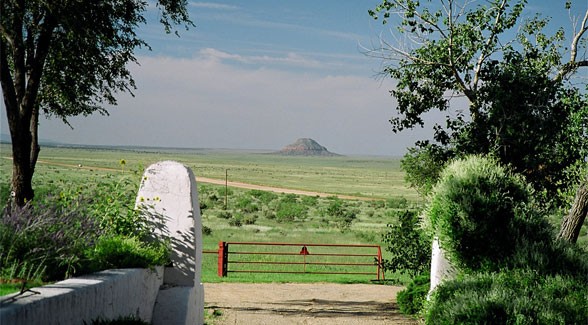
It's time for our quasi-periodic visit to The Land Report for the lowdown on who owns what.
From PR Newswire: The 2014 Land Report 100: America's Largest Landowners Making Even Bigger Investments
The Land Report releases 2014 Land Report 100 presented by Fay
Ranches; Malone and Turner still largest, but Reed Family jumps to No. 5
with purchase of 600,000-acre JELD-WEN Oregon estate.
DALLAS, Oct. 15, 2014 /PRNewswire/ -- Continuing the trend of investing in some of America's most iconic viewsheds and working landscapes, The Land Report released the 2014 Land Report 100 presented by Fay Ranches
highlighting the major investments and even bigger personalities of
America's largest landowners. In all, private holdings increased by
nearly 500,000 acres over the last year.
Among the major movers is nationally known homebuilder D.R. Horton, founder and chairman of DR Horton Inc. (DHI), which acquired New Mexico's
457-square-mile Great Western Ranch. This transaction landed Horton at
No. 32 on this year's list. Horton purchased the 292,779-acre Great
Western from Denver investor Patrick Broe. But don't worry about Broe. Thanks to holdings in Colorado and Wyoming, he stayed on the list and is at No. 76.
And that wasn't even the biggest sale. The Reed family, owners of Green Diamond Resource Company, acquired 600,000 acres of Oregon timberland from the estate of Richard Wendt,
founder of JELD-WEN Windows & Doors. The purchase upped the Reeds
from No. 10 in 2013 to No. 5 in 2014. This swath of rural Oregon is almost the same size as Rhode Island and is the largest land transaction in the U.S. since Liberty Media Chairman John Malone acquired more than 1 million acres of timberland in Maine and New Hampshire
in 2011. That buy put Malone atop The Land Report 100, where he remains
in 2014 with 2.2 million acres. His good friend and fellow cable
entrepreneur Ted Turner is No. 2 with more than 2 million acres. Rounding out the top five are California's Emmerson family with 1.86 million acres, Kentucky billionaire Brad Kelley with 1.5 million acres, and the Seattle-based Reeds with 1.37 million acres.
The
cover story dives into the intricacies of one of the largest ranches in
the U.S., the 535,000-acre Waggoner Ranch that spreads across six North Texas counties. For over 150 years, the Waggoner family has stewarded this historic property, which was recently listed for sale for $725 million.
The ranch runs thousands of cattle, breeds champion Quarter Horses, has
oil and gas production and more – all attributes of this "super asset
class."...MORE
For our European readers: 1000 acres equals 404.6 hectares.
Here's The Land Report's home page and the 2014 Land Report 100 via Fay Ranches, 37 page PDF
John Malone, the 70-year-old chairman of Liberty Media, is famously
reticent when it comes to discussing his business life. There is,
however, one subject that makes the Denver businessman open up: his
personal land holdings.
Recently,
he’s had a lot more to talk about. In 2011, Malone became the largest
private landowner in the U.S., wresting the top spot on The Land Report
100 from his friend and longtime business partner, Ted Turner. His
decades-long rise to the top dates back to the 1990s, when Malone began
acquiring land in Colorado, New Mexico, and Wyoming. His land grab
kicked into overdrive in the summer of 2010 when he purchased New
Mexico’s historic 290,100-acre Bell Ranch. In early 2011, he snapped up
an additional 1 million acres of timberland in Maine and New Hampshire
to become America’s leading land baron. Malone says his lust for land
harkens back to his Irish genes: “A certain land hunger comes from being
denied property ownership for so many generations.”...MORE
2011 Land Report 100: King Ranch Heirs No.
7 King Ranch Heirs 911,215 acres On October 27 and 28, ranch owners and
operators from across North America will make the trek to the King
Ranch Institute for...
2011 Land Report 100: Lykes Brothers Heirs No.
12 Lykes Brothers Heirs 615,000 acres The family holds 275,000 acres in
Texas and 337,000 acres in Florida, and they’re serious about the
stewardship of every square inch. The...
2011 Land Report 100: Benjamin W. Griffith III No.
59 Benjamin W. Griffith III 161,093 acres Southern Pine Plantations
founder Benjy Griffith has holdings in Georgia, South Carolina, Florida,
Virginia, Tennessee, Texas, and Montana. He emphasizes clean air...
2011 Land Report 100: Irwin Heirs No.
46 Irwin Heirs 210,000 acres John Irwin II purchased the historic O RO
Ranch in the early 1970s, and today the land is owned by his heirs. The
O...
2011 Land Report 100: Pingree Heirs No.
8 Pingree Heirs 830,000 acres The Pingree family has tended its Maine
timberlands for almost two centuries. The family’s patriarch, David
Pingree, made his first fortune in New England’s..
In addition to its focus on the productivity and profitability of its cattle operations, Malone’s SILVER SPUR RANCHES
makes the preservation of historic structures and time-tested
traditions a priority as well. One of the many examples of this takes
place on New Mexico’s BELL RANCH, an historic land
grant that dates back to 1824. In 2010, Malone acquired the Bell from
the heirs of William Lane, who had reassembled 290,100 acres of the
original Pablo Montoya grant. Two years later in 2012, a chuck wagon
rolled out of Bell Ranch headquarters and the crew spent the next four
weeks preparing grub for Bell cowboys during spring works. The
wooden-wheeled wagon was pulled by a pair of Bell Quarter Horses. “We’ve
been so fortunate that Silver Spur has bought the Bell Ranch and has
allowed us to maintain some of these old traditions and bring some of
them back,” said Kris Wilson, the Bell manager who resurrected the
tradition.
THE FULL LIST: AMERICA’S 100 LARGEST LANDOWNERS
1. John Malone
2. Ted Turner
3. Emmerson Family [Up 3,566 Acres]
4. Reed Family [Up 359,232 Acres]
5. Stan Kroenke
6. Irving Family [Up 1,644 Acres]
7. Brad Kelley
8. Singleton Family
9. Peter Buck [Up 125,000 Acres]
10. King Ranch Heirs
11. Pingree Heirs
12. Wilks Brothers
13. Briscoe Heirs
14. Lykes Heirs
15. Hamer Family
16. O’Connor Heirs
17. Thomas Peterffy [Up 20,000 Acres]
18. Ford Family [Down 203,000 Acres]
19. Martin Family
20. Stimson Family
Stan Kroenke
is now America’s largest landowner. Kroenke acquired almost 1 million
acres in New Mexico from the heirs of Dr. Henry Singleton in December
2025. The transaction increased his landholdings to more than 2.7
million acres. This breaking news story capped the debut of the 2026
Land Report by the magazine’s editor, Eric O’Keefe, at the Land Investment Expo in Des Moines.
The purchase of Singleton Ranches vaulted Kroenke Ranches from No. 4 in 2025 to No. 1 in 2026, ahead of California’s Emmerson Family with 2.44 million acres, Liberty Media chairman emeritus John Malone with 2.2 million acres, and CNN Founder Ted Turner with 2 million acres.
Amazon founder Jeff Bezos ranked 21st with 462,000 acres. Microsoft co-founder Bill Gates qualified at No. 44 with 275,000 acres. Yellowstone creator Taylor Sheridan, who owns Texas’s historic Four Sixes Ranch, ranked 49th.
About The Land Report
Founded in 2007, The Land Report is an award-winning platform for news and insights about America’s most valuable resource: land. The magazine’s Land Report 100 is recognized as the gold standard of private landownership and is regularly referenced by Bloomberg, Forbes, Fortune, the New York Times, and the Wall Street Journal.
About Peoples Company
The exclusive sponsor of the Land Report 100,
Peoples Company is a full-service farmland transaction and management
firm serving all agricultural regions in the US, offering land brokerage
and auction services, land and energy management, agricultural
appraisal, and access to capital markets. Learn more at PeoplesCompany.com.
We've visited the Land Report a few times over the years, here's the latest:
The Land Report 100
No. 1 John Malone
2,200,000 acres
Leslie and John Malone acquired Florida’s historic Bridlewood Farm in
August 2013. More than 100 stakes winners have been bred and raised
under the Bridlewood name, including the 2004 Kentucky Derby and
Preakness Stakes winner Smarty Jones. That tradition not only continues
under the Malones stewardship but was embellished when Tapwrit won the
2017 Belmont Stakes. Not only did the Tapit colt train at Bridlewood,
but the Malones own a share of the stakes winner. “We’re approaching
retirement age, and we were originally thinking of a retirement place.
And the thrill and excitement of the Thoroughbred industry, coupled with
the opportunity to preserve such a famed operation, was an opportunity
too good to pass up,” John Malone told The Blood-Horse.
THE FULL LIST: AMERICA’S 100 LARGEST LANDOWNERS 2017
1. John Malone
2. Ted Turner
3. Emmerson Family (up 9,666 acres)
4. Stan Kroenke
5. Reed Family
6. Irving Family (up 236 acres)
7. Brad Kelley (up 150,000 acres)
8. Singleton Family
9. King Ranch Heirs
10. Pingree Heirs
11. Peter Buck NEW TO LIST
12. Ford Family (up 158,000 acres)
13. Wilks Brothers (up 30,000 acres)
14. Briscoe Family
15. Lykes Heirs
16. Hamer Family NEW TO LIST
17. O’Connor Heirs (up 7,000 acres)
18. Martin Family
19. Thomas Peterffy NEW TO LIST
20. Stimson Family (up 52,000 acres)
21. Holland Ware BACK ON LIST
22. Westervelt Heirs (up 41,000 acres)
23. D.R. Horton
24. McDonald Family (up 64,000 acres)
25. Simplot Family
LandLeader is once again proud to present The Land Report 100, the
2017 annual survey of America's top land owners. In our second year of
sponsoring this exclusive list, LandLeader continues to reinvent land
and ranch marketing and is growing at a tremendous rate.
Since
2013, LandLeader jumped into the land marketing market with immediate
growth, innovative marketing strategies, exceptional land sales, and
welcomed the best land brokers
to join our exclusive partnership across the country. In just three
quick years our members have collectively sold over $3 billion in real
estate in over 35 states.
The network that our owner members have
created gives landowners and buyers the most trusted and wide spread
group of land professionals in America. Our team of agents and brokers
loves the great outdoors, believes in strong family values and are
purveyors of conservation and wildlife management.
In an effort
to support land stewardship and ownership, LandLeader and all of our
members are honored to host the digital version of The 2017 Land Report
100 below. Enjoy!...
No. 4 Stan Kroenke 1,380,000 acres
One of the greatest opportunities awarded to private landowners is
the restoration and enhancement of the lands they steward. At Kroenke
Ranches, this includes initiatives at Montana’s Broken O Ranch and
Texas’s Waggoner Ranch. On the Broken O, focal points include upland
bird enhancement as well as stream and wetland restoration. Given the
Broken O’s 40-plus miles of spring creeks, the latter is a massive
undertaking that incorporates a survey and engineering design team to
guide the construction efforts. On the Waggoner, wildlife enhancement
was initiated with hiring a quail biologist and wildlife staff. The
focal point on the Waggoner is the reduction of Mesquite density to 20
percent to create ideal quail habitat through water retention and
vegetative diversity. Helicopter surveys have indicated that quail
populations are already on the rise as a result of the enhancement work.
No. 6 Irving Family 1,246,236 acres (up 236 acres)
Founded in 1882, privately held J.D. Irving Company owns some 3.2
million acres in Canada, where it is based in New Brunswick, and manages
an additional 2.8 million acres. Seed production and yield are the
focus of the Northern Maine division of Irving Woodlands, which includes
1.246 million acres; all are certified under the Forest Stewardship
Council program. In addition, the US operations are regularly and
independently audited according to ISO 14000 environmental standards and
are certified under the Sustainable Forestry Initiative program. Last
year, Irving Woodlands planted some 2.9 million trees. All told, the
company has planted over 960 million trees. In addition to land, J.D.
Irving Limited ranks as one of Canada’s largest privately owned
enterprises and has wide-ranging operations, including hydropower,
shipbuilding, consumer products, transportation, and logistics.
No. 7 Brad Kelley 1,150,000 acres (up 150,000 acres)
Kelley’s Calumet Farm continues its return to glory. Since acquiring
it in 2013, the Kentucky native has been burnishing the reputation of
the legendary breeding and training facility on the track and in the
barn. This year, three contenders in the Run for the Roses wore
Calumet’s colors. Although neither Hence nor Patch nor Sonneteer
finished in the money, the presence of the trio in the starting gates
speaks volumes about Kelley’s commitment to the sport of kings. Earlier
this year, Kentucky Derby-winning trainer Todd Pletcher told the Lexington Herald-Leader,
“I think Mr. Kelley, as you can see, is putting together a pretty
powerful stable. He’s carrying on that Calumet tradition in a big way.
It looks to me like it’s only going to get bigger.”
No. 16 Hamer Family 600,000 acres (NEW TO LIST) Fourth Generation of West Virginia Foresters Cracks Land Report 100 at No. 16
Starting with just one sawmill in 1976, West Virginia native Jim
Hamer (1937–2011) grew his timber holdings exponentially. His heirs own
600,000 acres of timberland, run 5 sawmills, and produce 50 million
board feet of green lumber per year and 25 million board feet of
kiln-dried lumber in the Mountain State annually. Jim C. Hamer Companies
have long been recognized as a pioneer in converting sawdust into
densified fuel pellets and creating a novel fuel source.
One year into the war, a new report reveals how oligarchs and
financial interests are expanding control over Ukraine’s agricultural
land with help and financing from Western financial institutions.
Aid provided to Ukraine in recent years has been tied to a
drastic structural adjustment program requiring the creation of a land
market through a law that leads to greater concentration of land in the
hands of powerful interests.
Ukraine’s crippling debt is being leveraged by financial
institutions to drive post-war reconstruction towards further
privatization and liberalization in several sectors, including
agriculture.
Ukrainian civil society, academics, and farmers are demanding the
suspension of the land law and of all land transactions; and calling
for an agricultural model no longer dominated by oligarchy and
corruption.
Oakland, CA — One year after the Russian invasion of Ukraine, a new report from the Oakland Institute, War and Theft: The Takeover of Ukraine’s Agricultural Land, exposes the financial interests and the dynamics at play leading to further concentration of land and finance.
“Despite being at the center of news cycle and international policy,
little attention has gone to the core of the conflict — who controls the
agricultural land in the country known as the breadbasket of Europe.
Answer to this question is paramount to understanding the major stakes
in the war,” said Frédéric Mousseau, Oakland Institute’s Policy Director
and co-author of the report.
The total amount of land controlled by oligarchs, corrupt
individuals, and large agribusinesses is over nine million hectares —
exceeding 28 percent of Ukraine’s arable land. The largest landholders
are a mix of Ukrainian oligarchs and foreign interests — mostly European
and North American as well as the sovereign fund of Saudi Arabia.
Prominent US pension funds, foundations, and university endowments are
invested through NCH Capital, a US-based private equity fund.
Several agribusinesses, still largely controlled by oligarchs, have
opened up to Western banks and investment funds — including prominent
ones such as Kopernik, BNP, or Vanguard — who now control part of their
shares. Most of the large landholders are substantially indebted to
Western funds and institutions, notably the European Bank for
Reconstruction and Development (EBRD) and the World Bank.
Western financing to Ukraine in recent years has been tied to a
drastic structural adjustment program that has required austerity and
privatization measures, including the creation of a land market for the
sale of agricultural land. President Zelenskyy put the land reform into
law in 2020 against the will of the vast majority of the population who
feared it would exacerbate corruption and reinforce control by powerful
interests in the agricultural sector. Findings of the report concur with
these concerns. While large landholders are securing massive financing
from Western financial institutions, Ukrainian farmers — essential for
ensuring domestic food supply — receive virtually no support. With the
land market in place, amidst high economic stress and war, this
difference of treatment will lead to more land consolidation by large
agribusinesses.
The report also sounds the alarm that Ukraine’s crippling debt is
being used as a leverage by the financial institutions to drive post-war
reconstruction towards further privatization and liberalization reforms
in several sectors, including agriculture.
“This is a lose-lose situation for Ukrainians. While they are dying
to defend their land, financial institutions are insidiously supporting
the consolidation of farmland by oligarchs and Western financial
interests. At a time when the country faces the horrors of the war, the
government and Western institutions must listen to the calls made by the
Ukrainian civil society, academics, and farmers to suspend the land law
and all land transactions. The necessity to prioritize an agricultural
model no longer dominated by oligarchy and corruption, where land and
resources are controlled by and benefit all Ukrainians, is the way
forward for post war reconstruction,” Mousseau concluded.
And the overview with link to the download page (the report is a 33 page PDF):
War and Theft: The Takeover of Ukraine’s Agricultural Land, exposes the financial interests and the dynamics at play leading to further concentration of land and finance.
The total amount of land controlled by oligarchs, corrupt
individuals, and large agribusinesses is over nine million hectares —
exceeding 28 percent of Ukraine’s arable land. The largest landholders
are a mix of Ukrainian oligarchs and foreign interests — mostly European
and North American as well as the sovereign fund of Saudi Arabia.
Prominent US pension funds, foundations, and university endowments are
invested through NCH Capital, a US-based private equity fund.
Several agribusinesses, still largely controlled by oligarchs, have
opened up to Western banks and investment funds — including prominent
ones such as Kopernik, BNP, or Vanguard — who now control part of their
shares. Most of the large landholders are substantially indebted to
Western funds and institutions, notably the European Bank for
Reconstruction and Development (EBRD) and the World Bank....
This is a subject we have been posting on for years and many of our links can be found in March 2023's "Big Money: "Who Really Benefits from the Creation of a Land Market in Ukraine?" including Pyatt and Nuland and the Maidan coup, the disappearing IMF loot and the IMF's subsequent demand that Ukraine open their land market to foreigners for any more multi-billion largess, President K and his patron Kolomoisky, the Templeton sovereign bond fund shenanigans with the Ukraine debt, the shock therapy applied to Russia in the '90's as the role model for Ukraine, some of the immediately pre-war players in Uke farmland, the positioning of BlackRock as advisor and gatekeeper for the reconstruction to come and much more. For events and posts we didn't stuff into that post the 'search blog' box upper left comes in handy.
A Chinese national who made his fortune from online gaming has emerged
as one of the most significant non-American holders of land in the US.
Chen Tianqiao owns 198,000 acres (80,127 hectares) of Oregon
timberland, making him the country’s 82nd-largest property owner,
according to the Land Report’s latest ranking.
Chen, 50, acquired
the acreage from Fidelity National Financial Ventures for $85 million in
2015. Oregon tax records last month disclosed the name of the
beneficial owner as Shanda Asset Management, the same moniker as Chen’s
Singapore-based holding group.
His Oregon property makes him one
of the biggest individual owners of American land by a non-US citizen.
Only the Irving family of Canada — No. 6 on the Land Report’s list with
over 1.2 million acres of Maine timberland — owns more....
This is just foreign/domestic ownership. There has never been a national land census but there are ways to get more granular. If I get around to it, it might be worth a post.
From Modern Farmer: Who Owns U.S. Agricultural Land?
The USDA released a report today detailing
foreign holdings of U.S. agricultural land as of December 2011, and
it’s pretty fascinating stuff. “Foreign persons” are defined as
individuals who are not citizens of the U.S., foreign businesses and
governments that have their principal place of business in a foreign
country and U.S. entities in which there is a significant foreign
interest.
Below are some of the more eye-opening facts:
So, How Much Land is Foreign Held?
Foreign investors held an interest in 25.7 million acres of U.S. agricultural land (forest land and farmland) as of December 31, 2011. This is an increase of 1,490,781 acres from the December 31, 2010 report, and represents 2.0 percent of all privately held agricultural land in the United States.
Forest land accounted for 54 percent of all foreign held agricultural acreage, cropland for 19 percent, and pasture and other agricultural land for 27 percent.
Foreign persons have reported acreage holdings in all 50 States and Puerto Rico.
The state of Texas has the largest amount of foreign held U.S. agricultural land with 2,894,563 acres. This figure represents only 1.9 percent of privately owned agricultural land in Texas.
Maine has the second largest amount of foreign held agricultural acres with 2,877,965 and Washington
has the third largest amount of foreign held agricultural land with
1,671,102 acres, which is 7.6 percent of its privately held agricultural
land.
16 percent of Maine’s of Maine’s privately held agricultural land is held by foreign investors; this is approximately 11 percent of the reported foreign held agricultural land in the United States.
Hawaii has the second largest percentage of foreign
held U.S. agricultural land, 158,887 acres, which is 8.8 percent of the
privately held agricultural land in the state. Washington, Alabama and Florida follow.
Kansas, Washington and Wisconsin showed the biggest increases in foreign-held agricultural acres in 2011.
The increases were primarily due to the execution of long-term leasehold interests by wind energy companies.
Who Owns It?
Canadian investors own the most reported foreign held agricultural and non-agricultural land, with 28 percent, or 7,250,834 acres. Foreign persons from the Netherlands own 19 percent, Germany owns 7, the United Kingdom owns 6 and Portugal
owns 5. Together, 9,511,437 acres or 36 percent of foreign-held acres
are owned by individuals or entities from these countries....MORE
This question is the quest of the Land Report 100 Research Team all year long.
In 2025, America’s largest landowner is Red Emmerson. Red and his
family own 2,440,000 acres in California, Oregon, and Washington through
their timber-products company, Sierra Pacific Industries. The Emmersons
became America’s largest landowners in 2021 when they acquired 175,000
acres in Oregon from Seneca Timber Company. With that acquisition, the
Emmersons surpassed Liberty Media chairman John Malone’s 2,200,000
acres. CNN founder Ted Turner is America’s third largest landowner with 2
million acres in the Southeast, on the Great Plains, and across the
West.
The Land Report 100 Research Team analyzes transactions and scours
records to determine America’s leading landowners. That’s how we broke
the news in 2020 that Microsoft co-founder Bill Gates was America’s
largest farmland owner with more than 260,000 acres. That’s how we
identified Shanda Investment Group founder Tianqiao Chen as the owner of
almost 200,000 acres of Oregon timberland in 2024. It’s one of the many
reasons why news organizations worldwide rely on the Magazine of the
American Landowner to understand this asset class.
I've said the reason Pyatt and Nuland and the rest of the American gang facilitated the Maidan coup was to get at the farmland. That's a bit of an exaggeration but not by much.
Along with pushing against Russia, getting a piece of the oligarch's loot and, dream of dreams, turning Crimea into the headquarters of the U.S. Black Sea Fleat, it is just a piece of the picture, which is now coming into focus: the economic shock therapy that was applied to the Russian part of the Soviet Union will now strip Ukraine of its assets. And then perhaps move on to Poland and definitely liberate the assets of Germany.
If you follow these things, one of the interesting tidbits of the Nord Stream 2 sabotage is the fact that Jeffrey Sachs, one of the Harvard Boys who wreaked Havoc on the Russian economy in the 1990's is at the forefront of those calling for an honest investigation of who blew-up the pipeline. Go figure.
But I'm getting ahead of the story. Right now it is the land that matters, matters so much that the International Monetary Fund has made selling land to foreigners one of the conditions for the multi-billion-dollar loans that Ukraine has been receiving since the Maidan coup.
First up, from The Oakland Institute, the headline story, August 6, 2021:
Although Ukraine has large swaths of the most fertile farmland in the
world, the wealth of its agriculture sector has long remained largely
out of reach of the country’s farmers. In the country known as the
“breadbasket of Europe,” agriculture has been dominated by oligarchs and
multinational corporations since the privatization of state-owned land
following the collapse of the Soviet Union in 1991. For the past thirty
years, no government has been able to meaningfully challenge that status
quo.
Will this change, now that a controversial law to create a land market entered into effect on July 1, 2021?
The law, “On Amendments to Certain Laws of Ukraine on the Conditions
of Turnover of Agricultural Land” (Law 552-IX), is a crucial plank of
the liberalizing agenda championed by President Volodymyr Zelensky and
the Western international institutions that support his government. It
was passed by the Verkhovna Rada, Ukraine’s unicameral legislature, in
March 2020 as a condition for the financially imperiled government to receive a US$5 billion loan from the International Monetary Fund (IMF).
The Troubled History of Land Ownership in Ukraine When Ukraine was part of the Soviet Union, all land was the property of the state, with farmers working on state and collective farms. In the 1990s, guided and supported by the IMF and other international institutions, the government privatized(link is external) much of Ukraine’s farmland, and distributed certificates that individual workers could use to obtain ownership of a discrete plot of land. However, amid a nationwide economic collapse, many resold(link is external) their certificates, beginning a process that resulted(link is external) in the growing concentration of land in the hands of a new oligarchic class.
In order to stop this process, the government instituted(link is external)
a moratorium in 2001, which halted further privatizations of
state-owned land, and prevented almost all transfers of private land,
with a few exceptions, such as inheritance. Although the moratorium was
meant to be temporary, it was extended multiple times due to the failure
of the Verkhovna Rada and multiple presidential administrations to pass
and implement legal reforms that would allow for the creation of a more
equitable land tenure system.
While the moratorium prevented further purchases of land, farmland could still be leased(link is external), and many small landowners leased their land to both domestic and foreign corporations. The state also auctioned(link is external) off leases for extensive amounts of the land it owns. President Zelensky’s government has claimed(link is external)
that at least five million of over ten million hectares of state-owned
land was illegally privatized under previous administrations.
While reliable data on who is leasing Ukrainian farmland is hard to
find (many leases are not registered), the Land Matrix database lists
large-scale land deals totaling 3.4 million hectares by both Ukrainian
and foreign companies; other(link is external)estimates(link is external) place the amount of land leased by the largest corporations operating in Ukraine at over six million hectares. The largest(link is external)
farmland holder is Kernel, owned by a Ukrainian citizen but registered
in Luxembourg, with about 570,500 hectares; followed by UkrLandFarming
(570,000 hectares), US private equity firm NCH Capital (430,000
hectares), MHP (370,000 hectares), and Astarta (250,000 hectares). Other major players include Saudi conglomerate Continental Farmers Group(link is external) with 195,000 hectares (a majority shareholder(link is external)
is the Saudi Agricultural and Livestock Investment Company, owned by
the sovereign wealth fund of Saudi Arabia), and French agricultural
company AgroGeneration(link is external) with 120,000 hectares.
Opening of the Land Market Law 552-IX(link is external) ended the moratorium and allowed individuals to purchase up to 100 hectares of land starting July 1, 2021. Both individuals and legal entities (i.e. companies) will be allowed to purchase up to 10,000 hectares starting January 1, 2024. Banks will be able to seize land for nonpayment of a loan, but will have to auction off the land for agricultural use within two years. Individuals or entities that currently lease a piece of land are supposed to receive priority (“pre-emption rights”) when the land is up for purchase. A longstanding prohibition on foreign individuals and companies buying land in Ukraine will continue, although they retain the ability to lease land.....
“In general, as of today, a total of 153,659 land agreements, covering
344,061 hectares, have been signed since the land market was launched,”
the report states.
In terms of the total area of lands in relation to which the agreements
were signed, the following regions took the lead: Kharkiv (40.8 thousand
hectares), Dnipropetrovsk (31.5 thousand hectares), Poltava (28.5
thousand hectares), Kirovohrad (28.3 thousand hectares) and Khmelnytskyi
(21.5 thousand hectares).
The average price of land per hectare is UAH 39,000 in Ukraine. This
indicator was calculated based on 125,397 land agreements, covering
284,483 hectares....
One of the reasons for the Maidan Revolution was to open the sale of
Ukrainian land to foreigners—it's much too good for the Ukes to keep to
themselves—but that step, required by the IMF as a condition of any
further loans to replace the loans that were stolen and laundered (just
what was Templeton up to with the Ukrainian sovereign debt bets?), that
step needs a referendum and enabling legislation.
But this phase, also required by the IMF, is the starting point.
....What
I do know is that there is going to be something on the order of $100
billion worth of Ukrainian farmland changing hands over the next decade
which is getting to be serious money. Except maybe for Musk and Bezos.
And the CIA. And the State Department. and...
A law to privatise farmland, ultimately for the benefit of global
finance and agribusiness, was pushed through Parliament under pressure
from the IMF in the context of the coronavirus crisis.
Of particular interest is Ihor Kolomoisky, backer of both the current President Zelensky and the Azov Battalion.
We've been trying to figure out who Kolomoisky tainted and it appear to
include everyone from Victora Nuland who just became the highest
ranking careerist in the State Department to Donald Trump to the
Biden's. But then a $5 billion cash honeypot is apt to draw....um, people.
The
Pittsburgh Post-Gazette has done an astoundingly thorough job of
turning up facts and figures on one part of the story of a very, very
bad person....
President
Zelensky was not the optimal winner for the U.S. and Britain in the
2019 Ukraine election. The West was very happy with their guy, Petro
Poroshenko, installed after the 2014 Maidan coup. Zelensky's
sugar-daddy, Ihor Kolomoyskyi made a big bet on Zelensky and the result
was a blow-out 73 - 25 victory for Zelensky. However....
The
Pittsburgh Post-Gazette has made something of a cottage industry digging
into Kolomoyskyi's doings. Here's the latest, February 20, 2022....
As
the Department of Justice works through the cases - and I hope to hell
we get a special prosecutor, the magnitude of what was going on in
Ukraine gets quite impressive.
"Latvia wants foreigners to stop buying land" Meanwhile, as part of the IMF shenanigans in Ukraine a land reform
package was required which basically meant Ukraine had to sell land to
foreigners to get the latest multi-billion dollar loan....
That's it, one little sentence.
So we'll begin with some background. This is far from the whole story
because quite a bit has been learned in the intervening years but it's a
good place to start.
Two things to keep in mind:
1) Ukraine is the most corrupt place in Europe (outside Brussels)
2) Nothing is as it seems.
The
reason for the original query was the mandate from the IMF that in
return for one of the tranches of multi-billion dollar loans related to
the whole PrivatBank theft, money laundering, Maidan, Victoria Nuland
web of lies and corruption that Ukraine allow foreigners to buy
farmland.
Some really good farmland, by all accounts.
Farmlandgrab keeps track of this stuff all over the world and a couple of their posts give a quick overview of what's what.
Here is one part of the puzzle, not the stuff that attracts the foreign money:....
Speaking of such things, what is the Queen going to do with Balmoral should the resolution split the Union?
B&B?
From ValueWalk: John Malone goes on a property buying spree in Ireland
According to a September 13th article on news site Independent.ie, American billionaire John Malone
is planning a major expansion of Dublin’s Trinity City Hotel (formerly
the Trinity Capital Hotel). Malone purchased the hotel a few months ago
for $35 million. The billionaire also recently purchased the Humewood
Castle and estates in County Wicklow ($7.2 million), the Westin Hotel on
Westmoreland ($65 million) and the Hilton Hotel on Charlemont Place in
Dublin ($30 million).
John Malone: Details on planned expansion of Trinity City Hotel
The Independent.ie article says Trinity Leisure Holdings
firm has petitioned the Dublin City Council for planning permission to
extend the facility at the rear, adding 23 new rooms.The proposed
addition extension will bring the total number of bedrooms at the
four-star hotel to 218.
Of note, the Trinity City is already profitable, and is looking to take advantage of the robust hotel market
in Dublin right now .The development plans filed also include the
construction of a glazed terrace bar on the sixth floor of the property
as well as a number of modifications to the former Tara Street fire
station on the ground floor. The building has historical protection
status....MORE
John Malone, the 70-year-old chairman of Liberty Media, is famously
reticent when it comes to discussing his business life. There is,
however, one subject that makes the Denver businessman open up: his
personal land holdings.
Recently,
he’s had a lot more to talk about. In 2011, Malone became the largest
private landowner in the U.S., wresting the top spot on The Land Report
100 from his friend and longtime business partner, Ted Turner. His
decades-long rise to the top dates back to the 1990s, when Malone began
acquiring land in Colorado, New Mexico, and Wyoming. His land grab
kicked into overdrive in the summer of 2010 when he purchased New
Mexico’s historic 290,100-acre Bell Ranch. In early 2011, he snapped up
an additional 1 million acres of timberland in Maine and New Hampshire
to become America’s leading land baron. Malone says his lust for land
harkens back to his Irish genes: “A certain land hunger comes from being
denied property ownership for so many generations.”...MORE
We are fans of the Oakland Institute.
From Interpress:
Industry analysts say the institutional share of U.S. farmland ownership is rising quickly. Credit: Bigstock
WASHINGTON, Feb 19 2014 (IPS) -
An estimated 400 million acres of farmland in the United States will
likely change hands over the coming two decades as older farmers retire,
even as new evidence indicates this land is being strongly pursued by
private equity investors.
Mirroring a trend being experienced across the globe, this
strengthening focus on agriculture-related investment by the private
sector is already leading to a spike in U.S. farmland prices. Coupled
with relatively weak federal policies, these rising prices are barring
many young farmers from continuing or starting up small-scale
agricultural operations of their own.
In the long term, critics say, this dynamic could speed up the
already fast-consolidating U.S. food industry, with broad ramifications
for both human and environmental health.
“When non-operators own farms, they tend to source out the oversight
to management companies, leading in part to horrific conditions around
labour and how we treat the land,” Anuradha Mittal, the executive
director of the Oakland Institute, a U.S. watchdog group focusing on
global large-scale land acquisitions, told IPS.
“They also reprioritise what commodities are grown on that land,
based on what can yield the highest return. This is no longer
necessarily about food at all, but rather is a way to reap financial
profits. Unfortunately, that’s far removed from the central role that
land ultimately plays in terms of climate change, growing hunger and the
stability of the global economy.”
In a new report
released Tuesday, the Oakland Institute tracks rising interest from
some of the financial industry’s largest players. Citing information
from Freedom of Information Act requests, the group says this includes
bank subsidiaries (the Swiss UBS Agrivest), pension funds (the U.S.
TIAA-CREF) and other private equity interests (such as HAIG, a
subsidiary of Canada’s largest insurance group).
“Today, enthusiasm for agriculture borders on speculative mania. Driven
by everything from rising food prices to growing demand for biofuel, the
financial sector is taking an interest in farmland as never before,”
the report states.
“Driven by the same structural factors and perpetrated by many of the
same investors, the corporate consolidation of agriculture is being
felt just as strongly in Iowa and California as it is in the Philippines
and Mozambique.”
As yet, the amount of U.S. land owned by private investors is thought
to be relatively low. The report points to a 2011 industry estimate
that large-scale investors at the time owned around one percent of U.S.
farmland, worth between three five billion dollars.
Last year, however, another industry analyst put this figure at
around 10 billion dollars, suggesting that the institutional share of
farmland ownership is rising quickly.
“We’ve been seeing a decimation of the family farmer for a long time,
but now these processes are accelerating,” Mittal says. “We need a
tightening at the policy level before we’re swamped by these trends.”
Demographic collision
In the year after food prices suddenly rose in 2008, global
speculation in land rose by some 200 percent. With the international
financial meltdown coinciding almost simultaneously with this crisis,
investors have increasingly viewed agricultural land as a relatively
safe place to put their money amidst rising volatility....MORE
He's from Kentucky, makes his own bourbon, drives a Ford pickup—and flies in a private plane.
These are some of the few details that have emerged about Brad
Kelley, 55, a deeply private billionaire who made his fortune in the
discount cigarette business. Mr. Kelley, whose hobbies include breeding
rare, exotic animals, very rarely gives interviews. He doesn't tweet or
use email.
He is also one of the largest private
landowners in the country, spending by his own account hundreds of
millions of dollars on about a million acres—or about 1,600 square
miles. The state of Rhode Island, by comparison, has a land area of
1,215 square miles. According to the Land Report 100, which tracks land
ownership, Mr. Kelley is the fourth-largest private landowner by acres
in the U.S., just behind Liberty Media Chairman John Malone, media mogul
Ted Turner and the Emmerson family, headed by timber magnate Archie
Aldis Emmerson.
Mr. Kelley says it wasn't his goal to become one of the country's
biggest landowners. "I grew up on a farm and that's about as good an
explanation as there is," he says in an interview. "Land is something I
know. It's something I have an affinity for. It becomes part of your
DNA."
It has also become an increasingly popular investment in uncertain
financial times. Some investors see land as a hedge against inflation,
and low global interest rates have made land cheaper to buy. Higher
world food prices and an anticipation of a recovery in the housing
market have bankers pitching land as one of the few places to get real
returns on an asset whose underlying value continues to rise. "It's a
nonperishable commodity and it's as good a place as any to put my
money," Mr. Kelley says. "It's better than derivatives."
Dennis Moon, head of the Specialty Asset Management team at U.S. Trust, the private-banking division of Bank of America, says land appeals to people as an investment they can easily
understand. His clients have more than doubled their direct investments
in irrigated farmland—land that produces crops like corn, soybean and
wheat—over the past year to about $175 million, earning a net yield of
some 4% a year. Others are more cautious, warning that the high rate of
growth could mean the market is in a bubble, the risks being volatility
in agricultural commodity prices, farmland values and farm production
costs.
Ranches, which are Mr.
Kelley's specialty, don't tend to yield much of an annual return.
Instead, their value is in the underlying appreciation of the land:
According to the U.S. Department of Agriculture, the national average
value of U.S. ranchland rose 12% compared with five years earlier; in
Texas, it is up 30% compared with five years ago. Investors make cash on
ranches when they are subdivided and sold to developers or as "trophy
ranches," where the wealthy can fish and hunt.
Texas oil baron T. Boone Pickens describes his strategy with ranches as
"simple: Change the use of the land." He recently joined six other
investors in a new ranch fund called Sporting Ranch Capital. The plan,
says the fund's manager Jay Ellis, is to buy 12 to 15 premier ranches in
Colorado, Wyoming, Montana, Oregon and Idaho, fix them up and then
resell them as "trophy sporting ranches." In August, the fund made its
first purchase—a 760-acre ranch in Colorado with a 2.6-mile fishing
stream and five lakes—for about $6 million in cash; the fund hopes to
put it back on the market in 2014 for over $10 million. ...MORE
There is a real risk that the giant pools of
money that circle the globe will land in some of the smaller markets.
And though we bear no ill-will toward our hedge and PE brethren
(cough-scum-cough) if they land on agricultural commodities they have a
direct impact on the average person's existence.
Let them play with gold and bitcoin and other stuff people don't need rather than corn, rice, beans and wheat.
The major ag commodities are up one to three percent to start the new year....
From Forbes, January 14:
Bill Gates, the fourth richest person in the world and a
self-described nerd who is known for his early programming skills rather
than his love of the outdoors, has been quietly snatching up 242,000
acres of farmland across the U.S. — enough to make him the top private
farmland owner in America.
After years of reports that he was purchasing agricultural land in places like Florida and Washington, The Land Report revealed that Gates, who has a net worth of nearly $121 billion according to Forbes,
has built up a massive farmland portfolio spanning 18 states. His
largest holdings are in Louisiana (69,071 acres), Arkansas (47,927
acres) and Nebraska (20,588 acres). Additionally, he has a stake in
25,750 acres of transitional land on the west side of Phoenix, Arizona,
which is being developed as a new suburb.
According to The Land Report’s research, the land is held
directly and through third-party entities by Cascade Investments, Gates’
personal investment vehicle. Cascade’s other investments include
food-safety company Ecolab, used-car retailer Vroom and Canadian
National Railway.
While it may be surprising that a tech billionaire would also be the
biggest farmland owner in the country, this is not Gates’ only foray
into agriculture. In 2008, the Bill and Melinda Gates Foundation
announced $306 million in grants to promote high-yield, sustainable
agriculture among smallholder farmers in sub-Saharan Africa and South
Asia. The foundation has further invested in the development and
proliferation of “super crops”
resistant to climate change and higher-yield dairy cows. Last year, the
organization announced Gates Ag One, a nonprofit to advance those
efforts.
It is not entirely clear how Gates’ farmland is being used, or
whether any of the land is being set aside for conservation. (Cascade
did not return Forbes’ request for comment.)....
We'll be coming back to this topic, for now this is a placeholder/Aide-mémoire.
From PoAndPo Agrifish, April 4, 2024:
About 9,600 purchase-and-sale transactions for a total of 22,000
hectares of agricultural lands were concluded in Ukraine in February
2024.
About 9,600 purchase-and-sale transactions for a total of 22,000
hectares of agricultural lands were concluded in Ukraine in February
2024, which is 50% more than in January 2024, Ukrainian media reported
citing an analytical survey of the Ukrainian land market carried out by
the Kiev School of Economics Center for Food and Land Use Research along
with the U.S. Agency for International Development Program for Agrarian
and Rural Development.
This previous peak in sales of farmlands since the start of the crisis
was observed in December 2023, when 8,200 deals involving 19,800
hectares of farmland were concluded. The market leaders since the
beginning of 2024 have been the Poltava (3,700 hectares), Dnepropetrovsk
(2,700 hectares), and Kirovograd (2,000 hectares) regions.
Since the land market was opened for legal entities, 266 companies have
exercised the right to purchase agricultural land, including 223
companies that purchased at least one plot of land in February 2024....
....This is a subject we have been posting on for years and many of our links can be found in March 2023's "Big Money: "Who Really Benefits from the Creation of a Land Market in Ukraine?"
including Pyatt and Nuland and the Maidan coup, the disappearing IMF
loot and the IMF's subsequent demand that Ukraine open their land market
to foreigners for any more multi-billion largess, President Z and his
patron Kolomoisky, the Templeton sovereign bond fund shenanigans with
the Ukraine debt, the shock therapy applied to Russia in the '90's as
the role model for Ukraine, some of the immediately pre-war players in
Uke farmland, the positioning of BlackRock as advisor and gatekeeper for
the reconstruction to come and much more. For events and posts we
didn't stuff into that post the 'search blog' box upper left comes in
handy.
“In general, as of today, a total of 153,659 land agreements, covering
344,061 hectares, have been signed since the land market was launched,”
the report states.
In terms of the total area of lands in relation to which the agreements
were signed, the following regions took the lead: Kharkiv (40.8 thousand
hectares), Dnipropetrovsk (31.5 thousand hectares), Poltava (28.5
thousand hectares), Kirovohrad (28.3 thousand hectares) and Khmelnytskyi
(21.5 thousand hectares).
The average price of land per hectare is UAH 39,000 in Ukraine. This
indicator was calculated based on 125,397 land agreements, covering
284,483 hectares....
One of the reasons for the Maidan Revolution was to open the sale of
Ukrainian land to foreigners—it's much too good for the Ukes to keep to
themselves—but that step, required by the IMF as a condition of any
further loans to replace the loans that were stolen and laundered (just
what was Templeton up to with the Ukrainian sovereign debt bets?), that
step needs a referendum and enabling legislation.
But this phase, also required by the IMF, is the starting point.
....What
I do know is that there is going to be something on the order of $100
billion worth of Ukrainian farmland changing hands over the next decade
which is getting to be serious money. Except maybe for Musk and Bezos.
And the CIA. And the State Department. and...
A law to privatise farmland, ultimately for the benefit of global
finance and agribusiness, was pushed through Parliament under pressure
from the IMF in the context of the coronavirus crisis.
Of particular interest is Ihor Kolomoisky, backer of both the current President Zelensky and the Azov Battalion.
We've been trying to figure out who Kolomoisky tainted and it appear to
include everyone from Victora Nuland who just became the highest
ranking careerist in the State Department to Donald Trump to the
Biden's. But then a $5 billion cash honeypot is apt to draw....um, people.
The
Pittsburgh Post-Gazette has done an astoundingly thorough job of
turning up facts and figures on one part of the story of a very, very
bad person....
President
Zelensky was not the optimal winner for the U.S. and Britain in the
2019 Ukraine election. The West was very happy with their guy, Petro
Poroshenko, installed after the 2014 Maidan coup. Zelensky's
sugar-daddy, Ihor Kolomoyskyi made a big bet on Zelensky and the result
was a blow-out 73 - 25 victory for Zelensky. However....
The
Pittsburgh Post-Gazette has made something of a cottage industry digging
into Kolomoyskyi's doings. Here's the latest, February 20, 2022....
As
the Department of Justice works through the cases - and I hope to hell
we get a special prosecutor, the magnitude of what was going on in
Ukraine gets quite impressive.
"Latvia wants foreigners to stop buying land" Meanwhile, as part of the IMF shenanigans in Ukraine a land reform
package was required which basically meant Ukraine had to sell land to
foreigners to get the latest multi-billion dollar loan....
That's it, one little sentence.
So we'll begin with some background. This is far from the whole story
because quite a bit has been learned in the intervening years but it's a
good place to start.
Two things to keep in mind:
1) Ukraine is the most corrupt place in Europe (outside Brussels)
2) Nothing is as it seems.
The
reason for the original query was the mandate from the IMF that in
return for one of the tranches of multi-billion dollar loans related to
the whole PrivatBank theft, money laundering, Maidan, Victoria Nuland
web of lies and corruption that Ukraine allow foreigners to buy
farmland.
Some really good farmland, by all accounts.
Farmlandgrab keeps track of this stuff all over the world and a couple of their posts give a quick overview of what's what.
Here is one part of the puzzle, not the stuff that attracts the foreign money:....