Monday, August 6, 2018

"The intrepid reporter who got expelled from the UN"

We are fans of Inner City Press. How's this "About Us" grab you:
Inner City Press, headquartered in the South Bronx of New York City, engages in investigations and journalism regarding human rights, transparency, corporate accountability, community reinvestment, predatory lending, environmental justice, fair housing, social exclusion and related topics. Inner City Press covers (and where applicable is accredited media at) the United Nations, the U.S. Federal Reserve Board, banking and insurance regulatory agencies, the Federal Communications Commission, and various courts.
Covering central banking, UN geopolitics and The Bronx, NYC.
Links below.

From the Columbia Journalism Review:
Last March, Matthew Lee, an independent reporter, trained his phone’s camera on the 36th floor of the United Nations Secretariat Building. For more than a decade, Lee has been covering every inch of the UN for his self-made blog, Inner City Press, read widely by journalists on the diplomacy beat—if sometimes skeptically. “Matt plays an important role in being a gadfly,” a member of the UN press corps says. “Everyone thinks he’s nuts, but everyone reads him,” says another. Lee, who is 52, posts as many as 10 articles a day; favorite subjects are whether António Guterres, the secretary-general, is corrupt (“His wife still lives in Portugal. Who’s paying for his trips back home? He’s on vacation right now, where is he?”), and the integrity of Alison Smale, a former journalist now working for the UN’s department of public information (“She’s only interested in press that makes the UN look good”). Lee sees UN misdeeds “almost everywhere.”

On that spring day, Guterres had declared that the UN would participate in Earth Hour, an annual initiative to turn off non-essential electric lights from 8:30 to 9:30pm. But Lee noticed that someone’s corner office was illuminated. With his camera streaming via Periscope, he kept watch. “This is just the superficiality,” he said. “The problem is, the UN doesn’t live up to its principles.” Next, he checked the Malaysian mission—lights on there, too. “All right, we’re going to head up First Avenue,” he said. He hopped on his bike and rode north. “Look at the flags, and now beyond the flags, look at the hypocrisy. Fraud, fraud, fraud.” Turning onto Sutton Place, he stopped in front of the secretary-general’s house. A few lights were lit on the ground floor. “A $15 million mansion owned by the UN,” he said. “There is no Earth Hour at Casa Guterres.”

More than a year later, Lee, in gray slacks and a blue button-down, was working from a bus stop outside the delegates’ entrance to the UN. Ever-determined to get his story, tensions with the secretary-general’s office had escalated. First, Lee had been caught in an interpretation booth at the back of a meeting room. (Lee says he wasn’t hiding, he had retreated there to stream a conference that he should have been invited to.) Then, early this month, he’d been busted for “staking out” a budget meeting. Guards handled him forcibly enough to injure his arm, tear his shirt, and break keys off his laptop, Lee says. (He still has the shirt; the largest rip, at the neck, is several inches across.) The UN stripped his credentials, and for weeks, he’s been waiting to hear about his request to get them back—dashing off questions to delegates all the while, at least five a day for the noon briefing.

Lee leaned over his laptop screen, squinting through the glare of the sun. Just as he finished an email to Stéphane Dujarric, the secretary-general’s spokesperson, he got lucky. Lee had been relying on free WiFi from passing busses—somehow, it works—and the M15 pulled up. “It seems like I have a wisp of internet here,” he said. “My wheel is spinning.” Two elderly women struggled to climb aboard; a leg of a walker got caught on a step. The extra moment rocketed Lee’s email over the gates and into the fortress of the UN.

The exact circumstances of Lee’s expulsion are murky. “Just like the White House, access is not a right, it’s a privilege,” Dujarric says. “None of this is happening now because of what he writes.” Dujarric says that Lee is often critical of fellow journalists; walking the halls in the evenings, he’ll live-stream running commentary criticizing other reporters. Not long ago, encountering a crew from Al Jazeera—which Lee believes has misled viewers about its connection to the Qatari government—Dujarric says that Lee Periscoped while shouting, “Fuck you!” repeatedly. (Lee says he was complaining that Dujarric had given the Al Jazeera crew a private interview, and excluded him.) “He creates an atmosphere of incivility within our working environment,” Dujarric says....MUCH MORE
From 2007's   From "How to do Journalism":
...The press conference was scheduled to coincide with the UN's daily noon briefing, thereby excluding most UN correspondents, and its locale was outside the UN, at the Inter-Continental Hotel on 48th Street and Lexington Avenue, seven blocks from UNDP. Nevertheless, Inner City Press ran to the UNDP briefing immediately after the noon briefing. Source

..."Rwanda has emerged," President Kagame told the two reporters on Thursday night, as an example for all of Africa. The duo thanked him for this time, and he proceeded north along the UN's second floor, with an entourage of six.

This method of interviewing was perfected this week by radio journalist Bessan Vikou of BBC Afrique. Vikou, as he is known, tells Inner City Press that in the first three days of the current General Debate, he has interviewed eight heads of state as they descended from meeting with Ban Ki-moon on the 38th floor. "It would have been nine if I had gotten Kabila," president of the DRC, Vikou said. "They get off on the second floor and there's no where they can go. I tell them 'BBC! BBC!' and they almost always stop. It is even more likely when I am with another journalist, like now." Source
Ya gotta love it.

And speaking of the Democratic Republic of the Congo, 2008's  "UN's Congo Envoy Speaks of Disarmament and Trains, No Comment on China Resource Deals" recounted the above after:
I love Inner City Press.*
From ICP:

We're not leaving the Congo any time soon, the UN's top envoy to Kinshasa, Alan Doss, told the press on Tuesday....

...Doss said he served twenty years ago as the UN Development Program resident representative in the Congo; he spoke nostalgically about the train service at that time, which is now intermittent at best. Asked about a pending deal between China and Kinshasa, to build road in exchange for resources, Doss said he hadn't heard about it.
"It's on BBC," Inner City Press pointed out.
One day's scoopage from "Journalists I Respect: Inner City Press; Your Go-to for U.N. Carbon Offsets News":
Their juxtaposition of investigative financial journalism and local news just tickles me: 
7/30/07 --
Bank Beat: Challenge to Royal Bank of Scotland / Santander / Fortis application for ABN Amro.
CRA: How many fair lending referrals?
Will Federal Reserve take note of Santander's dealings with sanctioned Sepah?
UN - Global: UN Mulls Banning Bloggers, Leaked Minutes Reveal, Fearing Coverage Not Easily Controlled.
Enviro: Wicheta toxins, Belarus' gas bill.
Bronx: Tattoo parlor opens, bike shop shuts down.

Sorry about the long intro. but I love these guys. Here's the carbon offset story:....
And here is Inner City Press

Cooley Law: "Venture Financing Report – Q2 2018 – Invested Capital Spikes as Valuations Hold Steady "

Our Cooley boilerplate:
Cooley is one of the big dogs of the VC legal eagle biz. Something like a third of the unicorns on the WSJ's Billion Dollar Startup Club list have used Cooley for one purpose or another.
Additionally, 20 or 21 of the companies on the "Technology Review's 50 Smartest Companies 2017" list have been represented or counseled by the firm. As I said, one of the biggies.
From Cooley, August 2, 2018:
In the second quarter of 2018, both deal volumes and aggregate dollars raised remained at historically high levels. In Q2 2018, Cooley handled 224 disclosable deals, representing more than $7.5 billion of invested capital. This is the highest level of invested capital we have seen in a calendar quarter since the inception of this report. In Q2 2018, 86% of all transactions were up rounds, the highest percentage since Q4 2015. Median pre-money valuations remained strong in Series B and C financings, but cooled a bit in Series A and D+ deals.

Deal terms during the quarter continued to be company-friendly. Consistent with recent quarters, we saw just 9% of deals with full participating liquidation preferences. We also noticed decreases in the percentage of deals structured in tranches and in recapitalization transactions. However, the data did show an increase in the use of pay-to-play provisions in later stage deals. Visit Cooley GO to view the interactive visualization.

Indigo Ag is World’s Biggest AgTech Startup

From Nanalyze:
The world’s biggest agtech startup appears poised to grow even bigger this year with a multi-billion-dollar valuation just four years after launching out of Boston. (When we say “biggest”, we are using valuation to determine “biggest”. Valuation refers to what investors are willing to pay for shares when they invest, and consequently, these valuations will increase, decrease or stay the same, based on the latest funding round.)

PitchBook Data, a firm that provides research and data on private markets, recently reported that Indigo Ag is looking to raise up to $300 million, which would give it a valuation of $3.5 billion. Founded in 2014, Indigo has already reaped $359 million over five rounds (though the last was technically a continuation of a Series D that reached $203 million last year), according to Crunchbase. Pitchbook actually pegs equity funding slightly higher at $367 million. Either way, Indigo currently carries a $1.4 billion valuation, per both PitchBook and fellow data firm CB Insights.
Credit: PitchBook
Timing is everything. About a week after we published our list of top-funded agtech startups last September, Indigo doubled its war chest to surpass vertical farming startup Plenty Inc. as the world’s most well-funded agtech startup. Plenty has raised a total of $226 million, including a $200 million round in 2017 from free-spending SoftBank. In fact, last year was a good one for agtech, a broadly defined technology sector that includes everything from agricultural robots to Internet of Things aquaculture. Pitchbook says a record of $1.8 billion was invested in agtech companies last year over 221 deals.

Microbes for Crops
 
Click for Indigo website 
Riding that wave of investment is Indigo, which produces crop seeds—but not just any seeds. Their seeds are coated with microbes, tiny organisms that live in a symbiotic relationship with plants and soil, helping them stay healthy in less-than-ideal conditions such as drought. Currently, the company focuses on cotton, wheat, rice, corn and soybeans. We first profiled Indigo in our list of agtech startups keeping us fed.
Indigo doesn’t genetically modify the organisms but goes through a complex process to find the best bugs for the job. It uses sophisticated genomic sequencing and other methods to build an enormous database of genomic information for thousands of microbes. The company then applies algorithms and machine learning to predict which microbes are most beneficial to the plant’s health. The best and brightest bugs are then used in the company’s proprietary seed coatings.

Win for Wheat
Does it actually work? Just this month Indigo released the latest yield data for its second commercial season of growing Indigo Wheat (that’s trademarked, by the way). Across 24 wheat fields in three states (Texas, Oklahoma and Kansas), Indigo Wheat yielded 13 percent more than its conventional cousin. The numbers are even better when the researchers accounted for high-stress, low-yield conditions like droughts or intense heat. The average yield, in that case, was 19 percent better.
Credit: Indigo Ag
In one of those “meet the farmer” anecdotes, a grower in Oklahoma said Indigo Wheat yielded 33 bushels per acre (we think bushel is roughly equivalent to barrels of beer, but don’t quote us on that), while everything else on the property produced 15 to 20 bushels per acre. And that was over a season that experienced less than two inches of rain over six months....MORE

One Trader Explains Why Everyone's Wrong On The Dollar

This is a few days old but re-reading it over the weekend it seemed one of the sharper FX commentaries out there.
From Bloomberg via ZeroHedge:

"Everyone is entitled to their own opinion, far be it from me to say otherwise," notes former fund manager and FX trader Richard Breslow, but as far as the dollar is concerned - it's going higher, he contends.
Via Bloomberg,
As true as it is that differences of opinion are what “makes markets”, I find the avalanche of analysts arguing for an imminent move lower in the dollar confounding. The most you can say is the jury is out. Both technically and fundamentally. To say otherwise strikes me as arguing without the facts being in evidence. Rhetoric can be an effective form of argument. It may even be borne out by future results, but “Leap of Faith” isn’t something that really belongs in the pluses or minuses side of the ledger when settling on a trading strategy.

The dollar has been doing a lot of nothing for the last couple of months. It will break out at some point. But patience actually is a virtue when the range-trading opportunities continue to present marvelous possibilities.
The charts are difficult to read but if you were forced to say something, they would actually give a passing nod to a higher not a lower dollar. There is a better argument to be made that the DXY, and certainly the EUR/USD, are tracing out potential pennant formations favorable to the currency.
If I were looking for signs of a directional move, devoid of a lot of the cross-currency noise, I’d put a yellow Post-it on the bottom of my screen with the range for the euro versus the dollar set on June 14. We seem trapped within it. That’s when President Mario Draghi surprised a bulled-up market for euros by the extent of his dovishness post the ECB’s rate-setting meeting. I like it as a marker because you will be put on notice somewhat ahead of levels a lot of people are looking at.
One thing we do know for sure is that the Fed is in the process of raising rates and both the ECB and BOJ again made it clear, in the last week, no matter how wishfully you want to spin it, that they are on hold for the next year at least. Global growth is indeed growing, but by any measure the U.S. is outstripping Europe and Japan. People keep telling me that all the good news is already built into the dollar’s value and when, not if, growth differentials narrow markets will realize the error of their current ways. I’ve got news, those forecasts aren’t a secret.
And those expecting for the Fed to start tacking dovish are misreading what Chairman Powell meant by “for now”. He’s a pragmatist, not a zealot.
The phrase “secular decline” gets bandied about a lot. As in the dollar will resume its move lower driven by greater forces...I’m hard-pressed to see any secular decline but should it even exist you would have gone broke many times over waiting for it to bail out your positions. In any case, DXY has spent the majority of the last three years above its 20-year average price.
The weekly CFTC positioning data is also used as a warning sign of an imminent squeeze....
...MORE

The piece above was posted August 1, Here are the DXY futures over the last two weeks:

https://www.finviz.com/fut_chart.ashx?t=DX&cot=098662&p=h1&rev=636691379154937794

Insurance: California's Carr Fire Still Expanding, Insured Losses Over $1 Billion

On August 3 Artemis headlined "Carr wildfire industry loss may surpass $1bn: Aon" while this morning we read:

Carr & Mendocino wildfires destroy 1,734 structures, still expanding
Wildfires in California have now destroyed 1,734 structures, 1,148 of which are residential properties, with another 304 structures damaged, as the Carr wildfire continues to burn and the Mendocino Complex wildfires expanded over the weekend.

As we explained last week, it’s now assumed that the Carr wildfire will result in insurance and reinsurance industry losses of above $1 billion according to broker Aon, while Moody’s put the impact to the industry at up to $1.5 billion.

The Carr wildfire is now the sixth most destructive California wildfire on record and covering an area of 160,049 and still only 43% contained, further damage to property is likely and the town of Redding remains under threat.

Meanwhile the so-called Mendocino Complex wildfire, which is made up of the Ranch fire and River fire, has now expanded to cover 218,319 acres with the Ranch fire and another 48,663 with the River fire.

The Ranch fire is only 23% contained and still expanding, while the River fire is under more control at 58% contained.

The Carr wildfire has now destroyed 1,080 residential properties, 24 commercial properties and 500 outbuildings, with another 190 residential properties damaged, 26 commercial properties damaged and 62 outbuildings damaged....MORE

Sunday, August 5, 2018

"Tesla says it’s dumping Nvidia chips for a homebrew alternative" (TSLA)

Tesla has been saying similar stuff for a while now.*
This bit was in the conference call but Ars fleshes it out some..

From Ars Technica:
Tesla tapped an Apple chip guru to design next-generation AI chips.
Tesla is creating its own chips optimized for machine learning, CEO Elon Musk said during a call with investors on Wednesday. Musk acknowledged the rumored project last December but is now providing more details.
"We've been in semi-stealth mode for the last two to three years," Musk said.
During that time, Tesla created what Musk described as "the world's most advanced computer specifically for autonomous operation."
Musk said that the new chip, due out next year, will deliver an "order of magnitude improvement in operations per second" compared to "current Nvidia hardware." And the new hardware is designed to be backward-compatible with the current generation of Tesla vehicles, allowing Tesla to swap out the old hardware to give current cars a big performance boost.

The decision to make the chip backward-compatible with current Tesla vehicles may be a tacit admission that the "hardware 2" chip Tesla began shipping two years ago was not, in fact, powerful enough for full self-driving capabilities, despite being marketed as self-driving capable. Musk didn't specify when upgrades might be available to existing Tesla owners or if those upgrades would be offered for free or require an additional payment.

Tesla hired an Apple chip guru for the project
Tesla's chip efforts have been spearheaded by Pete Bannon, an engineer who oversaw the development of the A5 chip at the heart of the iPhone 5 and worked on a number of iPhone chips since then....
...MUCH MORE

*Our thinking last September hasn't changed much:

NVIDIA Partner Tesla Reportedly Developing Chip With AMD (TSLA; NVDA; AMD)
Today in leveraged WTFs....

And December 2017:
"During a talk at a private party, Elon Musk said Tesla is developing specialized AI hardware "'That we think will be the best in the world;" (TSLA)

And April 2017 
We've said NVIDIA probably has a couple year head start but this bears watching, so to speak....
***
The only reason for Tesla to do this is that NVIDIA's chips are general purpose whereas specialized chips are making inroads in stuff like crypto mining (ASICs), Google's Tensor Processing Units (TPUs) for machine learning and Facebook's hardware efforts.

In May, 2018 we met a person who knows about this stuff:

 AI VC: "We Are Here To Create"
Sometimes the competition is just plain intimidating/scary/resistance-is-futile, smart.
"KAI-FU LEE, the founder of the Beijing-based Sinovation Ventures, is ranked #1 in technology in China by Forbes. Educated as a computer scientist at Columbia and Carnegie Mellon, his distinguished career includes working as a research scientist at Apple; Vice President of the Web Products Division at Silicon Graphics; Corporate Vice President at Microsoft and founder of Microsoft Research Asia in Beijing, one of the world’s top research labs; and then Google Corporate President and President of Google Greater China. As an Internet celebrity, he has fifty million+ followers on the Chinese micro-blogging website Weibo. As an author, among his seven bestsellers in the Chinese language, two have sold more than one million copies each. His first book in English is AI Superpowers: China, Silicon Valley, and the New World Order (forthcoming, September). Kai-Fu Lee's Edge Bio page"
Much Much More 

In March 2017 we thought NVIDIA had a couple year head start so it's probably time to do some number-crunching.

"A Tesla Short Seller Gets Q2 Results" (TSLA)

So there I was, flipping through Fascism: The Journal of Comparative Fascist Studies, you know #4, the Baltic issue. Stuff like:
Neither Hitler nor Quisling: The Ragnarok Circle and Oppositional National Socialism in Norway / Terje Emberland

‘Home, Religion, Fatherland’: Movements of the Radical Right in Finland / Oula Silvennoinen

Fascism by Popular Initiative: The Rise and Fall of the Vaps Movement in Estonia / Andres Kasekamp

Latvia’s Pērkonkrusts: Anti-German National Socialism in a Fascistogenic Milieu / Matthew Kott
Just trying to keep up with the academic research and doing some compare/contrast with yesterday's to-do in Portland Oregon, when out drops:


Now I can't stop laughing, not so much that Hitler got caught short, because Hitler, but because I really want to use the phrase "fascistogenic milieu" at the Thursday salon.

Oh and because of the Fa-Antifa in Portland:
This guy again
In addition to Patriot Prayer, Proud Boys and antifa descending on Portland on Saturday, clowns will be joining the masses and having a dance party.
Unpresidented Brass Band, a marching band created about a year and a half ago in response to the political climate, is organizing the event "Send in the Clowns!" which encourages "colorful folk" to protest Patriot Prayer's Saturday rally.

Here's Berlin (and another city I don't recognize), 1921-1929:


And just so you know, you can't really just "flip through"  The Journal of Comparative Fascist Studies, it's online only.

It's Like Uber But For The Amish

Is the "It's like Uber but..." formulation still a thing?

ABC 7, Chicago didn't use it, instead going with:

Amish man puts new spin on ride-sharing with Amish Uber

An Amish man in Colon, Michigan is putting a new spin on ride-sharing.

Timothy Hoch-Stedler is giving customers a lift with his horse and buggy....MORE

"China to require patriotism education for intellectuals " (and the rise of "Xi thought")

What was old is new again. I read about this, back in the day they called it the Great Proletarian Cultural Revolution or something.

From Global Times (cn), August 2:
Chinese authorities are requiring intellectuals to participate in patriotism-themed activities and training to achieve the Chinese dream of national rejuvenation.

The campaign will be "launched mainly among young and middle-aged intellectuals at schools, research institutes, enterprises and public institutes," according to a notice released by the Communist Party of China (CPC) Central Committee's Organization Department and the Publicity Department, the Xinhua News Agency reported on Wednesday.

It needs to be promoted at a "normal" pace, without any time frame.  The format of the activities should not be uniform, or have rigid regulations and targets, the notice says.

Because of the wide range of intellectuals who have distinguished themselves in different fields, the activities should respect their diversity, the notice said.

"China's patriotism education has faded in recent years, which has led to many abnormal phenomena," Su Wei, a professor at the Party School of the CPC Chongqing Municipal Committee, told the Global Times on Thursday....MORE
Related, at Reuters, June 21:

In China, universities seek to plant 'Xi Thought' in minds of students
Armed with interactive online courses, generous funding and new dedicated research institutes, China’s universities are on the frontlines of an effort to promote the thinking of President Xi Jinping to China and the world.

Since October, many universities across China have placed “Xi Thought” at the core of their curricula – the first time since the era of Mao Zedong that a Chinese leader has been accorded similar academic stature.

Mandatory ideology classes have been updated by the universities in response to instruction from the leadership that Xi’s ideas must enter the textbooks, classrooms and minds of students.

For Hu Angang, an economics professor at the prestigious Tsinghua University and an expert in the field of “Chinese exceptionalism”, the emergence of a leader like China has been a long time coming.
Hu has for decades argued that China’s unique political system would eventually guide the country to become a superpower on par with the United States.
Now he is among a growing number of thinkers studying what is officially known as “Xi Jinping Thought for Socialism with Chinese Characteristics for a New Era” and disseminating it to students and officials.
“Xi’s proposals are all beneficial for the world, they are incomparable,” Hu said in his office on the Tsinghua campus in northwest Beijing...MORE
Now, if only Chairman Xi could package those thoughts into a little book, maybe put an eye-catching red cover on it...

Watch Out Ocado: "7 Warehouse Robots for Retail Automation"

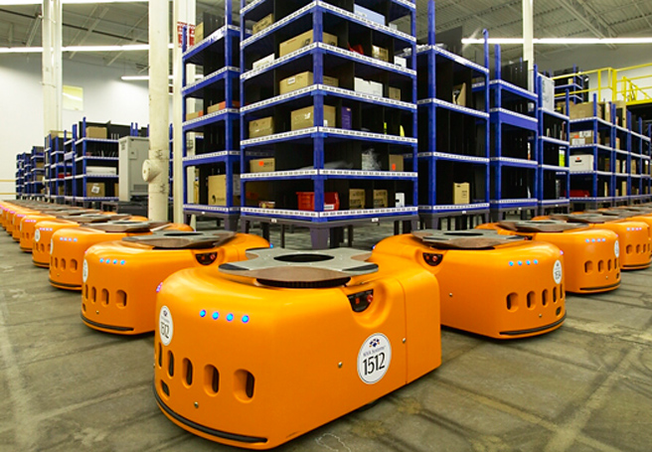
After Amazon bought Kiva Systems  and their utilitarian orange automated guided vehicles in 2012 folks really glommed onto the idea that "Saaay, there might be something to this robotic warehouse stuff."
https://www.engineering.com/Portals/0/BlogFiles/tomspendlove/Oct2013/kiva%20robots.png

Kiva's founder, Mick Mountz had worked at the poster child of the dotcom boom, the grocer Webvan, and thought Webvan's failure was due to material handling problems. So he started working on warehouse automation.

At about the same time Ocado was founded as an online-only grocery retailer and saw the same problems that Mountz was attempting to solve and worked on them, to the point that these days Ocado presents itself to investors as a tech company while still maintaining the consumer-facing grocery delivery business.

Back to Amazon's Kiva acquisition: It excited a lot of entrepreneurial dreams and here are some of the results and the reason that Ocado's stock (OCDO.L), which has tripled in the last year may be imperiled if management doesn't keep their eye on the ball.

From Nanalyze, August 3:
Really good science fiction movies help us imagine a more exciting future, where giant robots engage in combat for our viewing pleasure or there’s a cure for baldness. These films also remind us just how far those fantastic visions are from our more mundane reality. By now we should all own flying cars and be able to control machines with our minds. At the very least, we hoped by now to have artificially intelligent robots catering to our every whim. It turns out we’re not far off from that particular future, at least when it comes to buying stuff. 

Retail automation through robotics and AI is changing the way our consumption society consumes. On one end, machines can predict the sort of useless stuff we like to buy online, while at the other end, robots are delivering said useless stuff to our front doors. Even when forced to buy something from an actual store, autonomous check-out solutions ensure the possibility of interacting with a human is relatively low. Behemoth retailer Amazon (NASDAQ:AMZN) put retail automation technology in the spotlight with the 2012 purchase of Kiva Systems, a company which developed warehouse robots and related technologies, and which was acquired for $775 million. 

Now known as Amazon Robotics, based in Boston, the wholly owned subsidiary combines “autonomous mobile robots, sophisticated control software, language perception, power management, computer vision, depth sensing, machine learning, object recognition, and semantic understanding of commands.” All of that so you can get stuff made in China delivered to you in days, if not hours. A number of startups have attempted to fill the hole created when Amazon snatched up Kiva, some of which we profiled in our feature on industrial warehouse robots. Companies we’ve profiled like inVia Robotics, which has raised $29 million in funding, are developing warehouse robots that can work right alongside humans, giving rise to a term called cobots. (Most of that funding came just days ago in the form of a $20 million Series B round.) Let’s look at some other startups working on warehouse robots. 

Warehouse Robots for Fulfillment Centers
Click to go to company website
If you’re going to have to collaborate and work alongside a robot, it might as well be one named Chuck. Chuck is a warehouse robot from a Boston-based startup called “6 River Systems”, which has raised $46 million, including a $25 million Series B at the start of the year. The co-founders had both previously worked for Kiva Systems, now Amazon Robotics, so they had something of a track record before starting the company in 2015. The startup claims that Chuck, which looks a bit like a treadmill with the readout awkwardly stuck in the middle, is technologically similar to autonomous vehicles, with sensors like LiDARs and machine learning algorithms for cloud-based navigation and control.

Meet Chuck from 6 River Systems
The company says 70 percent of warehouse operations are still mostly manual, so there is plenty of work for Chuck. The warehouse robot actually comes in a couple of different sizes and configurations to handle various tasks. Chuck seems like the most bro-ish cobot of the crowd, designed to work closely with its human slave associate while telling off color jokes and hitting on chicks.
Warehouse Robots for On-Demand Grocery Delivery
Click to go to company website
A three-year-old company called CommonSense Robotics out of Tel Aviv, Israel, raised $20 million earlier this year in a bid to take a piece of the on-demand grocery market. The Series A in February brought total funding to $26 million. CommonSense appears to be engaged in a version of urban guerilla warfare, with plans to operate out of existing retail spaces no bigger than 10,000 square feet in the middle of cities, rather than in cavernous warehouses on the outskirts. So, it’s not selling its low-profile warehouse robots, but instead contracting with retailers to put together orders for them directly in what CommonSense calls micro-fulfillment centers. The Israeli company has designed robots that maneuver through tightly packed stores, picking up totes filled with groceries that a human then packs for delivery. More robots then take those packaged items to a dispatch area.

Credit: Commonsense
While the robots are outfitted with sensors, a central computer actually coordinates the complex choreography for the entire system, learning where to make improvements, such as relocating popular items to make them more easily accessible for the tiny robot army. The company claims that its warehouse robots can fill the average order in less than five minutes, about 10 times faster than a human, according to TechCrunch. And probably without crushing the Charmin.
Of course it’s not just startups like CommonSense thinking about filling grocery orders using robots. Walmart is spending heavily on robotics technology, and just 13 hours ago, announced that they’re going to use a robotics solution for online ordering called Alphabot. It’s being built by a company we haven’t come across before called Alert Innovation, and apparently they designed the solution just for Walmart with an undisclosed amount of funding. From the horse’s mouth:
When completed, automated mobile carts will retrieve ordered items – stored warehouse-style in this new space – then deliver them to our associates at one of four pick stations.
That’ great, because when we used Walmart’s online ordering service a few months back, the tools they had working in the Vancouver Washington store said they didn’t get the +$400 order we posted the day before, and then refused to rectify the problem by filling the order while we stood in the store twiddling our thumbs like a bunch of morons. Told you that would come back to haunt you lads. 
Warehouse Robots that Work in Three Dimensions...
...MUCH MORE

The art of stealing: "The tragic fate of the masterpieces stolen from Rotterdam"

From  NRC Handelsblad (NL)
Olga is on her own. Her son is in prison, being held on suspicion of having committed what they are calling on television ‘the art theft of the century’. She knows that the accusation is correct. Along with friends, her son Radu stole seven valuable artworks from a museum in Rotterdam, loaded them into a car and drove them to Romania.

There, in Carcaliu, a remote village at the poor south-eastern tip of the country, Olga stands in front of the heating stove in the bathroom. A short while ago she lit the fire then stepped out into the biting cold, making her way to the small graveyard opposite her house where, in the dead of night, she dug up the paintings and brought them back inside.

Picasso, Gauguin, Matisse, Monet, Meijer de Haan and Freud. On television they are talking about a loot worth hundreds of millions of euros. The amount is not important to her. The pictures are evidence against her son and destroying the evidence seems like the only way she can help him.
The artworks go up like tindersticks.

Early in the morning of 16th October 2012, seven valuable artworks were stolen from the Kunsthal in Rotterdam. The theft was world news. But what first seemed like a sophisticated burglary by professionals, turned out to be the work of a few small-time Romanian criminals who had no idea what they were getting themselves into. They knew about house burglaries, not art, and they certainly didn’t know about selling art.

This is the story of the Kunsthal robbery, based on the case files and conversations with those involved.

The alarm

Jan Moerer is first awoken by the sound of his mobile telephone ringing, then his landline. It is 04:28 in the morning. The Kunsthal’s production manager gets out of bed but is twice too late to pick up. The missed calls are from colleague Gert-Jan Knoll, the building supervisor. He calls him back.
Still Life with Cornflowers and Carnations
An alarm has gone off. Paintings may have been stolen.

Half an hour later, Moerer is walking through the building with two security guards. The Van Gogh is the first thing he sees as he enters the exhibition space. Still Life with Cornflowers and Carnations, one of the Triton collection’s key pieces, is still where it should be. It is a painting of an exuberant bouquet of flowers that Van Gogh painted in 1887, a blue vase with blue cornflowers against a blue background. Jan Moerer is relieved.

Then they turn the corner. Seven empty spaces.

The Kunsthal, literally meaning ‘art hall’, on the periphery of the Rotterdam city centre does not have its own collection and isn’t really a museum in the traditional sense of the word. The Kunsthal is dependent on artworks loaned by other art galleries and private collectors. Each year, 160,000 people visit the temporary exhibitions set up in three large rooms, collectively a space of 3,600 square metres.

At the Kunsthal there are no security guards at night – cameras and alarms do all the work. Mobile guards from the security company Trigion can be on the scene in twenty minutes if the alarms are triggered. The police are alerted too.
That night, Mehmet Karadurdu and Jordy Rook are driving through a rainy Rotterdam on their inspection rounds of the various companies that buy into Trigion’s services. At 03:20 they get a call from the control room. A burglar alarm has gone off at the Kunsthal on the Westzeedijk. Their PDAs show them the quickest route to the building. When they arrive eleven minutes later, the police are already on the scene. It had taken the officers just five minutes to get to the Kunsthal.
The Kunsthal is a labyrinthine building full of glass partitions, which signalled architect Rem Koolhaas’s international breakthrough. It is constructed so that some of the works are visible from the outside, like a kind of showroom. When they arrived, the policemen walked around the outside of the eccentric building. They didn’t notice that any of the paintings were missing. They were primarily looking for signs that would point to a break-in. There aren’t any, they tell the newly-arrived Trigion security guards. The officers ask whether they need to stay. No, if there are no signs of a break-in, they can go, the guards tell them. Nine times out of time it’s just a false alarm....
....MUCH MORE

Saturday, August 4, 2018

“All credit card PIN numbers in the World leaked”

From DataGenetics:

PIN Analysis
A good friend of mine, Ian, recently forwarded me an internet joke. The headline was something like:
“All credit card PIN numbers 
in the World leaked”
The body of the message simply said 0000 0001 0002 0003 0004 …

Ian’s messages made me chuckle. Then, later the same day, I read this XKCD cartoon. The merging of these two humorous topics created the seed for this article.
http://www.datagenetics.com/blog/september32012/xkcd.png
What is the least common PIN number?
There are 10,000 possible combinations that the digits 0-9 can be arranged to form a 4-digit pin code. Out of these ten thousand codes, which is the least commonly used? 

Which of these pin codes is the least predictable?
Which of these pin codes is the most predictable?

If you were given the task of trying to crack a random credit card by repeatedly trying PIN codes, what order should you try guessing to maximize your chances of selecting the correct number in the shortest time?

If you had to make predication about what the least commonly used 4-digit PIN is, what would be your guess?

This tangentially relates to the XKCD cartoon. In Randall’s cartoon, the perpetrator’s plan backfired because his selected license plate was so unique that it was very memorable. What is the least memorable license plate? Ask any spy you know (snigger) what the best way to blend into a crowd is. Their answer will be not stand out, to appear “normal”, and not be notable in any way.

If you had to make predication about what the least commonly used 4-digit PIN is, what would be your guess?

People are notoriously bad at generating random passwords. I hope this article will scare you into being a little more careful in how you select your next PIN number.
Are you curious about what the least commonly used PIN number might be?
How about the most popular?
Read on …
...MUCH MORE 

"Everyone is racing to build a killer meme-making tool"

Not the future we were promised.

From The Atlantic:

https://cdn.theatlantic.com/assets/media/img/mt/2018/07/Image_from_iOS_2_1/lead_720_405.jpg?mod=1533135147
Last year, Alex, a 19-year-old in California who runs a network of Instagram pages dedicated to publishing memes, became so frustrated with the current apps for making memes that she hired a developer to build her own. She spent $3,000 on the project, which she says has saved her hours of time and frustration.

“I don’t want to say it’s a competitive edge, because at the end of the day that’s not really what determines if a meme does well,” says Alex, whose pages have 5 million collective followers. “But for people who care enough about having memes perfect, it makes a difference.” (Like all members in this story, Alex runs her pages anonymously, and asked to be referred to by her first name only to protect her privacy.)

As memes have increasingly dominated social platforms like Instagram, the methods for making them remain largely rudimentary. Many large accounts on Instagram treat Twitter as a content-management system for laying out images with text, but that comes with huge limitations. As memes become increasingly visually complex, they’re forcing meme makers—from professionals who run massive pages, to amateurs, to those just starting out—to rely on a patchwork of unreliable photo-editing tools.

“I use four apps to make a meme,” says Andy, who runs the Instagram meme page @heckoffsupreme. “There’s not one app I can go to for everything I need, not even close.”
“It’s ad hoc,” says Terry, who runs the page @socialpracticemafia and has used a slew of photo- and video-editing apps to make memes. “You know the term bricolage? It’s basically making due. It’s like that.”

Years ago, when classic macro-memes with Impact font—like Success Kid, Condescending Wonka, and Business Cat—became popular, there were tons of easy online meme generators. Unfortunately, as memes have evolved, the majority of top meme-making apps in Apple’s App Store have failed to adopt to more modern formats, rendering them semi-useless.

“You’d only use one of those now to be ironic about how terrible they are,” Terry says....MUCH MORE
At least I'll always have my CryptoKitties. Besides being cute as can be, I was told:
CryptoKitties Sales Hit $12 Million, Could be Ethereum’s Killer App After All 

"How to beat LinkedIn: The Game"

From The Outline:

A strategy guide for using a semi-pointless social network in all the wrong ways.
Since its founding in 2002, LinkedIn has quickly become one of the most popular video games of all time. It currently has roughly 530 million users, and was purchased by Microsoft in 2016 for $26.2 billion, the same company that also purchased two other trendy games, Minecraft (2014) and GitHub (2018).

For those unfamiliar, LinkedIn is a 2D, turn-based MMORPG that sets itself apart from its competitors by placing players not in a fantasy world of orcs and goblins, but in the treacherous world of business. Players can choose from dozens of character classes (e.g., Entrepreneurs, Social Media Mavens, Finance Wizards) each with their own skill sets and special moves (Power Lunch; Signal Boost; Invoice Dodge). They gain “experience” by networking, obtaining endorsements from other users, and posting inspirational quotes from Elon Musk.

The general goal of LinkedIn (the game) is to find and connect with as many people on LinkedIn (the website) as possible, in order to secure vaguely defined social capital and potentially further one’s career, which allows the player to purchase consumer goods of gradually increasing quality. Like many games, it has dubious real-life utility. The site’s popularity and success, like that of many social networks, depends heavily on obfuscating this fact. This illusion of importance creates a sense of naive trust among its users. This makes it easy to exploit.

To novices, the game appears to be open-ended, and impossible to “beat” in any clearly defined sense. But it is, in fact, possible to win at LinkedIn. I have done so, and you can too, by following this short strategy guide.

One: Create The Ultimate Businessman
The most important part of winning LinkedIn is creating the perfect profile. Set your location to New York, San Francisco, or Los Angeles (the only three cities that matter) — or better yet, just describe yourself as “bi-coastal.” Juke your qualifications with high-powered finance jobs and an ivy league school or two (more on this later). Steal a headshot from the Real Businessmen Tumblr to use for your profile photo, and insert stock photos of people shaking hands and taking meetings to both exude power and demonstrate that you’re no stranger to making high-powered deals.


...MORE

Who knew?

"Chocolate, bioterrorism and the birth of Brazilian funk"

“…For, after all, I had been into cocoa a bit myself. That was back when The Great Winfield had discovered cocoa trading. Occasionally in those more leisured days I would sit with him lazily watching stocks move, like two sheriffs in a rowboat watching catfish in the Tennessee River….”
-'Adam Smith', Supermoney
From engadget:
Is a plot to topple the aristocracy to blame for the collapse of cacao in Brazil? 
In the 1990s, the cacao farmers of Brazil fell into a collective depression. Some hanged themselves, others dosed themselves with rat poison, still others walked around crying and saying they didn't have anything to eat. The cacao pods on orchards throughout Bahia sat stagnant on their branches, rotting from the inside out. A coven of foreign, tightly gnarled stalks covered the trees themselves. The country had been the world's third-largest producer of cocoa beans, but it had fallen from grace and even had to import beans from West Africa to satisfy its residents' sweet tooth. 
Juliana Pinheiro Aquino remembers it well. "My father was depressed. He was very sad," she said.
About a century earlier, her great-grandmother's brother, Firmino Alves, had founded the city of Itabuna and started the tradition of farming cacao in Bahia. "He called all his friends to help him," Aquino said, describing the land rush of the late 1800s. Alves and his friends grew fabulously wealthy thanks to cacao and the mass of workers who helped them farm it. "Cacao was like the golden fruit," Aquino said, "so everyone was raised with a lot of money."

Aquino spent the first few years of her life on the Pinheiro family's large-scale farm, living near her celebrity uncle who used his wealth to buy several Ford dealerships. Then, after a falling out, her father bought his own farm, Fazenda Santa Rita. When witches' broom hit, Aquino said that within a couple of years, they had lost their entire fortune.

Her family wasn't alone. More than 200,000 people lost their jobs. Bahia experienced a mass exodus as people flocked from the farms to nearby cities, creating overpopulation and, with it, poverty and crime: Brazil now boasts 17 of the world's 50 most dangerous cities, which historian Claudio Zumaeta linked directly to the collapse of cacao. Meanwhile, parts of the rainforest were wrecked and Bahia's biodiversity irreparably affected as farmers razed their trees to control the disease.

How could devastation happen on such a definitive level, especially in an area that had been farming cacao for more than 100 years? Two words: Moniliophthora perniciosa. The fungus causes a disease called witches' broom that spells disaster for cacao farming, systematically transforming healthy trees into possessed messes with rotting pods and nasty-tasting beans.

Witches' broom isn't native to Bahia. Rather, it grows more than 1,200 miles away, in the Amazonian rainforest. The first farmers to discover the disease in their trees encountered it in an unconventional way: "I found two cocoa trees with dry witches' broom tied onto them in the middle of their trunks," José Roberto Benjamin, a farm owner in Camacan, tells the camera in the documentary The Knot. Others discovered it the same way, as if, in an act of bioterrorism, the disease was introduced intentionally.
It turns out, it was.

The government investigated by evaluating the disease's entry points (the middle of farms rather than natural boundaries like rivers), and in a 1989 report called "The Report of the First Occurrence," it concluded that the outbreak of witches' broom "cannot be attributed to natural agents of dissemination. ... It makes it possible to believe that the pathogen was introduced by human hands." The trouble was, it didn't know whose.

Then, in 2006, Luiz Henrique Franco Timoteo, a supporter of the leftist Workers' Party (PT), confessed in a startling article in Veja magazine. The idea, he said, had come from Geraldo Simoes, a leading member of the PT who worked at the Comissao Executiva do Plano da Lavoura Cacaueira (CEPLAC), the governmental agricultural agency responsible for Brazil's cocoa-growing regions. Timoteo said that as part of a group of five PT militants (all of whom, besides for him, worked at CEPLAC), he helped introduce the disease to farms to wrest power from the wealthy landowners, destabilizing the area and allowing the oppressed lower classes to have their day.

After all, there was a lot of resentment about the wealth of the so-called cacao colonels -- the owners of large plantations -- compared to the lives of the farm workers. "Cacao elites used to say that the best doctor in the area was Varig and Vasp, which were the two airlines that would take you out of town," said Mary Ann Mahony, a professor of history at Central Connecticut State University. "In the '80s there was no running water, no indoor plumbing, no electricity, nothing."

"Anytime we had health problems, we would go to Salvador or Sao Paulo," Aquino remembered about living in Itabuna, near the farm. When she was three years old, the family moved away from the area: It was the norm for farm owners to live in a bigger city while a manager and hired hands took care of the farm. Aquino moved into a "big apartment" with her grandmother in Salvador and attended private school there. Both she and her brother had cars, and her brother went to "the best university in Brazil for agronomic engineering" and then to California for an exchange program. "We didn't live in luxury, but we had everything we wanted," Aquino said.

Yet compared to most of the workers on her father's farm, she lived like a queen. "They were very poor," Aquino recalled. "They wouldn't know how to read and write." Mahony recalled seeing payroll sheets from the 1970s where workers "were signing with their fingerprint because they were illiterate."

Novelist Jorge Amado describes the scene aptly in his book The Golden Harvest. Ilheus is "a city of money and cabarets, of dauntless courage and dirty deals."...
...MUCH MORE

Friday, August 3, 2018

Mr. Bond, Your New Car Is Here: MotorTrend Takes The 2019 DBS Superleggera For A Spin

This looks like fun.

Sticking with the spy theme, MotorTrend, July 31:

2019 Aston Martin DBS Superleggera First Drive: Glorious. Glorious. Glorious.
The Aston We’ve Been Waiting 104 Years For  

Image result for 2019 Aston Martin DBS Superleggera First Drive: Glorious. Glorious. Glorious.
At what point does emotion overtake logic? Inductive logic can be as simple as premise + premise = reasonable conclusion. Many flowers are red; most flowers smell good. Therefore red flowers should smell good. That's easy enough, until you realize that titan arum, aka the corpse flower, blooms a deep red but smells like a locked dumpster that's been sitting outside a Las Vegas Arby's for the entire month of August.

Logic can therefore be tricky, especially, I'd argue, in the case of overwhelmingly beautiful sports cars. The Aston Martin DBS Superleggera is fist-chewingly gorgeous; cars with 715 horsepower are fabulous. Obviously then, the DBS Superleggera is the Aston Martin we've all been dreaming about since we loved our first car. Or is it? Only a black-hearted cynic could deny this brute's charms, and then only out of spite. However, in the interest of a fanboy's attempt at journalism, let me at least walk you through the trial before I deliver the verdict.

Friends, it's Marek Reichman's world; we're just living in it. Even though he won't follow me back on Instagram, Aston's chief creative officer just hit a royal flush while the rest of the industry is shouting, "Go fish." I'm sorry, but with the notable exception of the DB4 Zagato, I think this new DBS is the most beautiful Aston Martin since ever. It's a riveting design, blood pumping, jaw dropping, sweat inducing. I'll save you the list of each and every physical reaction caused by Reichman's latest and greatest, but rest assured, the car moves you.

The hard nose is exquisite, the front three-quarters a masterpiece. The side profile smartly apes the aforementioned DB4 Zagato, but in loving homage, not slavish facsimile. And those hips! Sinful is putting my feelings mildly. If I have a single gripe, it's with the Superleggera's Teutonic rear end, specifically the gaudy 144-point A S T O N M A R T I N spelled out like a chrome billboard. I understand the argument: Customers in emerging luxury markets (Hi, China!) aren't always sure what they're looking at so the signage is needed. But with a design this strong, it's not needed. Plus it looks tacky. Thankfully, fishing wire and Goo Gone are cheap. Did I mention how small and perfect the taillights are?...
...MUCH MORE

"How Silicon Valley Became a Den of Spies"

We looked at the Russian Consulate last December (link below) but right now one of the more interesting bits o'espionage going on is the Chinese thirst for GE's and Westinghouse's nuclear secrets.
Here's some good open-source background on both country's efforts from Politico, July 27:

The West Coast is a growing target of foreign espionage. And it’s not ready to fight back.
SAN FRANCISCO—In the fall of 1989, during the Cold War’s wan and washed-out final months, the Berlin Wall was crumbling—and so was San Francisco. The powerful Loma Prieta earthquake, the most destructive to hit the region in more than 80 years, felled entire apartment buildings. Freeway overpasses shuddered and collapsed, swallowing cars like a sandpit. Sixty-three people were killed and thousands injured. And local Soviet spies, just like many other denizens of the Bay Area, applied for their share of the nearly $3.5 billion in relief funds allocated by President George H.W. Bush.

FBI counterintelligence saw an opening, recalled Rick Smith, who worked on the Bureau’s San Francisco-based Soviet squad from 1972 to 1992. When they discovered that a known Soviet spy, operating under diplomatic cover, had filed a claim, Smith and several other bureau officials posed as federal employees disbursing relief funds to meet with the spy. The goal was to compromise him with repeated payments, then to turn him. “We can offer your full claim,” Smith told the man. “Come meet us again.” He agreed.

But the second time, the suspected intel officer wasn’t alone. FBI surveillance teams reported that he was being accompanied by a Russian diplomat known to the FBI as the head of Soviet counterintelligence in San Francisco. The operation, Smith knew, was over—the presence of the Soviet spy boss meant that the FBI’s target had reported the meeting to his superiors—but they had to go through with the meeting anyway. The two Soviet intelligence operatives walked into the office room. The undercover FBI agents, who knew the whole affair had turned farcical, greeted the Soviet counterintelligence chief.
“What,” he replied, “You didn’t expect me to come?”

We tend to think of espionage in the United States as an East Coast phenomenon: shadowy foreign spies working out of embassies in Washington, or at missions to the United Nations in New York; dead drops in suburban Virginia woodlands, and surreptitious meetings on park benches in Manhattan’s gray dusk.

But foreign spies have been showing up uninvited to San Francisco and Silicon Valley for a very long time. According to former U.S. intelligence officials, that’s true today more than ever. In fact, they warn—especially because of increasing Russian and Chinese aggressiveness, and the local concentration of world-leading science and technology firms—there’s a full-on epidemic of espionage on the West Coast right now. And even more worrisome, many of its targets are unprepared to deal with the growing threat.

Unlike on the East Coast, foreign intel operations here aren’t as focused on the hunt for diplomatic secrets, political intelligence or war plans. The open, experimental, cosmopolitan work and business culture of Silicon Valley in particular has encouraged a newer, “softer,” “nontraditional” type of espionage, said former intelligence officials—efforts that mostly target trade secrets and technology. “It’s a very subtle form of intelligence collection that is more business connected and oriented,” one told me. But this economic espionage is also ubiquitous. Spies “are very much part of the everyday environment” here, said this person. Another former intelligence official told me that, at one point recently, a full 20 percent of all the FBI’s active counterintelligence-related intellectual property cases had originated in the Bay Area. (The FBI declined to comment for this story.)

Political espionage happens here, too. China, for example, is certainly out to steal U.S. technology secrets, noted former intelligence officials, but it also is heavily invested in traditional political intelligence gathering, influence and perception-management operations in California. Former intelligence officials told me that Chinese intelligence once recruited a staff member at a California office of U.S. Senator Dianne Feinstein, and the source reported back to China about local politics. (A spokesperson for Feinstein said the office doesn’t comment on personnel matters or investigations, but noted that no Feinstein staffer in California has ever had a security clearance.) At the Aspen Security Forum last week, FBI director Chris Wray acknowledged the threat Chinese spying in particular poses, saying, “China from a counterintelligence perspective represents the broadest, most pervasive, most threatening challenge we face as a country.”

Making it even more complicated, said multiple former U.S. intel officials, many foreign intel “collectors” in the Bay Area are not spies in the traditional sense of the term. They aren’t based out of embassies or consulates, and may be associated with a state-owned business or research institute rather than an intelligence agency. Chinese officials, in particular, often cajole or outright threaten Chinese nationals (or U.S. citizens with family members in China) working or studying locally to provide them with valuable technological information.

“You get into situations where you have really good, really bright, conscientious people, twisted by their home government,” said a chief security officer at a major cloud storage company that maintains sensitive government contracts. U.S.-based Chinese employees of this company have had Chinese government officials attempt to “leverage” these individuals’ family members in China, this person told me. The company now requires employees working on certain projects to be U.S. citizens.
As Silicon Valley continues to take over the world, the local spy war will only get hotter—and the consequences will resonate far beyond Northern California.
And yet, it’s not clear that the Bay Area—historically famous for its liberalism, and now infamous for its madcap capitalism—is prepared to handle this escalation and these new tactics. Tech firms, especially start-ups, lack incentives to report potential espionage to U.S. officials; and businesses and universities are often ignorant about the espionage threat, or so attuned to local political sensitivities they may fear being accused of stereotyping if they attempt to institute more stringent defensive security and screening measures....MUCH MORE
Late last year Foreign Policy published "The Secret History of the Russian Consulate In San Francisco".

We used that post as a wrap for a couple earlier stories:
October 29
"Twitter’s multi-million dollar US election pitch to RT revealed in FULL" 

And:
September 13
Russians RETALIATE For San Francisco Consulate Closure
They have a very deep understanding of the Amerikanskiy psyche....  

....And how did the Russkies retaliate for the closing of their San Francisco consulate with the beautiful view?
https://gdb.rferl.org/5760DE5D-C406-4D4D-AC13-DFB2A55C996E_cx0_cy8_cw0_w1023_r1_s.jpg
From the Associated Press:

Russia reduces parking spaces at US consulates 
MOSCOW (AP) — Russia has withdrawn parking privileges for U.S. diplomats, an apparent continuation of a diplomatic tit-for-tat between Washington and Moscow.

State-owned television channel Rossiya 24 reported on Wednesday that parking spaces outside the U.S. consulate in St. Petersburg had been painted over with a pedestrian crossing, and special parking signs had been removed outside the U.S. consulate in Yekaterinburg, near the Ural Mountains.

Diplomatic tensions between the U.S. and Russia are at their lowest level since the Cold War...MORE
Yeah, they understand Americans.

Some Bacteria Are Becoming Tolerant of Alcohol-Based Hand Sanitizers

Alcohol tolerance.
Aye, soon the wee alkies* will be trying to scrounge a drink by sidling up and telling their version of why Def Leppard's drummer lost his arm.
Yeah, yeah heard it before, make it a cheap one, "uh, Bell's please".

From National Public Radio's Goats and Soda:

Some Bacteria Are Becoming 'More Tolerant' Of Hand Sanitizers, Study Finds
In the early 2000s, hospitals across Australia began installing more hand-sanitizer dispensers in their rooms and hallways for staff, visitors and patients to use. Research showed these alcohol-based disinfectants helped battle staph infections in patients and certain kinds of drug-resistant bacteria. And rates of these infections went down.

But other infections didn't drop when people started using the sanitizer stations. In fact, certain infections went up.

In particular, enterococcal infections — caused by bacteria that affect the digestive tract, bladder, heart and other parts of the body — started increasing.

This wasn't only happening in Australia. Countries around the world saw rises in this type of infection even as hand sanitizer became more popular. Globally, enterococci make up ten percent of bacterial infections acquired in the hospital. In North America and Europe, they are a leading cause of sepsis, a deadly blood infection.

Now, researchers say, they may have found the cause. Blame it on the alcohol.

New research published by Science Translational Medicine on Wednesday shows that several strains of these bacteria have begun adjusting to alcohol-based hand sanitizers. They're not resistant to the alcohol — at least, not yet — but they're becoming "more tolerant" of it, the authors write. That means the bacteria were able to survive for longer periods of time after being doused with alcohol....MORE
I swear I am close to pulling a Howard Hughes, bathing in surgical scrub juice and wearing Kleenex boxes as disposable shoes.

https://simpsonsscreenshots.files.wordpress.com/2011/10/get-these-kleenex-boxes-off-my-feet.png
 *Went with the spelling used by Glasgow's Daily Record in their story "SCHEMING ANTICS OF BEEB BOSSES":
...Instead, they pounced on a cynically skewed view of a Scotland they understand - a drug-addled hell full of benefit scroungers and alkies - faster than you can say social welfare....