Wednesday, October 11, 2017

Weather Events In Great Britain and Ireland In the Years 1300-1399 (the Martin Rowley, booty.org.uk files)

We found two more pages of Mr. Rowley's "lost" website (see here for some background).
Discovery of this page is particularly gratifying as it was the impetus for the revelation the British Library did not have the website readily available and the subsequent search to see whether we had stored any of the pages.

The 14th century was especially brutal in Europe; from the 1315-1317 famine to the Black Death to the 1337 – 1453 Hundred Years War. For folks wondering whether the 21st century could be any worse the answer is yes, yes it could.

Tomorrow we'll post 751 - 999 but that I fear, will be that, meaning upwards of a dozen pages covering 1200 years are lost.
Finally, as noted in the introduction to the 1000 - 1099 page:

CHMW/Lamb) is Hubert H. Lamb, historian and founder of the Climatic Research Unit at the University of East Anglia with CHMW being one of his books: Climate, History and the Modern World, 1982.

main historical menu
<<<<1200 - 1299
(T: warm/cold events; R: dry/wet events; S: 'stormy' events)
 DateTRS Description Ref:
 1300 -1399
 First third 14th century (Winters)[ Researchers suggest that the frequency of 'severe' winters across Britain during the first three decades of this century was unusually high. Also, analysis of agricultural records, estate reports, tax returns etc., also points to frequent wet / cool summers with failures of harvests and impact on survival of livestock. Probably by extension applies at least to continental NW Europe. See individual entries below ... not exhaustive!] 25, x
 1302/1303
(Winter)
 A cold winter in western Europe / implied for parts of Britain. (Easton, in CHMW/Lamb) 1
 1305 A hot, dry summer (London/South). Modern researchers think that the summers of the first decade of the 14th Century were often dry or very dry & probably often warm as a result; as often happens though, this 'fine' mini-era followed a spell in the mid-1290s when summers were less than ideal with possibly one or two chillier such-named seasons. [See: 'Weather', May 2014, Pribyl] 8
 1305/06
(Winter)
 Severe winter (London/South). A severe winter over much of western Europe. (Easton, in CHMW/Lamb): taking these two last entries together suggests a high frequency of blocked / anticyclonic episodes. 1, 8
 1309/10 London Bridge arches damaged by ice during a severe winter. Thames frozen. A possible frost-fair on the Thames in London; which implies a persistent length of sub-zero temperatures at some time this winter (inferred by the statement in some chronicles that 'sport' was held on the river). Usual stories about people walking across the Thames. According to contemporary reports " dancing took place around a fire built on the ice and a hare was coursed (chased) on the frozen waterway ". 8
 1314-1316 Several famines occurred during these years (weather assumed to have been responsible, with all three years noted by various historians as 'very wet' ... it's a moot point though as to whether all three were really wet, or just the effects of one or two carrying over). Brazell says that the famine of 1316 was probably the last really severe one in England, and historians have estimated that over this period, approximately half-a-million people died (roughly 10% of the population) of causes related to famine, which represented approximately 10% of the population. [ The wet year credited to 1315 may be the origin of the St. Swithin legend. ]
The 'Black Death' (Bubonic plague) that ravaged the country 1348 onwards may have some linkage to these precursor conditions - though it is a long time afterwards. Certainly though, in the mid-1300's, mortality was high due to famine, disease etc.
It is suggested that it was an increase in climatic variability, rather than the absolute temperature & rainfall regimes that caused the problems. There is some suggestion of an increase in extreme events (including wind-storms), however defined. Some evidence that as well as excessively damp conditions, temperatures were depressed.
[Additional references: Lucas, 1930: "The Great European Famine of 1315, 1316 and 1317"; Kershaw, 1973: "The great famine and agrarian crisis in England, 1315-1322" and others ]
 8
 1315/1316
(Winter)
 A cold winter in western Europe / implied for parts of Britain. (Easton, in CHMW/Lamb) 1
 1318
(March)
 A storm noted as having affected both the Netherlands & England - 23rd (OSP). GOTT
 1320
(Summer)
 Wet, cool summer and disastrous harvest. [from ... www.tree-ring.co.uk/Timeline.htm; haven't found any other sources for this.]
[The period 1313 - 1323, with exceptions (see 1321 below) are though to have been categorised by indifferent-to-poor summers, with low TEMPERATURES and above-average RAINFALL; reported in 'Weather', May 2014, Pribyl]
 (see text)
 1321 Hot, dry summer (London/South). 8
 1323/1324
(December/
January OSP)
 At Stepney, a sequence of damaging floods began on New Year's Eve 1323 (OSP), with a "mighty flood proceeding from the tempestuousness of the sea, which overflowed all the banks; as the waters ebbed they tore a great breach in the wall, allowing subsequent tides to flow across the land." [Dugdale 1662: The History of Imbanking and Draining 2nd Edition, London 1777), quoted in reference.] 25
 1324
(Summer)
 Drought in summer (London/South). Possibly the start of ten or so years of warm, often dry summers [As noted in 'Weather', May 2014, Pribyl]. 8
 1325 & 1326 Severe droughts: rivers & springs dried up & in both years the Thames was so low that sea water penetrated much further up river than usual - for 1326, noted as 'salty' for nearly the whole year (presumably in London). 8
 1330
(December)
 Roofs Blown Off at Croxden Abbey, 23 December 1330 (OSP) From the Croxden Chronicle . . . " On the night preceding Christmas Eve at twilight, a very strong wind blew up from the west, and took the roofs off the Abbey buildings and from buildings throughout the country in a terrifying way. It tore many of them from their foundations and uprooted oaks in the woods, and countless apple trees and pear trees in the gardens, in a remarkable way."
Reference: William Salt Library The Abbey of St Mary, Croxden, Charles Lynam, including extracts from The Croxden Chronicle [Staffordshire] http://www.staffspasttrack.org.uk/exhibit/weather/december.html
[This may be the same storm that brought down the steeple of Wrexham church (St. Giles); the whole church was re-built. ]
 web
 Spring 1331 In the spring of 1331, there was a drought which lasted 15 weeks, but a few days before 17th June(OSP), when a tournament was due to commence at Stepney, the drought was broken and 'all the ground was thoroughly watered'. 8
 1334 Tidal flood on the Thames on the 22nd November(OS). (presumably due to wind-driven surge?) 8
 1335
(Annual)
 This year may have been a wet year, but there may be confusion with the floods reported for 1334 (above). 8
 1338
(Autumn -
early winter)
 Very wet from October to December. 8
 1338/39 Hard frost started in December and lasted for 12 weeks. (London/South). Also, from the 'Annals of Dublin' (http://www.chaptersofdublin.com) .. "So great a frost was this year (AD 1338) from the 2d of December to the 10th of February, that the river Liffey was frozen over so hard as to bear dancing, running, playing foot-ball, and making fires to broil herrings on. The depth of the snow that fell during this frost, is almost incredible; yet it is agreed, that such a season was never before known in Ireland". 8,
op. cit.
 16th January 1342 This gale destroyed the tower of the Church of Friars Minor in London, and occurred at night. It was associated with a violent thunderstorm - so almost certainly a tornadic event - though of course it may have been associated with a more widely-based cyclonic development. 8
 1342 "A Great drought (in summer)": southern Britain certainly, but not known if it was nationwide. 1
 1344 Norwich/East Anglia: at some time in this year, this from Norwich cathedral records . . ." A very high wind, by which the passage-boat coming from Yarmouth was sunk near Cautley, and 38 people perished." x
 1346
May
 At the Battle of Crécy (dated as 26th August/OS), in NE France, it is claimed that the occurrence of heavy rain / thunderstorm prior to the battle, and the subsequent cloud clearance & bright (low-angle) sunshine was somehow instrumental in the victory gained by the English forces of Edward III over the combined French / Genoese army of Philip, King of France. It is suggested that the damp crossbow strings of the Genoan mercenaries were no match for the English longbows, and that the bright sunshine caused problems for the French forces. I would have thought it might be something to do with better organisation. x
 1348 Wet autumn & winter. 8
 1352 (or perhaps 1353) Drought, with exceedingly dry summer. Doubts about which year this statement applies to. An ecclesiastical record from Winchester (Bishopric) notes that there was a 'great heat . . . lasted for the whole summer' and ' meadow . . . not mown due the heat and the drought in summer', in Wargrave (Berkshire); and from same source we have . . . ' spring corn was short and grew badly due to the drought': this in Farnham (Surrey). Modern researchers have attributed this to 1352. [Titow J, 1960: Evidence of weather in the account rolls of the Bishopric of Winchester]
> This may have been part of a period in the 1350s that are thought to have experienced benign (or perhaps dry/drought - warm) summers; not necessarily a 'good' thing of course to a society that required to live off the produce of the land.
 8
 1353/54 Long, cold, hard winter lasting from early December to mid-March (London/South). 8
 1356 Dry spring. (London/South). 8
 1357
(December)
 Storm/flood - 24th (OSP)? GOTT
 1360
(April)
 NOTE! This applies to Paris but I've included it because it is such a famous 'nearby' event, and it must imply that the airmass was unusually cold across at least the southern British Isles.
"Black Monday: or Easter Monday, 1351, when hailstones fell that killed both horses and men in the army of Edward III., from the extreme cold. (This would have been 5th April according the Julian calendar in use at the time & also note that this applies to Paris, not Britain!).
 x
 1362 A wet year. 8
 January 1362 " St. Mary's Wind ": A severe gale / storm (at least as powerful as that of October 1987) from between south and west commenced on the 15th (23rd new-style) January 1362 and lasted for about a week - affecting large areas of southern Britain. A large number of buildings were blown down or damaged, including St. Pancras Church, the church of Austin Friars in London, Norwich cathedral and the (original) Abbey Gateway in St. Albans. Damage also to shipping. The "exceptionally 'severe gale' caused great destruction - buildings, towers, trees, wind-mills etc., all 'thrown down' according to contemporary chronicles. Noted by English, Scottish & Irish sources.
The "Great Drowning" ('Grote Mandrenke') causing widespread / severe damage across SE Britain - also along the East Coast, and as 60 Danish 'parishes' are noted as having been 'swallowed up' by the sea, with several thousands dead there, it suggests a rapidly-deepening low moving swiftly across southern Britain and the southern North Sea with a high storm-surge event.
(Might have been a sequence of events I would have thought, with perhaps the main-event on the 15th). This storm is regarded as the severest on record for the area, with the exception of that in November 1703 & possibly October 1987.
 7, 8
 1362/63 &
1363/64
(Winters)
 Cold or Severe winters; frost from December to March in the second winter (London/South), which is regarded as the worst of the two when taking the whole of western Europe (Easton in CHMW). 1, 8
 1368 (or perhaps 1369) A wet year: there is some doubt about the year. 8
 1370s
(Decade)
 Modern researchers believe that this decade often experienced DRY or VERY DRY summers. [Lamb & others/see 'Weather' May 2014, Pribyl] (See text)
 1373
(or perhaps 1374)
(February - March)
 Norwich cathedral records: " A deep snow in February that laid upon the ground seven weeks, and on thawing occasioned a great flood." Given that the listing is under 1373, it may be that in fact the event refers to early 1374, given that church records around this time usually noted the year as beginning around Easter. x
 1374
(October)
 Storm/flood - 9th (OSP); probably affected English coastline, certainly affected Dutch coastal communities. GOTT
 1375
(October)
 Storm/flood - 8th or 10th (OSP); probably affected English coastline, certainly affected Dutch coastal communities - where noted as a 'terrible storm'. GOTT
 1375 Exceptionally warm year (in London/South). 8
 December 1382 The flood which occurred in December 1382 prevented the King (Richard II / 5 years on the throne) from travelling from Westminster to Windsor where he had proposed to spend Christmas. This sounds like a pluvial flood, due to high rainfall (or melted-snow). Whether the 'court' was travelling overland or along the river isn't known to me. Heavy rain is noted from 18th to 20th December(OSP).
(Richard II .. credited with introducing the handkerchief !)
 8
 1384
(Summer)
 Possibly a major drought, at least for areas based on the SE of Britain: it was reported that streams/springs dried up and "the deepest wells" also failed. The dry episode is noted as having lasted until early September (the reference has 8th September OS). [Westminster Chronicle 1381-1394 (Hector & Harvey, 1982) (See text)
 1390s
(Summers)
 Possibly a series (or at least a higher-frequency) of warm, dry summers. x
 1392 Severe thunderstorms in London on 3rd September. 8
 1393
(January)
 Storm/flood 21st/22nd (OSP). GOTT
 1393/1394
(Winter)
 A cold winter in western Europe / implied parts of Britain. (Easton, in CHMW/Lamb) 1
 1398/1399
(Winter)
 A cold winter in western Europe / implied parts of Britain. (Easton, in CHMW/Lamb) 1
main historical menu
1400 - 1499 >>>>

Tuesday, October 10, 2017

"Wall Street Journal Reporter Sentenced to Prison by Turkish Court"

Following up on our earlier look at the wannabe Caliph: "Today's Word Is Irredentist: 'Mosul and Kirkuk are Turkish cities' - Erdogan regime begins paving its way for Iraq".

From the Wall Street Journal:

Conviction on terrorist propaganda charges highlights government’s increased targeting of journalists; reporter to appeal decision
A Turkish court sentenced Wall Street Journal reporter Ayla Albayrak to two years and one month in prison Tuesday, declaring her guilty of engaging in terrorist propaganda in support of a banned Kurdish separatist organization through one of her Journal articles.

The conviction of Ms. Albayrak, who is currently in New York, highlights the increasing targeting of journalists in Turkey, where President Recep Tayyip Erdogan’s government has gained attention for deteriorating media freedoms.

“This was an unfounded criminal charge and wildly inappropriate conviction that wrongly singled out a balanced Wall Street Journal report,” said Wall Street Journal Editor in Chief Gerard Baker. “The sole purpose of the article was to provide objective and independent reporting on events in Turkey, and it succeeded.”

Ms. Albayrak plans to appeal the decision.

“Given the current climate in Turkey, this appalling decision shouldn’t have come as a surprise to me, but it did,” said Ms. Albayrak.

Turkish legal actions against Ms. Albayrak began after the publication on Aug. 19, 2015, on the Journal’s website of her article “Urban Warfare Escalates in Turkey’s Kurdish-Majority Southeast.” The story and an accompanying video reported on the state of a conflict in Silopi, Turkey, between Turkish security forces and the outlawed Kurdistan Workers’ Party, or PKK. It included interviews with the local mayor and residents, a Turkish government official, as well as a representative of an organization Turkey says is the youth unit of the PKK.

Turkey, along with the U.S. and the European Union, consider the PKK a terrorist organization....MUCH MORE

"Amazon is exploring ways to deliver items to your car trunk and the inside of your home"

Last Amazon story today.
From CNBC:
  • Amazon is in advanced talks with Phrame, a smart license plate maker, to ship packages to your car's trunk, CNBC has learned.
  • The company is also developing a smart doorbell device for safe delivery to the home, sources said.
  • Amazon is attacking "porch pirates," who steal packages from doorsteps.
astAmazon has almost perfected speedy delivery to your home. Now the company is working to make sure your packages get inside the front door, or even into your car.

The company is in advanced talks to forge a partnership with Phrame, a maker of smart license plates that allow items to be delivered to a car's trunk, according to a person with knowledge of the potential deal. Phrame's product fits around a license plate and contains a secure box that holds the keys to the car. Users unlock the box with their smartphone, and can grant access to others — such as delivery drivers — remotely.

At the same time, Amazon is developing a smart doorbell device that would give delivery drivers one-time access to a person's home to drop off items, said two people familiar with the matter. The sources asked not to be named because the discussions are confidential.

The new initiatives are part of Amazon's effort to go beyond convenience and fix problems associated with unattended delivery. As more consumers shop online and have their packages shipped to their homes, valuable items are often left unattended for hours. Web retailers are dealing with products getting damaged by bad weather as well as the rise of so-called porch pirates, who steal items from doorsteps. Amazon also has an incentive to reduce the number of lost packages, as they can be costly.

"Unattended delivery is the least desirable of last-mile fulfillment options as it leaves the package exposed to all kinds of risk," said Natalie Berg, an analyst at Planet Retail RNG. "It's not just the financial cost but also the impact that a failed delivery can have on brand reputation and customer loyalty. Nothing makes shoppers more irate than missing a delivery."

Amazon, UPS and other delivery companies don't disclose data on lost packages. But according to the smart doorbell maker August, 11 million U.S. homeowners had a package stolen in 2016, and a survey by Shorr Packaging showed 31 percent of U.S. shoppers have experienced package theft....MUCH MORE
Earlier:
"Amazon Energy? Amazon Looks To Deploy Drones To Recharge Electric Cars And Other Vehicles" (AMZN)

Today's Word Is Irredentist: ""Mosul and Kirkuk are Turkish cities" - Erdogan regime begins paving its way for Iraq"

Irredentist:

A person advocating the restoration to their country of any territory formerly belonging to it.

Of course, in that part of the world and points east, claims are only allowed if they post-date 622* or so. Anything earlier is dismissed. But the history goes back so far and it gets so confusing that even The Concise History of Afghanistan runs to 25 volumes.
I do like the history of the Göktürks; in addition to their name being a football exhortation it is also long umlauts (diaereses).

Moving on, the headline story via Fort Russ:

October 10th, 2017 -
- Breakingnews.sy - - translated by Samer Hussein -
The Turkish newspaper Yeni Akit, a propaganda mouthpiece with very close ties to the head of the Turkish regime Recep Tayyip Erdogan, published an article, claiming that the Iraqi cities of Mosul and Kirkuk are Turkish because they were once occupied by the Ottoman Sultan Abdul Hamid II.

The newspaper claimed that Sultan Abdul Hamid ll held ownership over many important areas in Iraq, including 104 square kilometers and 807 hectares of land in Karbala, and 489 square kilometers and 557 hectares of land in Kadhimiya and Samarra.

The newspaper noted that Sultan who ruled between 1876-1909 sought to strengthen the Ottoman Empire in the wake of the potential foreign occupational campaigns and thus attempted to seize and secure as many land as possible.

The article of Yeni Akit likely comes as a response to the recent Iraqi Kurdistan independence referendum which was gravely opposed by the Erdogan regime.

Many now fear Erdogan will exploit the referendum for his territorial ambitions in Iraq and turn its outcome in his favour by deploying his forces to Kirkuk.

It is noteworthy that Kirkuk, itself an ancient Assyrian city, is now a major hub of the Iraqi Turkmen minority.

This is not the first such controversial article published in Turkey in recent time.

Last year, Erdogan's Anadolu News Agency published an article, citing data from the archived Ottoman documents, according to which, there used to be at least 7763 records of Turkish properties in the Iraqi city of Mosul, dating back 169 years.  
Meanwhile, the newspaper Gerçek Hayat (itself a subsidiary of Yeni Shafaq, another notorious Erdogan regime mouthpiece), proclaimed Turkey as the owner of the whole Middle East.
—original source

Of course this is all complicated by  Erdogan's ethno/sectarian/political hatred of the Kurds and the oil.
The oil.
From the AP via Military Times:
Iraqi VP warns of 'civil war' over Kurdish-held Kirkuk

And the Financial Times, Sept. 22: 
Kurdish independence referendum raises the stakes in Kirkuk
...But Masoud Barzani, the KRG president, has vowed to go ahead with the poll and Kirkuk, a territory claimed by the Kurdistan region and Baghdad, is braced for the possibility that it will be a flashpoint in the push for independence.
This sprawling city, choked with cement blast walls, has been battered by years of violence — fuelled by the blessing and the curse of its large oil reserves. “My big fear is not September 25th. It is the day after the 25th,” says Ismail al-Hadidi, an elderly Arab sheikh and former Kirkuk council member. “We fear the possibility of clashes . . . It could be the beginning of the splitting of Iraq.”

Both the KRG and Baghdad consider Kirkuk’s oil critical to their economic survival. And both can stir the loyalties of local communities to their side, risking clashes that would reverberate throughout the nation and the region just as foreign powers hoped Iraq could start to heal from the destruction caused by Isis.... 
The question is, now that the West is done using the Kurds to defeat ISIS do they throw them to the wolves or do they back the Kurds against fellow NATO member Turkey?

The Kurds best bet is probably to talk nice to the Iranians and the Russians or maybe buy a nuke on the second-hand nuke market and take a hint from Repin on how to deal with Caliph wannabes.
Last seen in December 2016's "Turkey's Erdoğan Backs Down In Battle Of Wills With Putin":
...The precedent is already established, the one used in "Reply of the Zaporozhian Cossacks", see below....
... And back to the Cossacks. A couple weeks ago we posted "Little Has Changed Between Turkey, Russia Despite Reconciliation" with this introduction:
Whenever I think about Turkish-Russian relations I think of this painting:
https://upload.wikimedia.org/wikipedia/commons/7/79/Ilja_Jefimowitsch_Repin_-_Reply_of_the_Zaporozhian_Cossacks_-_Yorck.jpg
... That's "Reply of the Zaporozhian Cossacks" by Repin, hanging in the State Russian Museum, St. Petersburg.

As the story goes, in 1676 the Turkish Sultan, despite being beaten by the Cossacks when he tried to invade what is now southern Ukraine, demanded these guys surrender and submit to Turkish rule.

As can be seen, the Cossacks thought this was the funniest thing they had ever heard and wrote a letter in response.
A very profane, very defiant, very vulgar, very contemptuous letter.

These old boys just cracked themselves up with their letter.
And that's what I think of when I think of Russians and Turks.
And now, Kurds and Turks

*
https://upload.wikimedia.org/wikipedia/commons/a/af/East-Hem_600ad.jpg

"A Stanford battery based on sodium may offer more cost-effective storage than lithium"

We've been tracking battery technologies for a long time and if pressed to condense the lessons learned into one sentence it would be: "Scaling up is hard".
That said we keep an eye on developments, as Intel's Andy Grove once said: "Success breeds complacency. Complacency breeds failure. Only the paranoid survive."

From Stanford News Service:
Industrial forecasts predict an insatiable need for battery farms to store renewable energy like solar and wind. Lithium ion batteries may remain tops for sheer performance, but when cost-per-storage is factored in, a Stanford design based on sodium ions offers promise.
By Tom Abate
As a warming world moves from fossil fuels toward renewable solar and wind energy, industrial forecasts predict an insatiable need for battery farms to store power and provide electricity when the sky is dark and the air is still. Against that backdrop, Stanford researchers have developed a sodium-based battery that can store the same amount of energy as a state-of-the-art lithium ion, at substantially lower cost.

Chemical engineer Zhenan Bao and her faculty collaborators, materials scientists Yi Cui and William Chueh, aren’t the first researchers to design a sodium ion battery. But they believe the approach they describe in an Oct. 9 Nature Energy paper has the price and performance characteristics to create a sodium ion battery costing less than 80 percent of a lithium ion battery with the same storage capacity.

“Nothing may ever surpass lithium in performance,” Bao said. “But lithium is so rare and costly that we need to develop high-performance but low-cost batteries based on abundant elements like sodium.”

With materials constituting about one-quarter of a battery’s price, the cost of lithium – about $15,000 a ton to mine and refine – looms large. That’s why the Stanford team is basing its battery on widely available sodium-based electrode material that costs just $150 a ton.

This sodium-based electrode has a chemical makeup common to all salts: It has a positively charged ion – sodium – joined to a negatively charged ion. In table salt, chloride is the positive partner, but in the Stanford battery a sodium ion binds to a compound known as myo-inositol. Unlike the chloride in table salt, myo-inositol is not a household word. But it is a household product, found in baby formula and derived from rice bran or from a liquid byproduct of the process used to mill corn. Crucial to the idea of lowering the cost of battery materials, myo-inositol is an abundant organic compound familiar to industry.

Making it work
The sodium salt makes up the cathode, which is the pole of the battery that stores electrons. The battery’s internal chemistry shuttles those electrons toward the anode, which in this case is made up of phosphorous. The more efficiently the cathode shuttles those electrons toward and backward versus the anode, the better the battery works. For this prototype, postdoctoral scholar Min Ah Lee and the Stanford team improved how sodium and myo-inositol enable that electron flow, significantly boosting the performance of this sodium ion battery over previous attempts. The researchers focused mainly on the favorable cost-performance comparisons between their sodium ion battery and state of the art lithium. In the future they’ll have to look at volumetric energy density – how big must a sodium ion battery be to store the same energy as a lithium ion system.

In addition, the team optimized their battery’s charge-recharge cycle – how efficiently the battery stores electricity coming in from a rooftop solar array, for instance, and how effectively it delivers such stored power to, say, run the house lights at night....MORE
HT: Futurity

Regarding paranoia we noted in relation to NVIDIA, who just today announced the first board capable of being the brains for Level 5 autonomous vehicles, unassailable if any tech position is:

November 21, 2016
Artificial Intelligence: What Could Derail NVIDIA? A Lab in Shenzhen; A Basement in Moscow; An Office in Bristol (NVDA)

"Ola is stocking up its war chest in India while Uber struggles with its worst nightmare"

There's an outside chance Uber will be sent packing from countries containing half the world's population.
And have to compete for the other half.

From Quartz:
Ola has just landed some serious firepower to take on Uber in one of Asia’s most closely fought ride-hailing markets.

Bengaluru-based Ola has raised $400 million (Rs2,612 crore) from Chinese internet giant Tencent, according to a Sept. 20 filing with the registrar of companies.

This is possibly part of a $2 billion funding round that Ola is in the midst of closing, media reports suggested, citing anonymous sources. The company has already raised around $150 million from two US-based hedge funds and $50 million from the UC-RNT Fund of former Tata group chief Ratan Tata in partnership with the University of California’s investment arm. The remaining amount is to come from Japan’s Softbank, the Business Standard newspaper reported. Ola and Softbank declined to comment.

Ola’s valuation after the latest funding round is unclear, but the highest it reached was $5 billion in November 2015.

The timing of this round is critical for Ola as arch rival Uber is now widely expected to splurge in India following its exit from China last year. The San Francisco-based firm has said that it would allocate a “significant portion” of the $1 billion earlier meant to be spent in China to India instead.
With money in the bank, Ola is now ready for Uber.

“It (the funding) creates a formidable competitor for Uber, which can match its deep pockets and has the advantage of understanding the Indian market better than Uber does,” Vivek Wadhwa, a distinguished fellow at Carnegie Mellon University, told Quartz. “I am betting on Ola.”...
...MORE

Meanwhile in Singapore Uber is making mini-movies for branding.
From the advertising mavens at The Drum:

Creative works APAC featuring Brandmovers, Creativeland Asia, BBH, Ogilvy & more
Welcome to The Drum's APAC Creative Works.

As always, this section is dedicated to showing the best creative work and gives you, the reader, the chance to decide which work we feature as our APAC 'Creative Work of the Week.'

We've now introduced our new five-star voting system. To vote for your favorite, make sure you click on the stars. The winner be chosen based on the average rating and the number of votes cast. Voting closes on Tuesday 17 October.

For project information, credits and more hover over the 'i' icon or expand to full screen....MORE
Uber: Where is more than just a place by BBH Singapore
Uber's first film in its first brand campaign in Singapore aims to show the emotions within the locations in its map.

Using a story that harks back to Singapore's first military roots, while celebrating a creative future - it tries to show two very different stories behind the 'Gillman Barracks' location.

The film by BBH will be shown on social media channels, such as YouTube and Facebook, while also being shown in cinemas across Singapore....MORE

Showing the emotions behind the locations makes for a beautiful ad but man, Didi and Ola are bringing serious cash.

Stanford Engineering: Lives Lost in Mexico Quake Could Have Been Saved

From ABC (US) News:
Warm lighting would enhance the wood floors' natural glow, the developer promised, so when all the custom lightbulbs burnt out, Anahi Abadia and her husband grudgingly drove to Home Depot to replenish supplies for their chic new flat in southern Mexico City.

They had just reached the register when the earthquake hit, shaking the store so fiercely the structure screeched. Minutes later, a text came in from their neighbor: The elegant apartment they had purchased only six months earlier had collapsed, rendering their new home a pile of crushed concrete.
They were among the fortunate: Two women working in their building and dozens more perished on Sept. 19 in structure failures that several prominent engineers now say could have been prevented. 

Nearly two-thirds of the 44 buildings that fell in Mexico City were designed with a construction method called flat slab — in which floors are supported only by concrete columns — now forbidden in parts of the United States, Chile and New Zealand according to data compiled by a team of structural engineers at Stanford University and obtained by The Associated Press.

Mexico City officials were widely lauded for tightening their building codes after thousands died in the 1985 earthquake. But they left out one crucial reform: a prohibition on the building technique that caused 61 percent of the building collapses in last month's magnitude 7.1 quake, which killed 369 people and blanketed tree-lined avenues in rubble.

"I keep thinking about what would have happened if I had still been in bed that afternoon." said Abadia, 26, who was in her bedroom that morning recovering from thyroid cancer, dreaming of furnishing the home she and her husband moved into in March. "That was where we used to feel safe."

The concrete slabs used to build floors and ceilings can be cast to include some rebar for reinforcement, and give builders greater flexibility in room layout and allow for higher ceilings.
But in an earthquake, without reinforced concrete walls or lateral bracing to resist forces pushing structures sideways, buildings with that design can move too much. The columns, and connections between the slabs and columns, can easily break, prompting collapse, as was the case at a school where 26 people died, most of them children.

"We have known for 30 years that this system killed lots of people, so why are we still using it?" asked Eduardo Miranda, a professor of civil and environmental engineering at Stanford and global expert on earthquake-resistant design who compiled the data. "The right decision after '85 would have been to completely ban this kind of construction. We could have saved lives."...MUCH MORE

"Amazon Energy? Amazon Looks To Deploy Drones To Recharge Electric Cars And Other Vehicles" (AMZN)

This is approaching "Bored Elon Musk" levels of silliness. (see also below)

The amount of electricity the drones would be able to transmit is so trivial that the idea is approaching onionesqe levels. More on that tomorrow.

From CB Insights:
Amazon has patented a way for drones to provide "in-flight refuel" to vehicles — which might help resolve the charging-infrastructure challenge facing EVs.

As our vehicles become more automated and battery powered, we’ll spend less time at the fuel pump and less money on gas. But even electric cars — or bikes, or boats for that matter — can run out of juice, and charging stations aren’t widely available yet.

UAV rendering from patent
With a newly granted patent, Amazon could use the drones from its Prime Air fleet to keep you and your Tesla from getting stranded if you cruise too far out of town.

The e-commerce giant just won approval for an invention that would allow it to use its drone fleet to deliver energy to vehicles, both at rest and while they move — just like fighter jets refuel large aircraft in flight.

As electric vehicles (EVs) get cheaper, they’re growing increasingly appealing to American consumers: US sales of EVs were up 37% in 2016 compared to the year prior, according to data from InsideEVs.

At-home charging is often touted as a benefit for EVs over gasoline cars, but access to charging stations limits their mobility on longer trips: even the most energy-efficient EVs on the market can only go around 200 miles on a full charge, but the US has only around 16,000 public electric vehicle charging stations (compared to ~112,000 gas stations, as of 2015).

Those factors converge into a problematic scenario: Sales of EVs are accelerating so rapidly that sources like Bloomberg New Energy Finance have warned the US will hit an “infrastructure cap” in the mid-2030s due to a lack of charging stations.

With its new drone fuel-delivery patent, Amazon could help solve the charging problem for EV automakers … and potentially create a highly valuable product for the owners of the ~130,000 new EVs that hit the road last year.

Stranded no more
Knowing that vehicle-power depletion “may result in an adverse user experience,” Amazon patented a way to deploy its drone fleet to rescue vehicles with draining energy reserves: US patent 9778653 details a method whereby “uncrewed autonomous vehicles,” or UAVs, can:
  • locate energy-deficient vehicles based on transmitted data signals
  • dock with energy-depleting vehicles (while stationary or while they move)
  • and transfer energy to re-up depleting vehicle power.
The patent envisions UAVs attaching to vehicles via a docking mechanism comprised of various connectors. The patent illustrations show the docking mechanism affixed to the roof of the vehicle, but the patent says the dock could be located elsewhere (such as on a door or trailer hitch)
As with most patents, the filing makes no mention of offering the drone-refueling invention as a saleable product, so it’s possible that this tech could be used exclusively inside Amazon’s logistics operation. Yet the patent also claims a wide variety of applications for the technology, signaling that Amazon recognizes the commercial potential for on-demand energy delivery.
For one, the patent makes clear that the drone-refueling concept is not limited to EVs, pointing out that UAVs could transfer many forms of energy — including traditional fuels — to any “mobile machine that uses energy to move from one location to another.” (In addition to cars and trucks, the patent notes that a UAV could be used to refuel a bus, motorcycle, boat, aircraft, or even another UAV.)

Charging electric cars, however, provides the clearest use case for the invention.

As detailed in the illustration below, the systems that manage and monitor an EV’s energy use (and reserves) would communicate with a server to request and receive energy. The vehicle’s system would determine whether the amount of energy stored in its rechargeable battery is sufficient to get the vehicle to its desired destination, and if not, the vehicle’s technology would send up an “energy request” to a server....MORE
Previously in Amazon patents:

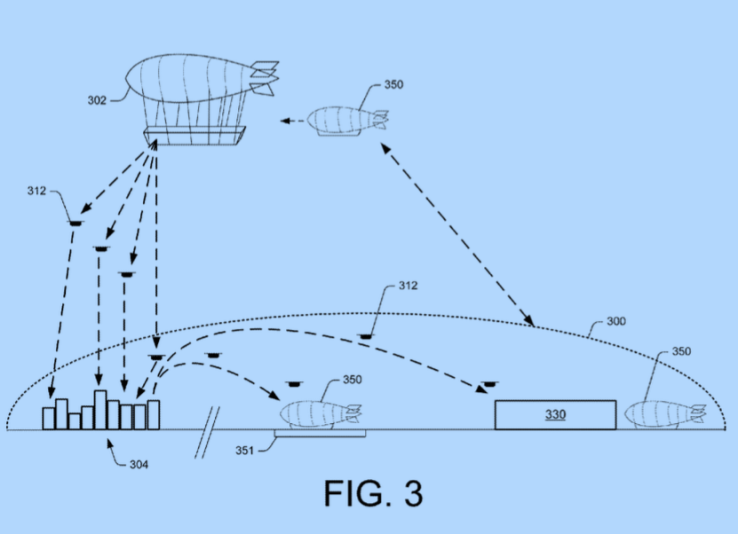
Airborne Alexa? Amazon Patent Reveals A Delivery Drone That Will Talk To You"
https://tctechcrunch2011.files.wordpress.com/2016/12/amazon_airborne_fulfillment_center_patent.png?w=738

A new patent indicates that the ‘intermodal vehicles’ could be used to meet consumer demand 

 https://cdn.vox-cdn.com/thumbor/iPgX9nUEp-v7dgxcaiZm3wWJ7Vo=/0x0:1006x674/920x613/filters:focal(299x223:459x383)/cdn.vox-cdn.com/uploads/chorus_image/image/56074039/Screen_Shot_2017_08_06_at_9.07.58_AM.0.png
Just in Time For The Whole Foods Announcement, Amazon Gets A Patent on In-Store Anti-Price-Comparison Technology (AMZN)

Walmart-Amazon Battle of the Blimps (AMZN; WMT)

"Amazon Wants to Build a Network of Mobile Drone Maintenance and Delivery Platforms" (AMZN)

...I do like the steampunk-retro Montgolfier Bros/Henri Giffard stylings of the the Amazon airships:


And many more.

And, from BEM:

FX: "Dollar Pullback Extended"

From Marc to Market:
The US dollar's advance faltered before the weekend after rise average hourly earnings and a new cyclical low in unemployment and underemployment initially fueled greenback buying. There is no doubt the data was skewed by the storms, though the upward revision to the August hourly early cannot be attributed to the weather distortions. The reversal in the dollar before the weekend has carried over into the early trading this week. Even the Turkish lira, which had been battered yesterday amid a diplomatic squabble with the US, is firmer today, though there is no resolution at hand.

The dollar reached a high at the end of last week nearJPY113.45, a nearly three-month high, before reversing and finishing on it lows before the weekend nearJPY112.65. It dipped below JPY112.35 yesterday and is trading near there now. Support is seen near JPY111.75. The main driver of the dollar-yen exchange rate continues to be US Treasury yields. The yield on the 10-year note is nearly six basis points below the pre-weekend peak of 2.40%, which is the upper end of the six-month range.

Meanwhile, the momentum behind the "Party of Hope" has begun fading. The party is not running sufficient candidates unseat the LDP, and a new party, formed from the rump of the Democratic Party of Japan, called the Constitutional Democratic Party, led by former Cabinet Secretary Edano is attracting support. The takeaway is that although there may be an underlying desire for an alternative, it will not be satisfied in the upcoming election.

At the same time, a new corporate scandal has exploded in Japan. One of the largest metal producers admitted to falsifying reports of the strength of a durability of its aluminum and copper products that are used for aircraft and autos. Kobe Steel lost more than a fifth of its value today. The Topix gained nearly 0.5% to reach a fresh two-year high. Separately, the August current account was considerably larger than expected. This reflects not only the trade account and tourism but more importantly, the income from overseas investments. The current account surplus of JPY2.38 trillion compares with a surplus of JPY1.97 trillion in August 2016.

In the UK, May's contingency for Brexit without an agreement won praise from her hard Brexit wing, at the same time as she recognized a role for the European Court of Justice in a transition phase. Brexit wrestles with the outlook for UK monetary policy as a driver for sterling. Last week, sterling's drop was a function of politics as the expectations for a hike in November were little changed. This week, the estimates of high unit labor costs (lower productivity), and today's news of stronger industrial output (0.2%), and especially manufacturing (0.4%), with a recovery in construction (0.6%) helped keep sterling's recovery intact....
...MORE

The dollar index is down 0.30 at 93.20

"How UBS Became Home to Half the World’s Billionaires"

Simply, first rate.

From Bloomberg Markets, October 3, 2017:
The CEO of UBS, Sergio Ermotti, is a trader at heart. Yet the most recent chapter of his career begins with the investment banker overhauling an investment bank. It’s 2011, and he’s just been named interim chief executive officer of a Swiss bank that’s no longer quite so secretive, that’s still reeling from the financial crisis, and that’s been tarnished by a rogue trader’s $2.3 billion loss.

Ermotti quickly embarked on a Matterhorn-size strategic shift that downplayed the company’s investment banking and asset management efforts to focus on building the world’s largest wealth manager. The resulting stability and credibility has made UBS Group AG such a model that investors now value the bank at a premium to its European rivals, several of which have attempted to deploy versions of Ermotti’s playbook. Asked if there’s a limit to how big UBS can grow from an assets perspective, Ermotti says, “If I look at the size of some of our asset-management competitors, it doesn’t look like it.” In two recent interviews, Ermotti discussed his strategic vision, the role technology will play in shrinking the bank over the next decade, and a regulatory landscape so inhospitable that it’s like “they’re living on a different planet”—which could someday even mean the Swiss bank reconsiders its Swissness.

BLOOMBERG MARKETS Almost half the world’s billionaires bank with you. That’s a distinct set of clients. What have you learned from them?

SERGIO ERMOTTI It’s always fascinating to hear how they became so successful. When you look at billionaires, many of them share one characteristic: They were not born billionaires. I was in Asia recently, where I met a few, and they have quite impressive stories. It feels like the American dream, only it’s no longer just in America. The main lesson for me is that with passion, focus, vision, determination, you can do a lot.

BM Which trait most stands out?

SE You see a lot of passion for what they do. And the same level of focus. It’s quite clear that it’s not all about money. Of course some people care about that, but at the end of the day, they enjoy what they do.

BM How much time do you actually spend with clients?

SE Not as much as I would like. The most interesting discussions are actually when we are fortunate enough to bring them together. We organize events where our clients can get together. It’s also a way for them to foster a level of cooperation, of getting to know each other—which is important for business regardless of UBS being involved or not.

BM You’re like Tinder?

SE At these events we are a kind of sophisticated speed-­dating organizer, sure. It adds value for our clients. Take Art Basel. The idea is that people attend because they share a common interest, a passion. And while attending the events, maybe they start to talk about other issues or opportunities.

BM What did you think of UBS before you got here?

SE I thought it was an incredible franchise with almost 150 years of history that had survived a dramatic moment. My predecessors had stabilized things, but it was not clear yet what the path was going to look like going forward. I’ve always been impressed by the fact that, as bad as things got here, only 2 percent of clients closed their accounts. I figured the franchise and the quality of the people who are able to retain the clients during such a crisis must be extremely high. My view was, I want to be a part of this.

BM How would you describe your business today?

SE We are the undisputed global leader in wealth management. We think that this is a huge advantage. It’s a very fragmented market still. And if I look at our position and the growth expectations of wealth creation, which is expected to be twice as high as GDP, we should stay focused on doing this. Sell-side analysts, rating agencies, and the media still consider us an investment bank. I find it totally ridiculous. If you look at where our business comes from, we are basically the world’s most expensive investment bank and its cheapest asset manager.

BM What advice did you get when you arrived here?

SE Some competitors were telling me, “Shut down the investment bank; we’ll serve you.” They wanted to grab flows and build out their business. People also told me to sell Wealth Management Americas. My popularity would have soared, especially in Switzerland; UBS wouldn’t be where it is today; and I doubt I’d still be here. That was a defining moment—to say, These are businesses we can turn around. It was a good reminder that the consensus is not necessarily the right thing to do.

BM Was there a company, maybe even outside your industry, that you looked to for inspiration?

SE Not for strategy. But when I joined, I said I wanted UBS to be the Apple or the IBM of the financial-services industry: from glory, to near-death, and then back to glory.
“What I see in the financial-services industry is people still struggling with their business model”

BM You were briefly interim CEO while the board figured out who would be the best person for the job. How did you approach that role?

SE We were having a difficult time. Because after the big crisis was over, we had the rogue trader incident that was undermining the credibility of our ­recovery. It was a shock internally and externally. My No. 1 question was, Will I have the power to manage the bank? The most important issue was defining our strategy. I knew we had pockets of excellence and that we needed to focus our investments and growth in certain areas. We were starting to develop an understanding of where we may go, and we needed to give our investors and employees a vision for that direction, even if it wasn’t the final direction. I thought if we stayed silent and defensive, we were going to lose talented people and clients. We needed to find a model that was more stable and credible, and that also created value for our shareholders.

BM Was there ever a moment you thought, Maybe getting the CEO job isn’t such a good idea?
SE Never.

BM What gave you that confidence?

SE The confidence was progressive. I spoke with my colleagues and said, “We can regain control of our destiny.” Previously, UBS had been reactive. This was the first moment when we said, “Maybe our strategy can be accelerated, and we’re the ones dictating the acceleration.” We’re not waiting for someone else—a regulator or a shareholder—to tell us what to do. We were top-of-the-class in many areas of investment banking, but we don’t want to compete across the board. We are not a one-stop shop. We want to be seen as a focused investment bank that is very competitive where we choose to compete. My investment banking background—17 years at Merrill Lynch, five years at UniCredit—gave me confidence, and we decided to focus the acceleration into a model I thought could work. After the strategy announcement, people commented that it was like decommissioning a nuclear plant. But I knew it was possible.

BM How do you get everybody else in the organization, or at least the key people, to follow you?

SE That’s a very important point. I wouldn’t have had the confidence if our people and our clients didn’t believe. I think I had their full confidence, and that gave us a tail wind. When you start to get shareholders, clients, employees, rating agencies, and everybody converging, and then your competitors bad-mouth you, you know you did the right thing.

BM Imitation is the sincerest form of flattery. Many of your competitors have since retooled their own strategies to look more like yours. How would you have changed your approach?

SE I wouldn’t have done things any differently today, and I am totally convinced about that. We may be an example for some banks, but I don’t think we can be an example for all banks, because we are quite special. Every bank has to find its own DNA. I knew that we needed to show every quarter—quarter by quarter, no matter the market conditions—that we were serious about our new business model. Of course, we are not printing as much pretax profit and revenue growth, but if I look at return on allocated capital, I don’t believe that we are losing anything, actually. We are protecting our shareholders by not doing businesses that are clearly dilutive and not value-accretive.

BM Is there a limit to how big UBS can grow from an assets perspective?

SE If I look at the size of some of our asset-management competitors, it doesn’t look like it.

BM Speaking of which, your asset-management business is one area in which investors might still like to see better results. Is M&A the way forward?

SE We’d also like to see better results. We’ve exited certain businesses that weren’t adding value or differentiating us. You always need to understand, What’s the trajectory? Everything is open; never say never about anything nowadays. And it’s always our duty to look at any growth opportunity, organic or not. Having said that, the valuation doesn’t indicate that a bank can be a buyer of an asset-management business without being totally wiped out in terms of capital consumption. We are very happy. Our asset management is a low-capital-absorbing business and creates value for us.

BM So it’s less important to compete with the BlackRocks and the Vanguards of the world?

SE No, we can’t compete. It’s like the investment bank. We are competing with the so-called top in all the businesses where we choose to compete. We have to define the competition, and we have to define how we compete by our own targets.

BM So what’s your asset management play going to look like?

SE More focused, for sure. Already today we’re not small. We have around $700 billion of assets under management, more than a third of which—$250 billion—is passive. It’s true, passive is a new trend. We believe that the days of active are not over. It’s changing though. You need to be very good and focus on that. We are playing more the David than the Goliath. I know I can’t go out and compete on size with Vanguard or BlackRock on ETFs. But that’s not what we want to do. We want to have ETFs that are designed to serve certain characteristics....
...MUCH, MUCH MORE

HT: Naked Capitalism

Monday, October 9, 2017

How the Eruption of Bali's Mount Agung Can Create the World’s Most Fertile Soil

Yes, still waiting on Mt. Agung.
The Express has been running what is effectively the "AgungWatch blog" for the last couple weeks with the latest entry being:

Monday October 9
7.16pm: Bali volcano hit by more than 800 quakes yesterday

Earlier in the day, probably a bit bored with watching steam rising from the crater, they linked to The Conversation:
Mount Agung in Bali is currently on the verge of eruption, and more than 100,000 people have been evacuated. However, one of us (Dian) is preparing to go into the area when it erupts, to collect the ash.

This eruption is likely to be catastrophic, spewing lava and ashes at temperatures up to 1,250℃, posing serious risk to humans and their livelihoods. Ash ejected from volcano not only affects aviation and tourism, but can also affect life and cause much nuisance to farmers, burying agricultural land and damaging crops. However, in the long term, the ash will create world’s most productive soils.

Read more: Bali’s Mount Agung threatens to erupt for the first time in more than 50 years

While volcanic soils only cover 1% of the world’s land surface, they can support 10% of the world’s population, including some areas with the highest population densities.
The ring of fire
Indonesia is situated on the Pacific Ring of Fire, a chain of volcanoes that stretches from Sumatra through Java and Bali to Timor, and constitutes the most dangerous of the world’s tectonic interfaces.
Throughout history, Indonesia’s volcanic eruptions have affected the world’s climate, notably the volcano of Lake Toba with its super-eruption around 74,000 years ago, which caused a six-year volcanic winter. Mount Tambora is known for its violent eruption in 1815 causing a year without summer in Europe, and the Krakatau explosion in 1883 also cooled the world.

Read more: Explainer: why volcanoes erupt

The eruption of Tambora, on the island of Sumbawa in 1815 ejected an estimated 160 cubic kilometres of ashes into the atmosphere. This catastrophic event affected population in nearby islands, including Bali. Agriculture was destroyed by ash deposits and shortage of sunlight. It was estimated that the misery lasted 10–15 years before the ashes turned into fertile soils.
The 1963-64 eruption of Mt Agung released 0.95 cubic km of solid volcanic material and lava. Some 1,580 people were reportedly killed by the rapid lava flows and accompanying poisonous gases.
But if a comparable eruption occurred tomorrow, the death toll would be greatly lessened by the warning systems now in place.

Implications for neighbouring countries
Among the constant eruptions of Indonesia’s many volcanoes (66 currently being monitored, and among those 50–60 are considered “active”), huge ones will arrive.
They will be enormously destructive to Indonesia, will impact the world’s climate, and will challenge neighbouring countries such as Australia in manage without air traffic while assisting millions of displaced Indonesians to survive and recover.

Read more: The world’s five deadliest volcanoes … and why they’re so dangerous

Even the moderate ones that are likely to occur every decade, causing dislocations to hundreds of thousands, need to be prepared for in a systematic way.

Volcanoes and population density
In the past decade, volcanoes in various parts of Indonesia have been quite active and erupted, notably Merapi (2010) in Central Java, Sinabung (2014) in North Sumatra, and Kelud (2014) in East Java.

Despite the danger posed by these volcanoes, areas with high volcanic activity also have some of the world’s most fertile farmlands due to release of plant nutrients such as potassium and phosphorus.
Dutch scientist E.C.J. Mohr observed in 1938 that the region near Mount Merapi has higher population densities in areas with soils derived from volcanic ash.
These soils are most probably the reason that Java can sustain high human population densities, estimated at more than 1,100 people per square km. Several years after Mt Galunggung in West Java erupted in April 1982, crop productivity in the local area of Tasikmalaya were boosted.

Volcanic ash, the fertilizer reserve
Dian Fiantis from University of Andalas in Padang is a volcanic ash hunter. She sees volcanic eruptions as an opportunity to study the beginning of how soils formed, a process that could take thousands and even millions of years. She has collected and studied ashes immediately after volcanoes have erupted in Sumatra....MUCH MORE

Elaine Answers the Question: "How do I get my daughter interested in computers?"

From Elaine's Idle Mind:

I get this question a lot, especially from Silicon Valley tech VCs. Tech execs genuinely want to get more women involved in software, but many find themselves thwarted by their very own daughters.
I think I can help.

“I sent my daughter to coding class, but she just isn’t interested.”
The first mistake is in thinking that the child should have any say in the matter. Kids don’t get to have free will, okay. If your daughter announces that she has no interest in learning algebra, would you allow her to forgo maths? Of course not.

FWIW, I learned to code at the local Boys Club (free day care for poor people). This was in the 1980s; I was six and probably hated it. Was my mother concerned about whether this was a gender-sensitive learning environment? No, we were immigrants, we took what we could get.

“My daughter wants to major in photography/journalism/basket-weaving.”
The second mistake is in allowing your child to believe that a career should be fulfilling and fun. The do-what-you-love mythology has led thousands of students to load up on debt for a degree in what amounts to a hobby.

Work isn’t fun. If work was supposed to be fun, they wouldn’t pay you to do it. Software engineering is no different. Yes, we hear about cool projects like self-driving cars and rockets to Mars, but most Silicon Valley engineers are working on boring stuff like server virtualization and load balancers. My first programming job consisted of generating test vectors for network routers. Don’t get me wrong; my current job is great. But it took many years of crap jobs to get here.

The thing I don’t understand is why people keep agitating for more women to do software in the first place. Sure, we get paid well, but so do actuaries and aircraft mechanics. And those workers don’t get put out to pasture by age 35.

More confusing still, is that the people screaming most loudly about getting girls to code are not themselves coders....MORE

Media and Artificial Intelligence: They Will Be As Gods

Or maybe not. Your call.

Here's the story, AFP via PhysOrg, Oct. 7:

Future of news: bracing for next wave of technology
New technologies have disrupted news media over the past 20 years—but one report says that's just the beginning
If you think technology has shaken up the news media—just wait, you haven't seen anything yet.

The next wave of disruption is likely to be even more profound, according to a study presented Saturday to the Online News Association annual meeting in Washington.

News organizations which have struggled in the past two decades as readers moved online and to mobile devices will soon need to adapt to artificial intelligence, augmented reality and automated journalism and find ways to connect beyond the smartphone, the report said.

"Voice interface" will be one of the big challenges for media organizations, said the report by Amy Webb, a New York University Stern School of Business faculty member and Founder of the Future Today Institute.

The institute estimates that 50 percent of interactions that consumers have with computers will be using their voices by 2023.

"Once we are speaking to our machines about the news, what does the business model for journalism look like?" the report said.

"News organizations are ceding this future ecosystem to outside corporations. They will lose the ability to provide anything but content."

Webb writes that most news organizations have done little experimentation with chat apps and voice skills on Amazon's Alexa and Google Home, the likes of which may be key parts of the future news ecosystem.

Because of this, she argues that artificial intelligence or AI is posing "an existential threat to the future of journalism."

"Journalism itself is not actively participating in building the AI ecosystem," she wrote.

One big problem facing media organizations is that new technologies impacting the future of news such as AI are out of their control, and instead is in the hands of tech firms like Google, Amazon, Tencent, Baidu, IBM, Facebook, Apple and Microsoft, according to Webb.....MORE
For our journalist friends I'll note the story changes its tone further on:
These technologies "will give journalists superpowers,
if they have the training to use these emerging systems and tools," Webb writes.

"These hearing implants let you connect your iPhone to your nervous system"

From New Scientist:

Phone calls can be beamed right into your central nervous system
Just what you need in the age of ubiquitous surveillance: the latest cochlear implants will allow users stream audio directly from their iPhone into their cochlear nerve.

Apple and implant manufacturer Cochlear have made “Made for iPhone” connectivity available for any hearing implants that use the next-generation Nucleus 7 sound processor. The advance means that these implants can also stream music and Netflix shows.

The technology was first unveiled in 2014 when it was added to hearing aids such as the Starkey Halo and ReSound LiNX. But this is the first time it’s been linked into the central nervous system.

While some cochlear implants already offer Bluetooth connectivity, these often require users to wear extra dongles or other intermediary devices to pick up digital signals, and then rebroadcast them to the hearing aid as radio. This technology simply beams the signal right into the brain.

It’s also a better way to use Bluetooth. Bluetooth headsets have been commonplace since the early 2000s, but the energy-sapping technology has meant they are typically clunky devices with poor battery life.

In 2014, Apple technicians developed a way to stream audio over the low energy Bluetooth format used by wearables such as FitBits. Now, tiny devices like hearing aids – and Apple’s Airpods — can stream audio signals for up to a week on a battery the size of an aspirin....MORE
HT to, and headline from:The Next Web:

“When Will AI Exceed Human Performance? Evidence from AI Experts.”

From the Future of Humanity Institute at Oxford:
Posted on
This paper reports the results from a large survey of machine learning researchers on their beliefs about progress in AI. The surveyed researchers predict AI will outperform humans in many domains in the next 40 years, such as translating languages (by 2024), driving a truck (by 2027), working in retail (by 2031), writing a bestselling book (by 2049), and working as a surgeon (by 2053). Researchers believe there is a 50% chance of AI outperforming humans in all tasks in 45 years and of automating all human jobs in 120 years.

Asian respondents anticipate these dates much sooner than North Americans. The results of this study will inform discussion on trends in AI development amongst researchers and policymakers.

For more information on the paper and a wider ranging discussion on the subject, please see this post by lead researcher Katja Grace.
Access the full paper

http://aiimpacts.org/wp-content/uploads/2017/06/timelineofairesults.jpeg


Study Finds Americans Do Most Financial Planning When Figuring Out How To Get Money’s Worth At Buffet

From AFNS:

WASHINGTON—Shedding light on how the nation managed its wealth, a study released Thursday by the Pew Research Center revealed that Americans conduct the vast majority of their financial planning when figuring out how to get their money’s worth at an all-you-can-eat buffet. “Our data show that Americans devote the greatest amount of attention to allocating their resources when determining how much value they can wring from the offerings at their local Hometown Buffet or Golden Corral,” said lead researcher Michelle Keene, noting that more than half the study’s participants indicated they would head immediately for big-ticket items like the roast beef, ham, or fried chicken, while approximately 30 percent opted to arrive just as breakfast transitioned to lunch in an effort to enjoy two meals at once....MORE

Corn: "Analysts warn of fast expansion of China’s ethanol gas plan"

From the Asia Times:
Current policy will create long-term demand for corn, and the depreciation of the dollar will also inevitably exacerbate the rise of food prices

According to a recent plan jointly released by the National Development and Reform Commission, the National Energy Administration, the Ministry of Finance and 15 other ministries, China will implement the use of ethanol-added gasoline nationwide by 2020 while targeting large-scale production of ethanol and developing advanced biofuel technologies by 2025, Yicai.com reported.

Analysts have shown great confidence in the sector: National Automotive Ethanol Promotion Leading Group Specialist Joe Yingbin told Yicai that it is currently the best time to expand the scale of ethanol production.

“First of all, China has a huge amount of corn stocks,” Joe said. “Secondly, international crude oil prices have rebounded — it will improve the business profits of ethanol fuel. Thirdly, the import tax rate of ethanol fuel has been raised from 5% to 30%, effectively inhibiting the impact of imported products. These factors show a great reason to expand.”...
...MORE 

"So I was looking at the Fed's 2016 annual report" (Fed IOER payments to big banks)

Following up on Sept. 26's "Questions America Wants Answered: 'Why Pay Interest on Required Reserve Balances? - New York Fed'".

From the Macro Musing's Blog:

From a Floor System to A Corridor System 

So I was looking at the Fed's 2016 annual report and was able to construct the following chart:

https://blogger.googleusercontent.com/img/b/R29vZ2xl/AVvXsEh1nhOtPlNugV5U3fn0u421mu0O385_M0Musf2l_YC4DwXhM64vVDC-81rlqsVxglyGeIzCvfUSOrB9IjSSSP9R5uYu5j8bWefsUk4Ri3a89oMRwV0m_pxWhI4T1jTM6UlPZm_OjpdriDjz/s1600/Screen+Shot+2017-10-08+at+6.44.59+PM.png
Several observations from this figure. First, the sharp growth in the Fed's income is unsurprising as it is a natural consequence of the Fed's QE programs. These large scale asset purchase programs expanded the Fed's assets from around $900 billion in late 2008 to $4.5 trillion today. Moreover, the Fed's portfolio has changed from being mostly short-term treasury securities to one of long-term treasury and agency securities. In addition, the Fed also started paying interest on excess reserves (IOER) to banks during this time. Together, these two developments have effectively turned the Fed into the largest fixed-income hedge fund in the world. Hence, the surge in the Fed's income. 
Second, the Fed's net expenses have also grown rapidly since 2008. Fed officials will point to new financial regulations they have to enforce as the main culprit, but there is arguably a political economy story to the surge as well. Interestingly, this surge accelerated between 2015 and 2016 as seen in the figure. There is no mystery behind this uptick. It is almost entirely the result of the larger IOER payments going to banks as interest rates have gone up. This can be seen in the following numbers:
https://blogger.googleusercontent.com/img/b/R29vZ2xl/AVvXsEjT9a6vPyReO_gJbhVP1JOQg1dM8crdImlxSaj5YqmIG43OtRAWkxT2JU3OJTWiDS5gQuZLZHMe9IYXL762FEUPSxE-wDsGT24fIuryIfwmjl0zaxrOdJQPCM5j8Mjr5lH9mJk3wsFS2Dwi/s1600/Screen+Shot+2017-10-08+at+9.12.58+PM.png
The IOER payments are expected to grow as the Fed continues to tighten policy. Assuming this tightening does not get ahead of the recovery and cause a recession, future IOER payments should grow as seen in this chart from The Economist:
The Fed estimates these payments could hit $50 billion by 2019. And, as a reminder, most of these payments will be going to large domestic banks and foreign banks as they hold most of the excess reserves. This can be seen in the figure below....MORE
If interested see also:
Aug 2014
New Fed Exit Strategy Emerges and Foreign Banks Big Winners
Feb 2016
Negative Interest Rates: Learning From The Swiss and Swedish Examples