Wednesday, April 27, 2022

"Commodity Traders Thrust Into the Spotlight as War Exposes Risks"

From Yahoo via Yahoo Canada, April 26:

The world of commodity traders has long been a secretive one. The merchants who buy and sell the world’s resources have a massive global reach but are mostly privately owned and tend to operate away from public and regulatory view.

Suddenly, it seems that everyone is talking -- and worrying -- about them.

The International Monetary Fund last week noted investors’ concern about traders’ access to credit and said it’s time for regulators to look more closely at commodity markets. The Dallas Federal Reserve recommended the companies take action to increase liquidity. And the Financial Stability Board flagged commodity-market strains -- including the huge margin calls that pressured traders in recent weeks -- as an issue that needs particular attention.

Spiking prices after Russia’s invasion of Ukraine meant a dramatic increase in funding requirements for the companies that move oil, metals and crops around the world. Traders use banks to finance their shipments and as counterparties to derivative hedging positions. There’s now mounting concern that further shocks in commodity markets could shake the wider financial system.

“Much in a way that 2008 shone a spotlight on a whole bunch of institutions nobody had paid much attention to, these unique circumstances that we’re in now have shifted focus onto a new section of financial markets,” said Steven Kelly, a research associate at the Yale Program on Financial Stability.

With the spotlight on commodity trading set to keep getting brighter, here’s a rundown of what to watch and why:

1. Who’s in focus?

The commodity trading industry is dominated by a group of mostly private companies. Glencore Plc -- one of few that is publicly listed -- is the largest trader and also a big miner. Vitol Group is the top independent oil merchant and Trafigura Group leads the group in copper.

Producers, like miners and drillers, also trade physical commodities to varying degrees, and -- like the trading houses -- use derivative positions to hedge against the risk of changing prices.

The surge in commodity prices in the aftermath of Russia’s invasion piled pressure on traders, and several quickly moved to arrange new or expanded credit lines from banks. Traders had already been reeling from volatility in the wake of the pandemic -- for example, ICE Clear Europe saw a margin breach of just over $1 billion in the final quarter of 2021

Since the invasion, a group of European energy traders asked the European Central Bank for emergency funding but got turned down.

2. Why’s everyone so worried?....

....MUCH MORE

Creighton Uni's "Rural Mainstreet Economic Index Remains Healthy...."

Apologies for the delay linking, it appeared and almost immediately disappeared into the link-vault.

From Creighton University's Heider College of Business, April 21:

April Survey Results at a Glance:

  • The overall index moved above growth neutral for the 17th straight month indicating healthy, consistent growth for the region.
  • Farmland prices continue to grow at the fastest pace since the 2006 launch of Creighton’s Bank CEO survey.
  • Regarding President Biden’s emergency waiver of summer ethanol E-15, fewer than 4 of 10 bankers, or 39.1%, expect the move to have a positive impact.
  • On average, bank CEOs estimated that 2.3% of farmers have been involved in cryptocurrency transactions in the past 12 months.
  • More than 9 of 10 bankers expect the Federal Reserve to raise short-term interest rates by one-half of one percentage point at its May 3-4 meetings.
  • Farm equipment sales continue to expand at a robust pace.

OMAHA, Neb. (April 21, 2022) — The Creighton University Rural Mainstreet Index (RMI) fell from March’s healthy reading and remained above growth neutral for the 17th straight month, according to the monthly survey of bank CEOs in rural areas of a 10-state region dependent on agriculture and/or energy.

Overall: The region’s overall reading for April declined to 62.0 from March’s 65.4. The index ranges between 0 and 100 with a reading of 50.0 representing growth neutral.

“The region recorded a 34% gain in farm commodity prices over the past 12 months, but low short-term interest rates and healthy farm income have underpinned the Rural Mainstreet Economy,” said Ernie Goss, PhD, Jack A. MacAllister Chair in Regional Economics at Creighton University’s Heider College of Business.

This month bankers were asked to forecast the impact of President Biden’s emergency waiver on the summer production of E-15 ethanol. Fewer than 4 of 10 bankers, or 39.1%, expect the move to have a positive impact. More than half, or 56.5%, expect the waiver to have little or no impact, with the remaining 4.4% anticipating a negative impact.

Farming and ranching: The region’s farmland price index for April climbed to a strong 80.0 from 78.0 in March, marking the 19th straight month that the index has moved above growth neutral. Over the past several months, the Creighton survey has registered the most consistent and strongest growth in farmland prices since the survey was launched in 2006.

Farm equipment sales: The April farm equipment-sales index declined to 67.6 from 72.2 in March. This was the 17th straight month that the index has advanced above growth neutral. Readings over the past several months are the strongest string of monthly readings recorded since the beginning of the survey in 2006....

....MUCH MORE

"Italian city introduces social credit style system"

And again, what were once conspiracy theories are now headlines.

From Reclaim the Net, April 24:

A pilot scheme.

The Italian city of Bologna is set to launch a social credit score style system, dubbed the “smart citizen wallet.” Participating in the program is voluntary, for now.

According to Corriere di Bologna, users of the “smart citizen wallet” will receive “digital points” for “virtuous behavior,” like recycling. The points can be used for purchases and discounts.

“The citizen will [get rewards] if he recycles; if he uses public transport; if he manages [energy consumption] well; if he does not receive sanctions from the municipal authority; if he actively uses the Culture Card,” said councilor Massimo Bugani.

Bologna’s social credit score will differ from the one in China in two ways; it is voluntary and people will not be penalized for bad behavior. The municipality hopes that by treating the program like a reward card, adoption will increase....

....MORE

Elon Musk's Family Office Guy

 From Reuters via Yahoo Finance, April 25:

When Elon Musk announced his surprise bid for Twitter Inc earlier this month, he said the social media company should reach out to his family office with any questions.

Yet very little is known about the Austin, Texas-based family office that manages the assets of Musk, the world's richest person and CEO of both electric car maker Tesla Inc and aerospace company SpaceX.

The office is called Excession and the man who helped build it is Jared Birchall, a former Morgan Stanley banker who has advised Musk on his interactions with Wall Street for several years, according to regulatory filings and legal documents.

Birchall is also the chief executive of Musk's brain chip firm Neuralink, a director at Musk's tunneling firm the Boring Company and a board member at the billionaire's philanthropic private foundation.

Birchall's multiple roles are uncommon for a family office manager and illustrate Musk's faith in him, said Raphael Amit, a management professor at the Wharton School.

"Once you appoint somebody to run the family office, that means that you trust him. And Elon wants to set it up in a way that allows him (Birchall) maximum control."

Birchall and Musk did not respond to requests for comment.

Born in 1974, Birchall was hired by Musk from Morgan Stanley in 2016 to work for his family office. Business registration records with the Texas comptroller of public accounts list Birchall as the manager of Excession as recently as 2021....

....MUCH MORE

"Why are Russian pundits claiming Romania is preparing to invade Transnistria?"

It's a casus belli.

First up, referring back to February 6ths "The RAND Corporation Blueprint For Forcing Putin To Over-Extend Himself"

I hope that the U.S. or NATO or whoever commissioned this study didn't pay a lot for it, it's basically the strategy that Pope John Paul II, Margaret Thatcher and Ronald Reagan came up with in the early 1980's although the details do differ. The tactical components of the RAND plan are:

 1. Arming Ukraine ;
 2. Increase support for jihadists in Syria;
 3. Promoting regime change in Belarus;
 4. Exploiting tensions in the South Caucasus;
 5. Reducing Russian influence in Central Asia;
 6. Rivaling the Russian presence in Transnistria.

....MUCH MORE

On January 12 Victoria Nuland showed this approach is top-of-mind in the Biden Administration. From Interfax Ukraine:

Nuland: I'm going to let Russians speak for themselves how long they can financially back placement of troops near Ukraine

And from BNE IntelliNews, April 26:

Russian media have been reporting claims by figures including a former minister from Ukraine’s separatist Donetsk region that EU and Nato member Romania is preparing to take Moldova’s pro-Russian Transnistria region by force. 

The bizarre claims were widely reported in the Russian media following the first of a series of as yet unexplained attacks on targets within Transnistria, a Russia-backed separatist region in the east of Moldova, bordering Ukraine. There is no evidence to support them, yet they raise some worrying questions about Russia's future intentions towards Transnistria. 

As reported by bne IntelliNews, after news broke of an attack from a grenade launcher later identified as a RPG-27 Tavolga on the empty headquarters of the Ministry of State Security (MGB) in Tiraspol, the Russian public were inundated with propaganda claiming that Romania has nearly invaded Moldova and is preparing to oppress Russian-speaking nationals in Transnistria.

“Romania, with the support of Nato and with the participation of the Ukrainian army, plans to seize Transnistria and carry out massive political repressions against all supporters of Russia,” Russian daily Pravda announced immediately after the incident in Tiraspol, quoting politologist Sergei Markov.

The so-called expert claimed that the Romanian army has already been deployed in Moldova and forces are being built up.

Earlier, the former minister of defence of the unrecognised Donetsk People's Republic (DPR) in eastern Ukraine, Igor Strelkov, claimed that Romania was conducting covert preparations to capture Moldova.

According to him, a significant part of the Moldovan officers in all headquarters in all key positions have been replaced by officers of the Romanian army.

The unfounded claims have not yet received any official response from Romania, a staunch backer of Ukraine in the war against Russia, as well as a supporter of Moldova, whose economy has been hard hit by the war on its eastern border. 

While they are unlikely to carry any weight in either Moldova or Transnistria, set against observations on the ground, they may help convince some of the Russian public should Moscow be gearing up for action in Moldova. 

Moldova is seen as the most vulnerable country to a potential spillover from the conflict, given its status as a small post-Soviet state, close to the fighting and with part of its territory occupied by Russia-backed separatists. 

Officials in both Chisinau and Tiraspol have so far largely refrained from comments that could lead to an escalation of the situation. While condemning the invasion, the Moldovan government has insisted on maintaining its neutrality and unlike Ukraine, has not been pursuing Nato membership, although it recently applied to join the EU. 

For its part, the government of Transnistria has linked the attacks to Ukraine. The unrecognised republic's President Vadim Krasnoselsky commented on April 26: "I assume that those who organised this attack have the goal of dragging Pridnestrovie into the conflict."

Tensions between Chisinau and Moscow increase 

However, tensions between Chisinau and Moscow have increased in the last week, after Russian Brigadier General Rustam Minnekayev said on April 22 that the Russian army plans to take Ukraine's Donbas region, then create land corridors to both the Crimea and Transnistria.

"Since the beginning of the second phase of the special operation, which has already begun, literally two days ago, one of the tasks of the Russian army is to establish full control over the Donbas and southern Ukraine," said Minnekayev, the acting commander of Russia’s Central Military District, as reported by Tass.

"Control over the south of Ukraine is another way out to Pridnestrovie [Transnistria], where there are also facts of oppression of the Russian-speaking population. Apparently, we are now at war with the whole world, as it was in the Great Patriotic War, all of Europe, the whole world was against us. And now the same thing, they never liked Russia," added Minnekayev....

....MUCH MORE

If the Russians take Odessa the resulting Ukraine would be a landlocked rump state similar to the Russophile/Europhile Presidential election map from a dozen years ago:

https://i.dailymail.co.uk/i/pix/2014/02/23/article-0-1BBF828700000578-989_964x663.jpg

Daily Mail, February 23, 2014

Or, going a bit further back in time, as noted February 28:

....And if I didn't know better—seriously, who would be that revanchist—I'd say the Russians are trying to recreate the Novorossiya (New Russia) of Catherine the Great:

https://upload.wikimedia.org/wikipedia/commons/thumb/4/4d/New_Russia_on_territory_of_Ukraine.png/450px-New_Russia_on_territory_of_Ukraine.png

We didn't have all those posts on Crimea for nothing you know.....

Equities: How Microsoft Beat The Estimates (MSFT)

In pre-market trade the stock is up $9.78 nearly erasing yesterday's $10.50 (-3.74%) decline. $280.00 last.

From Seattle's own, GeekWire: 

Microsoft posts nearly $50B in quarterly revenue, beats expectations due to cloud growth

Continued growth in Microsoft’s cloud business boosted its quarterly revenue to $49.4 billion, up 18%, with profits of $16.7 billion, up 8%, beating Wall Street’s expectations with earnings per share of $2.22.

Here are initial highlights from the company’s results for the three months ended March 31, the third quarter of the Redmond company’s 2022 fiscal year.

  • Microsoft Cloud revenue reached $23.4 billion, up 32% year-over-year.
  • Growth in the company’s Office business led to a 17% increase in revenue in Microsoft’s Productivity and Business Processes Division, to $15.8 billion.

....MUCH MORE

Tuesday, April 26, 2022

Microsoft Earnings: Small Beats Top and Bottom Line, Stock Falls 2% After-hours (MSFT)

From Investing.com (also on blogroll at right): 

Microsoft Reports Q3 Earnings Beat, Revenue Grows 18%

Microsoft reported its Q3 results, with EPS coming in at $2.22, beating the consensus estimate of $2.18. Revenue grew 18% year-over-year to $49.4 billion, slightly above the consensus estimate of $49.03 billion....

....MORE

Shares were down $10.50 (-3.74%) during the regular session and are off another $4.72 (-1.75%) at $265.50.

If interested, here's the press release. 

"Google (GOOG) Q1 2022 earnings release misses revenue and EPS expectations"

The class C shares (no vote) are down another $112.12 after hours (-4.69%) after falling $74.88 (-3.04%) during the regular session. The 2009 - 2022 bull market is over.

From the gamers at ShackNews, 1:17 pm PDT:

Despite a fairly good quarter, Google still came up shy of Wall Street expectations in both revenue and earnings-per-share. 

It’s another quarter of earnings results and Google (GOOGL) is next on the block today. Parent company Alphabet reported on its recent quarter and while there was plenty to be happy about, it barely missed on a couple of important metrics. When it came down to the wire for Google’s Q1 2022 fiscal quarter, the company came up short on both revenue and earnings-per-share (EPS) against Wall Street’s projected numbers.

Google reported its Q1 2022 earnings results on April 26, 2022, alongside a conference call coming up....

....MORE

For the broader market, first comes p/e multiple contraction followed by revenues held up only by inflation and should we enter a recession, declining earnings.  

"China Urges Restraint After Russia Warns of World War III"

From Newsweek:

China said Tuesday that "no one" wants to see a third world war and that it hopes the "relevant parties" in the Ukraine crisis can prevent the conflict from escalating further.

Speaking at his regular press conference, Chinese Foreign Ministry spokesperson Wang Wenbin warned of a "heavier price" on Europe and the rest of the world and encouraged the involved parties to reach a peaceful resolution as soon as possible.

"Under the current circumstances, all parties should, first and foremost, support dialogue and negotiation to prevent the expansion and prolongation of conflicts," he said.

The Foreign Ministry's comments came after Russian Foreign Minister Sergey Lavrov spoke openly about the "serious" risk of World War III in an interview that aired Monday. The conflict in the Russia-Ukraine war has so far involved only the two countries, although Ukraine is receiving substantial military aid from other nations, including the U.S. But there are concerns that the conflict could expand and involve the international community....

....MUCH MORE

"Seventy-Three Million People Lose Mobile Phone Access in Nigeria For Not Having Digital ID"

What were once conspiracy theories are now headlines.

From naked capitalism, April 26:

As the World Bank drives the implementation of digital ID programs across the Global South, including in Nigeria, its fellow Bretton Woods institution, the IMF, is doing exactly the same for central bank digital currencies (CBDCs).

“I would never want to get a digital ID.”

Those are the words of Ann Cavoukian, who served three terms as privacy commissioner for the Canadian territory of Ontario (1997-2014) and is renowned for pioneering the concept of privacy by design, which takes privacy into account throughout system engineering processes. She was also an advisor on Sidewalk Labs, Google’s pet project to transform the Toronto’s Quayside development into a “new type of smart city,” whose plans to collect and share data on local citizens ended up sparking a public backlash. Cavoukian resigned from her advisory role in 2018 over privacy concerns and the project was eventually scrapped in 2020.

Cavoukian now serves as executive director of the Global Privacy and Security by Design Centre. A recent article in the Toronto Sun cited her fears that digital ID systems will fall victim to identity theft and online accessing of data by unauthorized third parties. These are just two of the many concerns the digital ID programs rapidly being rolled out around the world throw up. Another is their potential to exclude people — particularly those already on the margins — from being able to participate in the economy or society.

Nigeria’s government, determined to speed up public adoption of its mandatory digital ID, just gave one example of how this could happen. To encourage (to put it kindly) citizens to get with its ID program, it has barred anyone who isn’t registered in the national digital identity database from being able to make outgoing calls from their mobile phones. The move has affected some 73 million people, according to a Thomson Reuters article. That is roughly a third of the West African nation’s just over 200 million inhabitants....

....MUCH MORE

Ag Commodities—USDA Crop Progress Report: Slow Going

From DTN Progressive Farmer:

This article was originally posted at 3:04 p.m. CDT on Monday, April 25. It was last updated at 3:52 p.m. CDT on Monday, April 25.

**

OMAHA (DTN) -- Cold and snow over much of the Northern Plains, wet conditions in the Eastern Corn Belt and drought in parts of the Midwest, West and Southern Plains continued to keep planters parked and hampered the development of winter wheat last week, USDA NASS reported in its weekly Crop Progress report on Monday.

CORN

-- Planting progress: 7% nationwide as of Sunday, April 24, up just 3 percentage points from the previous week. Current progress is 9 percentage points behind last year's 16% and 8 percentage points behind the five-year average of 15%.

-- Crop development: 2% of corn was emerged as of Sunday, 1 percentage point behind both last year's and the five-year average of 3%.....

....MUCH MORE

Meanwhile in Canada: "Words and phrases you may want to think twice about using" (ghetto; blind spot; first world problems...)

I'm starting to think some members of the Commonwealth have lost their collective minds with Canada in particular leading the way toward a WEF-approved neurosis.

From The Canadian Broadcasting Corporation, November 29, 2021:

https://i.cbc.ca/1.6264034.1637949741!/fileImage/httpImage/image.jpg_gen/derivatives/16x9_780/word-collage.jpg

Historical, cultural context important for phrases like 'grandfathered in' and 'spirit animal'

Have you ever casually used the terms "spirit animal," "first-world problem," or "spooky"? It might be time to rethink your use of these phrases and remove them from your daily lingo.

CBC Ottawa compiled a small list of words, submitted by readers and some of our journalists who are Black, Indigenous and people of colour. We ran some of the words by anti-racism and language experts, who said some of these phrases can be hurtful to various groups of people for their historical and cultural context.

"Being an English speaker doesn't entail that you necessarily know the racist etymology automatically," said Ai Taniguchi, a linguist and an associate language studies professor with University of Toronto Mississauga, in an email to CBC.

Etymology is the study of the origins of words and the way their meanings change over time.

"The fact that you said it, oblivious to the etymology, doesn't automatically make you a bad person."....

....MUCH MORE

It's like some weird melding of pop psychologies: 

Bateson's Double Bind Theory of schizophrenia mated with Seligman's theory of Learned Helplessness and brought forth - Canada.

S&P Global: "Commodity Tracker: 5 charts to watch this week" (French power prices; food price inflation+++)

From S&P Global Commodity Insights, April 25:

This week, we take a look at what Emmanuel Macron's election victory means for French power prospects, record prices for Brazil's soybeans, and the rise in food inflation. Also in focus are India's crude demand and the cost of shipping fuel from Asia to the US.

1. French power prices keep rising after Macron victory amid near-term nuclear woes

French power prices

What's happening? French power prices for 2023 hit a new record-high April 25 after President Emmanuel Macron secured a second term in office following a run-off election April 24 amid rising power generation costs across Europe. The vote was held during volatile times with Russia's invasion of Ukraine moving the goalposts of European energy policy as the continent seeks to end its reliance on Russian energy imports. French year-ahead power rose 34% over the past month to Eur260/MWh ($279 MWh), while French winter premiums over European neighbors widened even more.

What's next? Macron seeks to strengthen France's nuclear sector amid unprecedented reactors outages and the current fleet set for the lowest annual production in over two decades. Long-term, however, France is set to lead Europe's ambitions in building new nuclear plants, analysts from S&P Global Commodity Insights said. In its European Electricity Long-Term Forecast, S&P Global forecasts France to see the highest level of new nuclear build in Europe, albeit not enough to prevent capacity falling to 2050 as existing reactors come to the end of their technical lifespan. S&P Global forecasts French nuclear to average around 30 GW this summer, the lowest on record for the current fleet....

....MUCH MORE

Chinese Currency: Alphaville's New Editor Has Some Thoughts

From FT Alphaville:

Uh oh . . . 
Here we go again?
With Elon Musk riding the headlines like a demented cowboy, it’s easy to forget that there ARE other things happening in the financial world. Such as an abrupt 3 per cent deprecation in the renminbi to 6.55 versus the dollar in recent days. 
 
Given that little happens with the Chinese currency without tacit government approval, this is notable, and potentially worrying. Back in August 2015, a surprise 3 per cent renminbi devaluation triggered convulsions across financial markets, as investors worried that it was the start of something far bigger and spookier. 
 
Another 1.5 per cent devaluation in January 2016 then caused a second spasm of volatility on global markets. China’s FX reserves fell by almost a trillion dollars between mid-2014 to early 2016 due to capital flight and interventions.

Given ongoing fears about China — from property debt shenanigans to renewed Covid outbreaks and draconian, economically-disruptive lockdowns in places like Shanghai — the timing is super awkward. Could this be the start of another 2015 China-triggered tantrum?....

Monday, April 25, 2022

Oil: "U.S. SPR releases - legislative authority, market impact and replenishment"

Via Reuters' John Kemp:

"Inflation, Quick and Dirty"

This was the piece at Mises.org that triggered the ramble in our post immediately below.

In addition to facilitating that excursion, the writer refers to the events of Q3 - Q4 2019 when the U.S. Federal Reserve did an enormous bailout, very, very quietly. Again triggering a meander. More after the jump.

From The Mises Institute's Power and Market blog, April 22, 2022:

All of a sudden everyone is an expert on inflation. Your brother-in-law, your local paper, and even dilettantes at dubious outlets like the Washington Post or The Atlantic feel compelled to explain our current predicament. With the admitted rate of consumer inflation running somewhere around 8 percent, and the real rate much higher, even central bankers can’t hide the reality from us. So the commentariat has to explain to us why this is happening and make sure we blame the mysterious workings of capitalism for our troubles.

In other words, economics is back. Covid was a nice diversion, and Ukraine took up all the media’s oxygen for a few months. But now we must deal with the economic devastation caused both by lockdowns and two years of crazed fiscal and monetary policy. Everyday Americans, stubborn as they are, care more about rising gas and food prices than the political class would like. So they trot out Nancy Pelosi to explain how government spending actually reduces inflation and push pseudoeconomic ideas like modern monetary theory to explain why more federal spending is always the cure.

But what is really happening?

First, consider the two covid stimulus bills passed by Congress in 2020 and 2021. These pumped more than $5 trillion directly into the economy in the form of payments to government, payments to households, unemployment benefits, employer payroll loans, cash subsides to airlines and countless other industries, and a host of grab-bag earmarks which had nothing to do with covid. This new money injected itself straight into the veins of the daily economy.

Second, supply chains remain degraded because politicians around the world didn’t think through their lockdown policies. The deeply interconnected global economy does not have an ON/OFF switch. Idle resources and idle workers don’t simply spring to life and produce goods and services on command. But our policy makers have no conception of a structure of production, its temporal elements, or the ravages of malinvestment created by their political decision to shutter businesses.

Third, covid allowed the Fed to justify yet another spasm of “extraordinary” monetary policies beginning in March 2020. This gave central bankers an easy out, in a sense, because real trouble was already on the horizon back in September 2019. The repo market, which commercial banks use for short-term (overnight) financing of their operations, suddenly seized up and sent rates spiking.....

....MUCH MORE

January 20, 2022:
"Economist Michael Hudson Says the Fed 'Broke the Law' with its Repo Loans to Wall Street Trading Houses"
At the time I remember thinking "Oh look, the Fed has a new lending facility" and moving on to something shiny, not realizing it was a very big deal. As the old-timers used to say: "Pay attention or pay the offer."

January 19
A Nomura Document May Shed Light on the Repo Blowup and Fed Bailout of the Gang of Six in 2019

And a most amazing little write-up from The Philosophical Salon, October 8, 2021:
Money, Money, Money: "A Self-Fulfilling Prophecy: Systemic Collapse and Pandemic Simulation"
Is this why we had lockdowns?

Think You Know Sovereign Debt? "Lending To The Borrower From Hell: Debt and Default in The Age Of Philip II, 1556-1598" (plus a tiny treasure)

Reading a short article by Jeff Deist, President of the Mises Institute, wherein he ponders:

"Given historically low rates of return on Treasury debt—well below real inflation—and given 
the almost unbelievable and irreversible profligacy of the spendthrift US government, why 
would any sentient being continue to loan money to Uncle Sam?"

I was reminded of the headline paper from one of the few, very few, economists who might be enjoyable company for the weekend. A repost from 2013/updated in 2018:

Update: had a rotted link on "Riding the South Sea Bubble". Fixed
Original post-
 
With news of Argentina in 2018—and faint echoes of 1890 (more later today), here's a recollection from 2013:

The closing of Switzerland's oldest private bank got me thinking of England's oldest private bank, C. Hoare & Co which got me thinking of their experience in the 1720's: "Riding the South Sea Bubble"* which got me wondering what the authors of that paper were up to.
Here is Hans-Joachim Voth, ICREA/Universitat Pompeu Fabra [now at University of Zurich]:

Abstract:

Philip II of Spain accumulated debts of over 50% of GDP. He also failed to honor them four times. We ask what allowed the sovereign to borrow much while defaulting often. Earlier work emphasized either banker irrationality or the importance of sanctions, in line with Bulow and Rogoff (1989). Using a unique dataset on 438 lending contracts derived from the archives, we show that neither interpretation is supported by the evidence. What sustained lending was the ability of bankers to cut off Philip II’s access to smoothing services. Lenders contracted with the king in overlapping syndicates, effectively creating a network of bankers. We analyze the incentive structure that supported the cohesion of this bankers’ coalition, and examine how it survived across the biggest defaults in Philip’s reign. In particular, we argue that the effectiveness of lending moratoria was sustained through a ‘cheat-the-cheater’ mechanism, in the spirit of Kletzer and Wright (2000). Since the king needed to smooth his expenditure in the face of major revenue and spending shocks, the ability of bankers to cut him off from funding was sufficient to sustain cross-border lending.
So much for Dictum meum pactum. Here's the paper, 37 page PDF.

See also our 2011 post: "How Venice Rigged the First, and Worst, Global Financial Crash" which lets Edward III off the hook for ruining the Bardi and Peruzzi families.
*From deep in the link-vault comes a tiny treasure, an analysis of Hoare's trading during the South Sea bubble (62 page PDF):
Riding the South Sea Bubble
By PETER TEMIN AND HANS-JOACHIM VOTH
This paper presents a case study of a well-informed investor in the South Sea bubble. We argue that Hoare’s Bank, a fledgling West End London bank, knew that a bubble was in progress and nonetheless invested in the stock: it was profitable to “ride the bubble.” Using a unique dataset on daily trades, we show that this sophisticated investor was not constrained by such institutional factors as restrictions on short sales or agency problems....MORE

Capital Markets: China's Lockdowns

From Marc to Market:

Overview: Fears that the Chinese lockdowns to fight Covid, which have extended for four weeks in Shanghai, are not working, and may be extended to Beijing has whacked equity markets, arrested the increase in bond yields, and lifted the dollar. Commodity prices are broadly lower amid concerns over demand. China's CSI 300 fell 5% today and Hong Kong's Hang Seng was off more than 3.5%. Most of the major markets in Asia Pacific were off more than 1%. Europe's Stoxx 600 is off around 1.9% after falling 1.4% last week. US futures are about 0.7%-0.8% lower. The S&P 500 fell last week for the third consecutive week, the longest losing streak in 18 months. The US 10-year Treasury yield is almost seven basis points lower at 2.83%. European benchmark yields are 4-6 bp lower. The BOJ bought JPY727 bln of 10-year bonds at the pre-committed fixed rate operation, more than in the previous three operations last week combined. The yield slipped half of a basis point. The dollar rides high. It has appreciated against all the major currencies but the yen. The Australian dollar, Scandis, and sterling have been hit the hardest and are around 0.9-1.2% lower in the European morning. Emerging market currencies are heavy as well. Hungary, Mexico, and China have seen their currencies decline by around 1% to lead the complex. 

Gold fell to new lows for the month around $1912 before stabilizing. June WTI is 4.3% lower near $97.70 after falling around 4% last week. US natgas is extending last week's 10.5% sell-off, while the European benchmark is up 2.5% after a flat showing last week. Iron prices are off 8.7%, after tumbling closer to 12% at one juncture today. It fell a little less than 5% last week. Copper is off around 2.1% after declining about 3% last week. July wheat is up about 0.5% as it tries to snap a four-day slide.

Asia Pacific
China's Covid has emerged as a powerful economic force in its own right.
It is threatening demand for commodities and threatening to extend supply chain disruptions. Shanghai reported a record number of fatalities, and the infection is spreading to Beijing. The Chaoyang district will submit to three days of testing this week for people who live and/or work in the area. Reports suggest 14 smaller communities have been sealed and another 14 have imposed limitations on movement. China's demand for gasoline, diesel, and jet fuel has reportedly fell by 20% year-over-year, which may translate to 1.2 mln barrels of oil a day.

The US has threatened unspecified action if Beijing's new security pact with the Solomon Islands result in a permanent Chinese military presence. While the US has defended Ukraine's right to make its own foreign policy decisions, it seems to want to limit Solomon Island's choices. Prime Minister Sogavare has articulated his own 3 No's Policy. He says that the secret treaty has no provision for a Chinese military base, no long-term presences, and no ability to project power from the islands. The Solomon Islands are about 2k kilometers of Australia's coast....

....MUCH MORE

Oil: At The Moment It Is All About China

Brent - $102.00 - 4.65 

WTI -   $97.49 - 4.58

From ING, April 25:

Energy

Oil has been unable to escape the broader risk-off move across markets. Equities and commodities took a hit on Friday. ICE Brent settled more than 1.5% lower on the day and this weakness has continued in early morning trading in Asia today. China continues to be a key concern for the oil market. The Covid situation in China appears to be moving in the wrong direction with Beijing seeing a spike in cases over the weekend. China’s zero-covid policy means that oil demand will be taking a hit as authorities try to bring the outbreak under control. Refiners have already cut operating rates significantly due to lower demand. There are reports that state refiner, Sinopec, cut rates at two refiners in Shanghai by around 18% over the first 20 days of April. Weaker demand and growing refined product stocks could offer some relief to the tightness in global refined product markets, particularly when it comes to middle distillates. Though in order to see a meaningful increase in export supply, we would likely need to see the government issue further export quotas to refiners.

Middle distillate inventories remain tight in all regions. In NW Europe, gasoil stocks held in ARA stand at 1.44mt, down 24kt over the week, which is the lowest level seen at this stage of the year since 2008. While in Singapore, middle distillate stocks stand at 9MMbbls and have increased by a sizeable 1.41MMbbls over the last week. However, inventories still remain below the 5-year average. The tightness in middle distillates is reflected in the strength of gasoil cracks, which are sending a very clear signal to refiners to maximise their middle distillate yields.

Libya is set to restart oil production over the next few days at fields which were previously shut due to protests. Libyan oil output had fallen by about 500Mbbls/d, with both the Sharara and El Feel fields shut....

....MUCH MORE

Sunday, April 24, 2022

Société Générale's Albert Edwards: "Something In The Market Is About To Snap"

From ZeroHedge, April 24: 

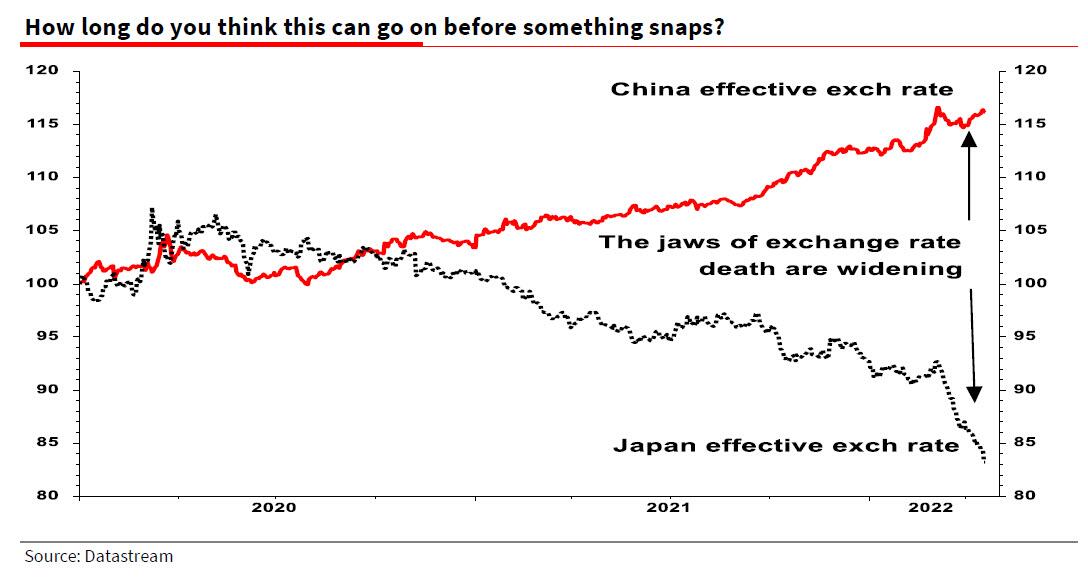
....Ok, so both the yen and the yuan have cratered, largely due to fundamental schism in monetary policy as both Japan and China are the two major central banks who are currently easing (or in the case of China, mostly pretending to) even as the Fed is about to hike more than 10 times in 2022 according to market estimates. Hardly shocking and to be expected (at least for our readers).

But according to Albert Edwards, who refuses to let this story drop, not only is this divergence about to get much worse, but it will lead to catastrophic market consequences. It's also "the biggest story no-one is talking about."

In a note published late last week under the same title (and available to all professional subscribers), Edwards turns his attention to the yen and yuan, and writes that "surely all of us working in finance realize by now that something is likely to snap in the financial system and probably quite soon."

Why? Because according to the SocGen strategist, "the rapidity of current market moves and the polarisation of the now extreme Fed (hawkish) and BoJ (dovish) policies almost guarantees that outcome.... Maybe the outcome wouldn’t be so ugly if central bankers had not spent recent decades ramping up asset prices to today’s grotesque levels through their monetary incontinence. But they did."

Comparing the monetary policy divergence between the US and Japan to "a car crash in slow motion", Edwards writes that polarization in central bank monetary policy between the US Federal Reserve and Bank of Japan is being stretched ever wider to the point where "at some point soon your life might even flash before you (btw that really does happen. I know because it has happened to me twice, although only one was a vehicle collision)" he writes.

And while nobody died trading FX on Friday (that we know of), that's when the Bank of Japan continued to hold the line on its Yield Curve Control policy capping the 10y JGB yields at 0.25%, and even offered a second round of extremely dovish unlimited 10y bond purchases for a four-day period; at the same time the Fed's "super hawks" were trying to convince the market that a series of 50bp (or even 75bps) Fed Funds hikes were imminent (and judging by the crash in the Dow, they may have succeeded). Between these extremes of behavior, Edwards adds that "what the ECB and PBoC are getting up to is effectively just a sideshow, although still an important one."

It's not just Edwards who focuses on the divergence between the Fed and the BOJ: frequent ZH guest, Larry McDonald, author of the excellent Bear Traps Report writes that the current policy divergence consists of “a) the PBOC (cutting rates, 530bn yuan additional liquidity), b) the ECB winding down net asset purchases this quarter and setting up for a 2H rate hike, c) the BoJ’s aggressive balance sheet expansion, and d) the Fed’s promising 9-12 rate hikes looking out a year with QT aggressively involved.” and concludes “This type of insane monetary policy divergence will clearly break something, that is certain."

Picking up on this dire warning, Edwards notes that one place where something might break soon is in China; he quotes SocGen China expert Wei Yao who believes that the Chinese "economy is now in severe distress and requires aggressive easing. In that context, its strangulation caught between a rising renminbi and a slumping yen, is simply intolerable." This divergence - which SocGen calls the "jaws of exchange rate death" can only go on for so long before something snaps...

Stepping away China's problems for a moment, Edwards turns the spotlight to the Fed, whose "increasingly loud [and hawkish] chest-beating" is "for most commentators the most important financial market development at the moment."....

....MUCH MORE

Earlier this evening: Currencies: "Oh My God, They Killed CNY! You Bastards"

April 20: Capital Markets: "The Yen Bounces after 13-Day Slide and BOJ Defends Yield Cap"

And previously from Albert:
Société Générale's Albert Edwards Is Seeing Possible Chinese Currency Devaluation
That would not be good for Germany. Not at all

On the export front it means Chinese exports getting more competitive simply by virtue of the currency, competition that furthers the slowing of an already slowing German economy....