Saturday, January 29, 2022

"What’s The Connection Between News—Fake and Real—And Opinion?"

From Discourse Magazine, January 24:

Contrary to settled assumptions, the media mostly reinforces existing beliefs rather than changing them

A telling schism in our fractured, post-truth world is that between “fake” and “real” news. Those who insist on this division associate fake news with Donald Trump, Republicans and the unvaccinated—and place great store in the causal power of information. Only because of fake news, many believe to this day, could a monstrosity like Trump get elected president. Starved of real news, democracy dies in darkness.

I have always found the evidence in support of these propositions to be pretty threadbare. The initial report that pro-Trump “fake election news stories” had “generated more engagement on Facebook than top election stories from 19 major outlets combined” was put forward by Buzzfeed in November 2016. It was a methodological mess. Even if one accepted all the claims, the implications were left hanging. Suppose hundreds of thousands of Catholic voters read an article stating that the Pope had endorsed Trump: Was there any evidence that minds had been changed? The report provided none.

In fact, the subject was never broached. The magical power of the written word was simply assumed—a common failing among those of us who churn out words by the pound. That has been the typical maneuver of participants in the fake news panic. The proliferation of lies is shown to be a fact, while the “so what” is passed over in silence. And, of course, anyone wishing to quantify the spread falsehood will have a field day with the internet—where, as N.N. Taleb has observed, the digital information tsunami is composed mostly of noise.

The web is many things—including the mother of lies. But it’s a long leap from this description of the landscape to proving that “Fake news is bad news for democracy.”

Belief in the power of the word requires a parallel faith in the gullibility of the public. Fake news can only be dangerous if ordinary people can be made to believe in preposterous lies. That’s a risky posture for an analyst: It divides the world into the clever, which is mostly us, and the foolish, which is entirely them. More to the point, it’s almost certainly wrong.

The human mind is a hard object to budge. That is the conclusion Hugo Mercier arrives at in “Not Born Yesterday,” after reviewing the psychology of persuasion. If recipients of information “were excessively gullible,” Mercier writes, “they would be mercilessly abused … until they reached a point where they simply stopped paying any attention to what they were being told.” For good evolutionary reasons, the default isn’t blind faith but hunkering down. When deprived of the means to evaluate information, people “revert to a conservative core, rejecting anything they don’t already agree with, being much harder, not much easier, to influence.”....

....MUCH MORE

That last point is similar to one I was attempting to make on a different aspect of trust last December:

Tribalism
The title of this piece was "Is Tribalism a Natural Malfunction?" but that seems an incorrect characterization.

It's all about trust, which is one of the reasons globalists have a problem convincing ordinary people to share their grand dreams and visions. Many of the things globalists have promised turned out not to be true so people go to the population size they feel they can trust.

Can't trust the U.N. after the Oil-for-Food frauds and the Rwandan genocides? Let's try nation-state.

Can't trust nation-states because one part of the populace cheats or shows themselves to be hypocrites? 
(And it is this very point, Orwell's “All animals are equal, but some animals are more equal than others.” where globalists lose the masses)

Let's try states.

And then city-states and if you can't trust your fellow metropolitans we'll go with blood relations, first tribes and if there are schisms there, to immediate family. Consanguinity and all that.

Tribalism isn't a "mal" anything, it's a survival mechanism for when you really, really have to increase the odds that you will be able to trust another person.....

The Crypto Meme War

I think this is Izabella Kaminska's last piece for FT Alphaville. Because of that fact, I am going to add music and a forward. In light of her subject and her subsequent departure it is only appropriate to use the "last dance" waltz, Ashokan Farewell as our title theme


Please click play now.

And as a forward: 

The Meme War was fought in ten thousand places, from Crypto Valley Switzerland and Chengdu, Sichuan, to Almaty in Kazakhstan and Lambo headquarters in Sant'Agata Bolognese. More than three million memers fought in it. And over six hundred thousand bros, two percent of the population, died in it.  

From FT Alphaville, January 28: 

El Hodlador suffers an IMF counterattack
Remembering the great meme power wars of 2022, a retrospective time capsule of the El Hodlador fracas.

As George Orwell once didn’t quite observe:

As I write, highly civilised human beings are launching troll attacks, trying to kill my online reputation. They do not feel any enmity against me as an individual, nor I against them. They are ‘only doing their duty’, as the saying goes. Most of them, I have no doubt, are kind-hearted law-abiding people who would never dream of committing acts of great slander and hate speech in private life. On the other hand, if one of them succeeds in blowing my reputation to pieces with a well-placed tweet, they will never sleep any the worse for it. They are serving their tribe, which has the power to absolve them from evil. 

At the dawn of the great meme wars of the post-Covid era, people didn’t quite appreciate the degree to which great fortunes could be won and lost with a single tweet. Nor was it clear who was fighting whom, or why. It took time for civilisation to understand the scope and parameters of the new Great Game. What was at stake. What the rules of engagement really were. How lives would be extinguished and lost.

In time, the nation-scale implications of finely crafted attacks from blue checkmark accounts became increasingly apparent. As they did, so did the collateral damage....

....MUCH MORE 

Sincere, oh so sincere apologies to Izabella Kaminska and Ken Burns.

"On Orwell: "It isn't about the surveillance. It's about seizing control of the truth"

“The party told you to reject the evidence of your eyes and ears.
It was their final, most essential command.”

—George Orwell, 1984

From Mashable, December 2019:

It isn't about the surveillance. It's about seizing control of the truth. 

Saying George Orwell's 1984 is my favorite book is like saying Star Wars is my favorite movie franchise. It would be more accurate to call them obsessions. I consume both in their entirety at least once a year, and have read everything there is to read about their creators. Their styles couldn't be more opposite – naive space fantasy vs. ultimate hard-nosed dystopia — but both are exquisite examples of worldbuilding.

And both returned to our world with a bang in the 2010s, when they were needed more than ever. Star Wars topped the all-time box office charts; 2016 happened, and 1984 came back to the bestseller lists, where it has bounced around ever since. (It has also cropped up in protest signs around the world.) 

In a talk I gave mid-decade, ironically named The Lighter Side of 1984! (spoiler alert, there's no light side, not even in the tale of its creation), I noted the world Orwell built has staying power for one reason alone. It's so airtight that it puts all subsequent dystopias to shame.

There's no poking holes in the Party's control, no loose thread for any opposition to pull. If there is a Resistance, it vanishes halfway through. The book is designed to make The Party and its machinery of oppression look entirely infallible. You accept, like the protagonist Winston Smith, that it can never be overthrown. This isn't The Hunger Games. There is no cartoonish YA villain like President Snow for a defiant Katniss Everdeen to topple. Even Margaret Atwood, in The Handmaid's Tale, destroyed Gilead in a far-future postscript.

But 1984? So far as we know, it's boots on human faces all the way down. 

Big Brother is gaslighting you

How come? The Party doesn't get its power from spying on its citizens, or turning them into snitches, or punishing sex crimes. All were presented as mere tools of the state. How did it come to wield that control in the first place?

Orwell, aka Eric Blair, a socialist freedom fighter and a repentant former colonial officer who had a lifelong fascination with language and politics, knew that no control could be total until you colonized people's heads too. A state like his could only exist with loud, constant, and obvious lies.

To be a totalitarian, he knew from his contemporary totalitarians, you had to seize control of truth itself. You had to redefine truth as "whatever we say it is." You had to falsify memories and photos and rewrite documents. Your people could be aware that all this was going on, so long as they kept that awareness to themselves and carried on (which is what doublethink is all about).

Don't call him Winston Smith. Call him Mr. 2019.

The upshot is, Winston Smith is gaslit to hell and back. He spends the entire novel wondering exactly what the truth is. Is it even 1984? He isn't sure. Does Big Brother actually physically exist somewhere in Oceania, or is he just a symbol? ¯\_(ツ)_/¯

Winston is what passes for well-educated in his world; he still remembers the name "Shakespeare." He's smart enough not to believe the obvious propaganda accepted by the vast majority, but it doesn't matter. The novel is about him being worn down, metaphorically and physically, until he's just too tired and jaded to hold back the tide of screaming nonsense.

Don't call him Winston Smith. Call him Mr. 2019. Because it's looking increasingly like we live in Oceania. That fictional state was basically the British Isles, North America, and South America. Now the leaders of the largest countries in each of those regions — Boris Johnson, Donald Trump, Jair Bolsonaro — are men who have learned to flood the zone with obvious lies, because their opponents simply don't have the time or energy to deal them all.

As we enter 2020, all three of them look increasingly, sickeningly, like they're going to get away with it. They are protected by Party members who will endure any humiliation to trumpet loyalty to the Great Leader (big shout-out once again to Sen. Lindsay Graham) and by a media environment that actively enables political lies (thanks, Facebook).

All the Winston Smiths of our world can see what the score really is. It doesn't seem to make any difference. But hey, at least we're all finally aware of the most important line in 1984, which is now also its most quote-tweeted: 

“The party told you to reject the evidence of your eyes and ears.
It was their final, most essential command.”

—George Orwell, 1984

....MUCH MORE

Or, as Marx said Who ya gonna believe? Me or your OWN eyes?

That's Chico Marx, not Karl or Groucho.

"Retailers Face Post-Holiday Reality of Rising Prices, Decreased Spending"

That would imply a dramatic slowdown in the overall economy since consumer spending is such a large part of the economy.

From PYMNTS.com, January 28:

When prices rise faster than incomes, consumers tend to tighten their belts and give up a few non-essential purchases, and according to the latest government data, that is exactly what’s happening right now.

This as the Commerce Department reported that personal spending snapped a six-month streak of gains in December and fell 0.6% from November, alongside a modest 0.3% month-on-month increase in personal incomes.

At the same time, the Fed-fave PCE Index (personal consumption expenditures) jumped 5.8%, a level last seen in the early 1980s, as consumers spent less on goods and more on services to end out the year on a low note.

Specifically, the data showed that the cutbacks were most pronounced in recreational goods and vehicles, as well as in other nondurable goods. such as newspapers, household supplies, games and toys, furnishings and durable household equipment.

On the service side, the Commerce Department said, healthcare was the largest contributor.

“Interestingly it was goods that fell in December while service spending rose [slightly] (adjusted for inflation),” former White House economic advisor, Harvard professor and Peterson Institute senior fellow Jason Furman said via Twitter in response to the report. “But overall the economy continues to be tilted towards goods and away from services.”....

....MUCH MORE

Friday, January 28, 2022

Mementos Mori: Does Anyone Have An Ashtray?

From The Baffler:

Mementos Mori
What else is lost when an object disappears?

Extinct: A Compendium of Obsolete Objects, ed. Barbara Penner, Adrian Forty, Olivia Horsfall Turner, and Miranda Critchley. Reaktion Books, 400 pages.

“My mother possessed a superlative ashtray,” writes architecture critic Catherine Slessor. It had a waist-high stand and a chrome-plated bowl, and, she writes, “faintly reeking, it stood to attention in our 1960s suburban living room like some engorged trophy.” Slessor goes on to describe other ashtrays of note: a Limoges porcelain limited-edition ashtray that Salvador Dalí designed for use on Air India, in exchange for a baby elephant that the airline transported for him from Bangalore to Spain; the ashtrays at Quaglino’s in London that reportedly used to disappear at a rate of seven per day in the 1990s, snatched by diners as souvenirs of a society locale. In doing so, she conjures the material world of the twentieth century, inhabited as it was by ashtrays of all shapes and sizes. Then, with the dawn of the millennium, this category of object—part functional décor, part objet d’art—all but disappeared.

Slessor’s short essay on the ashtray appears in the new book Extinct: A Compendium of Obsolete Objects, a collection of illustrated essays on eighty-five objects that, its editors write, “once populated the world and do so no longer.” To skim its table of contents is to encounter a wide-ranging catalog of lost things: all-plastic houses, cab fare maps, chatelaines, flying boats, moon towers, paper dresses, slide rules, UV-radiated artificial beaches, zeppelins. It is pointedly open-ended, inclusive of infrastructure and architecture as well as personal effects. The only unifying criterion is what its editors term “extinction,” in a self-conscious nod to Darwin-inflected evolutionary theories of technological innovation. 

“When things disappear, they do so, it is implied, because of their own inadequacy or their unsuitedness to their conditions. Part of the purpose of this book is to probe and question this seeming inevitability,” they write in the introduction. The word “extinct” also connotes something else, more poignant than “obsolescent”: a nod to the kind of death that can happen to our things. It is a loss more profound than many of our words for it—waste, breakage, consumption, discarding—convey. Extinct takes these material losses seriously and tries to quantify the social effects wrought by the wholesale disappearance of particular objects.

Now, there is something illicit about possessing ashtray, associated as it is with the mild rebellion of smoking cigarettes.

The essays in Extinct often answer two questions: What was it that has disappeared and why? And then, what was the significance of this loss? Some, like Slessor’s, are lucidly personal meditations, stuffed with anecdotes and design history; others are more technical treatises on the reason a particular technology failed to take root. The editors identify six general reasons why things become extinct and categorize each object in this way. Certain objects are deemed “failed”; they simply didn’t work. Many more, though, are “superseded” by more advanced models of similar things. Some dead objects, especially commercial products, are “defunct”—these have failed to gain widespread adoption, or couldn’t be mass-produced, or have simply gone out of style. Others are “aestivated,” meaning that they disappear but are revived in a new form. Still others are classified as “visionary,” in that they never quite came into being at all. The rest are “enforced,” basically regulated into disappearance.

Ashtrays fall into this last category. They have largely vanished, at least in the West, in the wake of indoor smoking bans and the decline of smoking in general. Though their disappearance might have seemed sudden, it was the culmination of long-term litigation, public health campaigns, and the slow process of local government action. None of this was aimed at the ashtray itself, but it does go to show how shifts in behavior and social mores affect the material world and vice versa. Ashtrays still exist, of course; some are still in use, and others have taken on a second life as mementos of a bygone era. But even those still circulating have a different aura than they once did, Slessor argues. Ashtrays are no longer status symbols, displayed waist-high in suburban living rooms. Now, there is something illicit about possessing an ashtray, associated as it is with the mild rebellion of smoking cigarettes. She writes, “The ashtray is not only an adjunct to social pleasure, but a memento mori, a reminder that you are dancing with death.”

Not all the essays in Extinct are inflected with nostalgia. Some things should have died sooner. Arsenic....

"Hackers hacked France’s Ministry of Justice and threaten to release the stolen files if ransom is not paid by February 10"

 From TechStartups, January 28:

The Lockbit 2.0 ransomware gang announced Thursday it had hacked France’s Ministry of Justice’s systems and threatened to release the files stolen unless France government meets its demand. The infamous cybercriminal group said it has encrypted the stolen files and now asking for a ransom payment in return for the data.

Formerly known as “ABCD” ransomware, the LockBit is a new ransomware attack in a long line of extortion cyberattacks designed to block user access to computer systems in exchange for a ransom payment.

The group also added the French Ministry of Justice to its list of victims it publishes on a data leak site. The group gives France’s Ministry of Justice until February 10 to pay a ransom or else “all available data will be published” on the dark website. France’s cybersecurity agency (ANSSI) has yet to provide comments on the breach....

....MUCH MORE

Also at TechStartups:

This 55-year-old Latvian woman, mother of two, is a member of the Trickbot cybercrime gang responsible for infecting millions of computers around the world


Questions Elaine Ou Is Asking: Should I Sell My Organs To Buy The Dip In Crypto?

From Elaine's Idle Mind:

Should I Sell My Organs to Stack More Sats?

I recently learned that the going rate for a kidney is $262,000, and if you were to liquidate your entire body it would net a cool $45 million. Upload your consciousness to the metaverse before doing so, of course.

That means most of us are carrying non-productive assets that could be traded for, well, a different non-productive asset — But one that is going to the moon.

There’s a huge societal benefit as well. This market is clearly suffering from illiquidity:


....MUCH MORE

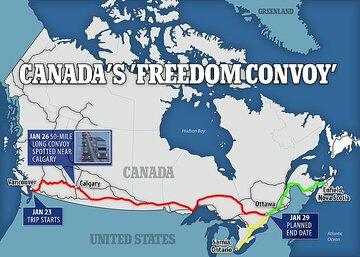
Well, It Appears The Canadian Truckers Are Up To 50,000 In 11 Convoys Converging On The Capital

Oh, and it's going international.

From ZeroHedge:

Truckers Across Planet Unite In Convoys Against Medical Tyranny

The 50,000 strong truck drivers heading to Ottawa, Canada's capital, expected to arrive as early as Saturday, may break a world record for the longest convoy. Called the "Freedom Convoy," the truck drivers oppose the federal government's vaccine mandates for cross-border activity and have inspired others worldwide. 

Truck drivers from Canada to the US to Australia to Europe are banding together in protests worldwide against their respective governments' overreach of public health, especially forced vaccine mandates. 

Freedom convoys from America are expected to join tens of thousands of truckers in Ottowa [sic] on Saturday to get the government to repeal cross-border COVID vaccine passports....

....MUCH MORE

Side note: the American truckers will have to show proof of vaccination to enter Canada.

This has escalated a bit from January 21's "1000 Canadian Trucks On The Way To Ottawa To Protest The Cross-Border Vaccine Mandate".

The Prime Minister said on January 26th:

"The small fringe minority of people who are on their way to Ottawa, who are holding unacceptable views that they are expressing, do not represent the views of Canadians" 

Perhaps forgetting how food gets to Ottawa (and Montreal and Toronto and...)

The saga:

"A Chinese Satellite Just Grappled Another And Pulled It Out Of Orbit"

 From The Drive's TheWarZone:

The maneuver raises concerns about the potential militarization of satellites designed to inspect, manipulate, or relocate other satellites.

A Chinese satellite was observed grabbing another satellite and pulling it out of its normal geosynchronous orbit and into a “super-graveyard drift orbit.” The maneuver raises questions about the potential applications of these types of satellites designed to maneuver close to other satellites for inspection or manipulation and adds to growing concerns about China's space program overall.

On January 22, China’s Shijian-21 satellite, or SJ-21, disappeared from its regular position in orbit during daylight hours when observations were difficult to make with optical telescopes. SJ-21 was then observed executing a “large maneuver” to bring it closely alongside another satellite, a dead BeiDou Navigation System satellite. SJ-21 then pulled the dead satellite out of its normal geosynchronous orbit and placed it a few hundred miles away in what is known as a graveyard orbit. These distant orbits are designated for defunct satellites at the end of their lives and are intended to reduce the risk of collision with operational assets. 

The unusual maneuver was observed by telescopes belonging to commercial space awareness firm Exoanalytic Solutions. During a webinar hosted by the Center for Strategic and International Studies (CSIS) this week, Exoanalytic Solutions’ Brien Flewelling said the SJ-21 satellite “appears to be functioning as a space tug.” Space Command did not respond to a request for comment, Breaking Defense reports....
....MUCH MORE 


"So long Izzy, we’ll miss you"

From the pixel-stained wretches, the denizens de Ville, un-bylined, known only as FT Alphaville:

A post celebrating some of Kaminska’s greatest hits.

It’s an emotional day at FT Alphaville Towers. Our beloved editor, Izabella Kaminska, is leaving after a 13-year stint at the blog. Having joined in 2008 as a junior reporter after working for Big Oil (yes, that’s right conspiracy theorists), Reuters and CNBC, Izzy rose through the ranks to finally be made head honcho in 2017, succeeding FTAV founder Paul Murphy. 

She will be sorely missed by all of us, and many of you. 

Readers will agree that there is no one quite like Izzy in financial media. Her knack for spotting trends and troubles long before the rest of us, and her ability to combine on-point, esoteric references — from the power structures of classical Rome to Soviet-era state planning and Tom Cruise movies — with a deep knowledge of finance has long made her work a must-read when it comes to everything from payments to crypto to the gig economy....

....MUCH MORE

We might have a post this weekend on some of the stuff that came out of Alphaville during Ms Kaminska's time there, but for now:


German Economy Shrinks Much More Than Anticipated

From the Federal Statistics Office via Trading Economics (also on blogroll at right), January 28:

The German economy contracted 0.7% on quarter [sic] in the last three months of 2021, much worse than market forecasts of a 0.3% fall, as tightening curbs to slow the spread of the omicron coronavirus variant weighed on household spending and construction investment while public expenditure increased. It is the first decline in three quarters, preliminary estimates showed.....

....MORE

Also at Trading Economics:
US PCE Price Inflation Hits 39-1/2-Year High


BEA: "What accounts for the differences in the PCE price index and the Consumer Price Index?"

 From the Bureau of Economic Analysis:

Table 9.1U - Comparison of the PCE Price Index with the CPI reconciles the changes in the personal consumption expenditures (PCE) chain-type price index, prepared by the Bureau of Economic Analysis (BEA), with changes in the consumer price index for all urban consumers (CPI), prepared by the Bureau of Labor Statistics (BLS).

The differences between the two indexes can be grouped into four categories: formula effect, weight effect, scope effect, and "other effects."

  • The formula effect accounts for the different formulas used to calculate the two indexes. The PCE price index is based on the Fisher-Ideal formula, while the CPI is based on a modified Laspeyres formula.
  • The weight effect accounts for the relative importance of the underlying commodities reflected in the construction of the two indexes.
  • The scope effect accounts for conceptual differences between the two indexes. PCE measures spending by and on behalf of the personal sector, which includes both households and nonprofit institutions serving households; the CPI measures out-of-pocket spending by households. The "net" scope effect adjusts for CPI items out-of-scope of the PCE price index less items in the PCE price index that are out-of-scope of the CPI.
  • "Other effects" include seasonal adjustment differences, price differences, and residual differences.

For more details, see "Comparing the Consumer Price Index and the Personal Consumption Expenditures Price Index" by Clinton P. McCully, Brian C. Moyer, and Kenneth J. Stewart in the November 2007 Survey of Current Business....

....MORE

And more to come

Bureau of Economic Analysis: "Personal Income and Outlays, December 2021" (PCE Index up 5.8% Dec YoY)

From the BEA, January 28:

Personal income increased $70.7 billion (0.3 percent) in December according to estimates released today by the Bureau of Economic Analysis (tables 3 and 5). Disposable personal income (DPI) increased $39.9 billion (0.2 percent) and personal consumption expenditures (PCE) decreased $95.2 billion (0.6 percent).

Real DPI decreased 0.2 percent in December and Real PCE decreased 1.0 percent; goods decreased 3.1 percent and services increased 0.1 percent (tables 5 and 7). The PCE price index increased 0.4 percent. Excluding food and energy, the PCE price index increased 0.5 percent (table 9).

  2021
Aug. Sept. Oct. Nov. Dec.
Percent change from preceding month
Personal income:  
     Current dollars 0.3 -1.0 0.6 0.5 0.3 
Disposable personal income:  
     Current dollars 0.3 -1.3 0.5 0.4 0.2
     Chained (2012) dollars -0.1 -1.6 -0.2 -0.2 -0.2
Personal consumption expenditures (PCE):  
     Current dollars 1.1 0.6 1.5 0.4 -0.6
     Chained (2012) dollars 0.7 0.3 0.9 -0.2  -1.0 
Price indexes:  
     PCE 0.4 0.3 0.6 0.6 0.4
     PCE, excluding food and energy 0.3 0.2 0.4 0.5 0.5
Price indexes: Percent change from month one year ago
     PCE 4.2 4.4 5.1 5.7 5.8
     PCE, excluding food and energy3.63.74.24.74.9

...The PCE price index for December increased 5.8 percent from one year ago, reflecting increases in both goods and services (table 11). Energy prices increased 29.9 percent while food prices increased 5.7 percent. Excluding food and energy, the PCE price index for December increased 4.9 percent from one year ago....

....MORE

Copper: Kids, don't try this at home

January 18, 2022, 10:30 PM PST:

Before we get into the meat of this article there is something going on in copper that may interest folks on the long side. All day today, as U.S. equities were getting whacked the world's third or fourth largest producer (it depends on the kind of month Glencore is having) the third or fourth largest producer, Freeport-McMoRan (FCX), was trading in the green while U.S. copper futures were only off a few pennies as the dollar showed impressive strength and the 10-year note showed impressive weakness, two occurrences that one might infer to be negative to the red one, but no. FCX is a pretty good leading/coincident indicator of sophisticated speculator sentiment in copper.

And now as I type the front futures are up 0.0305 at 4.4130.

Just to be clear, we are intermediate-term bearish on the metal, thinking we will trade under $4.00 before the real fun begins on the long side but in the immediate-term it appears long ain't wrong. Something's up.....

"Copper supply in 2022 – eyes on Chile, Peru, DRC"

https://www.cmegroup.com/markets/metals/base/copper.quotes.html