Thursday, July 29, 2021

"Anti-Money Laundering, Know Your Customer and the End of Offshore Crypto"

 Christopher Whalen at The Institutional Risk Analyst, July 27:

Back in January, we published a comment (“A Tale of Two Frauds: Bitcoin & GSE Shares”) that compared two recent schemes, namely the bitcoin-tether game and the equally odious pretense of privatizing Fannie Mae and Freddie Mac. In both cases, a large crowd of retail investors are or were convinced of the solidity of the speculation. In the case of the latter, the game now seems to be up. And the former wager involving tether and bitcoin seems headed in that very same direction.

Most recently, The US Justice Department is investigating possible bank fraud by executives of Tether Ltd., according to Bloomberg News: “Federal prosecutors are scrutinizing whether Tether Ltd concealed from banks that transactions were linked to crypto, said three people with direct knowledge of the matter who asked not to be named because the probe is confidential.”

The major complaint against tether is that this opaque market is a leveraged feeder into bitcoin, essentially a dark pool of liquidity of unknown provenance used to manipulate the price of the leading crypto market. Tether Ltd denies allegations that it is a fraud, including through its banker Gregory Pepin of Deltec Bank and Trust in the Bahamas.

While strong denials of wrong-doing are welcome, Tether Ltd so far has not been able to provide an independent audit of its reserves, a key sticking point for many managers, even those who are strong advocates of crypto assets. One post on Twitter recently, replying to Carl Quintanilla at CNBC, summed up the view of some skeptics regarding Tether Ltd and Deltec Bank:....

....MUCH MORE

Previously:

 https://climateerinvest.blogspot.com/2021/01/of-tether-bitcoin-fraud-and-holy-hell.html

https://climateerinvest.blogspot.com/2021/06/crypto-is-tether-black-swan.html

https://climateerinvest.blogspot.com/2019/06/how-tether-is-fueling-this-booming.html

https://climateerinvest.blogspot.com/2021/05/investigating-charge-bitcoin-price-is.html

https://climateerinvest.blogspot.com/2021/02/bitcoin-ecosystem-this-might-be.html

https://climateerinvest.blogspot.com/2018/06/has-bitcoin-come-to-end-of-its-tether.html

https://climateerinvest.blogspot.com/2018/04/cryptonarco-scam-du-jour-bitfinex-rumor.html

That Time FT Alphaville Marked The Top In The NFT Market

Not hearing much about NFT's are we? Alphaville killed 'em.
As we approach the four month anniversary of the April 1 enthusiasm peak, a reprise. The sting, as has been said is in the tail.*
(or highlighted hyperlink)
 
Parents, Have You Talked To Your Kids About The End Of The NFT Boom?

Although not as crucial to their understanding of the world as the yield curve "talk", this is something the wee munchkins should be prepared for.

From Tech StartUps, April 2:

NFT Bubble will soon burst after people find out they are paying millions of dollars to buy only bits of code that “point” to an artwork on the internet

Dr. Albert Einstein, who was considered to be one of the greatest scientists ever lived, once said, “Compound interest is the eighth wonder of the world. He who understands it earns it; he who doesn’t, pays it.” If Einstein were to be alive today, he probably would say that NFT is the eighth tech bubble of the world.

Non-fungible tokens (NFTs) are all the rage. Celebrities, artists, influencers, and NBA stars are riding the NFT hype and cashing in millions of dollars as the crypto-collectibles craze sweep through the art world.

In early March, Elon Musk’s partner Grimes made $5.8 million in just 20 minutes selling digital art as NFT. Then three days later, Twitter founder Jack Dorsey also auctioned off his first tweet as an NFT, which already drew a $2.5 million bid. Then about two weeks ago, Christie’s Auction sold digital artist Beeple’s NFT for a record-setting $69.3 million, making it the most expensive digital art ever sold.

So what exactly are NFTs?

NFT is a type of cryptographic token on a blockchain network that represents a unique digital asset. This asset can either be entirely digital or tokenized versions of real-world assets. Because NFTs are not interchangeable with each other, they may function as proof of authenticity and ownership within the digital realm, for example as proof of the authenticity of rare art.

However, the above explanation of NFT is not good enough. Today, millions of people around the world still have a distorted view of what NFT really is. The best way to understand NFT is to start with the idea of what a token really is.

What is a token?

In a very simple term, a token represents a thing or bits of code. A blockchain token is a digital asset created on a blockchain network as part of a decentralized software protocol and every token belongs to a blockchain address. At the same time, there are also many different types of blockchain tokens, which we will not discuss in this article.

So, why is the concept of token important? Every time someone buys an NFT, they aren’t really buying an artwork itself on the blockchain, but a token (a piece of code) that represents the artwork. This is very important because most descriptions about NFTs are that you are buying artwork — unfortunately you aren’t. Instead, you are buying a token (bits of code on a blockchain network) that points to a URL of a media or an artwork somewhere on the internet.

Unlike digital images with embedded metadata, NFT-based artworks are not embedded with tokens. Instead, the token only references or points to the URL of a piece of media located somewhere else on the internet.

NFT Implementation Examined

We’ve written over a dozen articles on the subject of NFT and we still don’t fully grasp the concept until yesterday after we came across an eye-opening tweet from Jonty Wareing about NFT is implemented. After careful examination, it seems that the NFT implementation is actually far worse than we originally thought.

It turns out that the implementation of NFT on the blockchain network doesn’t make it as trustless and decentralized as everyone was made to believe. Unlike bitcoin, which is a fully decentralized and based peer-to-peer network, NFT authentication and certification require a third-party company like Rarible or OpenSea. Special thanks to Jonty Wareing for investigating how NFT works behind the scene. Below is what Jonty said:

“The NFT token you bought either points to a URL on the internet, or an IPFS hash. In most circumstances it references an IPFS gateway on the internet run by the startup you bought the NFT from. Oh, and that URL is not the media. That URL is a JSON metadata file”....

....MUCH MORE

 It is possible that future historians (and psychologists) will be able to identify April 1, 2021 as the exact day the market popped
*****
*that guy from Avon said it in 1592 (also Scorpions 2010)
...“Petruchio: Come, come, you wasp; i' faith, you are too angry.
Katherine: If I be waspish, best beware my sting.
Petruchio: My remedy is then, to pluck it out.
Katherine: Ay, if the fool could find where it lies.
Petruchio: Who knows not where a wasp does wear his sting? In his tail.
Katherine: In his tongue.
Petruchio: Whose tongue?
Katherine: Yours, if you talk of tails: and so farewell.
Petruchio: What, with my tongue in your tail? Nay, come again, Good Kate; I am a gentleman.”
The Taming of the Shrew via No Fear Shakespeare

"Nikola Founder Trevor Milton Charged With Lying to Investors " (NKLA)

 Ya think?

From the Wall Street Journal:

Federal prosecutors say alleged scheme targeted individual investors

Trevor Milton, the founder of Nikola Corp. NKLA -7.43% and onetime executive chairman of the electric-truck startup, was indicted Thursday on securities-fraud charges for what prosecutors said was a scheme to mislead investors about the company’s product and technology development.

Mr. Milton faces two counts of securities fraud and one count of wire fraud, according to the indictment. The U.S. attorney’s office in Manhattan, which brought the charges, is set to make an announcement about the indictment on Thursday morning.

A spokesman for Mr. Milton didn’t immediately comment. Last year, Mr. Milton said on Twitter that he intended to defend himself against “false allegations.” He resigned from Nikola in September as concerns mounted about the startup darling that had attracted backing from some of the industry’s biggest names.

Nikola wasn’t charged. The company said that Mr. Milton hasn’t been involved in the company’s operations or communications since his resignation. “Nikola has cooperated with the government throughout the course of its inquiry,” the company’s statement said. “We remain committed to our previously announced milestones and timelines and are focused on delivering Nikola Tre battery-electric trucks later this year from the company’s manufacturing facilities.”....

....MUCH MORE

The stock is changing hands at $13.03 down $1.17 ( -8.21%) and as we said about competitor Lordstown Motors (RIDE):

"Why is there still a bid?"

See:
June 14
Electric Truck SPAC Lordstown Motors: CFO and CEO Resign (RIDE)
Why is there still a bid?
In premarket action the stock is changing hands at $10.04 down $1.37 (-12.01%)

June 9 (it was at $11.22)
Electric Truck Startup, Lordstown Motors Gets a "Going Concern", May Be Headed For Bankruptcy Court
And why is there still a bid?
As the old joke goes, third marriages are proof of the triumph of hope over experience.
Here's an experience anecdote:....Sometimes markets confuse me.....


RIDE $6.42 down $0.14 (2.13%)

"China extends zinc reserves sales, copper and aluminium auctions complete"

 From Reuters via Nasdaq, July 29, 7:40AM EDT:

China will extend the bidding hours for zinc reserves sales that were affected by an earlier system breakdown, a customer service representative of the online auction platform said.

The world's top metals consumer released a total of 170,000 tonnes of non-ferrous metals from state reserves to fabricators on Thursday, the second reserves sales within a month.

However, the online bidding platform for 30,000 tonnes of copper and 50,000 tonnes of zinc, operated by China Minmetals Corp, had a temporary breakdown after auctions started at 9 a.m. Beijing time (0100 GMT), a customer service representative of the platform told Reuters.

The reason for the breakdown was unclear.

The copper auctions affected by the system crash were reopened at 3 p.m. (0700 GMT) and were completed "pretty fast", said the representative.....

....MUCH MORE   

The last three months of price action via FinViz:


4.5210 up 0.0390 last

For more on the difficulty China faces in manipulating prices see July 12's:  
 
We are not yet buyers.

Big If True: "Higher Levels of Omega-3 in the Blood Increase Life Expectancy by Almost Five Years"

I got interested in the Omega-3's after reading some of the early research on the reduction in post-partum depression in mothers. The TL;dr is that while pregnant the little vampires growing inside mom are sucking her brain for DHA and EPA and that there is weak but positive evidence that increasing mom's intake of the Omega-3's reduces perinatal and post-natal depression.

However is not something to mess with on a massive scale. For one thing the fatty acids are so reactive to oxygen that they can cause liver damage, especially in people with livers somewhere on the fatty-to-NASH-to-cirrhosis liver disease spectrum. Which is why we don't post anything on supplements but do tout salmon.

Be all that as it may be, it turns out that the anti-inflammatory action of the fatty acids may actually be their most important effect on people.

From the

A 1% increase in this substance in the blood is associated with a change in mortality risk similar to that of quitting smoking.

Levels of omega-3 fatty acids in the blood are as good a predictor of mortality from any cause as smoking, according to a study involving the Hospital del Mar Medical Research Institute (IMIM), in collaboration with The Fatty Acid Research Institute in the United States and several universities in the United States and Canada. The study, published in The American Journal of Clinical Nutrition, used data from a long-term study group, the Framingham Offspring Cohort, which has been monitoring residents of this Massachusetts town, in the United States, since 1971.

Researchers have found that omega-3 levels in blood erythrocytes (the so-called red blood cells) are very good mortality risk predictors. The study concludes that “Having higher levels of these acids in the blood, as a result of regularly including oily fish in the diet, increases life expectancy by almost five years,” as Dr. Aleix Sala-Vila, a postdoctoral researcher in the IMIM’s Cardiovascular Risk and Nutrition Research Group and author of the study, points out. In contrast, “Being a regular smoker takes 4.7 years off your life expectancy, the same as you gain if you have high levels of omega-3 acids in your blood,” he adds.

2,200 people monitored over eleven years

The study analyzed data on blood fatty acid levels in 2,240 people over the age of 65, who were monitored for an average of eleven years. The aim was to validate which fatty acids function as good predictors of mortality, beyond the already known factors. The results indicate that four types of fatty acids, including omega-3, fulfill this role. It is interesting that two of them are saturated fatty acids, traditionally associated with cardiovascular risk, but which, in this case, indicate longer life expectancy. “This reaffirms what we have been seeing lately,” says Dr. Sala-Vila, “not all saturated fatty acids are necessarily bad.” Indeed, their levels in the blood cannot be modified by diet, as happens with omega-3 fatty acids....

....MORE

Related at SciTechDaily: 
 
And from the National Institute's of Health's National Library of Medicine:

VaaS: It Appears We Have Entered The Vaccine-as-a-Service Phase of Marketing (PFE)

 Well, I suppose since every other business is trying to create those recurring revenue streams...

 
Now to choose a plan. Hmmmm...the discount on the lifetime program looks nice.
If only the terms of service didn't include that "no right-to-repair" clause.
 
Earlier: 

Wednesday, July 28, 2021

Morgan Stanley Expects European Earnings Growth To Double That In The U.S. (plus Thaler and Chandler)

 From The Market.ch, July 6:

«In Europe, earnings growth is expected to be twice as high as in the US»
Graham Secker, Head of Equity Strategy Europe at Morgan Stanley, expects more challenging markets in the coming months. He is betting on securities from the energy and financial sectors and believes Europe can outperform.

The rebound on the stock markets to the Covid 19 shock has been impressive: Equities can look back on the fifth best half-year in a hundred years. Now, however, deceleration is the order of the day. Even though the global economic outlook remains encouraging, much of the good news is now priced into stock prices, says Graham Secker, head of equity strategy for Europe at Morgan Stanley, in an interview with The Market.

Furthermore, he says, global economic momentum has peaked. Add to that rising inflationary pressures, the prospect of higher taxes in the U.S. and of the Fed curbing its securities purchases. In combination, this is likely to lead to more choppy markets in the months ahead.

While Secker expects US equities to move sideways until the end of the year, things look better on the other side of the Atlantic. The strategist is particularly confident about the UK stock market and Italian equities.

Stock markets seem unstoppable since March 2020. Is that a reason to worry or is it a sign of strength?

I think the market strength reflects that the global economic recovery is very robust. We had a big recession, followed by a big bounce back. However, because of the stimulus measures that have been put in place, the environment is very different than before the crisis and the outlook for the global economy over the next several years is very solid.

However, both the fiscal and the monetary thrust seem to be waning. Wouldn’t that potentially create headwinds for equities?

What the market is facing at the moment is what I call a first versus second derivative discussion. The first derivative is that the global economy is very strong and there is a huge amount of policy support out there, fiscally and monetarily. However, even though the global economy is very strong, growth momentum is peaking out – that’s the second derivative. The same is true with monetary policy, given that the Fed is now talking a bit more about tapering.

That makes for a tougher environment, doesn’t it?

That’s why we have tactically turned from bullish to a bit more neutral on equities. Investing is all about the changes at the margin. However, when the first derivative is very good, i.e. growth is strong and there is a huge amount of liquidity and policy support, and maybe the second derivative shift is only small, that raises the question of how bearish you want to be on asset markets. To keep things very simple: we have record economic growth and record policy support - what’s not to like?

Are the good news not in the price already?

Equity valuations are high in absolute terms but relative to fixed income markets equities are still quite cheap. When deciding on where to put your money, you know there is no return on cash and there is no real return on bonds. The hurdle to take money out of the equity market is quite high because you have to park it in an asset class where you know you won’t earn a good return. Therefore, you probably end up with a bit more money staying in equities. We’ve seen that in the record high inflows into global equities year to date.

What if interest rates head higher? At some point bonds will be an alternative to equities.

Correct. The question is at what level.

And what’s your answer?

Our work suggests that a yield in the order of 2% on the ten-year US treasury note or German bund yields moving to +15 or maybe +20 Bp could potentially derail the equity market. However, even a 2% yield on ten-year treasuries is still effectively a negative real yield. That is not a particularly attractive alternative to equities. Yields would need to go up an awful lot to create a realistic alternative where you can say: when I buy that asset, I can actually make some pretty good returns....

....MUCH MORE

Also at The Market.ch:

July 26 Richard Thaler
«Anybody Who's Buying and Selling Stocks Thinks They're Smart»

July 28 Marc Chandler
Deja Vu All Over Again

Supply chain 'stretched' for cardboard boxes, wood pallets: Thomas

From Supply Chain Dive, July 20:

Dive Brief:

  • Cardboard boxes and wood pallets saw heightened demand in Q2, according to Thomas, as buyers continue to encounter challenges sourcing shipping equipment.
  • Packaging ranked fourth among product types by sourcing volume for the quarter, behind adhesives, medical supplies and steel. Corrugated cartons had one of the largest QoQ sourcing increases at 358%, according to Thomas' quarterly report on sourcing activity.
  • "The challenges that we’re having in the supply chain right now show just how far we’re stretched for certain components," Thomas Chief Marketing Officer Shawn Fitzgerald said during a presentation on Q2 activity.
Dive Insight:

Supply-demand imbalances have been prevalent in many facets of the supply chain since the COVID-19 pandemic gripped the world. This trend also affects shipping supplies, with prices climbing for corrugated boxes and wood pallets amid tight supply, according to the Institute for Supply Management's June manufacturing report.

The Bureau of Labor Statistics' Producer Price Index for corrugated and solid fiber box manufacturing climbed to 375.3 in June, up from 342.0 in June 2020. The index for wood container and pallet manufacturing rose to 208.5 in June, versus 155.1 the year before. Both are record highs....

....MUCH MORE

Previously:
June 9
Logistics: And Now There's A Shortage Of Pallets: Prices Up 400%

"Next stop, hydrogen? The future of train fuels"

From Railway Technology, July 15:

Climate change and emissions reduction are topics high on the agenda for the rail industry. As companies continue to seek more sustainable fuel options, we explore the potential of hydrogen as a train fuel. 

With 2021 being named the European Year of Rail, all eyes are on the industry when it comes to innovation, sustainability initiatives and new technology.

Rail has been recognised as one of the cleanest, greenest modes of transport. Data from the Office of Rail and Road, published in its report Rail Emissions 2019-2020 report, shows that, for passenger trains, diesel usage increased by 1.5% compared to 2018-2019, but the resulting CO2e emissions for passenger trains have fallen to 35.1g CO2e per passenger km. This is the lowest level recorded since the comparative data series started in 2011-2012.

Although rail has a less harmful impact on the environment than many other modes of transport, the industry is constantly striving towards alternative fuels which could help reduce its environmental impact. Some companies have opted for battery-powered engines as a cleaner alternative, while others are turning to hydrogen to fuel their trains.

Hydrogen fuel can be produced through several methods. The most commonly used methods today are natural gas reforming (a thermal process), and electrolysis of water, which sees electricity running through water to separate the hydrogen and oxygen atoms. The electricity used can be generated by wind, solar and hydro sources.  

The world’s first hydrogen train

The world’s first passenger train powered by hydrogen fuel cell was produced by Alstom. Named ‘Coradia iLint’, this zero-emission train also emits low noise levels due to the exhaust being only steam and condensed water. 

The train was first showcased back in 2016 at InnoTrans in Berlin and entered commercial service in Germany in 2018. Following on from successful operations in Germany, Alstom received several orders for its hydrogen-powered locomotives from Italy, France and Austria.

In a press release, Jörg Nikutta, Alstom Transport Deutschland managing director for Germany and Austria, commented: “Our two pre-series trains of the Coradia iLint have proven over the past year and a half that fuel cell technology can be used successfully in daily passenger service.”

The electricity required for the running of the on-board systems is supplied via a fuel cell, which generates energy by combining the hydrogen stored on the train’s roof  with oxygen in the air. 

The Coradia iLint can carry up to 150 seated passengers and 150 standing passengers and can reach a range of up to 1,000km at a maximum speed of 140km/h.  

Hydrogen power: a first for the UK....

....MUCH MORE

Also at Railway Technology:
Paris-Nice night train: Aboard Le Train Bleu’s worthy heir

I like night trains:
The Return of the Night Train to Europe

Take Your Cisgendered, Heteronormative, Melanin-deprived, Patriarchal Fish Names and Shove 'Em

 From PhysOrg, July 27:

Study calls for end to 'rough fish' pejorative and the paradigm that created it

From art to religion to land use, much of what is deemed valuable in the United States was shaped centuries ago by the white male perspective. Fish, it turns out, are no exception.  

A study published in Fisheries Magazine, a journal of the American Fisheries Society, explores how colonialist attitudes toward native fishes were rooted in elements of racism and sexism. It describes how those attitudes continue to shape management today, often to the detriment of native fishes.

The study, led by the University of California, Davis, with Nicholls State University and a national team of fisheries researchers, found that nearly all states have policies that encourage overfishing native species. The study maintains that the term "rough fish" is pejorative and degrading to native fish.

"That has bothered me for a long time," said lead author Andrew Rypel, co-director of the Center for Watershed Sciences and the Peter B. Moyle and California Trout Chair in Coldwater Fish Ecology at UC Davis. He and others have been disturbed by images of "glory killings" of native fish that periodically pop up on the internet, as well as the lump categorization of less preferred species as "rough" or "trash" fish.

"When you trace the history of the problem, you quickly realize it's because the field was shaped by white men, excluding other points of view," Rypel said. "Sometimes you have to look at that history honestly to figure out what to do."....

....MUCH MORE 

See also "Asian carp"

And another thing:

From the journal Progress in Human Geography:

Glaciers, gender, and science
A feminist glaciology framework for global environmental change research

  1. Mark Carey
  2. M Jackson
  3. Alessandro Antonello
  4. Jaclyn Rushing
  1. University of Oregon, USA
  1. Mark Carey, Robert D. Clark Honors College, University of Oregon, Eugene, OR 97403, USA. Email: carey@uoregon.edu

Abstract

Glaciers are key icons of climate change and global environmental change. However, the relationships among gender, science, and glaciers – particularly related to epistemological questions about the production of glaciological knowledge – remain understudied. This paper thus proposes a feminist glaciology framework with four key components: 1) knowledge producers; (2) gendered science and knowledge; (3) systems of scientific domination; and (4) alternative representations of glaciers. Merging feminist postcolonial science studies and feminist political ecology, the feminist glaciology framework generates robust analysis of gender, power, and epistemologies in dynamic social-ecological systems, thereby leading to more just and equitable science and human-ice interactions.

I Introduction

Glaciers are icons of global climate change, with common representations stripping them of social and cultural contexts to portray ice as simplified climate change yardsticks and thermometers. In geophysicist Henry Pollack’s articulation, ‘Ice asks no questions, presents no arguments, reads no newspapers, listens to no debates. It is not burdened by ideology and carries no political baggage as it crosses the threshold from solid to liquid. It just melts’ (Pollack, 2009: 114). This perspective appears consistently in public discourse, from media to the Intergovernmental Panel on Climate Change (IPCC). But the ‘ice is just ice’ conceptualization contrasts sharply with conclusions by researchers such as Cruikshank (2005), who asks if glaciers listen, Orlove et al. (2008b), who analyze the cultural framing of glaciers, Carey (2007), who sees an endangered species narrative applied to glaciers, Jackson (2015), who exposes how glaciers are depicted as ruins, and Sörlin (2015), who refers to the present as a cryo-historical moment because ‘ice has become historical, i.e. that ice is an element of change and thus something that can be considered as part of society and of societal concern’ (Sörlin, 2015: 327).

Nüsser and Baghel (2014) also reject the ‘ice is just ice’ assertion. Glaciers, they argue, ‘have increasingly become contested and controversial objects of knowledge, susceptible to cultural framings as both dangerous and endangered landscapes’ (Nüsser and Baghel, 2014: 138). Glaciers, after all, affect people worldwide by influencing sea level, providing water for drinking and agriculture, generating hydroelectric energy from glacier runoff, triggering natural disasters, yielding rich climate data from ice cores, shaping religious beliefs and cultural values, constituting identities, inspiring art and literature, and driving tourist economies that affect local populations and travelers alike (e.g. Carey, 2010Cruikshank, 2005Gosnell, 2005;Hewitt, 2014cOrlove et al., 2008a). Despite their perceived remoteness, glaciers are central sites – often contested and multifaceted – experiencing the effects of global change, where science, policy, knowledge, and society interact in dynamic social-ecological systems. Today, there is a need for a much more profound analysis of societies living in and engaging with mountains and cold regions (Halvorson, 2002;Byers and Sainju, 1994Bloom et al., 2008), including the social, economic, political, cultural, epistemological, and religious aspects of glaciers (see e.g. Allison, 2015;Gagné et al., 2014). 
A critical but overlooked aspect of the human dimensions of glaciers and global change research is the relationship between gender and glaciers. While there has been relatively little research on gender and global environmental change in general (Moosa and Tuana, 2014Arora-Jonsson, 2011), there is even less from a feminist perspective that focuses on gender (understood here not as a male/female binary, but as a range of personal and social possibilities) and also on power, justice, inequality, and knowledge production in the context of ice, glacier change, and glaciology (exceptions are Bloom et al., 2008Williams and Golovnev, 2015Hevly, 1996Hulbe et al., 2010Cruikshank, 2005). Feminist theories and critical epistemologies – especially feminist political ecology and feminist postcolonial science studies – open up new perspectives and analyses of the history of glaciological knowledge. Researchers in feminist political ecology and feminist geography (e.g. Sultana, 2014;Mollett and Faria, 2013Elmhirst, 2011Coddington, 2015) have also called for studies to move ‘beyond gender’, to include analyses of power, justice, and knowledge production as well as ‘to unsettle and challenge dominant assumptions’ that are often embedded in Eurocentric knowledges (Harris, 2015: xx). Given the prominent place of glaciers both within the social imaginary of climate change and in global environmental change research, a feminist approach has important present-day relevance for understanding the dynamic relationship between people and ice – what Nüsser and Baghel (2015) refer to as the cryoscape.....
I like the matter-of-fact tags at the top of the paper.

"Pfizer sells $7.8 billion in Covid shots in the Q2, raises 2021 guidance on vaccine sales" (PFE)

I'm in the wrong business.

From CNBC:

  • Pfizer said it sold $7.8 billion in Covid-19 shots in the second quarter.
  • It also raised its 2021 sales forecast for the vaccine to $33.5 billion from $26 billion.
  • The company’s second-quarter financial results also beat Wall Street expectations on both earnings and revenue.

Pfizer said Wednesday it sold $7.8 billion in Covid-19 shots in the second quarter and raised its 2021 sales forecast for the vaccine to $33.5 billion from $26 billion, as the delta variant spreads and scientists debate whether people will need booster shots.

The company’s second-quarter financial results also beat Wall Street expectations on earnings and revenue. Here’s how Pfizer did compared with what Wall Street expected, according to average estimates compiled by Refinitiv:...

....MUCH MORE

"Dr. Kate O’Brien, WHO’s director of immunization, vaccines and biologicals, said Wednesday
the organization is still researching whether a booster shot is needed to increase protection"

Meahwhile, In Chicago....

From CWB Chicago:

West Loop man was shot when gang members opened fire on rivals who were robbing him

In a bizarre, only-in-Chicago twist, Chicago police now believe that a West Loop man suffered a gunshot wound Monday night after a group of gang members opened fire on members of a rival gang who were trying to rob him outside the Presidential Towers high-rise complex. According to a source:

The 52-year-old man, who lives in the four-tower complex at 555 West Madison, was walking into the building when three men walked up and tried to rob him at gunpoint around 11:22 p.m.

As he gave the men his wallet, a four-door sedan pulled up to the corner of Jefferson and Madison. Three gunmen emerged from the car and began shooting toward the robbers and the victim. One of the robbers returned fire.....

....MORE

CWB operates one of the police radio monitoring twitter feeds. It can be eye-opening.
Sometimes amusing,* mostly not.  
 
*Usually at bail hearings:
CWBChicago
Jul 27
Today's bond court wit twister: "Your honor, the defendant is the victim's mother's boyfriend's brother-in-law."

"What Tesla’s bet on iron-based batteries means for manufacturers" (TSLA)

Although we are loathe to relay every chemical or manufacturing 'breakthrough' (having gone through the mid-aughts and a million pixels of stuff that didn't scale up), this is one we've flagged a few times.

A deep dive from TechCrunch, July 28:

Elon Musk earlier this week made his most bullish statements yet on iron-based batteries, noting that Tesla is making a “long-term shift” toward older, cheaper lithium-iron-phosphate (LFP) cells in its energy storage products and some entry-level EVs.

The Tesla CEO mused that the company’s batteries may eventually be roughly two-thirds iron-based and one-third nickel-based across its products. “And this is actually good because there’s plenty of iron in the world,” he added.

Musk’s comments reflect a change that is already underway within the automotive sector, mainly in China. Battery chemistries outside of China have been predominantly nickel-based — specifically nickel-manganese-cobalt (NMC) and nickel-cobalt-aluminum (NCA). These newer chemistries have become attractive to automakers due to their higher energy density, letting original equipment manufacturers (OEMs) improve the range of their batteries.

If Musk’s bullishness is heralding a genuine shift across the EV industry, the question is whether battery makers outside of China will be able to keep up.

Musk is not the only automotive executive to signal a return to the LFP formula. Earlier this year, Ford CEO Jim Farley said the company would use LFP batteries in some commercial vehicles. Meanwhile, Volkswagen CEO Herbert Diess announced during the company’s inaugural battery day presentation that LFP would be used in some VW entry-level EVs.

On the energy storage front, Musk’s comments about using LFP-based chemistries in Powerwall and Megapack are in line with other stationary energy storage companies pushing for iron-based formulas. “The stationary storage industry wants to move to LFP because it’s cheaper,” Sam Jaffe, who heads the battery research firm Cairn Energy Research Advisors, told TechCrunch....

....MUCH MORE

Previously:
May 17
"Tesla in talks with China's EVE for low-cost battery supply deal -sources" (TSLA)
Well I guess Tony Stark Elon Musk is now officially Iron Man..... 

*****

Back in 2018 we posted "Batteries: Lithium-Iron may be Competitive With Lithium-Cobalt" but with so many technologies that failed to scale-up over the years we are a little bit jaundiced about wasting the reader's time chasing every rabbit that pops up.

However, if this works, Elon may have found the chemistry for the next generation of Powerwalls.....

Also from 2018:
"Ten years left to redesign lithium-ion batteries"
This time frame is not too restrictive.
Tesla and their battery partner, Panasonic, have removed a lot of the cobalt (60%) from their battery recipe and are on their way to zero cobalt over the next couple years.

So, more interesting than any time pressure is the potential spur to creativity on the question of alternative chemistries.

From the journal Nature, July 25:...

One more from 2018—apparently a great year for Iron Age types while I kept writing Bronze Age on my checks. ("Dad, what's a check?"):

Twenty Month Payback for Tesla 100-MW Utility Scale Battery Storage System
Elon (and Panasonic) may have just found another multi-billion dollar business.
Going forward the chemistry probably won't be Lithium ion, maybe molten-salt or iron based, but the fact TSLA can now pitch this kind of payback probably heralds the beginnings of lithium rush 3.0, or at least the promotion thereof....

And just so you know how long it can take to go from lab bench to production, this post is from 2008!
Lithium-Ion Batteries for Less

From MIT's Technology Review:
Researchers show a low-cost route to making materials for advanced batteries in electric cars and hybrids.

A new way to make advanced lithium-ion battery materials addresses one of their chief remaining problems: cost. Arumugam Manthiram, a professor of materials engineering at the University of Texas at Austin, has demonstrated that a microwave-based method for making lithium iron phosphate takes less time and uses lower temperatures than conventional methods, which could translate into lower costs.....

The Convexity Maven Writes an Open Letter To The Fed

Although I sometimes poke gentle fun at Mr. Bassman for his proprietary product creation and packaging during his time at Mother Merrill—remember all those cutesy acronyms (OPOSSMS et al) in the '80's and '90's? That was him—although I poke fun at that, his knowledge of debt instruments and markets, particularly mortgage-related structured products (pre-2007), is unrivaled.

From The Convexity Maven at Simplify Asset Management, July 25:

In 1986 Herbert Stein, a University of Chicago economist and onetime Chairman of the President’s Council of Economic Advisors, modestly proposed Stein’s Law: “If something cannot go on forever, it will stop.”

As such, with similar modestly, let me propose a few ways for the Federal Reserve Bank (FED) to “trim the sails” of their monetary support programs before another “Chuck Prince moment” arrives with a deafening silence.As a reminder, we have a massive debt problem in the US, both public and private; and there are only two paths out of such a situation, either default or inflate, where inflation is simply a slow-motion default.Thus, the FED’s program of Quantitative Easing (QE) was well-intentioned, and in fact it did create inflation; such a pity this inflation occurred in asset prices instead of Service (Labor) wages as intended.

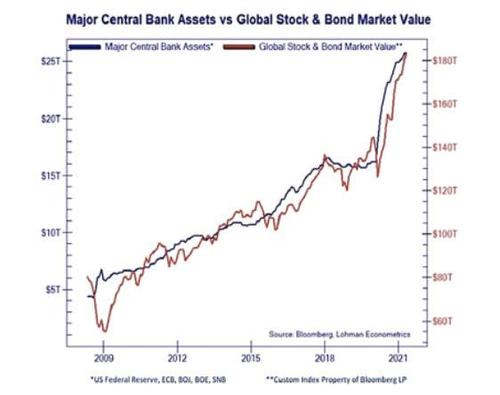
Clever quants will say that a statistically significant mathematical correlation does not exist between money creation and financial asset prices;but who are you going to believe, them or your lying eyes? Below the blue line is the balance sheet assets of the major Western Central Banks, while the red line is the value of their Global financial market.

Perhaps on a week-to-week basis asset prices do not move synchronously with the production of fiat currency, but $20 Trillion of money must reside someplace, and with the magic of financial leverage it is quite clear where.

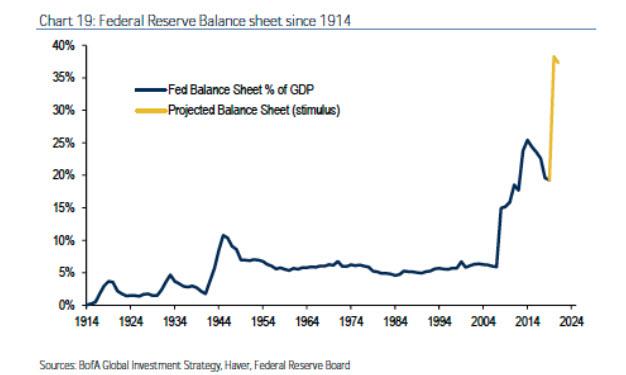
Similarly, while I cannot show a formula that links concentrated wealth creation to significant political unrest, once again I will let your lying eyes consider the green line and the purple line on the prior chart. The yellow line below was a projection for the growth of the FED’s balance sheet relative to US GDP; hat tip to Bank of America as the balance sheet presently tops out at $8.24Tn versus a GDP of $22.79Tn, or 35.2%.

At some point,simple common sense must be a viable consideration. After all, if it were possible for the Sovereign to create the coin of the realm (fiat currency) at a pace faster than the growth of the economy, wouldn’t there be a record of that happening successfully before? Why should there be poor people if it is possible to create wealth and offer it to all citizens? It must stop eventually....

....MUCH MORE

HT the letter was out: ZH

Russia Considering North - South Shipping Route To Bypass Suez Canal

 From gCaptain, July 24:

This week Russian President Vladimir Putin met with the country’s shipbuilding executives to review plans to prioritize short sea shipping with the hope of bypassing the Suez Canal.

“We are focusing on the South-North corridor, primarily moving cargo via the Caspian Sea,” said Alexei Rakhmanov, Chief Executive of United Shipbuilding, Russia’s largest shipbuilding company. “This year, we are starting to design a containership that will ply the Caspian Sea with Helsinki as its final destination. In this way, we will be opening up routes that do not depend on foreigners.”

Related News: Top Secret Israeli Oil Pipeline To Bypass Suez Canal

According to the Kremlin, by building smaller vessels capable of short sea shipping, it’s possible to load cargo in northern Iran or western China and take it to Helsinki via the Russian Port of Olya on the Caspian Sea. They believe this route will take only seven or eight days to reach Helsinki from Olya at an average speed of 10 knots.

“We are zealously working on many new products,” said Rakhmanov. “In the case of civilian shipbuilding, I am referring to the opening of basically new segments, including small boats, which few businesses have dealt with systematically, and solutions for Russian cities.”

“The main question is the cost of this shipment. We are working on it jointly with shipping companies.” Putin was told the route north will include navigating the Volga River, then the Volga-Baltic Waterway, and the Moscow Canal to St Petersburg. Vessels could go as far as the White Sea, but the scale would be a bit smaller there, with smaller cargos....

....MUCH MORE

Tuesday, July 27, 2021

"Resilient Grid Generates New Market Opportunities"

The electriicity mavens at EE Times have been running a series on the grid that has some thought provoking commentary.

From Electrical Engineering Times, July 14:

Global electricity consumption continues to grow at a consistent 3.5 percent annual rate over the last five years, according to a survey of the energy and utilities sector by the International Energy Agency. In 2020, apparent consumption was estimated to be 16 gigawatt hours by the top 12 countries, with China, the U.S. and India accounting for 60 percent of total. Though the consumption rate plummeted by 5 percent in 2020 due to pandemic-induced lockdowns, a rebound is expected to occur this year, driven by a “V- shaped” recovery and pent-up demand.

The value of the electricity transmission infrastructure market is projected to reach $350 billion by 2030, fueled by public and private investment projected to grow 3.8 percent annually through the end of the decade. That growth will be driven in large measure by grid upgrades for transmitting renewable energy resources. The amount of electricity generated by wind, solar and other renewables is predicted to grow at a 5-percent annual clip.

Key growth areas include microgrids, local energy infrastructure that can operate autonomously from traditional grids, and community power distribution systems used to store and distribute renewable energy. Those remote systems are promising architectures for developing countries.

Another notable avenue derives from municipal infrastructure utility services, many involving in urban rail transit networks with accelerated development of metropolitan rail projects in urban and suburban areas. 

Growth, innovation

Current growth opportunities mostly focus on new infrastructure projects, but repair and maintenance services also remain a revenue generator for equipment manufacturers and electric power control providers. The order value per service is significant for incumbent stakeholders as well as independent vendors armed with emerging open source development skills....

....MUCH MORE

Links to the other articles in the series are at the bottom of this post:  

Girding the Grid

"Cloud Computing’s Coming Energy Crisis" (AMZN; GOOG; MSFT: AAPL; FB)

 From IEEE Spectrum, July 21:

The cloud’s electricity needs are growing unsustainably

How much of our computing now happens in the cloud? A lot. Providers of public cloud services alone take in more than a quarter of a trillion U.S. dollars a year. That’s why Amazon, Google, and Microsoft maintain massive data centers all around the world. Apple and Facebook, too, run similar facilities, all stuffed with high-core-count CPUs, sporting terabytes of RAM and petabytes of storage.

These machines do the heavy lifting to support what’s been called “surveillance capitalism”: the endless tracking, user profiling, and algorithmic targeting used to distribute advertising. All that computing rakes in a lot of dollars, of course, but it also consumes a lot of watts: Bloomberg recently estimated that about 1 percent of the world’s electricity goes to cloud computing.

That figure is poised to grow exponentially over the next decade. Bloomberg reckons that, globally, we might exit the 2020s needing as much as 8 percent of all electricity to power the future cloud. That might seem like a massive jump, but it’s probably a conservative estimate. After all, by 2030, with hundreds of millions of augmented-reality spectacles streaming real-time video into the cloud, and with the widespread adoption of smart digital currencies seamlessly blending money with code, the cloud will provide the foundation for nearly every financial transaction and user interaction with data.

How much energy can we dedicate to all this computing? In an earlier time, we could have relied on Moore’s Law to keep the power budget in check as we scaled up our computing resources. But now, as we wring out the last bits of efficiency from the final few process nodes before we reach atomic-scale devices, those improvements will hit physical limits. It won’t be long until computing and power consumption will once again be strongly coupled—as they were 60 years ago, before integrated CPUs changed the game....

....MUCH MORE

Chartology: Speaking of Ominous (RTY; IWM)

Following on the dark clouds in the post immediately below we have one of the scarier chart formations to be found in the land of portents and omens. (otherwise known as technical analysis):


 BigCharts

Those are the futures (continuous contract) but you see the same pattern in the index (RTY) and ETF (IWM). 

The thinking upon seeing this formation is that each drop/recovery absorbs more and more of the available buying power at whatever level the downside resistance forms and that, should the pattern keep recurring eventually all the buying power is exhausted and the next test results in a giant "Whooshing" sound and the decline can get vertical on the chart until the next level of buying initiated transactions is found at lower prices. It works the same way on the upside with each test absorbing more and more of the selling pressure until there is none, resulting in the sort of pop you get from releasing a cork you've been holding underwater.

Or something.

The current set-up was first brought to our attention by Tim Knight at Slope of Hope, July 26 pre-market:

Speaking of Support

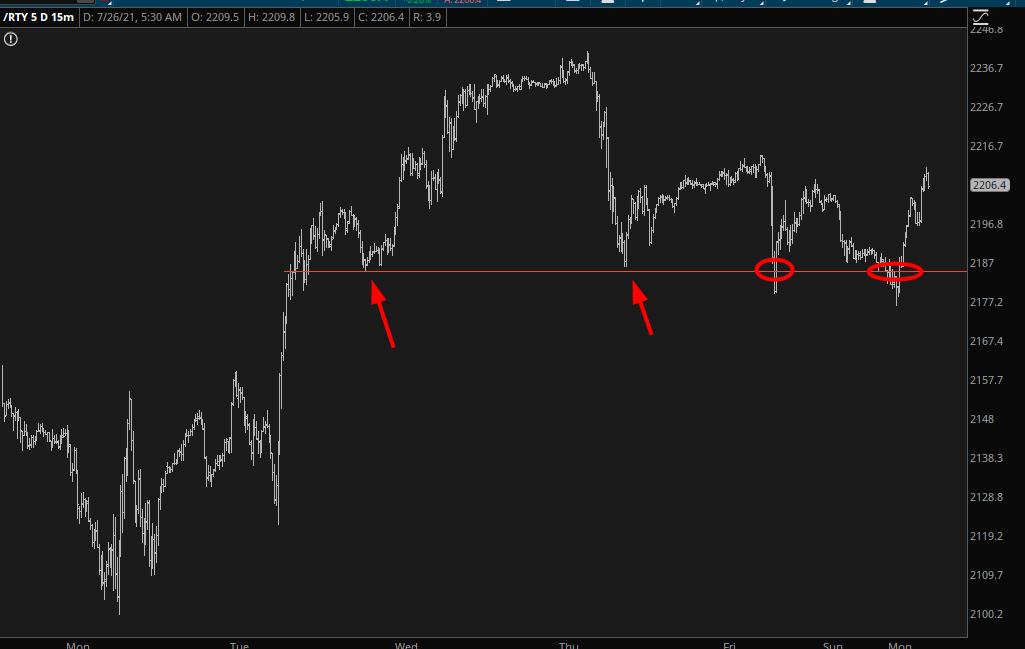
Well, there you have it. As required by federal statute, once the Russell 2000 futures reached their zone of support, boom, the buying started. Let’s take a look at what /RTY has been doing in recent days:

So reading from left to right, you can see the first arrow marks support. After a surge to lifetime highs and a hard fall, the same level is reached again, followed by buying, albeit at a less furious pace. The market weakens and actually punctures support....

....MUCH MORE