Showing posts sorted by date for query msc maersk. Sort by relevance Show all posts

Monday, May 11, 2026

"Shipping giant MSC opens new trade route to bypass Hormuz disruption"

The first lesson of commodity trading (second lesson of ecology*): Humans are quite adaptable.

From EuroNews, May 11:

As tensions choke the Strait of Hormuz, Mediterranean Shipping Company races to keep global trade moving with new route.

Global container shipping giant, Mediterranean Shipping Company (MSC), has announced a new Europe-Red Sea-Middle East express service, linking key European ports with Saudi Arabia and other regional hubs.

The announcement comes as companies across global supply chains respond to surging demand and mounting disruption across Middle Eastern trade routes as a result of the US-Iran conflict.

MSC said its new service will offer faster, more efficient, multimodal alternatives in an increasingly volatile maritime landscape.

Ships sailing from the Baltic sea and across Europe will be directly connected to Jordan’s Aqaba, Saudi Arabia's King Abdullah Port and Jeddah via the Suez Canal....

....MUCH MORE 
*The first lesson of ecology is: Everything is connected. 

As we saw in 2022 when MSC surpassed Maersk as the largest container shipping line, different business models require different assets. French standard bearer CNA CGN rounds out the top three. 

Friday, April 24, 2026

"Iran Confirms First Hormuz Toll Revenue Deposited Into Central Bank — But the Money Trail Leads Through IRGC Wallets"

From House Of Saud, April 23/24:

Iran says first Hormuz toll revenue deposited after 41 days of zero collection, but IRGC controls payment channels and seized two ships the same day. 

TEHRAN — Iran’s deputy speaker of parliament Hamidreza Hajibabaei confirmed on Wednesday that the first revenue from Tehran’s Strait of Hormuz toll scheme had been deposited into the Central Bank, breaking a 41-day streak of zero collection that had become the most cited evidence of the regime’s internal dysfunction. Neither the amount deposited nor the names of the paying vessels were disclosed, and the announcement — reported by Tasnim News Agency and confirmed by PressTV — arrived on the same day the IRGC seized two foreign-flagged ships and reportedly forced parliamentary speaker Mohammad Bagher Ghalibaf off Iran’s negotiating team entirely. 

The deposit, described by Hajibabaei as placed into “the Ministry of Economic Affairs and Finance account at the central bank in accordance with constitutional provisions,” represents a narrow factual correction to the revenue record while opening a far more consequential question. Whether the money that physically passed through IRGC-controlled collection intermediaries — yuan via Kunlun Bank, USDT via Tron blockchain — actually reached the civilian treasury that parliament is now claiming credit for, or whether the Central Bank deposit is a fraction routed for public consumption while the bulk remains in wallets the IRGC controls and Pezeshkian’s government cannot audit, is the fault line this announcement exposes without resolving.

What Iran Actually Confirmed — and What It Didn’t

Hajibabaei’s statement to Tasnim on April 23 was calibrated to declare victory without providing evidence of it. He confirmed that “the first revenue received from the Strait of Hormuz tolls was deposited into the Central Bank account” and that “several vessels” had paid, but disclosed neither the sum nor the identities of the ships involved, according to reporting by the Times of Israel and Xinhua on the same day. Iranian lawmaker Alireza Salimi, speaking separately to Tasnim, added that fees “depend on the vessel’s cargo and level of risk” and were “currently being deposited into a unified account and the treasury” — language that implies an ongoing process rather than a single lump-sum transfer.

PressTV, Iran’s English-language state broadcaster, confirmed the deposit had been received “in cash currency” and credited to the Central Bank, framing the toll as Iran exercising sovereign rights over its territorial waters. The framing matters more than the figure, because the figure was not given. As of April 18, Iran’s toll had collected nothing in 36 days — 60 permits issued, eight payment requests sent, zero payments completed, with India explicitly confirming no fees were paid and Hapag-Lloyd and Maersk continuing to avoid the strait entirely, according to Iran International’s April 16 reporting.

What changed between April 18 and April 23 is almost certainly the yuan payments Bloomberg reported on April 1: at least two earlier transits that paid through a Chinese maritime services company intermediary via Kunlun Bank, outside the US banking system. Those transactions, which Iran had not previously confirmed, appear to be what Hajibabaei is now claiming as Central Bank revenue — repackaging payments that may have occurred weeks ago as evidence of a functioning toll system.

Three Ships, One Message

The timing of Hajibabaei’s announcement was not incidental. On the same day he confirmed the first toll deposit, IRGC naval forces seized the MSC Francesca — a Panama-flagged, Italian-owned container vessel — and the Epaminondas, a Liberia-flagged ship bound for India, while firing on a third vessel, the Euphoria, according to Al Jazeera and NBC News reporting on April 23. Panama’s government condemned the MSC Francesca seizure as “illegal” within hours.

The juxtaposition was deliberate and legible: Iran depositing its first toll revenue into the Central Bank while simultaneously seizing vessels that had not paid presented the strait as a binary — pay or be boarded. Hajibabaei reinforced this framing explicitly, telling Tasnim that “Iran, not the United States, was now making demands.” The statement positioned the deposit not as a commercial transaction but as proof that Iran’s coercive architecture was producing compliance, even as the seizures demonstrated what non-compliance looked like.

The three-vessel operation also served as an answer to the narrative that had dominated coverage since Iran International’s April 16 report headlined “Iran leaders frustrated over failed Hormuz revenue plan.” That story — sourced to officials close to the supreme leader’s office — described internal discussions about stripping toll oversight from SNSC secretary Zolghadr and handing it to Pezeshkian, a transfer of blame rather than authority. The seizures and the deposit announcement, arriving seven days later, were the IRGC’s counter-narrative: the toll works, it generates revenue, and the IRGC Navy’s “full authority” over the strait is producing results.

Who Controls the Money?...

 ....MUCH MORE

Also at House of Saud, April 23:
Aramco’s Q1 2026 War-Price Paradox: 57% Profit Surge, 30% Production Loss, and the IPO Architecture That Separates Them

Sunday, March 1, 2026

Shipping: "The First 36 Hours: Strait of Hormuz Becomes a War Zone, Tankers Hit, Shipping Giants Halt Gulf Transits"

From gCaptain, March 1:

The world’s most vital energy artery is under siege. Following coordinated U.S. and Israeli strikes that killed Iran’s Supreme Leader Ayatollah Ali Khamenei and top military commanders, the Strait of Hormuz—through which roughly 20% of global oil supply flows—has become a war zone, forcing major shipping lines to halt operations and sending hundreds of vessels to seek shelter in open waters.

The escalation has been swift. Iran’s Revolutionary Guard Corps responded with sustained missile and drone attacks targeting both military installations and commercial shipping across the region. Three U.S. service members have been killed in action, while Iranian strikes on civilian vessels mark an ominous expansion of the conflict’s scope.

President Trump confirmed the sinking of nine Iranian naval vessels in a social media post, declaring: “We are going after the rest – They will soon be floating at the bottom of the sea, also! In a different attack, we largely destroyed their Naval Headquarters.”

U.S. Central Command previously confirmed the sinking of an Iranian Jamaran-class corvette at a pier in Chah Bahar during the opening hours of the operation, which the Trump Administration is calling Operation Epic Fury.

The impact on commercial shipping has been immediate and severe. Within 24 hours, at least three tankers had been struck by missiles or drones in what maritime security officials describe as indiscriminate attacks. The oil tanker Skylight was hit 5 nautical miles north of Khasab, Oman, forcing crew evacuation and injuring four. The crude carrier MKD Vyom took a projectile strike above the waterline, sparking an engine room fire that was later controlled. A third vessel, the Sea La Donna, also reported an attack.

Concerningly, the Joint Maritime Information Center has “found no association that would make these vessels a viable candidate for targeting and attack,” underscoring that merchant ships of any flag or nationality now face existential risk in Gulf waters.

The JMIC has elevated the regional threat level to CRITICAL—its highest classification—warning that “an attack is almost certain.” While Iran has not formally closed the Strait of Hormuz, the operational reality reflects “active kinetic hazard conditions” throughout the waterway.

Major shipping companies have responded with unprecedented action. Maersk announced it is “suspending all vessel crossings in the Strait of Hormuz until further notice,” while also rerouting its ME11 and MECL services around the Cape of Good Hope to avoid the Bab el-Mandeb Strait.

MSC Mediterranean Shipping has taken even more drastic measures....

....MUCH MORE  

Thursday, July 17, 2025

"China Threatens to Block Panama Ports Deal Unless Its Shipping Giant Is Part of It"

From the Wall Street Journal, July 17:

Beijing pushes for state-owned Cosco to become shareholder of two Panama Canal ports, dozens of others in BlackRock deal 

China’s government is threatening to block a deal that would transfer ownership of dozens of seaports to Western investors if Cosco, China’s largest shipping company, doesn’t get a stake.

The proposed sale includes two ports at the Panama Canal and more than 40 others around the world, all owned by Hong Kong-based CK Hutchison.

China is pushing for state-owned Cosco to be an equal partner and shareholder of the ports with BlackRock, and Mediterranean Shipping Co., a containership operator, according to people familiar with the deal talks. BlackRock and MSC in March reached a preliminary agreement to buy the ports in a deal valued at nearly $23 billion.

Now, BlackRock, MSC and Hutchison all are open to Cosco’s taking a stake, the people familiar with the talks said.

The parties aren’t likely to reach a deal before a previously agreed upon July 27 end date for exclusive talks between BlackRock, MSC and Hutchison, the people familiar with the talks said. The parties can’t strike a deal that includes Cosco until the exclusivity period ends.

Any deal giving a stake in the Panama ports to a Chinese-owned company would likely upset President Trump, who has threatened to take control of the canal and has objected to Hutchison’s ownership of two ports there. The White House didn’t respond to a request for comment Thursday.

After this article was published online Thursday, Rep. John Moolenaar (R., Mich.), who chairs a congressional committee on China, made public a letter he had sent to a top Panamanian official, saying that the inclusion of Cosco or any other Chinese company in port operations at the canal “would represent an unacceptable risk to the national security of both our nations.”

Hutchison’s initial plan to sell the ports angered Beijing, according to people familiar with the talks. Chinese authorities have told Chinese state-owned companies to freeze any coming deals with Hutchison or other businesses linked to its controlling shareholder, the family of the Hong Kong billionaire Li Ka-shing, these people said....

....MUCH MORE 

Recently:

MSC's Aponte Eclipses BlackRock in Li Ka-shing’s Port Deal 

One quibble. We know some stuff about the shipping companies.

MSC is not just "a containership operator." It is the world's largest, having passed Maersk's capacity in 2022. That achievement was in all the papers and better blogs (ahem).

MSC has the largest container fleet and an over 1mm TEU larger capacity. It is also a giant in logistics and other businesses involved in moving stuff around the world. 

Because MSC is privately held they don't splash their numbers - so to speak - but revenue was almost €90 billion in '22 and Italian media reported the holding company booked quite a profit in what was a very good year for the entire industry. From TradeWindsNews, 

Gianluigi Aponte’s MSC Group has — perhaps inadvertently — revealed its financial performance for the first time.

The holding company of the world’s largest liner company reportedly made €36.2bn ($38.4bn) in profits last year.

The number has been widely published by Italian media outlets after MSC announced the purchase of around half of high-speed Italian train operator Italo.

Turnover of the MSC Group was €86.4bn in 2022, according to Il Messaggero, which first reported the accounts.

Ebitda was €43.2bn and Ebit was €35.7bn.

The Geneva-based company possessed cash reserves amounted to €63bn and equity of €91bn. Medium to long-term debt is put at €26bn.

The figures reflect a big increase in profitability during the pandemic....

....MUCH MORE 

As noted in a 2019 post:

Sept. 25
Shipping: "MSC Announces New Bunker Surcharge to Help Cover $2 Billion Per Year Low Sulphur Fuel Costs"
MSC Mediterranean Shipping Company S.A is another of the world's largest shippers who sound as though they are about to establish a GoFundMe page.
That's a joke.
The Aponte clan* is doin' alright.

***
*The latest Lloyd's 100 Most Influential People in Shipping (Edition Eight, Dec. 2017) has the Aponte famiglia at #10, just behind the Saadé family (CMA CGM) now led by Rodolphe after his father's death this summer, at #9.

If interested here's an ungated version of Edition Seven of the 100 Most Influential, for folks who don't subscribe via Maritime Cyprus.It's a year out of date but good background or a dandy prospect list.
The subscription makes a fine gift.

Thursday, March 6, 2025

French Shipping Giant CMA CGM Passes Maersk To Become #2 Line; Pledges To Invest $20 Billion In U.S. Infrastructure

First up, from Splash 24/7, March 6:

CMA CGM overtakes Maersk in the liner rankings 

CMA CGM, the year’s most aggressive acquirer of ships to date, has made history.

As of this week, Marseille-headquartered CMA CGM has surpassed rival Maersk to the second spot on the liner rankings when including its huge orderbook.

The latest data from Alphaliner shows CMA CGM’s fleet – including ships on order – stands at 5.42m slots, some 140,000 teu more than its Danish rival. Mediterranean Shipping Co (MSC) remains far out in the lead, however, its fleet – including ships on order – is now at 8.47m slots, larger than the extant fleets of CMA CGM and Maersk combined....

....MUCH MORE

And from the Wall Street Journal, March 6:

French Shipping Giant CMA CGM Pledges $20 Billion Investment in U.S.
The world’s [No. 3 2] container line’s pledge comes as Trump pushes to revive the U.S. shipbuilding and maritime industry

French shipping giant CMA CGM pledged Thursday to invest $20 billion in U.S. logistics over the next four years. 

Marseille’s CMA CGM intends to triple the size of the container line’s U.S.-flagged fleet, upgrade its U.S. port facilities and create a new airfreight hub in Chicago, among other moves, the company said.

A CMA CGM official said its $20 billion pledge represents the group’s U.S. investment plans. It wasn’t clear how much of the spending had been planned previously.

Rodolphe Saadé, the billionaire chairman and chief executive of CMA CGM visited President Trump at the White House on Thursday. The company’s pledge comes as Trump pushes to resurrect commercial and military shipbuilding in America and to challenge China’s dominance of the global maritime industry in ways that threaten profits at the world’s largest ocean carriers.

Trump told Congress this week he would create a new Office of Shipbuilding in the White House. To raise revenue for the maritime sector, administration officials are considering an executive order that would include measures such as charging fees on Chinese-built ships calling at U.S. ports, according to a draft summary of the order reviewed by The Wall Street Journal.

That idea, which is subject to change, draws on recent proposals under consideration by the U.S. Trade Representative’s office. The fees of up to $1.5 million per port call are opposed by U.S. trade and agriculture groups as well as by the container line industry.

CMA CGM’s chief financial officer in February said the fees would significantly hurt ocean carriers because China so dominates shipbuilding, according to news reports at the time. Almost 36% of CMA CGM’s container fleet, measured by capacity, is made in China, according to data firm Linerlytica. More than 64% of the company’s new order capacity is being built at Chinese shipyards.

The company operates a U.S.-flagged fleet of 10 containerships under its APL subsidiary. Because the ships are U.S.-flagged, they are crewed by U.S. sailors and are a preferred carrier for U.S. government and military cargo.

A CMA CGM official said the company will triple that fleet to 30 vessels using orders at South Korean shipyards. The official said CMA CGM wants to place new orders at U.S. shipyards but that will depend on the yards’ capacity.

CMA CGM routinely orders vessels from South Korea and China capable of carrying the equivalent of 18,000 containers.

U.S. shipyards build smaller containerships. APL’s U.S.-flagged fleet ranges in size from ships capable of carrying the equivalent of between 1,600 and 6,000 containers.

Saadé joins a growing line of executives who have visited Trump to pledge big U.S. investments over the next four years....

....MUCH MORE

Thursday, November 21, 2024

"Container Shipping Industry Sees Exponential Profit Surge Driven by Red Sea Situation"

From gCaptain, November 20: 

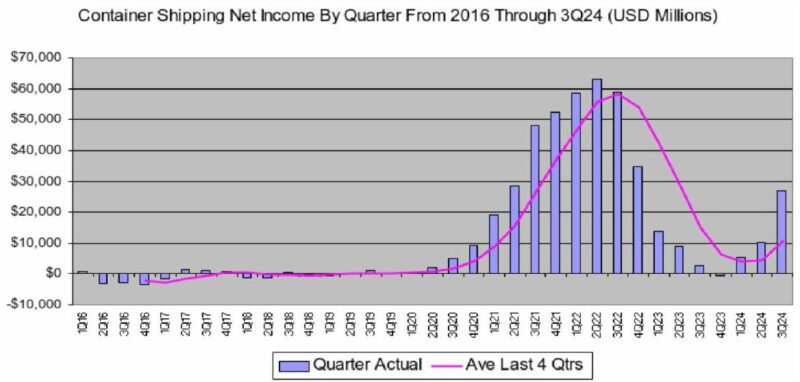
The container shipping industry has experienced a remarkable turnaround in the third quarter of 2024, with total net income soaring to $26.8 billion, marking a staggering 164% increase from the previous quarter, according to renowned industry analyst John McCown.

The impressive growth trend, which began in the first quarter of 2024, has been primarily fueled by capacity tightening in the Red Sea region and strong global demand.

In his Q3 financials report, McCown reports that compared to the same quarter last year, net income skyrocketed by 856%, representing a $24.0 billion increase. This dramatic upswing follows a period of declining earnings that lasted for six consecutive quarters after the industry’s peak earnings of $63.1 billion in Q2 2022....

Chart of Container Shipping Net Income By Quarter From 2016 Through 3Q24

 Credit: John McCown

. ....MUCH MORE

Hmmm, someone should maybe look into money flows from Copenhagen or Marseilles or Geneva to Yemen.

The largest container shipping companies as of 2024 are

Mediterranean Shipping Company (MSC)

APM-Maersk 

 CMA CGM 

— https://www.marineinsight.com/know-more/10-largest-container-shipping-companies-in-the-world/

Wednesday, December 27, 2023

Shipping: "Will ESG, Climate Activists, and Houthis Help Boost Containership Profits?"

From gCaptain, December 27:

Will the actions of Houthi militants and climate activists inadvertently avert the widely anticipated financial fallout in the containership market set for 2024?

Editors Note: This narrative unfolds amidst a highly intricate and chaotic series of events. While we’ve strived to present this story in a clear and linear manner, it’s important to acknowledge that the actual situation is far from straightforward and tidy.

by John Konrad (gCaptain) Just before the Houthi attacks disrupted Red Sea shipping, top containership companies such as Maersk, CMA CGM, and MSC were facing formidable challenges. Coming off a period of COVID-induced record profits, the industry was dealing with an influx of new ship deliveries and unstable freight rates. This situation was poised to significantly reduce containerline profits by 2025, potentially leading to a level of bankruptcies among smaller carriers not witnessed since the downfall of Hanjin in 2016. Confronted with this uncertainty and the need to match growing fleet sizes with decreasing market demand, major carriers were compelled to branch out into other sectors, including logistics, data management, and aviation, to stabilize and diversify their business models. Everyone in the sector tightened their seatbelts for the coming downturn.

Nevertheless, two factors could play a pivotal role in rescuing the industry from the substantial financial losses anticipated next year: one predictable (new climate regulations) and the other unexpected (Red Sea militant activities). Comprehending the impact and shipping company strategies surrounding the new climate regulations could provide valuable insights into how the industry might effectively navigate and potentially capitalize on the challenges posed by the situation in the Red Sea.

A Perfect Storm Builds
Container shipping is a highly competitive and volatile industry. Ship owners often engage in overbuilding during times of favorable rates and strong cash flow, only to face steep downturns when new vessels saturate the market, leading to excessive shipping capacity.

This dynamic has been intensified by two key developments over the past two decades. Firstly, the introduction of ultra-large containerships, which began in 2006 with the launch of the 14,770 TEU Emma Maersk, underscored the cost-saving benefits of economies of scale. This trend was further emphasized in 2013 with the debut of the 18,270 TEU Mærsk Mc-Kinney Møller. Secondly, the resulting overcapacity in the market led to the financial strain and potential bankruptcy of smaller players, thereby reinforcing the dominance of the largest firms in the sector.

These factors resulted in record profits when stimulus checks and COVID-induced ordering flooded the market with freight. Profits skyrocketed higher when port congestion sidelined many ships thus reducing overall capacity in the system.

The Perfect Storm Nears
With these record profits, majors followed the usual playbook and ordered too many ships. Every major shipping analyst has predicted a downturn in 2024 as new capacity is launched from the drydocks of Chinese shipyards.

Maersk has already cut 10,000 jobs in response to the downturn. Analysts foresee further difficulties in 2025, with over 2 million TEU (Twenty-foot Equivalent Unit) in capacity expected to be delivered for the third consecutive year. Clarksons Research anticipates fleet growth rates of 8% in 2023, 7% in 2024, and about 5% in 2025. This rapid expansion may disrupt the balance of supply and demand until 2026....

....MUCH MORE

Monday, September 18, 2023

Everything Shipped To Europe Is About To Become More Costly (ditto for exports)

From Bloomberg via gCaptain, September 18:

Big Emissions Bills Are Coming for Ships in Europe 
Ships carrying everything from consumer goods to food and fuel in and out of the European Union will soon face hefty emissions bills.

The maritime industry will join the bloc’s Emissions Trading System in January, meaning big ships will start paying for carbon emissions. Some major freight firms — such as MSC Mediterranean Shipping Company SA and A.P. Moller-Maersk A/S — could see costs run into hundreds of millions of dollars, according to BloombergNEF.

Vessels carry more than 80% of world trade and are a big source of emissions, pumping about 1 billion tons of CO2 into the atmosphere in 2018. The incoming system is the world’s first large-scale carbon charge for international shipping, and part of the bloc’s green push to tackle climate change. Yet though sizable, the fees are unlikely to be high enough to force an immediate shift to cleaner marine fuels.

“The EU ETS will increase the freight rates,” said Tore Longva, decarbonization director at ship classification society DNV. But vessel supply and demand is likely to have a bigger impact on shipping rates, he said.

For a single container ship sailing between Europe and Asia, the emissions cost could total about €810,000 ($864,500) next year, assuming a carbon market price of €90 a ton, according to DNV. Firms will have to cover a greater share of emissions in the following two years, meaning costs should go even higher.

An example of how it will work:...

.....MUCH MORE

Friday, January 13, 2023

Shipping: Maersk Strategy For World Domination Diverges Sharply From MSC and CMA CGM

From Hellenic Shipping News, January 10: 

Top 10 container lines: How did rankings change during boom?

Container shipping lines reaped massive windfalls during the COVID-era consumer boom. Different ocean carriers pursued different fleet strategies in 2020-22, from aggressively maximizing market exposure on one hand to keeping capacity flat or even reducing it on the other.

The liner bonanza isn’t over yet — high contract rates should keep outsized profits flowing well into this year. But with the historic super-cycle winding down, it’s time to take stock of how fleets evolved over the past three years.

Alphaliner released its overview of 2022 fleet changes on Tuesday. Together with Alphaliner’s historical records, the data shows that the aggregate market share of the top 10 lines has stayed steady through the super-cycle — now at 85% of the global fleet versus 84% in early 2020 — but with big changes among individual players.

There are “major discrepancies between the ‘gainers’ and ‘losers,’” said Alphaliner.

The big gainers

Between Jan. 1, 2020, and Jan. 1, 2023, Alphaliner data shows the top 10 liners increased aggregate capacity by 2.6 million twenty-foot equivalent units or 13%. Five companies drove the gains.

MSC: Switzerland’s Mediterranean Shipping Co (MSC) — the world’s largest carrier since surpassing Maersk last January — has been the biggest gainer in terms of absolute capacity. Its capacity is up 832,324 TEUs or 22% over the three-year period.

According to Alphaliner, MSC increased capacity by 7.5% in 2022, primarily through second-hand acquisitions. It boosted capacity by 10.7% in 2021 through a combination of second-hand acquisitions, charters and newbuild deliveries.

CMA CGM: France’s CMA CGM is now the world’s third-largest liner operator, up from fourth place pre-pandemic.

CMA CGM grew the second fastest in terms of TEUs after MSC. It hiked capacity by 697,327 TEUs or 26% over the past three years. A portion of that growth was fortuitous timing, courtesy of newbuilds delivered in 2020-21 that were ordered before the boom. Capacity rose 7.1% last year....

....MUCH MORE

Sunday, January 30, 2022

French Shipyard, Chantiers de l’Atlantique, Delivers The World's Largest Cruise Ship To Royal Caribbean

From gCaptain, January 28:

Royal Caribbean has taken delivery of the Wonder of the Seas from the Chantiers de l’Atlantique shipyard in France.

At 236,857 gross registered tonnes (grt), the ship is biggest cruise ship ever built. It is the fifth installment in Royal Caribbean’s Oasis-class, which kicked off in 2009 with the Oasis of the Seas. The other four ships in the class come in at 225,000 grt to over 228,000 grt.

With its delivery, Wonder takes the “world’s largest” crown from sister ship Symphony of the Seas, at 228,081 grt.

Wonder of the Seas measures 1,188 feet in length and 210 feet wide. Passenger capacity comes in at 6,988 guests with an additional 2,300 crew.

Wonder of the Seas will make its official debut in Fort Lauderdale, Florida, in March, starting with 7-night cruises to the Caribbean before heading to Barcelona, Spain and later Rome to offer summer cruises in the Mediterranean....

....MORE

Chantiers de l’Atlantique has some experience with big boats. Really, really big boats. Here's a January 2020 post:
French Shipyard Chantiers de l’Atlantique Nabs a Big Order

From LNG World News:

Chantiers de l’Atlantique bags MSC Cruises LNG pair
MSC Cruises and Chantiers de l’Atlantique have signed firm contracts for the construction of third and fourth LNG-powered MSC World Class ships.  
The vessels are scheduled for delivery in 2025 and 2027,  Chantiers de l’Atlantique said in its statement.

The first of the initial two ships in the class is currently under construction at Chantiers’ shipyard in Saint-Nazaire and is due to enter service in 2022. With 205,000 GT, she will become the biggest vessel operated by a European cruise line as well as the first LNG-powered cruise ship built in France.

These contracts represent a capital investment by MSC Cruises exceeding €2 billion ($2.2 billion).
The two companies have also extended their partnership over the next decade with two additional newbuild projects....MORE
Previously:
November 2019
Shipping: Two Approaches To NextGen Power: Maersk Goes With Batteries In a Box; 
Chantiers de l'Atlantique and MSC Cruises Trial LNG Fuel Cells 
...And speaking of big, the Saint-Nazaire yard built four of these suckers, second only to the 657,019 DWT Happy Giant as the largest ultra-super-mega tankers. Batillus was the lead ship of the class:
http://www.maritimeherald.com/wp-content/uploads/Batillus-Top-10-Biggest-Ships-2017.jpg
Batillus class tanker, 555,000 DWT.
We've mentioned it a few times. 
Related: 
France's Chantiers de l’Atlantique Shipyard To Build Ships With Fuel Cells, Ships With Sails

Thursday, January 6, 2022

HA! "The Mediterranean Shipping Company (MSC) is now largest ocean carrier by operated vessel capacity"

I've been having a bit of a mini-drama regarding the accuracy of a statement from a December 21 post:

MSC just passed Maersk as the largest container shipping company by container capacity although Maersk is larger based on revenues and net income....

Yesterday The Loadstar stated Maersk was larger by 12,500 TEU's of capacity: 4,279,305 to 4,266,805 for MSC.

However, after reviewing the film, the Stewards Enquiry gives the nod to Climateer (more accurately, to our source). From Hellenic Shipping News, January 6, 2021:

Global ocean fleet statistics of Alphaliner show that the Mediterranean Shipping Company (MSC) is now the world’s largest ocean carrier by operated container vessel capacity.

Some 52 years after its foundation in 1970, MSC, the long-term number two, today on 5 January 2022 overtook Maersk Group of Denmark as the world’s biggest container line.

As of today, MSC deploys a fleet of 645 container ships with a total capacity of 4,284,728 teu. The company therewith holds a global market share of 17.0%.

Contrary to most other major ocean carriers, which reached their positions in the top-ten through series of mergers and acquisitions, MSC’s rise to the top was entirely organic.
In recent years, MSC has shown a strong growth, mainly through the phase-in of large newbuilt container vessels. Since 2020, the Swiss company has also grown significantly through the rapid acquisition of 128 secondhand container vessels: An unprecedented number in shipping history.

In the first quarter of 2022, MSC is expected to close its first carrier acquisition and buy a 67% majority stake in the Brazilian regional and domestic shipping and logistics firm Log-In Logistica. This will add a further ca. 15,000 teu of capacity to the fleet of MSC Group.
Starting out in 1970 with a German-built second-hand vessel of just 2,900 dwt, acquired from Hapag-Lloyd and renamed PATRICIA, MSC flourished and over the years developed into a massive group....

....MUCH MORE

For folks with an interest in the industry the above story also links to Alphaliner TOP 100 / 06 Jan 2022 with CMA CGM; COSCO; and Hapag-Lloyd rounding out the top five and everyone else down to Irish Continental Group at #100 with 5502 TEU capacity on 6 ships.

Wednesday, January 5, 2022

Shipping: MSC May Not Be The Largest Container Line...Yet

Hold all tickets, we have a Stewards Enquiry.

On December 21 we posted "Logistics/Shipping: "Shipping giant MSC offers to buy Africa unit of Bolloré Logistics"
MSC just passed Maersk as the largest container shipping company by container capacity although Maersk is larger based on revenues and net income....

So, as the stewards watch the video and I check my usually accurate source, we read this, from The Loadstar, January 5:  

MSC the major 'winner' in 2021's containership capacity race

MSC added 411,000 teu of capacity last year, mostly via second-hand containership purchases, for a growth of 10.7%, to 4,266,805 teu, according to Alphaliner data.

This compares with 2M partner Maersk’s conservative 3.4% capacity growth of 142,405 teu, to 4,279,305 teu, and other carrier rivals’ flat or negative tonnage growth in 2021.

MSC’s tonnage growth was especially impressive given that several of its acquisitions involved ships it already operated on charter.

The consultant’s analysis of the ‘winners and losers’ in the capacity race last year highlighted Geneva-headquartered MSC’s insatiable appetite for the S&P market, notching up more than 100 reported purchases.

S&P brokers told The Loadstar last year MSC was hunting ships of “any size and any age” and prepared to outbid all other carriers for an available vessel, even if the transaction involved the expiry of a current charter of six months or more.

However, percentage-wise, Taiwan’s Wan Hai grew its fleet the most: by nearly a third, to 421,202 teu, thereby powering its way into the carrier top 10 rankings and demoting Zim to 11th, despite the Israeli line boosting its fleet by almost 15%, to 413,862 teu, with new charters and its first purchases of second-hand ships.

Elsewhere, Wan Hai’s compatriot, Evergreen, added 199,254 teu of tonnage representing a 15.6% increase in capacity, to 1,477,644 teu.

Nevertheless, Evergreen was not an active player on the S&P market....

....MUCH MORE

Sunday, December 26, 2021

Maersk Goes Big On Warehouses: Buy's Li & Fung's Logistics Unit For $3.6B

A deep dive from SupplyChainDive, December 22:

The deal will grow Maersk's global warehouse footprint to more than 100 million square feet.

A.P. Moller - Maersk made one of its biggest deals to date on Wednesday with a $3.6 billion purchase of Li & Fung's Asia-Pacific logistics subsidiary, LF Logistics.

The all-cash deal comes with its usual bells and whistles. Maersk will purchase a 100% stake in LF Logistics, taking control of the Hong Kong-based company's in-country logistics and global freight management business units. The deal is expected to close in 2022, pending regulatory approvals.

But it also comes with a twist: After the deal closes, Li & Fung plans to acquire the global freight management unit back, in order to retain and grow it on its own terms.

Both Maersk and Li & Fung aim to be leaders in the end-to-end supply chain management space. But they have different capabilities, a fact which the two companies leaned into to make a deal work. In addition to the acquisition of LF Logistics, the two companies signed a "long-term strategic partnership" to work together on supply chain services for customers.

"With Li & Fung’s upstream digital and sourcing expertise and Maersk’s downstream logistics capabilities, we will begin to offer our respective customers the opportunity to take advantage of this unique end-to-end value chain proposition anchored upon operations excellence, technology, and sustainability," Spencer Fung, group executive chairman of Li & Fung, said in a statement.

For Li & Fung, it was more of a cash-rich divestment. The deal allows the company to shed logistics assets to grow its freight management and supply chain finance portfolio.

But for Maersk, documents disclosed to investors show it's a growth milestone that caps a year of acquisitions....

....MUCH MORE

Recently:
Big Money Still Buying Warehouse Assets: Canada Pension Plan Investment Board Enters Into $1.1 Billion J.V.
Logistics/Shipping: "Shipping giant MSC offers to buy Africa unit of Bolloré Logistics"

Tuesday, December 21, 2021

Logistics/Shipping: "Shipping giant MSC offers to buy Africa unit of Bolloré Logistics"

MSC just passed Maersk as the largest container shipping company by container capacity although Maersk is larger based on revenues and net income. However, MSC is private and Forbes says the Aponte fam is the wealthiest in Switzerland at $10.3 billion. That is very lowball as the company is turning $28 -30 billion in revenues. Throw even a 1 multiple on that and, well it's not higher level math is it.

From FreightWaves. December 20:

$6.7B deal highlights diversification strategy of ocean carriers

Mediterranean Shipping Co., the world’s second-largest ocean container line, has made an offer to acquire the Africa division of Bolloré Group, the France-based third-party logistics provider announced Monday. 

The move is part of a recent trend that has seen ocean carriers and terminal operators become more vertically integrated freight transportation and logistics providers to diversify their revenue streams and offer customers holistic supply chain solutions based on variable needs. Supply chain disruptions during the pandemic have heightened cargo owners’ interest in having alternative freight transportation strategies and capabilities.

The MSC Group, based in Switzerland, is offering to buy 100% of Bolloré Africa Logistics at an enterprise value of 5.7 billion euros ($6.7 billion), not including any minority interests in the company.

The Bolloré Group said it has granted MSC Group exclusive rights until March 31, 2022, to conduct negotiations and comprehensive appraisal of the business. 

Any final agreement is contingent on consultation with labor unions and reorganization of certain internal Bolloré operations. Completion of the sale would require approval by relevant regulatory bodies as well as certain counterparties of Bolloré Africa Logistics.

Bolloré is ranked as the 21st largest logistics provider in the world, based on gross revenue of $5.3 billion in 2020, according to consultancy Armstrong & Associates....

....MUCH MORE

FreightWaves is still using the old rankings for MSC. They really have bumped Maersk from the #1 position Maersk held for 25 years. 

Sunday, April 18, 2021

Shipping: "Vessel-hungry MSC set to take Maersk's crown as world's largest box line"

From The LoadStar, April 14:

Based on box ship orderbooks and its aggressive purchasing in the second-hand market, MSC is set to usurp 2M partner Maersk next year to become the world’s largest container line.

According to Alphaliner data, the capacity gap between the two carriers currently stands at around 225,000 teu, with the Danish carrier operating a fleet of 709 ships for 4,121,964 teu, while MSC’s 588-ship fleet has a capacity of 3,897,002 teu.

However, the consultant said, MSC’s two-pronged owned fleet growth strategy of hoovering up second-hand tonnage alongside its large orderbook will see Maersk become the junior partner in the 2M alliance “sometime in 2022”.

“MSC is behind orders for at least 35 big deepsea vessels, with a combined capacity of nearly 660,000 teu, while Maersk’s current orderbook only includes 16 ‘regional’ ships, for 41,674 teu,” said Alphaliner....

....MUCH MORE

Previously:
January 2019
Shipping: "MSC to Close Capacity Gap on Maersk in 2019"

Dec. 2018
"MSC" is the abbreviation, not a stock symbol. The company Is privately owned with the controlling shareholders, the Aponte clan, being worth at least $8 billion and probably over $10 B.

And Sept. 2018
Shipping: "MSC Announces New Bunker Surcharge to Help Cover $2 Billion Per Year Low Sulphur Fuel Costs"
MSC Mediterranean Shipping Company S.A is another of the world's largest shippers who sound as though they are about to establish a GoFundMe page.
That's a joke.
The Aponte clan* is doin' alright.

***
*The latest Lloyd's 100 Most Influential People in Shipping (Edition Eight, Dec. 2017) has the Aponte famiglia at #10, just behind the Saadé family (CMA CGM) now led by Rodolphe after his father's death this summer, at #9.

Tuesday, December 8, 2020

Hong Kong Shipping: Do Not Short Seaspan's Bing Chen (ATCO)

Or former Buffet heir apparent David Sokol for that matter but it is Chen running the larger company of the wannabe conglomerate, Atlas, and Chen who has built Seasspan into the largest non-operating ship lessor.

From The LoadStar: 

MSC buys more second-hand ships and may be eyeing Seaspan newbuilds

The world’s largest non-operating containership owner, Seaspan Corporation, has ordered five newbuild 12,200 teu vessels, backed by 18-year charters with a major ocean carrier.

“All five vessels will commence long-term charters with a leading global liner company and are subject to vessel purchase obligations at the conclusion of the charters,” said Seaspan.

But it gave no details of the charterer, other than that it is a “long-standing customer”, or the construction yard.

“Executing a discreet newbuild opportunity to fulfil customer needs and achieve targeted returns is a win-win result,” said Seaspan chairman, president and CEO Bing Chen.

However, one broker source told The Loadstar today he suspected the charterer would be either Cosco, Maersk or MSC, but thought the tone of the announcement suggested the latter....

....MUCH MORE

Because there is so much financial engineering involved in what Seaspan does, buying ships with debt and chartering them out to operators it is a little spooky to look at their financials but if they keep all the plates spinning there is a lot of money to be made. And that's the dilemma for betting on either side of this one.

Previously

Monday, September 14, 2020

Ahead of Tuesday's Vote, Shippers Balk At EU Carbon Market Plan

From Euractiv via Hellenic Shipping News, 15/09/2020:
The shipping industry has railed against plans to expand the EU carbon market to the maritime sector ahead of a crucial vote in the European Parliament on Tuesday (15 September) that risks putting lawmakers on a collision course with shippers.

Unlike power plants, industrial sites and flights within the EU, ships are currently exempt from paying to pollute under the bloc’s Emissions Trading System (ETS), but that looks set to come to an end soon.

MEPs will vote on whether to support an initiative that aims to expand the ETS into uncharted waters, while the European Commission has repeatedly indicated that it is a part of its climate agenda.
The sector has a pollution problem: in 2018, it accounted for 3.7% of the EU’s total CO2 emissions and this year the Mediterranean Shipping Company (MSC) ranked seventh on a list of the bloc’s top ten biggest emitters. The other nine are coal power plants and Ryanair.

But the World Shipping Council (WSC), which counts giants like Maersk, Hapag-Lloyd and MSC among its members, has warned that carbon market expansion could jeopardise global efforts to reduce shipping’s environmental footprint.

In a discussion paper, the WSC said “the international tensions and disruption caused by an EU ETS with extraterritorial effect would harm the prospects for a comprehensive global solution through the International Maritime Organisation (IMO).”

“The EU wants to lead the effort to decarbonise shipping, and that leadership needs to be channelled through the IMO, which is the only place where a global solution can be reached,” said CEO John Butler....
....MUCH MORE

Sunday, August 16, 2020

Shipping: "Chinese authorities investigate liners as transpacific rates hit record territory"

From Splash 24/7:
China’s Ministry of Transport has sent letters to six major containerlines, asking them for explanations behind the recent freight rate surges, which has seen ships charging record figures on the transpacific.
The six companies questioned are Cosco, Maersk, MSC, CMA CGM, Hapag Lloyd and Evergreen.
According to Alphaliner, spot freight rates on the North China to US West Coast trade have surged to their highest level ever, despite the restoration of blank sailings by carriers and even the introduction of new capacity.

Rates are now 120% up on their value a year ago. Prices on the route reached $3,144 last Friday, consolidating the all-time high of $3,167 recorded the previous week. Both mark the first time rates have exceeded $3,000....
....MORE

Related:
Shipping: "More carriers must blank voyages to avoid transatlantic rate collapse"
Contra the transPacific routes where the price per box is over $3100.*
*Shipping: Trans-Pacific Spot Freight Rates Hit Record (fewer boxes but more $ per)

Thursday, August 6, 2020

Shipping: "More carriers must blank voyages to avoid transatlantic rate collapse"

Contra the transPacific routes where the price per box is over $3100.*
From The Loadstar:
Transatlantic demand continues to be hit by the pandemic, obliging carriers to extend voyage-blanking programmes and putting rates under pressure.

2M partners Maersk and MSC announced today they were extending the suspension of their TA4/NEUATL4 transatlantic loop to the end of September outbound from Europe, and to early October from the US.

Maersk said the service suspension was being extended “due to continued market demand reductions in North America and Europe”.

The loop, which has been suspended since May, deploys five vessels with an average capacity of 5,300 teu and has a rotation of Antwerp-Rotterdam-Bremerhaven-Liverpool-New York-Savannah-Port Everglades.

Alphaliner said demand recovery on the route was taking longer than on the two other east-west trades.

“Whereas most blanked sailings have been reinstated on the transpacific and extra sailings are now being offered from Asia to North Europe to accommodate all the cargo volume during the short summer peak period, more void sailings in September have already been announced for the transatlantic trade, as cargo demand is still affected by the Covid-19 pandemic,” said the consultant....
....MUCH MORE
* Shipping: Trans-Pacific Spot Freight Rates Hit Record (fewer boxes but more $ per)

Monday, January 20, 2020

French Shipyard Chantiers de l’Atlantique Nabs a Big Order

From LNG World News:

Chantiers de l’Atlantique bags MSC Cruises LNG pair
MSC Cruises and Chantiers de l’Atlantique have signed firm contracts for the construction of third and fourth LNG-powered MSC World Class ships.  
The vessels are scheduled for delivery in 2025 and 2027,  Chantiers de l’Atlantique said in its statement.

The first of the initial two ships in the class is currently under construction at Chantiers’ shipyard in Saint-Nazaire and is due to enter service in 2022. With 205,000 GT, she will become the biggest vessel operated by a European cruise line as well as the first LNG-powered cruise ship built in France.

These contracts represent a capital investment by MSC Cruises exceeding €2 billion ($2.2 billion).
The two companies have also extended their partnership over the next decade with two additional newbuild projects....MORE
Previously:
November 2019
Shipping: Two Approaches To NextGen Power: Maersk Goes With Batteries In a Box; 
Chantiers de l'Atlantique and MSC Cruises Trial LNG Fuel Cells 
...And speaking of big, the Saint-Nazaire yard built four of these suckers, second only to the 657,019 DWT Happy Giant as the largest ultra-super-mega tankers. Batillus was the lead ship of the class:
http://www.maritimeherald.com/wp-content/uploads/Batillus-Top-10-Biggest-Ships-2017.jpg
Batillus class tanker, 555,000 DWT.
We've mentioned it a few times.