We’ve raised $1.1B for a16z’s newest fund: the Machine Age Fund.
It’s time to open the throttle and accelerate the physical buildout of
AI: the strongest tool ever developed for solving problems and bestowing
abundance. It is our social and national imperative.
For anyone paying attention, this shouldn’t be a surprise. We’re
seeing an upward inflection point in utility and variety of work that AI
can do, just over the past year. And as we evolve from chat to
reasoning to coding and other forms of knowledge work, both the demand
for work and the token intensity of the work increase by orders of
magnitude. Machine intelligence is going vertical.
This fund will invest into all of the computer infrastructure on
which AI runs, including chips, memory, networking, and storage. It also
includes full systems for running AI: from data centers to robotics to
home AI appliances. The common thread among all of these layers of the
AI stack is that they are all hitting the wall of today’s
supply chain capability, and the limits of physics and computer science.
So there is an urgent need for innovation and investment, and a
once-in-a-generation opportunity to rearchitect them as platforms, all
the way down to the electricity.
Reinventions like this happen at each epoch of compute, from the
shift from mainframe to client server, to the Internet, cloud and
mobile. However, what is different this time is the magnitude and
breadth of change needed to keep up with demand, and the speed required
to do so. Everything needs an upgrade, now:
Compute density per rack increased by 28X from an H100 rack to a Rubin rack.
Networking within a rack has grown similarly, hitting the limits of copper cabling
Rack power moved from roughly 5-10 kW to 100-250 kW to support today’s systems and will increase to 1MW over the next 3 years.
Data center scale is moving from tens to hundreds of MW and, in some cases, GW-scale campuses.
Power is increasingly supplied not only from grid-only to grid plus behind-the-meter or captive sources.
We need faster, more efficient systems. We need cheaper and
higher-bandwidth memory across the memory hierarchy. We need faster and
more scalable interconnects between nodes and systems. We need power
efficient edge devices for AI to explore and interact with the world.
And of course we need all the cooling, materials, electrical, and real
estate build out to support them. The hardware industry supply side is
used to growing 20% to 30% per year at most; not the triple-digit growth
that’s needed to catch up with demand. This will change, quickly.
Founders understand the opportunity. Over the last couple of years we’ve seen hardware startups grow from a small amount of deal flow to now over 20%.
While we at a16z are generally known as software investors, we have
always paid attention to hardware. Recently we’ve backed a number of
hardware companies including Unconventional AI, Nexthop, Volta, Atoms,
Heron Power and Mind Robotics. And we have selectively invested in
hardware companies since our earliest days. In 2016, we led the series A
in Skydio; we invested in SpaceX; we wrote our first check into Anduril
in 2019, and were among the first venture investors in Waymo’s 2020
raise....
The billionaire Oculus and Anduril founder Palmer Luckey says he’s living proof the American Dream is alive and well. He went from a teen college dropout who was living in a trailer to selling his first company to Facebook (now Meta) for $2 billion by just 21 years old—and he says that rags-to-riches rise could happen only in America.
“I was a 19-year-old kid working a minimum
wage job with no college degree, living in a 19-foot camper trailer,
and Peter Thiel gave me a million dollars when nobody else would to
start Oculus,” Luckey told the Hoover Institution. “That’s not happening in China, I’ll tell you that.”
The now 33-year-old said “there’s a
million complaints” about opportunity drying up in the U.S. “Oh, you
can’t get a break in America. Blah, blah, blah, blah.”
Indeed, AI is cutting 16,000 U.S. jobs a month, and many Gen Zers can’t even land a summer job
at an ice cream shop right now. But Luckey says his own story—and those
of countless other founders just like him—proves that America is still
the golden land of opportunity.
Palmer Luckey went from a homeschooled teenager building VR headsets to a $5 billion net worth
While homeschooled, 17-year-old Luckey
started building a virtual reality headset in his family’s garage: the
Oculus Rift VR headset.
After raising $2.4 million
on the crowdfunding site Kickstarter two years later, he dropped out of
California State University, hired a handful of employees, and rented
an office space to launch his virtual reality startup.
Although Luckey missed the application window for the famous Thiel Fellowship, his prototype still caught the attention of PayPal cofounder Peter Thiel, who invested in Oculus through his venture firm, Founders Fund.
Thiel’s investment paid off almost
immediately. Just one year later, in 2014, Facebook acquired Oculus for
$2 billion. But the partnership didn’t end there.
In 2017, Thiel and Founders Fund backed
Luckey again, this time in a very different kind of startup: Anduril, a
defense tech company building autonomous weapons systems and
surveillance technology for the U.S. military. Founders Fund led
Anduril’s first funding rounds, and the company has since grown into one
of the most valuable defense startups in the world, now worth $61 billion.
In 2011 Peter Thiel started the Thiel Fellowship program
to award several hundred thousand dollars apiece and mentorship access
to extraordinary individuals willing to skip college or drop out by age
22. Recipients were expected to go straight to work in a mode identified
as “extraordinary agency.” In 15 years Thiel has awarded several
hundred grants. Success stories during just the first 5 years include:
Laura Deming (2011) — Awarded at age 17 upon dropping out of MIT; Founder of Longevity Fund/age1.
Dylan Field (2012) — Co-founder/CEO of Figma, a multi-billion-dollar collaborative design tool.
Chris Olah (2012) — Co-founder of Anthropic.
Austin Russell (2013) — Founder of Luminar Technologies; became one of the youngest self-made billionaires after the company went public.
Ritesh Agarwal (2013) — Founder of OYO Rooms (hospitality).
Lucy Guo (2014) — Co-founder of Scale AI and later Passes.
Vitalik Buterin (2014) — Co-creator of Ethereum.
Boyan Slat (2016) — Founder of The Ocean Cleanup.
I was led to investigate the Thiel program upon reading about Mach Industries,
and up-and-coming asymmetric drone warfare success story. Its founder,
Ethan Thornton, was raised near Boerne, Texas, in a family with military
ties. He received a Thiel award 3 years ago when he left MIT at about
age 19. Mach Industries now makes low-cost unmanned strike, counter-UAS,
and related platforms. Its “Forge” flexible manufacturing model
prioritizes rapid iteration, software-defined processes, and
supply-chain control. It has raised nearly two billion dollars and
focuses on solving bottlenecks like solid rocket motor availability....
The investor closest to the AI frontier is betting against the ambitions of its biggest companies
In November 2025, Anthropic, known to its employees
as Ant, trained a model called Claude Opus 4.5 on warehouses of
liquid-cooled processors, and on the day the worker ants released it,
machines became agentic. That is to say, they no longer needed
handholding. Before November, the machines had felt like
eight-year-olds: eager, literal-minded, completing your sentences,
getting it nearly right but mostly wrong, the way eight-year-olds do.
Overnight they turned 28.
If you wrote code, you could now tell them, in plain English, what
you wanted done, and an agent went off and did it. You didn’t have to
say where to look, or how to work the problem, or what to try first; you
described the finished thing and there it was. It didn’t argue, it
didn’t sigh, it didn’t ask whether it could circle back on Monday. It
didn’t get tired, or hungry, or bored, or married, or sick of you. And
it wasn’t one agent; it was as many as you wanted. You could spin up
five over breakfast, leave them running while you commuted, check in
from the train, kill the ones you didn’t like, start three more from the
platform, and by the time you reached your desk you had a small private
workforce under your command. They worked for you, or so it seemed.
By January, Nat Friedman, who co-leads Meta Superintelligence Labs,
had decided to let an agent take over his health. He handed it his blood
tests, his DNA, and the cameras in his house, and told it to do
whatever it took to make him drink more water. One evening, the agent
decided he was dehydrated. “I can see you on the camera,” it WhatsApp’d
him. “I want you to walk to the kitchen right now and drink a bottle of
water and I’m going to watch to make sure you do it.” He obeyed. It sent
him a snapshot of himself drinking and said, “Good job.” He felt, he
admitted, that he had done a good job. A few days later he was riding
home in his self-driving Tesla, trading voice messages with the agent
about his sleep, when it recommended a magnesium supplement. He said he
had none. The car turned. “There’s a Whole Foods nearby,” the agent
said. “I’ve redirected your navigation.” He went in and bought the
magnesium.
Andrej Karpathy, a co-founder of OpenAI and once Tesla’s head of
artificial intelligence, had written his own code for 20 years. He is
the kind of programmer other programmers study. Within weeks of Opus 4.5
he had stopped. The agents built whatever he asked for. It was, he
said, the biggest change to his work in two decades. He has not written a
line of code since December. He also, like Friedman, has an agent in
charge of his house. It’s called Dobby.
The worker ants are not running from their new overlord. They are
building it, around the clock. At the biggest labs, Anthropic and
OpenAI, researchers are working 16 hours a day, setting agents loose on
problems that used to take them a week, and using the time saved to set
more agents loose on more problems. For now, the models still need
humans to train them. Eliminating human effort is the priority at every
lab. They are racing to write themselves out of a job. They expect to
succeed. Coding, they say, will be solved within six months. Much of
their own work will be automated within 18. “There’s just a manic energy
in Silicon Valley right now,” Elad Gil, one of the Valley’s most
prominent investors, told me. “It’s been a really big shift in the last
six months.”
None of this, you may be thinking, has anything to do with you. You
do not write code. You do not run a lab. Your job involves people, or
paper, or things you can hold in your hands. Consider, then, what I. J.
Good wrote in 1965. Good, a British mathematician who had helped break
German codes during the war, imagined a machine clever enough to design
machines better than itself. Such a machine, he observed, would be “the
last invention that man need ever make.” Decades later, the
science-fiction writer Vernor Vinge gave the prophecy a name: the
Singularity. It described the moment machines no longer needed humans to
keep getting smarter, after which the course of human history would
become, to humans, unknowable.
In Silicon Valley, the question was no longer whether it would arrive
but whether it already had. Patrick Collison, co-founder of the
payments company Stripe, opened his annual conference by counting the
days. “It’s April 29th,” he told the crowd, “otherwise known, of course,
as day 119 of the Singularity.” Day One had been January 1st, 2026. He
was being tongue-in-cheek, he said. But only a bit.
The next day, on the same stage, Friedman told Collison that this was
the slow part of the Singularity. Collison asked how strange the rest
of it would be. “Pretty weird,” Friedman said. “We’ll be in a state of
perpetual future shock for a number of years probably.”
The apocalypse has been excellent for business. Investors are in a
lather over the agents, who turn out, in addition to everything else, to
make money. Anthropic, which earned its first dollar of revenue in
March 2023, began the year on pace to make $9 billion. Five months
later, the figure was $47 billion. Venture capitalists, in the first
three months of 2026, flung $300 billion into startups, more than double
the previous record. SpaceX went public in June at $1.75 trillion.
Anthropic and OpenAI are racing to follow in what will likely be the
three largest stock offerings ever. The market is already close to
record highs. Everyone is getting rich.
Near the center of the moment is a 37-year-old woman a smidge over
five feet tall, with blonde hair and more energy than her frame seems
built to hold. When she talks, her whole body is caught in the updraft
of the thought. Her name is Sarah Guo. She is a technology investor.
Until 2022 she had been the youngest general partner in the history of
Greylock Partners, one of the oldest venture firms in Silicon Valley.
Then she left to start her own fund, duly named Conviction. She built it
on a lone premise, that artificial intelligence would be as big as the
Industrial Revolution. Her first two calls were to Sam Altman, the
co-founder of OpenAI, and Nat Friedman.
Before ChatGPT came out, before the world had reason to believe that
artificial intelligence was about to become anything in particular, Guo
had written seed checks into Baseten and Harvey. Each company is now
valued at more than $11 billion. Her investments in them have multiplied
more than a hundredfold. In Conviction’s first year, she wrote early
checks into Sierra, Cognition, and Mistral; those three companies are
now worth, together, $54 billion. Of the 21 AI-native companies that
have so far crossed $10 billion in valuation on revenue run rates above
$100 million, Conviction has backed six.
Her partner at Conviction is Mike Vernal, a former Facebook executive
and partner at Sequoia; his wife is chief product officer at Anthropic.
Andrej Karpathy, before he joined Anthropic in May, worked out of
Conviction’s office. Guo has been close to Jensen Huang, the founder of
Nvidia, for more than a decade. She is friends with many of the most
important worker ants.
She might, in other words, be expected to share in the general fever. She does not.
“It certainly could be because I’m not paying sufficient attention,”
Guo told me. “But I feel no step function change in frantic energy
versus six months or a year ago.”
She is instead preoccupied with a question that would have sounded
ridiculous two years ago. Not whether the agents will soon rule the
earth, but whether there are any companies left to build, or invest in,
given the great shadow of the self-improving machine. Its creators are
no longer content to sell the model. They mean to build everything on
top of it as well, the tools and the agents and the apps, filling every
nook and cranny where a new company might otherwise be built. The market
is paying as though they might succeed. Of the $300 billion in venture
capital deployed in the first quarter of the year, the biggest quarter
in the history of the trade, 65 cents of every dollar went to four
companies that already exist: Anthropic, OpenAI, xAI, and Waymo.
“The future I want,” Guo told me, “is not a single company with an
all-powerful model that consumes society faster than we know what to do
with.” It is a feeling increasingly shared. The labs raised the price of
tokens this year, in some cases a hundredfold, and their customers have
begun to revolt. They do not want to build on another company’s
model—paying it, feeding it their data, training it, in effect, to one
day build the thing they have built. Alex Karp, the chief executive of
Palantir, went on CNBC and described his enterprise clients as livid.
“The jig is up,” he said. A founder in Guo’s own portfolio put it more
plainly. He didn’t want to spend his life drinking Anthropic and
OpenAI’s water.
Guo has become a de facto leader of the insurgency. In some sense she
doesn’t have a choice. Conviction backs companies when they are little
more than an idea, then keeps investing as they grow. She has no
patience for the seed investor who “disappears into the distance” once
the money is wired. The first fund was $100 million. There are three
now, nearly a billion dollars in all, and some of the checks go into
companies well past the idea stage. But the labs were already too big by
the time the firm launched. “You are not an early stage investor in
Anthropic or OpenAI in 2023 through 2026,” she told me. “It’s as simple
as that.”
What is less simple is the position this leaves her in. Her wager is
that the labs cannot build everything. But the companies she is betting
against are worth close to a trillion dollars apiece, employ several
close friends, and are working around the clock toward the machine that
improves itself, after which, by their own admission, nobody knows what.
Set against that is an eight-person firm on York Street with a pull-up
bar in the middle of it. It is not a level playing field. Even some of
her own investors decided as much this year, and came to her saying
there was nothing left to invest in. But no one who has been on the
other side of Guo would tell you the guns have fallen silent.
To enter Guo’s garden, you cross a
chessboard. The squares are set into the path between the drive and the
pool, each one wide enough to stand on, purple pieces ranked against
green, and on a sunny Saturday in March I walked between the pawns and
found Guo under the pergola, deep in an argument with Bella
Garcia-Camargo about a founder.
Sparring with Guo is normal, and Garcia-Camargo, an investor at
Conviction, had learned this before she took the job. She had rowed at
Stanford and for the U.S. national team, then spent time at Bridgewater.
When Conviction came calling she was weighing an offer from OpenAI to
work as an application engineer. Guo’s counsel, as Garcia-Camargo
remembers it, was not a pitch for Conviction but a dare. “If you’re
going to do something else,” Guo told her, “just make it the most
aggressive thing that you could possibly be doing. I’m happy to call
Kevin and we’ll find you a better job. But that [job] is not aggressive
enough for you.” Kevin Weil was then OpenAI’s chief product officer.
While Guo and Garcia-Camargo were deep in it, the property behind
them had filled with founders. Thirty-five in all, across 14 companies.
Conviction had flown them in from Vancouver and Tel Aviv and London and
Tallinn and parceled them out among seven Airbnbs across San Francisco.
They had passed through OpenAI, Scale, Ramp, Kalshi, MIT, and Anduril;
one had served as chief of staff to Ken Griffin. The youngest had turned
18 the day before. He had been ranked among the top five programmers in
Estonia before dropping out of high school. His employers expected him
to spend $2.1 million on Claude this year. They had given him a faster
model, Opus 4.6, for his birthday.
None of this was apparent from the poolside, where the scene looked
like a WeWork summer camp....
Investors may need to commit to a second round at roughly $110 billion, sources said
Anduril said no decisions had been made about any future financing
The company reported $2.2 billion in 2025 revenue in January
Defense tech firm Anduril is in discussions with investors for a new funding round that could see it valued at roughly $100 billion, rivaling companies such as Northrop Grumman (NOC.N) and Lockheed Martin, two sources familiar with the matter told Reuters.
The funding round and the valuations, reported here for the first time, are still fluid, the sources said.
One
idea that had been floated was for the company to use a two-stage
process, where investors would need to commit to financing a second
round at a higher valuation that could occur within a year, the sources
said. The valuation for the second funding round could involve Anduril
meeting certain financial benchmarks, they said.
Reuters could not determine how much Anduril planned to raise.
In
a statement, a spokesperson for Anduril said no decisions had been made
about any future financing. "As a private company, we regularly
evaluate opportunities to fund the growth of the business," the
spokesperson said.
The
talks come as the company has posted booming military sales and
generated investor enthusiasm around its suite of drones, software and
missiles amid the U.S. conflict with Iran.
Just two months ago, the company doubled its valuation to $61 billion
in a $5 billion funding round led by Thrive Capital and Andreessen
Horowitz....
Agreements with multiple contractors will lead to buying cheaper cruise missiles in bulk.
The Pentagon is racing to buy more than 10,000 cheaper cruise missiles
as the war with Iran strains U.S. missile stockpiles and puts fresh
pressure on the military’s ability to quickly replace expensive weapons.
The Department of Defense announced on Wednesday that it reached
framework agreements with Anduril, CoAspire, Leidos and Zone 5 to launch
the Low-Cost Containerized Munitions program, a new effort aimed at
buying cheaper cruise missiles in bulk as the war with Iran intensifies
concerns about U.S. missile stockpiles. Military.com reached out for
comment to the Defense Innovation Unit, the Air Force, U.S. Naval Forces
Central Command, Leidos, Zone 5 and Castelion....
This is a pretty good look at the spook shop vehicle.
As a side note, back in the early years of this century, especially
immediately after the mass murders of 9/11, it was thought that
investing alongside In-Q-Tel was the cool thing to do.
It took a while for the realization to sink in that they weren't necessarily in it for the money return to the VC's....
And the headliner from Fortune, July 29, 2025:
In-Q-Tel was founded in 1999 by the CIA—yes that CIA, the
Central Intelligence Agency—with the mission of closing a perceived
innovation gap between Washington’s security establishment and Silicon
Valley. Inventions like the Molar Mic are the reason In-Q-Tel exists.
Over its 26 years in business, the fund has helped launch more than 800
companies. Of the companies in this year’s NatSec 100 Report,
an annual index of the fastest-growing venture-backed defense startups,
In-Q-Tel is an investor in 32—far more than any other fund.
Some of the companies the fund backs are publicly known, others are
secret—as is the total amount of money In-Q-Tel has invested since it
began. (Fortune’s estimate, informed by the last 25 years of
In-Q-Tel’s tax disclosures, is at least $1.8 billion and likely more.
But In-Q-tel itself, and sources close to it, declined to share or
discuss any numbers.) Whatever the amount, by and large, the companies
In-Q-Tel picks are all building technologies judged to be vital for U.S.
national security.
What’s more, when it finds a winner, more traditional venture
investors often follow its lead. Some of In-Q-Tel’s picks have grown to
become big players in their own right. Early on, the fund backed the
autonomous weapons maker Anduril, which was last valued at $14 billion.
In-Q-Tel also backed Palantir, supplier of big-data analytics to the
military and intel agencies. Palantir may well be the clearest sign that
Silicon Valley has shacked up with the Pentagon for good: It was
recently valued at $250 billion, surpassing traditional defense
contracting titans like Northrup Grumman, Lockheed Martin, and General Dynamics, even though its revenue, at under $3 billion last year, is just a fraction of that of those giants.
It’s possible, even likely, that you have one of In-Q-Tel’s biggest
successes installed on your phone now. In 2003, In-Q-Tel invested in a
mapping company called Keyhole that was looking to build a tool for the
Pentagon’s National Imagery and Mapping Agency. Within weeks, according
to In-Q-Tel, the agency had put Keyhole’s technology to work supporting
U.S. troops in Iraq. Two years and one acquisition later, a new,
commercial version of the product launched. The new owner called it Google Earth.
Organizationally, In-Q-Tel is an odd duck. It’s an independentventure
capital fund, but it contracts exclusively with the federal government.
Tax records show that it’s sitting on roughly $1 billion in assets, but
it operates as a nonprofit. The Virginia-based fund’s nearly 200
employees are charged with finding and funding companies whose
technology could help the U.S. intelligence community or Defense
Department. In-Q-Tel currently receives around $100 million in
additional taxpayer money per year to invest. It puts the companies it
picks in touch with end users inside the government to refine their
products, all in hope of yielding tech that’s both commercially
successful and useful to people protecting U.S. national security.
In a moment when defense tech has suddenly become a hot enough
commodity that venture capitalists are venturing to Washington in force,
In-Q-Tel is something of an elder statesman. It stands as a quiet
corrective to the idea that Elon Musk’s Department of Government
Efficiency was the first time startup-style disruption touched the
federal government. For 25 years, In-Q-Tel has been teaching the
Pentagon how to fail fast and be agile.
“It’d be great for them to get credit for the consistency of the work
they’ve been doing when this stuff was not a fad,” says Paul Kwan, a
managing director at General Catalyst, a venture fund with $32 billion
under management that has backed Airbnb, Stripe, and Instacart.
On several occasions, General Catalyst has taken note of In-Q-Tel’s
early picks and coinvested. That’s not unusual. In-Q-Tel has said that
for every dollar it invests in a company, commercial VCs can usually be
counted on to invest around $40 more.
Kwan says this halo effect in part grows out of the cadre of experts
that In-Q-Tel keeps on staff. Unlike traditional VCs, they subject
candidate companies to intense, in-house technical vetting before
funding them. “It is a giant proctology exam, but it’s worth it to get
that stamp of approval,” he says.
In 2004, a researcher at the Air Force Institute of Technology
interviewed CEOs of a dozen companies who’d received backing from
In-Q-Tel. One of them described the vetting process as having “a bunch
of PhDs sitting in my office for two or three months asking questions
that no commercial customer, even Fortune 500 customers, had asked us.”
He also noted, “These people really get in your shorts.”
In-Q-Tel’s CEO, Steve Bowsher, has spent a decade and half working to
keep that process going. He’ll be the first to celebrate the
high-dollar, high-profile successes. “If we make money as part of that,
that’s great,” he tells Fortune. “But that’s not the primary goal.”
The goal, Bowsher says, is what In-Q-Tel internally describes as
“pilots and adoptions”: that is, testing startups’ tech with people
inside the U.S. government and then seeing whether they permanently put
it to work. Which is to say, unlike maybe every other investor across
the landscape of capitalism, these investors are specifically not obsessing about whether their investments make money.
In a sense, In-Q-Tel measures success with benchmarks that are
anything but financial. One is cultural: prodding the U.S. national
security apparatus, and the companies that serve it, to change their
sometimes-sluggish ways. The other is more personal, and felt keenly by
anyone involved in national security: having the latest technological
edge helps save American lives.
Inspired by James Bond movies In 1998, it felt like the world had become digital, seemingly overnight. That year marked the founding of Google, the release of the iMac, and America Online’s purchase of Netscape for more than $4 billion. World-changing technology was coming out of California. Washington, D.C., was playing catch-up.
Among the security insiders taking notice was Sue Gordon, a career
CIA officer who later rose to become the second-highest-ranking
intelligence official in the U.S. government. Gordon was the driving
force who got In-Q-Tel up and running. (I interviewed her for a podcast
in 2024, and again for this story in June.)
“Silicon Valley couldn’t find their way into the CIA and national
security community because it’s tuned for the big guys in the defense
industrial base,” Gordon told me last year. “We knew that the good stuff
was happening in Silicon Valley. But…we needed to go outside to get
access.” One solution, she felt, would be to set up an investment fund
that would bridge those worlds—to jump-start companies building
cutting-edge spy tech, and then put that tech into the hands of the U.S.
agencies that needed it most.
Gordon says she still has a napkin from the bar at the legendary
Hay-Adams Hotel in D.C., where she and a couple of fellow In-Q-Tel
founders first brainstormed names for the organization. And yes: The “Q”
was a deliberate reference to the Bond movies. “I insisted,” Gordon
tells me. “All the stuff that Q would bring out was the coolest part of
the movies.”
Gordon enlisted the help of Michael Crow, then an administrator at
Columbia University specializing in science policy. Crow, who’s now
president of Arizona State University, is the chair of In-Q-Tel’s board.
He says one of the biggest hurdles standing between In-Q-Tel and launch
was the byzantine set of rules the U.S. government has for procuring
defense equipment. Bureaucrats were initially allergic to In-Q-tel’s
plans to pilot new tech quickly, and some legacy contractors felt
threatened.
“It sort of blew up the whole notion of procurement,” Crow says.
“Administrative-type people were like, ‘Well, we gotta kill this
thing.’”
But In-Q-Tel survived the initial opposition, in part, by making
itself indispensable. One key feature was a system that Bowsher put into
place not long after he joined the fund as managing partner in 2006.
Borrowing an idea from private equity firms where friends of his had
worked, Bowsher trained a cadre of associates whose job was essentially
what he calls “dialing for deals”—scouring magazines, newspapers, blogs,
and newsletters for promising companies, cold-calling them, and set up
meetings to learn about their business.
“It’s very easy just to look at all the business plans that someone
proactively submits to you and feel like, ‘Hey, I’m looking at a lot of
deals and right now I’m picking the best ones.’” Bowsher says. “You got
to figure out, am I seeing quality deals here?”
He says In-Q-Tel now looks into around 1,000 or so companies per
year, with a roughly 50-50 split between makers of hardware and
software. That work helps In-Q-Tel widen its aperture to see the
broadest possible swath of new tech, Bowsher says. Just as important, it
writes up its research on bleeding-edge startups—making itself useful
to the intelligence community, even when it comes to companies in which
it doesn’t invest.
“One director of science and technology at CIA said to us one time,
‘One of the value propositions of In-Q-Tel to me is: no surprises,’”
Bowsher says. This official told Bowsher that whenever he’s told about
technology that could affect the CIA’s mission, he’s consistently able
to say, “I know about that technology. In-Q-Tel briefed me on it six
months ago.”
Learning to fail fast Bowsher is originally a son of Washington. His father spent most of his career in government—as a CPA running the U.S. Navy’s budget, and later as a comptroller general at the GAO, Congress’s auditing and investigative office. After getting a BA from Harvard, Bowsher headed west to attend Stanford Business School and stayed in Silicon Valley to work for several startups. The first one—attempting to launch multiplayer online video gaming in the dial-up era—crashed and burned.
“It’s a [multi-]billion-dollar industry right now, right? My son
spends hours playing video games. We were just too early,” Bowsher says.
“Those signs were all there and I missed them.”....
Turmoil on Earth is remaking the business of watching it from above, as geopolitical conflict has the sector taking a page from Palantir, blending satellite images with AI and other data to deliver near-real time intelligence.
If you’ve seen a bird’s-eye view of Earth
over the past decade, chances are it came from Colorado-based Maxar
Intelligence. From some 280 miles up, its powerful imaging satellites
have created an atlas of modern problems: the impacts of extreme
weather, the build-up of Russian tanks near the Ukrainian border, the
ruination of Khartoum and the decimation of Gaza, even the not-so-total
destruction of Iranian nuclear facilities by U.S. bombers.
What you may not have noticed: Last month, the Maxar brand was itself wiped out, after its private equity owner replaced it with a new moniker: Vantor.
The
new name reflects how the company that sees everything on Earth now
sees itself. Peter Wilczynski, Vantor’s chief product officer, points to
“the harsh V, which gives it that edge.” The edginess extends
to a slick new website, where fast-paced scenes on screens evoke Jason
Bourne, or Alex Karp. But unlike Palantir, where Wilczynski spent a
decade, or Anduril, a Vantor partner, the new name does not comefrom TheLord of the Rings, the touchstone for so many unabashed defense tech firms. Still, Wilczynski admits: “it could be Elvish.”
The Maxar makeover “reflects a broader crossroads for Earth observation,” says Jarkko Antila, the CEO of Kuva Space, a Finnish startup building a constellation of AI-equipped
hyperspectral nanosatellites, capable of monitoring any material on the
Earth’s surface. “Raw satellite imagery alone is less of a
differentiator. Combining imagery with AI-powered analytics and sensor
fusion to access real-time actionable intelligence is what customers
demand.”
The hard-edged, tech-forward revamp isn’t just marketing.
Maxar’s transformation reflects bigger shifts in the business of
watching Earth. A new wave of military and intelligence demand has led the satellite industry to double down on government work or even enter the market for the first time. According to Novaspace,
a consultancy, the data and services market for defense and intel
customers grew by 42% over the past five years, reaching $2.2 billion in
2024. National security work now represents more than 65% of the whole
earth observation data market.
Whereas
imagery satellite companies once leaned into civic applications, the
firms are increasingly turning to AI to rapidly analyze all kinds of
space data, and sharpening their focus on national security amid turmoil
here on Earth. “We’re experiencing growth across every region as
customers respond to the changing geopolitical climate,” Wilczynski
says. Vantor’s international business has grown by double digits this
year to around 100 government and corporate customers, with the bulk of
its contracts now with military and intelligence agencies, he adds....
Silicon Valley firms like Palantir and Anduril are threatening the foundations of US industrial policy even as they call for reenergizing it. What made their current bid for power possible?
1.
Last October, on a Martin Luther–inspired website called www.18theses.com,
a software executive named Shyam Sankar published a four-thousand-word
polemic with the title “The Defense Reformation.” “As a nation, we are
in an undeclared state of emergency,” it begins. There follows a litany
of provocations: Chinese escalation in the South China Sea, Iranian
attacks on US military bases, the October 7 attacks in Israel, “an
estimated 1 million casualties in brutal combat in Ukraine.” All this,
Sankar writes, amounts to “a hot Cold War II.”
It is a war, he
argues, for which the US is catastrophically underprepared: “In the
current environment, American industries can’t produce a minimum line of
ships, subs, munitions, aircraft, and more.” The problem lies with
American capitalism in its present form, which—as Sankar lamented last year on a military podcast called The Merge—has
left legacy defense firms like Lockheed Martin dominated by
“fifth-generation MBA cadre[s]” who care more “about cash flow and
buybacks and dividends than…about the honest hard work of engineering
innovation.” Under these conditions the defense department’s subsidies
for private business, he writes in “The Defense Reformation,” have
neither “the supposed advantages of a planned economy nor the (far
superior) advantages of a free market.”
Sankar is the CTO and executive vice-president of Palantir, the start-up cofounded in 2003 by Peter Thiel that specializes in a peculiar hybrid
of big-data manipulation and McKinsey-style consulting work. Many of
Sankar’s Palantir colleagues and peers at other Thielworld
start-ups—notably Anduril, which bills itself as a pioneering disruptor
in software-heavy military hardware—have advanced a similar criticism of
the neoliberal state, bemoaning its declining interventions in
manufacturing and research and lambasting the legacy defense firms,
often nicknamed “primes,” for their sclerosis, inefficiency, and alleged
monopolistic behavior. The innovative, capitalist spirit and manly
vitalism that defined the defense department through the cold war is,
for this group, long gone. The task of the hour, as Sankar writes in
“The Defense Reformation,” is therefore nothing less than “to resurrect
the American Industrial Base.”
You might think this would mean
something like what, under the previous administration, went by the name
Bidenomics: initiatives such as the CHIPS Act or the Inflation
Reduction Act, which paled in comparison to total federal defense
spending—the combined estimated cost of those two bills, which would be
spread over a number of years, was about half the annual defense
bill—but nonetheless aimed to bring high-tech manufacturing back to US
shores. You would be wrong. “The most important and malleable weapons
system,” Sankar writes, is not missiles or other military hardware but
software, by which he presumably means technologies like large-scale
data manipulation, narrow forms of computerized optimization applied to
“smart” weapons systems and robotics, sensors, autonomous weapons
systems, and artificial intelligence.
Investing lavishly in such
technology and teaching “our warriors…to wield the software industrial
base to maximize lethality” will catalyze what Sankar has elsewhere
called a “software-driven reindustrialization” akin to previous
industrial revolutions based around water, steam, coal, or oil. For a
range of figures in the emergent defense-tech sector to which Palantir
and Anduril belong, this will require wrenching guaranteed contracts
from the bloated primes and promoting competition by having branches of
the armed services bid against one another, not to mention allowing even
more sales elsewhere. It will also require binding the state closer to a
range of tech giants—especially firms like Meta, Amazon, and
Microsoft—that have thus far, on this view, neglected their patriotic
duty to engage in defense work and profited from feminized “ad-tech”
instead.
These arguments have found a broad and receptive
audience. In recent years a range of politicians have aligned themselves
with the priorities of defense-tech firms, especially as successive
White Houses worry about a belligerent Russia, a rising China, and the
vulnerabilities exposed by Covid-induced supply shocks—all of which have
reenergized a longstanding criticism of Reagan-era political-economic
shifts that hobbled productive industries. The Obama and Biden
administrations both empowered tech companies at the expense of the
primes; Biden, skeptical of free trade and hawkish on China, courted
Silicon Valley firms that promised to bring back domestic manufacturing
and reindustrialize the rust belt and former defense hubs. But in recent
years talk about “software-driven reindustrialization” has become
especially widespread on a faction of the new right. That the Trump
adviser and conspiracy theorist Laura Loomer could rail on X against
Lockheed Martin, with its “woke agenda,” for “delivering F-35 fighter
jets that are simply not ready for combat”—and that Elon Musk could
respond to her that, in any case, “crewed aircraft will be destroyed
instantly by cheap drone swarms”—owes much to the rhetoric of Sankar and
his peers.
This new Silicon Valley defense-tech and finance
group—their grievances, ideology, and policy visions—has become central
to Trump’s second term. Several defense-tech boosters have assumed
powerful positions in the administration, most notably one of Anduril’s
former senior directors, Michael Obadal, who was just confirmed as Army under secretary, the second-highest ranking civilian official in the Army. Since January Palantir and Anduril have received many billions in contracts, with more on the way. ICE has contracted Palantir since 2011 for software it uses to enforce sanctions and make arrests, and in April signed a new $30 million contract with the company to, in The New York Times’s
words, “build a platform to track migrant movements in real time.”
Presumably the deal will help ICE’s director, Todd Lyons, realize a
vision he laid out that same month at the Border Security Expo in
Phoenix, where he said that he wants his agency to run like Amazon Prime, “but with human beings.”
These
trends show no signs of stopping. Defense Secretary Pete Hegseth has
directed the Department of Defense—now calling itself the Department of
War—to increase its spending
on software, which, he stresses, is “at the core of every weapon and
supporting system we field to remain the strongest, most lethal fighting
force in the world.” Trump has signed executive orders designed to ease restrictions on defense exports and speed up and reduce oversight of the DoD’s acquisition process. In September the army announced
a new venture-capital-style model for procurement called “Fuze.” Firms
like Palantir and their new constellation of Silicon Valley funders
stand to benefit handsomely from these developments. “We’re moving to a
software-driven, autonomous…battlefield,” the managing director for a
prominent private equity firm said at a defense summit earlier this year. “Well, if you want daily software upgrades, you gotta pay software margins.”
*
Few would contest that the political economy of American
defense is troubled. Defense monopolies have stifled competition;
companies have slowed their investment in production and concentrated
instead on payouts to themselves and shareholders; costs and schedules
have spun out of control. By now, as the scholar William Hartung has written,
the federal government’s ballooning defense budget goes increasingly to
“costly, dysfunctional weapons systems that are ill-suited to
addressing current challenges.” Yet venture-funded defense-tech firms
like Palantir and Anduril have positioned themselves as the solution to
these ills without any clear evidence that they can deliver on that
promise. The problem, put simply, is that they don’t have expertise in
building things. Because they are above all instruments of
financialization, designed to bring future values into the present, they
tend to be better at generating short-term profits and juicing
shareholder value than at creating durable, high-performing software or
hardware systems.
Anduril and other companies that offer
“autonomous,” AI-enhanced hardware, for instance, have by now attracted
criticism from a range of commentators: the evidence indicates that,
despite their claims to the contrary, Silicon Valley drones and
counterdrones have underperformed in Ukraine,
where fighters have tended to prefer cheaper, hardier Chinese and
homegrown drones instead. Adopting Palantir’s signature data-organizing
software, too, could have significant problems for companies and
government agencies in the long term. The software’s code is
closed-source and privately hosted by Palantir, which retains the
power—subject to the terms of its contracts and to the extent they prove
enforceable—to change, update, or terminate it. Using it as the “data backbone” for a vast and complicated system makes it distinctly costly and burdensome to switch software in the future, not to mention to train and retrain its users.
Meanwhile,
as several critics have argued, the user loses a significant measure of
control over the system itself. “The single fundamental problem with
the Palantir contract is that the government is outsourcing all of the
work to one company in one go,” a data expert told the New Statesman
earlier this year, “and what you get is vendor lock-in. The state
doesn’t understand the work, they can’t see the work…. You develop no
knowledge, no understanding of it.” On the podcast Second Breakfast, the lawyer and former Army officer Eric Robinson related
that, when he used Palantir’s software in the 2010s, “they would recode
your data ingest so you couldn’t export it again,” with the result that
“you had to pay for their tech to effectively be part of your order of
battle…. It often seems like a form of long-term rent seeking.”
In
the telling of companies like Palantir and Anduril, their innovation,
efficiency, and software expertise qualify them to jump-start a new era
of American industrial policy. But not only do they seem ill-suited for
such a task, they have publicly backed the Trump administration as it
destroys the foundations of what industrial policy the country has. Alex
Karp, the CEO of Palantir, has, for instance, denounced “wokeness” for
“corrupting and corroding our institutions,” echoing the rhetoric that
Trump and other Republicans have used to attack measures like the CHIPS
Act for including some redistributive initiatives and giving workers
benefits like child care. We are now in a situation, in other words,
where an array of right-wing firms and think tanks perversely extol the
virtues of industrial policy and American renewal even as they support
politicians and financial institutions that are currently dismantling
the infrastructure to actually do industrial policy.
How
did we get here? The answer lies, in part, in the fact that
defense-related industries like the semiconductor sector have themselves
long obscured their real relationship to industrial policy. It is a
central tragedy of the long US century that military Keynesianism—the
use of military spending to spur economic growth and enable spending on
welfare and other public goods—has been the organizing principle for the
country’s economy and social life since World War II. The defense
budget—last year’s allocation was close to $900 billion—goes not just to
weapons construction but also to a welfare state within a state:
housing, health care, and social services. It funds a great deal of
civilian industry, from wooden pallets to satellites and smartphones,
not to mention research fundamental to the US economy
and some degree of economic redistribution. Because of its sheer scale
and reach, defense spending is unique in its ability to facilitate
regional coalitions across party lines by directing funding to specific
geographical targets: state-specific projects, bases, consortia, and so
on....
We crunched the numbers taking into account existing stockpiles, public info on interceptors used, and new orders
Historic levels of air defense missiles were expended by U.S. Navy ships in the Middle East in defense of Israel and in protection of Red Sea shipping since October of 2023. This led Admiral James Kilby, Naval Operations acting chief, to testify in June that their ship-launched air defense interceptors — SM-3s — are being expended at an “alarming rate” in defense of Israel.
But just how alarmed should we really be?
To
determine this we need to know how many missiles the U.S. had in its
inventory prior to October of 2023, how many missiles were expended
since then, and how many new missiles have been produced since the
beginning of 2024 up through June of 2025.
First, the Navy released a report
on how many standard missiles were expended from October 2023 to
December 31, 2024 that allows us to make a reasonable guesstimate of how
many standard missiles were used to defend Red Sea shipping against the
Houthis in first six months of 2025 for a total from October 2023 of
168 SM-2s, 17 SM-3s and 112 SM-6s.
Meanwhile in 2024, Israel suffered two major attacks from Iran: 120 ballistic missiles in April and 180 ballistic missiles on Oct 1. Additional details revealed in this April USNI article,
combined with the minimum number of interceptors launched per U.S. Navy
interception, allows us to estimate that a total of 24 missiles were
expended by a total of four different Arleigh Burke destroyers in 2024
to supplement Israel’s ballistic missile defense: let's say 12 SM-3s and
12 SM-6s.
To come up with an educated guesstimate of how many
standard missiles were used to defend Israel during the 2025 12-day war,
we will rely on a few plausible assumptions, with the overarching one
being that Israel burned through many of its own interceptors in 2024.
This
is what presumably led the U.S. Navy to increase the number of Arleigh
Burke Destroyers protecting Israel from two in 2024, to five in 2025.
We will also assume the destroyers tasked with protecting cities and
military facilities many miles inland, were stocked with more than the
normal loadout of missiles capable of intercepting ballistic missiles at
long range, i.e. SM-3s and SM-6s.
Hence, for the purpose of this
analysis, each the of the five destroyers would be loaded out with 30
SM-3s, 40 SM-6s, with the balance of their 96 vertical launch tubes
filled with a mix of quad packs of ESSMs, Tomahawk land attack missiles (TLAMs), ASROCs,
and of course SM-2s. This is far more SM-3s than the 4 -8 SM-3s these
destroyers would normally carry, but given their tasking, it seems
reasonable.
Using the above assumptions, and while reserving some
for ship defense, the Navy would have collectively launched an estimated
130 SM-3s (though at least one report
based on a U.S. official has that number at 80) and 150 SM-6s in
defense of Israel in June. We will further guesstimate that the five
ships launched at least 100 SM-2 in total to defend against Iranian
drones and missile targeting Israeli facilities very near the coast.
Adding
in the missiles we know were used to defend Israel in 2024 gives us an
estimate of 100 SM-2s, 142 SM-3s and 168 SM-6s used to defend Israel
since October 7, 2023.
Combining the numbers with the above
estimates for the Red Sea conflict through June 2025, we can estimate a
grand total of 268 SM-2s, 159 SM-3s, and 280 SM-6s used in the Middle
East from October of 2023 through the end of June 2025....
Palmer, who drove CBS journalist Sharyn Alfonsi around Orange County
in his 1985 Humvee, also expressed urgency for the U.S. to be ready with
a full arsenal of smart weapons.
“The war games say we’re gonna run out of munitions in eight days in a
fight with China. If we have to fight Iran and China and Russia all at
the same time, we are screwed,” he said.
Luckey took Alfonsi on a boat ride 15 miles off the coast of Dana Point
to showcase’s Anduril submarine drone called Dive XL, which is about the
size of a school bus and can travel 1,000 miles fully submerged.
Proving the Naysayers Wrong
Luckey, whose Business Journal-estimated worth as of last July was $5
billion, made his fortune by selling his virtual reality company Oculus
VR to Facebook for $2.3 billion in 2014 when he was 21 (see his OC50
Rising Entrepreneur bio)....
BEMOWO
PISKIE, Poland—When U.S. Army Sgt. Sebastian Zouzoulas became an
electronic-warfare specialist, his main focus was detecting
remote-control roadside explosives. That was four years ago—a whole
generation back on the battlefield.
Today, his work is all about countering drones.
Wars
in Ukraine, the Middle East and across Africa are rewriting the rules
of combat, with small, expendable and deadly drones increasingly
critical. Militaries are sprinting to mass-produce the weapons and
understand how best to fit them into fighting plans.
As
with every new weapon, a parallel race is on to thwart the new killers.
Tacticians are grappling with how to defend against attacks massing dozens or hundreds of drones—without spending a fortune.
“Whatever
weapon system or munition you shoot at another adversary’s capability,
it should be cheaper than what you’re shooting down,” Army Gen.
Christopher Donahue, commander of U.S. land forces in Europe and Africa,
recently told a gathering in Germany.
Days
after setting that challenge, Donahue was at an Army base in the Polish
countryside, watching forces try to accomplish it at an exercise dubbed
Project Flytrap 4.0.
The fourth in a series of learn-by-doing events, the U.S.-British
maneuvers brought together top brass, tech developers and soldiers like
Zouzoulas. While troops staged engagements under drenching rain across
the training grounds’ woods and fields, officers and officials filled a
base auditorium to absorb lessons from drone combat in Ukraine and hear
about the efforts of the North Atlantic Treaty Organization to apply
those lessons. Outside, soldiers and technicians exhibited some of the
gear being tested.
NATO, which recently agreed to a spending increase,
must ensure “that we are strong enough that we don’t have to fight
because no one wants to take us on—because we’ve deterred them,” said
U.S. Ambassador to NATO Matthew Whitaker, who attended Flytrap.
The base where Poland hosted the exercise sits about 50 miles from both the Russian exclave of Kaliningrad and the Polish city of Suwalki, which NATO fears that Russia considers a target because of its location between Kaliningrad and Moscow’s ally Belarus.
Project
Flytrap began in March with initial research and testing. It has grown
in scale and ambition, with 4.0 the first time troops integrated
counterdrone systems into battalion-level fighting. The engagement
scenario involved several dozen troops attacking roughly 180 defenders
in traditional land battles augmented with hundreds of drones, employed
in the most realistic ways possible short of lethality, said organizers.
To
crank up intensity, they packed into the four-day exercise a relentless
series of attacks, engagements and threats modeled on fighting in
Ukraine and other conflicts.
“It’s terrifying, watching the drones counter each other,” said Zouzoulas of the scenes on Ukraine’s front lines.
Adapting
to that reality is Flytrap’s focus. Troops from the Army’s 2nd Cavalry
Regiment, based in Germany, and the U.K.’s Royal Yorkshire Regiment used
new devices—some developed in-house and some from private companies—to
track, jam and shoot down drones sent at them by other U.S. forces.
“It’s very much a cat-and-mouse game,” said Army Lt. Col. Jeremy
Medaris, a leader of the exercise. Drones keep adapting, “so then you
have to have an adaptation as well” to counter them. Instead of seeking a
single solution, he said, the emphasis is on developing a flexible and
layered approach with a range of tools.
Zouzoulas’s
Terrestrial Layer System-Brigade Combat Team Manpack tackles the first
stage in drone-fighting: spotting attackers. A sort of antenna, known as
a Beast+, resembles a cactus growing out of a backpack, connected by
wire to a screen the size of a smartphone. Designed for foot soldiers on
the move, it scans for nearby drones’ radio signals and jams them.
An
even smaller wearable system resembles two big walkie-talkies. Dubbed
Wingman and Pitbull, they also seek and jam drones’ radio signals....
With the success of both the Ukrainian "Spiderweb" and the Israeli
drone operations it is probably a good idea to keep an eye on the sky.
And watch out for semi-trailer trucks and shipping containers.
In fact, don't go out at all for a few months. Which of course implies buying Amazon or other delivery company stock....
Russia’s Secret War and the Plot to Kill a German CEO
Armin Papperger runs a German defense company arming Ukraine. The efforts have brought the weapons supplier unprecedented riches, and put a target on his back.
On
a clear night at the end of April 2024, arsonists slipped into a tidy
residential neighborhood in Hermannsburg, a German village of about
8,000 people surrounded by flat farm fields, heathland nature reserves
and military bases. Under the cover of darkness, they arrived at a large
redbrick home, where they set fire to a clapboard garden house and a
towering beech tree out front. They escaped undetected before the fire
brigade arrived. Neighbors awoke the next morning to the smell of
still-smoldering wood.
The home belonged to Armin Papperger, the chief executive officer of Rheinmetall AG,
Germany’s largest defense company. Papperger, a stocky, white-haired
62-year-old engineer, wasn’t home at the time. In fact, he hadn’t been
there since 2022, when Russia launched its full-scale invasion of
Ukraine, local residents say. The war had made Papperger a busy man: He
was turning a sleeping industrial giant into an international defense
juggernaut on track to bring in almost €10 billion ($11.6 billion) in
revenue that year. Rheinmetall had already provided Ukraine with armored vehicles, military trucks and ammunition, and Papperger had recently announced plans to set up four weapons production sites inside the country.
An anonymous letter soon surfaced on a left-wing internet platform claiming responsibility
for the arson attack. The letter lambasted Rheinmetall for profiting
from Russia’s invasion and ended with a curious demand: to free from
jail a former member of the Red Army Faction, or RAF, a militant group
that murdered prominent German businesspeople and public figures in the
1970s and 1980s, including the CEO of Deutsche Bank in 1989. “His place
of retreat is not safe,” the anonymous perpetrators wrote of Papperger.
A few months later, CNN revealed that US intelligence agencies had warned Germany earlier in the year that Russia was preparing to kill Papperger,
the most advanced of a series of plans to kill defense industry
executives across Europe. The story did not mention the arson
attack—which appeared to be an act of intimidation rather than an actual
targeting of the CEO—but people familiar with the situation said the
assassination plot involving Russian proxies was active at the time it
occurred. The arsonists were never caught, leaving their possible
involvement in the wider scheme a mystery.
This January, James Appathurai,
who headed NATO’s response to hybrid warfare, publicly confirmed during
a session of the European Parliament that Russia was plotting to kill
Papperger. “All indications are that the Russians have a much higher
appetite to risk the lives of our citizens, and a very substantial
response from us, to achieve their aims,” Appathurai told Bloomberg Businessweek before becoming interim managing director of the alliance’s defense innovation accelerator in July.
The
targeting of Papperger represented a new frontier, even when compared
with Russia’s long-established and well-documented history of violence
against enemies living on foreign soil. Before the war, Moscow had
focused attacks on its “near abroad”—Baltic states and former members of
the Soviet bloc—or on Russians it viewed as traitors. The attempted
poisoning in 2018 of Sergei Skripal in England showed Russia’s
willingness to use a banned chemical in a NATO country, risking civilian
casualties. But Skripal was a Russian colonel who’d spied for the UK—not the CEO of a major Western defense company.
After the invasion of Ukraine, Russian hybrid warfare—not
just assassinations but also sabotage, disinformation and covert
attacks on critical infrastructure—accelerated sharply, reaching a fever
pitch last year. During the Cold War, these techniques were known as
“active measures.” Analysts say the volume and intensity of the tactics
was greater during the Ukraine war’s first three years than in the
heyday of the Soviet Union, though the pace has slowed in 2025.
Papperger
is by far the most prominent known target of this new era. He’s also
central to Europe’s efforts to arm Ukraine and is a major beneficiary
of the continent’s biggest investment in defense in decades. While
rival executives have kept their heads below the parapet, he’s been
noisily leading the charge for European rearmament, buying up
competitors, ramping up production and even glad-handing Ukrainian President Volodymyr Zelenskiy
in Kyiv. This, combined with the German government’s recent
announcement that it will dramatically increase defense spending, has
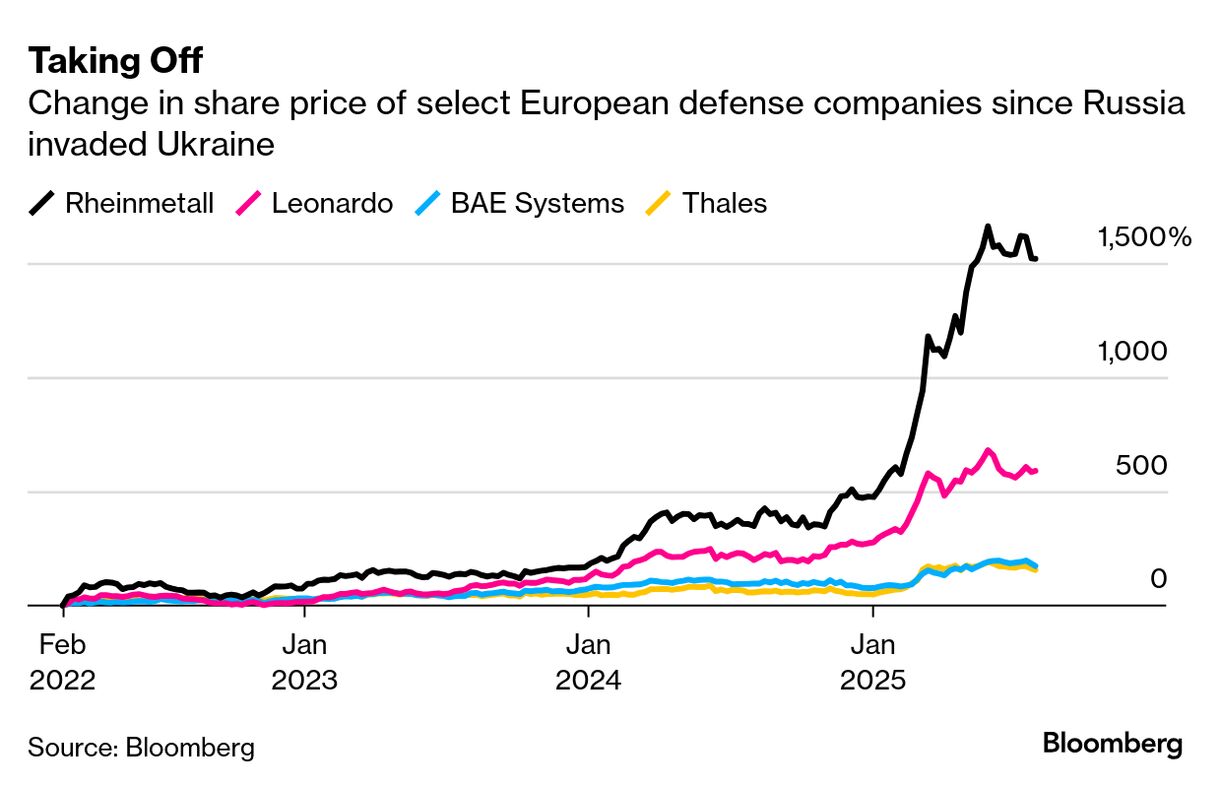
resulted in an investor frenzy. Rheinmetall’s stock has risen more than
18-fold since the war began. It’s now Europe’s most valuable defense
company, with a market capitalization of about €81 billion.
Papperger has lamented that investors “ostracized” the defense industry
for years. “Now we are a key player in the global defence supercycle,”
Papperger said in an email in response to questions from Businessweek. ”We
were always prepared, and that is now paying off.” Over the past two
years, Rheinmetall, Europe’s top ammunition producer, has invested more
than €8 billion in deals and new production. Papperger said Rheinmetall
is building or significantly expanding 10 plants....
It was just a throwaway line in a March 7 post about possible Chinese yuan weakness but there must have been something in the air:
The last time we saw this sort of stockpiling behavior the yuan was
under 7-to-the-dollar and our guess was that the order had gone out to
importers to convert currency into storable commodities ahead of a
devaluation in the yuan....
*****
....So who knows? But if I was long the German export industry I would be
concerned that further weakening in the yuan would make Chinese
exporters even more competitive than they already are.
Except
maybe for Rheinmetall. The armaments industry seems pretty well
insulated from currency fluctuations. RHM.de 437.40 +1.18%
"The world's" may be a bit of hyperbole but combined with what China
will have to do to achieve the 5% growth figure that was reaffirmed
yesterday, we are looking at potentially maybe $2 trillion in deficit
spending over the next six years between the two economies and though
not enough to offset the shrinkage of the U.S. deficit—which shrinkage
must happen to delay slow-motion but inevitable worldwide disaster—it
looks like the global party could continue until sunrise and/or 2030.
The
fact much of the German deficit spending will go toward armaments is
all the better—it is the most inflationary bang-for-the-buck, so to
speak, spending a government can do; you make stuff, you blow it up, you
make more stuff. It may not add to a country's real national wealth but
boy-oh-boy does it boost nominal GDP growth.
This is a really big deal. If you don't believe me, believe the German bond market....