Showing posts sorted by relevance for query dopamine. Sort by date Show all posts

Wednesday, March 7, 2018

"Has dopamine got us hooked on tech?"

A first rate primer on this stuff.
From The Observer (Guardian):

Silicon Valley is keen to exploit the brain chemical credited with keeping us tapping on apps and social media
In an unprecedented attack of candour, Sean Parker, the 38-year-old founding president of Facebook, recently admitted that the social network was founded not to unite us, but to distract us. “The thought process was: ‘How do we consume as much of your time and conscious attention as possible?’” he said at an event in Philadelphia in November. To achieve this goal, Facebook’s architects exploited a “vulnerability in human psychology”, explained Parker, who resigned from the company in 2005. Whenever someone likes or comments on a post or photograph, he said, “we… give you a little dopamine hit”. Facebook is an empire of empires, then, built upon a molecule.

Dopamine, discovered in 1957, is one of 20 or so major neurotransmitters, a fleet of chemicals that, like bicycle couriers weaving through traffic, carry urgent messages between neurons, nerves and other cells in the body. These neurotransmitters ensure our hearts keep beating, our lungs keep breathing and, in dopamine’s case, that we know to get a glass of water when we feel thirsty, or attempt to procreate so that our genes may survive our death.

In the 1950s, dopamine was thought to be largely associated with physical movement after a study showed that Parkinsonism (a group of neurological disorders whose symptoms include tremors, slow movement and stiffness) was caused by dopamine deficiency. In the 1980s, that assumption changed following a series of experiments on rats by Wolfram Schultz, now a professor of neuroscience at Cambridge University, which showed that, inside the midbrain, dopamine relates to the reward we receive for an action. Dopamine, it seemed, was to do with desire, ambition, addiction and sex drive.

Schultz and his fellow researchers placed pieces of apple behind a screen and immediately saw a major dopamine response when the rat bit into the food. This dopamine process, which is common in all insects and mammals, is, Schultz tells me, at the basis of learning: it anticipates a reward to an action and, if the reward is met, enables the behaviour to become a habit, or, if there’s a discrepancy, to be adapted. (That dishwasher tablet might look like a delicious sweet, but the first fizzing bite will also be the last.) Whether dopamine produces a pleasurable sensation is unclear, says Schultz. But this has not dented its reputation as the miracle bestower of happiness.

Dopamine inspires us to take actions to meet our needs and desires – anything from turning up the heating to satisfying a craving to spin a roulette wheel – by anticipating how we will feel after they’re met. Pinterest, the online scrapbook where users upload inspirational pictures, contains endless galleries of dopamine tattoos (the chemical symbol contains two outstretched arms of hydroxide, and a three-segmented tail), while Amazon’s virtual shelves sag under the weight of diet books intended to increase dopamine levels and improve mental health.

“We found a signal in the brain that explains our most profound behaviours, in which every one of us is engaged constantly,” says Shultz. “I can see why the public has become interested.”

In this way, unlike its obscure co-workers norepinephrine and asparagine, dopamine has become a celebrity molecule. The British clinical psychologist Vaughan Bell once described dopamine as “the Kim Kardashian of molecules”. In the tabloid press, dopamine has become the transmitter for hyperbole. “Are cupcakes as addictive as cocaine?” ran one headline in the Sun, citing a study that showed dopamine was released in the orbital frontal cortex – “the same section activated when cocaine addicts are shown a bag of the class A drug” – when participants were shown pictures of their favourite foods. Still, nowhere is dopamine more routinely name-dropped than in Silicon Valley, where it is hailed as the secret sauce that makes an app, game or social platform “sticky” – the investor term for “potentially profitable”.

“Even a year or two before the scene about persuasive tech grew up, dopamine was a molecule that had a certain edge and sexiness to it in the cultural zeitgeist,” explains Ramsay Brown, the 28-year-old cofounder of Dopamine Labs, a controversial California startup that promises to significantly increase the rate at which people use any running, diet or game app. “It is the sex, drugs and rock’n’roll molecule. While there are many important and fascinating questions that sit at the base of this molecule, when you say ‘dopamine’, people’s ears prick up in a way they don’t when you say ‘encephalin’ or ‘glutamate’. It’s the known fun transmitter.”

Fun, perhaps, but as with Kardashian, dopamine’s press is not entirely favourable. In a 2017 article titled “How evil is tech?”, the New York Times columnist David Brooks wrote: “Tech companies understand what causes dopamine surges in the brain and they lace their products with ‘hijacking techniques’ that lure us in and create ‘compulsion loops’.” Most social media sites create irregularly timed rewards, Brooks wrote, a technique long employed by the makers of slot machines, based on the work of the American psychologist BF Skinner, who found that the strongest way to reinforce a learned behaviour in rats is to reward it on a random schedule. “When a gambler feels favoured by luck, dopamine is released,” says Natasha Schüll, a professor at New York University and author of Addiction By Design: Machine Gambling in Las Vegas. This is the secret to Facebook’s era-defining success: we compulsively check the site because we never know when the delicious ting of social affirmation may sound.

Randomness is at the heart of Dopamine Labs’ service, a system that can be implemented into any app designed to build habitual behaviour. In a running app, for example, this means only issuing encouragement – a high-five badge, or a shower of digital confetti – at random intervals, rather than every time the user completes a run. “When you finish a run, the app communicates with our system and asks whether it would be surprising to him if we congratulated him a little more enthusiastically,” explains Brown. Dopamine Labs’ proprietary AI uses machine learning to tailor the schedule of rewards to an individual. “It might say: actually, right now he’d see it coming, so don’t give it to him now. Or it might say: GO!”

While the sell seems preposterously flimsy (with a slot machine, for example, at least the random reward is money, a much more compelling prize than any digital badge), Brown says that the running app company has seen significant positive results....MUCH MORE
We've posted on Dopamine Labs a few times and should note they finally realized the name was a little, as they say in Hollywood, "too on the nose" and have rebranded as Boundless Mind.

Same great taste, same neurotransmitter-based behavioral manipulation, but now with extra AI and pseudo-Zen.

Thursday, June 19, 2014

"Your genes affect your betting behavior"

A subject near and dear, some links below.
From the University of California at Berkeley:
Investors and gamblers take note: your betting decisions and strategy are determined, in part, by your genes.

Researchers from the University of California, Berkeley, National University of Singapore and University of Illinois at Urbana-Champaign (UIUC) have shown that betting decisions in a simple competitive game are influenced by the specific variants of dopamine-regulating genes in a person’s brain.

Dopamine is a neurotransmitter – a chemical released by brain cells to signal other brain cells – that is a key part of the brain’s reward and pleasure-seeking system. Dopamine deficiency leads to Parkinson’s disease, while disruption of the dopamine network is linked to numerous psychiatric and neurodegenerative disorders, including schizophrenia, depression and dementia.

While previous studies have shown the important role of the neurotransmitter dopamine in social interactions, this is the first study tying these interactions to specific genes that govern dopamine functioning.

“This study shows that genes influence complex social behavior, in this case strategic behavior,” said study leader Ming Hsu, an assistant professor of marketing in UC Berkeley’s Haas School of Business and a member of the Helen Wills Neuroscience Institute. “We now have some clues about the neural mechanisms through which our genes affect behavior.”

The implications for business are potentially vast but unclear, Hsu said, though one possibility is training workforces to be more strategic. But the findings could significantly affect our understanding of diseases involving dopamine, such as schizophrenia, as well as disorders of social interaction, such as autism.
“When people talk about dopamine dysfunction, schizophrenia is one of the first diseases that come to mind,” Hsu said, noting that the disease involves a very complex pattern of social and decision making deficits. “To the degree that we can better understand ubiquitous social interactions in strategic settings, it may help us understand how to characterize and eventually treat the social deficits that are symptoms of diseases like schizophrenia.”

Hsu, UIUC graduate student Eric Set and their colleagues, including Richard P. Ebstein and Soo Hong Chew from the National University of Singapore, will publish their findings the week of June 16 in the online early edition of the Proceedings of the National Academy of Sciences.

Two brain areas involved in competition
Hsu established two years ago that when people engage in competitive social interactions, such as betting games, they primarily call upon two areas of the brain: the medial prefrontal cortex, which is the executive part of the brain, and the striatum, which deals with motivation and is crucial for learning to acquire rewards. Functional magnetic resonance imaging (fMRI) scans showed that people playing these games displayed intense activity in these areas.

“If you think of the brain as a computing machine, these are areas that take inputs, crank them through an algorithm, and translate them into behavioral outputs,” Hsu said. “What is really interesting about these areas is that both are innervated by neurons that use dopamine.”...MORE
HT: The Big Picture

As mentioned in 2012's "New research suggests link between genetics, Wall Street success":
We've been on the dopamine beat for a while:
Engineer -- Addicted to Day Trading -- Stole Nearly $750,000 Making False Securities Class-action Claims
Now that's obsessive.
Usually it's the little old lady bookkeeper embezzling from her employer of thirty years to cover her slot habit.
Understandable, in a dopaminergic sort of way.
She's triggering her reward pathways and going a little nuts from the neurotransmitters bathing her brain but she's not trying to rob the casino to keep playing the slot machine.

This guy, on the other hand is a) participating in a slower game, which in theory should trigger the dopamine cascades less frequently and b) he's ripping off Martha Stewart!?
Here's the headline story from the Contra Costa Times:
New research suggests link between genetics, Wall Street success
CLAREMONT - Stock traders whose genetic makeups can help them make healthy decisions about risk-taking may be better suited for a long career on Wall Street than others who may be predisposed to a "cowboy" way of doing business, new research suggests.

"I don't want the guy who is going to stay awake for four days and drink Red Bull and make trades across three markets in three time zones," Claremont Graduate University professor Paul Zak said....MORE 
Possibly also of interest:
Berlusconi Blames Stock Market Volatility On Cocaine (and a look at neurotransmitters)
"What Caffeine Actually Does to Your Brain"
Your Brain and Financial Bubbles
The Internet, Deflation and Depression
...Further, the newspapers likened the changes to those seen in cocaine abusers but went on to describe something quite different from my understanding of what blow does to the reward pathways, overexciting the dopamine cascade until the various D receptors no longer react to dopamine and eventually leading to anhedonia. The big A is often concurrent with and like anxiety, may even kindle for depression.
Don't worry, be happy.
See also "Pleasure Dissociative Orgasmic Disorder"

Monday, September 25, 2017

Dopamine Labs: "Meet the tech company that wants to make you even more addicted to your phone"

Following up on "If You Want To Be Happy, Listen Up. Now! alternative title: The FT's Izabella Kaminska Is...".
Go listen or bookmark, I'll wait.

O.K., from TechCrunch:

With a magic line of code, Dopamine Labs aims to give any app the same addictive power that Facebook, Zynga and others have spent millions to perfect.
The company — a product of the little-heard joke “What do you get when a neuro-psychologist and a neuro-economist walk into bar?” — is the culmination of years of research that Ramsay Brown and co-founder T. Dalton Combs conducted at the University of Southern California.

Now, armed with $1 million in seed funding and some initial data that their experiments in mind control actually work, Dopamine Labs is spending money to boost its staff and sales and marketing efforts to bring more apps in on its brain science.

Much of that million in funding came from the now-defunct Lowercase Capital, which was helmed by Chris Sacca and Matt Mazzeo. Dopamine appears to be one of the firm’s last deals before both Sacca and Mazzeo became embroiled in the sexual misconduct scandals that swept the venture industry during 2017’s long, lurid summer.

While Brown condemned the behavior that’s been attributed to Sacca — and expressed disappointment that Mazzeo found the same troubles at his would-be new home, Binary Capital — he said that it didn’t dissuade him from taking Lowercase’s money.

“It’s all of our jobs in the community to make sure that those kinds of attitudes and beliefs don’t have a place in the industry going forward,” Brown told me. “It’s our job to make sure that everyone gets treated as a human, not as an object.”

Beyond Lowercase Capital, additional investments in the round came from Social Starts, one of the most prolific early-stage investment firms; Deep Fork Capital; and First Round Capital founder Howard Morgan, through a personal investment. Morgan is also taking a seat on the Dopamine Labs board of directors.

“I was excited to find a strong team that had deep knowledge of neuroscience, and an understanding of how to apply it in today’s world where people are so often overloaded with inputs,” said Morgan, in a statement. “I think Dopamine can become a major tool with many applications and am happy to have invested and to be helping them grow.”

What attracted these investors, said Brown, are the results that Dopamine Labs has seen with the pilot customers it’s enrolled for its addiction experiment.

“As you collect more data, things happen within the data set that improves the quality of the model, which in turn improves the quality of the service,” Brown said....
...MUCH MORE

We linked to TechCrunch's first look at DL in February's "L.A. Startup Dopamine Labs Manipulates Your Neurotransmitters to Hook You On Apps (and maybe unhook you)"

Additionally, we have dozens and dozens of posts on the effects of neurotransmitters on, well everything:

"Your genes affect your betting behavior"
A subject near and dear, some links below.
From the University of California at Berkeley...

Want to Make Big Money? Engineer A Little Addiction Into Your Product
"New research suggests link between genetics, Wall Street success"
Berlusconi Blames Stock Market Volatility On Cocaine (and a look at neurotransmitters)
The Leadership Gene: DAT1
The Internet, Deflation and Depression
...Further, the newspapers likened the changes to those seen in cocaine abusers but went on to describe something quite different from my understanding of what blow does to the reward pathways, overexciting the dopamine cascade until the various D receptors no longer react to dopamine and eventually leading to anhedonia. The big A is often concurrent with and like anxiety, may even kindle for, depression.
Don't worry, be happy.
And our addition to the earlier DL post, some of the research on FaceBook:

Here are a couple papers on one of the more troubling apps:
A Qualitative Exploration of Facebook Addiction:  Working toward Construct Validity
PORTUGUESE   VALIDATION   OF   THE   BERGEN   FACEBOOK   ADDICTION  SCALE: AN EMPIRICAL STUDY 
The obsessive checking behavior some users exhibit is virtually indistinguishable from obsessive-compulsive disorder while the anxiety occasioned by withdrawal sure looks miserable....

Thursday, January 18, 2018

Engineering Addiction Into Your Product: Lessons From the Professionals

The pros in this case being the gaming gurus at Gamasutra, November 13, 2017:

Compulsion Loops & Dopamine in Games and Gamification
The following blog post, unless otherwise noted, was written by a member of Gamasutra’s community.
The thoughts and opinions expressed are those of the writer and not Gamasutra or its parent company.


This is a presentation I put up together for the Big Gamification Challenge 2018 organised by REACTOR in collaboration with the Anglia Ruskin university , UK To explain how to use Compulsion Loops to produce Dopamine in games and gamified apps I touch multiple subjects
  • Extrinsic vs Intrinsic Motivation and Rewards
  • Challenges and Skills
  • Anticipation, Churn and Retention
Most of the talk is based on my experience of some theories I found works best for game system design. Find the Presentation Slides Here .I also decided to write an article on that talk so here it is :

Compulsion Loops & Dopamine in Games and Gamification
What is Gamification really about?

When you talk about Gamification to people, one word that comes back a lot is "Rewards". Well that's not what Gamification (or Games for that matter) is about! Whaaaat? don't get me wrong here, Rewards ARE important, but that's not what it's about.  It's really all about Dopamine!
Dopamine is a drug produced by the brain. Simply put, it makes people do stuff seeking rewarding outcomes. Its responsible for addiction but also for things like seeking food or shelter.
Compulsion loops come from Behavioral Psychology and can be used to explain how games and Gamification makes the brain produce Dopamine. A compulsion loop is made of 3 steps:
  1. Anticipation
  2. Activity
  3. Reward
compulsionloop

Counter intuitively Dopamine is produced at the first step : Anticipation. If you look at BJ Fogg's Behavior Model anticipation would be the "Trigger" moment when you think about what you will do and its hopefully rewarding outcome.

But first to explain how to create anticipation that generates Dopamine we need to dig a bit deeper into the Rewards and Activities that are anticipated.

REWARDS 
There is a lot to say about rewards and a lot of ongoing research and it would take too much time to go through all of it here. If you want more on that you can find some reference at the bottom of this article. For the sake of simplicity I will divide Rewards into two categories :
  • Extrinsic
  • Intrinsic
When I do something for something else, that "something else" is an Extrinsic motivation to the activity (that's kind of important because a part of the "clusterfuck" surrounding the theoretical discussions on rewards and motivation is due to the confusion between "What" rewards are extrinsic to. Let's just agree that here we are talking about motivations that are extrinsic or intrinsic to the activity and we should be able to talk about what really matters : how does it work?

Intrinsic motivation is when I do something for itself. The thing I do is it's own reward.

Let's look at an example :
Say I am playing a video game because I love the story. Unraveling the story is it's own reward. This is an intrinsic reward. While playing I discover that the game mechanics are actually great and I like the challenge they offer me. Progressively I start playing more and more for the mechanics and less for the story. There is a shift in my motivation. I play the mechanics because I like them. This is still Intrinsic to the activity.
Now Let's imagine that for some reason the game designer tough it would be a good idea to add Achievements to the mechanics to reinforce the wanted behaviors. Every time I succeed at a challenge using the game mechanics I love I get rewarded with an achievement that tells me I'm doing it right. That's nice and I start seeking these achievements. As I keep playing I start doing it more and more for the achievements. I might even start grinding to get them, getting me through mechanics I don't like that much which makes the game designer quite happy.  What is happening is that my motivation is shifting from Intrinsic to Extrinsic. This shift is called the Over justification effect. Where I was doing something for it's own sake I am now doing it for an extrinsic reward. What's important to know is that this is a one way trip. It's easy to steal Intrinsic motivation and shift it to Extrinsic motivation but the other way is much harder. If at that point the game stopped to give me achievements I would probably stop playing... 
OverJustificationEffect
Over-Justification Effect
Intrinsic Motivation is the Unicorn of game design. If you have it in your game or app, protect it ferociously and harness it's power!! Ok... so how do we do that? Glad you asked! Well my friend we will use what's called "Scaffolding" with the Skills and Challenges that are intrinsically motivating in the activity....
...MUCH MORE

We'll be coming back to the topic and probably to Gamasutra over the next few weeks. Until the next installment here's an overview of where we're headed with this stuff:
"If you think your smartphone is addictive, you ain’t seen nothing yet."
"Mark Zuckerberg’s radical decision to reinvent the News Feed is a plea for mercy." (FB)
Related: Monday's ""Facebook Can’t Be Fixed" (FB)", last month's "Engineer a Little Addiction Into Your Product - Redux" or the just posted "Cory Doctorow: Persuasion, Adaptation, and the Arms Race for Your Attention ".

Also:
Facebook's Statement on Social Media and Mental Health (FB)
"Hey, we've toned down the 'destroying society' shtick, Facebook insists" (FB)
"The Right to Attention in an Age of Distraction"
Climateer Line of the Day: Neurotransmitters and Facebook Edition
 "The short-term, dopamine-driven feedback loops we've created are destroying how society works.  No civil discourse, no cooperation; misinformation, mistruth. And it's not an American problem — this is not about Russians ads. This is a global problem."
—Former Facebook Vice President for Addicting Users, Chamath Palihapitiya
And many more, use the 'Search blog' box if interested.

Engineer a Little Addiction Into Your Product - Redux
My work here is done.
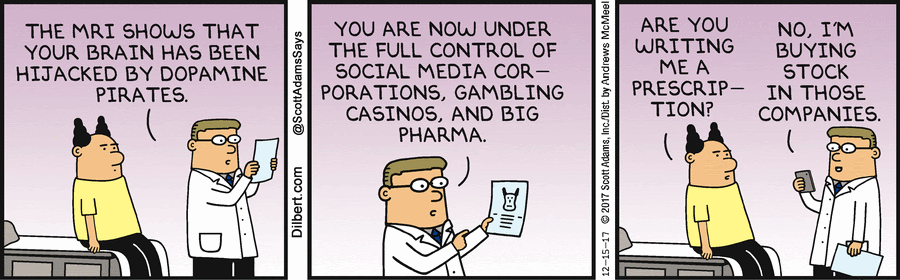
From Dilbert.com:

December 15
 Doctor And Dopamine - Dilbert by Scott Adams

December 21
 Dopamine - Dilbert by Scott Adams

There are three more in the series, very topical.

Previously in non-Dilbert commentary:
Dec. 11 
Climateer Line of the Day: Neurotransmitters and Facebook Edition
Dec 3 
"The Neurochemistry of Smartphone Addiction"
Sept. 25
Dopamine Labs: "Meet the tech company that wants to make you even more addicted to your phone"
Sept 24
"If You Want To Be Happy, Listen Up. Now! alternative title: The FT's Izabella Kaminska Is...".

And dozens and dozens more including  the namesake 2015 post "Want to Make Big Money? Engineer A Little Addiction Into Your Product" 

Monday, February 20, 2017

L.A. Startup Dopamine Labs Manipulates Your Neurotransmitters to Hook You On Apps (and maybe unhook you)

From TechCrunch:

Dopamine Labs slings tools to boost and reduce app addiction
Dopamine Labs, a small startup in Los Angeles, not just creates tools that can hook users to an app… the company is now also giving people a way to kick their app habit.

Formed by two neuroscientists who received their doctorates from the University of Southern California, the company has developed what it calls a “reinforcement api” based on the duo’s complementary research at USC.

The company believes that using its api — a few lines of code — app developers can increase user engagement and positive reinforcement on any app.

The work is based on the twin avenues of research pursued by company co-founders T. Dalton Combs and Ramsay Brown.

Combs, a doctor in the field of neuroeconomics and the company’s chief executive, was responsible for identifying and understanding the chemistry and biology involved in decision-making. Brown, the chief operating officer, graduated with a doctorate in neuroinformatics, which involved developing tools to help neuroscientists better understand the brain.

Between the two of them they’ve developed a technology that they claim can improve app usage, and have data from a few beta customers to back it up.

Initial customer Root, a teaching tool for university students saw a 9% improvement in student attendance after integrating the Dopamine Labs api. Micro-lender Tala saw a 14% improvement in micro-loan repayment, while Vimify, a startup providing coaching on healthy living saw a 21% improvement in sticking to a daily diet and exercise plan.

The biggest gains were at apps like Movn, which encourages daily movement (they saw a 60% improvement in minutes walked per month) and Brighten, a social network that saw 167% improvement in app opens and positive messages sent.

“We asked ourselves what is the direction of the future of technology and humanity,” said Brown in an interview. “We had some hunches about human behavior as applied to technology and vice versa… and how one might go about building a better way for humans to use apps and navigate them.”

On the strength of its api tool the company has raised roughly $250,000 in seed funding from Lowercase Capital (Matt Mazzeo was responsible for the deal).

“The dopamine api is a tool that allows any app to become addictive,” said Brown. “The premise is really straightforward… people don’t just love that burst of dopamine they get from a notification, it changes the wiring of the brain.”

What the two neuroscientists have ultimately sussed out is a way to manage the delivery of “rewards” in apps in a manner that encourages repeat visits.

Combs recognizes the potential for abuse that’s inherent in a tool that can, ostensibly, increase addictiveness and says the company has strict terms of service to limit abuse....MORE
Here are a couple papers on one of the more troubling apps:

A Qualitative Exploration of Facebook Addiction:  Working toward Construct Validity 

PORTUGUESE   VALIDATION   OF   THE   BERGEN   FACEBOOK   ADDICTION  SCALE: AN EMPIRICAL STUDY 

The obsessive checking behavior some users exhibit is virtually indistinguishable from obsessive-compulsive disorder while the anxiety occasioned by withdrawal sure looks miserable.

We have quite a few posts on dopamine cascades and D4 receptors:

Want to Make Big Money? Engineer A Little Addiction Into Your Product

New York Fed On "Anxiety, Overconfidence, and Excessive Risk Taking" (pathological gambling and self-manipulation with booze and blow)

Ethanol: "Why Coffee, Cigarettes and Booze Can Be Good For You"

Your Brain and Financial Bubbles

"Your genes affect your betting behavior"

The Internet, Deflation and Depression
There was a story out last week that purported to show a correlation between time spent on the www and changes in brain physiology. I'm dubious.
As Britain's NHS News put it:
...Several news headlines have suggested that internet addiction can cause changes to the brain, but this description is inappropriate, as the study design did not look at changes over time. It looked at how the brains of problem internet users differed from those of people who did not report such a problem. Therefore, it is entirely possible that the heavy users had particular brain structures that made them susceptible to addictions, rather than that the internet actively changed their brain structures....
Further, the newspapers likened the changes to those seen in cocaine abusers but went on to describe something quite different from my understanding of what blow does to the reward pathways, overexciting the dopamine cascade until the various D receptors no longer react to dopamine and eventually leading to anhedonia. The big A is often concurrent with and like anxiety, may even kindle for depression.
Don't worry, be happy. 
See also "Pleasure Dissociative Orgasmic Disorder"
And many more.

Monday, November 3, 2025

"Venture Capital Firms Bet Big on Gambling. Now They’re Banking on the Addictions."

From Barron's, July 10, 2025: 

U.S. VC firms have invested $2 billion in gambling businesses in recent years. At least six of the firms are simultaneously betting on problem gambling treatments. 

Alumni Ventures got in early on the sports betting trend. In 2017, the New Hampshire–based venture-capital firm was part of an initial round of investment that raised $2 million for Sleeper, a fantasy sports and betting app. Four years later, Sleeper was valued at $400 million. This past August, Alumni made a new bet—this time on gambling addiction treatment, investing $1.5 million in Kindbridge Behavioral Health.

Alumni isn’t the only one getting in on the pair trade. Bettor Capital, a VC firm devoted entirely to gambling, invested in Kindbridge in March. In all, Barron’s identified six VC firms simultaneously invested in gambling and gambling treatment. Most didn’t respond to requests for comment.

The investment thesis is straightforward: As more people gamble, more will eventually develop a gambling problem and seek help. Venture-capital firms see the market for treatment growing in lockstep with the market for gambling.

Tracy Barba, director of the Lucas Institute for Venture Ethics at Santa Clara University, says the paired investments are a clear “conflict of interest” without historical precedent.

“Nobody’s telling them they can’t do this,” Barba says. “When there’s no regulation, no rules, and there’s no consequences or accountability, the only thing that is going to be driving their decision-making is internal revenue return.”

Boston-based Will Ventures has a stake in both Birches Health, a telehealth gambling treatment firm with an “empathetic online care model,” and a stake in BetHog, a crypto casino and sportsbook that calls itself “nakedly degen,” short for degenerate.

All told, U.S. VC firms have invested $2 billion in gambling businesses since a U.S. Supreme Court ruling opened the door to nationwide sports betting in 2018, according to PitchBook. As a business, treating problem gambling is still in its early stages, with VCs generally participating in so-called seed round funding for treatment firms.

As the gambling industry has realigned itself toward a younger audience that prefers virtual betting, treatment is becoming more tech-forward, too: Casinos and in-person therapy are out; smartphone bets and app-based recovery are in....

....MUCH MORE 

If one is interested in all things dopaminergic including signaling pathways and reward deficiency syndrome these prior posts may be of interes:

UK Announces New Crackdown On Predatory Addictive Gambling Games
This stuff is just evil.  Deliberately using a human being's neurophysiology against them to extract every last penny that can be had, and destroy lives as they do it is nasty.... 

Previously on the dopamine channel:  

Engineering Addiction Into Your Product: Lessons From the Professionals

The pros in this case being the gaming gurus at Gamasutra, November 13, 2017:

Compulsion Loops & Dopamine in Games and Gamification....
L.A. Startup Dopamine Labs Manipulates Your Neurotransmitters to Hook You On Apps (and maybe unhook you)

The obsessive checking behavior some users exhibit is virtually indistinguishable from obsessive-compulsive disorder while the anxiety occasioned by withdrawal sure looks miserable.

We have quite a few posts on dopamine cascades and D4 receptors:

Want to Make Big Money? Engineer A Little Addiction Into Your Product

New York Fed On "Anxiety, Overconfidence, and Excessive Risk Taking" (pathological gambling and self-manipulation with booze and blow)

Ethanol: "Why Coffee, Cigarettes and Booze Can Be Good For You"

Your Brain and Financial Bubbles

"Your genes affect your betting behavior"

See also "Pleasure Dissociative Orgasmic Disorder" 

Engineer a Little Addiction Into Your Product - Redux

My work here is done.
From Dilbert.com:


December 15
Doctor And Dopamine - Dilbert by Scott Adams

December 21
Dopamine - Dilbert by Scott Adams

There are three more in the series, very topical.

Previously in non-Dilbert commentary:
Dec. 11 
Climateer Line of the Day: Neurotransmitters and Facebook Edition
Dec 3 
"The Neurochemistry of Smartphone Addiction"
Sept. 25
Dopamine Labs: "Meet the tech company that wants to make you even more addicted to your phone"
Sept 24
"If You Want To Be Happy, Listen Up. Now! alternative title: The FT's Izabella Kaminska Is...".

And dozens and dozens more including  the namesake 2015 post "Want to Make Big Money? Engineer A Little Addiction Into Your Product"

Finally, from the journal Cell:

Decoding Dopamine Signaling 

https://www.cell.com/cms/attachment/4d2bf50c-3f05-4b9c-a142-0b075955574a/gr1_lrg.jpg 

Saturday, November 7, 2020

Arianna Huffington Buys Dopamine Labs

We've looked at the company in question a half-dozen times, usually in relation to gaming or tech or other businesses that manipulate your physiology to trigger a dopamine cascade in your brain and when it dissipates, leaves you wanting another hit. Here's a post from 2017 that has quite a few links:  

Dopamine Labs: "Meet the tech company that wants to make you even more addicted to your phone"

Well, Dopamine Labs changed its name, I'm guessing because, as they say in Hollywood it was a little too "on the nose"; they changed it to "Boundless Mind" and lo-and-behold we have this from one of Arianna Huffington's creations, Thrive Global via BusinessWire [note date: October 2019, I may not have made that clear enough]:

Thrive Global Acquires Boundless Mind, Neuroscience-based Artificial Intelligence Company to Power Health and Productivity Behavior Change

With acquisition of Boundless, the leader in behavior change AI, Thrive advances its core mission to help individuals and corporations unlock human potential and shape technology for good

Thrive also announces new funding round led by JAZZ Venture Partners, venture capital firm focused on human performance technology

NEW YORK--()--Thrive Global, the leading behavior change technology company founded by Arianna Huffington in November 2016, announced today the acquisition of Boundless Mind, the neuroscience-based artificial intelligence company and leader in behavioral design and engineering. The acquisition furthers Thrive Global’s commitment to building the leading behavior change technology platform that leverages data collection and the application of the latest science to end the stress and burnout epidemic and help individuals and organizations unlock their full potential. 

Since its launch in 2016, Thrive Global has worked with some of the top employers and brands in the world – including Accenture, JPMorgan, Hilton, Bank of America and Procter & Gamble – to bring behavior change technology, content and people experience programs to employees and consumers to improve their well-being and performance. Earlier this month, Thrive announced a partnership with Stanford Medicine that combines Stanford’s research with Thrive’s behavior change expertise into a digital enterprise program designed to help companies unlock better mental health. Stanford researchers have also lent their expertise to a program to help parents navigate their journey with less stress and more joy.

Boundless Mind’s innovative technology fuses neuroscience and artificial intelligence to optimize, personalize and target recommendations to users to inspire positive behavior change. Boundless’s technology learns to predict – for every unique user – when and how to deliver technology-driven rewards to fuel healthy habit-formation. By integrating Boundless into Thrive’s behavior change technology platform, Thrive will be able to make meaningful behavior change more achievable and more sustainable for Thrive platform users.

The Boundless team will integrate immediately into Thrive Global’s product and engineering team and be based between Thrive Global’s San Francisco and Los Angeles offices.

“This acquisition is an exciting milestone for Thrive Global,” said Arianna Huffington, Founder and CEO of Thrive Global. “Since our founding in 2016, we have been committed to cracking the code on behavior change to help individuals and organizations end the stress and burnout epidemic and unlock their full potential. And it’s more important than ever that we leverage the latest technology to help people build healthy habits. Boundless Mind shares our mission to create a world where everyone can thrive At a time when preventable, lifestyle-related diseases account for 75% of healthcare costs and mental health problems are escalating, the only way to change health outcomes is to shift human behavior. The Boundless acquisition is a critical next step in scaling Thrive’s behavior change platform to millions of users around the world.”....

....MUCH MORE

 This isn't immediately actionable but may prove to be important somewhere down the road.

Related:
Nov. 2017 

Climateer Line of the Day: Neurotransmitters and Facebook Edition
Via The Verge:

 "The short-term, dopamine-driven feedback loops we've created are destroying how society works.  No civil discourse, no cooperation; misinformation, mistruth. And it's not an American problem — this is not about Russians ads. This is a global problem."
—Former Facebook Vice President for Addicting Users, Chamath Palihapitiya
And the rest of the story:

Former Facebook exec says social media is ripping apart society
‘No civil discourse, no cooperation; misinformation, mistruth.’
Another former Facebook executive has spoken out about the harm the social network is doing to civil society around the world. Chamath Palihapitiya, who joined Facebook in 2007 and became its vice president for user growth, said he feels “tremendous guilt” about the company he helped make. “I think we have created tools that are ripping apart the social fabric of how society works,” he told an audience at Stanford Graduate School of Business, before recommending people take a “hard break” from social media. 
Palihapitiya’s criticisms were aimed not only at Facebook, but the wider online ecosystem. “The short-term, dopamine-driven feedback loops we’ve created are destroying how society works,” he said, referring to online interactions driven by “hearts, likes, thumbs-up.” “No civil discourse, no cooperation; misinformation, mistruth. And it’s not an American problem — this is not about Russians ads. This is a global problem.”...MUCH MORE, including video

Possibly also of interest:

Founding Facebook President: ‘God only knows what it’s doing to our children’s brains’ (FB)

Want to Make Big Money? Engineer A Little Addiction Into Your Product

"'We're designing minds': Industry insider reveals secrets of addictive app trade"

"If you think your smartphone is addictive, you ain’t seen nothing yet." 

And many more, use the 'Search blog' box if interested.

Engineer a Little Addiction Into Your Product - Redux
My work here is done.
From Dilbert.com:

December 15, 2017
Doctor And Dopamine - Dilbert by Scott Adams

December 21, 2017
Dopamine - Dilbert by Scott Adams

There are three more in the series, very topical. 

Wednesday, February 3, 2021

UK Announces New Crackdown On Predatory Addictive Gambling Games

This stuff is just evil.  Deliberately using a human being's neurophysiology against them to extract every last penny that can be had, and destroy lives as they do it is nasty.

 From Casino News Daily, February 3:

UK Gambling Commission Announces Heavy Online Slots Restrictions

With the increase of online gaming options, rose the need for measures to ensure safer experience. For that end, the UK Gambling Commission announced a package of changes that are supposed to strengthen the protections, as well as the control of online slots play.

Measures include introduction of limits on spin speed and a permanent ban on features that increase the game’s speed or “celebrate losses as wins.”

The operators had to go through a consulting period with the public and players, with the gambling industry and other shakeholders. Then they will have to implement new player protection measures, which need to be stronger to ensure safety.

The aim is to make online casino games less intensive and safer by design and as a result, the players will have more control over their gambling.

Online slots were the main focus for the Commission since their features often increase the intensity of play and thus the risk for players. Slot games also hide the highest risk for losses among all the gambling products.

The Rules

The new rules include the ban of four key features on online slots. The feature that speeds up play, thus giving the illusion of control over outcome, slots spin speed, autoplay, which was proven to lead to losing track of players’ play, sounds and imagery that can also create illusions.

It is proven that reverse withdrawal functions lead to bigger temptation for players to continue gambling. On the other hand, the removal of the feature is associated with increase intensity of play among other things.

As part of the new changes, operators must display in a clearer way to players their losses or wins, as well as the time they played during any session.

The Commission also introduced a permanent ban on reverse withdrawals for all online gambling.

The new protection measures must be implemented by all operators by October 31 2021....

...MUCH MORE

Previously on the dopamine channel:  

Engineering Addiction Into Your Product: Lessons From the Professionals

The pros in this case being the gaming gurus at Gamasutra, November 13, 2017:

Compulsion Loops & Dopamine in Games and Gamification....
L.A. Startup Dopamine Labs Manipulates Your Neurotransmitters to Hook You On Apps (and maybe unhook you)

The obsessive checking behavior some users exhibit is virtually indistinguishable from obsessive-compulsive disorder while the anxiety occasioned by withdrawal sure looks miserable.

We have quite a few posts on dopamine cascades and D4 receptors:

Want to Make Big Money? Engineer A Little Addiction Into Your Product

New York Fed On "Anxiety, Overconfidence, and Excessive Risk Taking" (pathological gambling and self-manipulation with booze and blow)

Ethanol: "Why Coffee, Cigarettes and Booze Can Be Good For You"

Your Brain and Financial Bubbles

"Your genes affect your betting behavior"

See also "Pleasure Dissociative Orgasmic Disorder" 

Engineer a Little Addiction Into Your Product - Redux

My work here is done.
From Dilbert.com:


December 15
Doctor And Dopamine - Dilbert by Scott Adams

December 21
Dopamine - Dilbert by Scott Adams

There are three more in the series, very topical.

Previously in non-Dilbert commentary:
Dec. 11 
Climateer Line of the Day: Neurotransmitters and Facebook Edition
Dec 3 
"The Neurochemistry of Smartphone Addiction"
Sept. 25
Dopamine Labs: "Meet the tech company that wants to make you even more addicted to your phone"
Sept 24
"If You Want To Be Happy, Listen Up. Now! alternative title: The FT's Izabella Kaminska Is...".

And dozens and dozens more including  the namesake 2015 post "Want to Make Big Money? Engineer A Little Addiction Into Your Product"

Friday, September 1, 2023

Extreme gene therapy treatment for alcoholism slashes drinking by 90% in monkeys

It's about time.*

From BigThink, August 26:

  • Chronic alcohol use causes the brain to produce and process less dopamine, and this persistent dopamine deficit has been linked to relapse.
  • A team of U.S. researchers suspected that an in-development gene therapy for Parkinson’s disease might work as a dopamine-replenishing treatment for alcoholism, too.
  • To find out, they tested it in heavy-drinking monkeys — and the animals’ alcohol consumption dropped by 90% over the course of a year.  

A single shot — a gene therapy injected into the brain — dramatically reduced alcohol consumption in monkeys that previously drank heavily. If the therapy is safe and effective in people, it might one day be a permanent treatment for alcoholism for people with no other options.

The challenge: Alcohol use disorder (AUD) means a person has trouble controlling their alcohol consumption, even when it is negatively affecting their life, job, or health.

Chronic alcohol use causes the brain to produce, and process, less dopamine.

In the U.S., more than 10% of people over the age of 12 are estimated to have AUD, and while medications, counseling, or sheer willpower can help some stop drinking, staying sober can be a huge struggle — an estimated 40-60% of people relapse at least once.

According to the CDC, more than 140,000 Americans are dying each year from alcohol-related causes, and the rate of deaths has been rising for years, especially during the pandemic.

The idea: For occasional drinkers, alcohol causes the brain to release more dopamine, a chemical that makes you feel good. Chronic alcohol use, however, causes the brain to produce, and process, less dopamine, and this persistent dopamine deficit has been linked to alcohol relapse....

*I, for one, was already growing increasingly concerned about the primates.

And then you add in primate potables:

That last link in particular, like some demented para-scuba aquatic version of the flying monkeys of Oz should really hammer home the point, do not flush your meth into the sewer every time you hear a knock at the door you paranoid Florida idiots. 

Tuesday, November 7, 2017

"'We're designing minds': Industry insider reveals secrets of addictive app trade"

From the Canadian Broadcasting Corporation, Nov. 3:

A look at the science behind the 'technological arms race' to keep people fixated on their phones
The average Canadian teenager is on track to spend nearly a decade of their life staring at a smartphone, and that's no accident, according to an industry insider who shared some time-sucking secrets of the app design trade.
CBC Marketplace travelled to Dopamine Labs, a startup in Venice, Calif., that uses artificial intelligence and neuroscience to help companies hook people with their apps.
Named after the brain molecule that gives us pleasure, Dopamine Labs uses computer coding to influence behaviour — most importantly, to compel people to spend more time with an app and to keep coming back for more.
Co-founder Ramsay Brown, who studied neuroscience at the University of Southern California, says it's all built into the design.
"We're really living in this new era that we're not just designing software anymore, we're designing minds."
Brown is one of the few industry insiders who would talk. Marketplace contacted social media giants Facebook, Instagram and Snapchat. None would go on the record to discuss their design techniques.
Brown says he hopes by speaking to CBC, Canadians will be more informed about how they're being manipulated to spend so much time using apps.
To make a profit, companies "need your eyeballs locked in that app as long as humanly possible," he says. "And they're all in a technological arms race to keep you there the longest."

Habit-forming rewards
One of the most popular techniques, he says, is called variable reinforcement or variable rewards.  
It involves three steps: a trigger, an action and a reward.

A push notification, such as a message that someone has commented on your Facebook photo, is a trigger; opening the app is the action; and the reward could be a "like" or a "share" of a message you posted.

These rewards trigger the release of dopamine in the brain, making the user feel happy, possibly even euphoric, Brown says.

"Just by controlling when and how you give people that little burst of dopamine, you can get them to go from using [the app] a couple times a week to using it dozens of times a week."

The rewards aren't predictable. We don't always get a like, a retweet or a share every time we check our phones. And that's what makes it compulsive, Brown says.

Plus, he says, app developers use artificial intelligence, which is essentially decision-making code, to predict the best time to make the payouts based on the user data they collect....MUCH MORE
Possibly also of interest:
"Google, Twitter and Facebook workers who helped make technology so addictive are disconnecting themselves from the internet"

Dopamine Labs: "Meet the tech company that wants to make you even more addicted to your phone"

If You Want To Be Happy, Listen Up. Now! alternative title: The FT's Izabella Kaminska Is...

See also, if interested, the very accessible:
Reward Deficiency Syndrome
(14 page PDF)
Some Thoughts on Google Offering An Online Depression Test
From AFNS:*
To encourage more sufferers to seek treatment, Google is now offering a quiz for users to check their own depression symptoms when searching for information about the disease. What do you think?
http://images2.onionstatic.com/onion/1031/9/1x1/150.jpg

“This should help remedy the current problem of Google not having nearly enough info about me.”
Hannah Leibold Lithium Wholesaler


http://images2.onionstatic.com/onion/1031/8/1x1/150.jpg

“Thanks, but if I were actually interested in addressing my mental health problems I wouldn’t be spending so much time online.”
Pete Winspear Sidewalk Excavator


Additionally, we have dozens and dozens of posts on the effects of neurotransmitters on, well everything:

"Your genes affect your betting behavior"
A subject near and dear, some links below.
From the University of California at Berkeley...

Want to Make Big Money? Engineer A Little Addiction Into Your Product
"New research suggests link between genetics, Wall Street success"
Berlusconi Blames Stock Market Volatility On Cocaine (and a look at neurotransmitters)
The Leadership Gene: DAT1
The Internet, Deflation and Depression
...Further, the newspapers likened the changes to those seen in cocaine abusers but went on to describe something quite different from my understanding of what blow does to the reward pathways, overexciting the dopamine cascade until the various D receptors no longer react to dopamine and eventually leading to anhedonia. The big A is often concurrent with and like anxiety, may even kindle for, depression.
Don't worry, be happy.

Sunday, January 29, 2012

"New research suggests link between genetics, Wall Street success"

We've been on the dopamine beat for a while:
Engineer -- Addicted to Day Trading -- Stole Nearly $750,000 Making False Securities Class-action Claims
Now that's obsessive.
Usually it's the little old lady bookkeeper embezzling from her employer of thirty years to cover her slot habit.
Understandable, in a dopaminergic sort of way.
She's triggering her reward pathways and going a little nuts from the neurotransmitters bathing her brain but she's not trying to rob the casino to keep playing the slot machine.

This guy, on the other hand is a) participating in a slower game, which in theory should trigger the dopamine cascades less frequently and b) he's ripping off Martha Stewart!?

Here's the headline story from the Contra Costa Times:
New research suggests link between genetics, Wall Street success
CLAREMONT - Stock traders whose genetic makeups can help them make healthy decisions about risk-taking may be better suited for a long career on Wall Street than others who may be predisposed to a "cowboy" way of doing business, new research suggests.

"I don't want the guy who is going to stay awake for four days and drink Red Bull and make trades across three markets in three time zones," Claremont Graduate University professor Paul Zak said.
Zak and two graduate students published their research in the January issue of PLoS One, an online science journal. The researchers conducted their study by comparing the genetic codes of working Wall Street traders to a control group of business students.
 
The researchers found evidence that genes affecting the way the brain processes dopamine, a chemical linked to risk-taking behavior, may be associated with success on Wall Street.
Traders who had successful careers, as measured by length of employment, tended to have genetic backgrounds linked to moderate levels of dopamine.
 
In other words, a good trader is likely to have a genetic code that influences a person's behavior toward competitiveness, but not the kind of thrill-seeking behavior in which risk taking becomes an addiction.
"Combining the personality analyses and genetic findings from the present study reveals that our sample of traders are analytical, integrative and can delay gratification," Zak and his co-authors wrote in their research paper....MORE
HT: Finance Professor

I love PLoS One; JSTOR and the journals crowd can go hang. Any work financed by the public should be publicly available. Here's the paper.

*Previously:
Berlusconi Blames Stock Market Volatility On Cocaine (and a look at neurotransmitters)
"What Caffeine Actually Does to Your Brain"
Your Brain and Financial Bubbles

And just two weeks ago:
The Internet, Deflation and Depression
There was a story out last week that purported to show a correlation between time spent on the www and changes in brain physiology. I'm dubious....

...Further, the newspapers likened the changes to those seen in cocaine abusers but went on to describe something quite different from my understanding of what blow does to the reward pathways, overexciting the dopamine cascade until the various D receptors no longer react to dopamine and eventually leading to anhedonia. The big A is often concurrent with and like anxiety, may even kindle for depression.
Don't worry, be happy....

Saturday, October 31, 2020

"The Epigenetic Secrets Behind Dopamine, Drug Addiction and Depression"

So, it's a little more complex than neurotransmitter cascades and our old pals the D3 and D4 receptors.

From Quanta Magazine, October 27:

New research links serotonin and dopamine not just to addiction and depression, but to the ability to control genes.

As I opened my copy of Science at home one night, an unfamiliar word in the title of a new study caught my eye: dopaminylation. The term refers to the brain chemical dopamine’s ability, in addition to transmitting signals across synapses, to enter a cell’s nucleus and control specific genes. As I read the paper, I realized that it completely upends our understanding of genetics and drug addiction. The intense craving for addictive drugs like alcohol and cocaine may be caused by dopamine controlling genes that alter the brain circuitry underlying addiction. Intriguingly, the results also suggest an answer to why drugs that treat major depression must typically be taken for weeks before they’re effective. I was shocked by the dramatic discovery, but to really understand it, I first had to unlearn some things.

“Half of what you learned in college is wrong,” my biology professor, David Lange, once said. “Problem is, we don’t know which half.” How right he was. I was taught to scoff at Jean-Baptiste Lamarck and his theory that traits acquired through life experience could be passed on to the next generation. The silly traditional example is the mama giraffe stretching her neck to reach food high in trees, resulting in baby giraffes with extra-long necks. Then biologists discovered we really can inherit traits our parents acquired in life, without any change to the DNA sequence of our genes. It’s all thanks to a process called epigenetics — a form of gene expression that can be inherited but isn’t actually part of the genetic code. This is where it turns out that brain chemicals like dopamine play a role.

All genetic information is encoded in the DNA sequence of our genes, and traits are passed on in the random swapping of genes between egg and sperm that sparks a new life. Genetic information and instructions are coded in a sequence of four different molecules (nucleotides abbreviated A, T, G and C) on the long double-helix strand of DNA. The linear code is quite lengthy (about 6 feet long per human cell), so it’s stored neatly wound around protein bobbins, similar to how magnetic tape is wound around spools in cassette tapes.

Inherited genes are activated or inactivated to build a unique individual from a fertilized egg, but cells also constantly turn specific genes on and off throughout life to make the proteins cells need to function. When a gene is activated, special proteins latch onto DNA, read the sequence of letters there and make a disposable copy of that sequence in the form of messenger RNA. The messenger RNA then shuttles the genetic instructions to the cell’s ribosomes, which decipher the code and make the protein specified by the gene.

But none of that works without access to the DNA. By analogy, if the magnetic tape remains tightly wound, you can’t read the information on the cassette. Epigenetics works by unspooling the tape, or not, to control which genetic instructions are carried out. In epigenetic inheritance, the DNA code is not altered, but access to it is....

....MUCH MORE

I'm still trying to get my head around what's real and what's hype in epigenetics. In the introductory riff from "Labor Markets: 'Rural America Needs Triage'" I sound more certain than I actually am.

Some concepts, profound in their simplicity, that policymakers will have to internalize before the human toll of current economics—whether fast suicides by firearms or hanging or slow suicides by opioids, self-medicating with carbohydrates and booze leading to epidemic levels of obesity, cirrhosis and diabetes, from first generation poverty leading to  multi-generational epigenetic DNA methylation of genes linked to depression—the policy wonks have to get the basics down first....

See also:

"Do Your Grandmother’s Experiences Really Make It Into Your Genes?"

"It’s now possible to map a person’s lifetime exposure to nutrition, bacteria, viruses, and environmental toxins—which profoundly influence human health"

Sunday, June 26, 2022

Why Cancel Culture? Because It Is Just So Rewarding

We've looked at the brain's reward systems for years, some links below.

From Medical Xpress, June 16:

by

Us versus them: Harming the 'outgroup' is linked to elevated activity in the brain's reward circuitry

Humans tend to form groups, which often find themselves in conflict with rival groups. But why do people show such a ready tendency to harm people in opposing groups?

A new study led by researchers at Virginia Commonwealth University has used functional brain imaging technology to reveal a potential answer: It increases activity in the brain's reward network.

"At a time of deepening political divisions and global , it is crucial for us to understand why people divide each other up into 'us' and 'them' and then show a profound willingness to harm 'them,'" said corresponding author David Chester, Ph.D., an associate professor in the Department of Psychology in the College of Humanities and Sciences. "Our findings advance this understanding by suggesting that harming outgroup members is a relatively rewarding experience."

The researchers had 35 male college students complete a competitive, aggressive task against either a student from their university or from what they were told was a rival university. In reality, participants unknowingly played against a computer program, and no real people were harmed.

They found that participants who were more aggressive against outgroup members (students from a rival university) versus ingroup members (students from their own university) exhibited greater activity in core regions of the brain's reward circuit—the and ventromedial prefrontal cortex—while they decided how aggressive to be.

Both before and after outgroup exclusion, toward outgroup members was positively associated with activity in the ventral striatum during decisions about how aggressive to be toward their outgroup opponent. Aggression toward outgroup members was also linked to greater post-exclusion activity in the rostral and dorsal medial prefrontal cortex during provocation from their outgroup opponent. These altered patterns of brain activity suggest that frontostriatal mechanisms may play a significant role in motivating aggression toward outgroup members....

....MUCH MORE

As a part of a fascination with the wider field of neurotransmitters we've posted on dopamine cascades and our little buddies the D3 and D4 receptors: 

Trading the Nucleus Accumbens: Using MRI Scans to Top-tick a Bubble

Want to Make Big Money? Engineer A Little Addiction Into Your Product

"New research suggests link between genetics, Wall Street success"

The Leadership Gene: DAT1 

Engineer -- Addicted to Day Trading -- Stole Nearly $750,000 Making False Securities Class-action Claims

Now that's obsessive.
Usually it's the little old lady bookkeeper embezzling from her employer of thirty years to cover her slot habit.
Understandable, in a dopaminergic sort of way.
She's triggering her reward pathways and going a little nuts from the neurotransmitters bathing her brain but she's not trying to rob the casino to keep playing the slot machine.

This guy, on the other hand is a) participating in a slower game, which in theory should trigger the dopamine cascades less frequently and b) he's ripping off Martha Stewart!?

Berlusconi Blames Stock Market Volatility On Cocaine (and a look at neurotransmitters)  

Marketers Want to—Literally—Get Inside Your Head

The nucleus accumbens is a critical component of the brain's reward/pleasure circuitry; modulated by our old pals dopamine and serotonin.
See, if interested, the very accessible:

Reward Deficiency Syndrome
(14 page PDF)

We've posted on Dopamine Labs a few times and should note they finally realized the name was a little, as they say in Hollywood, "too on the nose" and have rebranded as Boundless Mind.

Same great taste, same neurotransmitter-based behavioral manipulation, but now with extra AI and pseudo-Zen. 

See also "Pleasure Dissociative Orgasmic Disorder"   

And for many of our links on social sadism and the sadocratic impulse:

"The woke world is a world of snitches, informants, rats...."

The character trait that really stands out about the denizens of Wokistan is the cruelty. Cruelty for cruelty's sake. Cruelty just to be cruel. Yuck.

It's pathological and like other pathologies the stench it gives off, like other stenches humans find revolting, is a warning from nature: "Something bad is going on here, something toxic, stay away."..... 

Speaking of random acts of cruelty (and the WaPo, immediately below):

Why Did the Washington Post Get This Woman Fired?
https://nymag.com/intelligencer/2020/06/why-did-the-washington-post-get-this-woman-fired.html
"We blew up this woman's life for no reason." In 2018, Schafer attended a Halloween party at the home of Tom Toles, the Post 's Pulitzer Prize-winning editorial cartoonist. The basis for ...