From Yahoo Finance, February 25:
In his State of the Union address on Tuesday night, President Trump laid out new guidelines for Big Tech's AI developers: Bring your own power, and pay your own way.
Under a new "ratepayer protection pledge," companies building out AI data centers — which consume enormous amounts of energy — will be required to fund their own electricity usage going forward, Trump said.
“We have an old grid, it could never handle the kind of numbers — the amount of electricity — that’s needed,” Trump said. “So I’m telling [companies] they can build their own plant; they’re going to produce their own electricity.”
Details of the new agreement remain sparse, but Energy Secretary Chris Wright said after the State of the Union address that "all of the brand-name hyperscalers" have signed onto the deal, according to Politico. That category would presumably include companies like Alphabet (GOOG), Meta (META), and Amazon (AMZN).
The announcement comes as domestic energy demand and prices have soared.
According to estimates from the Lawrence Berkeley National Laboratory, power demand from US data centers doubled between 2018 and 2024 and could triple by 2028. The average retail price for electricity reached $0.1724 per kilowatt-hour in December, roughly 6% higher than the same time the year prior, according to government data.
The issue has been a persistent thorn in Trump's side. On the campaign trail, the president promised to cut electricity bills by half, but prices have instead surged throughout his second term on the back of the growing AI industry.
Americans are concerned that “energy demand from AI data centers could drive up their electricity utility bills," Trump said on Tuesday.
In the service region for PJM Interconnection, the country's largest grid operator, capacity prices — the price utilities must pay to generators for electricity — have exploded, rising to $329.17 per megawatt-day for the 2026-2027 period from $28.92 in the 2024-2025 period.
For their part, AI hyperscalers and developers have already made independent pledges to pay for their energy use.
In January, Microsoft said it would pay utility rates high enough to fully cover its data center energy costs and replenish more water than its US data centers consume, and OpenAI said the ChatGPT maker would "commit to paying our own way on energy, so that our operations don’t increase your electricity prices."....
....MUCH MORE
The last Energy Information Agency update, February 24, saw average rates up 7.1% with a wide range across the states:
....Retail rates/prices and consumption
In this section, we look at what electricity costs and how much is purchased. Charges for retail electric service are based primarily on rates approved by state regulators. However, a number of states have allowed retail marketers to compete to serve customers and these competitive retail suppliers offer electricity at a market-based price.
EIA does not directly collect retail electricity rates or prices. However, using data collected on retail sales revenues and volumes, we calculate average retail revenues per kWh as a proxy for retail rates and prices. Retail sales volumes are presented as a proxy for end-use electricity consumption.
[emphasis added]
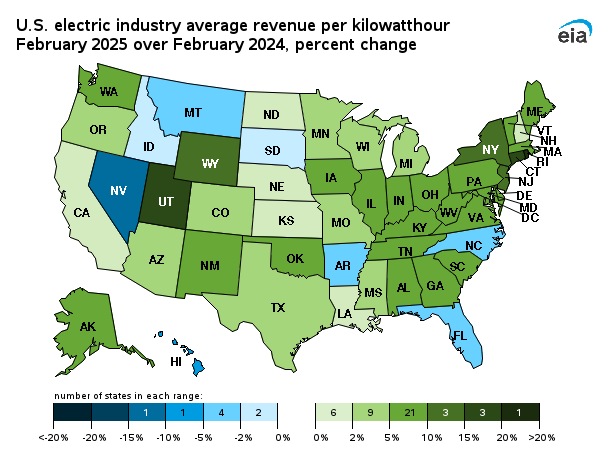
....Forty-four states and the District of Columbia saw increased revenue per kilowatt-hour (kWh) compared to last December, while average revenue per kWh increased by 7.1% on a national basis. The largest percent increase was in the District of Columbia, up 26.3%, followed by Pennsylvania, up 18.9%, and Rhode Island, up 16.3%. Average revenue per kWh figures decreased in five states compared to last year. The largest percent decrease was in Nevada, down 7.7%, followed by Connecticut, down 7.6%, and New Mexico, down 2.9%. In the contiguous US, California, Rhode Island, and Massachusetts had the highest average revenues at 28.18, 28.01, and 26.72 cents per kWh, respectively. North Dakota, New Mexico, and Iowa had the lowest average revenues at 8.12, 8.69, and 8.94 cents per kWh, respectively....
....MUCH MORE

