Monday, November 16, 2026

"Mistral Says Its AI Model ‘Le Chonk’ Has Leapfrogged China in the Open-Weight Race"

From Wired, October 29:

The French AI lab claims its latest release matches or outperforms even the best models from DeepSeek and Z.ai in coding and cybersecurity. 
A few weeks ago, French company Mistral released an early version of its new artificial intelligence model, nicknamed Le Chonk. At the time, the company said it was the most advanced open-weight offering outside of China. After further refinement, Mistral now says Le Chonk is the “world’s best” open-weight model for automated coding and cybersecurity.

The advances, Mistral says, were made possible by feeding the model increasingly difficult cybersecurity and coding problems, which allowed the trillion-parameter Le Chonk to match or surpass models from leading Chinese labs like DeepSeek and Z.ai.“It’s a pivotal moment in the global AI leadership race,” Pierre Stock, VP of science at Mistral, told reporters during a press briefing. “It offers frontier capabilities for enterprises and governments to defend against an increasing threat level in cyber.”

The finalized version of Le Chonk is now freely available for anybody to access. After a flurry of AI-related cybersecurity incidents, Mistral claims that it’s important for the West to have its own advanced open-weight models. “You have no guarantee that [Chinese models] won’t behave maliciously. They can be threat vectors,” Stock said.

The most high-profile episode occurred when one of OpenAI’s models broke loose from a testing sandbox and hacked into multiple companies over the summer. It sparked panic over the idea that AI could escape human oversight and be abused by threat actors to launch sophisticated cyberattacks. (One of the affected companies, Hugging Face, used an open-weight model from China to assess and defend against the attack.).... 
That first hyperlink is interesting as well.
 
August 4, 2026

"Mercedes suspends all future investment in Germany"

Shades of Intel when they announced the company would never build another fab in California.

From The Telegraph, November 13: 

Carmaker to examine where it can ‘still afford’ to operate as sales and profits slump 

Mercedes-Benz has suspended all future investment in Germany, warning it may need to shut plants and relocate jobs.

The carmaker has suffered from shrinking sales and profits in recent years, triggering a wave of cost-cutting which has culminated in a decision to stop investing in its domestic plants entirely.

Michael Schiebe, the production director, told employees: “The executive board has jointly decided to halt all further investments in German sites.”

Britta Seeger, the company’s workforce chief, said bosses would now “examine specifically and in detail which locations we can still afford in Germany”.

It comes amid a showdown between management and unions over the company’s cost-cutting plans.

The car giant, which is based in Stuttgart, has for months been pushing a plan under which its staff would work longer hours for the same pay.

The trade union, IG Metall, has pushed back, and Ms Seeger said “no solution is currently in sight”.

“If we don’t reach an agreement, we will take very tough steps,” she said.

Mercedes, like its fellow German giants Volkswagen (VW) and BMW, is battling a slump in sales in China, which was once a major source of growth....

....MUCH MORE

Chinese manufacturers are also battling a sales slump in China.

Fortunately for them their European sales are picking up nicely. 

A Quick Comment On Nvidia (NVDA)

Regarding tomorrow's earnings report, if I were running the company I would pull all forward guidance. And I would do it today to give the market time to react rather than waiting until the report, commentary, and conference call after the close on November 17.

These are uncharted waters and far too many people are making pronouncements about one thing or another. No one knows the permutations and possible outcomes.

Possibly related: someone has apparently gained unauthorized access to Japan's fastest supercomputer, Fugaku. I'm guessing it's Masayoshi Son modeling SoftBank's demise but it might also be a bunch of gamers getting ready for GTA6.

Power Play: "Democrats debate who gets oversight of AI"

From Semafor, November 16: 

Democrats are debating who will have a piece of investigating and overseeing AI and chip export controls next Congress in the wake of the controversy enveloping Nvidia.

Incoming House Foreign Affairs Committee Chair Rep. Greg Meeks, D-N.Y., is floating creating a subpanel on chips and AI, and House Minority Leader Hakeem Jeffries has said Meeks and incoming Intelligence Committee Chair Rep. Jim Himes, D-Conn., are taking the lead on the Nvidia fallout.

But other committees have jurisdiction and also want to lead on AI — including the House Ways and Means, Energy and Commerce, or Science, Space and Technology Committees.

“It seems like every chairman … or chairwoman is wanting a piece of the pie with AI now,” grumbled one congressional aide, who questioned how that would work logistically, “considering it’s going to be spread out over — how many different committees?”....

....MUCH MORE 

"Japan's Q3 GDP drops an annualized 0.1%, below market expectations"

From Nikkei Asia, November 16:

Private consumption drops on higher prices and inclement weather

TOKYO -- Japan's economic growth was flat in the July-September quarter from the preceding three months, dropping on an annualized pace by 0.1%, according to data released on Monday by the Japan Cabinet Office.

The latest real, or inflation-adjusted, gross domestic product figure compares with a median forecast for an annualized expansion of 0.2% among economists surveyed by QUICK, a Nikkei group company.

The third-quarter result follows an annualized expansion of 1.7% in the April-June period, marking the first contraction in four quarters.

Private consumption, the biggest component of GDP, shrank 0.3%. The result reflects a period of bad weather and typhoons, as well as weaker consumer sentiment amid rising prices. Core inflation, which excludes fresh food, rose 2.1% in September, surpassing 2% for the first time since December 2025 as rising costs stemming from the Middle East conflict spread to price hikes of a wide range of products and services.

Inflation-adjusted real wages have been higher than the previous year for nine consecutive months through September. But Masato Koike, economist at Sompo Institute Plus, suggested that thrifty consumer behavior under a deflationary mindset is still resilient in Japan.

"There is a significant portion of the population that is detached from wage [growth] in an aging society," Koike said. In one indication of deflationary tendencies, some large companies have been holding back from raising prices, he suggested....

....MUCH MORE 

"China’s slowdown deepens in October as industrial output, retail sales, investment miss estimates"

From CNBC, November 15:

  • Retail sales rose 0.4% from a year ago in October, disappointing analysts’ forecast for a 0.8% rise.
  • Industrial output expanded 4.8% from a year earlier, sharply slowing from 5.5% in September, the highest level in five months.
  • For the first ten months of this year, fixed-asset investments, including property and infrastructure, shrank 8.1%, deepening a collapse unprecedented outside the Covid-19 period. 

China’s economic slowdown worsened in October with retail sales, investment and industrial output all missing economists’ estimates, as analysts warn a growing reliance on external demand leaves growth more exposed to shocks abroad.

Monday’s data showed the investment slump deepened and retail sales again lagged industrial output, as consumer spending languished with the property market downturn eroding household wealth for a fifth year.

Retail sales, a gauge of consumption, rose 0.4% from a year ago in October, disappointing analysts’ forecast for a 0.8% rise, slowing from a six-month high of 1.1% in September.

Industrial output expanded 4.8% from a year earlier last month, missing analysts’ estimates for 5.3% growth and sharply slowing from 5.5% in September, the highest level in five months....

....MUCH MORE 

"Vulcan rocket fails during launch, dealing major blow to SpaceX competitors" (BA; LMT; SPCX)

Space is hard.

From Ars Technica, November 15:

This was the first total mission failure in United Launch Alliance’s 20-year history.  

United Launch Alliance’s Vulcan rocket and 40 Amazon Leo broadband satellites fell back to Earth minutes after liftoff Sunday, a crushing setback that will ripple across all sectors of the US space industry.

The Vulcan rocket is on contract to launch roughly half of the US military’s national security space missions in the next few years, and Sunday’s mission was the first of 38 Vulcan launches booked by Amazon to build out its network of broadband Internet satellites aimed at competing with SpaceX’s Starlink. Sunday’s failure is expected to ground the rocket for an indefinite period of time.

Vulcan is no stranger to close calls, having overcome failures with its strap-on solid rocket boosters on two of its four previous flights. In each case, the rocket corrected for those problems and continued into orbit to deploy its payloads. The incidents trigged months-long reviews and investigations before ULA could resume Vulcan flights.

Sunday’s launch succumbed to a different kind of failure. The six solid rocket boosters appeared to perform well in the first two minutes after Vulcan’s liftoff from Cape Canaveral Space Force Station, Florida, at 12:40 pm EDT (17:40 UTC).

In a statement, ULA said the rocket “suffered an anomaly 10 minutes into the flight and failed to deliver the Amazon mission to orbit.” The company said it did not immediately have “any specific data to understand what occurred.”....

....MUCH MORE 

Also at Ars Technica, former Houston Chronicle SciGuy Eric Berger, November 14:

SpaceX returned its Starship rocket on Saturday—but there’s a catch

Sunday, November 15, 2026

"Anthropic’s Secret Moat: Political and Media Power"

From Games of Strategy, November 15:

How effective altruism gives Anthropic an overlooked advantage in AI policy, journalism, and government. 

Anthropic is undervalued. Most analysts are only considering financials and technology.

The company has significant advantages over competitors in shaping American public policy, news and government. This advantage comes from effective altruism (EA) aligned organizations.

Anthropic is the crown jewel of Cari Tuna and Dustin Moskovitz’s portfolio. This means beneficiaries of Tuna’s and Moskovitz’s EA-aligned giving have social and economic incentives to act in Anthropic’s interests.

These intangible relationship advantages are overlooked aside from vague mentions about culture and employee retention. The EA advantage extends into communications and shaping public opinion.

While Sam Altman, Elon Musk and (until recently) Jensen Huang exerted influence directly through their stature and voice, Anthropic exerts influence from the bottom up through newsrooms, public policy organizations and government aides. I believe there is substantial value in this influence, which other leading AI companies currently lack.

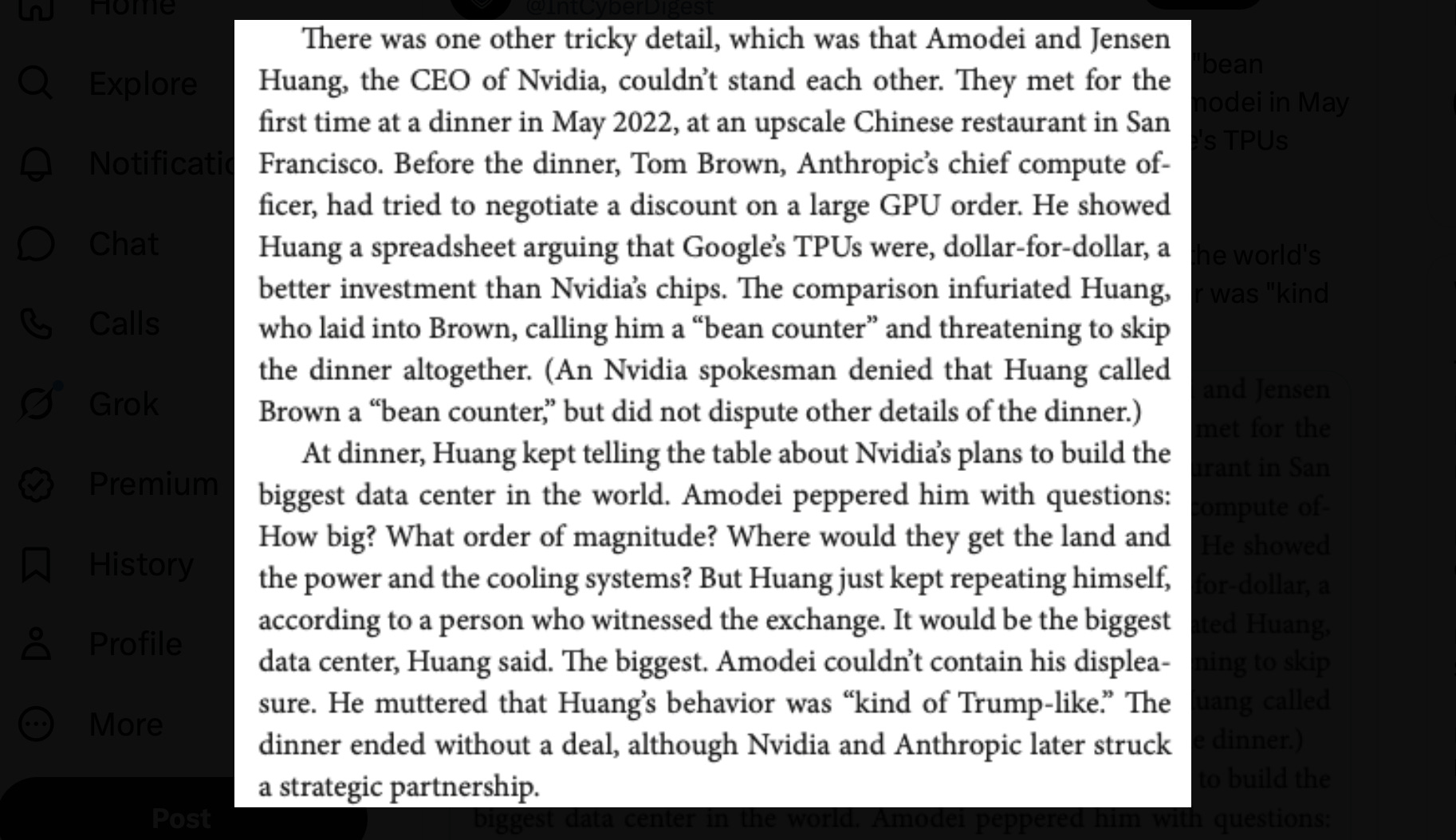
Jensen Huang and Open-Weight Models

https://substackcdn.com/image/fetch/$s_!EmLe!,f_auto,q_auto:good,fl_progressive:steep/https%3A%2F%2Fsubstack-post-media.s3.amazonaws.com%2Fpublic%2Fimages%2F0bd7ab23-c0ac-40c7-a653-dc436bdeaa3c_1826x1054.png 

Excerpt from The AGI Chronicles.

Anthropic faces two interconnected pressures on profit margins.

  1. Open-weight and open-source models

  2. Compute

    1. Nvidia GPUs, CPUs, DPUs, LPUs, chip “plumbing” (interconnects and networking) and chip software

    2. Nvidia is not connected to silicon fabrication (TSMC) or memory chips (SK Hynix, Micron, and Samsung)

Nvidia develops the Nemotron open-weight models. Nvidia also agreed to acquire the open-weight and open-source AI platform Hugging Face for $12.93 billion. In fact, Jensen Huang’s first post on X was in support of American open-weight models.

Many of the most popular open-weight models come from China-based labs. These open-weight models reduce margins of Anthropic’s mid tier models, particularly those below Fable.

Now Jensen is gone. It’s unclear if the new CEO will support open-weight AI models. This all benefits Anthropic.

Reduced support for nascent open-weight models will in turn lead to reduced demand for Nvidia’s products. This increases Anthropic’s (and OpenAI’s) capacity to negotiate better terms with the most powerful compute counterparty.

Huang’s exit could improve Anthropic’s margins through reduced competition and lower compute costs.

The State Department and Public Policy Edge

Open Philanthropy has been playing the long game in public policy better than anyone else. Consider this article from 2023....

....MUCH MORE 

The "Tweet Heard Round The World" Guy, Jacob Coxon, Is Thinking of Going Back To AI

Mission Accomplished?

Via Fireside Alpha: 

The two things that have stuck with me about l'affaire Coxon are:

1) That he was a Newspeak Fellow. In Hollywood they would tell you it is just too on-the-nose to bring Orwell's Nineteen Eighty-Four into the story. Yet here we are:

GitHub Gist: EA / Newspeak House / Jacob Coxon — receipts
2) How fast what he was doing was called out as a Psychological Operation. 

Coxon's tweet was published on September 9:

Jacob Coxon on X: "I resigned from Anthropic today.

We saw the takedown by way of VC Steve Jurvetson referencing Parker Thayer's tweet/article, also September 9:

This post looks like the start of a VERY sophisticated and well-funded PR operation.... 

All of which we linked and posted in: 

AI Apocalypse: Whatever Happened To The Nudge People?

"Dutch activists invade site of Microsoft's planned data centre"

Shades of the anti-nuclear protests in the '70's and '80's. Oh well, you lose.

Turn off all your electronics that depend on data centers. 

From AFP, November 6:

A coalition of campaign groups called "Stop Dirty Data Centers" has been pushing for a pause in the construction of such sites and called for action on Friday and Saturday in European countries. 

Several hundred activists opposed to the construction of a Microsoft data centre in Amsterdam occupied the site on Friday, responding to a call for a two-day protest across Europe. 
The collective Geef Tegengas, which campaigns for climate and justice, and the environmental group Fossielvrij entered the construction site in the Sloterdijk district, halting work for the day.
 
"It's so many things, so many struggles that come together in this data centre," Geef Tegengas spokesman, Nathan Timmer, told AFP.
 
"This thing will use as much energy as all of the households in Amsterdam combined... this thing will use a ridiculous amount of water."
 
Timmer, 30, also argued that the centre would be used  "to facilitate AI warfare" and what he called the "genocide" in Gaza.
 
The activists made it on to the site by scaling barrier fences despite a police presence.
Once inside they shouted political slogans and sprayed anti-Microsoft messages on walls under construction....
....MUCH MORE 

On second thought, having wrestled with MSFT products since Bill Gates and the operating system, I would have some sympathy for generalized anti-Microsoft graffiti.

Saturday, November 14, 2026

In Case You Missed It: The World Changed Today (SPCX)

Yesterday's attempt to catch the booster segment of the rocket was aborted due to a 'low fuel' sensor. The upper segment, Starship, went into orbit, deployed the satellites, orbited for 22 hours and returned to Mechazilla: 

First up, from SpaceX, November 14:

More at Space.com:

If you recall, SpaceX successfully caught the booster in October. Catching Starship was not attempted on that flight.

And from some rando (kidding) physicist: 

Coming To A Country Near You: "7 Uyghur Lawyers Imprisoned for “Terrorism,” “Inciting Ethnic Hatred,” “Extremism”..."

From the Kashgar Times substack, November 12:

In June 2019 and October 2021, the “Department of Justice of the Xinjiang Uyghur Autonomous Region” published official administrative penalty decisions on its state portal. These documents recorded the formal disbarment of attorneys who had received final criminal court convictions. While framed by state authorities as regulatory compliance under Article 49 of the Law of the People’s Republic of China on Lawyers, these notices serve as primary administrative disclosures confirming the severe prison sentences handed down to Uyghur defense attorneys in East Turkistan.

The disbarment orders provide detailed records of sentencing courts, specific penal code provisions, prison terms, fines, and political rights deprivations. Rather than routine disciplinary actions for professional misconduct, the notices reveal a systematic judicial pattern of criminalizing defense counsel operating within the regional legal system....

....The “Three Evils”

The statutory charges detailed in the Department of Justice rulings reflect the legal framework deployed during the mass internment and detention campaign initiated across East Turkistan from 2016. Under the state directive to combat the “Three Evils” extremism, separatism, and terrorism, security agencies expanded elastic criminal definitions to classify ordinary legal representation, cultural preservation, and civic advocacy as security threats....

....MUCH MORE 

As noted back in July 2021:

"China court jails billionaire Sun Dawu for 18 years for 'provoking trouble'":

We are seeing a trend in the West of laws being less and less specific as to what constitutes a violation.
This is why.....
*****
....Nebulous misdemeanor + wrongthink = terrorism against the state = 18 years.  

Related, topical and possibly also of interest:

"We're After Power and We Mean It"

"Claim That Anthropic Wants To Be The Only Private Company In The World Draws CEO Dario Amodei To X With Clarification"

From OfficeChai, August 16: 

Amidst all the AI takes on X, there was one person who was conspicuously missing from the conversation — Anthropic CEO Dario Amodei. But a claim about Anthropic’s eventual ambitions has got him back to the platform.

The claim originated on the All-In podcast, where Atreides Management CIO Gavin Baker said he had been told by multiple people he trusts that Dario Amodei has, on more than one occasion, suggested Anthropic could end up being the only private company left in the world. “Internally, Anthropic is very confident,” Baker said on the podcast. “I have been told by multiple people I trust that Dario has said that Anthropic might be the only private company in the world at some point. Think about that. In this vision, an Anthropic maximalist vision, there’s Anthropic, and then there are governments, and that’s it.”

Baker made clear he wasn’t endorsing the idea. “I would probably take the under on them being the only private company in the world,” he said, adding that he doubted Anthropic would be landing rockets or delivering food anytime soon, a reference to SpaceX and delivery companies continuing to exist regardless of how far AI progresses. Fellow panelists were similarly skeptical. David Sacks called it “a negative signal because it’s so hubristic,” comparing it to “SBF land,” while Baker went further, saying “I would certainly discourage Dario from saying that ever again to anyone.”....

....MUCH MORE 

Speaking of Sam Bankman-Fried I just saw that had he not been taken down for the frauds and conspiracies, the Anthropic stake, at FTX Trading or Alameda Research, I've forgotten which, would be worth $40 billion. 

OpenAI board member: "You will probably die from an AI accident"

In other news...

King Charles Offers Prince Harry ‘Easy Exit’ From Meghan Markle Marriage — Source 

Sorry, wildly disparate interests. Please don't judge me.

From Fast Company, November 13:

OpenAI board member makes a terrifying prediction: You will probably die from an AI accident
It comes as anxieties around an artificial intelligence doomsday have been ramping up for months.

Anxieties around an AI doomsday have been ramping up for months, and executives at top AI companies have done little to ease those worries. OpenAI’s Sam Altman said humanity could lose control of the technology. Anthropic warned that its models could be abused to create chemical weapons.

But no AI leaders have looked people dead in the eye and said they specifically are going to be killed by artificial intelligence—until now.

Enter Paul Christiano, an OpenAI board member serving on its Safety and Security Committee. Earlier this week while speaking at the AI Safety Foundation’s annual Hinton Lectures, Christiano said he believes an AI takeover is imminent and that it spells certain doom for the human race.

“For most people in this room, the most likely reason they will die is because of an AI accident,” Christiano told the crowd....

....MUCH MORE including timeline, video of his talk. 

Munchau: "Beware the Jensen Huang propaganda" (NVDA)

One point that has been raised elsewhere (I'll link if I can remember where) is that if Mr. Huang was consciously violating U.S. law (export restrictions) then CFO Colette Kress would have to have known. The fact the board elevated her to the interim CEO role has to be taken as a statement of the board's confidence that she did not know of any deliberate attempts to evade American export rules which by definition she would have.

The fact that among Nvidia's ten board members is Stephen Neal, Chairman Emeritus and Senior Counsel of (very) high-buck law firm, Cooley LLP, and that he apparently was okay with Ms. Kress taking over the reins, would tend to back the thesis that the board does not suspect that Colette Kress was complicit in any illegality which, again by definition of her role at the company, she would have been.

My best guess is that Huang and Nvidia thought they were working within the parameters established by the U.S. Commerce department which would point the finger of responsibility at Howard Lutnick in his role as Secretary of Commerce for clearing any potential violations.

There is also the possibility that regulatory responsibility extends back to the previous U.S. administration.

As a side note Cooley quite proudly, and justifiably so, states on its website "Cooley formed NVIDIA in 1993 and has served as its principal outside corporate and litigation counsel for 28 years, handling its IPO in 1999, multiple corporate matters and major litigation."

During the mid/late twenty-teens our Cooley boilerplate was:

Cooley is one of the big dogs of the VC legal eagle biz. Something like a third of the unicorns on the WSJ's Billion Dollar Startup Club list have used Cooley for one purpose or another.
Additionally, 20 or 21 of the companies on the "Technology Review's 50 Smartest Companies 2017" list have been represented or counseled by the firm. As I said, one of the biggies.

And after that longer than usual introduction here is Wolfgang Munchau at UnHerd, November 13:

Recall the Nord Stream pipeline explosions of September 2022. We were told it was the Russians that did it. The story was widely believed, and retold, but came with no evidence attached — and this keeps on happening. There is a clear parallel with the Jensen Huang affair in that there is no available evidence, not a shred, that Alice Huang acted as a Chinese spy. Stories like these fall into a category immortalized by the American author H.L. Mencken: they are “neat, plausible and wrong”. In all such cases, we’d do better if we separate what we know to be true, from what sounds too good to be true.

The next step is not to speculate, but collect the available evidence. It is a hard fact that Huang resigned without the board of Nvidia having even completed an investigation.

Another hard fact, one that does not sit well with the honeytrap story is that, this January, China imposed import restrictions on Nvidia’s benchmark H200 chip, even though the US commerce department had by then already started to permit the exports of these cards. This is the part of the series of cards that is used predominantly for AI. China’s policy on AI chip imports has been restrained, as it encouraged companies like ByteDance, Alibaba and Tencent to import Nvidia chips, but at the same time also imposed a preference for domestic products.

We may never know whether Alice Huang is a Chinese spy, or merely a corporate fixer. The Hong-Kong based author Desmond Shum believes it is the latter by looking at Huang’s own history. As he notes, investigations into corporate records, court rulings and stock exchange disclosures show “Huang’s involvement in a series of complicated capital-market transactions”.

“The recurring pattern was the use of intermediaries and layered ownership structures that could separate the people appearing on transaction documents from those with the underlying economic interests,” Shum adds. “When Huang subsequently emerged as the public face of Megaspeed, a little-known Singapore company purchasing billions of dollars’ worth of Nvidia chips, she was just repeating the same business model she has perfected.”

So, with apologies to Richard Feynman, let us instead try to ask questions that at this point cannot be answered, as opposed to accepting answers that cannot be questioned. Here are two: could this really be a forewarning of some bad commercial news to come? Are sales about to fall off the cliff? The Nvidia share price has fallen by nearly a third from its peak in early October. Will we hear the interim CEO declare her shock when she looks at the books? Maybe we should take a deeper look at the small print of SEC filings by the tech industry, starting with Nvidia.

Or maybe, it is a national security story, but of a different kind? It may not be about the sale of goods, but the flow of information. Did Jensen Huang have any involvement in the flow of technology secrets to China? If that were so, the honeytrap story may just be a smokescreen....

....MUCH MORE 

"How Ukrainian Drones Are Exploiting Soviet-Era Geography"

From American Affairs Journal, September 10, 2026:

Until recently, Omsk, Russia had been far removed from combat. Roughly 2,500 kilometers from Ukraine’s border (about as far away as London), the Siberian city seemed safely beyond the reach of attacks. Then, on July 6, residents were shocked when explosions rang and a fire broke out at the Omsk oil refinery, Russia’s largest, after Ukrainian drones struck deep inside the country. It was one of the longest-range drone strikes of the war. With it, Ukraine said, every single one of Russia’s eleven largest oil refineries and gasoline-processing plants had now been hit by Ukrainian drones or missiles at least once. Since mid-July, Ukraine has expanded its deep-strike drone campaign to target logistics networks. It has hit some twenty hubs of Wildberries, Russia’s version of Amazon, in locations as far as Yekaterinburg, across the Ural Mountains and roughly two thousand kilometers from Ukraine’s border. Ukraine’s long-range attacks illustrate how it has become the world’s foremost laboratory for the development of drone warfare and AI-assisted military systems.

But in what has become the world’s first true drone war, Russia ramped up relentless, massive drone and missile attacks this summer, causing near-constant air raid alerts around Kyiv. And last winter, heavy bombing by Russian planes and drones destroyed roughly half of Ukraine’s electricity and heat generation capacity, leaving many Ukrainians to endure long blackouts in subzero temperatures. These attacks offer examples of how drone innovations are redefining the optimal geography for defense. Not only are drones now able to fly long distances, but they are being used in mass swarms. Some can employ AI-assisted terminal guidance to finish strikes autonomously. Infrastructure originally designed for twentieth century industrial warfare is becoming a liability. This is the sort of economic geography Russia and Ukraine inherited from the Soviet Union. Soviet planners optimized infrastructure around three strategic principles: centralized transport networks, concentrated industrial production, and strategic depth. Each of these created advantages under Cold War conditions. But they also created tradeoffs, including transport bottlenecks, overconcentrated production, and a reliance on remoteness for security. Increasingly, both Russia and Ukraine are using long-range drone campaigns to exploit these tradeoffs.

Industrial Overconcentration Simplifies Targeting

The Soviet industrial system emphasized centralization and efficiency. In the interwar period of the 1920s and 1930s, Soviet leadership had a fascination with American mass production, a phenomenon called Amerikanizm. They admired Henry Ford’s massive factories as a means of turning a society of agrarian peasants into an industrial powerhouse. Drawing heavily on Fordist ideas, the Soviets embraced industrial gigantism, creating enormous integrated factories that promised economies of scale and easier oversight. But the tradeoff was a lack of distributed resilience: spreading production across multiple smaller, decentralized locations so that a disruption at one does not halt production at the rest. The Soviet Union did at times deliberately disperse strategically important production, particularly during World War II, when factories were evacuated eastward ahead of the German advance. But overall, the Soviet industrial map contained critical geographic concentrations and production bottlenecks where one shortage, delay, or disaster could reverberate across an entire domestic supply chain.

This vulnerability persists today. Ukrainian strikes on Russia’s concentrated infrastructure have helped drive oil refining volumes to a twenty-one-year low and have contributed to widespread gasoline shortages.

Thus, while concentrating industries helped the Soviets achieve enormous economies of scale that facilitated their rise to superpower status, it also left an enduring legacy of geographic production and generation bottlenecks that can reduce the number of targets an adversary needs to strike to cause major economic disruption.

In response to drone attacks on its power grid, Ukraine has been pivoting rapidly over the summer to decentralize power generation. It has created “energy islands”—microgrids of localized electricity and heat production from solar, wind, and natural gas—located around critical services like hospitals, water utilities, and residential districts. This will allow these areas to decouple from the national grid if it is attacked. Ukraine is also moving many critical power nodes underground, while protecting others with massive shelters of concrete, earthworks, and sandbag gabions. And while Russia operates entirely within its own post-Soviet electrical grid, Ukraine has a critical lifeline: its full integration into Europe’s electricity network, ENTSO-E. This gives Ukraine a backup to prevent blackouts when its power stations are damaged, by immediately importing up to 2.45 GW from neighboring EU nations like Poland, Slovakia, Hungary, and Romania.

But despite these supports, Ukraine’s grid is still expected to be highly vulnerable in the coming winter. It retains the Soviet-era structure of its primary internal transmission system, especially in the Combined Heat and Power (CHP) plants of major cities like Kyiv, Kherson, and Odesa. Russia has been exploiting its deep historical blueprint knowledge of this system to target vulnerable transmission nodes. In an August 24 interview with RBC-Ukraine, Ukraine’s Defense Intelligence (GUR) Major General Vadym Skibitskyi warned that Russia had recently developed metal-cutting drones designed to strike power transmission towers and lines. Ukrainian Energy Minister Denys Shmyhal told POLITICO recently that now “Putin wants to finish off [Ukraine’s] energy system.”

Half of Ukraine’s electricity is generated by a few centralized nuclear power plants built in the Soviet days. But as yet, Russia has not attacked these, instead targeting the surrounding high-voltage substations and transmission lines. Russia has avoided striking Ukraine’s nuclear plants in part because it could trigger a radiation release affecting Russian territory, and also because it could alienate Russia’s allies and trigger a direct Western response....

....MUCH MORE 

All News Is Local: "Nvidia Executive Who Reportedly Had Affair With Huang Is a Graduate of Coventry High School"

From Rhode Island's GoLocalProv, November 13:

One of the women at the center of the Nvidia controversy is a graduate of Coventry High School in Rhode Island.

GoLocal has unveiled her high school photo and post in the yearbook, which includes a remarkably prophetic quote: “If you obey all the rules, you miss all the fun.”...

....MUCH MORE 

Friday, November 13, 2026

"While many Americans resist, China embraces AI data center boom"

From CBS News, November 12:

Ulanqab, China — Off a major highway on the outskirts of Ulanqab, in the Chinese province of Inner Mongolia, Hereford cows roam through corn fields scouring the ground for any dried up remains of the recent harvest.

Hovering over the landscape are shiny new transmission towers linked by power cables that stretch along the plateau for as far as the eye can see. On the ridgeline, covered in snow, wind turbines spin, taking full advantage of the ever-blowing wind.   

The energy pulsing from the remote Chinese region — a combination of renewables and fossil fuels — will soon power multi-story data centers being constructed on farmland as part of a sprawling AI data center construction boom. 

The construction site is the size of a small American city. It is the biggest, and fastest growing infrastructure project anywhere in China right now.

This corner of Inner Mongolia was famous for generations for growing potatoes. Now, it's fast becoming an AI hub, and Chinese officials hope the expansive, rugged landscape will help power the country's ambition to surpass the U.S. as the global leader in artificial intelligence.

Baletu, a 72-year-old farmer, who has lived here for more than 40 years growing potatoes and corn, said the changes across his local landscape are positive. 

"It doesn't affect my farmland, not at all," he told CBS News. "It's good for the area."

A short drive away, CBS News was able to see what all that wind power will soon be feeding. Trucks, cranes and thousands of workers are taking part in the construction project to create one of the biggest data centers anywhere in the world.  

We drove miles down new roads with multistory data centers going up on either side. Even from the road it was easy to spot the countless racks that will hold servers, semi-conductor chips and cooling and exhaust fans.

There are dozens of data centers being built in Inner Mongolia, more than any other part of the vast nation. The reason they have chosen Ulanqab is because it offers cheap, abundant energy. Fossil fuels are still the main source of power here, but they also use renewables, including wind and solar. 

Ulanqab is one of the most consistently windy locations in the province. The climate is also cold all year, which helps keep cooling costs down, and land and labor are more affordable in the remote region.

Experts cited by the Financial Times say data centers in China are built at about one-fifth of the costs incurred in the U.S., not least due to the much higher land and labor costs.

As many as 30,000 workers have been brought in from across China to help build the AI hub, and in a country experiencing an economic downturn and high youth unemployment, these mass infrastructure projects are very much welcome....

....MUCH MORE 

LIVE: "SpaceX Starship Flight 15 live updates: SpaceX 'GO' for fueling Starship Flight 15 for launch"

From Space.com, November 13:

SpaceX could make history with the world's first full recovery of an orbital rocket and spacecraft on Starship Flight 15. 


Space.com's YouTube channel 

SpaceX is counting down to make history with the launch of its Starship Flight 15 mission on Friday, Nov. 13, with liftoff scheduled for 5:45 p.m. EDT (2245 GMT) at Starbase, Texas....

....MORE

Space.com home page 

Do You Remember Jensen Huang's First Post On Social Media Platform X? (NVDA)

We referred back to it when Anthropic and OpenAI wanted to build a regulatory moat in September 2026:

September 13, 2026 

At the time "The Trigger" referred to open models triggering the duopoly into the attempt to regulate-away any competition.

In hindsight, that tweet by Mr. Huang may have triggered much more than Altman/Amodei simply trying to influence/manipulate politicians and the administrative state. Our outro caught some, but not nearly enough, of what was going on:

This weekend's contretemps? 

It's all about money, moats (or lack thereof), marketing and political power.