Friday, November 28, 2025

“People tend to notice when you say, ‘I can open your front door in thirty seconds.’”

From Hazlitt Magazine, April 5, 2023:

Everything is Open

The first lock I ever picked was my own: one day in my sophomore year of high school I came home to find that my bedroom door wouldn’t budge. I must have grazed the lock button with my thumb as I closed the door that morning, or else the internal springs had become loose and excitable from overuse.

I’d gotten into the habit of locking my door before going to sleep. Stories of murders were dominating the local news at the time; two girls about my age whose bodies and bones had turned up by a lake not far from where I lived. It wasn’t clear or logical, even to me, what protection locks were supposed to afford: both victims had been killed while out jogging during the daytime, not snatched out of their beds, and the attacks had taken place along a nature trail and not in a quiet suburb. Still, the steady drip of stranger danger messaging I’d absorbed over the last decade or so meant that any new threat could be absorbed by osmosis and incorporated into the faceless, ever-present figure of the Kidnapper. In this context, my door-locking was less practical than ritual, one that brought me some inchoate sense of safety and wellbeing, like a psychic sugar pill.

I passed the better part of the afternoon jabbing and scraping a straightened paper clip into the hole in my doorknob, waiting for whatever happened inside locks to happen. At one point, nearing defeat, I asked my stepmother if we could go to the hardware store to buy a lockpicking kit. There’s no such thing, she said firmly. I frowned; I was sure I’d heard the phrase before, but it was true that the more I turned the words over in my head the more implausible they sounded. A box full of tools purpose-built for break-ins? That you could just buy like it was a candy bar? Surely that couldn’t be right. But then I heard a click, and I felt the door give way, and suddenly the question was moot, and I allowed it to submerge itself in the lower depths of my subconscious for another decade or so.

*

I don’t know why, exactly, YouTube’s algorithm first shepherded me to LockPickingLawyer’s videos, but I do remember that what jumped out to me immediately was how short they were: two minutes, maybe three, in which he promised to accomplish something that had taken me multiple hours all those years ago. More amazing still: only after clicking on one of the links did I realize that, short as they were, the majority of the videos’ time was taken up with explanatory patter. The actual picking, when all was said and done, was over in a matter of seconds.

LockPickingLawyer’s videos have an almost unvarying formula: they open onto a shot of his chosen quarry on a grey desk. He will introduce himself and in a steady, professorial voice explain the order of the day. Perhaps he has received a package from a fuming locksmith who doubted the veracity of his claims. Perhaps the owner of some upstart channel, hungry for clicks, has attempted to foil LPL with a custom keyway of their own devising. Perhaps he’s decided to demonstrate yet another hopelessly flawed design from Master Lock, which frequent viewers of the channel will quickly come to recognize as a byword for alarmingly shoddy workmanship. Only after the preliminary remarks are out of the way will LockPickingLawyer actually get down to the picking. “Nothing on one, click out of two, three is binding,” he’ll say, narrating the unseen drama unfolding within the device as he runs down the pins until all of them have at last been pushed into place.

He will open the thing once and then once again to show us, as he always says, that the first time wasn’t a fluke. It never is.

On occasion, if presented with a particularly interesting challenge (and any lock that takes more than a couple of minutes for him to subdue would fall out of the ordinary for LPL), he will follow his picking with a kind of autopsy: sliding the keyway out, he will shake loose all the pins and springs it contains, classifying them as he goes—spool pin, serrated pin, modified driver pin—and slot them into the grooves of a tray created specifically for the dissection and study of lock parts.

LPL has catholic taste in subjects: he picks gun cases and front doors and sports cars and hotel safes and school lockers. He unclicks security tags on clothing and booze bottles with the swipe of a magnet. His personal collection of historic locks spans eras and continents: an Indian lock featuring a sculpture of Shiva and a Venezuelan motorbike lock and a bulky Soviet dual-custody padlock requiring two bureaucrats with two sets of keys to open. In one video, he gives us a window into his training routine: a carabiner as thick with locks as a Parisian bridge, which he picks idly while watching TV like others reach for handfuls of popcorn, the movements so smoothly automatic at this point that he can do it all by touch and sound alone.

LPL never shows his face; all we see are his hands working as his voice explains their every movement. Whenever I’ve watched him pick I am always reminded, eerily, of dentistry: delicate unseen instruments probing a void, feeling for where something sticks or another thing wiggles and gives way. Even the little sounds are the same. The resemblance is so uncanny that it’s hard not to half-imagine, as you watch, the sensation of a cold metal hook grazing the ridges of your backmost teeth.

*

But LockPickingLawyer is not merely a dab hand with a shim; he’s at the top of the field in what practitioners refer to as “covert entry” or “locksports,” a man who’s found his strange singular talent and rocketed to the front of the pack. Though for privacy reasons he rarely participates in official contests, LPL won the first competition he ever entered in 2019 and has picked multiple locks that those in the community consider to be “black-belt” level.

But most of the locks LPL demonstrates on his channel present no challenge to him at all. Disconcertingly often, in fact, the products he tests are either so badly designed or so carelessly put together that they can be bypassed in less than the time it would take to fish out the key from your pocket. In capable hands, anything can become a pick: a clothes hanger, an orange juice carton, a twig, even the plastic packaging of the lock itself....

....MUCH MORE 

"Jakarta becomes world’s most populous city while Tokyo shrinks"

From The Telegraph, November 27:

Indonesia’s capital of Jakarta has overtaken Tokyo as the world’s most populous megacity, with almost 42 million inhabitants.

The dense and sinking city’s dramatic growth has been driven, in part, by mass migration, but largely because of a change in the ways urban populations are counted.

According to the UN’s World Urbanisation Prospects 2025 report, Tokyo, with 33 million people, has now dropped to third, while Dhaka, the capital of Bangladesh, is second with 37 million.

When the report was last published in 2018, Jakarta was listed as 33rd with 11 million people and Tokyo – which includes three neighbouring prefectures – first with 37 million.

The drastic shift in the rankings is mostly the result of a new methodology. UN researchers previously relied on official national statistics which used hugely varied metrics. This time, more consistent criteria was used to categorise cities, towns and rural areas.

For Jakarta, the new method counted 30 million more people living in the city, which spreads along the northwestern coast of the island Java. The previous official national statistics excluded many of the “densely populated communities” that are connected to the city centre, the report said.

Pressure on infrastructure
A huge proportion of the metropolis’s population and workforce live in slums and informal settlements, known as kampungs in Indonesia. Often built within the shadows of skyscrapers, the harsh divide is an indication of the city’s growing economic inequality.

The areas often lack access to basic amenities such as clean water, electricity and waste disposal – and their residents had largely been missed by the government’s official count.

The city’s rapid population growth has been fuelled by both rural to urban migration by those looking for better jobs, wages and education as well as informal migration. Indonesia has become a major transit country for those fleeing conflict and instability, including from Afghanistan, Somalia, Iraq and Myanmar.

However, Jakarta’s rapid overpopulation has put severe pressure on its infrastructure. It has contributed to a gridlocked city, thick with pollution and harmed by environmental degradation.

The city is sinking as much as 11 inches a year, with some neighbourhoods already below sea level. In 2022, Indonesia began building a new city, Nusantara, in the jungles of Borneo to eventually replace Jakarta....

....MUCH MORE 

The building of Nusantara is slow-going. In the meantime Jakarta continues to suck-up groundwater and continues to sink.

Here's the U.N. World Urbanization Prospects 2025: Summary of Results  

And the whole package:

World Urbanization Prospects 2025

"AI Play Quanta Services Stock, Up 47% in 2025, Extends From Cup Buy Point " (PWR)

Quanta is much more than an AI play. Whether or not AI's promises are fulfilled, the power-grid has to be upgraded. 

From Investor's Business Daily, 02:43 PM ET 11/28/202:

Quanta Services (PWR) stock is this week's Big Cap 20 pick to watch, as the AI play becomes extended from a proper buy point. The Houston-based company is up 47% year to date as of Friday.

Institutional investors are showing interest in the company, which builds electric plants and provides other services for the power grid. The need for artificial intelligence computations is fueling a boom in data centers, which require massive amounts of electricity. In addition, many companies are shifting manufacturing into the U.S., resulting in more factory construction.

The company's third-quarter earnings report on Oct. 30 had little effect on the stock, and shares have drifted sideways since. But the day following the report, the stock hit a high of 469.43. This could serve as a possible add-on entry if shares can move above that price in strong volume.

Quanta Services stock is primarily worth watching because of its high IBD Ratings. First, a recent run of strong earnings has won Quanta Services stock a high Earnings Per Share Rating of 97, alongside a near-top 98 Composite Rating.

Also, the company has proved to be a steady profit grower, with an Earnings Stability Factor of 4 out of 99 possible, with a lower number being better.

Quanta Services Stock Extends From Cup-Base Entry 
With a Relative Strength Rating of 90, Quanta Services is outperforming 90% of all other stocks on a technical level. Shares are now extended from a cup base with a 424.94 buy point. It's a second-stage base....

....MUCH MORE 

Today the stock closed up $4.45 (+0.97%) at $464.88, just below that $469.43 all-time-high.

The thing to know about breakout points is: Don't try to front-run them! With patience you will avoid a lot of failed breakouts and the losses and heartache (mainly the losses) they produce. You give up some upside by waiting for a stock to actually get through the buy-point, resistance, whatev but that is an ephemeral cost compared to jumping the gun, getting burned, getting out. 

Life is too short for those games.

"The Private Equity-Owned Data Center Behind Giant CME Outage"

From Bloomberg via Canada's Financial Post, November 28: 

About 45 minutes west of downtown Chicago lies a rather unassuming, glass-encased data center that some of the world’s largest markets depend on. By one 2018 estimate, at least $25 quadrillion of notional trade volume passes through the facility every day. 

The Aurora, Illinois, complex has served as the primary hub of digital operations for the world’s largest futures exchange operator CME Group Inc. for nearly two decades. The 450,000-square-foot facility is famous among high-frequency traders and Wall Street firms, who’ve long jostled for position around the site to gain a leg up on competitors. At one point, DRW Holdings mounted an antenna on a utility pole near the complex to cut down on the latency. Rival Jump Trading bought property across the street for its own antenna. Scientel erected a tower, too. 

Traders want to be close to the data center to reduce latency, minimizing the distance data must travel in order to shave microseconds off their trades. As a former executive of the data center’s operator once put it: “If you read the book Flash Boys, you can get a real quick lesson on what’s going on.”

On Friday, the data center — located in the Chicago suburb probably best known for serving as the setting of the comedy film Wayne’s World — became infamous to all who trade across equities, foreign exchange, bonds and commodities markets globally. A malfunction in the cooling system at the complex took down virtually all CME futures and options trading platforms, wreaking havoc for traders around the world. The operator of the data center, CyrusOne, said that its teams were working “around the clock” to respond to the cooling system issue but didn’t respond to further questions. 

This critical piece of infrastructure to global markets dates back to 2009, when CME started building the facility to host its electronic trading infrastructure, essentially serving as the backbone for CME’s futures and options trading platform Globex. 

In 2016, CME decided it wanted to shift away from owning infrastructure and sold the site to Dallas-based CyrusOne. As part of the deal, CME agreed to rent space from CyrusOne for 15 years so it could continue to house the computers at the site that keep its markets running, essentially outsourcing its day-to-day operations.

CyrusOne knew what it was getting into. Gary Wojtaszek, the company’s chief executive officer at the time, described the data center to analysts as “ground zero” for high-speed trading and the “epicenter for all the futures trading.” In laying out the business case for a new tower that the company was building there in 2018 to boost connectivity, he emphasized that “speed is of the essence there.”

With that, CyrusOne added Aurora to a broader portfolio of roughly 50 data centers across the US, UK, Germany and Singapore that serve customers spanning the technology, financial services, energy, medical, research and consulting industries. 

CyrusOne’s business case is built on going after big clients like CME that are buying virtually all of the space in a data center, according to Tobias Bopp, a manager of strategy and transactions at the consulting firm EY-Parthenon. “They’re building a lot of new data centers, and their position in the market right now is pretty important,” Bopp said in an interview....

....MUCH MORE 

Related:

HFT and Latency: "The West Chicago Tower Mystery" 

"Bridgewater's Greg Jensen echoes Michael Burry on Nvidia's AI chips — and says they could help make themselves obsolete"

It is hard to tell if people like Jensen actually know anything or if they are grasping for justifications after a decision has been made; regardless of whether it is positive or negative for the stock. As for Burry, since deregistering his so-so hedge fund he's started a substack and reportedly has 25,000 subscribers paying $400 per year, so good on him.

From Business Insider, November 28:  

  • Michael Burry has warned AI giants are overstating how long their Nvidia chips will stay relevant.
  • Bridgewater's Greg Jensen said the chips may be used to invent better chips that make them obsolete.
  • While Burry has warned about circular deals in AI, Jensen said Nvidia is building an ecosystem.

Michael Burry of "The Big Short" fame has said some of the world's largest AI companies are exaggerating how long their Nvidia chips will last to pad their short-term profits. Now, one hedge fund boss has warned that those chips could make themselves obsolete.

Greg Jensen, the co-chief investor of Ray Dalio's Bridgewater Associates, told the "In Good Company" podcast this week that the "depreciation schedule is probably going to be quite fast, and you hope it has to be in a sense."

Jensen explained there's a "resource grab" in AI as companies compete for scarce land, energy, microchips, and scientists, and tech bosses are hoping AI itself can help.

"One of the things they have to do is figure out how to make the chips more efficient, make the energy more efficient, and they're trying to use AI to do those things," he said.

Jensen predicted that some of the scientific advances that will "depreciate the current assets will come from those assets themselves," as "AI will generate better ways to do this."

Puts, deals, and ecosystems
Burry shot to fame after his massive bet against the US housing bubble was immortalized in the book "The Big Short," and a movie adaptation starring actor Christian Bale as Burry.

He resurfaced on X in late October after more than two years of silence. Since then, he has sounded the alarm on an AI bubble, closed his hedge fund to outside cash, launched a Substack to share his research, and disclosed he owns bearish put options on Nvidia and another AI darling, Palantir.

Burry has taken aim at the AI giants for dragging out depreciation from around three years to six years or longer, pointing out that Nvidia is releasing new chips faster and faster, so the current generation will likely lose value more quickly....

....MUCH MORE 

Regarding the depreciation schedules for Nvidia's chips we were babbling about such things back in May before the commentariat became au courant.

Here we were using Nvidia's development cycle as a reason it might not result in China winning World War III if they got their hands on some cutting-edge-but-not-bleeding-edge chips: 

"Nvidia Orders 300,000 H20 Chips From TSMC Due to Robust China Demand, Sources Say" (NVDA; TSM)

***** 

....Which raises a second question. Is this story, here via UPI July 28, but also available on some of the tech sites, is this story already moot? 

Security experts warn against selling Nvidia AI chips to China
In letter to Commerce secretary, they say H20 AI chips can be used to support China's military.

Twenty national security experts and former government officials are urging the Trump administration to reverse a decision earlier this month to let Nvidia resume selling H20 AI chips in China.

They wrote a letter Monday to Commerce Secretary Howard Lutnick, saying that the decision announced two weeks ago was a "strategic misstep that endangers the United States' economic and military edge in artificial intelligence (AI) -- an area increasingly seen as divisive in the 21st-century global leadership."....

....MUCH MORE 

As noted exiting from May 18's "U.S. Still Mulling Whether To Allow Nvidia To Sell One Million+ Most Powerful Chips To UAE": 

On the one hand with that many chips floating around that part of the world there is no way to keep a bunch of them from ending up in China. On the other hand, Nvidia's development cycle is focused on releasing new, more powerful chips every 12 -14 months meaning the current smoking hot H100 chips will have been superseded by two cycles at the end of the contract period. 

The first point, that chips will get to China is borne out by the recent news that $1 billion worth of chips had been smuggled into China in three months after the export ban on the more powerful Nvidia chips. 

note: the smuggled chips were not the ones destined for the UAE.

The second point is that the real technology transfer deterrent is in the pace of NVDA's development cycle. 
Although there are hiccups—most recently server racks overheating from the amazing amount of electricity flowing through the systems—the overarching goal is an almost metronomic rhythm to the development of new chips such that the H20s will be out-dated in under 2 1/2 years.

That said, even outdated GPUs have economic value. It's not as though they decompose into their constituent elements, leaving a pile of silica to be swept up.

"One of America’s most dangerous volcanoes will soon power homes"

From the Washington Post via MSN, November 19: 

On the slopes of an Oregon volcano, engineers are building the hottest geothermal power plant on Earth.

The plant will tap into the infernal energy of Newberry Volcano, “one of the largest and most hazardous active volcanoes in the United States,” according to the U.S. Geological Survey. It has already reached temperatures of 629 degrees Fahrenheit, making it one of the hottest geothermal sites in the world, and next year it will start selling electricity to nearby homes and businesses. 

But the start-up behind the project, Mazama Energy, wants to crank the temperature even higher — north of 750 degrees — and become the first to make electricity from what industry insiders call “superhot rock.”

Enthusiasts say that could usher in a new era of geothermal power, transforming the always-on clean energy source from a minor player to a major force in the world’s electricity systems.

“Geothermal has been mostly inconsequential,” said Vinod Khosla, a venture capitalist and one of Mazama Energy’s biggest financial backers. “To do consequential geothermal that matters at the scale of tens or hundreds of gigawatts for the country, and many times that globally, you really need to solve these high temperatures.”

Today, geothermal produces less than 1 percent of the world’s electricity. But tapping into superhot rock, along with other technological advances, could boost that share to 8 percent by 2050, according to the International Energy Agency (IEA). Geothermal using superhot temperatures could theoretically generate 150 times more electricity than the world uses, according to the IEA.

“We believe this is the most direct path to driving down the cost of geothermal and making it possible across the globe,” said Terra Rogers, program director for superhot rock geothermal at the Clean Air Task Force, an environmentalist think tank. “The [technological] gaps are within reason. These are engineering iterations, not breakthroughs.”  

A new kind of geothermal 
The Newberry Volcano project combines two big trends that could make geothermal energy cheaper and more widely available.

First, Mazama Energy is bringing its own water to the volcano, using a method called “enhanced geothermal energy.”

Historically, people have been able to use geothermal energy only in rare locations that have hot rocks and underground water, creating natural pockets of steam. That limits conventional geothermal to a handful of hot spots in countries such as Japan, Iceland, Kenya and the American West....

....MUCH MORE

Can geothermal saunas be far behind? 

Electricity: Microsoft CEO Satya Nadella Says He Needs More Power

From Benzinga, November 27:

Microsoft CEO Satya Nadella Admits 'I Don't Have Warm Shells To Plug Into' — While OpenAI CEO Sam Altman Warns Cheap Energy Could Upend AI 

Artificial intelligence may have hit an unexpected snag — there aren't enough powered data centers to keep up with the machines driving it. And now, Microsoft (NASDAQ:MSFT) has AI chips sitting idle because there's nowhere to plug them in.

On the "BG2Pod," a technology and investing podcast hosted by Brad Gerstner and Bill Gurley and featuring OpenAI CEO Sam Altman, Microsoft CEO Satya Nadella said the shortage of power has become the industry's biggest constraint.

Too Many Chips, Not Enough Power 
"The biggest issue we are now having is not a compute glut, but it's power," Nadella said. "It’s not a supply issue of chips. It’s actually the fact that I don’t have warm shells to plug into." The remarks referred to data centers that are incomplete or lack sufficient energy and cooling capacity.

Microsoft has slowed or paused some early-stage data center projects to address those constraints. Microsoft Cloud Operations and Innovation President Noelle Walsh said in an April LinkedIn post that the company is "slowing or pausing some early-stage projects" as part of the "largest and most ambitious infrastructure scaling project" in its history.

Alphabet Inc.'s (NASDAQ:GOOG, GOOGL)) Google has signed demand-response agreements with U.S. utilities to temporarily reduce data center power use during grid events and reschedule nonurgent computing to off-peak times, according to a company's blog post last month.

Amazon.com Inc. (NASDAQ:AMZN) has also outlined efforts to improve data center efficiency and support grid reliability as AI usage grows.

Altman Warns Of Contract Risks...

....MUCH MORE 

Related at Bloomberg, November 10:

Data Centers in Nvidia’s Hometown Stand Empty Awaiting Power 

All of which brings to mind James (Scotty) Doohan:

"BofA says AI is boosting bankers' productivity, revenue"

From Reuters, November 17:

  • BofA plans $4 billion in new tech investments, focusing on AI
  • Gopalkrishnan says AI boosts productivity, allows bankers to cover more clients
  • He says BofA focused on reskilling employees instead of cutting jobs

Bank of America (BAC.N) plans to spend billions of dollars on technologies such as artificial intelligence to boost bankers' productivity and bring in more revenue, its chief technology and information officer said on Monday.

BofA plans to allocate $4 billion into new technology capabilities from its $13 billion tech budget, the company told investors earlier this month. It plans to use AI more widely across all its businesses. 

"How many clients can a given relationship banker cover if you're able to actually automate that process using AI," such as preparing client briefing documents before meetings, Hari Gopalkrishnan, who took over the role at BofA in July, said at the Reuters Momentum AI Finance conference in New York. "You now can have a banker cover 50 clients instead of 15. And that's exactly what we're seeing in the real world."

In wealth management, the second-biggest U.S. lender sends AI-generated market information to its financial advisers, combined with data on clients' portfolios, so that bankers can better tailor their investment advice, he said.

The bank's 18,000 developers have been using AI agents for the last year, and observed "significant gains" in productivity to automate or speed up mundane tasks, including streamlining some software tests by 90%.

"Our teams are looking at growth, and we're in the process of strategic planning for the next three years, and you see much more aggressive objectives," Gopalkrishnan said. "These tools are now taking flight."

Earlier this year, larger rival JPMorgan Chase (JPM.N) said AI tools enabled it to boost sales to wealthy clients and manage scores of requests during April's market rout. Goldman Sachs (GS.N) is rolling out a generative AI assistant to its bankers, traders and asset managers, while Morgan Stanley (MS.N) developed a chatbot for its financial advisers with OpenAI.

BofA's virtual assistant, Erica, has done work for customers that would have otherwise required 11,000 employees, he said, including routine requests like ordering checks or disputing transactions....

....MUCH MORE 

Meanwhile, American Banker (Nov. 17) led with: 

'Revenue opportunities everywhere': BofA's tech chief on AI

  • Key insight: Bank of America is directly connecting increased revenue and decreased cost to AI.
  • What's at stake: Operational costs and competitive advantage hinge on successful AI integration.
  • Supporting data: Erica has processed three billion customer interactions, replacing the equivalent of 11,000 staff.

Source: Bullets generated by AI with editorial review....

And goes a bit deeper than Reuters: 

...."Every time you make Zelle payments, we run two AI-based models to figure out if it's you, if it's the right amount, are you sending it to the right people?" Gopalkrishnan said. "That's all automated through AI that's been in production for a couple of years and is working, and we have significantly reduced our fraud losses."

To protect against the danger of hallucination and error, Bank of America has a process by which it looks at 16 different dimensions of risk in these models, including hallucinations, ethics and privacy.....

....MUCH MORE 

Capital Markets: "USD Bounces into the End of the Week"

From Marc Chandler at Bannockburn Global Forex:

Overview: The US dollar is trading firmer against nearly all the G10 currencies. The yen is the best performer, and it is virtually flat despite the swing toward BOJ hike next month. Expectations have steadied for a Fed cut next month around 80%. The November inflation reports from the largest eurozone members failed to inspire the market and the euro's four-day advance is being threatened. Sterling's favorable reaction to the government's budget stalled yesterday near $1.3270 after starting the week below $1.3100. Emerging market currencies are mixed. The Chinese yuan is a little firmer, even though the PBOC lifted the dollar's fix for the first time in six sessions.

Global equities are mostly higher. Markets in the Asia Pacific region were mixed, though, with losses in Samsung and SK Hynix dragging South Korea's Kospi down by 1.5%, though small cap stocks did better. The Hang Seng and mainland stocks that trade there fell. Europe's Stoxx 600 is little changed after advancing in the first four sessions this week. US index futures are firm. Benchmark 10-year yields are little changed and mostly narrowly mixed in Europe. The US 10-year yield, which settled below 4% on Wednesday, is barely above there now. Gold is firm, but the earlier momentum that carried it to a new two-week high (~$4193) has eased. Initial support now is seen around $4150. Oil is firmer ahead of the weekend OPEC+ meeting. January WTI is at a new high for the week, a little above $59.

USD: The Dollar Index fell for the fourth consecutive session yesterday to reach 99.40. It is threatening to snap that streak today and is consolidating between about 99.50 and 99.80 today. The market expectations have swung hard toward a Fed cut next month, but with a little more than an 80% chance now discounted, the pendulum might have swung as far as it might, pending more data, and today's calendar is empty. The Fed's quiet period ahead of the FOMC meeting begins this weekend, and the lack of opportunity makes it difficult for officials to push back against expectations. The market will be sensitive to articles written by journalists who cover the Federal Reserve closely, as some are wary of a repeat of past efforts when it appeared stories were planted to help shape expectations during the run-up to an FOMC meeting....

....MUCH MORE

Indeed. 

"ChatGPT boss’s ex-boyfriend’s house targeted in $11M crypto heist by fake delivery man"

From the New York Post, November 25:
 
The home of a tech investor who once dated ChatGPT boss Sam Altman was targeted in an $11 million crypto heist on Saturday evening in San Francisco, police sources and people with knowledge of their prior relationship told The Post.  

The armed robber posed as a delivery worker when he buzzed the $4.4 million Dorland Street address while carrying a white box, as seen in doorbell camera footage posted to social media. 

The suspect asks for “Joshua,” pretending to have a package for him and claims he works for a UPS affiliate. The victim answers the door and identifies himself as Joshua.

The thief then asks for him to sign for the package before rummaging through his pocket and then asking the resident if he can borrow a pen. The suspect then follows the resident inside and a loud bang is heard. 

Once inside the home, the suspect pulled a gun on the resident and tied him up with duct tape before draining his crypto accounts and stealing the victim’s phone and laptop, according to police sources. Cops arrived at 6:45 PM and found the victim suffering from minor injuries, including bruising. 

The gunman stole $11 million worth of Ethereum and Bitcoin in what is believed to be a targeted hit by an organized crime group, a source with knowledge of the investigation said. 

The attacker tied up and tortured the victim, beating him while he held up a phone on loudspeaker as foreign voices on the line reeled off personal information about him. The thief then poured liquid over the victim before emptying his crypto wallets over the course of around 90 minutes, the source tells The Post....

....MUCH MORE 

If interested see also November 17's "How to Not Get Kidnapped for Your Bitcoin". 

"China’s industrial profits slump in October as price war deepens"

From the South China Morning Post, November 27:

Beijing to crack down on ‘disorderly’ market practices amid rising financial costs, while analysts point to excess capacity eating into corporate margins

China’s industrial profits dropped in October after a strong September, according to official year-on-year data released on Thursday, and analysts are pointing to domestic competition and trade tensions weighing on corporate balance sheets.

Profits fell 5.5 per cent from a year ago, reversing a 21.6 per cent surge in September and a 20.4 per cent jump in August, according to figures from the National Bureau of Statistics.

For the January-October period, profits earned by Chinese companies of a certain scale rose by 1.9 per cent, slower than the 3.2 per cent growth in the first nine months, the bureau said.

Profits among manufacturers grew by 7.7 per cent from January through October, while earnings for electricity, heat, gas and water providers expanded by 9.5 per cent. Meanwhile, mining profits saw a year-on-year decline of 27.8 per cent.

The profit setbacks last month were partly due to a high base effect and rapid growth in financial expenses, the bureau said.

A cyclical pause in Chinese holiday spending spikes combined with an expected slowdown of spending in the US – still a major Chinese export market despite the trade war – could have also chilled profits in October, said Charles Chang, a finance professor at Fudan University in Shanghai....

....MUCH MORE 

Thursday, November 27, 2025

"The self-driving taxi revolution begins at last"

From The Economist, November 24:

It’s Waymo complicated than it looks 

IN 1995 RESEARCHERS from Carnegie Mellon University drove 3,000 miles from Pittsburgh to San Diego without their hands on the steering wheel. The “No Hands Across America” tour marked the start of a long road trip towards autonomous driving in America. Thirty years later you can, at last, see the fruits of that journey in the proliferation of self-driving cabs in several cities across America. Soon they will be braving the less predictable weather—and the left side of the roads—in London and Tokyo.

The number of American cities on the robotaxi roadmap is rising fast. Alphabet-owned Waymo, which has the world’s biggest fleet of 2,500 autonomous cars, provides paid rides in five places—Atlanta, Austin, Los Angeles, Phoenix and the San Francisco Bay Area—and plans to more than double that number next year. Elon Musk’s Tesla has expanded its rudimentary robotaxi service (which still has a human “safety monitor” in the car) from Austin to San Francisco. Zoox, an Amazon-owned company that has built a quirky-looking cab without a steering wheel or pedals, offers autonomous ride-hailing in Las Vegas and has just launched in parts of San Francisco. Like Doctor Dolittle’s pushmi-pullyu, it can go in both directions.

Many people still have concerns about the technology. In a recent YouGov survey, three-quarters of Americans said they had little or no trust in self-driving taxis. Yet their misgivings may be at least in part the result of unfamiliarity. Another poll by J.D. Power, a consumer-research firm, found that confidence was 56 percentage points higher among those who had ridden in a robotaxi than those who had not. What is more, the number of people who have given one a try is growing speedily. In April Waymo surpassed 1m monthly active users (MAUs), according to Sensor Tower, a data provider, more than a ten-fold increase in two years (see chart).

Waymo and its competitors are not the only companies lured in by the promise of the technology. Others looking to cash in include traditional ride-hailers such as Uber, carmakers such as Mercedes-Benz and Volkswagen, and technology suppliers such as Nvidia—not to mention the vibrant robotaxi ecosystem emerging in China.

They are betting that the market for self-driving technology will prove to be vast. Americans currently spend around $50bn a year on ride-hailing. Then there is the possibility of selling self-driving software to carmakers and manufacturers of other vehicles, such as long-haul trucks and delivery vans. Dara Khosrowshahi, Uber’s chief executive, has said that the market for self-driving technology could be worth $1trn or more in America alone. That raises two questions: when will the autonomous revolution hit full speed; and who will come out ahead?

To answer these questions, start with the technology. It is easy to forget the miracle of a self-driving car when sitting in a Waymo or a Zoox, because it quickly feels so familiar that you forget your life is in the hands of a computer on wheels. Unlike other robots that operate in clean, controlled environments such as factories, robotaxis have to deal with the messiness of everyday life—road rage, clueless pedestrians and pets, and weather conditions like snow that can be as soft as slush or hard as a brick wall.

Several innovations have combined to make that possible. Robotaxis rely on sensors such as cameras, laser-based lidars, microphones and radars to assess road conditions, judge distances and manage speed. They then use artificial intelligence both in the car and in the cloud to mimic the way human drivers process such information and react to it. And as robotaxi services have expanded, they have hoovered up ever more data, allowing them to refine their algorithms. The rise of multi-modal generative-AI models, which weave together text, images and sounds, has also accelerated progress, including by making it easier to train autonomous systems using simulations and teach them to react to unusual situations.

For the industry, building confidence that self-driving vehicles are safe is vital. Research conducted last year by Waymo with Swiss Re, an insurance giant, showed that its robotaxis generated 88% fewer property-damage claims and 92% fewer bodily-injury claims than the average human during 25m miles of driving, a performance which has improved further since. But public trust is easily shattered. A grisly accident in 2023 involving a robotaxi operated by Cruise, a competitor to Waymo, became existential after the company failed to provide full transparency during a federal investigation. General Motors, Cruise’s owner, subsequently shut its robotaxi service down.

Such incidents risk setting back the industry’s efforts to win over policymakers. Under President Donald Trump, the Department of Transportation has said it will develop federal regulations for autonomous vehicles, including robotaxis. But there are still myriad state-by-state rules (California has two agencies that regulate robotaxis). Some cities such as Seattle put up roadblocks as well. “Everything we do today is to build trust and safety, and we can’t scale the technology without that,” says Chris Mooney, a Waymo executive.

Still, the speed at which Waymo is accelerating its city-by-city rollout suggests it is becoming increasingly confident in the safety of its service. Turning it into a profitable business, however, is another matter. Human drivers are estimated to account for 50-70% of the cost of a traditional ride-hailing service such as Uber, so stripping them out sounds like a quick way to undercut the incumbents. Yet all robotaxi services currently lose money, including Waymo. (In addition to receiving fistfuls of cash from Alphabet, the company raised $5.6bn in a share offering to outside investors last year.)

That is partly because their vehicles are expensive; they are kitted out with costly safety features and trained on pricey AI chips. And unlike ride-hailing firms such as Uber, which rely on owner-drivers, robotaxi operators have to cover the cost both of acquiring and managing their fleets, including cleaning, fuel, maintenance and parking. They also need human supervisors to monitor their vehicles in case things go wrong.

As a result, Augustin Wegsheider of BCG, a consultancy, estimates that self-driving vehicles cost about $7-9 a mile to operate, compared with $2-3 a mile for traditional ride-hailers and $1 a mile for personal cars. Cutting costs “has not been a priority of the robotaxi companies so far”, says Philipp Kampshoff of McKinsey, another consultancy. “They haven’t even scratched the surface, because mission number one was making the operation safe.” McKinsey estimates that it will take a decade to bring costs below $2 a mile.

Cheaper hardware will contribute. Estimates for the cost of Waymo’s current generation of robotaxis range from $130,000 to $200,000 each. Using the sporty Jaguar I-Pace as the starting point hasn’t helped to keep costs down. This month the company started testing the more modest Hyundai IONIQ 5, equipped with Waymo’s newer generation of self-driving technology which requires fewer sensors. The cost of those sensors is coming down, too. American-made lidars that used to cost around $100,000 are now little more than $1,000.

The economics of robotaxis can be improved in other ways. To keep utilisation of its vehicles high, Waymo’s approach to expansion has been to deploy a relatively small number of cabs in several markets, rather than trying to saturate one in particular, though the tactic has obvious limits. Instead of managing all its vehicles, it is also starting to forge alliances with fleet operators, such as Avis, a car-rental firm, to help handle day-to-day operations.

Off to the races....

....MUCH MORE 

Speaking of CMU:

May 2015 -  Big Money: Uber Guts Carnegie Mellon Robotics Lab To Hire Autonomous Car Developers

June 2015 - "Uber Is Stealing Scientists, But Only So It Can Lay Off Drivers" 

November 2016 - the introduction to "Interview: Manuela Veloso Head of Machine Learning, Carnegie Mellon University":

Our readers probably know Carnegie Mellon more for the  top-ranked financial engineering program (Master of Science in Computational Finance) but artificial intelligence was pretty much invented at CMU by Herbert Simon and Allen Newell. Simon received the Nobel in Economics but it actually could have been for any of four or five subjects, he was quite the polymath.

Newell had to settle for the Turing award (along with Simon) from the Association for Computing Machinery, probably the root'in-tootin high-falootinest tchotchke in the computer biz.
The Association for the Advancement of Artificial Intelligence along with the ACM subsequently named an award in Newell's honor. Ditto for CMU.

The University's machine learning department was the first in the world to offer a doctorate and as far as I know is still the largest.
A department, for one branch of AI.

Carnegie-Mellon used to have a world class robotics Institute but Uber gutted it with a combination of cash and stock options leaving a Dean and a couple robots to rebuild.
One of the robots is said to be in advanced negotiations with the Ube-sters....

"The Gaslit Asset Class"

From David Rosenthal's DSHR blog, September 30, 2025:

James Grant invited me to address the annual conference of Grant's Interest Rate Observer. This was an intimidating prospect, the previous year's conference featured billionaires Scott Bessent and Bill Ackman. As usual, below the fold is the text of my talk, with the slides, links to the sources, and additional material in footnotes. Yellow background indicates textual slides.

The Gaslit Asset Class

Before I explain that much of what you have been told about cryptocurrency technology is gaslighting, I should stress that I hold no long or short positions in cryptocurrencies, their derivatives or related companies. Unlike most people discussing them, I am not "talking my book".

To fit in the allotted time, this talk focuses mainly on Bitcoin and omits many of the finer points. My text, with links to the sources and additional material in footnotes, will go up on my blog later today. 
Why Am I Here?
I imagine few of you would understand why a retired software engineer with more than forty years in Silicon Valley was asked to address you on cryptocurrencies[1].

I was an early employee at Sun Microsystems then employee #4 at Nvidia, so I have been long Nvidia for more than 30 years. It has been a wild ride. I quit after 3 years as part of fixing Nvidia's first near-death experience and immediately did 3 years as employee #12 at another startup, which also IPO-ed. If you do two in six years in your late 40s you get seriously burnt out.

So my wife and I started a program at Stanford that is still running 27 years later. She was a career librarian at the Library of Congress and the Stanford Library. She was part of the team that, 30 years ago, pioneered the transition of academic publishing to the Web. She was also the person who explained citation indices to Larry and Sergey, which led to Page Rank.

The academic literature has archival value. Multiple libraries hold complete runs on paper of the Philosophical Transactions of the Royal Society starting 360 years ago[2]. The interesting engineering problem we faced was how to enable libraries to deliver comparable longevity to Web-published journals. 

Five Years Before Satoshi Nakamoto
I worked with a group of outstanding Stanford CS Ph.D. students to design and implement a system for stewardship of Web content modeled on the paper library system. The goal was to make it extremely difficult for even a powerful adversary to delete or modify content without detection. It is called LOCKSS, for Lots Of Copies Keep Stuff Safe; a decentralized peer-to-peer system secured by Proof-of-Work. We won a "Best Paper" award for it five years before Satoshi Nakamoto published his decentralized peer-to-peer system secured by Proof-of-Work. When he did, LOCKSS had been in production for a few years and we had learnt a lot about how difficult decentralization is in the online world.

Bitcoin built on more than two decades of research. Neither we nor Nakamoto invented Proof-of-Work, Cynthia Dwork and Moni Naor published it in 1992. Nakamoto didn't invent blockchains, Stuart Haber and W. Scott Stornetta patented them in 1991. He was extremely clever in assembling well-known techniques into a cryptocurrency, but his only major innovation was the Longest Chain Rule.

Digital cash
The fundamental problem of representing cash in digital form is that a digital coin can be endlessly copied, thus you need some means to prevent each of the copies being spent. When you withdraw cash from an ATM, turning digital cash in your account into physical cash in your hand, the bank performs an atomic transaction against the database mapping account numbers to balances. The bank is trusted to prevent multiple spending.

There had been several attempts at a cryptocurrency before Bitcoin. The primary goals of the libertarians and cypherpunks were that a cryptocurrency be as anonymous as physical cash, and that it not have a central point of failure that had to be trusted. The only one to get any traction was David Chaum's DigiCash; it was anonymous but it was centralized to prevent multiple spending and it involved banks.

Nakamoto's magnum opus

Bitcoin claims:
  • The system was trustless because it was decentralized.
  • It was a medium of exchange for buying and selling in the real world.
  • Transactions were faster and cheaper than in the existing financial system.
  • It was secured by Proof-of-Work and cryptography.
  • It was privacy-preserving.
When in November 2008 Nakamoto published Bitcoin: A Peer-to-Peer Electronic Cash System it was the peak of the Global Financial Crisis and people were very aware that the financial system was broken (and it still is). Because it solved many of the problems that had dogged earlier attempts at electronic cash, it rapidly attracted a clique of enthusiasts. When Nakamoto went silent in 2010 they took over proseltyzing the system. The main claims they made were:
  • The system was trustless because it was decentralized.
  • It was a medium of exchange for buying and selling in the real world.
  • Transactions were faster and cheaper than in the existing financial system.
  • It was secured by Proof-of-Work and cryptography.
  • It was privacy-preserving.
They are all either false or misleading. In most cases Nakamoto's own writings show he knew this. His acolytes were gaslighting. 
Trustless because decentralized (1)
Assuming that the Bitcoin network consists of a large number of roughly equal nodes, it randomly selects a node to determine the transactions that will form the next block. There is no need to trust any particular node because the chance that they will be selected is small.[3]

At first, most users would run network nodes, but as the network grows beyond a certain point, it would be left more and more to specialists with server farms of specialized hardware. A server farm would only need to have one node on the network and the rest of the LAN connects with that one node.
Satoshi Nakamoto 2nd November 2008
The current system where every user is a network node is not the intended configuration for large scale. ... The design supports letting users just be users. The more burden it is to run a node, the fewer nodes there will be. Those few nodes will be big server farms. The rest will be client nodes that only do transactions and don’t generate.
Satoshi Nakamoto: 29th July 2010
But only three days after publishing his white paper, Nakamoto understood that this assumption would become false:
At first, most users would run network nodes, but as the network grows beyond a certain point, it would be left more and more to specialists with server farms of specialized hardware.
He didn't change his mind. On 29th July 2010, less than five months before he went silent, he made the same point:
The current system where every user is a network node is not the intended configuration for large scale. ... The design supports letting users just be users. The more burden it is to run a node, the fewer nodes there will be. Those few nodes will be big server farms.
"Letting users be users" necessarily means that the "users" have to trust the "few nodes" to include their transactions in blocks. The very strong economies of scale of technology in general and "big server farms" in particular meant that the centralizing force described in W. Brian Arthur's 1994 book Increasing Returns and Path Dependence in the Economy resulted in there being "fewer nodes". Indeed, on 13th June 2014 a single node controlled 51% of Bitcoin's mining, the GHash pool.[4].... 

....MUCH MORE

Thanksgiving and Beer

First posted November 27, 2013: From a 2011 email to a friend:

So Thursday was beautiful and around 1:00 p.m. I said "I'd like a beer".
Rather than "Here, let me get one for you" my interlocutor says "You and Samoset".
Being quick-witted I respond "Huh?"
And receive "You remember Samoset?"
"Uh, sure. Samoset, Squanto and Massasoit, right?"
"Look it up"

So I do.
March 16, 1621
The Pilgrims made it through that first winter, spring is coming and lo-and-behold, so is one of the locals.
The Pilgrims grab their guns shouting "Indians, Indians" and he continues walking right into the middle of their camp and says:

"Welcome"

After the Pilgrim version of "WTF" they say "Welcome".

The big guy responds "I am Samoset".

Time for another quick "WTF" before he continues:

"Have you any beer?"

---------------------------------------------------------------------------------------------

"Friday, the 16th, a fair warm day towards; this morning we determined to conclude of the military orders, which we had begun to consider of before but were interrupted by the savages, as we mentioned formerly.
And whilst we were busied hereabout, we were interrupted again, for there presented himself a savage, which caused an alarm. He very boldly came all alone and along the houses straight to the rendezvous, where we intercepted him, not suffering him to go in, as undoubtedly he would, out of his boldness.
He saluted us in England [English], and bade us welcome, for he had learned some broken English among the Englishmen that came to fish at Monchiggon [Monhegan Island], and knew by name the most of the captains, commanders, and masters that usually came. He was a man free in speech, so far as he could express his mind, and of a seemly carriage. We questioned him of many things; he was the first savage we could meet withal. He said he was not of these parts, but of Morattiggon [Monhegan Island or Pemaquid, Maine], and one of the sagamores or lords thereof, and had been eight months in these parts, it lying hence a day's sail with a great wind, and five days by land. He discoursed of the whole country, and of every province, and of their sagamores, and their number of men, and strength.
The wind being to rise a little, we cast a horseman's coat about him, for he was stark naked, only a leather about his waist, with a fringe about a span long, or little more; he had a bow and two arrows, the one headed, and the other unheaded. He was a tall straight man, the hair of his head black, long behind, only short before, none on his face at all; he asked some beer, but we gave him strong water and biscuit, and butter, and cheese, and pudding, and a piece of mallard, all which he liked well, and had been acquainted with such amongst the English."

— Mourt's Relations, Edward Winslow, 1622
(damn near contemporaneous, eh?)
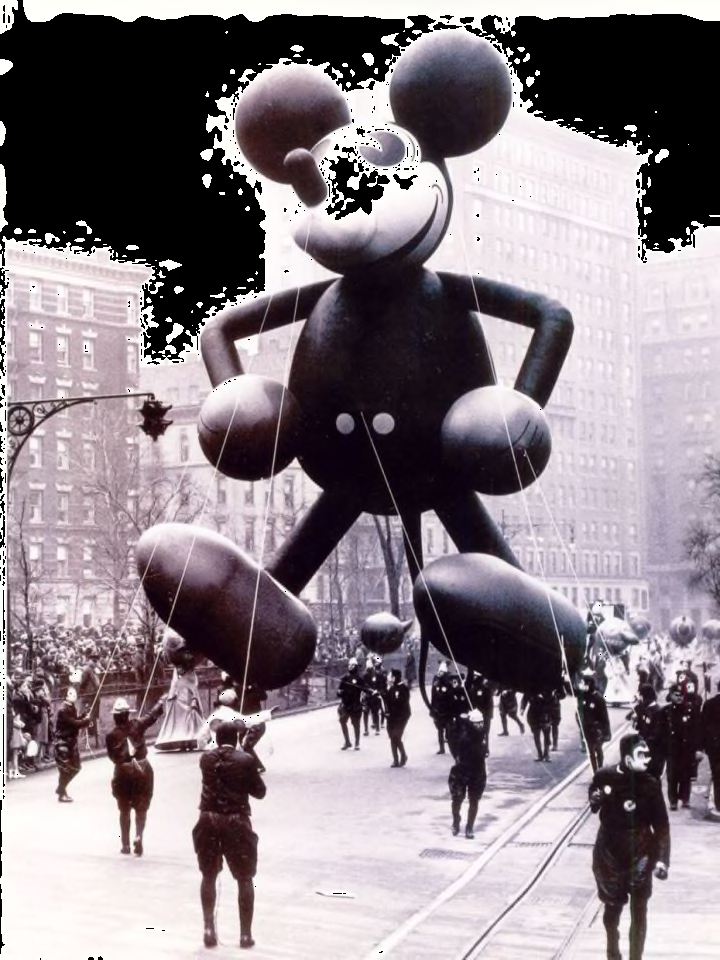
There is no record of Samoset being at the harvest feast that Autumn of 1621 but he helped make it happen and because he did, 213 years later, in ca. 1934, Macy's could do this (via Mental Floss):

Mickey Mouse has made many appearances over the years, in various incarnations. But the first Mickey balloon, which appeared in 1934's parade, was designed with the help of Walt Disney himself. Photo courtesy of Macy's, Inc.

Gratitude Or Grievance, It's A Choice: "Why We Are Better Off Than a Century Ago"

First up, in my humble opinion, The Best Thing About Being A Utopian: 

“Utopia is not under the slightest obligation to produce results: its sole function is to allow its devotees to condemn what exists in the name of what does not.”
― Jean-François Revel, Last Exit to Utopia: The Survival of Socialism in a Post-Soviet Era   

And from the science & technology fanbois and fangrrls at The New Atlantis, Fall, 2025:

Our ancestors built grand public systems to conquer hunger, thirst, darkness, and squalor. That progress can be lost if we forget it.  

I began this series of articles by describing a destination wedding that made me think of Thomas Jefferson. As I was writing this afterword, I went to another wedding in a faraway place, which put me in mind of another president, Calvin Coolidge. 

The groom was a career military man from a conservative Catholic family. The bride’s family was liberal and Jewish. As I talked with the families, it became clear that they had strongly diverging ideas about issues like crime, immigration, religion, economics, and the environment. It is commonplace to observe that in the United States, and every other Western nation, these divisions have become so heated that threats of civil war and government collapse have become familiar news headlines. But at the reception there was a shared sense of happiness as the bridesmaids, beautiful young women in flowing dresses, and the groomsmen, handsome young men in dress uniforms, danced together under a splendid full moon.

The political fights that beset the nation are real and important. But at the same time people would have to be pretty far gone not to join in celebrating two nice young people beginning their lives together.

But the people at the wedding had deeper commonalities, too. All of them — like all the inhabitants of the United States and every other Western nation — stand together atop a mountain of successful efforts to improve human well-being. Conservative and liberal, atheist and believer, every race, age, and social class — each and every one has benefited from the great systems built up in the last century and a half that deliver to us good food, clean water, instant electric power, and advances in health. In every material sense, the people at the wedding were far better off than their forebears.

I was bluntly reminded of our good fortune the day after the wedding, when I visited friends who lived nearby. When I took a shower, I looked down and noticed that one of my calves was flushed and swollen. One of my legs is bigger than the other, I thought. That can’t be good.

A few hours later, I went to the emergency room, where a doctor diagnosed the swelling and redness as a skin infection: cellulitis. I asked if cellulitis is risky. “Oh, yes,” the doctor said. “These things have an excellent chance of killing you.” He prescribed antibiotics, which I bought afterward. Within a few hours of taking the first pill, the swelling had subsided. The episode was over — which put me in mind of Calvin Coolidge.

In the summer of 1924, Coolidge’s sixteen-year-old son, Calvin, Jr., played tennis on the White House grounds. For some reason, he wore sneakers without socks. He got a blister on his toe, as one might expect. It quickly became infected. The White House physician took Calvin, Jr., to Walter Reed General Hospital, then as now one of the nation’s finest health care facilities. Unsurprisingly, the son of the president got the best care available. Multiple specialists visited and the full resources of the hospital were devoted to his care. But none of this did any good. Within a week, the president’s son was dead. Coolidge went into a deep depression from which he never fully recovered.

Staphylococcus aureus, a common bacterium, was the cause of death. Staph was responsible for my infection, too. It was striking to realize that a) a century ago I might well have died; and b) the cost of maybe saving my life was three hours in the ER and $4.16 worth of antibiotics.

Another way of saying this is that I, like billions of others, have benefited from the progress humankind has made during the last century.

Progress today is a loaded word. The idea and its name both arose during the Enlightenment, when modern ideas about science first became widespread. Progress’s most important exponent was probably the French philosopher and mathematician Marie-Jean-Antoine-Nicolas de Caritat, Marquis de Condorcet, who wrote Outline of a Historical View of the Progress of the Human Mind in 1794. The Outline is a triumph of hope over experience. Its author initially supported the French Revolution, believing it would lead to more freedom, including freedom to criticize the government. But the revolutionary junta branded Condorcet as a traitor after he criticized it. He wrote about progress while hiding from the police. Soon after finishing the book, Condorcet was caught and thrown in prison. He died in his cell — possibly murdered, certainly still dreaming of progress — two days later. The Outline appeared posthumously.

Condorcet saw the increase of scientific knowledge as leading unavoidably to greater political freedom and well-being. So did most of the framers of the Constitution. But the awful wars of the twentieth century called this idea into question. In a celebrated passage written in 1940, the German writer Walter Benjamin imagined the “angel of history” turning backward to look at the past. “Where we perceive a chain of events [leading to the present], he sees one single catastrophe which keeps piling wreckage upon wreckage.” The angel would like to stop to fix the disaster, Benjamin wrote. But he can’t, because he is caught in a violent storm that hurls him helplessly forward “into the future to which his back is turned, while the pile of debris before him grows skyward. This storm is what we call progress.”....

....MUCH MORE 

Previous visits to The New Atlantis:

"A Nuclear Renaissance?"
From The New Atlantis, Fall 2022 edition:

"Why This AI Moment May Be the Real Deal"
The author of this piece digs science. 
From The New Atlantis, Summer 2023 edition: 

Reality: A Post-Mortem
From the science-lovers-and-proud-of-it at The New Atlantis, Spring 2023 edition:

Fresh Water: "A Spring in Every Kitchen"
From The New Atlantis, Spring 2025 edition:

Also:

 "Google.gov"

 "For the first time since the fall of the Roman empire, wilderness is returning to Italy. Are Italians ready?"

"Introducing 'How the System Works,' a series on the hidden mechanisms that support modern life"

We Live Like Royalty and Don’t Know It....

 "AI Is a Hall of Mirrors"

 "Are We Under-Bubbled?"

And many more. Use the 'search blog' box upper left if interested,

Thanksgiving Day Stories

For those who celebrate the day, Happy Thanksgiving. For those who don't celebrate the day, happy thanksgiving.

From the Paris Review, November 25, 2015:

The Nexus of All Despair
by Jane Stern

Our Winter 2015 issue features an interview with Jane and Michael Stern, who have written more than forty books; their Roadfood, first published in 1978 and now in its eighth edition, brought a new fervor and attention to regional American cuisine. To celebrate the new issue and the holiday, Jane Stern reflects here on Thanksgivings past. Happiness abounds. —D. P.
I’ve always thought that Thanksgiving was my favorite holiday, based solely on the fact that I adore turkey. But if I were to remove turkey from the equation, I would probably realize that this holiday, for me, has been nothing but one hideous thing after another.

Why Thanksgiving is the nexus of all despair is a mystery. But to prove that it is, here’s a short list of some of the things I remember.

1956, New Haven, Connecticut
The table is beautifully set in the dining room of the gracious colonial house on Trumbull Street, where my aunt and uncle live. I am ten years old, and my older cousins—Eric, seventeen, and his sister, Willa, thirteen—are my teen idols. After the family takes a few snapshots of all of us smiling, the food is spread out on the table and the shit hits the fan. Uncle Henry makes a snide remark about Elvis Presley, who has just been on The Ed Sullivan Show, and cousin Willa flings herself from the table in a histrionic fit. The whole table erupts into a pro- and anti-Elvis fight. The dinner is ruined, no one is hungry, and the gravy curdles as “All Shook Up” blasts from the phonograph in Willa’s room behind the slammed door.

1971, New Haven, Connecticut
A newlywed, I forgo seeing my family for Thanksgiving, and for a change of pace Michael and I invite two friends over. The only flaw in this plan is that I do not know how to cook. Undeterred, I take cookbooks out of the library, buy bags and bags of food, and at some point realize the twenty-eight-pound turkey (for four) will not fit in our apartment’s modest oven. I hack it into pieces.

By the time the two guests arrive, I’ve been cooking for four days, making unspeakably horrible and complicated dishes. I’ve also arranged flowers, cleaned the apartment, repainted the bathroom, and stocked up on Mateus and Boone’s Farm apple wine. I vaguely remember the guests arriving. I’m told that twenty minutes after they did, I excused myself and went to bed. I wake up the next day to a sink full of dirty dishes.

1977, Evanston, Illinois
My in-laws live in the Midwest, and every other Thanksgiving Michael and I travel to see them. This year we’re going to a close relative’s house a few miles away from where his parents live. These relatives are very pretentious. The house is Japanesque. We are instructed to remove our shoes when we enter. The floors are highly polished wood; the furniture is low, uncomfortable, and expensive. The host, a doctor, collects small, tortured bonsai trees.

Seventy-seven is the year the Cuisinart hit the American food scene, and these relatives are nothing if not on trend. Their Thanksgiving menu: pureed capon, pureed creamed spinach, pureed potatoes, pureed carrots, and, for dessert, a pureed pumpkin puree with pureed chestnuts on top. When I am very old and in a nursing home, I will look back on this meal fondly. But now, not so much.

1981, New Haven, Connecticut
Much of my family has died, unexpectedly, from awful diseases and fateful occurrences: my mother from a brain tumor, my cousin Willa from breast cancer, another cousin from a car accident, my grandmother from a broken hip, my father from smoking five packs a day. Those of us who are still living are at my Uncle Henry’s house for the traditional Thanksgiving meal. My Aunt Liz is cooking from rote, undeterred by her galloping Alzheimer’s. We all sit around glumly forking at the stuffing and Uncle Henry begins reading the most ghastly poetry, stuff he’s written for the event. It is not so much poetry as a morbid recitation of terminal cancer symptoms in iambic pentameter. I want to go screaming into that good night.
1995 and 1996, Redding, Connecticut   
Michael is now devoted to AA.... 
...MORE

And speaking of J.M.W. Turner (for folks who don't obsessively remember every word that appears herein, it was November 21, 2016)...

Again from the Paris Review, this time November 24, 2014:

Sleep of the Just
by
You know how J. M. W. Turner tried to exhibit his work at the Royal Academy and the Royal Academy was all, Wow, your work is way too innovative and interesting and we can’t show it because it would threaten all our hidebound, bourgeois ideas and force us to reevaluate everything and make important societal changes? Yeah, well, I totally see their point. Once a year, anyway.

Because every November, all the food magazines and blogs start trying to bully us into to reinventing the wheel. Don’t be a fogey! they scream. What, you’re still eating turkey? HAHAHA. Well, if you insist on being a “traditionalist,” stuff that turkey with linguica and kale! Baste it with ramen! Douse it in pomegranate molasses! (All this is said in a vaguely threatening, SportsCenter-style cadence.) This isn’t your mom’s green bean casserole! You’re not even seeing those losers, are you, with their stupid political views and opinions about your love life? Surely you’re having some awesome no-strings Friendsgiving celebrating the new family you’ve chosen! Right? RIGHT?! SRIRACHA. SRIRACHA. SRIRACHA. 

Look. I get the market demands of the newsstand. You can’t just recycle the same stuff year after year. Nor do I mean to advocate a slavish adherence to tradition. In my family’s case, that would mean cleaning the dining room table off in a panic at the last minute, barring entrance to the rooms where we’ve stuck all the mess, then watching my mother stand in front of the digital meat thermometer with tears rolling down her cheeks....MORE 
"...and the Royal Academy was all, Wow, your work is way too innovative and interesting and we can’t show it...."
Mr Turner Recreating theRoyal Academy Show of 1832

Because that's just the way they spoke at the Royal Academy, back in the day.

The pic is from Christie's "Mr Turner: Recreating the Royal Academy Show of 1832"

Friday? Maybe some more Thanksgiving stories or a recipe or two.