Showing posts sorted by relevance for query carbon. Sort by date Show all posts

Sunday, December 17, 2023

The Harvard Business Review Looks At Carbon Credits

Less superficial than almost anything we've seen addressed to a general audience.

After many, many years of looking at this stuff, our preferred approach to pricing carbon dioxide in the U.S. is a tax on emitting sources, (to raise the price of carbon intensive activities) combined with a 100% rebate of the funds raised on a per capita basis. This would have the big-picture effect of transferring some income from the private-jet-set to people who don't use as many carbon intensive resources and the smaller-picture effect of pushing economy-wide substitutions for various industries. One example is the steel industry where at some price-point on carbon so-called "green steel" produced using hydrogen becomes viable.

As Senator Obama said:

“Under my plan … electricity rates would necessarily skyrocket.”
—Presidential candidate, Senator Barack Obama,
Q&A with the editorial board of the San Francisco Chronicle, January 21, 2008

The issue that must be kept in mind is that the entire exercise of the energy transition is to raise the cost of things deemed "bad" to change behavior toward things which are deemed as "good."

And cushion the blow of higher prices on those least able to afford them.

The per capita rebate helps to ameliorate some of the cost impacts on people who use fewer carbon-emitting resources.

Perhaps just as importantly the rebate would keep the money out of the hands of politicians who have never met a potential revenue stream—except perhaps taxing Harvard's endowment income—that they didn't love and couldn't co-opt to fund pet projects and pay off their cronies and voters.

The other approaches, mandating winners and losers by executive fiat and trading virtual carbon are much less efficient and lend themselves to much more corruption and fraud.

Here, the HBR looks at the latter approach, December 15:

What Every Leader Needs to Know About Carbon Credits

Summary.
Many companies have begun to look into credits to offset their emissions as a way to support their net zero goals as their target years get closer and closer. As it stands, the carbon credit market is too small to bear the brunt of reducing companies’ impacts on the environment. However, the voluntary carbon market has the potential to drive billions of dollars over the coming decade into climate solutions. Here, the authors offer a primer for leaders to learn about the carbon credit market. What’s the best way to participate in the market? Which types of credits are considered to be the highest quality, and thus carry the least reputational risk? Who are the players when it comes to standards and regulation? The authors answer these questions and outline the characteristics of high-quality carbon credits

In the absence of government regulations requiring dramatic reductions of greenhouse gas (GHG) emissions that are causing climate change, a growing number of companies are adopting “net zero” targets. More than one third of the world’s 2,000 largest publicly held companies have declared net zero targets according to Net Zero Tracker, a database compiled by a collaboration of academics and nonprofits. These targets typically entail public commitments to reduce GHG emissions through measures such as process modification, product reformulation, fuel switching, shifting to renewable power, investing in carbon removal projects — and a pledge to zero-out their remaining emissions by purchasing carbon offsets, also known as carbon credits. Carbon credits are financial instruments where the buyer pays another company to take some action to reduce its greenhouse gas emissions, and the buyer gets credit for the reduction.

As companies creep closer to their net zero target years, many have already begun purchasing carbon credits. The market for carbon credits is projected to grow 50-fold within a decade, from nearly $2 billion in 2022 to nearly $100 billion by 2030, and as much as $250 billion by 2050, according to Morgan Stanley. But navigating the world of carbon credits creates brand risk because the market remains immature and complex, with wide variation in project types, developers, location, and cost, resulting in unclear quality, transparency, and credibility.

Companies routinely choose to purchase rather than produce goods and services that other companies can create more inexpensively, and this decision doesn’t often attract the attention of activists or the media. Not so for carbon mitigation: Activists are vocal about how companies choose to meet their net-zero goals. Corporate carbon mitigation plans viewed as overly reliant on buying carbon credits rather than making carbon reductions to their own operations and supply chains risk being accused of not being sufficiently serious about decarbonization and seeking to “buy their way out” of meaningfully achieving their goals. In part, this is because the carbon credit market is far too small to accommodate the dramatic carbon reductions necessary to meet companies’ net-zero goals or for the world to reduce GHG emissions by 45% by 2030 and reach net zero by 2050 that the UN claims is necessary to avoid the worst effects of climate change by limiting the global average increase to 1.5 degrees Celsius. Questions about credits’ credibility abound, including whether they deliver on their promise to reduce GHGs, whether any such reductions will endure, and whether the project would have occurred even without the sale of carbon credits. From John Oliver’s claim that “offsets are bullshit” to the Guardian calling some carbon credits purchased by Disney, Gucci, and Shell “largely worthless,” some offsets receive charges of “greenwashing” — environmental performance claims that outstrip reality. That’s hardly the reputation boost firms seek.

Yet, the voluntary carbon market has the potential to drive billions of dollars over the coming decade into climate solutions, creating along the way an estimate of cost-of-carbon in goods and services. What’s the best way to participate in the market when carbon credits claiming to avoid or remove one metric ton of GHG range in price from nearly $2 per ton to $1,800 per ton? Which types of credits are considered to be the highest quality, and thus least likely to lead your company to be named and shamed? Despite the emergence of standards and registries meant to inject confidence in the market, many quality concerns remain. Leaders need guidance to apply due diligence to decisions regarding the carbon credit market.

What projects create carbon credits?
Carbon credits are created from projects that avoid the generation of GHG emissions or that remove GHGs from the atmosphere. These projects include “nature-based solutions,” such as reforestation and regenerative agriculture efforts, and “engineered solutions,” such as combusting methane emitted from landfills to generate electricity and direct air capture.

Examples of Carbon Credit Projects
This table illustrates the differences between nature-based and engineered solutions for both carbon emissions avoidance and carbon removal.

Carbon emissions avoidance Carbon removal

Nature-Based Solutions

Preservation of forest land to avoid its conversion into farmland

Regenerative agriculture practices that sequester (embed) atmospheric carbon into soils and vegetation

Engineered Solutions

  • Carbon capture and storage of GHGs from smokestacks at coal- and natural-gas-fueled power plants and other types of factories
  • New solar-and wind-power plants that substitute for fossil fuel electricity
  • Combustion of stockpiles of ozone-depleting substances that would otherwise leak into the atmosphere
  • Combustion of methane emissions from landfills

Direct air capture of GHGs from the atmosphere with deep-well storage

Some companies focus only on some of these types. Microsoft, for example, invests only in carbon removals. Others create a portfolio across the spectrum, such as Delta’s $137 million investment in carbon credits that include REDD+ (reducing emissions from deforestation and forest degradation) avoidance credits, avoidance credits from solar and wind-power projects, and removal credits including afforestation and carbon capture and storage.

Who are the players?
Unlike with stock exchanges, carbon credits lack widely adopted standards and large centralized marketplaces. This makes it difficult to find, understand, and compare carbon credit projects.

Instead, leaders have to navigate a maze of various standards and players with frustratingly overlapping roles. There are numerous carbon credit registries and standards bodies that provide minimum requirements for various project attributes and in some cases list projects that meet their own standards.

  • Carbon credit verifiers, also known as validation/verification bodies (VVBs), assess whether projects meet certain standards. They range from global companies to niche players that focus on just one type of project.
  • Carbon credit brokers and marketplaces connect buyers with project developers. Some list projects they helped finance and develop, raising the potential for conflicts of interest.
  • Carbon credit ratings agencies assess carbon credit projects along various dimensions, including but not limited to the attributes featured in standards. They tend to sell their ratings via a subscription model to prospective credit buyers. These ratings agencies provide much-needed transparency and convey key attributes of the projects they rate.

With so many players and many standards, it’s no wonder companies find it difficult to navigate the landscape. The Voluntary Carbon Markets Integrity Initiative or Oxford Net-Zero Aligned Offsetting Principles provide holistic carbon credit and offsetting principles and are a great place for leaders to start, but even these are updated periodically to keep pace with the changing landscape.

Examples of players in the carbon credit marketplace....

....MUCH MORE

Wednesday, September 25, 2019

BlackRock and Alphaville Are Thinking About Pricing Carbon

We've never been fans of carbon trading, preferring instead a ratcheting carbon tax and 100% rebate to households. A couple examples after the jumps.
First up, Claire Jones at FT Alphaville:

What is the true cost of carbon emissions?
One of the many challenges facing attempts to green the economy is gauging an “acceptable” price for carbon emissions.

The German government, for instance, was met with criticism from both sides when it said last week that it would price emissions at €10 per tonne under a new certificate scheme beginning in 2021 (with the figure rising to €35 by 2025).

So in the interests of transparency, it is helpful that data firm IHS Markit has put together what it claims is the first global benchmark for carbon emissions pricing. (There’s a news story here from our colleague Nikou Asgari.)

The benchmark, which it plans to calculate daily, launches today using carbon prices based on trading under the three most liquid trading schemes: the EU’s, and two from the US. It uses data going back to 2014 and here is what it looks like at the moment, the weighted average cost of a tonne of carbon coming in at $23.65 today -- or about double what the government in Berlin wants to charge:...
***
... IHS Markit says they plan to add other carbon credit trading schemes once new markets become deep and liquid enough. All of which ought to help governments, and the public, assess what’s a fair price.

The problem is -- as IHS Markit pointed out to us -- that the World Bank thinks the current price is far lower than it ought to be.

So why is the market getting it wrong?...
....MUCH MORE

And from BlackRock's blog:
Introducing Carbon Beta: What pricing carbon means for investors
For the first time ever, BlackRock is enabling all portfolio managers to stress test their portfolios to future carbon price scenarios. Andre and Mike explain why.

Investors already know that the transition to a low-carbon economy matters to their portfolios. But measuring how it matters has been incredibly difficult – until now. In order to answer this pressing question, BlackRock Sustainable Investing has developed a new cutting-edge investment metric called Carbon Beta. Simply put, it’s a way of measuring a company’s sensitivity to carbon prices.
Carbon Beta, which is integrated into our risk and investment management technology Aladdin, is designed to help investors better understand the energy transition. Using Carbon Beta, every portfolio manager at BlackRock can review the impact of future carbon price scenarios on their investment portfolios. This enables us to better understand the risks and opportunities of carbon pricing and deliver our clients solutions aligned with the low-carbon transition.

Carbon pricing gains traction
Why is this metric so urgent for investors? Because carbon pricing mechanisms—such as carbon taxes and emissions trading schemes—have taken center stage in the global policy debate. In order to manage risk and achieve out-performance, investors need to understand the different ways in which carbon pricing policies—and carbon prices more generally—could affect their portfolios.
The idea of pricing carbon and allowing market forces to reduce overall emissions is not a new one. In fact, 57 carbon pricing initiatives are now in effect or scheduled for implementation globally, up from 51 in April 2018. These initiatives currently cover around 20% of global greenhouse gases, more than five times what was covered in 2010. See chart below.
Despite the overall growth in interest, many jurisdictions have yet to take action, and both the amount and set price of emissions covered are still too low to meet the objectives of the Paris Climate Accord. In light of the United Nation’s warning last year–that without dramatic new limits on emissions, global temperature increases in the next decade could produce alarming rates of food scarcity, mass migrations, and instability as soon as 2040–more regulatory attention is warranted.

Anticipating increased carbon pricing activity, some financial institutions and emissions-intensive industries are starting to apply internal carbon pricing in their investment decisions, consistent with risk guidelines provided by the Financial Stability Board’s Task Force on Climate Related Financial Disclosure. This summer, BlackRock and a group of global energy CEOs —including representation from ExxonMobil, BP, Royal Dutch Shell, Total, Chevron and Eni—joined the Pope at the Vatican in calling for economically meaningful prices to carbon to address global climate change. Due to these underlying forces, we anticipate more carbon pricing regulation to be implemented in coming years.

Introducing BlackRock Carbon Beta 
To help BlackRock’s portfolio managers better understand the implications of regulation, we introduced Carbon Beta, a new approach quantifying a company’s sensitivity to carbon prices....
....MORE

Here's a 2009 post;
Climateer Investing on Carbon Trading and Traders
Our preference is "Cap-and-Tax (auction) with 100% Rebate" not Cap-and Trade.

The post immediately below, "Richard Sandor, Barack Obama and the Founding of the Chicago Climate Exchange (CLE.L)" got me to thinking about the carbon markets.
Proponents repeat the mantra that cap-and-trade is a "market based 'solution'". This is, of course, nonsense.

Just as an economist using the tools of science (mathematics) doesn't make economics a science, carbon traders using the tools of markets doesn't make carbon trading market based.

The carbon markets are an entirely artificial construct, beholden to political paymasters for their very existence. Which may be why so many political types are planning to profit from them.
Directly, think Al Gore's Generation Investment Management's investment in carbon project developer Camco or Lord Nicholas Stern's Vice-Chairmanship of IDEACarbon's parent IDEAGlobal or indirectly as a source of campaign contributions for pols still in office, or an unaccountable slush fund in the case of the U.N.

The word artificial led me to think of it's cousin, artifice. Here's the Oxford Pocket definition:ar·ti·ficen. clever or cunning devices or expedients, esp. as used to trick or deceive others: artifice and outright fakery. 
The securities attorneys among our readers will recognize the word from the common state security law usage "...employ any device, scheme, or artifice to defraud".
Coincidence?
Here's the view from Russia, quoted in The Bored Whore of Kyoto:
"I don't know if climate change is caused by burning coal or sun flares or what," said the Moscow-based carbon cowboy. "And I don't really give a shit. Russia is the most energy inefficient country around, and carbon is the most volatile market ever. There's a lot of opportunity to make money."
Here's a former Goldman Sachs trader:
The whole reason for the existence of traders is to make as much money as possible, consistent with what's legal...I lived through this: if you didn't manipulate the market and manipulation was accessible to you, that's when you were yelled at.
-Former Goldman Sachs trader
New York Times, May 8, 2002
Here's Lord Stern at the Bali Climate Conference where the largest NGO contingent were the gang from the International Emissions Trading Association, 336 representatives including lawyers, financiers, emissions traders, consultants, certifiers and emissions trading experts... the IETA made up 7.5% of the 4483 Non-Governmental Organisation (NGO) delegates registered for the U.N. shindig:
“Bali will set in motion a process that will define the structure
of the carbon markets for decades to come”
“By 2020 the global carbon market could be worth EUR 240-
450 billion”
-Sir Nicholas Stern
"This (climate change) is much too important to leave to environment ministers"
-Sir Nicholas Stern
to Finance Ministers basking in Bali
And here's a post from 2007:
"When Britain decided to end slavery,
Wilberforce didn't set up a cap-and-trade system"
That's me, misquoting myself.

Sometimes I find my fellow capitalists repulsive. When they lobby for political favors, then turn around and blandly refer to the result as an example of free markets I don't know whether to laugh, cry or attempt to destroy them. Laughing is probably the healthiest response, world domination the most challenging.

I've been looking for examples to skewer CO2 cap-and-trade.
One thought problem was how to end slavery.
Another was Nuclear weapons proliferation. Think about it.
Mr. Consultant comes up to you and says "The market based system of capping production and handing out allowances to produce nukes, which can then be traded, is the only rational approach".
Don't think too long though, lest you enter "Le Théâtre de l'Absurde". Trust me, the world of Jean Genet and Sam Beckett gets old fast, Pinter and Albee's, faster....
One more. 2011, "Zeitgeist: 2/3 Support Revenue Neutral Carbon Tax As Pew Trusts Pull Funding for Pew Climate Center"

Friday, December 30, 2022

"'Greenflationary' expectations"

From the prolific (not kidding, I don't think he ever stops thinking about this stuff) Peter Sainsbury's Substack, Carbon Risk, May 10:

The lumpy, unpredictable nature of climate change and the transition towards zero carbon is likely to mean that inflation will be higher, and more volatile in the future.

Much of this inflationary pressure relates to the impact that climate shocks have on the supply of essential commodities, especially agricultural and energy. However, the transition to a zero carbon economy (and the costs that implies) is likely to become an increasingly important contributor to high and volatile inflation.

Up until relatively recently, carbon prices were low and the impact on carbon abatement behaviour was limited. Over the longer term though, higher carbon prices provide the incentive to decarbonise power generation and industrial assets. However, these assets take time to come to fruition, which means that in the short-term capital is diverted away from high carbon sectors such as fossil fuels.

Higher carbon prices also represent a cost that business must either pass onto their consumers, or alternatively absorb it and see their margins cut. Uncertainty over short and long term carbon prices will become more and more important in determining inflationary expectations.

Volatile inflation is particularly pernicious due to the significant cost it imposes on economic activity resulting from the the uncertainty it introduces into decision making (see 'Greenflation' fears are a twin threat to the EUs monetary and climate credibility.

Central bankers should play a pivotal role in communicating the economic trade-offs involved in decarbonisation. They have the power to provide a stable foundation for the investment and behaviour change required. Without that foundation then carbon prices are likely to be higher, and for much longer.

‘Greenflationary’ expectations

The degree to which inflation will result from carbon pricing ultimately depends on where we are today.

Compliance carbon markets covered ~17% of global emissions in 2021 and posted a carbon market-weighted average price of ~$28 per tonne (~€26.50). The low average price reflects the large share of emissions covered by China’s nascent carbon market and it’s relatively low carbon price; launched in July 2021 the scheme closed the year below $10 per tonne. Taking account of other countries where carbon taxes exist and carbon pricing of some sort (either taxes or carbon markets) covers around 22% of global emissions. The other 78% are starting from zero.

On a global basis this means the price of carbon is low, really low.

~$2.50 per tonne.

We are so very early. Global carbon prices need to be well north of $75 per tonne if the world is to decarbonise in the timescales its leaders have committed to. The inflationary implications of higher carbon prices has barely begun.

Impact of higher cost of carbon on energy prices

Credit Suisse estimates that every $10 per tonne increase in the carbon price (equivalent to €9.50), will add ~$4 per barrel (bbl) to the oil price. At an oil price of $100 per bbl, this would imply a 21% and 42% increase in prices if carbon rose to $50 per tonne and $100 per tonne respectively.

When it comes to natural gas the bank estimates that every $10 per tonne increase in the carbon price would add ~$0.5 per MMBtu. At $8 per MMBtu, a $50 per tonne carbon price would raise natural gas prices by 34%, and 68% at a carbon price of $100 per tonne.

Crucially, the estimates here only account for Scope 3 emissions, i.e. those involved with the combustion of the fossil fuels. If Scope 1 and Scope 2 emissions are included then the impact on energy prices for every $10 increase in the carbon price could be some 25% higher.1

Remember that higher carbon prices could be introduced through the compliance markets (e.g. via steeper floor price or expanding the coverage, etc.), or through direct carbon taxes, or some combination of the two (e.g. several countries in Europe have a separate carbon tax and are also part of the EU ETS).

Impact on inflation across economies....

....MUCH MORE

Friday, May 25, 2007

The Only Green Vacation Is Staying Home

If you are intellectually honest you know it's true.
This is part 3 of a ramble along the byways of eco-hypocrisy.

Wednesday Russell Seitz, writing at ADAMANT, made gentle fun of right-of-center sites "Planet Gore" and the Competitive Enterprise Institute's Open Market blog. That got me poking around CEI's blog where I found the post with the above headline.

Many well-meaning people are buying into carbon offset schemes that are either not doing what they purport or are outright frauds, as reported so well by the Financial Times among others. HT: WSJ.com's Energy Roundup. FT stories here, here, here.

That last FT link is interesting, it was the first mention of the sequestration technique of charring wood in the absence of oxygen that I saw. Caveat: tradable carbon credit prices will have to rise five to ten-fold to make the technique economically feasible; it's still a decent way to recharge depleted soils.

This is a big deal because offsets and credits are the last refuge of people who won't change their lifestyle. If the offset/credit deals don't work, people are confronted with having to change their lifestyle, possibly in drastic ways, or admit they don't care or face up to their hypocricy. No other choices. And frankly people don't want to change. There's a reason the Inuit use snowmobiles. There's a reason celebrities fly privately. There's a reason people heat their homes, or drive rather than walk. People are lazy, comfort loving, easifying creatures.

One industry in potentially big trouble is travel. "Travel Experts Mull Ecotourism Threats" Here's The draft statement from the just concluded Oslo eco-tourism conference Here are two headlines that appeared the same day at ENN: Arctic Islands Invite Tourists To See Climate Woes; Travel Experts See Worrisome Downside to Ecotourism. Is it any wonder the hypocrite founder of "Roughguides" has embraced tree planting offsets?

I like trees. At age 12 I sent $5.00 to the National Arbor Day Foundation from my paper route earnings (why you little entrepreneur/philanthropist, you).

The idea of using trees as carbon sinks has real problems. From Forest Fraud, a report by Sinkswatch and Fern.org:

Ten facts about carbon sinks

1. Carbon in trees is not equivalent to carbon in fossil fuels: Tree-stored carbon is easily released into the atmosphere through fire, natural decay and timber harvesting. Carbon in fossil fuels is locked away and only released through human intervention. Carbon credits that equate the two are based on a false premise.

2. One-way road: Trees provide temporary carbon storage as part of the normal cycle of carbon exchange between forests and the atmosphere. The release of carbon from fossil fuels is permanent and, over relevant timescales, will accelerate climate change by increasing the active carbon pool and destabilising carbon flows.

3. Fake credit: Carbon sink credits in the Kyoto Protocol use temporary tree plantations to justify permanent releases of fossil-stored carbon into the atmosphere. Carbon sink credits are fake credits for the climate.

4. Footprint chaos: Carbon sink credits increase the ecological debt of the North. The more fossil fuel a Northern country uses, the more land it is entitled to use to ‘offset’ its emissions. This is unfair and undermines global efforts towards sustainable development.

5. Subsidies for mega-plantations: The Kyoto Protocol stands to provide a new subsidy for the plantations industry. Documented evidence shows how large-scale plantations have negative impacts on forests and forest peoples. Kyoto includes no meaningful safeguards to rule out large-scale monoculture tree plantations from receiving carbon credits.

6. Communities suffer twice: First, climate change affects the livelihoods of forest peoples and rural communities through increased droughts, floods, forest fires and deforestation. Second, carbon sink credits promote the expansion of large-scale tree plantations, which indigenous peoples and forest dependent communities are opposing in many parts of the world.

7. Arming a time bomb: Avoiding climate change requires drastic reductions of greenhouse gas emissions from fossil fuels, but carbon sink projects do nothing to help solve this problem; in fact they mask the real crisis. This is sentencing future generations to live with fewer choices and worse conditions.

8. Forest fraud: Forests play a vital role in storing carbon and buffering extreme weather events. But linking forest restoration with carbon credits is a dead-end for forest peoples as well as for the climate. Halting the forest crisis requires action against the underlying causes of deforestation, not a bigger active carbon pool and more monoculture tree plantations.

9. Blind guess: Measuring carbon pools is fraught with uncertainties. Scientists have found that estimates of the carbon balance in Canadian forests could vary by 1000 per cent if seemingly small factors, such as increased levels of atmospheric CO2, are taken into account.

10. Phony climate fix: Real and lasting solutions to the forest crisis and the climate crisis lie in providing incentives for forest-dependent communities and indigenous peoples to restore their forests and practice sustainable forest management. Small-scale pilot projects are already showing positive results, while large-scale carbon sink projects are attracting criticism and protest.

This is getting longer than I planned. Have a great holiday, I'll wrap up in part four.
Part one: New Report Challenges Basic Assumptions of "Climate Change"
Part two: DiCaprio bites back over eco 'hypocrisy'

Tuesday, September 15, 2009

Carbon Trading: JPMorgan to buy EcoSecurities for $204 million (JPM; ECO.L)

We've been following this for a while, see links below. From Reuters:
JPMorgan Chase & Co agreed to buy carbon offset aggregator EcoSecurities for 122.9 million pounds ($204 million) on Monday, trumping a bid from the firm's co-founder, to boost its carbon-credit trading business.

J.P.Morgan Ventures Energy Corp., a subsidiary of the bank, said its 100 pence-a-share bid, made through Carbon Acquisition Company, had the backing of shareholders representing 19.9 percent of the company.

It said EcoSecurities had successfully realized value from sourcing, developing and trading emission reductions, and it noted the firm had recorded its first period of profitability in the first half.

The offer represents a 120 percent premium to the group's share price before the start of the offer period on June 4.

"It looks like JPMorgan is backing the current management to take the business private," said Ken Rumph, an equity analyst at Nomura Code.

Ireland-based EcoSecurities Group Plc develops clean energy projects under the Kyoto Protocol's Clean Development Mechanism, which allows companies to export cuts in greenhouse gas emissions to emerging countries like China and India, where such reductions are cheaper to make.

EcoSecurities shares were up 11.5 percent at 101.5 pence by 1411 GMT (10:11 a.m. EDT)....MORE

Also from Reuters:

FACTBOX: Investment banks in carbon trading

Investment banks are chasing opportunities in a $126 billion carbon market as the U.S. Senate considers a federal climate bill that would launch a cap and trade scheme.

Governments worldwide are also expected to lean heavily on the private sector and carbon markets in particular, as a way to raise finance to fight climate change, at a major U.N.-led meeting in Copenhagen in December.

Investment banks have three main strategies in carbon: buy and sell emissions rights on behalf of corporate clients to profit from bid-offer spreads; proprietary trade with their own money; investment in carbon offset development under the Kyoto Protocol's clean development mechanism (CDM).

In the last category, JPMorgan Chase & Co said on Monday it was buying carbon offset company EcoSecurities for an agreed 123 million pounds ($204 million).

The role of traders in carbon markets is under scrutiny in the United States. One lawmaker guiding the draft climate bill through the Senate, Sen. John Kerry, said the bill should have tough controls on speculation.

Following is a list of some of the more active banks, and what they do --

Bank of America Merrill Lynch

* CDM project originator; structuring CDM deals

* lender to renewable energy projects, including CDM

Barclays Capital

* market maker for clients and through prop desk

* says has traded 2 billion tons of carbon allowances

* has no proprietary investment in carbon commodities

* research and structuring teams

Citi

* equity investment in Sindicatum Carbon Capital Continued...

Our recent posts on ECO:

Carbon Trading: EcoSecurities co-founder considers bid for company (ECO.L; CAO.L)

Chart for ECOSECURITIES GROUP (ECO.L)

For those interested, the WSJ's Jeffrey Ball did an extensive piece in April, '08:

Two Carbon-Market Millionaires Take a Hit as U.N. Clamps Down (ECO.L)

The other carbon trader we follow is in Al Gore's GIM portfolio, Camco International:

Carbon Trader Praises Chinese Carbon Trade (CAO.L)

Carbon: Al Gore, Score! Camco Int'l posts maiden full-year profit (CAO.L)

Al Gore. No Score: Camco shares fall on delay of '08 results release (CAO.l; CAMIN.L)

Al Gore: Score! Generation Investment Management ups Stake in Camco International (CAMIN.L; CAO.L)

MORE

Carbon Trading: EcoSecurities Jumps Again, Second Bidder (ECO.L)
Trading Emissions PLC Ups Stake in Ecosecurities (ECO.L; TRE.L)
Fresh takeover bids expected for carbon asset firms (ECO.L; CAO.L; TRE.L)
Carbon Trade: "Swedes swoop on EcoSecurities" (ECO.L)
Credit Suisse Cuts EcoSecurities Stake as UBS Alumnus Backs Bid (ECO.L)
And, on Sep. 3, "Carbon Trade: "EcoSecurities says in offer talks with another party" (ECO.L)"

Sunday, February 25, 2024

"For Captured Carbon, Scientists Plot a Sub-Ocean Tomb"

This approach addresses one of the big risks of just willy-nilly burying CO₂: that the gas will somehow escape and a) re-enter the carbon cycle via the atmosphere or b) create a Lake Nyos (Cameroon, 1986) scenario which released naturally trapped CO₂ and killed over 1700 people and thousands of head of livestock. Solidifying the CO₂ as part of the entombment has had its  attractions since the Al Gore days:

I too have heard the siren song of carbon capture and storage.
There are two ways to use carbon once it is captured (still theoretical because of price but the cost is dropping, see below), either sequester it and remove it from the carbon cycle or reuse it in a closed loop hydrocarbon fuel infrastructure.
From 2007: "Can baking soda curb global warming?":

I have a fascination with calcium carbonate. But, being flexible, I am willing to consider the bicarbonate of various metals.
Some scientists have proposed compressing carbon dioxide and sticking it in underground caves as a way to cut down on greenhouse gases. Joe David Jones wants to make baking soda out of it.
Jones, the founder and CEO of Skyonic, has come up with an industrial process called SkyMine that captures 90 percent of the carbon dioxide coming out of smoke stacks and mixes it with sodium hydroxide to make sodium bicarbonate, or baking soda. The energy required for the reaction to turn the chemicals into baking soda comes from the waste heat from the factory.
"It is cleaner than food-grade (baking soda)," he said.
The system also removes 97 percent of the heavy metals, as well as most of the sulfur and nitrogen compounds, Jones said.
And a few months earlier:
... Right now I'm looking at calcium carbonate. Literally. Got a hunk of limestone. CaCO3. That's sequestered carbon, right?. Hmmm.
Make a green pitch, wrap it in recycled fiberboard; et voila! Return of the Pet Rock, eco-version! And seashells, same stuff, calcite. There's the hook! Mom, you're going to Miami Beach.

And many, many more. Use the 'search blog' box if interested.

The cost of the carbon capture stage is still exorbitant but who knows what advances are ahead?

From UnDark, February 19:

It’s a contentious idea, but advocates say storing CO2 under the seafloor could help address climate change—if it works.

In 2010, as the Deepwater Horizon rig sank and millions of gallons of oil gushed into the Gulf of Mexico, Kate Moran’s phone rang in Washington, D.C. At the time, she was assistant director in President Barack Obama’s Office of Science and Technology Policy, and government officials recognized that she brought years of ocean drilling experience. Within a matter of days, and guided by her understanding of deep ocean geochemistry, the government rapidly deployed resources and experts to manage the crisis, overseeing controlled burns, remote undersea vehicles, even air and sea traffic control systems. “It was remarkable,” Moran said recently of the mobilization. “Unbelievably remarkable.”

That memory looms large as Moran leads a project to mitigate the environmental impacts of fossil fuels on a much larger scale. Now president and CEO of the research institute Ocean Networks Canada, she is also the principal investigator for Solid Carbon, a project overseen by the institute that aims to permanently remove greenhouse gases from the atmosphere by entombing carbon under the seafloor.

“You can do big things in the ocean — the oil industry does,” Moran said, expressing dismay that governments have not marshaled resources like they did for Deepwater Horizon. “So why not look at a system where you could have essentially an independent system offshore that actually removes CO2 from the atmosphere and puts it away forever?”

In addition to transitioning away from fossil fuels, climate science experts are increasingly convinced that greenhouse gases will need to be removed from the atmosphere to avoid cascading impacts of climate change. A new global climate deal from the United Nations climate conference, COP28, doesn’t require countries to completely phase out fossil fuel use, but rather relies on investments in renewable energy and carbon removal techniques to mitigate the impacts of greenhouse gases. National climate plans, too, increasingly depend on carbon removal.

But it’s a gamble: Removing enough carbon dioxide on a large scale hasn’t been fully tested. And the slower the transition away from fossil fuels, the more carbon removal will be needed to reach goals and avoid catastrophes.

“My students always say, ‘But don’t we have to try?’ And the answer is absolutely,” said David Goldberg, a professor at Columbia University’s Climate School who designed the Solid Carbon plan with Moran.

Effective carbon removal is essentially a two-step process: first, remove the carbon dioxide from the air, and then somehow keep it from returning for at least several decades and ideally much longer. Forests and other plant life remove and store carbon dioxide naturally, but it risks returning through decomposition or fires. Solid Carbon would use machinery that filters out carbon dioxide both from sources of emissions, as well as directly from the air. The next step is finding a way to permanently store the trapped carbon dioxide.

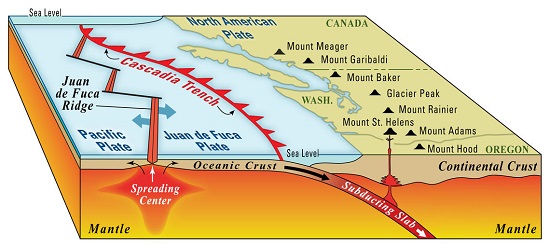
Researchers at Solid Carbon are turning to basalt, a volcanic rock that easily reacts with acids like carbon dioxide, to turn the greenhouse gas into a carbonate rock under the seabed. Storing carbon in geologic formations like this is expected to be the most long-lasting method among options to keep carbon dioxide out of the atmosphere. Under the Cascadia Basin off the coast of Vancouver Island lies the most extensively studied ocean basalt. What’s more, it’s colossal: large enough in theory to store carbon from all global annual emissions many times over.

Solid Carbon offers a glimpse into the enormous scale that would be required to impact emissions. In one version of its plan, dozens of floating rigs on the Pacific Ocean would be coupled with many more wind turbines to funnel compressed, carbon dioxide nearly 2 miles under the sea. But that would only remove less than 1 percent of what climate scientists predict will be needed by 2050. If carbon removal techniques are to make any dent in emissions, they will need to scale up multiple magnitudes....

....MUCH MORE

I know Professor Moran is all over the earthquake risk but for readers who are unfamiliar with the area here's a little map of the Cascadia Subduction Zone from Kids Fun Science:

https://www.kids-fun-science.com/images/rf3-cascadia-subduction-zone-usgs.jpg

And more fun via Climateer Investing:
When The Megaquake Hits, The Living Will Envy The Dead
Okay, a bit of hyperbole in the headline but let's go with 10,000 dead, 30,000 injured and 2,000,000 people displaced and dependent on handouts.

We've had three posts on the Cascadia Subduction Zone, a couple links below.
There have been a few cat bonds issued over the years that cover Cascadia, they seem to be underpriced for the risk.*

Friday, May 9, 2025

"XPRIZE Makes History, Awards $100M Prize for Groundbreaking Carbon Removal Solutions"

It's not enough just to capture the carbon, to prevent re-release you have to sequester it.
And do so in an affordable way. The rock weathering approach addresses both of those goals.
The next step will be to speed things up.

Some background from January 2021:

"Elon Musk to offer $100 million prize for 'best' carbon capture tech" 

Carbon capture is an approach the Norwegians among others are exploring but it is not easy. Because the concentrations of CO2 in air are so low, ~415 parts per million, you have to move a lot of air through your systems to get meaningful amounts of CO2 to sequester.

The other reasons are ideological. A lot of folks in the authoritarian crowd don't like it because it means that things don't have to change as much as they would like things to change. Wealth transferers don't like carbon capture because it directly attacks their rationalization for "climate reparations", always set with a starting point far enough back in time so that only Northern Hemisphere and in particular, western, countries owe x-number of trillions of dollars to southern and eastern countries. And then there are the....

Yeah, I've been doing this a long time.

Putting all that aside, prizes are good, a very efficient way to mobilize talent and creativity in a focused pursuit. I may even see if I can recruit a team of folks smarter than I to claim Elon's money....

....MUCH MORE

Here's Musk's one sentence announcement back in January 2021.

First up, The XPrize Foundation, April 23:

The 4-year competition accelerated solutions to combat climate change and catalyze a vitally important carbon removal industry 

XPRIZE, the world’s leader in designing and operating large-scale incentive competitions to solve humanity’s grand challenges, today proudly announces the winners of its $100 million XPRIZE Carbon Removal competition, the largest global incentive competition award in history. The four-year  competition was designed to combat climate change by challenging teams around the world to develop high-quality carbon dioxide removal (CDR) solutions that are scalable to gigatonne level and durably and sustainably remove carbon dioxide (CO₂) from the atmosphere and oceans. The winning teams, selected from 20 impressive Finalists across 11 countries, each successfully removed more than 1,000 net tonnes of CO₂ in the final year of the competition, meeting XPRIZE’s bold demonstration requirements, the first step towards scaling sustainably to remove billions of tonnes globally.

Mati Carbon received the $50M grand prize for their enhanced rock weathering solution. Runners up NetZero, Vaulted Deep and UNDO Carbon were awarded $15M, $8M and $5M, respectively. Two XFACTOR awards of $1M each were awarded to Planetary and Project Hajar, a partnership between Aircapture and 44.01. This announcement, timed during Earth Week, coincides with recognition of the winning teams as part of the TIME100 Summit in New York, where XPRIZE is a supporting partner.

Excess CO₂ in the Earth’s atmosphere and oceans is the main driver of climate change, with human-produced CO₂ emissions accounting for more than two-thirds of all greenhouse gas emissions. In addition to dramatic emissions reductions, scientists agree that sustainable and scalable carbon removal solutions are necessary to keep average global temperatures from rising 2°C above pre-industrial levels, a critical threshold above which dangerous and cascading effects of human-generated climate change will occur. As we approach this “tipping point,” rising temperatures are contributing to higher sea levels, longer and hotter droughts, and more frequent extreme weather events. 

“At this critical turning point for our planet, the technologies developed by these winning teams represent hope with a broad range of approaches that are suitable for different geographies and can help the world reach net zero and ultimately reverse climate change,” said Anousheh Ansari, chief executive officer, XPRIZE. “We cannot stabilize our climate without sustainably and safely extracting carbon from our atmosphere and oceans at large scales. I’m incredibly proud of the ways this XPRIZE competition catalyzed and fostered the innovation and collaboration necessary to build this critical new industry that was missing prior to our competition.”

The grand prize winner Mati Carbon demonstrated a highly durable approach to CDR, by applying finely crushed basalt over agricultural lands in India to accelerate a natural weathering process that permanently draws down atmospheric CO₂. Beyond carbon removal, Mati Carbon’s process delivers significant benefits to smallholder farmers. These farmers are among the least responsible for and the most vulnerable to the impacts of climate change. Mati Carbon’s deployments bolster farmers’ livelihoods through improved soil health, reduced agricultural inputs, and increased income at zero cost to them. Mati Carbon’s team has developed a scientifically rigorous approach to monitoring and verification, and excelled across each of XPRIZE’s evaluation criteria – operational, sustainability, and cost metrics – giving the XPRIZE judges the highest confidence in Mati Carbon’s solution’s long-term scalability.

“Being named the grand prize winner of XPRIZE Carbon Removal is not just a validation of our approach to CDR, it also represents a major catalyst to building out the science and infrastructure needed to deliver on our mission – generating climate resilience and economic empowerment for the more than 100 million smallholder farmers in developing economies worldwide,” said Shantanu Agarwal, Founder and CEO of Mati Carbon. “I am very proud of our Mati Carbon team and the thousands of smallholder farmers who have partnered with us in India, Tanzania, and Zambia.”

XPRIZE named additional runner-up teams for their compelling carbon removal demonstrations in the final year of the competition. NetZero, a French biochar company operating in Brazil, earned recognition as first runner-up and $15M for a highly efficient circular model to source and process tropical crop residues, then returning the biochar to local farmers to improve crop yields and resilience. Vaulted Deep, a U.S.-based waste management company, earned recognition as second runner-up and $8M for permanently storing otherwise unusable organic waste deep underground. UNDO Carbon, an enhanced rock weathering solution operating in Scotland and Canada, earned recognition as third runner-up and $5M for accelerating the natural process of rock weathering to permanently remove atmospheric CO₂ and boost soil health. $1M XFACTOR awards were also given to Planetary and Project Hajar for coming closest to meeting XPRIZE’s stringent demonstration criteria in the Ocean and Air tracks. Planetary’s solution, with operations in Canada, enhances the ocean’s natural ability to fight climate change through ocean alkalinity enhancement; Project Hajar, a partnership between Aircapture and 44.01, removes atmospheric CO₂ using direct air capture and mineralizes it in peridotite rock formations deep underground in the United Arab Emirates’ Hajar mountains.

In May 2024, 20 Finalist teams were selected to advance to the final round of the competition and challenged to demonstrate their CDR solutions at kilotonne scale over a one-year testing period, model their expected cost at megatonne scale, and show a viable pathway to scaling sustainably to gigatonne scale. The Judges assessed that all 20 Finalists performed exceptionally well in the competition and represent compelling examples of high-quality, scalable carbon dioxide removal solutions with the potential to make a meaningful difference in the fight against climate change. They also represent a diverse portfolio of carbon dioxide removal solutions that will all be necessary to scale in different geographies around the world....

....MUCH MORE

Here's Mati - "Mati Carbon is the Grand Prize winner of XPRIZE Carbon Removal competition"

If one is so inclined "Companies hoping to grow carbon-sucking kelp may be rushing ahead of the science" has more background.

Friday, April 16, 2021

"We’ve got carbon capture all wrong"

I don't know if I would use the word wrong but that quibble aside this article, especially deeper into it, presents some very interesting opportunities to complement current approaches.

Just as a personal preference, sequestering CO2 as a mineralized solid seems like a possibly more fruitful path than either tying carbon up in plant material—because the plant dies, the carbon gets released, reforms into CO2, that whole carbon cycle thing—or as a gas buried deep under the earth's crust—the potential disaster scenario of a catastrophic leak.

But maybe that's just me.

 From Wired UK April 6:

Carbon capture is viewed by many as a last resort. But in the race to tackle the climate crisis, intelligently taking advantage of natural processes will be key

We’re transitioning to renewables; we are using the energy we generate with extraordinary efficiency; our industries are innovating with clean, green methods; we’re recycling, reusing and reclaiming. Our greenhouse gas emissions are slowing. But perhaps it’s not enough.

There is another final – some might say ‘last resort’ – set of tools in the decarbonisation toolkit: ‘negative emissions technologies’ – technologies that store or sequester more greenhouse gas emissions than they produce. These come in two main forms: nature-based solutions such as reforestation and afforestation, and more technological solutions such as direct air carbon capture and storage, enhanced weathering, biochar, and soil carbon sequestration.

As a 2020 report from the International Energy Agency argues, carbon capture, utilisation and storage technologies are a critical part of ‘net-zero’ goals because they enable key sectors to reduce their emissions directly, but also help to balance some of the more intractable emissions.

But carbon capture is a twin challenge. First, you have to capture the carbon dioxide, either directly from the atmosphere or from emissions sources. Then you have to put it somewhere that will store it securely for as long as possible.

The good news is this is already happening naturally. Around half of the excess carbon dioxide that is released into the atmosphere by human activity – the combustion of fossil fuels – is ‘drawn down’ again by natural processes: half by land-based processes – mainly plants – and half by the oceans. We can’t – and shouldn’t – seek to control these natural processes. But we can take advantage of them.

Ironically, higher concentrations of carbon dioxide in the atmosphere can actually increase plant growth; a phenomenon called carbon dioxide fertilisation. There is evidence that plants are already putting out more leaves during their growing season in response to increasing carbon dioxide availability. However, plants eventually adapt to the higher concentration of carbon dioxide, so the effect is limited. And as climate change brings warmer temperatures and more rainfall to some parts of the world, that could increase the length of the growing season there. But in others, higher temperatures and decreased rainfall could have the opposite effect.

The fact remains, though, that trees are carbon guzzlers. Around half the mass of a single tree is pure carbon. Given that forests cover 31 per cent of global land area – around 4 billion hectares – that’s a lot of stored carbon.

The problem is scientists don’t know exactly how much. At the moment, forest cover is mapped from space using satellites that can tell the difference between surfaces such as forest, grasslands and desert, for example. But they don’t show whether a tree in a forest is ten metres tall or 100 metres tall, and that is a critical piece of climate information. “If we don’t know how much carbon is even stored in the Earth’s forests, let alone how it’s changing with deforestation and whatnot, that’s a massive uncertainty for those climate models,” says remote sensing scientist Laura Duncanson from the University of Maryland.

This uncertainty has significant implications for how we assess the impact of ongoing deforestation, how we plan reforestation or what’s called avoided deforestation – not chopping down existing forests – and how we calculate the emissions credits associated with that reforestation or avoided deforestation. It’s knowledge that is critical to the concept of reducing emissions from deforestation and forest degradation (also known as REDD+).

Which is where GEDI – Global Ecosystem Dynamics Investigation – comes in. This Nasa project uses a technology called LiDAR, or Light Detection and Ranging: a pulsed laser shot from the International Space Station to measure the height of objects like trees. A beam, with a footprint measuring around 25 metres in diameter, is painted billions of times across the Earth’s surface, and the open-source data from those billions of samples can then be translated into a map of the Earth’s forests that will allow scientists to calculate forest carbon with far greater accuracy than ever before. “Instead of just saying, ‘Yes, we know there’s trees there,’ we actually have measurements of the physical structure of those trees that we can turn into estimates of carbon,” says Duncanson.

There are already numerous initiatives underway around the world to plant trees. For example, the Bonn Challenge aims to reforest 350 million hectares of degraded and deforested landscapes by 2030, and has already achieved 150 million hectares of reforestation in countries such as Brazil, Burkina Faso, India and Cameroon. One study has estimated that 0.9 billion more hectares of forests could be grown on existing viable land that isn’t already occupied by forests, agriculture or urban areas, and that these could store 205 gigatonnes of carbon – the equivalent of around one-quarter of the carbon dioxide currently in the Earth’s atmosphere.

But planting trees isn’t quite the straightforward solution that it appears. “It’s this great concept: you plant a tree, you save the planet from climate change and it’s actionable, it’s super-easy to integrate into economic solutions, and we all love trees,” Duncanson says. “But the reality is that it absolutely cannot solve the entire problem.”

For starters, the magnitude of that carbon draw-down is uncertain: Duncanson says some papers have based their calculations on the maximum theoretical amount rather than an average. Trees can’t be planted just anywhere, and not all those areas earmarked for possible reforestation will prove to be suitable. Regional climate or soil conditions may be unfavourable, with the result that tree planting in a particular place, far from helping the environment, will fail or will have a negative impact on local ecosystems. In practical terms, there’s the question of where the seeds and seedlings for such a massive reforestation effort will come from, whether there is enough genetic diversity, and how many of those seeds can be harvested without compromising the survival of existing forests. Finally, trees take a long time to grow and larger trees, which are also the ones storing the most carbon, can take decades to reach maturity – decades we probably don’t have.

Despite these concerns and limitations, given the incredible number of ecosystem services that trees provide to humanity – clear air, water, soil stability, oxygen, shelter, food and building materials – reforestation can only improve our environmental conundrum, not worsen it.

Traditionally, reforestation and agriculture have not sat well together, both requiring land that has sufficient nutrients, rainfall and temperatures conducive to growth. And agriculture, of course, poses its own environmental challenges, being responsible (along with forestry and other land use) for around 23 per cent of anthropogenic greenhouse gas emissions (particularly methane and nitrous oxide). But the two activities are not mutually exclusive. Agriculture can work with reforestation to play a vital role in climate change mitigation – sequestering carbon – while delivering the added benefit of more nutrient-rich soils, less fertiliser use, less water use, increased production and better food and economic security....

....MUCH MUCH MORE

Recently: 

Carbon Capture & Storage: The Current State of Play 

"Carbon Capture and Storage: The Negative Carbon Option?"

Thursday, October 22, 2020

"Breakingviews - Stored carbon could morph into investment gold"

Our preferred end-product* has always been some sort of solid binding the carbon, calcium carbonate (pearls, marble) being one example, or sodium bicarbonate (baking soda) but sadly the cost for this more secure option is still out of reach. So it is gaseous CO2 that gets the focus despite the risk of carbon dioxide burps that could release an awful lot of the stuff if there are any flaws in the engineering.

From Reuters BreakingViews:

If wind and solar power are zero-carbon energy’s golden boys, carbon capture is its problem child. Climate activists often see the process of removing the pollutant from fossil fuel emissions as an expensive and untested way for oil majors to stick to business as usual. That’s about to change, and in a way that will interest investors.

CCUS – carbon capture, utilisation and storage – is a catch-all term for technologies that remove carbon dioxide produced when generating power, by heavy industries, or, less frequently, from the air itself. Once the CO2 is removed it can be used as an input to assist other industrial processes, or compressed and stored in a suitably secure venue. CCUS is increasingly seen as a way to help eliminate today’s 35 gigatonnes of global carbon emissions by 2050, thus creating a chance of limiting global warming to no more than 1.5 degrees Celsius above pre-industrial era temperatures.

Attention usually focuses on wind turbine and solar panel installation, rather than CCUS. That’s fair enough. A massive increase in capacity is needed if they are to generate the majority of global electricity by mid-century. But one-fifth of carbon emissions come from heavy industrial processes like steel and cement, which are much harder to decarbonise using wind or solar-powered electricity.

That’s why forecasters pencil in a massively expanded role for CCUS. To hit 2050 targets, the International Energy Agency estimates the volume of carbon captured every year will have to jump 200-fold, to 8 gigatonnes from 40 million tonnes currently. The Energy Transitions Commission, a think tank chaired by former UK financial regulator Adair Turner, estimates governments and companies need to spend $5 trillion by 2050 to create sufficient capacity for all this carbon removal.

The IEA identifies 16 big projects around the world representing $27 billion of investment which are at the advanced planning stage, and which could double carbon storage capacity to around 80 million tonnes. But it’s difficult to move faster. Major emitters still lack a strong enough economic incentive to capture carbon – few countries tax it yet, and the European emissions trading scheme’s carbon allowances trade at around $30 a tonne. That doesn’t cover the cost of the infrastructure to remove the carbon in the first place, nor the need to find suitable places to store it. Right now, that’s a deterrent for the private sector....

....MUCH MORE
*From a July 2019 post "A (Very) Close Look at Carbon Capture and Storage"

I too have heard the siren song of carbon capture and storage.
There are two ways to use carbon once it is captured (still theoretical because of price but the cost is dropping, see below), either sequester it and remove it from the carbon cycle or reuse it in a closed loop hydrocarbon fuel infrastructure.
From 2007: "Can baking soda curb global warming?":

I have a fascination with calcium carbonate. But, being flexible, I am willing to consider the bicarbonate of various metals.
Some scientists have proposed compressing carbon dioxide and sticking it in underground caves as a way to cut down on greenhouse gases. Joe David Jones wants to make baking soda out of it.
Jones, the founder and CEO of Skyonic, has come up with an industrial process called SkyMine that captures 90 percent of the carbon dioxide coming out of smoke stacks and mixes it with sodium hydroxide to make sodium bicarbonate, or baking soda. The energy required for the reaction to turn the chemicals into baking soda comes from the waste heat from the factory.
"It is cleaner than food-grade (baking soda)," he said.
The system also removes 97 percent of the heavy metals, as well as most of the sulfur and nitrogen compounds, Jones said.
And a few months earlier:
... Right now I'm looking at calcium carbonate. Literally. Got a hunk of limestone. CaCO3. That's sequestered carbon, right?. Hmmm.
Make a green pitch, wrap it in recycled fiberboard; et voila! Return of the Pet Rock, eco-version! And seashells, same stuff, calcite. There's the hook! Mom, you're going to Miami Beach.
And many, many more. Use the 'search blog' box if interested.

Here's another approach to capture, from IEEE Spectrum:
A material called ZIF-8 swells up when carbon dioxide molecules are trapped inside, new images reveal....

Thursday, April 1, 2021

Carbon Capture & Storage: The Current State of Play

 CC&S, along with a CO2 tax-and-100%-rebate—no carbon traders, no money for politicians to give to their friends, just a straight-up Pigovian tax* and per cap rebate of all the money—are our preferred policy approaches to anthropomorphic genic, anthropogenic CO2. [sheesh, type slower, think faster]

Here's the intro from January's "Elon Musk to offer $100 million prize for 'best' carbon capture tech":

Carbon capture is an approach the Norwegians among others are exploring but it is not easy. Because the concentrations of CO2 in air are so low, ~415 parts per million, you have to move a lot of air through your systems to get meaningful amounts of CO2 to sequester.

The other reasons are ideological. A lot of folks in the authoritarian crowd don't like it because it means that things don't have to change as much as they would like things to change. Wealth transferers don't like carbon capture because it directly attacks their rationalization for "climate reparations", always set with a starting point far enough back in time so that only Northern Hemisphere and in particular, western, countries owe x-number of trillions of dollars to southern and eastern countries. And then there are the....

Yeah, I've been doing this a long time.

Putting all that aside, prizes are good, a very efficient way to mobilize talent and creativity in a focused pursuit. I may even see if I can recruit a team of folks smarter than I to claim Elon's money.....

last seen three days ago in "Carbon Capture and Storage: The Negative Carbon Option?".

And from PitchBook, March 29:

Carbon capture is all the rage. Can these startups make it profitable?

A growing number of startups have ambitions to turn carbon dioxide emissions into cold hard cash—with the hope of charting a course to clean up emissions-heavy industries without relying on perpetual government subsidies.

Capturing carbon—whether it be from the air, ocean or factory smokestacks—has amassed prominent fans who see it as a moonshot that could one day help humanity reverse course on CO2 emissions.

Elon Musk recently volunteered $100 million of his own money as part of an XPrize competition to be doled out to carbon capture startups. Bill Gates has backed Carbon Engineering, a prominent startup that scrubs CO2 directly from the atmosphere. And BP, Shell and the Norwegian government have all launched significant projects to catch and bury carbon. 

But the industry has received relatively little funding from venture capital in recent years, despite startup investors' frothy backing of electric vehicles and related technology. 

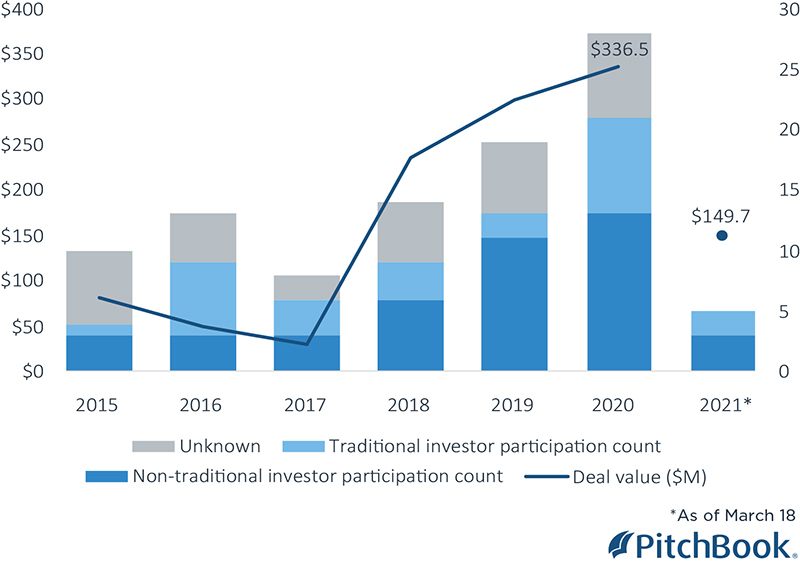
VC-backed carbon capture startups took in $336.5 million last year to set a modest record, according to PitchBook data. Much of that investment was driven by non-traditional investors—oil companies, governments and others—who participated in nearly two-thirds of all deals.

Carbon capture VC deals, global


Investors have plenty of reasons to be skeptical. Carbon-capture projects often involve immense capital investment, political uncertainty and vastly longer time horizons than typical startup efforts. And storing CO2 underground in and of itself isn't a business; it relies on subsidies or a carbon market with sufficiently high prices to function.

"You can capture the carbon, but then what do you do with it?" said Andrew Chung, founder and managing partner of 1955 Capital, a VC firm that invests in sustainable technologies. "You want to be able to reuse it."

Carbon Engineering and Climeworks are among the most prominent companies to attempt direct-air carbon capture at scale. The approach pulls in air using massive fans, sends it through a liquid or solid filter to remove the CO2, and typically stores the gas permanently underground. 

Direct-air capture could effectively allow humanity to turn back the clock on past emissions, and it has gained traction with corporations and governments in recent years. Shopify recently became one of the largest corporate buyers of the technology in a deal with Carbon Engineering to capture and store 10,000 metric tons of CO2.

But such direct-air carbon capture systems remain far more expensive than natural solutions like planting trees....

....MUCH MORE

*If you are new to this stuff here's Baumol with a pretty good introduction. 

Then economists being economists, with seemingly unlimited time on their hands, began picking at and prodding, pinching and posing and finally making the entire conversation all about economists (as is their wont).

Thursday, October 9, 2025

"Scientists seek to turbocharge a natural process that cools the Earth"

A topic near and dear.

From the Washington Post, October 8:

Terradot, a carbon removal company, is using “enhanced rock weathering” to sequester carbon by spreading crushed volcanic rock over farmland. 

STATE OF SÃO PAULO, Brazil — Across vast stretches of farmland in southern Brazil, researchers at a carbon removal company are attempting to accelerate a natural process that normally unfolds over thousands or millions of years.

The company, Terradot, is spreading tons of volcanic rock crushed into a fine dust over land where soybeans, sugar cane and other crops are grown. As rain percolates through the soil, chemical reactions pull carbon from the air and convert it into bicarbonate ions that eventually wash into the ocean, where the carbon remains stored.

The technique, known as “enhanced rock weathering,” is emerging as a promising approach to lock away carbon on a massive scale. Some researchers estimate the method has the potential to sequester billions of tons of carbon, helping slow global climate trends. Other major projects are underway across the globe and have collectively raised over a quarter-billion dollars.

As governments around the world fall woefully short of their emissions reduction targets, there is a growing consensus that large-scale carbon removal will be necessary to avoid some of the worst effects of climate change. An analysis conducted by an international team of researchers estimated that the world may need to remove up to 10 gigatons of carbon dioxide a year by 2050 to limit warming to 1.5 degrees Celsius — an amount greater than the annual greenhouse gas emissions of the United States.

Shawn Benner, a hydrogeologist and geochemist who left Boise State University after more than two decades to join Terradot, said he made the decision by asking himself what his grandchildren would want him to do. “Not too many people have the opportunity to change the temperature of the planet,” he said.

Yet significant challenges remain for enhanced rock weathering to meaningfully contribute to reducing global emissions. A key question is whether companies like Terradot can accurately and cost-effectively measure how much carbon they remove. And scaling the process globally poses major logistical hurdles.

“It’s at an exciting juncture,” said David Beerling, director of the University of Sheffield’s Leverhulme Center for Climate Change Mitigation. “But there’s a need for caution in ensuring that we have rigorous, cost-effective [tracking and verification] so that people don’t make claims for carbon credits that aren’t substantiated.”

Geologic to human timescales

Terradot was founded in 2022 at Stanford, growing out of an independent study between James Kanoff, an undergraduate seeking large-scale carbon removal solutions, and Scott Fendorf, an Earth science professor. Terradot ran a pilot project across 250 hectares in Mexico and began operations in Brazil in late 2023.

Since then, the company has spread about 100,000 tons of rock over 4,500 hectares. It has signed contracts to remove about 300,000 tons of carbon dioxide and is backed by a who’s who of Silicon Valley. It expects to deliver its first carbon removal credit — representing one metric ton of verified carbon dioxide removed — by the end of this year and then scale up from there.

Rock weathering is well-studied by scientists. The process acts like a global thermostat. When temperatures are higher, weathering speeds up, pulling carbon dioxide from the atmosphere and helping cool the planet.

Terradot is working to accelerate this process, bringing it from a geological timescale to a human one. It does so by taking basalt, a rock that weathers easily, and grinding it to the texture of baby powder to increase its surface area. The rock is then placed in regions with hot, humid climates for rapid weathering.

Brazil offers an additional benefit: widespread agriculture and plenty of quarries....

....MUCH MORE 

Back in 2011 we posted "How They Harvest Soybeans in Brazil" which gives some idea of the scale the Brazilians work on:

Northern Brazil:
http://farmlandgrab.org/uploads/images/photos/1596/original_image-255493-galleryV9-qtao.jpg?1314891432

Western Brazil:


More Mato Grosso:
Here the corn planters are following immediately behind the combines.
This is no till farming on steroids.

And on rock weathering: 

June 2025 - Removing Carbon Dioxide From The Air: "A Review of Massively Scalable Enhanced Rock Weathering"

I wanted this on the blog as a personal bookmark, he goes deep.... 

...Previously:

November 7, 2007 - Engineered weathering process could mitigate global warming

May 9, 2025 - "XPRIZE Makes History, Awards $100M Prize for Groundbreaking Carbon Removal Solutions"

It's not enough just to capture the carbon, to prevent re-release you have to sequester it.
And do so in an affordable way. The rock weathering approach addresses both of those goals.
The next step will be to speed things up.

Some background from January 2021:

"Elon Musk to offer $100 million prize for 'best' carbon capture tech" 

Carbon capture is an approach the Norwegians among others are exploring but it is not easy. Because the concentrations of CO2 in air are so low, ~415 parts per million, you have to move a lot of air through your systems to get meaningful amounts of CO2 to sequester.

The other reasons are ideological. A lot of folks in the authoritarian crowd don't like it because it means that things don't have to change as much as they would like things to change. Wealth transferers don't like carbon capture because it directly attacks their rationalization for "climate reparations", always set with a starting point far enough back in time so that only Northern Hemisphere and in particular, western, countries owe x-number of trillions of dollars to southern and eastern countries. And then there are the....

Yeah, I've been doing this a long time.

Putting all that aside, prizes are good, a very efficient way to mobilize talent and creativity in a focused pursuit. I may even see if I can recruit a team of folks smarter than I to claim Elon's money....

There are a lot posts in between those two bookends. One from June 2024 reiterates the key question to ask about any policy proposal:

Oxford Uni.: "The outlook for CO2 removal"

It is still far too expensive to be more than just demonstration projects, now and for another decade minimum.

And as with all such conversations the promoters never, ever, speak of degrees of warming avoided. If interested see after the jump.

From Dialogue Earth, June 10:

More clarity needed on CO2 removal in national climate action plans, finds Oxford University report

A nascent industry removing carbon from the atmosphere and storing it in trees, rocks and the ocean will need to quadruple in size by 2050 if the world is to keep temperature rise to within the internationally agreed threshold of 1.5C, a new report has found.

“Carbon dioxide removal” is defined by the UN’s climate science body, the IPCC (Intergovernmental Panel on Climate Change), as human activity that captures CO2 from the atmosphere and stores it for decades to millennia in geological, land or ocean reservoirs, or in products.

Around two billion tonnes of carbon are currently removed in this way each year, mostly using conventional methods such as afforestation and reforestation, wetland restoration and soil improvement.

However, an industry in more novel techniques has seen rapid growth in recent years. Such methods include: storing carbon in products like construction materials or “biochar”, a carbon-rich material produced by heating biomass in an oxygen-limited environment; enhanced rock weathering, which involves spreading finely ground silicate rock onto surfaces to speed up chemical reactions between rocks, water, and air; and direct air carbon capture and storage (DACCS), where carbon is separated from the air using chemical processes and deposited underground.

Last month, the world’s largest commercial DACCS plant, dubbed Mammoth, began operating in Iceland. It will draw down 36,000 tonnes of CO2 from the air every year and store it permanently underground, says the company behind it, Climeworks. The company is planning to build “multiple megaton hubs” in the US, meaning several facilities that can remove a million or more tonnes of CO2 per year.

Today such novel methods remove just 1.3 million tonnes of carbon a year, less than 0.1% of total carbon removals, with conventional methods responsible for the remaining 99.9%, the analysis found. But the researchers behind the report are optimistic that both novel and conventional methods can be scaled up to reach the estimated required level of 7-9 billion tonnes of CO2 per year by 2050.

Taken together, the carbon removal capacity proposed by companies globally would be sufficient to reach this, the authors found. However, they did not assess the likelihood of individual plans or announcements coming to fruition.

Diverse methods
The report, which was led by academics at the University of Oxford’s Smith School of Enterprise and the Environment, but also involved more than 50 international experts, stresses that politicians, policymakers and business leaders should still be focussing on reducing emissions as the primary way to achieve net zero.

But they argue that carbon dioxide removal (CDR) will also be needed to address climate change. CDR is advocated by the IPCC, which cites its potential to reduce emissions in the near term, to counterbalance unavoidable emissions in the medium term, and to achieve net-negative emissions in the longer term....

....MUCH MORE

From the outro of "Reminder of A Reminder of What Net Zero Means":  

As always, the correct question to ask of each and every policy is how many degrees C will this proposal reduce the temperature. You don't want the airy-fairy answer in tons of CO₂ or number of automobile-equivalents, you want degrees.

The reason for this is: you have to do comparisons to judge the effectiveness of policy proposals and to do that you have to use the the tools of science (maths).

As we've said over the years - this version is from 2019 but there are many others:

In the last years of the last century there was an international agreement on global warming policy called the Kyoto Protocol. It was a pretty big deal.

It was going to be expensive for the developed economies but worth it.
You heard of it right? It was in all the papers.

And do you recall how much the Kyoto Protocol would cool the planet?
Of course not.

The U.N. and the NGO's and Enron* and the consultants and everybody involved elided right past that number.
The answer was (no, not 42), the answer to the question of how much would the Kyoto Protocol cool the earth was 0.07 degrees. But that's 0.07°C, which is more cooling than if it had been 0.07°F.
The answer was not from me, it's the analysis of the U.S. National Center for Atmospheric Research....

****

*The first step is to get honest.
Like this guy, Enron's top lobbyist, John Palmisano, senior director for environmental policy and compliance who emailed from Kyoto:

If implemented [the Kyoto Protocol] will do more to promote Enron’s business than will almost any other regulatory initiative outside of restructuring of the [electricity] and natural gas industries in Europe and the United States…. The endorsement of emissions trading was another victory for us…. This agreement will be good for Enron stock!!
It was time to turn deeds into dollars, he added:
Enron now has excellent credentials with many ‘green’ interests including Greenpeace, WWF [World Wildlife Fund], NRDC [Natural Resources Defense Council], GermanWatch, The US Climate Action Network, the European Climate Action Network, Ozone Action, WRI [World Resources Institute], and Worldwatch [Institute],” reported Palmisano. “This position should be increasingly cultivated and capitalized on (monetized).
 As gentle reader has surmised, we've been following this stuff for a long, long time.
....This has helped form my personal belief that carbon trading is not going to lower world temperature by even a half-a-degree.

For example, in an October 1998 article in Nature, Martin Parry (Co-chair of the IPCC's Working Group II) said the effect of the Kyoto Protocol (and it's associated carbon trading, CDM etc. [articles 6,12 and 17 of the protocol]) would be a reduction of –0.05°C by the year 2050.
Tom Wigley of the National Center for Atmospheric Research estimated that Kyoto would result in a reduction from baseline of 0.06°C to 0.21°C . (under one Kyoto scenario 0.06 to 0.11°C, under another 0.11 to 0.21)....Here's the U.S. NCAR 2006 estimate of Kyoto's effects.