Thursday, June 2, 2011

First Solar Chartology: Mind the Gaps (FSLR)

The stock is up 83 cents at $120.54.
It still amazes me how many times a stock or commodity will fill the gap on a chart.
I've been at the market for my entire adult life, going back to the days of CycleCharts and other chart books [tell them about the quill pens -ed] and it is one of the basic tenets of technical analysis that still has a statistically meaningful result.

That said, when I was a pup there was an older analyst who would not buy into the 18-year bull market that started on August 12, 1982 at DJIA 776 because of a gap on the Dow's chart dating back to 1973 or '74 in the 590 area.

He died poor and crabby.

Here's the 15-minute five day chart for FSLR, We are of the opinion that the stock bottomed at $114 and change last week and is setting up to squeeze the shorts, the gap up on Tuesday being an indication of the large short interest (third largest among the S&P 500 components):

Here's the six month chart showing the gaps at the round numbers, 130 and 140:

Climatology: "Do farmers face repeat of 1983-style devastation?" (DBA; MOO; DE; POT)

From Agrimoney:

La Nina may be dead, but that doesn't mean an end to the unusual weather patterns which have dogged the world's growers.
The US may continue to witness extremes – rain to the north and drier and hotter weather to the south – this summer, with Europe potentially facing a "historic drought", David Tolleris at WxRisk.com says.
Some observers have made comparisons, for US weather, with 1983 when, as Kim Rugel at Benson Quinn Commodities says, "Mother Nature shut off the spigot in late June after a wet spring delayed planting".
"That is possible. It certainly looks like we have had a shift to a warmer and drier pattern for a lot of states," Mr Tolleris said, while saying he expected Midwest temperatures to prove -fortunately - relatively cool in July and August, after hotting up this month.
Bad year 
Farmers might hope for that mercy, given what a repeat of 1983 would mean.
That year was dire for US agriculture. Soybean output tumbled by one quarter, on yields which fell to a seven-year low of 26.2 bushels per acre.
Corn production near-halved, as wet weather prevented farmers sowing – plantings fell by 26% to 60,200 acres, is still the lowest on record – with yield on what was seeded tumbling 28% to 81.1 bushels per acre.
"The trouble was that root systems used to rain every other day did not develop fit for the dry spell that followed. They were too shallow," Mr Tolleris said, adding that this year's switch from wet conditions for much of the Corn Belt to dry was hardly ideal either.
"What you need is occasional moisture, and we are not getting that at the moment."
Cool pool 
The climatalogical culprit this time is an area of cold water off in the eastern Pacific, which is driving rain fronts into North America, from where they are being directed across the continent by a jet stream, a narrow belt of fast moving air some 10km up in the atmosphere....MORE
Long time readers may remember that, based on a search of the New York Times' archive to 1851, the preponderance of  incidences of the term "crop failure" occured during the cool phase of the Pacific Decadal Oscillation.
Here's the current Sea Surface Temperature Anomaly Map from Unisys: 

Current Sea Surface Temperature Anomaly Plot

Altucher, Dow 20,000 and Enlightenment

When I posted "James Altucher: "Next stop: Dow 20,000" (DIA)" I had two thoughts:
1) If he's talking any kind inflation adjusted return I would like to take the other side of that action.
2) Perhaps #1 is a rash judgement and guru Swami James has achieved a deep Prajñā by one means or another:

Benefits of Yoga and Drinking.
Research confirms that drinking gives you the same benefits yoga does!!!

Savasana
Position of total relaxation.


Balasana
Position that brings the sensation of peace and calm.


Setu Bandha Sarvangasana
This position calms the brain and heals tired legs.


Marjayasana
Position stimulates the midirift area and the spinal comumn.


...MORE

James Altucher: "Next stop: Dow 20,000" (DIA)

We'll have a comment in the next post.
From MarketWatch:

Commentary: 10 reasons why the market will soar
The market fell like a brick on Wednesday. People can’t handle any piece of bad news without saying “this is the big one.” We have visceral memories of May through July 2010, just a year ago. We have visceral memories of 2008, when it seemed like no end was in sight. Nobody wants to be caught trying to catch that knife with their mouths like in a circus act. You get cut up that way, and the blood isn’t pretty.
But it’s not going to happen. Even God took one day to rest. The market every now and then needs a day or two to rest. Maybe even more than a day or two. But over the next 12 to 18 months I expect to see Dow 20,000 DJIA -2.22%  .
Here are some reasons: 

1) QE2 has not started. WHAT? You might say? I thought not only has it started last November, it’s about to end? Not true at all. Federal stimulus takes 6 to 18 months before even one dollar hits the U.S. economy in a meaningful way. So expect that $600 billion or more to start hitting toward the end of 2011. 

2) Then why is the market going up? One major reason is because we are in the third administration of George W. Bush. The tax cuts got extended. This signaled that Barack Obama was going to pay lip service to his constituents while still keeping an eye on the stock market. The guy wants to get re-elected, after all.
3) Multiplier effect. Once the stimulus hits the economy, it’s not just $600 billion. It’s probably more like $3 trillion. How come? Because when you buy that coffee with $1 at the local deli, what does that deli guy do with it? He buys a newspaper? And then that guy buys a donut. The multiplier effect is up to 10X. To be honest, I’m more worried about a bubble in 2013 then I am worried about a economic slowdown....MORE

Wednesday, June 1, 2011

I love the Short Side but This Could Get Concerning

It appears that the herd has gotten spooked.
DJIA down 274, S&P 500 down 29.

From our February 2, 2011 post "Nomura's Bob Janjuah: QE2 Has Run It's Course, "Time to Fade Jackson Hole"':
Wile E. Coyote & the Roadrunner
I think he's early on the call.
The Fed's open market purchases of treasuries are scheduled to run through June and equity market participants are fully aware that they are playing a game of Chicken with each other. The problem the punters face is the miserable returns offered elsewhere, a half-point picked up in a Netflix scalp can equal the interest earned on T-bills in 100 days. So they stay at the market.

It is going to take one of those collective Wile E Coyote moments:

Wile E realizes there is nothing supporting him a nanosecond before gravity reasserts itself. We aren't at the mass realization stage yet. As I said yesterday, "When the music stops try to grab a chair, this is a dangerous little game we're all playing.". 
We all know it, we've been babbling about it since August.
Last month in "How Dysfunctional Is This Market? (SPY; XLF)":
Everyone knows this market is rigged. The general feeling is that when it tanks "I" will be sharp enough to recognize it....
Well, with the ADP jobs numbers this morning and the Moody's downgrade of Greece, described by the Wall Street Journal's Mark Gongloff:
...Eh, there’s no point in even being sarcastic about it any more. Moody’s has downgraded Greece today to Caa1 from B1, which is essentially downgrading a corpse from dead to really, truly dead....
The markets have been in pretty much straight-line decline since the open.
Wile E. may have just realized that General Motors has stuck their dealers with 574,000 cars that they've counted as "sales" and that Joe Biden isn't as smart as we thought. QE2 is ending and Jesus didn't return last month.
Alles ist kaput.

In September-November 2008 I was sleeping in the office at least a couple nights per week and the markets were moving 7 to 11% on the wildest days. The volatility index was setting new all time highs and it was exhilarating. Look at these point moves, the largest in the history of the DJIA:

Rank↓         Date↓     Close↓ Net Change↓  % Change↓
1 2008-10-13 9,387.61 +936.42 +11.08
2 2008-10-28 9,065.12 +889.35 +10.88
3 2008-11-13 8,835.25 +552.59 +6.

And on the downside:

1 2008-09-29 10,365.45 −777.68 −6.98
2 2008-10-15 8,577.91 −733.08 −7.87
4 2008-12-01 8,149.09 −679.95 −7.70
5 2008-10-09 8,579.19 −678.91 −7.33

Today I'm just tired

North Korean analyst: We'll be the next Asian tiger by 2012

From Foreign Policy's Passport blog:
North Korean scholar and unofficial Kim Jong Il spokesman Kim Myong Chol writes in the Asia Times on the glorious success of Dear Leader's visit to China and throws in a mighty bold prediction:  
A closer bond of friendship and solidarity that bands together two nuclear weapons states goes a long way to keeping the peace in East Asia. The enhanced ties coincide with two major developments in the global balance of power.

One is an International Monetary Fund forecast that China will become the world's number one economy in 2016, downgrading the war-weary and reluctant US into a humiliating second place. Leaderless Japan finds itself reeling from the poorly managed nuclear power disaster, while South Korea's President Lee Myung-bak and his administration are shivering in their shoes at disquieting signs of their lame-duck syndrome given their successive election defeats at the hands of disgruntled South Korean voters.

The other is a growing strong likelihood that a 2006 Citigroup prediction of North Korea becoming the next Asian tiger will come true in 2012....MORE
See also:
Kim Jong-Il and the Carbon Markets
"North Korea offers to pay its debts in ginseng"
Totally off-topic: Kentucky Fried North Korea
North Korea endorses IPCC, goes Solar
North Korean Soccer Coach Sentenced to Manual Labor for Loss (FSLR)
And from kim jong-il looking at things:

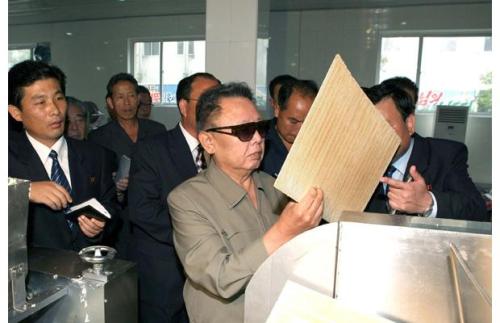
looking at plywood looking at plywood

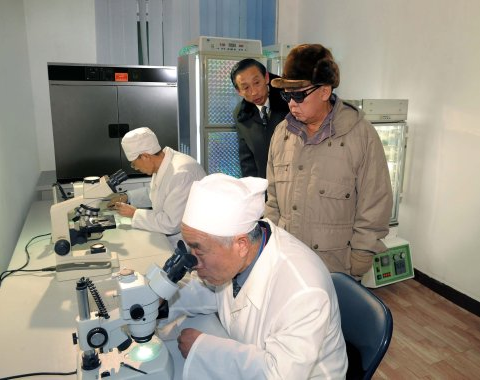
looking at microscopes looking at microscopes

General Electric’s Big bet on Natural Gas (GE)

In a 2009 post, "GE, Cleantech and Your Tax Dollars" I said:
Marc Gunther is pretty green and has been for as long as I can remember. He's also a good analytical thinker.
Although he doesn't mention it, I find it astounding that GE's CEO Jeff Immelt is an advisor to President Obama at the same time his company has $51 Billion of a subsidiary's debt guaranteed by the FDIC.
Meet the new boss, same as the old boss....
At the time, and for a couple years prior, many writers in the alt/green/clean space became cheerleaders for the companies, regardless of the underlying economics. Mr Gunther avoided that trap and remains someone I'll link to. Add to that the fact that Marc was dubious of GE's pronouncements and strategy under Jeff Immelt and I thought "Hey, this guy is seeing the stuff without the rose colored glasses". Cool
Plus, I just can't picture him with pom-poms.

On the Immelt/GE B.S. I felt personally vindicated a few weeks ago: "GE's Immelt wishes he had soft-pedaled green talk" (GE).

Gunther has been much kinder toward Immelt than I've been. I don't recall him using the words corporatist, fascist or crony, or calling for the J-man's dismissal as I have done but on the other hand I couldn't get an interview with Immelt if I wanted one.

Here's Marc's latest, via AltEnergyStocks:
General Electric Co. (GE) is betting big on natural gas.

The $150-billion a year company, whose power plants generate about one-fourth of the world’s electricity, today announced a new natural-gas power plant that it says is more efficient and flexible than any other in the market.

By phone from Paris, where the announcement was made, Steve Bolze, president of GE Power & Water, told me:  “This is about transforming the industry over the next five or 10 years.”

GEEnergyLogoGE says it invested more than $500 million in the new plant development. It will be manufactured in France and sold first in Europe and Asia, and then later in the U.S.
One key selling point of the new plant is its unprecedented flexibility: It can ramp up and down rapidly, and thus be easily combined with wind and solar power plants that generate electricity intermittently.

It’s also efficient enough to work as a generator of baseload power, Bolze said. Here’s a GE webpage describing the plant and its operation.

The new GE plant—dubbed the FlexEfficiency 50–is rated at 510 megawatts and offers fuel efficiency greater than 61 percent.  Competing plants burn natural gas at efficiency rates of 57 or 58 percent, Bolze said. Each percentage point of improved efficiency saves a utility about $2 million a year, he said. Capital costs are projected to be CapitaCosts should be somewhere “north of $450 million.” he said....MORE
See also:
Siemens energy plan: Diversify (SI; GE)
What Does Big Solar Want? What Doesn't It Want?
GE’s Immelt: I thought wind was a “hula hoop”

Here's my intro for another of his posts with the appropriately skeptical view:
Beware of [President] Obama's 'Battery Gold Rush'
Please note that Marc Gunther is one of the 'greenest' writers out there. It is simply prudent to remind ourselves that investing in areas that are not self-sustaining is as much about politics as it is about balance sheet analysis. When you are backing rentseekers you have to stay attuned to the political winds or risk being blindsided by a policy change. This is why, since our second month, we have periodically quoted the first inductee into the prestigious Climateer Hall of Fame:
...Finally for investors in rent-seeking organizations there is the real risk that the politicians will change the rules. Heed the words of Sen. Simon Cameron (R&D!-Pa.):
"The honest politician is one who when he is bought, will stay bought."
Our Hero
Simon Cameron

And from 2007:
Clean energy will make Gore rich
A good follow-up piece from the co-author of the 3400 word(!) Fortune exclusive on Mr. Gore and Kleiner Perkins:
Al Gore's next act: Planet-saving VC

Wind farms: Britain is 'running out of wind'

The hell you say.
From the Telegraph:

Despite the freak gales that battered parts of the country last week, climate experts are warning that many of Britain’s wind farms may soon run out of puff. 
Wind farms: Britain is 'running out of wind'
Statistics suggest that the winds that sweep across the British Isles may be 
weakening Photo: ALAMY

According to government figures, 13 of the past 16 months have been calmer than normal - while 2010 was the “stillest” year of the past decade.
Meteorologists believe that changes to the Atlantic jet stream could alter the pattern of winds over the next 40 years and leave much of the nation’s growing army of power-generating turbines becalmed.
The Coalition has drawn up plans to open more wind farms in an effort to meet Britain’s European Union target of providing 15 per cent of its energy from renewable sources by 2020.More than 3,600 turbines are expected to be installed in offshore wind farms over the next nine years.
But statistics suggest that the winds that sweep across the British Isles may be weakening. Last year, wind speeds over the UK averaged 7.8 knots (8.9mph), a fall of 20 per cent on 2008, and well below the mean for this century, which stands at 9.1 knots (10.5mph).
Usually Britain has warm, wet and windy winters, thanks to Caribbean air carried here by the Atlantic jet stream, a fast-flowing current of air.

But the last two winters have featured exceptionally low temperatures and were remarkably still when they should have been the windiest seasons of all, as high pressure diverted the jet stream from its normal position.
Meteorologists have found that the position of the jet stream has been influenced by the lower levels of activity on the Sun. This decline in sun-spot activity is expected to continue for the next 40 years, with potentially serious consequences for the viability of wind farms....MORE
If the lower levels of sunspots should lead to the "Little Ice Age"temperatures experienced during the Maunder minimum, 1645-1715, what with the Thames freezing over and all, it would be a rotten time to have the power go out.

The calm before the (volatility) storm (VIX; VXX; XIV)

Nice catch at FT Alphaville:
We ♥ this note from Bank of America Merrill Lynch’s Ruslan Bikbov and Priya Misra.
It’s on a subject dear to our own hearts here on FT Alphaville — the curious case of persistently low volatility and the idea that it might be masking systemic risk. It also weaves together a plethora of other themes — massive short volatility positions, search for yield, correlation, LTCM – we’ve touched on.
So sit back, think of stubbornly low volatility measures like the Vix, and read on:
The Chart of the Day shows that our measure of average cross-asset correlation has notably increased. This measure is a weighted-average correlation of the 10y US swap rate with the S&P 500, oil and DXY dollar index. The rise in correlations is evident in almost all individual cross-asset pairs. For example, the three-month correlation between 10y and S&P increased to 64% (1.7 standard deviation above its historical mean). In the Chart of the Day, a positive value corresponds to a risk-on/ risk-off trading environment. Days when rates increase tend to coincide with the rallies in risky assets and weaker US dollar, while days when rates decline tend to go along with sell-offs in risky assets and dollar strengthening.
It is very unusual, however, to see high levels of cross-asset correlation together with declining volatility.
...MORE

Soros Fund Management's Largest Position Was up 7.68% Yesterday (AGRO; CRESY; MOO; DBA)

Each quarter there is a great wastage of electrons when hedge funds file their 13F position statements.
It's a waste because half the sites linking to the reports don't understand what the SEC requires and the various ways the funds can reduce transparancy.

I'll leave that discussion to another post. Another problem is that most of the commenters are clueless when it comes to connecting investments listed in the reports to major economic and financial trends. When Soros Fund Management LLC released their positions a couple weeks ago most of the commentariat glommed onto the funds drastic reduction in the SPDR gold trust. There were maybe two dozen comments that pointed out the new names in the portfolio. There were a handful who made the connection between SFM's new largest position and the current commodity megatrend.

Back on April Fools Day we posted: "Farmland: "Investors pump $400m into Ukraine farming groups"; Soros-Backed Adecoagro Trades solidly Above IPO Price Despite Loss (AGRO)" as part of our almost obsessive attraction to farmland as an investment (links below).

Here's SFM's March 31, 2011 13F. At the bottom of the page we find Adecoagro, 27,158,693 shares worth $366,099,000. That is the fund's largest position, the second biggest being $302 mil. worth of InterOil (use the blog search box, symbol IOC, we have quite a few posts) and the SPDR S&P 500 ETF worth $278 mil.

It was also a new position.
Mr. Soros' has had an interest in Adecoagro through other entities for some time but for SFM it was brand new.
You'd think that Soros buying farmland as his largest position would have made headlines around the world.
It didn't.

One writer who did understand, Frank Byrt at TheStreet, put this story together:
5 Stocks to Bet on Farming, Like Soros Does
Billionaire investor George Soros has gone from gold bug to gaucho, as his hedge fund took a 23% stake in a South American farming conglomerate after dumping most gold holdings in the first quarter.

Soros' move underscores a growing trend among investors who are cutting back on gold and shifting into assets that can produce saleable products, such as farmland, and hence serve as an inflation hedge as well as a bet on the value of the land.
South America is the geographic hotspot for many of these companies due to its favorable growing climate, dearth of natural disasters, the availability of farmland and a minimal number of government restrictions on its ownership by foreigners.

And many companies there grow can grow sugar and corn which then have multiple uses for them depending on market conditions, either as human food, animal feed or to be converted into bio-fuels.

Other hedge funds recently joining Soros down on the farm are the $18.7 billion Van Eck Associates fund, which is the largest investor in Brasil Foods(BRFS), with a 1% stake, and D.E. Shaw & Co., which is the largest shareholder of Argentine farm conglomerate Cresud(CRESY) at just under 9% of its shares, according to Securities and Exchange Commission 13-F filings.

Renatto Barbieri, chief investment officer at Galtere Ltd., a New York-based private-equity firm that, among its many investments, runs a $1 billion agribusiness fund, said in an interview that "there is a global trend to be invested in, what we would call 'real assets,' and tangible assets in agriculture is very much a part of that basket."

He said that's being driven by concerns over "climate change, food (supply) security and the health of the financial system....MORE
I'll come back to AGRO later this week. In the meantime here are some of the stories we thought were signposts along the way:

2007
Ethanol Is Feeding Hot Market for Farmland

2008
Farmland value boom continues
The hedge fund manager who bought a farm
Hedge Funds Buying Farmland
England's green and pricey land
Did Hedge Funds Signal the Top in Farm Income?
Californians to pay $600 mln for green think tank. And Farm visits can ease mental illness

As I said, more to come on  AGRO.
And more of our earlier posts on farmland investments.
Or you can copy and paste " site:climateerinvest.blogspot.com climateer farmland" as a search term.

Tuesday, May 31, 2011

Things that Make You Say Hmmm..."India faces problem of plentiful food"

From the Economic Times:

Is there food shortage in India? Bet you will say yes. After being rammed by inflation, it's natural. But not true. India has no food shortage. On the contrary, we are now faced with the huge problem of plenty.

There is a bumper wheat and rice crop. In Andhra Pradesh, India's rice bowl, production is up 30%. Millers are offering only Rs 8 for a kilo of paddy though the MSP is Rs 10.30. Angry farmers last week threw paddy into the Krishna river. The state government has borrowed Rs 550 crore from RBI for procurement. The FCI can do little. After buying 50 million tonne wheat and rice this season, added to 44 million tonnes left from last year, it is exhausted.

The oilseed crop is 20% larger. Import of palm oil from Malaysia and Indonesia is down for the sixth straight month till April, a three-year low. Sugar output is up 28%. Even exports can't prod the bulls into action....MORE
India's National Commodity and Derivatives Exchange (NCDEX) has an ag futures index called “Dhaanya”.
“Dhaanya” means "Bountiful Harvest" in Sanskrit.
Hmmm...

Value Investing's Long Run

The folks at Ben Graham's alma mater (and where he hung his hat ) may know something about the subject.
From Columbia's Ideas@Work blog:

What the gradual turn away from modern portfolio theory holds for value investing. 
The finance discipline is in the process of a halting transition. The efficient markets/modern portfolio theory is giving way to broader perspectives that incorporate the realities of information asymmetry — the fact that all market participants do not have the same access to relevant information — and deeply ingrained behavioral biases that often dominate actual financial market outcomes. At the leading business schools these latter approaches are now firmly established even though in the finance profession at large they remain relatively unfamiliar.

One particular aspect of this change is the increasing importance of value investing, an approach to investment management pioneered by Benjamin Graham and David Dodd ’21 at Columbia. In part, this is due to the overwhelming success of the value approach in practice. Individual value investors like Warren Buffett and value-oriented institutions like Sanford Bernstein populate the ranks of outstanding investors out of all proportion to their numbers. However, it is also due to a detailed appreciation of the way value investing differs from more conventional approaches, how this is responsible for the historical success of value investors, and why it is likely to continue in the future.

Traditional characterizations of value investing have been overly simplistic. Value investing involves buying securities at one-third or greater discounts to their “true” values, effectively buying dollar bills for fifty cents. More recently we have begun to appreciate how a value approach is distinct in the particular areas of searching for investment opportunities and valuing companies.

In search, the value strategy is to look in areas that are obscure, boring, unattractive, and therefore cheap by common metrics like low market-to-book and PE ratios. Simple statistically constructed portfolios of such stocks produce above average returns in cross-sections of securities over all extended time periods in all global markets. (My colleague Tano Santos shows this in his take on the question.) In time-series, there are reliably predictive levels of positive serial correlation in short-term returns. Neither phenomenon should be observed if markets were perfectly efficient. (Attempts have been made to associate the higher cross-sectional returns of “cheap” stocks with higher levels of risk, but these risk factors never turn out to be empirically measurable independent of cheapness.)...MORE
HT: Simoleon Sense

For some reason I keep thinking I should have drunk more champers.
[his is a hopeless case. He sees the headline, cross-wires to the famous Keynes quote, barrels along to the last words attributed to J.M.K and wonders 'Where was I?' -ed]

Also at Ideas@Work:
Untangling Skill and Luck

Climateer Quote of the Day

 
12.60 +0.90 (7.68%)

We'll have the story tomorrow morning.

German Nuclear Decision: Phase One of First Solar Short Squeeze (FSLR; GS)

Following up on last Thursday's "First Solar: Short Squeeze Being Set Up (FSLR)", at the time I wrote the post the stock was "In light pre-market action the stock is down 7 cents at $120.55."
FSLR traded down to $114.40 that day before closing at $117.96, down $2.66 on the day but up $3.56 from the Chanos inspired bottom.

The next day the stock was up $3.41 to close at $121.37.

Today, in a burst of enthusiasm (and short covering) the stock hit $128.95 up $14.55 from the Thursday intermediate-term bottom. It is currently changing hands at $124.75, up 3.38 on the day.
Here's the nuke story from Reuters:

U.S.-listed solar stocks rally after German nuke decision
* JA Solar, LDK rise more than 8 pct
* First Solar, Suntech climb more than 4 pct
May 31 (Reuters) - Shares of U.S.-listed solar companies jumped in early Tuesday trade after news that Germany, the world's leading solar market, would shut down its nuclear reactors by 2022.
American Depositary Receipts of China-based JA Solar Holdings (JASO.O) led the gains, climbing 8.8 percent to $6.15, followed by LDK Solar Co (LDK.N), up 8.7 percent to 7.63, and Yingli Green Energy (YGE.N), up 6.3 percent to $9.29....MORE

The next phase should be further accumulation followed by Goldman Sachs' reiterating their "Conviction Buy" call.
If you missed it, be sure to read all of Friday's "Analyst Smackdown: Are the Bears Right on First Solar? (FSLR)"

Heinrich Campendonk in the News: "German Art Forgery Scandal Reaches Hollywood"

From Der Spiegel:
Steve Martin Swindled 
German Art Forgery Scandal Reaches Hollywood
The Heinrich Campendonk painting "Landscape With Horses" is believed to be a forgery.
Zoom
The Heinrich Campendonk painting "Landscape With Horses" is believed to be a forgery.
The scope of what is believed to be Germany's biggest art forgery scandal since World War II has reached as far as Hollywood. American actor Steve Martin bought one of the fake paintings in 2004 and later sold it at a loss of some 200,000 euros.

German police believe that American actor, comedian and collector Steve Martin played a minor role as a victim in what may be Germany's biggest-ever art forgery scandal. According to investigators at Berlin's state criminal police office (LKA), the art lover purchased what he believed to be a 1915 work by the German-Dutch modernist painter Heinrich Campendonk. He bought the colorful "Landschaft mit Pferden," or "Landscape With Horses," from the Paris gallery Cazeau-Béraudière for what would have been considered the bargain price of an estimated €700,000 (around $850,000 at the time) in July 2004....MORE
 Mr. Martin was tired of the old "Would you like to see my Campendonk" schtick anyway.

President Obama Approves of Natural Gas Fracking (CVX; XOM; UNG)

in Poland.
From Bloomberg, May 28:
Obama Says U.S., Poland Will Cooperate on Economy, Energy
...Obama said he had an “extensive” discussion with Polish leaders about Poland’s shale gas reserves and that the U.S. would share its technology on energy extraction.

“We are also aiming to expand our bilateral economic relationship with Poland,” Obama said. “Poland’s economy was the only economy in the EU not to fall into recession during the economic crisis and has enormous potential for economic growth.”

Obama returns home today after a six-day European trip and will hit the road again tomorrow to visit the town of Joplin, Missouri, where tornadoes killed at least 116 people last week. He’ll also be occupied by negotiations, led by Vice President Joe Biden, with congressional Republicans to trim cumulative budget deficits and raise the nation’s $14.3 trillion debt limit before an Aug. 2 deadline.

Energy Development

Obama and Tusk pledged cooperation on energy development, including tapping Poland’s shale gas reserves and expanding nuclear power.

“This is a moment of breakthrough,” Tusk said at the news conference with Obama. “We’re talking about cooperation and investments between two partners of whom one is a leader regarding technology, and the other has turned out to be a leader in terms of resources.”...MORE

Zeitgeist: Russia, Japan and Canada Will Not Rejoin Kyoto Protocol in 2012

China, of course, remains willing to run their HFC-23 scam* on anyone foolish enough to give them the money.
From the Sydney Morning Herald:
 Russia, Japan and Canada told the G8 they would not join a second round of carbon cuts under the Kyoto Protocol at United Nations talks this year and the US reiterated it would remain outside the treaty, European diplomats have said.

The future of the Kyoto Protocol has become central to efforts to negotiate reductions of carbon emissions under the UN's Framework Convention on Climate Change, whose annual meeting will take place in Durban, South Africa, from November 28 to December 9.

Developed countries signed the Kyoto Protocol in 1997. They agreed to legally binding commitments on curbing greenhouse gas emissions blamed for global warming....MORE
*September 2007:
China's Kyoto Scam = $Billions

Friday, May 27, 2011

Memorial Day, 2011

bald eagle american flag 

America the Beautiful has been called the country's second National Anthem.
In this version Mr. Charles begins with the third verse:

O beautiful, for heroes proved
In liberating strife,
Who more than self their country loved
And mercy more than life!
America! America! May God thy gold refine,
‘Til all success be nobleness, and ev’ry gain divine!


Here's JibJab's take on The National Anthem:

Personalize funny videos and birthday eCards at JibJab!

Have a safe and wonderful holiday.
I'm going long hot dogs and hamburgers.

Real Estate: "Charlie Sheen Lists Warlock Lair"

From The Real Estalker:

SELLER: Charlie Sheen
LOCATION: Los Angeles, CA
PRICE: $7,200,000
SIZE: 7,924 square feet, 5 bedrooms, 7 bathrooms

YOUR MAMAS NOTES: Buckle up babies because we're about to take a short ride on the Charlie Sheen crazy train.

Last month the unhinged and newly unemployed actor paid $6,999,999 for a 9,020 square foot mansion with 6 bedrooms and 9 bathrooms. The house, oft reported to be where Mister Sheen planned to keep a harem of hoochies, sits right around the corner from his long-time crib in the guard-gated Mulholland Estates community high in the hills above and between Beverly Hills and Sherman Oaks, CA....MORE

Direxion Unveils +/- 3x Versions of Market Vectors Agribusiness ETF (MOO; COWL; COWS)

All you have to do is be right (or short both sides).
From Benzinga:
Direxion rolled out four new ETFs yesterday (5/25/11) providing +3x and -3x leveraged exposure to existing ETF offerings from Van Eck Market Vectors.  This is not the first time Direxion has taken this path, having added leverage to the Market Vectors Gold Miners ETF (GDX) last December.

Direxion Daily Agribusiness Bull 3x Shares (COWL) and Direxion Daily Agribusiness Bear 3x Shares (COWS) track the same DAXglobal Agribusiness Index as the unleveraged Market Vectors Agribusiness ETF (MOO) (MOO overview).  COWL provides +300% the daily return while COWS provides -300% (three times the inverse) the daily return.  The new ETFs hold swaps on the performance of MOO and have their expense ratios capped at 0.95%.

The underlying index has current sector exposures of Materials 48.0%, Consumer Staples 35.0%, and Industrials 17.0%.  Country weightings include U.S. 47.9%, Singapore 10.5%, Canada 10.0%, Switzerland 7.5%, and Germany 4.4%.  The COWL/COWS combined fact sheet (pdf) provides additional background on the funds, while the COWL overview and COWS overview contain links to other material....MORE
On the joys of shorting ETF pairs:

April '09 
Direxion 3x Financial ETFs Go Certifiably Crazy (FAS; FAZ etc.)
...One approach is to short both of them, in effect writing an option. Ooops, have I said too much?

June '09 
FAS and FAZ: A Short Seller's Dream?

Sept. '09 
Shorting Leveraged ETF Pairs (FAS, FAZ: SPXU, UPRO)

Oct. 2010 
UPDATED: "Shorting Leveraged ETF Pairs (FAS, FAZ: SPXU, UPRO)"
...Here are the results of the strategy since that first post, via BigCharts:


Cool huh? One short goes against you 60% while the other goes in your favor 90%. 
If only they had 6X leveraged ETF's! You'd get 4% per month (approximate, it depends on the implied volatility of the options) on a mirror image pair trade as the rebalancing scrapes off the time premium of the options in the ETF....
Feb. 2011 
"Shorting Leveraged ETF Pairs" (FAS; FAZ; QLD; QID)