Thursday, January 4, 2018

It's National Trivia Day in the U.S.!

Which I learned from the Oxford University Press blog:

National Trivia Day [quiz]
Each year, National Trivia Day is observed across the United States on 4 January. To celebrate, we cracked open books from our What Everyone Needs to Know series and pulled some facts. From facts about advertising to tidbits about the human brain, put your knowledge and trivia skills to the test by taking our quiz below!
...MUCH MUCH MORE

Monster Lizard Ravages East Coast

Les Nessman with the report:

Global Fleet Capacity to Bulge as More Containerships are Delivered in 2018; Baltic Dry Index Down 21%, Hyundi Heavy Up

I'm going to have to learn how to say "Boom-and-bust cycle" in Korean.

First up, from The Loadstar via gCaptain:

http://3kbo302xo3lg2i1rj8450xje.wpengine.netdna-cdn.com/wp-content/uploads/2013/02/31911_461817640540294_298965992_n.jpeg
There will be a 5.6% growth in container fleet capacity this year, according to scheduled newbuild deliveries of 1.49m teu and expected in scrapping of some 350,000 teu, says Alphaliner.

After 2017’s slight supply-demand rebalancing, the pent-up flood of newbuild deliveries this year will be a challenge for shipowners and container lines – especially if there is a dip in demand.
And notwithstanding a softening of demand and seasonal fluctuations, analysts cited higher oil prices and increased protectionism as additional threats to demand growth this year and next.

Alphaliner noted that orders placed in 2017 were up a massive 140% on the previous year, to 671,641 teu, and expected a “marginal increase” this year as ocean carriers renew their newbuild appetite and take advantage of discounts and incentives from embattled Asian shipyards.

Indeed, some of the smaller liner players, such as Hyundai Merchant Marine (HMM) and Yang Ming, have made no secret of their intentions to place new orders on the back of improved trading in 2017
In his new year message to HMM staff yesterday, chief executive and president CK Yoo restated the South Korean carrier’s aggressive growth aspirations, including plans to order ultra-large container vessels (ULCVs).

HMM would “continue to consider ways of doubling our vessel capacity by 2022 [from the current 347,000 teu] including the launching of mega containerships....MORE
From the Financial Times:

World’s largest shipbuilder surges 10% on sales outlook
Hyundai Heavy Industries surged as much as 10 per cent on Wednesday after the group announced its sales outlook for 2018. The world’s largest shipbuilder by sales said on Wednesday its sales outlook for this year was Won7.98tn ($7.5bn), compared to sales of about Won10tn in 2017....MORE
And from ZeroHedge: 

Baltic Dry Index Plunges Most In 2 Years (Despite Global Coordinated Growth)
The last six months have seen an almost unprecedented surge in world macro-economic data upside-beats as the so-called 'global coordinated growth' narrative surprised more dismal economists. Until recently, The Baltic Dry shipping index had confirmed that narrative...

But The Baltic Dry Index has dropped for 8 straight days, tumbling over 21% - the biggest drop since Jan 2015...
https://www.zerohedge.com/sites/default/files/inline-images/20180102_BDIY2.jpg

...MORE

Wednesday, January 3, 2018

"The Weaponization of Tedium Is Putin's New Strategy"

In contrast with the American approach to politics.
Today:
 Chelsea Clinton was accused of being a Satanist

The President's former campaign manager Steve Bannon was reported to have called the  actions of the President’s son “treasonous.”

One of the persons criminally charged by Special Counsel Robert Mueller is suing Special Counsel Robert Mueller
There was a fire at Bill and Hillary Clinton's New York home.

President Trump says his former campaign manager has lost his mind.

Chelsea Clinton denied she is a Satanist, tweeting: "Oh goodness gracious...I'm a Methodist"
But I digress. 
The headline story from BNE Intellinews via the Moscow Times, December 18:
 
His campaign platform will mix populism, paranoia and outright boredom
At the end of every year, Vladimir Putin stages a marathon press conference. Amidst the carefully-contrived zingers, the obsequious softball questions, and the barrage of tedious factoids, what usually emerges is a sense of the man’s current state of mind and his priorities for the future.

With the 2018 presidential election looming, it is clear that his approach will be a little populism, a measure of national paranoia — and a huge admixture of outright boredom. And it is probably the right strategy.

This year’s lasted three hours and 40 minutes, a full hour short of 2008’s record, but in all fairness it felt longer. Much was taken up with questions on such riveting topics as the legality of fitting cows with GPS trackers (Putin thought it ought to be OK) and the price of fish (Putin was on the fishermens’ side).

Even when given the chance to pitch his presidential election platform, Putin managed to be both evasive and general, offering a manifesto of “infrastructure, health, education and technology,” before adding that “this is not the right format to go into detail.” Who, after all, is against infrastructure, health, education and technology?

Asked about the continued absence of Alexei Navalny on the ballot, as ever Putin stepped into Harry Potter territory, treating the opposition leader as he-who-must-not-be-named and comparing him with Mikheil Saakashvili, the chief spoiler in Ukrainian politics.

However, what real passion Putin — who appeared detached, even bored for much of the event – could muster was about US policy and especially the exclusion of Russia from the forthcoming Winter Olympics, which he clearly considers an American plot...MUCH MORE

The $100 Billion Venture Capital Bomb: Softbank's Vision Fund

From Institutional Investor:

Softbank’s Masayoshi Son bets the Vision Fund — the biggest VC pool in history — on automation. 
In July 11, 2016, Ian Thornton picked up the phone for what he thought was a routine catch-up after a monthlong sabbatical. He had missed a rough couple of weeks in the U.K., including the country’s shock decision in a June 23 referendum to leave the European Union, sending the pound tumbling to a three-decade low against the dollar as investors struggled to comprehend the result. Chris Kennedy, then chief finance officer at computer processor designer Arm Holdings, was about to deliver even less likely news. Arm had a takeover bid.

“Who would want to buy us? Given where we sit in the industry, we thought it would be hard for anyone to acquire Arm,” Thornton says. Arm makes money licensing designs for processors, the “brains” of a computer chip, including the kind that runs 95 percent of the world’s smartphones. Arm has been called “the most successful British tech company you’ve never heard of.” It’s growing fast, and reaping profits of about 40 percent.

The bid came from SoftBank Group, a Japanese telecommunications company best known for turning a $20 million stake in Alibaba into $60 billion when the company went public in 2014.
Masayoshi Son, SoftBank’s founder, had flown to Turkish seaside resort Marmaris a week before Thornton’s fateful call and had met with Arm chairman Stuart Chambers. Son offered an unsolicited £24.3 billion ($32.4 billion) in cash for the company, or 70 times Arm’s 2015 net income. He had pulled out all the stops for what would become Softbank’s biggest acquisition yet — selling off a chunk of Alibaba and other valuable assets to amass $20 billion in ready money. Those close to the Arm deal are still stunned by its velocity.

“The whole thing was very fast,” Thornton says. “Masa wanted the deal done quickly — I think he was worried about someone pinching us away from under his nose. He said he had wanted to own Arm for many years, and the opportunity came in.”

Masayoshi Son — Masa to those who know him — famously thinks in decades, not years. At 19 he sat down and wrote his life plan, which stipulated that by 60, his current age, he would begin looking for a successor. (He now says that he’s not ready to take the backseat.) His vision for SoftBank extends 300 years into the future, far beyond Son’s natural life, the company claims in a slideshow outlining the next three decades.

SoftBank and Arm deny that Brexit influenced the sale. If that’s true, something else compelled Son to strike fast.

Son has one vision, outlined in countless interviews: the singularity, a moment when robots with IQs above 10,000 will outnumber humans. This will happen in the next 30 years, he predicts. He is assembling multiple $100 billion investment vehicles to capitalize on this moment through massive tech investments in the companies at the vanguard of his vision. Son launched the first — the Vision Fund — a month after SoftBank’s acquisition of Arm.

At $97 billion, the current Vision Fund is the largest corporate venture capital fund in history.
SoftBank itself has contributed $25 billion. It’s not the fund’s largest investor, but Son’s company is the largest owner. Saudi Arabia’s $45 billion stake includes $17 billion in equity, against which it has borrowed $28 billion. The debt is in the form of preferred units, which received an annual coupon of 7 percent across the fund’s 12-year cycle, with other investment returns apportioned against only the equity. The money comes from the Saudi Arabia Public Investment Fund, which has its own 2030 “vision realization program” and targets returns of between 4 and 5 percent.

Other backers include Apple, Qualcomm, and Sharp, convinced by Son’s reputation as a resolute deal maker and by SoftBank’s returns. Son must deploy $20 billion, or a fifth of the fund, every year for the next five years to meet investors’ terms and their expectations in a market that many already consider overvalued. The Vision Fund’s early investments — cash injections of more than $100 million into a seemingly random range of companies, from co-working-cum-real-estate-company WeWork to Internet satellite company OneWEB to sports retailer Fanatics — have made some wonder if it’s dumb money. Son has already been branded “a one-man bubble maker.”

But there is a method to the Vision Fund’s billion-dollar rainmaking. And it began with Arm....MUCH MORE

"Ice Cream Company Pivots, Eschews Blockchain Fad For Obvious Cannabis Cryogenic Play"

From DealBreaker:

These days, if you hear about a novelty food company pivoting its business model a bit, you immediately start to think Blockchain. But one Kentucky-based flash frozen beaded ice cream company is apparently charting yet a different course:
The nation’s leading flash frozen beaded ice cream company, Dippin’ Dots, today announces the launch of Dippin’ Dots Cryogenics, L.L.C. Leveraging its 30 years of experience and its intellectual property in cryogenic processes and machinery, Dippin’ Dots Cryogenics will make Dippin’ Dots’ patented technology and equipment available to other cutting-edge industries where cryogenics is applicable including nutraceutical, pharmacy, agriculture, aquaculture and animal feed.
Dippin’ Dots is gonna start freezing plants, because there will be huge upside margin in bespoke agricultural/holistic pharma solutions during 2018.

Hahaha, JK, you guys. Dippin’ Dots is obviously dipping a toe in the legalized cannabis industry! And while the company might want to deny it til the cows come home…and spurt out frozen dots, wejust want to point out that the truth is right there in the press release:...MORE

"Nissan Reveals It is Working on 'Brain-to-Vehicle' Technology"

Suddenly I'm not so proud of this morning's accomplishments.
From Inverse:
Ahead of CES in Las Vegas next week, automaker Nissan revealed what it’s been working on at its Atsugi, Japan-based research facility. A car that measures brain waves to help drivers steer their autonomous cars. Really.

In a wild video that hit the internet on Wednesday, Lucian Gheorghe, who’s a Nissan Senior Innovation Researcher, explains in broad terms how this nascent technology works.
“Our systems will be able to tell an autonomous vehicle, the driver will be steering in the next 300 milliseconds,” Gheorghe says. “Then we can use this window in time to enhance the execution synchronizing the support of the AV with your own actions.

”Nissan's brain-reading helmet.
So, in a third of a second, Nissan researchers claim they can measure brain activity that show you want to turn left — or slam the brakes — and the car can assist you in doing just that.

It’s the inverse approach to self-driving vehicle technology that uses AI to make decisions on when a car should turn left or hit the brakes. Nissan’s latest project seems be more about melding the car with the mind of the driver, instead of letting the car do 100 percent of the thinking.

“When most people think about autonomous driving, they have a very impersonal vision of the future, where humans relinquish control to the machines. Yet [brain-to-vehicle] technology does the opposite, by using signals from their own brain to make the drive even more exciting and enjoyable,” said Nissan Executive Vice President Daniele Schillaci in a statement. “Through Nissan Intelligent Mobility, we are moving people to a better world by delivering more autonomy, more electrification and more connectivity.”...MUCH MORE

"Nouriel Roubini: The Mystery of the Missing Inflation"

From CFI.co, Dec. 14:
Since the summer of 2016, the global economy has been in a period of moderate expansion, yet inflation has yet to pick up in the advanced economies. The question that inflation-targeting central banks must confront is straightforward: why?
 
Since the summer of 2016, the global economy has been in a period of moderate expansion, with the growth rate accelerating gradually. What has not picked up, at least in the advanced economies, is inflation. The question is why.

In the United States, Europe, Japan, and other developed economies, the recent growth acceleration has been driven by an increase in aggregate demand, a result of continued expansionary monetary and fiscal policies, as well as higher business and consumer confidence. That confidence has been driven by a decline in financial and economic risk, together with the containment of geopolitical risks, which, as a result, have so far had little impact on economies and markets.

Because stronger demand means less slack in product and labour markets, the recent growth acceleration in the advanced economies would be expected to bring with it a pickup in inflation. Yet core inflation has fallen in the US this year and remains stubbornly low in Europe and Japan. This creates a dilemma for major central banks – beginning with the US Federal Reserve and the European Central Bank – attempting to phase out unconventional monetary policies: they have secured higher growth, but are still not hitting their target of a 2% annual inflation rate.

“If a shock is temporary, central banks should not react to it; they should normalize monetary policy, because eventually the shock will wear off naturally and, with tighter product and labour markets, inflation will rise. ”

One possible explanation for the mysterious combination of stronger growth and low inflation is that, in addition to stronger aggregate demand, developed economies have been experiencing positive supply shocks.

Such shocks may come in many forms. Globalisation keeps cheap goods and services flowing from China and other emerging markets. Weaker unions and workers’ reduced bargaining power have flattened out the Phillips curve, with low structural unemployment producing little wage inflation. Oil and commodity prices are low or declining. And technological innovations, starting with a new Internet revolution, are reducing the costs of goods and services.

Standard economic theory suggests that the correct monetary-policy response to such positive supply shocks depends on their persistence. If a shock is temporary, central banks should not react to it; they should normalize monetary policy, because eventually the shock will wear off naturally and, with tighter product and labour markets, inflation will rise. If, however, the shock is permanent, central banks should ease monetary conditions; otherwise, they will never be able to reach their inflation target....MORE

"The Daily Prophet: Commodities Roiled as Arctic Blast Takes Hold"

You ain't seen nuthin yet.
There is some stuff coming over the next couple years that will be worth trillions.
From Bloomberg Prophets:

Connecting the dots in global markets. 
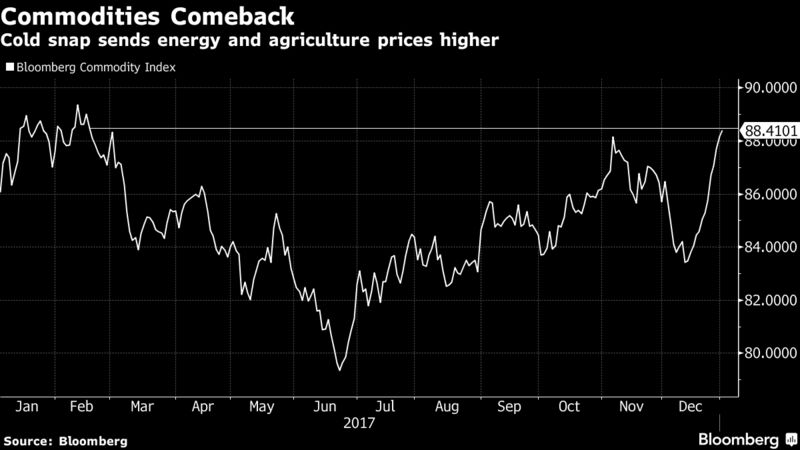
The bitter cold gripping much of North America may be making living conditions a bit uncomfortable, but for commodities traders it's a chance to profit. The Bloomberg Commodity Index has risen for 13 straight days, closing Tuesday at its highest level since last February on gains in energy and certain agricultural goods.

Prices for the heating fuel rose to the highest in a month as the U.S. burned the most natural gas ever on Monday, breaking a record set during the so-called polar vortex that blanketed the nation’s eastern half with arctic air in 2014, Bloomberg News reports. America consumed 143 billion cubic feet of gas as temperatures dipped to all-time lows on New Year’s Day, topping the previous high of 142 billion from four years ago, data from PointLogic Energy show. Ice in the Hudson River delayed fuel-barge deliveries, as the government warned of a home heating-fuel shortage from the East Coast to Texas. Natural gas prices have jumped 19 percent from a 10-month low on Dec. 21. U.S. retail diesel prices averaged $2.87 a gallon on New Year’s Day, the most since June 2015, according to AAA.
Beyond the energy sector, the cold weather is having an impact on wheat plants and cattle, according to Bloomberg News. March futures tracking both hard red winter wheat and soft red winter wheat climbed to the highest since early December in Chicago, while feeder-cattle futures rose as much as 4.5 cents, the exchange limit. Temperatures through Jan. 4 are forecast at 15 to 25 degrees below normal from the Southern Plains to Ohio Valley, according to the National Weather Service. The chill can also slow grain movement as ice builds on rivers and railways....

The Inherent Conflict Between ESG and Passive Investing

Over the last couple years we've seen investment shops embrace both passive investing and the Environmental, Social And Governance (ESG) criteria in their marketing material and to a somewhat lesser extent in portfolio construction.

Our typical reader is already way ahead of me on this: going ESG means, by definition, you're not passive and,  by definition, going passive means you're not ESG. It's a tautology; it is what it is.

In June 2017 Matt Levine at Bloomberg View had some related thoughts on index construction and the Governance part of ESG that I've been meaning to post but first, just so our position is clear, we have not seen any academic research that overturns the findings of the Marcin Kacperczyk (now Imperial College London) and  Harrison Hong (now Columbia) paper "The price of sin: The effects of social norms on markets" which we headlined way back in 2007 as:
Moral Judgment On 'Sin Stocks' Means Higher Returns For Vice-Friendly Investors

Until ESG can be shown to, at minimum, equal broader indexes over time (not just for a quarter or a year as sometimes happens) our chosen approach is to pursue the vice afforded by broader exposure and use the excess returns for whatever do-gooder projects strike one's fancy.

It's a variation on John Wesley's Sermon 50, The Use of Money (1744) which contains the admonition:

"Earn all you can, Save all you can, Give all you can" 

So, with Wesley thundering in our ears, here's part of Mr. Levine's June 20, 2017 Money Stuff piece "Bank Relationships and Index Rules Also Bancor, leaky brokers, Martin Shkreli, slot machines and unicorns.":
...Indexing.
Is Facebook Inc. a company? Hmm:
A proposal being floated by a large index firm could force finance chiefs at companies like Alphabet Inc., Facebook Inc. and Ford Motor Co. to choose between keeping their places in broad stock benchmarks or changing their share class structures.
FTSE Russell is proposing possible restrictions on the inclusion of companies with unequal voting rights in its indexes, but the firm will weigh input from clients and investors before working out specifics.
Let's say you want to invest in the entire U.S. stock market. The Russell 3000 index, which covers about 98 percent of the U.S. public stock market, is a reasonable proxy for that. So you might buy a Russell 3000 index fund.

But let's say you also think that Good Governance Is Good, and that dual-class shares are bad. Then you might ... well, you might do a lot of things. One thing you could do is buy the Matt 2997 index fund that I just made up, which buys all of the stocks in the Russell 3000 except Alphabet, Facebook and Ford. Or if you are a big institutional investor you can replicate that yourself: Just look at a list of the Russell 3000 stocks, observe which ones have dual-class shares, and buy the rest of them.
Then one of three things will happen:
  1. You will outperform the index, because Good Governance Is Good and leads to better performance; or
  2. You will underperform the index, because Good Governance Is Good Only On Some Longer Timeframe or whatever, but you will feel good about striking a blow for good governance.
  3. You will underperform the index, conclude that Good Governance Is Bad, and go back to buying Facebook stock.
Any of those things would be fine, really! This is life, and investing: You make choices, and sometimes your choices work out well, and sometimes they don't. But of course the passive-investing revolution is about not making choices, so making this choice is awkward. You can't just buy 2997 of the Russell 3000 stocks, especially if the omissions are as big as Alphabet and Facebook. That would be active management, and your belief that Active Management Is Bad is even stronger than your belief that Good Governance Is Good.

So the trick is to get FTSE Russell to make the choice for you: If the Russell 3000 doesn't contain dual-class stocks, then you can just buy the index, avoid those stocks, and neither outperform nor underperform the index. This is purely cosmetic: Facebook and Alphabet still exist, and if you invest in the Neo-Russell 3000 and they outperform it, then you have still missed out on performance by not buying their shares. But it is performance that you don't care about, because your performance is measured against the index, not against the actual universe of all investable stocks. So you're fine, as long as FTSE Russell makes the decision that you want it to make.

"'The future of the markets are at stake,' said James Andrus, an investment manager at the California Public Employees’ Retirement System," and it's an extraordinarily silly thing to say. He works for Calpers! They have a lot of money! They can just buy the stocks that they think are good and not buy the stocks that they think are bad! They don't have to outsource that decision to FTSE Russell, and then lobby FTSE Russell desperately to make the decision they want! They can just make the decision they want! But they can't, because that would be Active.

Elsewhere, "MSCI will decide on Tuesday whether to include Chinese domestic stocks in the benchmark emerging markets index":
Investors in mutual- and exchange-traded funds tracking indexes often think they’re making a simple decision to follow what the market’s doing. In reality the indexes have mutated from measures of the market into primitive investing algorithms, with sometimes odd effects.....

Europe’s Childless Leaders

Over the holidays a friend asked what I made of this and frankly I'm not sure. There are many reasons a person won't have children, ranging from the biological to economic to lifestyle. What is surprising about the piece below is how many European leaders are childless. This may be an historic first.

From the Washington Examiner, May 14, 2017:

Emmanuel Macron and the barren elite of a changing continent
Emmanuel Macron founded a new party, and his election as France's president is said to herald the "revival of Europe." Interestingly, Macron has no children.
This is not that notable in itself. After all, George Washington had no biological children. But across the continent Macron wants to bind closer together, there's a stark pattern:

German Chancellor Angela Merkel also has no children. British prime minister Theresa May has no children. Italian prime minister Paolo Gentiloni has no children. Holland's Mark Rutte has no children. Sweden's Stefan Löfven has no biological children. Luxembourg's Xavier Bettel has no children. Scotland's Nicola Sturgeon has no children. Jean-Claude Juncker, president of the European Commission, has no children.

This is too remarkable to ignore. While Macron is young—39 years old—the rest of Europe is being governed by childless Baby Boomers....

Union Square Ventures' Fred Wilson: "What Is Going To Happen In 2018"

From A VC Jan. 1:

What Is Going To Happen In 2018
This is a post that I am struggling to write. I really have no idea what is going to happen in 2018.
  • Will the crypto markets continue in their bull cycle? I have no clue. I was showing my daughter’s friend an app that helps people save and invest and he said to me “I don’t need that, I just buy some ETH every week.” I said “that’s a good plan until it isn’t.” I just don’t know when buying crypto will stop being a good idea. It was a great idea in 2017.
  • Will the economy extend its eight year expansion? I have no clue. The longest post WWII economic expansion was 10 years from 1991 to 2001. Can this one beat that one? Maybe. Will this one also burst over the collapse of another tech bubble? Maybe. But again, I have no idea when that might come.
  • Will the corporate tax cuts that are coming from Trump’s tax bill lead to increased hiring and investments, or will companies simply hoard that cash or pay it out in dividends? Likely a bit of both. But I think Wall Street has largely priced in the increased earnings so I’m not sure the tax bill will be a boon for the stock market in 2018.
  • Will the current Internet oligopoly (Amazon, Apple, Facebook, Google) continue to take share from the rest of the sector, or will one or more start to falter? I’d like to see the latter, but I suspect it will be more of the former......
 ...MORE

Compare/contrast: 
Union Square Ventures' Fred Wilson: "What Is Going To Happen In 2017"

Tuesday, January 2, 2018

"Blockchain announcement sends Hooters parent company stock soaring"

No Comment yet from that insurance salesman in Omaha.
From Ars Technica:

Press release: “Eating a burger is now a way to mine for cryptocoins.”
The stock market loves blockchains. Last month, the Long Island Iced Tea Company rebranded itself as Long Blockchain and saw its stock price triple. On Tuesday, Chanticleer Holdings, the parent company of Hooters, saw its stock soar by 50 percent after the company announced that it would be moving its reward programs to the blockchain.

"Eating a burger is now a way to mine for cryptocoins," said Dennis Becker, CEO of Mobivity, the company that's helping Chanticleer jump on the cryptocurrency bandwagon. "Every meal enjoyed at any Chanticleer Holdings brand will accrue currency for the consumer that can be used for future meals or traded with other consumers."

Chanticleer Holdings owns a number of different brands, most of them burger-related. These include Little Big Burger in the Northwest, American Burger Co. on the East Coast, and the national BGR chain. Also Hooters, whose rewards program is called HootClub.

Evidently, the stock market believes that putting these restaurants' reward programs on the blockchain raises their value by around 50 percent.
What's the advantage of blockchain-based rewards?

"Mobivity Merit is real cryptocurrency, leveraging the same infrastructure and principles of bitcoin, Ethereum, Ripple, litecoin," Chanticleer CEO Michael Pruitt says in the company's press release. Rather than being locked into one specific rewards program, customers will be able to transfer their reward points across multiple restaurants. Meanwhile, the Mobivity blockchain will help companies track their customers' preferences, allowing them to provide more personalized service.
"Each brand owns the data about [its] interactions with a consumer, but the consumer owns the data about ALL of their transactions across all brands, stored in the distributed ledger of blockchain technology," according to the company statement.

Chanticleer expects to roll out the technology across all of its restaurant brands before the end of 2018....MORE
Attractive as HootClub membership sounds, I'm not really much of a joiner.
I am however, reminded of this post from 2008:

Bill Gate's and the Retirement Planning Team

I'm not sure who the guy in the red sweater is, probably an actuary
or something.

Last reprised in 2011's "Bill Gates’ Children Mock Him With ‘Billionaire’ Song".

Lithium: Here Comes the Supply Surge

On December 27th Reuters published "Bolivia seeks investors to power up lagging lithium output".
We have a few hundred posts on lithium and enough of a crude working knowledge of Bolivian Presidente Evo Morales that it makes sense he's had some difficulty attracting investment for Bolivia's enormous resource,

According to the last US Geological Survey numbers (Jan. 2017, new ones this month). Evo is sitting on one of the largest piles o'lithium in the world:

World Resources:
*****
LITHIUM
(Data in metric tons of lithium content unless otherwise noted)
...Owing to continuing exploration, lithium resources have increased substantially worldwide. Identified lithium resources in the United States, from continental brines, geothermal brines, hectorite, oilfield brines, and pegmatites, have been revised to 6. 9 million tons.

Identified lithium resources in other countries have been revised to approximately 40 million tons.

Identified lithium resources in Argentina and Bolivia are approximately 9 million tons each and in major producing countries are: Australia, more than 2 million tons; Chile, more than 7.5 million tons; and China, approximately 7 million tons. Canada’s lithium resources are about 2 million tons. Congo (Kinshasa), Russia, and Serbia have resources of approximately 1 million tons each. Lithium resources in Brazil and Mexico are approximately 200,000 tons each and Austria and Zimbabwe have more than 100,000 tons each...
The rest of the world is not having trouble attracting  investment. As noted by the FT's commodity mavens a couple weeks ago in "What to watch in metals market in 2018":
...Battery metals
Cobalt and lithium, key ingredients in the batteries used in electric vehicles, have had stellar years. Electric vehicles sales are expected to top the 1m mark for the first time. The price of lithium carbonate has risen 36 per cent, while cobalt prices have doubled — luring investors and junior miners to what has been dubbed “battery gold”. Yet the increasing supply of both metals remains a risk for prices next year. One of the world’s largest producers, Chile’s SQM, is in talks to resolve a dispute over how much lithium it can produce following the election of billionaire Sebastián Piñera as president. “For Chile, the new round of negotiations could mean the country significantly expanding its lithium output,” analysts at BTG Pactual in Santiago note.

A host of new lithium projects in South America and Australia are likely to end the shortage in the market by 2019, which will be followed by a few years of oversupply, according to Bank of America Merrill Lynch....
Argentina:
...Up until two years ago, the only company extracting lithium on a commercial scale from Argentine brine was U.S.-based FMC Corp., which began operations in the Dead Man salt flat in 1997. Australia’s Orocobre Ltd. became the country’s second producer in 2015.
The SQM-Lithium Americas venture on the Cauchari-Olaroz salt flats about 13,000 feet (4,000 meters) above sea level in Jujuy province plans to start producing lithium carbonate at an annual rate of 25,000 metric tons in 2019. Dozens of other projects are at earlier stages.
Argentina is looking to take market share from neighboring Chile where would-be producers need authorization from the nuclear energy commission in a throwback to a 1979 decision to declare lithium “strategic.”
—Bloomberg's Dec. 22 "Battery Makers’ Great Hope for Cheap Lithium Faces Talent Crunch
—Reuters' Nov. 13 "FEATURE-Argentina seeks to overtake Chile in South America lithium race"
—SMM Metal News' "Argentina Supports FMC on Lithium Output Expansion"

Australia:
Biggest lithium mine doubles with Greenbushes expansion
The Chinese and American owners of Talison Lithium have green-lit a $320 million expansion of its mine in the South West, the world’s biggest, which will more than double capacity....
—The West Australian, March 2017
And on and on and on.

Don't stay too long at the ball or Cinderella's portfolio is cinder's.
[see what I did there?]

"If you’re seeking a longread about Texas oil to curl up with...look no further than Lawrence Wright’s latest 8,000-word opus"

From Texas Monthly, December 30:

The New Yorker’s Lawrence Wright on Texas Oil
We recommend this gripping piece on the boom-and-bust cycle for your weekend longread.
If you’re seeking a longread about Texas oil to curl up with over the long New Year’s weekend, look no further than Lawrence Wright’s latest 8,000-word opus in the January 1, 2018, issue of New Yorker. Titled “The Dark Bounty of Texas Oil,” the piece by the Austin resident and Texas Monthly alumnus surveys the history of the black gold in the state, a natural resource that “has been both a gift and a trap” for the state, Wright opines.

The sprawling piece covers the industry in the state from its inception at Spindletop to the modern fracking boom, ushered in by George Mitchell, “one of Texas’s greatest wildcatters.” Wright takes us from East Texas at the Daisy Bradford No. 3, where when oil was struck in October 1930, “people danced in the black rain, and children painted their faces with oil” to the Permian Basin, with a landscape so dotted with wells that it “looks like graph paper” from the air, to the Barnett Shale, where he witnessed the “dark bounty” of the fracking boom, writing, “It has created enormous wealth for some, and the flood of natural gas has lowered energy costs for many, but it has also despoiled communities and created enduring environmental hazards.”...MORE

Engineer a Little Addiction Into Your Product - Redux

My work here is done.
From Dilbert.com:

December 15
 Doctor And Dopamine - Dilbert by Scott Adams

December 21
 Dopamine - Dilbert by Scott Adams

There are three more in the series, very topical.

Previously in non-Dilbert commentary:
Dec. 11 
Climateer Line of the Day: Neurotransmitters and Facebook Edition
Dec 3 
"The Neurochemistry of Smartphone Addiction"
Sept. 25
Dopamine Labs: "Meet the tech company that wants to make you even more addicted to your phone"
Sept 24
"If You Want To Be Happy, Listen Up. Now! alternative title: The FT's Izabella Kaminska Is...".

And dozens and dozens more including  the namesake 2015 post "Want to Make Big Money? Engineer A Little Addiction Into Your Product"

One Year On: Is Finland's Universal Basic Income Experiment Working?

From CNBC, January 1:

One year on: Is Finland’s free money experiment working?
A routine trip to check the mail took an unexpected turn for Mika Ruusunen in November 2016.
"I opened it and I didn't understand it at all, so I gave it to my wife and asked her what the heck is this," Ruusunen said.

It was the Finnish government informing Ruusunen that he would start receiving free money each month as part of a first-of-its-kind experiment.

Ruusunen was among 2,000 unemployed Finns randomly selected from across the country for a trial testing universal basic income. Each month for two years he would receive 560 euros (roughly $670) from the government, tax-free. He was free to spend the money however he liked.
"I'm not accustomed to that kind of bureaucratic freedom," Ruusunen said.
Less bureaucracy, more flexibility
Reducing bureaucracy in the welfare system is one of the main aims of the universal basic income trial in Finland. The government is testing whether basic income is a more flexible policy than existing welfare programs for providing assistance and work incentives to an evolving workforce.
"It is assumed that this would be a policy that could activate people through different mechanisms and, well, we want to find out if that's the case," said Miska Simanainen, a researcher at Kela, the government organization overseeing the trial.

Finland's universal basic income experiment launched January 1, 2017 and will run until the end of 2018. Official results from the trial won't be released until it concludes. Experts said it's not surprising the Nordic country known for its generous welfare benefits, like universal free education, is at the forefront of a new economic experiment.

"We have had political discussions on basic income for many years, actually, for a couple of decades in Finland," Simanainen said.

The idea of free money has become more popular in recent years thanks to advocates in Silicon Valley like Elon Musk and Mark Zuckerberg. They see universal basic as a cushion for workers whose jobs might be replaced by automation or robots. Advocates argue free money could provide workers with flexibility to retrain for a new career, pursue creative interests, or start their own business.
A key goal of the Finland experiment is to give unemployed people incentive to work by providing them with financial assistance even once they're employed. Researchers chose the 560-euro monthly amount because it roughly equals the current level of unemployment benefits.

"One main idea behind this version of basic income that we are testing is that it would replace the basic social benefits or at least basic unemployment benefits," Simanainen said....MORE

Crop and Livestock Price Prospects for 2018 (llinois Farm Economics Summit—IFES)

From the University of Illinois' FarmDoc Daily, December 28:
This is a presentation summary from the 2017 Illinois Farm Economics Summit (IFES) which occurred December 18-22, 2017. A complete collection of presentations including PowerPoint Slides (PPT) and printable summaries (PDF) are available here.
CROPS
Crop prices will remain below the high levels seen in the early part of this decade due to large global inventories. Global economic growth continues to build on the momentum seen over the last year. Growth in China and emerging market in Asia is projected to remain strong throughout 2018. The prospects of improved growth support commodity demand, but the significant changes to trade policy could mitigate some of this demand growth in export markets. Lower prices are expected to continue in 2018 barring a shortfall in one of the major production regions. The following price outlook analysis assumes a good 2018 growing season.

Corn prices continue to struggle with large crops and five consecutive years of growth in ending stocks. Domestic corn demand continues to see moderate growth in corn used for ethanol which has been supported by record levels of ethanol exports. Growth in livestock production and low corn prices provide support for increased feed usage during the 2017-18 marketing year. The potential for greater than 5.5 billion bushels in feed and residual use would be the largest amount since 2007-08. Corn exports currently lag the pace of last marketing year's 2.29 billion bushels and are projected at 1.95 billion bushels by the end of the current year. Planted acreage of corn is expected to increase slightly in 2018 to 90.8 million acres. Assuming a trend yield near 172.3 bushels would result in a 2018 crop near 14.4 billion bushels. A projected total use of 14.5 billion bushels would result in the 2018-19 marketing year ending stocks near 2.44 billion bushels, a slight decrease from 2017-18 projections. Prices are expected to average near $3.30 during the current year and near $3.40 during the 2018-19 marketing year if production develops as expected.

Soybean prices remain strong relative to corn and wheat prices. U.S. soybean ending stocks continue a five-year pattern of growth with 2016-17 ending stocks ending at 301 million bushels. The lower than initially projected ending stocks benefited from very strong export numbers driven by continued growth in exports to China. Soybean exports are projected to exceed 2.2 billion bushels during this marketing year, up from last marketing year's 2.174 billion bushels. Expanded soybean acreage and a 49.5 bushel yield for the 2017 crop are expected to increase 2017-18 marketing year ending stocks to 480 million bushels. Planted acreage of soybeans is expected to increase moderately to 90.6 million acres in 2018 due to the low prices of corn and wheat and the lower cost of producing soybeans relative to corn. A yield near 48.5 bushels would result in a 2018 crop about 52 million bushels smaller than the 2017 crop. With total use projected at 4.32 billion bushels, a further increase in U.S. stocks is expected by the end of the 2017-18 marketing year. Prices are expected to average near $9.20 during the current year and near $8.80 during the 2018-19 marketing year if world production develops as expected.

U.S. wheat acreage is expected to continue declining. Planted acreage decreased to 46.01 million acres in 2017. U.S. wheat production decreased by 508 million bushels in 2017 with average yield down by 6.3 bushels per acre. Soft red winter wheat production decreased to 202 million acres on 230,000 fewer acres nationally. Soft red winter wheat production is down 49 percent from 2010-2017 in Illinois. During the same period, wheat acreage in Illinois declined by 450,000 acres. World wheat production in 2017-18 is expected to decline slightly from the record levels of 2016-17. Foreign wheat production is expected to increase for the fifth consecutive year. U.S. stocks of wheat in all classes are projected to decline to 935 million bushels after hitting 1.18 billion bushels in 2016-17. U.S. soft red winter wheat ending stocks are expected to grow by 7 million bushels in 2017-18. The average price received for the 2017 crop is expected to be near $4.60. The Illinois price at harvest is expected to be near $4.75....MORE

Monday, January 1, 2018

Capital Markets: "The Past is Not Passed: 2017 Spills into 2018"

From Marc to Market:
The New Year may have begun in fact, but in practice, full participation may return only after the release of US employment data on January 5. The macroeconomic and policy tables have been set, though interpolating from the Overnight Index Swaps market, there is 45% chance the Bank of Canada hikes rates at its policy meeting near the middle of the month.

In the currency markets, sentiment appears to be as uniformly dollar negative as it had been positive a year ago. More important for the near-term price action, there have been powerful but extended trends over the past two-three weeks as participation thinned. Consider that the Canadian dollar appreciated nine of the past 10 sessions. The Australian dollar rose in 13 of the last 15 sessions.

It is too difficult to find a consistent narrative of what the market is saying. The rally in industrial metals and equities suggest an economically optimistic outlook. However, the rally in the US Treasuries and the flattening yield curves in most advanced economies would seem to be consistent with downside risks. There is no sign in recent data that the synchronized upturn is slowing. In fact, on balance, data from Q4 suggests, growth may have accelerated.

The flash PMI for the eurozone is expected to be confirmed in the coming days. The composite firmed to a new cyclical high 58.0 from 57.5 in November. It averaged 56.0 in Q3. The composite PMI was at 54.4 at the end of 2016. Not only has economic activity quickened but it also broadened. Italy and France, and no less than Greece are participating.

Data over the last couple of weeks suggests that what might have begun as an export-led growth in industrial output and capital investment has spread to consumption. Overall household spending rose 1.7% year-over-year in November. This is the second strongest pace in more than two years.

China, the world's second-largest economy, is also finishing the year on a firm note. The official manufacturing PMI slipped to 51.6 in December from 51.8 in November. The Q4 average was 51.7 after 51.8 in Q3 and 51.5 in H1. The non-manufacturing PMI edged up to 55.0 from 54.8. It averaged 54.7 in Q4 and 54.4 in Q3, following a 54.5 average in H1.

Of the large countries, India's economy may be the most concerning. After a good H1 2017, the economy struggled in Q3. The composite PMI posted the year's high of 51.7 in June before falling below the 50 boom/bust level in July and August. The recovery in September and October (51.3) fizzled out in November (50.3). The December reading is due January 4.

The minutes from the December FOMC meeting that delivered the third hike of the year will be scrutinized for clues into the bar for a March move. Assuming that there is no practical chance of a hike at the next FOMC meeting, the market appears to have discounted a little less than a 60% chance of a March hike.

The US jobs data is the economic highlight of the holiday-shortened first week of the New Year. Even modest disappointment with the December report will not prevent 2017 from being the seventh consecutive year the US economy created more than two million jobs. A little more than 8.5 mln jobs were lost 2008-2009 and 18 million jobs have been created since.

Job growth is expected to have cooled in December after two months in which 472k net new jobs were created. Newswire survey put the median guesstimate near 190k. Manufacturing has been on a hiring binge, with 54k new positions in October and November. Another 20k are expected to have joined the payrolls in December Through November, the manufacturing sector jobs have risen by 16k on average. Last year, there was an average loss of 1k manufacturing jobs.

In November, the work week ticked up to 34.5 hours. It is the third time in 2017 it has risen there, but each time it was quickly turned back. Some observers suggest there needs to be a sustained increase in the work week to boost the likelihood of wage pressure. Average hourly earnings need to rise by 0.3% in December to keep the year-over-year rate steady at 2.5%.

US auto sales are not particularly interesting presently. Sales had slowed in the March through August period. The terrible destruction of a couple of storms helped boost auto sales, and arguably, save the year. Through November the pace has averaged 17.11 mln (annualized pace) vehicles. This is the lowest in three years (17.45 mln in 2016 and 17.40 mln in 2015). December auto sales are expected to be around the 17.5 mln unit pace.

Geopolitical developments in recent days will be part of the talking points to start the New Year..... 

...MUCH MORE

Why Encryption Really, Really Matters

We've visited the author of this essay, Bruce Schneier, a few times, usually with lighthearted headlines for deadly serious problems.
From Demos Quarterly, Nov. 1:

Encryption’s curse is also its blessing
Bruce Schneier considers the value of encryption and the risks of backdoor access by governments and law enforcement. Ultimately, he argues, we need to develop better investigative tools.

The Internet has become vital to society, and attacks against it have serious consequences. Denial-of-service attacks against popular platforms costs millions. Ransomware affects hospitals. Privacy violations threaten to undermine our democracies. And the Internet of Things means that vulnerabilities in computer systems can allow attackers to crash cars, disable medical devices, and otherwise affect both life and property.

It is against this backdrop that we need to debate the value of encryption and the dangers of backdoors. Currently, some politicians in the US, the UK, Australia, and other countries are trying to pass laws limiting the effectiveness of encryption. Citing police investigative needs, they want encryption products in their own countries to have a mechanism to give police officers access to encrypted content – messages and stored data – without the knowledge or consent of the user. It’s a myopic and short sighted idea that 1) won’t have the desired effects, and 2) will make us all much less safe.

I’ll take the second point first. Encryption is a powerful security tool. It secures our data and communications against eavesdroppers such as criminals, foreign governments, and terrorists. We use it everyday to hide our cell phone conversations from eavesdroppers and our Internet purchasing from credit card thieves. Dissidents in China and many other countries use it to avoid arrest. It’s a vital tool for journalists to communicate with their sources, for NGOs to protect their work in repressive countries, and for attorneys to communicate with their clients. Governments around the world use encryption to protect themselves against foreign espionage.

The never-ending litany of attacks illustrates how important computer and Internet security is, on a personal and national level. Anything that forces companies to create alternate access mechanisms that bypass the user will only exacerbate the risks. As technologists, we can’t build an access system that only works for people of a certain citizenship, or with a particular morality, or only in the presence of a specified legal document. If the FBI can eavesdrop on your text messages or get at your computer’s hard drive, so can other governments. So can criminals. So can terrorists.

And while it’s data that encryption primarily protects today, encryption will be essential to protect our physical safety tomorrow. Computers are permeating everything from airplanes and automobiles to toys and home appliances, from drones to nuclear power plants. We need technology companies to make encryption ubiquitous, and to design it to be as bulletproof as possible. This is for our own security and safety.

Now to return to the first point. Criminals and terrorists use tools like WhatsApp and iMessage to prevent authorities from eavesdropping on their communications and accessing their data. If those tools were weakened to allow for surreptitious access, those same criminals and terrorists would use something else....MORE
Previously:

Another Job the Robots Will Be Taking: Safecracker
The Internet of Things Is A Surveillance Nightmare
"How Hackers Hijacked a Bank’s Entire Online Operation"
"Click Here to Kill Everyone"

Rocketman: Musk's SpaceX (and ULA) Get Called Out For Military Launch Preparedness Issues

United Launch Alliance is a 50/50 joint venture between Boeing and Lockheed.
Mr. Bezos' Blue Origin is not mentioned.
From Space.com:

Military Launch Quality Issues Flagged by DoD Watchdog

https://img.purch.com/w/660/aHR0cDovL3d3dy5zcGFjZS5jb20vaW1hZ2VzL2kvMDAwLzA3Mi85MjYvb3JpZ2luYWwvdWxhLWRlbHRhLWl2LWhlYXZ5LWxhdW5jaC5qcGc=
A United Launch Alliance Delta IV-Heavy rocket lifts off from Space Launch Complex 37B at Cape Canaveral Air Force Station, Fla.
WASHINGTON — An evaluation of military space launch services revealed lapses in quality control that could compromise the schedule and performance of future missions, the Defense Department inspector general reported last week.

The IG specifically called out the main contractors that support the evolved expendable launch vehicle program, or EELV, for failing to comply with standards required by AS9100 — a widely adopted quality management system for the aviation and space industries.

Prime contractors United Launch Alliance (ULA) and SpaceX, and ULA subcontractor Aerojet Rocketdyne "did not perform adequate quality assurance management of the EELV program," said the Dec. 20 report signed by Randolph Stone, deputy inspector general for policy and oversight....MUCH MORE
Boeing and Lockheed are so big and have been doing this stuff for so long you have to wonder if they've become a bit bored with the whole thing.

No worries with SpaceX taking this seriously though.
Should Tesla experience what Titanic enthusiasts were calling a "crash floe" problem everyone knows Elon is counting on the rockets for the ultimate exit strategy:


One More Reason Cryptography May Not Stand Up to Quantum Computers

Twelve weeks ago we were reading "Google Just Revealed How They’ll Build Quantum Computers":
... A quantum computer with a mere 50 qubits would outclass the most powerful supercomputers in the world today. Surpassing the limits set by conventional computing, known as achieving quantum supremacy, has been a difficult road. Now, a team of physicists at the University of California Santa Barbara (UCSB) and Google have demonstrated a proof-of-principle for a quantum computer that may mean quantum supremacy is only months away....
Two weeks after that piece in Futurism we saw this at New Scientist:

Google’s quantum computing plans threatened by IBM curveball
...IBM has come up with a way to simulate quantum computers that have 56 quantum bits, or qubits, on a non-quantum supercomputer – a task previously thought to be impossible. The feat moves the goalposts in the fight for quantum supremacy, the effort to outstrip classical computers using quantum ones.

It used to be widely accepted that a classical computer cannot simulate more than 49 qubits because of memory limitations. The memory required for simulations increases exponentially with each additional qubit.

The closest anyone had come to putting the 49-qubit limit to a test was a 45-qubit simulation at the Swiss Federal Institute of Technology in Zurich, which needed 500 terabytes of memory. IBM’s new simulation upends the assumption by simulating 56 qubits with only 4.5 terabytes....
Well, at ten weeks old that's ancient history.

From Next Big Future, December 30:

Progress to turning silicon transistors into qubits which could enable billion qubit quantum computers
Japanese RIKEN researchers are trying to adapt existing the silicon metal–oxide–semiconductor field-effect transistors (MOSFETs) to integrate qubits with current electronics, offering the potential for scaling up quantum devices and bringing quantum computing closer to becoming a reality.

Keiji Ono and colleagues from the RIKEN Center for Emergent Matter Science and the Toshiba Corporation in Japan, in collaboration with researchers from the United States, are investigating the properties of qubits produced by imperfections or defects in silicon MOSFETs. In particular, they are exploring their potential for developing quantum computing devices that are compatible with current manufacturing technologies.

“Companies like IBM and Google are developing quantum computers that use superconductors,” explains Ono. “In contrast, we are attempting to develop a quantum computer based on the silicon manufacturing techniques currently used to make computers and smart phones. The advantage of this approach is that it can leverage existing industrial knowledge and technology.”

After cooling a silicon MOSFET to 1.6 kelvin (−271.6 degrees Celsius), the researchers measured its electrical properties while applying a magnetic field and a microwave field. They found that when the silicon MOSFET was neither fully turned on nor off, a pair of defects in the silicon MOSFET formed two quantum dots in close vicinity to each other. This ‘double quantum dot’ generated qubits from the spin of electrons in the dots. It also produced quantum effects that can be used to control these qubits....MORE 
Of course, with that "having been reported over x days ago"..... which partly explains our lead-in to Saturday's "Cryptography and Quantum Computers":
The author seems optimistic - note headline - but I'm not so sure....

From Nautil.us:
How Classical Cryptography Will Survive Quantum Computers
Some of last year's more popular Quantum computing posts:
Nov. 5
Questions America Wants Answered: "Is Quantum Computing an Existential Threat to Blockchain Technology?"

July 26
Yeah, I Got Your Bitcoin Right Here: "‘Quantum Checks’ to Replace Cryptocurrencies in the Future?"

July 11
Computing: Will Quantum Devices Outperform Classical Computers by Year-end 2017? (thus achieving 'quantum supremecy')

April 6
The route to high-speed quantum computing is paved with error

March 8
"Google's Quantum AI Laboratory set out investment opportunities on the road to the ultimate quantum machines" (GOOG).

How to Create Collective Intelligence

The interviewer, David S. Wilson, is SUNY Distinguished Professor of Biology and Anthropology at Binghamton University and Arne Næss Chair in Global Justice and the Environment at the University of Oslo.
The interviewee,  Geoff Mulgan, is chief executive of Nesta, the UK’s National Endowment for Science, Technology and the Arts, and a senior visiting scholar at Harvard University’s Ash Center.

Part of the 'Complexity' series at Evonomics:

Markets, science, and humanity don’t automatically generate solutions.
David Sloan Wilson interview Geoff Mulgan
Say the word “mind” and most people immediately think about the workings of an individual brain. The idea that something larger than an individual might have a mind seems like science fiction—but modern evolutionary theory says otherwise.

It is now widely accepted that eusocial insect colonies—ants, bees, wasps, and termites—have collective minds, with members of the colony acting more like neurons than decision-making units in their own right. For example, a critical stage in the life of a honeybee colony is when it fissions and the swarm that leaves must find a new nest cavity. Exquisite research by Thomas Seeley and his associates shows that the swarm behaves like a discerning human house hunter, scouting the available options and evaluating them according to multiple criteria. Yet, most scouts visit only one cavity and have no basis for comparison. Instead, the comparison is made by a social process that takes place on the surface of the swarm, which is remarkably similar to the interactions among neurons that take place when we make decisions. After all, what is a multi-cellular organism but an elaborately organized society of cells?

The reason that multi-cellular organisms and eusocial insect colonies both have minds is because they are both units of selection. Lower-level interactions that result in collective survival and reproduction are retained, while lower-level interactions that result in dysfunctional outcomes pass out of existence. What we call “mind” focuses on the lower-level interactions that result in the gathering and processing of information, leading to adaptive collective action.

As soon as we associate “mind” with “unit of selection”, then the possibility of human group minds leaps into view. It is becoming widely accepted that our distant ancestors found ways to suppress disruptive self-serving behaviors within their groups, so that cooperating as a group became the primary evolutionary force. Cooperation takes familiar physical forms such as hunting, gathering, childcare, predator defense, an offense and defense against other human groups. Cooperation also takes mental forms, such as perception, memory, maintaining an inventory of symbols with shared meaning, and transmitting large amounts of learned information across generations. In fact, most cognitive abilities that are distinctively human are forms of mental cooperation that frequently take place beneath conscious awareness. It is not an exaggeration to say that small human groups are the primate equivalent of eusocial insect colonies, complete with their own group minds. As the great 19th century social theorist Alexis d’Toqueville observed, “The village or township is the only association which is so perfectly natural that, wherever a number of men are collected, it seems to constitute itself.”

The adjective “small” is needed because all human groups were small prior to ten thousand years ago, although a tribal scale of social organization needs to be recognized as important in addition to the fission-fusion bands within each tribe where most of the social interactions occurred.  In addition, cultural evolution is a multi-level process, no less than genetic evolution. As Peter Turchin shows in his book Ultrasociety, the societies that replaced other societies during the last 10,000 years did so in part because of their ability to gather and process information, leading to effective collective action at ever larger scales, such as the nations of France and America which were the main objects of Toqueville’s attention. Some elements of culturally evolved group minds are consciously designed, but many others are the result of unplanned cultural evolution, taking place beneath conscious awareness. They work without anyone knowing how they work.

Not only do units of selection tell us where group minds are likely to exist, but also where they are unlikely to exist. In many animal societies, within-group selection is the primary evolutionary force, leading to behaviors that would be regarded as selfish and despotic in human terms. If these societies have group minds at all, they are highly impaired, unlike eusocial insect colonies. By the same token, despotic human societies have group minds that are highly impaired, unlike more cooperatively organized human societies.

Knowing all of this has tremendous potential for recognizing collective intelligence in human life where it currently exists and socially constructing it where it is needed. However, most of what I have recounted is new, emerging only within the last two or three decades, and is often not reflected in the thinking of otherwise smart people on the subject of collective intelligence. In particular, there is a tendency to naively assume that collective intelligence emerges spontaneously from complex interactions, without requiring a process of selection at the level of the collective unit.

It was therefore with trepidation that I began reading Big Mind: How Collective Intelligence Can Change Our World, by Geoff Mulgan—founder of the think tank Demos, director of the UK Prime Minister’s Strategy Unit and head of policy under Tony Blair, and current chief executive of Nesta, the UK’s National Endowment for Science. That made him smart—but was he smart about collective intelligence from a modern evolutionary perspective?

To my delight, I found him very well informed, clearly recognizing that collective intelligence only exists under very special conditions, which makes it both present andabsent in human life. In addition to his conceptual understanding, his book is filled with examples from his extensive policy experience that were previously unknown to me, along with practical advice about how to enhance collective intelligence where it does not already exist. I therefore lost no time inviting him to have an email conversation, which he generously accepted.  An excerpt of his book is featured on the online magazine Evonomics.com.

DSW: Welcome, Geoff, to TVOL and congratulations on your superb book. In our correspondence leading up to this conversation, you called my attention to a 1996 issue of Demos Quarterly devoted to evolutionary thinking. Tell us about your background and how you came to appreciate the relevance of evolutionary theory in relation to human affairs. Bear in mind that while you are already well known in some quarters, you will be new to many of our readers.

GM:  My intellectual background is a combination of economics, philosophy, social science and telecommunications, the subject of my PhD.  By the time I started becoming interested in public policy there was already widespread dissatisfaction with the overly mechanistic, equilibrium models of economics which failed adequately to explain patterns of change: how technologies arise and spread; how economies grow.  Many of us looked to evolutionary thinking as a useful tool.  It could provide metaphorical frames – understanding social change in terms of the generation of new possibilities, selection and then replication (which has subsequently helped feed a very dynamic field of social innovation); it gave some new insights into how we were formed as human beings, and new psychological insights into policy.  The Demos Quarterly you mentioned was a good showcase of the state of the field at the time.  But it had little immediate influence.

One interesting spin-off was what is now called behavioural economics, which adapted many insights from evolutionary biology into the language of economics. The next issue of Demos Quarterly in 1996 focused on that, and I later commissioned quite a bit of work in the UK government (including a big 2002 study on the implications of behavioural psychology for public policy).  A few years later Nudge was published by Cass Sunstein and Richard Thaler and introduced these ideas to the mainstream, helping the creation of a behavioural insights team in the Prime Minister’s office in the UK.

Another result, which I write about quite a bit in the book, is to see large scale cognition, like evolution more generally, in terms of trade-offs. I call it cognitive economics: what selection or survival advantages are provided by certain kinds of cognition, and at what cost. A great deal of work has been done on this at the individual organism level in terms of the advantages of a larger, but very energy hungry, brain. I’m interested in the parallels for groups of organisations: if they spend scarce resources on abilities to observe, analyse, create or remember does that confer advantages?  Can they overshoot – like the clan that spends so much time remembering its ancestors that it fails to protect itself from threats; or a company that spends so much time trying to create the new that it fails to attend to the present. My hunch is that a new discipline is possible that draws on evolutionary thinking to analyse these kinds of trade-offs in more precise ways.

DSW: That’s very helpful background. I don’t want to assume that we agree upon everything, so please comment on my rather lengthy introduction. Is there anything that you would like to add or amend, to set the conceptual stage broadly for our conversation?

GM: Your introduction makes a great deal of sense to me, and coming from a social science background it’s obvious that the group is a unit of selection.  The question that animated me was a version of this: why do some nations, cities, organisations manage to thrive and adapt while others don’t, even though they appear to be endowed with superior intellectual resources or technologies?  Why did some of the organizations that had invested the most in intelligence of all kinds – from firms like Lehmann Brothers to the USSR in the 1980s – fail to spot big facts in the world around them and so stumble?  I was looking for a theory that could explain some of these patterns and understand how and when some groups are able to optimize for a particular environment and then adapt to a rapidly changing one....MORE

Military AI: China, Russia and the U.S. are Running Neck-and-Neck in an Arms Race

China might be ahead, tough to tell but that's the way to bet.

From 13D Research, October 11, 2017: 

As software eats the world, a dramatic shift is underway in both the technology and the doctrine of war
A new Harvard Kennedy School study concludes AI could revolutionize war as much as nuclear weapons have done. China and Russia have also reached effective technological-military parity with the U.S. But, America does not have a roadmap like China, which plans to dominate AI by 2030, while Russia will make 30% of its military equipment robotic by 2025. Putin warns: “Artificial intelligence is the future, not only for Russia but for all of humankind. Whoever becomes the leader in this sphere will become the ruler of the world.”

Software is eating the world’s militaries across a range of systems — including modular digital components that can be quickly interchanged on military equipment, new drones with “bird-like agility,” and AI-powered missile systems. The key differentiator is the ability to effectively utilize the new information and increased computing capacity, highlights a Fast Company analysis, in order to improve military tactics and strategy.

What are the implications? First, a dramatic shift is underway in both the technology and the doctrine of war. Software is becoming pivotal behind weapons and information systems — determining who gets the advantage.

Second, the new AI competition differs from prior arms races because much of the innovation can be used for both commercial and military applications. The commoditization of drone-delivery-technology and autonomous passenger vehicles could become powerful tools for asymmetric warfare.
Third, in contrast to nuclear weapons, which still require resources and expertise in relatively short supply, improvements in AI and related technologies also make it easier for smaller nations to change the balance of international power, according to Wired. Indeed, ISIS has begun using consumer quadcopter drones to drop grenades on opposing forces.

AI-defense related stocks are showing relative strength, but are trading at discounted cash flow multiples. Consider the following:

China’s AI strategy is to directly link commercial and defense developments. China aims to dominate the next generation of “intelligentized” warfare, relying on “long-range, precise, smart, stealthy and unmanned weapons platforms.” In February, China opened a national lab — operated by Baidu — dedicated to making the nation more competitive in machine learning. For example, China has developed a cruise-missile system called the Long Range Anti-Ship Missile (L.R.A.S.M.), which is described as a “semi-autonomous” weapon, notes the New York Times, using AI to avoid defenses and make final targeting decisions. The weapon is part of its “remote warfare” strategy that involves building large fleets of cheap, small ships deploying missiles to attack the enemy’s larger ships, such as aircraft carriers.

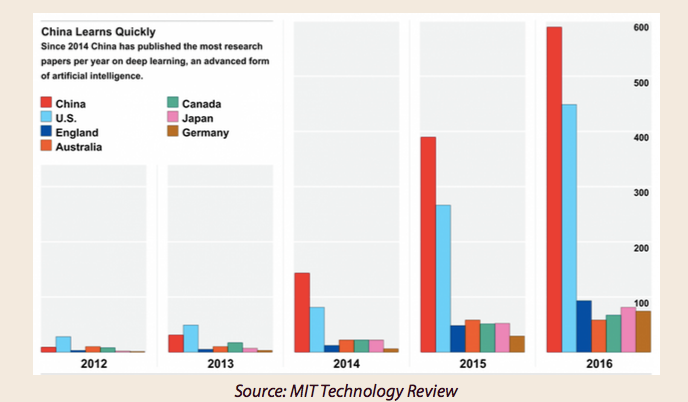
China has surpassed the U.S. in the number of scientific papers produced on AI— with 40% of AI research papers worldwide now published in Chinese. Chinese AI researchers have an advantage, because most also speak English and benefit from access to all research studies disseminated in English.
Many western AI researchers are not aware of THIS progress in China.For instance, last year, Microsoft proclaimed that it had created software capable of matching human skills in understanding speech. However, Baidu clarified that it had achieved similar accuracy with the Chinese language two years earlier.

Andrew Ng, former chief scientist at Baidu, believes the U.S. is too myopic and self-confident to understand the speed of Chinese competition. “There are many occasions of something being simultaneously invented in China and elsewhere, or being invented first in China and then later making it overseas,” notes Ng. “But the U.S. media reports only on the U.S. version. This leads to a misperception of those ideas having been first invented in the U.S.”

Russian arms maker, Kalashnikov, is launching a range of autonomous combat drones that use AI to identify, target and make decisions. In late 2014, Russia unveiled its Robotics 2025 program to develop military robots for every environment — water, air and land. Since then, Kalashnikov has created a fully-automated AI combat module — allowing it to identify targets, learn and make decisions on its own. The development raises the possibility that unlike current drones, which have some autonomous functions but still require humans, Russia’s new drones could operate entirely independently.

Russia has a smaller tech industry, but retains a strong academic science tradition. Samuel Bendett of the Center for Naval Analyses believes Russia may be willing to use AI more aggressively than rivals. In Syria and Ukraine, Russia demonstrated its ability to outperform even without the most cutting-edge technology. While Russian drones are typically less expensive and have shorter ranges than those used by the U.S, they have proven extremely effective....MORE