Thursday, July 12, 2012

Celine Dione Stiffs Employees on Overtime, Lists Private Island/Mansion for $29.7 Mil.

Now is the time we juxtapose.
From the New York Daily News:
Celine Dion accused of cheating employees out of overtime
A Florida handyman is suing Celine Dion for unpaid overtime claiming the singer is a tight-fisted taskmaster with her domestic employees.

Keith Sturtevant said he was asked to work 48 to 60 hours a week by Dion and her husband Rene Angelil but offered no extra money beyond his $63,000 per year salary because he was a designated as a private contractor....MORE
And from Toronto's National Post:
Celine Dion’s belle maison Canada’s Buckingham Palace

Courtesy of Sotheby’s International Realty Canada
Courtesy of Sotheby’s International Realty Canada The estate is selling for just shy of $30-million.

Two weeks ago, singer Céline Dion and her husband/manager René Angélil announced that because their Quebec mansion was seldom used — due to her concert schedule — they had decided to put the fabulous island retreat up for sale. At $29,655,500, including all the furnishings, the Île Gagnon retreat was hailed as the most expensive property ever listed on the Quebec housing market.

Earlier this week, Sotheby’s International Realty Quebec broker Joseph Montanaro offered Postmedia an exclusive interview and a sneak peak into the world of a superstar.

Located approximately 25 kilometres north of downtown Montreal, in the Sainte-Rose district of Laval, the secluded 19-acre paradise is surrounded by the Rivière des Mille Îles. A short stone causeway allows access from the mainland to the island, where one passes through two huge gated fences and a guardhouse maintained by security officers 24 hours a day. The property is virtually impregnable without an invitation....MUCH MORE
And from the Montreal Gazette:
Photos: Inside Celine Dion's island paradise

Here's the Sotheby's listing.

Back when Celine was touting her green cred we posted this little gem::
Water: Celine Dion Uses 6,500,000 Gallons Per Year

"Capitalizing on Inefficiencies in Mega Cap Equities"

The only long we've really been touting has been Wal*Mart, definitely a mega-cap and acting as if it will account for half of the word's retail activity in ten years. But even that is looking a bit toppy. We are being very opportunistic, picking spots and considering anything past settlement date to be long-term.

However this too will pass, big wheel keep on turnin', bottom rail on top now boss, Rota Fortuna, blah, blah, blah, and you'll want to have some strategies gamed out when the  time comes.

From Pyramis Global Advisors (Fidelity):

After a decade of unremarkable performance from mega cap equities, it may be reasonable for
investors to question whether they need exposure to the asset class, and whether their exposure to
mega caps should be through active strategies. By comparing mega caps with mid caps, represented
respectively by the 200 largest and the 800 smallest companies in the Russell 1000 Index, this
paper seeks to lay out the case for owning mega caps now, and for taking an active approach to
mega cap investing.

Why consider mega caps now?
Mega caps have been market leaders over extended periods
Over a short to medium time horizon, the casual observer could easily conclude that mega cap securities
have a justified reputation as being the most predictable and least interesting part of the equity market.1
After all, mega cap equities have underperformed mid cap equities during most of the past decade.2
However, looking back further to capture multiple market cycles, we see that mega caps have exchanged
market leadership with mid caps several times during the past three decades (see Exhibit 1, below). Mega
caps outperformed mid caps through much of the late 1980s and for a lengthy stretch in the 1990s.

In most instances, these prolonged periods of market leadership were preceded by extreme relative
valuations. With mega cap price-to-earnings (P/E) valuations currently at a low point (as discussed below),
the recent extended underperformance against mid caps suggests that the equity market may be poised
for another shift in leadership toward mega caps....MORE (7 page PDF)

HT: Horan Capital--
 
 From The Blog of HORAN Capital Advisors

"Correlation will lead to opportunities"

The Financial Times' John Authers hints at a couple different arbitrages.
From the FT:
Stocks have never been so correlated. The specifics of each company’s profit and loss account have become secondary to the broader factors of the market.

The figures demonstrate this beyond argument. In October last year, for example, the one-month correlation between individual S&P 500 stocks reached 90 per cent. The average since 1990 has been 30 per cent. Similarly, the correlation of different geographical indices has increased steadily. Twenty years ago, emerging markets offered great diversification from the developed world, with a correlation of almost zero. Now, that correlation is close to 80 per cent, according to MSCI indices.

Correlations that are this close imply that markets are ignoring corporate fundamentals, and that therefore companies’ cost of equity is being set inefficiently....MUCH MORE
We'll be coming back to this.


OPEC Channels Fawlty Towers: Don't Mention the...

...sanctions.

From Platt's:
OPEC published its latest monthly oil market report on July 11. Anyone reading it might expect to find some mention of the fact that one of its members, Iran, is now under two sets of sanctions which threaten not only its oil exports but also, ultimately, the volume of crude it produces.

But there was no mention of the European Union ban on the import of Iranian oil which came into full force on July 1 and which directly affects some 500,000 b/d, or of the EU ban on provision of insurance for shipments of Iranian oil, which reaches far beyond Europe.

Nor was there mention of new US sanctions which came into force on June 28 and which threaten to bar from the US financial system banks of countries continuing to to do oil-related business with Iran's central bank -- unless they reduce their oil volumes from Iran significantly. Washington has already given 180-day waivers from the sanctions to Tehran's top Asian importers for having pledged or shown evidence of lower purchases of Iranian oil. These countries include Japan, India, South Korea and China.

So for any assessment of the impact of sanctions on Iranian oil production and exports we have to look elsewhere.

The US Energy Information Administration said in its latest Short-Term Energy Outlook on July 10 that it expected Iranian crude oil production to fall by 1 million b/d by the end of this year from about 3.6 million b/d at the end of 2011, and to drop by a further 200,000 b/d next year....MORE

The Booming Business of Testosterone

Strong like bull.
From CNBC:
Wall Street's Secret Weapon for Getting an Edge
Traders on Wall Street are always looking to get an edge and pull ahead, especially in this catch-a-falling knife market. The latest secret weapon isn’t some complex trade or computer algorithm, it’s something more primal — testosterone. 

Testosterone has been blamed for many a bar fight but for some aging traders and executives — and aging on Wall Street means 30 and up — who feel these young kids breathing down their necks and the economic screws tightening, say boosting their testosterone levels has helped them get their edge back.

Testosterone levels in men tend to be anywhere from 150 to 850 nanograms per deciliter (ng/dL), depending on age and other factors. Testosterone levels typically start to decline after age 30. For some men, as they get older, those levels fall to 200 or below. "Low T" as its been branded, has been attributed to that sluggish feeling, muscle aches, belly fat, low stamina, low sex drive and lack of focus that many just attribute to the aging process. 

One of the most widely known ads for Low T is of a shirtless 64-year-old man whose head looks like a 64-year old, but whose ripped body looks like that of a man half his age. That’s for a Las Vegas-based mega-clinic called Cenegenics, which has 20 centers and 20,000 patients in the U.S. They opened a Wall Street clinic a year and a half ago in the Trump Building on Wall Street. And, while some other businesses on Wall Street were floundering during the recession, their business tripled. So much so that they’re hiring more doctors and moving to a bigger space by year end. 

Dr. George Shapiro, the CEO and chief medical officer of the Wall Street clinic, was a cardiologist for 20 years when he decided to seek treatment from Cenegenics to get his energy, focus and muscle tone back. After becoming a patient, he was such a believer, he joined Cenegenics as a doctor to help other men — and a few women — who were similarly struggling with symptoms most just chalked up to the aging process, figuring there was nothing they could do about it....MORE

The 100 Largest Landowners in America

From The Land Report:

No. 1 John Malone
2,200,000 acres

John Malone, the 70-year-old chairman of Liberty Media, is famously reticent when it comes to discussing his business life. There is, however, one subject that makes the Denver businessman open up: his personal land holdings.
 
Recently, he’s had a lot more to talk about. In 2011, Malone became the largest private landowner in the U.S., wresting the top spot on The Land Report 100 from his friend and longtime business partner, Ted Turner. His decades-long rise to the top dates back to the 1990s, when Malone began acquiring land in Colorado, New Mexico, and Wyoming. His land grab kicked into overdrive in the summer of 2010 when he purchased New Mexico’s historic 290,100-acre Bell Ranch. In early 2011, he snapped up an additional 1 million acres of timberland in Maine and New Hampshire to become America’s leading land baron. Malone says his lust for land harkens back to his Irish genes: “A certain land hunger comes from being denied property ownership for so many generations.”...MORE 
THE FULL LIST: AMERICA’S TOP 100 LANDOWNERS 2011
  1. John Malone
  2. Ted Turner
  3. Archie Aldis Emmerson
  4. Brad Kelley
  5. Irving Family
  6. Singleton Family
  7. King Ranch Heirs
  8. Pingree Heirs
  9. Reed Family
  10. Stan Kroenke
  11. Ford Family
  12. Lykes Bros. Heirs
  13. Briscoe Family
  14. W.T. Waggoner Estate
  15. Holland Ware
  16. D.M. O’Connor Heirs
  17. Drummond Family
  18. Phillip Anschutz
  19. J.R. Simplot Heirs
  20. Robert Earl Holding
...MORE

See also:
Land Report Top 10: Dillingham Ranch
2011 Land Report 100: D.M. O’Connor Heirs

For the whole thing.

More Field Reports From The Land Report:
  1. 2011 Land Report 100: King Ranch Heirs
    No. 7 King Ranch Heirs 911,215 acres On October 27 and 28, ranch owners and operators from across North America will make the trek to the King Ranch Institute for...
  2. 2011 Land Report 100: Lykes Brothers Heirs
    No. 12 Lykes Brothers Heirs 615,000 acres The family holds 275,000 acres in Texas and 337,000 acres in Florida, and they’re serious about the stewardship of every square inch. The...
  3. 2011 Land Report 100: Benjamin W. Griffith III
    No. 59 Benjamin W. Griffith III 161,093 acres Southern Pine Plantations founder Benjy Griffith has holdings in Georgia, South Carolina, Florida, Virginia, Tennessee, Texas, and Montana. He emphasizes clean air...
  4. 2011 Land Report 100: Irwin Heirs
    No. 46 Irwin Heirs 210,000 acres John Irwin II purchased the historic O RO Ranch in the early 1970s, and today the land is owned by his heirs. The O...
  5. 2011 Land Report 100: Pingree Heirs
    No. 8 Pingree Heirs 830,000 acres The Pingree family has tended its Maine timberlands for almost two centuries. The family’s patriarch, David Pingree, made his first fortune in New England’s..

EIA Weekly Natural Gas Storage Report: Up 33 Bcf

The report covers the week ended July 6th i.e. the second week of the East coast heatwave.
One datapoint to begin tracking: storage in the producing region which will top off before total storage and is at 79% of capacity.
In a generally down energy complex the front futures are up 1.7 cents at $2.87.
From the EIA:

Released: July 12, 2012 at 10:30 a.m. (eastern time) for the Week Ending July 6, 2012.
Next Release: July 19, 2012

Working Gas in Underground Storage, Lower 48
Region Stocks in billion cubic feet (Bcf) Historical Comparisons
07/06/12 06/29/12 Change Year Ago (07/06/11) 5-Year (2007-2011) Average
Stocks (Bcf) % Change Stocks (Bcf) % Change
East
West
Producing
Total


Summary
Working gas in storage was 3,135 Bcf as of Friday, July 6, 2012, according to EIA estimates. This represents a net increase of 33 Bcf from the previous week. Stocks were 548 Bcf higher than last year at this time and 516 Bcf above the 5-year average of 2,619 Bcf. In the East Region, stocks were 229 Bcf above the 5-year average following net injections of 20 Bcf. Stocks in the Producing Region were 196 Bcf above the 5-year average of 923 Bcf after no net change in stock levels. Stocks in the West Region were 92 Bcf above the 5-year average after a net addition of 13 Bcf. At 3,135 Bcf, total working gas is above the 5-year historical range.

Working gas stocks in the Producing Region, for the week ending July 6, 2012, totaled 1,119 Bcf, with 251 Bcf in salt cavern facilities and 868 Bcf in nonsalt cavern facilities. Working gas stocks decreased 7 Bcf in the salt cavern facilities and increased 8 Bcf in the nonsalt cavern facilities since June 29. An historical series of the salt and nonsalt subtotals of the Producing Region is available for download at: wngsr_producing_region_salt.xls.

"Using Artificial Intelligence to Take the Market’s Pulse"

I had meant to post this when it was published (June 14) and somehow misplaced it. Sorry.
Two things to remember in regards to technology applied to finance:
1) There is no silver bullet, it is just one more tool in the toolbox.
2) Eventually any advantage is arbed away as the technology diffuses into the market.
From Institutional Investor:
Harnessing the power of language can be a boon to traders bent on something as seemingly subjective as a diagnosis of the market’s pulse. It’s one thing to scour news databases to find negative references to a company whose stock you’re about to sell short. But it’s another thing to detect what Philip Resnik, a professor of linguistics at the University of Maryland, calls spin.

“Language is ambiguous — words have multiple meanings,” says Resnik, who’s also a member of the university’s Institute for Advanced Computer Studies.

Traders have been mining for data in news archives for decades. And they’ve long known how to detect the mood of the masses by assessing puts and calls on stock options. But today, computers armed with the latest artificial intelligence, or AI, software are learning to decipher how the public uses language and which combinations of words can predict the kind of phenomena that interest investors and pollsters.

For example, when a professor at Carnegie Mellon University searched for negative words in news databases — “unemployment,” “layoffs” and “fear” — he noticed a high correlation with a drop in the U.S. Consumer Confidence Index. His project worked just fine until the fall of 2010, when he deduced from the frequency of certain positive words, including “jobs” and “employment,” that public sentiment was about to rise.

The problem: Apple had just released a new iPhone; all those “jobs” references were mentions of company co-founder Steve Jobs. Consumer confidence was in fact falling, but news reports on the hip new Apple product made the scientist erroneously predict that consumer confidence would soon shoot through the roof.
Or think about it this way: A person describing a movie as “a bomb” probably didn’t like the flick. But if he says the movie was “the bomb,” he’s using slang to say how much he enjoyed it. An AI-enabled computer can distinguish between the two uses of the word. And there’s another difference in how traders today are trolling for sentiment: their data sources. Twitter alone has 140 million users churning out thoughts on products, companies and current events around the clock.

Back in 2005, Paul Tetlock, now a professor at Columbia Business School in New York, wrote an academic paper when he was at the University of Texas demonstrating how content in the business press predicts stock market movements. He found not only that high levels of what he calls media pessimism predict downward swings in the stock market, but also that investors can use media pessimism to predict trading volume....MORE

Wednesday, July 11, 2012

Sin is In: Vice Beats the S&P 500

A quasi-periodic look at the wages of sin.

We first examined the profit to be had by being naughty back in April 2007:
Moral Judgment On 'Sin Stocks' Means Higher Returns For Vice-Friendly Investors

...Prof. Hong lists his research interests as: 
"Asset pricing with less-than-fully-rational investors; differences of opinion, short-sales constraints and asset prices; social interaction and financial markets; career concerns, biased forecasts and security analysts; organization, performance and mutual funds; asset pricing with asymmetric information and other market imperfections."
Hey! Mine too!
Professor Hong has put together a pretty impressive c.v. including associate editor at the Journal of Finance and a Directorship of the American Finance Association. He hangs his hat at Princeton.

One proxy is the Vice fund, first mentioned in 2007 and again in 2008.
Here's the one year comparison chart, from Yahoo Finance:

Chart forVice (VICEX)

Here are the funds' holdings.

The Slow-Motion Collapse of American Entrepreneurship

Although my crypto-fascist friends rail against Federal regulation I am becoming more and more convinced that it is codes, ordinances rules and regs at the municipal, county and state level that really hinders new business formation.
Here the decidedly gauche-tilted authors seem to agree that it's all Washington's fault.

It's so rare when the kids can play nice with each other.
From Washington Monthly:
For all its current economic woes,” the Economist magazine recently asserted, “America remains a beacon of entrepreneurialism.” That idea is at the heart of America’s self-image. Both parties celebrate entrepreneurial small business as the fount of innovation and growth. Even if America no longer manufactures its own smartphones or computers, we cling to the idea that American entrepreneurs invent most of the new products and services that matter to the world.

Americans also view entrepreneurialism as a vital route to upward mobility—a way for average people to build wealth, in the form of a business venture that can be passed on to one’s children or sold upon retirement. Whether it’s the family farm or the local diner, small businesses have traditionally provided citizens not only with income but also with a place to teach kids the value of responsibility and hard work.
Then there’s the role entrepreneurs play in creating jobs. One recent study by the Small Business Administration (SBA) showed that businesses with fewer than twenty employees were responsible for more than 97 percent of all new jobs between 1988 and 2004.

More broadly, Americans have traditionally seen entrepreneurship as a crucial measure of the nation’s political vibrancy and liberty. We hold that the more independent citizens we have, the more widely power, responsibility, and voice will be distributed, and hence the stronger our democracy will be. The basic thinking here was best expressed by James Madison more than 200 years ago, when he wrote that the “greater the proportion” of citizens who are their own masters, “the more free, the more independent, and the more happy must be society itself.”

Yet how much does this faith in the vigor of American entrepreneurialism stand up to scrutiny? To a casual news consumer, it might seem that it has never been easier to launch and grow a new venture. One highly publicized study claimed that the United States leads all major industrial economies in the percentage of the adult population engaged in entrepreneurial activity. “We are in the midst of the largest entrepreneurial surge this country has ever seen,” a CNNMoney article tells us. Or, as the Council on Competitiveness has observed, “One of the critical drivers of America’s economic dynamism and flexibility has been the strength of its entrepreneurial economy.”

Last summer, however, a report by the Ewing Marion Kauffman Foundation exposed a big crack at the base of this widely held belief. “Even before the overall economy started its most recent downturn,” the authors noted, the number of business births had already “peaked.” Worse, with the onset of the Great Recession these numbers began to “plummet,” with the number of new independent employers dropping 27 percent in only three years.

This spring Kauffman followed with a second report that was in many ways even more dire. Compared to a generation ago, the report said, it is now much harder to start a business in America and keep it running. In 1980 “young firms”—those less than five years old—accounted for almost half of all going concerns. By 2010, their share of the total had collapsed to less than 35 percent. And as the Kauffman authors made clear, this doesn’t only mean less opportunity for America’s entrepreneurs. It also means millions fewer jobs every year, and much less economic growth.

Inspired by Kauffman’s report last summer, we set out to examine for ourselves the health of America’s entrepreneurial economy. What we discovered is that the decline in entrepreneurship is even bigger and more systemic in nature than was clear from Kaufmann’s work. America really is undergoing a radical change in the structure of our political economy. And yet this revolutionary shift of power, control, and wealth has remained all but unrecognized and unstudied by the mainstream media, Capitol Hill, the White House, state legislatures, and both party machines.

A good way to begin getting a sense of the magnitude of the drop-off in entrepreneurship—and its potential significance—is to examine the number of new “employer businesses” created every year, as compiled by the Census Bureau. The Census defines employer businesses as proprietorships, partnerships, and corporations that have at least one paid employee. In other words, we’re not talking about the midlevel executive turned “consultant,” not the nanny who pays taxes, not the part-time potter puttering around Etsy.
According to the Census Bureau’s raw data, the total number of employer businesses has grown continuously over the last three decades. When we focus only on this one number, we get an image of slow and steady expansion in the ranks of entrepreneurs. Which is why this figure is used so often to buttress claims of the nation’s entrepreneurial health.

The problem with this picture, however, is that it does not account for the fact that between 1977 (the first year the Census captured this “employer business” data) and 2009 the working-age population in the United States increased by seventy-five million people. If we adjust for this expansion, a much darker picture emerges. New business formation in America is revealed to have actually fallen dramatically over the last generation....MUCH MORE
HT chain: WaMo's Political Animal blog < naked capitalism.

Hedge Funds 2012: FAIL

From The Economist's Buttonwood's Notebook:
Mastered by the universe 
IT IS turning into another difficult year for the hedge fund industry. A survey by Globeop found that, in June, funds suffered the largest withdrawals in assets since October 2009. Eurekahedge found that hedge funds suffered their fourth consecutive month of negative returns in June; in the first half of the year, they eked out a return of 1.3%, compared to a 3.7% gain for the MSCI World index. That follows a 3.6% decline in 2011. for those investors who picked a fund-of-funds, with the accompanying extra layer of fees, a 0.4% return this year followed a 5.4% loss in 2011. In short, investors have lost money over the last 18 months.

The marketing claims of hedge funds have changed over the years. In the 1990s, the glory days of George Soros and Michael Steinhardt, it was argued that hedge fund managers were the "smartest guys in the room" who could produce superior returns. In the 2000s, as equity markets faltered, it was claimed that hedge fund managers delivered absolute returns; they tended not to lose money. But then they lost almost 20% in 2008. So now people talk about the uncorrelated returns hedge fund managers achieve....MORE
See also:

Taleb Makes Hyperinflation Bet and Why You Might Want to Be Skeptical
Gaming the System: Are Hedge Fund Managers Talented, or Just Good at Fooling Investors?
Eugene Fama: Do Active Managers Earn Their Fees?
Climateer Headline of the Day: Hedge Fund Spit Take Edition
From Reuters:

Hedge funds faulted for not being short-term enough

Follow up: The Old Age Pensioners Who Kidnapped and Tortured Their Financial Advisor Were Given Jail Time

I had completely forgotten this story:

June 23, 2009
German pensioners ‘kidnap and torture their investment adviser’

A reader emails the rest of the story via Glasgow's Daily Record:

Mar. 24, 2010
Sadistic German OAPs jailed for kidnapping and torturing financial adviser
A GANG of sadistic German pensioners have been handed jail terms for kidnapping their financial adviser and torturing him in a cellar for four days.

Victim James Amburn blew the four wealthy OAPs' £2.3million savings on the US sub-prime mortgage market.

And in a bizarre caper that left police astonished, the elderly plotters snatched him off the street and threw him into a specially prepared dungeon in a bid to force him to pay back the cash.

The kidnappers:
WHACKED Amburn over the head with a ZIMMER FRAME and stuffed him in a cardboard box;
WRAPPED him in duct tape until he "looked like a mummy" after stopping to get their breath back;
BUNDLED him into a car boot and took him 300 miles to a secret prison at a holiday beauty spot;
STRIPPED him naked, burned him with cigarettes and chained him up "like an animal", and;
SMASHED his ribs with a chair leg before 40 police commandos stormed the house and saved him.

"The fear of death was indescribable," Amburn told the plotters' trial. "I didn't know if night was day or day was night. I never thought I'd make it out alive."

The ringleader of the gang, Ronald Koenig, 74, was jailed for six years yesterday in Traunstein, where Pope Benedict grew up.

Koenig's sidekick, Willy Dehmer, 60, got four years. Koenig's wife Sieglinde, 79, got 21 months and doctor Iris Fell, 63, got 18 months. The women's sentences were suspended....MORE

USDA Does the WASDE Just Right: Corn Pops, Drops, reverses

We had an earlier post on the WASDE that disappeared into the ether. If I recall correctly corn was up 23 cents at the time. Corn is now down 9 cents at 7.085.

Over the last few years one of the problems market participants have complained about is the USDA's slow, measured response to rapidly changing conditions.
So traders have taken this into account and projected the trend from report to report: If yield (bushels per acre) is up 5 bu. in the June report traders project that yield will be up again in the July and August reports and position themselves accordingly.

Today that changed.
Participants were looking for a WASDE number lower than their internal projections and when he USDA came in with a cut in yields of 12% resulting in a 1.8 billion bushel drop in supply they said "Crap, now everyone knows."

This was, in part, the rationale for our only public comment on the run up in corn. From Monday's "Corn Belt heat wave breaks, but rains to miss driest areas":
Corn is up another 37.5 cents (5.41%) at $7.3050. We're looking for a spot to short this freight train and think after the WASDE we may get a chance for a little counter-trend....
This is a dangerous little game and I have no clue where the market goes next.
One guidepost, the 2010 move in wheat:
Climateer Line of the Day: Staff of Life Edition
Yes, here at station W-EAT it's all wheat, all the time.*
From The Progressive Farmer's Market Matters blog:

...Reuters cited Rich Feltes at MFGlobal, who said he thinks wheat futures will get to $7. Feltes was quoted saying, "Structurally, everybody has been leaning the wrong way, and now you'll have every doctor and dentist wanting to own a piece of this (wheat market) now."... 
*When MarketBeat gets around to putting up a wheat post we should be looking for a lock limit-down day...

Mandy Rice-Davies Sighting at FT Alphaville

Mandy Rice-Davies is a former model and showgirl known for her role in the Profumo affair.
When informed by the prosecuting attorney that Lord Astor disputed her version of events and denied having an affair she responded:
"Well, he would, wouldn't he?"
From the FT Alphaville post:
Spooks on the payrolls

...The report slipped out onto the DOL website this week. The Associated Press and Bloomberg have already torn it apart. But then, they would....
To the best of my knowledge, Mr. Cotterill is not a former model and showgirl.

We are keepers of the M.R-D flame:
Mandy Rice-Davies Alert: Christina Romer Says Maximum Tax Revenue at 84% Marginal Rate
She would, wouldn't she.*

*For British politicians of a certain age [often referred to as octo or nona-genarians -ed] the scandal surrounding Secretary of State for War John Profumo's affair with the alleged mistress of a Russian spy was highlighted by the testimony of Miss Rice-Davies, a friend of the alleged mistress, Christine Keeler.
From Wikipedia:

While giving evidence at the trial of Stephen Ward, charged with living off the immoral earnings of Keeler and Rice-Davies, the latter made a famous riposte. When the prosecuting counsel pointed out that Lord Astor denied an affair or having even met her, she replied, "Well, he would, wouldn't he?"
We've tried to keep the phrase alive, using it about once per year:

2007
Gore Says Markets are Key in Battle to Combat Climate Change
"Well, he would, wouldn't he?"
Mandy Rice Davies*
2007
ICE, Skating on Thin
TESTIMONY OF JEFFREY C. SPRECHER CHAIRMAN AND CHIEF EXECUTIVE OFFICER, INTERCONTINENTALEXCHANGE, INC.

Warning: Mandy Rice-Davies moment ahead.
"...we do not believe that a complete overhaul of the current regulatory structure is either warranted or advisable."
2008
UN Can Regulate Emissions Trading Without Conflict of Interest
All together now: A Mandy Rice-Davies Moment!*
2009
Major Problems at California's Public Pension Fund, CalPERS And: A Mandy Rice-Davies Moment!
One of these days I'll have to tell the story of how CalPERS got to this point. It is an ugly tale. For now we'll just post the slow motion train wreck.
On a positive note: Mandy Rice-Davies* moment ahead!  
One of my favorite usages:
Lord McIntosh of Haringey:  My Lords, I am proud of many things that this Government have done. I pause to anticipate the interjection—"He would say that, wouldn't he?"...
Lords Hansard text for 6 Feb 2002

EIA July 10 Short Term Energy Outlook: Natural Gas

From the EIA's STEO, July 10, 2012:

U.S. Natural Gas Consumption
EIA expects that natural gas consumption will average 69.9 billion cubic feet per day (Bcf/d) in 2012, an increase of 3.3 Bcf/d (4.9 percent) from 2011 and an upward revision of 0.5 Bcf/d from last month's Outlook. EIA expects that large gains in electric power use in 2012 will more than offset declines in residential and commercial use.

Projected consumption of natural gas in the electric power sector grows by 21 percent in 2012, primarily driven by the increased relative cost advantages of natural gas over coal for power generation in some regions. Consumption in the electric power sector peaks at 31.2 Bcf/d in the third quarter of 2012, when electricity demand for air conditioning is highest. This compares with 27.7 Bcf/d during the third quarter of 2011.

Growth in total natural gas consumption slows in 2013, with forecast consumption averaging 71.1 Bcf/d (U.S. Natural Gas Consumption Chart). However, unlike 2012, growth in 2013 is driven by consumption increases from the residential, commercial, and industrial sectors. A forecast of near-normal weather next winter drives 2013 increases in residential and commercial consumption of 7.7 percent and 4.5 percent, respectively. Although projected natural gas burn in the electric power sector declines by 1.9 percent from 2012, it remains at historically high levels in 2013.

U.S. Natural Gas Production and Imports

Total marketed production of natural gas grew by 4.8 Bcf/d (7.9 percent) in 2011. This strong growth was driven in large part by increases in shale gas production. EIA expects continued year-over-year growth in 2012, though not as strong as the previous year (U.S. Natural Gas Production and Imports Chart). This month's Outlook revises upward the forecast for marketed production for 2012, partially reflecting upward revisions to historical data for the first few months of the year. EIA, however, expects a small drop in production in the coming months, reflecting the decline in rigs since October 2011. According to Baker Hughes, the natural gas rig count was 542 as of July 6, 2012, up slightly from last week, which was the lowest rig count since 1999. EIA's production survey indicates natural gas marketed production fell between February and March 2012, but rebounded in April. Declining production from less-profitable "dry" natural gas plays such as the Haynesville Shale is offset by growth in production from liquids-rich natural gas production areas such as the Eagle Ford and wet areas of the Marcellus Shale, and associated gas from the growth in domestic crude oil production.

Based on the outlook from National Oceanic and Atmospheric Administration for the current Atlantic hurricane season, EIA estimates a 70-percent probability that total shut-in natural gas production in the GOM during the upcoming hurricane season (June through November) will fall somewhere between 5.8 and 16.2 Bcf, with a median outcome of 9.5 Bcf (an average of 0.05 Bcf/d over the 6 months; see the 2012 Outlook for Hurricane-Related Production Outages in the Gulf of Mexico)....MORE

Baseball at 90% of the Speed of Light (not good, not good)

From xkcd:
Relativistic Baseball

What would happen if you tried to hit a baseball pitched at 90% the speed of light?
- Ellen McManis
Let’s set aside the question of how we got the baseball moving that fast. We'll suppose it's a normal pitch, except in the instant the pitcher releases the ball, it magically accelerates to 0.9c. From that point onward, everything proceeds according to normal physics.:
pitcher throwing ballThe answer turns out to be “a lot of things”, and they all happen very quickly, and it doesn’t end well for the batter (or the pitcher). I sat down with some physics books, a Nolan Ryan action figure, and a bunch of videotapes of nuclear tests and tried to sort it all out. What follows is my best guess at a nanosecond-by-nanosecond portrait:
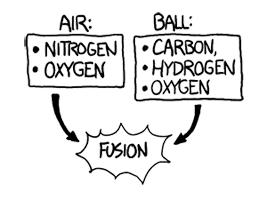

The ball is going so fast that everything else is practically stationary. Even the molecules in the air are stationary. Air molecules vibrate back and forth at a few hundred miles per hour, but the ball is moving through them at 600 million miles per hour. This means that as far as the ball is concerned, they’re just hanging there, frozen.

The ideas of aerodynamics don’t apply here. Normally, air would flow around anything moving through it. But the air molecules in front of this ball don’t have time to be jostled out of the way. The ball smacks into them hard that the atoms in the air molecules actually fuse with the atoms in the ball’s surface. Each collision releases a burst of gamma rays and scattered particles.
fusion illustration fusion zone of baseballThese gamma rays and debris expand outward in a bubble centered on the pitcher’s mound. They start to tear apart the molecules in the air, ripping the electrons from the nuclei and turning the air in the stadium into an expanding bubble of incandescent plasma. The wall of this bubble approaches the batter at about the speed of light—only slightly ahead of the ball itself....MORE

CERN: The First Photograph Uploaded to the Web

From Motherboard:

Crossdressing, Compression and Colliders: The First Photo on the Web
The first photographic image ever uploaded to the Web was a Photoshop disaster. It was created to sell something, and featured attractive women in a come-hither pose.
In short, photo-uploading was born with some original sins that have never quite washed away.
Here it is, in all its glory:


Next Wednesday, July 18th, the photograph at the center of that image — a homemade promotional shot for Les Horribles Cernettes, a comedy band based at the CERN laboratory near Geneva — will turn 20 years old. Despite the artifact’s world-historical significance, its full story has never been told. Few enthusiasts of art or photography or technology will be marking its 20th birthday, in no small part because it’s such an odd and un-artistic image....MUCH MORE
HT: Hit&Run

Equity Premium: Over 80% Gained in the 24 Hours Preceeding FOMC Announcement

The hell you say.
From the Federal Reserve Bank of New York's Liberty Street Economics blog:

The Puzzling Pre-FOMC Announcement “Drift” 
For many years, economists have struggled to explain the “equity premium puzzle”—the fact that the average return on stocks is larger than what would be expected to compensate for their riskiness. In this post, which draws on our recent New York Fed staff report, we deepen the puzzle further. We show that since 1994, more than 80 percent of the equity premium on U.S. stocks has been earned over the twenty-four hours preceding scheduled Federal Open Market Committee (FOMC) announcements (which occur only eight times a year)—a phenomenon we call the pre-FOMC announcement “drift.”

    The equity premium is usually measured as the difference between the average return on the stock market and the yield on short-term government bonds. Previous research on the size of the premium finds that it is too large for plausible levels of risk aversion (see Mehra [2008] for a review).

The Drift: A First Take

The pre-FOMC announcement drift is best summarized in the chart below, which provides two main takeaways:
  1. Since 1994, there has been a large and statistically significant excess return on equities on days of scheduled FOMC announcements.

  2. This return is earned ahead of the announcement, so it is not related to the immediate realization of monetary policy actions.

Returns-on-sp-500

    The chart shows average cumulative returns on the S&P 500 stock market index over different three-day windows. The solid black line displays the average cumulative return starting at the market’s opening on the day before each scheduled FOMC announcement to the market’s close on the day after each announcement....MORE

Tuesday, July 10, 2012

"Revealed: Why Gordon Brown sold Britain's gold at a knock-down price"

At the time, market participants were completely baffled by the Exchequer's actions.
This is the first  I've seen of even a purported explanation. There sure as hell hasn't been any from Gordon Brown.
From the Telegraph:

Gold
Britain's gold reserves were sold at a ludicrously low price
A great deal of Gordon Brown’s economic strategy would strike a sane man as troubling. Not a great deal was mysterious. The orgy of consumption spending, frequent extensions of the cycle over which he would “borrow to invest”, proclamations of the “end of boom and bust”: these are part of the armoury of modern politicians, of all political hues.

One decision stands out as downright bizarre, however: the sale of the majority of Britain’s gold reserves for prices between $256 and $296 an ounce, only to watch it soar so far as $1,615 per ounce today.
When Brown decided to dispose of almost 400 tonnes of gold between 1999 and 2002, he did two distinctly odd things.

First, he broke with convention and announced the sale well in advance, giving the market notice that it was shortly to be flooded and forcing down the spot price. This was apparently done in the interests of “open government”, but had the effect of sending the spot price of gold to a 20-year low, as implied by basic supply and demand theory.

Second, the Treasury elected to sell its gold via auction. Again, this broke with the standard model. The price of gold was usually determined at a morning and afternoon "fix" between representatives of big banks whose network of smaller bank clients and private orders allowed them to determine the exact price at which demand met with supply.

The auction system again frequently achieved a lower price than the equivalent fix price. The first auction saw an auction price of $10c less per ounce than was achieved at the morning fix. It also acted to depress the price of the afternoon fix which fell by nearly $4.

It seemed almost as if the Treasury was trying to achieve the lowest price possible for the public’s gold. It was....MORE
HT: ZeroHedge

We've posted on Chancellor Brown's odd behavior a few times, starting with 2008's "Gold trades at $850 per Ounce. And: How We Got There the First Time":
Again.
For a couple decades (since watching the XMI action on Oct. 20, 1987) I mentally run market movements through a thought experiment.*
(Gedankenexperiment, coined by Hans Christian Ørsted)

I call the thought experiment The Grassy Knoll Theory of Investing.
This name tends to insure that I am left alone at parties.
The GKTI has as its postulate: "There is a THEY" and its corollary "They know".

Except sometimes they don't.
(or do they?)

I use it to explain the inexplicable.
First I adjust my tin-foil hat.
Then I pick up the FT or the WSJ.
And think.

For example, why on earth was the Bank of England selling the British people's gold reserves at announced (!) auctions between July 1999 and March 2002 at a weighted average price of $274.92? Here's HM Treasury's explanation.
(page 27 of a 36 page PDF)

In most cases the GKTI is about as useful as Riemannian geometry.
You don't need Riemann to walk around the block, but knowledge of Great Circles sure helps to get you to your destination before the jet fuel runs out.

Which perambulation reminds me: The pedestrian conspiracy theories have the Queen of England mixing it up with the Rothschilds in a New World Order/Bilderberger/CFR/Trilateral shindig to rule the world.

Selling the nation's gold at the bottom of the market (the lowest p.m. price fix of the last 27+ years was $252.80, if memory serves) and just prior to a tripling of the price was either extraordinarily stupid or treason. Either way, someone should have been executed.
There have been no reports of shots at the Tower of London, though.

Here's the story that triggered this ramble: Gold, 1980.
And twice in 2010: 
This is How a Competent Central Bank Does it: Swiss National Bank Seen Selling Euros (EUR/CHF) 
A Trade Against the Swiss National Bank (CHF/YEN)

How the Mormons Make Money

From BusinessWeek:
Late last March the Mormon Church completed an ambitious project: a megamall. Built for roughly $2 billion, the City Creek Center stands directly across the street from the church’s iconic, neo-Gothic temple in Salt Lake City. The mall includes a retractable glass roof, 5,000 underground parking spots, and nearly 100 stores and restaurants, ranging from Tiffany’s (TIF) to Forever 21. Walkways link the open-air emporium with the church’s perfectly manicured headquarters on Temple Square. Macy’s (M) is a stone’s throw from the offices of the church’s president, Thomas S. Monson, whom Mormons believe to be a living prophet.

On the morning of its grand opening, thousands of shoppers thronged downtown Salt Lake, eager to elbow their way into the stores. The national anthem blared, and Henry B. Eyring, one of Monson’s top counselors, told the crowds, “Everything that we see around us is evidence of the long-standing commitment of the Church of Jesus Christ of Latter-day Saints to Salt Lake City.” When it came time to cut the mall’s flouncy pink ribbon, Monson, flanked by Utah dignitaries, cheered, “One, two, three—let’s go shopping!”

Watching a religious leader celebrate a mall may seem surreal, but City Creek reflects the spirit of enterprise that animates modern-day Mormonism. The mall is part of a vast church-owned corporate empire that the Mormon leadership says will help spread its message, increase economic self-reliance, and build the Kingdom of God on earth. “The Church of Jesus Christ of Latter-day Saints attends to the total needs of its members,” says Keith B. McMullin, who for 37 years served within the Mormon leadership and now heads a church-owned holding company, Deseret Management Corporation (DMC), an umbrella organization for many of the church’s for-profit businesses. “We look to not only the spiritual but also the temporal, and we believe that a person who is impoverished temporally cannot blossom spiritually.”

McMullin explains that City Creek exists to combat urban blight, not to fill church coffers. “Will there be a return?” he asks rhetorically. “Yes, but so modest that you would never have made such an investment—the real return comes in folks moving back downtown and the revitalization of businesses.” Pausing briefly, he adds with deliberation: “It’s for furthering the aim of the church to make, if you will, bad men good, and good men better.”

It’s perhaps unsurprising that Mormonism, an indigenous American religion, would also adopt the country’s secular faith in money. What is remarkable is how varied the church’s business interests are—and, at a time when a former Mormon bishop is about to receive the Republican Party’s presidential nomination, that so little is known about the church’s financial interests. Despite a recent public-relations campaign aimed at combating the perception that it is “secretive,” the LDS Church remains tight-lipped about its holdings and offers little financial transparency, even to its members, who are required to tithe 10 percent of their income to gain access to Mormon temples.

The Mormon Church is hardly the only religious institution to be less than forthcoming about how it amassed its wealth; the Catholic Church has been equally opaque throughout its history. On the other hand, says historian D. Michael Quinn, who is working on a book about the LDS Church’s finances and businesses, “The Mormon Church is very different than any other church. … Traditional Christianity and Judaism make a clear distinction between what is spiritual and what is temporal, while Mormon theology specifically denies that there is such a distinction.” To Latter-day Saints, opening megamalls, running a Polynesian theme park, and operating a billion-dollar media and insurance empire are all part of doing God’s work. Says Quinn: “In the Mormon worldview, it’s as spiritual to give alms to the poor, as the old phrase goes in the Biblical sense, as it is to make a million dollars.”

Mormons make up only 1.4 percent of the U.S. population, but the church’s holdings are vast. First among its for-profit enterprises is DMC, which reaps estimated annual revenues of $1.2 billion from six subsidiaries, according to the business information and analysis firm Hoover’s Company Records (DNB). Those subsidiaries run a newspaper, 11 radio stations, a TV station, a publishing and distribution company, a digital media company, a hospitality business, and an insurance business with assets worth $3.3 billion....MORE

"The political perils of low oil prices"

Great.
As Grandmother used to say, "It's one tham ding or another".
From European Energy Review:
Oil prices have rapidly dropped in recent months, and some analysts predict a further (steep) decline. This might seem like good news to consumer states, but there is a catch. Whereas producer states could balance their budgets at $30 a barrel less than ten years ago, they now need $100 a barrel to make ends meet. If oil prices continue to correct, expect instability to hit producer states across the board. That might (ironically) help to set a price floor and push prices up again, but it's not a development that consumer countries should be happy about. Keeping oil prices at $100/b remains a better plan than seeing producer states collapse.

A not so silent war is being waged in the oil world right now. Prices have tumbled 31% since March which means someone needs to set a price floor, and do so fast. Most OPEC states had hoped that was going to happen when the cartel recently met in Vienna. But official quota levels were kept at 30 million barrels per day (mb/d), with the implicit agreement that once delegates flew out of Schwechat Airport, Saudi Arabia would start closing the taps to bring OPEC's non-official 31.8 mb/d production in line with the formal target. Saudi swing, Riyadh ropes.

Fair enough, but what everyone wanted to know, and especially Iran, Venezuela, and Algeria, was how far and how fast Saudi was going to make cuts and 'balance' the market. With Brent prices regularly dipping well below $100 and WTI prices considerably lower, OPEC hawks are getting very nervous. Non-OPEC producers in Russia and Central Asia even more so. Assuming demand side dynamics don't drastically pick up in Asia, we can expect three things to sequentially happen.
  • The first is an international price war across all producer states to force Saudi Arabia to take assertive action to tighten the taps and raise prices. That will be a difficult process given Riyadh has its own strategic objectives to want a sustained period of moderate prices, well below $100/b.  
...MUCH MORE