Sunday, July 1, 2012

Artificial Intelligence: Why There is No Reason to Fear The Singularity/HAL 9000

From the Los Angeles Times:
Google researchers and Stanford scientists have discovered that if you show a large enough computing system millions of images from random YouTube videos for three days, the computer will teach itself to recognize ... cats.
...MORE
As the Belfast Telegraph reported:
...Like many people looking for light amusement on the internet, the cyber brain searched for felines completely of its own volition, something scientists say is a major breakthrough.
In the past the machine would have been given certain reference points - such as labelling features - to help it with its search. This time it got no help at all...
From the Twitter commentary on the Google X Lab feat:

Also, Turing was probably not hoping the most impressive AI of 2012 would identify cats in YouTube videos:

How else are they supposed to pass the Purring Test?

Attention All Mo-mo Mamas: The Huge Hidden Downside Risk in Momentum Trading

Apparently when issues lose their momo mojo they lose it big.
From Marginal Evolution:
Momentum trading produces outsized losses, paper
Piling in on the hot stock can be all too exciting not just because of the exuberance from outsized gains but also because of the pain of outsized losses such trading strategy can bring and which one of these possibilities happens depends on when such trading strategy is employed, says the latest paper from a triplet of professors.

It has been well documented that price momentum strategy – long position in past winners and an equal short position in past loser – produces outsized gains but based on data from July 1927 to December 2010, authors Kent Daniel, Ravi Jagannathan and Soohun Kim, find that such strategy inflicts staggering losses suggesting that the strategy has a hidden bias in it.

“Given the low unconditional volatility of the momentum strategy, if returns were normal the probability of observing a month with a loss exceeding 42% in a sample of 1002 months would be one in 29,000, and the probability of seeing five or more months with losses exceeding 42% would be almost zero. Yet the lowest five monthly returns in the sample are: -79%, -60%, -46%, -44%, and -42%, a rare black swan like occurrence from the perspective of someone who believes that the time series of monthly momentum returns are generated from an i.i.d. normal distribution,” calculate the authors.


The authors then spend some time looking for a mathematical model that would capture these two states of events, and after some discussion they settle on the “two state hidden Markov model” – a jingo for breaking up the market into two characters: turbulent or calm.

Based on the 1002 months of data, the authors calculate that the “average duration of 16 months and turbulent months have an average duration of 4 months” and it is within these 4 months that these staggering losses occur....MORE 

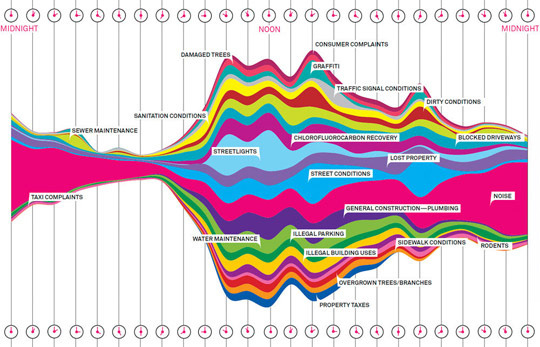
Here's the 311: Data graphic--What New Yorkers Complain About During Each Hour of the Day

Via I Love Charts:

Get Ready for the New Obamacare Investment Tax

I'm guessing some smart young tax advisers have already gamed out the effect the tax will have on markets, business broking and home sales (over the cap gains 'threshold').
The medical device manufacturer stocks are already getting whacked. I thought the paper companies eligibility for the Black Liquor tax ended a couple years ago:
International Paper first-quarter profit grew 93% (Sweet Liquor Eases the Pain*)

From the Wall Street Journal:
It really is happening.

Until this week, investors were waiting to see what the Supreme Court would do about the 3.8 percentage-point surtax on investment income, part of President Obama's health-care overhaul. The Internal Revenue Service hasn't yet released guidance on the new tax.

So when the court affirmed the law on Thursday, investors—and tax advisers—started scrambling.

The new tax, which Congress passed in 2010, affects the net investment income of most joint filers with adjusted gross income of more than $250,000 ($200,000 for single filers). Starting on Jan. 1, 2013, the tax rates on long-term capital gains and dividends for these earners will jump from their current historic low of 15% to 18.8%, assuming Congress extends the current law.

If, on the other hand, Congress allows the tax rates set in 2001 and 2003 to expire on Dec. 31—an unlikely scenario, according to many experts—the top rate on capital gains will rise to 23.8% and the top rate on dividends will nearly triple, to 43.4%.

Whatever the fate of the 2001-03 tax rates, advisers are telling clients to start making moves to minimize the new levy.

Beatrice Mitchell of Sperry Mitchell in New York, a broker of middle-market businesses, says she expects that entrepreneurs looking to sell companies will hurry to do so this year and forgo installment sales, in order to avoid paying the 3.8% surtax.
"Business sellers haven't been paying attention to this tax, but now they are," she says, adding that one client, the head of a 2,000-employee firm, "is in shock."...MORE
The Washington Times put together a list of a few of the various taxes in the bill, we'll have the full list next week: 

"Caffeine: A User’s Guide to Getting Optimally Wired"

From Developing Intelligence:
Caffeine is the most widely used stimulant in the world, but few use it to maximal advantage. Get optimally wired with these tips.

1) Consume in small, frequent amounts.
Between 20-200mg per hour may be an optimal dose for cognitive function.
Caffeine crosses the blood-brain barrier quickly (owing to its lipid solubility) although it can take up to 45 minutes for full ingestion through the gastro-intestinal tract. Under normal conditions, this remains stable for around 1 hour before gradually clearing in the following 3-4 hours (depending on a variety of factors).
A landmark 2004 study showed that small hourly doses of caffeine (.3mg per kg of body weight [approx 20 mg per hour; thanks digg!]) can support extended wakefulness, potentially by counteracting the homeostatic sleep pressure, which builds slowly across the day and acts preferentially on the prefrontal cortex (an area of the brain thought responsible for executive and “higher” cognitive functions).
At doses of 600mg, caffeine’s effects on cognitive performance are often comparable to those of modafinil, a best-of-class nootropic.

2) Play to your cognitive strengths while wired.
Caffeine may increase the speed with which you work, may decrease attentional lapses, and may even benefit recall – but is less likely to benefit more complex cognitive functions, and may even hurt others. Plan accordingly (and preferably prior to consuming caffeine!)
Caffeine has long been known to improve vigilance, but work focusing on its more more cognitive effects – through interactions with the “frontal task network” – show less clear effects.
In tests of lateral prefrontal function, caffeine only remediates some fatigue-related symptoms. For example, in a random number generation task (a commonly-used measure of prefrontal function), caffeine increased the quantity of numbers generated to pre-fatigue levels, but did not significantly affect more demanding aspects of performance: caffeine didn’t affect the likelihood of subjects generating numbers outside the acceptable range, or their tendency to perseverate on particular numbers.

Another study indicates the same is true of caffeine’s effect on the medial prefrontal cortex. In that study, sleep deprivation-related decrements on the Iowa Gambling Task were not mitigated by caffeine.
The Stroop task, which a wealth of neuroimaging shows is related to functioning of the anterior cingulate, may also benefit from caffeine, but this effect may also be due to general speed improvements rather than those of cognitive control specifically.

(Interestingly, it appears that none of these studies follow guideline #1 – and there are hints in the second one that subject’s performance might have shown significant improvements if another dose of caffeine had been provided about half-way through the task).
Recall from memory may be improved by caffeine (here and here), possibly due to enhancements in memory encoding rather than retrieval per se. Another study shows caffeine can actually impair estimates of “memory scanning” speed (in the Sternberg paradigm), so the failure of many studies to find recall-related effects of caffeine may reflect a speed-accuracy tradeoff at the time of retrieval.

3) Play to caffeine’s strengths.
Caffeine’s effects can be maximized or minimized depending on what else is in your system at the time. ...MORE
We first linked to this in 2008 with a HT to Freakonomics but this time the HT for the reminder goes to Barking up the Wrong Tree.
Also at Barking:
What's the secret to amazing naps?

Previously:
The more in-depth "What Caffeine Actually Does to Your Brain.