Showing posts sorted by date for query saudi syria. Sort by relevance Show all posts

Monday, April 13, 2026

"Trump’s Road to Riyadh: The Geopolitics of AI and Energy Infrastructure"

In 2025 the Trump administration pulled the Persian Gulf Arab states—the GCC—much closer to the U.S. through a series of deals/agreements/investments. 
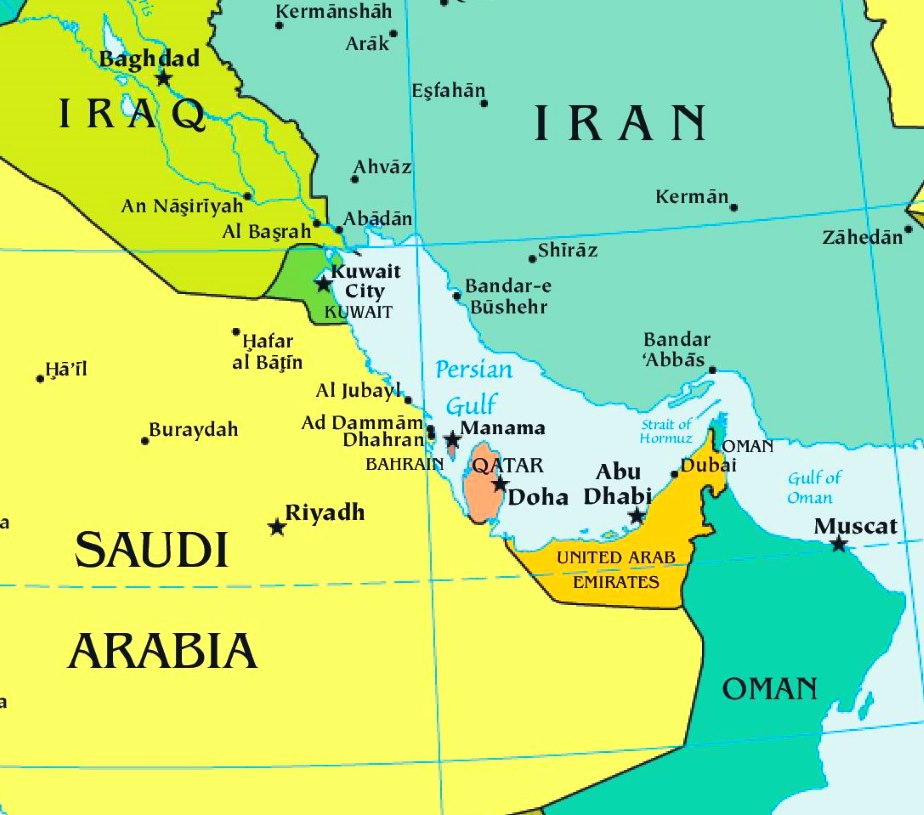
 

That series of events were crucial for understanding the current reality.  

From American Affairs Journal:

Something big happened in the Persian Gulf in May 2025. Donald Trump, fresh off one of the most astonishing comebacks in recent political history, hopped from one Arab capital to the next. He was greeted not merely as a visiting head of state but as something like a returning emperor. The images were surreal: camel processions, sword dances, ululating crowds, gleaming skyscrapers, and desert megaprojects rising from the sand like mirages. Even more staggering were the numbers. By the end of his tour of Saudi Arabia, Qatar, and the United Arab Emirates, Trump announced that U.S. companies had signed deals worth an eye-watering $2 trillion.1 This was, by any measure, the sale of the century, crafted by a man who styles himself as the ultimate dealmaker. But what kind of world order was being built in the Gulf, and how did we get here?

To understand what was unfolding in the Gulf, we need to rewind. The deeper logic of this new order wasn’t born in a single summit; it emerged, barely noticed, through a series of seemingly disconnected events over the last two years. The subsequent outbreak of a brief but dramatic shooting war between Israel and Iran—and the U.S. intervention it induced—are not likely to change its overall trajectory and may ultimately function to solidify it.

A Tale of Ambition and High Stakes

Throughout President Biden’s four years in office, his administration found itself increasingly entangled in the world’s oldest geopolitical trip wires. Against the backdrop of a high-stakes confrontation with Russia over Ukraine, and a simmering confrontation with China over trade and technology, the press talked about a “New Cold War.” In a bold gambit to regain the strategic advantage, President Joe Biden unveiled a flagship project at the September 2023 G20 Summit in New Delhi: a new trade corridor linking India to Europe via the Arabian Peninsula, dubbed the India–Middle East–Europe Corridor, or IMEC.2 It was touted as the West’s response to the Belt and Road Initiative (BRI), Beijing’s global enterprise linking roads, ports, and railways with the goal of making China the center of a vast Eurasian trade network.

But just one month after Biden’s news conference, Hamas launched its devastating October 7 attack on Israel, plunging the region into chaos and disrupting the fragile normalization talks between Israel and Saudi Arabia. The fallout sent shockwaves through the very region IMEC was meant to stabilize, casting doubt on the project’s future.

At the same time, as if in a parallel universe, another portentous development was unfolding. This one less bloody but no less destabilizing: artificial intelligence (AI) had moved from speculative hype to a widely accessible everyday technology, with potentially world-transforming impact. OpenAI, the company at the forefront of this revolution, began with no clear business model. Its founders half-joked that once they built an Artificial General Intelligence (AGI), they’d simply ask it how to generate returns. But with the release of ChatGPT in 2022 and the broader generative AI boom that followed, the company stumbled into a business model: automation at scale.

By late 2024, however, OpenAI was no longer a scrappy research outfit. Rather, it was a financial blackhole with geopolitical consequences. The financial demands of developing cutting-edge AI had become staggering. In that year alone, the company lost $5 billion.3 Its CEO, Sam Altman, a lean figure with steel-blue eyes and an uncanny ability to command attention without theatrics, understood what few others did: there was no turning back. The only way out of the debt trap was through.

So Altman doubled down. He envisioned a global infrastructure network to match the scale of his ambition: a $7 trillion blueprint to build the physical and digital scaffolding for the AI age.4 That sum exceeded Japan’s GDP and the combined market capitalization of Apple and Microsoft. But to Altman, it wasn’t optional; it was urgent. In a widely circulated blog post, he warned that without massive new compute supply, AI could become “a very limited resource that wars get fought over.”5

There was also a more calculated logic at play. By building and controlling the infrastructure of compute, OpenAI could secure a dominant position in the AI economy, just as Amazon had done by monopolizing the infrastructure of online commerce. Altman’s blueprint called for a massive buildout: data centers, semiconductor fabs, power plants, high-capacity fiber networks, and new trade corridors. He pitched the plan not only to Microsoft and Nvidia but also to Persian Gulf governments.

By then, Gulf sovereign wealth funds had already pivoted toward AI at scale. In 2024, Gulf states—the UAE, Saudi Arabia, Qatar, and Kuwait—dramatically ramped up AI investments, collectively committing tens of billions in funds, data centers, and strategic infrastructure. Altman, alongside other U.S. AI executives, began quietly deepening ties with these regimes.

At the center of Altman’s courtship stood a shadowy figure who represented his country’s towering ambition to become an AI superpower. His name is Sheikh Tahnoun bin Zayed. He is brother to the ruler of the United Arab Emirates, Mohamed Bin Zayed, and his national security advisor. Tahnoun also serves as his country’s AI czar. Tahnoun heads both the MGX fund, an Emirati investment firm in AI with $100 billion in capital, and G42, a vast technology conglomerate involved in fields ranging from AI to biotechnology, with particular expertise in government-backed cyber operations and surveillance systems.6 These roles give Tahnoun unmatched leverage across the region’s AI, finance, and compute sectors. Tahnoun’s master plan and Altman’s grand strategy overlapped, and they began working hand in hand. Thus, Altman’s vision for planetary AI infrastructure had found its anchor in the fossil-fuel-rich, regulation-light economies of the Persian Gulf.

While the Biden administration signaled its commitment to constraining the global diffusion of American AI technology by imposing more and more export controls, Altman was already forging the deals that would make such constraints obsolete. His revolution needed capital, land, and dispatchable power, and the Gulf was the only place offering all three.

Altman was not alone. His turn to the Gulf reflected a broader convergence, one that would come to define the coalition behind Trump’s return to power. It was an amalgam of AI moguls, cryptofinanciers, fossil fuel interests, and real estate developers. What binds Trump’s business coalition is the structural interdependence of its core sectors—AI, crypto, energy, and real estate—each feeding the infrastructural needs of the others. AI is the engine: it demands colossal compute resources, generates vast data flows, and drives the automation of decision-making across sectors. Crypto is the payment system: it monetizes usage, distributes rewards, and enables capital to flow across borders without much regulatory friction. But these technologies are intensely resource-hungry. They require a constant, high-volume energy supply, something intermittent renewables can’t provide. This is also why the coalition favors fossil fuels and nuclear, since only they offer the stability and scale needed.

All of this—compute, power, fiber, liquidity—ultimately rests on real estate. Land, buildings, and zoning regimes form the chassis of the entire system. Data centers, energy hubs, and submarine cable landing stations must be physically sited, cooled, secured, and connected.

The Middle East, particularly the Persian Gulf, has reemerged as a strategic hub for Trump’s business coalition. With its abundant dispatchable energy, permissive regulatory regimes, and position at the intersection of global trade routes, the Gulf is uniquely positioned to anchor the infrastructure of the AI age. The coalition’s ascent, enabled by the election of the AI-industry-aligned Trump, meant that Biden’s IMEC project, long stalled by regional conflict, would now be retooled and repurposed.

IMEC retained its original ambition: to link Europe and Asia through a secure, high-capacity trade corridor. But under Trump, it acquired an additional layer, a digital one. The emphasis shifted to the corridor’s southern leg, the route connecting Gulf-based data centers with India’s vast pool of educated, low-cost office labor. How these Gulf data campuses will link to European markets remains unclear, but Trump’s visit offered some hints that will be explored below. As under Biden, the project still aligns with the Gulf monarchies’ goals of diversifying income, gaining access to advanced technologies, and elevating their global relevance.

Yet under Trump, the political logic of IMEC has shifted dramatically. No longer a multilateral initiative shepherded by technocrats and international institutions, the corridor is now turning into a privatized artery of power governed not by memoranda of understanding or diplomatic summits, but by sovereign wealth funds, ambitious tech firms, and transactional deal-making.

To be sure, the Trump administration has floated other infrastructural ambitions: a land bridge through Canada and Greenland to the emerging Transpolar Sea Route and a renewed push to control chokepoints like the Panama Canal.7 But these remain geopolitical mirages: underdeveloped, logistically uncertain, and disconnected from any coherent implementation strategy. IMEC, by contrast, is real, resilient, and already underway. After a year of regional upheaval, it is paradoxically more secure than ever, bolstered by a convergence of interests among Gulf states and countries like Iraq, Syria, and Turkey, all of which see in the corridor a path to integration, logistical leverage, and infrastructure rents. It is moving rapidly from planning to execution and, unlike most of Trump’s ventures, reflects a rare alignment of capital, geography, and strategic intent.

To understand how the road to Riyadh became the epicenter of Trump’s Eurasian strategy, we must return to New Delhi, where Biden first launched the corridor.

From Biden to Trump: IMEC under New Management

The announcement of IMEC at the September 2023 G20 Summit in the Indian capital marked a rare moment of transcontinental alignment, with India, the United States, the European Union, and key Gulf states as signatories. But the corridor wasn’t just a symbolic rebuke to Beijing. It was a strategic effort to anchor India more firmly in the Western orbit without demanding formal alignment. By improving India’s access to European markets and channeling Gulf capital into regional logistics infrastructure, the United States hoped to offer Indian Prime Minister Narendra Modi a viable alternative to deepening ties with China or Russia. The goal was not to absorb India into an alliance but to prevent its gravitational drift toward a rival Eurasian bloc.

At stake was not just competition with China’s BRI, with its Northern and Middle Corridors linking China to Europe through Russia and Central Asia, but also competition with yet another rival trade route, the Russian- and Iranian-backed International North–South Transport Corridor (INSTC).8 That project, nearly complete, connects Russia, Iran, and India through a web of ports, rails, and Caspian crossings. IMEC was a bet that India’s ambitions could be turned westward not by ideology but by infrastructure.

IMEC was Biden’s attempt to carve a U.S.-aligned corridor through the heart of Eurasia’s infrastructure contest, which would mean a resilient supply chain outside of China’s reach. Accordingly, IMEC was framed as a state project: rooted in formal diplomacy, coordinated with the European Union, aligned with Israel, and backed by a growing U.S. military footprint in the eastern Mediterranean and Red Sea. And in many ways, it was the last major push of a technocratic, multilateral hegemony: coordinated through formal diplomacy, reliant on NATO and EU frameworks, and governed by elite consensus rather than charismatic politics or brute coercion.

That vision unraveled on October 7, 2023. As later revealed by internal Hamas records, the attack was not merely about Gaza. It aimed to disrupt the regional realignment that IMEC depended on, particularly the pending normalization of ties between Saudi Arabia and Israel, which threatened to marginalize Hamas diplomatically. Iran responded by activating its regional network: Hezbollah in Lebanon, militias in Iraq and Syria, and the Houthis in Yemen. Tehran saw IMEC not just as a Western power play but as a direct competitor to its own strategic corridor, the INSTC, a project it views as a tool to overcome the stringent sanctions imposed by the United States and European Union. The resulting conflict spiraled into a full-blown regional war. What had begun as a diplomatic corridor became a battlefield.

In 2024, the Biden administration mounted one of the largest U.S. military deployments to the region since the Iraq War, positioning carrier strike groups, air defenses, and strategic bombers to deter direct Iranian escalation. American protection shielded Israel from large-scale missile attacks and enabled the IDF to inflict serious damage on Hezbollah and Hamas. The collapse of Assad’s regime in Syria, following Hezbollah’s defeat, delivered a major blow to Iranian influence. The Biden administration hoped that these battlefield gains would revive the push toward Israeli-Saudi normalization and breathe life back into IMEC.

Under Biden, artificial intelligence had been deliberately fenced off from corridor diplomacy. The administration viewed AI through the lens of national security, not market expansion. Beginning in 2023 and continuing into 2024, Washington imposed strict export controls on AI-enabling chips, citing risks of diversion to China. These controls affected Gulf states like the UAE, requiring a U.S. license to obtain advanced semiconductors such as Nvidia’s H100.9 Nevertheless, the UAE pushed back hard. In 2024, Tahnoun bin Zayed, the UAE’s national security advisor, led an intensive campaign to gain exemptions from these controls. The Emirati conglomerate G42 was at the center of this push. It had already severed ties with China’s Huawei and rebranded as a trusted U.S. partner. But American intelligence agencies weren’t convinced. G42’s historic entanglements with Beijing, its use of Chinese‑built infrastructure, and its role in spyware operations all raised red flags. CIA briefings warned of backdoor leakage of U.S. tech to Chinese actors via G42, while then Commerce Secretary Gina Raimondo and CIA Director William Burns personally traveled to Abu Dhabi to press for tighter controls.10....

....MUCH MORE 

Originally posted August 30, 3035

Some of our posts from the Spring of 2025:

May 13 - "GE Vernova to export $14.2 billion in turbines, energy solutions to Saudi Arabia, US says" (GEV) 

May 14 - "Yahoo Finance: Nvidia stock extends gains as Saudi Arabia set to spend billions on AI chips, US moves to rescind Biden's chip curbs" (NVDA)

May 15, 2025 -  U.S. Still Mulling Whether To Allow Nvidia To Sell One Million+ Most Powerful Chips To UAE

First up, some of the deals that were announced today. From Bloomberg, May 15:

Trump Touts $200 Billion in UAE Deals in Wrapping Mideast Trip

US President Donald Trump has secured $200 billion in deals during a visit to the United Arab Emirates, according to the White House, including agreements involving artificial intelligence that will boost the Gulf nation’s technological ambitions.

“These deals will significantly expand investment in the United States and U.S. market access in the United Arab Emirates,” the White House said in a statement Thursday.

The announcements came during the third and final leg of the US president’s visit to the Middle East, where he highlighted investments earlier in the week of $600 billion from Saudi Arabia and more than $243 billion with Qatar. Trump made scoring business deals a centerpiece of his first planned overseas trip since returning to office.

The deals and initiatives with the UAE include:

AI has been central to many of the agreements Trump has negotiated in the region. Gulf nations have been eager to secure greater access to cutting-edge chips in a bid to become hubs for the emerging technology and diversify their economies. Thursday’s announcements include:

  • Plans for Qualcomm Inc. to help develop a new “global engineering center” in Abu Dhabi focused on AI and data centers.
  • A new AI campus in the UAE that will be built by G42, the crown jewel of the country’s tech ambitions, and operated in partnership with several US companies. The US Commerce Department said the campus will include 5 gigawatts of capacity for AI data centers, providing a regional platform for large-scale providers of cloud or computing services.
  • Amazon Web Services Inc., e& — formerly telecom company Etisalat — and the UAE Cybersecurity Council will partner on bolstering public cloud services in the country....

....MORE 

May 28 - UAE's ENEC And GE Vernova Hitachi Sign Memorandum To Explore Deploying Small Modular Reactors Internationally (GEV) 

Saturday, August 30, 2025

"Trump’s Road to Riyadh: The Geopolitics of AI and Energy Infrastructure"

From American Affairs Journal, Fall 2025 / Volume IX, Number 3:

Something big happened in the Persian Gulf in May 2025. Donald Trump, fresh off one of the most astonishing comebacks in recent political history, hopped from one Arab capital to the next. He was greeted not merely as a visiting head of state but as something like a returning emperor. The images were surreal: camel processions, sword dances, ululating crowds, gleaming skyscrapers, and desert megaprojects rising from the sand like mirages. Even more staggering were the numbers. By the end of his tour of Saudi Arabia, Qatar, and the United Arab Emirates, Trump announced that U.S. companies had signed deals worth an eye-watering $2 trillion.1 This was, by any measure, the sale of the century, crafted by a man who styles himself as the ultimate dealmaker. But what kind of world order was being built in the Gulf, and how did we get here?

To understand what was unfolding in the Gulf, we need to rewind. The deeper logic of this new order wasn’t born in a single summit; it emerged, barely noticed, through a series of seemingly disconnected events over the last two years. The subsequent outbreak of a brief but dramatic shooting war between Israel and Iran—and the U.S. intervention it induced—are not likely to change its overall trajectory and may ultimately function to solidify it.

A Tale of Ambition and High Stakes

Throughout President Biden’s four years in office, his administration found itself increasingly entangled in the world’s oldest geopolitical trip wires. Against the backdrop of a high-stakes confrontation with Russia over Ukraine, and a simmering confrontation with China over trade and technology, the press talked about a “New Cold War.” In a bold gambit to regain the strategic advantage, President Joe Biden unveiled a flagship project at the September 2023 G20 Summit in New Delhi: a new trade corridor linking India to Europe via the Arabian Peninsula, dubbed the India–Middle East–Europe Corridor, or IMEC.2 It was touted as the West’s response to the Belt and Road Initiative (BRI), Beijing’s global enterprise linking roads, ports, and railways with the goal of making China the center of a vast Eurasian trade network.

But just one month after Biden’s news conference, Hamas launched its devastating October 7 attack on Israel, plunging the region into chaos and disrupting the fragile normalization talks between Israel and Saudi Arabia. The fallout sent shockwaves through the very region IMEC was meant to stabilize, casting doubt on the project’s future.

At the same time, as if in a parallel universe, another portentous development was unfolding. This one less bloody but no less destabilizing: artificial intelligence (AI) had moved from speculative hype to a widely accessible everyday technology, with potentially world-transforming impact. OpenAI, the company at the forefront of this revolution, began with no clear business model. Its founders half-joked that once they built an Artificial General Intelligence (AGI), they’d simply ask it how to generate returns. But with the release of ChatGPT in 2022 and the broader generative AI boom that followed, the company stumbled into a business model: automation at scale.

By late 2024, however, OpenAI was no longer a scrappy research outfit. Rather, it was a financial blackhole with geopolitical consequences. The financial demands of developing cutting-edge AI had become staggering. In that year alone, the company lost $5 billion.3 Its CEO, Sam Altman, a lean figure with steel-blue eyes and an uncanny ability to command attention without theatrics, understood what few others did: there was no turning back. The only way out of the debt trap was through.

So Altman doubled down. He envisioned a global infrastructure network to match the scale of his ambition: a $7 trillion blueprint to build the physical and digital scaffolding for the AI age.4 That sum exceeded Japan’s GDP and the combined market capitalization of Apple and Microsoft. But to Altman, it wasn’t optional; it was urgent. In a widely circulated blog post, he warned that without massive new compute supply, AI could become “a very limited resource that wars get fought over.”5

There was also a more calculated logic at play. By building and controlling the infrastructure of compute, OpenAI could secure a dominant position in the AI economy, just as Amazon had done by monopolizing the infrastructure of online commerce. Altman’s blueprint called for a massive buildout: data centers, semiconductor fabs, power plants, high-capacity fiber networks, and new trade corridors. He pitched the plan not only to Microsoft and Nvidia but also to Persian Gulf governments.

By then, Gulf sovereign wealth funds had already pivoted toward AI at scale. In 2024, Gulf states—the UAE, Saudi Arabia, Qatar, and Kuwait—dramatically ramped up AI investments, collectively committing tens of billions in funds, data centers, and strategic infrastructure. Altman, alongside other U.S. AI executives, began quietly deepening ties with these regimes.

At the center of Altman’s courtship stood a shadowy figure who represented his country’s towering ambition to become an AI superpower. His name is Sheikh Tahnoun bin Zayed. He is brother to the ruler of the United Arab Emirates, Mohamed Bin Zayed, and his national security advisor. Tahnoun also serves as his country’s AI czar. Tahnoun heads both the MGX fund, an Emirati investment firm in AI with $100 billion in capital, and G42, a vast technology conglomerate involved in fields ranging from AI to biotechnology, with particular expertise in government-backed cyber operations and surveillance systems.6 These roles give Tahnoun unmatched leverage across the region’s AI, finance, and compute sectors. Tahnoun’s master plan and Altman’s grand strategy overlapped, and they began working hand in hand. Thus, Altman’s vision for planetary AI infrastructure had found its anchor in the fossil-fuel-rich, regulation-light economies of the Persian Gulf.

While the Biden administration signaled its commitment to constraining the global diffusion of American AI technology by imposing more and more export controls, Altman was already forging the deals that would make such constraints obsolete. His revolution needed capital, land, and dispatchable power, and the Gulf was the only place offering all three.

Altman was not alone. His turn to the Gulf reflected a broader convergence, one that would come to define the coalition behind Trump’s return to power. It was an amalgam of AI moguls, cryptofinanciers, fossil fuel interests, and real estate developers. What binds Trump’s business coalition is the structural interdependence of its core sectors—AI, crypto, energy, and real estate—each feeding the infrastructural needs of the others. AI is the engine: it demands colossal compute resources, generates vast data flows, and drives the automation of decision-making across sectors. Crypto is the payment system: it monetizes usage, distributes rewards, and enables capital to flow across borders without much regulatory friction. But these technologies are intensely resource-hungry. They require a constant, high-volume energy supply, something intermittent renewables can’t provide. This is also why the coalition favors fossil fuels and nuclear, since only they offer the stability and scale needed.

All of this—compute, power, fiber, liquidity—ultimately rests on real estate. Land, buildings, and zoning regimes form the chassis of the entire system. Data centers, energy hubs, and submarine cable landing stations must be physically sited, cooled, secured, and connected.

The Middle East, particularly the Persian Gulf, has reemerged as a strategic hub for Trump’s business coalition. With its abundant dispatchable energy, permissive regulatory regimes, and position at the intersection of global trade routes, the Gulf is uniquely positioned to anchor the infrastructure of the AI age. The coalition’s ascent, enabled by the election of the AI-industry-aligned Trump, meant that Biden’s IMEC project, long stalled by regional conflict, would now be retooled and repurposed.

IMEC retained its original ambition: to link Europe and Asia through a secure, high-capacity trade corridor. But under Trump, it acquired an additional layer, a digital one. The emphasis shifted to the corridor’s southern leg, the route connecting Gulf-based data centers with India’s vast pool of educated, low-cost office labor. How these Gulf data campuses will link to European markets remains unclear, but Trump’s visit offered some hints that will be explored below. As under Biden, the project still aligns with the Gulf monarchies’ goals of diversifying income, gaining access to advanced technologies, and elevating their global relevance.

Yet under Trump, the political logic of IMEC has shifted dramatically. No longer a multilateral initiative shepherded by technocrats and international institutions, the corridor is now turning into a privatized artery of power governed not by memoranda of understanding or diplomatic summits, but by sovereign wealth funds, ambitious tech firms, and transactional deal-making.

To be sure, the Trump administration has floated other infrastructural ambitions: a land bridge through Canada and Greenland to the emerging Transpolar Sea Route and a renewed push to control chokepoints like the Panama Canal.7 But these remain geopolitical mirages: underdeveloped, logistically uncertain, and disconnected from any coherent implementation strategy. IMEC, by contrast, is real, resilient, and already underway. After a year of regional upheaval, it is paradoxically more secure than ever, bolstered by a convergence of interests among Gulf states and countries like Iraq, Syria, and Turkey, all of which see in the corridor a path to integration, logistical leverage, and infrastructure rents. It is moving rapidly from planning to execution and, unlike most of Trump’s ventures, reflects a rare alignment of capital, geography, and strategic intent.

To understand how the road to Riyadh became the epicenter of Trump’s Eurasian strategy, we must return to New Delhi, where Biden first launched the corridor....

....MUCH MORE 

Saturday, April 13, 2024

"Roster of Iran’s Drones"

Iran's developed a lot of them.

From Iran Primer, April 12:

By 2024, Iran’s military-industrial complex had produced thousands of advanced drones used for surveillance, reconnaissance, and combat used against U.S. forces as well as American allies in the Middle East. The drones (unmanned aerial vehicles) have become one of the greatest assets of the Iranian-backed “Axis of Resistance”—a network of militias in Iraq, Syria, Lebanon, and Yemen—and one of the greatest dangers to Iran’s regional rivals. Among notable attacks that marked turning points in diverse Middle East conflicts:

  • On Jan. 28, 2024, an Iranian-made drone attacked Tower 22, a U.S. outpost in Jordan along the Iraq and Syrian borders, that killed three American soldiers and injured more than 40.
  • In January 2024, 18 Iranian-designed drones were fired by the Houthis in Yemen on ships in the Red Sea.
  • In September 2019, drones and cruise missiles fired from Iran attacked Saudi Arabia’s largest oil processing facility, temporarily crippling almost half of the kingdom’s petroleum output.

Iranian-backed militias began using drones against U.S. military and diplomatic targets in Iraq and Syria in 2021. In 2021 and 2022, Iranian-designed drones were linked to at least 20 percent of attacks launched by militias linked to Tehran, according to War on the Rocks. Drone attacks on targets in Syria, Iraq and Jordan increased again after war erupted between Hamas and Israel on Oct. 7, 2023. Iran has also supplied hundreds of drones to Russia, beginning in 2022, that have been used against civilian and military targets in Ukraine. Russia established its own industry to replicate Iranian drone models.

Drones “pose the most immediate threat to Middle East security because of their low cost, widespread availability, and potential deniability—since their point of origin can be disguised by employing a convoluted flight path,” Gen. Kenneth F. McKenzie Jr., former head of U.S. Central Command, wrote in a paper for the Washington Institute. The technology has produced “an inflection point in aerial warfare—comparable to the introduction of manned flight more than a century ago—that has ended the guarantee of U.S. air superiority over its forces and bases,” he warned in February 2023.

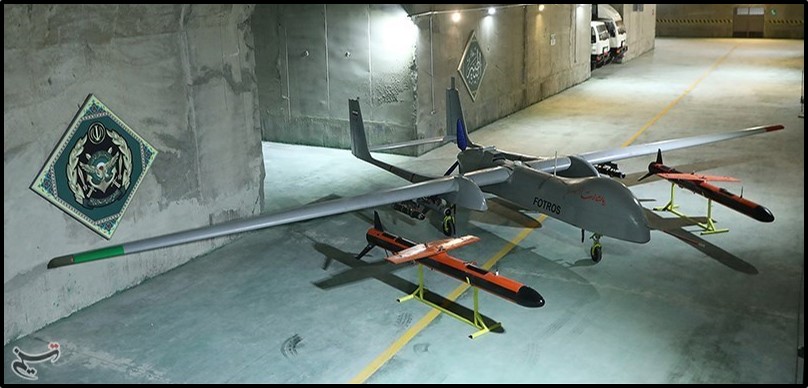
Fotros
Fotros reconnaissance, surveillance, and combat drone

Iran’s drones have diverse capabilities:

  • Suicide drones: Iran has at least 10 different models of suicide drones, which explode on impact. They can be as accurate as a ballistic missile, but they can fly lower to evade radar. Smaller models, such as the Shahed-136, carry less than 45 kilograms (100 pounds) of explosives. One of the smallest models, the Meraj-521, carries only 3 kilograms (6.6 pounds) of explosives. Many are slow and therefore easier to shoot down by anti-aircraft guns or missiles. Their ranges are as little as 5 kilometers (3 miles) or as far as 2,500 kilometers (1,550 miles). Iran’s largest suicide drones, such as the Arash series, can carry nearly 260 kilograms (575 pounds) of explosives. They have ranges of 2,000 kilometers (1,240 miles).
     
  • Combat and surveillance drones: Iran has more than a dozen models of combat drones that can attack ground, sea or air targets and then return to base. Larger models, such as the Shahed-149, have ranges of 2,000 kilometers (1,240 miles) and can carry up to 500 kilograms (1,100 pounds) of munitions or electronic equipment.

    Most of Iran’s combat drones, including long-range models, also have surveillance capabilities. Their functions range from taking photographs and video footage to marking targets for bombers, fighters or other drones. Iran also has smaller surveillance-only drones, such as the Hodhod-1, which have ranges as short as 30 kilometers (18 miles). They can only remain in the air for an hour or two at a time.

Several of Iran’s drones were modeled on captured U.S. drones, including the Predator, Reaper, Sentinel and ScanEagle 5 as well as the Israeli Hermes drone. Iran has mimicked the shapes of the UAVs but has not necessarily replicated all of the sophisticated on-board electronics. Iran has, however, succeeded in importing U.S.-made parts – almost certainly through intermediaries – for less-advanced drones, including the Shahed-136.

Since 2015, Iran has reportedly launched drones on Saudi oilfields, dissident groups in Pakistan and Iraqi Kurdistan, and jihadi groups in Syria. In 2018, the Islamic Revolutionary Guard Corps (IRGC) claimed to have conducted 700 drone strikes against ISIS targets in Syria alone. Iran has deployed armed drones beyond its borders. Tehran began exporting drone technology to Hezbollah, a Shiite militia in Lebanon, in the 2000s. In 2004, Hezbollah became the world’s first non-state actor to use military drones. And in 2006, Hezbollah – with Iran’s help – used armed drones during its 34-day war with Israel. Iran has exported drones or the technology to six other proxy militias and five governments, including Russia, Venezuela, Sudan, Ethiopia and Tajikistan. The following is a rundown of Iran’s most important drones, which are operated by both IRGC and the Artesh, or conventional military....

....MUCH MORE

Earlier:
Iranian Drone Attack Launched On Israel

Sunday, January 14, 2024

Just A Reminder: "The World's Densest Network of Oil Pipelines Runs Through Sunni Saudi Arabia's Shia Heartland."

We posted this eight years ago when Sunni - Shia animosity was running a bit hot.

January 5, 2016

From The Telegraph:

Saudi showdown with Iran nears danger point for world oil markets 

The Persian Gulf has become a strategic tinderbox.  
Saudi Arabia’s drastic decision to behead the Shia cleric Nimr al-Nimr marks a point of no return in the bitter Sunni-Shia conflict engulfing the region. It is a dangerous escalation in the Kingdom's struggle with Iran for regional hegemony.
Iran’s Revolutionary Guard has vowed swift and harsh revenge, promising to bring down the Saudi dynasty in short order to avenge this “medieval act of savagery”.
Brent crude jumped to a three-week high of $38.91 a barrel as traders began to price in the first flickers of political risk. Roughly a fifth of global oil supply passes through the Strait of Hormuz, where tankers would in extremis have to run the gauntlet past Iranian warships.

Helima Croft, from RBC Capital Markets, said investors have yet to wake up to the full danger. “If we’d had scenes five years ago of the Saudi embassy in flames in Tehran there would have been a big move in the price, but right now there is so much over-supply and people just seem to think this is all noise. They have yet to get their heads around what can go wrong,” she said.
'It will likely trigger a civil war that won’t end until the Saudi monarchy ceases to exist'
Ali al-Ahmed, director of the Institute for Gulf Affairs in Washington 
The risk for the Saudis is that the execution of Sheikh Nimr for what is essentially peaceful political protest ignites a long-simmering revolt by an aggrieved Shia minority, who make up 15pc of the population and are sitting on top of the giant Saudi oil fields in the Eastern Province. There were violent protests in the Sheikh’s home-town of Qatif on Monday, with at least one protestor shot dead by police.

Ali al-Ahmed, director of the Institute for Gulf Affairs in Washington, said Qatif is the nerve-centre of the Saudi petroleum industry, the so-called “Grand Central Station” where 12 pipelines come close together to supply the huge oil terminals at Ras Tanura and Dharan.
These pipelines are close to major roads and towns, making them hard to police against “hit and run” attacks.


Most of Saudi Arabia’s 10.3m barrels a day (b/d) of output passes through the Shia heartland, now seething with fury. While global crude stocks are at record levels, there is no spare capacity outside Saudi Arabia. A disruption lasting more than a few days could cause oil prices to spike violently – possibly to $200 or more – triggering a worldwide economic crisis.

Mr al-Ahmed said the mass executions have set in motion a fateful chain of events that nobody can now control. “It will likely trigger a bloody civil war that won’t end until the Saudi monarchy ceases to exist. This cycle of violence will not spare anyone or anything, including the coveted oil installations,” he said.

Bahrain and Sudan have already followed Saudi Arabia’s move to cut off diplomatic relations with Iran, and the United Arab Emirates has recalled its ambassador. The lines of cleavage are painfully clear in a Middle East already convulsed by four wars, and sliding closer to all-out conflagration.
Iran and Saudi Arabia severed ties from 1989 to 1992 but that was another era, when the US was at the height of its power, and willing to use it after the huge military build-up of the Reagan administration. There was then no civil war in Syria or Yemen....MORE

Sunday, January 7, 2024

"Afghan Taliban Leaders Silent After Reports Of Secret Visit To North Korea By Official Taliban Delegation Seeking Nuclear Weapons"

Some may not like what MEMRI reports but over the course of thousands of translations I think two were shown to be in error.

From the Middle East Media Research Institute, January 3 (also on blogroll at right): 

The Islamic Emirate of Afghanistan (IEA, i.e., the Afghan Taliban) is caught in an international controversy after it has come to light that an eight-member official Taliban delegation secretly visited North Korea to discuss cooperation on nuclear weapons technology.

Unnoticed by the world, Afghanistan has a long-standing nuclear energy program that was taken over by the Taliban mujahideen when they took control of Afghanistan in August 2021.[1] Afghanistan is a founding member of the International Atomic Energy Agency (IAEA), which was founded in 1957, and a nuclear laboratory was later established at the Kabul University.[2]

"I have reports indicating that a group of the Taliban is looking into how to access tactical nuclear weapons. Whether they can get them from Pakistan or pay engineers to get them. That is going to be a disaster," Rahmatullah Nabil, the former chief of the Afghanistan's intelligence agency, the National Directorate of Security (NDS), said at the Herat Security Dialogue, the annual conference on the situation in Afghanistan that was held on November 27-28, 2023, in Dushanbe, Tajikistan.[3]

Since Nabil belongs to the camp of the Taliban's political opponents, his comments were not taken seriously by many. However, on December 26, 2023, Sami Yousafzai, a senior Afghan journalist known for authoritative reports on Afghanistan and Pakistan, tweeted that the Taliban rulers are attempting to acquire nuclear weapons, and several Western intelligence agencies, alerted by Nabil's comment, have launched investigations into the Taliban's connections to North Korea.[4]

It is important that in his tweet, Yousafzai identified that Maulvi Abdul Rasheed Munib, the security chief of Kandahar and head of foreign relations for the Afghan Taliban intelligence, was on the eight-member delegation, which included six leaders from the Taliban's Ministry of Defense, on the secret visit to Pyongyang.[5]

The Taliban officials are known for making extensive use of social media networks such as Twitter and YouTube. However, since the allegations about the secret visit by the official Taliban delegation, all Taliban officials have maintained total silence, not denying the reports. A pro-Afghan Taliban account on Twitter even taunted the international community: "We are recognized by North Korea. We do not care about others."[6]

Sometime in February or March of 2023, the nuclear issue in Afghanistan attracted news headlines after the assassination of the head of the Bamyan Nuclear Energy Department, while one employee was injured.[7] At the time it was dismissed as part of a rivalry among Taliban officials, but due to a gag order from the Taliban governor of Bamyan province, all civil and military employees were barred from disclosing the incident to anyone, especially to media, and the name of the assassinated official was also not revealed.[8]

Afghanistan is surrounded by four states, all of whom are friendly with the Islamic Emirate of Afghanistan, that have nuclear weapons: Iran, Russia, Pakistan, and China. The region is known for nuclear proliferation involving Pakistan, with Pakistan's rogue nuclear scientist Dr. Abdul Qadeer Khan admitting in February 2004 that he shared Pakistan's nuclear technology with Iran, Libya, and North Korea for more than a decade.[9]

....MUCH MORE

Just to make the whole Sunni-Shia thing more interesting, January 10, 2016:
Pakistan Threatens To Wipe Iran Off the Face of The Earth If Saudi Arabia Threatened
In other news...

Just kidding with the 'in other news' schtick, a bit of whistling-past-the-graveyard humor while perusing Debka's:

« Breaking News »

Pakistan threatens to wipe Iran off the map if Saudi harmed
DEBKAfile January 10, 2016, 7:36 PM (IDT)
In Pakistan’s first transparent nuclear threat to Iran, its chief of army staff, Gen. Raheel Sharif, vowed Sunday to wipe Iran off the face of the earth if any harm came to Saudi Arabia. He gave this pledge to Saudi Deputy Crown Prince and Defense Minister Mohammed bin Salman, who was on a visit to a military base in Rawalpindi. 
As we often caveat [usage/grammar?], Debka has been known to spin a story to make a propaganda point but as we also emphasize, they have sources that intelligence agencies would literally kill for.

Daily Pakistan is using a more genteel headline:

Pakistan will strongly respond if Saudi Arabia attacked: COAS Raheel Sharif

ISLAMABAD (Staff Report) – Chief of Army Staff General Raheel Sharif has said Pakistan will strongly respond to any attack on Saudi Arabia, Inter-Service Public Relations said on Sunday.
During a one-and-half hour meeting with Saudi Arabia’s Deputy Crown Prince and Minister for Defence Mohammad Bin Salman Al Saud who called on him at General Headquarters, the COAS said Pakistan has good relations with every country in the region.

Pakistan has special relation with Saudi Arabia and values the relation between two countries, said the ISPR statement, adding that any attack on Saudi Arabia will be strongly countered.
The Saudi prince appreciated the efforts of Pakistan and its armed forces in war against terrorism, and also for keeping peace and stability in the region.

The Saudi prince was received by Defence Minister Khawaja Muhammad Asif and PM’s Adviser on Foreign Affairs Sartaj Aziz besides senior military and civil officers at Nur Khan Airbase. He went straight to General Headquarters after landing in the country.

This is the second high-profile visitor from Riyadh in three days. Foreign Minister Adel al-Jubeir visited Islamabad on Thursday for discussing Riyadh’s tensions with Tehran and the counter-terrorism coalition that Saudi Arabia has announced....MORE
ArabNews, Jan. 11 is going with "Deepening Saudi-Pakistan ties".
The ties are already pretty deep, Saudi Arabia financed A.Q. Khan, the Father of Pakistan's Nuclear Program.
Still, General Sharif speaking like this is noteworthy, to say the least.
Previously:
June 2012
"Riyadh to Beijing: We’ll Pay for Nuclear-Capable Ballistic Missiles with All the Oil You Need "


Nov. 2013
Saudi Arabia Has Nuclear Weapons ‘on order,’ Ready to Deliver from Pakistan: Report
Isn't that just special.
This crossed the wire earlier today (yesterday BST) but now there are a dozen other sources carrying the story.
The Saudis hate the Iranians and want to overthrow Assad in Syria.
They don't much like the Jews either
.

April 2014
"The risks of a nuclear Saudi Arabia"


May 2015
"Saudi Arabia to buy nuclear bombs from Pakistan: report"


August 2015 
"The Long-Term Oil Play"
Some of the easily identifiable considerations to plug into your model are the depressive effects of slowing population growth and international agreements to use force to further the stranded assets argument, the inflationary effects of a reduction in the total resource and more particularly in the lower cost plays and the could-go-either-way interplay of price and regulation in the development of alternative transportation and whether Saudi Arabia asks Pakistan to lend them 60-70 nukes until their domestic nuclear development program gets going.

Then there are the unknown unknowns....
 

Wednesday, October 25, 2023

Israel: The Furies Hamas Unleashed With Their Depraved Attacks Is About To Result In Their Complete Destruction

Looking at the actions of the Americans is all the foreshadowing one needs.

The coming Israeli response, which the Americans obviously have some (not complete) knowledge of, has so concerned the Pentagon that the American military is positioning for a mini-war of their own.

When we posted "U.S. Sends 26th Marine Expeditionary Unit, Navy Ships to Israel" last week it wasn't to fill space. We don't do that. It was posted because the MEU's are one of those groups that, like the Turkish Brigade* in Korea or the Ghurka on the train**, don't even think they might be outnumbered until it is 5 or 6 to 1 against them. They are the point on the tip of the spear.

The American's plan to be ready for any Hamas or Hezbullah or Syrian of Iranian blow back from the Israeli action.

If you've long-forgotten your Greek mythology, here's a quick sketch of the Furies.

Via ZeroHedge, October 25:

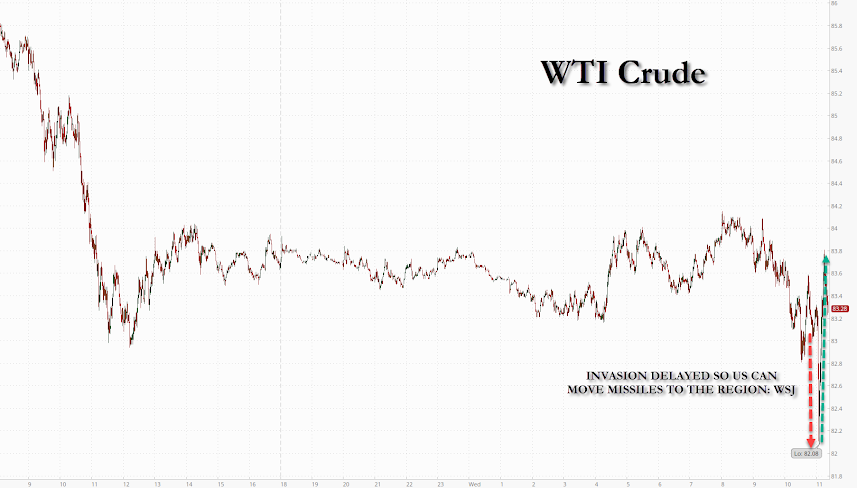
Israel Delays Gaza Invasion (Again) As US Scrambles To Put Missile Defenses In Place

Update(1128ET): Both US and Israeli officials have told The Wall Streat Journal in a breaking major development that Israel has decided to further stall its planned ground invasion of Gaza, at the request of Washington.

Though airstrikes have been ramped up, resulting in the Palestinian death toll soaring past 6,500 - it has become clear in the last several days that Israel has been waiting in terms of a ground assault. This also as four hostages have been freed due to negotiations involving Qatari mediation with Hamas. The WSJ frames this further delay, however, as related to putting additional air defense from the US in place.

"The Pentagon is scrambling to deploy nearly a dozen air-defense systems to the region, including for U.S. troops serving in Iraq, Syria, Kuwait, Jordan, Saudi Arabia and the United Arab Emirates, to protect them from missiles and rockets," the report says. "U.S. officials have so far persuaded the Israelis to hold off until those pieces can be placed, as early as later this week."

This is a sign that Washington is bracing for significant escalation to come. US Central Command (CENTCOM) yesterday revealed that last week US troops and installations in Iraq and Syria came under more than a dozen drone attacks, resulting in two dozen troop injuries, albeit described as "minor".

Crude prices jumped, as stocks fade, on the headline portending escalation, given the Pentagon is building up yet more major military assets in the Middle East...

Also yesterday, NSC spokesman John Kirby issued unprecedented words saying that more "innocent people" are going to die in Gaza. "This is war. It is combat. It is bloody. It is ugly, and it's going to be messy. And innocent civilians are going to be hurt going forward," he stated in a press briefing. The US has warned Iran against its proxies attacking US forces in the region. 

As the WSJ details further, even though the White House has been pressing for more humanitarian aid to get into Gaza, it remains that "the threats to the U.S. troops are of a paramount concern, U.S. officials said. U.S. military and other officials believe that American forces will be targeted by various militant groups once the incursion begins....

....MUCH MORE

Another way to tell how serious the Americans are is the fact one of the advisors they sent to the IDF was a rifle platoon commander in Operation Desert Storm.   

Thirty-two years later he's a Marine Corps Lieutenant General, having been, among other commands, the Commander of  United States Marine Forces Special Operations Command.

As the Associated Press put it in their headline: "Pentagon rushes Marine Corps general, other advisers to Middle East." Here's the Times of Israel blurb of the AP piece:

US general who fought ISIS in urban setting to advise Israel

Among the “military advisers” being dispatched to Israel is Marine Corps Lt. Gen. James Glynn, who previously helped lead special operations forces against the Islamic State and served in Fallujah, Iraq, during some of the most heated urban combat there, according to a US official who is not authorized to discuss Glynn’s role and spoke on the condition of anonymity.

Glynn will also be advising on how to mitigate civilian casualties in urban warfare, the official says.

You see what the Israeli press is highlighting.

And the Turks? In 2011's "Just a Friendly Heads-up: Don't Mess With a Gurkha, They Think 1 on 40 is a Fair Fight" I led with a quick vignette:

Twenty-odd years ago I found myself talking to an old Turkish soldier about his experience in Korea.
He said the Turks didn't think they were outnumbered until the odds got over 5 or 6 to 1.
Here are a couple comments on one of their battles:
"The heroic soldiers of a heroic nation, you have saved the Eighth Army and the IX'th Army Corps from encirclement and the 2nd Division from destruction. I came here today to thank you on behalf of the United Nations Army."
- General Walton H. Walker, Commander, Eighth Army

"The Turks are the hero of heroes. There is no impossibility for the Turkish Brigade."
- General Douglas MacArthur - United Nations Forces Commander in Chief

You read that right. An American four-star said they had saved a freakin' division of the U.S. Army.
A five-star was a bit more flowery with his language.

The Gurkhas have a similar reputation, here's a story at Republica (Nepal):

Lone Nepali Gorkha who subdued 40 train robbers 

POKHARA, Jan 13: Gorkha soldiers have long been known the world over for their valor and these khukuri-wielding warriors winning the British many a battle have become folklore.

A retired Indian Gorkha soldier recently revisited those glory days when he thwarted 40 robbers, killing three of them and injuring eight others, with his khukuri during a train journey. He is in line to receive three gallantry awards from the Indian government....


A well-used Kukri.

.....“They started snatching jewelry, cell phones, cash, laptops and other belongings from the passengers,” Shrestha recalled. The soldier had somehow remained a silent spectator amidst the melee, but not for long. He had had enough when the robbers stripped an 18-year-old girl sitting next to him and tried to rape her right in front of her parents. He then took out his khukuri and took on the robbers.

“The girl cried for help, saying ´You are a soldier, please save a sister´,” Shrestha recalled. “I prevented her from being raped, thinking of her as my own sister,” he added. He took one of the robbers under control and then started to attack the others. He said the rest of the robbers fled after he killed three of them with his khukuri and injured eight others......

 Got that?
With his khukuri knife he charged 40 low-life punks armed with pistols, knives and swords.
Killed three. Wounded eight. Chased the other 29 away.

A different approach to gang-rape from that evinced by, say, the South Yorkshire Police in Rotherham, know what I'm sayin'?

Singapore hires Gurkhas as cops. Pretty smart if you ask me.

Wednesday, October 18, 2023

"Saudi Arabia calls on citizens to immediately leave Lebanon" (also: what's up in Beirut?)

This was earlier today but I had been called away and am just getting to it.

From Al Arabiya (English) October 18:

Saudi Arabia calls on its citizens to abide by the travel advisory to Lebanon and for those in the country to immediately leave.

The Saudi Embassy in Lebanon said it was closely following developments in south Lebanon, “calling on all citizens to adhere to the travel ban and to leave Lebanese territory immediately for those who are currently in Lebanon.”....

....MORE

Also at Al-Arabiya, October 18:

France advises citizens against traveling to Lebanon

Netherlands advises against travel to south of Lebanon
 

Where this gets doubly interesting is a comment by Dario Garcia Giner at The Blind Spot's resurrected Spot Markets Live, October 17 i.e before the riots and attempted firebombing at the U.S. Embassy, Beirut:

Well, if Trump built an embassy, it would look like this

Julian Rimmer
like the trump taj mahal casino in New Jersey
Dario Garcia Giner
What’s weird about it?

Well, the embassy is twice as expensive as the next-most expensive American embassy ; the $750mn, 104 acre Iraqi embassy – while being the second-largest American embassy in terms of project size at 42 acres.

And locals are simply flummoxed about it. Why all this money?

The Americans have Israel 30 minutes helicopter ride south, Incirclick an hour north, and Cyprus 30 minutes west....

Dario also had some thoughts on Armenian mining, facts that some of our readers may be aware of, but he lays it out in black and white so the story won't be off the front pages for very much longer.

See: Spot Markets Live Transcript, 17/10/23 (Azerbaijan and Armenia, oil, meme stocks)

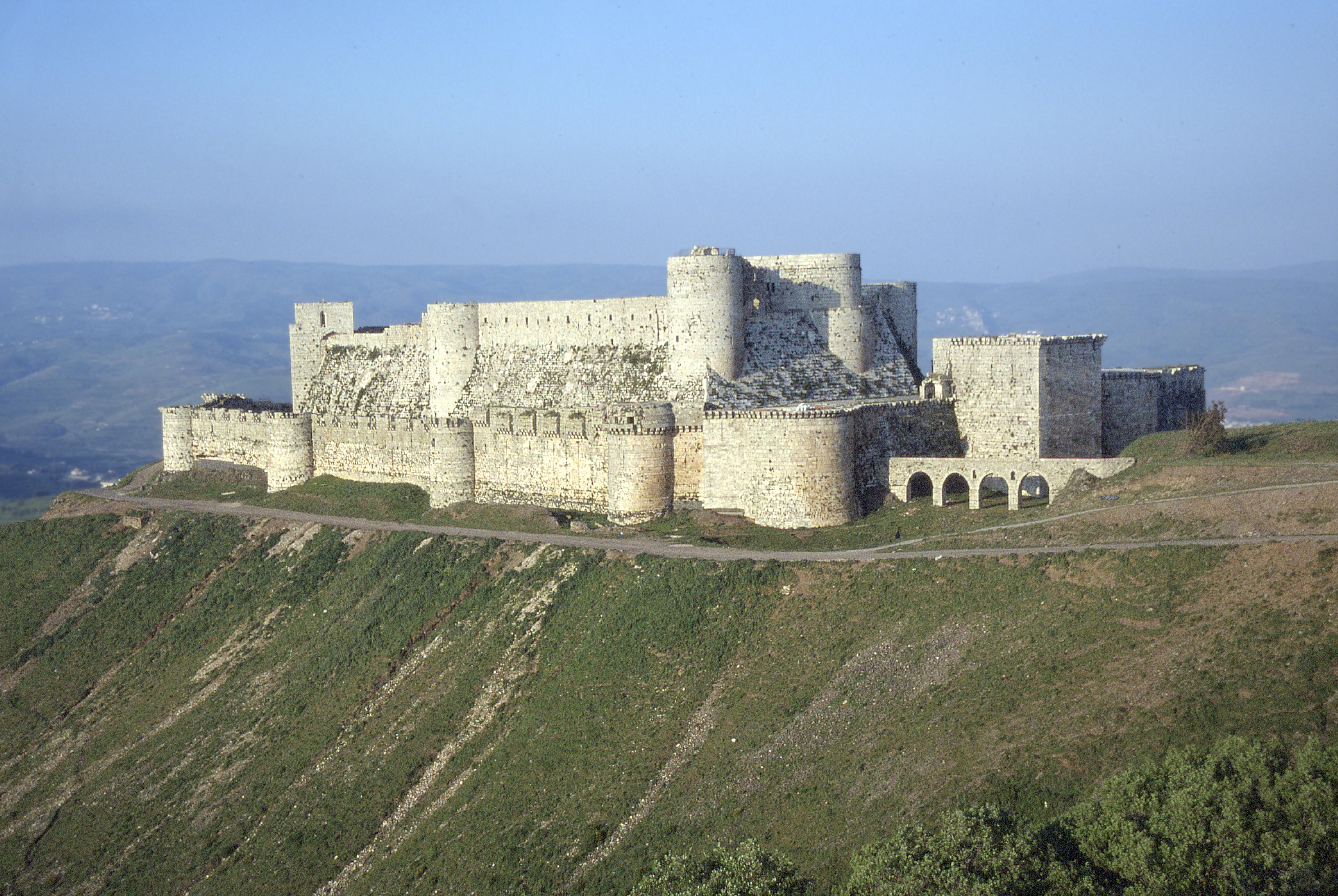
I swear that Embassy reminds me of nothing so much as some hilltop Crusader fort:

https://upload.wikimedia.org/wikipedia/commons/4/40/KRAK_DES_CHEVALIERS_-_GAR_-_6-00.jpg

Krak des Chevaliers from the southwest

That's at Qalʿat al-Ḥiṣn, Syria, just north of the current Lebanon/Syria border

Monday, October 9, 2023

Capital Markets: "War in Israel Spurs Flight to Dollars, Yen and Gold, While Driving up the Price of Oil"

From Marc Chandler at Bannockburn Global Forex:

Overview: There are three main developments. First, the market is digesting the implication of the US employment data, where the optics were strong (336k increase in nonfarm payrolls compared with 170k median forecast in Bloomberg and Dow Jones surveys) but some details were disappointing (like the third consecutive decline in full-time posts, seasonally adjusted). Second, Chinese mainland market re-opened after a six-day holiday). Chinese stocks slipped and currency strengthened. The third, and most significantly is Hamas's bold and brutal thrust into Israel and the Israeli response. There three levels of analysis that seem particularly relevant. First, it does not seem coincidental as US-Saudi Arabia-and Israel were working toward a new agreement that some forces (including Iran) sought to disrupt it. Second, it may be part of a larger pattern of flaring up of tensions in several places including Nagorno-Karabakh and Kosovo and Serbia. Some have suggested that Russia is fanning the flames to sap the strength of the alliance it faces in Ukraine. Others frame it as a result of a distracted America. The third level of analysis is in the escalating tension between Israel and the Palestinians in Gaza and the West Bank. The next day to two may clarify whether Hezbollah, Iranian militias in Iraq and Syria, and Palestinians from elsewhere join the fighting. Oil prices jumped on concern of supply disruptions. November WTI settled near $84.65 and gapped higher, opening at $85.25 before rallying to about $87.25. It is now hovering around opening levels.

We had thought that the dollar was set for a setback as the rally since mid-July looks exhausted. The price action today does not negate it, and often political developments shape but do not derail the underlying trend. The Japanese yen, where markets are closed today, Norwegian krone, and Canadian dollar are a little firmer, while the euro and sterling have been trading around 0.4% lower in late European morning turnover. Emerging market currencies are mostly lower. The Chinese yuan's modest gains lead the complex. Asia Pacific equities traded lower, but Europe's Stoxx 600 is slightly higher after rallying the past two sessions. US index futures are nursing small losses. European benchmark 10-year yields are mostly 2-3 bp lower. Italy is an exception with the 10-year yield rising by a couple of basis points. Gold posted a potential key reversal before the weekend and gapped higher today in reaction to the weekend developments. It had approached $1810.50 before the weekend and settled at $1833. Gold opened slightly above $1846 and rallied to $1855.50 before stabilizing. The next target is around $1862-3.

Asia Pacific
China's markets re-open from the extended national holidays while Japan, Taiwan, and South Korean markets were closed....

....MUCH MORE

Wednesday, June 7, 2023

Al Jazeera—"The Middle East: Goodbye America, hello China?"

I have to remind myself when we link to Al Jazeera that the Qatar-based/backed company does not speak for all Arabs, much less all Middle Easterners and certainly not all Muslims (think Indonesia or Nigeria). That said, and at risk of putting too much emphasis on what's going on - Syria being readmitted to the Arab League, the Iranian Embassy reopening in Riyadh, both counter to the Washington establishment's desires - something's up.

From Al Jazeera, June 6:

The US is losing ground in the region and it has only itself to blame.

In an attempt to salvage his country’s waning influence in the Middle East, US Secretary of State Antony Blinken is embarking on a three-day visit to Saudi Arabia this week. But advancing “strategic cooperation” with his Saudi and Gulf counterparts may well prove an uphill battle.

In July last year, President Joe Biden attended the Gulf Cooperation Council summit in the kingdom and vowed that the United States “will not walk away and leave a vacuum to be filled by China, Russia, or Iran”. But that is precisely what has been happening.

Despite US objections, the past year has seen its regional allies go hybrid: they have improved relations with Beijing and Tehran and maintained strong ties with Moscow.

Although the Biden administration has publicly downplayed the importance of the recent Chinese-brokered Saudi-Iranian agreement to re-establish diplomatic relations, it seems frantic about the growing Chinese influence in the oil-rich Gulf region and the greater Middle East.

Over the past two decades, the US has ramped up oil and gas production, becoming virtually energy independent. It may no longer need Gulf oil as much, but it insists on being in charge in the region so it is able to cut China off of vital energy supplies in the event of a conflict, and secure them for its allies.

As Blinken warned last month, “China represents the most consequential geopolitical challenge we face today: a country with the intent and, increasingly, the capability to challenge our vision for a free, open, secure, and prosperous international order.”

But Beijing’s autocracy may actually be an easier and better fit for the region’s autocrats than Washington’s democracy.

Russia’s sway in the Middle East and beyond has also made the US nervous.

Fed up with their ambiguity, even complicity with Russia, the Biden administration has been ramping up pressure on certain Middle Eastern states, making clear that its patience is running out. It has been warning countries in the region against helping Russia evade sanctions and demanding they pick sides – or else face the wrath of the US and G7 nations.

But to no avail.

Saudi Arabia has thus far refused the US request to substantially increase oil production to lower its market price and offset the effect of Western sanctions on Russia. It has maintained good relations with Moscow and dragged its feet on supporting Ukraine. Saudi Crown Prince Mohammed bin Salman’s “middle finger to Washington” has reportedly made him extremely popular in the region....

....MUCH MORE

The two most plausible explanations for what is going on are that a) the U.S. is governed by morons or that b) this is a deliberate effort by the U.S. powers-that-be to take global U.S. influence down a notch-or-three.

Throw in the emerging realization that the Biden family is a wholly-owned subsidiary of the Chinese Communist Party-and-government (a dandy excuse to throw Joe overboard and bring in a "clean" Dem. President, "Michelle, you're on") and the analysis gets complicated, fast.

Speaking of "clean" it is still hard to comprehend that Biden actually said about then-Senator Obama as both were gearing up for the 2008 Presidential race:

"I mean, you got the first mainstream African-American who is articulate and bright 
and clean and a nice-looking guy," Biden said. "I mean, that's a storybook, man."
 
Yeah, I don't think the movers and shakers pulling Joe's strings would think twice about discarding him. 
But by then the damage will have been done, with plausible deniability for the puppet-masters.

Wednesday, April 12, 2023

Afraid Your Sanctions Might Drive Up The Price Of Oil? There Is A Solution

 Just steal a hundred billion dollars worth from Syria.

What does the American leadership think it is doing invading and (figuratively) raping another Arab country? 

It's enough to give Uncle Sam a bad name.

From The Cradle (West Asian geopolitic), April 12:

 
Whatever it is the folks in Washington and Brussels think they are doing, it's not working.
Some other headlines at The Cradle:
What-in-the-actual-hell has the O'Biden-Harris administration done?
It used to be the U.S. could get by on oderint dum metuant (let them hate so long as they fear) but the last few years have pretty much shown the world....what? 
That there is no reason to fear? 
That our front-man is a doddering old corruptocrat? 
That this "Democracy" American-style is pretty damn perverse if not perverted?

Saturday, April 8, 2023

"CIA Director Tells Saudis the US Was Blindsided By Iran Normalization"

 "You had one job..."

From AntiWar.com:

Saudi Arabia and Iran agreed to reopen their embassies on Thursday after their foreign ministers met in China

CIA Director William Burns visited Saudi Arabia earlier this week to express frustration over Riyadh’s surprise normalization deal with Tehran that was brokered by Beijing, The Wall Street Journal reported Thursday.

According to the Journal, Burns told Crown Prince Mohammed bin Salman that the US “has felt blindsided” by Riyadh’s rapprochement with Iran as well as Syria, two nations under crippling US economic sanctions.

Following the deal with Iran, Saudi Arabia is poised to normalize with Syria. Riyadh is expected to invite Syrian President Bashar al-Assad to an Arab League summit it’s hosting in May. The Biden administration is against regional countries upgrading ties with Syria as it prefers to keep the country isolated as US policy is to prevent reconstruction....

....MORE

HT: ZH

The CIA being blindsided by Riyadh-Tehran rapprochment is a pretty major indictment of the State Security Apparatus.

Right up there with the failure to spot the crop failures in Russia and Ukraine which led to the Soviets getting huge advantage in 1974's "Great Grain Robbery".

And the failure to foresee the rapidity of the collapse of the communist governments in Eastern Europe.

And the round-up, torture, and murder of virtually all the human assets the CIA was running in China.

And the Chinese hack of the U.S. Office of Personnel Management starting in 2013, exposing the personal information of 20 million current and former employees, including those with highest level security clearances. That was actually a joint CIA/FBI failure. As was the Soviet development of the H-bomb.

And....well, it is a very long list.

On the other hand, perhaps the CIA director is lying and they weren't blindsided—spies lie for a living—and this is exactly the result that those in the corridors of power desired. Reduce the standing of the U.S. in the Middle East and in the eyes of the rest of the world, enhance the power of the petroleum power players, maybe make some bucks for themselves with a few well placed hydrocarbon bets informed by, as the securities lawyers say, material non-public information.

Who knows? And is it any wonder that James Jesus Angleton went nuts? 

Saturday, March 7, 2020

"Yes, Shell Is Changing Its Name to She’ll for Women’s Day (But Only at 1 Station)"

From AdWeek:

Yes, Shell Is Changing Its Name to She’ll for Women’s Day (But Only at 1 Station)
Move sparked mockery on Twitter and even accusations of a hoax
Shell is giving itself a temporary name change for International Women’s Day, a move that—while part of a larger effort to highlight women in leadership at the company—has been mocked and criticized by many in social media today for seeming insincere.

At one Shell station in San Dimas, Calif., the brand will replace its logo with one that says She’ll to mark Sunday’s global day of recognition for women. The location was chosen for the activation because it is owned and operated by women who are, according to a statement about the campaign, “the largest distributors of Shell-branded oil in the state of California.”

Carrie Philpott, president of agency Wunderman Thompson Atlanta, said in a statement that she hopes the campaign will “continue to position Shell as a brand that supports and is invested in [its] female workforce. International Women’s Day is a great opportunity to shed light on this issue and Shell’s commitment.”

As the “She’ll” activation circulated on Twitter today with an image of a gas pump with the temporary logo change, Shell’s effort was largely mocked and denounced for seeming opportunistic or insincere....
....MORE

A few years ago we tried to draw attention to the former Yazidi sex slaves who were hunting down and killing ISIS pigs. The Assyrian, Yazidi, and Kurdish women even asked their western sisters for help but I don't think anyone replied.

So last year we gave up on that and addressed Western sensibilities and did the superficial thing:

Thursday March 7, 2019
Sword in Saudi Flag Turns Pink to Honour Tomorrow's International Women’s Day
From The Pan Arabia Enquirer:

NEWS IN PICS


http://www.panarabiaenquirer.com/wp-content/uploads/2018/03/SaudiFlagWomensDay.jpg

Note: This is "fāke " news.

Saudia and other countries in the region are among the repressive places of the world.

The Pan Arabia Enquirer celebrated the Saudi's move last year (2018, Hijri 1439) allowing women into the late 19th century with:
Chaos on Saudi Roads as Women Drivers Accused of Obeying Traffic Laws