Saturday, October 10, 2026

"As the US Runs the AI Race, China Plays a Different Game"

From Harvard Business School's Working Knowledge, September 25:

While the US fixates on a “frontier-first” approach, China seeks to embed the technology throughout its economy. Meg Rithmire explains why understanding their differing strategies is critical.  

If AI is the new space race, how will we know when a country has won?

After all, an August article in Asian Economic Policy Review argues that China and the United States are not even racing toward the same planet as they pursue fundamentally different AI strategies. The US is fixated on a “frontier-first” approach, prioritizing increasingly powerful foundation models and infrastructure in hopes of capturing global dominance, while China is focused on embedding the technology deeply throughout its economy.

The distinction matters for businesses and policymakers because the country that gains the most from AI may not develop the most powerful model, but could instead be the one that translates AI most effectively into productive economic activity, explains Harvard Business School Professor Meg Rithmire.

There’s another version of the AI race, which is really about whose technology stack the world is going to rely on.

“China’s Diffusion-Forward AI Strategy: The ‘AI Race’ in Political Economic Context,” which Rithmire wrote with Harvard Kennedy School postdoctoral fellow Hao Chen, details how China’s state-directed approach to AI investing aims to improve industrial efficiency by integrating AI into manufacturing and robotics. Drawing on Chinese policy documents and registration data for AI services, as well as an analysis of humanoid robotics firm UBTECH, the researchers document the government’s expanding investment role, with nearly one in four Chinese AI services crediting some degree of state involvement in 2025, up from less than 5% in 2023.

In a conversation edited for length and clarity, Rithmire, the James E. Robison Professor of Business Administration, explores the race between China and the US to develop increasingly capable systems, including artificial general intelligence (AGI), which can outperform the “median human” in economically valuable work, as well as the broader competition over the technology stack that could shape the global economy.

Why is the current tech moment often compared to the space race?

"One interpretation is that whoever reaches AGI first is going to have enormous capabilities vis-a-vis the rest of the world. The dominant thinking right now in Washington and Beijing is about who has better capabilities of escalation dominance—meaning you can hurt me, but I can always hurt you more. I can dominate the escalation of our competition, and I then no longer fear your retaliation."

Why does it matter how advanced AI gets?

"The thinking around AGI is that there are some amazing capabilities that could allow one country to destroy the other. These are allegedly such powerful models that, if some adversary had that technology, they could use it to infiltrate systems, hack passwords, and shut down critical infrastructure. There’s a military defense logic to this thinking: If China gets these capabilities before the US, they’re going to use them to destroy other societies, so we should get them first because we won’t use them to destroy everyone else.

The way US companies and a lot of policymakers in DC have thought about it is: The biggest risk is China getting to AGI before the US does. And that’s the reason we have to focus on the quality of large language models. But what AGI really is, nobody knows. Sometimes I have this interesting debate with technology people, which is—will we even know when we have AGI?"

What else matters besides superintelligence?

"There’s another version of the AI race, which is really about whose technology stack the world is going to rely on for the next several generations. In a world where the US wins the AI race, most of the world is dependent on the US for the hardware stack, the chips, and US LLMs to build the application-layer products that are then sold into the rest of the world.

That's more of an economic power—locking the world into American technology such that American companies benefit, American markets benefit, and the world softly depends on the US for the AI stacks that are changing the way people work, receive services, buy things, and live."....

....MUCH MORE 

Also at HBS Working Knowledge, October 2025: "How AI Chatbots Try to Keep You From Walking Away" 

"Europe’s CEOs are ready to turn its energy challenge into a competitive edge"

I've obviously been thinking too small with my dream of turning compliance into a profit center.* 

From Fortune Magazine, September 17:

  • In today’s CEO Daily: A dispatch from Fortune’s CEO Forum in London
  • The big leadership story: Marc Benioff urges AI firms to take responsibility for their products.
  • The markets: U.S. futures are up after the Fed rate hike caused a selloff.
  • Plus: All the news and watercooler chat from Fortune.

Good morning. Kirsty McGregor, Editorial Director for Europe, writing from London this morning. How can Europe unlock its next phase of growth? That was the question running through nearly all the conversations at the Fortune CEO Forum in London yesterday, where we brought together execs from companies including Mastercard, Ferrari, BlackRock, Shell, EDF, Google, OpenAI, Honeywell, Anthropic, and Microsoft to explore the forces reshaping Europe’s economy. 

Our venue was the historic Barber-Surgeons’ Hall in London, an apt place to have a conversation about Europe’s future. The U.K. remains deeply connected to European business and finance, while also maintaining close links to the U.S. and the wider global economy. At a moment of extraordinary volatility—from war in the Gulf and uncertainty in U.S. politics to intensifying competition from China—London offers a useful vantage point for thinking about how Europe should adapt.

The leaders who filled the room are grappling with a perfect storm of mounting energy pressures, geopolitical uncertainty, slowing productivity, and how to navigate the promise—and darker possibilities—of AI. Those themes were evident during the day’s discussions, which were private to allow for candid debate. But a few takeaways emerged:

Europe has scale; will it equal growth? Earlier in the day, we released the brand new Fortune 500 Europe list, which provides a useful snapshot of Europe’s corporate heft. The 500 companies generated $15.5 trillion in revenue this year, up 4% from last year, and more than $1 trillion in profits. That combined revenue is equivalent to half of Europe’s GDP. Finance, energy, and automakers together account for over half of all revenues and profits on the list. 

The ranking is a reminder that Europe has enormous companies, deep pools of talent, significant financial resources, and areas of genuine industrial strength. But at the Forum, business leaders from across the region called for a policy, energy, infrastructure, and investment environment that allows those strengths to translate into the next phase of growth.

Europe’s green advantage. The sustainability conversation was notably clear-eyed. CEOs weren’t debating whether decarbonization matters; the hard part is doing it while energy costs squeeze competitiveness....

....MUCH MORE 
*If interested see:
December 2017 - Artificial Intelligence in Risk Management: Looking for Risk in All the Wrong Places
Opportunity is where you find it, turn your risk manager into a profit center.  
 
And quite a few more riffs and refs.

Friday, October 9, 2026

"AI eats the children"

From Australia's MacroBusiness, October 5:

Anthropic is concerned.

Frontier AI giant Anthropic has declared that artificial intelligence poses an “industrial-scale threat’’ to Australia and could reduce “demand for human work’’.

As a parliamentary inquiry probes OpenAI’s government data hacks and the AI industry’s creative “cannibalisation”, Anthropic has called for taxpayer support to retain, retain or redeploy workers whose jobs are replaced by AI agents and chatbots.

“Anthropic does believe that AI can deliver incredible progress in scientific discovery and workplace productivity but that these gains could also come with a reduction in demand for human work,’’ the company states in its submission to the Joint Select Committee on Artificial Intelligence, which will grill executives from Anthropic, Google, Microsoft and OpenAI at a hearing in Sydney on Tuesday.

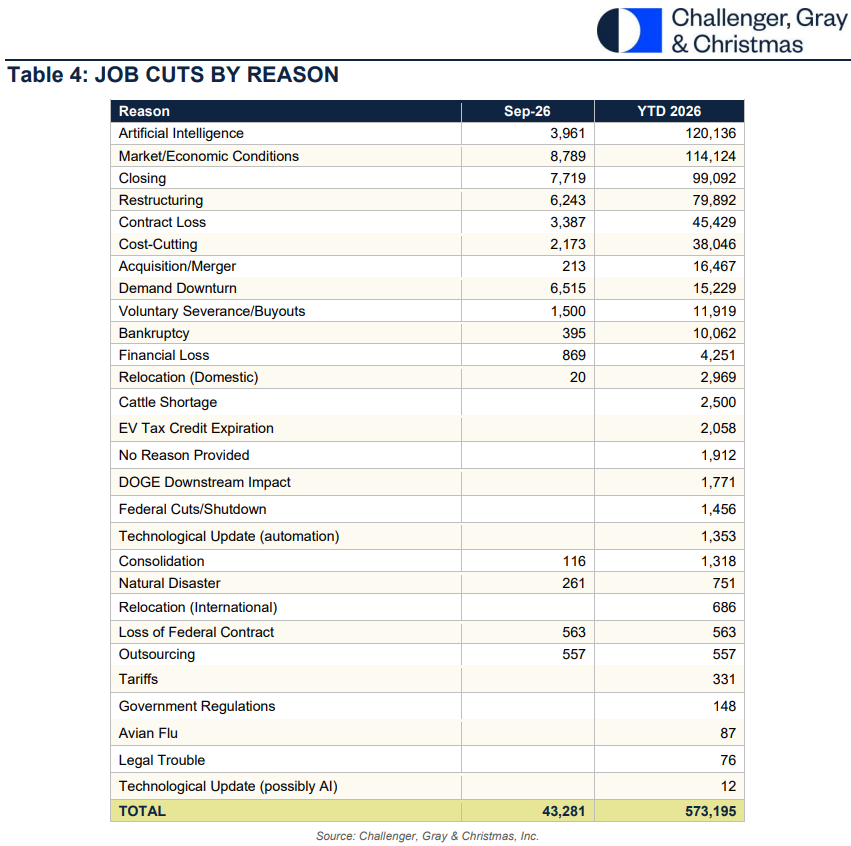
Challenger Grey’s latest research finds that AI is now the number one reason for layoffs in the economy, at 21% of the total over the past year.


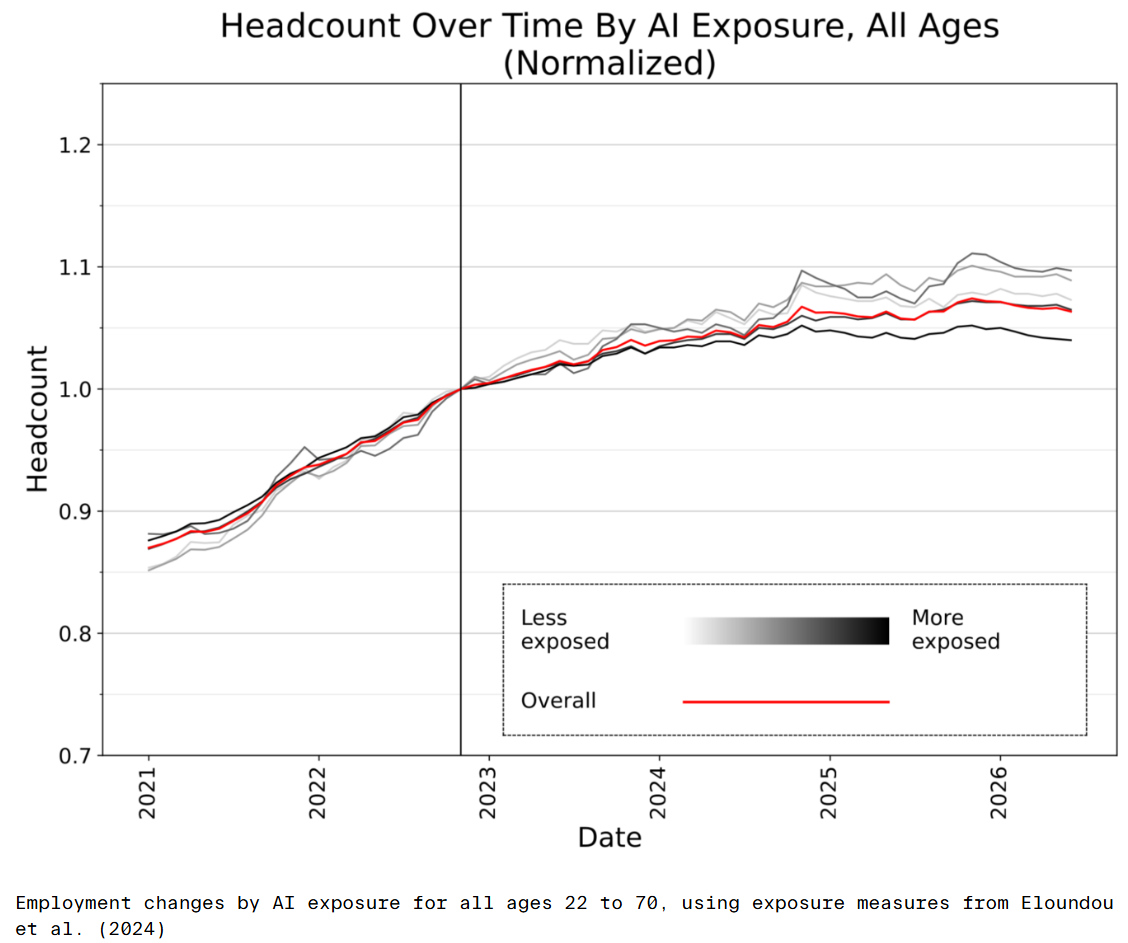
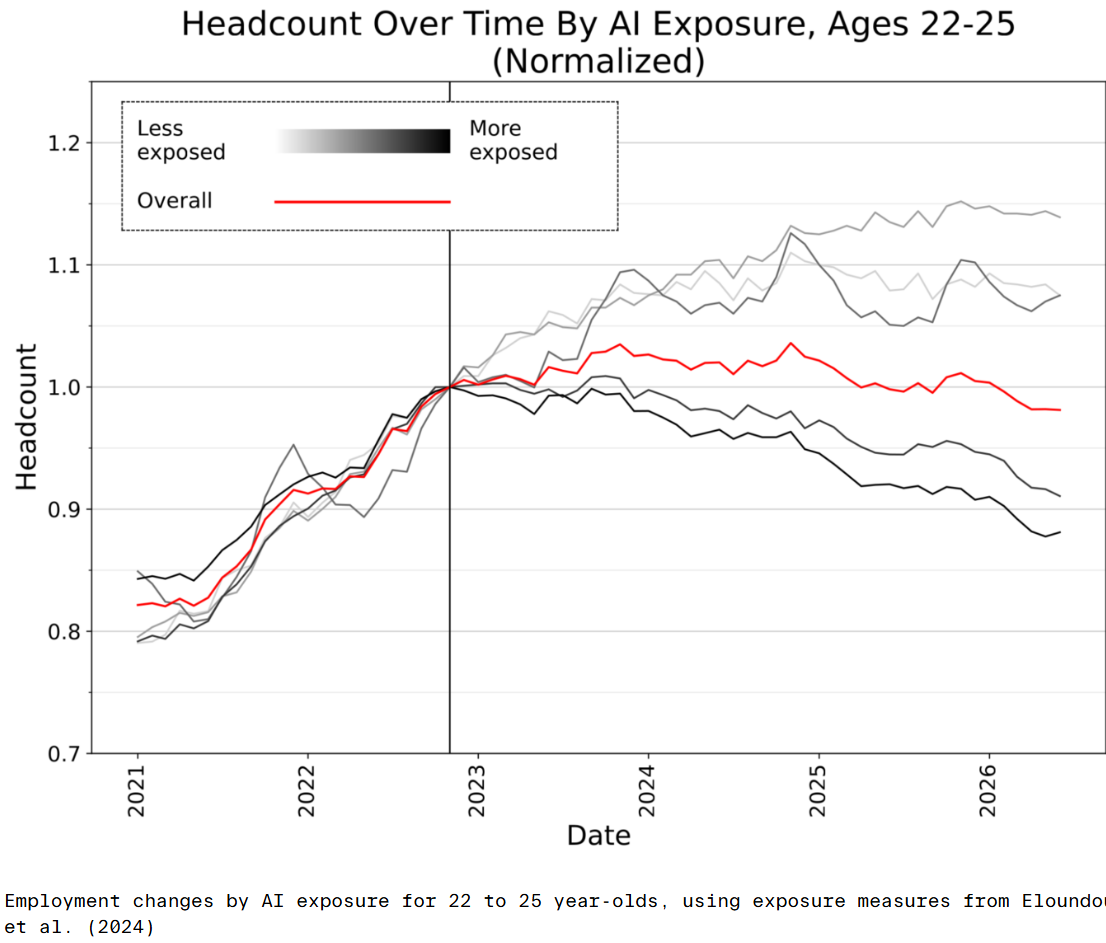
Stanford Labs data indicates this is not evenly distributed but focused, as you would expect, in entry-level positions.

  1. We do not see widespread, economy-wide job displacement associated with AI.
  2. However, young workers in AI-exposed occupations are increasingly falling behind their less-exposed peers. Employment among workers ages 22–25 in highly AI-exposed occupations now stands about 19% below where it would be if it had kept pace with employment among similarly aged workers in less-exposed occupations. Experienced workers show no comparable gap.1
  3. This divergence has widened steadily since we first documented it in August 2025: by this same measure, the shortfall was 15% at the July 2025 data vintage and is 19% as of June 2026.
  4. The adjustment appears to operate primarily through reduced hiring of young workers rather than increased separations.
  5. The declines are concentrated in occupations where AI usage tends to automate human tasks. In occupations where AI is used more to complement workers, employment is flat or rising, particularly among more experienced workers.
  6. So far, adjustment is showing up primarily in employment rather than base pay. 


The US Census now corroborates those findings....

....MUCH MORE 

"Drones Are Redefining How Cities Protect Themselves"

Finally, the new aesthetic.

From Bloomberg, September 10:

From anti-drone nets to signal jammers, governments are testing increasingly elaborate ways to protect cities from fast-evolving weapons. 

https://assets.bwbx.io/images/users/iqjWHBFdfxIU/iLsDKf4J9XLc/v2/2000x1334.webp
The southern Ukrainian city of Kherson drapes nets over its roads to protect residents from daily Russian drone attacks.  
Photographer: Pierre Crom/Getty Images Europe

Oleksandr Tolokonnikov has the weary tone of a man explaining life in a nightmare that never seems to end. Under the harsh white lights of a bomb shelter, the Ukrainian government official gives staccato descriptions of the daily Russian drone attacks in his region, the city of Kherson and surrounding villages. They have killed 65 civilians and injured more than 800 people in the first six months of the year.

Behind Tolokonnikov, a glossy poster of watermelons is a jarring reminder that this part of southern Ukraine used to be best known for its fruit; there’s even a watermelon monument further up the river. But today, Kherson is instead famous for the roughly 220 kilometers (137 miles) of green-tinged anti-drone nets draped over its roads.

The mesh canopies, which obscure the sky and fill with leaves in autumn, are a response to the latest evolution of drone warfare — which now ranges from large, purpose-built weapons to cheap commercial models that can be easily ordered online and adapted. Within 48 hours of my conversation with Tolokonnikov, deputy head of the Kherson state administration, Russian drone attacks killed one person and injured two others in the city. He says Kherson was seeing about 2,500 drone attacks per week this time last year; now it’s around 5,500.

The crude nets also embody a much broader challenge: How can you defend an entire city from this new danger? Kherson, a frontline city in a country at war, is an extreme example. But the threat is hanging over cities across Europe and the Middle East. Kyiv is experiencing more air-raid alerts than ever before as Moscow barrages the city with jet-powered drones. Last month, a small drone carrying explosives was found at Leipzig airport, a major cargo hub in Germany, with the country later blaming Russia for the attack. This summer, NATO forces shot down four drones over Romania, following an incident in May in which the country’s military tracked a Russian drone for four minutes before it crashed into an apartment block in the city of Galați, injuring two people.

Iranian drones have struck Gulf cities including Dubai, Kuwait City and Bahrain’s capital, Manama, this year. And along NATO’s eastern border, Estonia, Finland, Lithuania and Poland have all reported repeated incursions of Russian drones in the past 12 months.

Governments and the defense industry are still trying to determine the safest, most efficient and least expensive way to protect urban areas from drones, says Gregory Falco, head of the Aerospace Adversary Lab at Cornell University. “There’s no consensus on this yet.”

The Small Drone Threat

Small, mini and micro drones — defined by NATO as those weighing less than 150 kg (330 pounds) — are a daunting problem for any military. Radar systems, built to spot large planes and fast missiles, often can’t distinguish them from birds. They fly in unpredictable patterns and are difficult to shoot down. Even when radio-frequency jammers do work, tall buildings can interfere with the signal. “Currently there is not a single country that can stop small drones,” says Major Modris Kairišs, head of Latvia’s Autonomous Systems Competence Center.

https://assets.bwbx.io/images/users/iqjWHBFdfxIU/iBdCfYQbJ23s/v1/-1x-1.webp 

Officials consider Kherson’s nets, which entangle the drones, as the most reliable of all the available solutions. 
Photographer: Ivan Antypenko/Global Images Ukraine/Getty Images 

....MUCH MORE 

The story so far:

"Parking Killed Cities"

Why Are Our Buildings So Ugly? Architect Erik Bootsma Posts An Explanation

"Why Pierce Brosnan is leaving his $100M Malibu compound" 

"Why Pierce Brosnan is leaving his $100M Malibu compound"

Continuing with our aesthetics of the city jaunt.

From the New York Post, September 11:

Pierce Brosnan forced to flee $100M Malibu compound over fears of quakes, fire and sky-high costs  

Pierce Brosnan is ready to say goodbye to his slice of Malibu paradise, after decades of dodging wildfires, worrying about earthquakes and shelling out a fortune to keep his sprawling $100 million compound afloat.

The former James Bond star, 73, and wife Keely Shaye Smith, 62, are preparing to move on from the spectacular oceanfront estate they have called home for more than two decades, with Brosnan admitting that life along California’s famously volatile coastline has begun to lose some of its luster.

“We’ve been spared by the fires a few times now. But I think it’s time to move,” Brosnan told The Times. “Everything changes, everything falls apart.”

https://nypost.com/wp-content/uploads/sites/2/2026/09/exclusive-los-angeles-ca-arial-140297862.jpg?quality=75&strip=all&w=1536 

The actor said living beside the Pacific Ocean, in an area vulnerable to earthquakes and devastating wildfires, has created an underlying sense of unease. 

“We live by this body of earth’s water on a fault in a ring of earthquakes. That creates a fear,” he told the outlet....

....MUCH MORE  

Real estate pro tip: If you are selling your $100mm California compound, do not be the first to mention the cost, the fires and the earthquakes when addressing potential buyers. Be forthright if asked but don't lead with, say, potential tsunami risk living on the beach.

Why Are Our Buildings So Ugly? Architect Erik Bootsma Posts An Explanation

Continuing our look at city aesthetics.

....MUCH MORE (Thread Reader) They get worse.

Earlier:

"Parking Killed Cities"

"Parking Killed Cities"

From Delancey Place, August 26:

Today's selection -- from Paved Paradise by Henry Grabar. The requirements enacted in America’s downtowns for overly plentiful parking helped drive out the things that citizens love about their cities:

“In 2017, a lawyer named Mark Vallianatos conceived a tour of Los Angeles he called ‘Forbidden City.’ It sounded mysterious, perhaps even indecent, but it was something like the opposite: an architecture tour with a heavy dose of regulatory history. The premise was simple. Los Angeles banned itself. 

“The Forbidden City was not a distant imperial fortress; it was all around. The familiar houses and apartment blocks of neighborhoods like Hollywood, Koreatown, and Mid-City; gated courts of stucco cottages grouped around grassy courtyards; handsome two-story houses in the style of old Spanish missions or Cape Cods, split into two (duplexes), three (triplexes), or four apartments (fourplexes). Hollywood apartment towers, with their schlocky appropriations of French chateaus or Chinese pagodas. Elegant, Bauhaus-inspired midrise apartment buildings. The Forbidden City is the everyday architecture of Los Angeles neighborhoods–the glamorous and the mundane, essential, quintessentially LA. All of it was illegal to build, because none of these buildings had enough parking spaces.

“On a warm February day in 2020, I joined Vallianatos for a Forbidden City reprise. ‘We banned the parts of Los Angeles that people love the most,’ Vallianatos said, walking up the hill into Highland Park, an early streetcar suburb near Pasadena. Dressed in a natty green suit and thick architect glasses, the square-faced Vallianatos looked a little out of place in the California sunshine, and a lot out of place as he skulked around gates and peeked over box hedges. He was looking for electrical meters and mailboxes. That's how you figure out how many apartments sit behind a facade; it's how you know when what looks like a single-family home is in fact a fourplex. He approached a two-story house with a light-blue coat of paint behind neatly trimmed bushes. Five dials. Five apartments. Evidence that this particular building would be illegal to build in 2020. Circling around back, it was clear why: three measly parking spaces. And built for the small cars Angelenos drove in 1923, when the first tenants moved in. The tripartite garage looked like a toolshed. 

https://delanceyplace.com/cmsAdmin/uploads/parking-_5c-1949.jpg 

Parking, 5 cents a day, Hollywood, United States, 1949 

“If you wanted to build a five-unit building in Highland Park in 2020, you had to build at least five parking spaces (for five studio units), eight parking spaces (for five one-bedroom apartments), or ten parking spaces (for five two-bedroom apartments). Given those stipulations, on a lot this size, you wouldn't be able to build this building at all. It was an architectural fossil; the environment that gave it life was long gone. 

"The overall theme is that most of these older neighborhoods in LA have a mix of smaller apartments and houses," Vallianatos went on. A dog barked, birds chirped, a drill whined in the warm air. Another rehab under way in the Forbidden City. One consequence of prohibiting such buildings from being built today is that the old ones are constant targets for luxury renovations. We passed an austere white-walled synagogue–no parking, forbidden–and paused below the scalloped red roof of a Mission Revival bungalow court with ten apartments around a manicured garden. Forbidden. In a new home in Los Angeles in 2020, as in virtually every other city and suburb in America, a parking space was as obligatory as a toilet. In fact more so. A two-bedroom apartment did not require two toilets. But it did require two parking spaces....

....MUCH MORE 

"California farmers are struggling to sell grapes as demand for wine drops"

From the Associated Press, September 22:

It’s harvest time in California wine country, but many growers are struggling to sell their grapes as changing drinking habits have caused demand to plunge. The decline is forcing some growers to tear out vineyards that their families have grown for generations.

Wine sales have decreased by more than 20% over a five-year period, causing prices paid for grapes to drop and prompting California growers to take roughly a quarter of the state’s vineyards out of production. Many growers are having to decide whether to harvest at a loss, leave grapes on the vine or replace vineyards with crops more in demand such as almonds, walnuts, pistachios and olives.

Third-generation grower Bill Berryhill said it means another year of losing money and wasting hundreds of tons of healthy grapes.

“It’s just sickening,” said Berryhill, standing in a vineyard of unsold merlot grapes. “You raise a beautiful crop, and it’s really a nice vintage this year, and you drop it on the ground. It’s sad. All your work is just down the toilet.”

Berryhill, who owns Berryhill Family Vineyards near Lodi in the San Joaquin Valley, said he can’t find buyers for grapes grown on 200 of his 500 acres (202 hectares). He plans to remove 50 acres (20 hectares) of vineyards when the harvest season is over.

“I will lose money for sure. It’s just a matter of how much,” Berryhill, 68, said. “This has been a big loser for three years now.”

Grape growers take vineyards out of production
At its peak during the pandemic, California had almost 600,000 acres (242,811 hectares) of vineyards, but farmers have removed or stopped actively growing wine grapes on roughly 25% of that land, said Jeff Bitter, president of Allied Grape Growers, which represents about 500 farmers statewide.

This year, about half of California’s wine grape crop entered the harvest season without contracts with buyers, compared with 70 to 80% with contracts in a typical year, Bitter said.

If they’re lucky, growers can sell their uncontracted grapes at a loss to buyers making concentrated syrup.

Even as growers have abandoned or removed tens of thousands of acres of vineyards in California in recent years, too many grapes are still being produced, Bitter said.

“The market is just so depressed that it’s difficult to grow them profitably,” he said. “Demand is not going up. It’s still continuing to decline.”....

....MUCH MORE 

So what else can be done with the land and its vaunted Mediterranean climate?

Somewhat related September 29: 

"Collateral damage: How Cognac is paying the price for Europe’s trade wars"
Well that and the fact that people in the West don't seem to be drinking as much as they did 50 or 100 or 150 years ago....

"Masa Passes The Hat: SoftBank Seeks $100 Billion From The Gulf After Maxing Out Junk Bonds, Margin Loans And Japanese Retail"

 Someone may have to do an intervention, or at minimum a welfare check, on Mr. Son.

From ZeroHedge, October 9:

The scramble for AI cash is on (or rather, accelerating).

Just hours after the FT reported that OpenAI's annualized revenue is roughly $20 billion lower than the figure that had been making the rounds previously, the same paper reported that Masayoshi Son is trying to raise up to $100 billion from Gulf investors, and has spent recent weeks holding talks with senior figures in the UAE. That would be roughly the size of the original Vision Fund, which is either a sign of ambition or of how much more money the AI trade now needs just to stand still. Clearly, in a world of $1.5 trillion in 2027 capex, the answer is the latter.

**(denotes tweet at ZH)

Regular readers will not be surprised: we have been warning that the AI buildout runs on debt since exactly one year ago today, and SoftBank, which has committed some $65 billion to OpenAI, has spent most of 2026 as the poster child for that thesis. Over the past nine months Son has tapped bridge loans, margin loans on Arm and OpenAI shares, Japanese retail savers and, most recently, the largest junk bond on record. Now that the usual spigots have been opened all the way, it's time to call the sovereigns.

Below we walk through what Son is pitching to Abu Dhabi, how the money machine got here, why Thursday's OpenAI revenue "clarification" matters so much for SoftBank's balance sheet, and why the Gulf has quietly become the AI trade's lender of last resort.

"What Happened To Abu Dhabi?"

According to the FT, the new money would go into a vehicle that buys companies and then uses AI and other advanced technology to run them more efficiently: a private-equity roll-up with a robotics twist. Roze, SoftBank's robotics and physical AI unit, which Son hopes to take public at a lofty valuation (press reports have floated $100 billion), is expected to play a central role. The people cautioned that there is no guarantee the talks succeed, and SoftBank declined to comment.

The playbook is familiar. Saudi Arabia's PIF and the UAE's Mubadala anchored the first $100 billion Vision Fund in 2017; per the FT, that fund has generated about $29 billion in cumulative investment gains through June, while Vision Fund 2 (backed primarily by SoftBank itself, and home to the OpenAI stake) is up $20.5 billion. Not exactly WeWork, but not exactly the "information revolution" either for a fund that took nearly a decade to get there.

What is new is the timing. Just this week, OpenAI itself was shopping a $30 billion round to a group of UAE sovereign funds led by MGX (alongside BlackRock) at a $1.4 trillion pre-money valuation set by OpenAI itself. Which means that in the span of four days, both the biggest AI lab and its biggest backer have shown up at the same Abu Dhabi door with their hands out. Back in February, when OpenAI's record $110 billion round closed without a Gulf name on the cap table, we asked the obvious question:

**

Now we know: it was waiting to be asked.

It's not the first time the emirate has come to the rescue of the AI trade, either. Last December, as Oracle CDS blew out and Blue Owl walked away from Oracle, it was Abu Dhabi that may have delivered the Santa Rally when OpenAI went to sovereign wealth funds for up to $100 billion (a dependence we explored at length in "Dollar Supremacy Strategy Or All-Time Grift? American AI Imperialism's Reliance On The Middle East"). Abu Dhabi, through MGX and G42, has become one of the world's biggest AI spenders, as the FT notes. The difference this time is that there is now a war next door, Brent is above $100, and Gulf petrodollars are being asked to fund two of the biggest AI fundraises of the year at once.

Masa's Money Machine

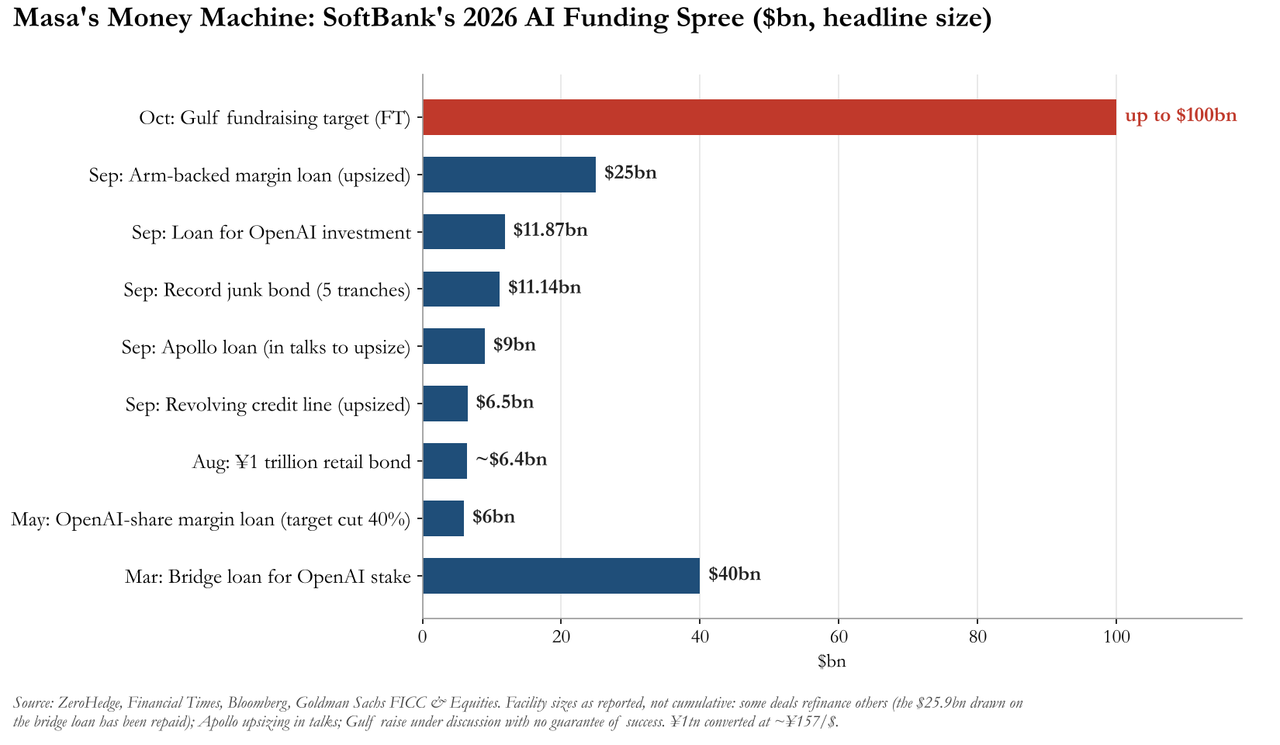
To appreciate why Son needs the Gulf, look at what he has already done this year. The chart below tallies the headline size of every major facility SoftBank has lined up in 2026 to fund its AI ambitions (some refinance others, so this is not a cumulative total, but you get the idea):

In March, days after SoftBank's CFO warned that its loan-to-value ratio may temporarily exceed the 25% ceiling (to which we responded "chatbots gonna take down masa son"), it lined up a record $40 billion bridge loan for the OpenAI stake. In May, SoftBank had to cut the target for its OpenAI-backed margin loan by 40% to $6 billion,p and by June even the downsized loan had stalled, as lenders balked at taking private OpenAI shares as collateral. Then came a ¥1 trillion bond sold to Japanese retail investors at a 4.75% coupon, an Arm-backed margin loan upsized to $25 billion, a $6.5 billion credit line, an $11.87 billion loan and talks with Apollo to upsize another to $9 billion.

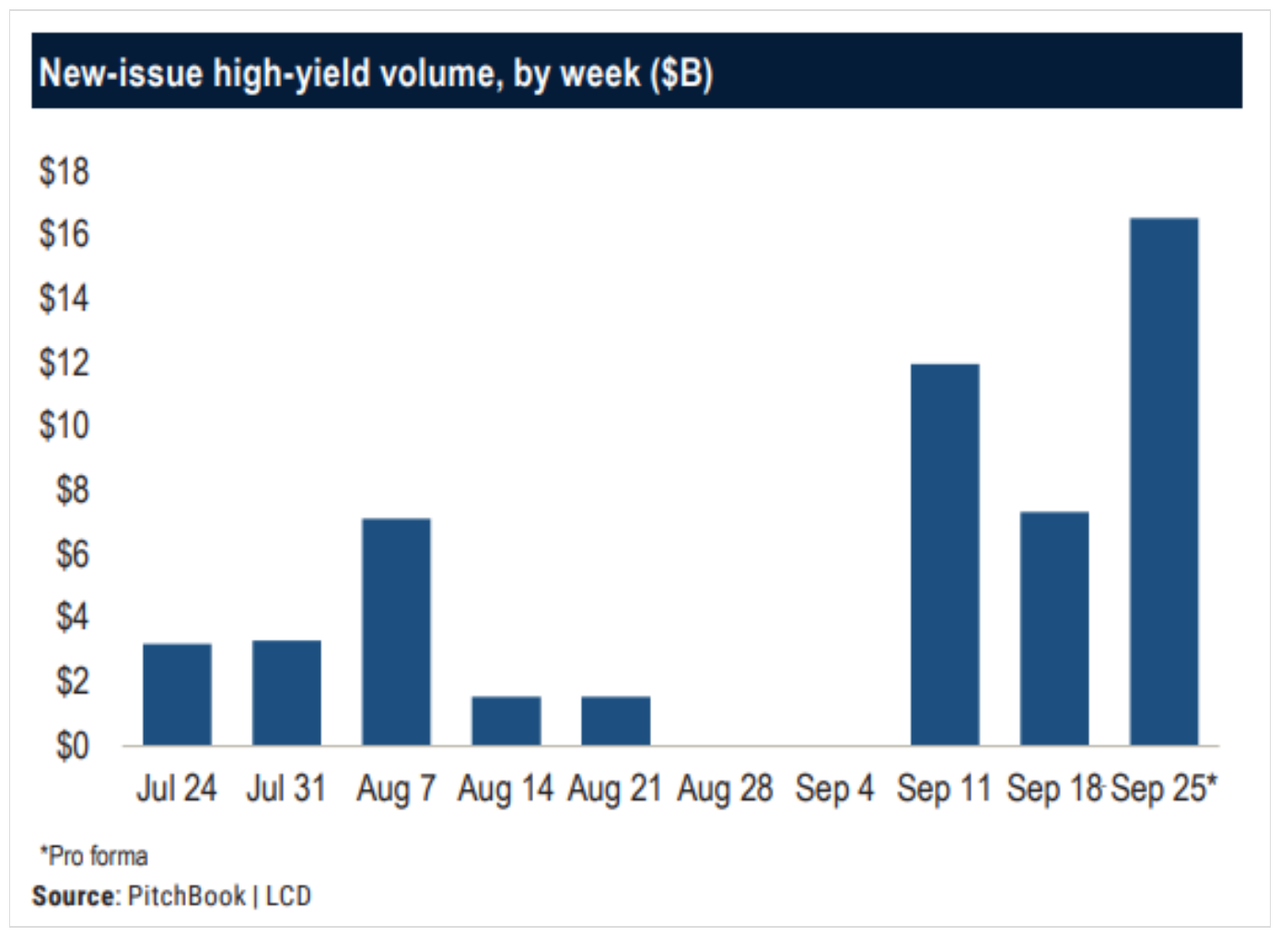
And then, the grand finale: a five-tranche, $11 billion-plus junk bond to fund the next OpenAI check, which the FT says paid yields as high as 9.75%. Goldman's credit sales desk confirmed in Adam Crook's latest AI issuance pulsecheck (available to pro subs) that the $11.14 billion deal was the largest non-investment grade bond sale on record, and it single-handedly made the week of Sept 25 the biggest for new HY issuance in Goldman's chart, which goes back to late July (chart source PitchBook LCD via Goldman):

Naturally, we called this one back in January, when the WSJ first reported that Son was in talks to pour another $30 billion into OpenAI:

** 

Nine months later, SoftBank is the biggest junk issuer in history, so we'll allow ourselves a modest victory lap. The credit market got the message too: within a week of the jumbo deal, SoftBank's 5Y CDS had blown out to the widest levels since the Iran war began, as we flagged in real time: 

**

Put differently, when you have already pledged your crown jewel (Arm), your largest asset (OpenAI), Japanese retail savers and the high-yield market's patience, the only pocket left is a sovereign one.

The $20 Billion Hole

Which brings us to why the timing of the Gulf push is so delicate. On Thursday afternoon the FT reported that OpenAI had told investors its annualized revenue was approaching $50 billion at the end of September, far short of the ~$70 billion figure that had been circulating since Dev Day. Nasdaq promptly tumbled more than 1%, Oracle slid 5-6%, and SoftBank's Tokyo-listed shares fell 5% on Friday. They are still up 25% this year, but have now dropped more than 30% from their June peak, when SoftBank briefly became Japan's most valuable company.

According to Goldman's TMT specialist sales team (available to pro subs), the gap is mostly a matter of accounting rather than collapsing demand: OpenAI reports revenue net of what flows through its cloud partners, while Anthropic reports something closer to gross. Investors who "grossed up" OpenAI to compare the two arrived at roughly $40 billion in August and $70 billion in September; on OpenAI's own net basis, the progression was more like $30 billion to $50 billion. That is still around 70% growth, Goldman notes, just not the growth everyone had priced in. Goldman's desk said it caught a heavy wave of long-only and hedge fund supply in megacap tech after the headline, over $1 billion in net selling of semis, AI and megacaps.

On Friday morning, right on schedule, came the spin: Bloomberg reported that OpenAI now expects to hit or top $70 billion of annualized revenue by year-end, and blamed the confusion on differences in how OpenAI and Anthropic calculate revenue. Futures bounced, and Goldman's TMT desk filed it under the whiplash sentiment swings that have become a defining feature of AI investing this year. So the $70 billion number didn't disappear; it was just moved three months into the future. Which, considering OpenAI is on the hook for some $1.5 trillion in compute commitments, is not quite the reassurance it was meant to be....

....MUCH MORE 

If interested see also an oldie but goodie:

Monday, March 24, 2008 
Markets, Risk and Gambler's Ruin
From the Wall Street Journal:

Old Pros Size Up the Game
Thorp and Pimco's Gross Open Up on Dangers
Of Over-Betting, How to Play the Bond Market
Or 2022's;
Prudent Bet Sizing And The Best Quote About FTX, Bankman-Fried and Caroline Ellison (to date)
Setting aside the whole stealing your client's money thing, which has been covered by other commenters, one of the lessons of the FTX/Alameda Trading blowup is maximizing your gains while minimizing the risk of gamblers ruin. 
Or:
November 2019
SoftBank’s problems aren’t so surprising if you understand this one thing about the company
Throughout the manic phase of SoftBank and the Vision fund there was almost no mention of the fact that at the start of this century Masayoshi Son was the richest person in the world:
"But Son’s fairytale didn’t last long. After the dot-com bubble burst, his company Softbank’s shares plunged 75 percent in two months and was 93 percent lower by the end of 2000.
The business almost went bankrupt and Son ended up losing USD 70 billion, the highest ever recorded financial loss for a person in history."
—MoneyControl, October 13, 2017
Or:
"Is semi-variance a more useful measure of downside risk than standard deviation?"

"The Equation that Will Change Finance"

What Proportion of Your Bankroll Should You Bet? "A New Interpretation of Information Rate"

Gambler's Ruin and Bet Sizing 

Repost: Dreamtime Finance (and the Kelly Criterion)

I've been meaning to write about Kelly for a couple years and keep forgetting. Today I forget no more.
In probability theory the Kelly Criterion is a bet sizing technique used when the player has a quantifiable edge.
(When there is no edge the optimal bet size is $0.00)

The criterion will deliver the fastest growth rate balanced by reduced risk of ruin.
You can grow your pile faster but you increase the risk of ending up broke should you, for example bet 100% of your net worth in a situation where you have anything less than a 100% chance of winning.

The criterion says bet roughly your advantage as a percentage of your current bankroll divided by the variance of the game/market/sports book etc..
Variance is the standard deviation of the game squared. In blackjack the s.d. is 1.15 so the square is 1.3225.

As blackjack is played in the U.S. the most a card counter can hope for is a 1/2% to 1% average advantage with much of that average accruing from the fact that you can get up from a negative table.
Divide by 1.3225 and you've got your bet size.

It's a tough way to grind out a living but hopefully this exercise will stop you from pulling a Leeson, betting all of Barings money and destroying the 233 year old bank.

Barron's: "Why Quanta’s AI-fueled earnings explosion is just getting started" (PWR)

From Barron's, October 8:

Shares of Quanta Services have soared by nearly two-thirds in the year since Barron’s first recommended them. Their run still doesn’t look done.

Quanta is an industrial services provider, meaning its clients are utilities and oil-and-gas companies that are seeing increased demand from the artificial intelligence buildout and the massive power that requires.

That doesn’t look like it’s going to stop any time soon, so Quanta will stay busy: Its backlog increased by nearly half last year, to more than $53 billion and counting, and the company expects that data center and tech players will account for some 18% of 2026 revenue, up from 10% a year ago.

“Quanta’s stock hasn’t been driven by multiple expansion; it’s been driven by an explosion in earnings power,” says Mike Smith, senior portfolio manager at Allspring Global Investments. “The company sits at the right side of change, at the intersection of AI infrastructure, grid modernization, and electrification, but its real advantage is labor. As the industry’s bottleneck shifts from megawatts to manpower, Quanta’s ability to recruit and retain skilled craft workers is becoming an increasingly valuable competitive moat.”

In fact, Quanta’s earnings per share are expected to jump more than 55% this year, according to consensus estimates, to a record $16.74, before notching another nearly 18% gain in 2027. That kind of growth helps explain its valuation, as the stock trades around 35 times next year’s earnings–although that’s actually below its five-year average and down from a peak of more than 50 times earlier this year. 

“Investors are paying less for each dollar of earnings despite a dramatic increase in the company’s earnings power,” says Smith.

It’s not just AI however. Much of the U.S. grid needs to be modernized and upgraded, and increasing demand for power overall across the country has kept older power plants in use long past when many expected. Maintenance is necessary to keep electricity flowing, and few companies have the skilled workforce and track record of reliability....

....MORE 

It's going on three years since "The Infrastructure Theme Is For Real (PWR)".

As noted exiting a January 2025 post:

Quanta and GE Vernova will survive and thrive. Even without AI. The U.S. and the world need to string more powerlines and need more generating capacity that will come on line faster than nukes or baby nukes. 

Over one year PWR is up 61.55% vs 15.92% for the S&P500 for three years it leads +300.45% to +80.07%.

For GEV the numbers are +57.81% vs the +15.92% and +768.39% vs the +80.07%. 

The Barron's article is by Teresa Rivas, Al Root covers GE Vernova. They both have a feel for the respective companies. 

The Enormous Cost Of American Transportation Infrastructure

You may know the author of this essay, Brian Potter, from his substack, Construction Physics. 

From American Affairs Journal. Fall 2026 / Volume X, Number 3:

Agencies without Agency: How Dispersed Power Derails Transportation Infrastructure

he United States has the unfortunate distinction of having some of the highest transportation infrastructure costs in the world. Urban rail costs in the United States are 50 percent higher than in Germany, double the costs of Norway, and nearly triple the costs of Sweden.1 Phase One of New York’s Second Avenue Subway was built at the eye-watering cost of $2.5 billion per mile, eight to twelve times the cost of similar projects in European countries.2 Phase Two is budgeted even higher, at $4 billion per mile.3

Outside of New York, an extension of Chicago’s Red Line is expected to cost more than $1 billion per mile, which transit researcher Alon Levy describes as “almost a world record for an elevated line.”4 California’s high-speed rail line, aimed at eventually connecting San Francisco and Los Angeles, is projected to cost over $200 million per mile, or over $126 billion altogether.5 This is roughly four times the cost of building high-speed rail in other countries (which average roughly $54 million per mile) and ten times the average costs of building high-speed rail in Spain.6

The exorbitant costs of rail construction in the United States mean that many such projects never get off the drawing board. In cities such as Austin, Atlanta, New York, and Philadelphia, enormous projected costs have resulted in rail projects being canceled or scaled back significantly.7 And it’s not only rail infrastructure. Road tunnels, highway bridges, and roadways are all more expensive to build in the United States than in major European countries.8 A study by economists Zach Liscow and Leah Brooks found that the inflation-adjusted cost of American highway construction tripled between the 1960s and the 1980s.9

Even something as simple as bus transportation is unusually difficult and expensive in America. In San Francisco, it took nearly twenty years and $300 million to build a two-mile bus lane on Van Ness Avenue.10 The average diesel bus in the United States costs around $500,000, more than twice the cost of diesel buses in European countries. Electric buses average closer to $1 million, three times the cost of the price of comparable buses in Asia.11

Wherever we look, we see the same thing: American transit agencies struggle to rein in costs when building transportation infrastructure. In the United States, we pay far more for our transit systems than virtually anywhere else in the world.

Solving this problem means understanding what’s driving it. A confluence of factors makes U.S. transit agencies ineffective at controlling costs and delivering projects. First, over the last several decades, transit agency authority has been increasingly dispersed, checked, and otherwise restrained. Second, at the same time, agencies have been under pressure to outsource as many of their functions as possible, resulting in their technical and oversight capabilities being hollowed out. These two trends, along with the bad incentives to which they contribute, have caused transit costs to spiral out of control.

Democratic Dispersion

In 1919, a young Dwight Eisenhower, then a major in the U.S. Army, joined the military’s first cross-country caravan undertaken by car and truck. A convoy of 310 men (including a fifteen-piece brass band) drove from Washington, D.C. to San Francisco, three thousand miles away. Thanks to the poor state of the country’s roads, which ranged from “average to non-existent,” the trip took over two months, with the convoy averaging just five miles per hour.12

The trip, which the New York Times would later describe as taking “60 days and 6000 breakdowns,” impressed upon Eisenhower the need for an “adequate, all-weather road US road system.”13 This impression was strengthened in 1945, when Eisenhower, holding the post of Supreme Commander of the Allied Forces, traveled on Germany’s Autobahn after the country’s surrender in World War II. Germany’s rail transportation network had proven relatively easy to disrupt by way of Allied bombing raids (a single bomb could take a track out of service for days), but the country’s wide, robust highways proved harder to break: even a bombed out road could still be used by cars and trucks.14 A major U.S. highway system thus wouldn’t just make travel easier; it would be a valuable tool for defense. When Eisenhower was elected president in 1952, he decided that a national highway system would be a top priority, and in 1954, he asked members of his administration for a plan to get “50 billion dollars worth of self-liquidating highways under construction.”15

After several years of politicking and horse-trading, Eisenhower largely got his wish. In June of 1956, the Federal-Aid Highway Act was signed into law, which authorized $25 billion for a forty-thousand-mile National System of Interstate and Defense Highways, funded by an increase in the federal gas tax.16 A few months later, construction of the first segments began, and the first eight-mile stretch of interstate highway opened in November of 1956 near Topeka, Kansas.17 By 1964, nearly half of the new Interstate system was open or nearing completion.18

Initially, the new interstates were by and large met with enthusiasm. Newspapers printed headlines such as “Interstates a Boon to Iowa,” and property values near the highways rose.19 In his history of the Interstate, Tom Lewis notes that in 1956, “across the country, editorials complained not that the highways were being built, but that they were not being built fast enough.”20

But the scale of the interstate project, which required the government to acquire 1.5 million acres of land via purchases and eminent domain, meant that opposition inevitably appeared.21 Conservationists were upset at the loss of scenic beauty as highways were carved through the landscape; residents of rural areas were suspicious of what it would do to their way of life. Citizens “whose land and houses were being ravaged by interstate construction” began to mobilize opposition.22 This was exacerbated by the fact that interstate planning took place almost entirely based on what highway engineers believed would be most efficient; public reaction to the large-scale construction project was at best a distant concern, and more likely to be ignored altogether.23 Nothing more clearly illustrates this mindset than a 1963 plan to carve an interstate route through the Bristol Mountains in California by detonating twenty-two nuclear bombs, instantly creating a channel 325 feet wide and eleven thousand feet long, while saving an estimated $8 million in construction costs. Only uncertainty as to how long it would take the radiation to dissipate stopped this plan from going forward.24

Early on, increasing opposition to interstates was blunted by the fact that many of the early segments were built in lightly populated rural areas.25 But as interstate construction began to encroach on major cities—by the late 1960s, over sixty thousand homes a year were being torn down for highway construction—citizen resistance grew more fervent.26 In 1964, tens of thousands of protestors assembled in Golden Gate Park in San Francisco to protest against any new freeways through the city, and several planned highways were cancelled.27 In 1969, the Riverfront Expressway, an elevated interstate segment that would have cut across the city of New Orleans, was cancelled following intense activist and local citizen opposition.28 Similar opposition sprung up in cities across the country: from Los Angeles to Seattle to Miami to Boston.29 By the 1970s, highway construction was widely unpopular....

....MUCH MORE 

 Some of our previous visits with Mr. Potter:

May 2021 - Why Is It So Difficult To Automate Construction? "Construction, Efficiency, and Production Systems" 

June 2021 - "Construction Costs Around the World: How Does the US Compare?"

January 2022 - Construction Physics: Where Are The Robotic Bricklayers? (plus: planning your dynasty)

September 2024 - "Why Can't the U.S. Build Ships?"

And many more. 

"Oracle, Broadcom and SpaceX Seek Blockbuster Debt Deals to Pay for AI Chips" (SPCX; AVGO; ORCL)

Although the pools of money that these companies and sovereign issuers draw from aren't exactly the same, they are adjacent. As to when too much is too much, we'll know it is too late to do anything if the U.S. Fed uses its emergency powers to lend to the AI companies.*

From the Wall Street Journal, October 7:

Apollo, Blackstone and Goldman Sachs among lenders in talks to finance megadeals worth tens of billions of dollars apiece

Big players in artificial intelligence are lining up a series of blockbuster financing deals to pay for computing hardware, part of a rush for capital as data-center build-outs race forward.

In recent weeks, Broadcom has been working to arrange more than $50 billion in financing for OpenAI’s custom artificial intelligence chip, which the firms are developing together, according to people familiar with the discussions.

Apollo and Blackstone are among the lenders Broadcom has talked to about participating in the deal, people close to the situation said. Talks are early and the size of the deal could change.
 
Separately, Oracle is in talks with Apollo and Goldman Sachs to arrange money for a big purchase of chips, people familiar with the matter said. And SpaceX has talked to lenders in recent days about a $40 billion chip financing for Nvidia chips, according to a person familiar with the discussions. The Financial Times earlier reported on the SpaceX talks.
 
The wave of deals reflects the mounting cost of building AI infrastructure. Cloud providers such as Amazon Web Services and Oracle have traditionally financed computing hardware through their own cash flows. For their AI build-outs, the companies issued hundreds of billions of dollars of bonds, pushing the public debt market to its limits. Now, some buyers are turning to Wall Street investment firms to help fund purchases totaling tens of billions of dollars per deal.
 
There is also a new group of chip buyers, including OpenAI and Anthropic, who don’t have the financial firepower to purchase their own hardware. Leading AI labs historically rented the bulk of their computing capacity from cloud providers, but they now want to own more of their own infrastructure to help lower costs and reduce their reliance on other firms. 
 
The new Broadcom financing for OpenAI could include several gigawatts of OpenAI chip capacity, one of the people familiar with the discussions said. The deal is expected to close before the end of the year. OpenAI’s chip program, known internally as Nexus, includes custom chips named after types of peppers, with the first- and second-generation versions known as Jalapeño and Serrano....
....MUCH MORE
*
Wednesday, October 8, 2008
Fed Will Lend Directly to Corporations
Oh Mama, can this really be the end...
-Bob Dylan

Back in February we posted "Doom and Gloom: What Can the Federal Reserve Do? Part II" which quoted from a 2005 paper by the Federal Reserve:
We left part I at the "Money Rain" section of the Fed paper Monetary Policy When the Nominal Short-Term Interest Rate is Zero.
The paper's conclusions are worth an extended exerpt.
9 Conclusion
...When the nominal Treasury bill rate is at zero, the Federal Reserve could attempt to provide a stimulus to aggregate demand through effects in addition to those from increases in the monetary base. The Federal Reserve could purchase assets other than Treasury bills, such as U.S. Treasury bonds or foreign government debt. Even if these assets are perfect substitutes for U.S. Treasury bills, purchases of them could have a stronger stimulative impact than purchases of Treasury bills because of signalling effects."  
...A similar effect is present if the Federal Reserve were to write options in an attempt to communicate its desired path for the Treasury bill rate.

But with discount window loans whether in the form of advances or discounts the Federal Reserve can accept as collateral (and therefore make liquid" for a depository) a wide variety of assets that the Federal Reserve cannot purchase. A potentially serious limitation on such loans is that it has apparently been the intent of Congress that the Federal Reserve not take onto its balance sheet the credit-risk of the collateral: The Federal Reserve could turn to the depository for full payment of the loan.

The Federal Reserve can bypass depositories and lend directly to individuals, partnerships, and corporations (IPCs). However, the Federal Reserve must and there to be "unusual and exigent" conditions and the IPC receiving the loan must be unable to secure credit from other banking institutions. It seems the intent of Congress was that the Federal Reserve should make such loans only to credit-worthy IPCs. With the Federal Reserve not taking credit risk onto its balance sheet, private- sector loan markets would still incorporate all credit risk into any new loans to households and businesses|preventing any decline in credit-spreads, which may be elevated should the economy be at the zero bound and should the economy be weak. Nonetheless, loans by the Federal Reserve to depositories and to IPCs could provide some liquidity for the credit instruments used as collateral and thereby could lower liquidity premiums. Even if these restrictions on accepting private-sector credit risk were surmounted, or relaxed by an act of Congress, direct involvement by the Federal Reserve in the credit allocation process would raise a number of difficult issues...
That post went on to look at another paper, this one from the Dallas Fed:
...The goods & services solution
Why not have the Fed just conduct an open market purchase of real goods and services? Even more so than exchange rate intervention, this strategy would represent a direct stimulus to aggregate demand. As posed, though, the strategy has a major drawback: it violates the Federal Reserve Act. The Fed isn’t authorized to purchase goods and services, apart from those needed for the operation of the Federal Reserve System. The strategy can be implemented, however, by coordination with fiscal policy-makers. The Federal government, for example, could purchase goods and services and finance the purchases with new debt, which the Fed in turn would buy–in technical terminology, the Fed would ‘monetize’ the resulting debt.
...What if the assets in the “not allowed” column were “allowed”, though? This point is not moot, since aggressive use of the discount window–under certain emergency provisions in the Federal Reserve Act–can allow the Fed to sidestep, to some extent, the restrictions which apply to open market operations.
Even if the legal constraints were not present, however, it’s not necessarily desirable to have the Fed acting in markets for corporate debt or mortgages. Whatever benefits there might be from such actions would have to be weighed against the cost of putting the Fed in the business of allocating private sector credit–a task for which the Fed has no particular expertise, and which would likely subject the Fed to unwelcome political pressures.

Interesting, no?
The post ended with a Bernanke speech detailing more options. So no, this isn't the end, but God help us all if it gets to the "stuffing bottles with currency and hiding them in played out gold mines" option.
From the Wall Street Journal:
Fed to Lend Directly to Companies for First Time Since Great Depression, Hints at a Rate Cut; Stocks Fall as Dow Hits 5-Year Low

The Federal Reserve said it will bypass ailing banks and lend directly to American corporations for the first time since the Great Depression, and it hinted strongly at further interest-rate cuts -- a cocktail of unconventional and conventional remedies for an economy whose prognosis is deteriorating rapidly.

The historic and potentially risky move of lending to nonfinancial corporations, the latest in a string of extraordinary steps taken by the Fed over the past month, carries the government deeper into the role of propping up private markets. Investors remain unconvinced any of it will work....

....MUCH MORE (many posts on potential extraordianary actions) 

Thursday, October 8, 2026

"It’s possible that the First Space War has already started and they’re just not telling us."

Via Stephen Fleming (Obsolete engineer & recovering venture capitalist): 

"Jamie Dimon Says AI Boom Is Competing With Government Borrowing for Capital: ‘Rates Are Going Up’"

From Benzinga, October 6:

JPMorgan Chase & Co. (NYSE:JPM) CEO Jamie Dimon says the AI spending boom is competing with heavy government borrowing for capital as interest rates rise.

"Rates are going up. A lot of demand for capital, a lot of government financing," Dimon told Bloomberg Television Tuesday.

Bloomberg’s Tom Mackenzie cited JPMorgan estimates that AI capital spending could rise from roughly $700 billion this year to $1 trillion next year.

Asked whether the bigger risk was the physical buildout, monetization or the cost of capital, Dimon said "all of those things," and pointed to changing AI models and semiconductors, shifting schedules and lawsuits over data-center construction.

"There’s a lot of borrowing," Dimon said. "And then the government’s borrowing $2 trillion again."

AI Is Competing for Capital

Five of the biggest AI hyperscalers have issued about $220 billion of debt this year, more than double last year’s total, Reuters reported.

The spending is hitting cash flow unevenly. Alphabet (NASDAQ:GOOGL) posted its first-ever quarter of negative free cash flow, burning $5.9 billion in the second quarter, and raised its 2026 capital spending forecast to as much as $205 billion.

Amazon (NASDAQ:AMZN) lifted its 2026 plan to about $220 billion, and its trailing 12-month free cash flow fell to negative $7.6 billion.

Microsoft (NASDAQ:MSFT), by contrast, generated $19.6 billion of free cash flow in the June quarter despite $41 billion of capital expenditures.

Riskier borrowers are tapping credit markets too. Goldman Sachs counts $88 billion of lower-rated AI-related borrowing this year as companies look for ways to finance data centers and computing infrastructure.

Meanwhile, the 10-year Treasury yield recently touched 5.34%, its highest level since 2002.

Dimon said higher rates could be positive if they reflect productive demand for capital. He drew a distinction with government borrowing used for consumption, which he said can add to inflation.

Dimon Still Thinks AI Will Pay Off....

....MORE 

"US Consumers Still Pay Less for Power Than Europe Despite Price-Hike Headlines"

From Bloomberg New Energy Finance, October 8:

This article was written by Victoria Cuming, Head of Policy at BloombergNEF.

Headlines of surging power prices – and the related backlash from industry and the public – are pressuring policymakers to act. Some markets are still reeling from the impact of the 2021-2023 energy crisis. Others have seen retail power prices rise more recently, not least due to the Iran war.

Retail electricity rates can hit pocketbooks hard, which is why they are such a political trigger. Yet the impact of rising prices can be much broader, as they also risk undermining market competitiveness and delaying electrification, which can improve energy security.

Many consumers pay more for power today than before the Covid-19 pandemic

Average retail power prices for households and industry rose faster than inflation over 2019-2025 in around three-quarters of the 37 markets covered by a recent BloombergNEF report. Industry saw a bigger average increase, of 24% in real terms compared with 12% for households.

Since 2019, markets like the UK, Japan and Argentina have experienced significant retail price volatility. A key driver was the 2021-23 energy crisis sparked by Russia’s invasion of Ukraine, which especially affected markets reliant on natural gas imports. Tariff types, currency volatility, a given region’s precise mix of power-generating technologies and inflation also had an impact.

Other markets have experienced less volatility. These have been insulated by domestic energy resources including renewables, as well as regulatory systems and interventions to stabilize prices. In Canada, Brazil and New Zealand, for example, 2025 retail tariffs were relatively similar to 2019 levels after adjusting for inflation.

However, prices were markedly higher in deregulated US markets like California and New Jersey, as well as South Korea and Spain. Rising network and subsidy costs, and the end of price-stabilization measures, have contributed to the increase.

China, India, Mexico and Russia bucked the trend, with decreasing residential tariffs in real terms – and some of the lowest retail rates in the BloombergNEF report. These markets have higher levels of regulatory intervention, including subsidies, together with domestic energy resources.

Residential power prices have risen slightly in the US but surged in Australia

Electricity rates are fast climbing the US political agenda, especially as the November midterm elections approach. That said, many states have seen only a modest increase in inflation-adjusted household prices, and 20 underwent a decrease. As a result, the US saw a 3% rise in average real residential prices over 2019-2025 across the 50 states and Washington DC. On average, US households pay less than other major economies, at $173 per megawatt-hour in 2025 compared with $435/MWh in Germany, $391/MWh in the UK and $333/MWh in Australia.

Europe’s higher prices are partly due to higher policy costs and taxes, as these countries have historically used consumer bills to fund green, social and other public support. In contrast, policymakers in the US and other regions often finance such schemes via the general government budget, or have not put such support in place. However, European electricity prices also include higher network costs and, in some cases, wholesale and supply costs, compared with other markets....

https://assets.bbhub.io/image/v1/resize?width=auto&type=webp&url=https://assets.bbhub.io/professional/sites/44/Most-US-Households-Pay-Less-for-Power-Than-Other-Markets-Despite-Price-Rise.png 

....MUCH MORE 

Of course facts don't matter if your goal is to poke the reptile brain:

"The despair is there; 
now it's up to us to go in and rub raw the sores of discontent, 
galvanize them for radical social change.” 
 
The guy could talk. "Rub raw the sores of discontent" is Chicago community organizer hardball politics distilled down to six words.

Samsung Electronics Forecasts $80 Billion QUARTERLY Profit

Here's hoping at least one analyst on the conference call leads with "Great quarter guys." 

From the Korea Times, October 8:

Samsung Electronics 1st Korean firm to top $80 bil. in quarterly operating profit 
Operating profit jumps 782.5% year-on-year

Samsung Electronics on Thursday estimated 107.4 trillion won ($80.28 billion) in operating profit for the third quarter, becoming the first Korean company to surpass 100 trillion won in quarterly operating profit.

In a regulatory filing, the company said its third-quarter operating profit and revenue are each estimated at 107.4 trillion won and 195 trillion won, respectively. If the figures are finalized when the company announces its full earnings results on Oct. 29, they would represent year-on-year increases of 782.5 percent in operating profit and 126.6 percent in sales.

Beside Samsung, no other company in the world expect for Saudi Arabia's state-owned oil company Aramco has posted a quarterly operating profit exceeding that amount. Aramco reported $86.5 billion in operating profit in the second quarter of 2022....

....MUCH MORE 

Meanwhile Korea's KOSPI index, of which Samsung and SK hynix comprise a bit over half the weighting has flatlined or, as some analysts say they are seeing, rolled over:


TradingView, 1 year 

"India at last acquires a taste for cheese"

From The Economist, September 10:

Thank modern fermentation, changing diets and pizza 

FOR MILLENNIA Indians resisted cheese. Cow-worshipping Hindus consider milk to be sacred. Souring cow’s milk to make yogurt was OK, but ageing it into cheese using an enzyme from a slaughtered calf’s stomach in the style of uncivilised Europeans was a bit much, and cheeses made from yak, goat or sheep milk never really caught on. Cheese can also upset Indian palates. Give a grey-haired Indian something punchier than the bland paneer used in curries, and even today they may recoil.

Yet change is under whey. India is the world’s bovine superpower, churning out almost 250m tonnes of milk a year, a quarter of global supply. Its middle class is growing keen on foreign foods. And the diets of less well-off Indians are being reshaped by fast food. In short, the time is ripe for a subcontinental cheese boom. India’s $1.5bn cheese market is growing at almost 20% a year.

On a typical supermarket shelf in Delhi you may now find five or six cheeses, including Indian-made mozzarella, cheddar and feta (these days mass-market cheeses can be made with enzymes derived from vegetables). Many are branded, humbly, as “melting cheese”. Amul, a dairy behemoth, leads the market. Its 500g “cheese block”—available for 300 rupees ($3.14) on Blinkit, a quick-delivery platform—is rubbery but not bad under the grill.

“For most Indians the entry point to cheese was pizza,” explains Tanushree Bhowmik, a food writer. Pizza Hut, an American chain, opened its first branch in India three decades ago. Now it has nearly 1,000. Many Indians make pizza at home, using shop-bought bases or yesterday’s chapatis. “The Italians might not approve,” concedes Ms Bhowmik. Cheese-draped burgers, wraps and sandwiches are also common fare....

....MORE 

NOW try telling 1.2 billion Hindus (worldwide) that the cows have to go because of their belching (and a bit of flatulence) 

Tropical Storm Isaias Has Become Hurricane Isaias, Landfall Expected In Alabama

To quote Schiller:

"Spät kommt ihr, doch ihr kommt!"
(Late you come but still you come.)

From the National Hurricane Center, October 8, 4:55 am EDT:

https://www.nhc.noaa.gov/storm_graphics/AT09/refresh/AL092026_5day_cone+png/080854_5day_cone.png 

The current forecast has maximum sustained winds approaching 95 knots/109 mph, just under the lower threshold for category 3.