Monday, November 25, 2013

Wrap up: "Oil price reaction muted to Iran nuclear deal"

Following up on yesterday's "Société Générale: Initial Impact on Oil Prices From Iran Deal Should Be 'Muted'".
From the Financial Times:
Oil prices fell on Monday morning after Iran agreed the deal with world powers on its nuclear programme. As the market recovered, however, many traders are asking: why did they not move more?
 
The fate of Iranian sanctions, which have cut Iran’s exports in half over the past year and led Saudi Arabia to pump at unprecedented levels to fill the supply gap, has been a wild card for the oil market all year. 

As US shale production booms, some analysts had tipped a breakthrough on Iran to push oil below $100 per barrel, providing welcome relief to a global economy labouring under high energy prices.

Instead, market reaction to the deal has been muted. Brent, the international benchmark, fell by almost $3 to $108.05 per barrel before recovering, with prices remaining several dollars higher than when negotiations began in Geneva last week.

“In normal market conditions, when such a huge cloud over supplies leaves the market, you would expect a much bigger reaction,” said Miswin Mahesh at Barclays....MUCH MORE
Yes both the FT and the BloomPo headlines used the word muted which is a pretty good description.
The verb would have been very different had the agreement allowed a million barrels a day to come on the market. In that event the we'd probably be looking at:
 Nov. 6: 
If Iran can resume exporting 1mm bbl/day I'd look for a quick overreaction $20 haircut for both Brent and WTI ($105.62, $94.40). And then depending on how fast Saudi Arabia cuts production that should narrow to a $10 decline....
See also:
"Iran and the oil markets"

"Latest Taper Consensus: March, Or January, Or December"

From Barron's:
For fixed-income markets, the waning weeks of 2013 remain a game of watching incoming economic data and waiting on the Federal Reserve. After bond prices did another yo-yo move last week following the release of the latest Fed policy committee meeting minutes, market expectations remain all over the map regarding when the Fed will start tapering its monthly asset-purchase program. For example, here’s JP Morgan on Friday:
We still expect a January taper, but Fed commentary and the October FOMC minutes suggest an increased risk of a December move. With the Fed looking for ways to reinforce forward guidance, we have lowered our forecast for front-end Treasury yields and 3-month Libor in 2014.
And here’s RBS today:
Based on the recent FOMC meeting minutes, some market participants appear expect a December taper that is paired with enhanced forward guidance....MORE 
And Bank of America/Merrill Lynch via MoneyBeat:

Inflation Enters the Fed Taper Equation 
Even if the U.S. economy and jobs market continue to improve, a low inflation environment could keep the Fed’s bond-buying program going to end of the first-quarter, according to Bank of America Merrill Lynch.
The firm now sees the Fed announcing a first reduction to its bond-buying program in March, from January as it forecast last month. Market expectations have broadly centered around early 2014.

BofA Merrill Lynch’s decision to push out its tapering timetable comes even as it remains upbeat about 2014 growth, with a 2.6% forecast on real GDP....MORE

It's Probably Nothing: Major Copper Producer Tracing Out Head-and-Shoulders Stock Pattern

As go the equities, so goes the product.
As goes the product, so goes the economy.
Or something.

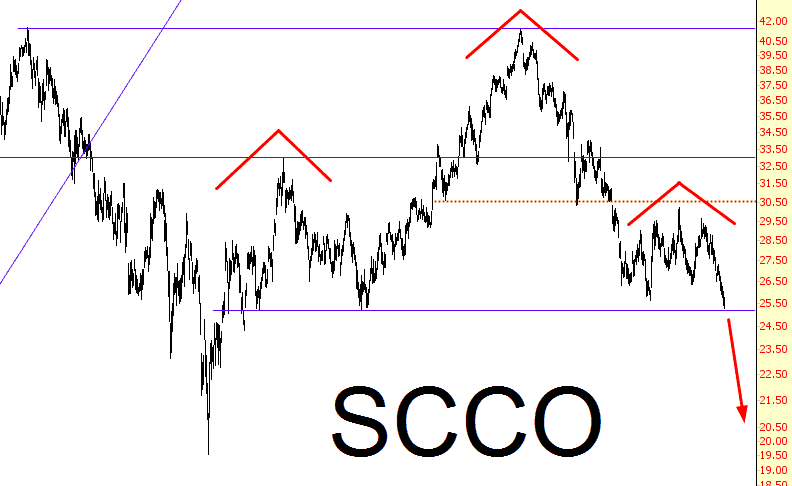
The last two times we  posted on head-and-shoulders formations, Tesla at $164.50 Oct. 23 (currently $120.77) and gold at $1271.20 on Nov. 12, (current $1249.90) it seemed to work out (although the more profitable gold short was in the miners). Let's see if this one works as well. SCCO $25.30 down 37 cents.
Southern Copper was in the top 10 miners a couple years ago although I don't see them on the current list.

From Slope of Hope:

Coppers and Robbers
By -
Copper has been weak lately (which is data point #1,389 that the real economy is toast, in spite of the Big Round Number highs on stock indexes). One short in particular I’d suggest looking at is Southern Copper, shown below.
1125-scco

Prince Alwaleed: "Saudi Government Doesn't Get that Shale Oil Poses a Real Threat"

From Arabian Business:

'I will make them get it', says Alwaleed
Saudi billionaire businessman Prince Alwaleed Bin Talal said the kingdom’s government does not “get it” that increased shale output in the west poses a real threat to the country’s economic stability and addressing it urgently is “a matter of survival”.

Speaking to Canada’s The Globe and Mail newspaper, the prince said new shale oil discoveries “are threats to any oil-producing country in the world” and the kingdom urgently needed to urgently diversify its economic output in order to guarantee its long-term stability.

“It is a pivot moment for any oil-producing country that has not diversified,” he was quoted as saying. “Ninety two percent of Saudi Arabia’s annual budget comes from oil. Definitely it is a worry and a concern.”
However, his concerns have fallen on deaf ears as the kingdom’s deputy oil minister on Wednesday said the Riyadh government remains unconcerned by surging US shale output, which threatens to eat into OPEC's market share, and sees no need to cut production to support prices.

"I think that the world economic growth will be sufficient to handle growth from all sorts - shale oil, shale gas, tight oil and including renewable," Prince Abdulaziz Bin Salman Bin Abdulaziz told a conference in Dubai.
As a result, Alwaleed said he would use all outlets possible to him to convince the government to take the threat from shale seriously, as he believed many Saudi shared his concerns....MORE
HT: Economonitor

Media: "PandoDaily acquires NSFWCORP to double down on investigative reporting"

Pando has developed into a solid little news source, this next step should be interesting.
From PandoDaily:
There are three people who have long been on my dream team to help me build PandoDaily. One of them I’ve still gotta work on. The second is Mike Tatum, who keeps saying no and then keeps doing work for us for free anyway. The third is joining us today by way of acquisition.

I’m sure regular readers can guess who I am talking about: Paul Carr. I’m thrilled to announce that PandoDaily has reached a deal to acquire his company, NSFWCORP.

But it’s a lot better than that. We aren’t just getting Paul. I’m equally thrilled to announce that we’re also adding Mark Ames, Brad Jonas, Yasha Levine, and David Sirota as full-time staffers. NSFWCORP contributors like John Dolan and Dayvid Figler will be making regular appearances too, and Katherine Dolan will continue to work her copy editing magic behind the scenes.

This team will form the core of a new investigative reporting unit at PandoDaily, of which Paul will be the editor. Our regular PandoDaily staff will also be working with Paul on more long-form, investigative pieces as well. The goal? To produce one-to-two “Holy Shit!” stories per week.
This is going to be fantastic.

There are three predictable reactions to this news:
  • Are you just bailing Paul out because you guys are friends?
  • Wait, the two weren’t already the same company?
  • About time!
The answer to no. 1 is a clear “no.” Paul can attest I’ve been a brutal negotiator throughout this process, our friendship aside. The answer to no. 2 is we’ve long been sister companies but separate organizations. The answer to no. 3 is a clear and resounding: Yes, it is. High time....
...MORE

Monty Python Reunion Show Sells Out in 43.5 Seconds

I guess we know who should have been hired to do the Affordable Care Act website.
From Variety:

Monty Python Extends Run of Stage Show


Monty Python Extends Run of Stage

First show sells out within 43.5 seconds
Comedy troupe Monty Python said Monday it will extend the run of its stage show, which was unveiled last week.

The show at London’s 20,000-seat O2 Arena will now run from July 1 to 5 next year.

The first show sold out within 43.5 seconds, organizers said.

A sixth show is being planned for the Hollywood Bowl in L.A., where the Pythons’ performed a live gig in 1980, according to the Daily Mail newspaper. The Daily Mirror reports that a source has told them the Pythons are also considering a world tour.

The show reunites John Cleese, Eric Idle, Terry Gilliam, Michael Palin and Terry Jones. The sixth Python, Graham Chapman, died in 1989. Eric Idle said last week that Chapman would “take part” via comedy seance.
Climateer Investing, your source for breaking entertainment and venue information.

North Korea Achieves 80% CO2 Reduction

From the Carbon Dioxide Information Analysis Center at Oak Ridge National Laboratory:


CO2 Emissions from North Korea (Democratic People's Republic of Korea)
Data graphic Data
image

"Iran and the oil markets"

Brent futures are trading down 1.6% at $109.31, WTI off 1.3% at $93.61.
From FT Alphaville:
Here to explain why refiners in Asia aren’t getting giddy about the Iran deal are some analysts accompanied by an angry Congress, angry Israel, angry Saudi, OPEC, existing sanctions, such as the ban on exports to the EU, and a large implicit counterfactual – without a deal, sanctions would have tightened further.
As the FT said:
In the short term, Iranian exports may receive a limited boost from current levels estimated by traders at up to 1.2m barrel per day, as the remaining large buyers of the country’s crude feel less pressure to reduce imports. However, a return to pre-sanctions levels of exports of around 2.5m b/d is not on the cards for now.
To Barc (with our emphasis):
Despite the landmark agreement, we believe that next phase of the talks will prove challenging. A key question is whether the current Iranian concessions represent a floor or a ceiling. If it is the latter, it will likely be very difficult to get the US Congress to go along with the deal. On Saturday evening, President Obama warned the US Congress against potentially derailing the deal by enacting additional sanctions legislation during the next six months. As we have noted before, many of the most restrictive sanctions – including the restrictions on dealing with the Iranian central bank and the requirement for foreign countries to reduce their Iranian oil imports every six months – originated in the US Congress, not the White House.
...MUCH MORE 

See also yesterday's "Société Générale: Initial Impact on Oil Prices From Iran Deal Should Be 'Muted'".

Natural Gas: Interesting Week Ahead

There was a reason we posted the temperature anomaly map last week, the first time since January 2013.
$3.77 settle, up 7 cents.
From RBN Energy:

Price Outlook:
Prices did continue higher with the market up now for 2 consecutive weeks while also slightly expanding he weekly range. The market again ended very near the weekly high and thus another new weekly high is expected. 53 of the 95 instances where there have two consecutive higher weeks witnessed a 3rd weekly high. Considering the Thanksgiving Holiday, volatility with low volume is very likely. The December contract will also expire this week.

The slide in the CFTC speculative net long position continued, but at a slower pace than recently. Total open interest across the complex rose to 4.69 million contracts as of November 19.
CME futures open interest dropped to 1.24 million contracts as of November 21. There is still a decent net long position and unlike crude where speculators have not been net short for years, natural gas speculators were net short as recently as March 2012. Additional selling could keep the market very defensive....MUCH MORE (5 page PDF)

Sunday, November 24, 2013

Magnitude 7.3 Tokyo earthquake could cost $3 trillion in economic losses

Note that's 3 Trillion dollars not ¥3 Trillion.
From the Artemis blog:
A professor of civil engineering at Kansai University, who is also part of the Japanese government’s Central Disaster Management Council, estimates that a magnitude 7.3 earthquake beneath Tokyo could cost as much as $3 trillion dollars (300 trillion yen) in economic losses.

The new estimate from professor Yoshiaki Kawata, a recognised expert in earthquake science and the potential damages resulting from earthquakes, is roughly triple an estimate given previously by the central government, according to the Japanese newspaper The Asahi Shimbun.

The Japanese government’s Central Disaster Management Council is currently in the process of reviewing its own estimates for the potential economic damages that a major earthquake could cause in the Tokyo area. With Kawata proposing a figure so much greater than the previous government sanctioned estimate, and with Kawata a member of that team, we can expect the governments estimate to rise significantly.

Kawata simulated a magnitude 7.3 quake in the northern area of Tokyo Bay, an event which is given a 70% chance of occurring within the next 30 years, according to the data. This simulation is seen as one of the worst possible earthquake occurrences for Tokyo, so it’s not a surprise to see an estimate so large.
Kawata’s estimate suggests such an event could cause 48,000 deaths and cause economic damage, largely to buildings and infrastructure, of between 200 trillion and 300 trillion yen. Include the breakdown of political and economic activity that such a major event would cause and Kawata believes the damage could exceed $3 trillion.

Kawata also estimated that a magnitude 8.5 Sagami Trough earthquake could top the Tokyo event, with estimated economic losses of 280 trillion to 420 trillion yen (over $4 trillion) and 124,000 deaths....MORE

If You Absolutely Have to Have Precious Metals Exposure, Consider Platinum (HSBC)

I mean beyond the silver and lead you will use to make everyday transactions when the apocalypse hits.
(enough lead and you can take the other guy's gold)
Short gold until the first few high-cost producers go bankrupt.
There is also still time for a pair trade.
From Kitco:
HSBC Looks For Stronger Platinum, Palladium Prices In 2014
Buoyant auto demand and static mine output are likely to propel prices of platinum group metals higher next year, said HSBC Friday.

The bank looks for the metals to rise, although it trimmed its prior price forecast for platinum while leaving its palladium forecasts unchanged.

“Based on tightening fundamentals, we expect the PGMs to increasingly decouple from the influence of gold,” the bank said.

HSBC looks for platinum to average $1,625 an ounce in 2014, down from its prior estimate of $1,725. For the current year that is winding down, HSBC lowered its forecast to $1,500 from $1,580.
The palladium forecasts were left at $750 for 2013 and $825 for next year.

As of 9:24 a.m. EST, spot platinum was at $1,393.20 and palladium was at $719.30.

Platinum is often influenced by movements in gold, therefore was dragged down by gold this year, the bank said. However, analysts also said, they look for platinum to rise in 2014 regardless of what gold does.

HSBC looks for a record platinum market deficit of 889,000 ounces this year, narrowing to 402,000 ounces in 2014....MORE

A Fine Whine: "Attacks on mainstream economics and reforming economics teaching"

Claret?
I usually like Professor Wren-Lewis' thinking but this piece points up the fact that there is an awful lot of navel-gazing going on in the econ academy.
From Mainly Macro:
Mainstream (orthodox) economics is having a hard time in the pages of the Guardian. First Aditya Chakrabortty writes “How do elites remain in charge? If the tale of the economists is any guide, by clearing out the opposition and then blocking their ears to reality. The result is the one we're all paying for.” Then Seumas Milne adds “Any other profession that had proved so spectacularly wrong and caused such devastation would surely be in disgrace.” In this post I want to say why such attacks are wide of the mark, but also say something about how these attacks gain traction, and why they suggest changing the way the subject is taught.

One frequent accusation, very evident in Milne’s piece, and often repeated by heterodox economists, is that mainstream economics and neoliberal ideas are inextricably linked. Of course economics is used to support neoliberalism. Yet I find mainstream economics full of ideas and analysis that permits a wide ranging and deep critique of these same positions. The idea that the two live and die together is just silly.

The absurdity of linking mainstream economics to all our current problems is also obvious if you think about austerity. As I never tire of saying, the proposition that austerity was a crazy thing to try in this recession is prominent in the pages of undergraduate and graduate textbooks. It is what mainstream economics, as practiced in central banks, tells us. Now I agree that it is a great shame that some influential economists sometimes seem to ignore or have forgotten what is in these textbooks, or put their own textbooks aside to provide support for particular political parties. However it remains the case that the most effective critic of austerity is using totally orthodox economics.

Nearly all complaints about that mainstream start off with the economics profession’s failure to foresee the financial crisis. Again it’s important to make some fairly basic points. First economics is not just (or even mainly) about trying to forecast the future. The percentage of the profession that made this mistake is tiny. Another one of my favourite lines back from when I did forecasting is that macro forecasts are only slightly better than guesswork. We know that, both from past evidence and the models themselves. It is a difficult message to get across, because a very visible part of economics - making decisions about interest rates - necessarily involves forecasts, and the media loves simplistic messages, but institutions like central banks do their best to emphasise the uncertainty involved.

It is also obviously not true that mainstream economics is incapable of understanding what led to the crisis, and what needs to be done to avoid it happening again. I think it’s fair to say that much that is in Admati and Hellwig’s The Bankers New Clothes is pretty mainstream. Perhaps in the past economists have been rather narrow, and even politically naive, in issues from regulation to overseas aid, but that is clearly changing and has been changing for some time. 

Having said all this, it would also be a mistake of equal magnitude to think that everything is just fine in the land of academic economics. I am struck about how economists, while at least partially defending their own particular field, are quite happy to express grave concern about what some of their colleagues in other fields do. I’ve noted Andy Haldane and Diane Coyle’s criticisms of DSGE modelling before, and you will find plenty of economists who can be very rude about their colleagues doing finance. More generally I suspect slightly less shrill versions of the sentiments expressed by the two Guardian columnists would attract considerable sympathy from lots of very sensible people who know quite a lot about economics....MORE

Banks Warn Federal Reserve They May Have To Start Charging Depositors

Scoopage from the Financial Times:

US banks warn Fed interest cut could force them to charge depositors
Leading US banks have warned that they could start charging companies and consumers for deposits if the US Federal Reserve cuts the interest it pays on bank reserves.

Depositors already have to cope with near-zero interest rates, but paying just to leave money in the bank would be highly unusual and unwelcome for companies and households.

The warning by bank executives highlights the dangers of one strategy the Fed could use to offset an eventual “tapering” of the $85bn a month in asset purchases that have fuelled global financial markets for the last year.
 
Minutes of the Fed’s October meeting published last week showed it was heading towards a taper in the coming months – perhaps as soon as December – but wants to find a different way to add stimulus at the same time. “Most” officials thought a cut in the interest on bank reserves was an option worth considering.
Executives at two of the top five US banks said a cut in the 0.25 per cent rate of interest on the $2.4tn in reserves they hold at the Fed would lead them to pass on the cost to depositors.....MORE
How's this for a pull quote:
...“It’s not as if we are suddenly going to start lending to [small and medium-sized enterprises],” said one. “There really isn’t the level of demand, so the danger is that banks are pushed into riskier assets to find yield.”...

Study Suggests Link Between Silk Road's Dread Pirate Roberts and Bitcoin Inventor Satoshi Nakamoto

Via Economic Policy Journal:
NYT reports:

Two Israeli computer scientists say they may have uncovered a puzzling financial link between Ross William Ulbricht, the recently arrested operator of the Internet black market known as the Silk Road, and the secretive inventor of bitcoin, the anonymous online currency, used to make Silk Road purchases.

Dorit Ron, a computer scientist at the Weizmann Institute, and Adi Shamir, a pioneering cryptographer who is a member of the applied mathematics faculty at the Institute, will publish a paper Sunday exploring how the 29-year-old Mr. Ulbricht, who was arrested by the Federal Bureau of Investigation in October and has been charged with a murder-for-hire scheme and narcotics-trafficking, acquired and protected the estimated millions he made in commissions operating Silk Road. The researchers say Silk Road, at the time of Mr. Ulbricht’s arrest, had sales of $1.2 billion, generating $80 million in commissions. A huge run-up in the value of bitcoin in the last month has exponentially increased those amounts.

However, the researchers added, they believe the F.B.I. has seized only about 22 percent of the commissions they have identified, and that they themselves have only been able to trace about a third of the total[...]

Mr. Ulbricht was arrested last month, the scientists used public information to begin tracing Silk Road-related transactions. Among their discoveries was a particular transfer to an account controlled by Mr. Ulbricht from another that had been created in January 2009, during the very earliest days of the bitcoin network, which was set up the previous year.

Although the authors state that they cannot prove that that account belongs to the person who created the bitcoin currency, it is widely believed that the first accounts belong to a person who identifies himself as “Satoshi Nakamoto,” but who has remained anonymous and has not been publicly heard from since 2010[...]
...MORE

"Policy: Twenty tips for interpreting scientific claims"

Be very careful quoting anything from The Lancet. Both the Iraq war deaths scandals of 2004 and 2006 and the MMR vaccine/Wakefield paper scandal appear to be not just the statistics problem (you can't trust one-third all medical research because of shoddy work) but were in fact politically motivated attempts to deceive.

We will never link to The Lancet, there are just too many reputable journals to choose from.
As a side note the British Medical Journal must have had fun publishing ""How the case against the MMR vaccine was fixed".

From the journal Nature:

This list will help non-scientists to interrogate advisers and to grasp the limitations of evidence, say William J. Sutherland, David Spiegelhalter and Mark A. Burgman.

Science and policy have collided on contentious issues such as bee declines, nuclear power and the role of badgers in bovine tuberculosis.
BADGER: ANDY ROUSE/NATURE PICTURE LIBRARY; NUCLEAR PLANT: MICHAEL KOHAUPT/FLICKR/GETTY; BEE: MICHAEL DURHAM/MINDEN/FLPA
Calls for the closer integration of science in political decision-making have been commonplace for decades. However, there are serious problems in the application of science to policy — from energy to health and environment to education.

One suggestion to improve matters is to encourage more scientists to get involved in politics. Although laudable, it is unrealistic to expect substantially increased political involvement from scientists. Another proposal is to expand the role of chief scientific advisers1, increasing their number, availability and participation in political processes. Neither approach deals with the core problem of scientific ignorance among many who vote in parliaments.

Perhaps we could teach science to politicians? It is an attractive idea, but which busy politician has sufficient time? In practice, policy-makers almost never read scientific papers or books. The research relevant to the topic of the day — for example, mitochondrial replacement, bovine tuberculosis or nuclear-waste disposal — is interpreted for them by advisers or external advocates. And there is rarely, if ever, a beautifully designed double-blind, randomized, replicated, controlled experiment with a large sample size and unambiguous conclusion that tackles the exact policy issue.

In this context, we suggest that the immediate priority is to improve policy-makers' understanding of the imperfect nature of science. The essential skills are to be able to intelligently interrogate experts and advisers, and to understand the quality, limitations and biases of evidence. We term these interpretive scientific skills. These skills are more accessible than those required to understand the fundamental science itself, and can form part of the broad skill set of most politicians.

To this end, we suggest 20 concepts that should be part of the education of civil servants, politicians, policy advisers and journalists — and anyone else who may have to interact with science or scientists. Politicians with a healthy scepticism of scientific advocates might simply prefer to arm themselves with this critical set of knowledge.

We are not so naive as to believe that improved policy decisions will automatically follow. We are fully aware that scientific judgement itself is value-laden, and that bias and context are integral to how data are collected and interpreted. What we offer is a simple list of ideas that could help decision-makers to parse how evidence can contribute to a decision, and potentially to avoid undue influence by those with vested interests. The harder part — the social acceptability of different policies — remains in the hands of politicians and the broader political process.

Of course, others will have slightly different lists. Our point is that a wider understanding of these 20 concepts by society would be a marked step forward.

Differences and chance cause variation. The real world varies unpredictably. Science is mostly about discovering what causes the patterns we see. Why is it hotter this decade than last? Why are there more birds in some areas than others? There are many explanations for such trends, so the main challenge of research is teasing apart the importance of the process of interest (for example, the effect of climate change on bird populations) from the innumerable other sources of variation (from widespread changes, such as agricultural intensification and spread of invasive species, to local-scale processes, such as the chance events that determine births and deaths).

No measurement is exact. Practically all measurements have some error. If the measurement process were repeated, one might record a different result. In some cases, the measurement error might be large compared with real differences. Thus, if you are told that the economy grew by 0.13% last month, there is a moderate chance that it may actually have shrunk. Results should be presented with a precision that is appropriate for the associated error, to avoid implying an unjustified degree of accuracy.

Bias is rife. Experimental design or measuring devices may produce atypical results in a given direction. For example, determining voting behaviour by asking people on the street, at home or through the Internet will sample different proportions of the population, and all may give different results. Because studies that report 'statistically significant' results are more likely to be written up and published, the scientific literature tends to give an exaggerated picture of the magnitude of problems or the effectiveness of solutions. An experiment might be biased by expectations: participants provided with a treatment might assume that they will experience a difference and so might behave differently or report an effect. Researchers collecting the results can be influenced by knowing who received treatment. The ideal experiment is double-blind: neither the participants nor those collecting the data know who received what. This might be straightforward in drug trials, but it is impossible for many social studies. Confirmation bias arises when scientists find evidence for a favoured theory and then become insufficiently critical of their own results, or cease searching for contrary evidence.

Bigger is usually better for sample size. The average taken from a large number of observations will usually be more informative than the average taken from a smaller number of observations. That is, as we accumulate evidence, our knowledge improves. This is especially important when studies are clouded by substantial amounts of natural variation and measurement error. Thus, the effectiveness of a drug treatment will vary naturally between subjects. Its average efficacy can be more reliably and accurately estimated from a trial with tens of thousands of participants than from one with hundreds.

Correlation does not imply causation. It is tempting to assume that one pattern causes another. However, the correlation might be coincidental, or it might be a result of both patterns being caused by a third factor — a 'confounding' or 'lurking' variable. For example, ecologists at one time believed that poisonous algae were killing fish in estuaries; it turned out that the algae grew where fish died. The algae did not cause the deaths2.

Regression to the mean can mislead. Extreme patterns in data are likely to be, at least in part, anomalies attributable to chance or error. The next count is likely to be less extreme. For example, if speed cameras are placed where there has been a spate of accidents, any reduction in the accident rate cannot be attributed to the camera; a reduction would probably have happened anyway....MUCH MORE

RepoWatch Says: "Financial Times key to understanding repo and U.S. default"

I wish he'd get off the default horse, our readers could give him a half-dozen reasons it won't happen but suffice to say; IT WON'T HAPPEN.
On the other hand he is pretty good on the importance of  keeping an eye on the repo biz.
From RepoWatch:
Early next year, when Congress once again threatens to default on U.S. debt, you will need to have a subscription to the Financial Times to get timely information about conditions in the repo market, which is where the danger lies.
News 
During the last round of brinksmanship, which ended October 16 with a four-month ceasefire, the only media that reported regularly on developing conditions in that market – and this includes RepoWatch, which does not do daily reporting – was the Financial Times.

To fully understand what’s at stake and to prepare for the next round, RepoWatch recommends:
– Read the Financial Times and RepoWatch articles below.

– Subscribe to the Financial Times, at least the online version, and set up an email alert so you’ll know when the Times publishes something about the repurchase market.

– Sign up for email alerts from Securities Finance Monitor, Scott Skyrm and Google.

It’s true that repo has lately been seen drifting out into the general U.S. business press.  This is gratifying.

In the past two months the New York Times,  NYT’s Dealbook blog, and the Associated Press have discovered repo, although AP waited until the 32nd paragraph of a 34-paragraph story to actually use the r-word.  Reuters had a story. Bloomberg had an editorial. The Wall Street Journal  had three stories in less than a week, here, here and here.

A good technical discussion of the repo market and U.S. debt default was on Oct. 15 by blogger Scott Skyrm.
But the daily granular reporting was done by the Financial Times. Here are some of their repo stories beginning in September, presented chronologically...MORE

Société Générale: Initial Impact on Oil Prices From Iran Deal Should Be 'Muted'

From Bloomberg via the Washington Post:

Oil Prices Seen Showing ‘Muted’ Impact From Iran Nuclear Accord
Iran’s promise to limit nuclear work in return for loosened economic sanctions will have a “muted” effect on crude prices as the nation’s oil sales stay capped, said analysts including Societe Generale SA’s Mark Keenan.

Oil exports from the Islamic republic will be held to about 1 million barrels a day under sanctions that remain in force after Iran and six world powers reached an agreement yesterday in Geneva, according to the White House. The sanctions cut Iranian crude sales by 60 percent since the start of 2012, depriving the country of more than $80 billion in revenue, U.S. President Barack Obama’s administration said in a statement.

“I doubt the deal will have any significant price impact,” given that Iran can’t boost crude sales under the accord, Gordon Kwan, Nomura Holdings Inc.’s regional head of oil and gas research, said yesterday by e-mail from Hong Kong. “The oil market will take some time to be convinced that Iran is serious in compliance before pricing out the hefty geopolitical premium.”

The six-month agreement, which offers Iran about $7 billion in relief from sanctions in exchange for curbs on its nuclear program, leaves in place banking and financial measures that have hampered the OPEC member’s crude exports. Sanctions on sales of refined products also remain, while Iran gains access to $4.2 billion in oil revenue frozen in foreign banks, the White House said.
EU Embargo

Buyers of Iranian crude that have reduced purchases won’t be required to make further cuts over the next six months under yesterday’s accord. As part of the deal, the European Union will lift a ban on insurance for tankers transporting Iranian oil, making it easier for the Persian Gulf nation’s six remaining customers to take delivery. The EU will continue to prohibit crude imports from Iran.

“The resolution doesn’t at this stage extend to the lifting of sanctions on oil exports, and as such the initial impact on the oil price is likely to be somewhat muted,” said Keenan of Societe Generale. “We can, however, expect some price weakness as the market adjusts to the future prospect that Iranian exports will resume.”...MORE
One sign the deal was going to happen, Nov. 2: 

And some commentary Nov. 6: 
If Iran can resume exporting 1mm bbl/day I'd look for a quick overreaction $20 haircut for both Brent and WTI ($105.62, $94.40). And then depending on how fast Saudi Arabia cuts production that should narrow to a $10 decline....
And Nov. 8: 

See also ZeroHedge:

Saturday, November 23, 2013

The Fed is Desperate to Taper

After the bursting of the dotcom bubble and the terrorist attacks of 2001 Greenspan did the right thing and brought rates, in this chart Fed Funds, down fast. The problem was he kept them down too long as this FRED Chart shows:
FRED Graph
As can be seen, the 2001 recession ended in November but Greenspan not only didn't reverse course he continued cutting. The stock markets bottomed on October 9, 2002 (so much for the foreword looking idea) and Greenspan continued cutting! Finally by Q1-2005 folks started asking "with rates at 1% what the hell is the Fed going to to in the next recession?"

So, the question coming into the last month of 2013 is "with the effective Fed Funds rate at 0.09% what the hell are we going to do when the next recession hits?"

Just as Bernanke, the expert on the Great Depression, was brought in to clean up Greenspan's mess, Yellen is being brought in to clean up Bernanke's.
Reasoning from that point means she won't be as loosey-goosey as Ben, at least at first, which is going to surprise some folks who don't understand she has to get some room to maneuver.
Let's just hope the economy is strong enough to handle the upticks.

From Tim Duy's Fed Watch:
The minutes of the October FOMC meeting leave little doubt that the Fed increasingly desires to end the asset purchase program, enough so to contemplate tapering regardless of seeing satisfactory improvement in labor markets.  It is that desire - or perhaps desperation - that puts an element of random chance into the policymaking process and keeps the expectation of near-term tapering alive despite efforts of policymakers to reassure market participants that it is all data dependent.  Trouble with that story is simple - it is not only data dependent.  The Fed has already admitted as much.
Policy planning and communication strategy were the hot topic of this FOMC meeting, and the discussion of the specifics of the asset purchase program began with:
During this general discussion of policy strategy and tactics, participants reviewed issues specific to the Committee's asset purchase program. They generally expected that the data would prove consistent with the Committee's outlook for ongoing improvement in labor market conditions and would thus warrant trimming the pace of purchases in coming months.
The mythical taper - just a few months away.  And it will always be just a few months away given the broad weakness in the labor chart.  Recall the Yellen Charts:
YELLEN112113
Unless they narrow their focus to only the unemployment rate, the argument to taper is challenged to say the least.  It is even more challenged considering inflation indicators.  Knowing that the data continuously refuses to cooperate, the Fed explores plan B:
However, participants also considered scenarios under which it might, at some stage, be appropriate to begin to wind down the program before an unambiguous further improvement in the outlook was apparent.
To be sure, some doves shrieked...MUCH MORE

JP Morgan on the Sweet Smell of Euro Trash

I'm getting a bit far from my area of expertise posting this because most of these trades depend on either a deep understanding of European politics or some inside information re: the political class. I don't have a lot of either at the moment but fortunately have found Penta (as in $5 mil and up) to be reasonably astute.
From Barron's Penta blog:
Europe will be the hot equity play of 2014, claims JPMorgan Private Bank. If you are of a similar view, we have a less obvious way you might play the turgid European recovery—distressed debt. Large tranches of nonperforming European loans, priced at 30 to 50 cents on the dollar, are about to come onto the market.
European banks are saddled with a bad-loan problem similar to what the U.S. faced four years ago, when borrowers walked away from their outsize mortgages, after the value of their properties collapsed. The problem persists in European commercial real estate where nonperforming loans—the borrower has not made scheduled payments for at least 90 days—are sitting on the balance sheets of the Continent’s banks.
According to a PwC estimate, the value of those bad European loans is somewhere between one trillion euros and €1.5 trillion ($1.3 trillion and $2 trillion) in 2012, up from €514 billion in 2008. By comparison, U.S. lenders now have less than $200 billion of these clunkers on their balance sheets.

The euro-zone banks have let these loans fester on their balance sheets, says Robert Klein, president of JPMorgan Alternative Asset Management, because they don’t have the ability to sell on a robust securities aftermarket. Furthermore, taking losses on these loans would have further damaged the European banks’ already fragile reputations.

But recent earnings releases from recovering banks like Deutsche and Barclays have shown promise, and the prospect of absorbing these losses is suddenly more palatable. Perhaps more importantly, the Continent’s foot-dragging bankers are facing up to a new reality, as the European Central Bank finally pushes them hard to grapple with their problems. Specifically, the ECB’s round of stress tests next year—and the initial rollout of Basel III global banking standards starting in 2015, with stricter standards to follow in 2019—is focusing many a euro banker’s mind.

Enter opportunity. In the past few years, private-equity firms like KKR, Blackstone Group, Cerberus, and Apollo Global Management have been quietly snapping up a steady trickle of deals. Last year Blackstone’s real-estate group bought $3.5 billion worth of distressed European mortgages and properties, the most it has ever invested in the Continent in a year. In the process, these private-equity firms have built banking relationships that translate into best pricing, an advantage they have backed with turnaround operations and manpower on the ground in Europe, capable of efficiently managing and restructuring the deadbeat loans.

The problem for everyone else is that it takes time and huge effort to realize a profit from these bad loans, so even $100 million-plus family offices so far have struggled getting into the game and becoming players. But that, too, is changing rapidly. Citi Private Bank, JPMorgan Private Bank, and Deutsche Bank Wealth Management are teaming up with the private-equity firms so their clients can get some of the action....MORE
See also this week's Barron's Fund of Information column:

A Big, Dispassionate Bet on Europe's Recovery
Hedge-fund manager Stephen Roberts of Horseman Capital got the Continent's turnaround right. And why he's still short Newmont Mining.
Stephen Roberts attributes a lot of his recent investment success to avoiding the passion—and occasional panic—of the markets. He used to keep to himself in the library-like offices of Horseman Capital Management in London. In 2011, he took it a step further. He bought a tranquil, manicured estate in the British tax haven of Jersey in the Channel Islands off the coast of France. Roberts wanted to "isolate" himself from the "noise and distraction" of the European financial centers of London, Frankfurt, Zurich, and Milan. As a rule, Roberts never visits a company he invests in or meets its managers. Instead, he monitors his Bloomberg screen, listens to earnings calls and reads regulatory filings and news reports online.

Staying far from the madding crowd seems to work for him. The 41-year-old portfolio manager of the Horseman European Select long-short equity fund has nearly three quarters of its $550 million in European shares, much of that acquired at the beginning of this year, when the region's prospects seemed far dicier. Europe has attracted a lot more hedge-fund money this year, but Roberts got in early. His hedge fund has delivered a 26.6% return, net of its 1.5% management fee and 20% performance fee, from Jan. 1 to Oct. 31. The return trounced those of the vast majority of equity-oriented hedge-fund managers.

Roberts put down some bets in Europe when it was in the throes of its crisis in 2010. At that time, he decided that the "emerging wealth" of Asia would keep revenue flowing into European luxury brands, which today make up 40% of the fund's gross assets. China accounts for about 20% of the $330 billion in global consumption of luxury goods, up from less than 10% a decade ago. Many of these purchases are made by tourists at the fashionable stores on Fifth Avenue in New York and the Champs Elysées in Paris, he says. Even as China's economy slows down to a more mature growth rate, he expects the number of Chinese people who earn $30,000 a year to more than triple over the next decade from just 3% of the population today. As a result, luxury brands are still a favorite of his.

Roberts' biggest single holding is Cie. Financière Richemont (ticker: CFR.Switzerland), a Swiss firm that's sitting on about 3.2 billion euros ($4.34 billion) in cash and owns numerous luxe brands including Cartier and Montblanc. The stock is up 123% since he started buying the shares for 41.20 Swiss francs ($45.44) in March 2010, and he thinks it can go higher still....MORE