Showing posts sorted by relevance for query cole artemis. Sort by date Show all posts

Thursday, October 19, 2017

"Will Short Volatility Trigger the Next Black Monday?"

From MoneyBeat:
Market watchers are increasingly eyeing the popular bet against volatility as ground zero for the next financial crisis.

More than $2 trillion has flowed into the “global short volatility trade,” says Artemis Capital Management founder Christopher Cole. Those wagers both influence and are influenced by stock market turbulence. They also could backfire, threatening the eight-year-old bull market.

The tactics include options selling strategies by the largest pension funds and asset managers alongside exchange-traded products tracking the CBOE Volatility Index, or VIX, and VIX futures. Exchange-traded products betting on a pickup in volatility are some of the riskiest, and some investors could see extreme losses if the VIX jumps, Mr. Cole wrote in an Oct. 18 note.
Among the other strategies are ones that utilize volatility to make investing decisions, such as so-called risk parity strategies, that tend to bank on assets like stocks and bonds moving in different directions. If stocks and bonds rise and fall at the same time, it could hurt the billions of dollars in investments that rely on this relationship, he said.

“The danger is that the multi-trillion dollar short volatility trade, in all its forms, will contribute to a violent feedback loop of higher volatility resulting in a hyper-crash,” wrote Mr. Cole.

If that happens, there is no limit to how high volatility could go, Mr. Cole wrote, a moment markets experienced 30 years ago to the day. The Dow Jones Industrial Average plummeted 22.6% on Black Monday, fueled by many of the drivers that markets are experiencing right now, he said.

Artemis is not alone in flagging these risks. The International Monetary Fund recently warned in its Global Financial Stability Report that low volatility can heighten how sensitive a financial system is to risks because when things are calm, investors ramp up exposure to financial assets. Investors also use more leverage, which can amplify any swings when they do happen.

Ironically, so-called volatility-targeting investment strategies, meant to keep portfolio fluctuations at a certain level, can lead to market disruptions and heavy selling when market jitters pick up...MORE
Here's Mr. Cole's Artemis Capital Management:

Volatility and the Alchemy of Risk 
Reflexivity in the Shadows of Black Monday 1987

Volatility and the Alchemy of Risk 
The Ouroboros , a Greek word meaning ‘tail devourer’, is the ancient symbol of a snake consuming its own body in perfect symmetry. The imagery of the Ouroboros evokes the infinite nature of creation from destruction . The sign appears across cultures and is an important icon in the esoteric tradition of Alchemy. Egyptian mystics first derived the symbol from a real phenomenon in nature. In extreme heat a snake, unable to self - regulate its body temperature, will experience an out - of - control spike in its metabolism. In a state of mania, the snake is unable to differentiate its own tail from its prey, and will attack itself, self - cannibalizing until it perishes. In nature and markets, when randomness self - organizes into too perfect symmetry, order becomes the source of chaos (1) .

The Ouroboros is a metaphor for the financial alchemy driving the modern Bear Market in Fear. Volatility across asset classes is at multi - generational lows. A dangerous feedback loop now exists between ultra - low interest rates, debt expansion, asset volatility, and financial engineering that allocates risk based on that volatility. In this self - reflexive loop volatility can reinforce itself both lower and higher. In a market where stocks and bonds are both overvalued, financial alchemy is the only way to feed our global hunger for yield, until it kills the very system it is nourishing .

The Global Short Volatility trade now represents an estimated $2 + trillion in financial engineering strategies that simultaneously exert influence over, and are influenced by, stock market volatility (2). We broadly define the short volatility trade as any financial strategy that relies on the assumption of market stability to generate returns, while using volatility itself as an input for risk taking. Many popular institutional investment strategies, even if they are not explicitly shorting derivatives, generate excess returns from the same implicit risk factors as a portfolio of short optionality, and contain hidden fragility.

Volatility is now an input for risk taking and the source of excess returns in the absence of value. Lower volatility is feeding into even lower volatility, in a self - perpetuating cycle, pushing variance to the zero bound. To the uninitiated this appears to be a magical formula to transmute ether into gold... volatility into riches... however financial alchemy is deceptive. Like a snake blind to the fact it is devouring its own body, the same factors that appear stabilizing can reverse into chaos. The danger is that the multi - trillion - dollar short volatility trade, in all its forms, will contribute to a violent feedback loop of higher volatility resulting in a hyper - crash. At that point the snake will die and there is no theoretical limit to how high volatility could go.

Thirty years ago to the day we experienced that moment. On October 19th, 1987 markets around the world crashed at record speed, including a - 20% loss in the S&P 500 Index, and a spike to over 150% in volatility. Many forget that Black Monday occurred during a booming stock market, economic expansion, and rising interest rates. In retrospect, we blame portfolio insurance for creating a feedback loop that amplified losses. In this paper we will argue that rising inflation was the spark that ignited 1987 fire, while computer trading served as explosive nitroglycerin that amplified a normal fire into a cataclysmic conflagration. The multi - trillion - dollar short volatility trade, broadly defined in all its forms, can play a similar role today if inflation forces central banks to raise rates into any financial stress. Black Monday was the first modern crash driven by machine feedback loops, and it will not be the last....MUCH MORE (19 page PDF)
Previously from Mr. Cole:
"Volatility and the Prisoners Dilemma"—CBOE Risk Management Conference Asia, December 1, 2015

And many more, use the search blog box keywords 'Cole, Artemis' if interested.
(just using 'Artemis' will get you a hundred posts on reinsurance and cat bonds, worthy but not related, directly) 

Baby Got Black (Swan)
(With apologies to Sir Mix-a-Lot)
I like… fat… tails and I cannot lie
You vol sellers can’t deny
When a hot trend breaks with a well-timed stop
and a great big black swan pop you get
Paid… P&L year gets made
‘Cause you noticed that trade was packed
Buncha mean reversion suckers got jacked

Oh baby I wanna get lumpy
Long gamma for when it gets bumpy
Central banks tried to haze me,
But those carry trades just don’t faze me!...MORE
Genius or madman? 

Wednesday, September 19, 2018

Volatility Mavens Artemis Capital Management | Letter to Investors | July 2018

Always interesting, even a couple months out of date.
From Chris Cole's Artemis Capital:

What is Water in Markets? Volatility and the Fragility of the Medium
“This is Water” is the title of a commencement speech delivered by David Foster Wallace that has become a masterpiece of meta -thinking. If you haven’t listened to it, put down this paper and do so now. It is worth 20 minutes of your life. The Foster Wallace parable of two young fish ignorant of the medium that defines their reality is so important on many levels. Foster Wallace contends that we swim in a world defined by self-centered thoughts, that serve to make reality visible, but should never be mistaken as fundamental truth.

In capitalism the medium that defines reality is fiat money. To this point, does money exist? This seems silly to ask but it is very important philosophically. Yes, money exists in the sense that you can purchase goods and services with it. At the same time, money is only important because of a collective belief in it, and is worthless without that. This is true of any human construct: markets, words, brands, and nation-states... all abstract mediums that have meaning because we collectively believe they do, and hence they give form to reality, but are not real independent of our thoughts.

In markets and in life, we swim in mediums of thought abstractions... the same way a fish swims in water . When the medium collapses, so does the reality... causing us to question the nature of both. As Foster Wallace eloquently explains, “ The immediate point of the fish story is that the most obvious, ubiquitous, important realities are often the ones that are the hardest to see and talk about.”

Volatility is always the failure of medium ... the crumpling of a reality we thought we knew to a new truth. It is the moment whe re we learn that we are a fish living in a false reality called water... and that reality can change... or there are other realities. True volatility isn’t the change of the thing, it’s the changing of the medium around it and the realization that the thing never really existed in the first place.

This is all you need to know to understand when the volatility storm will truly come. It is not about valuations, money printing, or where the VIX is at any point. When the collective consciousness stops believing growth can be created by money and debt expansion the entire medium will fall apart violently, otherwise it will continue to be real. The belief that the medium is the reality is what holds the edifice together temporally.

This letter is divided into three key themes: The first part will discuss fragility of the market medium; the second will discuss how the volatility in February was a symptom of a much greater liquidity problem ; and the third will discuss how flows are more important than fundamentals when the medium dominates truth. Out of the fishbowl and down the drain we go...

Fragility in the Medium 
Investors swim in a pond of bid and ask prices. Without a bid and ask there is no price discovery... and the market... like a fish out of water... dies . Now here is an interesting question: does the market create value, or can value exist without a medium to facilitate it? A silent revolution is now being fought for the soul of investing between two contradictory schools of meta -thinking, each with their own strategies and central planning philosophies to support them. These two schools are the following:

1) Value is independent of the medium and intrinsic to the asset: The classic school of investing embodies the value investing principals of Graham and Dodd as put into practice by investors like Warren Buffet (younger version) , Seth Klarman, and David Einhorn. In this school, the bid and ask prices of an asset do not represent value any more than a picture of a “pipe” is a real pipe. Liquidity is a highly flawed medium to express value. Although prices may fluctuate they are independent from the intrinsic worth of an asset . If you want to smoke a pipe, the picture is not sufficient to provide value.

2) Value is generated from the medium . In the second school, liquidity is the sole determinant of value as defined by a constant bid and ask price. An asset is only worth what someone is willing to pay for it at any given moment. If Facebook, Snapchat, Tesla, Ethereum, and Ripple keep going up, who cares why, as long as someone is willing to pay. When market participants gain confidence in a quantitative investment factor (growth, low volatility, cat ownership of company management), it becomes real, regardless of whether it makes sense. As long as people supply a bid and ask price, the medium is the reality, so to speak. The school is also supported by modern central banking policies. If a picture of a pipe looks like a pipe, it is a damn pipe, especially if people buy more tobacco.

The second meta-view of value is now winning the revolution and dominating central banking and institutional asset flows. Passive and factor -based investments are just the most obvious symptom of this new worldview. If value is “created” by the medium of money, you don’t need to pay people to find it, hence active investors should be replaced by passive index funds, systematic trading, and factor -based quantitative investments. Today fundamental discretionary traders only account for 10% of trading volume in stocks according to J .P . Morgan, while rules-based strategies account for 60%. Since the recession $2 trillion in assets have migrated from active to passive strategies. Starting this year, over 50% of the assets under management in the U .S. will be passively managed according to Bernstein Research . Almost a decade of unprecedented global monetary stimulus resulted in the best risk-adjusted returns for passive investing in over 200 years between 2012 and 2017. Large capital flows into stocks occur for no reason other than the fact that they are highly liquid members of an index, and those capital flows chase the hottest ETFs and collections of stocks (FANGs)....

...MUCH MORE (11 page PDF)

Previous visits to Artemis:
October 2017 
"Will Short Volatility Trigger the Next Black Monday?"
 August 2017
"Volatility and the Prisoners Dilemma"—CBOE Risk Management Conference Asia, December 1, 2015

And many more, use the search blog box keywords 'Cole, Artemis' if interested.
(just using 'Artemis' will get you a hundred posts on reinsurance and cat bonds, worthy but not related, directly)

Baby Got Black (Swan)
(With apologies to Sir Mix-a-Lot)
I like… fat… tails and I cannot lie
You vol sellers can’t deny
When a hot trend breaks with a well-timed stop
and a great big black swan pop you get
Paid… P&L year gets made
‘Cause you noticed that trade was packed
Buncha mean reversion suckers got jacked

Oh baby I wanna get lumpy
Long gamma for when it gets bumpy
Central banks tried to haze me,
But those carry trades just don’t faze me!...MORE
Genius or madman?

It should be noted that we were introduced to Mr. Cole by FT Alphaville.
From the intro to May 2017's "VIX Surge Is Unwelcome Lesson in Duplicity of Volatility Wagers"--UPDATED:
FT Alphaville's Izabella Kaminska used to talk with Chris Cole of Artemis Capital about volatility but I haven't seen him mentioned in a while. What he's up to is on a whole different level from the usual. Here's an example: The shadow convexity risk in the machine (and the VIX)
Or 2014's "An Awful Lot of People Are Shorting Volatility (VIX; VXX; XVIX; XXV)":
I'm starting to wonder if Izabella likes posting on volatility because, in addition to talking to Chris Cole who is pretty sharp, the ETP symbols read like Roman numerals?

As to the headline, I mean "awful lot" in both the colloquial and the literal....
But, instead of listing our links to FTAV, you can go directly to the source:
site:https://ftalphaville.ft.com Chris Cole

Tuesday, March 11, 2025

Budget Impasse: "Never Let A Crisis Go To Waste"

 From Real Investment Advice, March 5:

Many believe Winston Churchill coined the phrase: “Never let a good crisis go to waste.” Others think it was President Obama’s Chief of Staff, Rahm Emanual, who said, “You never want to let a serious crisis go to waste” during the financial crisis. Regardless of who first spoke those words and whether the crisis is “good” or “serious,” the Fed may be planning on heeding their crisis advice.

On February 19, 2025, the Fed made a confounding statement about QT, aka balance sheet reduction. Per its latest FOMC minutes: “several participants suggest halting or slowing balance sheet reduction pending debt ceiling resolution.”

If the government were to stop issuing debt because of a debt ceiling impasse, financial liquidity would increase as the Treasury would spend down its roughly $800 billion piggy bank known as the Treasury General Account (TGA). Due to its positive impact on liquidity, some people call a potential TGA withdrawal “Not QE, QE.”

Thus, if a government shutdown results in additional, albeit temporary, liquidity to the financial system, why halt or slow QT, which drains liquidity?

The timing of the Fed’s confounding statement aligns with an essential gauge of excess liquidity. Might the Fed be offering investors a liquidity warning cloaked as a reaction to a fiscal crisis?

To help answer the question, we review two popular liquidity gauges. In the postscript, following our summary, we share some measures of liquidity and reserves the Federal Reserve monitors.

What Is Water?

Before progressing, it is worth emphasizing how vital and underappreciated liquidity is to the financial markets. We lean on Chris Cole at Artemis Capital to help you appreciate liquidity.

In his piece, What Is Water In The Markets, Cole uses a commencement speech by David Foster Wallace to make an analogy between liquidity in the financial markets and water for a fish. Likely, fish don’t pay attention to the water that surrounds them. Similarly, how often do we think about the air we breathe? 

Financial markets, like fish and humans, exist in a medium that sustains its being. Yet, despite the grave importance of liquidity, the market medium, few investors pay much attention to it. Without water, a fish will die. When liquidity fades, volatility often spikes, and market fragilities are exposed. Thus, measuring liquidity, the medium investors struggle to quantify and rarely discuss, is warranted.

what is water

The Roots Of The Current Liquidity Omen

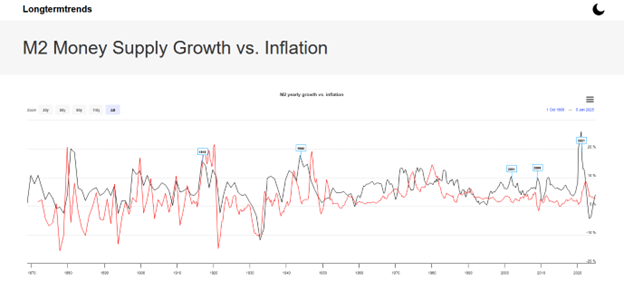
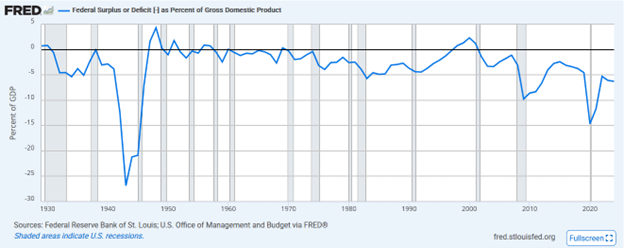
In the pandemic crisis of March 2020, the Federal Reserve and the government opened the liquidity floodgates to combat the shuttering of the global economy. As we share in the first graph below, courtesy of Longtermtrends, in 2020, the percentage growth of M2 money supply (black) grew at a higher rate than at any time in history. The second graph shows that deficit spending as a percentage of GDP was 15% in 2020. The only time since 1930 it was higher was during World War II.

money supply growth and inflation

federal surplus deficit

The covid crisis shut down the global economy and sent financial markets plummeting. Liquidity fled the markets, and significant volatility ensued. Consequently, the Fed and government did everything possible to restore economic and market liquidity.

What is now most important to grasp is how much of that extra liquidity still exists. One big clue is the Fed’s Reverse Repurchase Program (RRP).

Reverse Repurchase Program (RRP)

Had the Fed not managed excess liquidity, its monetary policy in 2020 and 2021 would have sent short-term interest rates well into negative territory. The Fed’s RRP was employed to soak up the extra liquidity.

The program allows banks and money markets to lend money to the Fed, and in exchange, the Fed provides them with risk-free Treasury collateral. The “risk-free” money market surrogate effectively met the massive demand for short-term investments and kept rates positive.

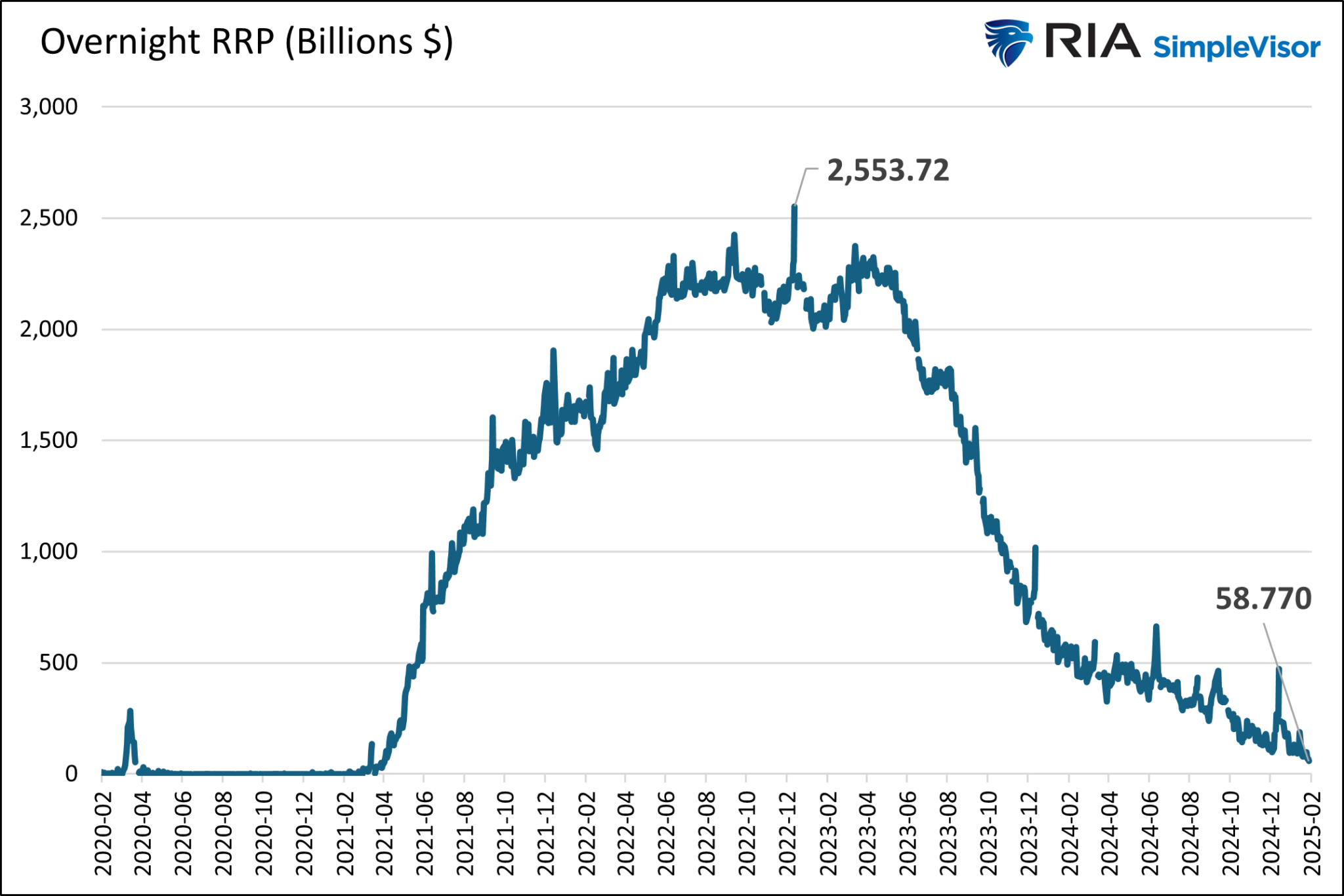
We should consider the RRP balance as the financial market’s excess liquidity. The liquidity warning we allude to in the opening is the current negligible RRP balance. As shown below, the once $2.55 trillion storer of excess liquidity has dwindled to near zero. While liquidity may not be an issue today, there is no longer a massive bank of liquidity for the market to draw on. 

rrp 

With RRP largely evaporated, tracking liquidity becomes much more critical.

Market Monitors of Liquidity

One of the more straightforward gauges of liquidity is the sum of the RRP balances and bank reserves held at the Fed. Bank reserves approximate the potential liquidity banks could provide.

As the data below shows, liquidity, using this measure, is steadily declining. However, it is still well above pre-pandemic levels. The question worth asking but lacking an answer is how much more liquidity our economy and markets require today than before the pandemic....

....MUCH MORE (chart mania)

We linked to Chris Cole's "What is Water" piece under the headline "Volatility Mavens Artemis Capital Management | Letter to Investors | July 2018" along with:

....Previous visits to Artemis:
October 2017 
"Will Short Volatility Trigger the Next Black Monday?"
 August 2017
"Volatility and the Prisoners Dilemma"—CBOE Risk Management Conference Asia, December 1, 2015

And many more, use the search blog box keywords 'Cole, Artemis' if interested.
(just using 'Artemis' will get you a hundred posts on reinsurance and cat bonds, worthy but not related, directly)

Baby Got Black (Swan)
(With apologies to Sir Mix-a-Lot)
I like… fat… tails and I cannot lie
You vol sellers can’t deny
When a hot trend breaks with a well-timed stop
and a great big black swan pop you get
Paid… P&L year gets made
‘Cause you noticed that trade was packed
Buncha mean reversion suckers got jacked

Oh baby I wanna get lumpy
Long gamma for when it gets bumpy
Central banks tried to haze me,
But those carry trades just don’t faze me!...MORE
Genius or madman?

Sunday, December 31, 2017

"Betting Against Boredom: A Field Guide to 2018 Volatility Trades"

From Bloomberg Dec. 27:
  • Volatility has been below 10 about 20% of the time this year
  • Global short vol trade has $2 trillion in strategies: Cole
It’s pretty simple: in three decades since the Cboe Volatility Index was invented, 2017 will go down as the least exciting year for stocks on record. There are three trading days left and the VIX’s average level has been 11.11, about 10 percent lower than the next-closest year.
https://assets.bwbx.io/images/users/iqjWHBFdfxIU/iGpiiuxMXO2o/v2/800x-1.png
It’s tempting to say nobody thinks it will last, but that would be to ignore the walls of money that remain stacked up in bets that it will. Going just by the sliver represented by listed securities, about $2.4 billion is in the short volatility trade as of this month, the most on record. Hundreds of billions more are betting against beta in things like volatility futures.

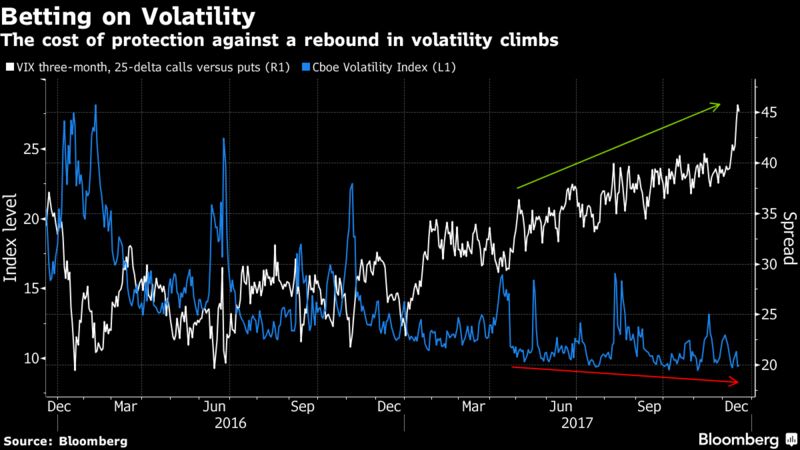
Still, that doesn’t mean investors are ignoring the possibility of a resurgence, or at least a reversion to the mean. Here’s a look at volatility positioning as it stands now.

Surging Cost of Protection Against VIX Upside
Nervousness about next year is visible in the relative cost of betting on an increase in volatility, which has surged to a peak compared with wagers on a decline. (The spread is based on three-month VIX skew in data compiled by Bloomberg.) Someone, somewhere is spending money to capitalize on a rebound in the gauge.

But it’s the furthest thing from a one-way bet. The global short volatility trade currently has more than $2 trillion in various strategies, according to an October report by Christopher Cole, the founder of Artemis Capital Advisers hedge fund. He compared the strategy of betting that volatility, already near record lows, will fall even further, to a snake “blind to the fact that it is devouring its own body.”
Reptilian autosarcophagy aside, as of December 2017, betting against volatility has been the trade that worked. An analysis on the ETF.com website Tuesday said that seven of the 20 worst-performing exchange-traded securities this year were long VIX and other volatility measures.

Investors see a 74 percent probability that equity price swings will widen next year as the current levels of volatility are “unsustainable,” according to a survey of 229 investors representing $6 trillion in managed assets conducted by Absolute Strategy Research. The VIX rose for a second day to 10.25 on Tuesday after hanging below 10 for about 20 percent of the time this year.

Record Number of Investors See Stocks as Overvalued
Between rising corporate profits, a pick-up in global growth and laudable message-management by central banks, volatility has had few catalysts. But as the S&P 500 Index has reached 62 all-time highs this year, a record number of investors see stocks as overvalued, according to a Bank of America Merrill Lynch survey last month.

Perhaps as a result, smart-beta exchange-traded funds purporting to offer a haven from chaos have taken in more than $3.5 billion in 2017....MORE
Previous visits with Mr. Cole and Artemis; as noted in the intro to May 18's "VIX Surge Is Unwelcome Lesson in Duplicity of Volatility Wagers"--UPDATED:

FT Alphaville's Izabella Kaminska used to talk with Chris Cole of Artemis Capital about volatility but I haven't seen him mentioned in a while. What he's up to is on a whole different level from the usual. Here's an example: The shadow convexity risk in the machine (and the VIX)
Or 2014's "An Awful Lot of People Are Shorting Volatility (VIX; VXX; XVIX; XXV)":
I'm starting to wonder if Izabella likes posting on volatility because, in addition to talking to Chris Cole who is pretty sharp, the ETP symbols read like Roman numerals?

As to the headline, I mean "awful lot" in both the colloquial and the literal....
But, instead of listing our links to FTAV, you can go directly to the source:
site:https://ftalphaville.ft.com Chris Cole
More recently, both August's link to "'Volatility and the Prisoners Dilemma'—CBOE Risk Management Conference Asia, December 1, 2015" and October 19's "Volatility and the Alchemy of Risk" are worth a read to help get the bigger picture.
 
And while I attempt to synthesize these concepts, here's a 1992 Mack Daddy beat:

From The Mercenary Trader:
Baby Got Black (Swan)
(With apologies to Sir Mix-a-Lot)
I like… fat… tails and I cannot lie
You vol sellers can’t deny
When a hot trend breaks with a well-timed stop
and a great big black swan pop you get
Paid… P&L year gets made
‘Cause you noticed that trade was packed
Buncha mean reversion suckers got jacked

Oh baby I wanna get lumpy
Long gamma for when it gets bumpy
Central banks tried to haze me,
But those carry trades just don’t faze me!...MORE
Genius or madman?

Monday, January 14, 2019

Artemis Capital's Chris Cole On The Risks of a Short-Volatility Blowup

I liked it better when Izabella Kaminska would interview Mr. Cole, no "triumphant return" talk, possibly because she knows the classics stuff better than the ZH writers.
(and definitely better than I)*
Sadly though we haven't seen him at FT Alphaville for a while.

From ZeroHedge:

Chris Cole: The Coming $2 Trillion Short-Vol Blowup Could Be More Devastating Than 1987 
In a now-legendary interview given almost exactly one year ago, Artemis Capital's Chris Cole appeared on the MacroVoices podcast to elaborate on a paper he had written titled the "Volatility and Alchemy of Risk", where Cole laid the risks posed by what he estimated to be $2 trillion in global explicit and implicit short-volatility exposure, and how the unwinding of this massive position could usher in an era of instability across asset classes as markets were forced into a devastating reevaluation of systemic risk.
And as fate would have it, barely a week later on Feb. 5, markets exploded in a massive short-vol squeeze that vindicated Cole's warnings and led to the death of one of the most popular short-vol ETPs - eroding years of profits accrued by amateur day traders who had reaped millions in profits off the short-vol trade.

Fortunately for legions of American retirees and retail investors, the February blowup proved to be an isolated incident. Markets staged a surprisingly swift recovery, and by the summer, had returned to all time highs. But Cole persisted with his warnings that what we saw in February was merely the weakest hands getting pushed out of the short-vol trade, and that more chaos would follow.

And so, with markets sloughing off a brutal fourth quarter, prompting some in the financial press to speculate about whether the bulls are back in charge, Cole is making his triumphant return to MacroVoices to offer his take on the volatility that gripped markets during the fourth quarter, along with a word to the wise:  The unwind of the massive short-vol trade that Cole predicted more than a year ago isn't over.

Rather, it's just beginning.
But first, a quick refresher: In Cole's view, traders have massively underestimated the risks associated with the short volatility trade by using it as a source of return and an input for taking risk. Counterintuitively, the more volatility goes down, the more risk rises. The more volatility goes up, the more risk is taken off. This sets up a regime of self-reflexivity that creates massive systemic risk.
I think what we saw last February actually just was the weak hand of the table being taken out by the short-vol trade. A lot of people read my paper. They came to me, and they said congratulations on getting it so right because there is this blowup of the short VIX ETP products that occurred, actually, literally within a couple of days after the interview.
And I said, you know what, that’s not what I was referring to. Those short-vol products, those VIX ETPs, the weak hands of the table, that was just the first phase of what is going to be a multi-year cycle and rebalance in the vol regime as many of these institutional short volatility strategies come unwound.
Looking back to the beginning of last year, Cole touches on one aspect of the vol-pocalypse that has been widely misunderstood: That rather than being an "all at once" volatility explosion, volatility as measured by the absolute move in fixed strike volatility options on the S&P 500, actually rose more in January than it did in February, suggesting that the first rumblings of the February vol explosion could be felt weeks before.
Cole followed that up with a step-by-step analysis of how a repricing in interest rates led to a liquidity crisis that ultimately drove the blowup in equities.
Yeah, I think 99% of the people would say February volatility rose more. Actually, if you look at the absolute move in implied vol, fixed strike vols of the S&P 500, vol actually moved more in January than it moved in February of last year. A lot of that was actually right-tail movement in volatility. I think that is quite shocking to most people. The bond spike in February was widely misunderstood. The media talked about this as a volatility event. But this was not a true vol event.
It was a liquidity crisis as a result of a rapid repricing and tail risk. You had a lot of very weak hands at the table that were shorting volatility in the form of these VIX ETPs on the expectation of continued stability. And it was, put quite simply, there was a point where many of these strategies had never been tested in a true volatile environment.
And when we had a revaluation, volatility higher. These weak hands at the table were taken out. And what we saw, actually, was not a fundamental repricing in vol driven by the credit cycle or fundamentals as much as it was the weakest hands at the table scrambling to buy tail risk insurance. Not to hedge their portfolios. To hedge their careers. They were forced to buy tail risk insurance or face insolvency. This is analogous to some of the subprime lenders that blew out in the late 2006–2007, the dumb, dumb, dumb money that was over-levered and was out of control and got taken out early. Of course that dumb money gets taken out first.
There is an initial panic. And then we begin to see a fundamental regime shift in volatility that comes later, after that dumb money is taken out. This is what we’ve begun to see in the fourth quarter of 2018 heading into this year. And my point here is that, in February, traders were not buying options because they thought volatility would increase. They were buying options because they were facing insolvency. And that bid on tail risk insurance is what caused the vol in the VIX to shoot up so dramatically.
Ultimately, the chaos from February was largely contained within the VIX ETP space, which represents only a sliver of the overall $2 trillion monster short-vol trade...which means there's still $1.995 trillion that Cole expects will unwind over the next 1-3 years.
In other words, "the Big one" - a blowup on par with (or possibly worse than) Black Monday - could be in the offing,
And it was a blowout of this teeny portion of the global short vol trade. I talk about this Ouroborus, $2 trillion worth of short-vol exposure. These VIX ETPs were only about $5 billion – $5 billion of $2 trillion. We still have the much larger $2 trillion unwind in the global short-vol trade that has just begun to start. And this is a fundamental regime shift in volatility that, if history is any guide, will last anywhere between one to three years and presents tremendous opportunity for different strategies that profit from change and coincides with not only quantitative tightening but also the evolution of the debt and leverage cycle.
Particularly if resurgent inflation forces the Federal Reserve to keep hiking interest rates. Cole argues that signs of these stressors are already appearing in the form of rising interbank lending rates and widening credit spreads. These risks have been amplified by the record levels of corporate debt that is only one notch above speculative grade - creating the potential for a wave of newly minted fallen angels to produce a reaction that blows up the entire market...
...MORE

And we'll be back with more Mr. Cole tomorrow, including a couple of his FT Alphaville visits.

*From a 2014 post:
*memento mori, "Remember that you will die," a shorter version of "Respice post te! Hominem te esse memento! Memento mori!" i.e. Dude, look behind you, you're just a guy, remember-you'll die.

-Supposedly the words a slave whispered to a returning Roman general during his triumphal return.
Cambridge classicist Mary Beard makes a strong case against the simplistic popular conception in her book "The Roman Triumph".

From Friends of Classics Reviews:
...Balancing the enemy captives and bringing up the rear of the triumphal procession were the victorious general’s troops, chanting the mysterious “io triumpe”.

Less mysterious were the rude chants that the triumphing troops were licensed to direct at their general. Suetonius gives us a sample of what Caesar’s troops contributed: “Romans, watch your wives, the bald adulterer’s back home. You fucked away in Gaul the gold you borrowed here in Rome”.....
 
Traditionally these chants have been seen as “apotropaic”, designed to ward off envy and the evil eye in the moment when the successful general was most vulnerable. This is consistent with what is perhaps the best-known aspect of the traditional picture of the triumph, the slave who supposedly stood behind the general in his chariot to remind him that he was not a god, by repeating the words “Look behind. Remember that you are a man”. In the film Quo Vadis? the slave’s words receive an unintended comic twist when they are delivered to a triumphing Marcus Vinicius as he ogles a pretty girl in the crowd (nothing wrong with Marcus Vinicius!).

Beard points out that the slave and his cautionary words have been cobbled together out of bits and pieces of evidence from different contexts and periods and that no single text gives us the whole picture. She is similarly sceptical about the modern theory that the triumphing general impersonated the god Jupiter Best and Greatest, dressed in the clothes of his cult statue and with his face similarly painted red.

The impersonation of the god, the admonitory slave and the apotropaic songs all make a tempting package, but the evidence for the triumphator’s impersonation of Jupiter is very slender. What we can say is that Roman authors of the late Republic and early Empire were particularly concerned with the line between the human and the divine, and with the problematic concept of the divine human. Eventually, the emperor would be hailed as a god and receive divine honours, but this would be a slow and difficult process....

Wednesday, October 14, 2015

Trading Volatility and The Future of Human Evolution (VIX; VXX; XVIX; XXV)

As noted about 18 months ago:
An Awful Lot of People Are Shorting Volatility (VIX; VXX; XVIX; XXV)
I'm starting to wonder if Izabella likes posting on volatility because, in addition to talking to Chris Cole who is pretty sharp, the ETP symbols read like Roman numerals? 
As to the headline, I mean "awful lot" in both the colloquial and the literal. 
From FT Alphaville:

The shadow convexity risk in the machine (and the VIX)

Every so often Chris Cole, of Artemis Capital, perhaps one of the deepest and most provocative thinkers in the volatility trading space, graces us with a rare glimpse into his imaginarium. 
His latest publicly available research report offers this: 
The Prisoner’s Dilemma is the most important paradigm for understanding shadow risk in modern financial markets at the pinnacle of a multi-generational debt cycle unparalleled in the history of finance. 
In their masterwork tapestry entitled “Allegory of the Prisoner’s Dilemma” the artists Diaz Hope and Roth visually depict a great tower of civilisation that rests upon a bedrock of human cooperation and competition across history. The artists force us to confront the fact that after 10,000 years of human civilisation we are now at a cross-roads.Today we have the highest living standards in human history that co-exist with an ability to destroy our planet ecologically and ourselves through nuclear war. We are in the greatest period of stability with the largest probabilistic tail risk ever. 
We take that to mean the computer age has forced us into an unnatural state of human cooperation which is both precarious as it is efficient, and equally capable of being deployed for good as it is for bad, or of de-settling the system as much as improving it. 
Or as Minsky once wrote, it’s stability that proves to be the greatest source of instability. A phenomenon Cole likes to attribute to the presence of shadow convexity in the system. 
So, while in game theory a single-minded strategy is supposed to be the best strategy because cooperation is costly, cooperation can manifest if and when a positive or negative feedback loop is to be had which overrides that cost, but whist destabilising the system. 
Like Minsky, Cole sees the financialisation and leveraging of the system in the modern era as having increased everyone’s propensity for cooperation because we now all have a vested interest in defending the paper-contracted distribution system we have created. This in itself is an inherent risk. Worse than that, because the market now knows central banks will defend this precarious cooperative state at any cost, there’s arguably a new scale of self-reflexivity that’s been added into the system — the mother of all feedback loops, if you will....
...MUCH MORE, including some potentially very profitable insights.

Meanwhile, writing at Victor Niederhofer's Daily Speculations is Mumbai's Trader-Philosopher:

 I read a few days ago on a website that no more evolution is possible beyond the human form, until consciousness is worked upon. I interpreted that nature kept forcing a biological evolution & brought us into human form and hereon for remaining relevant in the continuing evolution, for improving the lot within this and the next live(s), one will have to raise the envelope of one's consciousness. 
If I connect this idea to another idea that we cannot let people press the wrong switches in our being, causing either morbid fear or fatal attraction, then I have a combined thought that for my evolution to continue I have to de-activate the wrong switches in my consciousness such as outside of me other forces cannot trigger them. Only inward flow of intelligence into any action or thought switch has to activate any. 
This leads me to a thought that if God is the supra-intelligence design that Governs this Universe and every Universe, then there is a tendency for the human world to keep becoming more and more vigorous, intense in the stimuli each next generation will keep getting. The one effective in a world that will have more and more intense stimuli are then going to be those who are stronger in the face of such stimuli. The same way that progressive resistance training builds the muscles on our body, progressive resistance training to information stimuli may develop Emotion Intelligence. 
More information, more TV channels, more internet, more books, more facilities, more attractions & eventually more frustrations and at an increasingly faster speed is the trend within this life. To evolve and become more effective than others is a goal of the process Darwinian Evolution, then each life we get is a preparation for the next one is one view. To be given birth in a much faster, more enticing, more opulent world one might be then actually getting eligibility by effectively training received in a lesser / simpler / easier world to respond less and less to external attractions and frustrations....MORE
While I attempt to synthesize these concepts, here's a 1992 Mack Daddy beat:


From The Mercenary Trader:

Baby Got Black (Swan)
(With apologies to Sir Mix-a-Lot)
I like… fat… tails and I cannot lie
You vol sellers can’t deny
When a hot trend breaks with a well-timed stop
and a great big black swan pop you get
Paid… P&L year gets made
‘Cause you noticed that trade was packed
Buncha mean reversion suckers got jacked

Oh baby I wanna get lumpy
Long gamma for when it gets bumpy
Central banks tried to haze me,
But those carry trades just don’t faze me!...MORE
babygot 
Yo 
See also:
Aaarrrggghhh: I Can't Get Matthew Klein's Song Out Of My Head

A couple other Cole/Kaminska productions:
April 2012
April 2011

There are others I don't instantly recall, use the 'search blog' box if interested.

Saturday, August 12, 2017

"Volatility and the Prisoners Dilemma"—CBOE Risk Management Conference Asia, December 1, 2015

From the Chicago Board Options Exchange:

Volatility is an  Instrument of Truth
Regardless of how it is measured volatility reflects the difference between 
the  world as we imagine it to be and the world that actually  exists.

Volatility is your only escape from the Prisoner’s Dilemma
Hedge unknown unknowns and sell known unknowns
Global Macro Straddle + Asset Beta

Those are a couple of the headers from the conference slide show, pretty wild stuff, interesting graphics too.
45 page PDF

And the verbiage from Artemis Capital Management hosted on Squarespace:

Volatility and the Allegory of the Prisoner’s Dilemma 
False Peace, Moral Hazard, and Shadow Convexity
Dorothy Thompson once said “peace is not the absence of conflict. Never forget here is a form of peace and stability reinforced by a foundation of underlying volatility. Game theorists call this the paradox of the Prisoner’s Dilemma, and it describes a dangerously fragile equilibrium achieved only through brutal competition. The Prisoner’s Dilemma is the most important paradigm for understanding shadow risk in modern financial markets at the pinnacle of a multigenerational debt cycle unparalleled in the history of finance.

In their masterwork tapestry entitled “Allegory of the Prisoner’s Dilemma” the artists Diaz Hope and Roth visually depict a great tower of civilization that rests upon a bedrock of human cooperation and competition across history. The artists force us to confront the fact that after 10,000 years of human civilization we are now at a crossroads. Today we have the highest living standards in human history that co-exist with an ability to destroy our planet ecologically and ourselves through nuclear war. We are in the greatest period of stability with the largest probabilistic tail risk ever. The majority of Americans have lived their entire lives without ever experiencing a direct war and this is, by all accounts, rare in the history of humankind. Does this mean we are safe from the risk of devastating conflict on our own soil ? In 1961, at the height of the Cold War, a B-52 bomber carrying two Mark 39 thermonuclear bombs accidentally crashed in rural North Carolina. A low technology voltage switch was the only thing that prevented a 4-megaton nuclear bomb with 250 times the yield of the bomb dropped on Hiroshima from detonating on American soil. In addition to killing everyone within the vicinity of the blast, the winds would have carried radioactive fallout over Washington D.C., Baltimore, Philadelphia, and New York City (1) . It is not inconceivable to imagine that, at the height of cold war, a weapon of that magnitude exploding randomly on the eastern seaboard would have triggered immediate accidental retaliation against the Soviets resulting in full scale Armageddon and the end of humankind as we know it. This is just one of many nuclear accidents during the cold war . Peace has a dark side. Peace can exist due to hidden conflict in the Prisoner’s Dilemma.

Global Capitalism is trapped in its own Prisoner’s Dilemma; forty-four years after the end of the Bretton Woods System global central banks have manipulated the cost of risk in a competition of devaluation leading to a dangerous build up in debt and leverage, lower risk premiums, income disparity, and greater probability of tail events on both sides of the return distribution. Truth is being suppressed by the tools of money. Market behavior has now fully adapted to the expectation of preemptive central bank action to crisis creating a dangerous self-reflexivity and moral hazard. Volatility markets are warped in this new reality routinely exhibiting schizophrenic behavior. The tremendous growth of the short volatility complex across all assets, combined with self - reflexive investment strategies, are creating a dangerous ‘shadow convexity’ that will fuel the next hyper - crash. Central banks in the US, Europe, Japan, and China now own substantial portions of their own bond or equity markets. We are nearing the end of a thirty year “monetary super - cycle” that created a “debt super-cycle”, a giant tower of babel in the capitalist system. As markets now fully price the expectation of central bank control we are now only one voltage switch away from the razors edge of risk. Do not fool yourself - peace is not the absence of conflict – peace can exist on the very edge of volatility.

Prisoner’s Dilemma describes when two purely rational entities may not cooperate even if it is in their best interests to do so, thereby replacing known risks for unknown risks. In an arms race when two superpowers possess the ability to destroy each other, the optimal solution is disarmament and peace. If the superpowers do not trust one another completely, the natural course of action is proliferation of conflict through nuclear armament despite great peril to all. This non - cooperation, selfishness, and conflict, ironically results in an equilibrium of peace, but with massive risk....
 ...MORE, so much more  (52 page PDF)

Genius or lunatic, you tell me:

TABLE OF CONTENTS 
VOLATILITY AND THE ALLEGORY OF THE PRISONER’S DILEMMA 
MORAL HAZARD IN THE PRISONER’S DILEMMA
COSMOLOGY IN THE PRISONER’S DILEMMA
RISK CONTROL IN THE PRISONER’S DILEMMA
CONVEXITY AND THE PRISONER’S DILEMMA
SHADOW SHORT CONVEXITY IN THE PRISONER’S DILEMMA
BLACK SWANS IN THE PRISONER’S DILEMMA
MODERN PORTFOLIO THEORY IN THE PRISONER’S DILEMMA
CONVEXITY EXPOSURE IN THE PRISONER’S DILEMMA
EQUITY VALUATIONS IN THE PRISONER’S DILEMMA
YIELDS IN THE PRISONER’S DILEMMA
STOCK AND BOND CORRELATIONS IN THE PRISONER’S DILEMMA
VIX IN THE PRISONER’S  DILEMMA
SHORT VOLATILITY IN THE PRISONER’S DILEMMA
DEBT IN THE PRISONER’S DILEMMA
INCOME INEQUALITY IN THE PRISONER’S DILEMMA
DEMOCRACY IN THE PRISONER’S DILEMMA
ESCAPE FROM THE PRISONER’S DILEMMA
EPILOGUE TO THE PRISONER’S DILEMMA
APPENDIX CINEMATIC CONVEXITY
ALLEGORY OF THE PRISONER’S DILEMMA TAPESTRY KEY AND ARTIST COMMENTARY
Before you answer, here's the intro to May 18's "VIX Surge Is Unwelcome Lesson in Duplicity of Volatility Wagers"--UPDATED:
FT Alphaville's Izabella Kaminska used to talk with Chris Cole of Artemis Capital about volatility but I haven't seen him mentioned in a while. What he's up to is on a whole different level from the usual. Here's an example: The shadow convexity risk in the machine (and the VIX)
Or 2014's "An Awful Lot of People Are Shorting Volatility (VIX; VXX; XVIX; XXV)":
I'm starting to wonder if Izabella likes posting on volatility because, in addition to talking to Chris Cole who is pretty sharp, the ETP symbols read like Roman numerals?

As to the headline, I mean "awful lot" in both the colloquial and the literal....
But, instead of listing our links to FTAV, you can go directly to the source:
site:https://ftalphaville.ft.com Chris Cole
And while I attempt to synthesize these concepts, here's a 1992 Mack Daddy beat:

From The Mercenary Trader:
Baby Got Black (Swan)
(With apologies to Sir Mix-a-Lot)
I like… fat… tails and I cannot lie
You vol sellers can’t deny
When a hot trend breaks with a well-timed stop
and a great big black swan pop you get
Paid… P&L year gets made
‘Cause you noticed that trade was packed
Buncha mean reversion suckers got jacked

Oh baby I wanna get lumpy
Long gamma for when it gets bumpy
Central banks tried to haze me,
But those carry trades just don’t faze me!...MORE
Genius or madman?

Wednesday, April 11, 2012

"The market for forward volatility has become unhinged" (VIX; VXX; TVIX)

That would have been the quote of the day but for the fact the whole darn piece is worth a read.
From FT Alphaville:

When the tail-event becomes the standard risk
If anyone can bring metaphor and illustration to the market in volatility,  it’s Chris Cole at Artemis Captial Management, a volatility-focused investment firm.
Take the intro of his latest note as an example:
Imagine the world economy as an armada of ships passing through a narrow and dangerous strait leading to the sea of prosperity. Navigating the channel is treacherous for to err too far to one side and your ship plunges off the waterfall of deflation but too close to the other and it burns in the hellfire of inflation.
—-
Today the existential fear of world’s end deflation is so powerful investors are willing to pay the highest prices for portfolio insurance in nearly two decades.
The market for forward volatility has become unhinged as the SPX variance and VIX futures curves sustain historically high premiums over low spot vol.
My argument is not that this extreme fear is misplaced but that it is mispriced.
Like Odysseus in the epic poem the global economy is trapped between the monsters of Scylla and Charybdis. We risk one to avoid the other. From one world’s end to the next sometimes I wonder if decades from now we will look back with the hindsight that we were all hedging the wrong tail.
Cole has been arguing for a while that the injection of huge amounts of QE-money into the system — the equivalent of a giant put option –  has undoubtedly had an impact on volatility markets, and most likely in ways we don’t really understand. Yet.

For one thing, Cole observes that since early 2009 volatility spikes have consistently occurred shortly after the end of central bank balance sheet expansion.  “The greater the level of monetary expansion the calmer the Vix and the higher the gains in the S&P 500 index (and vice versa). Volatility markets know this and that game theory expectation has contributed to the steepest SPX volatility curves in over two decades.”...MUCH MORE

Sunday, October 13, 2019

"On Markets and Reality"

This is an older piece from Alphaville's Izabella Kaminska and is a nice bookend to today's little series on risk:
Oct 09 2012
Welcome to the ‘Desert of the Real’ — a postmodern economy
Volatility guru Christopher Cole, who heads up the volatility fund Artemis Capital Management, is known for making interesting arguments when it comes to volatility and risk. Previous philosophical thoughts have questioned the concept of volatility, proposed that risk itself is changing, and that QE and other forms of government intervention are warping volatility beyond recognition.

His latest note, though, takes us to an entirely new dimension of market abstraction.

Here’s a starter sample:
Modern financial markets are a game of impossible objects. In a world where global central banks manipulate the cost of risk the mechanics of price discovery have disengaged from reality resulting in paradoxical expressions of value that should not exist according to efficient market theory. Fear and safety are now interchangeable in a speculative and high stakes game of perception. The efficient frontier is now contorted to such a degree that traditional empirical views are no longer relevant.
—
Likewise how certain are we that the elevated two-dimensional prices of risk assets and low spot volatility have anything to do with fundamental three-dimensional reality? In this brave new world volatility is an important dimension of risk because it can measure investor trust in the market depiction of the future economy. The problem is that the abstraction of the market has become an economic reality unto itself. You can no longer play by the old rules since those rules no longer apply. I know what you are thinking. You didn’t get your MBA to be an amateur philosopher – your job is to make cold-hard decisions about real money – not read Plato. You are out of luck. For the next decade this market is going to reward philosophers over students of business. Why? Because the modern investor must hold several contradictory ideas in his or her head at the same time and none of them really make any sense according to business school case studies. Welcome to the impossible market where…
We, for one, like where he’s going with this.

His point seems to be that it’s not just a question of the old rules changing. More that we may be standing on the edge of a paradigm shift so unexpected that nobody has yet been able to imagine it. A shift, we dare say, that could take conventional business and investment practice and spin it on its head entirely.
For now that means volatility is both cheap and expensive, according to Cole.
In many respects it’s a quantum investing universe.

This makes sense to us since it suggests that value itself can only really be determined by an independent observer, subjectively. Until it’s observed, it can be both valued and not valued simultaneously. Or perhaps, weirder still, there is no universal value system at all?

If that’s not mind-bending enough, here’s some more reflective thought from Cole:
The perfectly efficient market is by nature random. When the market has too much influence over the economic reality it was designed to mimic, the flow of information becomes increasingly less efficient with powerful consequences. Information becomes trapped in a self-reflexive cycle whereby the market is a mirror unto itself. Lack of randomness ironically leads to chaos. I believe this is what George Soros refers to as “reflexivity”. The impossible object is a visual example of reflexivity. Deeper dimension markets like volatility, correlation, and volatility-of-volatility are important because they measure our confidence in the financial representation of economic reality....
...MUCH MORE

Saturday, February 9, 2013

On Markets and Reality

This is an older piece from Alphaville's Izabella Kaminska:

 Oct 09 2012
Welcome to the ‘Desert of the Real’ — a postmodern economy
Volatility guru Christopher Cole, who heads up the volatility fund Artemis Capital Management, is known for making interesting arguments when it comes to volatility and risk. Previous philosophical thoughts have questioned the concept of volatility, proposed that risk itself is changing, and that QE and other forms of government intervention are warping volatility beyond recognition.

His latest note, though, takes us to an entirely new dimension of market abstraction.

Here’s a starter sample:
Modern financial markets are a game of impossible objects. In a world where global central banks manipulate the cost of risk the mechanics of price discovery have disengaged from reality resulting in paradoxical expressions of value that should not exist according to efficient market theory. Fear and safety are now interchangeable in a speculative and high stakes game of perception. The efficient frontier is now contorted to such a degree that traditional empirical views are no longer relevant.
—
Likewise how certain are we that the elevated two-dimensional prices of risk assets and low spot volatility have anything to do with fundamental three-dimensional reality? In this brave new world volatility is an important dimension of risk because it can measure investor trust in the market depiction of the future economy. The problem is that the abstraction of the market has become an economic reality unto itself. You can no longer play by the old rules since those rules no longer apply. I know what you are thinking. You didn’t get your MBA to be an amateur philosopher – your job is to make cold-hard decisions about real money – not read Plato. You are out of luck. For the next decade this market is going to reward philosophers over students of business. Why? Because the modern investor must hold several contradictory ideas in his or her head at the same time and none of them really make any sense according to business school case studies. Welcome to the impossible market where…
We, for one, like where he’s going with this.

His point seems to be that it’s not just a question of the old rules changing. More that we may be standing on the edge of a paradigm shift so unexpected that nobody has yet been able to imagine it. A shift, we dare say, that could take conventional business and investment practice and spin it on its head entirely.
For now that means volatility is both cheap and expensive, according to Cole.
In many respects it’s a quantum investing universe.

This makes sense to us since it suggests that value itself can only really be determined by an independent observer, subjectively. Until it’s observed, it can be both valued and not valued simultaneously. Or perhaps, weirder still, there is no universal value system at all?

If that’s not mind-bending enough, here’s some more reflective thought from Cole:
The perfectly efficient market is by nature random. When the market has too much influence over the economic reality it was designed to mimic, the flow of information becomes increasingly less efficient with powerful consequences. Information becomes trapped in a self-reflexive cycle whereby the market is a mirror unto itself. Lack of randomness ironically leads to chaos. I believe this is what George Soros refers to as “reflexivity”. The impossible object is a visual example of reflexivity. Deeper dimension markets like volatility, correlation, and volatility-of-volatility are important because they measure our confidence in the financial representation of economic reality....
...MUCH MORE

Friday, March 7, 2014

An Awful Lot of People Are Shorting Volatility (VIX; VXX; XVIX; XXV)

I'm starting to wonder if Izabella likes posting on volatility because, in addition to talking to Chris Cole who is pretty sharp, the ETP symbols read like Roman numerals?

As to the headline, I mean "awful lot" in both the colloquial and the literal.

From FT Alphaville:
Why the new shoeshine boy trade is shorting volatility
Crowded trade alert.

Chris Cole, of volatility fund Artemis Capital, has an insightful piece in the latest edition of the CFA Institute Conference Proceedings Quarterly warning about one of the most popular trades of recent times: the shorting of volatility via Vix ETPs.

The speculative shorts on Vix futures as a percentage of open interest, for example, are already running at an all-time high. In Cole’s mind this now equates to the shoeshine boy trade of the modern era.
One of the ironies, he also notes, is that the trade simply synthesizes a much less efficient version of a 3-4 times leveraged position on the S&P 500.


From the piece:
On a risk-adjusted, equal volatility–weighted basis, the return on a strategy of consistently shorting volatility on the front of the volatility term structure using the XIV ETN is lower than the return on holding the S&P 500. Since November 2010, the annual return on the S&P 500 is 14.26%; for the risk-adjusted XIV ETN, it is 9.16%.

The annual volatility for both—with the XIV risk adjusted to the S&P 500—is 17.41%. So by holding the S&P 500, an investor could have earned a higher return per unit of risk than by holding this short volatility ETP, which has large drawdowns during sharp volatility rises.

In the end, shorting volatility is just a leveraged version of index beta. The problem when many “shoeshine boys” are shorting volatility is that the volatility of VIX futures dramatically outpaces the volatility of the VIX dur­ing the last 15 minutes of the trading day when all the structured products rebalance....
...MUCH MORE

Tuesday, October 9, 2012

The Closing of the (efficient) Frontier

Or Frederick Jackson Turner meets Modern Portfolio theory.

http://stockmarketcookbook.com/blog/wp-content/uploads/2009/11/Efficient-Frontier-11-05-09-640x395.jpg


For our non-U.S. readers, Turner was an historian who caused quite a sensation with his 1893 interpretation of the 1890 Census Bureau statement that the Frontier line, a point beyond which the population density was less than two persons per square mile, no longer existed.

Turner developed an entire cosmology around the frontier thesis encompassing rugged individualism, resource wastage, optimism and pretty much every other cliché  of the era.

With the closing of the frontier it was a whole new world for Americans who had believed that, forged in adversity, they were a breed unique on the earth.

So much for that Weltanschauung.

Regarding the efficient frontier, last year I dropped a comment at MarketBeat:
  • Dear Mr. Gongloff,
    When writing algorithms requiring a risk-free rate e.g. an old-fashioned Black-Scholes model or a Sharpe ratio, is it possible to substitute something for short dated T-bills?
    I’m thinking of using Δy of Apple common.
Three days later FT Alphaville posted "In a brave new world, there are no benchmarks" which among many other aspects of then-current events included this thought:
...The key issue is that a downgrade spells the death of “risk-free“.  Without a veritable “risk-free” rate, it’s a brave new world in finance, where all prices suddenly become meaningless....
Yeah, that pretty much nails it.
Here's Alphaville with another look at a world unmoored:

Welcome to the ‘Desert of the Real’ — a postmodern economy
Volatility guru Christopher Cole, who heads up the volatility fund Artemis Capital Management, is known for making interesting arguments when it comes to volatility and risk. Previous philosophical thoughts have questioned the concept of volatility, proposed that risk itself is changing, and that QE and other forms of government intervention are warping volatility beyond recognition.

His latest note, though, takes us to an entirely new dimension of market abstraction.
Here’s a starter sample:
Modern financial markets are a game of impossible objects. In a world where global central banks manipulate the cost of risk the mechanics of price discovery have disengaged from reality resulting in paradoxical expressions of value that should not exist according to efficient market theory. Fear and safety are now interchangeable in a speculative and high stakes game of perception. The efficient frontier is now contorted to such a degree that traditional empirical views are no longer relevant.
—
Likewise how certain are we that the elevated two-dimensional prices of risk assets and low spot volatility have anything to do with fundamental three-dimensional reality? In this brave new world volatility is an important dimension of risk because it can measure investor trust in the market depiction of the future economy. The problem is that the abstraction of the market has become an economic reality unto itself. You can no longer play by the old rules since those rules no longer apply. I know what you are thinking. You didn’t get your MBA to be an amateur philosopher – your job is to make cold-hard decisions about real money – not read Plato. You are out of luck. For the next decade this market is going to reward philosophers over students of business. Why? Because the modern investor must hold several contradictory ideas in his or her head at the same time and none of them really make any sense according to business school case studies. Welcome to the impossible market where…
We, for one, like where he’s going with this.

His point seems to be that it’s not just a question of the old rules changing. More that we may be standing on the edge of a paradigm shift so unexpected that nobody has yet been able to imagine it. A shift, we dare say, that could take conventional business and investment practice and spin it on its head entirely.
For now that means volatility is both cheap and expensive, according to Cole.
In many respects it’s a quantum investing universe.

This makes sense to us since it suggests that value itself can only really be determined by an independent observer, subjectively. Until it’s observed, it can be both valued and not valued simultaneously. Or perhaps, weirder still, there is no universal value system at all?

If that’s not mind-bending enough, here’s some more reflective thought from Cole...MUCH MORE