Showing posts sorted by relevance for query byd. Sort by date Show all posts

Monday, May 1, 2023

Electric Vehicles—Battle Of The Biggest Producers: Tesla Stock Vs. BYD Stock

 First, to set the mood:


A deep dive from Investor's Business Daily, May 1:

Tesla (TSLA) and BYD (BYDDF) are the world's largest electric-vehicle makers. Which one is No. 1 depends on your EV definition.

A lot of attention is focused on EV startups such as Nio (NIO), Li Auto (LI), Xpeng (XPEV), Rivian (RIVN) and Lucid (LCID). Efforts by traditional automakers such as General Motors (GM) and Ford Motor (F) also get coverage. However, Tesla and BYD stand apart.

In 2022, BYD vehicle sales raced far past Tesla's. Among all-battery electric vehicles, or BEVs, Tesla still leads.

Tesla announced big price cuts worldwide in January, and has kept doing so. Many other China EV makers have also cut prices in turn, including BYD.

Tesla earnings fell solidly in the first quarter, with gross margins plunging. BYD reported booming Q1 earnings growth vs. a year earlier, though profit and sales fell vs Q4.

Despite their similarities and size, Tesla and BYD historically haven't competed much directly. That's starting to change, with more BYD models vying for the same segments as Tesla. BYD unveiled several models at the Shanghai Auto Show, across a wide price scale.

Tesla stock had a terrible 2022, plunging sharply in December and to start 2023. But shares boomed from Jan. 6, when the latest China price cuts were announced. After consolidating, Tesla stock broke out on March 31, but tumbled back following deliveries. Shares have tumbled below key moving averages.

BYD stock is up solidly in an up-and-down year, recently clearing an aggressive entry.

Let's take a look at BYD vs. Tesla, as well as BYDDF stock vs. TSLA stock.

Tesla Vs. BYD: Does BYD Sell More EVs Than Tesla?
Tesla deliveries for the first quarter came in at a record 422,875, up 36% vs. a year earlier and 4% above Q4's 405,278. Big Tesla price cuts worldwide and new U.S. tax credits fueled demand.

Wall Street had expected deliveries of 432,000, according to FactSet on Friday. Tesla sales have fallen short of views for several quarters. Deliveries did top some consensus forecasts.

'Production once again exceeded deliveries, at 440,808. Model S and X output was at 19,437.

The output-to-sales imbalance is a concern, with analysts worried about further Tesla price hikes to support deliveries.

BYD sales surged 209% to 1,863,494 in 2022. Of the personal vehicles — excluding big rigs, buses and heavy equipment — some 911,140 were BEV vehicles and 946,239 plug-in hybrid (PHEV) vehicles. BYD's hybrids offer at least 50 miles of battery range.

On April 2, BYD reported first-quarter sales were 552,076, up 93% vs. a year earlier but down 19% from Q4's record 683,440. Sales did pick up to 206,089 in March from February's 191,664 and January's 150,164.

Passenger sales — excluding big rigs, buses and heavy equipment — were 547,917 in Q1, with 264,647 BEVs and 283,270 plug-in hybrid vehicles (PHEVs).

Some of the Q1 decline vs. Q4 reflected some Covid impact to start the year, as well as Lunar New Year holidays in late January. But there's no doubt that the Tesla-led EV price war has taken a toll on BYD, especially vehicles such as the Han and Seal.

Tesla slashed its entry-level Model 3 price by about $7,280 over late October and early January, with several other EV makers including XPeng announcing major cuts as well.

BYD has offered more limited discounts, but has stepped up with sizeable incentives for the Seal. From April 7-30, customers can get up to 31,000 yuan ($4,510) in discounts off the Model 3 rival.

BYD's upscale Denza brand sold 10,398 D9 minivans in March.

Export sales hit 38,725 in the first quarter, providing an escape valve from a brutal home market.

BYD is not just the largest EV and NEV seller in China, it's the country's largest automaker, period.

BYD will release April sales figures in early May.

Tesla Price Cuts
Tesla has slashed prices worldwide multiple times in 2023, starting in January and continuing into April. The only exception is China, where Tesla cut prices significantly in late October before the early January cuts.

U.S. price cuts have made most Model 3 and Y vehicles eligible for new U.S. tax credits of up to $7,500, subject to a variety of conditions. However, the IRS has released battery sourcing rules that reduced tax credits for the entry-level Model 3, which uses China-made LFP batteries, to $3,750.

The global price cuts sparked demand for Tesla Model 3 and Y vehicles, but the effect has quickly worn off, spurring further cuts.

In China, a slew of rivals have slashed prices, muting the impact of Tesla's discounts. BYD and rivals also will launch a bevy of new models in the next few months, many of which will target Tesla directly.

In late April, Tesla began offering some new modest discounts on some Model 3 and Y inventory vehicles in Europe....

....MUCH MORE

Monday, September 22, 2025

BYD: "Warren Buffett dumps stake in Chinese Tesla rival amid £31bn exodus"

Charlie Munger done good when he pitched Warren to buy BYD.

From The Telegraph, September 22:

Berkshire Hathaway’s sell-off leaves car giant BYD’s shares down 29pc from May high 

Warren Buffett’s investment giant has sold off its entire stake in BYD as investors lose faith in China’s Tesla rival.

Berkshire Hathaway revealed in its latest filings that its shareholding in BYD fell to zero in the second quarter, down from $415m (£308m) at the end of last year.

Mr Buffett’s exit led to the carmaker’s shares falling by 3.4pc in Hong Kong on Monday, fuelling a £31bn drop in BYD’s valuation since May.

Nicknamed the Oracle of Omaha, Mr Buffett first bought shares in BYD in September 2008 after the company was recommended by Charlie Munger, his long-term business partner, who died in 2023.

The company’s share price has since risen by more than 4,500pc, although it has been losing steam over the past six months.

Mr Buffett has been selling down his stake since 2022, a move that other Western investors have followed in recent months.

The carmaker’s top five stakeholders – Vanguard, BlackRock, JP Morgan, Fidelity and Citigroup – sold a combined 222m Hong Kong-listed shares in the second quarter, worth around £2.6bn....

....MUCH MORE 

Over the last few months:
"China's top leaders vow crackdown on price wars as deflation risks mount"
...As pointed out introducing June 24's Dear Europe: "China’s BYD expands car-carrier fleet to bolster EV exports amid furious domestic competition"it was the auto sector that caught our attention most recently:

BYD doesn't sell in the U.S. and there aren't very many markets that can absorb the overproduction.

And the government does not want the price war for the domestic market to get any more cut throat:

May 28 - "Chinese EV Stocks Tumble After BYD Slashes Prices Up to 35%"

Nay 29 - Whoa!—Chinese Electric Vehicles: "The Evergrande of the automotive industry already exists; it just hasn't collapsed yet."

June 3 - Chinese Government Warns Against Electric Vehicle Price War

But since the covid reopening it has been apparent what is going on in the wider economy...

Whoa!—Chinese Electric Vehicles: "The Evergrande of the automotive industry already exists; it just hasn't collapsed yet."

"BYD’s shares sharply lower after China EV maker’s earnings miss" 

"BYD’s $45 Billion Stock Wipeout Raises Doubts on China Outlook"

 And on Charlie+BYD:

April 2009 - Better Batteries: General Electric, A123 and the Power Grid. Plus Warren Buffett Does a Drive-by (Charlie too!)

Here's Fortune on Mr. Buffett and BYD:
Warren Buffett takes charge

Warren Buffett hasn't just seen the car of the future, he's sitting in the driver's seat. Why he's banking on an obscure Chinese electric car company and a CEO who - no joke - drinks his own battery fluid.
warren_buffett_byd.03.jpg
Warren Buffett with BYD's E6.
The car came straight to Omaha from the Detroit auto show.

Warren Buffett is famous for his rules of investing: When a management with a reputation for brilliance tackles a business with a reputation for bad economics, it is usually the reputation of the business that remains intact. You should invest in a business that even a fool can run, because someday a fool will. And perhaps most famously, Never invest in a business you cannot understand.

So when Buffett's friend and longtime partner in Berkshire Hathaway (BRKB), Charlie Munger, suggested early last year that they invest in BYD, an obscure Chinese battery, mobile phone, and electric car company, one might have predicted Buffett would cite rule No. 3 above. He is, after all, a man who shunned the booming U.S. tech industry during the 1990s.

But Buffett, who is 78, was intrigued by Munger's description of the entrepreneur behind BYD, a man named Wang Chuan-Fu, whom he had met through a mutual friend. "This guy," Munger tells Fortune, "is a combination of Thomas Edison and Jack Welch - something like Edison in solving technical problems, and something like Welch in getting done what he needs to do. I have never seen anything like it.">>>MORE

May 2009 - Here's the Story on Berkshire's Munger (BRK.A)

....The two men, Mr. Munger, 85 years old, and Mr. Buffett, 78, speak frequently and confer about most deals, but there are differences. Mr. Munger is laconic; Mr. Buffett loquacious. Mr. Munger leans Republican; Mr. Buffett tilts Democratic. Mr. Munger will pay hefty price tags for businesses; Mr. Buffett likes safe, dirt-cheap stocks.

Mr. Munger's views have pushed Berkshire into some surprising directions. Several years ago, Mr. Munger learned of an obscure Chinese maker of batteries and automobiles called BYD Inc., which hopes to create a cheap, functional electric car....MORE

August 2009 - China's BYD says Buffett wants to raise stake (BRK.A: 1211.HK)

[this comment did not please Buffet or Munger - Don't be tellin' people to go frontrun our buying] 


May 2023 - Berkshire Hathaway Cut Stake In China's BYD Because The Don't Want To Compete Against Elon Musk (TSLA)

January 2024 - "China could be on track to dominate the world’s EV market, even if not in the U.S."
Elon Musk, who seems to have some insight into the industry, says there will be 10 surviving manufacturers, 9 of them Chinese....
***** 
....In the case of BYD, its manufacturing prowess had long impressed Berkshire Hathaway vice chairman Charlie Munger, who passed away this week. While Berkshire generally steers clear of the auto industry—it declined to invest in Tesla—Munger led an enormously successful investment in BYD. He called the carmaker’s founder and CEO Wang Chuanfu a “natural engineer,” adding that “the guy at BYD is better at actually making things than Elon is.”....

And many, many more. It was an important story and we just happened to bookend it. 

Monday, June 12, 2023

Deep Dive: Tesla vs Archrival BYD

This is the second time in six weeks that Investor's Business Daily has looked at the two, this time with more emphasis on the businesses underlying the stocks.

From IBD, June 11:

Tesla (TSLA) and BYD (BYDDF) are the world's largest electric-vehicle makers, becoming more direct competitors in China and much of the world.

A lot of attention is focused on EV startups such as Nio (NIO), Li Auto (LI), Xpeng (XPEV), Rivian (RIVN) and Lucid (LCID). Efforts by traditional auto giants such as General Motors (GM), Ford Motor (F) and Volkswagen (VWAGY) also get coverage. However, Tesla and BYD stand apart.

At one point, the idea of China's BYD competing with Tesla would have seemed laughable, and indeed Elon Musk did laugh at the idea back in 2011. But when that video clip circulated again on Twitter recently, Musk tweeted back. "That was many years ago. Their cars are highly competitive these days."

Musk on May 30 traveled to Beijing. He's meeting with top China officials and will likely tour the Tesla Shanghai plant during his visit

In 2022, China EV and battery giant BYD's vehicle sales raced ahead of Tesla's. For all-battery electric vehicles (BEVs), Tesla remains No. 1.

In 2023, Tesla has slashed prices multiple times, as demand struggled to keep up with booming production capacity. Chinese EV makers have made their own cuts, including BYD.

Tesla earnings fell solidly in the first quarter, with gross margins plunging. BYD reported booming Q1 earnings growth vs. a year earlier, though profit and sales fell vs Q4.

Tesla has just four models, with the bulk of its sales the Model Y crossover SUV. The EV giant is expected to begin Cybertruck later this year and perhaps unveil a revamped Model 3. But there are still few details about prices, specs or when mass production might begin. Musk has teased a next-generation model, but little more than that.

BYD has an ever-growing lineup, with EVs from $11,000 to $160,000. New and refreshed models are commonplace.

Meanwhile, BYD has started supplying batteries to Tesla, making these two archrivals frenemies too.

Tesla stock boomed in early 2023 after a terrible 2022.  After consolidating for several months, TSLA has broken out into a buy zone.

BYD has done well in 2023, and also is in a buy zone.

Let's take a look at BYD vs. Tesla, as well as BYDDF stock vs. TSLA stock.

Tesla Vs. BYD Sales In 2023
Tesla deliveries in the first quarter hit a record 422,875, up 36% vs. a year earlier. But they only rose 4% vs. the fourth quarter, despite big Tesla price cuts and U.S. EV tax credits. Deliveries included 412,180 Model 3 and Y vehicles, along with 10,695 Model S and X luxury vehicles.

Output reached 440,808, topping sales yet again. Model S and X production was 19,437.

The Model Y was the best-selling vehicle in Q1, the first time an EV has done so.

Model Y sales in the U.S. are doing fine Q2, buoyed by price cuts. Tesla sales in Europe and China also were good in April, but that might reflect now-ample supply to start the quarter, vs. truly robust demand.

BYD sold a record 240,220 vehicles in May, up 109% vs. a year earlier and 14.2% vs. April. Among personal vehicles, BEV sales hit 119,603, slightly exceeding plug-in hybrids at 119,489.

While Tesla leads BYD in BEV sales globally, the latter is No. 1 in China. In fact, BYD is now China's largest automaker, period.

The Tesla-led EV price war took a toll on BYD, especially vehicles such as the Han and Seal. But sales are beginning to pick up, with refreshed models that often come with lower prices.

https://www.investors.com/wp-content/uploads/2023/04/wTESLAvsBYD_040323.jpg

Tesla Price Cuts
Tesla slashed prices worldwide in January, with further cuts in most markets since then, including in April.

The price cuts have made Model 3 and Y vehicles eligible for U.S. tax credits of $7,500.

China EV makers have slashed prices in response to Tesla and a general production cut. BYD resisted at first but has become more aggressive in the past several weeks. BYD and rivals are rolling out a slew of new models, many of which will take on Tesla vehicles.

Tesla raised official U.S. prices slightly twice in May. It's also slightly raised prices in some other key markets, including China. Some Model S and X price hikes have come with Supercharging or cheaper financing. Tesla may be trying to get possible buyers to act vs. waiting for further price cuts.

U.S. Model Y demand has been strong, though recent price upticks appear to have cooled order demand....

....MUCH MORE

Previously (May 1):
Electric Vehicles—Battle Of The Biggest Producers: Tesla Stock Vs. BYD Stock

Wednesday, March 23, 2011

Electric Vehicles: "China’s BYD Promises to Take Over the US Car Market." (BRK.A; BRK.B)

They have to do something, here were the headlines a couple weeks ago:
 Buffett-Backed BYD's Profit Plunges as Sales Slump- Bloomberg
BYD's Net Fell 34% in 2010 - Wall Street Journal
BYD's Q4 profits plunge as vehicle sales plummet- Taipei Times
At the time I wondered if Mr. Buffett was going to rethink the investment.
But then I remembered an old saying:
To a well-run insurance company the only quarter that matters is the next-quarter-century.
We'll see.
Here's the latest. First up, Mad Hedge Fund Trader via ZeroHedge:
For years now, I have been chronicling in exacting detail my quest to buy an all-electric Nissan Leaf automobile as the ultimate hedge against rising oil prices (click here for “Getting Something for Nothing” at http://www.madhedgefundtrader.com/february-8-2011-3.html  ). The crude price spike arrived right on schedule, with gasoline prices topping $4/gallon in San Francisco last week. My local Nissan dealer assures me that the car I ordered a year ago, along with my substantial $75 deposit, will be delivered in May.

Then I received a scratchy, badly echoing telephone call from the Southern Chinese manufacturing mega city of Shensen.  My friend had just driven BYD’s (Build Your Dreams) (BYDDF) new E6 all-electric sedan, and he could not sing its praises loudly enough (click here for their website at http://www.byd.com/company.php ). The car has a 200 mile range, versus the 100 miles for the Leaf. That is made possible by a 60 KwH battery, compared to the 24 KwH battery in the Leaf. Yet the E6 will be offered in the US for $40,000, close to the non-subsidized price for Nissan’s new vehicle.

The great barrier to competitiveness for electric cars has always been the cost of the batteries, which now run at $1,000/KwH. So $24,000 of the cost of the $38,000 fully loaded Nissan Leaf is just to cover the 600 pound lithium ion battery. However, by executing a globally integrated manufacturing model, BYD has been able to lower its costs to $500/KwH. This involves making its own chips, directly owning lithium mines, and operating in low wage countries like China and Eastern Europe. I guess this is what happens when a battery company builds a new car from the ground up, instead of a traditional car manufacturer.

BYD plans to launch mass marketing of the roomy, five passenger E6 in the US by the end of 2012. Safety specifications have already been satisfactorily upgraded to meet rigorous American standards. BYD is quietly setting up its own US dealer network. The cars will initially be offered to fleet users, and then the consumer market. It also will roll out a range of all-electric buses, which no one is currently producing here. The company’s goals are anything but modest. It plans to become the largest car maker in China by 2015, and the largest in the world by 2020, surpassing the behemoth Toyota Motors (TM).....MORE
Next a car salesman via China Car Times:

BYD Still Aiming for World's Number One Title
In 15 years time who will be the worlds number one car maker? Perhaps it will be VW, perhaps GM will retake its former crown, or perhaps a dark horse in the form of BYD will take it.

In 2008, Wang claimed they will be China’s No.1 in 2015 and world’s No.1 in 2025. BYD is a leading battery maker for cell phone, but as a carmaker, the target doesn’t seem that simple.

Let’s pay attention to these photos taken outside a BYD dealer. Two large banners remind every passerby that they will be world’s No.1 in 2025. Although Wang does not always repeat this slogan recently, these legible banners show that BYD is still aiming at world’s No.1 – the target haven’t been changed.

However, lower halves of the photos imply BYD’s hardship. In front of the showrooms, there are lots of unregistered new F3 waiting for their buyers – only F3, no F6, F0 or M6. In fact, among nearly 600,000 cars sold by BYD in 2010, more than a half are F3 (including F3R).

BYD F3 hit the market in September, 2005, followed by a hatchback version F3R in 2007. The corolla-like appearance and chassis are key factors of F3’s success. In 2010, F3 defended its sales title again, although the sales volume decreased. The five-year-old legend may cool down this year, but BYD cannot find a great successor. Perhaps, as time passes, plagiarisms will never be welcomed again by the increasingly mature consumers....MORE

Wednesday, October 16, 2024

"BYD Is Winning the Global Race to Make Cheaper EVs"

A deep dive into an astounding story, from Bloomberg Businessweek, October 16:

The Chinese company is flooding markets with its cars—while the US is doing everything it can to keep the booming brand out. 

Malta, a tiny archipelago in the Mediterranean Sea, might not seem worth the attention of a disruptive new car brand. The nation of just under 564,000 is known as a sunny tourist destination with limestone sea cliffs, ancient temples and lax regulation. About 7,200 new cars were registered in the country last year, approximately one-seventeenth the volume sold in a single day in the US. Yet the Maltese market isn’t too small for BYD Co., the Chinese electric-vehicle giant.

Last fall in Malta, BYD began selling the Atto 3, an all-electric compact crossover. Strip away the company’s futuristic logo, and it looks almost indistinguishable from other small, sporty SUVs. But inside it’s full of treats, including heated seats in vegan leather and a 360-degree rotating touchscreen. The 60-kilowatt-hour battery gives it a range of 260 miles, enough to circle Malta’s main island twice. And by European standards, it’s inexpensive, at about $28,000. It’s a novelty in Malta. But the real reason BYD is entering the European Union’s tiniest member state? The company’s happy place is emerging markets and countries with no domestic auto industry to defend: “You can basically describe them as a ‘chicken rib market,’ ” says Yu Zhang, the managing director of consulting firm AutoForesight in Shanghai. “All the chicken ribs added up together, it’s more than 10 million cars.”

After increasing its annual sales in China 15 times over, to 3 million cars in only three years, BYD is now exporting to roughly 95 markets, including 20 new ones this year. The company is building, has recently opened or has announced plans for assembly plants outside China in 10 countries on three continents. The speed and scope of this expansion have caught the global auto industry off guard and triggered protectionist tariffs in the US and EU, where policymakers fear Chinese players such as BYD will, in the words of Elon Musk, “demolish” their domestic automakers.

BYD, which stands for “Build Your Dreams,” is the brainchild of Wang Chuanfu, a 58-year-old battery scientist who in the 1990s saw an opportunity to start a rechargeable battery company to challenge Japan’s hold on the industry. It began by focusing on batteries for mobile phones and power tools, but in 2003 it decided to pursue cars. Wang’s battery and manufacturing innovations, cushioned by China’s EV-friendly government policies and the scale of its domestic auto market, have helped BYD do what Tesla Inc., Ford Motor Co. and the rest of the auto industry haven’t: build an affordable electric car for the masses and make money doing it. Since introducing a new battery technology in 2020, BYD has gone from being an also-ran in China’s crowded car market to cracking the top 10 automakers in the world. It’s unseated Volkswagen AG from its decade-plus perch at the top in China and briefly—in late 2023—surpassed Tesla to become the biggest seller of pure electric vehicles globally.

It’s a playbook reminiscent of those of Toyota Motor Corp. and Hyundai Motor Co., which grew out of Japan and Korea’s postwar industrialization; they exported for years before eventually setting up factories overseas. Like them, BYD started out with cheap cars but moved up the scale, leveraging muscular industrial policy, lower costs and more efficient manufacturing. As BYD makes its global push, it’s facing bipartisan anti-China sentiment in Washington that has echoes of the Japan Inc. hysteria of the 1980s, when the US feared being eclipsed as an economic superpower. The concern is that, as with solar panels and steel, electric cars are part of China’s larger economic strategy to amass political power through industrial and technological supremacy.

BYD executives say the company is just trying to sell cars and fight climate change. But it also wants to do what no Chinese carmaker has ever done: become a globally recognized consumer brand. It’s hoping to transcend geopolitics through the appeal of a plug-in hybrid sedan that can go 1,200 miles without stopping at a pump or a charger. Stella Li, BYD’s executive vice president and the face of its global expansion, says she wants consumers to see BYD as “a technological pioneer in changing the world.” She adds, “Just like when you are using an iPhone, you may not think it’s from a particular country. It’s just part of your life.”

This past summer, President Joe Biden imposed a 100% tariff on EVs exported from China; in September his administration proposed a ban on the sale or import of connected cars with Chinese hardware or software, underscoring a fear in US national security circles that internet-connected cars could become tools of Chinese surveillance or cyber warfare. In October, the EU slapped a 17% tariff on BYD’s EV imports, part of a probe into government subsidies in the Chinese auto industry. According to a recent study by Germany’s Kiel Institute for the World Economy, BYD receives “particularly high subsidies,” and China as a whole spends anywhere from three to nine times more than other democratic, market-based economies on subsidies.

Like many Chinese executives, Li bristles at the notion that BYD owes its success to government largesse and calls subsidy accusations “completely groundless.” BYD is so formidable because it’s emerged victorious from China’s brand of state-led capitalism, which weeds out weak or inefficient players by forcing them to compete in a protected, carefully calibrated sandbox. For Li, that victory was hard won, the result of grit and determination. “They cannot beat us and can only attribute our success to other factors,” she says. “We’d rather just show our muscles than make explanations to them.”

Still, BYD has benefited from government incentives, even if the full extent of it is opaque. “There is not a single major ‘private’ company that succeeds in China without the backing of the Party,” says Michael Dunne, a consultant and former General Motors Co. executive who spent more than two decades working in Asia. BYD is part of a wave of Chinese automakers fulfilling a government directive to combat a domestic economic slump by cranking up exports. But its bigger goal is localizing manufacturing around the world, so it can sidestep tariffs and become a household name in each market. “No company in recent memory has expanded globally at such a rapid clip as BYD,” Dunne says. “It sees a need to strike while the iron is hot, to move as fast as possible before others catch up.”....

....MUCH MORE

If interested see also: "Tariffs Backfire as China Outmaneuvers Rivals with Global EV Investments" and the outro from that post, a couple prior stories:

March 18
This Will Be A Bloodbath: "Biden Set to Crack Down on Auto Emissions to Accelerate EV Sales"
The net effect of this order will be to give the Chinese the auto industry.*

Bloodbath (partially) Averted: "A win for automakers as US softens EV mileage rule"
It's only partial because those BYD and other Chinese EV-maker plants to be built in Mexico that Trump was talking about with the "bloodbath" line are still going to destroy Detroit. It will just take a little longer.

Here's December 8 2023's "Western Legacy Automakers Probably Won't Be Long-Term Survivors":

Because their current business is being mandated and legislated out of existence the Western marques, barring some serious breakthroughs in small-scale hydrogen or methanol, will have to pivot to EV's. 

And they won't be able to compete.

It almost appears that the gifting of the electric vehicle and solar industries to the Chinese was deliberate.....MUCH MORE

Also:

December 6, 2023
Elon Musk suggests Tesla and 9 Chinese companies will be the top 10 carmakers

January 3, 2024
"China could be on track to dominate the world’s EV market, even if not in the U.S."

February 23 , 2024
Rystad: "China’s EV Growth Set To Explode in 2024"

Monday, August 31, 2009

China's BYD says Buffett wants to raise stake (BRK.A: 1211.HK)

You see all the bitchin' about BRK's stance on cap-and-trade* from some quarters (mainly à gauche) with nary a mention that the MidAmerican subsidiary has the largest utility-owned wind operation in the country, runs 17,000 miles of natgas pipeline, operates substantial hydro capacity through the Pacificorp sub. and in their role as one of the world's three largest reinsurance companies and through various insurance subsidiaries, including GEICO has an extraordinary property/casualty exposure. As this story points out they also own a fair chunk of battery and vehicle co., BYD.

I'd have to guess that Warren and Charlie understand the economics of climate better than the punditocracy. They also know more about traders and trading. This knowledge might be what informs their thinking on cap-and-trad.

From Reuters:

* BYD expects to sell electric car in US in 2010

* BYD keen on mainland A-share listing, maybe in the next yr

* Multinational automakers in talks to buy BYD batteries

* Shares close up 8 pct in weak HK market (Adds details and analyst comments)

By Joanne Chiu

HONG KONG, Aug 31 (Reuters) - U.S. billionaire Warren Buffett intends to raise his stake in Chinese electric car and battery maker BYD Co Ltd (1211.HK), BYD's chairman said on Monday, sending shares in his company up 8 percent.

MidAmerican Energy Holdings, a unit of Buffett's Berkshire Hathaway (BRKa.N), bought 10 percent of BYD for $230 million or about HK$8 a share last September, sparking a massive rally in the stock. [ID:nN26317503]

"MidAmerican has always intended to raise its stake in BYD because it believes BYD has good prospects in the development of renewable energy, but we are still considering (whether to sell more)," BYD Chairman Wang Chuanfu told reporters on Monday.

BYD, Hong Kong's largest listed auto stock, also said it expects to sell its e6 electric car in the United States in 2010, a year ahead of schedule.

"BYD shares are not cheap at the current price level, but since the company's strategy is in line with Beijing's policy, and with the support of Buffett, the market is willing to pay a premium for that," said Ben Kwong, the chief operating officer of KGI Asia.

China's government has been encouraging local automakers to focus on more fuel efficient models and environmentally friendly technologies.

BYD shares rose 8 percent to close at HK$48.6 on Monday, more than six times what MidAmerican paid and valuing the company at about $13 billion. The benchmark Hang Seng index .HSI fell 1.9 percent.

AMBITIOUS PLANS

BYD has ambitious plans for its hybrid and rechargeable electric vehicles, aiming to sell as many as 9 million units by 2025 to take on heavyweights like General Motors [GM.UL] and Toyota Motor Corp (7203.T)....MORE

*Here's one example:

"Why Warren Buffett Is Wrong About Cap and Trade: Eric Pooley" (BRK.A)

There are others. Here's a quick overview of the Berkshire/MidAmerican position:

** Berkshire Hathaway's Munger on Cap-and-Trade ("Monstrously Stupid Right Now...Almost Demented"); Warren and Charlie on Wind and Solar (BRK.A)

Warren Buffett on Cap-and-Trade (BRK.A)

Berkshire Hathaway's MidAmerican Energy on Waxman-Markey: "We Don't Much Care For It" (BRK.A)

UPDATE-- "Sokol: Markey seeks to intimidate" (BRK.A)

Climateer Investing on Carbon Trading and Traders

Wednesday, January 3, 2024

"China could be on track to dominate the world’s EV market, even if not in the U.S."

Elon Musk, who seems to have some insight into the industry, says there will be 10 surviving manufacturers, 9 of them Chinese.*

From MarketPlace, January 2:

There’s a new frontrunner in the clean vehicle race, and it’s a brand Americans might not have heard of. Chinese automaker BYD — a company, by the way, backed by Warren Buffett — announced its sales results for the end of the year Monday.

While BYD sells both hybrids and pure electrics, the company likely beat Tesla in total vehicle sales last year, which would make it the global leader in what the Chinese call “new energy vehicles.” That’s largely thanks to sales inside China — the world’s biggest auto market.

About 1 of every 3 cars sold in China is an EV, and the competition is fierce. There are dozens of major brands making big ones, small ones, luxury ones and very cheap ones, with the lowest price tag coming in at around $10,000, said Tu Le of Sino Auto Insights.

“What I would like to clear up is that these products from the Chinese brands are, like, cheap. As in, they’re, like, knockoffs. And that’s not the case,” he said.

Right now, none of these brands is sold in the U.S. But bigger names like BYD and Nio have been pushing into Asia, South America and Europe....

*Here's December 8's "Western Legacy Automakers Probably Won't Be Long-Term Survivors":

Because their current business is being mandated and legislated out of existence the Western marques, barring some serious breakthroughs in small-scale hydrogen or methanol, will have to pivot to EV's. 

And they won't be able to compete.

It almost appears that the gifting of the electric vehicle and solar industries to the Chinese was deliberate. 

First up, from Electrical Engineering Times, December 6:

Experts See Rapid Rise of Chinese EV Makers
Chinese companies will lead the global electric vehicle (EV) industry in the next 10 years by selling cars for prices unheard of outside China, according to experts interviewed by EE Times.

China’s domestic sales of EVs so far in 2023, at about 8 million units, are nearly double the 4.5 million sold in the rest of the world, according to Sandy Munro, an automotive engineer who founded industry consultancy Munro & Associates. BYD (Build Your Dreams), a publicly listed Chinese manufacturer, this year became the world’s largest EV maker, overtaking Tesla, he said.

BYD will eventually be “the biggest car company in the world,” Munro said. “Bigger than Volkswagen, bigger than General Motors, bigger than Toyota.”

While Western nations accuse China of EV dumping, about 40 of the surviving startups in the world’s largest car market are ramping up production to meet an expected surge in demand. China has led the rest of the world with an estimated $14 billion in EV subsidies since 2009.

Munro predicted that, by 2028, about half of the cars sold worldwide will be EVs. Sweden and Norway have become trendsetters by phasing out internal combustion engines (ICE) cars, he noted.

Chinese automakers will capture more of the global market, particularly in key countries like India that are unlikely to build EV industries in the near term, said Paul Triolo, who advises tech companies at Albright Stonebridge Group.

Developing nations will welcome lower-priced EVs from Chinese manufacturers as they try to meet climate targets, he added.

In China, EV prices are far lower than in the rest of the world. BYD’s Seagull EV, introduced in April, sells for about $11,000. That’s less than half the $26,838 “Model 2” EV that Tesla plans to make at a factory in Germany. The typical price for an EV in the U.S. today is about $50,000, Munro said.

BYD has expanded sales into Norway, Denmark and the UK, as well as Thailand and Australia. The company hasn’t entered the U.S. Tense relations between the U.S. and China and President Joe Biden’s push to build EVs in the U.S. have delayed BYD’s entry to the second-largest automobile market after China, according to a Reuters report.

For now, the EV price war is confined primarily to China, where BYD and Tesla are the top EV competitors.

“Tesla’s been talking about a $25,000 EV someday,” said Bill Russo, the CEO of Shanghai-based consultant Automobility. “Volkswagen’s saying ‘Let’s set a target for eventually making €25,000 [$ 27,000] EVs.’ Well, they haven’t done that yet. I can get an EV here for less than half the price.”

BYD and Tesla didn’t respond to EE Times’ requests for comment on this article.

Arrested development...

....MUCH MORE 

And at Fortune, November 30:

Elon Musk suggests Tesla and 9 Chinese companies will be the top 10 carmakers
Tesla CEO sees big things ahead for China's electric-vehicle makers 

In 2011, Elon Musk ridiculed the quality of electric vehicles made by China’s BYD. Then he admitted this May that “their cars are highly competitive these days.” Now, the Tesla CEO is amping up his praise of Chinese EV makers.

“The Chinese car companies are extremely competitive,” Musk said at this week’s New York Times Dealbook conference. “China is super good at manufacturing, and the work ethic is incredible.” 

He even went so far as to suggest that the top 10 automakers of the future might be mostly Chinese ones—although he still envisions Tesla sitting atop them all.

“There’s a lot of people out there who think that the top 10 car companies are going to be Tesla followed by nine Chinese car companies,” he said at the conference. “I think they might not be wrong.” 

In the case of BYD, its manufacturing prowess had long impressed Berkshire Hathaway vice chairman Charlie Munger, who passed away this week. While Berkshire generally steers clear of the auto industry—it declined to invest in Tesla—Munger led an enormously successful investment in BYD. He called the carmaker’s founder and CEO Wang Chuanfu a “natural engineer,” adding that “the guy at BYD is better at actually making things than Elon is.”

‘Demolish the old legends’....
....MUCH MORE 
 
Of course the big media takeaway from the DealBook conference was Musk's F*** You to Disney et al.

Wednesday, March 9, 2011

Reuters: "Warren Buffett's China car deal could backfire" (BRK.A; BRK.B)

Dear Warren, about that "investing in businesses you understand and managements you trust..."*
From Reuters India:
An ordinary American investor would probably not put money into a foreign electric car start-up suspected of openly copying competitors, let alone one whose franchised dealers occasionally put other companies' logos on its own vehicles.

But Warren Buffett is no ordinary investor, and China's BYD is no ordinary company.
At the depths of the financial crisis, Buffett put $232 million into BYD Co. Ltd., taking a 9.9 percent stake in the nascent Chinese auto business. Lest there be any doubt of the relationship, BYD showrooms are adorned with giant pictures of Buffett shaking hands with Chairman Wang Chuanfu.

More than any winning presentation at the Detroit Auto Show, more than any statistics or innovations, Buffett's imprimatur put BYD on the map, instantly making it the most serious Chinese contender among those seeking to sell an all-electric car in the U.S. market.

But diplomatic cables revealed by WikiLeaks and provided to Reuters by a third party, as well as interviews with industry consultants and executives who have examined the company's operations, raise a number of questions about the fledgling carmaker. Among other things, they describe a record of stealing designs from rivals, using those savings to undercut competitors on price and scrimping on safety.

"While BYD has certainly achieved a measure of success based on a business approach of copying and then modifying car designs just enough to convince Chinese courts that the company has not infringed on patents, it is far less certain that foreign courts will be as sympathetic," Guangzhou Consul-General Brian Goldbeck wrote in an Oct. 30, 2009 cable that was unclassified but marked for U.S. government eyes only. It was submitted just days after BYD shares hit a new peak, driven by Buffett's backing.

BYD's questionable behavior went beyond copying designs, though. According to the consulate, the company also sold some vehicles almost at cost to boost its market share and may have advertised safety ratings for one model it did not have.

The scorching assessment of BYD by U.S. officials carried the title, "BYD seeks to 'Build Your Dreams' -- based on Someone Else's Designs." Nothing in the consulate's cable describes the motivation for the secret review of the Chinese upstart, although it notes that Buffett's bet had put BYD in the spotlight and allowed it to be seen as "one of the most promising carmakers of the future." The State Department did not respond to request for comment on the cables....MORE
*Out of the link-vault from  a couple years ago, the big Fortune article with the iconic photo:

Warren Buffett takes charge
Warren Buffett hasn't just seen the car of the future, he's sitting in the driver's seat. Why he's banking on an obscure Chinese electric car company and a CEO who - no joke - drinks his own battery fluid....

warren_buffett_byd.03.jpg 
Warren Buffett with BYD's E6. 
The car came straight to Omaha from the Detroit auto show.

Tuesday, June 24, 2025

Dear Europe: "China’s BYD expands car-carrier fleet to bolster EV exports amid furious domestic competition"

BYD doesn't sell in the U.S. and there aren't very many markets that can absorb the overproduction.

And the government does not want the price war for the domestic market to get any more cut throat:

May 28 - "Chinese EV Stocks Tumble After BYD Slashes Prices Up to 35%"

Nay 29 - Whoa!—Chinese Electric Vehicles: "The Evergrande of the automotive industry already exists; it just hasn't collapsed yet."

June 3 - Chinese Government Warns Against Electric Vehicle Price War

From the South China Morning Post, June 24: 

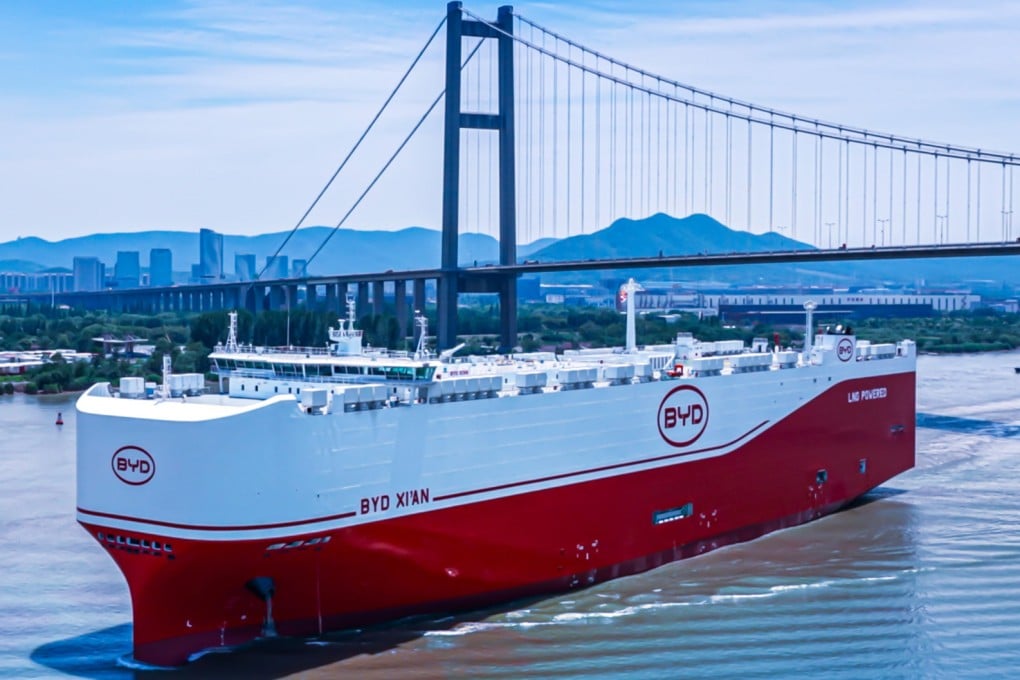
Carmaker’s six vessels can carry 45,600 cars, and two more ships will add 16,200 to that total soon, company says

https://cdn.i-scmp.com/sites/default/files/styles/1020x680/public/d8/images/canvas/2025/06/24/3b1267b6-2e1b-4907-854e-f2e6fb974ad1_ea1c5617.jpg?itok=2CH1SZOL&v=1750751845 

BYD, the world’s largest electric vehicle (EV) maker, has taken delivery of two new car-carrying ships – the largest yet in a growing fleet – as it bets on export growth to counter brutal competition at home.

The Shenzhen-based company took delivery of its sixth carrier, the BYD Changsha, which can transport 9,200 vehicles, on Tuesday, just three days after it received the Xi’an, another vessel with the same capacity.

The company’s six roll on/roll off vessels had a combined capacity of 45,600 vehicles, and another two ships with a combined capacity of 16,200 cars were due for delivery in coming months, BYD said.

The Xi’an was put to work immediately; laden with 7,000 EVs, it set sail on Tuesday from Taicang, in eastern China’s Jiangsu province, bound for European countries including Italy, the UK, Spain and Belgium, BYD said.

“The ships reflect BYD’s resolve to achieve higher sales in markets outside mainland China, since it can enjoy a higher profit margin abroad,” said Chen Jinzhu, CEO of consultancy Shanghai Mingliang Auto Service. “With car carriers owned and operated by the company, it can quicken its export pace and save ocean transport costs.”

BYD exported 374,200 vehicles in the first five months of 2025, up 112 per cent from a year earlier. Exports accounted for 21.5 per cent of its total deliveries, compared with just 10 per cent in 2024.

As its EVs are subject to a 27 per cent tariff in the European Union, BYD’s most affordable model, the Dolphin Surf, starts at €22,990 (US$26,679) on the continent. In mainland China, the same model, known as the Seagull, starts at 69,800 yuan (US$9,726), or about 63 per cent less....

....MUCH MORE 

The ship in the photo, the Xi'an was launched in April and was empty when the picture was taken.
 (the reason it is riding so high in the water)
When the sixth ship in the fleet, the BYD Changsha, was launched in June, the party's mouthpiece, China Daily, mentioned the Xi'an was on its way  to Europe with 7000 vehicles, below the 9200 vehicle nominal capacity of the two new ships but still a lot of cars. 
 
Our most recent mention of the big boats was in June 4's With The Morning Midas Still Burning; "A Look Back at Recent Car Carrier Fires"

These things are basically parking garages that move.... 

Monday, March 15, 2010

"Buffett-Backed BYD’s Profit Almost Quadruples as Car Sales Rise" (BRK-B; 1211:HK)

A couple indicators of our changing economic landscape.
From Bloomberg:
BYD Co., the Chinese carmaker backed by Warren Buffett, almost quadrupled earnings last year as consumers took advantage of government incentives to buy its F3 compact cars.

Net income rose to 3.79 billion yuan ($555 million) from 1.02 billion yuan a year earlier, the Shenzhen-based company said today in a statement to the Hong Kong stock exchange. Sales increased 47 percent to 39.5 billion yuan.

The F3 was last year’s best-selling model in China, the world’s biggest automobile market, helping make BYD the nation’s fastest-growing carmaker with sales surging 162 percent to 448,397 vehicles. China’s industrywide auto demand jumped 46 percent to a record in 2009.

“BYD and other automakers will have slower sales and profit growth this year given that demand is rising at a slower pace,” said Yin Guohui, an analyst at BOCOM International Holdings Co. in Beijing.

BYD, a battery maker that entered the automobile market in 2003, teamed up with German luxury-car manufacturer Daimler AG this month to develop and sell electric vehicles in China. It is also expanding into Europe and the U.S. to take advantage of higher demand for alternative-energy cars in developed markets....MORE

From Xinhua:

Authorities in California wooing China BYD automaker

A China automaker has made headlines in California as it is considering locating its U.S. office and assembly line in the state, local media reported on Tuesday.

The office and assembly line are expected to create high-paying jobs in a state hard-hit by the recent recession.

The Chinese automaker BYD, or Build Your Dreams, may really build a dream in California after it has teamed up with German automaking giant Daimler-Benz to manufacture an A-class electric vehicle.

As one of the world's largest rechargeable battery and consumer electronics makers, BYD entered the U.S. market this year with its electric car model BYD e6 through the North American International Auto Show in Detroit.

The first batch of such cars is to hit markets in Europe, the United States and China as early as next year.

Morale-boosted by the BYD intention, local authorities from both the Los Angeles County and Los Angeles City reportedly met BYD executives to woo the firm to locate its office and assembly line on their premises.

Several other places including Long Beach and Lancaster have also joined the race to attract the attention of China's fourth biggest carmaker.

"It would be a tremendous boost to our economy and economic growth and prosperity," said Tony Bell, spokesman for Los Angeles County Supervisor Michael Antonovich....MORE

Wednesday, April 3, 2024

"BYD lost its EV crown to Tesla after just one quarter as China’s EV market slumps" (TSLA)

 We didn't link to the story in "Goldman Hints That Tesla May Have Some Negative FCF Quarters Ahead (TSLA)" just for grins and giggles. This is serious business.

From Fortune, April 3:

The Chinese EV giant BYD only got to be the world's top EV seller for a single quarter. On Tuesday, following the release of Tesla’s first-quarter deliveries, the U.S.-headquartered carmaker reclaimed its status as the world’s top seller of battery electric vehicles, after losing to the Warren Buffett-backed BYD at the end of last year.

BYD has recently tried to use price cuts and new model releases to spur demand. Last month, it cut the price of its cheapest model, the Seagull, by 5% and marked down its top-selling Qin Plus sedan by 20%. Yet sales still fell: BYD sold 300,114 battery electric vehicles for the three months ending March, compared to 526,409 in the previous quarter. Tesla sold 386,610 cars in the same period, compared to 484,507 in the last quarter of 2023.

BYD shares fell 2.2% in Hong Kong trading on Wednesday, as the broader Hang Seng Index dropped 1.2%. Tesla shares plunged around 5% in U.S. trading Tuesday following the release of its first-quarter deliveries data.

Slowing sales in China
Sales for both BYD and Tesla dropped quarter-on-quarter as growth in China’s EV market, the world’s largest, slows down. (The weeklong Lunar New Year holiday may also have hit sales, compared to the previous quarter.)

The sector is also locked in a fierce price war between BYD, Tesla, and other Chinese car brands. The China Passenger Car Association has warned that price cuts could lead to consumers delaying their purchases in the hope of future discounts.

BYD previously surged on the back of Chinese consumers flocking to its affordable EVs. Yet the company’s reliance on China, unlike Tesla, could leave it more exposed to changes in the Chinese EV market.

The Chinese market accounted for over 85% of BYD’s automobile-related revenue in 2023, according to figures from BYD’s annual report. By comparison, China accounted for 22% of Tesla’s revenue. (Tesla generates 47% of its revenue from the U.S.)....

....MORE

Monday, May 4, 2009

Taiwanese Tycoon lashes out at Buffett over BYD Investment (BRK.A; 1211 [Hong Kong])

From the Taiwan News:
Tycoon Terry Gou is threatening to take his intellectual property dispute with Chinese battery giant BYD to U.S. investor Warren Buffett's door, the Chinese-language Economic Daily News reported yesterday. If the U.S. tycoon fails to answer three questions, Gou said, he would buy shares in the former's Berkshire Hathaway Inc. and ask him the questions personally at next year's shareholders meeting, the paper said.

In June 2006, Gou's Hon Hai Precision Industry Co., Ltd. took BYD to court in Shenzhen, China, for stealing commercial secrets from Hon Hai affiliate Foxconn. Last September, Buffett spent US$230 million to buy a 10-percent stake in BYD. Gou, himself one of Taiwan's wealthiest businessmen, told the Economic Daily News in an interview conducted on Sunday he wanted to ask Buffett three questions.

The first was why the U.S. business leader wanted to invest in a company stealing trade secrets, the paper reported in the interview published yesterday. The Shenzhen court found four BYD staff members guilty. Buffett has the reputation of only investing in trustworthy companies, Gou said.

The Taiwanese tycoon also wanted to know whether Buffett dared to drive a car made by BYD to work and back each day, instead of just driving it to his company's shareholders meeting. The Chinese company, the world's second largest producer of rechargeable batteries according to its website, has developed an electricity-powered car.

Gou's third question was directed at the profitability of the car. Prominent car makers such as Toyota, Honda, Ford and General Motors spent years developing hybrid models and selling them before they could make any profit, so what made Buffett think that BYD possessed the professional knowledge to succeed, the paper quoted Gou as wondering....MORE

From the AP via WTOP (Washington D.C.):

...Buffett and Berkshire's Vice Chairman Charlie Munger were asked about the allegations against BYD at a news conference on Sunday, and Buffett deferred to Munger because he initiated Berkshire's investment in BYD and knows the Chinese company well.

Munger said the allegations Foxconn made against BYD have already been litigated in a Japanese court.

"That set of claims, in my view, has been totally discredited," he said. "I don't have any ethical concerns about BYD."

An Associated Press call Monday to a Berkshire spokeswoman was not immediately returned....

From the Wall Street Journal:

August 11, 2007

The Forbidden City of Terry Gou

His complex in China turns out iPhones and PCs, powering the biggest exporter you've never heard of

Past a guarded gate on the outskirts of this city sits one of the world's largest factories. In dozens of squat buildings, it churns out gadgets bearing technology's household names -- Apple Inc.'s iPods and iPhones, Hewlett-Packard Co.'s personal computers, Motorola Inc. mobile phones and Nintendo Co. Wii videogame consoles.

Few people outside of the industry know of the plant's owner: Hon Hai Precision Industry Co.

With a work force of some 270,000 -- about as big as the population of Newark, N.J. -- the factory is a bustling testament to the ambition of Hon Hai's founder, Terry Gou. In an era when manufacturing has been defined by outsourcing, no one has done more to shift global electronics production to China. Little noticed by the wider world, Mr. Gou has turned his company into China's biggest exporter and the world's biggest contract manufacturer of electronics.

Hon Hai's revenue has grown more than 50% a year in the past decade to $40.6 billion last year. It is expected to add $14 billion in revenue this year. That is roughly the equivalent of Motorola's adding, within a year, the sales of CBS Corp.

Throughout his company's rise, the 56-year-old native of Taiwan has maintained a low profile. Publicity, he says, risks helping competitors and alienating customers. "I hate that I [have] become famous," Mr. Gou said in a recent three-hour interview at Hon Hai's Taiwan headquarters. It was Mr. Gou's first interview with Western media since 2002, following more than five years of requests by The Wall Street Journal. "We are so big we cannot hide anymore.">>>MORE

Wednesday, January 1, 2025

Electric Vehicles: BYD By The Numbers, December and Full-Year 2024 (may catch Tesla)

Because BYD manufactures Plug-in Hybrid Electric Vehicles in addition to Battery Electric Vehicles their total sales far outstrip Tesla which reports Thursday. More on that after the jump.

From CNEV Post, January 1:

BYD sells record 514,809 NEVs in Dec, full year 2024 sales reach 4.27 million

In the fourth quarter, sold 595,413 passenger BEVs and 918,556 passenger PHEVs.

BYD (HKG: 1211, OTCMKTS: BYDDY) saw a new sales record in December, selling more than 4 million units for the first time annually.

The company sold 514,809 new energy vehicles (NEVs) in December, marking the third time it has surpassed the 500,000 mark and the seventh consecutive month of record sales, according to data released today.

This is a 50.95 percent increase from 341,043 in the same period last year and a 1.58 percent increase from 506,804 in November.

BYD ceased production and sales of vehicles powered entirely by internal combustion engines in March 2022, switching to focus on the production of plug-in hybrid electric vehicle (PHEV) and battery electric vehicle (BEV) models.

BYD's NEVs include passenger cars as well as commercial vehicles, with passenger NEVs selling a record 509,440 units in December, up 49.76 percent year-on-year and up 1.08 percent from November.

....MUCH MORE

And from Bloomberg via the Japan Times, January 2:

BYD chalks up new record as it narrows EV sales gap with Tesla

...Tesla target

Tesla will unveil its fourth-quarter sales figures later this week. The Elon Musk-led company needs to deliver at least 515,000 EVs in the final three months of 2024 to meet its guidance for "slight growth” in annual sales, or 1.81 million deliveries, which would be a quarterly record for the company. Analyst estimates are for 510,400 deliveries, just shy of Tesla’s expectations.

BYD has trailed Tesla in quarterly sales this year. By the third quarter, BYD had sold 1.16 million EVs, lagging Tesla by 124,100. However, the Chinese best-seller has seen a last-quarter surge to narrow the gap with its U.S. rival.

On BYD’s December data, it will fall just shy of surpassing Tesla in annual sales. It has only topped Tesla once — on a quarterly basis in the final three months of 2023..... 

....MUCH MORE

Wednesday, December 6, 2023

Western Legacy Automakers Probably Won't Be Long-Term Survivors

Because their current business is being mandated and legislated out of existence the Western marques, barring some serious breakthroughs in small-scale hydrogen or methanol, will have to pivot to EV's. 

And they won't be able to compete.

It almost appears that the gifting of the electric vehicle and solar industries to the Chinese was deliberate.

First up, from Electrical Engineering Times, December 6:

Experts See Rapid Rise of Chinese EV Makers
Chinese companies will lead the global electric vehicle (EV) industry in the next 10 years by selling cars for prices unheard of outside China, according to experts interviewed by EE Times.

China’s domestic sales of EVs so far in 2023, at about 8 million units, are nearly double the 4.5 million sold in the rest of the world, according to Sandy Munro, an automotive engineer who founded industry consultancy Munro & Associates. BYD (Build Your Dreams), a publicly listed Chinese manufacturer, this year became the world’s largest EV maker, overtaking Tesla, he said.

BYD will eventually be “the biggest car company in the world,” Munro said. “Bigger than Volkswagen, bigger than General Motors, bigger than Toyota.”

While Western nations accuse China of EV dumping, about 40 of the surviving startups in the world’s largest car market are ramping up production to meet an expected surge in demand. China has led the rest of the world with an estimated $14 billion in EV subsidies since 2009.

Munro predicted that, by 2028, about half of the cars sold worldwide will be EVs. Sweden and Norway have become trendsetters by phasing out internal combustion engines (ICE) cars, he noted.

Chinese automakers will capture more of the global market, particularly in key countries like India that are unlikely to build EV industries in the near term, said Paul Triolo, who advises tech companies at Albright Stonebridge Group.

Developing nations will welcome lower-priced EVs from Chinese manufacturers as they try to meet climate targets, he added.

In China, EV prices are far lower than in the rest of the world. BYD’s Seagull EV, introduced in April, sells for about $11,000. That’s less than half the $26,838 “Model 2” EV that Tesla plans to make at a factory in Germany. The typical price for an EV in the U.S. today is about $50,000, Munro said.

BYD has expanded sales into Norway, Denmark and the UK, as well as Thailand and Australia. The company hasn’t entered the U.S. Tense relations between the U.S. and China and President Joe Biden’s push to build EVs in the U.S. have delayed BYD’s entry to the second-largest automobile market after China, according to a Reuters report.

For now, the EV price war is confined primarily to China, where BYD and Tesla are the top EV competitors.

“Tesla’s been talking about a $25,000 EV someday,” said Bill Russo, the CEO of Shanghai-based consultant Automobility. “Volkswagen’s saying ‘Let’s set a target for eventually making €25,000 [$ 27,000] EVs.’ Well, they haven’t done that yet. I can get an EV here for less than half the price.”

BYD and Tesla didn’t respond to EE Times’ requests for comment on this article.

Arrested development...

....MUCH MORE 

And at Fortune, November 30:

Elon Musk suggests Tesla and 9 Chinese companies will be the top 10 carmakers
Tesla CEO sees big things ahead for China's electric-vehicle makers 

In 2011, Elon Musk ridiculed the quality of electric vehicles made by China’s BYD. Then he admitted this May that “their cars are highly competitive these days.” Now, the Tesla CEO is amping up his praise of Chinese EV makers.

“The Chinese car companies are extremely competitive,” Musk said at this week’s New York Times Dealbook conference. “China is super good at manufacturing, and the work ethic is incredible.” 

He even went so far as to suggest that the top 10 automakers of the future might be mostly Chinese ones—although he still envisions Tesla sitting atop them all.

“There’s a lot of people out there who think that the top 10 car companies are going to be Tesla followed by nine Chinese car companies,” he said at the conference. “I think they might not be wrong.” 

In the case of BYD, its manufacturing prowess had long impressed Berkshire Hathaway vice chairman Charlie Munger, who passed away this week. While Berkshire generally steers clear of the auto industry—it declined to invest in Tesla—Munger led an enormously successful investment in BYD. He called the carmaker’s founder and CEO Wang Chuanfu a “natural engineer,” adding that “the guy at BYD is better at actually making things than Elon is.”

‘Demolish the old legends’....
....MUCH MORE 
 
Of course the big media takeaway from the DealBook conference was Musk's F*** You to Disney et al.

Monday, September 15, 2025

"BYD’s $45 Billion Stock Wipeout Raises Doubts on China Outlook"

From Bloomberg via MSN, September 14:

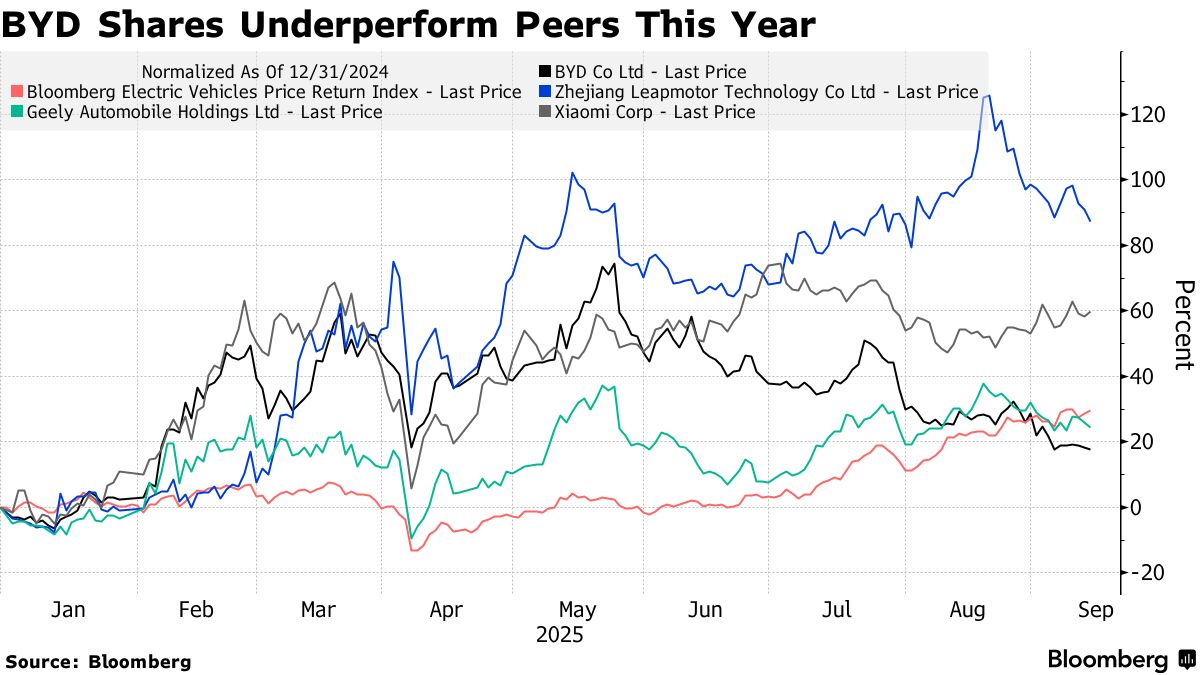
BYD Co. faces pressure to restore investor confidence after a $45 billion stock selloff, with growing concerns over its ability to fend off competition amid a destructive price war in China.

The Chinese electric-vehicle maker’s Hong Kong-listed shares have tumbled more than 30% from the all-time high reached just four months ago, underperforming peers. Analyst sell ratings on BYD have surged to the highest level since 2022, Bloomberg-compiled data show.

Investors are losing patience with BYD’s strategy of taking the lead on deep discounts, while the government is clamping down on the so-called involution wreaking havoc on the industry. At the same time, rivals including Geely Automobile Holdings Ltd. and Zhejiang Leapmotor Technology Co. are gaining ground.

“While I believe investors retain a positive long-term view, there is a real concern around BYD’s aggressive ‘market share gain by pricing pressure’ strategy in the anti-involution context,” said Kevin Net, head of Asian equities at Financiere de L Echiquier. “In the short term, this should still weigh on both topline and margins.”

https://assets.bwbx.io/images/users/iqjWHBFdfxIU/i.6KBtA8di1g/v2/pidjEfPlU1QWZop3vfGKsrX.ke8XuWirGYh1PKgEw44kE/-1x-1.png 

The company reported a 30% plunge in its June-quarter profit, its first decline in more than three years on the price war impact. China’s top EV maker, BYD has been a major driver of the multiple rounds of discounts over the past few years as makers fight for market share.

Meanwhile, Beijing has become increasingly vocal in its efforts to rein in excessive competition it sees as creating deflationary pressure and damaging the international reputation of Chinese manufacturing.

BYD now expects to deliver 4.6 million vehicles this year, a steep drop from its earlier target of 5.5 million. To meet even this lowered goal, the company must deliver some 1.7 million units in the last four months — that’s a tall order given its aging product lineup and the new regulatory environment.

The unveiling of new models in the first quarter of 2026 will be a key stock catalyst for BYD, market watchers say. The company postponed some launches to next year so it can make the vehicles more competitive, and as rivals notched success with recent offerings.

“No OEM could keep their product cycle strong forever — even BYD cannot,” said Xiao Feng, co-head of China industrial research at CLSA Hong Kong. BYD’s offerings have become stale since its dominance over 2018-2024, and buyers have turned to “new faces” like Geely and Leapmotor....

....MUCH MORE