Friday, November 3, 2017

Jason Zweig: "Can Fund Manager Bill Miller Use Earthquakes to Predict the Market?"

From the WSJ's MoneyBeat blog:
Bill Miller isn’t always right, but he’s never boring.

The former manager of the Legg Mason Capital Management Value Trust mutual fund beat the S&P 500 stock index for an unprecedented 15 years in a row only to lose a bloodcurdling 55% in 2008. The largest mutual fund he now runs, Miller Opportunity Trust, has outperformed 99% of similar funds over the past five years, although it lagged badly in 2016. And a hedge fund run by Mr. Miller has made a bet on bitcoin, the digital currency.

Through it all, Mr. Miller has remained one of the most interesting thinkers in the investment world, fascinated by everything from the physics of baseball to the social dynamics of ant colonies. In his latest intellectual foray, he is exploring whether the science of earthquakes can help make investing smoother.

Mr. Miller hopes to use insights from geophysics to measure when stock prices will be calm, when they will fluctuate sharply and when to reduce exposure to the market. In effect, he is hoping to develop a financial seismograph that could identify market shocks — before they occur.

So far Mr. Miller is testing the idea only in a private fund he runs for his family, Seismic Value Partners 1, that had about $15 million last December, according to a Securities and Exchange Commission filing. He isn’t using the technique in any of the accounts his firm, Miller Value Partners LLC of Baltimore, manages for outside investors.

“What we’re hoping to do is to have a quantitative model that would add value when the market’s going up and when it’s going down,” he says.

Using market prices and other measures, the system seeks to predict when conditions will favor buying or selling, and how aggressively the fund should buy or sell. It typically trades exchange-traded index funds tracking a wide selection of securities.

Mr. Miller’s son, Bill Miller IV, a portfolio manager at the firm who oversees the seismic model, says it “has done exactly what we thought it would do” since its launch two years ago. That includes doing “okay” during the extreme turbulence at the beginning of last year, when U.S. stocks slumped roughly 10% in six weeks.

John Rundle, a geophysicist at the University of California, Davis, who helped design the forecasting approach, says earthquakes and market crashes “look so much alike that you can describe them both with the same mathematics.”

Both kinds of shocks are preceded by tremors; both are followed by aftershocks. Earthquakes reach a critical point at which all fluctuations, large or small, are correlated and synchronized; in a market crash, nearly all assets tend to fall in lockstep. Financial markets, like tectonic plates, can form what physicists call a “metastable state,” temporarily harboring latent energy that gets suddenly and violently released.

Investors have long sought a reliable technique for determining when to get out of the market before a crash and back in before a rise.

Unfortunately, that holy grail remains at least as elusive as it is precious. As Cliff Asness, Antti Ilmanen and Thomas Maloney of AQR Capital Management in Greenwich, Conn., have shown, contrarian investors who tried to time the market didn’t substantially outperform those who held stocks non-stop through the booms and busts of the past six decades, without even accounting for taxes and trading costs....MUCH MORE
Previously:
April 2016
Former Legg-Mason Guy, Bill Miller, Is Running A Portfolio Using An Earthquake Prediction Algorithm
We are not fans of Mr. Miller and over the years have taken a few shots at him.
Back in a 2011 it was a post titled Fama/French: "Luck versus Skill in Mutual Fund Performance" (LMVTX):

...I dug this out of the link-vault because my memory was jogged yesterday by a post at MarketBeat quoting Legg Mason's Bill Miller. I commented that Miller was a "One-trick mo-mo pony" and that despite his record-setting 16 year run of beating the S&P he wasn't that good a manager.

In the 90's, during the middle of his streak he went with the momentum tech names. During the 2000's he switched to the momentum financials. Here's the complete record of his Legg Mason Capital Value Trust vs. the S&P 500:


...The portfolio's holdings of Countrywide Mortgage, AIG, Wachovia, Freddie Mac, Bear Stearns etc. affected performance negatively after mid 2007.

Since January 1, 2000 LMVTX has lost more than 50% vs. the S&P's 21% loss, a poor performance on either a relative or an absolute basis......
Our octa- and nona- genarian readers may recall that Joe Granville made a similar transition:
...Always remember that earthquakes can be tricky for equity analysts.
August 08's "Long-time bear joins bulls: Controversial Joe Granville says Dow could rise 800 points" had a few Granville vignettes, here's one of them:

Published: January 11, 1981 
Joseph Granville doesn't use the word ''forecasting.'' He prefers to say that he applies to the stock market a ''theory'' that he declines to reveal but whose results he communicates to clients in a weekly investment newsletter.  
Last week, as his latest bullish issue was still in the mails, Mr. Granville's theory suddenly turned bearish and advised selling. That advice, transmitted to about 3,000 clients in emergency telephone calls, triggered a selloff that drove the Dow Jones industrial average down 23.80 points and resulted in a new one-day volume record on the New York Stock Exchange. The next day, Mr. Granville predicted an earthquake of Richter magnitude 8.3 would hit Los Angeles in May.
From the New York Times:
NOTES ON PEOPLE; As a Seismologist, He's a Good Stock Analyst...
...MORE

"Tech's new Washington problem: Democrats"

We have to wait and see because, despite all the talk coming out of D.C, it looks more like posturing than anything actionable.

From Axios:
Senate Democrats have long been close allies of the tech industry. But this week, it became clear that they've turned into vocal skeptics.

Why it matters: Tech companies have enjoyed cozy relationships with Democrats in Washington over the past decade and are generally aligned with them on policy issues. But now Democrats are enraged over how Google, Twitter and Facebook handled the Russian exploitation of their platforms during the election, and their frustration was on full display during nine hours of tense hearings this week.
In some cases, Republicans — who have never been tech's biggest cheerleaders — actually went easier on the executives.

What it means: The shifting attitudes of Democratic friendlies presents a new vulnerability for the tech industry as it tries to fight back against growing questions about their size, power, and general lack of accountability.

Democrats on Capitol Hill have generally been reliable defenders of tech companies, and tech companies have been reliable campaign contributors for Democrats. But their handling of Russia's social media meddling, which Democrats see as a real factor that helped put Donald Trump in office, is something of a tipping point in their relationship with Silicon Valley.

What they're saying: Several Democrats on the Senate Intelligence Committee harshly criticized the companies' sluggish response to their questions and their apparent lack of appreciation for the enormous power they wield over public discourse. Their own senators from California — Kamala Harris and Dianne Feinstein — were particularly biting.

Some key quotes:
Sen. Ron Wyden: "To fight back on this espionage, Americans have to rely on our marketplace of ideas and the institutions that support it. Today, you three represent those institutions. You've discussed your response to these attacks. It is self-evident that in relation to the power your platforms now have, in the past election, you failed."

Sen. Kamala Harris: "With great success comes great responsibility. You are the modern town square and the modern postmaster. You are the phone company and the yellow pages. You are the newspaper and the radio broadcaster and the television station. And you are the emergency alert system."...MORE

"The Web began dying in 2014, here’s how"

From The Next Web:
Before the year 2014, there were many people using Google, Facebook, and Amazon. Today, there are still many people using services from those three tech giants (respectively, GOOG, FB, AMZN). Not much has changed, and quite literally the user interface and features on those sites has remained mostly untouched.

However, the underlying dynamics of power on the Web have drastically changed, and those three companies are at the center of a fundamental transformation of the Web — which will end with bypassing it completely.

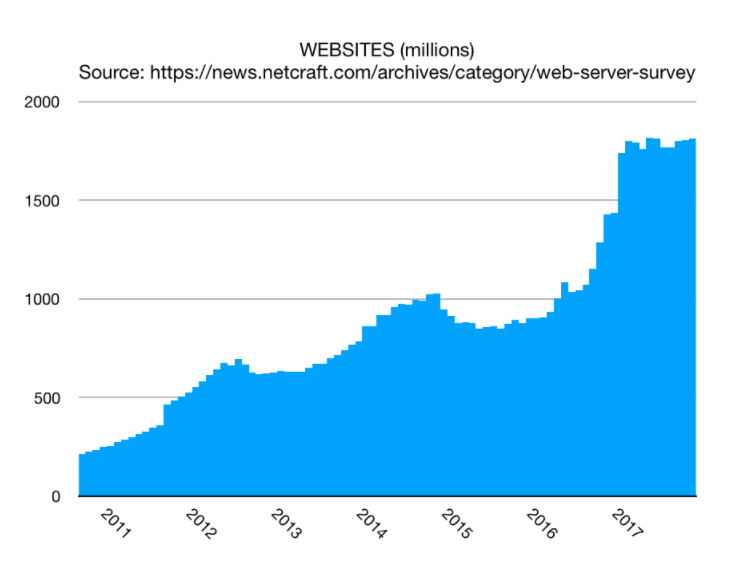
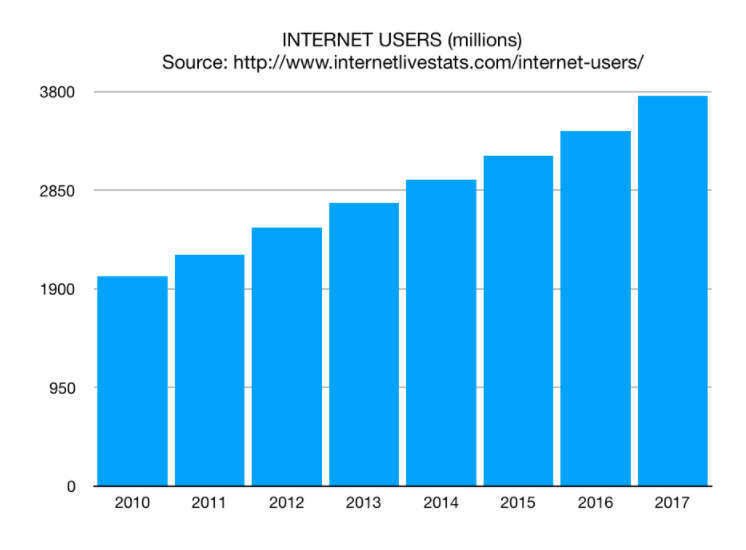
Internet activity itself hasn’t slowed down. It maintains a steady growth, both in amount of users and amount of websites:

https://cdn0.tnwcdn.com/wp-content/blogs.dir/1/files/2017/11/Screen-Shot-2017-11-01-at-15.32.21.png 
 https://cdn0.tnwcdn.com/wp-content/blogs.dir/1/files/2017/11/Screen-Shot-2017-11-01-at-15.32.47.png
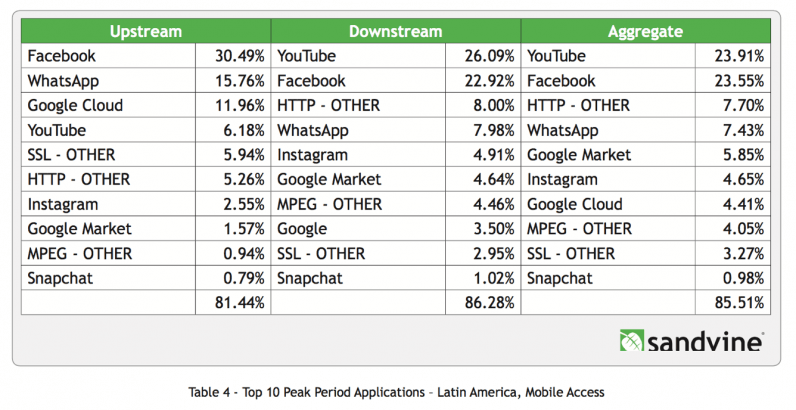
What has changed over the last four years is market share of traffic on the Web. It looks like nothing has changed, but GOOG and FB now have direct influence over 70 percent of internet traffic. Mobile internet traffic is now the majority of traffic worldwide and in Latin America alone, GOOG and FB services have had 60 percent of mobile traffic in 2015, growing to 70 percent by the end of 2016.

The remaining 30 percent of traffic is shared among all other mobile apps and websites. Mobile devices are primarily used for accessing GOOG and FB networks.

Another demonstration of GOOG and FB dominance can be seen among media websites. The most popular web properties that don’t belong to GOOG nor FB are usually from the press. For instance, in the USA there are six media sites in the top 10 websites; in Brazil there are also six media sites in the top 10; and in the UK it’s five out of 10.

From where do media sites get their traffic? Prior to 2014, Search Engine Optimization (SEO) was a common practice among Web Developers to improve their site for Google searches, since it accounted for approximately 35 percent of traffic, while more than 50 percent of traffic came from various other places on the Web....
...MUCH MORE

"Dollar Firms Ahead of What is Expected to Be Strong US Jobs Data"

So you're saying any upside is priced in?
(note to self: snark is not wit, snark is not wit)

From Brown Brothers Harriman's Head of Global Markets Strategy:
The US dollar is firm but is not going anywhere quickly. The lack of fresh interest rate support and uncertainty over the US tax proposals, which the Brady, the Chair of the House Ways and Means Committee hopes to have a revised version out after the weekend so the committee work can begin on Monday.

The popular press seems to focus on some objections by Democrats, but this misses the point. The Republicans hope to pass tax reform without relying on Democrats. It is the same strategy employed for health care reform, and the problem then and the challenge now is within the Republican Party and its constituencies. A wing of the GOP wants no increase in the deficit, and another wing wants lower taxes. Immediately upon the release of the proposals, the National Federal of Independent Business objected that the bill would not help most small businesses. The National Association of Realtor objected and homebuilder shares sold-off yesterday.

Tokyo markets were closed, which contributed to a subdued Asian session. The Nikkei closed the week with a 2.4% gain after a 2.6% gain the prior week. The Nikkei is sitting on 20-year highs and is on an eight-week run. Foreign investors are re-weighting toward Japanese shares after having cut exposure earlier in the year. There is some chunky option expires today. There is $2.2 bln struck at JPY114.00 and another $1.1 bln at JPY114.50. On the downside, there is an option at JPY113.80 for $400 mln that expire today.

Many observers think that the Chinese government may flatter its economic data, and they give private data more credence. However, the situation is more complicated, and this is born out with the PMI. The official measure showed weakness in the non-manufacturing sector (54.3 from 55.4), but the Caixin measure reported earlier today showed a modest increase to 51.2 from 50.6.

The more important development in China was the PBOC's large injection via one-year money that helped calm the government bond market. The 10-year yield had risen nearly 20 bp in recent days and the official action this week which injected nearly CNY1 trillion this week, which essentially replaced the maturing loans. The US dollar closed higher against the yuan for the second consecutive session, but all this did was pare its weekly loss to about 0.3%.


The Australian dollar is the weakest currency on the day, thus far, and is off nearly 0.5%. It was sold in response to the disappointing retail sales. Rather than recover from August's 0.5% decline as the market expected, they were unchanged. The central bank meets next week but is on a decidedly steady course with a 1.5% cash rate. The Aussie is nearing support near $0.7665, and a break of it would signal a test on the recent low from late October near $0.7625 initially.

Sterling continues to trade heavily and has marginally extended yesterday's losses.... MORE

Alphaville's Kadhim Shubber's Damp Nightmare May Be Over (plus tchotchkes)

We've mentioned Mr. Shubber's trials and tribulations with Google Maps, specifically their propensity to send him to the middle of the Thames:

October 17
Just Say No To Nudge: "Google Maps is removing a feature that told you how many 'mini cupcakes' you'd burn if you walked." 

Frankly, the GOOG would be better off if they quit trying to direct Alphaville's Kadhim Shubber to travel the middle of the Thames and let him get back to his doggy-bloggy twitter goodness. See below....
*****
Well, here's the latest on mappage (at least until Brexit).
From the Daily Kanban,, Oct. 27:

Good-bye Google: EU-Japanese dynamic mapping partnership emerge
Rumors of Germany’s digital mapping giant HERE seeking an intimate relationship with Japan’s Dynamic Map Platform Co.  have been thick for about a year. Today, the romancing couple did not quite go all the way, but it definitely went to second base. Meanwhile, Google’s importance in the automotive space shrinks to wallflower format.

In a small meeting room at Tokyo’s Daiba Hilton, Edzard Overbeek, CEO of HERE, and Isao Iguchi, Senior Vice President of Mitsubishi Electric, shook hands for the cameramen, and announced their “intention to link their technologies for autonomous vehicles into a powerful integrated offering for automakers.” Mitsubishi Electric is a prominent DMP shareholder....MORE
Back to Mr. Shubber, he went to the UK Tech Awards last night:

"Plaintiff in Russia dossier suit argues BuzzFeed isn't a real news organization"

From CNN
Lawyers for a Russian tech executive are asking a federal judge to force BuzzFeed to reveal its source for an unverified dossier about Donald Trump that it published in full earlier this year. Their argument: BuzzFeed isn't a real news organization.

In court papers filed Wednesday in Florida federal court, attorneys representing Aleksej Gubarev and his companies tried to prove that BuzzFeed does not qualify for the reporters' privilege that would allow it to avoid naming its source because it is not "a newspaper, news journal, news agency, press association, wire service, radio or TV station, network, or news magazine." 

As such, the plaintiffs argue, BuzzFeed does not qualify for the privilege under a 1998 Florida law. 

While the filings cite an arcane statute, the argument also has echoes of an era when BuzzFeed was thought of more as a supplier of listicles and cat videos and less about its reporting. It also goes back to a time when news websites and bloggers were often looked down upon by more traditional journalists.

"Anyone paying attention to current events would be surprised by this claim, given the string of massive stories BuzzFeed News has recently broken, from allegations against Kevin Spacey, to connections among white supremacists and right-wing media--which led this week to the billionaire Robert Mercer severing ties with Breitbart," BuzzFeed News spokesperson Matt Mittenthal said in a statement. "It would also come as a surprise to President Trump's White House, where BuzzFeed News occupies a seat in the press briefing room. We look forward to demonstrating that publishing the dossier - which is the subject of multiple federal investigations and was circulating at the highest levels of government - was, and continues to be, in the public interest."...MORE
Waddya mean not news?
From March 28's "Source Says BuzzFeed Is Going Public In 2018"

...UPDATE: "Best Actual Court Filing This Week: Libel Case Against BuzzFeed Edition"

They grow up so fast. It seems like it was just yesterday (actually it was January 11, 2017, 12:52 pm PST) that we were posting:

Breaking--Buzzfeed Considers Itself Media--Breaking
The tweeter is a writer on media at HuffPo and adjunct professor at NYU.

I can't imagine what Andreessen Horowitz and NBC Universal are thinking about their BuzzFeed investments right now.

Maybe this will cheer them up:

Possibly also of interest:

Buzzfeed Story Generator
New Media: "BuzzFeed missed 2015 revenue targets and slashes 2016 projections"
Update--"BuzzFeed Didn't Cut Its 2016 Forecast In Half, In Fact Everything's Fine"
Take That, Buzzfeed: 17 Numbered Lists From History 
From the Public Domain Review:
1. 7 types of drunkard
From pages 52 to 60 of The Anatomy of Drunkenness (1834) by Robert Macnish
Okay, Who Sent Me the BuzzFeed SEC Form D?
Journalism: BuzzFeed Releases Internal Style Guide--Updated 
Arrrgh--Updated--Journalism: BuzzFeed Releases Internal Style Guide--Updated
BuzzFeed Appears To Be Buying The Guardian, One Employee at a Time
Study Showing "Fake News' Beating 'Real News'" Is Fake
"NBCUniversal Buys Big Chunks of Vox Media and BuzzFeed"
15 Cliches In Buzzfeed President's Departure Memo*
"Can Silicon Valley disrupt journalism if journalists hate being disrupted?"
The Onion Launches Clickhole to Take On BuzzFeed, Upworthy
Facebook To Decide Which News Sites Live, Which News Sites Die

"The NYTimes could be worth $19bn instead of $2bn"
Errrmmm, yes.
Should the risk-free rate go to negative 5%.

Thursday, November 2, 2017

Lagarde: IMF Looking at Cryptocurrencies, May Consider An ICO (ChristineCoin? SDRcoin?)

First up, from the libertarians (they gave Tyler Cowen an award!) at The Foundation for Economic Education, September 30:

IMF Head Foresees the End of Banking and the Triumph of Cryptocurrency
Bitcoin "puts a question mark on the fractional banking model we know today."  
In a remarkably frank talk at a Bank of England conference, the Managing Director of the International Monetary Fund has speculated that Bitcoin and cryptocurrency have as much of a future as the Internet itself. It could displace central banks, conventional banking, and challenge the monopoly of national monies.

Christine Lagarde–a Paris native who has held her position at the IMF since 2011–says the only substantial problems with existing cryptocurrency are fixable over time.

In the long run, the technology itself can replace national monies, conventional financial intermediation, and even "puts a question mark on the fractional banking model we know today."
In a lecture that chastised her colleagues for failing to embrace the future, she warned that "Not so long ago, some experts argued that personal computers would never be adopted, and that tablets would only be used as expensive coffee trays. So I think it may not be wise to dismiss virtual currencies."

Here are the relevant parts of her paper:
Let us start with virtual currencies. To be clear, this is not about digital payments in existing currencies—through Paypal and other “e-money” providers such as Alipay in China, or M-Pesa in Kenya.

Virtual currencies are in a different category, because they provide their own unit of account and payment systems. These systems allow for peer-to-peer transactions without central clearinghouses, without central banks.

For now, virtual currencies such as Bitcoin pose little or no challenge to the existing order of fiat currencies and central banks. Why? Because they are too volatile, too risky, too energy intensive, and because the underlying technologies are not yet scalable. Many are too opaque for regulators; and some have been hacked.

But many of these are technological challenges that could be addressed over time. Not so long ago, some experts argued that personal computers would never be adopted, and that tablets would only be used as expensive coffee trays. So I think it may not be wise to dismiss virtual currencies.

Better value for money?
For instance, think of countries with weak institutions and unstable national currencies. Instead of adopting the currency of another country—such as the U.S. dollar—some of these economies might see a growing use of virtual currencies. Call it dollarization 2.0.
IMF experience shows that there is a tipping point beyond which coordination around a new currency is exponential. In the Seychelles, for example, dollarization jumped from 20 percent in 2006 to 60 percent in 2008....
...MORE

And from the crypto-fascists at CNBC (kidding), October 13:

'We are about to see massive disruptions': IMF's Lagarde says it's time to get serious about digital currency
  • "I think that we are about to see massive disruptions," IMF Managing Director Christine Lagarde told CNBC about developments in financial technologies
  • Lagarde didn't rule out that the IMF could at some point develop its own cryptocurrency
It's time for the world's central banks and regulators to get serious about digital currencies, according to the head of the International Monetary Fund.

Global financial institutions are taking risks by not watching and understanding emerging financial tech products that are already starting to shake up the financial services and global payments system, according to IMF Managing Director Christine Lagarde.

"I think that we are about to see massive disruptions," Lagarde told CNBC in a Facebook Live interview on the sidelines of the IMF Annual Meetings in Washington D.C.

Asked whether she agreed with JPMorgan Chase CEO Jamie Dimon's comments that bitcoin is a "fraud," Lagarde said it's important to look at the broader implications of technologies like digital currencies.

"I think we should just be aware of not categorizing anything that has to do with digital currencies in those speculation, ponzi-like schemes," she said. "It's a lot more than that as well."

Lagarde didn't rule out that the IMF could at some point develop its own cryptocurrency. She pointed to the IMF's Special Drawing Right (SDR), a currency the IMF created to serve as an international reserve asset, that could incorporate technology similar to cryptocurrencies..
...MORE

As soon as I typed 'crypto-fascist' I realized the term now has more than one meaning.

Plus CNBC may lean a bit left, who knows?
(But without going so far left they circle back around and meet Mussolini at the train station.)
Or something.
Time to go home, methinks.

"Tesla's Nightmare Before Christmas" plus the upcoming NLRB hearing and Ms. Kaminska does a driveby

Tesla’s eighth circle of hell may be a ring of fire atop of a gigafactory


Tesla's Nightmare Before Christmas
It looks like Elon Musk just canceled Thanksgiving and probably Christmas, too -- if you work at Tesla Inc., anyway.

The electric-vehicle-cum-battery-cum-solar-equipment company Musk heads reported third-quarter results on Wednesday evening. Tesla missed earnings forecasts by a mile. But that number, never a huge concern, mattered even less this time around. It's cash and cars -- specifically the somewhat more mass-market Model 3 -- that count.

First, cash: Having racked up its first quarter of burning through more than $1 billion of cash in the three months ending in June, Tesla topped that with $1.4 billion of negative free cash flow in the third quarter. In the past two quarters, therefore, Tesla has burned through more cash than the previous six combined.

More importantly, it has burned through roughly four out of every five of the $3.2 billion dollars it has raised since late March through selling new equity and convertible debt and its debut in the high-yield bond market.

The Engine
As Tesla's spending has accelerated this year, its balance sheet has taken all of the strain
Consequently, debt has soared. Even just using debt with recourse to the company, on a net basis it has almost tripled since the start of the year to $3.36 billion.

This would matter less if the primary objective of sucking in most of that external funding -- mass production of the Model 3 -- was fast approaching. Instead, it has receded further.

When Musk first talked about production targets for the Model 3 in 2016, they implied Tesla would be producing roughly 3,800 to 7,600 a week in the second half of 2017. By July of this year, Musk was guiding toward production hitting about 5,000 a week by the end of December. I estimated at the time that this implied a second-half average of maybe 1,400 a week.

Now, Musk estimates production might hit 5,000 a week by the end of the first quarter of 2018. As for this year, it might be in "the thousands" by the time New Year's Eve rolls around. He refused to say what the current run rate was. But I would estimate Tesla will be lucky to produce 10,000 Model 3 vehicles in total this year, or an average of 400 a week for the second half -- roughly 5 to 10 percent of the original guidance. As for the earlier target of 10,000 a week in 2018 ...

What we have brewing here is a credibility problem. This has lurked in the background for a while, with various missed targets on sales, capex or whatnot.

But the Model 3 is far more important than any of these because it is supposed to generate the vast majority of medium-term cash flows underpinning the valuation models supporting Tesla's high-flying stock; and it is the key test of the company's oft-touted manufacturing and design skill....MORE
Last February's

Feb. 26
Elon Musk Slams Unionization Drive at Tesla, Promises Free Frozen Yogurt, Roller Coaster (TSLA)
Feb 10
Tesla employee calls for unionization, Musk says that’s “morally outrageous”
Feb. 2
"Tesla: Now Comes the Hard Part" (TSLA)

probably won't sound very favorable to TSLA when read out to the hearing officer.

"The Staggering Value of Urban Land"

From CityLab:
The total value of America’s urban land is astounding, adding up to more than $25 trillion as of 2010—that’s roughly more than double the nation’s total economic output or GDP in 2006, according to a recent study by economists at the University of Illinois and the University of Michigan. Nearly half the total value of America’s urban land, 48 percent of it, is packed into just five superstar metro areas: New York, Los Angeles, San Francisco, Washington, D.C., and Chicago, with land in and around the urban center being the most valuable by far.

The study by economists David Albouy and Minchul Shin of the University of Illinois, and Gabriel Ehrlich of the University of Michigan, used data from CoStar, a national real-estate database, covering land transactions from 2005 through 2010. The data contains detailed information on the address, lot size, and price for each transaction, and covers 69,000 land sales that span more than 75,000 square miles.

The study organizes these data points across America’s 300-plus metros, and estimates not just the total value of urban land, but the average land price per acre. It also estimates the average price per acre in the urban center, which is defined as the area within 10 miles of city hall, or the mayor’s office. (In New York City, the Empire State Building is used as the city center instead.)
Across the entire United States, the total value of urban land, averaged across the period from 2005 to 2010, was slightly more than $25 trillion. That breaks out to an average of $511,000 per acre, or $100,000 for the typical residential lot of roughly a fifth-acre (or $2,000 for a typical parking spot). Over the course of the study period, the total value of urban land peaked at more than $28 trillion—2.2 times more than the U.S. GDP in 2006, before the economic crash—but then fell to $18 trillion, or 1.3 times GDP, in 2009.

The table below shows the value of urban land for metros with an average value of more than $1 million per acre.
Metro Total Land Value Average Land Value per Acre Value of Central Land per Acre Ratio of Central to Average Land Value
New York, NY $2.5 trillion $5.2 million $123 million 22.3
Los Angeles-Long Beach, CA $2.3 trillion $2.6 million $16 million 5.5
Washington, DC-MD-VA-WV $1.1 trillion $1.2 million $37 million 32.6
Orange County, CA $820 billion $2.6 million $3.2 million 1.3
Seattle-Bellevue-Everett, WA $658 billion $1.3 million $9.9 million 10.1
San Francisco, CA $622 billion $3.2  million $25 million 9.3
San Diego, CA $551 billion $1 million $10 million 8.7
San Jose, CA $458 billion $2.3 million $3.5 million 1.6
Oakland, CA $447 billion $1.4 million $5.4 million 3.3
Miami, FL $427 billion $1.7 million $4.4 million 3.2
Honolulu, HI $416 billion $3.3 million $16 million 7.0
West Palm Beach-Boca Raton, FL $322 billion $1.3 million $5.9 million 5.3
Fort Lauderdale, FL $318 billion $1.3 million $3.5 million 3.1
Bergen-Passaic, NJ $287 billion $1.4 million $4.1 million 3.7
Stamford-Norwalk, CT $172 billion $1.5 million $2.7 million 3.2
Santa Barbara-Santa Maria-Lompoc, CA $126 billion $1.2 million $2.5 million 2.8
Jersey City, NJ $98 million $3.3 million $9.5 million 8.8
San Luis Obispo-Atascadero-Paso Robles, CA $64 million $1.1 million $1.5 million 1.6
Santa Cruz-Watsonville, CA $53 million $1.1 million $2.2 million 4.3

The value of urban land tends to follow population, but not entirely. New York has the highest urban land value at $2.5 trillion, followed by Los Angeles at $2.3 trillion. But Washington, D.C., the nation’s sixth largest metro in terms of population, has the third most valuable total urban land, at $1.1 trillion. ...
...MUCH MORE

Analysts React: "Tesla Bulls and Bears Dig in After Warnings of Production Delays" (TSLA)

The stock is down 24.75 (7.71%) at $296.33.
From the WSJ's MoneyBeat blog:
A rocky quarter for Tesla had the electric automaker’s fans and skeptics digging in on Thursday.
Shares dropped as much as 8.9% on Thursday morning after the company said it would be late to meet its goal of making 5,000 Model 3 sedans per week by the end of the year, and reported a wider loss than analysts had expected. Shares were off their lows late Thursday morning and recently traded down 7.4% at $297.50, their first time under $300 since May.

The firm built by Elon Musk has long been a polarizing company for investors and analysts, due in part to the stratospheric rally in its stock price in recent years, which has given it a market value that rivals seasoned automakers like General Motors Co. Tesla is up 39% this year, versus a 15% rise in the S&P 500.

Among the 27 equity research analysts whose Tesla stock ratings are tracked by FactSet, year-ahead share price targets range from $170 to $500. Analysts, who tend to skew bullish on the stocks they cover, are nearly evenly split on Tesla between buy, sell, and hold recommendations. The company is also a favorite of short-sellers, with big-name investors such as David Einhorn and Jim Chanos warning about the company.

Here’s what the bearish analysts had to say:

Colin Langan of UBS Group AG, which has a $185 price target: “We believe the market should not ignore fundamental challenges that persist with regards to TSLA’s Model 3 profitability, stationary storage & solar businesses, and eventual need to raise cash. We see increased pressure on demand as luxury automakers launch competing products in the 2018-20.”

Ryan Brinkman of J.P. Morgan Chase & Co., which lowered its price target to $185 from $195 Thursday: “With the 3Q report came management’s update that it now targets reaching 5K units per week of Model 3 production by 1Q rather than 4Q. Perhaps more disconcerting was the electing to not guide to the time when it would reach 10K per week (previously said to be sometime during 2018). The combination of these two guidance changes is likely to result in a significant reduction in production expectations… Investor (and analyst) expectations need to be materially reduced.”

Jeffrey Osborne of Cowen & Co., which has a $170 price target: “We left the call frustrated with the lack of transparency from Tesla management. Battery pack assembly is the primary culprit for the Model 3 ramp; however, multiple other auto production steps also need retooling. Backing off of 10,000 units/week in 2018.”

And here’s what the bulls had to say:

Ben Kallo of Baird, which has a price target of $411: “We believe TSLA has the talent to fix its manufacturing issues, and should hit its targets of several thousand Model 3s per week by YE:17 and ~5k per week by the end of Q1. We view this as a core growth stock, and would use weakness as a buying opportunity.”

Romit Shah of Nomura Instinet, which has a $500 price target:...MORE

Goldman Throws Up On Tesla Earnings: Reiterates Sell, Cuts Price Target To 205 [36% downside] As Stock Tumbles (TSLA)

The stock is down  $22.55 (-7.02%) at $298.53.

TSLA Tesla, Inc. daily Stock Chart
From ZeroHedge:
One day after Tesla announced its worst quarter in history, in which it burned a record $1.4 billion in cash..
http://www.zerohedge.com/sites/default/files/images/user5/imageroot/2017/10/21/TSLA%20cash%20burn%20Q3.jpg
... Goldman has guaranteed it will not be an underwriter on the next Tesla stock offering - which at the current cash burn will take place in less than 2 quarter - by reiterating its Sell rating on Tesla, and cutting its Price Target to $205, or 36% downside. Here is the summary from Goldman's David Tamberrino who once again unapologetically throws up all over the latest TSLA earnings:
We reiterate our Sell rating on shares of TSLA. We believe the stock should continue to de-rate following 3Q17 results where the company further pushed out its Model 3 production targets for 5k/week to late 1Q18. We believe this further pushes out the potential to ramp to 10k/week production of the Model 3 to at least 2019 (though we continue to model a ramp well below both); this should weigh on gross margins through at least 1Q18 and we do not expect a return to above 20% Automotive gross margin levels until 2H18. Altogether, we believe this indicates that the company’s goal for positive OCF generation should remain elusive until the middle of 2018 — though we still forecast significant FCF burn. On that front, we now believe TSLA will need to raise capital sooner (2Q18 vs. 3Q18 previously). Lastly, we believe the company’s comments on potential China production (3 years out) will be disappointing to investors, which have been confident in TSLA entering the China market with local production in the next one to two years. Our 6-month price target declines to $205, showing 36% downside.
And some more details:
3Q17 results weaker than expected, Model 3 production targets pushed out

TSLA reported a weaker than expected quarter, with an adjusted EBITDA loss of $22mn vs. GSe of $145mn and FactSet consensus of $175mn. Overall, higher operating expenses than expected drove the miss. More importantly, the company pushed out expectations for its 5k/week production target for the Model 3. Altogether, we lower our estimates and believe that Street consensus figures similarly need to be tempered given lower gross margin guidance and a pushed out cadence to Model 3 production.

Key points — to the negative:
  • Model 3 production target for 5k/week has been pushed out to late 1Q18: Previously the company had targeted late 4Q17, and appeared about one month behind in October when it announced 3Q17 deliveries. However, due to battery pack module issues, this ramp appears pushed out further to the end of 1Q18. That said, the company believes it can exit 4Q17 above 1k/week in production (with comments suggesting potential to be in the 1,000s per week production range).
  • 10k/week Model 3 production now looks pushed to 2019: While this is very much undetermined – as the company needs to get to 5k/week before it can determine where to add capital in order to speed up or duplicate its lines, we believe the company has softly pushed its 10k/week production target into 2019 from “at some point in 2018” previously.
  • New product cadence could be pushed out: The company has previously communicated that new product development costs are largely contingent upon internal cash generation from the Model 3. Future product launches include (1) the Tesla Semi (reveal date of 11/16), (2) the Model Y –a crossover based on the Model 3 platform, (3) a pickup truck, and (4) the second generation roadster. We see the timeline for these products as likely pushed out as (1) the Model 3 remains a drag on cash flow generation from a slower ramp, and (2) the company allocates resources on ramping Model 3 production.....
...MUCH MORE 

Mary Poppins Triumphs: Thousand-Dollar IoT, Bluetooth and WiFi Enabled Tea Kettle Company Folds

Oh, and featuring machine-learning algos.

In February 2015's look at Dame Julia Elizabeth, "Nun with a Switchblade: Julie Andrews and The Fiftieth Anniversary Of The Sound Of Music" it was noted:
"It would surprise no one, perhaps, to learn that Julie Andrews travels with her own teakettle."
No. No it would not.
That was followed some months later by "Watch Out Mary Poppins: The World's First Tea Brewing System Utilizing Machine-Learning Algorithms Has Received Pre-Launch Seed Funding (plus a Princess Rap Battle)":
Teforia nabs $5.1 mln in Upfront Ventures-led round

And to bookend the story, the Daily Mirror:

Chai-ed and failed: Startup behind a $1000 'smart teapot' admits defeat
Turns out that people just don't want 'the best tea experience possible'
A Silicon Valley-based startup that took $12 million dollars in funding to create a $1,000 (£756) teapot has closed down, after its product failed to make it into kitchens around the world.
Teforia, which was founded in 2014, posted a lengthly message on its website explaining that it was ceasing all activites.

The message, written by CEO Allen Han reads: "The reality of our business is that it would take a lot more financing and time to educate the market and we simply couldn't raise the funds required in what is a very difficult time for hardware companies in the smart kitchen space."

The company's pricey "smart" tea maker used "advanced algorithms" and a hand-blown glass "infusion globe" to brew specially-made tea satchels called "Sips"...MORE.
As the story goes on to say, the machines and tea pods are on sale through tomorrow, marked down 50—80%.

And if you have a moment, the Princess Rap Battle is really quite good.

"Why the idea that the world is in terminal decline is so dangerous"

I know it sometimes appears there's nothing but gloomy and doomy in the world, and here on the blog, but that's just the way people are wired, literally.
We take notice of things that threaten or excite much more than we do of things familiar and hum-drum. It's just the way people (and risk managers) are.*

There's a lot of good stuff that happens every day, so to keep the vibe, I'll hold off on posting the "What happens when a hurricane crosses over an erupting volcano" story.

From Aeon:
From all sides, the message is coming in: the world as we know it is on the verge of something really bad. From the Right, we hear that ‘West’ and ‘Judeo-Christian Civilisation’ are in the pincers of foreign infidels and native, hooded extremists. Left-wing declinism buzzes about coups, surveillance regimes, and the inevitable – if elusive – collapse of capitalism. For Wolfgang Streeck, the prophetic German sociologist, it’s capitalism or democracy. Like many declinist postures, Streeck presents either purgatory or paradise. Like so many before him, Streeck insists that we have passed through the vestibule of the inferno. ‘Before capitalism will go to hell,’ he claims in How Will Capitalism End? (2016), ‘it will for the foreseeable future hang in limbo, dead or about to die from an overdose of itself but still very much around, as nobody will have the power to move its decaying body out of the way.’

In fact, the idea of decline is one thing the extremes of Left and Right agree upon. Julian Assange, avatar of apocalyptic populism, gets kudos from neo-Nazis and social justice crusaders alike.  He noted to one reporter how American power, source of the planet’s evils, was in decline like Rome’s. ‘This could be the beginning,’ he whispered with a smile, repeating it like the mantra of an avenging angel.

Rome’s decline looms large as the precedent.  So, world historians have played their part as doomsayers. At the same time as the English historian Edward Gibbon’s first volume of The History of the Decline and Fall of the Roman Empire (1776) was published, the American colonists said good-bye to their overlords; some read that as an omen. The First World War brought endism into the modern age. The most famous rendition was the German historian Oswald Spengler’s The Decline of the West (1918). The carnage of Flanders and the influenza plague of 1918 – which wiped out up to five per cent of the world’s population – made The Decline of the West more than timely. Spengler added a spin: he predicted that, by the end of the century, Western civilisation would need an all-powerful executive to rescue it, an idea that autocrats have seized upon with repeated glee ever since.
It is almost part of the modern condition to expect the party to be over sooner rather than later. What varies is how the end will come. Will it be a Biblical cataclysm, a great leveller? Or will it be more gradual, like Malthusian hunger or a moralist slump?

Our declinist age is noteworthy in one important way. It’s not just the Westerns who are in trouble; thanks to globalisation, it’s the Resterners too. In fact, we are all, as a species, in this mess; our world supply chains and climate change have ensured that we are poised before a sixth mass extinction together. We should worry less about our lifestyle and more about life itself.

Declinisms share some traits. They have more purchase in times of turmoil and uncertainty. They are also prone to thinking that the circles of hell can be avoided only with a great catharsis or a great charismatic figure.

But most of all: they ignore signs of improvement that point to less drastic ways out of trouble. Declinists have a big blindspot because they are attracted to daring, total, all-encompassing alternatives to the humdrum greyness of modest solutions. Why go for partial and piecemeal when you can overturn the whole system?

Declinists claim to see the big picture. Their portraits are grandiose, subsuming, total. Consider one of the all-time bestsellers, the Club of Rome’s The Limits to Growth (1972). With more than 30 million copies sold in 30 languages, this ‘Project on the Predicament of Mankind’ gave alarmed readers a portrait of demise, mapped out with gloomy confidence about ‘feedback loops’ and ‘interactions’. In fact, it shared much in common with the good Reverend Thomas Malthus, including the obsession with diminishing returns. Fixated with the decline of arable land, Malthus could not see sources of increasing returns – at least not at first. Some of his friends eventually convinced him that machinery and colonialism solved the problem of too little food for too many mouths; later editions of his Essay on the Principle of Population (1798) went through contortions to figure this out. In the same way, systems analysts at the Massachusetts Institute of Technology simulated the whole world, but could not admit little pictures of ingenuity, problem-solving and adaptation – some of which had the perverse effect of unlocking so many more sources of carbon that we’d begin to bake the planet several generations later!...
...MUCH MORE

HT,  Pethokoukis at AEI:
Why declinism, while often tempting, is usually wrong 

*Plus, markets go down faster than they go up and puts and calls are priced asymmetrically and...

Rabobank Talks Food Companies Interacting with Startup Innovation

From AgFunder:
In today’s episode, I speak to Nick Fereday, senior analyst of consumer foods at Rabobank, the Dutch food and agribusiness bank. In this role, Fereday tracks startup innovation and is a mentor at Rabobank’s agrifood startup pitch competition FoodBytes!, which last took place in Austin in September.

In this podcast, we talk about how Rabobank’s clients — the large food and agriculture companies — are reacting to this new innovation and working with startups, the acquisition of Whole Foods by Amazon, and consumer trends around natural, simple food as well as alternative meat products.
I hope you enjoy our conversation — there’s an abridged transcription below too.
*****
Louisa B-T: Tell us a bit about your role at Rabobank and how your work has changed amid this growing amount of innovation that’s taking place in food and agriculture. It must be quite a different world now from when you started at Rabobank six years ago.

Nick Fereday: I’m in the research group at Rabo. We’re not a bunch of equity analysts. We’re kind of more big picture, trends, type of guys. I’m in the more consumer-facing part of the food chain, so I’m definitely much more interested in what’s happening at the consumer level and what’s driving at home and how that plays out along the food chain.

In terms of changes, I think change is always there it just depends who’s doing the change and who’s doing the innovation. Certainly, when you look back five years or even 10 years, it is a very different landscape to what we were used to seeing. Five years ago, or even longer, it was the larger players that were driving a lot of innovation; there weren’t so many smaller players coming up.
I think all that’s really flipped in the last few years. So what you’re seeing now is it’s the small emerging brands that are really driving innovation, either through renovating a tired category or for identifying, what they like to say in the industry, is white space. Gaps in the market and coming up with products that really talk to today’s consumer or the things that today’s consumer is interested in.
FoodBytes, for us, is a great platform to have a firsthand insight into what’s going on. We get hundreds of applicants for each event, so by itself, that gives us an idea of what people are interested in, or what they think they can bring to market, or where they think there are opportunities. Then having been able to interact with these companies that we pick to present is certainly fantastic.
It’s interesting because in my part of the food chain, talking about what’s new and new companies and what they bring to the table is really like the currency. In the same way that when you interview, folk who are more at the farm level and they talk about the latest USDA forecasts or where they think corn acreage is going to be. That becomes the topic of conversation. In my world, it’s all about what’s new and what are you seeing that’s different. So that really takes you to the small players, the emerging brands, because they are driving a lot of change and disruption. And it’s also of incredible interest to the large food companies because they’re kind of struggling to catch up and understand what’s going on.

Louisa B-T: Well, obviously as an analyst for Rabobank, your clients are mostly the big food and ag companies. So how are they coping with this wave of innovation? How are they interacting with it, or not?

Nick Fereday: think for the longest time there was a little bit of denial going on around what was happening. So when the larger players were looking at their sales and their sales weren’t going anywhere, in fact, some of them were heading south, It was very much, “oh, this is the result of the lingering recession, or this is the rise of private label and stuff?” And there really wasn’t enough introspection to really look at their own portfolios and come to a rather scary, but brave, conclusion that they needed to change because a lot of what they were producing was less relevant than to previous generations, such as the baby boomers.

Louisa B-T: One of the things that we often think about is the CEO of Blockbuster talking about Netflix saying they weren’t at all on their radar as being competitive. Then around two years later, Blockbuster went out of business. Do you think food companies are aware of that threat, or do you think it’s taking them some time?

Nick Fereday: I don’t think there’s that level of denial in the food industry anymore. And certainly, when you hear the major CEOs of the big food companies talk, they recognize the pace of change and the fact that consumers have changed. 

They’re used to change; companies that have been in existence a very long time. So they’re used to change, and fads, and trends, what have you. But, I think it’s the pace of change that’s caught a lot of people by surprise. So they’re going from a model where they were used to ramping up production of their existing brands, or maybe tweaking them, and now they’re in a world where maybe their brands, or their iconic brands, are less relevant and they’re being threatened by all these emerging brands.
They’re kind of struggling to adjust their business model to be as flexible and as nimble as some of these smaller companies. It’s a bit like one of those large oil tankers that they know they have to change direction, but it takes a while to do that. Certainly, they’re all making attempts to do that to varying degrees of success.

To me, it reminds me of that scene, probably showing my age, in Wizard of Oz, where you meet the magician, the wizard at the end, and he’s got all these levers that he’s pressing. I have this image of these large food companies pressing all the different growth levers, whether it’s mergers and acquisitions, or product renovation, or setting up a VC fund. They’re all desperately pressing these and trying to kick-start their top line growth, which in a lot of cases is not that spectacular....MUCH MORE, including podcast.
Previously: 

"10 Startups Making Ocean Container Shipping Easier"

There is some big money trying to bring tech to shipping/logistics.
And a lot of little guys.
From Nanalyze, October 10:
We’re not sure when the term sailor went out of vogue, but we now call those guy seafarers – all 1.6 million of them that pilot the 68,723 merchant ships that navigate our world’s oceans. We say “guys” because 98% of seafarers are males, a fact that may be partially explained by the fact that women are more likely to get motion sickness than men. However this article isn’t about advocating for equality in the maritime industry (there are plenty of people doing that already), but rather to talk about what sort of technology is being applied to freight and supply chain visibility. We recently wrote about International Freight Forwarding Software from Flexport and how they plan to dominate an industry that has fallen way behind when it comes to technology. Since that article, Flexport has raised an additional $210 million in funding. An article by Tech Crunch cut loose with the following factoid about Flexport:
Flexport already moves 7,000 shipping containers a month for an average of $2,000 each while taking around a 15% cut, earning it roughly $2.1 million per month from ocean freight alone
They’re not the only ones looking to get a piece of the action. Those geniuses over at CB Insights came up with a list of over +150 different startups getting involved in supply chain and logistics technology:
Let’s take a look at some of the startups that address the needs of the maritime container shipping industry.

Expedias of Shipping


Founded in 2012, Israeli startup Freightos has raised $55.9 million in funding from investors that include General Electric (NYSE:GE) to make “global trade frictionless” which all starts with providing accurate and timely cost estimates. Their software-as-a-service (SaaS) platform,”AcceleRate”, automates the quoting process for some of the world’s largest freight companies, in all continents, and across air, ocean, and ground. Dubbed the “Expedia of Shipping” by TechWorld, Freightos can give you a quote in just 2 minutes. That’s incredible when you consider that the average time it takes to get a shipping quote presently is 1-3 days with 12% of quotes being inaccurate. The Freightos platform has generated 28.24 million quotes to date.
Another startup looking to provide quick quotes for maritime shipping is a Spanish outfit called iContainers which has taken in $8.3 million in funding so far to develop a platform that covers more than 250,000 shipping routes to 300 destinations around the globe. According to TechCrunch, they’re also the “Expedia of Shipping” in an industry with “more costs built in than artificial ingredients in a TV dinner”. You can literally get a quote right now using the below form:...
...MUCH MORE

Previously:
Norwegian Government to Chip In $17 Million to Develop the First Electric Autonomous Cargo Ship
Shipping: "Value of Autonomy Questioned"
Shipping: "Amazon vs Maersk: The clash of titans shaking the container industry"
"TEU Tokens and Blockchain Could Shape the Future of Container Shipping"
"Maersk Tankers invests in quantitative hedge fund CargoMetrics"
Shipping: Despite $300 Million Revenue Hit From Cyber Attack Maersk Is Upbeat 
Shipping: "The True Implications of the Technology Revolution"
Shipping: Following Maersk,"Now CMA CGM signs with Alibaba for online booking of container space"
Shipping: A Warning To Freight Forwarders, The Good Times Are Over
Shipping: "Amazon Enters Trillion Dollar Ocean Freight Business" (AMZN)
Shipping: Maersk, Alibaba Team Up To Offer Space On Container Ships.  

Wednesday, November 1, 2017

"JPM: GE Could Cut Dividend Within Two Weeks"

From Barron's:
General Electric stock is down 30% over the past year, leaving shareholders little solace beyond their hefty dividend payments. But those could be cut in half within the next two weeks, according to JPMorgan analyst Stephen Tusa, who ranked No. 1 in a recent survey by Institutional Investor for coverage in the electrical equipment and multi-industry category.

Tusa went bearish on General Electric stock (ticker: GE) in May 2016. The share price has slid from $30 to $20 since then. That puts the dividend yield at 4.8%. But Tusa predicts GE will cut payments to 45-to-50 cents a share per year, from 96 cents now. And he tells Barron’s that Chief Executive Officer John Flannery, who took over at GE in August, will likely want to make the cut before the company’s fast-approaching Investor Day meeting.

“Timing is always tough to call on these things,” says Tusa. “But if I were the new CEO...I would not want to step on that stage on Nov. 13 and have the focus be entirely on something like this that is so binary. Better to get it out before the meeting so you can talk about other things that need more color, like long-term strategy.”

By Tusa’s math, GE is generating less than $2 billion in yearly cash to fund $8.4 billion in dividend payments. It has been effectively borrowing to pay its dividend since it began transforming its business in 2012. Without a cut it will have to continue to do that, says Tusa....MORE (and more JPM on GE to come at Barron's this weekend)

Blasphème! "Paul Manafort May Have Used 'bond007' as His Online Password"

From Fortune:
It’s been a rough couple of days for President Donald Trump’s former campaign manager Paul Manafort, the subject of a federal indictment alleging tax fraud and money laundering.

Now, besides all those pesky conspiracy charges, it seems that Manafort is also bad at online security.

Two security researchers discovered Monday that Manafort may have used the password “bond007” to access his former Adobe and Dropbox online storage accounts, as tech publication Motherboard notes.

The researchers discovered the password—a reference to the fictional spy James Bond—by first obtaining Manafort’s email address from hacked text messages from his daughter’s smartphone. Those messages were released in March to the dark web, the tangle of encrypted networks where people can trade information or communicate outside of the public view....MORE
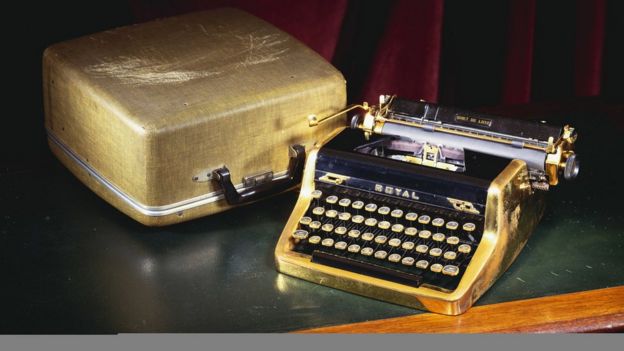
In happier 007 stories, here's the gold typewriter Ian Fleming bought for $174 to celebrate the completion of Casino Royale:

https://ichef-1.bbci.co.uk/news/624/cpsprodpb/0781/production/_92812910_8d857bf2-16f5-4765-94bd-4eb62256ee6a.jpg

Christie's hammered it down as Lot no 122 at Sale 6837 Modern 1st Editions & Autograph Letters 5 May 1995, London, South Kensington 
IAN LANCASTER FLEMING (1908-64)
Price realised GBP 55,750
Estimate GBP 5,000 - GBP 8,000

IAN LANCASTER FLEMING (1908-64)
A Royal Quiet De Luxe portable typewriter, circa 1952, with gold-plated body and fittings, four-row keyboard, 11 x 11 x 6in., in composition carrying case, the attached paper tag with printed address: "The Pantechnicon, Heathfield Terrace" and manuscript inscription: "Mrs I. Fleming 4, 23-2-73."
The machine was also featured in Christie's 250th anniversary retrospective (go ahead and click, Christie's ads will follow you around the internet rather than something from Amazon)

Here's Bloomsbury Publishing's blurb for their book, The Man With The Golden Typewriter:
On 16 August 1952, Ian Fleming wrote to his wife, Ann, 'My love, This is only a tiny letter to try out my new typewriter and to see if it will write golden words since it is made of gold'. He had bought the gold-plated typewriter as a present to himself for finishing his first novel, Casino Royale. It marked in glamorous style the arrival of James Bond, agent 007, and the start of a career that saw Fleming become one of the world's most celebrated thriller writers. And he did write golden words. Before his death in 1964 he produced fourteen bestselling Bond books, two works of non-fiction and the famous children's story Chitty-Chitty-Bang-Bang.
The Guardian noted:
Yes, he had a gold-plated typewriter, which he bought to celebrate the completion of Casino Royale, the first James Bond novel. “His literary acquaintances considered it the height of vulgarity,” writes Fergus Fleming, his nephew....

Whoa: "Yamaha's Humanoid Robot Ride a Motorcycle Around a Racetrack"

From IEEE Spectrum:
Yamaha has just put a humanoid robot on one of its motorcycles and pitted it against Valentino Rossi, a professional rider. The robot didn’t win, but it’s amazing that it could ride at all.

What’s striking is that the bike is unmodified: the robot is a hunched-over form on top. It senses the environment, calculates what to do, keeps the bike stable, manages acceleration and deceleration—all while factoring in road conditions, air resistance, and engine braking.

The project is “a moon shot,” says Hiroshi Saijo, the chief executive of Yamaha. They chose to do it because it is hard. But it’s also part of an industry-wide drive to incorporate autonomous features into commercial motorcycles to make them easier and safer to ride.

For instance, Yamaha’s bike can remain stable at speeds as low as 15 kph (9 mph). But that’s nothing compared to Honda’s latest feat, an all-electric concept called Riding Assist-e, which can stand up when moving at a snail’s pace and even when at a dead stop. It works rather like a Segway, balancing itself with tiny motions of the wheels. Kawasaki is taking another route by developing an AI voice-response system similar to Siri, both to help the driver stay abreast of the situation and to let the AI monitor the driver’s attentiveness....MORE


Slick New Ways to Use Autonomous Vehicles to Track You (and the stories they can reveal) TSLA

From the Observer, September 8:
C-3PO tends to be most people’s first representation of a super smart robot. Star Wars’ beloved protocol droid acts very much as an individual, with its own distinct personality. The films never address the question, but C-3PO’s intellgence appears to reside entirely on the droid’s CPU.
But when artificially intelligent machines become prevalent here in the real world, they won’t work like that at all. Self-driving cars won’t really drive themselves. They will be driven largely by brains in the cloud.

The U.S. House of Representative’s unanimously passed a bill this week offered by Ohio’s Rep. Bob Latta, greenlighting the deployment of autonomous vehicles. Key leaders in the Senate have expressed an appetite for such legislation, but its language on riders’ privacy looks inadequate to some advocates.

All the cars’ many sensors will beam information gathered directly to online navigation systems. That’s piles of data about road conditions, weather and other cars on the road. Those logs can be directly associated with the people riding in the car. It’s the simplest pieces of data about each trip that are probably the most revealing: where it started, where it ended and who was in the car.

Here’s a few instances when simple route information could reveal too much:
  • Lots of trips taking place between two competing companies could suggest a merger deal underway,
  • If one firm has lots of specialized accountants and lawyers visiting, that could indicate there’s trouble on its books or
  • If one employee has taken multiple trips to another company’s office, that could indicate that they are in talks to switch jobs.
Sound paranoid? It shouldn’t, because we’ve seen it before....
...MORE

Just last week Elon Musk was pitching this as a feature not a bug. From Interesting Engineering:
Elon Musk Hints Future Tesla Cars Could Predict Where You Want to Go 

"You Get Nothing" - World's Largest Insurer Warns US Stocks Offer "No Returns" For The Next Decade

Waddya mean "No return". There is no reason p/e multiples can't grow to infinity.

From ZeroHedge:
There will be "almost no prospective returns" from U.S. stocks over the next decade because the market is fully valued following years of gains, according to the global strategist at Allianz Global Investors, which manages $569 billion.

As Bloomberg reports, low interest rates and bond purchases by central banks have left cash and many other asset classes "significantly mispriced," Neil Dwane said Monday as part of a panel discussion on long-term investing at the Toronto Global Forum.
"The U.S. is fully valued," said Dwane, whose firm is owned by Munich-based insurance giant Allianz SE.

"There’s almost no prospective returns for the next 10 years from the U.S. equity market, and therefore investors have to look into Asia or Europe where valuations are significantly lower."

With interest rates close to zero around the world and bond markets "manipulated by central banks," it’s difficult to assess risk and return, he added.

Many investors have turned to high-yield bonds or emerging markets for income, which raises risks.
Dwane is not alone of course in this ominous view, as Bloomberg notes, Jim Keohane, chief executive officer of the Healthcare of Ontario Pension Plan, agreed that it’s not a good time to be buying assets of nearly any stripe.
"Right now assets are very expensive," said Keohane, whose firm manages more than C$70 billion ($54 billion).

"We need to be patient, to wait for better opportunities. Whenever the next crisis comes, assets are going to be on sale. You can buy them a lot cheaper than you can buy them today, but you have to have patience to be able to do that."
And finally, John Hussman, of Hussman Funds, warned that a century of reliable valuation evidence indicates that the S&P 500 is likely to experience an outright loss, including dividends, over the coming 10-12 year horizon, and we presently estimate likely interim losses on the order of -60% or more....
MORE 

Bali volcano latest update: Volcano warning downgraded as Mount Agung activity calms

We'll get around to why we were watching this one next spring but for now we are changing our focus.*
To quote Bart Simpson "Bárðarbunga dude!"

From The Express who had made a little business out of Agung coverage:
THE ALERT status of Bali’s highest volcano Mount Agung has been lowered after more than a month of intense seismic activity, though experts have warned that an eruption could still occur at any time.
Mount Agung’s alert status was downgraded from level four to level three on Sunday, after seismic activity underneath the volcano showed signs of abating.
However, the head of Bali’s Volcanology Centre (PVMBG) has warned that the threat of an eruption has not passed.

“The volcanic activities have not completely calmed down and there is still a potential for an eruption,” he said.

Translating a PVMBG statement, Dr Janine Krippner, who has been monitoring the closely for weeks, explained that the lower threat level “does not mean the risk is gone”....
....MORE

Also at The Express:
Bali volcano update: Mount Agung eruption threat has cost Bali £112 MILLION so far
BALI’s economy has taken a hammering over the past month, as tourists seek to avoid the threat of a Mount Agung eruption.
*I just realized I will probably forget to "get around" to the discussion sans some sort of aide-mémoire so here's this morning's edition of Nature - Communications:

The amplifying influence of increased ocean stratification on a future year without a summer

And Monday's arXiv.org: "Modelling Coupled Oscillations of Volcanic CO 2 Emissions and Glacial Cycles"

Oh, and a flashback to 2015's "Laki: How A Volcano Swallowed Europe"