Sunday, February 9, 2014

When Will We See a GoogleCoin? (GOOG)

Been there....April 2013's "What If Google Launched a Currency? (GOOG)" and, as Izabella Kaminska has hammered home in a series of posts on Dizzynomics and at FT Alphaville, the GOOG really has no reason to open the game to the unwashed masses as long as the stock is accepted as currency.
See also ""Google’s Stock Split Means More Control for Larry and Sergey" (GOOG)" and the posts below the jump.

From ZeroHedge:

Is Googlecoin Coming?
Google has been manifesting itself in more and more niches of the technology sector. Cryptocurrencies however, remained untouched by the internet giant for now. What if…
Googlecoin
Since the fall of 2012 our advice has been to sell Apple stock. The reasoning behind it was fairly simple. Without the leadership of top exec Steve Jobs, the large corporation would become very hard to manage and steer into the right direction. About a year and a half later, this is exactly the technology company’s problem. Apple does not surprise, innovate, or lead the pack anymore. Apple is lagging and that is deadly in a sector that is extremely competitive like technology. We have been waiting on iTV for years now, but it does not look like it is going to happen. The iWatch has been on our watch list for months, while the competition has been launching one smartwatch after the other. Too late, Apple. The company that once was a technological super power, now is a has-been.

On the other hand, regular readers of Sprout Money know that we love Google. The basic idea behind it is that Apple operates inside a closed environment, while Google has an open ecosystem. Google can power the entire internet to generate revenue, while Apple can only generate revenue from its own users. Meanwhile, Apple is hitting the limits of its business model, while Google’s growth is practically unlimited, only limited by the ever-expanding reach of the internet. The internet is taking a brand new direction too. We are evolving over the next few years into the concept of the ‘Internet of Things’, connecting the worldwide web to everyday objects and services. An example of that would be a ‘smart fridge’, which can deduce from your agenda what’s on tomorrow’s menu, alert you of missing ingredients if there are any, and even order online.

Google is biting down hard to not miss this trend, and potentially even shape it. Not only did the company come out with Google Glass last year, which are high-tech glasses projecting an additional dimension with all the knowledge of Google on the inside of the glasses, but the company also purchased Nest Labs recently, the producer of the smart thermostat. With that, Google can probably collect more data on its users in order to position even more and better ads, which is still the core business of the internet company. But Google also made some purchases in other niches of the technology sector. Recently, the company acquired robotics specialist, Boston Dynamics, and artificial intelligence authority, DeepMind. However, Google’s acquisition fever did not just start a few months ago. Since the beginning of 2013, Google has been extremely active on the acquisition trail as evidenced by the list below (source: Wikipedia).

Google acquisitions
The acquisitions are in different sectors of the technology space, but Google also spread out geographically with its purchases (not only in the US). This will prove to become a true value differentiator for shareholders, because only through innovation can a company remain competitive or, even more, become a market leader. One area in which we have not heard from Google yet is cryptocurrencies. You know, bitcoin et al. It is an interesting evolution in the online payment market.

It is highly likely that Google is in wait-and-see mode for now with regards to cryptocurrencies, but we are sure that this segment has their full attention. We recently read that Google would possibly accept bitcoins in its payment ecosystem Google Wallet, but we suspect that it might be a bit too early for that. Furthermore, Google might be a candidate for launching its own cryptocurrency in our opinion. The Googlecoin or Gcoin. Google has the largest P2P network in the world, which is what powers a cryptocurrency. Sounds crazy? We don’t think so. Don’t forget that Google owns banking licenses for the most important countries in the world. One day, Google could start putting those licenses to work, and what better way to serve the financial side than with its own cryptocurrency. It would be relatively cheap to do so, and the insight and data arising from its usage would be a huge advantage to the company....MORE
From Dizzynomics:
Most importantly:
Currencies everywhere
And
The tendency towards cartelisation
God complex

And at FT Alphaville:
Google, defender of the universe
Why it’s tough being in an altcoin cartel
Attack of the killer rentiers

And many more (esp. late Dec. 2013).
See also our:
UPDATED: JP Morgan Has Patented A Bitcoin-like Cryptocurrency (JPM)
Amazon is Introducing "Amazon Coins" Virtual Currency (AMZN)
Alternative, Community and Private Currencies
BANK RUN: "Second Life Closes Banks"
European Towns Creating Own Currencies  

J.K. Rowling Submits "Harry Potter" For Peer Review

For our newer readers I lean open-access for all research and demand that any taxpayer funded research be freely available.
The knowledge does not belong to the journals or to the researchers who take the King's shilling but rather it belongs to the funders. Period.

From Techdirt:

From the files of J. K. Rowling.
Dear Ms. Rowling,
Thank you for submitting your manuscript Harry Potter and the Half-Blood Prince. We will be happy to consider it for publication. However we have some concerns about the excessive length of this manuscript. We usually handle works of 5-20 pages, sometimes as much as 30 pages. Your 1337-page manuscript exceeds these limits, and requires some trimming.
We suggest that this rather wide-ranging work could usefully be split into a number of smaller, more tightly focussed, papers. In particular, we feel that the “magic” theme is not appropriate for our venue, and should be excised from the current submission.
Assuming you are happy to make these changes, we will be pleased to work with you on this project.
Correspondence ends.
Esteemed Joenne Kay Rowling,
We are delightful to recieve your manuscript Harry Potter and the Half-Blood Prince and we look forword to publish it in our highly prestigious International Journal of Story Peer Reviewed which in 2013 is awarded an impact factor of 0.024.
Before we can progression this mutually benefit work, we require you to send a cheque for $5,000 US Dollars to the above address.
Correspondence ends.
Dear J.R.R. Rowling,
We are in receipt of your manuscript Harry Potter and the Half-Blood Prince. Unfortunately, after a discussion with the editorial board, we concluded that it is insufficiently novel to warrant publication in our journal, which is one of the leading venues in its field. Although your work is well executed, it does not represent a significant advance in scholarship.
That is not to say that minor studies such as yours are of no value, however! Have you considered one of the smaller society journals?
Correspondence ends.
Dear Dr. Rowling
Your submission Harry Potter and the Half-Blood Prince has passed initial editorial checks and will now be sent to two peer-reviewers. We will contact you when we have their reports and are able to make a decision.
Dear Dr. Rowling
Re: Harry Potter and the Half-Blood Prince.
We agree that eighteen months is too long for a manuscript to spend in review. On making inquiries, we find that we are unfortunately no longer able to contact the editor who was handling your submission.
We have appointed a new handling editor, who will send your submission to two new reviewers. We will contact you as soon as the new editor has made a decision.
Dear Dr. Rowling
Re: Harry Potter and the Half-Blood Prince.
Your complaint is quite justified. We will chase the reviewers.
Dear Dr. Rowling
I am pleased to say that the reviewers have returned their reports on your submission Harry Potter and the Half-Blood Prince and we are able to make an editiorial decision, which is ACCEPT WITH MAJOR REVISION.
Reviewer 1 felt that the core point of your contribution could be made much more succinctly, and recommended that you remove the characters of Ron, Hermione, Draco, Hagrid and Snape. I concur with his assessment that the final version will be tighter and stronger for these cuts, and am confident that you can make them in a way that does not compromise the plot.
Reviewer 2 was positive over all, but did not like being surprised by the ending, and felt that it should have been outlined in the abstract. She also felt that citation of earlier works including Lewis (1950, 1951, 1952, 1953, 1954, 1955, 1956) and Pullman (1995, 1997, 2000) would be appropriate, and noted an over-use of constructions such as “… said Hermione, warningly”.

...MORE

xkcd on Mobile Marketing

From the incomparable xkcd:

Mobile Marketing

The Kidney Hoarders

From Reddit:
What's the most bullshit-sounding-but-true fact you know?
[–]LAL17 3533 points ago
When you get a kidney transplant, they usually just leave your original kidneys in your body and put the 3rd kidney in your pelvis.
[–]musicallyinclined 2495 points ago
True! My husband has had two transplants and has 4 kidneys. Apparently the surgery to remove the bad kidney is much more invasive and leaving it there does no harm.
[–]Bacon_Bitz 3206 points ago
Your husband is just hoarding kidneys.
[–]InsomniacMachine 2637 points ago
Up next on Hoarders, "I'm Joe, and I've been collecting kidneys since 1968."
...MORE

HT: The Big Picture's 10 Sunday AM Reads

Saturday, February 8, 2014

I Really Need A Way To Short Individuals to Zero: Robert Shiller and the Introductory Macro Students

There must be a way to bet against the lifetime accomplishments of individual human beings.
From the Yale Daily News:
On Monday afternoon, a cell phone appeared to go off several minutes into the Introductory Macroeconomics lecture. Then another identical ring emerged from the din. And another. Soon, a cacophony of rings from around the lecture hall succeeded in bringing professor Robert Shiller’s discussion of monetary policy to a halt.

“I think someone’s phone is going off,” he said.

What began as a jovial prank soon degenerated into a malicious, personal and uncalled for attack on a faculty member.

“Rise!”

One student’s scream prompted a handful of students holding bells to stand. Two of them — a boy and a girl — marched towards the stage. They shook Shiller’s hand, and handed him a few objects including a paper scroll and a bell. He fumbled trying to place them on his podium. Students glanced around in uneasy silence, confused by what was unfolding before their eyes.
“For talking about your Nobel Prize more than anyone else, we present you with the Yes-bell Prize,” announced one of the bell-carriers.

The handful of students proceeded to pick up their backpacks and walk out of the lecture hall. Their hijinks may have been intended to generate laughter, but the room was left quiet. Some sensed that a prank had gone too far — that a tacit code had been broken.

Professor Shiller struggled to comprehend what had just occurred. Visibly flustered, he took a couple of minutes to resume his lecture.

“I hadn’t even planned on mentioning the Nobel Prize today,” he said.
The episode that interrupted his lecture was no prank. It was rude, disrespectful and mean-spirited. It was glorified bullying of a Yale professor.

More than simply disrupt a class, the bell-ringing perpetrators attempted to publicly humiliate a faculty member. Without warning, they criticized him for referring to his Nobel Prize during lectures and did so in front of a room full of students....MORE
HT: Economic Policy Journal
It has to be possible to bet against this group.
The money would be so easy.
And the winnings would be so sweet.

Digitizing Art Collections (do copies sap the aura and mystery around the original?)

No, not swapping Rembrandts for Bitcoins.
From Barron's Penta blog:
Art is going online, not just through virtual auctions, but also through online museum portals. It begs the question: If major museums around the world are digitizing their collections, should a private collector do likewise? What are the potential costs and benefits of doing so?

To answer such questions, first a little history. The fear of creating replicas of art, as explained in Walter Benjamin’s 1935 essay, “The Work of Art in the Age of Mechanical Reproduction,” is that copies sap the aura and mystery around the original.

That view has proven remarkably resilient over time. Until recently, the world’s best museums held high-quality digital images close to their chest, reinforcing the notion that viewing originals on a wall is far superior to looking at them on a computer screen. The museum director’s concern, of course, was that by giving images away for free online, he or she would cannibalize attendance at their museum.
That concern suddenly doesn’t seem to carry much weight anymore. Over the past few years, the Smithsonian, London’s National Gallery of Art, Amsterdam’s Rijksmuseum, the Vatican Library and most recently the Getty Research Institute have joined the open-content movement, posting thousands of downloadable images on their respective sites.

Jim Cuno, CEO of the Getty, tells Penta we are witnessing something akin to the institution-wide movement unleashed when the digital wave hit the music industry in the 1990’s. “When MP3s first came out, the common belief was that people would stop going to concerts, but people still go. There is every indication that [digital images] will increase appetites for the real thing,” he said.

While most agree it’s still too early to definitively argue digital reproductions on the Web can actually drive museum foot-traffic, the images are certainly getting eye-play. According to the Getty, web visits rose 15% to over 9 million last year, from 7.8 million in 2012. Physical visits to the Getty Center and Villa similarly rose to 1.7 million last year, up 8% from the 1.6 million who clocked in during 2012.

Chicago Albumen Works is a leader in digital archiving of works on paper, and has worked with the likes of the Metropolitan Museum of Art, the Guggenheim, and the Rockefeller Archive Center. CEO Doug Munson declined giving specifics on the firm’s past and current projects, citing privacy, but encourages individuals to similarly consider the value of digitization, especially when it comes to private collections in family hands.

“Families that have approached us for digitization had private collections that have been passed down from the 19th and 20th century, and now there are three generations of people who are interested.” These families, Munson said, subsequently used digital images to create facsimile albums, scrapbooks and reproductions. “In addition, private collectors can enhance the value of their collections before a donation is made, to relieve the museums or historical societies of digitizing expenses,” he said.

In other words, increase awareness of your private collection, through making digital images available to the public, and the value of your collection should rise. Working exclusively with flat objects, particularly photographs, Housatonic, Mass.-based Albumen Works takes pride in working under the rules of museum-quality conservation. Munson said that the ubiquity of scanners has been an unfortunate fact for digitization. “It feels like you can push a button and that photo is magically on-screen,” Munson says. Furthermore, digitization a decade ago was inferior, mostly because industry standards hadn’t yet been developed.
While every firm’s methodology differs, the ones that aim to create archival-quality digital files adhere to standards put together by the Federal Agencies Digitization Guidelines Initiative, says Eric Philcox, founder of Pixel Acuity. This Maitland, Florida-based firm offers digitization services for fine-art collections – including paintings, decorative objects and sculptures– and like Albumen Works digitizes under these more stringent conditions. That means producing high-resolution files suitable for the size of the image, using specialized cameras that provide color accuracy, luminosity, a high input of ppi or pixels per inch, metadata and other photo metrics....MORE

"Occupy Wall Street leader now works for Google, wants to crowdfund a private militia"

More anthropology stuff than usual today.
From Pando Daily:

justine
Remember Justine Tunney? The OWS-anarchist-turned-cultist-Google-employee who bashed my reporting on Google’s for-profit surveillance? Well, today she hit the big time.

Over the last few days, Tunney has been causing a Twitter outrage tsunami after she took full control of the main Occupy Wall Street (OWS) Twitter account, claimed to be the founder of OWS and then proceeded to tweet out stream of ridiculous anarcho-corporatist garbage. She railed against welfare, described the government as “just another corporation,” argued poverty was not a political problem but “an engineering problem” and told politicians to “get out of the way.” She also debunked what she thought was a misconception: people thought OWS activists were protesting against concentrated corporate power, and that, she claims, is simply not true.

As I wrote before, Tunney’s sudden epiphany that not all corporations are evil just so happened to coincide with her decision to take a well-paid job at Google. Since then she has become an astroturfer par exellence for the company, including showing up in a comment section to bash my reporting on Google’s vast for-profit surveillance operation. “It never ceases to amaze me how far people have to stretch in order to denounce the one corporation that gives away everything for free,” she wrote.

It’s important to realize that, before taking her job at Google, Tunney wasn’t just an Occupy foot soldier, but a prominent spokesperson for the movement. She’s been written about in the New Yorker and The Nation as one of the founding members of OWS in Zuccotti Park, and was instrumental in setting up and  running OWS’s main Internet communication hub, OccupyWallSt.org. In media profiles, Tunney described herself as “just another geek trying to help out with the revolution,” and you can see her in photographs with other hi-tech revolutionaries occupying a table in Zuccotti Park, hunched over laptops, wires and computer gear.
And this week Tunney’s shift away from her former Occupy pals broke the Twitter troll barrier. Her tweets caused such a social media backlash that even Buzzfeed’s Rosie Gray felt compelled to cover it:
Occupy Wall Street is dead — but its Twitter account is alive, and it’s become a fascinating hotbed of infighting between rival factions of the group that once slept out in New York’s Zuccotti Park....MORE

Economists Roundup: For Economy ‘Winter From Hell’"

From Real Time Economics, Feb 7, 2014:
U.S. employers added 113,000 jobs in January, and the unemployment rate fell to 6.6%. It was the second straight month of weaker-than-expected job growth, with December’s number revised up a bit to 75,000. Economists disagreed about whether the weather played a role, and some found silver linings in Friday’s report.
A weak start to the year with back-to-back disappointing employment reports in December and January suggesting momentum in the labor market has waned. While weather may have slowed consumer foot traffic at points during the month or impeded manufacturing capacity in parts of the country, goods production hiring improved at the start of the year, making it difficult to blame weather for the headline weakness. –Sterne Agee Chief Economist Lindsey Piegza

In short, another weaker-than-expected report for payrolls, and the details do not suggest that weather was the reason. Beyond weather, there are plenty of other sources of volatility, especially in a month with a 3-million swing in the seasonal factor. Other data, such as claims and the ISMs, have not suggested any sudden weakening in the trend. We still expect catch-up in coming months. – High Frequency Economics Chief U.S. Economist Jim O’Sullivan

When the economy finally manages to dig out from an unusually snowy and cold winter, activity may strengthen. – Interactive Brokers Chief Market Analyst Andrew Wilkinson

This has been the winter from hell for the economy and the frigid cold, ice and snow have taken its toll. –Naroff Economic Advisors President and Chief Economist Joel Naroff

There was little evidence of a weather disruption as construction hiring rebounded to a robust 48k from a 22k decline in December and manufacturing was also solid adding 21k after an 8k increase. … Given the broader set of labor market indicators we think that the real picture of the US economy and labor market conditions is still one of chugging along, a disappointment to expectations of a take off that had built around year end but hardly a disaster. – BNP Paribas Chief Economist for North America Julia Coronado

Grim, but seasonals may have played a role. … The payroll rebound clearly is disappointing; none of ground lost in Dec was recovered. And with the household survey – NOT directly comparable to payrolls, but it’s all we have – showing 157K fewer people than usual kept away from work by the weather, it is hard to pin the blame on the severe winter.  The seasonal adjustment, however, was very unhelpful relative to Jan last year, for reasons which are not clear.  Had last year’s Jan seasonal factor been used this year, private payrolls would have risen by 265K. – Pantheon Macroeconomics Chief Economist Ian Shepherdson
...MORE

"A Guide to What the Hell Is Up With Silicon Valley Right Now" (the future is Pittsburgh)

You realize this is all a distraction right? Nothing will change, the Valley will last as long as silicon.
...The radio and the telephone
And the movies that we know
May just be passing fancies,
And in time may go !

But, oh my dear,
Our love is here to stay.
Together we're
Going a long, long way

In time the Rockies may crumble,
Gibralter may tumble,
There're only made of clay,
But our love is here to stay.

-George Gershwin
From Wired:
A Google shuttle bus drives by the corner of 18th Street and Dolores Street in San Francisco.  Photo: Ariel Zambelich/WIRED
A Google shuttle bus in San Francisco. Photo: Ariel Zambelich / WIRED
Conversations about Silicon Valley, like conversations about the media industry, are awfully navel-gazing. It doesn’t help that no one really knows who the “sides” are here — Is it non-tech workers against entrepreneurs/startups/VCs? Shuttle buses against city governments? City governments against unions? The there’s-an-app-for-that mindset against structural change? Tech workers who made it big in recent IPOs against other tech workers (who still make a lot of money but can’t afford local rents)?
We’ve got a roundup of the WIRED opinion pieces you must read here, whether it’s just to catch up on what the hell is going on in Silicon Valley or to explore the nuances — and there are many. Regardless of your position, though, it’s clear that as tech pervades every aspect of our lives, and Silicon Valley represents the tech industry, this is an important cultural moment to pay attention to … and care about.
1. Silicon Valley can’t afford to ignore its haters. Even just the image of arrogance could kill the industry — and future innovation. Silicon Valley is always selling the next category, the new frontier, the thing you’ll need tomorrow but can’t even imagine wanting today. A computer in your home. The Internet in your pocket. Your music in the cloud. A smartphone on your wrist or face. Unlike any other industry, tech relies on not merely trust but faith that a leap into the unknown, into breaking routines, will be rewarded. Since business models of tech companies are built on monetizing data that users freely supply, losing the trust and optimism of customers wouldn’t just mean failing to sell the next big thing … it could mean failing to make it. Read WIRED editor Bill Wasik’s argument here.
 
2. The protestors in this culture war — on both “sides” — are fighting about the wrong things. Last year, a fake Google bus protest felt real and a real rant by a tech entrepreneur felt fake because all logic has been lost in the midst of the cultural upheaval between those in tech and those outside of it. But the battlelines aren’t so clear: Not all who enter the tech industry do so with the intention to cash in, and not all who fight tech are Luddites who inherently see coders as the enemy. Still, make no mistake, argues Oakland illustrator and writer Susie Cagle in WIRED Opinion: We are in the midst of a fight here – and there must be sides. It’s just in everyone’s best interest that those sides don’t shift attention away from much-needed structural change by shifting blame to the bottom of the tech-sector food chain.
 
3. Silicon Valley stands for meritocracy, but that’s a dangerous myth when it comes to social change. If the tech scene is really a meritocracy, professor Alice Marwick argues in this exclusive excerpt from Status Update, why are so many of its key players, from Mark Zuckerberg to Steve Jobs, white men? The myths of authenticity, meritocracy, and entrepreneurialism do have some basis in fact. But they also reinforce ideals that shore up the tech industry’s power structures and privileges. And social software may inadvertently do more to promote this inequality than to counter it. It’s a kind of digital elitism that positions technology and entrepreneurship as a catch-all solution to an array of difficult problems — but not everyone can work at a startup, and startup models can’t be applied to all situations....MORE
From Pacific Standard:

It’s Settled: Silicon Valley Is Dying. So What’s Next?
The Rust Belt will rise again.
Silicon Valley is the next Detroit. California crumbles and Texas rises. Or so journalist Erica Grieder would have you believe. I assert the forgotten, shrinking Rust Belt stands as the heir apparent to the Innovation Economy. As the Manufacturing Economy (Detroit) fell, the Innovation Economy (Silicon Valley) took over. We can no longer deny that the Innovation Economy is in decline:
Silicon Valley’s tech-fueled prosperity — in combination with a failure by local governments, developers and employers to ensure that housing supply can meet demand — leaves the region vulnerable to talent poaching from less-expensive markets. It also manifests day-to-day in productivity-sapping traffic caused by commuters who clog the freeways driving from more affordable fringe cities.
Pick your poison. Bottom line, the wages are too damn high. The Innovation Economy requires cheaper labor. Exodus of the Creative Class:
Artists aren’t just leaving New York for LA – they’re also going to Portland, Minneapolis, Miami, Atlanta, Philadelphia and countless other places. And, as an aside, I don’t know why they aren’t moving to Newark. It’s 15 minutes away from Manhattan and remarkably cheap. I think it’s the unwarranted New Jersey stigma that unfortunately keeps people from crossing the Hudson. People would rather move to the worst part of Brooklyn and still have the magical “NY” in their address. That single consonant on their mail – “Y” as opposed to “J” – seems to keep people from making that 15-minute trek to Newark.
Emphasis added. So says Moby. Newark is an instructive geography. The ambitious head to New York or San Francisco out of tradition. For the same reason, they avoid Newark. It’s off the map and might as well be Des Moines. Regardless, talent can be someplace cheaper and still in the loop.
Korean made car.
Container box ship navy,
Globalization.

Down goes Detroit. Down goes Silicon Valley. What’s up? Pittsburgh.

Hidden in the slag heap is the Legacy Economy. What’s wrong with the Rust Belt is what will be right. Sinking with anchor institutions:
Others think we may be “too captive to the past,” one Philadelphia participant noted, “by limiting our definition of anchor institutions,” especially to the “eds and meds.” In fact, while universities and hospitals represent the legacy of the industrial wealth once enjoyed in rust belt cities, how and where they deliver services has and continues to evolve. Tom Schorgl of Community Partnership for the Arts agreed, noting that anchors can also be “neighborhood-based institutions or groups that provide an anchor in those neighborhoods.”
The Manufacturing Economy failed and moved to Korea. The Manufacturing Economy succeeded and fed the Innovation Economy. The engineers had to come from somewhere. They came from the anchor institutions that manufacturing built. First, physical geography blessed certain places with coal and waterways. Silicon Valleys of the time boomed. The wealth freed the labor and they sprawled. Wherever innovation happened, college graduates would go.

Luckily, Pittsburgh is too captive to the past. Arts and anchors are the current attraction, all thanks to quirks of earth science. Prosperity is once again grounded in geography, the same one that peaked way back in 1910. Environmentally determined Google:
“Google has signed a lease for an additional 66,000 Square Feet at Bakery Square 2.0 to accommodate for natural growth in our Pittsburgh office. Google Pittsburgh’s engineers and product managers work on search, ads and ads-shopping products used by hundreds of millions of people, as well as core engineering infrastructure.”
Sure, Google pops up in a variety places these days. Whoop-dee-doo, Pittsburgh. Hold on. Google is an anchor: “Consider the history of the growth of Google in Pittsburgh, home of one of only three engineering centers in the country.”

Google is the migrant, talent the attraction. Floating with anchor institutions...MORE

"Everything Was Fake but Her Wealth"

From Smithsonian Magazine:
Ida Wood, who lived for decades as a recluse in a New York City hotel, would have taken her secrets to the grave—if here sister hadn't gotten there first
 
 Herald Square circa 1907, when Ida Wood first moved into the Herald Square Hotel. From Wikipedia.

Ida Wood never had any intention of renewing contact with the outside world, but on March 5, 1931, death made it necessary. At four o’clock that afternoon, the 93-year-old did something she hadn’t done in 24 years of living at the Herald Square Hotel: she voluntarily opened the door, craned her neck down the corridor, and called for help.

“Maid, come here!” she shouted. “My sister is sick. Get a doctor. I think she’s going to die.”
Over the next 24 hours various people filtered in and out of room 552: the hotel manager, the house physician of the nearby Hotel McAlpin and an undertaker, who summoned two lawyers from the venerable firm of O’Brien, Boardman, Conboy, Memhard & Early. The body of Ida’s sister, Miss Mary E. Mayfield, lay on the couch in the parlor, covered with a sheet. The room was crammed with piles of yellowed newspapers, cracker boxes, balls of used string, stacks of old wrapping paper and several large trunks. One of the lawyers, Morgan O’Brien Jr., began questioning hotel employees, trying to assemble the puzzle of this strange and disheveled life.

The manager said he had worked at the hotel for seven years and had never seen Ida Wood or her deceased sister. His records indicated that they had moved into the two-room suite in 1907, along with Ida’s daughter, Miss Emma Wood, who died in a hospital in 1928 at the age of 71. They always paid their bills in cash. The fifth-floor maid said she hadn’t gotten into the sisters’ suite at all, and only twice had persuaded the women to hand over soiled sheets and towels and accept clean ones through a crack in the door. A bellhop said that for many years it had been his habit to knock on the door once a day and ask the ladies if they wanted anything. They requested the same items every time: evaporated milk, crackers, coffee, bacon and eggs—which were cooked in a makeshift kitchenette in the bathroom—and occasionally fish, which they ate raw. Ida always tipped ten cents, telling him that money was the last she had in the world. From time to time they also requested Copenhagen snuff, Havana cigars and jars of petroleum jelly, which Ida massaged onto her face for several hours each day. She was five feet tall and 70 pounds, nearly deaf and stooped like a question mark, but her face still bore clear evidence of its former beauty. “You could see what an extraordinarily pretty woman she once was,” O’Brien noted. “Her complexion, in spite of her age, was as creamy and pink and unwrinkled as any I have ever seen. It was like tinted ivory. Her profile was like a lovely cameo.” She hadn’t had a bath in years.

As the undertaker prepared her sister’s body just a few feet away, Ida Wood suddenly grew talkative. She said she had been a celebrated belle in the South and a prominent socialite in the North. Her husband was Benjamin Wood, the brother of Fernando Wood, former mayor of New York and perennial congressman. She had, despite her complaints to the bellhop, a good deal of cash stashed in her bedroom.
At first they all thought she was senile.

O’Brien called his elderly father, who confirmed at least part of her story. When he was a lawyer in the 1880s, he said, he had known Ida Wood quite well, both professionally and socially. She had been known for both her beauty and her business sense, and was indeed the widow of Benjamin Wood, erstwhile owner of the New York Daily News and brother of the mayor. He doubted she was destitute, and encouraged his son to take her case regardless of her ability to pay.

The younger lawyer obliged and began looking into Ida’s finances. A representative from Union Pacific revealed that the sisters owned about $175,000 worth of stock and had not cashed their dividends for a dozen years. Examining the sale of the New York Daily News, O’Brien learned that Ida had sold the paper in 1901 to the publisher of the New York Sun for more than $250,000. An old acquaintance reported that she sold all of the valuable possessions she’d acquired over the years—furniture, sculptures, tapestries, oil paintings. An officer at the Guaranty Trust Company remembered Ida coming to the bank in 1907, at the height of the financial panic, demanding the balance of her account in cash and stuffing all of it, nearly $1 million, into a netted bag. Declaring she was “tired of everything,” she checked into the Herald Square Hotel and disappeared, effectively removing herself from her own life....MUCH MORE

"Archaeologists discover 800,000-year-old footprints on an English beach"

It wasn't me, I swear.
From the British Museum blog:

The earliest human footprints outside Africa
Nicholas Ashton, curator, British Museum
Happisburgh has hit the news again. Last time the coverage even reached the People’s Daily in China, but I’ve yet to find out which parts of the globe the latest story has reached. Whereas three years ago the news was the oldest human site in northern Europe at over 800,000 years ago, now we have the oldest footprints outside Africa. Happisburgh just keeps giving up surprises.
Caption text?
We found them by pure chance in May last year. We were about to start a geophysics survey on the foreshore, when an old-time friend and colleague, Martin Bates from Trinity St David’s University, pointed out the unusual surface. The site lies beneath the beach sand in sediments that actually underlie the cliffs. The cliffs are made up of soft sands and clays, which have been eroding at an alarming rate over the last ten years, and even more so during the latest winter storms. As the cliffs erode they reveal these even earlier sediments at their base, which are there for a short time before the sea washes them away.
Caption text?
Back in May, high seas had removed most of the beach sand to reveal ancient estuary mud. We’d seen these many times before and had been digging them for years. Normally they consist of flat laminated silts, but in a small area of about 12 square metres there was a jumble of elongated hollows. Martin pointed them out and said that they looked like footprints. He’d been studying similar prints on the Welsh coast near Aberystwyth, but they were just a few thousand years old; we knew the sediments at Happisburgh were over 800,000 years old.

I imagine that there will be plenty of sceptics out there, as were we initially, but the more we eliminated the other possibilities, the more convinced we became. The sediments are hard and compacted – you can jump on them today and leave little impression. And there are no erosional processes that leave those sort of hollows....MORE
HT to and headline from The Verge 

Friday, February 7, 2014

Art: Another Week, Another Auction Price Record

Or two.
In this week's Impressionist auctions at the two big houses a Juan Gris still life "The Checked Tablecloth" sold for $56.7 million at Christie's breaking the previous record for a Gris, the 2010 auction of "Violin and Guitar" for $28 million

At Sotheby's a new record for a Pissarro was established, the Nazi-looted Boulevard Montmartre, Spring Morning, 1897 which made $32 million:

That handily beat the previous record of $7 mil. for Le Pont Boieldieu et la gare d'Orleans, Rouen, Soleil in 2009.
There's a lot of money floating around.

"Why Abraham Lincoln Loved Infographics"

From the New Yorker, Dec. 2013:

Coast_Survey_Slave_Map-1500_opt.jpg
Near the end of 1861, with the American Union crumbling, President Abraham Lincoln became obsessed with an unusual document. Nearly three feet in length, it appeared at first to be a map of the southern states. But it was covered with finely rendered shading, with the darkness of each county reflecting the number of slaves who lived there. South Carolina, the first to secede from the Union, featured a particularly dark coastline. Yet other parts of the South (like western Virginia) appeared as islands of lightness.

Lincoln often studied the map, and it “bore the marks of much service,” according to a memoir by Francis Bicknell Carpenter, an eminent painter who was at the White House conducting research for a portrait of the President. At one point, Carpenter borrowed Lincoln’s map so that he could include it in the painting. Some time later, the President visited him in his studio and, spotting his precious map, declared, “Ah! … you have appropriated my map, have you? I have been looking all around for it.” Then Lincoln slipped on his glasses, sat on a trunk by a window, and “began to pore over it very earnestly.”

In the map, Lincoln saw testimony that the American south was not a uniform bloc. Areas of heavy slavery—the darkened banks along the Mississippi River, for example—tended to be secessionist, but the areas in between held the hope of pro-Union sympathy. Unlike traditional cartography, the map was designed to portray political terrain and, in Lincoln’s mind, moral terrain. The President called it his “slave map.” Today we would call it an infographic.

Infographics are clearly having a cultural moment. They have become pervasive in newspapers, magazines, blog posts, and viral tweets; they appear on television and in advertising, in political campaigns and at art openings. As a Google search term, “infographic” has increased nearly twenty-fold in the last five years. Yet infographics have been popular, in one form or another, for centuries. The source of their power isn’t computers or the Internet, but the brain’s natural visual intelligence.

Credit for the world’s first infographics should probably go to William Playfair, a Scottish engineer, economist, and failed silversmith. In 1786, Playfair published the “Commercial and Political Atlas,” which included the first known line graphs. In one graph, for example, Playfair showed England’s exports and imports in a single chart: in the seventeen-fifties, the export line shoots up, and around the middle of the decade it crosses the import line, showing a trade surplus. Until that time, economists worked with expanses of figures arranged in rows and columns. With Playfair’s innovation, the numbers became dots connected in space and their broader meaning became immediately apparent.

The importance of what he had done was not recognized at the time, but Playfair, who also invented pie charts and bar graphs, had found a way to take advantage of a potent pattern-recognition machine: the human brain. From the first moment that animals on earth developed sight, the advantage went to those who were fastest to discern the patterns, or unusual details, that signalled potential threats—or potential opportunities. The human brain has been shaped by eons of evolution to make immediate sense of its surroundings. Roughly half of the human brain is involved in processing images. Playfair took information that is not easy for us to absorb (columns of British import-export figures) and put it into a form (a landscape of peaks and valleys) that the brain can interpret with speed. This is the idea behind all infographics....MORE
HT to ValueWalk for reminding me we had Playfair in the link-vault.
This 209 Year Old Graph Will Teach You A Lot About Global Growth

Used Tesla's Appreciating Almost as Fast as the Stock (TSLA)

A bit of hyperbole in my headline, the stock is up $7.95 (4.46%) at $186.33.
From Corporate Intelligence:

Things Increasing in Value: Tesla Stock, and Second-Hand Teslas 
Tesla Motors Inc. defies the auto industry’s normal forces of gravity in more ways than one. Its stock keeps levitating – up more than 2% today – and now comes a survey that suggests the prices for used Tesla Model S sedans may be higher than the price of the car new.

That’s the conclusion of a sample by iSeeCars.com, an auto shopping website. The company concluded that a used Tesla Model S that had a base price of $79,900 is worth an average of $99,734 used, and that a Model S with the long-range 85 kilowatt-hour battery pack is worth as much as $106,800. Other electric cars, such as the Nissan Leaf and Chevy Volt plug-in hybrid, lose value when they leave the showroom....MORE

Yes, Quantitative Easing Helps Mortgage Rates, But There's a Catch

From Mortgage News Daily:
Two Federal Reserve System economists have looked at the recent quantitative easing programs of the Federal Reserve to determine whether a central bank's monetary policy could retain potency when short-term rates reach zero.  The two, Diana Hancock and Wayne Passmore, were testing their theory that because the banks could purchase a wide variety of assets, not just short-term government securities the purchases could be used to enforce explicit ceilings for yields on longer-term securities, including longer-dated Treasury securities, agency debt, or agency mortgage-backed securities  

If such a long-term asset purchase program were successful they say, not only would yields on such securities fall, but yields on private debt (such as mortgages) would probably fall as well and the increase in the monetary base would lead to an increase in asset prices in general and a subsequent impact on spending.  Thus, even a central bank whose accustomed policy rate has been forced down to zero would not "run out of ammunition."

To test these assumptions they two looked at the impact the Fed's large-sale asset purchases (LSAPs) or quantitative easing (QE) programs had on agency mortgage-backed security (MBS) yields and thus on conforming mortgage interest rates.  They selected periods when the financial markets were functioning well rather than being in turmoil because the prevailing view is that LSAP's would have no effects on asset prices in normal times.  They tested the countervailing opinion is that such purchases can potentially influence all components of MBS yields to some extent by (1) signaling Federal Reserve intentions to financial markets (2) portfolio rebalancing effects, and (3) liquidity effects.  

The purchase of long-term assets may make more credible the Feds commitment to keep interest rates low even after the economy recovers, particularly if the central bank weighs potential losses on its asset holdings in its objective function.  This signaling affects all bond market interest rates, since lower future federal funds rates can be expected to affect all interest rates.  And, as market participants anticipate the announcement of LSAPs, their effects can be reflected in market prices even before they are announced.

These purchases can also potentially affect MBS yields through a portfolio rebalancing channel where the Fed purchases reduce private sector holdings while increasing short-term, risk-free, private sector bank deposits.   The private sector finds it holds more of these deposits than they desire because of receipts from selling securities so they bid up prices of remaining long-term securities and thus lower the yields.  This "scarcity" effect is primarily focused on the current coupon yield MBS.

For longer-term securities, this portfolio rebalancing effect is often expected from duration and convexity risk.  Duration refers to the length of time that the bonds will likely provide an income stream.  Convexity refers to "duration's sensitivity to rates"--i.e. a pool of mortgages that might normally last for about 7 years could quickly change to lasting half that time if rates fall quickly enough, prompting more refinances out of that pool....MORE

Market Differentiation: "Kazakh leader may drop the 'stan' in Kazakhstan"

One of these is not like the others:

stans_map.bmp
From Reuters:

President Nursultan Nazarbayev may drop the 'stan' from Kazakhstan to distinguish his booming oil-rich nation from the rest of Central Asia, where the other so-called stans are mostly mired in poverty.

The world's ninth largest nation by area with a population of just 17 million, Kazakhstan is the largest economy of the post-Soviet region, which also includes Kyrgyzstan, Tajikistan, Turkmenistan and Uzbekistan.

Foreign companies have invested billions of dollars in the nation's mineral wealth since its independence from the Soviet Union in 1991. But Kazakh officials say the vast country of steppes and mountains is still little known in the world.

Nazarbayev, who visited the nation's oil capital Atyrau in western Kazakhstan on Thursday afternoon, said a new name like Kazakh Eli, which stands for "The Land of Kazakhs", would be more eye-catching for a foreigner studying the region's map.

"In our country's name, there is this 'stan' ending which other Central Asian nations have as well. But, for instance, foreigners show interest in Mongolia, whose population is just two million people, but whose name lacks the 'stan' ending," Nazarbayev's press service quoted him as saying....MORE
Recently:
"The New New Great Game: Geography, Energy, The Dollar and Gold"
Just about the time 'the 'stans' start receding from the Western headlines it is probably most important to think about them....

Climateer Line of the Day: A String Of Words I Never Imagined Seeing Edition

We’re one of the only flying robot companies that are focusing on industrial applications....
-Helen Greiner, co-founder of iRobot on her latest venture

Whoa: "JPMorgan’s Masters Said to Quit CFTC Panel After One Day "

Following up on yesterday's "JP Morgan's Blythe Masters to Join CFTC Advisory Panel".
From Bloomberg:
Blythe Masters, JPMorgan Chase & Co.’s commodities head, withdrew from an advisory committee of the U.S. Commodity Futures Trading Commission a day after her appointment was disclosed, according to two people with direct knowledge of the decision.

The regulator may include another executive from New York-based JPMorgan on the committee, said one person close to the bank who requested anonymity because the move hasn’t been publicly announced. Masters, 44, withdrew because the company’s sale of its physical commodities unit will keep her occupied, the person said.

JPMorgan is selling a division that deals in assets such as metals and oil, as government watchdogs examine whether federally backed lenders should be involved in such markets. Masters’s appointment drew criticism from Twitter users who questioned the propriety of her advising the regulator of futures and swaps.

Masters, whose appointment was listed on the CFTC’s website yesterday, had been scheduled to participate in a Feb. 12 meeting to discuss cross-border guidance on rules. She was invited to the panel by acting Chairman Mark Wetjen, said one of the people.

Brian Marchiony, a JPMorgan spokesman, said the company had no comment.

Power Markets
JPMorgan, the biggest U.S. bank, agreed in July to pay $410 million to settle Federal Energy Regulatory Commission claims the firm manipulated power markets. The settlement released the company and its employees from future enforcement actions by the agency. Masters, whose division includes the unit involved in that case, wasn’t named as a defendant.

Masters probably wouldn’t join Mercuria Energy Group Ltd., the Geneva-based firm that’s in exclusive talks to acquire the unit from JPMorgan, a person with knowledge of the auction said this week....

An Indicator That Leads the Employment Number

From the Money Illusion:
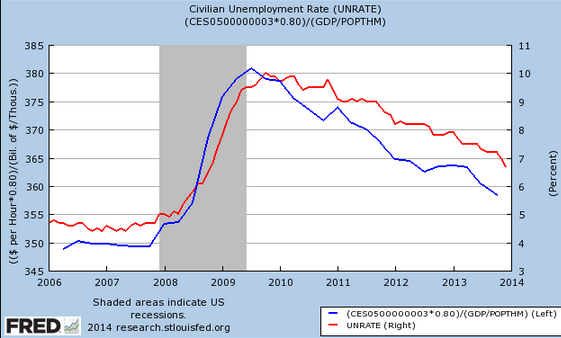
The musical chairs model, updated

It’s been about 6 months since we’ve looked at the sticky wage model, so let’s see how it’s doing:
Screen Shot 2014-02-04 at 3.57.01 PM 
The fit seems better than ever.  To my eyes it looks like “real wages” [(nominal average hourly earnings)/(NGDP/pop)] lead unemployment by about a month or two.  That’s partly an artifact of a flaw in the St. Louis Fred graphing program. The (W/(GDP/pop)) data for Q4 is put in the October 2013 slot, whereas it should be November 2013.  If you shifted the wage series one month to the right the correlation would look even closer....MORE
The HT goes to askblog although he goes with snark rather than curiosity about whether this information could be used to advantage on a day such as today:
Inferring from an Identity
Scott Sumner writes,
To my eyes it looks like “real wages” [(nominal average hourly earnings)/(NGDP/pop)] lead unemployment by about a month or two
Shock me, shock me. Let’s see...

"Jeremy Grantham on Tesla, Fertilizer Wars" (and lessons learned from 47 years at the market)

While in the post immediately below, "In His Latest Letter Jeremy Grantham Ramps Up The CarbonBubble/Stranded Assets Argumentum", I fleshed out a part of Mr. Grantham's quarterly letter that I figured maybe a handful of people were following there is much more in his missive.
From Barron's Wall Street's Best Minds column:

GMO's famed investor also discusses peak oil and fracking. Plus, investing lessons learned over 47 years.
Fossil Fuels: Is Tesla a Tease or a Triumph?
In an earlier report, "The Race of Our Lives," I finished on the unusually optimistic point (for me) that a combination of declining fertility and eventual declining population combined with unexpectedly strong progress in renewable energy might just save our modern civilization from a slow and, no doubt, irregular descent into dystopia. More recently, while still believing we are in this critical race, I have become increasingly impressed with the potential for a revolution in energy, which will make it extremely unlikely that a lack of energy will be the issue that brings us to our knees. Even in the expected event that there are no important breakthroughs in the cost of nuclear power, the potential for alternative energy sources, mainly solar and wind power, to completely replace coal and gas for utility generation globally is, I think, certain. The question is only whether it takes 30 years or 70 years. That we will replace oil for land transportation with electricity or fuel cells derived indirectly from electricity is also certain, and there, perhaps, the timing question is whether this will take 20 or 40 years. To my eyes, the progress in these areas is accelerating rapidly and will surprise almost everybody, I hope including me....

.... Update on Metals, Fertilizers, and Food
A group of important elements – iron, aluminum, and potassium – are generously supplied in the earth's crust, 2.5% to 4% each, and at some price that is affordable at least to rich and middle income countries they will be available for a century or two at least. Many other important elements, though, are genuinely scarce so that their availability at even fairly desperate prices is not assured, at least not for their current uses. Copper, for example, may become a semi-precious metal but will certainly not be commonly used for piping in a few decades. All of these metals must be replaced eventually by organic substitutes, just as cellulosic plastics from wood have already been substituted in some uses for petrochemical plastics. Substituting for copper and other elements that have special qualities such as conducting capability or use as a catalyst will take decades – a time period far too long to attract many corporate research dollars.

Phosphorus
As readers know, I consider phosphorus (phosphate) to be an especially important case. Phosphorus is about .07% of the earth's crust compared, say, to potash's 2.5%. This .07% had been washed down rivers for millions of years and, once in a geological while, an ocean dried up. If everything was just right, we were left with 20% or 30% phosphate concentrations, at which concentration extraction is efficient and cheap enough for the farmers of developed and most emerging countries to use in required quantities. As mentioned before, phosphorus (and potassium in potash) is necessary for the growth of all living things and, unlike very nearly everything else, cannot be substituted for or made. Currently both are mined and the mines deplete.
Particularly worrying to me is that phosphorus is not evenly divided: you either sit on a dried up ocean or you don't. Morocco and the neighbor it controls, Western Sahara, contain within their boundaries some 75% ±10% of all of the high-grade, low-cost phosphate known to exist in the world. Outside of these Moroccan deposits there is still a lot of phosphate – about enough for 50 years at 2% a year growth in demand. Even after allowing for further discoveries to add 40% to this total, it would mean that "peak non-Moroccan phosphate" would occur in some 30 years and all hell would break loose. Take out Morocco from the production side and serious people (most Scandinavians and maybe five in Congress, but which five?) would immediately worry. I'm pretty sure, though, that the U.S. military already pays suitable attention to this issue as it clearly does to problems stemming from climate change. (Who would have guessed that on several vital long-term issues the military here and in the U.K. seems to have the most sensible views of any establishment entity?)

Well, Morocco fortunately seems like a reasonable enough kingdom with an unusually reasonable king and sensible-sounding people running its phosphate operations, who seem to me to be not as short-term greedy as, say, your typical investment banker circa 2007. It seems to be settling into the role of market leader and price setter, and things could be a lot worse.

But think for a minute where Morocco is. Egypt, Syria, Libya, and Mali are not far from being failed states, and Tunisia, Algeria, Chad, etc., are not themselves models of stability. You will remember, perhaps, my thesis on North Africa and Syria. Their populations all increase rapidly, they are largely desert countries abnormally affected by climate deterioration (Syria's recent troubles were preceded by the driest six years in its long history), and wheat does their heavy calorie lifting. They cannot grow all of their own wheat and must import it on the world market at prices that vary from two to four times what they were only 10 years ago. Libya and Algeria have oil or gas to export but, critically, Egypt, which did until recently, is now an importer. The much- increased prices of wheat and oil and, to some extent, fertilizer, have helped destabilize their societies. They mostly run trade deficits that are hard to imagine being funded for long by international good will. So, what happens if this irregularly deteriorating situation spreads to Morocco, with its most important quasi-monopoly in the history of man, as I like to say? Surely the U.S. military or, say, the Chinese military will not allow Morocco to become a failed state for these reasons? Perhaps if we're lucky and not too reckless the worst will be avoided, but we should definitely try to avoid the Great Fertilizer War of 2037.

Problems in Forecasting Short-term Prices for Resources
I underestimated both the skullduggery of "miners" and the great lumpiness of their new production capabilities. New mines are surprisingly few and usually gigantic in scale. Deliberate delay in completing projects, legal or not, when shortages are intense and profits exceptional is understandable and does occur. I missed the point that when you run a copper mine at 1.2% average copper ore you start with the 1.5% stuff and end with the 0.7% dregs. And when the replacement mine comes on with a painfully lower average of, say, 0.7% it nevertheless starts mining its 1.1% ore first on its way in 30 years or so to its dregs of 0.4%. So, even as the quality of ore irretrievably declines in the long term, the quality of ore mined can increase in the short term when a new mine comes on line. And this higher quality for a short time improves the cost structure and puts temporary downward pressure on prices....MUCH MORE

Thursday, February 6, 2014

In His Latest Letter Jeremy Grantham Ramps Up The Carbon Bubble/Stranded Assets Argumentum

We've been following the proponents of the Carbon Bubble argument since the term was first floated by the Carbon Tracker Initiative in March 2012.

Al Gore tried to frame it as analogous to the sub-prime bubble but no one is really listening to him. Mr. Grantham via his Grantham Research Institute is going with the unburnable carbon/stranded assets approach and is probably the most prestigious voice making the argument followed in rapidly descending order by Nick Lord Stern who Chairs the GRI; billionaire political activist Tom Steyer who is making full use of Citizens United and who recently hooked up with Michael Bloomberg (just named the U.N's climate change/cities envoy) and former Goldman honcho (and less powerfully, U.S. Treasury Secretary) Hank Paulson in their Risky Business initiative.

A related movement is divestment from fossil fuel producers by some public employee pension funds and demonstrations for same from college endowments. In the most famous instance Harvard said no.

The thesis hangs on the 2°C target that the EU adopted as their goal for maximum global warming.
I should probably do a post on that one of these days.

I hope I've left enough breadcrumbs for our journalist friends to, should they wish to, write the book (or at least this chapter) on the global warming story.

From Grantham, Mayo, Van Otterloo:
Year-End Odds and Ends
(Possible Peak Oil Demand, Fracking Frictions,
and the Great Fertilizer Wars of 2037)
Jeremy Grantham
Fossil Fuels: Is Tesla a Tease or a Triumph?
...MUCH MORE (15 page PDF)

One Love: Rasta Mon Mayor Rob Ford Declares Bob Marley Day in Toronto

In answer to the unasked question 'sup dread? we have:

Toronto Mayor Rob Ford has declared Feb. 6 Bob Marley Day.
It coincides with Marley's birthday. The Jamaican singer, who was born in 1945, died in 1981 at age 36. He would have been 69 Thursday.
It's perhaps no surprise that Ford is a Marley fan. The mayor was seen in a video posted in December dancing to the song One Love during a council session....
-USA Today 
Here's Playing for Change doing their cover:

JP Morgan's Blythe Masters to Join CFTC Advisory Panel

This is what the word phantasmagorical was made for.
From Bloomberg:
Blythe Masters, head of JPMorgan Chase & Co. (JPM)’s commodities division, is joining an advisory committee of the U.S. Commodity Futures Trading Commission, said Steve Adamske, a spokesman for the regulator.
Masters, 44, was invited by acting Chairman Mark Wetjen to sit on a global markets committee at the Washington-based regulator of futures and swaps, according to a person with knowledge of the matter. Masters is scheduled to participate in a CFTC meeting on Feb. 12 to discuss cross-border guidance on rules, the person said.

JPMorgan, the biggest U.S. bank, is selling the part of its commodities division dealing in physical assets, such as metals and oil, as regulators examine whether federally backed lenders should be involved in those markets. Masters probably wouldn’t join Mercuria Energy Group Ltd., which is in exclusive talks for the unit, a person with knowledge of the auction said this week.

The CFTC has been enacting rules required by the 2010 Dodd-Frank Act designed to reduce risk and increase transparency in the global swaps market, after some firms’ bets on the derivatives helped fuel the 2008 credit crisis. The agency put in place more than 60 rules seeking to have most swaps guaranteed at central clearinghouses, which accept collateral from buyers and sellers, and traded on execution facilities or other exchanges.

Industry Representatives
Masters joined JPMorgan in 1991 after internships at the firm and became known that decade for helping develop credit-default swaps, which help investors hedge risks on bonds. She was named to run the commodities business in late 2006, and she also heads regulatory affairs within JPMorgan’s corporate and investment bank.

JPMorgan agreed in July to pay $410 million to settle Federal Energy Regulatory Commission claims the New York-based firm manipulated power markets. The settlement released the company and its employees from any future enforcement actions by the agency. Masters, whose division includes the unit involved in that case, wasn’t named as a defendant....MORE
In addition to Ms. Masters' responsibilities at JPM as global head of commodities she was also head of regulatory affairs.

iRobot Target, Estimates Lifted at Needham & Company; Stock Jumps 12% (IRBT)

I had put the stock back into sleep mode as we waited for next quarter. Wow.
$38.60 up $4.23.
From Street Insider:
Needham & Company analyst James Ricchiuti reiterated a Buy rating and rasied his price target on iRobot Corporation (NASDAQ: IRBT) from $39 to $41 following solid Q4 results and above consensus 2014 outlook despite a slower start.

"IRBT turned in a solid Q4 report, with EPS coming in at the high end of guidance while revenues increased 25% y/o/y, in line with consensus. The home robot business was up 31%, driven by strong growth in the domestic business. Mgmt guided below consensus for the seasonally weak Q1, but provided full-year revenue guidance for growth of 15%-17%, modestly above consensus. Full-year EPS guidance was in line with expectations. We expect another strong year from IRBT's home robot business, while the defense business should remain stable. Longer term, we believe IRBT's telepresence robots have the potential to open up a new growth leg. We reaffirm our Buy rating."...MORE
Here is the  Q4 2013 IROBOT CORP Earnings Conference Call Replay
and her is the conference call transcript via NASDAQ
Yesterday:
UPDATED--iRobot Reports Q4, Violates Asimov's 1st Law of Robotics (IRBT)

What if Google Glass Ran on Windows?

OMG


HT:
HuffPo's "One Of Google's Biggest Fans Calls Glass 'An Expensive Nightmare'".

The Financial Times Trounces the Wall Street Journal in Busi-bloggy Weather Deep Divery

A couple hours ago we noted "The WSJ's Metropolis Blog Is Doing A Regular NYC Feature Called 'Weather Journal'".
Now comes before us FT Alphaville's Cardiff Garcia:

Weather it’s worth worrying about, who knows
A chart from Credit Suisse (click to enlarge for a clearer picture):
 
The strategists add:
The debatable contribution that weather may have had in the December payroll number appears unlikely to repeat itself this Friday, judging by the weather conditions prevailing during the January survey week.
As illustrated in Exhibit 11, the unusually cold weather experienced during the December payrolls survey contrasts noticeably with the unusually warm temperature observed during the January payrolls survey week. Not only was temperature higher than average for January, but also snow depth, as estimated by the National Operational Hydrologic Remote Sensing Center, appears to have been lower than the recent average for January.
Despite the warmer survey week, the labour market might still have had lingering effects from December (nearly all of which was colder than average — more on that below).
Friday’s report will also be complicated for other reasons, and the status of US economic recovery will remain uncertain given the number of disappointing economic indicators in recent weeks. But a “normal” payrolls number — say, something above 150,000 — would at least suggest that December really was a fluke.
—–
But whatever its impact on the payrolls report, here’s an observation from Bank of America Merrill Lynch on the historical relationship between cold weather and growth, and how it might affect growth in the first quarter...MUCH MORE
Making weather puns is a breeze.

"Goat Simulator Sets the Internet on Fire"

Worlds and worlds of worlds I never knew existed.

From Modern Farmer:
The video game designers at Coffee Stain Studios just finished an elaborate sci-fi shoot-em-up called Sanctum 2. It's their baby — the result of four years, endless development, buckets of blood, sweat and tears.

Coffee Stain is also working on a basic little goat simulation. Which one do you want to play?
“The Goat Simulator is more popular than any other game we’ve made,” says developer Armin Ibrisagic. “It’s not even done yet.”

A short video preview for Goat Simulator went online this week. It shows a goat careening through town, knocking stuff over and getting creamed by cars. The game is a rough draft, clearly working out the rough edges (e.g., the goat’s pixellated neck hangs limply while it climbs ladders — and also the goat can climb ladders).

Yet since it was released on Monday, the video earned well over a million views — more than all other Coffee Stain videos combined. It’s been covered by various “Ain’t that crazy!” websites, goat gifts are pouring in to Coffee Stain’s offices in Sweden, and Ibrisagic is clocking thousands of new Twitter followers (including Pew Die Pie, the most popular YouTube star in the world).

Not to be smug, but no one at Modern Farmer is shocked by this development. We’re like the goat version of a Crazy Cat Lady — we fully relate to goat obsessives. We’ve also seen how well goats play on the Internet; GoatCam remains one of our most enduringly popular features....MORE

Japanese Panel Recommends Abe Govt. Renounce Renouncing War and Re-Arm

Aspiring sincerely to an international peace based on justice and order, the Japanese people forever renounce war as a sovereign right of the nation and the threat or use of force as means of settling international disputes. (2) To accomplish the aim of the preceding paragraph, land, sea, and air forces, as well as other war potential, will never be maintained. The right of belligerency of the state will not be recognized.
ARTICLE 9 of the Japanese Constitution via-U.S. Library of Congress
From the Guardian:

Japan considers constitutional changes to enhance defence capacity
Tokyo wants to play greater role in international peacekeeping and step up defence posture
A government panel will urge Japan to allow its military to help allies that come under attack, in a major reversal of the country's ban on collective defence under its pacifist constitution.

The panel on Tuesday discussed ways that Japan could improve its defence capability and said it would present its near-final draft recommendation in coming weeks, before its final report is expected after April.
The prime minister, Shinzo Abe, wants Japan to play a greater role in international peacekeeping and step up its defence posture, mainly because of potential military threats that Japan sees from China and North Korea. As China's influence rises and that of the United States fades in the region, Japan is trying to expand its defence alliance outside its "cornerstone" ties with Washington and has signed defence agreements with several other countries, including Britain and Australia.

The 14-member panel, headed by former ambassador to the US Shunji Yanai, says the revision is possible if the government alters its current interpretation of the war-renouncing constitution. Formal constitutional change involves high hurdles, though Abe eventually hopes to achieve that....MORE
Previously:
Shinzō Abe and "the Funniest Song Ever Written About Any Japanese State Document...Ever!"
China and Japan Are Probably Going to War

Is More Or Less Income Inequality Better For Market Returns?

Mesdames et Messieurs, welcome to the Le Théâtre de l'Absurde:
From Kapitall:
There's been a lot of talk about income inequality. Does it have any effect on the stock market? 
 
One of the key points in President Barack Obama's State of the Union address was income inequality. Recent gains in the stock market have been hugely beneficial to the wealthy, who saw their portfolios grow significantly in 2013. But this hasn't been so good for everyone else, as wages and incomes have stayed pretty flat.

Interestingly enough, according to our partners at Hedgeye, income inequality isn't a Democratic or a Republican issue. They blame quantitative easing: something which was initiated by Ben Bernanke under President George Bush. Our question is, do differences in income inequality mean stocks perform better, or worse?

As the video explains, quantitative easing is basically asset purchasing. And when the government take over purchasing these assets, it keeps their prices high.

This is good for the wealthy, who see the values of these assets go up. But for everyone else, all you get is inflation. To actually buy the assets, the government needs to print money, which sends the value of currency down. Now, rich people usually only keep a relatively small portion of their assets in cash to get higher returns.

But as Hedgeye also explains, people lower on the economic ladder don't have a lot of assets. They usually live paycheck to paycheck. And if wages stay the same, but inflation goes up, then those paychecks can buy less and less.

Voila: rising income inequality.

In reality it's probably not as neat as that. There are many other factors contributing to the rising income inequality levels we've seen in the US, not the least of which is the fact that our low-skilled workers now have to compete with low-skilled workers all over the world.

But this still gives us something to think about. We decided to create a list of stocks in countries with high income inequality, and compare them with stocks based in countries with low income inequality, as measured by the Gini Coefficient. The Gini Coefficient is a figure published by the World Bank that looks strictly at a nation's distribution of wealth (but not how much wealth there is in total.)

We chose four stocks from Scandinavia, which has the lowest income inequality in the world, and three stocks from Hong Kong and South Africa, which have fairly high Gini Coefficients, meaning they have higher rates of income inequality.....MORE
Also at Kapitall:
Income Inequality: 7 Restaurant Stocks With Upscale Customers

The WSJ's Metropolis Blog Is Doing A Regular NYC Feature Called 'Weather Journal'

I still don't know if the market anomaly that allowed an acquaintance to retire very comfortably, checking the temperature outside the NYMEX as an indicator for moves in natural gas futures, is real or just an oddity but over the years I've found myself paying more and more attention to NYC's weather.
Here's Metropolis:

Weather Journal: Another Winter Storm Predicted for the Weekend
Greater New York will enjoy a few dry, partly sunny days before yet another winter storm pays a visit to this weekend.

A woman with open-toe boots navigates a 
slushy intersection near Union Square. 
See more photos in our slideshow.
Five days into February, Central Park has received one foot of snow, well over the average 1.3 inches for this time of year. Wednesday’s storm is responsible for about four inches of that total, as well as another day of complicated commutes across the region....MORE
I'm maybe not paying as close attention as the guy snapping pics of women in open toe boots.