Friday, May 27, 2022

OMG: Izabella Kaminska Has Become A One Woman Content Machine

Here she is at UnHerd:

Elon Musk isn’t Tony Stark — he’s Han Solo
These two loveable rogues share a fondness for money-making stunts

And here tweeting on contract law

Here at Bloomberg Opinion on the stand-offish part of the periodic table.

I'm getting dizzy.

"Glencore says bribery days are over. Now it has to prove it" (GLEN.L)

Two via Mining.com. First up, the headline story, May 26:

Glencore Plc has closed the “cash desks” in London and Switzerland that once dispensed money for bribes. Employees implicated in sweeping, cross-border corruption investigations are gone. New safeguards are in place, and boss Gary Nagle says it’s a “different company.”

Now he will have to prove it.

Glencore this week agreed to plead guilty to a web of bribery and price manipulation charges that stretch from Venezuela to Nigeria and Los Angeles in deals with the US, UK and Brazil. The penalties will total about $1.5 billion but there’s a longer-lasting requirement — the deal with the US Department of Justice means Glencore will spend the next three years being scrutinized by an independent monitor.

It’s a potentially seminal moment for the company founded by US fugitive Marc Rich, which has powerful trading networks in every corner of the globe and operates a sprawling suite of mines producing some of the most important commodities. Glencore’s top leadership has been overhauled in the last few years as former CEO Ivan Glasenberg and his lieutenants handed over to a younger generation, although many of the new chiefs are also longtime employees....

....MUCH MORE

And a bit about the physical oil market, also May 26 (both stories from Bloomberg):

Glencore’s oil-price rigging puts spotlight back on benchmarks

Glencore Plc’s settlement with US prosecutors has cast fresh light on manipulation of an under-the-radar part of the commodities world that’s crucial for valuing physical deals and derivatives.

The raw-materials giant this week agreed to plead guilty to rigging fuel-oil assessment prices after probes into wide-ranging bribery and corruption. The process for setting the benchmarks involves price reporters polling traders in the market for bids, offers and transactions so that they can publish values on products that otherwise would remain private information.

It’s a hugely important part of the industry. Billions of dollars of physical deals are set against the daily benchmarks, which also act as a reference price for big amounts of derivatives. Yet they’re often based on a relatively small number of trades — or none at all — which can give large trading houses an incentive to manipulate physical markets to benefit their derivative positions.

Glencore admitted to conspiring to manipulate from 2011 to 2019 fuel benchmarks set by price-reporting agency S&P Global Platts, which allowed it to reduce costs and boost profits artificially....

....MUCH MORE

So what's a $200+ billion revenue company going to do to get a leg up on the competition?

Carbon! If they work it right they can get paid for shutting down their coal mines. And the trading opportunities!  One of a thousand posts on carbon trading, this one from June 16, 2009:
"The whole reason for the existence of traders is to make as much money as possible, consistent with what's legal...I lived through this: if you didn't manipulate the market and manipulation was accessible to you, that's when you were yelled at."
—Former Goldman Sachs trader
New York Times, May 8, 2002

"Germany to Bring Back Coal [and oil!] Power Plants If Russia Cuts Gas"

From Bloomberg via Yahoo Finance, May 24:

Germany plans to bring back coal- and oil-fired power plants should Russia cut off natural gas shipments to Europe’s largest economy.

https://s.yimg.com/ny/api/res/1.2/xk7MRmgLILR_9QQFM0t.OQ--/YXBwaWQ9aGlnaGxhbmRlcjt3PTk2MDtoPTYzOTtjZj13ZWJw/https://s.yimg.com/uu/api/res/1.2/3ngcfAhR0jX_qL0YYyIc3Q--~B/aD04NjI7dz0xMjk2O2FwcGlkPXl0YWNoeW9u/https://media.zenfs.com/en/bloomberg_markets_842/090cc205730a0f55ba2f7ce096aebe5a

Economy Minister Robert Habeck will on Tuesday present an emergency decree enabling the government to bring back the facilities in case of gas shortages, according to the proposed legislation seen by Bloomberg.

Germany is resorting to desperate measures to keep the lights on and its massive industrial parks running, turning to dirty fuels even if that means a surge in carbon emissions. The nation has almost six gigawatts of facilities that are currently part of a national reserve, many of which were supposed to be closed down as part of the coal phase-out plan.

“This request for additional coal-fired power generation only occurs when there is a gas shortage, or if there is a threat of a gas shortage and the gas consumption in power generation has to be reduced,” according to the proposed law.

The decision comes even as Habeck’s Greens -- part of Chancellor Olaf Scholz’s so-called traffic light coalition -- want to bring forward to 2030. The coal-phase out was initially planned for eight years later.....

....MUCH MORE

I think I see the problem. Chancellor Merkel's advisors were idiots. 

They were warned, over and over again, especially fervent were the Polish geostrategists, but nein, they go their own way.

Here's one of the warnings from 2018:

Natural Gas: "Polish PM: Nord Stream II Would Make Russia Free to act Against Ukraine, So Must Not be Built"

Someone should check in with Victoria "Fuck the EU" Nuland to see what the plan to follow-up on the 2014 regime change in Ukraine was.
Because, despite the fact their first concern is their own energy security, the Poles do have a point regarding their frenemy Ukraine, things could get a bit chaotic for Kyiv if Nord Stream 2 is completed as planned.

Maybe the Ukraine follow-up plan is mixed in the same stack as the follow-up for the "We came, we saw, he died" Libya plan.

Here are three stories on some aspects of the current state of play in Eastern European energy geopolitics....

Prescient. And that's just the intro.

2019
"First American LNG Shipment for Ukraine Arrives at Polish Port"
Poland has been trying to warn the rest of Europe of the risks in getting too dependent on Russian gas, in particular via the Nord Stream 2 pipeline.  
 
And one from 2016:
New Russian Pipeline In Baltic Sea Could 'Collapse' Ukraine

I'm not sure what it is about the Poles but they seem wary of their neighbors

"Berlin, Moscow Negotiate New Trade Accord".
-Reading Eagle
Feb. 12, 1940 
 
There are a couple dozen more if the reader is interested in the history

"DARPA Wants a Better, Badder Caspian Sea Monster"

From IEEE Spectrum, May 19:


Arguably, the primary job of any military organization is moving enormous amounts of stuff from one place to another as quickly and efficiently as possible. Some of that stuff is weaponry, but the vast majority are things that support that weaponry—fuel, spare parts, personnel, and so on. At the moment, the U.S. military has two options when it comes to transporting large amounts of payload. Option one is boats (a sealift), which are efficient, but also slow and require ports. Option two is planes (an airlift), which are faster by a couple of orders of magnitude, but also expensive and require runways.

To solve this, the Defense Advanced Research Projects Agency (DARPA) wants to combine traditional sealift and airlift with the Liberty Lifter program, which aims to “design, build, and flight test an affordable, innovative, and disruptive seaplane” that “enables efficient theater-range transport of large payloads at speeds far exceeding existing sea lift platforms.”
*****
DARPA is asking for a design like this to take advantage of ground effect, which occurs when an aircraft’s wing deflects air downward and proximity to the ground generates a cushioning effect due to the compression of air between the bottom of the wing and the ground. This boosts lift and lowers drag to yield a substantial overall improvement in efficiency. Ground effect works on both water and land, but you can take advantage of it for only so long on land before your aircraft runs into something. Which is why oceans are the ideal place for these aircraft—or ships, depending on your perspective.
 
During the late 1980s, the Soviets (and later the Russians) leveraged ground effect in the design of a handful of awesomely bizarre ships and aircraft. There’s the VVA-14, which was also an airplane, along with the vehicle shown in DARPA’s video above, the Lun-class ekranoplan, which operated until the late 1990s. The video clip really does not do this thing justice, so here’s a better picture, taken a couple of years ago:
*****

Actually we had a better picture in 2018's "To Protect The Northern Sea Route Russia Is Bringing Back the Ekranoplan!":

https://thebarentsobserver.com/sites/default/files/styles/full_width/public/ekranoplan.jpg?itok=bDtWAqp6
The Lun-class missile carrying Ekranoplan was operating in the Caspian Sea in the late 1980s. 

A better picture because, yes, those are rocket launchers on top of the fuselage, shown in 3/4-profile.

"Roman Abramovich Faces Probe After Moving Assets to an Island in the English Channel"

From the Wall Street Journal, May 24:

Jersey has tried to remake itself as an offshore haven where rule of law runs deeper than in others
ST. HELIER, Jersey—For years authorities on this small island in the English Channel have tried to clean up its image as a tax haven for the super rich, marketing it as a well-governed offshore financial center enshrined in the rule of law.

The makeover helped draw billions of dollars in new assets to the territory from other well-known, but scandal-plagued havens like the British Virgin Islands and the Cayman Islands. Part of that migration of money: Russian oligarch Roman Abramovich, who has increasingly concentrated his wealth here. The island has offered him residency and became the home to some of his closest advisers.

Now, Jersey officials are in an awkward standoff with one of their best-known customers. Last month, they froze over $7 billion of assets they say are linked to Mr. Abramovich amid sweeping economic sanctions imposed on him and scores of other wealthy Russians by Western governments in response to Moscow’s invasion of Ukraine. Jersey officials have gone a step further: opening a wide-ranging preliminary probe into how he acquired oil companies in 1990s post-Soviet Russia, according to people familiar with the matter. The probe is also looking into whether one of his business partners helped the billionaire try to evade U.K. sanctions, according to these people.
The Jersey probe, first reported earlier Tuesday by The Wall Street Journal, is in its early stages and hasn’t reached the stage of being a formal investigation. Authorities haven’t accused anyone of wrongdoing.

Located just off the north coast of France, Jersey is a self-governing island with the British monarch as head of state. Technically called the Bailiwick of Jersey, it is a picturesque island closer to France than England, popular with day-tripping tourists and famous for its low taxes and namesake cows and potatoes.

The size of Mr. Abramovich’s assets in Jersey has surprised many, forcing the government to defend its previous courtship of the billionaire. “Right across Europe, with hindsight, different decisions would have been made,” said Ian Gorst, Jersey’s minister for external relations and financial services, sitting in an office in the capital St. Helier. “But at the time, Russian individuals and oligarchs were investing and being given residency across Europe, just as they were here.”
Jersey’s outsize financial role traces its roots back to a historical anomaly in the thirteenth century, when the island pledged allegiance to the British monarchy but was never formally incorporated into what became the U.K. That left it free to set its own rules while benefiting from privileged access to Britain, including passport-free travel.

The largely agrarian economy gravitated to finance from the 1970s, when Britons and others started parking assets here to avoid higher onshore taxes. Today, funds routed through Jersey’s 46 square miles total some $1.7 trillion in assets, according to a report by industry body Jersey Finance. The island’s financial industry now accounts for 40% of its economy....
....MUCH MORE

Thursday, May 26, 2022

TIME Magazine Corrects An Earlier Report

 From TIME's Twitter feed:

Beta had no business pulling his political stunt at that press conference.

As the Mayor of that torn up little town shouted: "[Y]ou’re a sick son of a b---- that would come to a deal like this to make a political issue" 

"A 'Lost Decade' Ahead For Markets?"

A very smart analysis of expected future returns, decomposition of returns and the interplay of valuation and time frames.

From RealInvestmentAdvice, May:

Is a “lost decade” ahead for markets? We and many others have discussed a topic regarding financial market valuations and forward returns. Now, halfway into 2022, all of a sudden, the “crazy talk” of valuations seems a lot less crazy as bear markets growl.

However, it wasn’t that long ago the mainstream media discounted valuations and forward returns. For example, in December 2021, Ben Carlson recounted a presenter at a 2010-2011 conference who discussed valuations for a 60/40 allocation in the 95th percentile. Historically, that suggested investors were doomed for a low-return environment of roughly 2-3% over the next decade. As he states:

“Instead, this happened.”

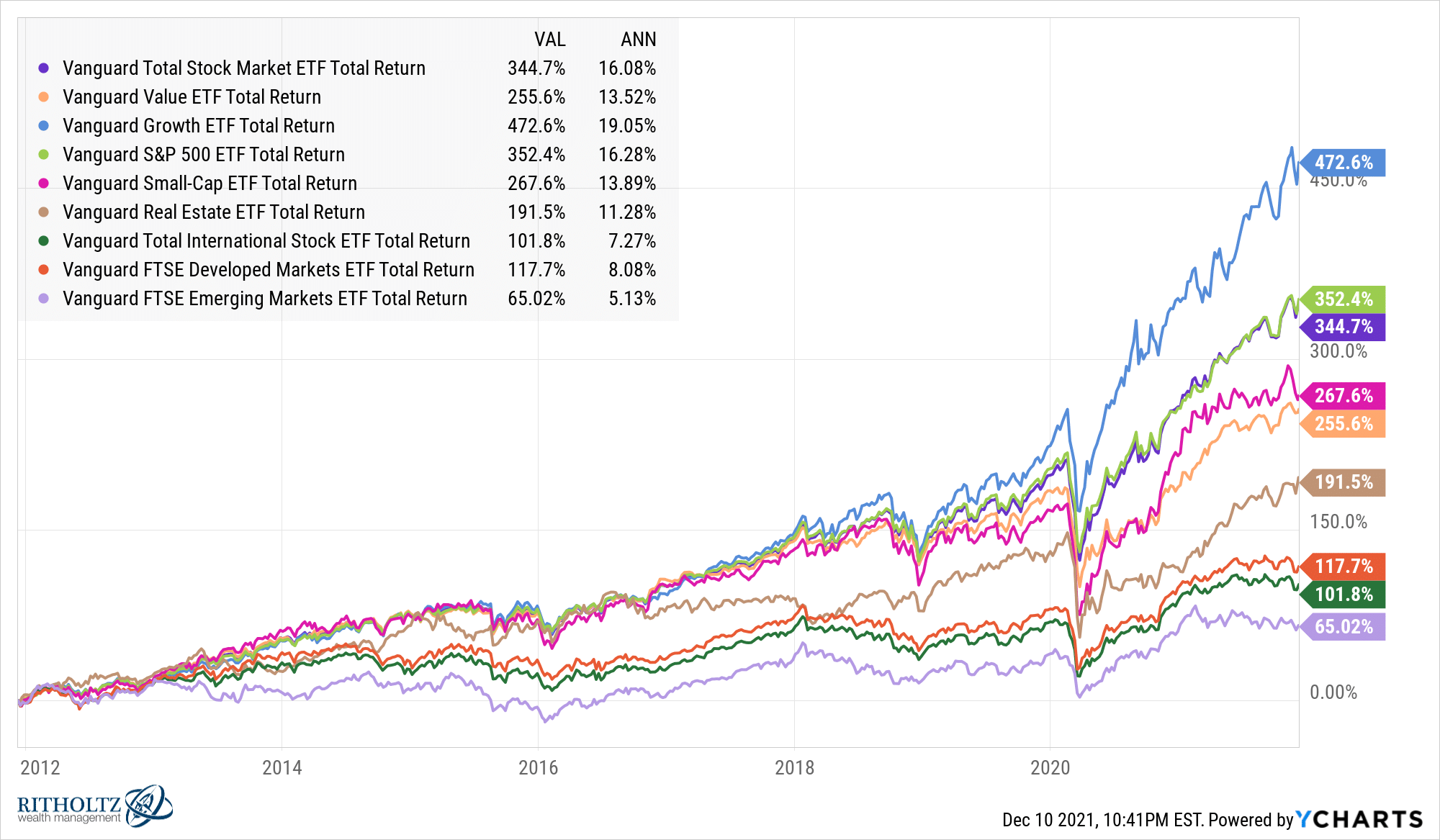
https://realinvestmentadvice.com/wp-content/uploads/2021/12/Decade-Returns-for-last-10-years.png

“U.S. growth is up almost 20% per year. The S&P 500 is up more than 16% per year. Small caps are up almost 14% per year. REITs rose more than 11% annually. Everyone has been dancing on the grave of value stocks for years now, yet they’re up nearly 14% per year over the last decade.

A simple 60/40 portfolio of U.S. stocks and bonds is up around 11% per year over the past 10 years.”

Valuation and forward return assumptions were wrong then.

Or were they?

Over the last 120-years, valuations have consistently proved to be a strong predictor of future returns with lost decades a common occurrence. However, as we discussed previously in “Rationalizing High Valuations:”

“The mistake investors repeatedly make is dismissing the data in the short-term because there is no immediate impact on price returns. Valuations by their very nature are HORRIBLE predictors of 12-month returns. Investors avoid any investment strategy which has such a focus. In the longer term, however, valuations are strong predictors of expected returns.”

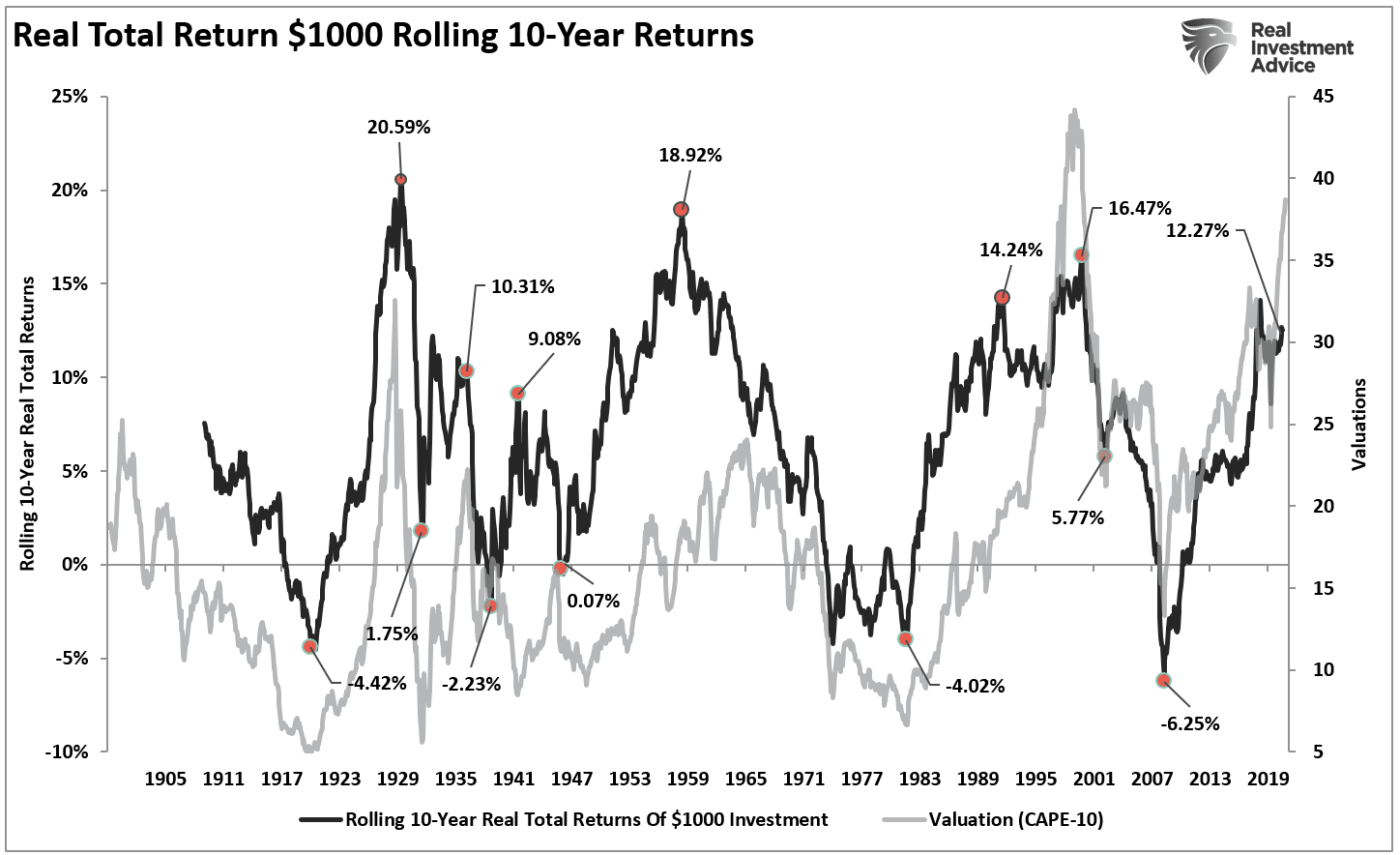
The chart below shows valuations and rolling 10-year total real returns. The obvious conclusion is that overpaying for value leads to lost decades.

https://realinvestmentadvice.com/wp-content/uploads/2021/12/SP-500-Total-Rolling-Returns-10-Years-121821.png

However, let’s go back to Ben’s comment above. In 2009, valuations had corrected significantly, not only from the “Financial Crisis” peak but also from the preceding “Dot.com” bubble. Therefore, investors should have expected forward returns on equities to be higher over the next decade....

HT: ZH

That second chart in its various manifestations is one of the most illuminating in all of finance. 

As the old pros used to say, "Well bought is half sold."

"Ghostly 'mirror world' might be cause of cosmic controversy"

Okay, we're getting into a weird place here.

From PhysOrg, May 19:

New research suggests an unseen "mirror world" of particles that interacts with our world only via gravity that might be the key to solving a major puzzle in cosmology today—the Hubble constant problem. 

The Hubble constant is the rate of expansion of the universe today. Predictions for this rate—from cosmology's standard model—are significantly slower than the rate found by our most precise local measurements. This discrepancy is one that many cosmologists have been trying to solve by changing our current cosmological model. The challenge is to do so without ruining the agreement between standard model predictions and many other cosmological phenomena, such as the cosmic microwave background. Determining whether such a cosmological scenario exists is the question that researchers, including Francis-Yan Cyr-Racine, assistant professor in the Department of Physics and Astronomy at The University of New Mexico, Fei Ge and Lloyd Knox at the University of California, Davis have been trying to answer....

....MUCH MORE

Or, as SciTech put it: 

Our Reality May Only Be Half of a Pair of Interacting Worlds

We won't even get into the cosmological constant problem (okay, just a little: theory may be off by 120 orders of magnitude) 

In other news, Beyond Meat (BYND) jumped 15.5% on news Kim Kardashian was appointed the company's Chief Taste Consultant.
To think it all started with a porno tape.

French Oil Major, Total, Puts Another $2.4 Billion Into Wind and Solar

The protesters outside the annual general meeting were apparently unaware of this when they came close to rioting or decided the new, new thing, Ukraine, justified the myopic view that writing-off the Russian portfolio investments (not operations) was the virtuous thing to do.

From the AP via ABC News:

....Protesters representing Greenpeace, Friends of the Earth and other environmental organizations denounced TotalEnergies for its huge presence in Russia as well as an oil pipeline project in Uganda and Tanzania that the protesters denounced as a “climate bomb.”

In a statement, TotalEnergies did not comment on the protest disruption or on Russia, but highlighted its progress on sustainability. It said it was on track to going carbon neutral by 2030.

TotalEnergies published in March its “principles of conduct” in Russia, which said the company would “gradually suspend its activities" there and strictly comply with European Union sanctions “no matter what the consequences on the management of its assets in Russia.”....

....MUCH MORE

And from Reuters via MSN, the headline story May 25:

TotalEnergies agrees to buy 50% of U.S. renewables company Clearway

TotalEnergies said on Wednesday it has agreed to buy 50% of Clearway Energy Group, the fifth-largest renewables company in the United States, marking the French group's largest U.S renewables energy acquisition.

TotalEnergies has been branching out into the fast-growing renewables energy sector and diversifying away from hydrocarbon-centred activities in recent years.

The company said the acquisition would see it team up with Global Infrastructure Partners (GIP). As part of the deal, GIP will receive $1.6 billion in cash and an interest of 50% minus one share in the TotalEnergies subsidiary that holds its 50.6% ownership in SunPower Corporation.....

....MUCH MORE

Artemis 2022 Hurricane Season Forecasts & Predictions

A snippet from the current Artemis 2022 Hurricane Season page, May 26:

.....2022 Hurricane Season Forecasts & Predictions

These 2022 hurricane season forecasts provide a range of views and forecasts for the 2022 hurricane season from leading meteorologists. The 2022 hurricane forecast table will be updated throughout the year as updates are published and storms occur. Where a forecast team has specified a range we have displayed the mid-point of that 2022 hurricane forecast. If you would like to add your forecast information please contact us.

Forecaster Named storms Hurricanes Major hurricanes ACE
NOAA 14 – 21 6 – 10 3 – 6
Colorado State University 19 9 4 160
Tropical Storm Risk 18 8 4 138
Accuweather 16 – 20 6 – 8 3 – 5
Weatherbell 18 – 22 6 – 10 2 – 4 160
UK Met Office 18 9 4 176
The Weather Company
NC State University 17 – 21 7 – 9 3 – 5 129
Artemis Average forecast
19 8 4 153
2022 Hurricane Season Actuals
1950 – 2021 long-term average
12 6 3 105
1981 – 2010 median
12 6 3 106
1991 – 2020 NOAA average
14 7 3 122
2012 – 2021 recent average
17 7 3 125


....MUCH MORE

Scheduling Alert: Cooper's Hill 2022

 From SoGlos:

Gloucestershire’s Cooper’s Hill has played host to the traditional Cheese Rolling event since the 1800s, with thousands of spectators and daring competitors descending on Cooper’s Hill, determined to keep this world-famous tradition alive.

While the Cheese Rolling usually takes place on the late May bank holiday Monday each year, due to the Queen’s Platinum Jubilee, this year’s event is due to take place on Sunday 5 June 2022 instead – according to the Cooper’s Hill Cheese Roll Facebook page....

....MUCH MORE

After two years of "Gloucestershire Cheese Rolling 2021 has been cancelled" and "Gloucestershire Cheese Rolling cancelled for 2020 amid ..." the pent-up anticipation is almost unbearable: The beauty, the grace, the effortless athleticism:


However, should you absentmindedly show up on Monday all is not lost. 

Cooper's Hill is #6 on the SoGlos list "20 of the most romantic places to propose in Gloucestershire" while nearby Cranham Woods is one of the "14 of the best places to walk your dog in Gloucestershire.

Ordnance Survey map

(No Context Brits home

Wednesday, May 25, 2022

"Copper market needs more than China’s covid stimulus measures"

 From Bloomberg via Mining.com, May 25:

Copper prices in China have barely budged since the central bank cut interest rates and the government announced 33 measures to rescue the economy from the clutches of its Covid Zero policy.

Given the wide range of copper’s applications, from construction to white goods and renewable power, it might seem odd that such a broad response from the authorities has failed to provoke much enthusiasm among buyers. However, it may be that the bulk of the stimulus, particularly around freeing up lending, has actually been skewed to bandaging Beijing’s self-inflicted wounds in the real estate sector.

And Chinese demand for property is in the deep freeze. While lockdowns or the threat of them persists, buying a new home is probably the last thing on people’s minds....

....MUCH MORE

Similar thoughts a couple weeks ago with this intro:

Copper: It Is All About China's Economy
If China ever begins tearing down the tens of millions of apartments that are sitting empty the amount of supply from copper that will be recycled is mind boggling. Barring that, the huge cutback in residential construction has taken one of the largest demand factors out of the equation and except for the run-up in price we saw immediately after Russia invaded Ukraine, when it appeared China was converting their foreign exchange holdings into just about any kind of tangible stuff that would be storable, grains, metals etc., the trend since the Shanghai lockdowns became widely publicized has been pretty much unidirectional....

4.2190 down 0.0360 (-0.85%) last.

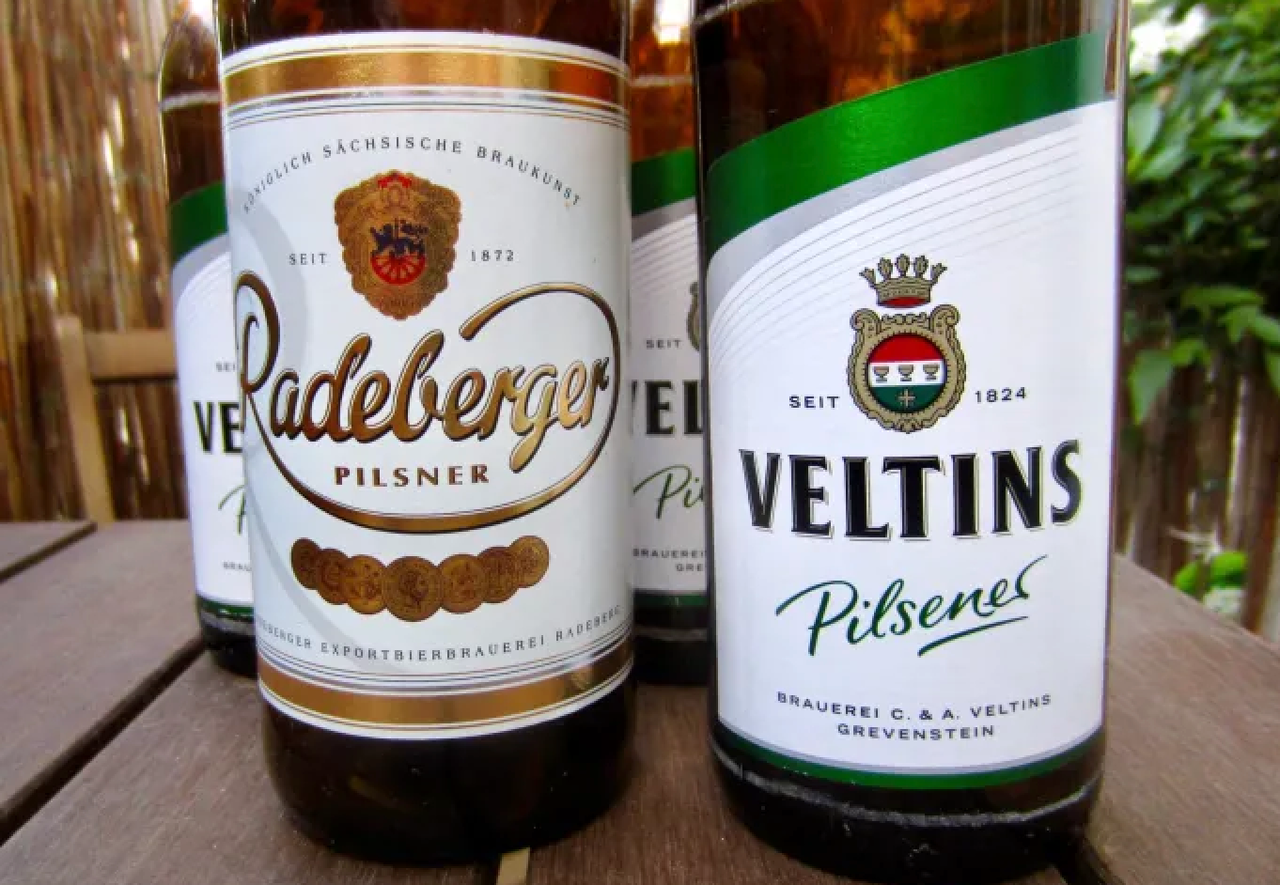
"Extremely Tense" Beer Bottle Shortage Emerges Ahead Of Germany's Oktoberfest

This is not good news, but the connection to Oktoberfest is a bit strained.*

From ZeroHedge:

The world's largest beer festival, "Oktoberfest," situated in Munich, Germany, is four months away, and the country's energy crisis has sparked a beer bottle shortage. 

Germany is Europe's largest manufacturing hub and faces exorbitantly high energy costs, rapid inflation, and a breakdown in supply chains, pressuring energy-intensive glass manufacturers. This economic backdrop alone could unleash stagflation

Holger Eichele of the German Brewers' Federation told the German newspaper Bild the beer bottle shortage would impact small- and medium-sized breweries the hardest. He described the situation as "extremely tense" as the rising cost of production and logistics problems plague breweries. 

"If you don't have long-term contracts, you currently have to pay 80% more for new glass bottles than you did a year ago. Some breweries are threatened with idling, they may soon be without bottles," Eichele warned. 

Bild found the shortage of glass bottles is due to the soaring cost of fossil fuels, such as natural gas and diesel....

*I thought most of the beer hall and biergarten brew was on draught.
There was a similar scare in 2012: 
(It's a recipe for disaster)
From NBC's Bottom Line blog:
Beer brewers in Munich may not be able to supply enough beer for the annual Oktoberfest beer festival, local newspaper Munich TZ reported, but the problem is not a lack of the alcoholic beverage.

Instead, Heiner Müller, manager at the Paulaner and Hacker-Pschorr brewery told TZ, brewers do not have enough bottles to supply the festival. He called on drinkers to return their empties.

"Dear Munichers — bring back your crates. We need our empties,” Müller said....MORE
At Munich's Burgerbrau Keller in 1923 Herman Goering was at least able to say to the assembled putschers:
"Shut up. You've got your beer, haven't you?"
And related:
"Is the End of the German Beer Industry Near?"
Nein.
From Knowledge@Wharton....

The Era of Borderless Data Is Ending

Good.

Every time data is shared it increases the risk of nefarious actors gaining access.

In fact, people, companies and governments that have information about individuals should be ring-fenced and isolated. With the servers air-gapped* so there is no direct connection to the internet. If they can't do that they aren't competent to have the data in the first place.

Too clumsy? Too onerous? Then stop the data collection.

From the New York Times, May 23:

Nations are accelerating efforts to control data produced within their perimeters, disrupting the flow of what has become a kind of digital currency.

Every time we send an email, tap an Instagram ad or swipe our credit cards, we create a piece of digital data. The information pings around the world at the speed of a click, becoming a kind of borderless currency that underpins the digital economy. Largely unregulated, the flow of bits and bytes helped fuel the rise of transnational megacompanies like Google and Amazon and reshaped global communications, commerce, entertainment and media.

Now the era of open borders for data is ending.

France, Austria, South Africa and more than 50 other countries are accelerating efforts to control the digital information produced by their citizens, government agencies and corporations. Driven by security and privacy concerns, as well as economic interests and authoritarian and nationalistic urges, governments are increasingly setting rules and standards about how data can and cannot move around the globe. The goal is to gain “digital sovereignty.” Consider that:
In Washington, the Biden administration is circulating an early draft of an executive order meant to stop rivals like China from accessing American data.

In the European Union, judges and policymakers are pushing efforts to guard information generated within the 27-nation bloc, including tougher online privacy requirements and rules for artificial intelligence.

In India, lawmakers are moving to pass a law that would limit what data can leave the nation of almost 1.4 billion people.

The number of laws, regulations and government policies that require digital information to be stored in a specific country more than doubled to 144 from 2017 to 2021, according to the Information Technology and Innovation Foundation.

While countries like China have long cordoned off their digital ecosystems, the imposition of more national rules on information flows represents a fundamental shift in the democratic world and alters how the internet has operated since it became widely commercialized in the 1990s. 

The repercussions for business operations, privacy and how law enforcement and intelligence agencies investigate crimes and run surveillance programs are far-reaching. Microsoft, Amazon and Google are offering new services to let companies store records and information within a certain territory. And the movement of data has become part of geopolitical negotiations, including a new pact for sharing information across the Atlantic that was agreed to in principle in March.

“The amount of data has become so big over the last decade that it has created pressure to bring it under sovereign control,” said Federico Fabbrini, a professor of European law at Dublin City University who edited a book on the topic and argues that data is inherently harder to regulate than physical goods.

For most people, the new restrictions are unlikely to shut down popular websites. But users might lose access to some services or features depending on where they live. Meta, Facebook’s parent company, recently said it would temporarily stop offering augmented reality filters in Texas and Illinois to avoid being sued under laws governing the use of biometric data.

The debate over restricting data echoes broader fractures in the global economy. Countries are rethinking their reliance on foreign assembly lines after supply chains sputtered in the pandemic, delaying deliveries of everything from refrigerators to F-150s. Worried that Asian computer chip producers might be vulnerable to Beijing’s influence, American and European lawmakers are pushing to build more domestic factories for the semiconductors that power thousands of products.

Shifting attitudes toward digital information are “connected to a wider trend toward economic nationalism,” said Eduardo Ustaran, a partner at Hogan Lovells, a law firm that helps companies comply with new data rules.

The core idea of “digital sovereignty” is that the digital exhaust created by a person, business or government should be stored inside the country where it originated, or at least handled in accordance with privacy and other standards set by a government. In cases where information is more sensitive, some authorities want it to be controlled by a local company, too....

*As noted in the outro from a 2021 post
Just ten years ago the neo-Luddite approach was easier than it is today when even air-gapped servers with zero connections to the web can be monitored.
We mentioned this in the introduction to 2018's "Science Academies Urge Paper Ballots for all US Elections": 
Following on the MIT Technology Review piece immediately below.

Back in the dark ages, 2010 or so, the gold standard of network security was physically isolating a computer from any other and from intranets and internets, so called air-gapping.
Sweet innocent days gone by.
Over the last five or ten years that ultimate security approach, a literal air-gap surrounding the target computer, has been beaten with at least a half-dozen different approaches.
So the advice in the piece below is already behind the times if the polling place is relaying voting numbers over the internet but at least it is a start.

Seriously, we used to say the only secure computer was one not connected to the internet, ha!

Lifted in toto from the journal Nature, September 6....
But taking the grid offline can and probably should be done.  

"Russia and Iran agreed to connect Shetab and Mir payment systems"

This version of the story is via the Russia-Islamic World Group of Strategic Vision.
I use them because, despite being new to me they appear to be legit and I wanted them searchable on the blog.
See the members list. I was most interested in the second group of 35, the non-Russian members.

May 25:

Russia and Iran have agreed to move to the highest possible level of mutual settlements in national currencies. The countries are discussing the connection of the Mir and Shetab  (Iran's payment system) payment systems, as well as the work of national systems for transmitting financial messages, the co-chairman of the intergovernmental commission of Russia and Iran, Russian Deputy Prime Minister Alexander Novak said.

"One of the key topics (of the talks) was to create conditions for mutual settlements and the passage of payments between our legal entities, organizations. It is important that we have agreed to switch as much as possible to settlements in national currencies. Together with the central banks we have discussed the distribution and operation of financial messaging system, as well as the connection of payment cards Mir and Shetab,"  he said after the meeting of co-chairmen of the Intergovernmental Commission.

Currently, the Mir card does not work in Iran. It was reported that Iran and Russia are discussing the issue of connecting their banks to the Financial Message Transfer System (FTS), the Russian equivalent of the SWIFT system of international settlements....

....MORE

Also at TASS via the sustainable development peeps at World News Monitor who get the HT that the story was out.

I am starting to think the Western Grand Strategy poobahs really, really screwed up.
Or things are proceeding exactly according to plan. Who the hell knows?

Following-Up On Zoltan Pozsar's Thinking We See: "Is America the Real Victim of Anti-Russia Sanctions?"

Mr. Pozsar's April 14 piece on Russia as a "'Global Systemically Important Bank' Of Commodities", linked in the post immediately below, is mirrored in this article from Tablet Magazine yesterday, May 24:

By misjudging the size and importance of Russia’s economy, the West might have taken steps toward its own isolation

Remember the claims that Russia’s economy was more or less irrelevant, merely the equivalent of a small, not very impressive European country? “Putin, who has an economy the size of Italy,” Sen. Lindsey Graham, R-S.C., said in 2014 after the invasion of Crimea, “[is] playing a poker game with a pair of twos and winning.” Of increasing Russian diplomatic and geopolitical influence in Europe, the Middle East, and East Asia, The Economist asked in 2019, “How did a country with an economy the size of Spain … achieve all this?”

Seldom has the West so grossly misjudged an economy’s global significance. French economist Jacques Sapir, a renowned specialist of the Russian economy who teaches at the Moscow and Paris schools of economics, explained recently that the war in Ukraine has “made us realize that the Russian economy is considerably more important than what we thought.” For Sapir, one big reason for this miscalculation is exchange rates. If you compare Russia’s gross domestic product (GDP) by simply converting it from rubles into U.S. dollars, you indeed get an economy the size of Spain’s. But such a comparison makes no sense without adjusting for purchasing power parity (PPP), which accounts for productivity and standards of living, and thus per capita welfare and resource use. 

Indeed, PPP is the measure favored by most international institutions, from the IMF to the OECD. And when you measure Russia’s GDP based on PPP, it’s clear that Russia’s economy is actually more like the size of Germany’s, about $4.4 trillion for Russia versus $4.6 trillion for Germany. From the size of a small and somewhat ailing European economy to the biggest economy in Europe and one of the largest in the world—not a negligible difference.

Sapir also encourages us to ask, “What is the share of the service sector versus the share of the commodities and industrial sector?” To him, the service sector today is grossly overvalued compared with the industrial sector and commodities like oil, gas, copper, and agricultural products. If we reduce the proportional importance of services in the global economy, Sapir says that “Russia’s economy is vastly larger than that of Germany and represents probably 5% or 6% of the world economy,” more like Japan than Spain.....

....MUCH MORE

Today's mini-series:

Maybe We Should Just Declare War On Russia And Take Their Stuff: Zoltan Pozsar on Russia As A "Global Systemically Important Bank" Of Commodities

None of the electorate in the NATO countries voted for another of these inconclusive, forever wars, so profitable for a select few and so costly in life and treasure for regular people. Surely no one in the developing nations signed on to pay for sanctions with their food budget. It is time to figure out a) What our goals are and b) What the hell we are doing, period and in furtherance of those goals. This isn't some game of RISK with let's try this, or let's try that and no consequences at the end of the night. Since the Maidan coup in 2014 the West has had eight years to plan for this.

Do it or don't do it; because trying to finesse a halfway reaction is nuts.

As the philosopher asked the generals and armaments producers some time ago: 
"When was the last time you b****es won a war?" 
From Zoltan Pozsar at Credit Suisse, April 14, 2022:

The “G-SIB” of Commodities 

Regular readers of our dispatches are familiar with our framing of J.P. Morgan as the “Bakken Shale” of global dollar funding markets, and as the system’s Lender of Next-to-Last Resort: J.P. Morgan cannot print reserves like the Fed, but it has the most amount of reserves at the Fed relative to other banks, and the bank that has the most reserves backstops the liquidity of the system during non-systemic episodes of liquidity shocks. In the world of commodities, the equivalent of J.P. Morgan is the Russian Federation. Not only did Russia own as much in FX reserves as J.P. Morgan owns in reserves at the Fed, but Russia’s exports of commodities (like J.P. Morgan’s “exports” of reserves) exceed the exports of every country in the world, including the United States.

What J.P. Morgan is to dollar funding, Russia is to the world of commodities – both are G-SIBs in a way, with similar phraseologies (“fortress balance sheet”; “Fortress Russia”). In today’s dispatch, we map Russia’s commodity fooprint...

...which, as the size of the country’s geographic reach would imply, is very big, or, rather, systemic. The first chart shows that the Russian Federation is the single largest exporter of commodities, and the U.S. is a very close second. Saudi Arabia comes third, but they export much less than the U.S. or Russia.

Russia’s dominant position spans many commodities. Similar to how J.P Morgan is a dominant player as a marginal lender (the marginal lender) in the repo, FX swap, and equity funding markets, as well as in Treasury underwriting and trading, Russia is a dominant exporter of energy, grains, metals, and other commodities.

The next set of charts (all in the form of Sankey diagrams) shows Russia’s commodity exports across a range of commodities, starting with energy exports.

In terms of crude oil, Russia is the single largest exporter outside of OPEC, and most of the oil Russia exports goes to Europe. The second biggest market for Russian crude is China, and the re-routing of Russian oil from Europe to China will lead to severe shipping bottlenecks as we discussed in detail here.

In terms of refined oil products (for example, diesel fuel), Russia is the third largest exporter in the world, and sends most of its refined exports to Europe.

In terms of natural gas (gas through pipelines), Russia is the biggest exporter in the world serving primarily Europe: Germany, the Baltics, and Eastern Europe. In terms of LNG (liquefied gas, seaborne) Russia is not a significant player, but the point about LNG is that it’s much smaller than the piped gas market, and (potential) disruptions to the flow of piped gas is impossible to replace with LNG. Not only in a “spot” sense but also over the medium term. That’s an issue.

In terms of coal, Russia is the world’s third biggest exporter after Australia and Indonesia, and much like with oil and gas, its biggest market for coal is Europe.

Now onto foodstuffs.
Russia is the single largest exporter of wheat, and Russia and Ukraine combined are an even more systemic source of wheat exports to the world. Combined, Russia and Ukraine export as much wheat as the U.S. and Canada combined. Unlike energy, most of the wheat exports of Russia and Ukraine go to emerging economies – Egypt and Turkey and other countries in Africa and Asia.

In other words, while in Europe industry is reliant on Russian energy to function, in EM, people are reliant on Russian grains to sustain themselves. Either way, much like you need funding to survive, and J.P. Morgan ensures your survival in that sense, you need energy to sustain industry and food to sustain yourself, and in those departments, Russian exports to Europe and EM countries ensure survival. That’s how you define systemic. Russia is a “commodity G-SIB”.

In terms of fertilizers, Russia is systemic again – it is the single largest exporter of fertilizers, and much like reserves in finance, nothing gets done without fertilizers in an age of industrialized agriculture when land is never given a chance to rest: unless you stuff earth with potash, you can’t grow stuff, and everything from peppers to tomatoes, potatoes, strawberries, and watermelons needs lots of potash. No reserves, no harvesting of basis points. No potash, no harvesting of fruits or veggies. No good harvest, higher headline inflation, not to mention the extra costs to growing vegetables that come from higher energy costs (to heat a greenhouse) and from the higher cost of plastic wraps used to build greenhouses and to cover the soil to keep the produce “tucked in”.

Now onto metals..
.

....MUCH MORE

If you've forgotten what was decided regarding G-SIB's after the Great Financial Crisis, the Canadian Office of the Superintendent of Financial Institutions has a handy infographic

And as far as the "a)" question above, on conceptualizing and communicating goals, this guy seemed to understand the need for clarity in matters of great importance:

"You ask, what is our aim? I can answer in one word: victory; victory at all costs, 
victory in spite of all terror, victory, however long and hard the road may be..."
 
No ambiguity, no finesse, just straight talk.

Natural Gas Market Is Hurtling Toward Historic Winter Shortages

It's not just the current prices,* it's the fact there will not be enough natural gas to store for the northern hemisphere heating season - except maybe for Britain whose shrunken storage capacity is filled to the brim. And Norway. And Russia who will probably establish a chain of sauna's up and down that long border, just to tempt, tease and torment the Finns.

From Yahoo Australia, who also have a lot of gas, Bloomberg, May 23:

The liquefied natural gas market is hurtling toward a potentially historic shortage this winter as the world rushes to secure the super-chilled fuel.

Europe’s plan to cut imports of piped Russian gas by two-thirds by the end of the year and replace it with LNG from the US and Africa is sharply intensifying competition for the power-plant and heating fuel. There’s also an expectation that China’s battle with Covid-19 will be winding down later in 2022, which should stoke industrial demand from Asia’s biggest economy.

In a normal year, LNG importers stock up on supplies for the peak winter season over the summer. That appears to have started earlier this year, with South Korean and Japanese utilities already snatching up shipments for delivery through early 2023. The looming supply crunch risks pushing up electricity bills and inflation and could see poorer nations miss out entirely.

“This coming winter has everyone on edge,” said James Whistler, the global head of energy derivatives at Simpson Spence Young. “All things point to tight supply under normal conditions, but additional risks are also present.”

How to cope with the widening gap between supply and demand will be the hot topic at the World Gas Conference in South Korea this week. It’s the first major gathering of the industry in Asia since Russia’s invasion of Ukraine upended the LNG trade and sent prices surging.

Global demand will hit 436 million tons in 2022, outpacing 410 million tons of available supply, Rystad Energy said in a note this month. Although soaring consumption has spurred the greatest rush of new projects worldwide in more than a decade, most new supply will only come online after 2024, it said....

....MUCH MORE

*All Is Proceeding According To Plan: U.S. Natural Gas Futures Break Through $9.00

Fortunately, should sweaters become a necessity we have historical precedent on the various means to profit along various links in the supply chain:

You may also want to dip into the big daddy of price series:
"A History Of Agriculture And Prices In England, From The Year After The Oxford Parliament (1259) To The Commencement Of The Continental War (1793)"
by J. E. Thorold‐Rogers, 7 volumes, 1866-1887 which probably influenced Jevons.

It appears most of the upstream plays involve sheep.

And being something of a neo-Luddite the midstream with the looms and the other textile machinery doesn't entice.

So perhaps wholesale and retail are beckoning  Marketing and market differentiation.

Is there a demand for yak wool?

https://cdn.sivanaspirit.com/wp-content/uploads/2014/02/04230457/yak.jpg
Tibetan yak all dressed up
Possibly also of interest:
The Strange Business of Subsidized Yak Insurance

I'm not sure if the world is ready for our "Tips on Trading the Insulation Complex".
It resembles what we found in "Stimulus: Tips on Trading the Caulk/Putty/Grout Complex". 

All Is Proceeding According To Plan: U.S. Natural Gas Futures Break Through $9.00

Not my plan.

You knew this was coming though, and here we are.
Most active (July) futures up 0.382 (4.32%) to $9.218, off the day's high of $9.283.
From the CME via TradingView:

TradingView Chart

Recently:

May 5  "$10 Handle in Sight For Natural Gas Futures, ‘Barring Massive Supply Gains’

May 4  "US natural gas prices surge above $8/MMBtu in 'irrational' market"

April 28 "U.S. Natural Gas Exports Are Growing 3x Faster Than Production"

April 24 "Beyond macro: Firm-level effects of cutting off Russian energy"

April 19 "American Consumers Are Paying The Cost Of Europe's Energy Fecklessness"

April 18 "It Appears The U.S. Is About To Have Its Own Natural Gas Crisis"

 
“Under my plan … electricity rates would necessarily skyrocket.”
—Presidential candidate, Senator Barack Obama,
Q&A with the editorial board of the San Francisco Chronicle, January 21, 2008
 
"In politics, nothing happens by accident. 
If it happens, you can bet it was planned that way."
—Franklin D. Roosevelt

ESG Heresy Triggers Shock & Horror... And About Time!

 From Bill Blain's Morning Porridge, May 23:

HSBC is being pilloried for comments made by its’ ESG head, but what he said is worthy of consideration. Overly emotional ESG is a distortion that may be as dangerous as climate change denial.

“Life always finds a way…”

This morning: HSBC is being pilloried for comments made by its’ ESG head, but what he said is worthy of consideration. Overly emotional ESG is a distortion that may be as dangerous as climate change denial.

Perhaps the most remarkable thing about Stuart Kirk, the “global head of responsible investing” at HSBC, is that’s he a bloke with a grey beard… Kirk and his ilk are a critically endangered species in The City these days.. and about to become even more so after his inflammatory comments to an FT conference last week.…

Kirk is was an HSBC executive until being suspended for daring to suggest the whole ESG (Environment, Social and Governance) debate has become a tad over-emotional and vulnerable to distortion and hyperbole. Naturally, the ESG industry has kicked into high gear moral indignation, shocked and horrified at his comments. I will be surprised if he isn’t sued for the emotional hurt, pain, distress and damage he’s inflicted on ESG professionals.

Yet, Kirk is a smart guy – he’s the former editor of the FT’s Lex column and had responsibility at HSCB for ESG and new green product development.

Let me stress: I wasn’t there but I have watched his speech on the FT website. Its actually very interesting, thought-provoking, and well worth a listen no matter how much you might disagree with what you’ve read in the press about it.

It will make you think – and its about time we did more of that when it comes to preparing for the consequences of climate change.

Most of Kirk’s speech was pushing against overly-emotional doom-mongers, like a lady from Deloitte called Sharon. Kirk noted that when she told the audience climate change meant everyone in the room was dead,  most didn’t even look up from their mobile phones. He also criticised some chap called Mark, a former central banker who is making a fairly good living jetting round the world to spread climate hyperbole. Kirk got a decent clap at the end of his 15 minute pre-coffee conference slot.

For some reason I can’t quite fathom, I tend not to get invited to ESG and sustainability conferences.  It doesn’t seem to matter how many times I say I absolutely agree with the science of global warming, or environmental damage must be addressed, but apparently the BBC has me down as a climate change denier because I suggested wind-farms ain’t all they are presented to be when it comes to reliability and power to the grid.

The quotes that have appeared on Kirk’s slot have been selective and contextualised. The media has been delighted by the shocked hysterical comments from the ESG high church of woke. Having watched Kirk on the Video, I doubt he will do the usual banker-caught-with-finger-in-till thing by stepping up later today, making a cringe-worthy apology for his comments.. and resigning in shame. He will, of course, be sacked… for putting his employer at risk by daring to question the hyperbole around ESG.

Naturally, HSBC’s leadership cadre has reacted with horror and shock – even though the speech was approved 2 months ago and has been sitting (unread?) on the company website..

Although Kirks comments have proved remarkably ill-judged in terms of his career longevity.. they are worth thinking about…  The most hyped quote is “who cares if Miami is six meters underwater in 100 years time”, before he explained Amsterdam copes rather well with being below sea-level. He argued that solutions will be found because mankind adapts.  He then talked about “nut-jobs telling me about the end of the world.”

And that’s a critical thing. Mankind is inventive and we adapt. We cope. Coping with change is why we thrive....

....MUCH MORE

HT: ZH