Our off-the-cuff-answer is on the start of the second decline from an all time high, something along these lines from StockCharts back in 2011:
Revisiting the 2007 S&P 500 Reversal
Although no two market tops are the same, we can get an idea of what a
major reversal looks like by examining past reversals. The 2007 top
evolved over a 9 month period. There were clear support breaks at 1425
and 1375. RSI broke its bull zone (40 to 80) at the end of December
2007. The ensuing throwback rally retraced 50% and met resistance near
broken support.
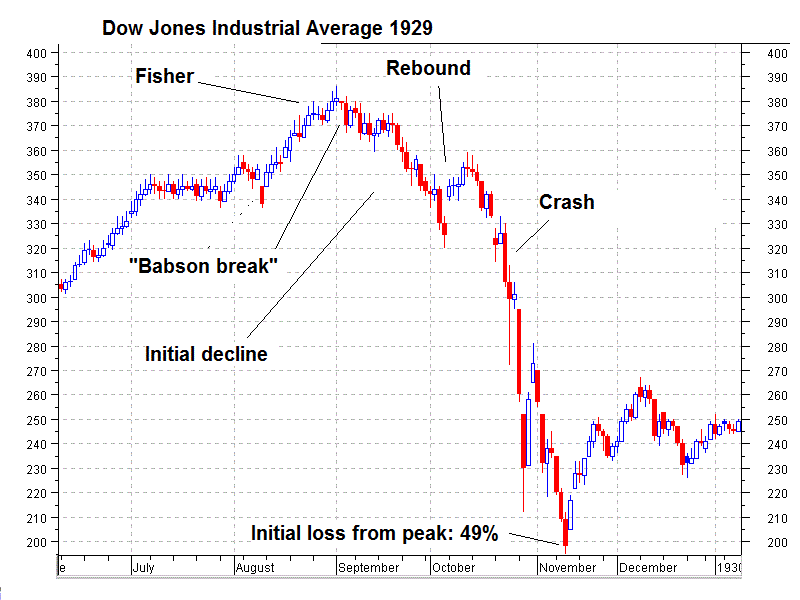
Here's another example via SNBCHF, the Dow Jones Industrial in 1929:
Do note this chart only takes you to the first week of 1930. The DJIA didn't bottom until July 8, 1932.
At 41.22 (close, 40.56 intraday)
The failure to re-take the highs after the first decline (the right shoulder of an H&S patter) is your clue to be wary.
Keep in mind that in broad based indices you have all kinds of churning around going on, some stocks head down while the index is still rising etc.
Possibly more interesting is this account of ubbly-bubbly parabolic goodness, from
Feb. 2012:
Prop Trading the South Sea Bubble: Hoare's Bank 1720
I've mentioned the archives at Hoare's bank a few times, firstly, I believe, in "
South Sea Bubble Survivor Says Dismantle RBS Along With Lloyds":
*From deep in the link-vault comes a tiny treasure, an analysis of Hoare's trading during the South Sea bubble (15 page PDF):
Riding the South Sea Bubble
By PETER TEMIN AND HANS-JOACHIM VOTH
This
paper presents a case study of a well-informed investor in the South
Sea bubble. We argue that Hoare’s Bank, a fledgling West End London
bank, knew that a bubble was in progress and nonetheless invested in the
stock: it was profitable to “ride the bubble.” Using a unique dataset
on daily trades, we show that this sophisticated investor was not
constrained by such institutional factors as restrictions on short sales
or agency problems....MORE
The bank has opened their records to academics and Temin and Voth have taken full advantage.
Along with the above they published "
Banking as an emerging technology: Hoare’s Bank, 1702–1742" in Financial History Review and "
Private borrowing during the financialrevolution: Hoare’s Bank and its customers, 1702–24" in Economic History Review.
It's
Riding the South Sea Bubble that really stands out though and is the 'tiny treasure'.
Yesterday, as I was putting "
The World's First Stock Exchange (and first bear raid, first dividend, first equity derivatives...)" together I wanted to refer to RtSSB and did a quick search of the blog.
The link was broken.
The entire original purpose of this blog was to give me a database of
things that caught my interest during the trading day. Hosted on
Google's servers. Searchable by the Goog's algos (or anyone else).
And the damn link was broken. So I had to replace it.
And I re-read the whole 15 page paper, starting with:
What allows asset price bubbles to inflate? The recent rise and fall of
technology stocks have led many to argue that wide swings in asset
prices are largely driven by herd behavior among investors. Robert J.
Shiller (2000) emphasized that “irrational exuberance” raised stock
prices above their fundamental values in the 1990s. Others, however,
have pointed to structural features of the stock market, such as lock-up
provisions for IPOs, analysts’ advice, strategic interactions between
investors, and the uncertainties surrounding Internet technology, as
causes of the recent bubble. We use a historical example to ask which of
these explanations is most apt, with the potential to shed light on
other important episodes of market overvaluation.
We examine one of the most famous and dramatic episodes in the history
of speculation, the South Sea bubble. Data on the daily trading behavior
of a goldsmith bank—Hoare’s—allow us to examine competing explanations
for how bubbles can inflate.
While many investors, including Isaac Newton, lost substantially in
1720, Hoare’s made a profit of over £28,000, a great deal of money at a
time when £200 was a comfortable annual income for a middle-class family
(John Carswell, 1993). The behavior of a single knowledgeable investor
can tell us much about the nature of bubbles and investors during
periods of substantial mispricing. The bank did not profit simply by
chance. It “rode the bubble” for an extended period while giving
numerous indications that it believed the stock to be overvalued.
Short-selling constraints and the difficulties of arbitrage that have
been emphasized in recent work on the dot-com mania cannot explain the
South Sea bubble. A zero-investment constraint, if it existed, did not
bind market participants like Hoare’s. Perverse incentive effects
arising from delegated investment management highlighted in recent work
on mutual funds and hedge funds were not at work. We infer that the need
for coordination in attacking the South Sea bubble was the key to
allowing it to inflate to such an extreme extent, in line with recent
theoretical work by Dilip Abreu and Markus Brunnermeier (2003).
There is a rich body of earlier research on the emergence of bubbles.
The efficient markets hypothesis rules out substantial mispricing
(Eugene F. Fama, 1965). The same conclusion emerges from no-trade
theorems under asymmetric information, as well as from backward
induction in finite horizon models (Manuel Santos and Michael Woodford,
1997; Jean Tirole, 1982). Famous historical episodes like the South Sea
bubble, the tulip mania, and the Mississippi speculation are given as
examples of markets functioning reasonably well under uncertainty (Peter
M. Garber, 2000). Recent theoretical and empirical work, however,
suggests that bubbles can inflate even if there are large numbers of
highly capitalized, rational investors....
And I thought "sweet".
The two most important parts of the paper "II. Hoare’s Trading
Performance" and "III. Causes of Success" are definitely worth a couple
minutes. Here's
the link. (also replaced in the original post).
*****
Now
that link is dead, the mortality rate for links is probably itself graphable as a parabola.
Here's
the copy hosted at MIT, cross your fingers that the famous trade school on the Charles can stay open for a while longer.