Friday, June 27, 2014

Chartology: A Potentially Wicked Drop In Interest Rates

I give Mr. Kimble crap (of which he is probably blissfully unaware) because he imputes some forecasting skill to long-term (multi-decadal) charts.
And then he comes up with something like this, which answers the unasked question: "So why do you keep linking to KCS?"

One of the things nagging at the reptile brain the last couple weeks has been the query: "What has put a bid under gold?".
A drop in 10-year interest rates to 2% (real rate negative), itself caused by a rally in bonds, would be one possible explanation.
2.5340% last, up 0.0090%

From Kimble Charting Solutions:
10-year yield could fall 20% if this breaks, says Joe Friday!

http://blog.kimblechartingsolutions.com/wp-content/uploads/2014/06/joefriday10yryldonnecklinesupportjune27.jpg
The yield on the 10-year note and 30-year bell weather bond look to be creating head & shoulders tops. The 30-year yield (right chart) looks to have broken its neckline and continues to decline inside of a falling channel since the start of 2014.

The yield on the 10-year note now looks to be testing its neckline of the bearish pattern right now, as it too remains inside of a falling channel since the start of the year.

TLT is up over 10% this year, if support breaks it could push TLT a good deal higher in short order, if the head & shoulders top is a correct read....MORE
The pattern on the right bears some resemblance to the 28 step Three Peaks and a Domed House pattern:

 
But personally I'm getting more of a Palais des Beaux-Arts de Lille vibe.

File:Lille palais des beaux arts.jpg

Or maybe a Mansard, Second Empire perhaps:
Chart forCBOE Interest Rate 10 Year T No (^TNX)

Natural Gas: EIA Weekly Supply/Demand Report

For the first time in quite a few weeks we did not post anything on the Thursday storage report as reality intruded on the blogging. We apologize.

Although we continure to prefer the equities to the futures, the latter are getting cheap enough to be worthy of attention again.
The equities, proxied by the First Trust ISE-Revere Natural Gas Index (FCG), are down about 3 1/2% since hitting the 3-year high on June 23rd.

$4.385 down 5.6 cents last, here's the action since yesterday's storage report, via FinViz:
From the Energy Information Administration:
Natural Gas Weekly Update 
In the News:
Natural gas production grows in three major tight oil production areas Despite a decline of 11% in the gas-directed rig count over the past year, natural gas production has grown 5%, due in part to growing gas production in tight oil production areas. Over the past year, the number of gas-directed rigs fell by 38, while the number of oil-directed rigs rose by 140, according to data released by Baker Hughes last Friday....MORE
Supply and demand both increase this week. Dry natural gas production increased by 0.3 Bcf/d, or 0.5%, from the previous week, to 68.3 Bcf/d. Dry production hit a record high on Saturday of 68.5 Bcf, according to data from Bentek Energy. Imports from Canada increased 3.2% from last week, with a large decrease in the Northeast only partially offsetting increases in the West and Midwest. U.S. consumption rose 1.8%, driven by increases in the industrial and power sector.
Storage Storage increases by triple digits for seventh straight week. The net injection reported for the week ending June 20 was 110 Bcf, 29 Bcf larger than the 5-year average net injection of 81 Bcf and 16 Bcf larger than last year's net injection of 94 Bcf. Working gas inventories totaled 1,829 Bcf, 690 Bcf (27.4%) less than last year at this time, and 822 Bcf (31.0%) below the 5-year (2009-13) average.
Storage build is larger than market expectations. Market expectations called for a build of 104 Bcf. When the EIA storage report was released at 10:30 a.m., the price for the July natural gas futures contract fell 7 cents to $4.48/MMBtu on the Nymex....MUCH MORE
U.S. Natural Gas Supply - Gas Week: (6/18/14 - 6/25/14)

Percent change for week compared with:
last year
last week
Gross Production
5.79%
0.51%
Dry Production
5.73%
0.51%
Canadian Imports
-8.57%
3.23%
      West (Net)
-18.94%
2.83%
      MidWest (Net)
2.13%
8.91%
      Northeast (Net)
-2.71%
-34.63%
LNG Imports
-69.25%
6.29%
Total Supply
4.31%
0.69%

Deviation between average and normal (°F)
7-Day Mean ending Jun 19, 2014
Mean Temperature Anomaly (F) 7-Day Mean ending Jun 19, 2014

Knight Frank: "UK Farmland prices hit record high, but growth to slow"

From Agrimoney:
UK farmland prices set fresh record highs, helped by strong demand from investors, although the rate of appreciation has eased, and is likely to remain at a slower rate, Knight Frank said. 

Land prices in England, which accounts for the majority of UK farmland, rose by 2.6% in the April-to-June period from the quarter before to an all-time high of $7,517 per acre ($18,574 per hectare), the property consultancy said.

In Scotland, prices rose 1.6% quarter on quarter to £4,329 an acre for average land.
However, the increases were markedly slower than those in the January-to-March period, of 6.4% in England and 6.8% in Scotland.

And, while prices will continue to grow, it will be at a slower rate, Knight Frank said, foreseeing values in England adding a further 6% over the next 12 months, a decrease from the 17% growth seen over the past year.
"I think values have plateaued in some areas, while there is room for more growth in others," James Prewett, the group's head of regional farms, said.

In Scotland, price growth will ease to 5% over the next year, compared with 8% over the past 12 months.

'Pensive market'
Knight Frank termed the Scottish market as "pensive", ahead of this autumn's referendum on independence from the UK, which has prompted some potential vendors to hold back on sales....MORE

Thursday, June 26, 2014

"Squandering the family fortune: Why rich families are losing money"

I'm not quite as concerned as Thomas Piketty is about wealthy individuals, in part because of the dissipating effects of procreation and death but I do wonder what it's going to take to rein in non-human creations like endowments, trusts and foundations.
Just something to think about.
From CNN via Click2Houston:
Rags to riches is a familiar narrative, but when it comes to preserving family fortunes, more often it's rags to riches to rags.

Nearly 60% of the time a family's money is exhausted by the children of the person who created the wealth, according to Roy Williams, president of wealth consultancy The Williams Group. In 90% of the cases it's gone by the time the grandchildren die.

"It goes back to the Biblical story of the Prodigal Son," said Williams, referring to the free spending child who blows his father's inheritance yet is welcomed back anyway. "We haven't changed in 2,000 years, and that same unprepared heir issue is now worldwide."

Profligate spending by heirs -- the type chronicled on sites like Rich Kids of Instagram -- is often a reason for a loss of wealth, as is a simple lack of ambition.

"The people who created the wealth were often obsessive," said Russ Prince, president of the wealth research and consulting firm Prince and Associates. "But their kids were not hungry."

Perhaps the most famous example is the Vanderbilt family. Cornelius, the patriarch, built a fortune on railroads and shipping during the mid-1800s. Adjusted for the size of the economy, he was the second richest American ever, worth over $200 billion -- well above Bill Gates.

Yet his children -- and especially, his grandchildren -- lived lavishly, building huge mansions in New York City, Newport, R.I., and elsewhere, and did little to preserve the fortune. By the 1970s, the family held a reunion with 120 members attending, and there wasn't a millionaire among them, wrote Michael Klepper and Robert Gunther in their book The Wealthy 100.

Yet the biggest reason family fortunes are squandered, experts say, is because the people who built the wealth do not pass along clear instructions on how to handle the money after they're gone. That often leads to bitter infighting among surviving family members, and an eventual loss of fortune.
"The intent is good, but there's a communications gap," said Michael Liersch, director of behavioral finance at Merrill Lynch Wealth Management....MORE
A few months ago we looked at Merrill's Private Banking Investment Group in "Anti-Piketty: Merrill Lynch's Tips on Creating a Financial Dynasty".

For more on the math of artificial personhood here's something we've posted a couple times:
Long Time Horizon's: The Methuselah Trust of Hartwick College
The post immediately below, "From Rob Arnott's Research Affiliates: What Assets Should Go Into a Portfolio You Can't Touch for Three Years", reminded me of one of the odder stories in the investment biz.
First posted September 2011.
From Lapham's Quarterly:
fortknox.jpg
Disclaimer: although Lapham's used the bullion picture this is not an asset to hold for more than the next 50-150 years. Gold will be one of the first targets for both asteroid miners and their deep sea counterparts.
Hartwick College didn’t really mean to annihilate the U.S. economy. A small liberal-arts school in the Catskills, Hartwick is the kind of sleepy institution that local worthies were in the habit of founding back in the 1790s; it counts a former ambassador to Belize among its more prominent alumni, and placidly reclines in its berth as the number-174-ranked liberal-arts college in the country. But along with charming buildings and a spring-fed lake, the college once possessed a rather more unusual feature: a slumbering giant of compound interest.

With bank rates currently bottomed out, it’s hard to imagine compound interest raising anyone much of a fortune these days. A hundred-dollar account at 5 percent in simple interest doggedly adds five bucks each year: you have $105 after one year, $110 after two, and so on. With compound interest, that interest itself get rolled into the principal and earns interest atop interest: with annual compounding, after one year you have $105, after two you have $110.25. Granted, the extra quarter isn’t much; mathematically, compound interest is a pretty modest-looking exponential function.
Modest, that is, at first. Because thanks to an eccentric New York lawyer in the 1930s, this college in a corner of the Catskills inherited a thousand-year trust that would not mature until the year 2936: a gift whose accumulated compound interest, the New York Times reported in 1961, “could ultimately shatter the nation’s financial structure.” The mossy stone walls and ivy-covered brickwork of Hartwick College were a ticking time-bomb of compounding interest—a very, very slowly ticking time bomb. 
One suspects they’d have rather gotten a new squash court.
The notion of a “Methuselah” trust has a long history—and as with many peculiar notions, Benjamin Franklin got there first. Upon his death in 1790, Franklin’s will contained a peculiar codicil setting aside £1,000 (about $4,550) each for the cities of Boston and Philadelphia to provide loans for apprentices to start their businesses. The money was to be invested at compound interest for one hundred years, then a portion of the fund was to be used in Boston for a trade school. For Philadelphia, he recommended using the money for “bringing, by pipes, the water of Wissahickon Creek into the town”—or perhaps “making the Schuylkill completely navigable.” The whole scheme was perfectly suited for a man who once half-jokingly proposed that, in preference “to any ordinary death” he be “immersed in a cask of Madeira wine” for later revival, as he had “a very ardent desire to see and observe the state of America a hundred years hence.”
Franklin’s plans soared beyond a mere century, though. After a portion of the funds were to be paid out for a first set of public works, the remainder was then to grow for another century—until, by Franklin’s estimate, in 1990 both cities would receive a £4,061,000 windfall from their most famous native son.
“Considering the accidents to which all human affairs and projects are subject in such a length of time,” Franklin admitted, “I have, perhaps, too much flattered myself with a vain fancy that these dispositions, if carried into execution, will be continued without interruption and have the effects proposed.”

Nonetheless, Franklin’s experiment inspired Peter Thellusson, a London merchant and a director of the Bank of England, to even dizzier heights. Thellusson had an impressive fortune of some £600,000 by his death in July 1797, worth about $68 million today. But at the reading of the old financier’s will, his reckless sons received the shock of their lives. “It is my earnest wish and desire,” he lectured them from beyond the grave, “that they will avoid ostentation, vanity, and pompous shew; as that will be the best fortune they can possess.”

It would also be almost the only fortune they’d possess. Most of the estate was to be invested at compound interest until every currently existing heir was dead, whereupon upward of £19 million would cascade onto their distant descendants. It was as if, one legal scholar marveled, Thellusson had “locked his treasure in a mausoleum and flung the key to some distant descendant yet unborn.”

His heirs did not take the news well: one took out a pistol and shot the old man’s portrait....MORE
HT: Longreads who also had a LED story that I'll get to next week.

Things I Did Not Know, General Motors Edition (GM)

From the WSJ's Corporate Intelligence blog:

GM Email: Ignition Key Problem ‘Around Since Man First Lumbered Out Of the Sea’ 
Rep. Diana DeGette holds an ignition switch as she questions GM’s CEO.
Associated Press
Back in May, we wrote about the 69 words GM warned its staff not to use in safety memos, including: Hindenburg, Kevorkianesque, Titanic, apocalyptic, Cobain and rolling sarcophagus.
If you’re wondering why GM may have been keen to get its staff to tone down the more lively side of their inter-company communications, consider the following email. It was released by the congressional committee investigating the company’s handling of a deadly ignition key defect in the Chevrolet Cobalt and other vehicles, that lingered for more than a decade before leading to a recall this year.

The February, 2009 email, with subject “Cobalt Key Hole Change” refers to an issue being tracked in GM’s Problem Resolution Tracking System (PRTS). It begins as follows:
Gentleman!
This issue has been around since man first lumbered out of the sea and stood on two feet. In fact, I think Darwin wrote the first PRTS on this and included as an attachment as part of his theory of evolution…
....MORE
What's wrong with 'rolling sarcopha.....Oh.

Dear Barclays: The Woman Who Took Down Arthur Andersen Is Heading the Criminal Division of the Department of Justice

What she did with AA was obviously prosecutorial overreach but if she went after Barclays with the same death threats I don't think anyone would lament the loss of what is obviously a criminal gang.
From the New York Observer:
Meet Leslie Caldwell. President Obama has installed Ms. Caldwell, known as a “terror of a prosecutor,” as head of the Criminal Division of the Department of Justice. It has been over a decade since Ms. Caldwell destroyed Arthur Anderson, and with it, 85,000 jobs—only to be reversed by the Supreme Court nine to nothing (well after she went into private practice). Now the president has brought her back—with a big promotion—and the vengeance of DOJ already aimed at Credit Suisse, BNP Paribas and others.
Ms. Caldwell and her then right hand man, Andrew Weissmann, viewed businessmen and bankers as “wise guys on Wall Street,” deserving of brutal prosecutorial tactics. Their prosecutions proceeded on the theory that the “end justifies the means.” Winning was the sole goal. They forgot that the job of a federal prosecutor is to seek justice—not convictions.

Arthur Andersen LLP was Ms. Caldwell’s first target in the wake of the collapse of Enron amid allegations of financial and accounting irregularities and secret-off balance sheet deals and partnerships. Andersen accountants were actually embedded at Enron, and the energy company paid the consulting firm millions in fees every year. Enron changed to mark-to-market accounting, lawful at the time, and was pushing the envelope.

Ms. Caldwell’s task force terrorized Arthur Andersen partner David Duncan with life in prison. Ms. Caldwell would walk into the room, take command and bark at a potential witness: “You’re going to tell us this, this and this (specifying the statements she wanted) or you’re going to be indicted.”

Ms. Caldwell and Mr. Weissmann persuaded Duncan it didn’t matter that he believed his conduct was lawful; it didn’t matter that he was following the policies of corporate counsel, that the accounting rules could be interpreted different ways, or, that Andersen had retained hundreds of thousands of documents—including anything it was supposed to keep. Ms. Caldwell and Mr. Weissmann virtually bludgeoned him into a guilty plea that required his testimony against his firm. Mr. Duncan acquiesced, but all the while maintained that he believed his conduct was lawful.

Ms. Caldwell knew the carnage she would cause. Andersen represented 2,300 publicly traded companies and employed 85,000 people worldwide. So Ms. Caldwell and Mr. Weissmann obtained the indictment, then sealed it for a week while the government worked behind the scenes with the SEC and Andersen’s clients to avoid “upheaval” in the markets from the announcement of the indictment. After all, no publicly traded company could continue doing business with an accounting firm under a criminal indictment.
Ms. Caldwell and Mr. Weissmann’s unprecedented prosecution proceeded on an indictment they had cobbled together from statutes that didn’t apply to Andersen’s conduct—with no “fair warning” to Andersen that its conduct was criminal. They destroyed an entire company when only a few people had any role in the decision-making underlying the problems that could have and should have been dealt with as a civil matter—not criminal. But they made their point: deal with DOJ or die.

Ultimately, the Supreme Court reversed Ms. Caldwell’s well-publicized claim to fame. On behalf of a unanimous court, Chief Justice Rehnquist wrote that it was “shocking how little culpability the jury instructions required.”...MORE

Halliburton and the Paradox of an Efficient Stock Market

Following up on Tuesday's "In Securities Fraud News: 'Prof. Charles Korsmo on the Supreme Court’s Halliburton decision'".
From Truth on the Market:
I share Alden’s disappointment that the Supreme Court did not overrule Basic v. Levinson in Monday’s Halliburton decision.  I’m also surprised by the Court’s ruling.  As I explained in this lengthy post, I expected the Court to alter Basic to require Rule 10b-5 plaintiffs to prove that the complained of misrepresentation occasioned a price effect.  Instead, the Court maintained Basic’s rule that price impact is presumed if the plaintiff proves that the misinformation was public and material and that “the stock traded in an efficient market.”

An upshot of Monday’s decision is that courts adjudicating Rule 10b-5 class actions will continue to face at the outset not the fairly simple question of whether the misstatement at issue moved the relevant stock’s price but instead whether that stock was traded in an “efficient market.”  Focusing on market efficiency—rather than on price impact, ultimately the key question—raises practical difficulties and creates a bit of a paradox.
First, the practical difficulties.  How is a court to know whether the market in which a security is traded is “efficient” (or, given that market efficiency is not a binary matter, “efficient enough”)?  Chief Justice Roberts’ majority opinion suggested this is a simple inquiry, but it’s not.  Courts typically consider a number of factors to assess market efficiency.  According to one famous district court decision (Cammer), the relevant factors are: “(1) the stock’s average weekly trading volume; (2) the number of securities analysts that followed and reported on the stock; (3) the presence of market makers and arbitrageurs; (4) the company’s eligibility to file a Form S-3 Registration Statement; and (5) a cause-and-effect relationship, over time, between unexpected corporate events or financial releases and an immediate response in stock price.”  In re Xcelera.com Securities Litig., 430 F.3d 503 (2005).  Other courts have supplemented these Cammer factors with a few others: market capitalization, the bid/ask spread, float, and analyses of autocorrelation.  No one can say, though, how each factor should be assessed (e.g., How many securities analysts must follow the stock? How much autocorrelation is permissible?  How large may the bid-ask spread be?).  Nor is there guidance on how to balance factors when some weigh in favor of efficiency and others don’t.  It’s a crapshoot.

In addition, focusing at the outset on whether the market at issue is efficient creates a market definition paradox in Rule 10b-5 actions.  When courts assess whether the market for a company’s stock is efficient, they assume that “the market” consists of trades in that company’s stock.  This is apparent from the Cammer (and supplementary) factors, all of which are company-specific.  It’s also implicit in portions of the Halliburton majority opinion, such as the observation that the plaintiff “submitted an event study of vari­ous episodes that might have been expected to affect the price of Halliburton’s stock, in order to demonstrate that the market for that stock takes account of material, public information about the company.”  (Emphasis added.)

But the semi-strong version of the Efficient Capital Markets Hypothesis (ECMH), the economic theorem upon which Basic rests, rejects the notion that there is a “market” for a single company’s stock.  Both the semi-strong ECMH and Basic reason that public misinformation is quickly incorporated into the price of securities traded on public exchanges.  Private misinformation, by contrast, usually is not – even when such misinformation results in large trades that significantly alter the quantity demanded or quantity supplied of the relevant stock.  The reason private misinformation is not taken to affect a security’s price, even when it results in substantial changes in quantities demanded or supplied, is because the relevant market is not the stock of that particular company but is instead the universe of stocks offering a similar package of risk and reward.  Because a private misinformation-induced increase in demand for a single company’s stock – even if large relative to the  number of shares outstanding – is likely to be tiny compared to the number of available shares of close substitutes for that company’s stock, private misinformation about a company is unlikely to be reflected in the price of the company’s stock.  Public misinformation, by contrast, affects a stock’s price because it not only changes quantities demanded and supplied but also causes investors to adjust their willingness-to-pay or willingness-to-accept.  Accordingly, both the semi-strong ECMH and Basic assume that only public misinformation can be assured to affect stock prices.  That’s why, as the Halliburton majority observes, there is a presumption of price effect only if the plaintiff proves public misinformation, materiality, and an efficient market.  (For a nice explanation of this idea in the context of a real case, see Judge Easterbrook’s opinion in West v. Prudential Securities.)

The paradox, then, is that Basic and the semi-strong ECMH, in requiring public misinformation, assume that the relevant market is not company specific.  But for purposes of determining whether the “market” is efficient, the market is assumed to consist of trades of a single company’s stock....MORE

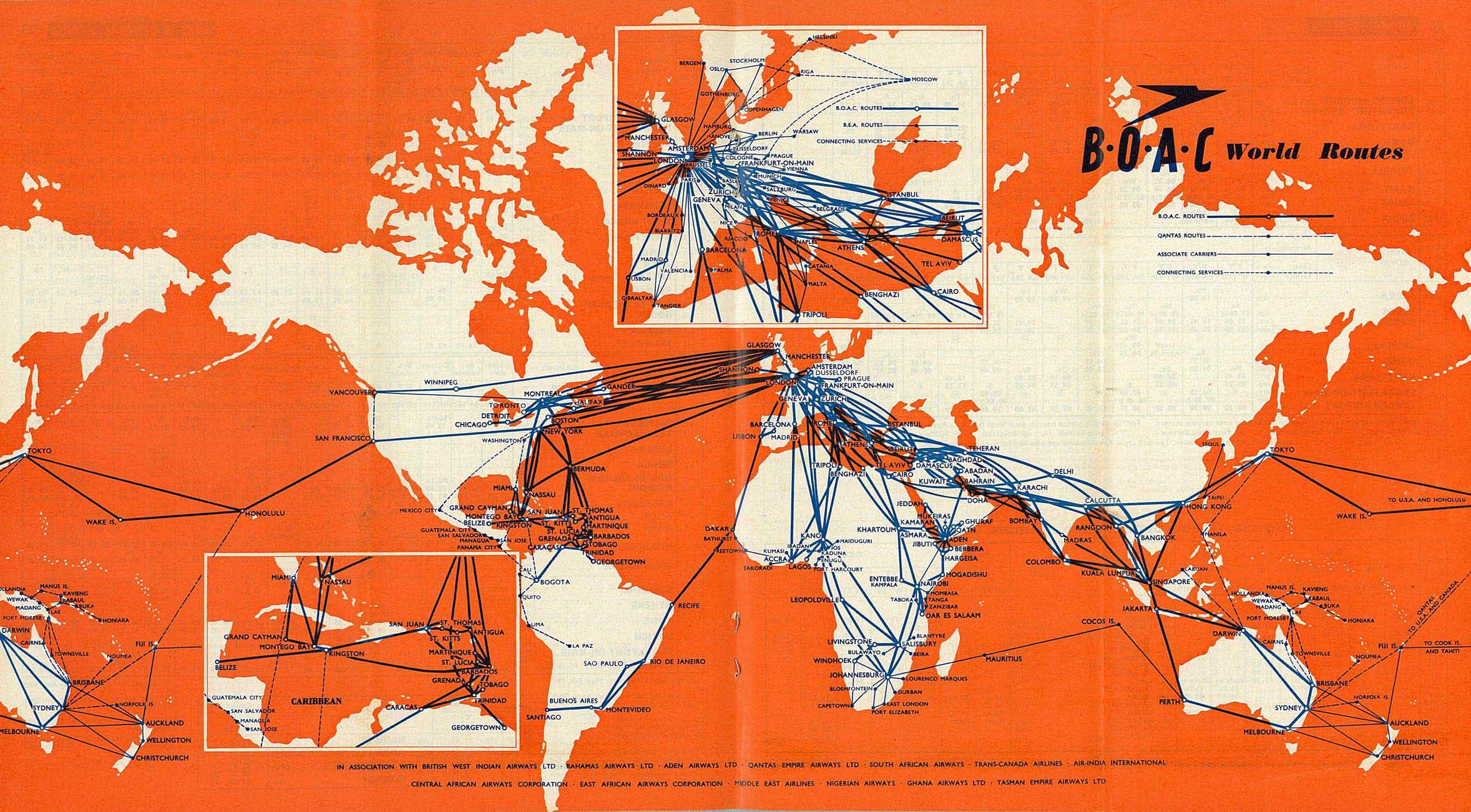
Grenada, Granada: British Airways Sends Couple to Caribbean Instead of Ancient Spanish City

This never would have happened in the B.O.A.C. days.
From CNN:

Grenada vs Granada and other flight destination mix ups
You'd think with all the technology at our disposal, destination mix-ups would be a rarity.
Not so.

They're surprisingly common.

One that's attracted attention this week is the unfortunate story of a couple flown to the southern Caribbean island of Grenada, instead of the ancient city of Granada, Spain.
The incident is now the subject of a lawsuit.

U.S. dentist Edward Gamson thought he'd bought tickets from London's Gatwick Airport to Granada, Spain, for himself and his partner via a British Airways booking agent, but only realized he was actually headed to Grenada in the Caribbean once on board, reported The Independent.
The destination country and flight duration hadn't been listed on his e-tickets, which instead displayed only the city name.

"It's just so sad," Gamson told The Independent. "A trip we had been really looking forward to was ruined and ... BA won't do the decent thing."

Gamson claims the airline refuses to reimburse his first-class tickets and didn't reroute the travelers to Granada from Grenada.

Gamson is now suing British Airways for the cost of the trip, including planned tours in Spain that he and his partner didn't get to take....MORE
Of course back in the B.O.A.C. days your Iberian choices were pretty much limited to Madrid and Gibraltar.
And you were sitting next to some jerk named Noel Coward who thought he was on his way to Jamaica.
http://www.timetableimages.com/ttimages/complete/ba60/ba60-13.jpg

A Couple Quick Notes on Gold and other Commodity Financing Scams

First and most important, beaucoup props to FT Alphaville's Izabella Kaminska for getting on to the 'entanglements' of physical and and finance, going back at least a couple years, and setting the intellectual table such that recent revelations at Qingdao and elsewhere came as no surprise to folks paying attention.

Secondly, especially in the case of the gold frauds, this is a financing scam i.e. it will be settled in cash.
There are no "Gnomes of Guangzhou" demanding the metal, they want their damn money back.
Thus rather than creating a demand for physical there will be forced sales, akin to margin calls, of any remaining collateral.

Sunday's big Reuters piece, "After port fraud, China's vast warehouse sector under scrutiny" is a good overview of what the hell just happened, with this morning's Bloomberg gold story being the latest.

For Ms Kaminska's reportage at Alphaville there is no single keyword that gets all the stories but 'commodities' comes close, although it is less than Boolean optimal. 
See also her latest:

When commodity collateral shenanigans go wrong
We’ve long reported about China’s amazing commodity collateral shenanigans, featuring almost every commodityor physical good under the sun.

None of which was a problem for the financing side of the equation as long as the deals could be rolled over and for as long as the collateral did not have to be liquidated.

A few bad loans later, however, and suddenly the need to check in on the underlying collateral has exposed a small problem with relying on commodity collateral to de-risk trade finance. So intense was the demand for cash financing in China that it seems the greatest shenanigan of all was rehypothecation — multiple use of the same collateral many times over for many different loans....MORE
She goes on to look at some of the knock-on effects including the FX implications

One last note. Although a lot of the flim-flammery was rehypothocation, much was straight up fraud, obtaining loans on collateral that didn't exist in the first place.

UPDATED--Hmmm..."China Finds $15B of Loans Backed by Falsified Gold Trades "

Update: "A Couple Quick Notes on Gold and other Commodity Financing Scams"
Original post:
Yesterday it was the Indian physical trade that maybe wasn't as robust as advertised.*
Front futures $1311.30 down $11.30 on the day.
From Bloomberg:
China’s chief auditor discovered 94.4 billion yuan ($15.2 billion) of loans backed by falsified gold transactions, adding to signs of possible fraud in commodities financing deals.
Twenty-five bullion processors in China, the biggest producer and consumer of gold, made a combined profit of more than 900 million yuan from the loans, according to a report on the National Audit Office’s website.

Public security authorities are also probing alleged fraud at Qingdao Port, where copper and aluminum stockpiles may have been pledged multiple times as collateral for loans. Steps by the Chinese government to rein in credit by raising borrowing costs in recent years created a surge in commodities financing deals that Goldman Sachs Group Inc. estimates to be worth as much as $160 billion.

“This is the first official confirmation of what many people have suspected for a long time -- that gold is widely used in Chinese commodity financing deals,” said Liu Xu, a senior analyst at Capital Futures Co. in Beijing. “Any scaling back by banks of gold-backed financing deals might lead to a short-term reduction in Chinese imports and also spur some sales by companies looking to repay lenders.”

 As much as 1,000 tons of gold may have been used in lending and leasing deals in China, where commodities including metals and agricultural products are used to get credit amid lending restrictions, according to World Gold Council estimates....MORE
*Hmmmm.... "Indian Jewelers Offer BMWs, Discounts to Lure Gold Buyers"

"OVERNIGHT ENERGY: House Votes to Fast Track Natural gas Exports"

In 2012-13 the chemical industry made around $100 billion in investments in American plant, property and equipment based on cheap shale natural gas supply and pricing to, you know, move up the value chain and keep the value-added in the U.S rather than shipping raw resources like some developing nation..
I'm not saying that $1.90 was anywhere near sustainable but, not to put too jingoistic a point on it, USA, USA, USA.
$4.586 last, up 0.017.
From The Hill:
NATURAL GAS EXPORTS: The House in a 266-150 vote passed legislation to speed up liquefied natural gas exports.

Following Russia's annexation of Crimea, calls for allowing natural gas exports to non-Free Trade Agreement countries have grown in Congress.
Rep. Cory Gardner's (R-Colo.) bill would expedite the process of gas exports by putting the Department of Energy (DOE) on the clock. The department would have to decide on applications within 30 days after the final environmental review of a gas export facility is finished.

Passage of the bill could help Gardner in challenging Sen. Mark Udall (D-Colo.) for his Senate seat this year. Udall introduced similar legislation in the Senate earlier this year. His bill requires DOE to approve an application in 45 days.

After the House passed the gas export legislation, Gardner called on the Senate to do the same....MORE
Here's the last five yeas action via FinViz:

Wednesday, June 25, 2014

ABB Earnings May Be Running Out Of Power (ABB; ABBN.vx)

ABB is one of the very few companies I would buy for a 25-year time horizon.
Either they or their acquirer will be around next quarter (century)
From Reuters' AlphaNow:
They say you can’t spell geek without “EE,” the abbreviation for electrical engineering. One of the largest EE companies is ABB Ltd. (ABBN.VX) which trades on the Swiss stock exchange (and as an ADR on the NYSE). ABB takes in revenues of more than $40 billion, however, it looks like its earnings will not be charged up.

ABB is the world’s largest builder of electricity grids and is active in many sectors, with its core businesses being in power and automation technologies. Its services are diversified around the world, with Europe generating the largest part of its revenues at 34%. The company made some moves to cut costs and improve margins over the last couple of years, and gave investors more clarity on its core business (since ABB has so many divisions). However, CEO Ulrich Spiesshofer described the latest recovery in the business cycle as patchy. Based on StarMine’s negative Predicted Surprise of 4%, it looks like ABB is likely to report an earnings miss when it releases quarterly results on July 23.
ABB
Source : Thomson Reuters Eikon/StarMine
Weak current
ABB has seen return on net operating assets (RNOA) fall for the last five years. RNOA is now at 21%, half its level three years ago. That steady decline shows that the company may not be using its assets very efficiently. The component responsible for the falling RNOA is net operating asset turnover — the amount of sales or revenues generated per dollar of assets. Operating asset turnover is an indicator of the efficiency with which ABB is using its assets to generate revenues.

As you can see in the chart below, that measure has been steadily falling and is now at 2.0. By this measure, ABB was outperforming the industry median just three years ago (3.2 vs. 2.6) but now trails the industry median. It also explains why management has been scrambling over the last few years to become more efficient, despite improved revenues.
ABB 1
Source:Thomson Reuters Eikon/StarMine
Flickering lights
Analysts have been cutting quarterly estimates for ABB. The I/B/E/S consensus estimate for the second fiscal quarter is at 34 cents per share, down four cents from 90 days ago. The StarMine SmartEstimate is lower at 32 cents per share. Eight analysts have lowered their estimates in the last three months. Estimates for full-year earnings have also come down dramatically to $1.38 per share, down nearly 35 cents during the course of the year....MORE

"Secretive Swiss vaults may hold missing link in platinum price equation" or Why Didn't the Price Double During the Miners Strike?

From Reuters via The Times (South Africa):

Underground vaults next to a Swiss farming village may reveal one reason for the platinum market's indifference to its biggest ever supply shock.

Most analysts and market players expected steep price increases for the precious metal as a record five month mining strike in South Africa, which ended on Tuesday, wiped out some 40 percent of global supply.
Yet values have been stuck in a $140 an ounce range gaining just five percent so far this year.

Estimates of total platinum stock value vary by billions of dollars, mainly because of uncertainty over how much metal is stored in off-shore vaults.

The Zurich Freilager, or freezone, has been used since the 1920s to store valuables, but very little is known about what goes in and out of the industrial park, advertised by precious metals brokers for the high level of privacy it offers.

Its vaults alone could hold around 20 percent of the total stocks of platinum in London and Zurich, the world's main two storage centres for the metal, market players said.

"Miners, refiners, investors, trade houses: they all hold stocks there," a German trader close to the car industry said.

He and other sources in the industry, the main consumer of the metal for catalytic converters, said this was a major reason prices did not shoot up with the strike.

"Every company knows how much it has but not how much the others have. But users know that there is metal there and therefore there was no panic buying," the trader said.

Storing metal in bonded warehouses is routine practice among purveyors of commodities and the companies involved have not come under the kind of international pressure for more disclosure felt by Switzerland's famously secretive banks.

The Swiss Federal Department of Finance (FDF), however, voiced concern over the Freilager system in a consultation paper in 2012 that is expected to lead to some reforms by the end of this year. Among issues it raised was the ease with which the stored goods can be sold in the vaults without tax consequences.
In April, the Swiss Federal Audit Office noted the warehouses' role in easing trade but asked the government to present a more comprehensive plan for them by the end of 2015 "that takes the economic and political stakes into account".

Its report noted issues such as "errors relating to the customs tariff, declaration of origin when declaring goods; inventory irregularities; a lack of traceability of the merchandise; and flaws in stock accounting".
The Swiss Union of Freeports which represents the industry was not immediately available to comment.

Privacy
Freilager's tax-exempt status means any platinum stored there does not appear in official import/export data and few people get to see it, let alone assess how much is there....MORE

"What Analysts are Saying About U.S. Oil Exports"

It is early days but this is potentially quite a big deal.
Following up on yesterday's WSJ's scoopage are their confrères at MoneyBeat:
U.S. oil prices climbed to $107.50 a barrel, near their intraday high for the year, on The Wall Street Journal’s report Tuesday that the U.S. government has allowed some exports of ultralight oil.
In separate rulings that haven’t been announced, the Commerce Department gave Pioneer Natural Resources Co.PXD +4.08% and Enterprise Products Partners LPEPD +1.30% permission to ship a type of ultralight oil known as condensate to foreign buyers. The buyers could turn the oil into gasoline, jet fuel and diesel.
The Commerce Department said in a statement that there has been “no change in policy on crude oil exports,” leaving analysts and investors scrambling to decide what the rulings mean.
Oil-market and equity analysts weigh in on how the rulings could affect producers, refiners and oil prices.

Citigroup:
“The minor process that has been approved isn’t so minor and is something long expected – a ruling on how lease condensate can be transformed into a petroleum product, and thus exportable under general license. What is a notable step towards greater crude exports (though it would be classified as product exports) is that this is not through a condensate splitter or a distillation tower, but a simple stabilization unit.
“In the absence of an unconditional export ban, which is not the case here, we don’t expect meaningful impact on our expectations for refining profitability. We believe that coastal refiners in the US will continue to have an advantage as improving logistics allows for greater flexibility in crude procurement and product placement. This is also in line with our long-term estimate for Brent vs. US light sweet crude price differentials of $5-$7/Bbl.”

Morgan Stanley:
“The consensus view is that any change in the crude export policy is unlikely ahead of the US midterm elections, which made the timing of this decision particularly surprising. Given the unique nature of this permit, it appears that logic still holds. However, Pioneer’s success in arguing that a lightly processed condensate is a refined product shows the administration is being thoughtful about the crude export issue. Given this approval, we would expect other producers to be more aggressive/creative with export applications as well.”

Simmons & Co. International:
“The obvious loser would be refiners, even if there are limits to their condensate consumption. Investors will likely interpret this ruling as the Obama Administration becoming more open to crude oil exports. We believe the events of the past few weeks have likely raised the probability of the federal government allowing crude oil exports in some capacity, especially if violence in Iraq spreads south and significant oil production is negatively impacted. This would raise the call on US light crude oil to help allies like Japan and Korea. For winners, this ruling should benefit producers with heavier condensate weightings.”...MORE
Nymex August's $106.19 up 0.16 on a $107.50--105.47 range

Should You Attend The FT Alphaville Conference at £199 per cap or the Vanity Fair Conference for $5,000?

On the one hand VF is featuring the nasal intonations of Michael Bloomberg.
On the other, if I'm reading this correctly, FTAv is discounting even that reasonable £199, at least for much of the hedge fund world:
- 50% off for full-time students and representatives of non-profit organisations
But back to Vanity Fair via the NYT's Media Decoder column:

Vanity Fair’s Fall Conference Taps Power of the Rolodex
Vanity Fair magazine will host a conference in San Francisco this fall, becoming the latest publication to enter the potentially lucrative — and increasingly crowded — field of live events.

For the conference, which will coincide with the 20th anniversary of the magazine’s annual “New Establishment” list of influential people in early October, 350 people will be charged $5,000 each to attend. Speakers include Jonathan Ive, Apple’s design chief; Michael R. Bloomberg, the former mayor of New York; and Gen. Keith B. Alexander, the former director of the National Security Agency.

Vanity Fair joins numerous other publications, including The Atlantic, The Huffington Post, The Wall Street Journal and The New York Times, in using live events to leverage their brands and contacts. The events have joined other established conferences — like the World Economic Forum in Davos, Switzerland; the Aspen Ideas Festival in Aspen, Colo.; and TED — that fill the calendars of business executives, or at least those with robust expense accounts....MORE
Then again, General Alexander was so smooth when he was lying to Congress last year that there will surely be some marketing tips to be gleaned.
How could Camp Alphaville with its 50 speakers compete?

The Camp AV caption competition
"Excuse me is this the Big Top?"
"Nah mate, this rally has probably got a couple years left in it."
"Thanks, and where can I get a drink?"
"In the beer tent but you'd better hurry because Andy Haldane is in there and I can hear a great sucking sound."...MORE

Kurds to Kerry: “We are facing a new reality and a new Iraq"

Or as Rudaw (news from Kurdistan) put it in their headline:

Erbil’s ‘No’ to the Americans

By RUDAW 3 hours ago
US Secretary of State John Kerry is greeted in Erbil by Falah Mustafa, head of the KRG’s Departhment of Foreign Relations. Photo: DFR
US Secretary of State John Kerry is greeted in Erbil by Falah Mustafa, 
head of the KRG’s Departhment of Foreign Relations. Photo: DFR
ERBIL, Kurdistan Region – When the US delegation that was arriving in Baghdad asked Iraqi Kurdistan’s top leaders to be there to meet with them, the Kurds reportedly refused.

In that rejection, and the reception they gave to Kerry in their own capital of Erbil on Tuesday, the Iraqi Kurds showcased their newfound confidence, strength and unity.

Knowing full well this was the last thing Washington’s top diplomat wanted to hear, the autonomous Kurdistan Region’s President Massoud Barzani brought up what his people wanted to talk about: independence....MORE

North Korea Calls Seth Rogen, James Franco Film "A most wanton act of terror and act of war"

Film reviews and paparazzi, who knew?

From AFP via Yahoo News:

N. Korea slams Kim assassination comedy as act of terror
AFP N. Korea slams Kim assassination comedy as 'act of terror'

Seoul (AFP) - North Korea on Wednesday denounced a new Hollywood comedy about an assassination bid on leader Kim Jong-Un as a "wanton act of terror" and warned of a "merciless response" unless the US authorities banned the film.

"The Interview" stars Seth Rogen and James Franco as two tabloid TV journalists who land an interview with Kim in Pyongyang and are then tasked by the CIA with killing him.
The film is due to be released in the United States on October 14.

In a statement carried by North Korea's official KCNA news agency, a foreign ministry spokesman said the film was the work of "gangster moviemakers" and should never be shown.
"The act of making and screening such a movie that portrays an attack on our top leadership... is a most wanton act of terror and act of war, and is absolutely intolerable," the spokesman said.
In his statement, he called on the US administration to ban the film from being screened and warned that failure to do so would trigger a "resolute and merciless response".

It is not the first time Hollywood has poked fun at a North Korean leader.

In the 2004 satirical action comedy "Team America," Kim's father Kim Jong-Il was portrayed as a speech-impaired, isolated despot....MORE

Watch Out Deere: "Farmers face lower incomes - for years" (DE; AGCO; CAT; MON: MOO)

Corn 438-2 down 2-4; wheat 578-4 down 2-2.
From Agrimoney:
Farmers face lower incomes - for years
Lower grain prices will depress income for US crop farmers to levels less than 15% of those received at the 2012 peak – and growers may have to get used to far lower profitability.
University of Illinois researchers warned of a potential end to the farming boom, caused by higher crop prices, which took average net income for a typical Illinois grain farm above $300,000 in 2012.
Already incomes have fallen steeply from this top, coming in at $145,000 per farm last year, a decline reflecting largely lower grain prices – estimated at an average of $4.65 per bushel for the 2013 corn harvest compared with $6.93 per bushel in 2012.
"Crop insurance payments were much lower" too last year, after the huge claims in drought-hit 2012, when claims accounted for about one-third of farm revenues, said Gary Schnitkey, professor at the university's department of agricultural economics.
'Below average'
And net incomes will fall further this year, to $45,000 per farm a figure which, besides being down two-thirds year on year would be "considerably below any average income level since 2006", Professor Schnitkey said.
It would also fall short of the average that growers received in the decade to 2005, before higher crop prices began to send profits soaring....MORE

Indicators: Watching Unit Labor Costs Like a Hawk

Inflation hawk?
I'm guessing Mr. Duy didn't wake up this past Sunday and think "I know, let's give that Climateer fellow an indicator that appears to have some forecasting skill!" But that's what he did.
From Tim Duy's Fed Watch:
Inflation Hysteria
It appears that a case of inflation hysteria is gripping Wall Street. Joe Weisenthal at Business Insider sums up the current state of play:
Here's what's on Wall Street's mind right now: Inflation is finally happening, and the Fed will end up being behind the curve.
...there were two big moments this week.
1) There was the jump in Core CPI that was the biggest since 2009.
2) And then there was the Janet Yellen press conference, in which she said that the CPI jump could be just "noise" and that the recent drop in the unemployment rate was not actually reflective of the true state of the labor market (which she regards as considerably weaker due to measures of worker discouragement).
In other words, despite data showing that the Fed is getting close to hitting its economic goals, Yellen doesn't believe the numbers.
But Wall Street does believe the numbers.
Hence the view that the Fed will be behind the curve.
Goodness, you would think it is 1975. It is probably instructive to stop and see what all the fuss is about...MORE
 Here's the part that really got my attention:
...So what is going on here?  Inflation is not a sustained phenomenon in the absence of participation from wage dynamics.  If inflation accelerates while wage growth remains stagnant, demand will soften and so too will any incipient price pressures. Hence why Yellen sees the potential for downside risk for consumer spending in the absence of stronger wage growth.  Moreover, as she notes, wage growth itself is not inflationary. We would expect wage growth should exceed inflation such that real wages grow to account for rising productivity. We might then expect inflation to be correlated with unit labor costs, and it is:
INFa062314

Hmmmm.... "Indian Jewelers Offer BMWs, Discounts to Lure Gold Buyers"

Maybe that "Physical demand in Inja" story ain't all it's cracked up to be.
Most active (Aug.) contract $1313.60 off $7.70.
From Bloomberg:
Joyalukkas Group, a gold and diamond retailer in India, is offering 12 free BMW cars and two kilograms (4.4 pounds) of bullion in a lucky draw as it fights a lean season in the world’s second-biggest buyer of the yellow metal.

Others including Gitanjali Gems Ltd. (GITG), Rajesh Exports Ltd. and Kalyan Jewellers Ltd. are promising everything from discounts to an opportunity to dine with Bollywood celebrities.

The monsoon season starting this month, usually considered a lean period for gold demand due to the lack of festivals and weddings, is threatening to deepen a sales slump caused by import curbs imposed last year. India raised duties on inbound shipments of the metal three times in 2013 to contain a record current-account deficit that pushed the nation’s currency to an all-time low.

“This is the first time we have come out with a single promotion for entire India and the Gulf countries to boost demand during the rainy season,” Joy Alukkas, managing director of Joyalukkas, said by phone from Kochi on June 18. “There are holidays in the Gulf countries during these months and non-resident Indians come back to their hometowns in south India. We are hoping to tap that market.”

Joyalukkas’s offers, valid until Aug. 2, are likely to boost sales this monsoon season by 10 percent to 15 percent, Alukkas said. The group has 47 stores in India, 32 in the Middle East and one each in the U.K., Singapore and Malaysia.

Rekindling Demand
Sales of Gitanjali Gems dropped 24 percent to 124.4 billion rupees ($2.1 billion) in the financial year ended March 31, the first annual decline in revenue since listing on the stock exchanges in 2006, according to data compiled by Bloomberg.

Rajesh Exports’ (RJEX) sales slid 24 percent to 235.4 billion rupees, the first annual slump since 2003, while Titan Co. Ltd. (TTAN)’s jewelry revenue grew 6.5 percent to 86.32 billion rupees, the slowest pace since at least 2008.

While freebies may stem the decline in sales, Prime Minister Narendra Modi’s efforts to revive economic growth may have a greater impact on rekindling jewelry demand, according to Abhijeet Kundu, an analyst at Antique Stock Broking Ltd....MORE