Showing posts sorted by date for query Jacques Saade. Sort by relevance Show all posts

Wednesday, April 21, 2021

Shipping: "CMA CGM Jacques Saade Boxship Sets Second Record for Full Containers"

A bit tardy getting to this but I wanted it on the blog as it is quite a remarkable accomplishment.

From The Maritime Executive, April 9:

For the second time in six months, French shipping giant CMA CGM Group is claiming a record for the largest number of full containers loaded aboard a single vessel. The achievement comes as the industry prepares to build even larger boxships to realize the economies of scale and meet the increasing demand for capacity.

The ultra-larger containership CMA CGM Jacques Saade (236,538 dwt) departed the port of Singapore on April 8 carrying 21,433 fully-loaded TEU for the new world’s record. The calculation for the load exceeded by more than three percent the ship’s prior record set in October 2020 during its maiden voyage. The 1,312-foot vessel had departed Singapore on October 12 with a calculation of 20,723 full TEU, which at the time was noted to be about 10 percent below her nominal capacity.

The CMA CGM Jacques Saade’s capacity is listed at 23,112 TEU, with the TEU being a standardized measure in the industry. Most boxes used by shippers are two TEU in size and as such the value does not reflect the number of individual containers on board. The current figure likely means the ship is loaded to capacity with full boxes. According to CMA CGM, among the current cargo are electronics, machinery, and household goods manufactured in Asia and being delivered to Europe.

The effort to complete the loading of the vessel to this level is equally significant. In October, CMA CGM reported that over 4,000 movements by nine different cranes working in unison were required during the stopover in Singapore....

....MUCH MORE

Jacques Saade was the founder of CMA CGM and the ship named in his honor is now the flagship of the company's fleet. The ship is the first of nine CMA CGM super-ultra-mega-container-ships powered by LNG.

He was quite a far-sighted guy.

Thursday, November 12, 2020

Fill 'er up: "Historic LNG Bunkering Operation Underway in Rotterdam" (CMA CGM; Total)

 From gCaptain:

The LNG-powered CMA CGM Jacques Saade has marked a new milestone as it kicks off its first LNG bunkering in Rotterdam.

CMA CGM said called the operation “the largest bunkering operation ever undertaken for a containership.”

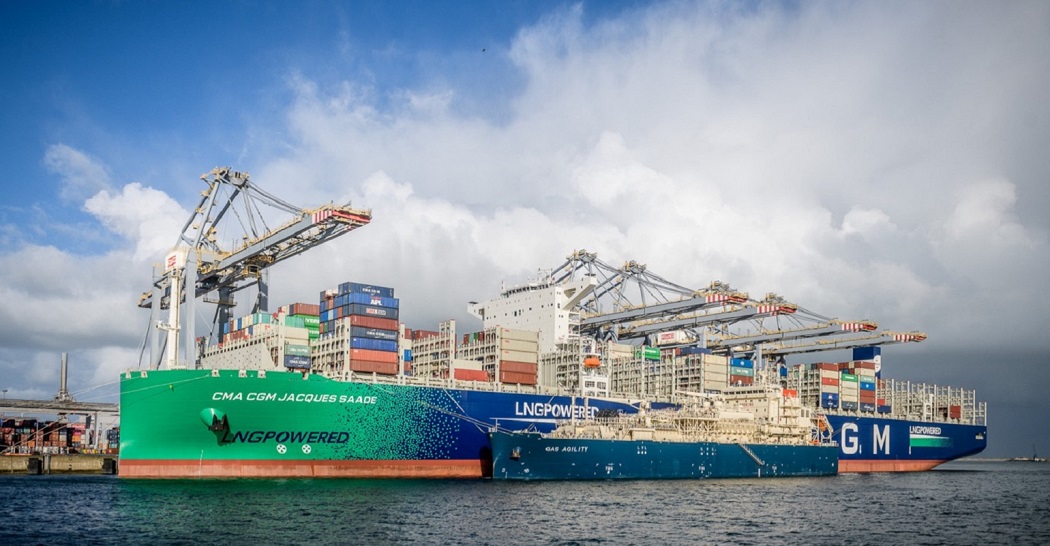
With a 18,600 cubic meter tank, CMA CGM Jacques Saade is being refueled with LNG while port handling operations remain underway. The bunkering operation is being performed by the Gas Agility, the world’s largest LNG bunkering vessel. The Gas Agility is operated by the French company Total, which has an agreement with CMA CGM to supply 300,000 tons of LNG fuel per year for a period of ten years.

Once bunkering is complete, CMA CGM Jacques Saade will continue on her maiden voyage, which began in China after she joined the fleet on September 22.

The CMA CGM Jacques Saade is the first of nine LNG-fueled, 23,000 TEU containerships ordered by CMA CGM in 2017. So far seven of those ships have been delivered by the shipyard. The vessels are operated French Asia Line (FAL 1) connecting Asia with Europe, providing a weekly service comprising 13 calls over 84 days....

....MORE

From Total:  Total's "Gas Agility" is the world's largest LNG bunker vessel

https://www.seatrade-maritime.com/sites/cet.com/files/CMA%20CGM%20JACQUES%20SAADE_Rotterdam%202%20%28003%29.png
Photo CMA CGM

Considering that the Gas Agility is 135 meters (443 feet) long and yet is dwarfed by the Jacques Saadé, you get a feel for just how huge these new boxships are.

If interested see also August 25's "CMA CGM to take delivery of world’s largest LNG-powered vessel" for Rotterdam as well as "'World’s Largest LNG Bunkering Vessel Arrives in Rotterdam' (so that's how CMA CGM will fuel the new megaships)"  

Also December 2019's "Shipping: 'CMA CGM bolsters its LNG fuel supply with Total deal'" and June 2020's "Shipping: CMA CGM Must Be Seeing A Pickup In Business" for CMA CGM's other fueling hub, Marseille-Fos.

Sunday, November 1, 2020

"CMA CGM takes delivery of 2nd LNG-powered 23,000 TEU giant" (Champs-Élysées)

What the Saadé family is doing is a truly breathtaking "bet the company" move, and at the moment fuel prices are going against them with low-sulfur fuel oil trending down and natural gas, up. However, if it all pans out, CMA CGM will have a monster of a cost advantage.

From Offshore Energy biz:

The CMA CGM Champs Elysees has joined CMA CGM Group’s fleet as the company’s second 23,000 TEU containership powered by liquefied natural gas.

The giant vessel is a sister ship to CMA CGM’s flagship, the CMA CGM Jacques Saade, which was delivered to the French major in September.

Measuring 400 meters in length and 61 meters in width, the two ships are the world’s largest container vessels to run on LNG at the moment....MORE

If interested here is more on the Winterthur GD engines.

Tuesday, October 13, 2020

Shipping: "CMA CGM's New LNG Flagship Takes on Record Container Load"

 From MarineLink:

The world’s largest liquefied natural gas (LNG)-powered containership, CMA CGM Jacques Saade, has set a new world record for the most full containers loaded on a single vessel.

On her Monday departure from Singapore, the CMA CGM Group’s new flagship was carrying a record 20,723 full containers, according to French shipping company CMA CGM.

After joining CMA CGM’s fleet in September, the new record-breaking containership is now on her maiden voyage on the CMA CGM Group’s French Asia Line (FAL 1), connecting Asia with Europe. Its rotation will lead it to the ports of Pusan in South Korea; Tianjin, Ningbo, Shanghai and Yantian, China; Singapore; Southampton, Dunkirk, Hamburg, Rotterdam, Algeciras in Europe; and Port Kelang in Malaysia. This line provides a weekly service comprising 13 calls over the course of 84 days....

...MORE

Previously on the big guy

Tuesday, August 25, 2020

"CMA CGM to take delivery of world’s largest LNG-powered vessel"

Following on yesterday's ""World’s Largest LNG Bunkering Vessel Arrives in Rotterdam" (so that's how CMA CGM will fuel the new megaships)".

From Offshore Energy, August 25:
French shipping group CMA CGM is to take delivery of its first ultra large LNG-powered containership following completion of the vessels’ gas trials.
The CMA CGM Jacques Saade returned to the Shanghai Jiangnan-Changxing Shipyard, a part of China’s Hudong-Zhongua, on Monday, its AIS data shows.

To remind, Jiagnan launched the 23,000 TEU LNG-powered containership in August 2019 and the vessel completed sea trials end March.

Offshore Energy understands that CMA CGM is expected to take delivery of the ship during September, more likely in the first half of the month, after it will depart to Europe.

The vessel will serve the Europe-Asia route. It will bunker LNG from the MOL-owned and Total-chartered Gas Agility that arrived off Rotterdam during the weekend....
....MORE

This is a huge bet by the French major and as long as oil doesn't revisit $20 (plus low-sulphur differential) it should give them a cost advantage on the big ones.
It was January 2018 when CMA CGM took delivery of the 20,600 TEU Antoine de Saint Exupery causing me to nickname the then-new flagship  "Le monstre des mers".
Now the Saade will become the line's flagship and I'll have  a new monster of the seas.
 

Thursday, April 16, 2020

"Three pathways to decarbonization of shipping"

From Offshore Energy, April 16:

There are three potential fuel pathways toward developing zero-emission vessels and decarbonizing the future of shipping, according to ABS.
The US-based classification society just released the 2020 Setting the Course to Low-Carbon Shipping — Pathways to Sustainable Shipping outlook, which maps out the path toward decarbonization goals of the global fleet.

The three fuel pathways are: (i) light gas, (ii) heavy gas-alcohol, and (iii) biofuel or synthetic fuels.
ABS says that owners and operators should choose their pathway based on two foundational criteria: the type of vessel and its operating profile in terms of trading route and cargo.
The study was carried out in cooperation with Maritime Strategies International (MSI) to create a global scenario for the future CO2 emissions from shipping,  and the outlook’s approach was supported by Maersk.

“Maritime’s decarbonization challenge can be regarded as a complex riddle with three elements: vessel energy-efficient technologies, operational optimization and low and zero-carbon or carbon-neutral fuels. All elements have a role to play, but we have identified that the rate of shipping’s transition to lower carbon fuels will have the single biggest impact on its global carbon footprint; more than any predictable shifts in commodity demand, enhancements to operating practices, vessel routings, or ship designs.,” said Christopher J. Wiernicki, ABS Chairman, President and Chief Executive Officer.

“The models in our research suggest our industry will meet the targets for the reduction in carbon intensity by 2050, but it might miss the target for the total GHG emitted annually.

The Light Gas Pathway
This category includes fuels comprised of small molecules with low-carbon/hydrogen (C/H) ratio, which helps to reduce carbon emissions.
Such fuels include LNG, bio-LNG, and synthetic natural gas (SNG) or renewable natural gas (RNG), which can be produced from biomass and/or by using renewable energy. The production of synthetic or renewable fuels from biomass is currently limited in scale and will have to be increased before they can be considered as viable commercial solutions.

LNG is a relatively mature low-carbon fuel, comprised primarily of methane. Its C/H ratio offers a reduction in carbon dioxide (CO2 ) emissions of up to 21 percent compared to baseline heavy fuel oils, the outlook reads.

The value does not include carbon release from methane slip, which may be an issue in two-stroke or four-stroke engines that operate on LNG in the Otto cycle.
Minimizing methane slip has been described as critical to the commercial adoption of these renewable fuels.

The industry is currently developing in-cylinder emissions control strategies, which could be combined with after-treatment systems. By minimizing methane slip, fuels such as bio-LNG and SNG/RNG can offer carbon-neutral propulsion.

The two-stroke and four-stroke engine manufacturers already offer solutions for minimizing methane slip from combustion, using high-pressure gas injection in the cylinder.
These can be combined with methane oxidation catalysts and other after-treatment systems used to treat the exhaust gas to further reduce the methane emissions and minimize the carbon output of using LNG.

As a low-carbon fuel, LNG can be combined with new technologies and/or operational measures to meet the 2030 emissions-reduction goals, and it can contribute to further reductions in the future, if blended with bioLNG or SNG/RNG.

If the latter can be commercialized and made available at a large scale in the medium term, the carbon footprint from using LNG would be reduced in proportion to the amount of renewable fuel used in the blend. Given the carbon-neutral promise of bio-LNG and SNG/RNG, significant efforts are currently being made to explore these solutions for commercial use, ABS said in the outlook.
At the end of the light gas spectrum, hydrogen may be a solution for future zero-carbon marine vessels, because it offers the highest energy content per mass among all candidate fuels, high diffusivity, and high flame speed.

However, it also requires cryogenic storage and dedicated fuel supply systems for containment. Hydrogen as a fuel has been demonstrated in internal combustion engines, gas turbines, and fuel cells, all of which will play a role in marine power generation and propulsion systems.
Nevertheless, as ABS explains significant technical advances are needed before hydrogen can be considered a viable, large scale, commercial fuel option....
....MUCH MORE

As their graphic for the light gas segment of the article the editor used a picture of CMA CGM's flagship, the LNG-powered monstre de la mer, 23,000 TEU Jacques Saade.
(I'm not sure when the Saade will take the flag from the current flagship, the 20,600 TEU Antoine de Saint-Exupéry. Sometime this year)

LNG powered containership CMA CGM Jacques Saade

Saturday, December 21, 2019

Shipping: "CMA CGM Leads Container Lines in Switch to LNG Fuel"

The article below expands on the quick hit from LNG World News we linked on the 17th: "Shipping: CMA CGM's Containerships takes delivery of fourth LNG-fueled vessel"

What CMA CGM is doing is really gutsy and if things work as planned, the January post "Shipping: CMA CGM May Be Building A Big Fuel Price Advantage" comes to fruition and the French mega-carrier has created quite the competitive advantage for itself..

From The Loadstar via gCaptain:
CMA CGM shortsea subsidiary Containerships has received its fourth LNG-powered vessel, the 1,380 teu Containerships Arctic.

The vessel will bunker with approximately 200 tons of LNG at Rotterdam and will be deployed on the intra-European carrier’s Baltic service after a period covering for CMA CGM on its Baltic feeder service network.

The vessel joins its three sister ships, Containerships Aurora, Containerships Nord and Containerships Polar, with the final two in a series of five yet to be confirmed by the carrier.

The Finnish container line had placed orders for the LNG ships prior to its acquisition by CMA CGM in June 2018, but the strategy was fully supported by the new owner, which has decided to go down the same route with an order of 20 LNG-fuelled ships, including nine 23,000 teu ULCVs.

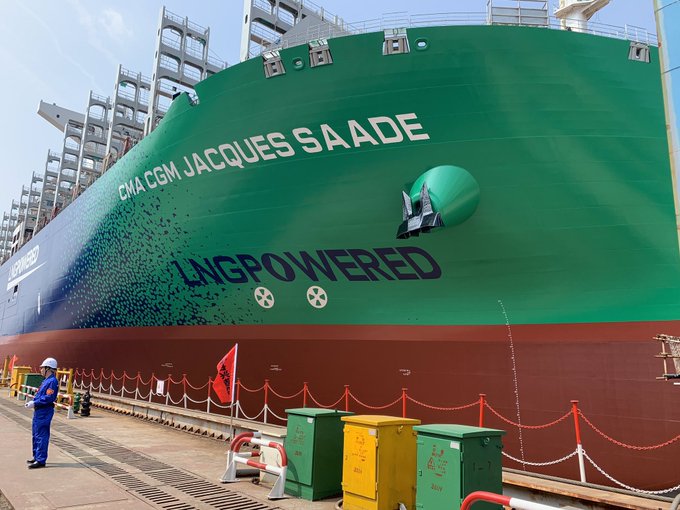
The first of these, the French-flagged 23,000 teu CMA CGM Jacques Saade, named after line’s founder, was launched in September and is claimed to reduce emissions of sulphur oxides and fine particles by 99%, compared with current marine fuel options.

However, other carriers have yet to follow CMA CGM’s LNG-fuelled strategy, citing continued concerns over the infrastructure to support its bunkering. And for existing vessels, retrofitting is not a viable option....
....MORE

Regarding that last point on infrastructure we saw this a couple weeks ago:
Shipping: "CMA CGM bolsters its LNG fuel supply with Total deal"

And for background , here's 2018's Shipping: "Why CMA CGM ordered 'game changing' 22,000 TEU LNG-powered containerships".

Tuesday, October 15, 2019

Shipping: "CMA CGM lays out plans for IMO’s 2020 regulation"

This will change as the giant LNG-powered ships, of which the ‘CMA CGM Jacques Saade'* is the lead ship in the series, come online but for the next 6 - 9 months here's the plan.
From Container Management:
CMA CGM Group has opted to use compliant fuels with 0.5% or 0.1% sulphur as its main solution to be compliant with the International Maritime Organisation (IMO)’S 2020 low sulphur regulation.
The group will also use liquid natural gas (LNG) powered vessels and advanced air quality systems onboard its vessels to help with the IMO’s goal of having all sea-going vessels worldwide to reduce their sulphur emissions by 85%.

Due to IMO’s low sulphur regulation, effective January 1, 2020, shipping costs are set to increase worldwide and CMA CGM is also due to implement a new price reference for its short-term and long-term contracts.

The new price reference has been put in place as Very Low Sulphur Fuel Oil (VLSFO) is anticipated to be significantly higher than the present High Sulphur Fuel Oil (HSFO)....MORE
*Shipping: CMA CGM Launches World's Largest LNG-fueled Container Ship

Wednesday, September 25, 2019

Shipping: CMA CGM Launches World's Largest LNG-fueled Container Ship

We noted some of the amazing stats about these ships a year ago in "Shipping: "Why CMA CGM ordered 'game changing' 22,000 TEU LNG-powered containerships"" and followed up in June with news on the smaller but Baltic ice class additions to the fleet "CMA CGM's Containerships Welcomes Its Second LNG-Powered Newbuild"

Now it's back to the big ones.
It appears the marine architects and engineers overcame some of the concerns that the LNG fueling system would take space that could hold additional containers.

First up, The LoadStar, 25 September:
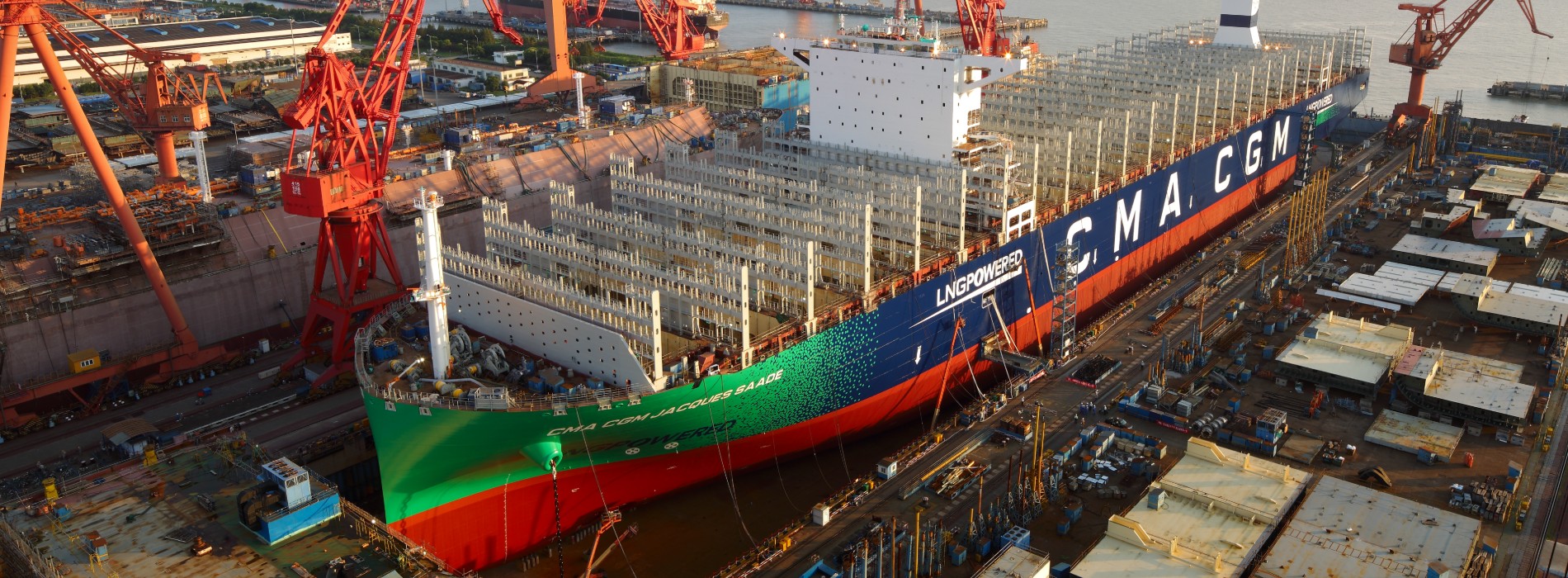
CMA CGM today launched the world’s largest LNG-powered ship at China’s Shanghai Jiangnan-Changxing Shipyard.

The 23,000 teu CMA CGM Jaques Saade is the first in a series of nine vessels that will run on what is considered to be the most environmentally friendly fuel.

The French carrier said LNG reduced sulphur oxide and fine particle emissions by 99%, nitrogen oxide emissions by up to 85% and CO2 emissions by around 20%.

It is named in honour of CMA CGM founder Jacques Saade, who died last year....MORE
And the Hat Tip to FreightWaves
CMA CGM unveils LNG-fueled box ship giant (VIDEO)

These aren't just the world's largest LNG powered box ships, they are within 756 TEU's (3.3% smaller) of being the world's biggest, period:
As The World's Largest Container Ship Completes Its Maiden Voyage from China to Europe, A Call For Even Bigger Behemoths
 
Finally, from the company, the ship is just so freakin' big:
THE WORLD’S FIRST 23,000-TEU CONTAINERSHIP POWERED BY LNG
By choosing LNG, the CMA CGM Group is confirming its resolute commitment to environmental protection and the energy transition of the maritime industry....MORE
https://cmacgm-group.com/api//sites/default/files/2019-09/CMA%20CGM%20JACQUES%20SAADE_Septembre%202019.jpg

If interested see also June's: "CMA CGM to Have 20 LNG-Powered Containerships by 2022"

Monday, December 4, 2017

"Shipping Magnates Shock Industry With Huge Orders"

From Bloomberg via gCaptain:
A shopping spree by two billionaires is shaking up a shipping industry still recovering from years of falling rates and overcapacity.

Jacques Saade’s CMA CGM SA, the world’s third-largest container line, announced an order for nine massive vessels in September, after a year of tepid sales for new ships. Within days, Gianluigi Aponte’s Mediterranean Shipping Co., the No. 2 container line, confirmed it had lobbed in an order for 11 behemoths, each of which can hold 22,000 shipping containers, enough capacity for 44,000 cars or 8.8 million 50-inch TVs.

The orders amounted to almost $2.9 billion combined, according to London-based Vessels Value, an online ship-valuation database. Longer than 3 1/2 football fields, the container ships will be among the largest ever built.

Some analysts, however, say it’s the last thing the market needs right now.
“The problem with the industry as a whole is that there are just too many ships,” said Toby Yeabsley, an analyst at Vessels Value. “It’s a struggle to see where these are going to fit in.”

Ferry Captain
But brash bets are characteristic of ship owners, in a volatile and cyclical industry. Aponte, an Italian-born former ferry captain, started operating cargo ships in 1970 and amassed a fleet of 490 container vessels, ferries, cruise ships and stakes in port terminals. His son Diego became chief executive officer in 2014. Saade formed CMA in Marseille after he moved from Lebanon in 1978. He built it into what has become France’s largest shipping company, helped by a 1992 bet on China’s economic growth. His son Rodolphe is now CEO.

Their success means Aponte has a net worth of $8.9 billion and Saade $4.4 billion, placing both men on the Bloomberg Billionaires Index, a daily ranking of the world’s 500 richest people. Both companies declined to comment on their founders’ net worth....MORE