The headline continues "...You Won't Want to Miss" but how the heck would I know what you want to miss?
In certain circles that sort of presumptuousness could lead to a tiny button being pressed, the meeting coming to a sudden end, two large gentlemen appearing as if by magic, and your being escorted off the premises, all before you had a chance to demonstrate your brilliance.
Or worse, the button isn't pressed but a judgement has been made. And not communicated to you.
From the Energy Bad Boys substack, March 28:
We read it so you don't have to
We appeared on the Energy Central podcast this week, where we discussed the causes of rising prices, utility green plating, and that there is no easy way out of the affordability pickle we find ourselves in.
Please take a second to check it out by clicking this YouTube link. We would like to crush the competition with respect to total views, and every click counts. Thank you for your attention to this matter.
On March 3rd, JPMorgan Chase released its 16th Annual Eye on the Market Energy Paper. This year’s report, written by Michael Cembalest, is titled “Fighting Words,” and it is a 98-page analysis with hundreds of graphs and charts on the state of the energy industry.
It spans most aspects of the energy industry, but as with all things energy, much of this year’s report centers on the impact of data centers on cost and reliability. Also of note are discussions on the cost of solar and storage, conventional fuels, small modular reactors (SMRs), electricity prices, and battery storage economics.
Here are the nine takeaways we found most interesting from the study, hereafter referred to as the JPMC report.
1. The Data Center Price Debate: A PJM Deep Dive
Data center impacts on customer costs continue to dominate the headlines for electricity affordability. The JPCM report notes:
The PJM region (data center alley: VA, PA, MD, OH) has 67 GW of existing and planned data center capacity, the largest cluster in the U.S. PJM has attracted attention due to spikes in its capacity payments, which are “insurance premiums” paid to generators to commit future supply or commit to demand response reductions during peak demand. Without the cap, the recent PJM auction would have cleared at $530 per MW per day.
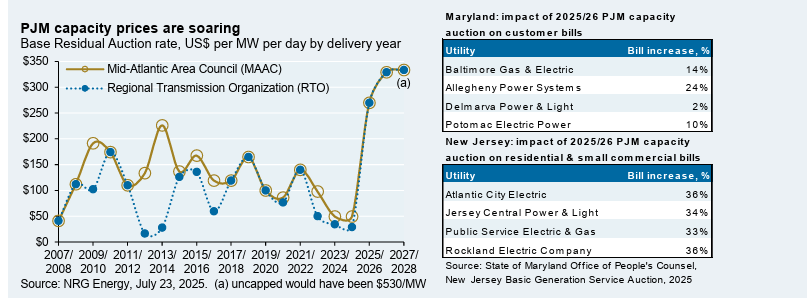
While capacity payments take place in wholesale markets, they’re partially flowing through to retail power prices in MD and NJ. Factors driving the spike in PJM capacity payments include retirement of thermal assets, data centers and declines in capacity accreditation for solar and storage.
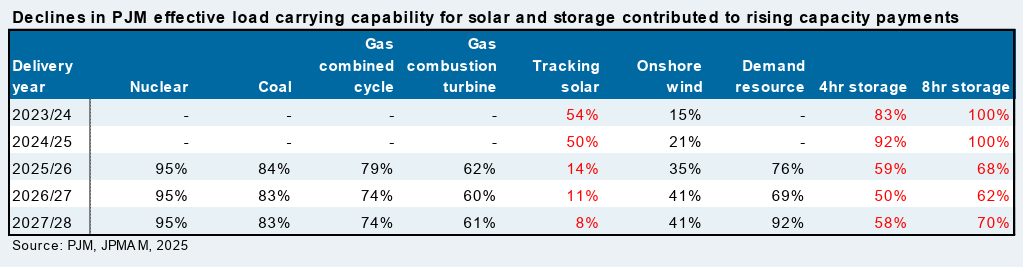
The reductions in capacity accreditation for solar and storage were overdue, and the recent increase in accreditation for onshore wind seems risky to us, as MISO, which, in fairness, has much more wind capacity than PJM, has the capacity value in the mid-teens.
On a final PJM note, Cembalest seems to think data centers could end the electricity “deregulation” experiment. “Last point: some utilities within PJM are questioning whether re-regulation would be the better option (Exelon, First Energy, PPL, and PSEG); I agree with them.”
2. Data Centers Are Likely Causing Nighttime Load Growth
The JPMC report provides evidence that data centers are materially increasing electricity demand at night, which also happens to be the period when the sun doesn’t shine.
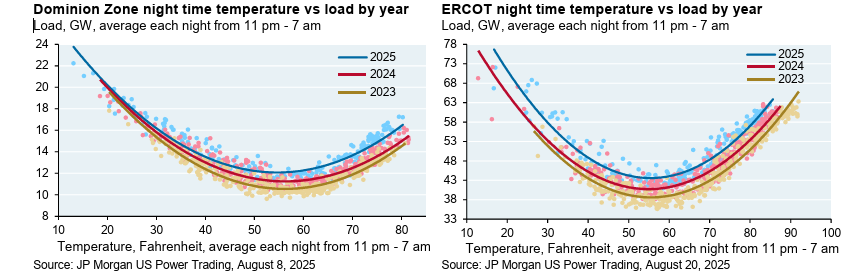
Nighttime loads have increased in Virginia and ERCOT since 2023. Nighttime loads are less influenced by industrial production or population. The increase in nighttime loads in data-center-heavy areas such as the Northern Virginia Dominion Zone and ERCOT suggests these facilities are driving evening demand, as JPMC notes, electric vehicles are not drawing enough power to be significant drivers of demand yet.
Cembalest writes “Nighttime load can be viewed as positive as it represents consistent load that allows utilities to monetize capital deployed assets and does not put additional strain during peak hours; but it’s another sign of rising data center demand.”....
....MUCH MORE
If interested see also 2025's "9 Takeaways from the JP Morgan Chase Energy Study You Won't Want to Miss".
Or maybe you will want to miss it, your call.

