Personally, I don't trust reported prices on private sales. As noted exiting a story on Pokemon cards:
....The craze intensified after influencer Logan Paul revealed in 2022 that he acquired a near perfect-grade “Pikachu Illustrator” card worth $5.3 million, setting a new Guinness World Record for the priciest Pokémon trading card sold in a private sale....First thought that comes to mind on the Logan Paul tidbit?
If it wasn't at auction it was probably a wash sale of some sort to either raise mark-to-market on other cards or to enhance Mr. Paul's brand.
But maybe that's just me. Here young Mr. Safra tackles a couple of the other challenges of private sales.
From Observer, February 27:
With 14,000 monthly users and a hands-on brokerage model, his lean, trust-driven private-sales platform is positioning itself as an alternative to galleries and auction houses.
For all its mystique and opacity, the art industry still runs on a disarmingly simple premise: someone wants a specific work by a specific artist and someone else is willing to part with it. Everything else—the fairs, the dinners, the whispered previews and sealed-bid theatrics—is choreography around that basic exchange. But because artworks are singular objects and buying decisions are driven as much by psychology, timing and cultural literacy as by capital, the distance between desire and deal can be considerable. In a globalized market where supply is theoretically infinite yet access remains carefully gated, and where buyers have grown increasingly selective, finding the right work and the right counterparty—at the right moment and on the right terms (price, logistics, legal considerations)—is an art in itself.
Over the years, several platforms have promised to streamline this inefficiency, often mistaking a relationship-driven business for a tech problem and trying to automate it outright. But the art market remains, at its core, people-focused and grounded in conversation, negotiation and, above all, trust built through personal connections. Elliot Safra, founder of The Art Marketplace, believes he can make the art market more efficient without undermining its core principles. His buzzy new online private sales platform quickly attracted 14,000 monthly active users across more than 30 countries, with over 1,000 artworks submitted, the vast majority by private collectors rather than advisors....
....MUCH MORE
Possibly also of interest:
The Sotheby’s trial revealed the art market’s unsavoury practices*
"Banks Keep European CLO Market Alive by Buying Their Own Product"
In February of this year [2017] we repeated the error with "Sotheby’s Hires Wall Street Vet to Head Private Sales" (BID), although, in our defense we at least expressed a bit of scepticism:
...The three (reputedly) most expensive paintings were all traded privately:"Qatar Purchases Cézanne’s The Card Players for More Than $250 Million, Highest Price Ever for a Work of Art"
Maybe if it's Bernard Berenson.
Or maybe not, links below.
*****
We've bumped into Berenson a few times, most memorably in "Duveen, The Greatest Salesman in the World: Isabella Stewart Gardner, Bernard Berenson and the Boston Connection Pt. IV" where he became the adviser to Mrs. Gardner and a bit of a bête noire to Duveen:
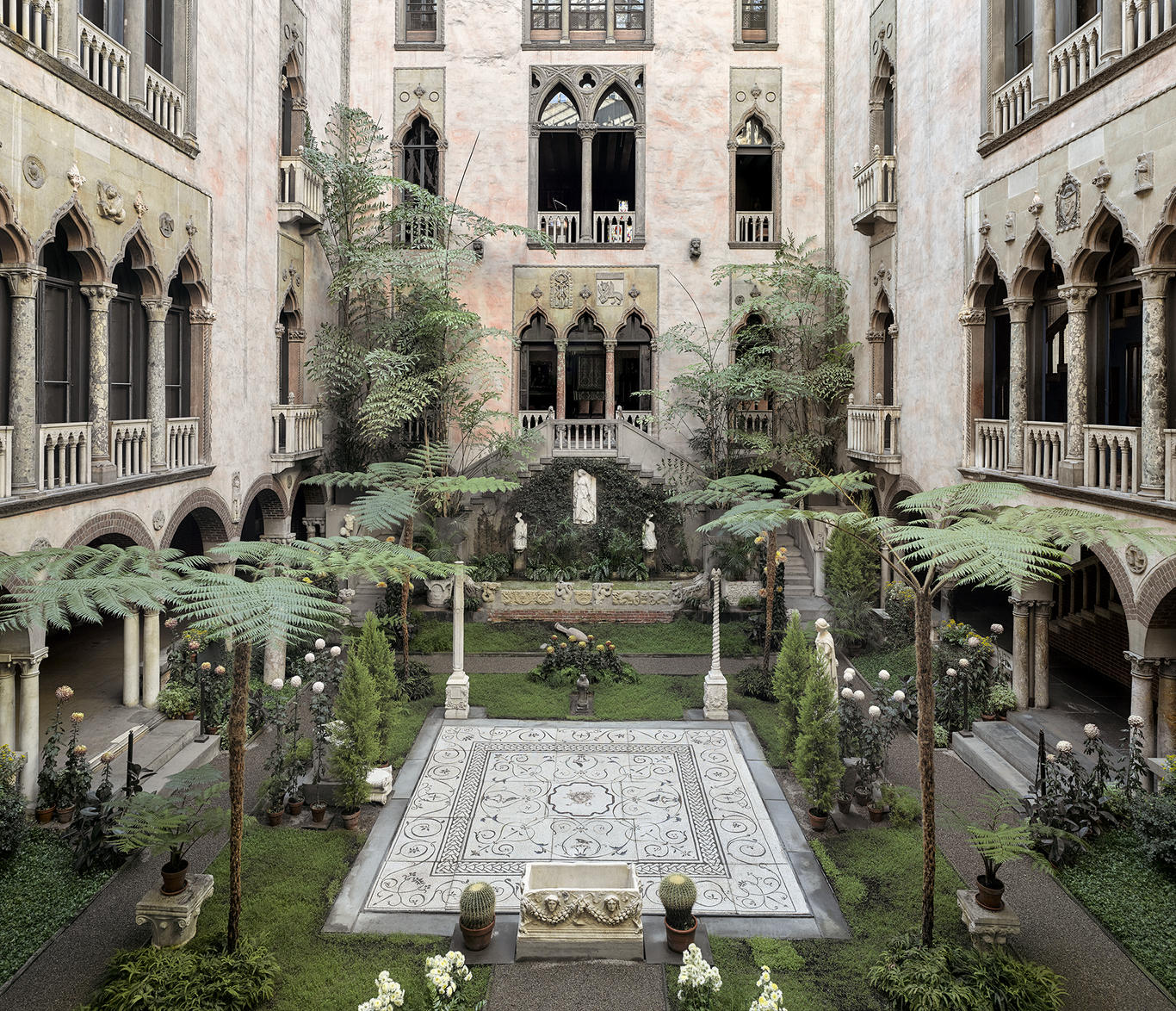
The courtyard of Mrs. Gardner's home, now the museum and site of the $500 million art theft
For more on the first gun for hire of the art world see the New York Review of Books "Only in America"
and The Spectator's "How honest was Bernard Berenson?"
"Sotheby’s and Christie’s expand private sales"
Ha, Duveen lives!
*****
On Duveen, the King of private sales, From the intro to September 2013's "Duveen: The Greatest Salesman Ever":
I've mentioned Joseph Duveen a few times, most recently in the intro to 2011's "Wildenstein: The Art World's Most Powerful Dealer Family".
Today his name came up because of a long form post at Quartz: "High-end art is one of the most manipulated markets in the world" that I'll link to again as tomorrow's weekend read.
Joe Duveen went from being one of thirteen children of a successful Jewish-Dutch importer to being
1st (and last) Baron Duveen, all because of a simple observation:
"Europe has a great deal of art, and America has a great deal of money."On that "Great deal of money", his buy-side clients included J.P. Morgan, Henry Clay Frick, William Randolph Hearst, Henry Huntington, Jules Bache , Andrew Mellon and John D. Rockefeller.
On the sell-side various European Aristos e.g. the seller of the painting below, the landlord known as the Duke of Westminster.
There have been two biographies of Duveen, the first by Behrman is better written but contained errors while the later one by Meryle Secrest is more accurate in the details, partly because she had access to the Getty Museum's hundreds of linear feet of business records and ephemera:
Duveen Brothers Resources
We have been planning to serialize Behrman's six New Yorker articles on Duveen, here's a taste of the first one, from 1951:....MUCH MORE
There is a lot of money to be made in opaque markets if one isn't too squeamish about screwing one's clients. This came on the market late last year:
Mansion on the Edge of Hyde Park Hits the Market for £42.5 MillionPark Lane, nice 'hood.
So again, good on young Mr. Safra.
