Monday, November 29, 2021

"Zuckerberg’s Meta Endgame Is Monetizing All Human Behavior" (FB; MVRS)

At least he's thinking big.

From VICE, November 1:

Exploiting data to manipulate human behavior has always been Facebook’s business model. The metaverse will be no different.
When Facebook bought Oculus and its much-hyped Rift headset for $2 billion way back in 2014, it wasn’t clear exactly what the social media company had in mind for the resurgent frontier of virtual reality. But to anyone familiar with the company’s countless scandals and insatiable appetite for personal data, it wasn’t hard to guess.

The announcement of Meta, the company’s VR and AR-forward rebrand, is the culmination of a vision that should have been obvious from the start. In 2021, Facebook’s colonization of social data has eclipsed the internet as we know it, and its ambitions now demand the creation of a new reality where intimate data about our social and physical behaviors can be captured and exploited for profit

During a tech demo in 2016, CEO Mark Zuckerberg described VR as “the next major computing platform”—a space where all our social interactions will play out with new levels of physical presence thanks to headsets and motion-controllers. As I wrote at the time, this could only mean one thing: Zuckerberg wants to build virtual environments where all human behavior can be recorded, predicted, and monetized....
*****
.... At the time, the company told me it had “no current plans” to use physical motion data like head and eye movements as a means of predicting behavior and serving ads. Since then, it has made logging into Facebook a mandatory requirement for users of its Oculus headset—a requirement it was recently pressured to remove. And earlier this year, the company announced its inevitable entry into VR-based advertising, inspiring enough backlash to cause one Oculus developer to abandon its plans for VR ads altogether.....
 
So while he is working on making money off of head movements I'm studying the latest research (October 26) on why dogs pretend that they are listening to me.
Explains quite a bit, actually.

"Regulate Crypto To Stop Chinese And Russian Manipulations – Hillary Clinton"

Is Madame Secretary of State angling for President again? She seems to be popping up in the news and other venues more frequently of late.

From EconIntersect:

The former Secretary of State Hillary Clinton has reiterated her statement that crypto markets need more and stronger regulations to protect the US against technological manipulations by China, Russia, and other nations. Clinton warned that if left unregulated, crypto markets and social media platforms may destabilize America and the US dollar, toppling it from the current position it holds as the reserve currency.

Her comments on crypto were part of a bigger segment in a November 24 interview with MSNBC TV news host Rachel Maddow. They were talking about the manipulation that takes place on social media platforms by various nations.

Clinton’s warning even extended to ‘technology of all kinds’ that she said states and non-state entities may use to destabilize nations and the dollar as the reserve currency of the entire world. She stated:

“There’s one other thing that’s on the horizon, which people are only beginning to pay attention to, and that’s the need to regulate the cryptocurrency market. Imagine the combination of social media, the amassing of even larger sums of money through the control of certain cryptocurrency chains.”

“We’re looking at not only states such as China, Russia, or others manipulating technology of all kinds to their advantage. We’re looking at non-state actors, either in concert with states or on their own destabilizing countries, destabilizing the dollar as the reserve currency.”

Crypto Can Destabilize Countries

A specific focus she had was on how the social media platforms that have been used mainly to influence elections using disinformation. These could be integrated with the crypto markets in a manner to help state and non-state actors destabilize other nations....

....MUCH MORE

 Also at EconInteresct:

The Crypto-Trading Hamster, Mr Goxx, Dies

Seriously, about the presidency thing, there is talk that Vice-President Harris gets bought off to depart the stage for personal reasons while Mme Secretary is nominated for the V.P. slot, only to be elevated to President due to the rapidly increasing deterioration of President Biden. The First Lady, Dr. Jill also being bought off to agree to the above. You could probably accomplish it for under $100 million, leaving only two questions: 1) Does Michelle Obama throw her hat in the ring in 2024 and 2) Does Hillary get to keep the gown from Queens University, Belfast, or is that a loaner?

 https://i.dailymail.co.uk/1s/2021/09/24/15/48341681-10025109-The_former_US_secretary_of_state_who_is_the_first_woman_appointe-a-29_1632493746975.jpg

Daily Mail

Okay, three questions. 3) Will the young lady holding the hem of the gown off the ground become a permanent member of the retinue, perhaps replacing Huma? 

We should have answers to questions 2 and 3 within six months and to #1 within a couple years.

"Humans Have Broken a Fundamental Law of the Ocean"

From Wired, November 23:

The size of undersea creatures seemed to follow a strange but stable pattern—until industrial fishing came along.

On November 19, 1969, the CSS Hudson slipped through the frigid waters of Halifax Harbour in Nova Scotia and out into the open ocean. The research vessel was embarking on what many of the marine scientists on board thought of as the last great, uncharted oceanic voyage: The first complete circumnavigation of the Americas. The ship was bound for Rio de Janeiro, where it would pick up more scientists before passing through Cape Horn—the southernmost point in the Americas—and then head north through the Pacific to traverse the ice-packed Northern Passage back to Halifax Harbour.

Along the way, the Hudson would make frequent stops so its scientists could collect samples and take measurements. One of those scientists, Ray Sheldon, had boarded the Hudson in Valparaíso, Chile. A marine ecologist at Canada’s Bedford Institute of Oceanography, Sheldon was fascinated by the microscopic plankton that seemed to be everywhere in the ocean: How far and wide did these tiny organisms spread? To find out, Sheldon and his colleagues hauled buckets of seawater up to the Hudson’s laboratory and used a plankton-counting machine to total up the size and number of creatures they found.

Life in the ocean, they discovered, followed a simple mathematical rule: The abundance of an organism is closely linked to its body size. To put it another way, the smaller the organism, the more of them you find in the ocean. Krill are a billion times smaller than tuna, for example, but they are also a billion times more abundant.

What was more surprising was how precisely this rule seemed to play out. When Sheldon and his colleagues organized their plankton samples by orders of magnitude, they found that each size bracket contained exactly the same mass of creatures. In a bucket of seawater, one third of the mass of plankton would be between 1 and 10 micrometers, another third would be between 10 and 100 micrometers, and the final third would be between 100 micrometers and 1 millimeter. Each time they would move up a size group, the number of individuals in that group dropped by a factor of 10. The total mass stayed the same, while the size of the populations changed.

Sheldon thought this rule might govern all life in the ocean, from the smallest bacterium to the largest whales. This hunch turned out to be true. The Sheldon spectrum, as it became known, has been observed in plankton, fish, and in freshwater ecosystems, too. (In fact, a Russian zoologist had observed the same pattern in soil three decades before Sheldon, but his discovery went mostly unnoticed). “It kind of suggests that no size is better than any other size,” says Eric Galbraith, a professor of earth and planetary sciences at McGill University in Montreal. “Everybody has the same size cells. And basically, for a cell, it doesn’t really matter what body size you’re in, you just kind of tend to do the same thing.”

But now humans seem to have broken this fundamental law of the ocean. In a November paper for the journal Science Advances, Galbraith and his colleagues show that the Sheldon spectrum no longer holds true for larger marine creatures. Thanks to industrial fishing, the total ocean biomass of larger fish and marine mammals is much lower than it should be if the Sheldon spectrum was still in effect. “There was this pattern that all life seems to have been following for reasons that we don’t understand,” says Galbraith. “We have changed that over the last 100 years or even less.”....

....MUCH MORE

HT: I think this was via Firefox's GetPocket start page but it seems to have lost its URL tag.

So maybe not.

When the Harvard Boys Did Mother Russia (Steyer and Summers, Shleifer and Sachs)

There are a lot of secrets that have yet to be exposed and the amount of money taken out of Russia and Ukraine, not just by the oligarchs but also by the hordes of American and European kleptos is almost beyound belief.
Let's say, oh, an eighth-of-a-trillion dollars. 
Back when a trillion was real money.

First up, from The Nation, May 14, 1998:

The Harvard Boys Do Russia

After seven years of economic “reform” financed by billions of dollars in U.S. and other Western aid, subsidized loans and rescheduled debt, the majority of Russian people find themselves worse off economically. The privatization drive that was supposed to reap the fruits of the free market instead helped to create a system of tycoon capitalism run for the benefit of a corrupt political oligarchy that has appropriated hundreds of millions of dollars of Western aid and plundered Russia’s wealth.

The architect of privatization was former First Deputy Prime Minister Anatoly Chubais, a darling of the U.S. and Western financial establishments. Chubais’s drastic and corrupt stewardship made him extremely unpopular. According to The New York Times, he “may be the most despised man in Russia.”

Essential to the implementation of Chubais’s policies was the enthusiastic support of the Clinton Administration and its key representative for economic assistance in Moscow, the Harvard Institute for International Development. Using the prestige of Harvard’s name and connections in the Administration, H.I.I.D. officials acquired virtual carte blanche over the U.S. economic aid program to Russia, with minimal oversight by the government agencies involved. With this access and their close alliance with Chubais and his circle, they allegedly profited on the side. Yet few Americans are aware of H.I.I.D.’s role in Russian privatization, and its suspected misuse of taxpayers’ funds.
At the recent U.S.-Russian Investment Symposium at Harvard’s John F. Kennedy School of Government, Yuri Luzhkov, the Mayor of Moscow, made what might have seemed to many an impolite reference to his hosts. After castigating Chubais and his monetarist policies, Luzhkov, according to a report of the event, “singled out Harvard for the harm inflicted on the Russian economy by its advisers, who encouraged Chubais’s misguided approach to privatization and monetarism.” Luzhkov was referring to H.I.I.D. Chubais, who was delegated vast powers over the economy by Boris Yeltsin, was ousted in Yeltsin’s March purge, but in May he was given an immensely lucrative post as head of Unified Energy System, the country’s electricity monopoly. Some of the main actors with Harvard’s Russia project have yet to face a reckoning, but this may change if a current investigation by the U.S. government results in prosecutions.

The activities of H.I.I.D. in Russia provide some cautionary lessons on abuse of trust by supposedly disinterested foreign advisers, on U.S. arrogance and on the entire policy of support for a single Russian group of so-called reformers. The H.I.I.D. story is a familiar one in the ongoing saga of U.S. foreign policy disasters created by those said to be our “best and brightest.”

Through the late summer and fall of 1991, as the Soviet state fell apart, Harvard Professor Jeffrey Sachs and other Western economists participated in meetings at a dacha outside Moscow where young, pro-Yeltsin reformers planned Russia’s economic and political future. Sachs teamed up with Yegor Gaidar, Yeltsin’s first architect of economic reform, to promote a plan of “shock therapy” to swiftly eliminate most of the price controls and subsidies that had underpinned life for Soviet citizens for decades. Shock therapy produced more shock–not least, hyperinflation that hit 2,500 percent–than therapy. One result was the evaporation of much potential investment capital: the substantial savings of Russians. By November 1992, Gaidar was under attack for his failed policies and was soon pushed aside. When Gaidar came under seige, Sachs wrote a memo to one of Gaidar’s principal opponents, Ruslan Khasbulatov, Speaker of the Supreme Soviet, then the Russian parliament, offering advice and to help arrange Western aid and contacts in the U.S. Congress.

Enter Anatoly Chubais, a smooth, 42-year-old English-speaking would-be capitalist who became Yeltsin’s economic czar. Chubais, committed to “radical reform,” vowed to construct a market economy and sweep away the vestiges of Communism. The U.S. Agency for International Development (U.S.A.I.D.), without experience in the former Soviet Union, was readily persuaded to hand over the responsibility for reshaping the Russian economy to H.I.I.D., which was founded in 1974 to assist countries with social and economic reform.

H.I.I.D. had supporters high in the Administration. One was Lawrence Summers, himself a former Harvard economics professor, whom Clinton named Under Secretary of the Treasury for International Affairs in 1993. Summers, now Deputy Treasury Secretary, had longstanding ties to the principals of Harvard’s project in Russia and its later project in Ukraine.

Summers hired a Harvard Ph.D., David Lipton (who had been vice president of Jeffrey D. Sachs and Associates, a consulting firm), to be Deputy Assistant Treasury Secretary for Eastern Europe and the Former Soviet Union. After Summers was promoted to Deputy Secretary, Lipton moved into Summers’s old job, assuming “broad responsibility” for all aspects of international economic policy development. Lipton co-wrote numerous papers with Sachs and served with him on consulting missions in Poland and Russia. “Jeff and David always came [to Russia] together,” said a Russian representative at the International Monetary Fund. “They were like an inseparable couple.” Sachs, who was named director of H.I.I.D. in 1995, lobbied for and received U.S.A.I.D. grants for the institute to work in Ukraine in 1996 and 1997.

Andrei Shleifer, a Russian-born émigré and already a tenured professor of economics at Harvard in his early 30s, became director of H.I.I.D.’s Russia project. Shleifer was also a protégé of Summers, with whom he received at least one foundation grant. Summers wrote a promotional blurb for Privatizing Russia (a 1995 book co-written by Shleifer and subsidized by H.I.I.D.) declaring that “the authors did remarkable things in Russia, and now they have written a remarkable book.”

Another Harvard player was a former World Bank consultant named Jonathan Hay, a Rhodes scholar who had attended Moscow’s Pushkin Institute for Russian Language. In 1991, while still at Harvard Law School, he had become a senior legal adviser to the G.K.I., the Russian state’s new privatization committee; the following year he was made H.I.I.D.’s general director in Moscow. The youthful Hay assumed vast powers over contractors, policies and program specifics; he not only controlled access to the Chubais circle but served as its mouthpiece....

 ...MUCH MORE

And from Economic Principals, May 20, 2018:

It may seem like an odd time to bring up the other Russia story, this being the first anniversary of Special Counsel Robert Mueller’s probe. But as it happens, there has been a break in this neglected case – or, rather, two of them.

It was slightly more than a year ago that President Trump fired FBI director James Comey and, the next day, told Russian officials visiting the Oval Office that Comey was “crazy, a real nut job.” He continued, “I faced great pressure because of Russia.  That’s taken off.”  Two weeks later Mueller was appointed, and his Russia investigation has only escalated since then, sprawling into several unexpected corners.

The New York Times offered readers a helpful graphic last winter: “Most of the stories under the ‘Russia’ umbrella generally fall into one of three categories: Russian cyber attacks; links to Russian officials and intermediaries; alleged obstruction.”

There is, however, another aspect of the Russia story, a category altogether missing in the Times’ classification scheme, an obviously thorny topic that almost no one wants to discuss: the proverbial elephant in the room.

It concerns the extensive background to the 2016 campaign – the relationship between the United States and Russia over the long arc of the twentieth century, and, especially, the years since the end of the Cold War.  This aspect is complicated, involving all five US  administrations since the Soviet Union dissolved itself at the end of 1991. It is a difficult story to tell.

I backed into it slowly, having followed for many years the Harvard-Russia scandal of the 1990s. In 1993, the US Agency for International Development, a semi-independent unit of the State Department, hired Harvard University’s Institute for International Development to provide technical economic assistance to the Russian government on its market reforms. Eight years later, the Justice Department sued Harvard for having let its team leaders go rogue.

Harvard economist Andrei Shleifer and his deputy, Jonathan Hay, were accused of investing in Russian securities, and of having established their wives at the head the line to obtain a license to enter the nascent Russian mutual fund industry. The suit was settled in 2005. The government recovered most of the money it had spent. The incident played a part in Harvard University president Lawrence Summers’s resignation the following winter. As Shleifer’s friend and mentor, Summers had distanced himself  via recusal.

After Boris Yeltsin had died, in 2007, I wrote a column about the failures of US policies in the 1990s. Thereafter I followed developments with increasing interest and alarm, particularly after the Ukraine crisis of 2014. And in the summer of 2016, when it seemed likely that Hillary Clinton would be elected president, I set out to collect some of the columns I had written and to add some additional narrative material in order to call attention to the entanglements she and her advisers would bring to the job. That project was supposed to take one year. It took two.

Because They Could: The Harvard Russia Scandal (and NATO Expansion) after Twenty-Five Years (CreateSpace) was finally published on Amazon last week – 300 pages and a relative bargain at $15. Alas, almost as quickly as the book went on sale, Amazon took it down, to make sure I actually owned the collected columns: their cloud computers had discovered these were also “freely available on the web” — in the archives of Economic Principals. Artificial intelligence at work: shoot first and ask questions afterwards.  As of May 24, Because They Could is back in print.The book consists of three main parts.

The first is a recap of the scandal as it appeared in the newspapers, from the front page of The Wall Street Journal, in August 1997; to Harvard’s decision, in March 2001, to try the case rather than settle the government suit; to September 2013, when Summers withdrew from the competition with Janet Yellen to head the Fed. These 29 columns, written as the story unfolded, introduce first-time readers to the scandal, and remind experts of what and when we knew and how we knew it.

The second part concerns the Portland, Maine, businessman whom the Harvard team leaders inveigled to start a mutual fund back-office firm in Russia, then forced out of its ownership. It turns out there was a second suit, overlooked for the most part because Harvard settled, paying an undisclosed sum in return for a non-disclosure agreement. This now-familiar tactic insured that John Keffer, whose Forum Financial at that point was one of the largest independently-owned mutual fund administrators in the world, and a significant presence in Poland, would be unable to tell his story. Only his filings and the massive documentation of the government case remained.

The third consists of six short essays on aspects of the US relationship with Russia since 1991. These relate a brief history of NATO expansion, which took place despite the administration of George H.W. Bush pledging in exchange for Russia agreeing to the reunification of Germany that the US would not further enlarge NATO; tell something of the US press corps in Moscow during those twenty-five years; identify a key issue in Russian historiography; express some sympathy for ordinary Russians and even for Vladimir Putin himself; and seek to separate the accidental presidency of Donald Trump from all the rest, the better to understand why he has so little standing in in the matter.

Also included is a short paean to the news values of The Wall Street Journal and two appendices. One is Shleifer’s letter to Harvard provost Albert Carnesale as the USAID investigation built to its climax. The other is the heavily-annotated business plan, drafted by Hay’s then-girlfriend, Elizabeth Hebert, later his wife, to make it appear to have been written by Hay, and backed financially by Shleifer’s wife, hedge-fund proprietor Nancy Zimmerman, offering control of Keffer’s company to Thomas Steyer, of Farallon Capital (who had been Ms. Zimmerman’s principal backer), and Peter Aldrich, of AEW Capital Management, a director of the National Bureau of Economic Research.

Preparing to espouse these unpopular views has made me snap to attention on the rare occasions when they are expressed in the mainstream press – not on the op-ed pages, where they mostly represent reflexive ballast-balancing, but in the news pages, where some deeper form of institutional judgment is at work. That was the case last Sunday, when an 8,600-word article in the Sunday New York Times Magazine presented the case that the United States shared the blame for the current disorder. “The Quiet Americans” startled me (though not the designer, who illustrated it with a standard what-makes-Russia-tick? design). The dispatch itself was a significant advance in the other Russia story....
....MUCH MORE

"The US Military is Expanding Its Operations In Greece. The Reason Might Be Russia"

You don't say:

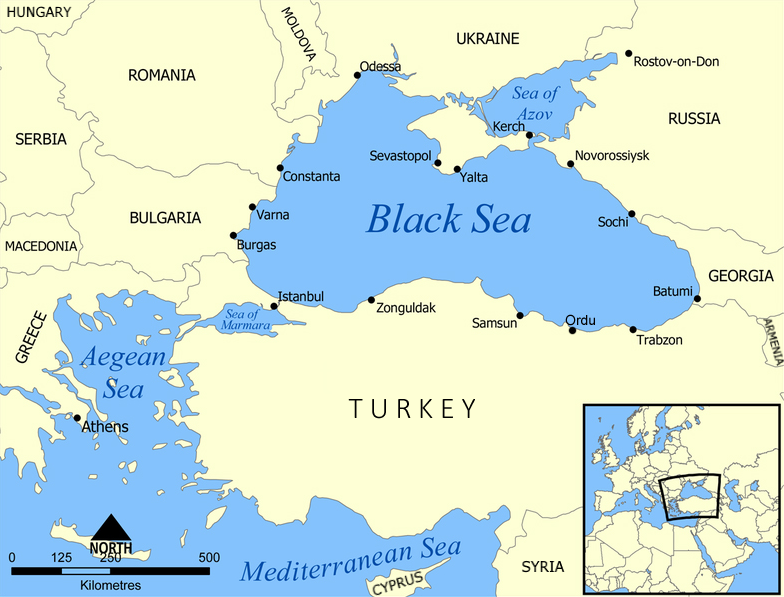
https://upload.wikimedia.org/wikipedia/commons/5/52/Black_Sea_map.png

Wikipedia

The distance from Istanbul (Turkey) to  Sevastopol (Crimea) is less than 350 miles (550 km)

If there is an EU navy, this is it.
And it is really handy to have all the ships fired up and ready to go should anything erupt at the other end of the Mediterranean/Black Sea between Ukraine and Russia (looking at you Crimea) over the next couple weeks.

And today's first story, from 19FortyFive, November 29:

In October, Secretary of State Antony Blinken and Greek Minister of Foreign Affairs Nikos Dendias updated and deepened the two countries’ Mutual Defense and Cooperation Agreement.

“MDCA is the bedrock of our defense cooperation,” Blinken said in a statement, referring to what is essentially a bilateral defense agreement.

The agreement is timely for both countries, coming amid rising tensions in the region.

The update “highlights the geo-strategic importance of Greece specifically and the Balkans and Eastern Mediterranean in general. In the context of ‘renewed great-power competition’ these regions are increasingly important,” Andrew Novo a non-resident fellow at the Center for European Policy Analysis, a think tank, told Insider.

“Greece has an important role to play in contributing stability in the Balkans, the Eastern Mediterranean, and even looking north toward the countries on the Black Sea,” Novo said....

....MUCH MORE  

And from GreekReporter.com, November 28:

Port of Alexandroupolis, Greece Hosts US Largest-Ever Military Landing

https://greekreporter.com/wp-content/uploads/2021/11/alexandroupolis-Us-forces1-credit-twitter-Konstantinos-Chatzimichail-1392x1044.jpg

The huge U.S. Roll-on, Roll-off Carrier “ARC Independence,” transporting military hardware, docked on Sunday in Greece’s port of Alexandroupolis....

....MUCH MORE

If both sides aren't very careful they are apt to start a shooting war.

"South Korean Draft Law Calls for Life Sentences for Crypto Market Manipulators"

From CryptoNews, November 24:

The South Korean government has unveiled a new draft crypto law that includes strict punishment for token market manipulation-related offenses – proposing massive fines and hefty jail sentences for offenders.

Per Maeil Kyungjae and the Hankyoreh, in cases where offenders make over USD 4.2m from their market manipulation efforts, courts would be allowed to dish out life sentences. The bill covers insider trading in the crypto markets, making use of as-yet “undisclosed information,” as well as illegal crypto transactions.

The bill is an indirect response to a number of high-profile instances of alleged and proven market manipulation controversies, with individuals and firms accused of artificially driving up trading volumes, releasing fake news stories about imminent token listings and more. Many South Korean exchanges have traditionally offered pairings in low-cap tokens that critics claims are ripe for market manipulation efforts.

The terms of the draft bill explain that even in cases where the manipulation brings in offenders less than USD 422,000 worth of “profits,” courts must hand out a minimum sentence of one year in prison.

Convicted offenders will also be forced to pay courts x3-x5 the money they earned in fines.

And it is not just conventional cryptoassets that will be covered by the law: it will also apply to decentralized finance (DeFi), stablecoins, in-game currencies and security tokens, the media outlets explained....

....MORE

Coming up— "Money Laundering With NFTs: What It Is, How To Do It"
(that headline is fāke , we will look at matched trades and painting the tape, not scrub-a-dub-dub)

Capital Markets: "Sentiment Remains Fragile"

 From Marc to Market:

Overview: The fire that burnt through the capital markets before the weekend, triggered by the new Covid mutation, burned itself out in the Asian Pacific equity trading earlier today. A semblance of stability, albeit fragile and tentative, has emerged. Europe's Stoxx 600 is up about 1%, led by real estate, information technology, and energy. US index futures are trading higher, with the NASDAQ leading. Benchmark 10-year yields are firmer. The US 10-year Treasury yield has risen about six basis points to 1.53%. European yields are mostly 1-2 basis points higher, while the UK Gilt yield is up four basis points. The dollar remains, as we say, at the fulcrum of the major currencies, but in an opposite way, with the funding currencies that rallied strongly before the weekend seeing their gains pared today, while the dollar bloc and Scandis trade firmer. Among the emerging market currencies, the liquid and freely accessible currencies, such as the South African rand, Russian rouble, and Mexican peso are leading the recovery. The Turkish lira and central European currencies, perhaps dragged down by the softer euro, underperform. The JP Morgan Emerging Market Currency Index is slightly firmer after falling around 0.4% before the weekend. Gold held support near $1780 but has been unable to resurface above $1800. January WTI jumped by about 5% after the 13% drop at the end of last week. Iron ore surged 6.5%, recouping in full the 5.6% decline in the last session to approach its recent highs. Winter weather is beginning to be experienced in Europe, and natural gas (Netherlands) is up 7.75% after falling 4.8% ahead of the weekend. Copper is recouping a little less than half of last Friday's nearly 4% fall.

Asia Pacific
Faced with much unknown about the new mutation, several Asia Pacific countries are opting to close their borders to foreign travelers.
Initially, countries limited the travel ban to a handful or so of countries from Southern Africa. It does appear that the omicron variant has been around before being sequenced in South Africa, and it is has been found in several countries. However, the origin is still not clear. While some reports from South Africa suggest mild symptoms, there is good reason for the World Health Organization's caution. If a new vaccine is needed for the variant, reports suggest it could take around 100 days.

Recall that Japan has lifted its formal emergency in late September, and the economy is rebounding as anticipated. Today's data showed retail sales rose for a second month in October. The 1.1% increase lifted the year-over-year rate to 0.9%. Purchases of clothing and food surged by 9.2%. Auto sales, still hampered by supply chain disruptions, was the only category that fell. After a frustratingly slow start, Japan's inoculation efforts have been successful, and the vaccination rate is above 75%....

.... MUCH MORE

Sunday, November 28, 2021

Media: The Kyiv Post Has Closed

We will be removing it from the blogroll on Dec. 1.

From .Coda's Oligarchy newsletter:

Oligarchy is a weekly newsletter tracking how the super rich 
are changing the world for the rest of us. 
Also in this edition: Why Dubai might not last as a tax haven 

Kyiv Post’s closure leaves a vacuum of accountability in Ukraine

KYIV POST

Regular readers of this newsletter will know I often talk about Ukraine. Partly, this is because it’s such a great country, but also it’s because it was working in Kyiv that helped me understand how corruption works, and what kleptocracy is (this is why Ukrainians feature so much in my book, “Moneyland”). 

I speak Russian, too, so, when working in Kyiv, I have always been able to take advantage of its remarkable bilingualism, which means people happily flip over and chat in Russian when I explain I can’t speak Ukrainian. That means I can understand what’s going on in a way I can’t in most countries. However, for obvious reasons, official documents and many media outlets are in Ukrainian, and there’s only so much Google translate can do.

That’s why many journalists, diplomats, aid workers, businesspeople and others loved the Kyiv Post. Not many of us spoke enough Ukrainian to read local media, but, fortunately, there was a reliable, independent and gutsy local newspaper to help us understand what was happening in the country. This is what I wrote about it back in 2014. Sadly, that story is no longer true, and the Kyiv Post is no more.

  • “We’ve gone after presidents, prime ministers, general prosecutors, CEOs, oligarchs. We gave them tough coverage — we believe fair, but they often didn’t — and they would complain. But in Ukraine, because there’s such a custom that owners control, or should control everything their journalists do, they often go to the owner,” Editor Brian Bonner told the Columbia Journalism Review. “I think he got tired of it.”

The Syrian-born businessman Adnan Kivan closed the paper two weeks ago, after a dispute with journalists over the launch of a Ukrainian-language version, with a totally different editorial set-up. He has promised that the Kyiv Post will be back, but its journalists say they have all been fired, and are furious....

....MUCH MORE, including Dubai, private jets, shell companies, the usual oligarch stuff.

South African Virologists Advise: Chill

They also posit one reason the variant was found in South Africa—SA is pretty good at virology, thank you very much.

From India's WION News:

Covid: Omicron variant causing mild disease, says South African Medical Association, slams hype 

South African Medical Association (SAMA) said that the new Omicron variant of coronavirus resulted in mild disease without prominent syndromes and slammed the hype around it as several countries imposed bans on flight from African countries.

"Yes, it is transmissible, but for now, as medical practitioners, we do not know why so much hype is being driven as we are still looking into it," Angelique Coetzee, the chairwoman of SAMA was quoted as saying by Sputnik news agency.

"We will only know after two to three weeks as there are some patients admitted and these are young people aged 40 and younger," Coetzee added.

She criticised the decision by some countries to ban flights from South Africa as premature as there is not enough information on how dangerous it is.

World Health Organization (WHO) on Friday identified the new strain of coronavirus as Omicron. The WHO said that the new strain was 'a variant of concern.' The new strain was detected in South Africa. The virus has been seen to show more mutations - over 30 - than previous variants and is feared to be more dangerous.

"It presents mild disease with symptoms being sore muscles and tiredness for a day or two not feeling well. So far, we have detected that those infected do not suffer loss of taste or smell. They might have a slight cough. There are no prominent symptoms. Of those infected some are currently being treated at home," Coetzee said.

South Africa on Sunday said that it was being punished for reporting the virus.....

....MUCH MORE

If interested see also Friday's commentary:

Capital Markets: "Covid Strikes Back"

"It's not yet clear if this B.1.1529 Covid variant, dubbed "Nu," is more infectious or deadly"

Covid: Meanwhile In South Africa

Some People Are So Cynical 

"UK Law Commission Gives Smart Contracts The Green Light"

From Artificial Lawyer, November 25:

The UK’s Law Commission has today confirmed that ‘the existing law of England and Wales is able to accommodate and apply to smart legal contracts, without the need for statutory law reform’. In effect this gives smart contracts the green light to be used with confidence, and for lawyers to start drawing them up for clients without fearing they are in a legal grey area.

The Law Commission added that their analysis ‘demonstrates the flexibility of the common law to accommodate technological developments, particularly in the context of smart legal contracts. It confirms that the jurisdiction of England and Wales provides an ideal platform for business and innovation’.

These findings build on the conclusions reached by the UK Jurisdiction Taskforce’s legal statement on cryptoassets and smart contracts. The legal statement established that the current legal framework is sufficiently robust and adaptable so as to facilitate and support the use of smart legal contracts; a view reinforced by the Law Commission’s advice, they said.

The Law Commission also encouraged the market to ‘anticipate and cater for potential uncertainties in the legal treatment of smart legal contracts by encouraging parties to include express terms aimed at addressing them’.

Examples of such provisions include: clauses allocating risk in relation to the performance of the code, and setting out clearly the relationship between any natural language and coded components.

In addition, as smart legal contracts become increasingly prevalent, the Commission anticipates that the market will develop established practices and model clauses that parties can use to simplify the process of negotiating and drafting their smart legal contracts.

Professor Sarah Green, the Law Commissioner for the Commercial and Common Law Team, said: ‘Smart legal contracts could revolutionise the way we do business, particularly by increasing efficiency and transparency in transactions.

‘We have concluded that the current legal framework is clearly able to facilitate and support the use of smart legal contracts; an important step in ensuring increased recognition and facilitation of these agreements.’

Lord David Wolfson of Tredegar QC, Parliamentary Under-Secretary of State, Ministry of Justice, added: ‘I would like to thank the Law Commission for this important paper analysing the current law as it applies to smart legal contracts. We in Government are excited about the transformative potential of emerging technologies, including smart legal contracts. We want a world-leading legal services sector, and that means ensuring English law can accommodate the technologies of the future.

‘The Law Commission’s findings provide that all-important legal certainty for those seeking to use smart legal contracts. I also want to thank the Commission for their update paper on digital assets, as well as to highlight their new project on conflict of laws – both are essential to ensure English Law supports emerging technologies.’

However, it’s not all neat and tidy on a global basis, and the Commission highlighted conflict of laws – that is, the area of law that primarily determines where disputes should be adjudicated, and the law applicable to those disputes – as an area where further work is required, they added....

....MUCH MORE

"How foreign investors are tapping into Germany's late-stage VC boom"

 From PitchBook, November 25:

Germany's government may have changed but appetite for Europe's second-largest VC hub has not as well-funded overseas investors continue to drive deal value to record levels.   

German startups raised a record €11.3 billion (around $12.7 billion) in venture capital funding in the first three quarters of 2021, up over 70% from last year's overall total, according to PitchBook data.

The rise was largely down to an increase in late-stage capital, but, as the majority of German VC firms are focused on early-stage deals, many have remained on the sidelines, with the country’s largest venture rounds not featuring any local backers....
*****
.... "The German startup ecosystem is itself still a bit young compared with markets like the US and in my view, that's why a lot of the investors are still focusing on the early stages and growth capital is largely coming from outside of Germany," Picus Capital partner and managing director Florian Reichert said.

German investors were absent from rounds such as process mining software provider Celonis' $1 billion Series D in June and content platform Contentful's $175 million July Series F. US investors Durable Capital Partners and T.Rowe Price led the latter's financing, while Tiger Global led Contentful's round.

Compared with other European countries, the German VC industry still accounts for a tiny portion of economic activity. A report from German state-owned bank KfW found that VC investments in Germany represented 0.047% of GDP between 2017 and 2019, compared with nearly 0.1% in the UK....

.....MUCH MORE

The World Economic Forum Is Very Excited By Play-to-Earn Gaming and The Metaverse

Following on "Izabella Kaminska Explores The Metaverse And Hits The Jackpot"

From the WEF, November 22:

What play-to-earn gaming can tell us about the future of the digital economy — and the metaverse

Play-to-earn games are introducing new paradigms of true digital ownership to the gaming industry—and beyond.  

  • Play-to-earn games could bring digital identity, assets, and ownership into players’ hands as the gaming industry is becoming decentralized.
  • This is how modern video games may introduce new paradigms that lend themselves to a wide variety of emerging digital environments and forms of value creation.
  • These games are also spearheading a recent development: the increasing convergence of the physical and digital worlds.

This article is written by two university graduates. Surprised? Didn’t think so. But what may be more intriguing is how we each paid our tuition. One followed a ‘conventional’ route: a combination of student loans, summer jobs and the good fortune of parental financial support. The other played video games.

Long before esports—the industry of competitive video gaming—was broadly recognized as a profession, popular play-to-earn PC games like ‘Diablo II’ (2000) or ‘Runescape’ (2001) created fully-fledged digital economies, in which the best players were able to make a living simply by being good at the game. Indeed, Moritz Baier-Lentz, one of your coauthors, was able to finance his undergraduate and graduate education by completing in game challenges and selling the resulting rewards for real money—at some point, more successfully than any of the other 13 million active players worldwide.

However, the early 2000s were a ‘Wild West’ of digital assets, virtual ownership, and online identity—and video game marketplaces and transactions were never fully legitimate and secure, making stories like this a case study in crafty individual entrepreneurialism more than a viable professional pursuit.

Enormous growth of gaming industry, built on centralized systems of value

Today, almost 3 billion people around the world play video games, and there is an entire infrastructure around professional gaming— one that has created significant opportunities and wealth for top players. The very best of them are considered athletes: employed as salaried team members, sharing in prize money at tournaments, and commanding lucrative sponsorship agreements. Others monetize live streams of themselves by playing games on viewership platforms like Twitch or YouTube Gaming.

Video games now represent a $336 billion industry, according to BITKRAFT Ventures, accounting for a wide spread of software, hardware, and intellectual property. As gaming has grown to become the world’s largest media category ahead of linear TV, on demand entertainment, film, and music, certain characteristics have developed with it. Importantly, almost all game based economic activity is centralized, giving developers and publishers the rights to everything going on within their games. The business case for this is to capture the billions of dollars generated from the sale of in game content, digital items, and subscriptions—but it also means that the vast majority of players themselves have few ways to share in the value without following the route of professionalization.

This historically custodial model of ownership and profitsharing has persisted as the industry has grown—but it might be on the cusp of transformation, with the arrival of so-called ‘play-to-earn’ games. This type of video game allows players to ‘truly’ earn and own digital assets that they can then sell outside of the game at their own discretion.

Play-to-earn could bring digital identity, assets, and ownership into players’ hands

If individuals are to allocate serious time, attention, and personal investments to digital environments, establishing trust in the durability of their digital presence and goods—as well as their economic robustness—is paramount. Early implementations show that this is indeed achievable with blockchain technology, which, using cryptography, can ensure digital trust and a decentralized storage of value.

Blockchain is already being applied to a broad range of sectors from finance to art—and video games are no exception. Play-to-earn games rely on blockchain technology, including in the form of non fungible tokens (or NFTs), as the foundation for value creation. An NFT is a digitally secured claim of ownership for a unique, non interchangeable digital asset. In practice, NFTs can take many shapes inside virtual worlds: characters, items, land, decorative personalization features such as digital clothing, and more. People ‘earn’ the most valuable items by playing the game very well, and can sell them for real-world money at their own terms....

Saturday, November 27, 2021

Questions Rabobank Was Asking: "Is Someone Trying To Delay The Global COVID Recovery To Ram Through Even More Stimulus"

Western economies were already tipping over in q4 of 2019, with the financial system showing signs of serious stress, see after the jump, but governments and central banks were faced with an almost impossible task.

First up, Rabo via ZeroHedge Jun 08, 2021:

By Michael Every of Rabobank

Yesterday’s Daily concluded with the question: “Is this a piece of your brain? Sadly, I feel the need to start today’s with the same question. What else can one ask when our financial press are filling pages telling us Jeff Bezos is going into space? “Multi-billionaire does something expensive and irrelevant” might as well be the headline; or, I would settle for a Muppets-like “Bezos in Spaaaaaace”, which at least has the appropriate lack of gravity.

Meanwhile, we need to be talking more about uncomfortable “I” words:

“Inflation”, obviously. There is a lot of market discussion about it, and if it is really back or not; and some even address formerly-taboo issues like labor vs. capital. However, those who have been brave enough to take that big leap have only landed on a narrow pillar sticking up from a deep intellectual divide, not the other side. The next, more difficult jump is to admit one cannot address the labor issue without also addressing the free movement of goods, services, and capital (let alone people) - and the global supply chains built on their back. Until then, you are intellectually stuck between the solid ground of neoliberal “because markets” --with low inflation, high inequality, and “Bezos in Spaaaaaace!”-- and Bretton Woods / national- conservatism / mercantilism / or international Marxism on the other side - which means higher inflation, lower inequality, less globalization, and very different supply chains. And that pillar in the middle is wobbly and won’t hold for long. (For our own take on an inflation framework, not model, and which tries to encompass these factors and more, please see here.)

“Interest rates”, just as obviously. US Treasury Secretary Yellen says she backs slightly higher rates, which would apparently be healthy for the US economy. How many times has she forgotten this is not her job anymore? Could Mr Powell say he prefers a slightly lower fiscal stimulus, for example? The media seem indulgent of these repeated snafus removing the clear red line between Fed and fiscal. Meanwhile, market chatter is that Jackson Hole in late summer is too soon for the Fed to flag any tapering. Given the extended unemployment checkes won’t have run out at that point, US jobs growth will still be below expectations, so requiring said stimulus: there is some logic if you think about it. And months more of $120bn QE a pop for markets.

“Invermectin”, which is a cheap, safe, effective medicine for treating parasitic infections and inflammation. Repeated on-the-ground medical studies claim the drug is an equally cheap, safe, and effective part of a cocktail Covid-19 treatment that could help ensure a far faster global recovery from this pandemic. The fact that none of you have probably heard of it; that academics at the UK’s leading virus-research universities aren’t looking at it; that Twitter has frozen the accounts of some advocating for it; and that India just dropped it as a recommended treatment, all suggests either the data from the studies are flawed, or how we make decisions about such important matters is. (I am no doctor or scientist: but Bret Weinstein has firm views on which of the two is more likely.)

Of course, a faster *global* recovery from Covid would mean we wouldn’t need as much fiscal and monetary stimulus in the first place. Yet even so, perhaps we aren’t having the well-rounded “have we tried this?” discussions about the realities of the best ways to treat either inflation or inflammation......

....MORE

And a very important repost, originally linked on October 8, 2021: 

Money, Money, Money: "A Self-Fulfilling Prophecy: Systemic Collapse and Pandemic Simulation"

Is this why we had lockdowns?

From The Philosophical Salon, where they don't sing songs from the O'Jays, August 16:

A year and a half after the arrival of Virus, some may have started wondering why the usually unscrupulous ruling elites decided to freeze the global profit-making machine in the face of a pathogen that targets almost exclusively the unproductive (over 80s). Why all the humanitarian zeal? Cui bono? Only those who are unfamiliar with the wondrous adventures of GloboCap can delude themselves into thinking that the system chose to shut down out of compassion. Let us be clear from the start: the big predators of oil, arms, and vaccines could not care less about humanity.

Follow the money
In pre-Covid times, the world economy was on the verge of another colossal meltdown. Here is a brief chronicle of how the pressure was building up:

June 2019: In its Annual Economic Report, the Swiss-based Bank of International Settlements (BIS), the ‘Central Bank of all central banks’, sets the international alarm bells ringing. The document highlights “overheating […] in the leveraged loan market”, where “credit standards have been deteriorating” and “collateralized loan obligations (CLOs) have surged – reminiscent of the steep rise in collateralized debt obligations [CDOs] that amplified the subprime crisis [in 2008].” Simply stated, the belly of the financial industry is once again full of junk.

9 August 2019: The BIS issues a working paper calling for “unconventional monetary policy measures” to “insulate the real economy from further deterioration in financial conditions”. The paper indicates that, by offering “direct credit to the economy” during a crisis, central bank lending “can replace commercial banks in providing loans to firms.”

15 August 2019: Blackrock Inc., the world’s most powerful investment fund (managing around $7 trillion in stock and bond funds), issues a white paper titled Dealing with the next downturn. Essentially, the paper instructs the US Federal Reserve to inject liquidity directly into the financial system to prevent “a dramatic downturn.” Again, the message is unequivocal: “An unprecedented response is needed when monetary policy is exhausted and fiscal policy alone is not enough. That response will likely involve ‘going direct’”: “finding ways to get central bank money directly in the hands of public and private sector spenders” while avoiding “hyperinflation. Examples include the Weimar Republic in the 1920s as well as Argentina and Zimbabwe more recently.”

22-24 August 2019: G7 central bankers meet in Jackson Hole, Wyoming, to discuss BlackRock’s paper along with urgent measures to prevent the looming meltdown. In the prescient words of James Bullard, President of the St Louis Federal Reserve: “We just have to stop thinking that next year things are going to be normal.”

15-16 September 2019: The downturn is officially inaugurated by a sudden spike in the repo rates (from 2% to 10.5%). ‘Repo’ is shorthand for ‘repurchase agreement’, a contract where investment funds lend money against collateral assets (normally Treasury securities). At the time of the exchange, financial operators (banks) undertake to buy back the assets at a higher price, typically overnight. In brief, repos are short-term collateralized loans. They are the main source of funding for traders in most markets, especially the derivatives galaxy. A lack of liquidity in the repo market can have a devastating domino effect on all major financial sectors.

17 September 2019:
The Fed begins the emergency monetary programme, pumping hundreds of billions of dollars per week into Wall Street, effectively executing BlackRock’s “going direct” plan. (Unsurprisingly, in March 2020 the Fed will hire BlackRock to manage the bailout package in response to the ‘COVID-19 crisis’).

19 September 2019: Donald Trump signs Executive Order 13887, establishing a National Influenza Vaccine Task Force whose aim is to develop a “5-year national plan (Plan) to promote the use of more agile and scalable vaccine manufacturing technologies and to accelerate development of vaccines that protect against many or all influenza viruses.” This is to counteract “an influenza pandemic”, which, “unlike seasonal influenza […] has the potential to spread rapidly around the globe, infect higher numbers of people, and cause high rates of illness and death in populations that lack prior immunity”. As someone guessed, the pandemic was imminent, while in Europe too preparations were underway (see here and here).

18 October 2019: In New York, a global zoonotic pandemic is simulated during Event 201, a strategic exercise coordinated by the Johns Hopkins Biosecurity Center and the Bill and Melinda Gates Foundation.

21-24 January 2020: The World Economic Forum’s annual meeting takes place in Davos, Switzerland, where both the economy and vaccinations are discussed.

23 January 2020: China puts Wuhan and other cities of the Hubei province in lockdown.

11 March 2020: The WHO’s director general calls Covid-19 a pandemic. The rest is history.

Joining the dots is a simple enough exercise. If we do so, we might see a well-defined narrative outline emerge, whose succinct summary reads as follows: lockdowns and the global suspension of economic transactions were intended to 1) Allow the Fed to flood the ailing financial markets with freshly printed money while deferring hyperinflation; and 2) Introduce mass vaccination programmes and health passports as pillars of a neo-feudal regime of capitalist accumulation. As we shall see, the two aims merge into one.

In 2019, world economy was plagued by the same sickness that had caused the 2008 credit crunch. It was suffocating under an unsustainable mountain of debt. Many public companies could not generate enough profit to cover interest payments on their own debts and were staying afloat only by taking on new loans. ‘Zombie companies’ (with year-on-year low profitability, falling turnover, squeezed margins, limited cashflow, and highly leveraged balance sheet) were rising everywhere. The repo market meltdown of September 2019 must be placed within this fragile economic context.

When the air is saturated with flammable materials, any spark can cause the explosion. And in the magical world of finance, tout se tient: one flap of a butterfly’s wings in a certain sector can send the whole house of cards tumbling down. In financial markets powered by cheap loans, any increase in interest rates is potentially cataclysmic for banks, hedge funds, pension funds and the entire government bond market, because the cost of borrowing increases and liquidity dries up. This is what happened with the ‘repocalypse’ of September 2019: interest rates spiked to 10.5% in a matter of hours, panic broke out affecting futures, options, currencies, and other markets where traders bet by borrowing from repos. The only way to defuse the contagion was by throwing as much liquidity as necessary into the system – like helicopters dropping thousands of gallons of water on a wildfire. Between September 2019 and March 2020, the Fed injected more than $9 trillion into the banking system, equivalent to more than 40% of US GDP.

The mainstream narrative should therefore be reversed: the stock market did not collapse (in March 2020) because lockdowns had to be imposed; rather, lockdowns had to be imposed because financial markets were collapsing. With lockdowns came the suspension of business transactions, which drained the demand for credit and stopped the contagion. In other words, restructuring the financial architecture through extraordinary monetary policy was contingent on the economy’s engine being turned off. Had the enormous mass of liquidity pumped into the financial sector reached transactions on the ground, a monetary tsunami with catastrophic consequences would have been unleashed.

As claimed by economist Ellen Brown, it was “another bailout”, but this time “under cover of a virus.” Similarly, John Titus and Catherine Austin Fitts noted that the Covid-19 “magic wand” allowed the Fed to execute BlackRock’s “going direct” plan, literally: it carried out an unprecedented purchase of government bonds, while, on an infinitesimally smaller scale, also issuing government backed ‘COVID loans’ to businesses. In brief, only an induced economic coma would provide the Fed with the room to defuse the time-bomb ticking away in the financial sector. Screened by mass-hysteria, the US central bank plugged the holes in the interbank lending market, dodging hyperinflation as well as the ‘Financial Stability Oversight Council’ (the federal agency for monitoring financial risk created after the 2008 collapse), as discussed here. However, the “going direct” blueprint should also be framed as a desperate measure, for it can only prolong the agony of a global economy increasingly hostage to money printing and the artificial inflation of financial assets....

....MUCH MORE

If interested see also: 
"Lockdowns,” the mass quarantine of both sick and healthy people, have never before been used for disease mitigation in the modern Western world. Previously, the strategy had been systematically ruled out by the pandemic plans of the World Health Organization (WHO) and by health experts of every developed nation. So how did we get here?....
 
And: 

Keep that in mind, quarantines of healthy people as a public health measure was almost unheard of in all of human history prior to the early months of 2020. More to come

Izabella Kaminska Explores The Metaverse And Hits The Jackpot

From the Financial Times:

The metaverse is just the latest incarnation of Las Vegas
Facebook’s reinvention aims to create a standardised virtual reality where the house always wins
From December 1, Facebook Inc’s stock ticker FB will be relegated to the dust of time. The world’s largest social media company will instead officially morph into Meta Platforms, to trade under the official ticker MVRS. 
 
The move follows Mark Zuckerberg’s bold decision to tie the company’s future evolution with the development of what is loosely described as the metaverse. In coming years, Zuckerberg hopes, people will transition to seeing his empire as primarily a servicer to this new digital realm. That means investors in the near $1tn market capitalisation company — and broader society — will have to get a grip on what exactly is the metaverse. 

It’s not that easy to describe. Today, it exists on many disjointed planes — from gaming universes to virtual conference call systems. Its first and most famous incarnation was probably the Second Life platform, notorious for being a flop although it still boasts some 200,000 active daily users. Zuckerberg’s vision will benefit from far superior tech.

“The metaverse will feel like a hybrid of today’s online social experiences expanded into three dimensions or projected into the physical world,” reads the Facebook spiel. 

But it’s also likely to be an attempt to standardise the metaverse’s consensus reality so that value can be harvested from users in even more creative ways. That may sound alluring to investors, but economists, politicians and activists should take heed.....

....MUCH MORE, she's just getting started.

HT: The FT's financial opinion editor

"The deal that the American elite chose to make with China...."

 From Tablet Magazine:

The Thirty Tyrants
The deal that the American elite chose to make with China has a precedent in the history of Athens and Sparta

In Chapter 5 of The Prince, Niccolo Machiavelli describes three options for how a conquering power might best treat those it has defeated in war. The first is to ruin them; the second is to rule directly; the third is to create “therein a state of the few which might keep it friendly to you.”

The example Machiavelli gives of the last is the friendly government Sparta established in Athens upon defeating it after 27 years of war in 404 BCE. For the upper caste of an Athenian elite already contemptuous of democracy, the city’s defeat in the Peloponnesian War confirmed that Sparta’s system was preferable. It was a high-spirited military aristocracy ruling over a permanent servant class, the helots, who were periodically slaughtered to condition them to accept their subhuman status. Athenian democracy by contrast gave too much power to the low-born. The pro-Sparta oligarchy used their patrons’ victory to undo the rights of citizens, and settle scores with their domestic rivals, exiling and executing them and confiscating their wealth.

The Athenian government disloyal to Athens’ laws and contemptuous of its traditions was known as the Thirty Tyrants, and understanding its role and function helps explain what is happening in America today.

For my last column I spoke with The New York Times’ Thomas Friedman about an article he wrote more than a decade ago, during the first year of Barack Obama’s presidency. His important piece documents the exact moment when the American elite decided that democracy wasn’t working for them. Blaming the Republican Party for preventing them from running roughshod over the American public, they migrated to the Democratic Party in the hopes of strengthening the relationships that were making them rich.

A trade consultant told Friedman: “The need to compete in a globalized world has forced the meritocracy, the multinational corporate manager, the Eastern financier and the technology entrepreneur to reconsider what the Republican Party has to offer. In principle, they have left the party, leaving behind not a pragmatic coalition but a group of ideological naysayers.”

In the more than 10 years since Friedman’s column was published, the disenchanted elite that the Times columnist identified has further impoverished American workers while enriching themselves. The one-word motto they came to live by was globalism—that is, the freedom to structure commercial relationships and social enterprises without reference to the well-being of the particular society in which they happened to make their livings and raise their children.

Undergirding the globalist enterprise was China’s accession to the World Trade Organization in 2001. For decades, American policymakers and the corporate class said they saw China as a rival, but the elite that Friedman described saw enlightened Chinese autocracy as a friend and even as a model—which was not surprising, given that the Chinese Communist Party became their source of power, wealth, and prestige. Why did they trade with an authoritarian regime and by sending millions of American manufacturing jobs off to China thereby impoverish working Americans? Because it made them rich. They salved their consciences by telling themselves they had no choice but to deal with China: It was big, productive, and efficient and its rise was inevitable. And besides, the American workers hurt by the deal deserved to be punished—who could defend a class of reactionary and racist ideological naysayers standing in the way of what was best for progress?

Returning those jobs to America, along with ending foreign wars and illegal immigration, was the core policy promise of Donald Trump’s presidency, and the source of his surprise victory in 2016. Trump was hardly the first to make the case that the corporate and political establishment’s trade relationship with China had sold out ordinary Americans. Former Democratic congressman and 1988 presidential candidate Richard Gephardt was the leading voice in an important but finally not very influential group of elected Democratic Party officials and policy experts who warned that trading with a state that employed slave labor would cost American jobs and sacrifice American honor. The only people who took Trump seriously were the more than 60 million American voters who believed him when he said he’d fight the elites to get those jobs back.

What he called “The Swamp” appeared at first just to be a random assortment of industries, institutions, and personalities that seemed to have nothing in common, outside of the fact they were excoriated by the newly elected president. But Trump’s incessant attacks on that elite gave them collective self-awareness as well as a powerful motive for solidarity. Together, they saw that they represented a nexus of public and private sector interests that shared not only the same prejudices and hatreds, cultural tastes and consumer habits but also the same center of gravity—the U.S.-China relationship. And so, the China Class was born.

Connections that might have once seemed tenuous or nonexistent now became lucid under the light of Trump’s scorn, and the reciprocal scorn of the elite that loathed him.

A decade ago, no one would’ve put NBA superstar LeBron James and Apple CEO Tim Cook in the same family album, but here they are now, linked by their fantastic wealth owing to cheap Chinese manufacturing (Nike sneakers, iPhones, etc.) and a growing Chinese consumer market. The NBA’s $1.5 billion contract with digital service provider Tencent made the Chinese firm the league’s biggest partner outside America. In gratitude, these two-way ambassadors shared the wisdom of the Chinese Communist Party with their ignorant countrymen. After an an NBA executive tweeted in defense of Hong Kong dissidents, social justice activist King LeBron told Americans to watch their tongues. “Even though yes, we do have freedom of speech,” said James, “it can be a lot of negative that comes with it.”

Because of Trump’s pressure on the Americans who benefited extravagantly from the U.S.-China relationship, these strange bedfellows acquired what Marxists call class consciousness—and joined together to fight back, further cementing their relationships with their Chinese patrons. United now, these disparate American institutions lost any sense of circumspection or shame about cashing checks from the Chinese Communist Party, no matter what horrors the CCP visited on the prisoners of its slave labor camps and no matter what threat China’s spy services and the People’s Liberation Army might pose to national security. Think tanks and research institutions like the Atlantic Council, the Center for American Progress, the EastWest Institute, the Carter Center, the Carnegie Endowment for International Peace, Johns Hopkins School of Advanced International Studies, and others gorged themselves on Chinese money. The world-famous Brookings Institution had no scruples about publishing a report funded by Chinese telecom company Huawei that praised Huawei technology.

The billions that China gave to major American research universities, like $58 million to Stanford, alarmed U.S. law enforcement, which warned of Chinese counterintelligence efforts to steal sensitive research. But the schools and their name faculty were in fact in the business of selling that research, much of it paid for directly by the U.S. government—which is why Harvard and Yale among other big-name schools appear to have systematically underreported the large amounts that China had gifted them.

Indeed, many of academia’s pay-for-play deals with the CCP were not particularly subtle. In June 2020, a Harvard professor who received a research grant of $15 million in taxpayer money was indicted for lying about his $50,000 per month work on behalf of a CCP institution to “recruit, and cultivate high-level scientific talent in furtherance of China’s scientific development, economic prosperity and national security.”....

Supply Chain Crisis: Beanie Babies Airlifted From Chinese Factories to Chicago Amid Holiday Crunch

The heart wants what the heart wants 

From Yahoo Finance, November 15:

Supply chain constraints won't keep Beanie Babies from reaching American homes this holiday season.

Chicago billionaire Ty Warner, who manufactures Beanie Babies in China, said he has booked more than 150 cargo flights in Shenzhen, Guangzhou, Shanghai, and Hong Kong since October to airlift the toys more than 6,000 miles to Chicago, according to a press release, circumventing backlogged ports and other supply chain issues.

"Christmas is not cancelled," Warner, who launched the private company Ty Inc. out of his home in 1986, said in the press release.

After the Beanie Babies land at Chicago O'Hare Airport, the stuffed animals will be sent to Ty Inc.'s warehouse in suburban Chicago to be distributed to retailers across America.

Each cargo flight can cost up to $1.5 to $2 million, according to the company. Despite the additional cost, Ty hasn't raised prices on its products....

....MUCH MORE

"Hitler's Handouts: Inside the Nazis' welfare state"

A companion piece to yesterday's "An Excellent Definition Of Fascism".

From Reason Magazine:

Hitler's Beneficiaries: Plunder, Racial War, and the Nazi Welfare State, by Götz Aly, New York: Metropolitan Books, 448 pages, $32.50

Few subjects arouse a historian's reductionist instinct like Nazism. It's hard to resist that desire to explain, in a single bullet point, just how "the nation of Goethe and Schiller" descended into imperial, genocidal madness. The earliest Holocaust reductionists saw in the German character a preternatural fealty to power: the stolid Prussian willing to subsume morality to a vague notion of duty, with those not of the Junker class simply terrorized into submission, too fearful to resist.

Among historians, this idea fell out of favor long ago. For non-specialists, it was effectively debunked in 1996 by the Harvard political scientist Daniel Goldhagen, who demonstrated that punishment was rarely if ever meted out to soldiers who refused to participate in mass murder. (According to Goldhagen, S.S. chief Heinrich Himmler allowed the righteous—and the squeamish—to be redeployed from the killing fields.) But Goldhagen merely replaced one monocausal theory with another, contending that the Holocaust was a natural extension of popular anti-Semitism. Fascism flourished, he claimed, because Germany was a country suffused with a "racist eliminationist view of Jews." Goldhagen's book, Hitler's Willing Executioners, was cut to ribbons by his peers, many of whom wondered why, if genocidal anti-Semitism was uniquely German, so many non-Germans willingly betrayed, deported, and executed their Jewish neighbors.

So if anti-Semitism alone cannot explain the fate that befell European Jewry, what can? According to Götz Aly's Hitler's Beneficiaries: Plunder, Racial War, and the Nazi Welfare State, most previous treatments of German complicity in genocide overlook a significant aspect of Nazi rule. Aly, a historian at the Fritz Bauer Institut in Frankfurt and the author of more than a dozen books on fascism, urges us to follow the money, arguing that the Nazis maintained popular support—a necessary precondition for the "final solution"—not because of terror or ideological affinity but through a simple system of "plunder," "bribery," and a generous welfare state. When first published in 2005, Aly's book caused a minor sensation in Germany, with critics accusing him of everything from sloppy arithmetic (a charge he vigorously denies in a postscript to the English translation) to betraying his soixante-huitard roots by implicitly connecting West German social democracy to fascism. After the massive success of books like Günter Grass' Crabwalk and Jörg Friedrich's The Fire, two bestsellers stressing that Germans too were victimized by fascism, Hitler's Beneficiaries shifts the brunt of the blame back toward ordinary Germans.

Far from being victims of Nazism, Aly argues, the majority of Germans were indirect war profiteers. Requisitioned Jewish property, resources stolen from the conquered, and punitive taxes levied on local businesses insulated citizens from shortages and allowed the regime to create a "racist-totalitarian welfare state." The German home front, Aly claims, suffered less privation than its English and American counterparts. To understand Hitler's popularity, Aly proposes, "it is necessary to focus on the socialist aspect of National Socialism."

While underemphasized by modern historians, this socialism was stressed in many contemporaneous accounts of fascism, especially by libertarian thinkers. F.A. Hayek famously dedicated The Road to Serfdom to "the socialists of all parties"—that is, Labourites, Bolsheviks, and National Socialists. "It was the union of the anti-capitalist forces of the right and the left, the fusion of radical and conservative socialism," Hayek wrote, "which drove out from Germany everything that was liberal." Ludwig von Mises agreed, arguing in 1944 that "both Russia and Germany are right in calling their systems socialist."

The Nazis themselves regarded the left-right convergence as integral to understanding fascism. Adolf Eichmann viewed National Socialism and communism as "quasi-siblings," explaining in his memoirs that he "inclined towards the left and emphasized socialist aspects every bit as much as nationalist ones." As late as 1944, Propaganda Minister Josef Goebbels publicly celebrated "our socialism," reminding his war-weary subjects that Germany "alone [has] the best social welfare measures." Contrast this, he advised, with the Jews, who were the very "incarnation of capitalism."....

....MUCH MORE

"‘Serial swindler’ Inigo Philbrick made £65m selling paintings twice"

From The Times, November 23:

A former Mayfair art dealer faces up to 20 years in prison after pleading guilty to conning art buyers out of more than $86 million.

Inigo Philbrick, 34, fled to the Pacific island nation of Vanuatu after his elaborate scams, which involved selling the same art works to different investors, began to unravel.

When asked by the judge why he did it, Philbrick said: “For the money, your honour.”

He entered the art scene more than a decade ago, rising up the ranks at the White Cube gallery in London, where he started as an intern, and going on to run two galleries in London and Miami, specialising in postwar and contemporary fine art.

The Connecticut-born son of an art museum curator pleaded guilty to federal wire fraud charges in a New York criminal court after prosecutors said he conducted an elaborate scam from 2016 to 2019 to finance his art business.

He was accused of selling the same art works to multiple investors at inflated prices to get the money to pay for another. In 2019 he is said to have resold an artwork for $5.5 million (£4.1 million) only for one person to claim they held 100 per cent of it and two others 50 per cent each, according to The Sunday Telegraph.

Prosecutors told a court last week how Philbrick misrepresented the ownership of certain artworks and sometimes sold more than 100 per cent ownership to multiple people and entities without their knowledge.

Artworks used in the scam included, among others, a 1982 painting by the Jean-Michel Basquiat titled Humidity, a 2010 untitled painting by Christopher Wool and an untitled 2012 painting by Rudolf Stingel depicting Pablo Picasso.

The scam unraveled as jilted art buyers filed civil lawsuits, a lender notified him that he was in default of a $14 million loan and he stopped responding to the legal process, prosecutors said. In November 2019 Philbrick failed to appear for court hearings in Miami and London. His whereabouts were unknown, even by his partner at the time, the Made in Chelsea reality TV star Victoria Baker-Harber, with whom he has a young daughter. He was eventually arrested by the FBI in Vanuatu last year and extradited back to the US....