Showing posts sorted by relevance for query buffett reinsurance. Sort by date Show all posts

Friday, May 22, 2015

Reinsurance: Warren Buffett Is Pissed That You Kids Are Playing In His Sandbox (BRK)

For the first time in years we didn't present the liveblogs of BRK's annual meeting a few weeks ago.
It seems that everyone is doing it and frankly Warren's schtick is best appreciated in the portion size one would allow any insurance salesman from Omaha.

Who's piled up $72.3 Billion.

From Artemis:

Buffett bemoans reinsurance becoming a “fashionable asset class”
Warren Buffett is none too happy that reinsurance has become what he termed a “fashionable asset class”, as the fact that investors are increasingly attracted to the space has damaged his insurance and reinsurance businesses returns.

At the Berkshire Hathaway annual meeting held this weekend, Buffett discussed the difficulties that even his insurance and reinsurance empire has in the current, softened and competitive reinsurance market environment.

Competition on price has hit both of his main reinsurance companies, General Re and Berkshire Hathaway Reinsurance Group, with first-quarter results showing a pull-back on premiums written as the firms constrain themselves on underwriting of catastrophe risks.

General Re’s premiums written in property declined 16% in Q1 and the reinsurer actually fell to an underwriting loss, partly due to the impact of competition and falling prices, but also claims rates and currency effects.

“Insurance industry capacity to write business remains high and price competition for most property/casualty markets persists,” the Q1 earnings statement explains.

“We continue to decline business when we believe prices are inadequate. However, we remain prepared to write more business when appropriate prices can be attained relative to the risks assumed.”

Berkshire Hathaway Reinsurance, meanwhile, continues to constrain its capacity and volume for many property & casualty lines and especially for property catastrophe reinsurance underwriting.

“Rates, in our view, are generally inadequate,” the firm explained. “However, we have the capacity and desire to write substantially more business when appropriate pricing can be obtained.”

So Berkshire clearly stands ready to increase its reinsurance underwriting if and when pricing rebounds or the firm can find the opportunities that it finds attractive and well-priced.

During the Berkshire Hathaway annual meeting shareholders, analysts and journalists get to ask Warren Buffett questions about the business, its investments and what might be coming in the future.

On reinsurance in particular Buffett was fairly negative and clearly showed that his firm is cognisant that it faces a threat from new entrants with lower-cost capital, including insurance-linked securities (ILS).
Reinsurance is “a business whose prospects have turned for the worse,” Buffett commented, adding that there’s “not much we can do about it.”...MORE
A couple of our BRK posts that may be of interest:
Insurance: "CEO FORUM: Gen Re's Tad Montross on model dependency" (BRK.A)
"Re/insurance. The engine of Berkshire Hathaway: Warren Buffett" (BRK) Plus a Special Bonus!

Insuring the Apocalypse: Warren Buffett on Global Warming (BRK.B)
In addition to See's Candies where cocoa would be a global warming canary in the coal mine, Mr. Buffett's Berkshire Hathaway owns a major property/casualty insurer, GEICO and the reinsurer of last resort, GenRe.

The utility operation owns the largest fleet of windmills in the U.S. while his railroad, Burlington Northern, is the largest hauler of coal in the country and the largest transporter of oil out of the Bakken field. There are a couple other tie-ins to climate that we've looked at over the years, some links below....

...Of the reinsurers Munich Re is the first to blame climate change for their weather related claims with industry #2 Swiss Re often following suit. The smaller Hannover Re doesn't do this. Zurich Re, along with the rest of the industry, is less vocal. Buffet's Re operations rank #3 in the world and is much better managed than Munich and Zurich so he often ends up taking risk off their hands or even lending them money.

Insuring weather over the last decade has been extremely profitable as premiums charged have been high-although declining as hedge funds and other non-traditional funders "want to get me some of that action"-and payouts on claims have been very agreeable....
And many more.

Tuesday, December 15, 2015

"Warren Buffett continues to dial back on reinsurance" (BRK.A)

From Artemis:
Warren Buffett has again reduced his investment in the reinsurance industry by cutting his share holdings in the world’s largest reinsurer Munich Re, as the ‘Sage of Omaha’ continues to dial back on his firm Berkshire Hathaway’s interest in reinsurance underwriting.

Much has been written in 2015 about Warren Buffett’s opinion of the reinsurance sector and the prospects for reinsurance underwriting returns in the future.

Despite having previously called insurance and reinsurance the “engine” of Berkshire Hathaway’s growth and continuing to invest heavily in his primary insurance businesses, Buffett has pulled back on underwriting property catastrophe risks and reduced his exposure to reinsurance pricing more generally.

In September Buffett reduced the shareholdings in Munich Re that his firms Berkshire Hathaway Inc. and National Indemnity Company held, from 12% to around 9.7% of the reinsurer.

Now, according to a report from Reuters, Buffett has reduced the holdings in Munich Re down to just 4.6%.

However, no matter how much Buffett dials back his direct investments in reinsurance, his firm Berkshire Hathaway continues to supply large amounts of reinsurance capital both through the syndicated market and through arrangements such as its investment in Australian insurer IAG.
Buffett is also breaking down the risk -> insurance -> reinsurance value chain, through initiatives such as the recently AA+ rated Berkshire Hathaway Direct Insurance Co., which will sell commercial policies, such as workers compensation and business owners’ package covers, online directly to buyers.

Some commentators have suggested that this direct online commercial platform could sell commercial property in future, which could be disruptive to the parts of the market which are more standardised and able to be transacted online.

Given its scale, Berkshire Hathaway does not need to cede much of the risk it writes back to reinsurers, not requiring protection of its own, so by writing commercial business direct and retaining the majority of the risk, Buffett is effectively reducing the costs that would have been associated with sourcing risk in the traditional syndicated and broker-led reinsurance marketplace.

So the appetite for assuming risk does not seem diminished at Berkshire Hathaway. One only has to look at the specialty business, the regular launches of new teams, lines of business and offices, to see an expansive approach to acquiring risk....MORE

Monday, May 21, 2018

"Buffett & Munger discuss reinsurance challenges Berkshire Hathaway faces"

BRK's annual meeting was held May 5, video below if interested.
From Artemis, May 9:
This weekend saw the quarterly results and annual shareholders meeting of Berkshire Hathaway and one of the most interesting exchanges during the question & answer session was Warren Buffett and Charlie Munger discussing over just how tough reinsurance can be these days.

Berkshire Hathaway experienced positive underwriting and investment results across its insurance and reinsurance business in Q1 2018, as reported by our sister site Reinsurance News.
But with market conditions in reinsurance remaining challenging, the analysts lined up to quiz Buffett and his deputy Munger were keen to explore just how tough Berkshire Hathaway is finding the state of business these days.

The responses highlight the close relationship developed over almost six decades of friendship that the pair enjoy, having originally met over dinner back in 1959.

Responding to an analyst question about the state of the market and the challenges Berkshire Hathaway faces, Buffett implied that while there are challenges, he expects to continue to achieve growth no matter how difficult the market gets.

“The reinsurance business, I don’t think I’d say that it’s tougher than it was ten years ago,” Buffett explained. “But if you go back to forty or fifty years ago, it was not brutally competitive.”
Discussing reinsurance subsidiary Gen Re, Buffett hailed the work Ajit Jain has done since taking responsibility for the firm, saying it has, “changed somewhat and it probably is more growth oriented than it was before.”

However he insisted that growth is not at any cost, saying that anything Jain has a hand in the development of has underwriting discipline attached.

But he noted that the portfolio at Gen Re has been growing, like so many other major reinsurers, explaining that, “There has been some pick-up and I think you actually will see the property casualty reinsurance business grow a fair amount.”
This despite the much discussed challenges faced by reinsurers.

On the life reinsurance side Gen Re has been growing steadily since Berkshire Hathaway took it over and Buffett noted that overall, “I think we’ll have a somewhat larger operation at Gen Re.”
On the appetite of Berkshire Hathaway to remain in the reinsurance business, despite the challenges faced, Buffett said, “We will be in the reinsurance business five years from now, ten years from now and fifty years from now, and we will have some unusual advantages that stem both from our capital position, our attitude towards the business and the talent that we have.”

Clearly Berkshire Hathaway benefits from efficiencies of scale across the conglomerate, as well as its active investment or total-return type model, which perhaps explains why the company can continue to expand into a still-challenging reinsurance environment....MORE 
2018 Berkshire Hathaway Annual Shareholders Meeting
Yahoo Finance Video (7:29:36)

Thursday, March 20, 2014

Updated--Huge Amounts of Capital Want to Fund The Reinsurance, Cat Bond Businesses

Update below.
Original Post:
This is a phase in the cycle where Warren Buffett can be expected to comment on Berkshire's General Re pulling back from the market.
From Artemis:
Munich Re: Reinsurance market competitive as capital spills over
The world’s largest reinsurance firm, Munich Re, expects conditions in the global reinsurance market will remain competitive in 2014. It also acknowledges the spreading influence of alternative capital as it spills outside of pure catastrophe business.

Munich Re’s profit target for 2014 is €3 billion, down on the €3.3 billion the firm achieved in 2013. That result in 2013 was the third best annual profit in Munich Re’s history, but challenges in the market and economy in 2014 make it unlikely to be repeated.

CEO of Munich Re Nikolaus von Bomhard commented on the firms 2013 performance; “The result for 2013 is an indication of how we have positioned ourselves competitively – we have strategically prepared Munich Re for foreseeable challenges which we can now tackle from a position of strength.”

The challenges Munich Re feels it faces in the coming years, which it believes it is well positioned to deal with, include the continued low-interest-rate environment which makes asset side performance more difficult, the increasing competition in the global reinsurance market driven by new entrants, capital markets capacity and well-capitalised traditional reinsurer competitors as well as changing demand on the primary insurance side of its business....MORE
UPDATE:
Errmmm, yes. It appears I am a half-step behind an 83-year old.
From Artemis, Mar. 15:

Warren Buffett: U.S. catastrophe rates too low for Berkshire Hathaway
Warren Buffett, chairman of diversified investment, insurance and reinsurance firm Berkshire Hathaway, said yesterday that his firm has pulled back from U.S. catastrophe reinsurance business as the rates are no longer attractive.

Warren Buffett was being interviewed by CNBC for its Squawkbox programme yesterda, Friday 14th March, when he said that Berkshire Hathaway has pulled back on its U.S. catastrophe re/insurance business as the rates are no longer felt to be commensurate with the risks.

Premiums have now fallen too far for Berkshire Hathaway to continue deploying its capacity into U.S. catastrophe premiums which is a clear sign that the well-capitalised traditional insurance and reinsurance market, combined with continued inflows and interest from capital markets investors, has truly disrupted incumbents.

When Buffett talks about catastrophe insurance at Berkshire Hathaway he is typically also referring to catastrophe reinsurance, as when speaking he generally does not distinguish between the two. Both Berkshire Hathaway and GenRe have been gradually pulling back on insuring and reinsuring U.S. property catastrophe premiums for a number of years, but Buffett said yesterday that U.S. catastrophe exposure has been all but eliminated from the groups underwriting.

Buffett explained to CNBC; “We actually in the United States have almost eliminated our catastrophe insurance business.” ...MORE

Tuesday, June 22, 2010

"ANALYSIS - Insurers revive catastrophe bond market" and "Reinsurance prices still in doldrums-industry execs" (AIZ; BRK.B)

Pricing and laying off risk have been a couple themes we've been following in the property/casualty and reinsurance business. As always we use Berkshire as a proxy for the group.
Two from Reuters:

Insurers are issuing catastrophe bonds again to complement traditional and cheaper reinsurance and to spread the risks in buying protection against events that could cost them tens of billions of dollars in claims.
The nascent cat bond market froze for several months after the late 2008 collapse of investment bank Lehman Brothers, which had played a counterparty role in several of the early bonds.
But already this year 12 new cat bonds have been issued, transferring risks associated with natural disasters to capital market investors rather than traditional reinsurers.

A hurricane or earthquake can wipe out profits across the traditional insurance and reinsurance market, often driving up prices for cover and limiting the amount available for insuring against certain perils. Hurricane Katrina, the industry's most costly natural disaster, cost $40 billion in claims.

"Cat bonds help to diversify our group protection capacity and supplement traditional reinsurance -- especially for peak risk, such as European wind and U.S. perils like hurricane and quake," said Georg Rindermann, senior project manager at Allianz(ALVG.DE).

Allianz is one of seven primary insurers that have issued cat bonds this year rather than relying solely on the reinsurance industry. The others are USAA, Assurant(AIZ.N), Nationwide MutualNMUIC.UL, State Farm, The Hartford and first time issuer Chartis.

Reinsurance companies, such as Munich Re and Swiss Re, also issue cat bonds to transfer major risks and thus free up capital to underwrite new business. They initially dominated issuance, but this year they have lagged primary insurers, issuing just five cat bonds so far.
Swiss Re issued two of these to cover against extreme mortality, Atlantic hurricane, European windstorm, California and Japan earthquake, while Munich Re issued the other three, against U.S. hurricane and European windstorm....MORE
And:

Reinsurance prices still in doldrums-industry execs
* Q1 quake, storms not enough to reinvigorate market
* Only major natural catastrophe can increase pricing


ZURICH, June 2 (Reuters) - The prices the reinsurance industry can charge primary insurers in premiums to cover their own risks have not increased and are unlikely to do so without a major natural catastrophe, reinsurance executives said.
The reinsurance industry had forecast battered insurers would seek to bolster their capital in the crisis by buying reinsurance cover to pass on insurance risk, boosting demand and prices, but it was unable to hike premiums as it had hoped.

"This industry really has trouble raising rates unless there's some catastrophe," Franklin Montross, Chief Executive of Berkshire Hathaway (BRKa.N) reinsurance unit General Re, told a reinsurance conference in Zurich on Wednesday.
The earthquake in Chile and winter storm Xynthia in Europe earlier this year had not been enough to 'harden', or increase, prices on their own, executives said.

"The high level of natural catastrophe losses in the first quarter is not a market-changing event," said Axis Re (AXS.N) Europe Chief Executive Karl Mayr. "It is a soft market now and is softening."
Reinsurers like Munich Re (MUVGn.DE), Swiss Re (RUKN.VX) and Hannover Re (HNRGn.DE) typically face their biggest payouts in the second and third quarters of the year, when the U.S. hurricane season peaks.
There was already enough capacity in the market to cover clients' needs, Mayr said, adding this was putting pressure on prices....MORE
Previous posts:

Where are the Catastrophe Bond Issuances? (BRK.B; BRK.B)

Insurance: Here Come the Catastrophe Bond Offerings (AIG; BRK.B)

"‘Extremely Active’ Hurricanes Set to Test Cat Bonds" (AIG; GS; BRK.B)

Berkshire Hathaway's "Buffett Picks Insurer Cooperation Over Competition " (BRK-B; BRK-A)
  
Hurricane Watch: Thinking of Shorting the Property/Casualty Insurance Companies (AIG; ALL; BRK.B; CB; HIG; TRV)

Insurance: Catastrophe! Travelers Reports- '“Weather had a big impact on our results,”' (TRV)

Catastrophe Bonds Year-to-Date and Pipeline (AIG; HIG)
"Buffett: Berkshire Has Some Exposure to Large Natural Disasters" and "Buffett Says He Has 100,000 Shares of Berkshire Rival Munich Re" (BRK.A; BRK.B)
Hurricane Watch: As Insurers Continue to Offload Risk; Coastal Residents Seem Unaware
Another Reinsurer that would Rather Invest Their Surplus than Write Business (RNR) 
"No Surprise: Chile Leads to Reinsurance Rate Increase Debate" BRK-A; BRK-B"':
No kidding.
A brisk breeze gets the boys in Omaha, Zurich, Munich and London (Lloyds) talking about premium increases.
Not to mention the herverzekering crowd in Amsterdam, they're tough bastards....
And way back in March:
Insurance: " Record warmth in Atlantic Main Development Region for hurricanes" (BRK-A; BRK-B)

Wednesday, May 6, 2020

Re/Insurance: "Berkshire Hathaway will write pandemic cover 'at the right price', Buffett says" (BRK)

As with terrorism insurance Warren would rather that governments take the risks,* the downside is just so huge.
And combining the two threats, terrorism and pandemic, considering how awful things have gotten in New York with the Coronavirus you have to ask what would be the result of a concerted bio-terrorism attack?
From "Two Factoids On The Covid-19 Situation In New York York City", way back on March 27
...And the troubling news.
Through Thursday at 5pm there have been 4720 hospitalizations.
Bad enough on its own but when combined with the reports of hospitals being overwhelmed you have to ask, what if something really, really big happened?

New York is one of the top two or three terrorism targets in the United States. How would the system respond if there were say 25,000 bioterrorism or biochemical terrorism victims in one day?
Or even 10,000?
You'd have thought that of all the places on earth that would have been prepared it would have been New York City, but no.
4700 hospitalizations seems so quaint with New York deaths over 25,000 40 days later. 

And from Artemis May 5:
For Berkshire Hathaway, the insurance and reinsurance underwriting conglomerate led by Warren Buffett, it’s not simply a question of carefully crafted exclusions when it comes to pandemic risks, for the so-called Sage of Omaha is perfectly happy to underwrite it, as long as the price is right.
Berkshire Hathaway reported its first-quarter results on Saturday and as our sister publication Reinsurance News reported at the time, the insurance and reinsurance underwriting performance suffered, with the Covid-19 pandemic one of the key drivers.

Overshadowing the performance of Berkshire Hathaway’s insurance and reinsurance underwriting divisions though, was the massive unrealised investment losses from the quarter that amounted to some $55.5 billion.

The P&C reinsurance unit of Berkshire Hathaway experienced losses of $2.12 billion in Q1 2020, higher than the $1.774 billion in the prior year period.

But the impacts of the pandemic were evident in this, as Buffett’s P&C reinsurance arm reported Covid-19 related reinsurance claims from Q1 amounting to $230 million.

Covid-19 and pandemic risks in general are not just seen as a threat at Berkshire Hathaway though, as the reinsurer is happy to underwrite them as long as the returns are risk commensurate.

Speaking during the Berkshire Hathaway annual meeting on Saturday, Warren Buffett explained, “We insure a lot of things. We had somebody come to us the other day wanting insurance involving a $10 billion protection on something very unusual. We’re not going to make that deal in all probability, in fact, I would say it’s dead. But we would have written pandemic insurance if people had come to us and offered us what we thought was the right price.”

Buffett went on to say that they may well have been wrong to do so, but at Berkshire Hathaway his underwriters are encouraged to look at the biggest risks the world faces, pandemics included....
...MUCH MORE

In a way Berkshire is like a Lloyd's of London syndicate but with a lot more money, willing to write custom coverage but because of the super-long tail and the unknowns, for a very pretty penny.
*July 2014
It's Time to Stop Subsidizing Warren Buffett and the Rest of the Insurance Gang (BRK; TRV; ALL; CB)
We're not intending to call out just Mr. Buffett's heavyweight property/casualty and reinsurance operations but rather the whole herd of porkers feeding at this particular trough.

It's just that since his comments at the 2002 annual meeting that the odds of a nuclear attack on Manhattan were "inevitable" by 2052, Buffett has carried water for the whole industry.
Page 9 of the BRK 2002 Annual Report has some more of his thoughts. It's all about the money.

Because the "temporary" 'Terrorism Risk Insurance Act' backstop is in place, the insurers and reinsurers are able to sell product that has brought in at least $40 Billion in profits in the last thirteen years.
(premiums paid with no claims pretty much drops straight to the profit line)

I understand the New York Congressional delegation, from Schumer down to the newest Rep. being all for the reauthorization, it's a pretty sweet deal if you can get the rest of the country to subsidize your real estate market but be forthright and say you're in favor of corporate welfare.

One last point. A nuke in NYC causes at least a $Trillion in damage and I'm guessing the insurers haven't squirreled-away that $40 Bil so they'll be able to meet their obligations when the time comes or as capacity to do more risk-management-good-works.

What I'm saying is, just be honest: the government will end up paying anyway so there's no reason to hand out $3 billion a year while we wait for the "inevitable". And at his core, Warren is an insurance salesman from Omaha.

And quite a bit more via the 'search blog' box.

Finally, I'm not sure how pandemic coverage would account for something like this directive a couple days before I was blathering on about the man-made risk in that factoids post:
DATE: March 25,2020
TO: Nursing Home Administrators, Directors of Nursing, and Hospital Discharge Planners
FROM: New York State Department of Health
....No resident shall be denied re-admission or admission to the NH solely based on a confirmed or suspected diagnosis of COVID-19. NHs are prohibited from requiring a hospitalized resident who is determined medically stable to be tested for COVID-1 prior to admission or readmission..... 
Underlining in original.

Monday, July 11, 2016

How Warren Buffet Hired Ajit Jain To Run Berkshire's Reinsurance Operations and How Ajit Made Billions For Warren

From A.M. Best's Review:

Hiring untested Ajit Jain paid off for Berkshire Hathaway
Warren Buffett remembers the day he met Ajit Jain. It was a Saturday in late 1985 when Jain first walked into the Omaha office of Berkshire Hathaway.

They spent hours talking, the billionaire investor from Nebraska and the unknown from India. By the end of the conversation, Buffett had learned two things: Ajit Jain knew nothing about insurance, and he was exactly the man Buffett wanted to build Berkshire Hathaway’s reinsurance division. “After talking to him for a couple of hours, I knew that we’d struck gold, and that he would be a great guy to run our reinsurance business,” said Buffett, the chairman and chief executive officer of Berkshire Hathaway.

Jain turned out to be one of Buffett’s best investments.

Over the past three decades, Jain has created a reinsurance business that has generated billions of dollars in float, as well as an underwriting profit, for Berkshire Hathaway. His smart risk-taking and disciplined decision-making have made him invaluable to Buffett’s operations.

“He has made Berkshire Hathaway tens of billions of dollars,” Buffett said. “My partner at Berkshire, [vice chairman] Charlie Munger, and I have told the shareholders if we are in a boat that’s sinking and they can swim and save only one of us, save Ajit.

“He’s hugely important to Berkshire. It’s impossible to overstate that.”

Jain, who is widely considered one of the front-runners to succeed Buffett, has earned a reputation for taking on liabilities that others can’t or won’t. With an enormous balance sheet and a willingness to accept risk for the right price, Jain has orchestrated some of the most notable deals— such as assuming legacy liabilities of Equitas and Brandywine—in the history of the insurance industry.
For years, he was the man insurers turned to when they needed deep pockets to get out of deep problems.

“Whenever the industry has some challenges, Ajit gets involved,” said Rolf Tolle, Lloyd’s first franchise performance director and a member of the board of QBE.

Though he may not be a household name like his boss, within the reinsurance industry Jain is a legend.

“He’s one of the most intelligent leaders in the industry and he commands a sizable wallet,” Robert DeRose, a vice president at A.M. Best, said. “He has a huge balance sheet. He has the ability to do transactions in the industry that no one else can do or can even come close to doing.

“For the large portfolio, legacy liabilities, he really is the go-to person.”...MORE
HT: Value Investing World

Tuesday, February 12, 2008

Buffett calls bond insurers' bluff, short sellers say (BRK.A; ABK; MBI)

Two from MarketWatch and a teaser from CapitalStool.
From MW:

Bond insurers may reject $800 bln reinsurance offer, Ackman, Chanos say
...The offer excludes the bond insurers' structured finance businesses, which have billions of dollars of exposure to complex mortgage-related securities known as collateralized debt obligations (CDOs). The market is increasingly concerned that losses on this part of the business will threaten bond insurers' crucial AAA ratings. But some companies have argued that short-term, market-based losses on these guarantees won't turn into very large actual losses.

"He's calling the bond insurers' bluff," said Bill Ackman, head of Pershing Square Capital Management LP, a hedge fund firm that's been shorting, or betting against, shares of MBIA and Ambac....MORE

AND:
Warren Buffett's letter to bond insurers

Below is the text of the letter sent by Ajit Jain, president of Berkshire Hathaway Reinsurance, to MBIA's bankers at Lazard Ltd.
February 6, 2008
Mr. Gary Parr
Deputy Chairman, Lazard
Dear Gary:

As you know, many constituencies in the financial markets have been increasingly focused on the emerging issues in the financial guaranty industry for several weeks now. In fact, we ourselves have had several meetings with the New York Insurance Department to explore whether there is something we can do under the current circumstances that would be helpful in addressing the growing concerns in the financial marketplace. Unfortunately, the structured finance "side" of the business, with its many moving pieces and interdependent variables, has proven to be beyond our ability to adequately analyze.

Nonetheless, we are ready and willing to lend our reinsurance support to the municipal side of the house, and in fact had set out in a letter to the New York Superintendent of Insurance a concept that we believe would address the needs and concerns of main street America's municipalities. The Superintendent has no objection to our approaching you with this proposal. We would like to meet with you and your client, MBIA, to discuss whether MBIA would have any interest in the proposal .

The key elements of the proposal we described to the Superintendent were: (1) we would raise the capital level in our monoline insurer, Berkshire Hathaway Assurance Corporation (BHAC), to $5 billion; (2) we would assume by reinsurance the muni bond portfolio of several of the monoline companies for a premium of 150% of the existing unearned premium reserves of the companies...MORE

From CapitalStool:

Sheriff Calls Their Bluff
In another in our series The Best of Capitalstool.com, stoolie Jimi gives us the story behind the story of Warren Buffet’s offer for the muni bond business of the monoline insurers.

Interesting exchange on the Buffett offer on crapvision. I didn’t hear the original phone call, but Beckie Quick seemed to indicate that Buffett has only thrown a line to the munis, in part, because the monolines maintain that the non-muni market still retains value. Since Buffett can’t evaluate that claim, he won’t offer to reinsure those, too - he can only offer the reinsurance to that which he understands, and when the munis are trading n a manner that suggests that they no longer possess the AAA wrapper, then there’s an opportunity for someone like Buffett.

It seems clear that the monolines can’t jettison their low risk business to defend and support their high risk business. Which is why Buffett’s offer is likely DOA. But here’s the thing as I see it - Buffett is calling the monolines’ bluff on their claims of value for the non-muni portion
...MORE

Friday, February 26, 2010

Berkshire Hathaway's "Buffett Picks Insurer Cooperation Over Competition " (BRK-B; BRK-A)

This is worth keeping an eye on. After a hurricane season with no U.S Atlantic or Gulf landfalls catastrophe bonds scored big and the reinsurers pocketed a bunch of premiums. The state of Florida's decision to self-insure also worked out.

This year may not have as favorable a El Nino/Southern Oscillation, I'll post the latest NOAA advisory after the headline story.
From Bloomberg:
Warren Buffett, who cut back sales of protection to insurers because prices were too low, is betting on a rate increase by investing in the only two firms to write more reinsurance than his Berkshire Hathaway Inc.

Buffett has more than $4.5 billion invested in Munich Re and Swiss Reinsurance Co., choosing to put Berkshire’s cash in two companies that account for more than a third of the global market instead of using the money to compete against them. Had Buffett, as Berkshire’s chairman and chief executive officer, directed a part of that capital to his own underwriters, he could have pushed down the price of coverage, analysts said.

“This is a move to increase that exposure without disrupting the pricing,” said Craig Fehr of Edward Jones & Co., who has a “hold” rating on Omaha, Nebraska-based Berkshire’s stock. “It’s likely a reflection of the fact there aren’t an abundance of opportunities to write new business.”

Buffett’s biggest takeovers in the last decade have boosted Berkshire’s energy and freight businesses, reducing his company’s reliance on insurance. Two years ago, he warned of an industry slump after underwriting results slipped from a record. “That party is over,” Buffett wrote in his 2007 letter to investors, and Berkshire’s underwriting profits have since slipped about 60 percent.

Appetite for Risk

The 2009 letter is scheduled to be released tomorrow with fourth-quarter results. Meyer Shields, an analyst with Stifel Nicolaus & Co., expects Berkshire to post net income of $1,354 a share, compared with $76 in the year-earlier period, according to Bloomberg data. Berkshire stock has risen 23 percent since the end of 2008 as Buffett purchased railroad Burlington Northern Santa Fe for about $27 billion in his largest takeover.

Berkshire, which sells protection through General Re and Berkshire Hathaway Reinsurance Group, scaled back on the coverage of large risks to conserve capital in the first half of last year. The company said in August it had recovered its appetite for new business, while adding it would wait to increase sales until prices improved.

“Due to the restoration of net worth that occurred during the second quarter, management’s willingness to write large catastrophe risks has increased, but to date rates have not warranted such writing,” Berkshire said in a regulatory filing.

Catastrophe Coverage

The price for catastrophe reinsurance fell for the third time in four years when insurers renegotiated their annual contracts on Jan. 1, according to Guy Carpenter & Co., a unit of brokerage Marsh & McLennan Cos. Prices typically fall when the economy declines, as companies have less to insure. Rates also slide when an increase in industry capital gives carriers the capacity to sell more protection than the market needs.

Reinsurer capital rose in 2009 as stock and bond market rallies boosted investments and the quietest Atlantic storm season in more than a decade reduced claims costs. In 2008, catastrophes including Hurricanes Ike and Gustav cost property insurers $52.5 billion worldwide, according to a Swiss Re study.

“We’ve seen a global easing of rates in the reinsurance market,” said Bryon Ehrhart, CEO of Aon Benfield Analytics, the reinsurance arm of Aon Corp., the world’s largest insurance broker. “There’s never been more capital in the reinsurance business than there is now.">>>MORE

From NOAA's National Center for Environmental Prediction:

EL NIÑO/SOUTHERN OSCILLATION (ENSO)
DIAGNOSTIC DISCUSSION
issued by
CLIMATE PREDICTION CENTER/NCEP
4 February 2010

ENSO Alert System Status: El Niño Advisory

Synopsis: El Niño is expected to continue at least into the Northern Hemisphere spring 2010.

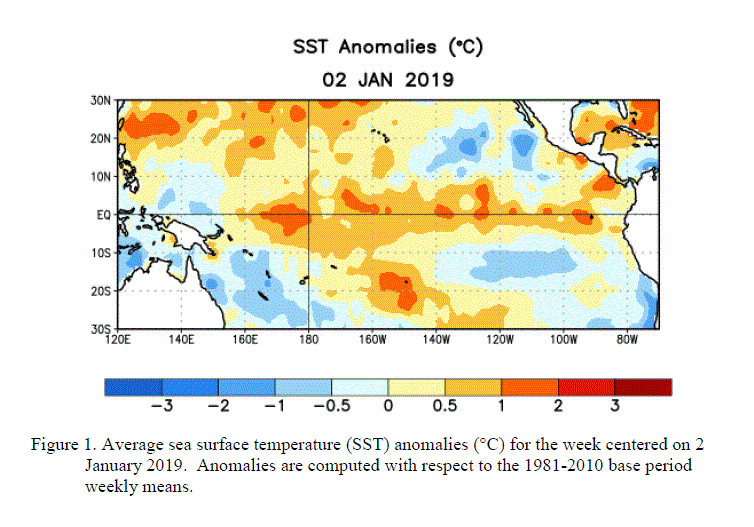
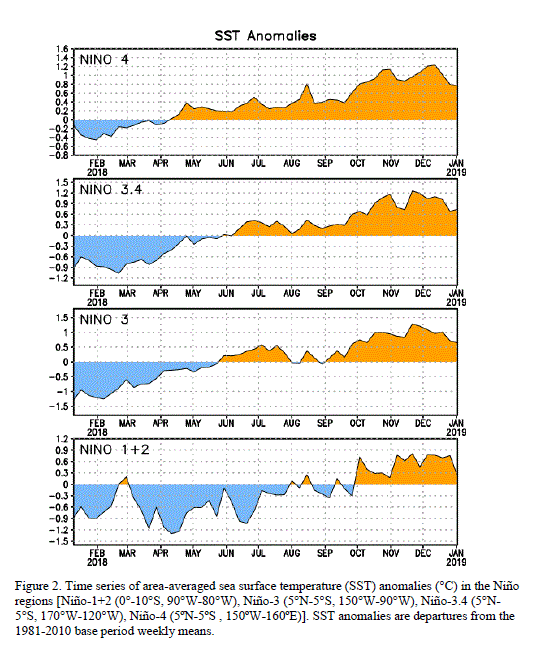
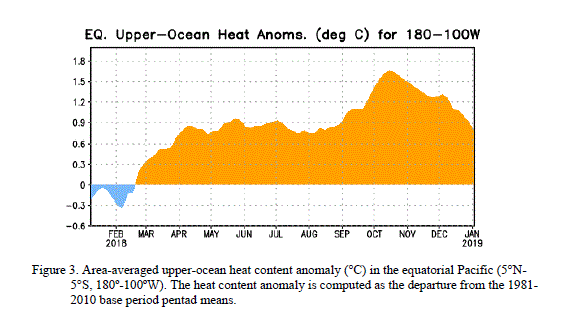
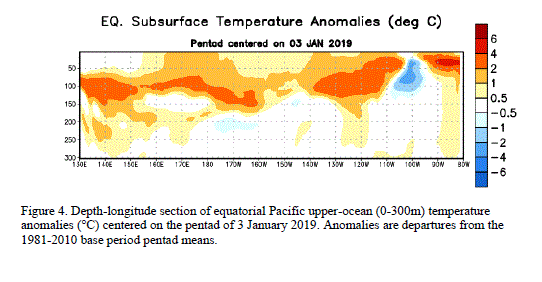
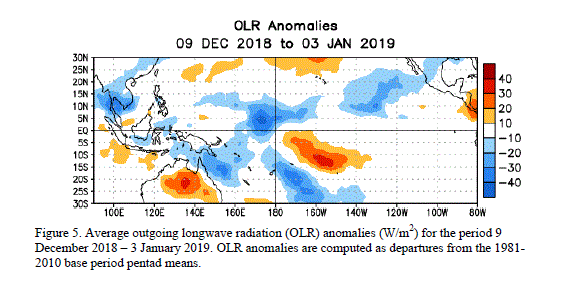
A significant El Niño persisted throughout the equatorial Pacific Ocean during January 2010 (Fig. 1). Although sea surface temperature (SST) departures in the Niño-3.4 region decreased to +1.2oC in late January, SSTs continued to be sufficiently warm to support deep tropical convection (Fig. 2 and Fig. 3). Over the last several months, a series of oceanic Kelvin waves contributed to the build-up of heat content anomalies in the central and eastern Pacific (Fig. 4). The latest Kelvin wave was associated with temperature departures exceeding +2oC down to 150m depth across the eastern half of the equatorial Pacific (Fig. 5). Equatorial convection over the central Pacific remained enhanced during the month, while convection over Indonesia exhibited considerable week-to-week variability. While the low-level winds have been variable, low-level westerly and upper-level easterly wind anomalies generally prevailed during January. Collectively, these oceanic and atmospheric anomalies reflect a strong and mature El Niño episode.

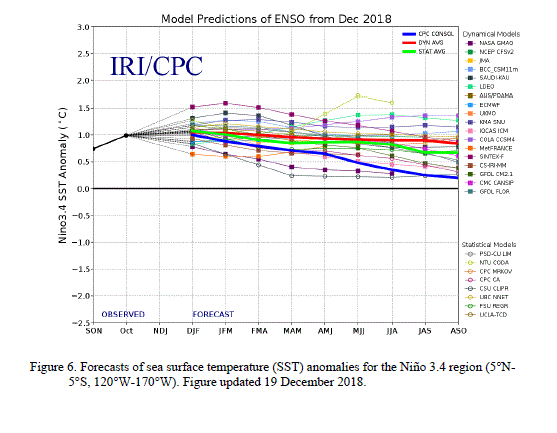
Nearly all models predict decreasing SST anomalies in the Niño-3.4 region through 2010, and model spread increases at longer lead times (Fig. 6). Nearly half of the models indicate the 3-month Niño-3.4 SST anomaly will drop below +0.5oC around April-May-June 2010, indicating a transition to ENSO-neutral conditions during Northern Hemisphere spring. However, predicting the timing of this transition is highly uncertain.

El Niño impacts are expected to last into the Northern Hemisphere spring, even as equatorial SST departures decrease, partly due to the typical warming that occurs between now and April/May (Fig. 3). Expected impacts during February-April 2010 include drier-than-average conditions over Indonesia and enhanced convection over the central equatorial Pacific Ocean, which will likely expand eastward and influence portions of the eastern tropical Pacific, as well as coastal sections of Peru and Ecuador. For the contiguous United States, potential El Niño impacts include above-average precipitation for the southern tier of the country, with below-average precipitation in the Pacific Northwest and Ohio Valley. Below-average snowfall and above-average temperatures are most likely across the northern tier of states (excluding New England), while below-average temperatures are favored for the south-central and southeastern states....

Tuesday, May 4, 2010

"Buffett: Berkshire Has Some Exposure to Large Natural Disasters" and "Buffett Says He Has 100,000 Shares of Berkshire Rival Munich Re" (BRK.A; BRK.B)

Continuing the insurance theme.
I am intrigued as all get out by Berkshire's decision to invest in competitors rather than write business with their surplus, as pointed out in the second story below and elsewhere.*
From MarketBeat:

When Warren Buffett talks about insurance, you’d be wise to listen. Insurance lies at the heart of Berkshire Hathaway’s money-generating machine.

In response to a question, Buffett addressed Berkshire Hathaway’s exposure to natural catastrophes, a highly relevant question in a year that has seen several large natural disasters.

Buffett said Berkshire will have some exposure to the February earthquake in Chile, in part through its investment in Swiss Re’s property and casualty business (Berkshire agreed to assume 20% of Swiss Re’s P&C biz for several years). The 8.8 magnitude earthquake as “one of the most powerful quakes in recorded history,” Swiss Re said in a press report.

Swiss Re estimated that insured losses, broadly, could reach $4 billion to $7 billion....

From Bloomberg:

Warren Buffett, the billionaire chairman of Berkshire Hathaway Inc., said he personally owns 100,000 shares of German reinsurer Munich Re, a Berkshire competitor.

Buffett, 79, discussed the investment today at a press conference in Omaha, Nebraska, a day after the annual meeting of Berkshire shareholders.

Berkshire had more than $4.5 billion invested as of February in Munich Re and Swiss Reinsurance Co., the only two firms it trails in the reinsurance market. Buffett chose to put Berkshire’s cash in two companies that account for more than a third of the global market instead of using the money to compete against them....

*From Feb. 26 and April 23:

Insurance: Catastrophe! Travelers Reports- '“Weather had a big impact on our results,”' (TRV)

When we posted "Berkshire Hathaway's "Buffett Picks Insurer Cooperation Over Competition " (BRK-B; BRK-A)" on Feb 26 I said:
This is worth keeping an eye on. After a hurricane season with no U.S Atlantic or Gulf landfalls catastrophe bonds scored big and the reinsurers pocketed a bunch of premiums. The state of Florida's decision to self-insure also worked out.

This year may not have as favorable an El Nino/Southern Oscillation, I'll post the latest NOAA advisory after the headline story....
The question of course was:
Why is Mr. Buffett buying equity in reinsurers rather than writing the business himself?
The quick and dirty answer is: He likes to get paid for the risk.

As the May 1 BRK annual meeting appraoches I'll be posting snippets of Mr. Buffet's thinking on the insurance/reinsurance business. For right now take my word for the fact that the insurers are not getting paid for the risk they are assuming. That's why I headlined our April 19 post "Hurricane Watch: Thinking of Shorting the Property/Casualty Insurance Companies (AIG; ALL; BRK.B; CB; HIG; TRV)"

I'll leave this introduction with a quote from Berkshire's 2002 annual report....

Tuesday, March 3, 2015

"Re/insurance. The engine of Berkshire Hathaway: Warren Buffett" (BRK) Plus a Special Bonus!

From Artemis:
Warren Buffett’s much-anticipated 50th anniversary letter to Berkshire Hathaway investors was published on Saturday and the ‘Sage of Omaha’ explained that insurance and reinsurance has been “the engine” that propelled the firm’s expansion.

Buffett’s was the first to truly discover the value of insurance premium float, by building huge pools of capital that he could put to work across his diversified investment focused business. As such he is the inspiration of many of the hedge fund strategy reinsurers, and the envy of many traditional insurers and reinsurers.

Berkshire Hathaway has such a strong capital base, as a result of the Warren Buffett strategy, that the largest insurers and reinsurers turn to Berkshire when they need a counterparty who can put down the largest lines in the industry and who they trust to be there to pay claims in another 50 years time.

So, it’s always insightful to take a look at some of the sage’s comments and in the 50th anniversary investor letter Warren Buffett gives away some of more of his thinking behind the way Berkshire has leveraged insurance and reinsurance premium float, as well as how important re/insurance has been to enable Berkshire Hathaway to become a huge and profitable business empire

Buffett’s letter includes a history lesson on Berkshire Hathaway’s entry into the insurance and reinsurance world, explaining; “That industry has been the engine that has propelled our expansion since 1967, when we acquired National Indemnity and its sister company, National Fire & Marine, for $8.6 million.”
Just think about that for a moment. The largest re/insurance business empire in the world began from an $8.6 million acquisition. That small acquisition, which was still a significant sum in 1967, has now morphed into a re/insurance business that in 2014 generated $2.7 billion of underwriting profit and over the last twelve years which have all been profitable, $24 billion.

Buffett said that “insurance was in my sweet spot”, an industry that he understood and saw as a way to generate both huge profits as well as huge premium float for investment purposes.

During the twelve successive profitable years of underwriting at Berkshire Hathaway the firm has generated a massive amount of premium float. “During that 12-year stretch, our float – money that doesn’t belong to us but that we can invest for Berkshire’s benefit – has grown from $41 billion to $84 billion,” Buffett explained.
The float is something Buffett always explains in his letters, because; “Though neither that gain nor the size of our float is reflected in Berkshire’s earnings, float generates significant investment income because of the assets it allows us to hold.”....MORE
Special Bonus: the earliest known video of Mr. Buffett, 1962, from the Nebraska State Historical Society archives:

Tuesday, December 23, 2014

Congress Fails to Reauthorize Terrorism Insurance Backstop, Market Thrives

You can probably glean our stance from the July 2014 post "It's Time to Stop Subsidizing Warren Buffett and the Rest of the Insurance Gang (BRK; TRV; ALL; CB)":
We're not intending to call out just Mr. Buffett's heavyweight property/casualty and reinsurance operations but rather the whole herd of porkers feeding at this particular trough.

It's just that since his comments at the 2002 annual meeting that the odds of a nuclear attack on Manhattan were "inevitable" by 2052, Buffett has carried water for the whole industry.
Page 9 of the BRK 2002 Annual Report has some more of his thoughts. It's all about the money.

Because the "temporary" 'Terrorism Risk Insurance Act' backstop is in place, the insurers and reinsurers are able to sell product that has brought in at least $40 Billion in profits in the last thirteen years.
(premiums paid with no claims pretty much drops straight to the profit line)

I understand the New York Congressional delegation, from Schumer down to the newest Rep. being all for the reauthorization, it's a pretty sweet deal if you can get the rest of the country to subsidize your real estate market but be forthright and say you're in favor of corporate welfare.

One last point. A nuke in NYC causes at least a $Trillion in damage and I'm guessing the insurers haven't squirreled-away that $40 Bil so they'll be able to meet their obligations when the time comes or as capacity to do more risk-management-good-works.

What I'm saying is, just be honest: the government will end up paying anyway so there's no reason to hand out $3 billion a year while we wait for the "inevitable". And at his core, Warren is an insurance salesman from Omaha....
And today's story from Artemis:

In TRIA’s absence no shortage of terrorism reinsurance capacity: S&P
The United States Congress is not going to extend the Terrorism Risk Insurance Act (TRIA), the financial backstop for U.S. property insurers against terrorist attacks, this year but with reinsurance capacity high this may result in a shortage of terrorism reinsurance cover.

Ratings agency Standard & Poor’s believes that the longer TRIA remains absent from the market, the greater the chance that traditional reinsurance capital, and to an increasing degree alternative capital, could be deployed into the space to make up for lost capacity.

With politicians seemingly unable to agree on the future of TRIA, which again seems partly to do with the U.S. legislatures habit of stuffing unrelated policies into laws facing Congress, there is considerable uncertainty right now as to whether any agreement to extend or replace TRIA could be reached in the near future.

TRIA never benefitted reinsurance firms anyway, S&P notes, and the protection it offered actually competed with traditional reinsurance that offered similar coverage. Without TRIA in place S&P believes that there could be an increase in demand for terrorism reinsurance cover and that the market could, in its currently over-capitalised state, meet this demand easily.

Aggregate private-market reinsurance capacity can be anywhere from $3 billion to $4 billion per risk, S&P notes, while capacity in high-risk areas where insurers could have aggregation issues is still only around $1 billion per risk, which the rating agency views as underinsured....MORE
I bolded that sentence because we sincerely disagree as to the benefit the insurers received. It allowed the property/casualty guys to sell "first dollar" insurance while telling the landlord that Uncle Sugar would make up any shortfall.

Wednesday, April 2, 2014

Chasing Yield: "Reinsurance renewal prices fall by as much as 20% across sector"

There is a lot of excess capacity in the re business and then there's more competition coming from hedge funds and cat bonds.
Buffett has pulled General Re back to avoid guaranteed-loss underwriting.
From Artemis:
The just-completed April reinsurance renewals saw a continuation of recent trends, with pricing down as much as 20% across most lines of reinsurance business, as the effects of record traditional and alternative reinsurance capital continue to be felt.

Further price declines had been expected to manifest at the April 1st reinsurance renewals, with the pressure from capital markets and non-traditional investors continuing (as forecast by Artemis) and the traditional reinsurance market continuing to be well-capitalised. However, the latest renewals report from reinsurance broker Willis Re states that price declines have been seen across the board, showing that the impact of this abundent reinsurance capital is spreading.

Willis Re said that reinsurance rates have softened across all lines of business, with rate reductions of as much as 20% seen on some lines of business and in some regions. This confirms the fears of many traditional reinsurers, that the market continues to soften and we are likely to see further year-on-year declines on the U.S. reinsurance renewals in July.

The trends observed at the January renewals have continued and show clear signs of accelerating, said the reinsurance broker. One of the key factors keeping up the pressure on rates is the ‘seemingly unabated supply’ of capital from third-party investors, said Willis Re.

The addition of continued inflows of third-party capital on top of the well-capitalised traditional reinsurance capital, combined with muted new demand for reinsurance capacity, is creating a perfect storm of too much capital and capacity chasing a pool with too little supply. Hence the continuing acceleration of reinsurance rate declines.

John Cavanagh, CEO of Willis Re, commented on market conditions; “The 1 April renewals have seen a softening of rates across nearly all classes and geographies which, in turn, has allowed buyers to achieve substantial savings in the cost of their reinsurance protections. Some buyers took the opportunity to buy more cover and some renewals saw an expansion in terms and conditions.”...MORE

Thursday, March 8, 2018

Re/Insurance: "Berkshire Hathaway can easily weather a $400bn mega catastrophe: Buffett"

Warren has sorta made GenRe the reinsurer of last resort.
At a price.
From Artemis, Feb. 27:
Berkshire Hathaway’s insurance and reinsurance businesses are the most prepared to handle a $400 billion mega catastrophe loss event, while the rest of the property & casualty industry may be out of business following such an extreme loss, according to Warren Buffett.

After the $100 billion or so of 2017 catastrophe losses, Warren Buffett’s insurance and reinsurance driven conglomerate Berkshire Hathaway reported catastrophe losses of $3 billion from the major hurricanes, while that alongside other losses and reserving sent his property and casualty business to a $3.2 billion loss, before tax.

As ever, Buffett delivered his thoughts in his awaited annual letter to shareholders, discussing issues ranging from the founding of his firm, to equities, his infamous investment bets and also the catastrophe loss activity of 2017.

Explaining that he has always warned his shareholders that catastrophes would eventually strike his re/insurance businesses, Buffett said, “I have warned you, however, that we have been fortunate in recent years and that the catastrophe-light period the industry was experiencing was not a new norm. Last September drove home that point, as three significant hurricanes hit Texas, Florida and Puerto Rico.

“My guess at this time is that the insured losses arising from the hurricanes are $100 billion or so. That figure, however, could be far off the mark. The pattern with most mega-catastrophes has been that initial loss estimates ran low.

“Ignorance, wishful thinking or, occasionally, downright fraud can deliver inaccurate figures about an insurer’s financial condition for a very long time.”

While the major catastrophes of 2017 were seen as sufficient to boost pricing a little at the renewals, Buffett notes that for his conglomerate even a mega catastrophe costing the insurance and reinsurance industry $400 billion would be manageable for his firm.

Berkshire Hathaway estimates its losses from the hurricanes at $3 billion, $2 billion after tax, as a result it estimates its share of the industry losses at roughly 3%, based on a $100 billion industry insured loss.

“I believe that percentage is also what we may reasonably expect to be our share of losses in future American mega-cats,” Buffett said....MUCH MORE
A couple of our BRK posts that may be of interest:

Insurance: "CEO FORUM: Gen Re's Tad Montross on model dependency" (BRK.A)
"Re/insurance. The engine of Berkshire Hathaway: Warren Buffett" (BRK) Plus a Special Bonus!

Sunday, January 23, 2011

"Mr. Moneybags" (Will Berkshire Hathaway Pay a Dividend?) BRK.B

If you look at Mr. Buffett's history of capital allocation and especially that history in BRK's insurance and reinsurance operations, it is apparent that divi's are always on the table as a use of cash..
And if it isn't apparent, here's Warren:


...We feel noble intentions should be checked periodically against results. We test the wisdom of retaining earnings by assessing whether retention, over time, delivers shareholders at least $1 of market value for each $1 retained. To date, this test has been met. We will continue to apply it on a five-year rolling basis. As our net worth grows, it is more difficult to use retained earnings wisely.
We continue to pass the test, but the challenges of doing so have grown more difficult. If we reach the point that we can't create extra value by retaining earnings, we will pay them out and let our shareholders deploy the funds....
That's point #9 of the Owner-Related Business Principles section of the Berkshire Hathaway Owners Manual from the 1999 Chairman's Letter.

See also our May 2010 post "As close to a Transcript of the 2010 Berkshire Hathaway Shareholders Meeting as you're likely to find (BRK.A; BRK.B)" which among other links goes to MarketBeat's liveblog:

3:10 pm

But this question was a two parter, and the second half is interesting: what question are they surprised that they haven't been asked. Buffett has a great response. He says he would ask if the company will be able to effectively reinvest all the cash it generates back into the company.

3:10 pm
Then Buffett answers his own question: "There will come a time when we can not intelligently use 100% of the capital we generate internally," he said. "There is a limit...There comes a point where the numbers get too big."
3:13 pm

That's the clearest I've ever heard him say that eventually, at some point in the future, Berkshire will perhaps pay a dividend.
From Barron's

With cash pouring in, Warren Buffett's Berkshire Hathaway may do something big this year -- maybe even pay a dividend.
A flush Berkshire Hathaway is in its best shape ever and piling up cash so quickly that it could be sitting on close to $50 billion at its core insurance operation alone by year end, and might even begin paying a dividend. Berkshire's profit recovery, aided by some smart acquisitions and investments by CEO Warren Buffett -- notably its purchase of the Burlington Northern railroad -- has gone largely unrecognized on Wall Street, where Berkshire's Class A shares (ticker: BRKA), now trading around $121,000, haven't budged in nearly a year. Berkshire's Class B shares (BRKB) trade around $81; each equals 1/1500th of a Class A share.

Berkshire's operating profits are on track to hit a record $12 billion to $13 billion after taxes in 2011, up from an estimated $11 billion in 2010, buoyed by Burlington and many of the company's manufacturing and industrial units, whose earnings fell sharply during the downturn.

Combine that with the likely repayment of some lucrative investments in Goldman Sachs (GS), General Electric (GE) and other companies that Buffett made during the financial crisis, and Berkshire's insurance units could be holding $20 billion more by year end than the $30 billion they had on Sept. 30, 2010. (We focus on cash at Berkshire's insurance operations and not in other divisions because insurance cash is readily available for investment. Other units held about $3 billion in cash.) Berkshire's market value is $200 billion, fifth-largest in the U.S. stock market, behind only ExxonMobil (XOM), Apple (AAPL), Microsoft (MSFT) and Google (GOOG).

The flood of cash could prompt Berkshire to finally start paying a cash dividend in the next 12 to 18 months, particularly if the 80-year-old Buffett is unable to find what he calls an "elephant," or a large acquisition. Locating one could prove difficult, given rising asset and equity values, as well as Buffett's refusal to participate in corporate auctions. Buffett, who declined to comment to Barron's, also hasn't been thrilled by the stock or bond market in the past year, when Berkshire has been a net seller of stocks.

Buffett's fans think Berkshire shares look appealing, trading for a reasonable 1.3 times estimated year-end 2010 book value of $95,000 apiece, and that the stock could surpass its 2007 record of $149,000 within the next 12 months. Book value, or shareholder equity per share, may hit $105,000 by the end of this year, assuming a decent performance by Berkshire's famed equity portfolio, which was an estimated total of $62 billion at year-end 2010. Thus, the shares trade for just 1.15 times projected year-end 2011 book, providing significant downside support.

LONGTIME BERKSHIRE INVESTOR Whitney Tilson of T2 Partners pegs Berkshire's "intrinsic value" around $160,000 a share and sees it surpassing $170,000 by year end. To reach that lofty level, the stock would have to shake off investor concerns about Buffett's longevity and about Berkshire's sheer size. Intrinsic value is the discounted cash flow of Berkshire businesses....MORE

Friday, February 29, 2008

Who Cares What Warren Buffett Thinks About Global Warming? (BRK.A)

Update below.
In addition to owning See's Candies, Berkshire Hathaway owns MidAmerican Energy Holdings:
...Berkshire has an 87.4% (diluted) interest in MidAmerican Energy Holdings, which owns a wide variety of utility operations. The largest of these are (1) Yorkshire Electricity and Northern Electric, whose 3.8 million electric customers make it the third largest distributor of electricity in the U.K.; (2) MidAmerican Energy, which serves 720,000 electric customers, primarily in Iowa; (3) Pacific Power and Rocky Mountain Power, serving about 1.7 million electric customers in six western states; and (4) Kern River and Northern Natural pipelines, which carry about 8% of the natural gas consumed in the U.S.
They've also got an insurance operation.

World's largest reinsurers

Ranked by 2006 net premiums written

">
Rank Company 2006 net premiums written
1 Munich Re Group $24,218,951,400
2 Swiss Re Group $23,202,134,100
3 Berkshire Hathaway/Gen Re Group3 $11,577,000,000
4 Hannover Re Group $8,907,121,773
5 Lloyd's of London $7,950,584,200

From Business Insurance.
From BI last month:

Big two reinsurers plot different courses

Published 02/11/2008 in Business Insurance Europe
The news that Omaha, Nebraska-based financial giant Berkshire Hathaway Inc. acquired a 3% stake in Zurich, Switzerland-based Swiss Reinsurance Co. and agreed a 20% quota share deal over five years with the reinsurance giant was greeted with enthusiasm by investors and analysts, and arguably augers......

Mr. Buffett is known in the popular media for his personal net worth. Just as mind-boggling is his company's position in both energy and insurance, at first glance on opposite sides of the green fence but actually a self contained hedge.
MidAmerican produces power with coal, natural gas and wind. The natural gas pipes* are National Critical Infrastructure.

The highest possible ratings the agencies give to the reinsurance operations (and Warren's disinclination toward silly pricing) allow them to pick and choose when they will make available their monstrous capacity. At a price. Remember why Allstate was going to raise Florida premiums 42% last month? Global Warming.

What Warren hath wrought: Heads I win, tails I win, if it lands on its edge I win, if gravity is momentarily suspended I win. Genius.

*Plus, he brought Northern Natural gas back to Omaha.

Here's the '07 annual report.
Here's the rest of Mr. Buffett's Letters to Shareholders.
Here's a bunch of our posts on Mr. Buffet.
(and a few on Charlie)

Uodate: I got an email asking "Well, what did Mr. Buffett say about global warming?"
Answer: nothing, in the 2007 annual report.
I screwed up when I put up the link to our prior Buffet posts. I should have pointed out two in particular. His comments in the 2006 letter:
SEC Pressed on Climate-Change Disclosures and When will Warren Buffett get on Board the Love Train?*

and comments at last years annual meeting:
Warren Buffet on Global Warming

Monday, May 19, 2014

Insuring the Apocalypse: Warren Buffett on Global Warming (BRK.B)

In addition to See's Candies where cocoa would be a global warming canary in the coal mine, Mr. Buffett's Berkshire Hathaway owns a major property/casualty insurer, GEICO and the reinsurer of last resort, GenRe.

The utility operation owns the largest fleet of windmills in the U.S. while his railroad, Burlington Northern, is the largest hauler of coal in the country and the largest transporter of oil out of the Bakken field. There are a couple other tie-ins to climate that we've looked at over the years, some links below.

From The New Yorker:

465860239-580.jpg
Last week, the White House released the National Climate Assessment, and the news is grim. Coral reefs are dying, shellfish will increasingly make us sick, and cherries are being decimated by weather extremes. Along the Eastern Seaboard, waters will rise up to four feet—perhaps six feet—by the end of the century, making Sandy-like storm surges a frequent event. California will continue to burn. Arizona will continue to burn. For most businesspeople, climate change seems bad for the bottom line.

But if you, like Berkshire Hathaway C.E.O. Warren Buffett, work in the disaster business, reports like the National Climate Assessment, all eight hundred and twenty-nine pages of it, are free advertising. In a recent television appearance, Buffett suggested that global warming—at least the idea of it—has been good for the insurance industry. “I love apocalyptic predictions on it because, you’re right, it probably does affect rates,” he told an interviewer. “The truth is that writing U.S. hurricane insurance has been very profitable in the last five or six years.”

Buffett’s insurance companies have yet to adjust how they calculate their exposure to hurricane risk, he explained, though “that may change in ten years.” They haven’t been hoarding more cash to prepare for bigger storms; they haven’t been cancelling policies. His point was not that climate science is a sham but that what it has mostly done—for now, for him—is to prop up revenues and bring in new customers.
By 2012, insurers had introduced eleven hundred and forty-eight climate-change products and services in fifty-one countries, according to a review by the Lawrence Berkeley National Laboratory. If you’re an executive today, for instance, especially if your business emits carbon, you may be interested in a policy from Liberty Mutual that protects against what the company calls “the continuously growing wave of litigation stemming from the alleged improper release of carbon dioxide and other greenhouse gases.” If you’re poor and African, you may be interested in reinsurer Swiss Re’s early efforts to insure you and four hundred thousand of your compatriots against drought. A 2007 program promised an eighteen-million-dollar climate-adaptation payout to subsistence farmers if the right “weather trigger” was hit, with premiums paid by international donors.

In 2008, while investigating how the insurance industry was faring in a warming world, I rode into a series of suburban wildfires near Los Angeles with a fire chief who worked part-time for A.I.G., the giant insurer that was then on the verge of being bailed out by the federal government. The company operated a squad of private firefighters, and, as helicopters clattered overhead, members of the A.I.G. team mostly drove around in haphazard circles, checking on client homes and sometimes spraying them with a fire retardant. They snuck across police lines. They made sure that A.I.G. clients had been evacuated. They made sure that brush wasn’t too close to any A.I.G.-protected structures. They stopped to get tacos, sip sodas, and watch news about the fire on a taqueria’s television set. They exchanged uneasy glances with public firefighters. They parked their trucks on a residential street for the better part of an hour and watched the public guys battle the blaze. The privateers didn’t do much good that day—not even for their own clients—but they made good money.

A boutique firefighting service is just one way that the insurance company attracts “high net worth individuals” to its private-client group. Another way, available in parts of Florida, New Jersey, New York, Massachusetts, and South Carolina, is its hurricane-protection Unit: a jump team of contractors that arrives at your house armed with tarps and hammers, racing to beat looters and rain. If there are any holes, it patches them. If your expensive paintings or sculptures are threatened, it evacuates them.

The National Climate Assessment is, in fact, just what Buffett suggests: an argument for more insurance. As we face the future, insurance can help us grapple with the true cost of the present—something that we’ve largely proved incapable of doing by ourselves....MORE
Of the reinsurers Munich Re is the first to blame climate change for their weather related claims with industry #2 Swiss Re often following suit. The smaller Hannover Re doesn't do this. Zurich Re, along with the rest of the industry, is less vocal. Buffet's Re operations rank #3 in the world and is much better managed than Munich and Zurich so he often ends up taking risk off their hands or even lending them money.

Insuring weather over the last decade has been extremely profitable as premiums charged have been high-although declining as hedge funds and other non-traditional funders "want to get me some of that action"-and payouts on claims have been very agreeable.

Previously:
July 2007
Warren Buffet on Global Warming
...From the 2006 Letter to Shareholders (page 3):

All that said, a confession about our 2006 gain is in order. Our most important business,
insurance, benefited from a large dose of luck: Mother Nature, bless her heart, went on vacation. After hammering us with hurricanes in 2004 and 2005 – storms that caused us to lose a bundle on super-cat insurance – she just vanished. Last year, the red ink from this activity turned black – very black. In addition, the great majority of our 73 businesses did outstandingly well in 2006....
February 2008
Who Cares What Warren Buffett Thinks About Global Warming? (BRK.A)

From 2009's "'Why Warren Buffett Is Wrong About Cap and Trade: Eric Pooley' (BRK.A)":
See also:

Warren Buffett on Cap-and-Trade (BRK.A)

January 2010
That's the Last Time I Look to 'Rolling Stone' for Climate; Investing Advice: "The Climate Killers: #1 Warren Buffett" (BRK.A; BRK.B)
What a bunch of moron poseurs. 
And many more. If Interested try http://climateerinvest.blogspot.com/search?q=buffett+global+warming or 'climate change' and reinsurance, Buffett or, hell what am I saying you're smart, you know what you want.

Tuesday, August 9, 2016

The Insurance Industry Has Been Turned Upside Down by Catastrophe Bonds

From the Wall Street Journal, August 7:

Investors are flocking to securities that shield the risks of hurricanes, pandemics and hackers; reinsurers are suffering

Piles of rubble in a trailer park after Hurricane Andrew in 1992. Andrew left roughly $25 billion in damage in today’s dollars and led to creation of the catastrophe-bond business.
Piles of rubble in a trailer park after Hurricane Andrew in 1992. Andrew left roughly $25 billion in damage in today’s dollars and led to creation of the catastrophe-bond business. Photo: Steven D Starr/Corbis/Getty Images

Catastrophe bonds were invented in the early 1990s to help insurance companies mitigate the risk of disasters such as hurricanes and earthquakes. Today, like the very storms they protect against, catastrophe bonds are upending the insurance business.

The oddball securities have exploded in popularity, driven by pension plans, sovereign-wealth funds and wealthy families seeking better returns. Investment banks and insurers’ own securities-brokerage operations churn out billions of dollars a year in catastrophe bonds.

There are “cat bonds” that pay off if too many people die in a pandemic. Others cover the opposite problem of people living beyond their expected lifetimes. An American International Group Inc. unit sold cat bonds this spring to insure itself against a potential rash of foreclosures. A Credit Suisse Group AG bond sale in May insured the Swiss bank against the risk of rogue traders, cyber hacking and accounting fraud.

Traditionally, insurers raise capital and use it to back policies that are priced by the companies’ actuaries. To unload some of their risk, insurers pay premiums to companies known as reinsurers, a low-profile corner of the industry that serves as insurance for insurers.

Catastrophe bonds have disrupted this way of doing business. The bonds are sold by insurers or the entity itself seeking insurance, like a local government or transit agency. An independent risk-modeling firm calculates the odds of a particular disaster occurring. Investors are paid relatively high interest rates but lose their principal if disaster hits.

As a result, the price of reinsurance is falling, as are profits. These bonds have also injected a new source of volatility into the otherwise staid insurance world, since money flows are driven by broader forces in the bond market.

In all, there are $72 billion of cat bonds and similar investments outstanding. The total is equivalent to 12% of the $565 billion in capital in the reinsurance business. The volume of cat bonds and related investments is widely expected to double in the next several years, a sign that the transfer of risk from the insurance industry to capital markets has opened up access to a seemingly limitless source of funding.

That means the fixed-income market “is acting like one giant insurance company,” says John Seo, a biophysics Ph.D. and former insurance-risk trader who co-founded Fermat Capital Management LLC in 2001 to invest in cat bonds and other securities.

The surge is partly an unintended consequence of economic-stimulus efforts by central banks. Low interest rates are pushing investors such as pension funds to seek out higher returns.

Ordinary bonds pay buyers interest to cover the risk of default by the issuer. With cat bonds, the payments compensate buyers for taking on the risk of extreme events, typically for several years.
United Services Automobile Association sponsored $250 million of cat bonds in May to help cover potential losses from U.S. storms, wildfires, meteorite strikes and a solar flare. Companies usually sell the bonds through a specially formed entity.

If any of those disasters occurs in a four-year period and causes losses at USAA of between $910 million and $1.2 billion, buyers of the deal’s riskiest slice will lose some or all of their money, according to a person familiar with the deal. An independent risk-modeling firm calculates the probability of a $1.2 billion loss at 7.6%.

In return, those investors will earn 11.5% a year, plus interest on their principal held in escrow, which is invested in Treasurys. Investors buying the least risky slice, which kicks in only if claims exceed $1.9 billion, will collect annual interest of 3.25%.

Premiums for reinsurance covering catastrophic property damage, reinsurers’ largest business line, is down by half since 2011, according to Bryon Ehrhart, a senior executive at insurance broker Aon PLC, in part because of this new flood of money. A multiyear streak of no severe U.S. hurricanes is compounding the pressure.

Citizens Property Insurance Corp., run by the state of Florida, used a mix of cat bonds and conventional reinsurance to buy $3.9 billion in coverage last year, up 20% from 2014. Citizens also paid less: about $282 million in 2015, compared with $304 million a year earlier.

Such savings are a boon for Florida residents such as Greg Truax of Tampa. When he opened this year’s policy-renewal package from Homeowners Choice Property & Casualty Insurance Co., he saw that his premium had fallen 5.7% from a year earlier, saving him $233.

Dulce Suarez-Resnick, an agent at NCF Insurance Associates in Miami, says lower rates have been a “lifesaver” for clients rebuilding their finances following the financial crisis and recession.
Sawgrass Mutual Insurance Co. has cut the annual premium on Ms. Suarez-Resnick’s own house by $484, or 15%, since 2013. “Thank God the rates started to go down to make it more affordable,” she says.

Warren Buffett, whose Berkshire Hathaway Inc. owns some of the biggest reinsurers, had a different reaction. Mr. Buffett used to brag about the scale and profitability of the business.
At last year’s Berkshire annual meeting, Mr. Buffett complained to shareholders that reinsurance has become “a fashionable asset class.” Faced with lower prices and poor returns, Berkshire is doing fewer deals.

Mr. Ehrhart, the Aon executive, says he used to call the profit squeeze “the battle of six and 16.” Reinsurers historically aimed for returns of 16% a year. The pension funds snapping up cat bonds are happy with just 6%.

By last year, though, the overall return of reinsurers tracked by Fitch Ratings had fallen to 9.9%.
Over the past decade, yields on cat bonds have outpaced junk-rated bonds by half a percentage point and high-quality securities by more than three points.

Catastrophe bonds were born after Hurricane Andrew cut across southern Florida in 1992 and left roughly $25 billion in damage in today’s dollars. At the time, Andrew was the costliest hurricane ever.

German insurance executive Eberhard Müller had a brainstorm while riding the London subway in 1993. He wondered if some of the financial risk from hurricanes and earthquakes could be shifted to bond investors.

Mr. Müller and a colleague at Hannover Re, Dirk Lohmann, were working on ways to build up the reinsurer’s capital base so that the German company could take advantage of rising rates. Some of their bosses worried about opening up the lucrative business to Wall Street and asked: “Are we opening Pandora’s box?”...
...MORE